Feeds:
Posts
Comments

Posts Tagged ‘exhibit’

Photo: John Lindquist/Harvard Theatre Collection.
Dancer and choreographer Alvin Ailey.

I have a special memory of dance icon Alvin Ailey, who early in his career came to Spring Valley (NY) High School to perform and offer a class. I jumped at the chance. I remember he gave me a moment of personal attention when I was trying to learn a step.

New York City’s Whitney Museum of American Art also has memories. 

Rebecca Schiffman writes at Hyperallergic, “Alvin Ailey’s performing arts transcend the traditional boundaries of dance. The seminal dancer and choreographer created a living history of movement imbued with cultural memory and personal expression. Through his choreography and his company’s performances, he seamlessly interwove narratives of Black, American, and queer identity, exploring themes of struggle and liberation in performances that were both physically dynamic and deeply rooted in the human condition. His expansive vision of what modern dance could be — flexible, inclusive, and multidisciplinary — makes his work an ideal centerpiece for the Whitney’s first-ever exhibition dedicated to a performing artist.

Edges of Ailey at the Whitney Museum of American Art blends performance footage, recorded interviews, and notes from the late choreographer’s personal archive with paintings, sculptures, music, and installations by more than 80 artists. As Ailey himself reflected in a 1984 interview, ‘There was movement, there was color, there was painting, there was sculpture, and there was the putting it all together.’ This holistic approach allows the two sides of the exhibition — Ailey’s life and work alongside art that relates to or is inspired by him — to coexist harmoniously, each enriching the other to compose a more complete story of American culture.

“Among the exhibition’s direct references to dance are Barkley Hendricks’s painting ‘Dancer’ (1977), depicting a Black woman in a white leotard set against a white ground; Senga Nengudi’s sculpture ‘R.S.V.P.’ (1975), evoking a body or body parts through stretched nylon pantyhose and sand; and two paintings of dancers in rehearsal by Lynette Yiadom-Boakye, one of which was created specifically for this exhibition.

“These works are complemented by an 18-screen video projection of various Ailey performances, played on a loop throughout the space and accompanied by scores from Josh Begley and Kya Lou. Another section hosts videos of musicians, dancers, and choreographers who influenced Ailey, including Katherine Dunham, Maya Deren, Carmen de Lavallade, and Duke Ellington. 

“But the real lure of the exhibition lies in the opportunity to connect with the storied Alvin Ailey on a personal level through his notebooks, journal entries, letters, and other ephemera meticulously organized alongside corresponding artworks. Ailey was a scrupulous note taker, chronicling his life in painstaking detail. On Monday, September 20, 1982, he works through his daily minutiae: ‘Woke up at 10:30, call from Atlanta, watched soaps and drank tea, called Ernie at 12:13, Sylvia called at 2:00 to talk about …’ But in other entries, such as one from 1980 that states ‘nervous breakdown, 7 wks in hosp,’ Ailey’s brevity highlights the overwhelming weight of the experience of a mental breakdown, a reality that might be too heavy or painful to unpack in words. Aptly placed next to this entry is Rashid Johnson’s ‘Anxious Men’ (2016), a drawn alter-ego of the artist’s own anxieties.

“Born in 1931 into a lineage of sharecroppers in rural Texas at the height of the Great Depression, Ailey was raised by his mother after his father abandoned them. Constantly searching for work, she moved them from town to town; at one point, when Ailey was just five, he helped her pick cotton. This upbringing, steeped in the struggles of Southern Black life and the spiritual grounding of the church, profoundly shaped his most iconic work, Revelations.

“Drawing from the gospel, blues, and spirituality that surrounded him as a child, he transformed these memories into a montage of pain, hope, and redemption. Works like John Bigger’s portrait of a weary yet resilient Black man, ‘Sharecropper’ (1945), characterized by its dark and somber tones, or ‘Haze’ (2023), Kevin Beasley’s landscape painting of a few trees against a yellow sky in the South, depict histories that visually resonate with Ailey’s creations.”

More at Hyperallergic, here. No firewall. The exhibition, running through February 9, is accompanied by a series of dance performances. Check the Whitney website for dates and times.

Read Full Post »

Art: Xiomara Morgan and Kathy Urbina, “Found in New York City” (2023), styrofoam life preserver, found Metrocards, plastic water bottles, candy wrappers, snack bags, labels, and bottle tops with a crocheted ribbon of plastic, rope, and caution tape.

Artists can turn anything into art. And I have learned that among New York City Parks employees, there are a few who are artists like that and a few who just have fun playing at art.

Maya Pontone wrote about a New York City Parks’ exhibition called “Wreath Interpretations” in 2023.

“More than 30 original holiday wreaths handcrafted from unexpected materials, including discarded Metro cards, thumbtacks, artificial hot dogs, pharmaceutical vials, and candy wrappers,” she reported were “on display in Central Park for the 41st iteration of New York City Parks’‘Wreath Interpretations‘ exhibition [bringing] together an eclectic assortment of alternative wreaths created by Parks employees, commissioned artists, and New York City residents for a whimsical display.

“Wreaths have historically played a number of roles. In Roman and Greek antiquity, they were emblems of power and victory, frequently awarded to the winners of sporting competitions and appearing in depictions of various deities, such as Apollo in Antonio Canova’s marble sculpture ‘Apollo Crowning Himself‘ (1781–1782). In Christianity, evergreen wreaths symbolize eternal life and everlasting faith; during Advent season, laurel rings are decorated with four candles that are subsequently lit each week leading up to Christmas.

“But the artists in ‘Wreaths Interpretations,’ go beyond these classic meanings to transform a holiday staple into new works of art, from an aluminum and gold leaf display commemorating Caribbean cooking to a diorama wasp nest containing a hidden memorial honoring Ukraine. On one wall, an unsettling wreath crafted out of plastic eyeballs tackles sleep deprivation, while another piece made of yellow Post-It notes playfully comments on work-life imbalance.

“In another corner, a pizza box with wiry rat tails emerging from the center — an unmistakable homage to the viral ‘Pizza Rat‘ — is situated between a spiral of playing cards and a ring of glistening frankfurters, humorously titled ‘The Wurst Wreath Ever Made: You Never Sausage a Terrible Wreath’ (2023). As Elizabeth Masella, Public Art Coordinator for the NYC Department of Parks & Recreation, told Hyperallergic, ‘the weirder, the better.’ …

“Many of the artworks are constructed out of found objects and recycled materials, such as Xiomara Morgan and Kathy Urbina’s joint project ‘Found in New York City’ [above]. … Marie Ucci’s ‘The Shape of Dreams’ (2023) is an assemblage of ceramic shards, dried fruits and vegetables, scraps of felted wool, and feathers, carefully pieced together like a bird’s nest, while Suzie Sims-Fletcher’s ‘All is Calm, All is Bright (Home for the Holidays)’ (2023) comprises cleaning puffs, scouring pads, plastic mesh, and rubber gloves. …

“Several of the displays also focus on environmental issues plaguing the city’s parks. A work by Maria Magdalena Amurrio employs repurposed water bottles for a wreath of butterflies, an insect increasingly threatened by climate change and human development, while Jean-Patrick Guilbert’s ‘Coral Wreath’ (2023) calls attention to the destruction of our oceans’ coral reefs. Another wreath made of saltmarsh cordgrass, hay, lavender branches, and other natural materials native to Staten Island’s William T. Davis Wildlife Refuge tackles the issue of marsh degradation. The work was created over two days by a team of eight ecologists, wildlife biologists, and botanists from NYC Parks Environment and Planning.

“ ‘The wreath is meant to symbolize how New York City salt marshes are at risk of drowning from sea level rise under climate change,’ Desiree Yanes, an NYC Parks wetlands restoration specialist, told Hyperallergic, pointing out the materials’ symbolic placement around the circle.

“ ‘We’re very much a science driven team, but it was a really refreshing mindset shift just to undertake an artistic endeavor together,’ Yanes added.”

More at Hyperallergic, here. No paywall. Does it make you want to try your hand at a wreath this year? You still have time.

Read Full Post »

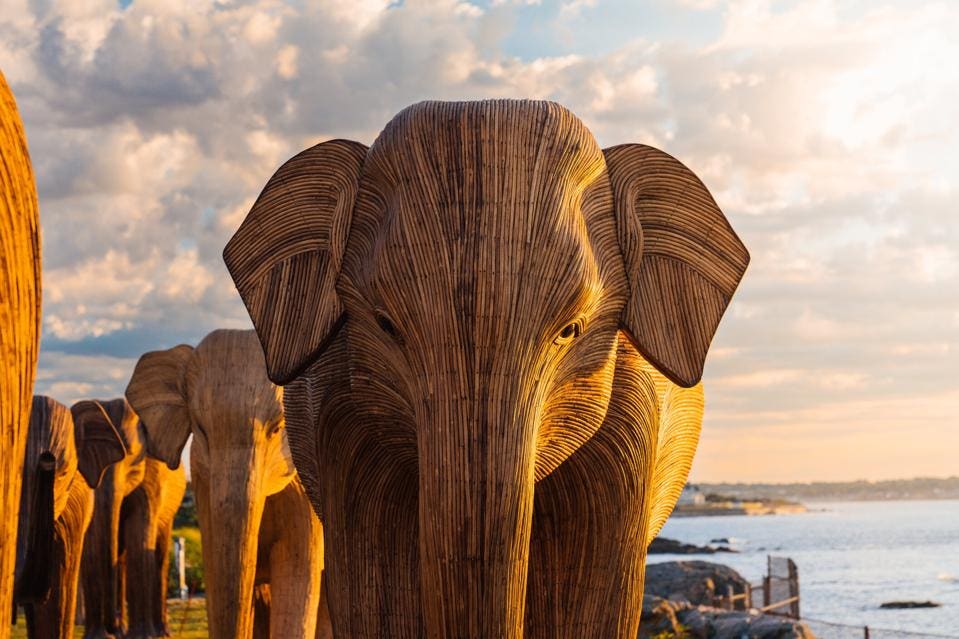
Photo: Corey Favino/Elephant Family USA/Newport Restoration Foundation.
The Great Elephant Migration installation outside Rough Point mansion in Newport, Rhode Island.
The elephants are made by indigenous people from an invasive plant.

Here’s a new way to reach audiences with a message about the importance of conservation: a giant “elephant” exhibit in a beautiful seaside setting that tourists visit anyway.

At Forbes magazine, Chadd Scott begins the story by talking about India.

“India has experienced a remarkable population explosion over the past 40 years. Several actually. One is well known. India’s human population has more than doubled since 1980. … Lesser known, and even more extraordinary in light of the country’s surging human population, has been a doubling of its elephant population over that same period, from a bottom-out of around 15,000 individuals to nearly 30,000 today. Populations of Asiatic lionstigers, and the greater one-horned rhinoceros are also increasing across the country.

“India offers a remarkable example for how humans and wildlife, even the largest of wildlife, can coexist in an ever-developing world. Sharing that message with the world is the mission of the Great Elephant Migration which debuted 100 life-sized Asian elephants in Newport, RI on July 1.

“The elephants — each based on a real, wild elephant from the Nilgiri Hills known by name and personality living alongside people in their coffee and tea plantations — were made by members of the Coexistence Collective, a group of 200 Indigenous artisans from the Nilgiri Biosphere Reserve

“The herd was produced from the Lantana camara, a toxic, invasive plant overtaking the Indian forest, pushing elephants and other wildlife out and into closer proximity to humans, with greater potential for conflict. …

“ ‘It’s a conservation miracle; it’s contrary to what’s happening everywhere else in the world and it’s definitely owed to an incredibly beautiful perspective on nature and our place within nature,’ Ruth Ganesh, trustee, Elephant Family USA, co-organizer of the Newport presentation along with Art&Newport, and co-founder of the Coexistence Collective, said at The Great Elephant Migration’s opening at Rough Point. ‘That’s what we hope the herd will spread, this beautiful perspective of coexistence and seeing other species as our biological kin.’

“The elephants, and the Indians, prove conservation is as much a mindset as a management plan.

“ ‘That culture of being able to live with animals is the most important thing, more than any of the natural variables about habitat and prey, and all of that,’ Asian elephant expert and co-founder of the Real Elephant Collective in India, Tarsh Thekaekara, told Forbes.com. The Great Elephant Migration exhibition and tour is the brainchild of he and Ganesh. His research in India has focused on human-elephant coexistence. ‘Animals will survive in human dominated landscapes if people tolerate them. That is the bottom line.’ …

” ‘The people who made the elephants [practice] kind of a fusion of Hinduism and animism,’ Ganesh told Forbes.com. Animism attributes a soul and living spirit to animals, rivers, mountains, plants, and other objects often considered inanimate. ‘There’s a spiritual tapestry that underpins the answer to the question why is India succeeding in this way despite so many challenges? It’s the spirituality. It’s this perspective.’ …

“Research published this year by scientists at Colorado State University indicates that elephants have names for each other.

“Research from 2022 demonstrates the numerous ways elephants grieve their dead and participate in post-death rituals like burial, same as humans. They communicate. Feel pain. Play. Look out for each other. …

“Seeing animals as beautiful people, seeing mountains as deities and rivers as our veins, that it’s a beautiful perspective,’ Ganesh added. …

“ ‘Not just India, in lots of traditional cultures there wasn’t a decimation of wildlife. If you look at conservation in most of the First World, it happened because there was a systematic decimation of all the wildlife,’ Thekaekara explains. ‘When settlers arrived on the North American continent, they wiped out most animals. So, then you had nothing, and you had to conserve.’ …

” ‘Set aside land for nature because you assume people cannot coexist with nature — that model of conservation was inherently separationist.’ …

“Indigenous people the world over have lived more or less harmoniously with wildlife for millennia. That has not been the case with Europeans and their descendants. …

“ ‘If people stopped killing, [animals are] going to come back,’ Thekaekara said. … ‘In coffee and tea plantations, the core of the local economy isn’t upset by the elephants. They don’t eat the coffee or tea, so people’s livelihoods are not affected. It’s only a minor adjustment to your lifestyle to be able to coexist.’ ”

More at Forbes, here. No paywall for your first articles.

Read Full Post »

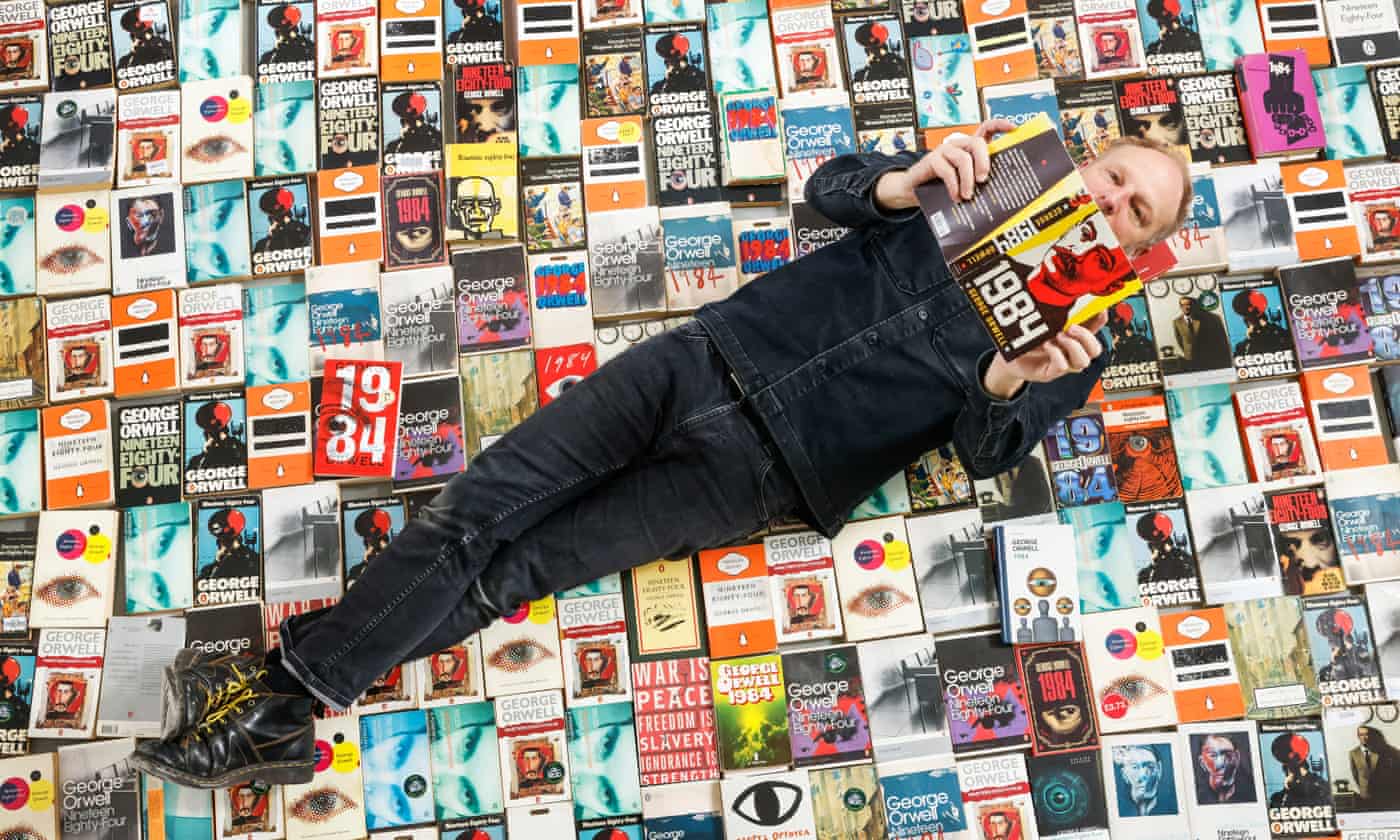
Photo: Murdo MacLeod/The Guardian.
Artist Hans K Clausen is on track to collect 1,984 copies of 1984 for an exhibition on Jura, the Scottish island where George Orwell wrote it. 

Is it 2024 right now or 1984? Remember when 1984 seemed a long time in the future? I do. Now it’s far behind. Meanwhile, the novel Nineteen Eighty-Four seems to many of us to have stopped being fiction.

The Guardian‘s Scotland editor Severin Carrell writes about a celebration of the novel and author George Orwell, an exhibit on the island where he wrote it.

“Copies of George Orwell’s dystopian masterpiece Nineteen Eighty-Four,” writes Carrell, “have been arriving at an artist’s studio in Edinburgh for months. Every shape and size, posted from Ukraine, Hong Kong, Peru, Germany, Cape Cod and Sarajevo.

“Some are in mint condition, others are dog-eared, tea-stained, heavily annotated or turned into graffitied art works. One is a water-stained first edition; one is a secret love letter from a married woman to her first love; another, a graphic novel version, came from Orwell’s son Richard Blair.

“Each has been donated to a unique installation in the community hall of Jura, the Hebridean island where Orwell, in dire poverty and desperately ill, wrote Nineteen Eighty-Four during the late 1940s, to mark its publication 75 years ago.

“Hans K Clausen, a sculptor based in Edinburgh, is collecting 1,984 copies of the book to exhibit on Jura for three days in [June]. It will be an interactive, ‘living’ sculpture where visitors are invited to open and read every volume.

“Many have arrived, often with overseas postmarks and customs stamps, addressed to ‘Winston Smith, care of Hans K Clausen.’ [Winston is the novel’s protagonist.]

“ ‘I don’t see my art project as political,’ Clausen said. ‘It has politics woven through it, but it also has a love story woven through it. … I’m interested in all the layers,’ he said. ‘Often people overlook the romance and the love, and this man trying to find his own humanity. It gets lost in the Big Brother-ness of it all.’ …

“One correspondent, a married woman who called herself Julia, after the hero Winston’s lover, sent in her personal copy as a memorial to her first love, a man also married to someone else, her Winston.

“Clausen said his installation, the Winston Smith Library of Victory and Truth, is designed to be ‘a monument [to] the defiance of the printed word.’ He is still taking donations. … In return, each donor receives an enamelled pin-badge as a gesture of thanks.

“Clausen wants visitors to appreciate the materiality of each volume: the Russian copy printed on coarse paper; the impeccably printed Japanese edition; the hand-cut Canadian volume on thick paper; the musty odor and yellowing edges of the oldest copies; the intense annotations and highlighting in others, and the inexpert repairs with sticky tape to the ones with battered spines. …

“Clausen has worked with secondary school pupils in Edinburgh, London and on Jura itself, with pupils who live there but go to school on neighboring Islay, who have customized copies using paint, scalpels and pens. A teacher and sculptor at Cape Cod community school in Massachusetts cut an intricate Big Brother artwork into his.

“The installation includes audiobooks on cassette and films on DVD. The audiobooks will be broadcast over two wide-mouthed loudspeakers reminiscent of the omnipresent speakers that indoctrinated the citizens of Airstrip One.

“Visitors to Jura will find a desk with a 1940s typewriter and a paperweight, in reference to the object Winston bought in the antique shop above which he and Julia conducted their illicit affair. The [shop] was a front for the thought police. …

“The project has the blessing of the Orwell Society, a group set up under Richard Blair’s patronage in 2011. … Quentin Kopp, the society’s chairman, whose father, George, was Orwell’s commander in the Spanish civil war, said they spent time talking to Clausen.

“ ‘We satisfied ourselves this was a very genuine initiative,’ Kopp said [adding] ‘This book has a clear modern resonance with many things that are going on. It’s staggering how prescient Orwell was.’ ”

More at the Guardian, here.

Read Full Post »

It took a little poking around on the web as neither the Rhode Island State Arts Council nor the Block Island Airport seem to have published any information on the airport’s new exhibit, but I can finally share some tidings of artist Neal Personeus.

From Cape Scapes: “Neal began his interest in driftwood sculptures as a young boy on the beaches of North Truro in Cape Cod, Massachusetts. His original works were typically pirate ships in the sand made from the various flotsam and jetsam that Cape Cod Bay and the Atlantic Ocean would return to the land. By the time he was in his early teens, his works began to change towards wharf scenes and typical seaside shops perched upon interesting driftwood base pieces.

“When Neal was in his early twenties, he became an architectural and engineering draftsman. He rented a beachside cottage with some friends during the summer of 1984, and spent the entire vacation working beachside on his sculptures while watching the Olympics. It was during this time that he honed in on the type of works he would ultimately settle upon. Utilizing his interest in architecture, he would scour the beaches and dunes for beautifully bleached and unusually shaped base pieces, and then picture the style of house that would blend into and compliment the environment of the base piece.” More here.

You can find lots of Neal’s work on Pinterest if you search on Neal Personeus. And check out this Warwick Museum of Art poster featuring the piece called “Yeah … but the view” here.

Art: Neal Personeus
This humorous piece, currently in an exhibit of Personeus sculptures at the Block Island Airport, is called “Yeah … but the view.”

Read Full Post »

In a recent NY Times article, art critic Holland Cotter expressed skepticism that a show of new artists lumped together as “Arab” could work. (Some artists declined to participate for the same  reason.)  The artists in the New Museum exhibit are from “Egypt, Iraq, Jordan, Kuwait, Lebanon, Morocco, Saudi Arabia, Syria, Tunisia and the United Arab Emirates, not to mention Europe and the United States.”

But in the end, he was thrilled with the opportunity to see the new works.

“It’s a big show, intricately pieced together on all five floors of the museum, and starts on the street-level facade with a large-scale photograph of an ultra-plush Abu Dhabi hotel. The image was installed by the cosmopolitan collective called GCC, made up of eight artists scattered from Dubai to London and New York who make it their business to focus on the preposterous wealth concentrated in a few hands in a few oil-rich countries on the Persian Gulf.”

Cotter goes on to describe many of the pieces in detail, here, and concludes with some advice for visitors.

“To appreciate this show fully, a little homework can’t hurt. But really all you need to do is be willing to linger, read labels and let not-knowing be a form of bliss. In return, you’ll get wonderful artists, deep ideas, fabulous stories and the chance, still too seldom offered by our museums, to be a global citizen. Don’t pass it up.”

The show will be up until September 28.

Photo: Ruth Fremson/The New York Times

“Here and Elsewhere” show at the New Museum

Read Full Post »