Feeds:
Posts
Comments

Posts Tagged ‘farm’

Photo: Riley Robinson/Staff.
Organic farmers Kayleigh Boyle and Doug Wolcik stand in a hoop house at Breadseed Farm in Craftsbury, Vermont.

‘I have long believed this is a bipartisan issue,’ says John Klar, a Vermont farmer who in 2022 ran for a Vermont state Senate seat as a Republican.

One reason I like the Christian Science Monitor is that it’s so good at searching out stories of divided Americans coming together. Today’s example features a diverse group of Vermont farmers promoting sustainable practices and eat-local values.

Stephanie Haines writes, “Kayleigh Boyle and Doug Wolcik knew all the reasons not to farm in Vermont: the short growing season, the hilly terrain, the dirt roads that make it hard to get products to market.

“Even the size of most farms here is a problem. For decades, farms across the United States have gotten larger as agricultural policies pushed growers to consolidate and scale up their operations. Vermont’s farms, however, have stayed relatively small. According to conventional wisdom, that means unprofitable.

“But small was what the couple wanted. Ms. Boyle is from Vermont, and while studying at Emerson College in Boston, she worked an office job connected to the local food movement. But she quickly realized she wanted to be outside with her hands in the earth.

“Mr. Wolcik graduated from the University of Massachusetts Amherst, where he studied sustainable agriculture and community food systems. He, too, realized he wanted a life close to the soil.

“They met while working at a nonprofit farm outside Boston and soon discovered they shared a dream about buying their own acreage to grow food and flowers. They weren’t interested in a massive operation. Instead, their vision included no-till growing methods, hand tools, and a desire to build a ‘human scale’ production system.

“They also wanted to make their living entirely from their farm – something increasingly difficult to do in New England. Over the past 60 years, the region has lost 80% of its farmland. …

“They spent years saving money and scouring Zillow listings and USDA soil surveys online. They eventually found a 16-acre property at the edge of Vermont’s rural Northeast Kingdom, complete with a house and a flat, 2-acre plot that got a lot of sun. In September 2020, they decided to take the plunge.

“And they’ve thrived. ‘We’ve just far exceeded any expectations that we set for ourselves,’ says Mr. Wolcik. ‘We’re selling everything we can. We can’t even grow enough. There’s such demand for it, from restaurants to retail to wholesale to markets,’ he says. ‘We can’t produce enough product fast enough.’

“Some of this is because of the couple themselves: Ms. Boyle’s sense of marketing, Mr. Wolcik’s attention to detail and innovation, and the experience and high standards they share as growers.

“But it is also because, when they bought these rare flat acres, they joined a community actively building a new storyline around farming, food, and resilience in New England.

“Here, in this part of little Vermont, statewide population 648,000, a coalition of farmers, nonprofits, and residents is eschewing mainstream beliefs about what makes agriculture successful and what it means to create a prosperous economy.

“Instead, they are building a system in which farmers are able to make a living and residents can eat healthy food grown nearby. They are intentionally moving away from a global supply chain vulnerable to market shocks – everything from pandemics to tariffs to natural disasters. …

“Across the country, communities on all sides of the political spectrum are reimagining the way Americans produce and value what they eat, tapping into a simmering belief that something is amiss with how detached, both economically and nutritionally, we have become from this fundamental human sector. …

“Subsistence farming gave way to commercial dairying and gardening for market. Refrigeration, and the resulting large-scale grocery stores, meant individuals didn’t need to spend their time growing food. Urbanization and competition from out-of-region farms followed.

“Still, what we think of as the modern food system is largely a phenomenon of recent decades. This includes a global supply chain, factory farming, and ultraprocessed foods, which now make up more than 50% of the calories in the American diet, according to the Johns Hopkins Bloomberg School of Public Health. What people tend to think of as the ‘local food movement’ is also relatively new. 

“[Although fascination] with locally grown organic foods became popularly associated with progressives – and was regularly criticized as elitist – there was also an emerging libertarian and conservative desire for a different, more localized sort of food system.

“ ‘I have long believed this is a bipartisan issue,’ says John Klar, a Vermont farmer who in 2022 ran for a Vermont state Senate seat as a Republican, a bid that fell short. ‘If there’s one thing that should bring Americans together, it is local, healthy food.’

“To him, the small farm is inherently conservative – a rejection of what he sees as dangerous globalism. It is a return to self-sufficiency, and far more environmentally and climate friendly, he says, than the traditionally liberal causes of electric vehicles and solar farms. …

“ ‘Both sides have been lulled by modernization of agriculture and the technological sirens,’ says Mr. Klar. ‘But both sides are coming back and coming together. These things don’t lend themselves to the red-blue dichotomy.’ ”

More at the Monitor, here. No paywall. Lots of cool pictures.

Read Full Post »

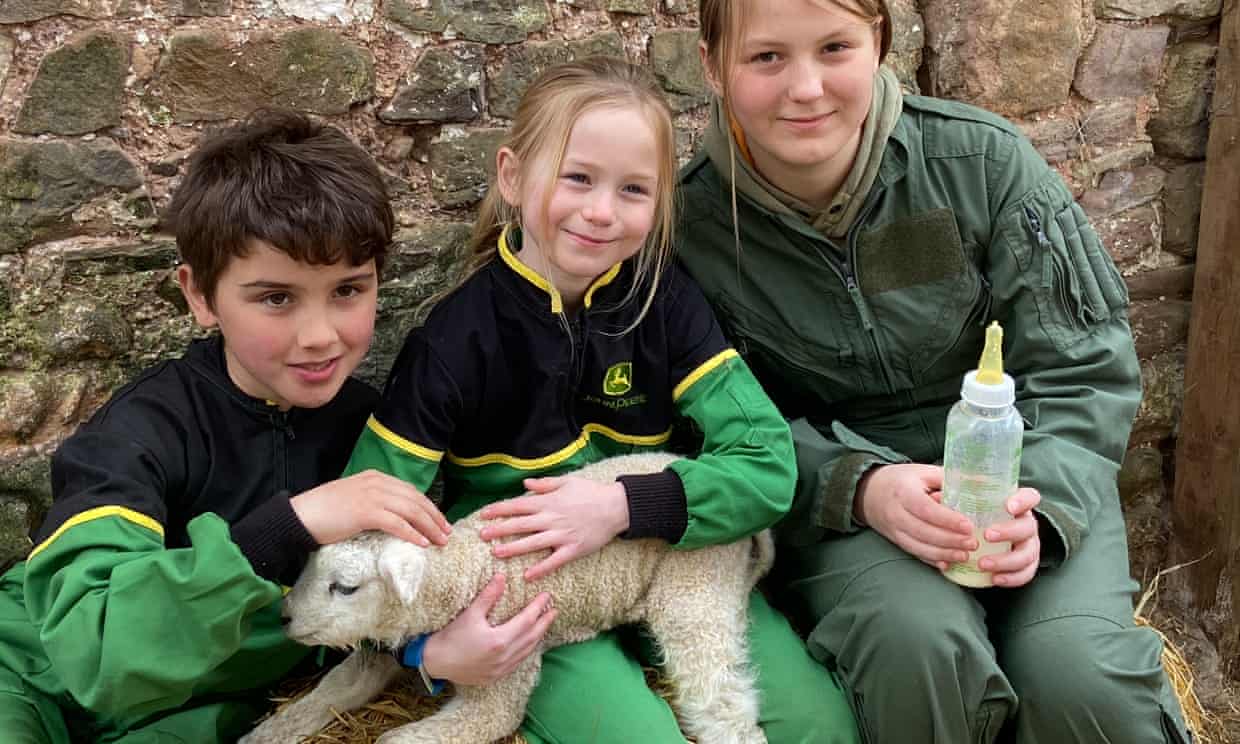
Photo: Handout via the Guardian.
You can take hikes with goats. Why not enjoy time with lambs, too?

I’ve been saving an article from the Boston Globe for some future birthday, when I’ll talk my family into joining me in a hike with goats. It’s a service that a goatherd here in Massachusetts offers, and I think it might be fun.

But now I’m learning about spending a weekend with lambs. Maybe that would be even more fun. But I would have to fly to England, and I’m down on air travel.

Sally Howard writes at the Guardian, “In a shed in the Malvern Hills, lambs struggle clumsily to their feet as holiday-making couples look on.

“Clare John, the third generation in her family to farm these 50 acres of Worcestershire pasture, began offering lambing-themed breaks two years ago in response to a surge of customer requests. Rowley Farm’s holiday cottages are block-booked for the 2025 spring lambing season, which traditionally peaks around Easter.

“ ‘For farmers like me it’s a bit strange to treat sheep like pets,’ John said. Self-catering guests arrive at Rowley Farm from February to May to feed hay to her pregnant ewes, and to bottle-feed orphan lambs who have been abandoned by their mothers or are the thirds in triplets (which ewes can struggle to feed).

“ ‘Mostly the guests want to touch and cuddle the lambs rather than do the mucking out,’ she said. …

“Farm Stay UK, a co-operative for farmers in hospitality, said that 90 of its 400 members now offer ‘lamb watch’ holidays. A number of farms are expanding their lambing offerings for 2025. … Church Farm in Lancing, West Sussex, offers evenings with the ‘shepherdess team’ where visitors can feed lambs and watch out for live births.

“Some put this popularity down to the effect of TV shows … or the growth of live-stream lambing cams such as lambwatch.co.uk and Walby Farm Park’s Lamb Cam Live.

“Farmer Helen Hearn introduced lambing-shed slots for visitors in 2023 after demand began to outstrip capacity at 450-acre Penhein Farm in Monmouthshire. Guests accompany Hearn – checking the sheds for births, ensuring lambs in the field are paired up with their mothers and bottle feeding the lambs – at a charge of £45 [~$60] for up to eight people a shed. ‘We charge for lambing as it takes four times as long to do our farming rounds when the public is involved.’ …

“She thinks lambing breaks answer a human need for connection to nature. ‘In previous generations most British people would have an aunt or cousin who worked on a farm and would be around farm animals that way,’ she said. ‘That’s all gone now.’

“Hearn said she wouldn’t install a lamb cam for the public to witness live births, however. ‘Often I’ll get a delivery that’s tricky … and the vet needs to come for a caesarean or the lamb comes out dead,’ she said.

“TikToker and amateur lambing enthusiast Melissa Arnold, AKA @melissa­lovessheep, refers to herself as ‘a crazy sheep lady.’ The graphic designer has volunteered for lambing season at her local farm, Readstock in Bagber, Dorset, since 2022. With no prior farming experience, Arnold has now delivered and raised more than 90 lambs. …

“ ‘I discovered lambing when I was going through a tricky period in my life and it’s total escapism for me,’ she said. However, she points out the hobby isn’t all gamboling newborns. ‘It’s an everyday soap opera in the lambing shed. Lambs and ewes die regularly, and you have to learn to handle that.’

“In Hampshire, farmers Fran and John Drake have had to take on additional staff, including veterinary students, to cope with surging demand for lambing stays at Michelmersh Manor Farm, a family-run mixed arable, dairy and sheep farm where 140 lambs are expected this April. ‘We have one London family coming back for their fourth lambing season,’ Fran Drake said. …

“Michael Gibbs, who has farmed at Mill Farm in Middle Tysoe, Warwickshire, for 50 years, welcomes local schoolchildren into his lambing sheds but is unconvinced about turning it into a spectator sport. Farming is a business, after all. ‘The French have a taste for British lamb at the moment and prices are up 30% on 2022,’ the 73-year-old said, passing a trailer of hoggets (sheep between one and two years old) off to market. ‘That’s what the job is at the end of the day. It’s not all cuddles.’ ”

More at the Guardian, here. No paywall at the Guardian, but please consider donating something to support their journalism.

Read Full Post »

Photo: Katie Orlinsky.
“On Long Island [in New York state] a group of Shinnecock women are nursing a bay back to health and, in the process, reclaiming traditions,” writes the magazine Nature.

A couple nonprofits and a few indigenous women are putting into practice one of my favorite principles: “Two and two and 50 make a million.” They are saving their small piece of the ocean from pollution and helping to bring back a better world.

Claudia Geib writes at Nature, “Danielle Hopson Begun stands waist-deep in the waveless expanse of Long Island’s Shinnecock Bay. She reaches into the water and lifts out a heavy rope, which drips with the amber and butterscotch-colored fronds of a marine plant called sugar kelp. It’s early June, and over the past eight months this kelp, anchored here, has grown from millimeter-long seedlings into foot-long golden ribbons, absorbing nitrogen and carbon from the water in the process.

“Tended by Hopson Begun and four other women from the Shinnecock Indian Nation, these lines are part of the first Indigenous-owned kelp farm on the U.S. East Coast. The kelp is harvested each year and sold locally as a natural fertilizer. But for these women, who have formed a nonprofit organization called Shinnecock Kelp Farmers, it has become something more than a crop: It is one piece of a multifront effort to reassert ancestral ties to the lands and waters their community has stewarded for thousands of years.

“Today, though, Shinnecock Bay is drastically different from the waters their ancestors once harvested wild kelp from. It’s more polluted, and the waters have grown warmer and more acidic. And almost every year since starting the farm in 2020, Hopson Begun and her partners have found their lines coated in an alga that suffocates and kills baby kelp. It significantly reduced part of their harvests — until now.

“To combat the algae, the kelp farmers have turned to cutting-edge science and technological solutions — supported by a grant from The Nature Conservancy and industry expertise from aquaculture nonprofit GreenWave — to supplement their long connection to the bay.

“ ‘There is this traditional knowledge that we have — of how the seaweed grows in the bay, and how to nurture it and prepare it for the work that it has to do,’ says Tela Troge, one of the group’s founders. If the Shinnecock Kelp Farmers can successfully grow kelp in the bay — weaving this ancestral understanding with modern science — the plant stands to help restore an ancient link to a cultural practice, while perhaps helping stem the rising tide of pollution that has invaded these waters since the arrival of colonialism.

“Among the challenges of farming kelp is simply finding the time. The kelp farmers and their friends and families — mothers, lawyers, counselors, activists — live and work in the communities of the greater Long Island and New York City area. Today about half of the nearly 1,600 enrolled members of the Shinnecock Indian Nation live on a 900-acre property on the eastern edge of Shinnecock Bay — a property surrounded by wealthy Hamptons enclaves and just a barrier island away from the Atlantic Ocean.

“Life here has always been intertwined with water. For at least 10,000 years, the ‘People of the Stony Shore’ gathered fish, mussels, scallops and clams, and cultivated oyster gardens along a vast stretch of land and waters on and around what is now called Long Island. Skilled seafarers, they relied on the Shinnecock and Peconic Bays — both local inlets — as well as the open sea. They hunted whales and exchanged white and purple wampumpeag beads they carved from the shells of hard clams, or quahog. These beads, known as wampum, remain an important touchstone for the Shinnecock, who continue to carve them as jewelry and cultural symbols.

“When Europeans arrived in the Northeast in the 1600s, they brought diseases that decimated the Shinnecock and their neighbors, razed forests to sow farms and claimed burial grounds to build towns. Over time the Shinnecock Indian Nation lost access to most of their historic hunting and fishing grounds, retaining a territory of about 1,000 acres, including the 900-acre reservation. With the spread of new people, the waters the Shinnecock relied on changed, too.

“Shinnecock Bay, in particular, suffered. The bay spans 9,000 acres, separated from the Atlantic Ocean to the south by a narrow barrier island. Warm and shallow, with an average depth of only about 6 feet, the bay’s connection to the sea has shifted over the centuries as storms alternately carved and filled in cuts through the island. A powerful 1938 hurricane created Shinnecock Inlet, a permanent opening to the Atlantic. Yet, still largely landlocked, the bay’s waters concentrated high levels of nitrogen, which seeped through the ground from cesspools and septic systems as homes and towns sprung up along its shores.

“By the 1980s, annual nitrogen-fed algal blooms turned the water ‘brown like a cup of coffee,’ says Stony Brook University researcher Ellen Pikitch, one of the co-founders of the university’s Shinnecock Bay Restoration Program. These ‘brown tides’ clouded the water, blocking sunlight from reaching eelgrass, killing fish and destroying shellfish habitat. …

“By the mid-2000s the marine life that the Shinnecock people had once relied on was nearly gone. Oyster reefs vanished. Between the 1970s and 2011, the commercial fishery for quahogs, the clams used for Shinnecock wampum and food, collapsed by more than 99%.

“At the same time, members of the Shinnecock Indian Nation had been fighting to assert their ancestral land and water claims. In 2019, an ocean-farming nonprofit called GreenWave reached out to members of the Nation. Inspired by a PBS documentary about the Shinnecock people’s long battle against Southampton’s development, one of the group’s staffers wanted to know if members of the Nation would consider working with GreenWave on a kelp farm.

“The proposal captured the interest of the future Shinnecock Kelp Farmers for multiple reasons. They knew that, historically, the Shinnecock harvested seaweed for home insulation, food and medicine, and that kelp could absorb nitrogen and carbon into its tissues. When harvested and dried for garden fertilizer and used in place of traditional fertilizers, kelp offered a way to pull excess nutrients from the bay. …

“The Sisters of St. Joseph, a Catholic religious order, joined the collaboration by providing water access from their community center along Shinnecock Bay. In 2020, five Shinnecock women — Danielle Hopson Begun, Donna Collins-Smith, Rebecca Genia, Tela Troge and her mother, Darlene Troge — took up waders and began the work of nursing kelp to life.”

There’s a lot more at Nature, here. No paywall. Great photos.

Read Full Post »

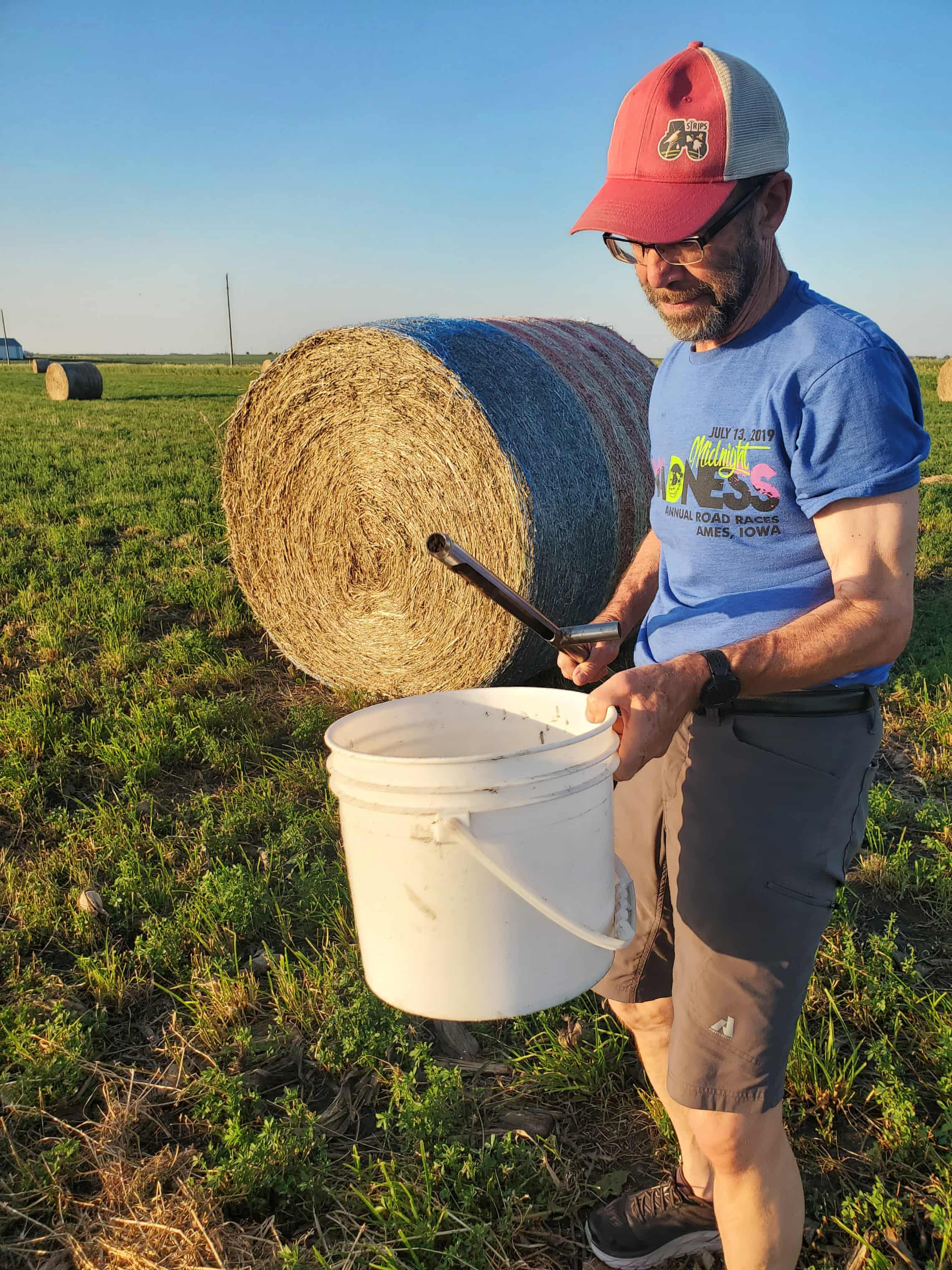
Photo: Lee Tesdell.
Behind farmer Lee Tesdell in the photo are rolled-up strips of prairie sod containing native plants that help improve his land’s resistance to climate change. 

There are so many things we have taken for granted in our natural world. Consider weeds. We might have noticed that various flying things liked their blossoms, but we didn’t like them.

That is, until we started noticing that we wouldn’t have much food if those flying things didn’t pollinate plants.

Now some farmers who used to kill weeds are bringing them back. As Rachel Cramer reports at the Guardian, strips of native plants (weeds) on as little as 10% of farmland can reduce soil erosion by up to 95%.

“Between two corn fields in central Iowa,” she writes, “Lee Tesdell walks through a corridor of native prairie grasses and wildflowers. Crickets trill as dickcissels, small brown birds with yellow chests, pop out of the dewy ground cover. …

“This is a prairie strip. Ranging from 10-40 metres (30-120ft) in width, these bands of native perennials are placed strategically in a row-crop field, often in areas with low yields and high runoff. Tesdell has three on his farm.

“He points out several native plants – big bluestem, wild quinine, milkweed, common evening primrose – that came from a 70-species seed mix he planted here six years ago. These prairie plants help improve the soil while also protecting his more fertile fields from bursts of heavy rain and severe storms, which are becoming more frequent.

“ ‘To a conventional farmer, this looks like a weed patch with a few pretty flowers in it, and I admit it looks odd in the corn and soy landscape in central Iowa,’ … he said. ‘I’m trying to be more climate-change resilient on my farm.’ …

“Prairie strips also help reduce nutrient pollution, store excess carbon underground and provide critical habitat for pollinators and grassland birds. Thanks to federal funding through the USDA’s conservation reserve program, they’ve taken off in recent years.

“But the idea started two decades ago with Iowa State University researchers and Neal Smith National Wildlife Refuge managers. Lisa Schulte Moore, a landscape ecologist and co-director of the Bioeconomy Institute at Iowa State University, who was integral to the research, knows that large patches of restored and reconstructed prairie are vital, especially for wildlife, but she argues that integrating small amounts of native habitat back into the two dominant ecosystems – corn and soya beans – can make a big difference. …

“In north-central Missouri, farmer Doug Doughty has been adding and expanding conservation practices, like no-till, for decades. He also has a few hundred acres of prairie enrolled in the USDA’s conservation reserve program. This past winter, he added prairie strips, as part of a plan to tackle nutrient pollution. High levels of nitrates and phosphorus can wreak havoc on aquatic habitats and the economies that depend on them. There are also health risks for people. Nitrates in drinking water have been associated with methaemoglobinaemia or ‘blue baby syndrome,’ and cancer. …

“During an outreach event in the Iowa Great Lakes region, Matt Helmers uses a rainfall simulator to demonstrate runoff and erosion with different conservation practices. He’s one of the prairie strips researchers and director of the Iowa Nutrient Research Center at Iowa State University. …

“During a big rain storm, each prairie strip in a field acts like a ‘mini speed-bump,’ said Helmers. A thick wall of stems and leaves slows down surface water, which reduces soil erosion and gives the ground more time to soak up water. Below ground, long roots anchor layers of soil while absorbing excess water, along with nitrates and phosphorus.

“Farmer Eric Hoien says he first heard about the conservation practice a decade ago, right around the time he was becoming more concerned about water issues in Iowa. But the final push to add 24 acres of prairie strips came from something Hoien saw in an plane above the Gulf of Mexico.

“ ‘I looked down and for what was probably 20 minutes, it was just like the biggest brown mud puddle I’d ever seen. And so I knew that, that stuff they say about the dead zone, from 30,000 ft, was real,’ Hoien said. …

“Hoien says prairie strips offer other benefits close to home. Neighbors often tell him they appreciate the wildflowers and hearing the ‘cackle’ of pheasants. He also enjoys hunting in the prairie strips and spotting insects he’s never seen before.

“The strips are hugely beneficial for pollinator populations, which have been dropping around the world. Researchers point to a combination of habitat loss, pesticide exposure, parasites and diseases, along with warmer temperatures and more severe weather events due to climate change.

“ ‘If we can help them have a place to live and something to eat, they can be better equipped to cope with those kinds of stress that they’re inevitably going to encounter in their environments,’ says Amy Toth, who is also part of the prairie strips research team and an entomology professor at Iowa State University. Research shows both the diversity of pollinator species and overall numbers are higher in prairie strips compared to field edges without native plants.

“And strips of native plants aren’t just good for pollinators. Researchers, including Schulte Moore, found a nearly threefold higher density of grassland birds on fields with prairie strips. She says that grassland birds have declined more than any other avian group in North America since 1970. …

“Schulte Moore says a group of forward-thinking, innovative farmers and partnerships with non-profits, foundations, universities and agencies in the midwest have helped prairie strips gain traction, but then a ‘monumental shift’ happened with the 2018 Farm Act, when prairie strips became an official practice in the federal conservation reserve program.” More here.

Pray that these federal conservation programs are not already slashed.

And for more on the prairie’s vast potential, read about Buffalo Commons, a movement launched by my husband’s classmate and his wife in the 1980s, here.

Read Full Post »

Photo: Annick Sjobakken/New York Times.
Farmers are restoring the prairie with government help. The aim is to reduce nutrient runoff from cropland, and help birds and bees.

Sometimes we have to go back to the old ways to fix the mistakes of the new ways.

For example, our country’s beloved “bread basket” has used for generations agricultural techniques that have depleted the soil. Maybe we can learn something from the time of Little House on the Prairie.

Cara Buckley reports at the New York Times, “The little tracts of wilderness grow on Maple Edge Farm in southwest Iowa, where the Bakehouse family cultivates 700 acres of corn, soybeans and alfalfa. Set against uniform rows of cropland, the scraps of land look like tiny Edens, colorful and frowzy. Purple bergamot and yellow coneflowers sway alongside big bluestem and other grasses, alive with birdsong and bees.

“The Bakehouses planted the strips of wild land after floodwaters reduced many fields to moonscapes three years ago, prompting the family to embark on a once-unthinkable path.

“They took nearly 11 acres of their fields out of crop production, fragments of farmland that ran alongside fields and in gullies. Instead of crops, they sowed native flowering plants and grasses, all species that once filled the prairie.

“The restored swaths of land are called prairie strips, and they are part of a growing movement to reduce the environmental harms of farming and help draw down greenhouse gas emissions, while giving fauna a much-needed boost and helping to restore the land.

“As the little wildernesses grew, more and more meadowlarks, dickcissels, pheasants and quail showed up, along with beneficial insects. Underground, root networks formed to quietly perform heroic feats, filtering dangerous nutrient runoff from crops, keeping soil in place and bringing new health to the land.

“ ‘We’re thinking about our farm as a small piece of the overall good puzzle,’ said Jon Bakehouse, on a visit to the family’s fields one sunny morning earlier this summer. ‘On a larger scale, we’re all in this together.’

“The fertile soils of America’s vast prairies made the heartland ideal for growing crops. But today in Iowa, less than 0.1 percent of original prairie remains, scattered in fragments around the state.

“Prairie strips are helping to reverse that loss, and are being adopted at an increasing clip. Researchers counted 586 acres of prairie strips on farmland across seven states in 2019. As of last year, they had spread to 14 states, filling 22,972 acres.

“While the acreage accounts for a tiny fraction of the Midwest’s farm fields — Iowa alone has roughly 30 million acres of cropland — researchers said the strips had disproportionately positive impacts.

“ ‘There are a whole suite of dramatic environmental benefits that come with this small intervention,’ said Lisa Schulte Moore, a professor of natural resource ecology and management at Iowa State University, and a founder of its prairie strips project. ‘If you put a bit of prairie back, it makes a big difference.’

“To  be classified as a prairie strip, restored land must adjoin active cropland, reach a width of at least 30 feet and be sown with dozens of native plant species.

“Researchers at Iowa State found that when prairie strips were planted in and around soy and corn fields, they acted as both ‘speed bumps and diapers,’ Professor Schulte Moore said.

“Soil erosion and surface runoff plummeted, as the prairie plants held soil in place and transpired water. Levels of nitrogen and phosphorus carried in surface runoff from adjacent cropland decreased by as much as 70 percent, absorbed instead by the prairie strips, resulting in less water contamination. The prairie strips created better conditions for helpful bacteria, resulting in dramatically lower levels of nitrous oxide, a powerful greenhouse gas generated by chemical fertilizer, compared to cropland without prairie strips. The strips also drew twice as many native grassland birds and three times as many beneficial insects, compared to fields that had not been rewilded.

“While the research did not show that prairie strips affected yields in adjacent cropland, tests found that the strips boosted the health and fertility of the soil where they were sown. …

“Iowa has the most industrialized livestock farms in the country, and tens of millions of pounds of untreated manure that they produce end up fertilizing crops, along with synthetic fertilizer made from fossil fuels. The nitrogen-heavy runoff from agricultural fields threatens drinking water, and is a leading cause of an oxygen-starved dead zone in the Gulf of Mexico that kills marine plant and animal life.

“In 2007, Professor Schulte Moore was part of a team at Iowa State University that began researching the ways in which restoring parts of the prairie could enrich soil, help insects and wildlife, and stanch emissions and fertilizer runoff. They went on to plant prairie strips on commercial farms and at some of the university’s test sites, and found that benefits were consistently achieved when 10 percent of a farm’s cropland is converted into prairie strips, with lower amounts still providing some boons.

“The findings might have sat on a shelf, Professor Schulte Moore said, were it not for her department chair, who rewrote the professor’s job description so she could promote the idea to farmers.

“In late 2018, the prairie strips initiative got perhaps its biggest boost when it was included in the federal Conservation Reserve Program. That meant that farmland owners who converted some of their acreage to prairie strips could collect money from the federal government. According to the Agriculture Department, the average payout for prairie strips is $209 per acre each year.

“ ‘That was monumental,’ Professor Schulte Moore said. ‘It helped align hearts, heads and pocketbooks.’ ” More at the Times, here.

Read Full Post »

Photo: Top Africa News.
One of the benefits of having Kenyan farmers raise butterflies for a living is that they are protecting East Africa’s largest coastal forest.

I’m reading a strange British novel called Ash Before Oak in which the protagonist is keeping a diary about the natural world he encounters on leaving London for England’s West Country. As a kind of self-therapy for the impending breakdown he senses, he makes lists of — and tries to focus on — all the flora and fauna he sees. Starting with butterflies.

Who knew there were so many butterflies in the world? Who knew there were so many in southwest England? They do have a mesmerizing quality. Today’s article is about how unsuspecting butterflies are mesmerizing people in Africa while doing good work for the planet.

Evelyn Makena wrote at Top Africa News, “Before becoming a butterfly farmer, Dickson Mbogo made a living by selling charcoal from trees he cut in the forest.

“ ‘In my search for food and an income, I was destroying the forest,’ he said.

“Now, after getting involved in butterfly farming, Mbogo’s weekly routine involves visiting sections of Kenya’s eastern Arabuko-Sokoke Forest to capture butterflies using trapping nets.

“Home to some of the world’s endangered animals and plants, the Arabuko-Sokoke Forest Reserve is the most extensive indigenous forest on the east African coast. Once part of an extensive coastal forest that ran from southern Somalia to northern Mozambique, the forest is visible for miles along Kenya’s north coast highway.

“It is home to several threatened bird species, including Clarke’s weaver bird and the Sokoke scops owl, as well as endemic animals like the Aders’s duiker, the golden-rumped elephant shrew and the bushy-tailed mongoose. It is also home to elephants and other members of the ‘big five.’

“The forest also hosts almost 300 butterfly species. For local communities living adjacent to the forest, these butterflies are now the source of a sustainable livelihood, enhancing the conservation of a forest previously threatened by illegal logging.

“At home, Mbogo places the butterflies in a netted cage that houses different varieties of trees for the butterflies to feed on and lay eggs.

“ ‘Butterflies can lay up to 300 eggs. After a few days, eggs hatch to caterpillars and feed on specific food plants until they develop into pupae,’ explained Mbogo.

“After the pupae stage, farmers take the insects to Kipepeo Center in Gede town, a few kilometers from their homes.

“ ‘Here, the insects are sorted according to species, graded, carefully wrapped in cotton for protection and packaged in boxes. They are then exported to markets in the United Kingdom,’ said Hussein Abdulahi Aden, Project Manager of the Kipepeo Butterfly Project.

“From an initial 141 members when the project started, [in 2022, there were] 872. … Farmers are paid for every pupa delivered, depending on the species type. Pupae can attract between Ksh. 90 – 225, (US$0.75 – 1.8) with farmers making collective earnings of up to Ksh.15 – 20 million (US$124,000 – 166,000) per year.

“According to Aden, the Kipepeo project was started in 1993 by the National Museums of Kenya and other stakeholders to reduce pressure on the forest while offering an alternative source of income to locals. Initially, the project was met with resistance from the community.

“ ‘For a community used to subsistence farming of maize, cashew nuts and coconuts, the idea of butterfly farming was strange and perceived as mystical. There was also fear that this was a government project aimed at evicting them from their farms,’ Aden explained. But other community members followed suit as the pioneer farmers began reaping the project’s benefits. …

“Among the butterfly species reared are the colourful African Swallowtail, Silver Stripped Charaxes and Taita Blue-banded Swallowtail. There are also other less colorful species, like the African Migrant.

“The project buys all the pupae brought by the farmers. When supply is higher than the demand, the surplus is released to the Kipepeo Butterfly Exhibition House at Gede to educate the public on the insects. Some are released back into the forest for the continuity of species – ensuring that the forest is not only protected from the charcoal burners but is also well pollinated. …

“In many ways, Kipepeo project members have become champions of conservation within the community. Sofia Saidi, a member of the Mkongani group, said that members report any suspicious activities they may come across in the forest to the relevant authorities, including Kenya Forest Service and Kenya Wildlife Service. The project has also trained volunteer community scouts who patrol the forest and deter illegal activities.

“The Kipepeo project has also been crucial in improving food security in the community. Specific butterfly species play a vital role in pollination. According to Aden, a survey conducted within a five-kilometre radius of the forest boundary found that farms closer to the forest had better yields, indicating the impact of the butterflies on plant reproduction.”

More at Top Africa News, here. For an audio story about Kenyan butterfly growers, check out The World, here.
Read Full Post »

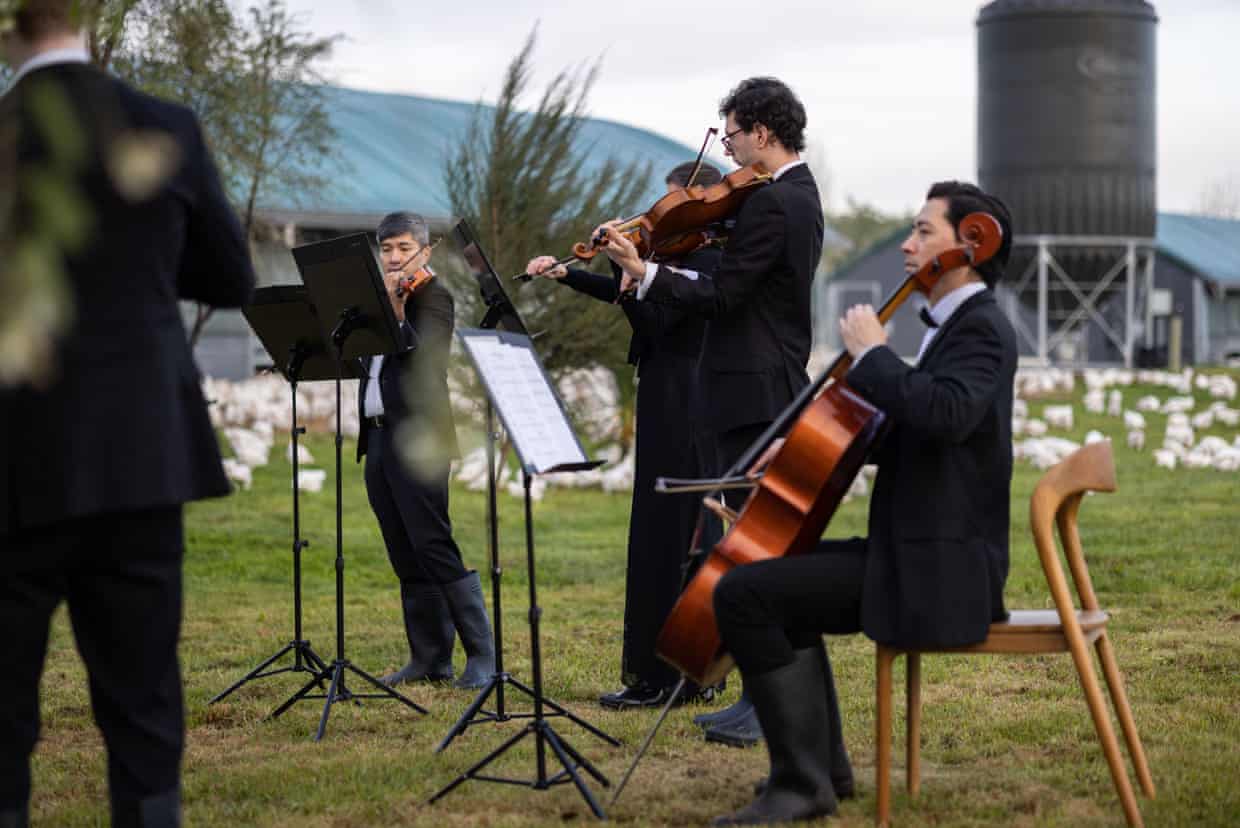
Photo: Bostock Brothers via the Guardian.
A live orchestral performance at the Bostock Brothers’ farm in Hawke’s Bay New Zealand. 

The media really knows how to have fun with a story that is susceptible to wordplay: “New Zealand Symphony Gives World Premiere for Hen-tastic Audience”; “Beethov-hen’s first symphony”; “NZ Symphony Orchestra members perform for thousands”; “im-peck-able.”

Mitchell Hageman at the New Zealand Herald wrote one of several delightful reports you can find online.

“Do chickens like classical music?” Hageman asks. “A Friday morning stunt in Hawke’s Bay proved they most certainly do.Members of the esteemed New Zealand Symphony Orchestra have performed for the likes of Dame Kiri Te Kanawa [and Sir Howard Morrison] but on Friday they faced some of their toughest critics yet: a hungry flock of thousands of Ross chickens.

“It was all part of a collaboration between Bostock Brothers Farm and the NZSO to promote ethical farming.

While slightly hesitant at first, the concert-going [chickens] eventually crowded around the clearly delighted musicians as they performed the world premiere of Chook Symphony No 1, created by composer and sound designer Hamish Oliver.

“ ‘Never could we have imagined producing a composition especially for a flock of chooks, let alone performing for them, but the opportunity was too good to pass up,’ NZSO chief executive Peter Biggs said. ‘The NZSO, like Bostock, is about being world-class and about wellbeing, so the two organizations have combined to create something very different and very new, and we hope it catches on.’

“The orchestra did some research and found instances where chickens responded particularly well to baroque music, which became the basis for the roughly two-minute symphony.

” ‘That’s strings, oboe, bassoon and harpsichord,’ Biggs said.

“After the composition was created, a sound recording was sent so it could be tested on the chickens. ‘They loved it,’ Biggs said. …

“For Bostock Brothers free-range chicken owners Ben and George Bostock, the collaboration was also a way to showcase the organic nature of chicken farming.

“ ‘Chicken farming is incredibly complex and organic farming even more so, and we’re constantly looking for ways to better our practices, ensuring our chickens are happy, healthy and organic,’ Ben Bostock said. ‘[We] know investing in a quality environment for our birds will only further yield quality results.’ …

“[George] said the response so far from the chickens had been great, and they would continue to play classical music in the sheds in future. ‘There’s lots of science that says classical music is really good for animal welfare and the response from our chickens has been really, really good.’ “

More at the Herald, here, at the Guardian, here, and at Symphony.org (the League of American Orchestras), here. No firewalls.

(And speaking of chickens, the Washington Post, here, reports that in Maine, chickens are now permitted as emotional support animals. Not that you asked.)

Read Full Post »

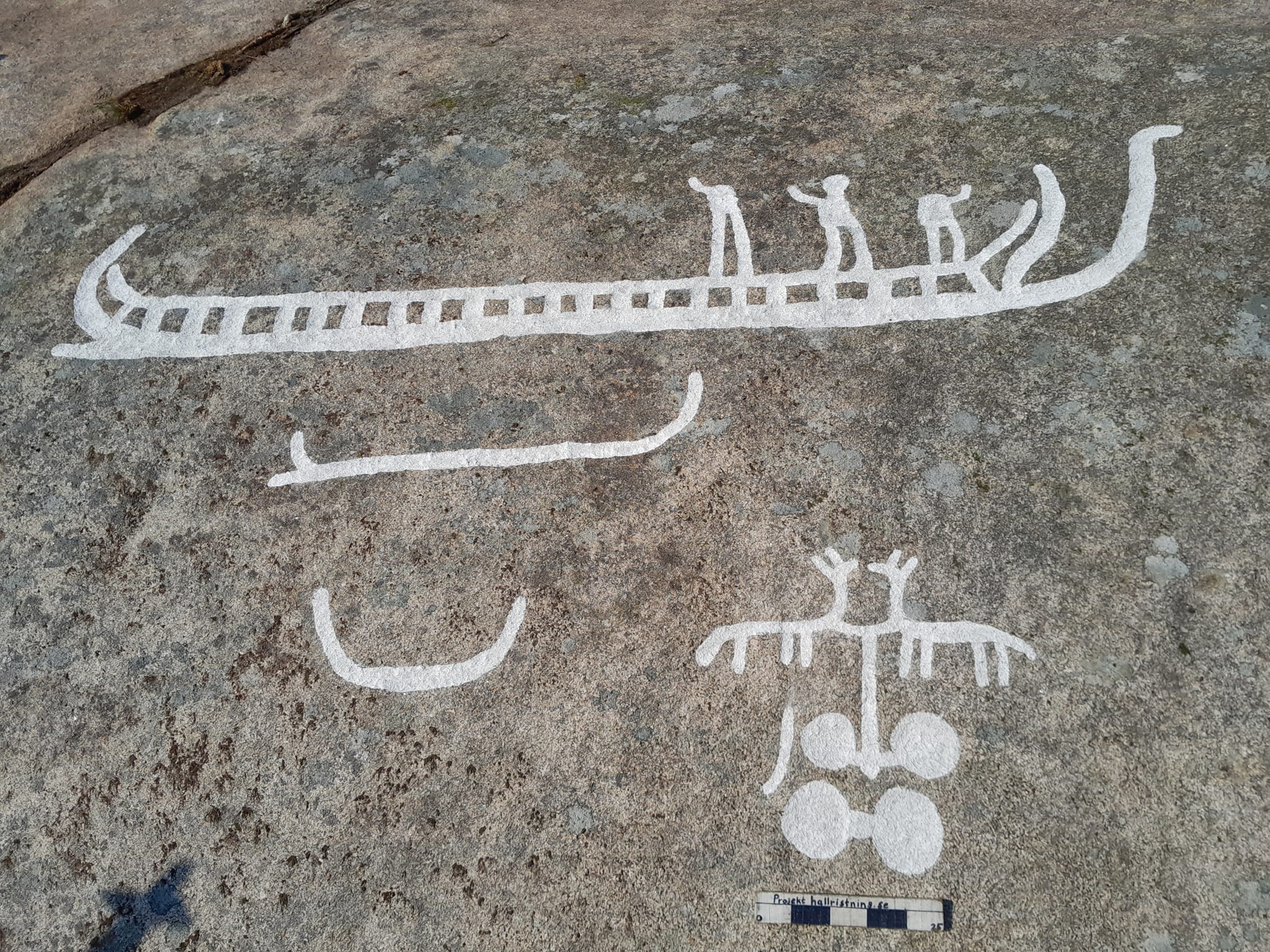
Photo: The Foundation for Documentation of Rock Carvings in Bohuslän.
One of the petroglyphs recently discovered on a farm in western Sweden.

Erik is from Sweden, so he takes Suzanne and the kids there every summer for about a month, where they connect with his sister’s lively family and his mother (Stuga40 on WordPress).

My husband and I paid Stuga40 a visit back in 2017, and one of the many fun things we did with her was visit a UNESCO World Heritage Site featuring ancient petroglyphs. (See a post on that here.)

It turns out that ancient civilizations in Sweden are not done revealing their secrets. Recently, researchers found more petroglyphs, startling the farmer who lives on the land and adding to the world’s pool of knowledge.

Richard Whiddington reports at Artnet, “In early May, a group of researchers scouring the western Swedish province of Bohuslän spotted irregular markings on a moss-covered rock face. They seemed man-made and so the team carefully removed the vegetation and uncovered scores of rock carvings, around 40 in total, depicting ships, animals, and people.

“The rock carvings, or petroglyphs, date back around 2,700 years and are the latest find in Bohuslän, an area known for its rock art, most notably the Bronze Age images at Tanum, a UNESCO site. …

“The recently discovered petroglyphs were found on a steep rock face that once formed the edge of an island before sea levels gradually dropped an estimated 40 feet over the course of several hundred years. This has led researchers to speculate the artists used boats, or a form of scaffolding laid on ice, to reach the rock surface. …

“The designs were made through a laborious process of smacking stones against the granite rock that exposed an underlayer of white. This color, in addition to their size, made them highly visible from both the mainland and passing ships.

“ ‘What makes the petroglyphs completely unique is that they are located three meters above today’s ground surface,’ Foundation for Documentation of Bohuslän’s Rock Carvings wrote in a statement. ‘The motifs lie on an even line that follows the height of the sea surface from approximately 700 to 800 BCE. The motifs are also stylistically consistent with this time period.’

“The latest group of petroglyphs found includes a 13-foot-long ship, as well as carvings of people, chariots, carts, and horses. Their meaning remains unknown. Sometimes petroglyphs were used to mark out territory, though researchers believe the repeated motifs carved into rocks outside the town of Kville may suggest they were used to tell a narrative.

“Lennart Larsson, on whose farm the rock carvings were found, was pleased by the discovery. ‘I haven’t actively been looking for petroglyphs, but it’s a lot of fun,’ he told SVT, the country’s national broadcaster in interview. ‘I can sit at home on the balcony and watch the stick figures and the ships outside.’ ” More at Artnet, here.

Also, at Live Science, Martin Östholm, a project manager with the foundation, noted that he petroglyphs include depictions of ships, people and animal figures, “including four-legged creatures that may be horses. … It’s not certain why people created the carvings, he said, but they may have served to mark ownership. …

James Dodd, a researcher at Aarhus University in Denmark and the Tanums Hällristningsmuseum’s Rock Art Research Centre Underslös in Sweden [said that] some of the motifs — including chariots, carts and animal figures — were depicted multiple times. … ‘On the basis of the repetition of the motifs, it is possible that this collection of figures forms a narrative,’ Dodd told Live Science in an email. Studies of other petroglyphs in the region have suggested that, in some cases, they may have been used in this way, but the exact meaning in this case is uncertain, he added.”

Artnet and Live Science have good pictures — and no firewalls.

Read Full Post »

The Little Sprouts Learning Center in Warren, Minn., is the town’s only day-care center. Residents recently voted to expand it — and fund it. 

The residents of a small town in northern Minnesota recently decided that “put your money where your mouth is” meant ponying up for a day-care center they couldn’t do without.

Cathy Free wrote at the Washington Post, “Lindsey Buegler learned that the only day-care center in her town of Warren, Minn., would be closing. She went to work that afternoon, upset and terrified. …

“She went to her boss, Phil Thompson, who owns the accounting and crop insurance firm where she worked, and told him: ‘We have no family here to help. If there is no child care, we’ll have to move.’

“Thompson said the moment hit hard as he realized Buegler and others were in a precarious situation. He decided to pitch in about $20,000 with a local banker to keep the Little Sprouts Learning Center open in the rural town, which has a population of about 1,600.

“That worked for a while, but Thompson said he knew it wouldn’t be enough to sustain the day-care center, which was operating as a nonprofit. …

“Thompson said he has written other large checks to help keep Little Sprouts running since that first crisis in 2015. He now employs about 30 people at his firm, and doesn’t mind when employees bring their children to work in a pinch when they need it.

‘I’ve seen firsthand how this affects people,’ said Thompson, who is also chairman of the Warren Economic Development Authority. ‘If people have to move away to work and raise their families, our town can’t grow.’

“In 2019, Thompson helped put together a committee that spent several years taking an in-depth look at Warren’s day-care dilemma. They explored several options to financially assist the day-care center, which was licensed for 47 infants and children and seven teachers. None of those options worked long-term.

“Last year, he and the committee proposed an idea: The city would ask residents to vote on a 20-year sales tax increase of half-a-cent to fund a $1.6 million low-interest loan for a new child care center, while keeping the old one open as it was being built. By doubling the number of teachers and increasing the availability of open slots, the day-care facility could survive.

“The plan was that Warren City would own the building and lease it to Little Sprouts, and the day-care center could continue to operate as a nonprofit. On Nov. 8, 2022, the measure narrowly passed. …

“ ‘We’re an agricultural community centered around corn, soybeans and sugar beets, and we have a lot of young people,’ [Thompson] said. ‘Now there’s an incentive to keep them here.’

“Nationwide, about 51 percent of the population live in child care ‘deserts‘ with no child care providers or not enough licensed child care slots, according to a 2018 study by the Center for American Progress. The pandemic made the situation more dire.

“Thompson and other residents of his farming community were determined to offer a day-care center option for working parents. ‘We became completely centered on solving this problem,’ said Mara Hanel, Warren’s mayor from 2018 to 2022. ‘At one time, we had a shortage of 180 child care slots in a 20-mile radius. We knew that we had to do something.’

“Shannon Mortenson, Warren’s city administrator, said the town decided that child care should become an essential service like water, electricity and sanitation.

“ ‘We knew that if we lost Little Sprouts, we would also lose revenue and some of our workforce,’ she said. ‘If parents had no options, they would move their families elsewhere.’

“The idea of moving to be near child care created stress in the community, said Adam Sparby, whose two daughters and son attend Little Sprouts. ‘Everyone was really worried — closing the day-care would mean a lot of us would have to move to another town and commute back and forth to work,’ said Sparby, who sells John Deere farm machinery in Warren.

“He said that his wife, Ashley, a pharmacist, would often volunteer at Little Sprouts on her lunch hour to help the teachers when the center was short on staff.

“ ‘Day-care is such a huge thing for families, so I’m really excited that the tax increase passed and we’ll soon have a new facility,’ Sparby said.

“Thompson said the sales tax increase will raise enough funds over 20 years for the town to pay off a $1.6 million loan for the new center but the community still needed to raise another $700,000 to $800,000 to offset price increases that occurred during the pandemic.

“ ‘We should meet our goal soon,’ he said, noting that businesses and residents have contributed about $600,000 to the effort. ‘Our community might be small, but people have been incredibly supportive and generous.’ ”

More at the Post, here.

Read Full Post »

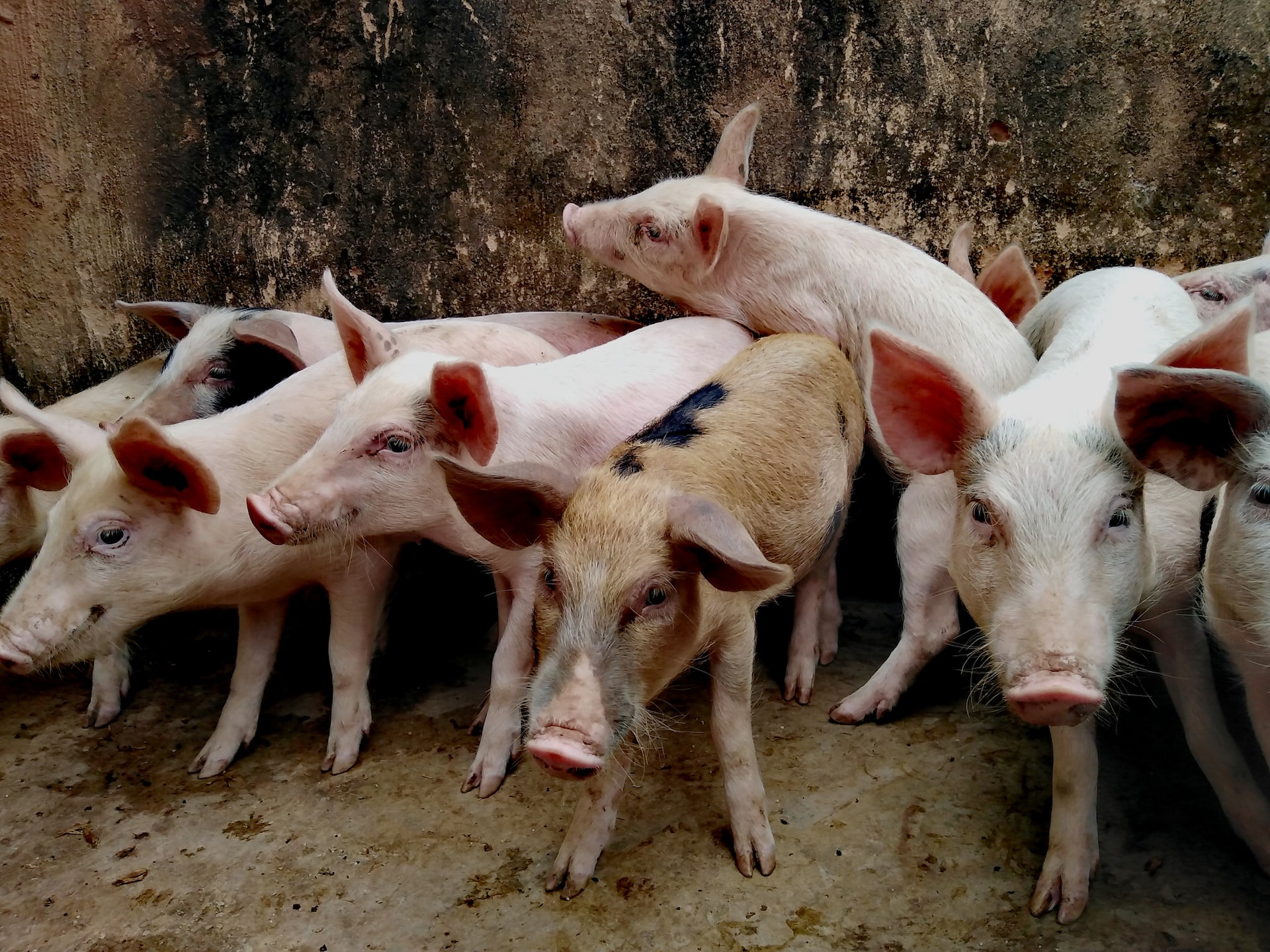
Photo: Emmanuel Eigege via Unsplash.

I love hearing author Sy Montgomery talk about her animal friends in her regular visits to Boston Public Radio. She has helped me be more aware of animals as fellow travelers on the planet, beings with personalities most humans don’t bother to see. Her books have intriguing titles: for example, the one about her pig Christopher Hogwood, The Good Good Pig.

Today’s article fits right in with Montgomery’s stories. It’s about how pigs mediate barnyard brawls.

Leo Sands reports at the Washington Post, “When a fight becomes particularly thorny and drawn out, sometimes it takes the involvement of an empathetic, calming third party to lower the temperature in the room.

“Or, it turns out, the farm.

“New research suggests that pigs — like many humans — are smart enough to recognize a conflict between others and defuse the situation.

“According to a study published [recently], the hoofed mammals appear to have the cognitive ability to watch and empathize when two other pigs fight — and then intervene afterward to reduce the levels of aggression or anxiety — a form of social regulation that can benefit the wider group.

“The study observed that bystander pigs sometimes intervene after a conflict by approaching one of the warring parties and initiating physical contact, by applying the calming touch of their snouts, rubbing either of the parties with their ears or simply sitting up against one of the opponents. Occasionally, a pig also placed its entire head over the body one of the combatants, which was also effective.

“ ‘Pigs are highly social, and they have a very complex and high cognitive capacity to recognize familiar individuals,’ Giada Cordoni, one of the study’s authors at the University of Turin, told the Washington Post.

“When a victim is contacted after a fight, its anxiety levels drop, while aggressors that are approached are less likely to attack the victim — or other members of the group — again.

“Cordoni describes this resolution strategy involving a third pig as a ‘triadic conflict mechanism.’ The study marks the first time it has been observed in the species — having previously been identified only in humans, wolves, primates and birds. …

“Louisa Weinstein, a conflict mediation specialist who works with humans [notes that] ‘when a third person comes in, it’s an opportunity for someone to hear you. In a conflict, the other person isn’t understanding your perspective. The third party is going to at least understand your perspective,’ she said in a telephone interview. ‘The third party contains the conflict and the emotions associated with it. … We automatically regulate and behave better when someone else is there.’

“The Italian researchers spent six months in 2018 observing 104 pigs on a farm near Turin, in northern Italy. The pigs were free to forage throughout a 13-hectare woodland area — an environment that let them move and behave naturally. Researchers collected hours of video data to analyze.

“They found that domestic pigs can take part in a wide array of post-conflict strategies in the minutes after a fight. The two fighting pigs can engage in reconciliation — or a third pig not involved in the conflict can make unsolicited physical contact with the aggressor or the victim, often with its snout. …

“Bystander pigs have the cognitive and empathetic skills to detect emotions like anxiety in other pigs. The physical contact — which is not solicited by either of the antagonistic animals — also suggests that the third pig knows when the moment is right to intervene, as well as how to do it, the researches said.

“Another observation made by the scientists, suggesting a further similarity pigs share with humans, was the influence of family dynamics on how fights played out. Bystander pigs were more likely to intervene with pigs they were closely related to, suggesting they recognized and responded to family ties.”

Do you think there is something we humans need to learn from pigs? More at the Post, here.

Read Full Post »

Photo: Josh Reynolds for the Boston Globe.
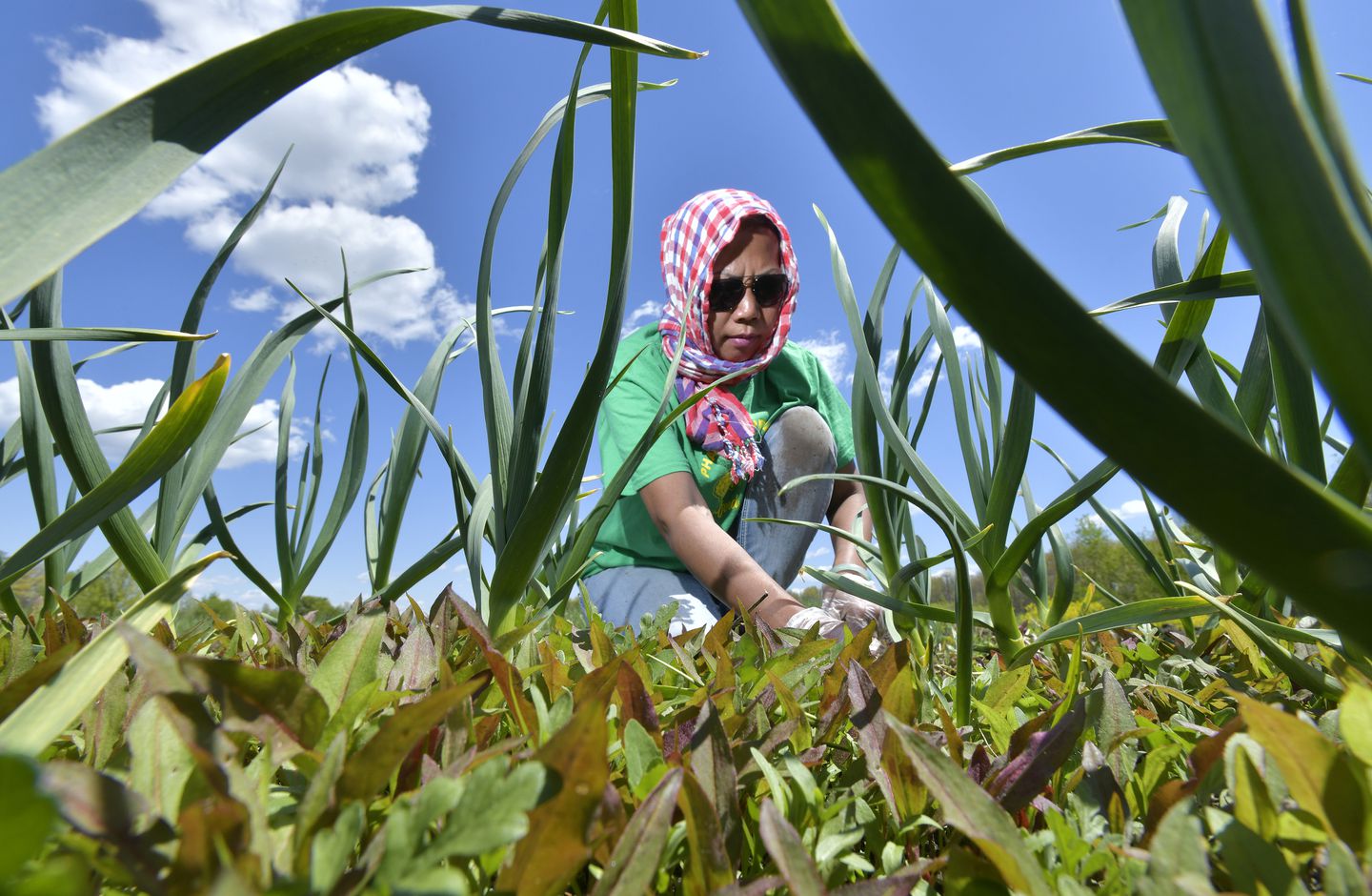
Phalla Nol of Lowell weeded rows of garlic in her plot at White Gate Farm in Dracut.

I’ve really been intrigued by the Boston Globe “States of Farming” series — “occasional stories looking at Black, indigenous, and people of color (BIPOC) farmers in New England.” Today’s article addresses how a Cambodian who arrived here as child went about building a well-respected produce business.

Jocelyn Ruggiero writes that after Phalla Nol’s family “entered the United States as refugees in October 1981, they settled in Revere. Nol spoke ‘a little bit’ of English and could understand well enough to get along at the local high school, where the students were friendly. The adults in the community weren’t as welcoming.”

After an act of arson that left Nol’s family homeless, they rebuilt their lives in Greater Boston, got jobs, and made friends.

Her father “was 71 in 1998 when he retired from the New England Seafood Company and was among the first participants in the New Entry Sustainable Farming Project, an initiative of Tufts University’s Friedman School of Nutrition Science and Policy. The farmer training program supported his plot at Smith Farm, a training site owned by the Dracut Land Trust, where New Entry trained him in such skills as sourcing seeds, selling produce, using small farm equipment, pest and disease management, and drip irrigation. …

“Although Nol ‘loved the farm,’ it didn’t generate enough revenue to interest her. ‘He didn’t care about money, but me, I do care about the money.’ Beginning around 2007, however, Nol saw an opportunity for profit. She began purchasing produce from Cambodian New Entry farmers and graduates and resold those vegetables at local farmers’ markets. This proved to be a financial success.

“In 2013, New Entry found that they had more Southeast Asian crops from their Cambodian farmers than they could use in their CSA. So Hashley approached Nol with a proposition.

“ ‘Phalla was . . . already organizing and buying and selling from other farmers for her own markets,’ [New Entry director Jennifer Hashley] said. New Entry proposed that Nol become a ‘broker’ of sorts between the farmers and Whole Foods. ‘We helped her get the necessary insurance and distributor’s license she needed to aggregate orders among the farmers and sell directly to Whole Foods. We also connected her to Russo’s in Watertown to do similar wholesale sales.’ …

“Tony Russo, the owner of Russo’s in Watertown, has nothing but respect for Nol after doing business with her for eight years. ‘Phalla’s remarkable. . . . She’s honest, she’s responsible, she’s skillful. All the products she gives us are always just what they’re supposed to be, never less than that, and she’s fair with her prices. She’s a very hardworking person in a very difficult business environment. She’s a tower of strength.’

“Today, Nol leases five acres from the town of Westford and a smaller plot from the Dracut Land Trust. Her sister drives from New Jersey to help every weekend, and nieces, nephews, cousins, and other relatives do what they can to chip in. Although Nol pays a couple of people to plow and till, her mother, Kimsan Ly, ‘is with me 24 hours. . . . She’s my main helper. She’s stronger than me!’ Nol and her mother begin many days at 5:30 in the morning, and some nights harvest until well after dark, preparing for farmers’ markets and wholesale deliveries. Since so much of the business’s financial success is tied to her family’s help, Nol is unsure of what the business will look like 10 years from now. ‘The older we get, the more challenging it is.’ …

“Despite the challenges and despite the uncertainty of the future, she’s proud of the business she’s built: ‘My stand, what a crazy thing,’ Nol laughs. ‘At my stand, people line up, from here to there,’ she says, making a wide gesture. ‘They fight to get to my veggies!’ ”

For more on the family’s difficult history in Cambodia and both challenges and successes in American, check out the Globe, here.

Read Full Post »

Photo: Le Lac St Jean.
Jean-Daniel Bouchard (left) in a 2011
Nutcracker. Bouchard now divides his time between ballet and his family’s farm.

I like reading about independently minded people who make surprising decisions that are perfect for them. In this story from Canada, a successful ballet dancer realized during the pandemic that keeping his family farm going is just as important to him as ballet.

CBC has the story. “A farmer in the Saguenay–Lac-St-Jean region of Quebec is striking a fine, if unusual, balance: running his family dairy farm by day and working as a classical ballet dancer by night.

“Jean-Daniel Bouchard started dancing before he turned four, and after high school he decided to try to make a career of it. His dancing took him to Banff, Alberta, British Columbia, Toronto and Montreal. In all, Bouchard spent almost nine years more or less constantly on tour. …

“But eventually, his rural Quebec upbringing as a sixth-generation farmer in St-Bruno started to call him home.

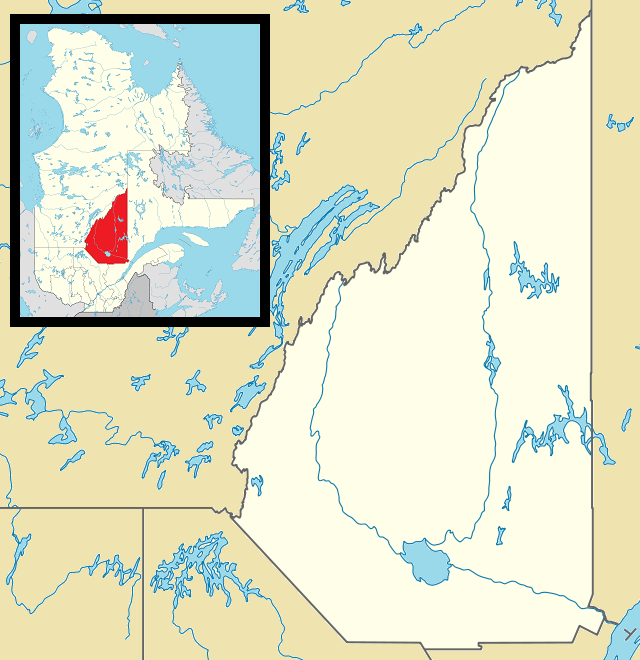
Map: Wikimedia Commons
St-Bruno, Quebec.

“Bouchard told Quebec AM that he was looking for more stability, to settle down, and his two older brothers were not especially interested in taking over the farm.

‘I thought it would be really sad to lose this family treasure,’ he said. ‘So I thought I could do both — I could come back here, start a company and dance, and do the farming with my dad.’

“Bouchard said although his twin passions may seem like something of a contradiction — farming can be gruelling physical labour and involves plenty of financial mathematics, versus an art form that depends on imagination and creativity — they help him find balance.

” ‘I think this is the perfect match for life,’ he said. ‘You have more stable work and then you can let go of the stress with dance.’

“Plus, there are physical benefits. Bouchard said farm work makes him stronger, which helps with his dancing, whereas the repetitive movements and stretching he uses for ballet help him prevent injury in the barn.

“With theatres closed due to the COVID-19 pandemic, Bouchard is both taking and teaching virtual dance classes. …

” ‘We can’t wait for the studios to open again so we can get back into a full dance ballet class, and to be able to move from a space in the studio to the other end,’ he said. …

“Bouchard said he sometimes misses touring and will dream he’s off dancing somewhere else, but he’s happy with the life he chose as both a farmer and a dancer. … ‘The point should be to be happy,’ he said.”

More at CBC, here. I can’t help wondering how Bouchard will manage when his father is no longer able to work. Somehow, I’m confident he’ll figure it out.

Video by Romy Boutin St-Pierre

Read Full Post »

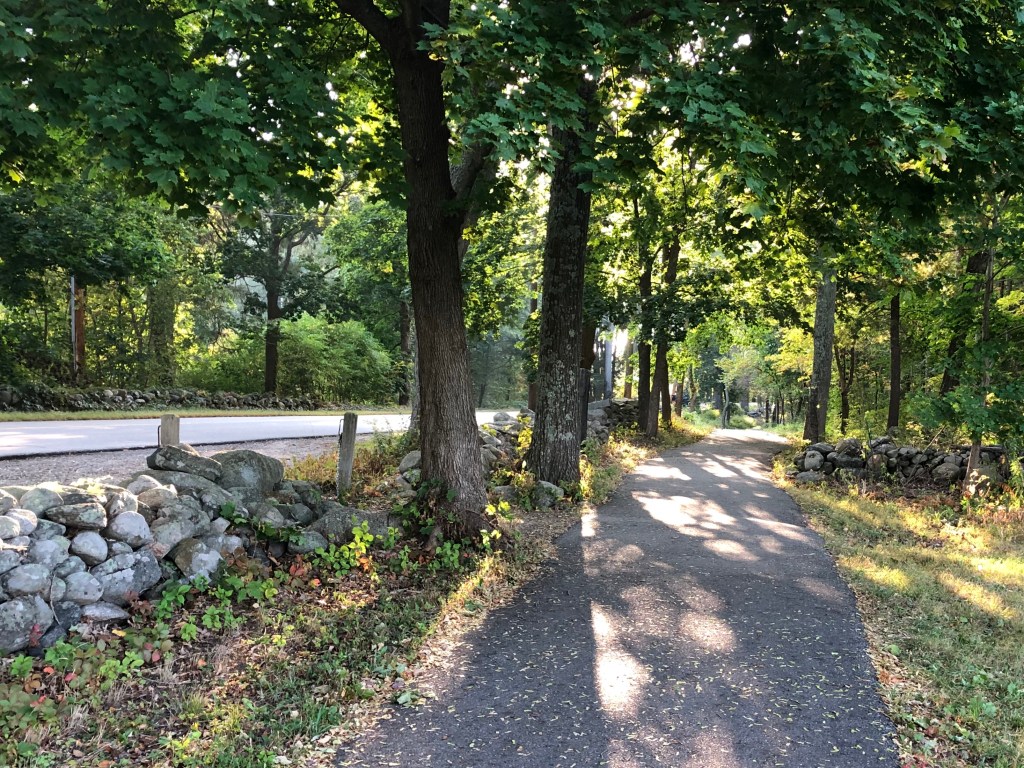
Bike path, Lincoln, Massachusetts

If you’re not traveling, you get to know your own neighborhood really well, both how it looks and sounds and smells, and what people are thinking about.

It can get complicated. People on the same side of an issue can disagree. Today for example, a small group of people is holding a rally to condemn our church, of all things! Another group, which I ordinarily admire, plans a counter-demonstration, even though the church has requested that no one show up to give the extreme talk show host the confrontation video she seeks.

Some days, you just have to turn to nature.

Above is a bike path I especially love. It goes past a farm with pigs and cows. I learned the farm has an honor-system, 24/7 shop in a big, airy barn. The food I got there was great. We had it last night for dinner.

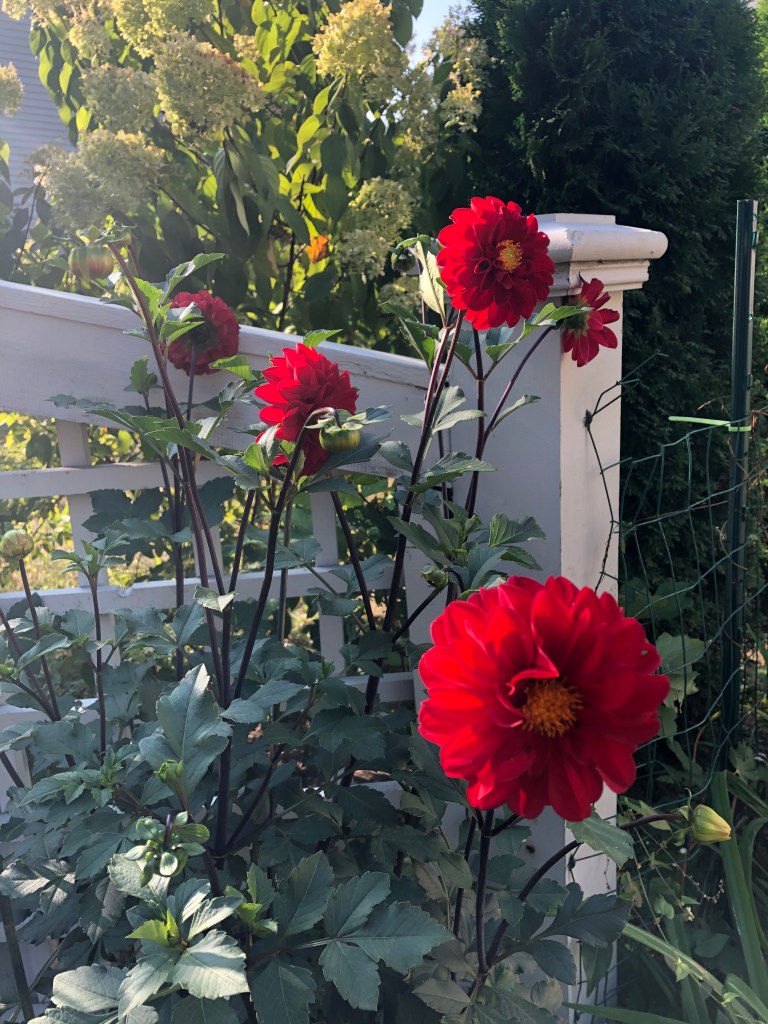
I took the first picture of dahlias, and Kristina took the one from a Western Massachusetts dahlia farm. Did you know you have to bring dahlias in every year and replant them the next year? Whoa!

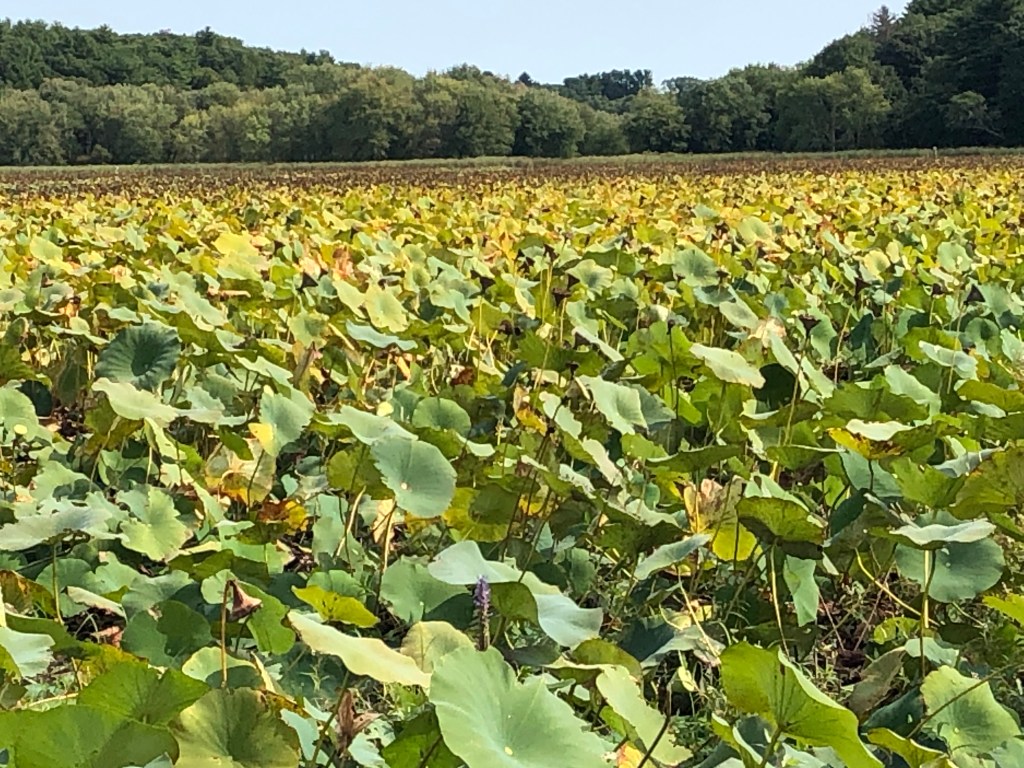
At the nature preserve Great Meadows, I was astonished by lotus leaves as far as the eye can see. Next year, I will definitely come when the plants are blooming.

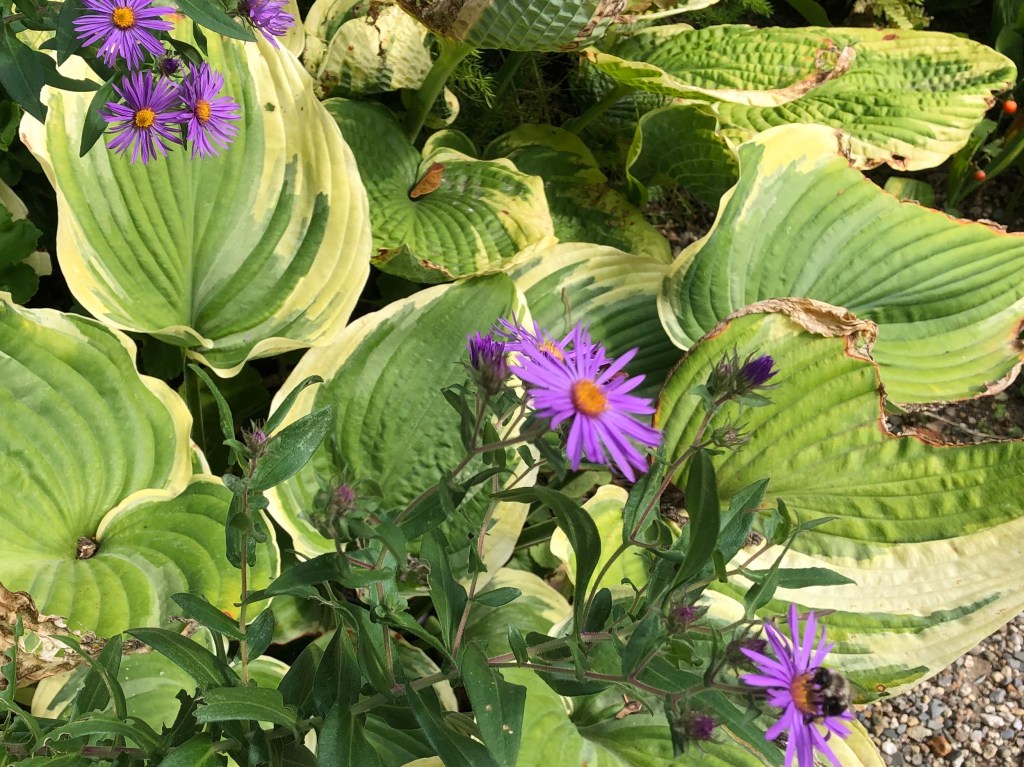
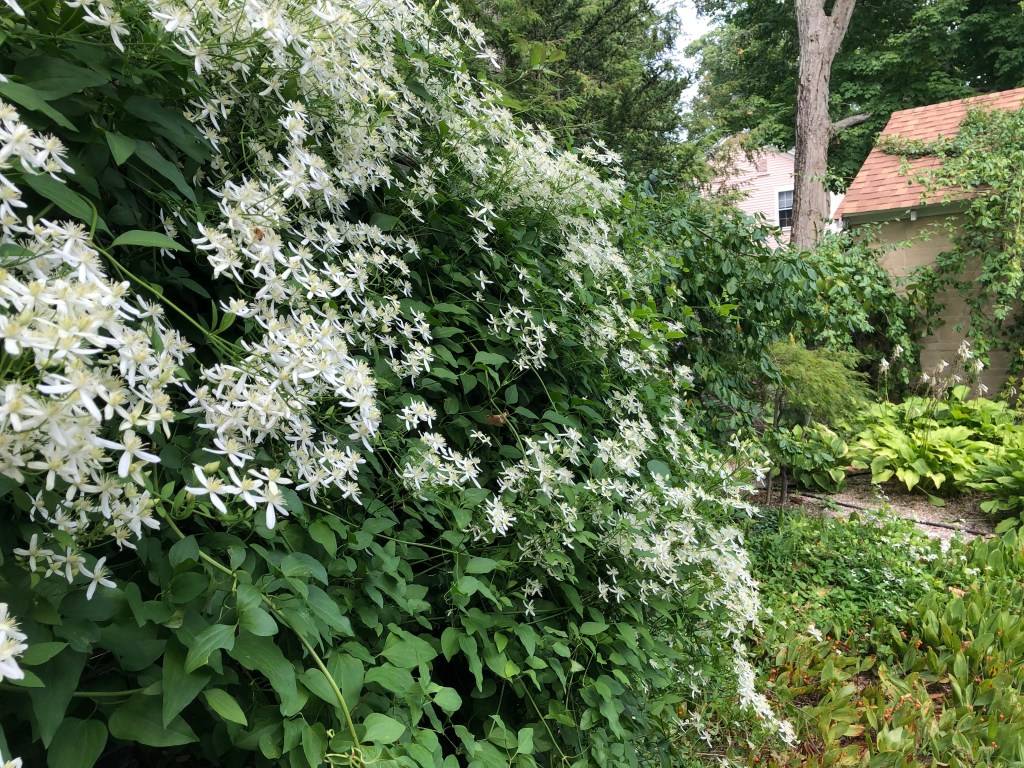
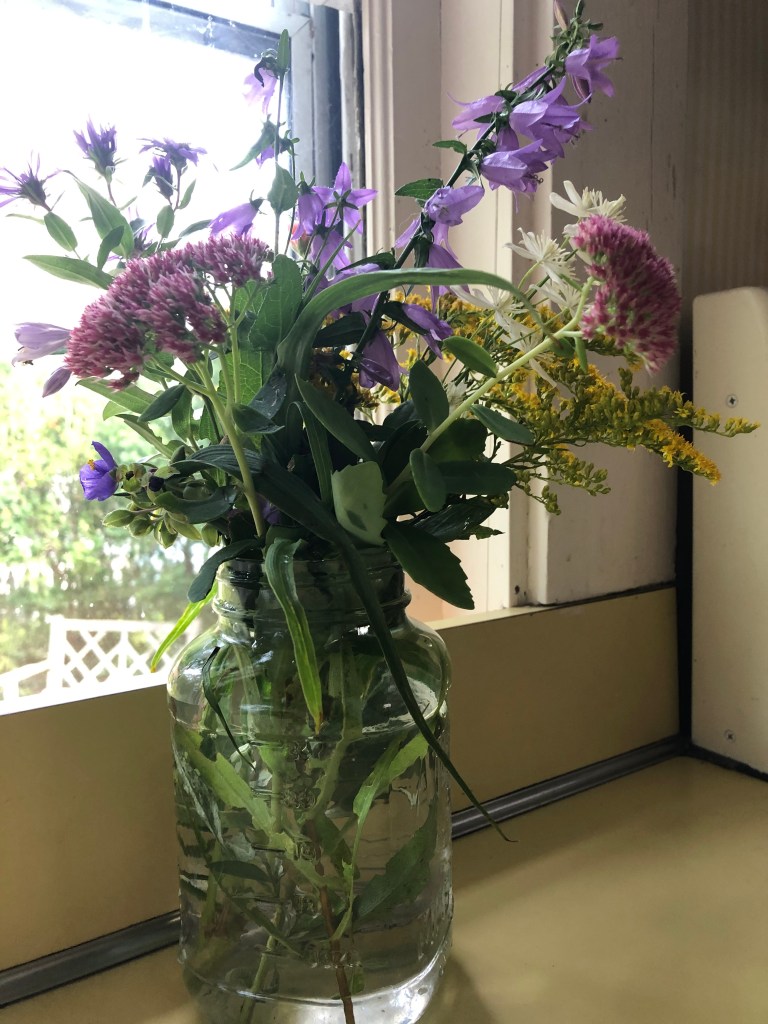
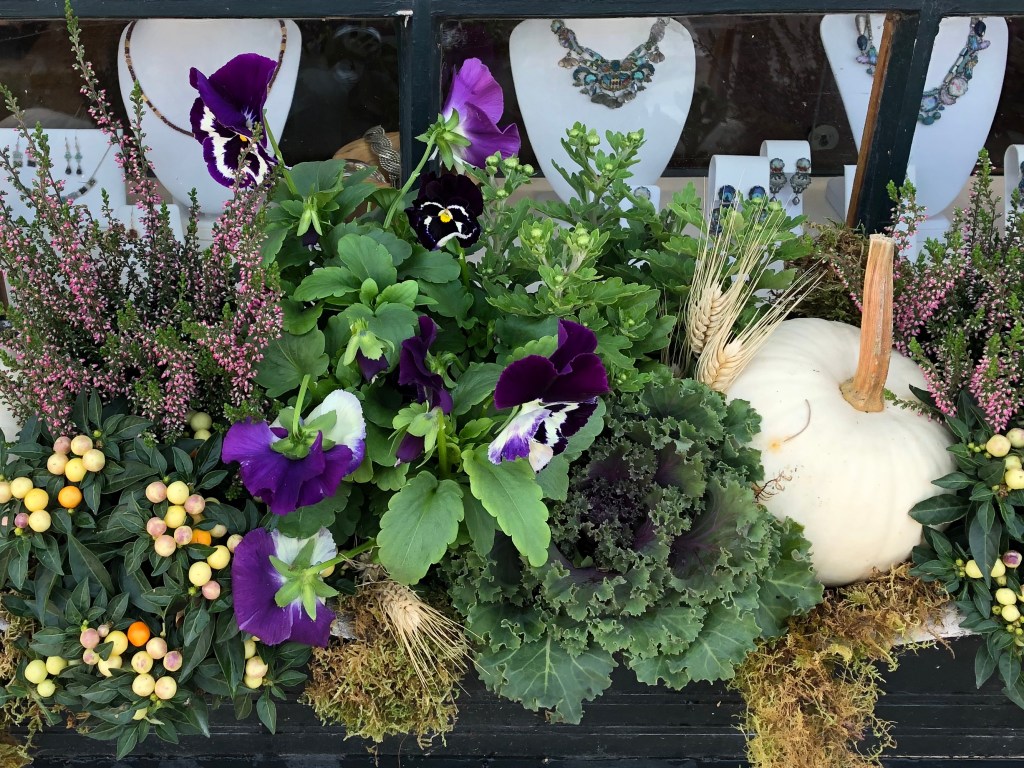
The flowers in the next three photos — asters, clematis virginiana, and a wild bouquet — are mostly from our yard. Then there’s a local jewelry shop, which has wonderful window boxes in every season.

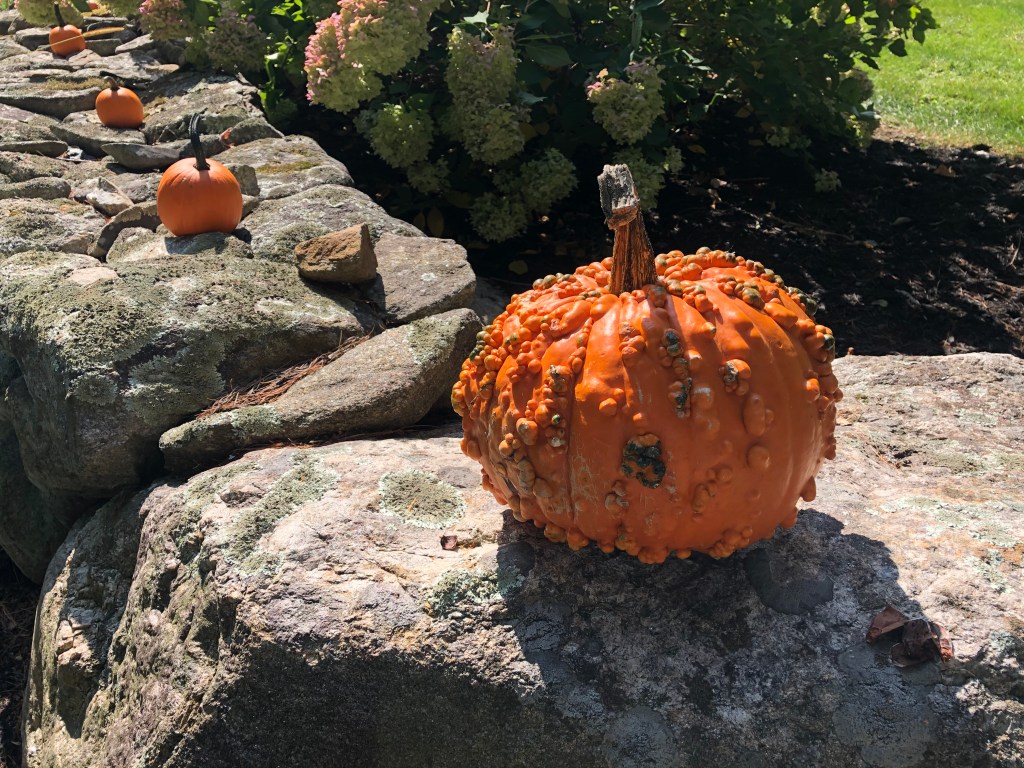
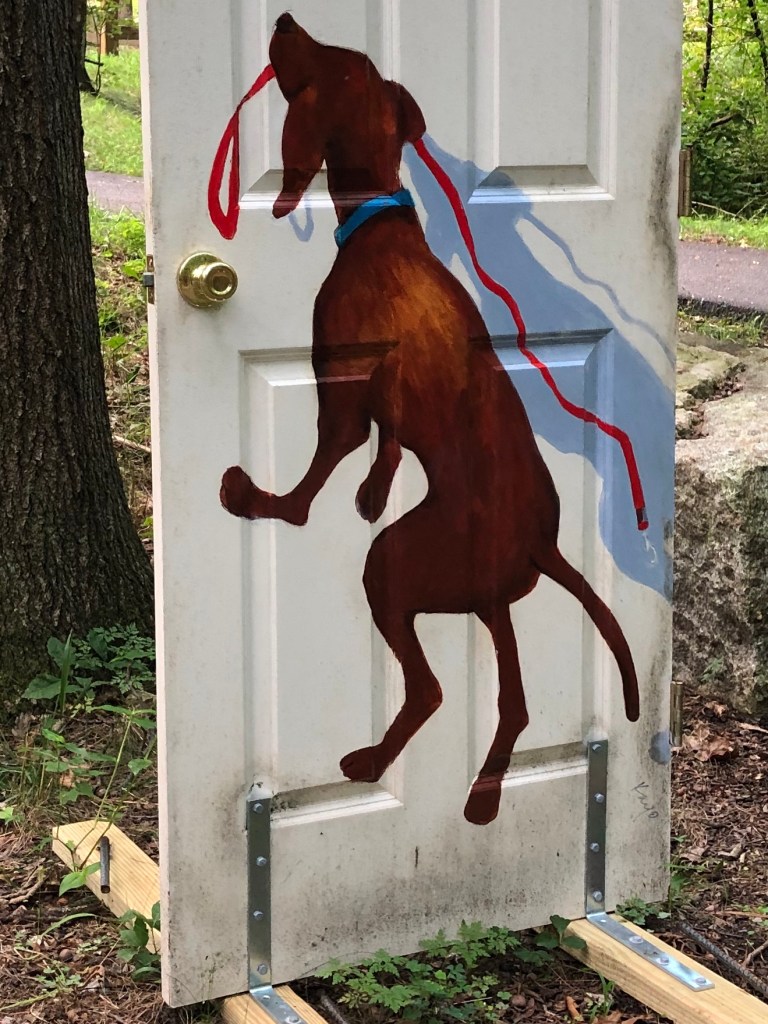
After the pumpkins, there’s a painted door called “Walkies,” by Kayo Burmon, located on the Bruce Freeman bike trail.

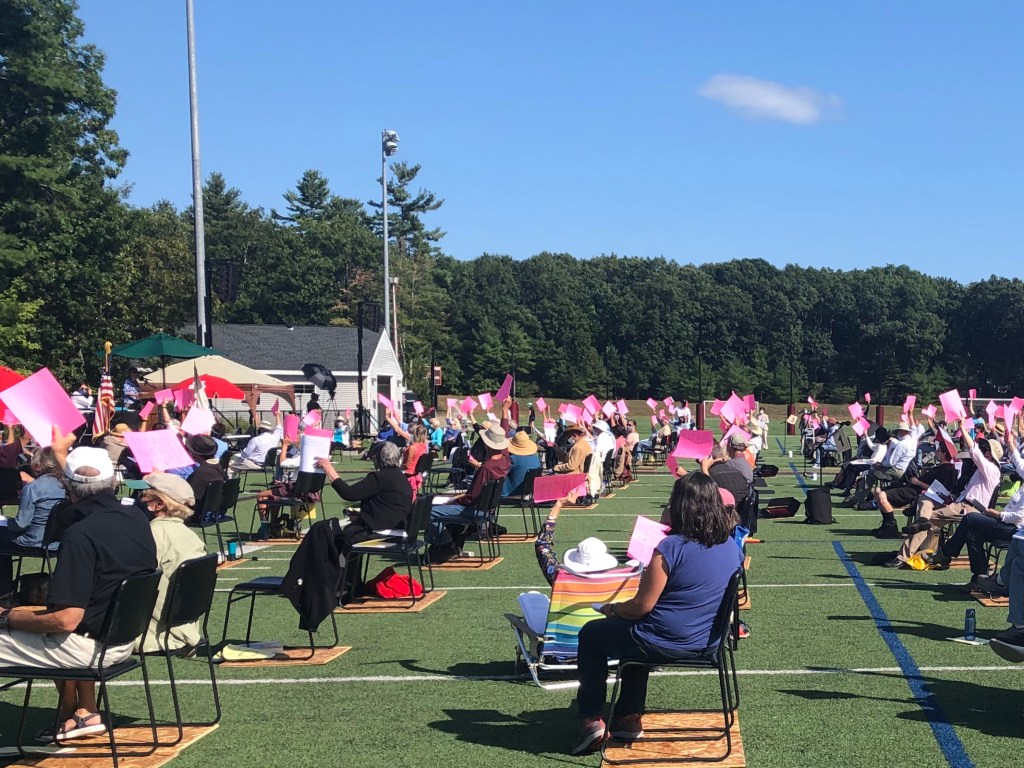
In the picture after that, my neighbors are holding up their pink voting slips at the coronavirus outdoor town meeting. Signs of the times.

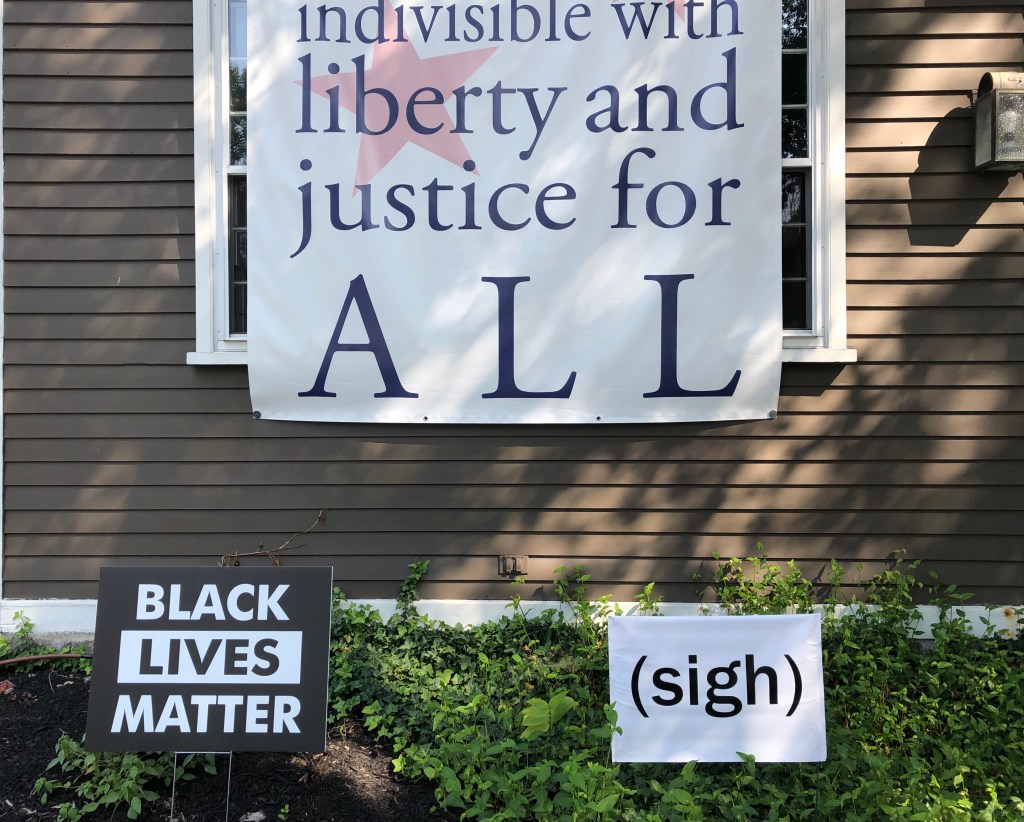
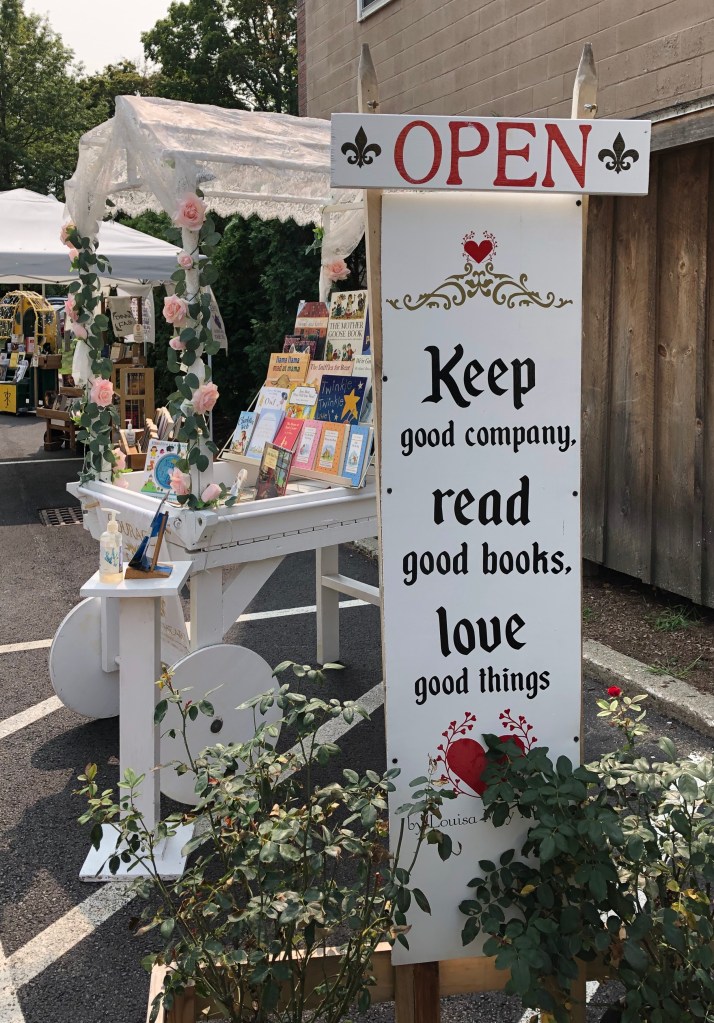
Literal signs of the times, below, need no discussion, although I do wonder if any of you know the code in the sign copied from Tolkien: “Speak, ‘Friend,’ and enter.”

Read Full Post »

img_2495_custom-67b416e668a5cfa1cb29c0344380143ce08b2baf-s600-c85

Photo: Allison Aubrey/NPR
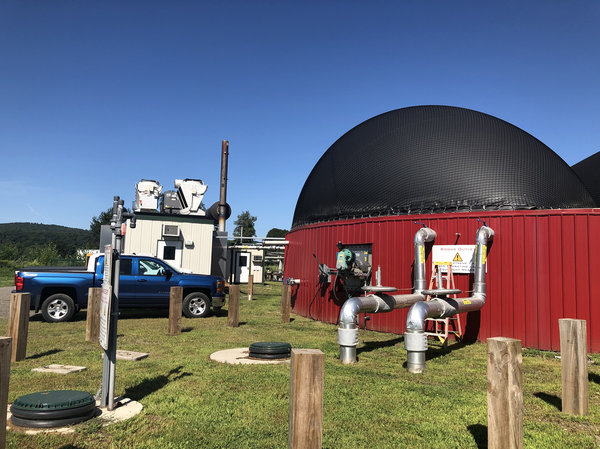
In the digester on his farm, Peter Melnik combines food waste with manure from his cows. The mixture cooks at about 105 degrees Fahrenheit. As the methane is released, it rises to the top of a large red tank with a black bubble-shaped dome to create electricity.

People are complicated. Even companies are complicated. Just the other day, I noted that I avoid Whole Foods because there is already enough money going to Amazon owner Jeff Bezos. Today I give you a story about something Whole Foods is doing for the environment.

Alison Aubrey reported the story for the PBS NewsHour and National Public Radio (NPR).

“If you piled up all the food that’s not eaten over the course of a year in the U.S., it would be enough to fill a skyscraper in Chicago about 44 times, according to an estimate from the U.S. Department of Agriculture.

“And, when all this food rots in a landfill, it emits methane, a powerful greenhouse gas that contributes to climate change. In fact, a recent report from the United Nations from a panel of climate experts estimates that up to 10 percent of all human-made greenhouse gas emissions are linked to food waste.

So, here’s one solution to the problem: Dairy farmers in Massachusetts are using food waste to create electricity. They feed waste into anaerobic digesters, built and operated by Vanguard Renewables, which capture the methane emissions and make renewable energy.

“The process begins by gathering wasted food from around the state, including from many Whole Foods locations. We visited the chain’s store in Shrewsbury, Mass., which has installed a Grind2Energy system. It’s an industrial-strength grinder that gobbles up all the scraps of food the store can’t sell, explains Karen Franczyk, who is the sustainability program manager for Whole Foods’ North Atlantic region. …

“While Whole Foods donates a lot of surplus food to food banks, there’s a lot waste left over. Much of it is generated from prepping prepared foods. Just as when you cook in your own kitchen, there are lots of bits that remain, such as onion or carrot peel, rinds, stalks or meat scraps. The grinder turns all these bits into a slurry. …

“From here, the waste is loaded into a truck and sent to an anaerobic digester. ‘There’s no question it’s better than putting it in the trash,’ Franczyk says. She says the chain is committed to diverting as much waste as possible and aims for zero waste. …

“We visited Bar-Way Farm, Inc. in Deerfield, Mass. Owner Peter Melnik, a fourth-generation dairy farmer, showed us how his anaerobic digester, which is installed next to his dairy barn, works.

” ‘We presently take in about a 100 tons [of waste], which is about three tractor-trailer loads, every day,’ Melnik says. In addition to all the food waste from Whole Foods, he gets whey from a Cabot Creamery in the area, as well as waste from a local brewery and a juice plant.

“In the digester, he combines all of this waste with manure from his cows. The mixture cooks at about 105 degrees Fahrenheit. As the methane is released, it rises to the top of a large red tank with a black bubble-shaped dome.

” ‘We capture the gas in that bubble. Then we suck it into a big motor,’ Melnik explains. Unlike other engines that run on diesel or gasoline, this engine runs on methane. ‘This turns a big generator, which is creating one megawatt of electricity’ continuously. …

‘We only use about 10 percent of what we make, and the rest is fed onto the [electricity] grid,’ [enough] to power about 1,500 homes.

“He says times are tough for dairy farmers, so this gives him a new stream of revenue. … In addition, he’s able to use the liquids left over from the process as fertilizer on his fields.”

More here.


Read Full Post »

arztsdawv4i6vgpa6lmbt2fbcu

Photo: Suzanne Kreiter/Globe staff
Craig and Bobby Giurleo carried wreaths out of their shop for customers. Millbrook Farm, family run for generations, was badly wounded this year by a construction road closure. Then some caring neighbors organized a
cash mob.

Six years ago I participated in a cash mob to help a longtime family-run five and dime threatened with bankruptcy. (My post on that.) I was only one of many who bought a lot of great stuff that day, and I’m happy to say the shop is still going.

Recently, another group of local well-wishers did something similar for a family-run farm, where summer and fall sales had gone down 90 percent thanks to an unconscionable road closure.

Deanna Pan wrote at The Boston Globe, “To reach Millbrook Farm from Boston, you must go out of your way. Take Route 2 west into historic Concord, past thickets of snow-drenched woods and picturesque Colonials. If you know where you’re going, you’ll find it, after a series of right turns, tucked back on the Cambridge Turnpike before the road abruptly closes to anyone passing through.

“The family-run nursery — which specializes in flowers and hanging plants in the spring, pumpkins and mums in the fall, and Christmas trees and wreaths in the winter — has survived its share of troubles.

“Sal Giurleo, 80, the brusque family patriarch, started the business 31 years ago, following in the footsteps of his father, an Italian immigrant who grew vegetables for First National grocery stores in the 1940s and ’50s. …

“When construction began on the Cambridge Turnpike this spring, sales at Millbrook Farm plummeted. Although part of the turnpike remained open, roadwork made it virtually impassable. Construction vehicles and machinery frequently blocked both lanes. Until recently, the road was dug up and unpaved. …

Shaun Giurleo, 50, Sal’s youngest son, estimates that by midsummer and fall, sales had plunged 90 percent.

“At their lowest point, they saw no more than one customer a day. Sal had to take out two loans, totaling $52,000, to keep the business afloat. They had no choice but to sell their flowers and plants wholesale at a fraction of the price they would normally charge their customers. …

“The Giurleos prepared for a tight Christmas. Sal worried he would have to take out another loan and sink deeper into debt. He was determined to stay open, no matter the cost. In late November, news of the Giurleo family’s plight proliferated across Facebook, Nextdoor, and e-mail as residents of Concord and beyond urged their friends and neighbors to patronize the struggling Millbrook Farm. …

“The Giurleos’ Christmas miracle arrived early, on the Wednesday before Thanksgiving. Millbrook Farm was unusually busy for a weekday, which Shaun thought was odd. But nothing could have prepared the Giurleos for what happened on the Friday after the holiday. From 9 a.m. until sundown, cars parked up and down the turnpike, as many as 20 at time. The crowds were unlike anything they’d ever seen, driving from as far as Natick and Saugus.

“It was the busiest day in Millbrook Farm’s history. Shaun guesses they sold between 350 and 400 Christmas trees, about half their lot. Saturday was even busier. … At least 10 customers paid for two trees when they only took home one. Another customer asked the Giurleos to charge him $500 for a single tree. …

“ ‘We had a million people here. We weren’t ready. We didn’t know,’ Sal said later, chuckling, …

“Millbrook Farm is now replenishing its inventory with help from other garden centers and wholesalers in the region.

“Inside the storefront [in December], an ebullient Shaun worked the cash register. Despite the weather, the nursery was humming with customers, picking up vibrant wreaths that Shaun had carefully decorated with handmade bows and other baubles, and whatever trees were left until Sal’s shipment arrived.

“The Giurleos won’t recoup all of their losses from the past year, but their business will survive until the next season. Thanks to the influx of sales, Sal immediately paid off his debts.” More here.

Read Full Post »

Older Posts »