Feeds:
Posts
Comments

Posts Tagged ‘food’

Photo: Nick Ut / AP.
A blue whale, the largest mammal on Earth, surfaces in the Pacific Ocean near Long Beach, California.

Whether we’re talking about Jonah and the whale or Pinocchio or the lobster fisherman’s uncomfortably close encounter in 2021, we humans have always been fascinated by the largest mammals on Earth. And the blue whale is the most massive of them all. But what is going on with Leviathan of late?

Shola Lawal writes at Al Jazeera that it is not singing as much as it used to.

“Unlike our musical sounds, those produced by whales are a complex range of vocalizations that include groans, clicks and whistles and that can sound like anything from the mooing of a cow to the twitter of a bird. These vocalisations can be so powerful that they can be heard as far as 10km (6 miles) away, and can last for half an hour at a time. …

“For researchers, these complex sounds are a window into whale behavior, even if humans don’t yet know exactly how to decode them.

“The frequency of songs and their intensity can signal various things: an abundance of food, for example. In recent studies, however, researchers have been alarmed to find that blue whales, the largest whales and, indeed, the largest mammals on Earth, have stopped singing at specific times.

“Their eerie quietness, scientists say, is a signal that ocean life is changing fundamentally. The most recent study, conducted by scientists from the Monterey Bay Aquarium Research Institute in California in the US and published in February, examined three types of whales. Researchers found that blue whales, in particular, have become more vulnerable to this change.

“Whale songs are critical for communication between males and females when mating and among schools of whales migrating. …

“The first study, conducted in the sea waters between the islands of New Zealand between 2016 and 2018, was led by scientists from the Marine Mammal Institute at Oregon State University in the US. Over that period of time, researchers tracked specific blue whale vocalizations linked to feeding (called D-calls) and mating (called patterned songs).

“Researchers used continuous recordings from underwater devices called hydrophones, which can log sounds over thousands of kilometers, and which were placed in the South Taranaki Bight – a known foraging spot for blue whales off the west coast of New Zealand.

“They discovered that during some periods, particularly in the warmer months of spring and summer when whales usually fatten up, the frequency and intensity of sounds related to feeding activity dropped – suggesting a reduction in food sources. That decline was followed by reduced occurrences of patterned songs, signaling a dip in reproductive activity.

” ‘When there are fewer feeding opportunities, they put less effort into reproduction,’ lead researcher Dawn Barlow told reporters. The results of that study were published in the journal Ecology and Evolution in 2023.

“Then, in a study published in the scientific journal PLOS One in February [2025] researchers tracked baleen whale sounds in the California Current Ecosystem, the area in the North Pacific Ocean stretching from British Columbia to Baja California. Blue whales are a type of baleen whale, and the study focused on them, alongside their cousins, humpback whales and fin whales.

“Over six years starting in 2015, the scientists found distinct patterns. Over the first two years, ‘times were tough for whales,’ lead researcher John Ryan, of the Monterey Bay Aquarium Research Institute in California, noted in a press statement, as the whales, particularly blue whales, were found to be singing less. Over the next three years, however, all three whale species were back to singing more frequently, the study noted.

“Both studies found one main reason for the reduction of whale song: food or, in this case, the lack of it. It turns out that the research, conducted between 2015 and 2020, captured periods of extreme marine heatwave events that killed off krill, the small shrimp-like animals that blue whales feed on.

“Those heatwaves are part of a looming environmental catastrophe … caused by high-emission human activities, chief among them being the burning of fossil fuels. …

“Krill, which blue whales primarily feed on, are highly sensitive to heat and can all but vanish during heatwaves, the studies found. Their movement patterns also change drastically: instead of staying together, as they usually do, krill disperse when it is hot, making them harder for predators like blue whales to find.

“Typically, when foraging, blue whales sing to others to signal that they have found swarms of krill. … Heatwaves can also trigger harmful chemical changes in the oceans that encourage the growth of toxic algae, which causes poisoning and death to mammals in the oceans and sea birds, researchers have previously found, suggesting that blue whales are also at risk of being poisoned.

“In the more recent study in California, researchers found that in the first two years when whales were singing less frequently, there was also a reduction in other fish populations. …

“ ‘Compared to humpback whales, blue whales in the eastern North Pacific may be more vulnerable due to not only a smaller population size but also a less flexible foraging strategy,’ Ryan, the lead author of the California study said in a statement. …

“It is likely, both studies say, that blue whales need to spend more time and energy finding food when it is scarce, instead of singing.”

At Al Jazeera, here, you read about climate change effects on other species, too.

Read Full Post »

Photo: Riley Robinson/Staff.
Organic farmers Kayleigh Boyle and Doug Wolcik stand in a hoop house at Breadseed Farm in Craftsbury, Vermont.

‘I have long believed this is a bipartisan issue,’ says John Klar, a Vermont farmer who in 2022 ran for a Vermont state Senate seat as a Republican.

One reason I like the Christian Science Monitor is that it’s so good at searching out stories of divided Americans coming together. Today’s example features a diverse group of Vermont farmers promoting sustainable practices and eat-local values.

Stephanie Haines writes, “Kayleigh Boyle and Doug Wolcik knew all the reasons not to farm in Vermont: the short growing season, the hilly terrain, the dirt roads that make it hard to get products to market.

“Even the size of most farms here is a problem. For decades, farms across the United States have gotten larger as agricultural policies pushed growers to consolidate and scale up their operations. Vermont’s farms, however, have stayed relatively small. According to conventional wisdom, that means unprofitable.

“But small was what the couple wanted. Ms. Boyle is from Vermont, and while studying at Emerson College in Boston, she worked an office job connected to the local food movement. But she quickly realized she wanted to be outside with her hands in the earth.

“Mr. Wolcik graduated from the University of Massachusetts Amherst, where he studied sustainable agriculture and community food systems. He, too, realized he wanted a life close to the soil.

“They met while working at a nonprofit farm outside Boston and soon discovered they shared a dream about buying their own acreage to grow food and flowers. They weren’t interested in a massive operation. Instead, their vision included no-till growing methods, hand tools, and a desire to build a ‘human scale’ production system.

“They also wanted to make their living entirely from their farm – something increasingly difficult to do in New England. Over the past 60 years, the region has lost 80% of its farmland. …

“They spent years saving money and scouring Zillow listings and USDA soil surveys online. They eventually found a 16-acre property at the edge of Vermont’s rural Northeast Kingdom, complete with a house and a flat, 2-acre plot that got a lot of sun. In September 2020, they decided to take the plunge.

“And they’ve thrived. ‘We’ve just far exceeded any expectations that we set for ourselves,’ says Mr. Wolcik. ‘We’re selling everything we can. We can’t even grow enough. There’s such demand for it, from restaurants to retail to wholesale to markets,’ he says. ‘We can’t produce enough product fast enough.’

“Some of this is because of the couple themselves: Ms. Boyle’s sense of marketing, Mr. Wolcik’s attention to detail and innovation, and the experience and high standards they share as growers.

“But it is also because, when they bought these rare flat acres, they joined a community actively building a new storyline around farming, food, and resilience in New England.

“Here, in this part of little Vermont, statewide population 648,000, a coalition of farmers, nonprofits, and residents is eschewing mainstream beliefs about what makes agriculture successful and what it means to create a prosperous economy.

“Instead, they are building a system in which farmers are able to make a living and residents can eat healthy food grown nearby. They are intentionally moving away from a global supply chain vulnerable to market shocks – everything from pandemics to tariffs to natural disasters. …

“Across the country, communities on all sides of the political spectrum are reimagining the way Americans produce and value what they eat, tapping into a simmering belief that something is amiss with how detached, both economically and nutritionally, we have become from this fundamental human sector. …

“Subsistence farming gave way to commercial dairying and gardening for market. Refrigeration, and the resulting large-scale grocery stores, meant individuals didn’t need to spend their time growing food. Urbanization and competition from out-of-region farms followed.

“Still, what we think of as the modern food system is largely a phenomenon of recent decades. This includes a global supply chain, factory farming, and ultraprocessed foods, which now make up more than 50% of the calories in the American diet, according to the Johns Hopkins Bloomberg School of Public Health. What people tend to think of as the ‘local food movement’ is also relatively new. 

“[Although fascination] with locally grown organic foods became popularly associated with progressives – and was regularly criticized as elitist – there was also an emerging libertarian and conservative desire for a different, more localized sort of food system.

“ ‘I have long believed this is a bipartisan issue,’ says John Klar, a Vermont farmer who in 2022 ran for a Vermont state Senate seat as a Republican, a bid that fell short. ‘If there’s one thing that should bring Americans together, it is local, healthy food.’

“To him, the small farm is inherently conservative – a rejection of what he sees as dangerous globalism. It is a return to self-sufficiency, and far more environmentally and climate friendly, he says, than the traditionally liberal causes of electric vehicles and solar farms. …

“ ‘Both sides have been lulled by modernization of agriculture and the technological sirens,’ says Mr. Klar. ‘But both sides are coming back and coming together. These things don’t lend themselves to the red-blue dichotomy.’ ”

More at the Monitor, here. No paywall. Lots of cool pictures.

Read Full Post »

Photo: John Okot.
A volunteer for The Mango Project places mango slices in a solar dryer for preservation in Midigo, Uganda, where malnutrition is a serious issue.

One of my grandsons has had an interest in Uganda for several years — first, through learning about endangered mountain gorillas, then through helping support a start-up water business in the country. As a result, I pay extra attention to Ugandan news.

John Okot reports at the Christian Science Monitor about two brothers in Uganda who launched a mango initiative to help their neighbors.

“Francis Asiku’s plan to fight hunger in his village began, quite naturally, under a bountiful mango tree. It was 2011, and he had just landed his first nursing job at Midigo Health Centre IV in Yumbe district in northern Uganda. He was excited and joyful. But in his first month at work, Mr. Asiku was surprised to learn that what many infants and expectant mothers seeking care needed wasn’t necessarily medicine. It was nutritious food.

“He recalls one hot afternoon, in particular, when a young mother rushed into the health center with a 4-year-old child in her arms. Mr. Asiku hurried to help. He quickly diagnosed poor feeding as the root of the child’s problem. …

“He headed home on a dirt road in the inky-dark evening. When he spotted birds feasting on rotting mangoes along his path, a question struck him: Why were so many people in his community malnourished when it experienced two plentiful mango seasons a year?

“He raised the issue later that night with his younger brother, farmer Emmanuel Mao. Soon afterward, the brothers met with village elders under the huge mango tree where community meetings were held. That was the start of their nonprofit, The Mango Project, which distributes glass jars full of mangoes to schools, to health centers, and directly to hungry individuals.

“The toll of hunger in Uganda is staggering, according to the Global Hunger Index, a report published by several global nonprofits. Almost 37% of the population is undernourished, and about one-quarter of children have stunting, a condition that is associated with malnutrition.

“When Mr. Asiku and Mr. Mao met with the Midigo elders, [they said] the brothers needed to figure out a way to preserve Midigo’s abundant mangoes throughout dry periods, when they are scarce. …

“Mr. Asiku and Mr. Mao embarked on researching a simple way to preserve food. They began ‘jarrying’ – cutting fruit pulp into thin slices and putting them in a glass container of boiling-hot water and sugar. While canning is practiced throughout the world, many Midigo villagers can’t afford sugar, not to mention glass jars with secure lids. The relatively easy preservation method – and the brothers’ fundraising efforts to obtain the necessary supplies – delighted village elders. …

“The brothers initially collected mangoes that were scattered throughout the village, but have since expanded their initiative to preserve the fruit from their family’s ancestral land. The jarred fruit is safe to eat for up to a year.

“Mr. Asiku knows that the mangoes alone will not end malnutrition in the community, since humans need a balanced diet. But the initiative, he says, is a great start to breaking the hunger cycle in Midigo. …

“Irene Andruzu, who supervises one of the Midigo Health Centre’s facilities, says she receives at least 50 jars of mangoes monthly to help malnourished patients. During the pandemic alone, more than 12,000 jars of mangoes were distributed to health clinics and refugee settlements.

“Scovia Anderu, a social worker for Calvary Chapel Midigo, lauds The Mango Project for instructing villagers. She says that most villagers lack knowledge about nutrition and that there are few qualified personnel who can educate them on the subject at the grassroots.

“Zuberi Ojjo, the district health officer for Yumbe, [says] The Mango Project ‘reminds people of the importance of nutrition to our well-being.’ …

“One obstacle for The Mango Project is that charcoal, which is needed to heat the water used to sterilize jars, can be difficult to obtain. Since 2023, the government has banned commercial charcoal production in the northern region over concerns about the alarming depletion of trees there. Nevertheless, illegal, large-scale tree-cutting has disrupted weather patterns in the region, where communities rely mainly on agriculture amid erratic, unpredictable rainfall. …

“Mr. Asiku has found one alternate form of fuel. Over the years, he has been scrimping and saving, and last year he purchased a solar-powered dryer worth $600. Besides mangoes, he dries vegetables such as okra and eggplant to give to villagers.

“He hopes to distribute the food more widely as he acquires a license from the government to do so – and more dryers. He also has an orchard with 310 hybrid mango trees. This is meant to supplement the seasonal mangoes in case there is low supply because of damage caused by fruit flies.

“ ‘It’s fulfilling to see my people smiling at the end of the day,’ Mr. Asiku says.”

More at the Monitor, here.

Read Full Post »

Photo: Southside Community Land Trust.
Southside Community Land Trust high school interns making pizza. SCLT has numerous programs to ensure that locally grown produce gets to community members.  

Today’s story is about regular folks doing good things. It isn’t news. It’s common. As I scroll through all my feeds, I like to remind myself that it’s actually common.

Brooke Warner wrote at the Providence Eye about a neighborhood I know.

“The term ‘produce aggregation’ may not conjure up an image of healthy kids and families and farmers bringing good food to communities facing food insecurity. But Southside Community Land Trust’s Produce Aggregation Program is working to do just that. It’s a way to connect urban farmers to their neighbors with healthy food while at the same time connecting their small farms to new markets.

“It ‘gets fresh local food into the local community,’ said Amelia Lopez, food access associate at Southside Community Land Trust (SCLT), who works on the Produce Aggregation Program.

“Small-scale farmers typically face numerous challenges to access wholesale markets: they lack the capacity to grow large quantities; may not have access to processing facilities; and must manage the complexities of logistics and distribution required to fulfill wholesale orders.

“The Produce Aggregation Program addresses these challenges by acting as a wholesale buyer that combines the harvest of numerous urban farmers to distribute in larger quantities. The program has its own farm-to-market processing center to collect and process crops grown by the farmers and manages the logistics and distribution of the produce, making it possible for small farms to increase the scale of their businesses.

“Twenty-seven farmers regularly sell their produce through the program. Most of the farmers are refugees, immigrants, or part of other marginalized communities. More than half of the farmers who participate have plots at SCLT’s Urban Edge Farm or Good Earth Farm properties, where farmers are able to farm on larger plots of land.

“As their businesses expand and they run out of space, many farm on numerous plots in multiple community gardens and farms. Most of the farmers in the program also sell at farmers markets, but income from farmers markets can be unpredictable and unsteady, Lopez said. The aggregation program gives them another, more reliable, outlet to sell their produce. In addition, there are many years of experience among the farmers, and they are able to share this knowledge with the high school students who take part in the SCLT’s paid internship program. ..

“ ‘Sometimes there are moments when we have an abundance of some products and the program helps us to sell them,’ said Margarita Martinez, translating her husband’s comment from Spanish. Teo Martinez, a farmer from the Dominican Republic, and Margarita are commercial growers based at Urban Edge Farm. …

“Marcel De Los Santos, SCLT’s grants and communications manager, said, ‘The fight against food insecurity faces several significant obstacles that threaten its sustainability. Reducing crucial funding sources, such as the expiration of ARPA [American Rescue Plan Act] funds, has left many food assistance programs needing help to maintain their service levels. Land acquisition for food production and community gardens has become increasingly difficult as urban development drives up property costs and reduces available space.’

“Additionally, rising food and transportation costs and persistent supply chain disruptions strain food banks’ operational capacities. These challenges are compounded by the growing demand for food assistance services, climate change impacts on agricultural production, and the need for consistent volunteer engagement. …

“The [aggregation] program runs two distribution cycles each week during the growing season. SCLT orders different products in various quantities from different participating farmers and notifies them in advance of each cycle what they will be purchasing. Farmers deliver their produce to the food hub, where it is processed and packed into bags with other farmers’ produce. Each bag contains about $20 worth of fresh produce, sourced from different farmers, and is ready to be distributed … through numerous community partners that in turn give it out to their participants at no cost. Distribution partners include organizations such as health clinics, day care programs, and recreation centers. Health clinic partners … give out the produce through the VeggieRx program, where doctors give patients a ‘prescription’ of produce. …

“[As of this writing] the program us funded primarily by the USDA’s Local Food Purchase Assistance Cooperative Agreement program (LFPA), which began during the pandemic to expand access to local, healthy food and increase economic opportunities for underserved farmers. [The] program has a new home in the SCLT’s new Healthy Food Hub. …

“SCLT’s mission is to help local urban farmers by providing land access, agricultural resources, and agriculture and business training. The nonprofit supports the operation of 60 community gardens in Providence, Pawtucket, and Central Falls, including 20 land trust-owned properties.

“The Produce Aggregation Program is one of many that the SCLT runs or partners with to address food insecurity in the Providence area. Farmers markets, gardens, education programs, and internships are among further examples of the SCLT’s mission. All of these activities, like the Produce Aggregation Program, help increase access to fresh, healthy, and culturally relevant food for these urban communities and feed roughly 1,200 families annually.

“Although the growing season typically ends at Thanksgiving, the work of the SCLT continues year-round, along with its partner organizations and local businesses, farmers, volunteers, students, families, and the local community.”

Not being sure that USDA will still fund programs like those, I suspect this could be another worthy cause that will have to rely on private fund raising.

More from the Providence Eye via ecoRI News, here.

Read Full Post »

Photo: Francine Kiefer/The Christian Science Monitor.
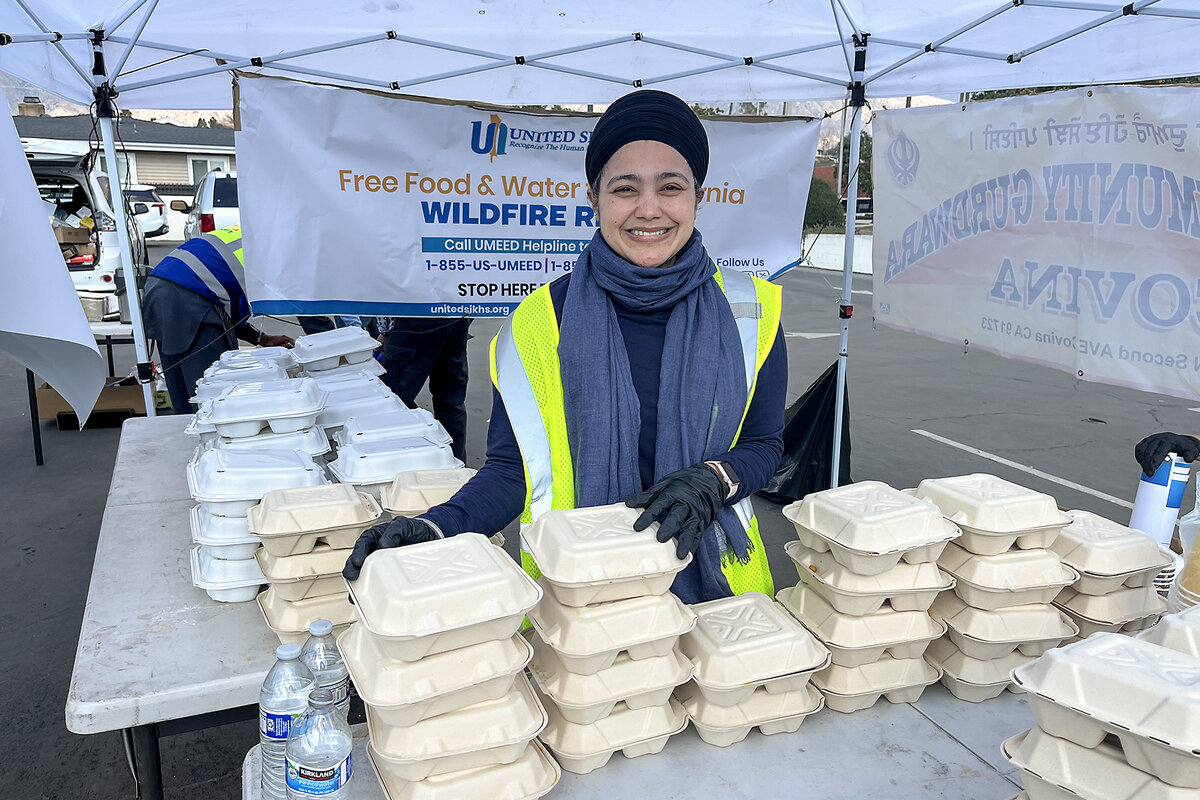
Meetan Kaur, of United Sikhs, stands with hot meals of basmati rice and chickpea curry for fire evacuees at the Pasadena Church East Campus donation center, Jan. 17, 2025.

Despite the loss of many houses of worship in the recent Southern California fires, faith communities are rising up to help others. And helping others others is helping the volunteers themselves begin to feel hopeful. (Scientologists? Why not? We are all human beings in a disaster.)

Francine Kiefer and Sophie Hills write at the Christian Science Monitor, “Cars pull into the Pasadena Church parking lot, waved forward by a couple of Scientologists. Christian volunteers hand out groceries and diapers. Orange, yellow, and black turbans dot the crowded lot, as Sikh volunteers dish out hot chickpea curry and basmati rice and cups of steaming chai.

“The line of cars stretches around the lot. Volunteers pass meals through car windows and load back seats with pet food, toiletries, and paper goods. Some Sikhs traveled from as far as New York and Canada to cook and serve meals to people displaced by the wildfires. The chai, especially, gets five-star reviews from volunteers and evacuees alike.

“ ‘That’s what we’re really hoping to do here – it’s really offering solace, offering comfort, in this absolutely crazy time,’ says Meetan Kaur, an organizer with United Sikhs, an international aid organization.

“The Eaton Fire destroyed thousands of homes, schools, restaurants, and businesses. Houses of worship burned, too. But their congregations are still here, gathering to pray in borrowed spaces and distributing food and clothing. …

“Organized religion provides space for worship and spiritual study, but it can be especially helpful when disasters strike because there’s already ‘a built-in system of caring,’ says Cynthia Eriksson, a dean at Fuller Theological Seminary, who specializes in the intersection of faith and mental health. …

“At the Pasadena Church, Chanel Jackson is loading up SUV after SUV with free groceries. She attends the Faithful Central Bible Church in Inglewood, clear across Los Angeles. But she’s driven to this donation and distribution center by both her faith and her roots.

“Ms. Jackson grew up in Altadena, so like several other volunteers, she says this is personal. Two of her schools burned. She knows some of the people in line. Sporting a ‘Dena’ T-shirt – that’s what folks call the Altadena-Pasadena area – she talks about the imperative from Scriptures to help the poor.

“ ‘A lot of people – their faith is shaken,’ she says. ‘They’re questioning God – “Why me?” – which I completely understand and empathize with. But God is in the people; God is in the angels. God is in the people that are here at this relief center, trying to help families in need.’ …

“The tragedies and hardship calls on a core aspect of faith: community. ‘It’s about the connection to something bigger than ourselves,’ says Rabbi Joshua Levine Grater, the director of Friends in Deed, a local interfaith nonprofit. His family lost its house in the Eaton Fire, as well as its synagogue, where he was once head rabbi and is now a congregant. …

“But leaders rescued 13 Torah scrolls before the building burned. When the fire died, one wall remained, etched with a mural that members didn’t know was hiding behind drywall. It depicts people and animals in the desert, beneath a single palm tree. …

“Founded 130 years ago, Friends in Deed focuses on the most needy people, operating a food pantry and providing housing assistance and case management. Since the fires, the requests for help have only increased. But so have the donations and volunteers.

“Despite the uncertainty his family and so many others face, there’s only one choice, says Rabbi Grater. ‘We have to find the courage to rebuild a step at a time.’ … The teachings and stories of the Torah are there as ‘reminders that there’s still an immense amount of love in the world.’

“In Altadena, at least five different places of worship succumbed to the wildfire. … First Church of Christ, Scientist, Altadena, whose edifice was spared, says it plans to share its space with nearby congregations once it’s safe to return. …

“For some, that generosity is central to their faith. A gurdwara is not just a place of worship, but also a place to coordinate and supply aid, says Gurvinder Singh, international humanitarian aid director for United Sikhs.

Seva, which translates to ‘selfless service,’ is a call to action, says Mr. Singh. That goes hand-in-hand with the tradition of langar, a community meal.

“ ‘It’s really the basis of humanity,’ says Ms. Kaur at the Pasadena Church. ‘It’s bonding through food.’ ”

More at the Monitor, here. Also, see how LA libraries are helping, here. No paywall.

Read Full Post »

Photo: Melanie Stetson Freeman/CSM.
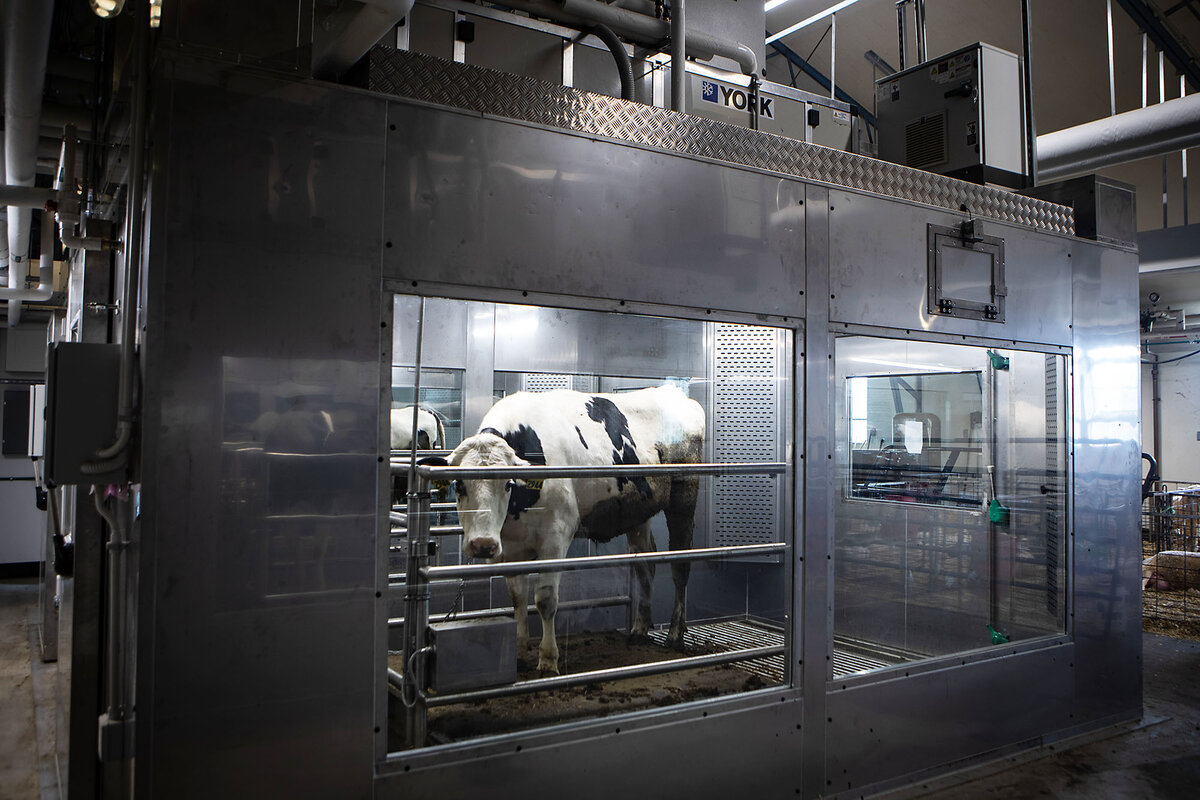
A heifer stands inside a methane chamber at Cornell University, June 7, 2024, in Ithaca, New York. Researchers are studying how to reduce methane emissions from dairy cows.

When he was only 11, one of my grandsons gave up eating beef after learning in school about the effects of cows’ methane emissions on global warming.

I guess it’s fortunate that there are people researching ways to make cows “less gassy.” But some of the research sounds like it’s not much fun for the cow.

Stephanie Hanes of the Christian Science Monitor reported recently on work at Cornell.

“On the campus of Cornell University, within an intricately monitored and carefully sealed chamber, there is a cow. Scientists carefully record what this cow eats and what she drinks. They open the chamber only once a day, so as to limit disturbances to her environment. Every breath she takes – or more crucially, exhales – is also measured to its molecular level. There is hydrogen. There is carbon, recorded down to its isotopic composition. There is oxygen. And, most important to this state-of-the-art study, there is methane.

“Methane is a naturally occurring gas that comes from a variety of biological and industrial sources, from oil- and gas-well leaks to decomposing garbage to, well, cow burps. It is also one of the world’s most potent greenhouse gases – far more heat-trapping than carbon dioxide. …

“ ‘There is growing awareness amongst environmental advocates, policymakers, that reducing methane emissions is the fastest way to reduce warming,’ says Dan Blaustein-Rejto, director of food and agriculture at the nonprofit Breakthrough Institute. …

“Although exact percentages are difficult to determine, researchers estimate that cows are responsible for around 30% of U.S. methane emissions. This is largely because cattle, like goats or sheep, are ruminants: animals with four-chambered stomachs that ferment grass and other vegetation into consumable food. And a natural by-product of rumination is methane. …

“According to the U.S. Department of Agriculture, there are 28.2 million beef cattle in the U.S., along with 9.36 million dairy cows and 33.6 million calves. And those numbers pale in comparison to countries such as India, which has an estimated 61 million milk cows, or Brazil, with around 234 million beef cattle. 

“With growing pressures from policymakers and climate advocates, then, agribusiness and scientists are trying to figure out how to make individual dairy cows more productive, which could lead to smaller herds, while at the same time trying to find ways to make cow burps — the body function that produces the most methane — less gassy.

“The first step to doing that, says Cornell associate professor Joseph McFadden, is to get good measurements of bovine methane in the first place. …

“ ‘The challenge comes in capturing the methane,’ says Joe Rudek, lead senior scientist at the Environmental Defense Fund. ‘Cows are breathing out this methane. You’ve got them walking around in a pasture, how do you capture that methane that’s coming out of the cows’ mouth and nostrils?’

“So instead of individually measuring each cow, scientists are trying to build up a robust sample size of measurements that would let them statistically predict methane emissions, both broadly and specifically. One contraption they use now is called the GreenFeed – basically a high-tech box with cow treats. When the cow puts her head into it to eat, the box measures methane and other gases. These instruments are portable, so theoretically farmers can use them in different locations.

“But, Dr. McFadden says, those measurements are not always exact. That’s why his respiration chambers are important. Because the pods are highly accurate, closed systems, they can calibrate other machines. … The chambers can help him monitor other inputs and outputs that can give clues about animal health and well-being, and about how the animal uses energy – as well as about other greenhouse gases, such as nitrous oxide. …

“Across the country, at the University of California, Davis, professor Ermias Kebreab is also working with dairy cows, and has his eye on some solutions. In addition to feed additives, he is measuring what happens when cows eat local agricultural by-products, such as the grape residue from winemaking. GreenFeed measurements are finding some promising initial results, he says.   

“ ‘We found a 10% to 12% reduction in emissions,’ he says. ‘Animals were happy to eat it … and it avoids the emissions from putting it into a landfill.’ Not only that, he says, but grape pomace — the fruit’s leftover skin, seeds, or stems — seems to improve milk quality. 

“ ‘It’s a win-win kind of situation,’ he says.”

More at the Monitor, here.

Read Full Post »

Photo: Loren Biser/Unsplash.
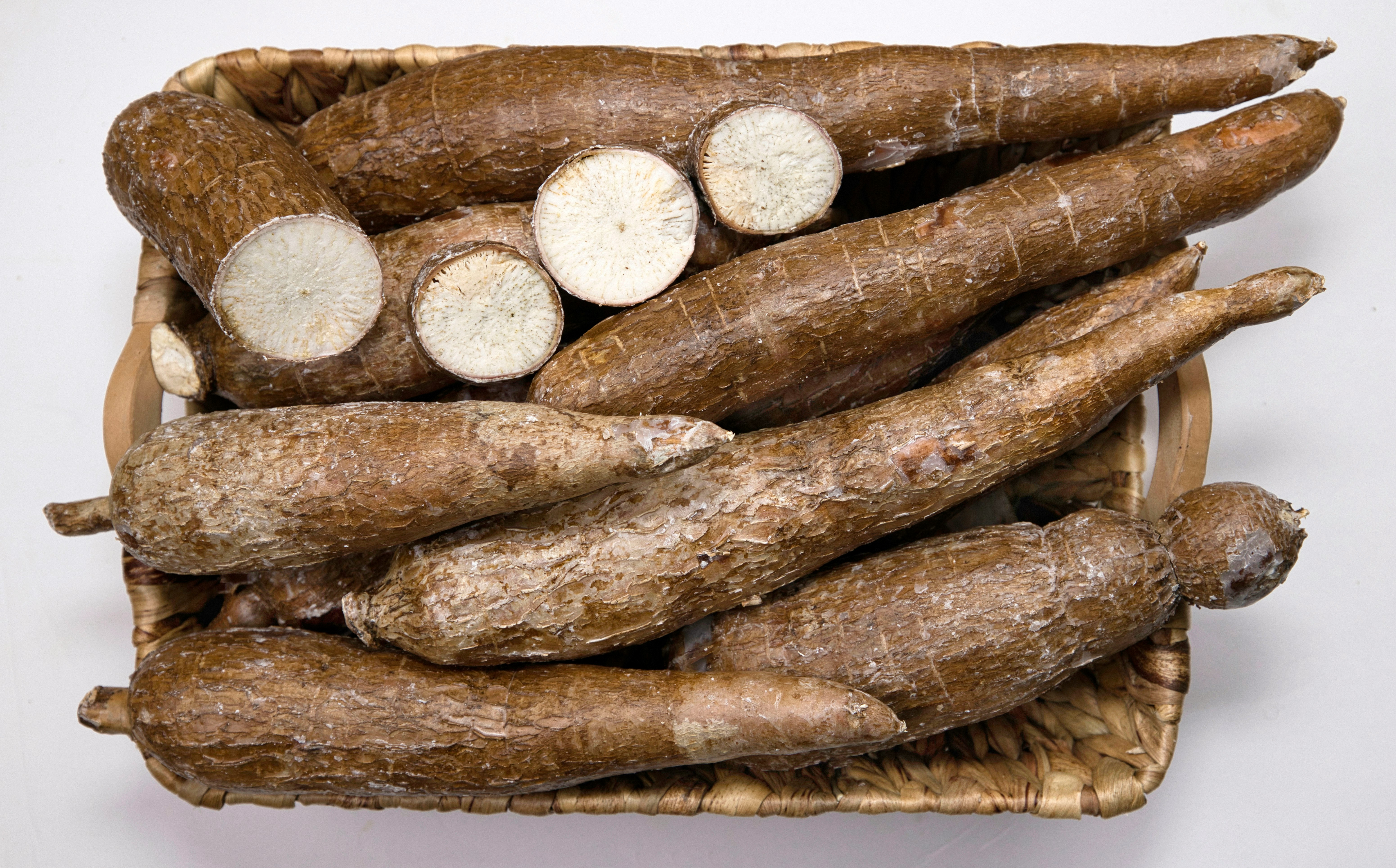
Cassava’s humble appearance belies an impressive combination of productivity, toughness and diversity,” says the Washington Post. But it has to be detoxified.

As Planet Earth keeps adding more people, many of the crops to feed them are suffering from climate change. What is the answer? Are there foods that are both nourishing and relatively easy to produce?

Stephen Wooding, an assistant professor of anthropology and heritage studies at the University of California at Merced, writes at the Washington Post about a food that is both. It just has a little toxicity problem.

“The three staple crops dominating modern diets — corn, rice and wheat — are familiar to Americans. However, another top crop is something of a dark horse: cassava.

“While nearly unknown in temperate climates, cassava is a key source of nutrition in the Southern Hemisphere. It was domesticated 10,000 years ago, on the southern margin of the Amazon basin in Brazil, and spread from there throughout the region. … There’s just one problem, however: Cassava is also highly poisonous.

“So, how can cassava be toxic, yet still dominate diets in Amazonia? It’s all down to Indigenous ingenuity. For the past 10 years, my collaborator, César Rubén Peña, who is of Cucuna heritage and grew up on the rivers of Amazonia, and I have been studying cassava gardens on the Amazon River and its myriad tributaries in Peru. We have discovered scores of cassava varieties, growers using sophisticated breeding strategies to manage its toxicity and elaborate methods for processing its dangerous yet nutritious products. …

“A little more than 10,000 years ago, [hunter-gatherers] cleared the hurdle with one of the most transformative innovations in history: plant and animal domestication. … Today, almost every rural family across the Amazon has a garden. Visit any household and you will find cassava roasting on the fire, being toasted into a chewy flatbread called casabe, fermenting into the beer called masato, and steaming in soups and stews. Before adopting cassava in these roles, though, people had to figure out how to deal with its toxicity.

“One of cassava’s most important strengths, its pest resistance, is provided by a powerful defense system. The system relies on two chemicals produced by the plant, linamarin and linamarase. These defensive chemicals are found inside cells throughout the cassava plant’s leaves, stem and tubers, where they usually sit idle. However, when cassava’s cells are damaged, by chewing or crushing, for instance, the linamarin and linamarase react, releasing a burst of noxious chemicals.

“One of them [is] cyanide gas. The burst contains other nasty substances as well, including compounds called nitriles and cyanohydrins. Large doses of them are lethal, and chronic exposures permanently damage the nervous system. …

“Ancient Amazonians devised a complex, multistep process of detoxification that transforms cassava from inedible to delicious. It begins with grinding cassava’s starchy roots on shredding boards studded with fish teeth, chips of rock or, most often today, a rough sheet of tin. Shredding mimics the chewing of pests, causing the release of the root’s cyanide and cyanohydrins. …

“Next, the shredded cassava is placed in baskets where it is rinsed, squeezed by hand and drained repeatedly. The action of the water releases more cyanide, nitriles and cyanohydrins, and squeezing rinses them away. Finally, the resulting pulp can be dried — which detoxifies it even further — or cooked, which finishes the process using heat. …

“The Amazonians pushed their efforts even further, taming it into a true domesticated crop. In addition to inventing new methods for processing cassava, they began keeping track and selectively growing varieties with desirable characteristics, gradually producing a constellation of types used for different purposes.

“In our travels, we have found more than 70 distinct cassava varieties that are highly diverse, physically and nutritionally. They include types ranging in toxicity, some of which need laborious shredding and rinsing and others that can be cooked as is, though none can be eaten raw. …

“While cassava has been ensconced in South and Central America for millennia, its story is far from over. In the age of climate change and mounting efforts toward sustainability, cassava is emerging as a possible world crop.

“Its durability and resilience make it easy to grow in variable environments, even when soils are poor, and its natural pest resistance reduces the need to protect it with industrial pesticides. …

“While cassava isn’t a familiar name in the United States just yet, it’s well on its way. It has long flown under the radar in the form of tapioca, a cassava starch used in pudding and boba tea. It’s also hitting the shelves in the snack aisle in the form of cassava chips and the baking aisle in naturally gluten-free flour. Raw cassava is an emerging presence, too, showing up under the names ‘yuca’ and ‘manioc’ in stores catering to Latin American, African and Asian populations. Track some down and give it a try. Supermarket cassava is perfectly safe, and recipes abound.”

More at the Post, here.

Read Full Post »

Photo: Melanie Stetson Freeman/CSM.
Repotting plants at Eastie Farm.
The Christian Science Monitor says, “The geothermal greenhouse is warmed in the winter and cooled in the summer by heat exchange, using pipes that circulate a fluid underground. Crops will be grown during all seasons.”

Here’s a new take on an urban community farm — keeping it going in the winter without recourse to fossil fuels.

Ariana Bennett writes at the Christian Science Monitor, “Tucked near a highway underpass, a greenhouse glows faintly in the cold night. Inside, volunteers stand in the warmth, crowded around two pizzas topped with homegrown basil. Rows of potted greens, herbs, peppers, eggplants, and even strawberries line shelves along the walls.

“The greenhouse is a new project of Eastie Farm, a nonprofit educational urban farm founded in 2016 and housed in East Boston. Focused on feasible climate action, the nonprofit – and its new greenhouse – provides the surrounding community with greater control over its food supply. The building runs on geothermal energy and is the first of its kind in New England. …

“ ‘Everything that we do, we try to make sure that it has a relevance here and now, and it serves the purpose for the people who are living here today,’ says Kannan Thiruvengadam, the director of Eastie Farm. …

“The geothermal greenhouse operates as a heat exchange. Below the frost line, Earth’s temperature stays at a steady 50 to 60 degrees Fahrenheit year round. A fluid composed of water and antifreeze is pumped up from the ground, runs through a compressor, passes over a warm coil, and finally blows into the greenhouse as warm air. The fluid then heads back underground, forming a closed loop system.

“By drawing the temperature below the frost line up and into the greenhouse, the system warms in the winter and cools in the summer. Add in some warmth from sunshine, and winter temps in the greenhouse can be as high as 70 degrees.

“Inspiration for the greenhouse sparked during one of Eastie Farm’s nature classes taught to local students: Kids wanted an opportunity to get outside and farm in the colder months. ‘They even asked, “Come on, there must be something we can grow in the wintertime, ‘ ” Mr. Thiruvengadam remembers. …

“There was no one to guide Eastie Farm through the project – because it hadn’t been done before. Greenhouses are typically powered by propane and aren’t all that green, despite their name. They leak warm air in the winter and are often abandoned or used as storage in the hot summer months. Funding entities and contractors alike were unsure how to help. …

“Greenhouse manager Will Hardesty-Dyck aims to use the 1,500-square-foot enclosure to grow year-round, for about 2,000 pounds of produce yearly.

“Inside the greenhouse, string lights crisscross the ceiling underneath an insulation layer that is pulled tight to trap the daylight’s long-gone heat inside the building. The smell of soil fills the space with the feeling of spring.

“ ‘I just really love growing plants,’ Mr. Hardesty-Dyck says. ‘That makes me tick – and then being able to do that in this sort of organization where we’re really engaging with people and addressing needs.’

“The neighborhood Eastie Farm serves is as unique as its greenhouse. East Boston is a community that suffers a disproportionate burden of climate hazards. The peninsula is home to Boston Logan International Airport, houses stores of petroleum-derived products, and is at risk of climate-related flooding. It also experiences a high level of food insecurity.

“Mr. Hardesty-Dyck is already fielding requests to house budding saplings as well as to cultivate culturally relevant foods that may not be available – at least not fresh – at supermarkets.

South and Central American community members have asked for tropical and subtropical fruits, such as mamoncillo. There have also been requests for herbs such as cilantro and mint, a common ingredient in Moroccan tea.

“ ‘The reality is that we don’t have a lot of access to fresh fruits and vegetables. So the farm really is a great way to expose yourself to a variety that you don’t easily get in the stores that we have,’ says Bessie King, a CSA subscriber and East Boston resident.

“Eastie Farm challenges the conventional definition of an urban farm.  ‘Urban farms have more to harvest from their proximity to a lot of consumers and from their connections with rural farms than just by maximizing what [they grow] in every square inch,’ Mr. Thiruvengadam says. …

“One of the pillars of the nonprofit is education. Students can learn about the greenhouse effect and its meaning for the planet while standing in a greenhouse and experiencing it hands-on. The farm also manages four school gardens, which give students ‘ownership or buy-in to the school community,’ says Sam Pichette, a fifth grade teacher at Bradley Elementary whose students have participated in nature classes here. ‘It helped to strengthen ties between the students and to the community they live in.’ “

More at the Monitor, here. No firewall. Subscriptions encouraged.

Read Full Post »

Photo: Simon Schneider/ Romantischer Rhein Tourismus GmbH via DW.
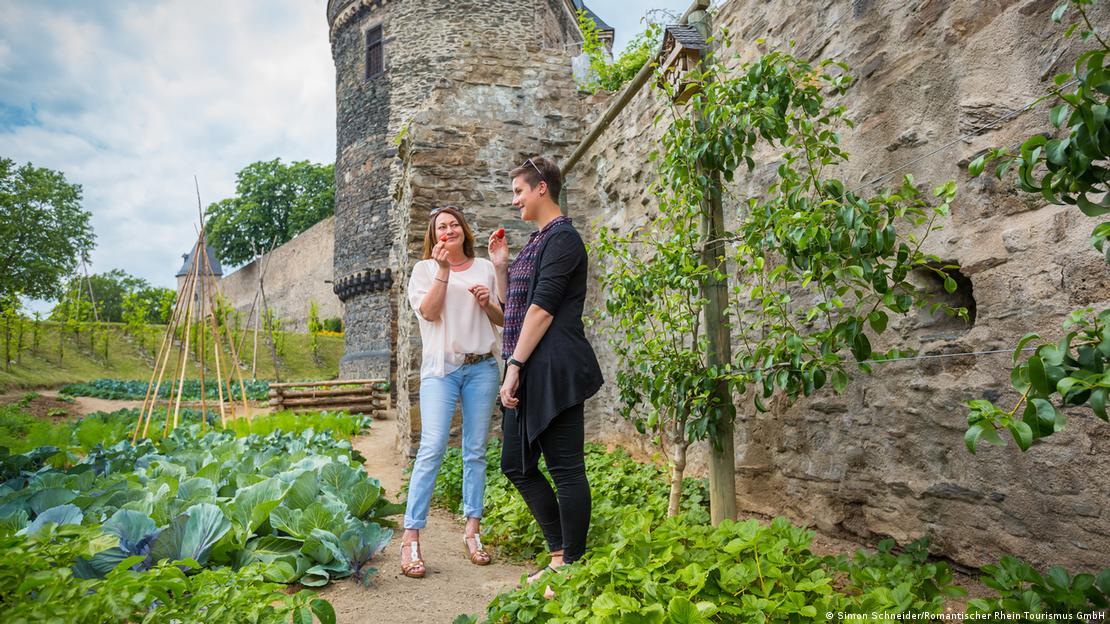
Residents and visitors alike are encouraged to pick whatever food they like from a public garden in Andernach, Germany.

An idea whose time has come may be growing food on public land and making it free for the picking. I wrote a 2011 post on scavenging, here, and a 2020 post on a homeless teen whose foraging helped her learn to cook, here. In those cases, the taking of food was done on the sly. But what if municipalities actively encouraged people to forage, as landscape director Paul did at my last job did?

Cathy Free writes at the Washington Post, “The city of Andernach, Germany, planted 101 varieties of tomatoes in the town center and told everyone to pluck and take whatever they wanted.

“It was such a hit, the following year the city did the same with beans. The next year, it was onions. After that, the city planted fruit trees, lettuce, zucchini, berries and herbs. All were free to anyone who lived or happened to be in the town of 30,000 people. …

“It’s one of a growing number of places across the globe known as edible cities. In the United States, there are public lands from Seattle to North Carolina where people are welcome to pick and take from fruiting trees and bushes.

“Organizers interviewed for this article said there has never been a problem with people taking more than they need, whether they grab a single pear or a bag full of potatoes and artichokes.

Every year, there is more than enough produce to go around.

“ ‘Many here are very proud when you talk to them about our edible city,’ said Bettina Schneider, 29, city team coordinator for the Edible Cities Network in Andernach.

“When word got out that Andernach’s public gardens and orchards — which started in 2010 — were free for the picking, other cities in Germany and throughout the European Union joined in, she said. Now the Edible Cities Network is funded by the European Commission, the executive body of the E.U.

“The areas that were converted into fruiting gardens and orchards in Andernach were previously overgrown and unkempt, so the gardens were well received, Schneider said, noting that a medieval moat is now covered with peach, almond and pear trees, and vacant spaces near schools have been transformed into community vegetable patches. …

“ ‘Every partner organization in the project receives funding from the E.U. budget to carry out their work,’ [Marisa Pettit, a coordinator for Edible Cities] said. Pettit said that several cities also receive funding for what Edible Cities calls ‘living labs’ — green spaces where residents can hold community events and develop their own plans to help their urban gardens to thrive and produce bountiful harvests.

“Edible Cities is now supporting a community garden in Cuba, while cities in China, Tunisia, Togo and Uruguay are also developing plans for urban food forests, said Ina Säumel, a principal investigator for the Edible Cities Network. …

“Many U.S. cities have similar projects. Detroit has an urban farming movement, Philadelphia has food forests, and there are edible community projects in Atlanta and Los Angeles. All rely on volunteers to do the weeding, pruning and planting.

“Smaller cities such as Bloomington, Ind., and Hyattsville, Md., also have fruit trees and vegetable gardens that can be accessed by anyone.

“At the Dr. George Washington Carver Edible Park in Asheville, N.C., founded more than 20 years ago, residents can harvest whatever they like from 40 varieties of fruit and nut trees, said Lynx Bergdahl, a community organizer at Bountiful Cities, the nonprofit that helps manage the food forest.

“ ‘Anyone can get whatever they want, when they want it,’ said Bergdahl, 33. ‘This is about taking away as many barriers as possible to create public food access, whether somebody wants a single apple or an entire basket.’

“In Seattle, the neighborhood of Beacon Hill turned a steep and empty slope next to a public park into a vibrant edible landscape in 2012 through a partnership with the city. The Beacon Food Forest recently celebrated its 10th anniversary as a diverse community garden that is open to anyone walking by, said Elise Evans, one of the project’s volunteers. …

“ ‘To create something from a blank hillside was a big deal,’ she said. ‘Our harvest truly offers something for everyone and it’s based on trust. People take what they need and are fed for free, and that’s an empowering feeling.’ “

Do you ever nibble from gardens around your town? Please let me know.

More at the Post, here.

Read Full Post »

Photo: David L. Ryan/Boston Globe.
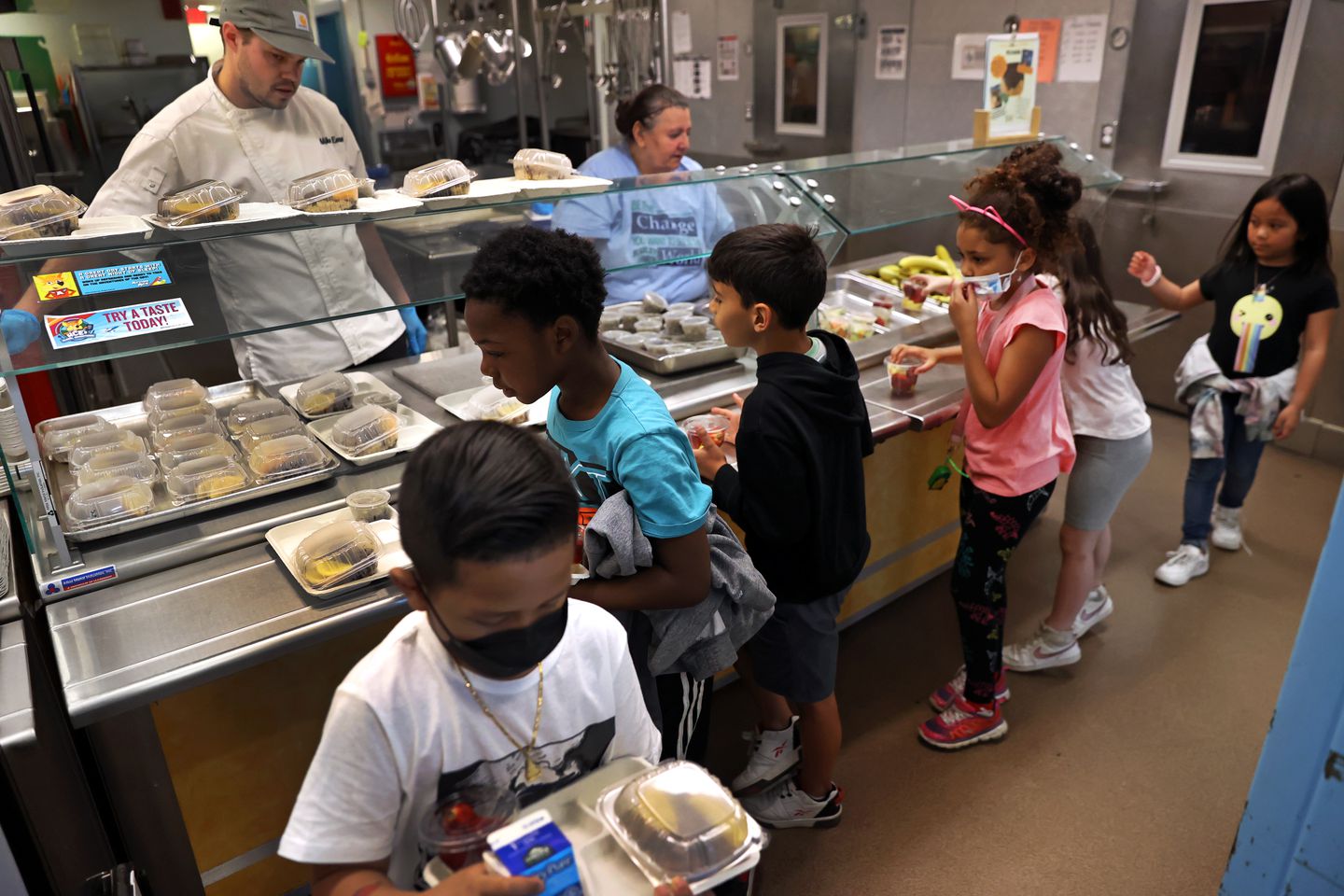
First-graders line up for lunch at McAuliffe Elementary School in Lowell.

The city of Lowell, Massachusetts, has been a “gateway city” at least since the Industrial Revolution. Located on two rivers that powered the early textile factories, it has attracted waves of immigrant workers looking for a foothold, or gateway, to America. Today its many nationalities continue to generate a multicultural energy.

Peggy Hernandez writes at the Boston Globe, “One day last fall, Umalkheeyr Cabdi Mahamed, 17, rose at 3 a.m. to make breakfast for her US history seminar at Lowell High School. The junior wanted to share canjeero iyo suugo, a spiced chicken stew with sweet thin pancakes, her mother’s favorite dish and a reminder of the home she left behind in Somaliland.

“Umalkheeyr was cooking out of more than goodwill; her dish was being sampled for this year’s edition of Tasting History, the seminar’s cookbook. She and her classmates — English learners and almost all immigrants — ultimately contributed 59 family recipes and stories about their journeys to the cookbook.

“Now in its fourth year, the Tasting History project has accomplished more than envisioned. In December, the 2020-2021 edition earned a Founders Award from The Readable Feast, an annual New England culinary book festival. That win led to a trial collaboration between the students and Lowell Public Schools Food and Nutrition Services.

Once a month, one recipe has been served as a lunchtime entree option to a student body of 14,387. The students are now teaching the adults.

” ‘I want people to know our culture because we have a lot of cultural diversity here in the United States. If you share your food, your culture, your experience, you’ll introduce them to your country,’ says senior Samantha Segura Marroquin of Guatemala, 19, who last year submitted a Christmas tamale recipe. …

“The trial [has] been a success, and the collaboration will continue in the fall. Some dishes were so popular Michael Emmons, the food service’s executive chef, hopes to include them into a regular lunch rotation. Dishes like lok lak, a glossy peppered beef served with salad from Cambodia, and feijoada, an inky black bean and pork stew served with white rice from Brazil.

“Lowell Public Schools is an ideal setting for this partnership. The student body is diverse: Hispanic (37.7 percent), Asian (27.5 percent), White (22.9 percent), Black (7.7 percent) and multi-race (4.1 percent). At least 50 languages are spoken in the high school. The four cookbooks reflect that range: 42 countries and one autonomous region are represented.

“The cookbooks are the brainchild of Jessica Lander, 34, a creative English Language history and civics teacher. … Lander arrived at Lowell High School in 2015 and, two years later, came up with the cookbook project while leading her ‘U.S. History 2 Seminar.’ The course covers the 1870s to the present, encompassing an era when 20 million immigrants arrived in the United States.

“While teaching immigration history, Lander recognized her students are, themselves, experts on being immigrants. She developed the cookbook as a means ‘to honor their stories and show their stories are valuable, just as important’ as those in US history books. ‘I wanted to use food as a story of migration,’ she says.

“Sometimes students have had to call relatives in their native countries for help with recipes. They learn to explain cooking techniques as well as ingredients others might find unfamiliar. Family tales introduce each dish. Edits go 15-20 rounds. Dishes are prepared at home and shared with the class. …

“When Alysia Spooner-Gomez, the district’s food service director, learned about the win last winter, she urged Emmons to tap into the cookbook because, she says, ‘it would be a waste to do nothing.’

“Emmons, known as ‘Chef Mike’ to students and faculty, joined the district last fall after a stint as a sous chef for Google in California. He was eager to pay homage to the students’ recipes. ‘We wanted to be culturally responsive and take a step into another world,’ he says.

“Once a recipe is selected, Emmons adapts it for scale and financial practicality. Then he takes it to Lander’s class for taste tests. The students are quick to tell Emmons if his early versions fail their expectations. ‘Letting the kids have a voice in the meal is the most rewarding part of this project,’ he says

“Spooner-Gomez prepares in-house marketing with fliers about the student and their dish then shares background on the meals with faculty. Lunch, like breakfast, is free of charge in Lowell’s public schools through a federal program for low-income districts.

“Lander’s students are awed by the results. ‘I’m so excited that a lot of people like it,’ says junior Nempisey Pout, 18, who submitted a lok lak recipe. ‘The important thing is that I share my culture and Khmer food with students from other countries.’

More at the Globe, here.

Read Full Post »

Photos: Valaurian Waller.
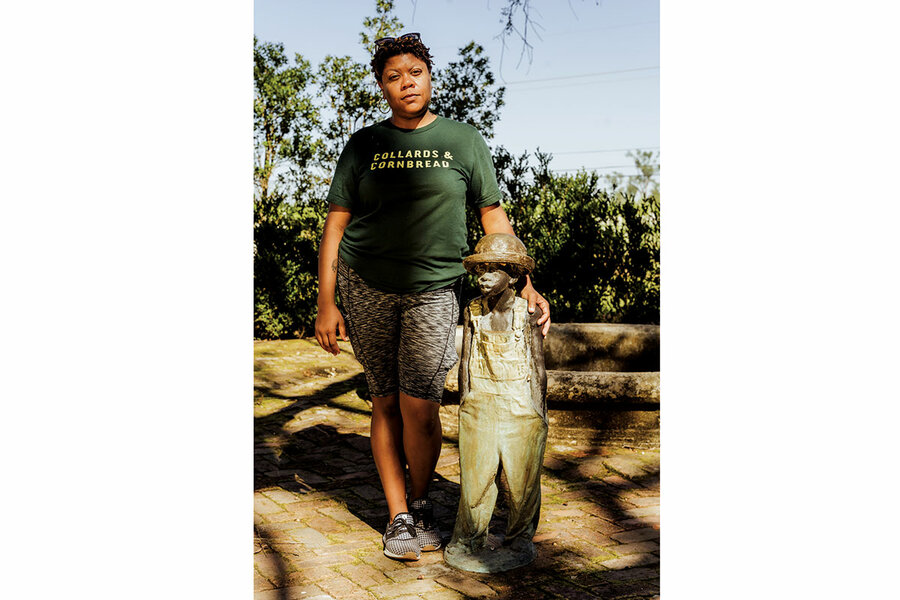
Ederique Goudia is a chef who came through for her community after Hurricane Ida. She is seen here with a statue commemorating child slaves on the Whitney Plantation — the only museum in Louisiana with an exclusive focus on the lives of enslaved people.

Have you been following the efforts of Chef José Andrés and World Central Kitchen as they serve the displaced people of Ukraine? Inspirational. Today I have a related story. It’s also about chefs who help desperate people by giving what they know best.

Xander Peters has the story at the Christian Science Monitor. “Ederique Goudia isn’t the type who stops moving. From November through February, her life was like a hurricane’s gust, tossing her about the country between the community that raised her and the place she now calls home.

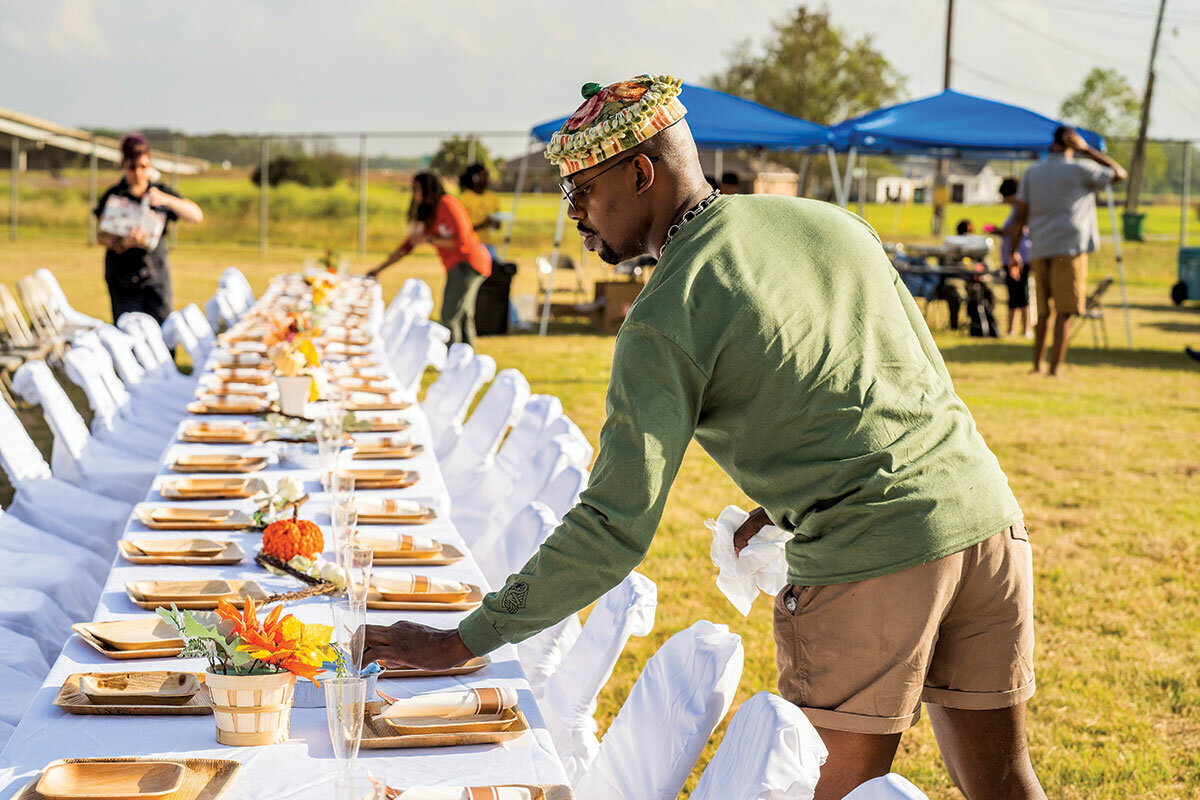
“In early November, Ms. Goudia and an entourage of chefs made their way from Detroit to her childhood hometown of Wallace, Louisiana, a community of nearly 600 about 50 miles outside New Orleans that had been pummeled by Hurricane Ida’s Category 4 strength last summer. Her foodways colleagues Raphael Wright and Jermond Booze, among a host of others from their home in Detroit, rallied around her and organized a day of service for the community, followed by their group’s inaugural diaspora dinner. …

“The day after they arrived back in Detroit, Ms. Goudia and company made a beeline back to the kitchen, where they began working alongside colleagues to prepare 50 family-sized Thanksgiving meals for their food-insecure community members. The meals were prepared through the food security group Make Food Not Waste, of which Ms. Goudia is the lead chef. 

“Food relief is about more than physical sustenance for Ms. Goudia and the many chefs who volunteer alongside her. It is a rung on the ladder to stability. And it can be the glue that holds communities together. ‘It creates a shared song amongst people, of a reset,’ says Detroit chef Kwaku Osei-Bonsu, founder of ​​BlackMetroEats and one of the volunteers who traveled to Wallace with Ms. Goudia. …

“After Ida hit southeast Louisiana, [friends from the nonprofit Taste the Diaspora] were among the first to ask how her family fared, and they were well aware that it wasn’t feasible to get to Louisiana to help right away, as disaster recovery dragged on for weeks after the storm. They then suggested hosting local pop-up fundraisers. Before long, they had gathered a group of 15 or so members of the Detroit food community interested in traveling to Wallace. …

“[Ms. Goudia] knows small towns like hers don’t often receive disaster relief quickly while efforts concentrate on metro areas like New Orleans and Baton Rouge first. Wallace sits in the middle of a petrochemical corridor and has long struggled with environmental justice issues.

“Ida made landfall on Aug. 29. As Ms. Goudia checked on her family, the Detroit food scene leaped into action. … In total they raised $8,500 and they distributed it to Wallace residents through the Descendants Project, an advocacy group for descendants of formerly enslaved people in Louisiana’s river parishes. … 

“By the time Ms. Goudia and her colleagues were ready to head to Wallace themselves, word had spread through the Detroit area. Soon sponsorships began rolling in: The Kresge Foundation, which expands opportunities for low-income individuals nationwide, was the first major group to chip in. Then ProsperUS Detroit, an economic development initiative, pitched in. Turning Tables NOLA caught wind of their efforts soon after and offered to help as well. …

“The Detroit food community’s support for Ms. Goudia and her hometown was, in some ways, as emotionally overwhelming as watching Ida hit her family. At the same time, it wasn’t surprising. It’s what Ms. Goudia has come to know as the heart of Detroit.

“ ‘The hospitality that lives in Detroit, it isn’t a one-off,’ says Ms. Goudia. ‘It isn’t surprising at all, because there is this Southern hospitality that’s here, that’s unmatched.’

“On the day of the Wallace dinner, as always, Ms. Goudia didn’t stop moving. She and her volunteers worked through the afternoon to prepare an evening meal of a beet-based African dish, mirliton dressing, baked spaghetti, cornbread tea cakes, and pralines.

“As he leaned against a picnic table out front, opening cans of corn, Mr. Osei-Bonsu of BlackMetroEats reflected on his and others’ trip down South so far, and what he hoped the meal would mean for the community.

“Healing a community’s emotional wounds through food ‘is definitely something that’s impactful,’ Mr. Osei-Bonsu says. ‘Today will be about so much more than just the consumption of food. It’ll also be a dialogue.’ …

“Ms. Goudia says from her home in Detroit several weeks later [that the point is] to use ‘food in a way that breathes life into people, that gives them what they didn’t think they needed at the time.’ She stops and reflects for a moment. ‘I think we were successful in that. … Everybody that came on the trip is now family. Not only with me, but with the residents of Wallace. I was blessed to be able to provide that for them.’ ”

More at the Monitor, here.

Kwaku Osei-Bonsu, Detroit-based chef and founder of BlackMetroEats, sets the table for a 100-person Taste the Diaspora community dinner in Wallace, Louisiana, Nov. 21, 2021.

Read Full Post »

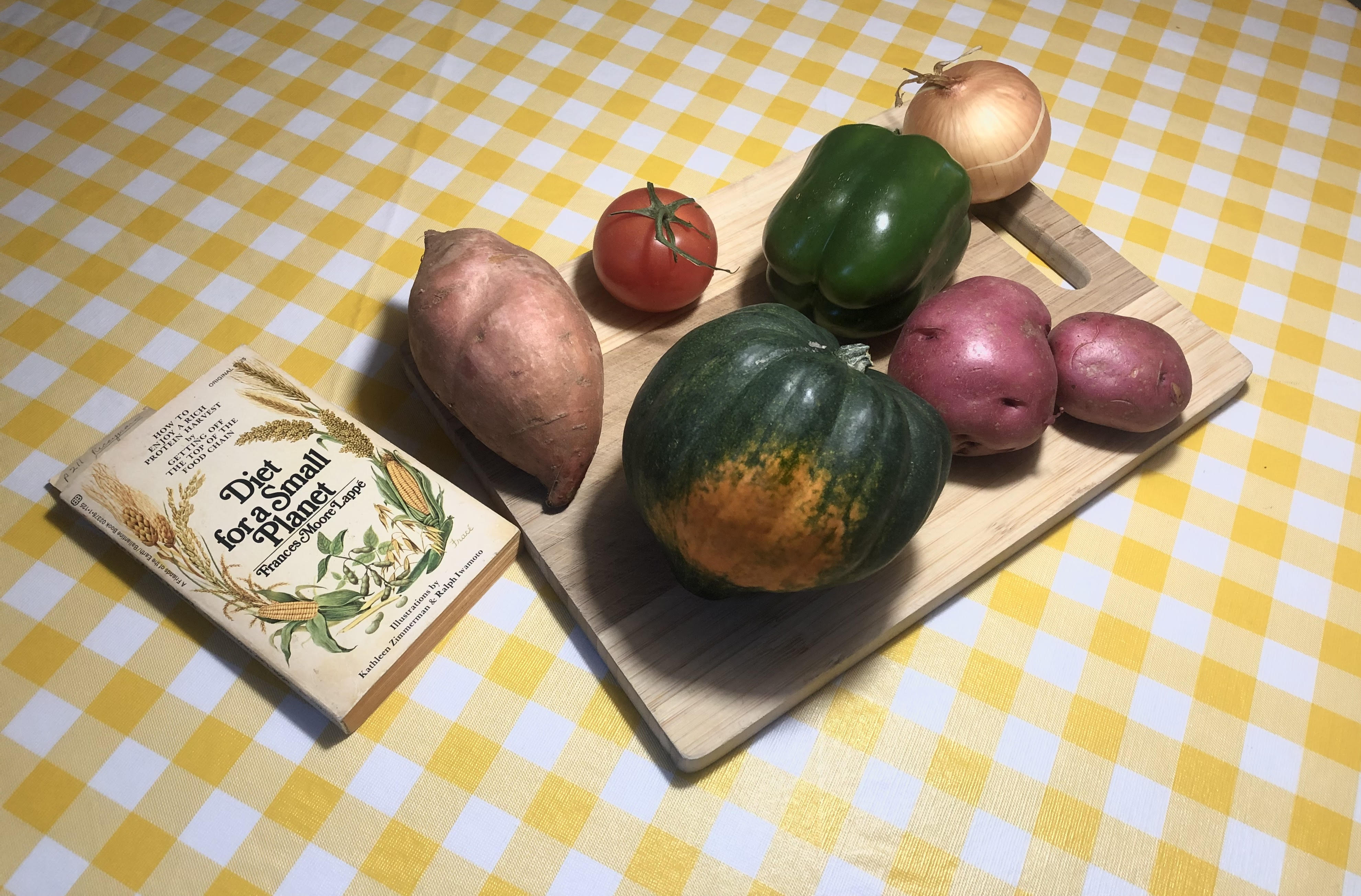
We do not have a plant-based diet in our house, although I’ve been taking baby steps in that direction as far back as the early 1970s when my little sister (now departed) gave me the Frances Moore Lappé book Diet for a Small Planet. This was when my sister was still in college and studying to be a poet. Long before she went to medical school and became a doctor.

I used to make an eggplant, mozzarella, and brown rice dish from that book. It was yummy but took too long to make. I’m a lazy cook.

Still, I keep being reminded that the effort is important — for example, when Robyn Vinter wrote for the Guardian in October about the environment summit in Glasgow, Scotland.

Vinter reported, “Plant-based dishes will dominate the menu at the Cop26 [Conference of the Parties no. 26] climate conference. … The low-carbon menu includes 95% British food, especially locally sourced Scottish produce, and each menu item has an estimate of its carbon footprint, ‘helping attendees make climate-friendly choices.’

“Delegates will be served dishes such as potato, leek and rosemary chowder, smoked salmon and ‘a spiced mushroom and onion burger served with a vegan tomato mayo, slaw and shoots.’

“Caterers are using sustainable suppliers including Edinburgh’s Mara Seaweed, which is abundant, entirely sustainable and does not require fertilizer, fresh water or soil to grow, and carrots and potatoes from Benzies, which uses wind turbines to power their cool storage, biomass to provide heating and recycles the water used. Hot drinks will be served in reusable cups that can be washed 1,000 times, which organizers say will save 250,000 single-use cups.”

How does the list at the Guardian sound to you?

” Winter squash lasagne (0.7kg CO2 equivalent emissions) – celeriac, glazed root vegetables and winter squash, with a vegan cheddar.
” Organic kale and seasonal vegetable pasta (0.3kg CO2 ee) – spelt fusilli, field mushrooms, kale and seasonal vegetables.
” Braised turkey meatballs (0.9kg CO2 ee) – with organic spelt penne pasta in a tomato ragu.
” Organic spelt wholegrain penne pasta (0.2kg CO2 ee) – with a tomato ragu, kale, pesto and oatmeal crumble.”

Mmmm. Maybe it’s worth the effort.

Meanwhile, at the Harvard Health newsletter, you can read why a plant-based diet is also better for your health. Katherine D. McManus, MS, RD, LDN, says, “Plant-forward eating patterns focus on foods primarily from plants. This includes not only fruits and vegetables, but also nuts, seeds, oils, whole grains, legumes, and beans. It doesn’t mean that you are vegetarian or vegan and never eat meat or dairy. Rather, you are proportionately choosing more of your foods from plant sources.

“What is the evidence that plant-based eating patterns are healthy? Much nutrition research has examined plant-based eating patterns such as the Mediterranean diet and a vegetarian diet. The Mediterranean diet has a foundation of plant-based foods; it also includes fish, poultry, eggs, cheese, and yogurt a few times a week, with meats and sweets less often.

“The Mediterranean diet has been shown in both large population studies and randomized clinical trials to reduce risk of heart disease, metabolic syndrome, diabetes, certain cancers (specifically colon, breast, and prostate cancer), depression, and in older adults, a decreased risk of frailty, along with better mental and physical function. Vegetarian diets have also been shown to support health, including a lower risk of developing coronary heart disease, high blood pressure, diabetes, and increased longevity. …

“Here are some tips to help you get started on a plant-based diet.

” Eat lots of vegetables. Fill half your plate with vegetables at lunch and dinner. Make sure you include plenty of colors in choosing your vegetables. Enjoy vegetables as a snack with hummus, salsa, or guacamole.
” Change the way you think about meat. Have smaller amounts. Use it as a garnish instead of a centerpiece.
” Choose good fats. Fats in olive oil, olives, nuts and nut butters, seeds, and avocados are particularly healthy choices.
” Cook a vegetarian meal at least one night a week. Build these meals around beans, whole grains, and vegetables.
” Include whole grains for breakfast. Start with oatmeal, quinoa, buckwheat, or barley. Then add some nuts or seeds along with fresh fruit.
” Go for greens. Try a variety of green leafy vegetables such as kale, collards, Swiss chard, spinach, and other greens each day. Steam, grill, braise, or stir-fry to preserve their flavor and nutrients.
” Build a meal around a salad. Fill a bowl with salad greens such as romaine, spinach, Bibb, or red leafy greens. Add an assortment of other vegetables along with fresh herbs, beans, peas, or tofu.
” Eat fruit for dessert. A ripe, juicy peach, a refreshing slice of watermelon, or a crisp apple will satisfy your craving for a sweet bite after a meal.”

To read McManus’s meal suggestions and her answers to readers with specific diet problems, click on the Harvard Health newsletter, here. More at the Guardian, here. And don’t forget to investigate Diet for a Small Planet, here.

Read Full Post »

Photo: Andrea Pyenson.
In this 2019 photo, a student harvested lettuce at the Rivers School’s Freight Farm.

Are we all too disconnected from the wisdom and skills of our ancestors? At the Rivers School and other Massachusetts schools, students have been getting hands-on insight into growing food — but a bit differently from how our ancestors grew it.

Boston Globe correspondent Andrea Pyenson reported on the hydroponic initiative in a January 2020 article.

“Inside the big white shipping container parked behind a classroom building on the campus of the Rivers School in Weston, it smells like a verdant field on a warm spring day, with a degree of humidity that is completely at odds with the cold, dry air outside. A variety of lettuces, herbs, and a smattering of other vegetables grow on vertical towers in adjustable rows. The sixth-grade students who maintain the school’s Freight Farm cycle through in groups of four to reap the bounty of work they started at the beginning of the 2019-2020 academic year. The first harvest day was in late October.

“ ‘They all love to come in here,’ says Emily Poland, who teaches eighth-grade science and is the farm director at this independent school for grades 6 through 12. The Freight Farm and related projects are built in to the sixth-grade curriculum, incorporating humanities, social justice, and science, among other subjects. Students spend time there once a week planting, cleaning, and harvesting. Farming is a club activity for the school’s high school students, who can go in during their free time.

“Based in Boston, Freight Farms manufactures technologically advanced hydroponic farming systems. In 320-square-foot, climate-controlled shipping containers, users can grow up to 13,000 plants at a time, vertically, without soil. The company was founded in 2010 by Brad McNamara and Jon Friedman. Several area schools, among them Rivers, Boston Latin School, and Worcester State University, are using the farms to grow food for their own communities, for their neighbors, and as educational tools.

“For Poland, managing the farm was a natural extension of her teaching. ‘I like to create curriculum. I care about food. I like to be outside,’ she says. One of the sixth-graders’ annual activities, which combines academics with community service, is cooking a meal for the Natick Open Door at St. Paul’s Episcopal Church. These are hosted every week and attended primarily by seniors. Poland explains that planning the meal incorporates math skills because the students have to scale recipes to feed up to 45 people. And naturally they use their own greens in the salads. …

“Boston Latin, a public exam school for grades seven through 12, acquired its farm in 2013 after students in the Youth Climate Action Network won the $75,000 prize in the Global Green Schools Makeover Competition. Farming is a student-run after-school activity here, under the guidance of eighth-grade history and civics teacher Cate Arnold. …

“Addy Krom, a junior, notes of the farm, ‘You can come in, it’s a whole different environment. All the stress from school [goes] away.’ Adds sophomore Azalea Thompson, ‘This makes locally grown food more accessible to the city.’ The students give the food they grow to faculty members, bring some home, and are working to create a CSA. With Arnold’s help they are also trying to reestablish a more consistent connection to a food pantry in Jamaica Plain, where a former Boston Latin parent, recently deceased, used to deliver their greens.

“At Worcester State, Mark Murphy, associate director of dining services, oversees the Freight Farm, which sits outside of Sheehan Hall, the school’s newest dormitory and site of its main cafeteria. Rich Perna, former director of dining, made the decision to purchase the farm five years ago, says Murphy, ‘to bring hyperlocal produce to the campus.’

“Murphy has been responsible for the farm for the last two years. An employee of Chartwells, which has the contract for all of the school’s food services, he grows almost all of the greens for the cafeteria, as well as for alumni catering events. …

“At full capacity, Murphy explains, the farm produces about two acres’ worth of crops. He is constantly looking for different varieties of lettuce that will appeal to the students and is currently ‘trying to figure out a gourmet mix.’ In addition to three varieties of lettuce, he grows kale, rainbow Swiss chard, parsley, and basil. He coordinates with the cafeteria’s cooks, telling them what he is growing so they can plan menus to incorporate the farm’s production. …

“Through a partnership with the Worcester Public Schools and its program that helps young adults with differences transition from school to the workforce Murphy has three part-time helper/trainees. Once a week three students, who have completed high school with a certificate, come (often with a job coach from the program) to seed, plant, harvest, and clean. Murphy is in the process of hiring one of the students, who has aged out of the program. She ‘has a lot of passion for the farm,’ he says.”

More at the Boston Globe, here.

Read Full Post »

Photo: ICA
The Institute of Contemporary Art’s Watershed building is in East Boston, one of the communities hit hardest by Covid-19. In April, the ICA decided the most important thing it could do would be to provide food to neighbors in need. (Art projects for families get included in the bundles.)

Some artists seem more alert to human needs than the rest of us. That’s something my mother noted after my father had a debilitating stroke in his 40s. The painter friend and the poet friend seemed to more moved by what happened, more empathetic, than many others.

Certainly, in the current pandemic, we’ve seen people in the arts stepping up to offer all kinds of help. Here’s an example.

Grace Griffin reported for the Boston Globe in April, “With its galleries closed to the public, the Institute of Contemporary Art is using its Watershed outpost to feed families in need. … The nonprofit enlisted its catering company, The Catered Affair, to help with a donation drive.

“The ICA also recruited new donors to fund the project. The monthlong drive — launched in partnership with East Boston Neighborhood Health Center, East Boston Social Centers, Maverick Landing Community Services, Eastie Farm, Orient Heights Housing Development, and Crossroads Family Center — distributes family-size boxes filled with fresh produce and dairy products. …

“ ‘We know this is just a drop in the bucket of need,’ said ICA director Jill Medvedow. ‘We are pleased to help in this small way.’ ” More.

Then in late May, Andrea Shea followed up with a story at WBUR radio.

“Now the museum, its catering company and partnering community organizations in East Boston are extending their food distribution program through Sept. 3.

“ ‘What we learned in April … how hard hit East Boston residents are by COVID,’ ICA director Jill Medvedow said Friday.

The struggle to feed families is ongoing, and Medvedow said it highlights life-threatening disparities the largely immigrant East Boston community faces.

“ ‘Not having the nutrition that contributes to one’s health, to one’s ability to take care of your family, to that sense of dignity that everyone deserves,’ Medvedow said. …

” ‘I see this heroism around me,’ Medvedow said, ‘and I feel very lucky to help facilitate this. That’s my role.’

“About four years ago, when Medvedow and her staff embarked on transforming the 15,000 square-foot condemned building into satellite space for the ICA, they were dedicated to building relationships with the people who live there. ‘I never thought then that this would be the way in which we would demonstrate that the arts and the ICA would be a resource in this Boston community,’ she said, ‘But it is.’

“The food boxes also carry on the ICA’s mission to share art. Each one includes a creative project for families isolated at home. Medvedow said the museum is currently in talks with artists about commissioning new activities designed for both solace and stimulation. …

“Initially the effort’s funding was seeded with unsolicited anonymous donations. Now the ICA is funding the food distribution project and welcomes any additional support. …

“By the end of summer the ICA’s Watershed estimates it will provide more than 2,000 boxes of eggs, butter, fresh vegetables and fruit to East Boston families.” More.

Read Full Post »

112093307_slunglow

Photo: Slung Low
The Slung Low theater group sorting out food parcels at their headquarters in Leeds, England.

Many companies and nonprofits around the world have been stepping up to meet new needs during the lockdown. This story is about an innovative UK theater delivering food to the hungry.

Ian Youngs reports at the BBC, “When you’re suddenly tasked with co-ordinating emergency food parcel deliveries to vulnerable local people during a pandemic, the ability to think creatively comes in useful. As artistic director of one of the UK’s most innovative theatre companies, Alan Lane is used to coming up with imaginative solutions.

“But they normally involve finding ways to stage epic community theatre shows, not making sure hundreds of people have the food and medicines they need in a lockdown.

” ‘Today we find ourselves with a Transit van full of crisps,’ he says on the phone from Leeds. … Yesterday we didn’t have any vegetables. And tomorrow we’re not going to have any eggs. So constantly I’m on the phone doing deals.

‘The other day, I swapped a load of tote bags that I got from the university for some face masks, which I split in half and swapped the other half for a lot of cream. …

“Six weeks ago, Lane and his company Slung Low were asked by Leeds City Council to co-ordinate the community response in Holbeck and Beeston, meaning any requests for help from the 10,000 households in the area have been passed to them.

“They are mainly from people needing food, but prescriptions need dropping off too, and they are often asked to just phone lonely people for a chat.

“Lane is in charge of around 90 volunteers, including some from the region’s other arts organisations — from Opera North and Yorkshire Sculpture Park to theatre company Red Ladder. …

“Managing them is not the only new role Lane has taken on during the pandemic. When not scrounging and delivering food, he has become a game show host, and a very entertaining one at that — appearing online every fortnight from Slung Low’s HQ to keep locals’ spirits up. …

“On top of that, he has launched an open-air art gallery, posting residents’ lockdown pictures on lampposts. And Slung Low has just made a short film — shot before coronavirus rewrote Lane’s job description — which went online on Friday.

” ‘We didn’t know this at the time, but having a short film to release at the moment is much better than having a play,’ he says.

“Except — he will be taking an enforced break from all that frenetic activity for a while. [A Covid-19 test] came back negative, but he has symptoms so is isolating and recovering. Others have stepped in to ensure Slung Low’s work goes on. …

“The connection with the local community is what sets Slung Low apart from other theatre companies and means it can adapt to doing things like delivering food during a crisis, Lane says.

“Other venues have been busy putting their shows online and continuing their education and outreach activities digitally, but Lane thinks they could be doing more with their facilities.

” ‘There are a lot of vans currently sat in the car parks of arts organisations because they couldn’t quite work out the insurance to get them doing food bank work,’ he says. … ‘We spend a lot of time talking about what we’re for at Slung Low. What we’re for is not putting on a show for people to pay for tickets.

” ‘[Putting on a show is] something we do quite a bit, and something that we can be quite good at on a good day. But it’s not what we’re for. And therefore, when you can’t do that, it doesn’t mean we stop.’ ” More at the BBC, here.

Although people in the arts may not be uniquely compassionate, they’re often among the first to demonstrate sensitivity to the needs of others. Still, gold stars for a city council that thought of asking for the theater’s help!

Read Full Post »

Older Posts »