Feeds:
Posts
Comments

Posts Tagged ‘funding’

Photo: Caitlin Babcock/Christian Science Monitor.
Tami Graham, executive director of KSUT Public Radio, in her Ignacio, Colorado, headquarters.

It’s inspiring to see ordinary people trying to fill the gaps left by the withdrawal of government funds. But will it be enough? That is the question for the staff of a small but vital public radio station in Colorado.

Caitlin Babcock wrote in September at the Christian Science Monitor, “Crystal Ashike’s reporting for local radio station KSUT made national news when she broke a story on white vans that were showing up on Navajo land and whisking people away. The photojournalist, who is herself Navajo, uncovered how tribal members were being offered access to treatment for substance abuse, only to end up in fraudulent sober living homes.

“KSUT is an NPR-affiliate radio station that serves five counties and four tribes in southwest Colorado and northwest New Mexico, providing local news like Ms. Ashike’s story. And it’s [losing] nearly a fourth of its funding. ….

“Congress passed a rescissions bill this summer, clawing back nearly $1.1 billion in funding for public broadcasting. [The Corporation for Public Broadcasting], established by Congress in the 1960s, provides a small percentage of funding for NPR and PBS [and] also helps fund local radio stations like KSUT, which are affiliated with NPR and air some of its content alongside their own programming tailored to local communities. …

“[For] this station serving small mountain towns, there’s a lot of uncertainty. And for many in the community, it fills an indispensable role.

“ ‘I think we’d really be in a news desert for anything that mattered to us locally, regionally, if it weren’t for KSUT,’ says Carol Fleischer, a longtime listener.

“KSUT is based in Ignacio, a town of about 1,000 people in southwest Colorado that is also the headquarters of the Southern Ute Indian Tribe. The Southern Ute originally founded the station in 1976 to provide community news and traditional Native American music. At the time, it was one of only eight tribal stations in the country.

“After becoming an NPR affiliate in the 1980s, KSUT now runs two separate signals, with one exclusively dedicated to tribal news. The tribal signal broadcasts from 8 a.m. to midnight every weekday. Its programming is a compilation of news affecting local tribes, traditional music, and talk shows like a weekly broadcast on health issues affecting Indian Country.

“The second signal airs a morning regional newscast, a compilation of the station’s own reporting as well as collaborations with other Colorado stations. They also broadcast programming from NPR and BBC News, plus music handpicked by their DJs.

“During the summer – which in southwest Colorado means fire season – KSUT’s morning host puts together a list of updates on any fires that are burning and how effectively they’re being contained. When necessary, the station broadcasts live emergency and evacuation alerts. The fire season this summer has been a pretty intense one, says Tami Graham, the station’s director, with six active fires in the area.

“For some listeners, radio is the primary or only source for this kind of information. In the mountains and canyons of the KSUT broadcast area, cell service is ‘hit-or-miss,’ as one resident describes it. More than 20% of people in La Plata County lack reliable broadband service, meaning radio may be their only way to receive emergency alerts. …

“Like many stations around the country, KSUT has seen an outpouring of support in the weeks since the CPB announced its shutdown. Members have upped their monthly donations, many listeners are sending money for the first time, and the station has even had funds come in from people far across the country. …

“Even though KSUT doesn’t have immediate plans to cut programming, the funding cuts could damage their broadcasting ability. Early this year, KSUT was awarded a $500,000 grant – administered by the Federal Emergency Management Agency through the CPB – to update the technology that enables emergency alerts. But they never received any of the money. After six months of uncertainty regarding the funds because of a separate issue with FEMA, Congress passed a bill rescinding funding for the CPB, which then informed Ms. Graham that KSUT would have to spend any allotted funds by Sept. 30.

“The station paid $46,000 to buy a needed transmitter and other equipment. Three days later, the CPB told the station it would not be able to reimburse them before the shutdown, and warned them not to purchase any new equipment. …

“Priscilla Precious Collins, a member of what’s known as the Ute Mountain Ute Tribe, says KSUT is ‘one of the pillar sources of information in our community.’ She recalls how the radio was ‘crucial’ in spreading information to tribal communities during the pandemic, such as how to keep tribal elders safe. …

“On a baking hot morning in Durango, one of the biggest towns served by KSUT, 20 local listeners assemble in the dining room of a downtown hotel to share their thoughts on local radio.

“ ‘I was a schoolteacher for 37 years, and I listened to KSUT going to school and coming home,’ says Sweetie Marbury, a former mayor who organized the group. ‘It’s a window to the world for us that live in mountain towns.’ …

“On a recent morning, the KSUT broadcast pauses. ‘We have a very sad announcement,’ says Ms. Graham, the executive director. She tells listeners that one of the station’s DJs has unexpectedly passed away. …

“A listener writes in that afternoon. ‘I send my deepest condolences to you and to everyone there at KSUT,’ she writes, ‘as I know it is not just a business.’ In this woman’s 49 years of listening to KSUT, she says the station has been a ‘lifeboat in an angry sea.’ ”

More at the Monitor, here.

Read Full Post »

Photo: Emily Mesner/Anchorage Daily News.
Lenora Ward, general manager at KOTZ radio station, listens to a 2022 dog-sled musher interview while on-air at the station in Kotzebue.

Few places in the US rely more heavily on public radio than Alaska. That is why people who care about Alaska rushed to bridge the gap after the current Congress decided public radio is not needed.

Iris Samuels reports for the Anchorage Daily News, “An Alaska fund has raised $3.5 million as it seeks to replace federal funding rescinded by Congress for public radio and television stations.

“Amid fundraising efforts, station leaders say they are already beginning to cut some programming. …

“Congress in July voted to rescind $1 billion in federal funding for public media across the country. … Two of Alaska’s three-member congressional delegation voted in favor of the rescission, which eliminated roughly $15 million intended for more than two dozen stations in Alaska. …

“Sen. Lisa Murkowski was one of a few Republicans in Congress who attempted to salvage the federal funding that Congress members themselves had approved last year, pointing to its importance in alerting Alaskans to natural hazards like tsunamis, earthquakes and fires.

“In a recent call hosted by a coalition of Alaska public radio and television stations, PBS President Paula Kerger said that Alaska is at the forefront of national fundraising efforts intended to — at least temporarily — supplant federal funding with money from private donors and foundations. …

“Kerger said she was ‘deeply grateful to Sen. Murkowski, who really fought for us more than any other member of Congress.’

Alaska stations banded together in the days following the July rescission vote to, with the Alaska Community Foundation, establish the Voices Across Alaska Fund, which in its first two months raised more than $3.5 million.

“The funds came from 80 donors, which include individuals, corporations and foundations in Alaska and in the Lower 48, according to Alaska Community Foundation spokesperson Ashley Ellingson. The funds will be disbursed to stations [based] on stations’ needs, Ellingson said. …

“Alaska Public Media President Ed Ulman said that since the rescission, new donors have begun giving, or existing donors have upped their contributions. …

“Funds will be distributed to Alaska stations, which are also independently fundraising, several station managers said in recent days. Even as they have pivoted to fundraising efforts, the station managers reported making several targeted cuts to their programming in response to the loss of federal funding.

“Alaska Public Media, the state’s largest public station, has paused Alaska Insight, a television news program that was broadcast across the state. Ulman said Alaska Public Media has also cut its education programming and is considering cutting Debate for the State, a program that features candidate forums for statewide offices. …

“Gretchen Gordon, general manager of KUAC, a station serving Interior Alaska, said the station has cut overnight broadcasting, eliminated some national radio programs and lost television service in Nenana in response to the federal funding cut. Gordon said KUAC is ‘determined to find ways to restore lost programs and services.’

“Kristin Hall, general manager at KYUK, which serves Bethel and the Yukon-Kuskokwim Delta, said the station lost $1.2 million in federal funding, and could eliminate more than half its staff by the end of the calendar year.

“Justin Shoman, president and general manager of KTOO, said the Juneau-based station may need to adjust its coverage of the Legislature. Gavel Alaska, a live-streaming service for legislative hearings, press conferences and trial hearings, costs more than $1 million annually to run and receives no state funding, Shoman said. Until the rescission, federal funding made up more than a third of KTOO’s annual budget. …

“The federal funding cut comes after a yearslong refusal by Gov. Mike Dunleavy to spend state dollars on public media. Starting in his first year as governor, he repeatedly vetoed funding intended for public radio stations. This year, the Legislature did not fund the grants for public radio in the budget. …

“ ‘It’s not lost on many of us that the Legislature has every single year put in funding, in particular for rural public radio,’ said Ulman. ‘And yet, there is one individual who has the power of the veto who exercises that veto and goes against — I’m just going to say it — the will of the people.’

“When Begich, Alaska’s lone U.S. House member, voted in June to claw back federal funding for public media, he reasoned that public broadcasting was no longer essential because Alaskans now use ‘pervasive cellular, satellite, and wireline technologies.’

“But Gordon, with KUAC, said many Interior residents do not have access to broadband internet. … ‘Our lawmakers need to understand that a little better,’ she said.”

Will the new fundraising levels last? Only time will tell. More at the Anchorage Daily News, here. And do read about how an Alaska public radio station saves lives, here.

Read Full Post »

Photo: Scotsman.
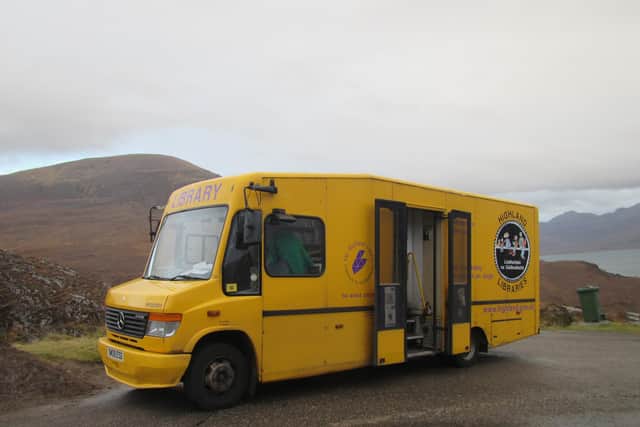
A yellow mobile library in the Highlands. The fleet has dwindled from 10 to seven. Transit vans, with fewer books packed in crates, are now filling the gaps.

All over the world, fans of books and libraries have found ways to reach readers in largely inaccessible regions. We’ve had stories here about using camels, horseback riders, vans, carts, and more.

Today’s article from the Scotsman, bemoans the gradual disappearance of Scotland’s yellow library buses.

As Alison Campsie reported in June, “For those living in the most isolated pockets of the Highlands, the sight of the yellow library van coming into view has long been a welcome one.

“But now, concerns for the future of the mobile libraries have been raised after the distinctive vans – complete with desk and bookshelves – dwindle in numbers.

“Mr Preston said a fleet of 10 yellow mobile libraries – plus a spare – has now been reduced to seven vans. Of these, five are standard Transits, which are now packed with crates, carry fewer books and have to be loaded and unloaded.

“The librarian, whose yellow van did not return from the garage in April, said: ‘I am worried that the mobile library service will fizzle out and die.

“ ‘People love the service and they want to see it continue. A lot of the people I serve are single people living by themselves and they might not see people, apart from the postman, for two or three weeks and then the library arrives. …

“Megan MacInnes, a co-opted community councillor for Applecross, said the mobile library was ‘a hugely important service.

” ‘The range of demographics of folk who use it demonstrates that. We have to drive nearly an hour to get to the nearest library at Lochcarron. That is just not feasible for many.

” ‘Personally, I completely rely on the mobile library for my books and as a parent it has been hugely important in helping my son to read and become interested in books. The children at school love being able to use the mobile library and they come out with such a range, from history and geology to novels and cartoons and the latest David Walliams or Harry Potter.

“Everyone here is very aware of the financial pressures that Highland Council is under but when it comes to these lifeline services, we really urge them to be continued.’ We are so far from population centres that we really can’t afford for our outreach services to go.’ …

“A spokesperson from Highlife Highland said it was working with Highland Council, which owns the vans, ‘to better understand how such services can be delivered including accessibility and customer needs. This will also help to inform replacement fleet requirements and to establish specifications and costs.’

“A statement added: ‘High Life Highland is providing an alternative service for rural customers with the option of a drop-off of books to their homes to ensure that they have access to reading material and schools are also given the option of a drop-off of books to their building.

” ‘We recognise that mobile libraries are an essential part of life in the Highlands and while this service is not a like for like replacement, it may help to ease some of the difficulties for the most vulnerable and isolated service users during this time.’ ”

More at the Scotsman, here. PS, if you search this blog on “mobile library,” you could get enough material for a dissertation, almost! Mobile libraries are cherished all over the world.

Read Full Post »

Map: Nations Online Project
Fergus Falls didn’t need much money from the National Endowment for the Arts to create both economic benefits and constructive conversation across the political divide.

As Victoria Stapley-Brown wrote recently at the Art Newspaper, the arts benefit communities in many ways, and in rural America, a little funding can go a long way.

“A grant of $25,000 is not even a drop in the bucket of the US federal government’s spending, around $3.5 trillion per year. But it was able to effect visible change in Fergus Falls, a small rural community in Minnesota with a population of 13,000, which received $25,000 from the National Endowment for the Arts (NEA), the government agency that funds art and culture across every congressional district in the nation, in 2011. …

“With the $25,000 NEA grant, the St Paul, Minnesota-based arts non-profit, Springboard for the Arts, which calls itself ‘an economic and community development organization for artists and by artists,’ opened an office in Fergus Falls and was able to launch a multi-year cultural project. Since 2011, the organisation has been given a total of $145,000 in NEA grants — but has also received over $1.2m in funding from private donors, such as the McKnight Foundation. …

“The project explores ‘how artists can be a part of rural economies and rural communities,’ … to encourage young people to stay in the town and see it as a viable place to make a living and raise their families …

“Artists from other communities working across all media, from the visual arts to music to film-making, have also come to Fergus Falls for the Hinge Arts Residency, a programme that has hosted 45 artists for one to three months. These artists live in apartments on the property of the formerly disused hospital complex, which has spurred a local conversation about preservation and the use of historic buildings in the town, and local politics. …

“The artists-in-residence have carried out their own work during their residencies, which often involve the local community, such as the folk and punk musician Shannon Murray’s research into music and Minnesota working class history. They have also shown work in empty storefronts and organised community art projects, such as casting architectural elements of disused buildings, and giving art classes to local children.” More here.

Hat Tip: Arts Journal.

Photo: Rick Abbott
Kirkbride Art & History Weekend at the former Fergus Falls State Hospital Complex, which is on the National Register of Historic Places.

Read Full Post »

Before I had children, I didn’t quite “get” Mister Rogers. I thought the slow, gentle way he talked was odd.

But then I saw how John at the age of three reacted to him, and the penny dropped. I hadn’t been able to figure out Mister Rogers because he wasn’t talking to me! He was talking to three-year-olds.

Mister Rogers did know how to talk to grown-ups when needed.

Recently, during the national discussion about possible funding cuts for the arts and Public Broadcasting, someone posted on Facebook a 1969 video of Mister Rogers testifying before US Senator John O. Pastore of Rhode Island. At the time, Sen. Pastore was chairman of US Senate Subcommittee on Communications.

It’s a great, great speech. It’s even recognized as such on the American Rhetoric website. The testimony won PBS $20 million in funding from the originally skeptical Sen. Pastore.

But what strikes me most strongly is that its power comes from the speaker’s clearly communicated belief in the essential goodness of his listener. It is communicated through Mister Rogers’s tone of voice and body language.

Faith in the listener is what came across to three-year-old John, too. “You are special. I like you just the way you are.”

See what you think.

Read Full Post »

The Institute for the Study and Practice of Nonviolence is an outstanding Providence nonprofit that takes a holistic approach to ending violence in poor communities.

On Thursday, I went to an open house and barbecue organized by the students in the Institute’s work program, and was mightily impressed. I shook hands with Mayor Jorge Elorza and chatted at some length with Chief of Police Hugh Clements and the Institute’s executive director, Teny Gross. Not to mention the retired priest who was a founding member, the youth themselves, and the dedicated staff. I heard some pretty inspiring stories!

The young organizers provided a tour of their headquarters, a lovely converted convent on Oxford St.

It was a great event. But here is something sad. In the five years since I visited the Institute’s old quarters, the vagaries of funding sources have forced cutbacks. They no longer have 17 streetworkers turning youth from violence toward work and better lives. They can afford only four. It seems a shame when the need is still significant.

The Institute is advertising for a development director, and they sure need a way to get more support. A big endowment to protect the work from shifts in the winds would be ideal. Read more here.

By the way, Teny Gross has been called to teach nonviolence techniques around the nation and world. He has received many acknowledgments for his success. An unusual honor this month gave him one of his proudest moments. It relates to a George Washington letter about religious tolerance.

“225 years ago, George Washington wrote a letter ‘To the Hebrew Congregation in Newport,’ which is now known as the Touro Synagogue in Newport, Rhode Island. To mark the historic importance of the letter, the congregation and the Touro Synagogue Foundation conduct an annual ‘Letter Reading,’ around the time that the letter was sent. The setting is the beautifully restored Touro Synagogue, built in 1763.

“The letter was only four paragraphs long, but they were four powerful and significant paragraphs and they are regarded as critical in the history of the Jewish people in the Colonial United States.  The letter reading evolved into today’s two hour event filled with greetings from dignitaries, announcements of scholarships and an award to Teny Gross, leader in the Institute for the Study of the Practice of Nonviolence.”

Goes to show that teaching nonviolence can spread out in many unexpected ripples.

Read the details here.

Photo: Institute for the Study and Practice of Nonviolence

Read Full Post »

Not me. It’s a story about a man in Detroit who was so determined to get to work after his car gave up the ghost that he walked 21 miles — and attracted some unexpected blessings for doing it.

I learned about him by way of The Guardian.

“The Detroit Free Press reports that James Robertson rides buses part of the way to and from his factory job in suburban Rochester Hills. But because they don’t cover the whole route, he ends up walking about eight miles (13 kms) before his shift starts at 2 pm and 13 miles (21 kms) more when it’s over at 10 pm. …

“After the newspaper wrote about the 56-year-old’s situation … multiple people started crowdfunding efforts to help him buy a car and pay for insurance. Some have offered to drive him for free and others have offered to buy or give him cars.

“Robertson began making the daily trek to the factory where he molds parts after his car stopped working ten years ago and bus service was cut back. He’s had perfect attendance for more than 12 years.

“ ‘I set our attendance standard by this man,’ said Todd Wilson, plant manager at Schain Mold & Engineering. …

“Evan Leedy, a 19-year-old student at Wayne State University, read the story and started a GoFundMe site with the goal of raising $5,000. [In no time,] he had raised more than $90,000. …

“Asked about a federal program newly available through Detroit’s bus system that might pick him up at home and drop him off at his job, Robertson said, ‘I’d rather they spent that money on a 24-hour bus system, not on some little bus for me. This city needs buses going 24/7. You can tell the city council and mayor I said that.’ ”

More here.

Photo: Ryan Garza/AP
James Robertson, 56, of Detroit, walked 21 miles every day until a well-wisher’s fundraiser helped him get an apartment closer to the job.

Read Full Post »

Matadero was an old abandoned slaughterhouse in Madrid. Lately it has been “evolving into a cultural laboratory, where a new arts financing strategy is being tested.” So says Doreen Carvajal in the NY Times.

“Companies and institutions are providing financial support to supplement dwindling government arts subsidies, but with a twist: they don’t just send checks, they move in.

“Within the walled 59,000-square-foot center, there are public theaters and exhibition spaces that last year drew more than 500,000 visitors for music and art events and avant-garde plays. But five new residents are private institutions, including a designers’ association, a publishing house’s foundation and offices of Red Bull, the Austrian energy drink maker.

“They are in the compound rent-free for now, but have invested millions in the remodeling of pavilions there, as well as in programming, from art exhibitions to music festivals.

“These new partnerships are forged, out of necessity, here in Spain, where government support for culture has plunged by almost 50 percent over the last four years, a result of a lingering economic crisis that hit late in 2008.”

Some observers worry about the downsides of corporations having a big influence on what art gets shown, but haven’t the arts always had to have some help from patrons or companies?

Probably it pays just to be wary, to recognize when there is undue influence, and to push back. Certainly smaller, more experimental projects are unlikely to find a home under a Red Bull banner.

Read more at the Times, here.

Photo: Carlos Luján for The International Herald Tribune
Inside Matadero Madrid: A closer look at the arts complex.

Read Full Post »

I’m fascinated by the many ways the Internet has enabled broader support for worthy causes. I’ve blogged about Kickstarter, for example, “a funding platform for creative projects.” Through Kickstarter, friends and other well-wishers can help fund a documentary, an art installation, or a book publication within a designated time frame. Magic can happen, often with only small donations that add up.

Today OFH_John tweeted about something similar for schools, Donors Choose. Donors Choose calls itself “an online charity connecting you to classrooms in need.” You can search for projects in your local area, projects that have special meaning to you, and projects that might let your company offer special expertise.

John’s company has optical expertise and jumped on a need at a District of Columbia school, where an applied science project on light called for optical gear. Read about that here.

If you are seeking to help impoverished schools in particular, you may look for the “high poverty” rating at Donors Choose. School needs of all sorts are listed here.

Photograph: DonorsChoose.org

Read Full Post »

A week or so ago, I wrote about CSA, community-supported arts, a concept that borrows from the community-supported agriculture movement. In case you missed it, here’s the post.

Another creative idea for supporting the arts is crowd funding. I learned about it from the Backstage blog by way of ArtsJournal.com.

” ‘I saw people believing in themselves enough to try and make money for their projects,’ said Monica Mirabile, a co-founder of the Copycat Theatre. Earlier this year, Mirabile was applying for grants for her Baltimore-based theater troupe when a friend suggested she look into Kickstarter, a ‘crowd-funding’ website that promotes artistic projects through social media and allows donors to
support fundraising campaigns with any amount of money they desire. Crowd-funding sites have grown in popularity over the last few years and continue to attract artists and benefactors. …

” ‘This is not the newest idea on the block. It’s very traditional. But we’ve become very used to the idea of someone in a boardroom giving us a check and we hand them a piece of art and cross our fingers. The longer history of art is actually one of patronage that involves the artist’s audience. …

” Users of crowd funding must summarize their projects and goals for potential donors, a process that can help artists sharpen the skills needed to pitch or develop those projects in the future. ‘I learned how to better articulate why I’m doing the project and my artwork and what we’re trying to gain,’ said Mirabile. ‘I made friends because, by promoting, I got to talk to different
people in my community and made connections.’ ”

Read more here. And if you try an approach like Kickstarter, would you let me know how it worked for you? Leave a comment.

Read Full Post »