Feeds:
Posts
Comments

Posts Tagged ‘germany’

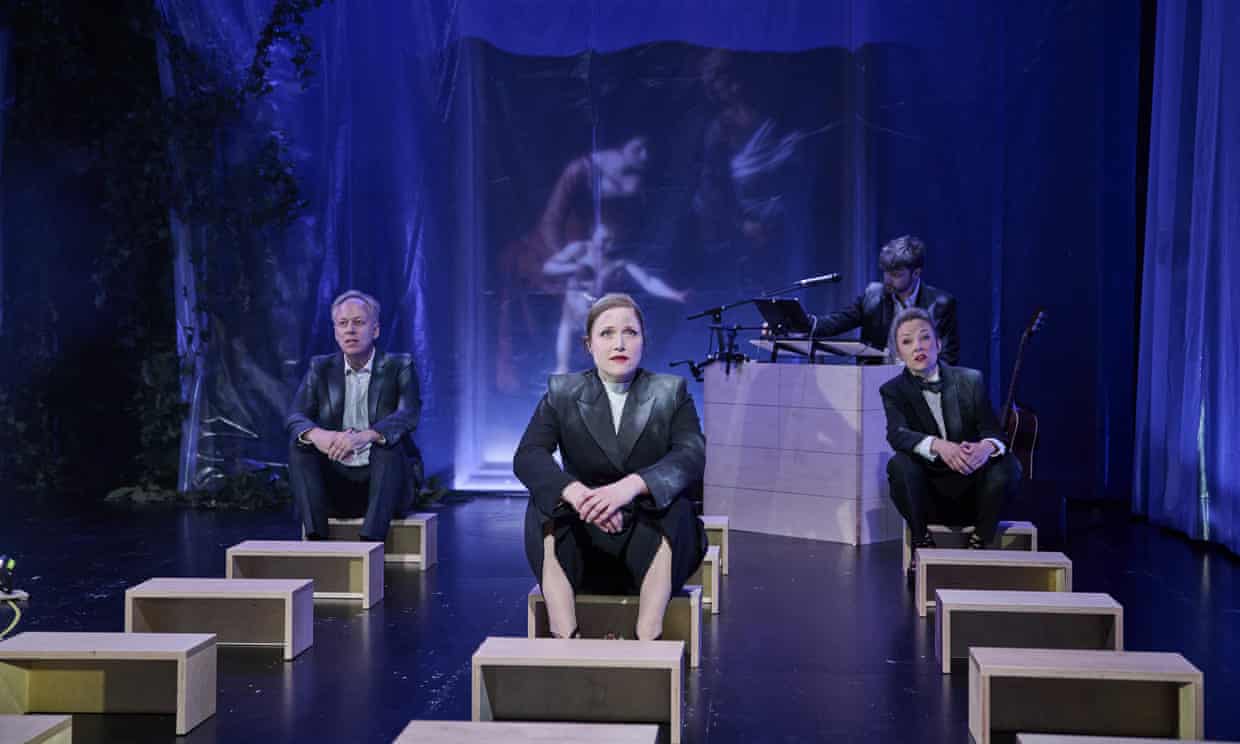
Photo: Thomas M Jauk.
This theatre’s climate impact report found wood made up half of the 41 tons of raw materials it used last year, but produced only 1% of its emissions.

What does it take to be climate neutral? This theater in Germany believes we all have role to play.

In June, Kate Connolly reported at the Guardian, “A handful of Spanish conquistadors fight through thick undergrowth to emerge in the ivy-clad ruins of a fallen civilisation during a rehearsal of Austrian playwright Thomas Köck’s Your Palaces Are Empty.

“Premiered last month at the Hans Otto Theater in Potsdam, south-west of Berlin, the bleak and unforgiving drama probes the wounds of a shattered capitalist world that has exploited its people and the planet’s resources.

“But it is not just the dystopian play that is embracing the subject of the climate crisis.

“The production itself has been declared climate neutral under a €3m [~$3.3 million] pilot project launched by Germany’s federal ministry of culture. The project, called Zero, is sponsoring the Potsdam theatrer and 25 other cultural institutions across Germany, from dance companies to libraries and museums, to completely restructure their creative modus operandi.

“ ‘It leads to restrictions,’ says the director, Moritz Peters, crouching on a wooden stool on stage as he takes a break from rehearsals. ‘But it also forces greater creativity.’

“No aspect of the process of making a play has been left unturned. From the lighting (switching to LED bulbs) to reducing travel (rehearsals are longer but less frequent to cut down on journeys) ‘everything has come in for scrutiny,’ says Marcel Klett, the managing director.

“Swapping to a green source of electricity in 2022 had already improved the theatre’s carbon footprint, reducing its annual 661 tons of emissions, or the ‘equivalent of 66 households,’ by more than 10%, but did not go far enough, Klett says. No less challenging is tackling a change in attitude. ‘Nurturing a sense that we all – from the set designer to the theatergoer – have a role to play and have to ask ourselves: “what can I concretely do?” ‘ Klett says.

“The costume designer, Henriette Hübschmann, says she initially struggled with having to abandon her usual task of creating new costumes from scratch. ‘At least half of the costumes have to come from the existing collection of props and costumes now,’ she says, on a tour of the wardrobe in the theater’s underbelly. ‘The rest should be from recycled, easily recyclable or renewable materials.’ …

“An inventory of its resources forms the basis of the theater’s first climate impact report. … It states that wood makes up half of the 41 tons of raw materials that the theater used last year, but is responsible for only about 1% of the emissions produced, while just four tons of steel and aluminum used in productions made up almost 30%. …

“Other forms of stage-set building are also being experimented with, such as growing constructions out of the organic building material mycelium. The potential use of this in other areas, such as exhibition architecture, is already being explored.

“Most [theaters], from a certain size upwards, will be required to do so from next year, under EU legislation that will treat theaters the same as all big commercial enterprises.

“Klett is hopeful of a knock-on effect among audiences and theatre staff as well as from other cultural institutes joining in. …

“He is appealing to local politicians to embrace the project by sponsoring the erection of solar panels on the theater’s roof and allowing the space – a former Prussian military stables – to be insulated, which is currently not allowed because the building is listed.

“The success of the project, though, will largely depend on the audience and the way they choose to travel to the theater. … Travel remains the theater’s single biggest polluting factor, contributing to about 50% of Hans Otto’s emissions. In response, theater tickets will double up as public transport passes in the three hours before and after the play.”

More at the Guardian, here. No paywall. Donations solicited.

Read Full Post »

Photo: Adrian Susec/Unsplash.

Film buffs, it turns out, are not only creative about making movies, they’re creative about ways to screen movies. That’s because a different locale can lend a whole new feeling to the movie-going experience.

Bryn Stole writes at the New York Times, “Some of international cinema’s biggest names gathered on [a Tuesday in February] at the Berlin International Film Festival as the event honored Martin Scorsese with a lifetime achievement award. Before accepting his trophy, Scorsese listened as the German director Wim Wenders gave a laudatory speech to an audience including celebrities and local dignitaries.

“Just around the corner, parked in the middle of a busy thoroughfare, a group of Berlin’s taxi drivers crammed into the back of a worn-out taxi van to watch a double-feature capped by Scorsese’s 1976 movie Taxi Driver.

“Klaus Meier, who has been driving a cab in Berlin since 1985, handed out bottles of soda and beer, popping the caps with the blade of a pocketknife. Irene Jaxtheimer, who runs a taxi company, passed around homemade popcorn. A generator outside the cab powered a modest television, a DVD player and a small electric heater.

“The unconventional screening, just outside a centerpiece event for one of Europe’s most prestigious film festivals, was part of the makeshift TaxiFilmFest. Running through Sunday, it is partly a protest over the miserable state of the taxi industry these days and partly a counterfestival to celebrate the taxi cab’s iconic place in the urban cultural landscape.

“It’s also in objection to an exclusive partnership deal between the festival, known locally as the Berlinale, and the ride-hailing giant Uber to ferry filmmakers between the city’s movie theaters during the event. … Beeping horns from the busy street outside — some of them coming from sleek black Uber vehicles emblazoned with the Berlinale logo — blended with the street scenes from Taxi Driver playing on the tinny television speakers. ‘Ah, I really miss those mechanical fare boxes!’ Meier said as the fares ticked away in the onscreen cab of the movie’s unhinged antihero, Travis Bickle, who drives around mid-’70s New York with growing hatred and menace.

“The back-seat festival is showing only taxi-themed flicks, and the potential repertoire is deep. Meier polled friends and fellow taxi drivers about which films to show, and said he had received dozens of suggestions about movies in which a cab plays a starring role.

“The early feature on Tuesday was Barry Greenwald’s 1982 quirky slice-of-life documentary Taxi! about some odd characters driving cabs in Toronto. The previous evening, a small rotating crowd beat the rain to catch portions of the 1998 French action-comedy Taxi, a lighthearted flick from the director Gérard Pirès about sinister, Mercedes-driving German gangsters, hapless Marseilles cops and a lead-footed rookie cabdriver who turns out to be the only person fast enough to catch the criminals.

“An early hit at the TaxiFilmFestival, which kicked off last Thursday, was Under the Bombs, a Lebanese drama set during the 2006 conflict between Hezbollah and Israel. In the movie, a Beirut taxi driver is hired to drive a woman into the war-torn south of Lebanon in hopes of finding her sister and son. Meier described it as ‘Shakespearean’ and ‘a masterpiece,’ and Berndt said it was clearly the ‘most moving taxi film’ he’d ever seen.

“But the clear favorite among attendees was Jim Jarmusch’s Night on Earth, a quirky, episodic 1991 film about taxi drivers and passengers in five cities around the world. The selection for TaxiFilmFest’s Sunday night finale had yet to be chosen, and Meier said he remained open to suggestions. …

“The festival attendees, squeezed into the back of the van on Tuesday, also reminisced about better days for taxi driving, such as ferrying around American and British soldiers from the occupying Allies stationed in West Berlin. (The French troops, the small crowd agreed, had less cash and rarely hailed cabs.) …

“The days before the fall of the Berlin Wall were ‘blissful times, hard to even imagine anymore,’ said Stephan Berndt.” More at the Times, here.

See also my 2014 post about a theatrical production in a taxi in Iran, here.

By the way, I hated the movie Taxi Driver when I saw it around 1976 — and walked out. Still don’t get what’s to like. You?

Read Full Post »

Photo: F.Kemner/LfU Bayern.
The rare mineral Humboldtine is known only from about 30 sites worldwide.
This specimen was found unexpectedly in a mineral collection in Germany.

I’ve often blogged about surprise discoveries of plants or animals thought to be extinct and about the unearthing of long-buried human artifacts. Today’s story by David Bressan at Forbes magazine is on the surprise discovery of a rare mineral that was hiding in plain sight. It makes me think there will be an endless supply of of things to discover in the future because we keep forgetting what we have.

“During a survey of an old mineral collection now hosted at the Bavarian Environment Agency or LfU Bayern in Germany,” Bressan writes, “experts discovered fragments of Humboldtine, one of the rarest minerals found on Earth.

Humboldtine is known from only 30 localities worldwide, including quarries and mines located in Germany, Brazil, the U.K., Canada, the U.S., Hungary, Czech Republic and Italy. It rarely forms tiny crystals and is most commonly found as a yellow, amorphous mass. Humboldtine forms when carbon compounds and iron-oxide react with water and is one of the few ‘organic minerals‘ containing carbon-oxygen-hydrogen groups in their crystalline structure.

“Humboldtine was first discovered by German mineralogist August Breithaupt in a weathered brown coal deposit near the municipality of Korozluky in Okres Most in the Czech Republic. [It was] scientifically described in 1821 by Peruvian geologist Mariano Eduardo de Rivero y Ustariz, who named the mineral after the German 19th-century naturalist and explorer Alexander von Humboldt. …

“In 2023, during the digitization of the archive of the LfU, a letter written by a coal mine owner and sent in 1949 to the agency was found. The letter mentions the presence of Humboldtine in coal seams of the Matthiaszeche near the town of Schwandorf, a town on the river Naab in the Upper Palatinate. The agency asked for some samples for further analysis to confirm the discovery. But no follow-up documentation seems to exist.

“But intrigued by the note, Roland Eichhorn, head of the geological department at the LfU, and colleagues decided to check the vast historic mineral collection — comprising over 130,000 rock and mineral samples — hosted in the agency’s basement. If any samples were ever sent in, they still could be here. In one drawer of the systematic mineral collection, where minerals are ordered according to their chemical composition, they found some fragments of a yellow mineral labeled ‘Oxalit,’ German for organic minerals, still inside an old cardboard box. The label also showed that the samples came from the locality mentioned in the letter.

“Modern chemical analysis confirmed the discovery made 75 years earlier; the six fragments, the largest almost the size of a nut, are indeed Humboldtine. Together with other samples, this doubles the amount of Humboldtine known so far. …

“The Matthiaszeche, a former open-pit mine for brown coal, was closed in 1966 and subsequently flooded. There is no chance of getting any more Humboldtine from this locality.”

More at Forbes, here.

I love that geologist Eichhorn was curious. Bless his heart. That’s how discoveries get made. And I also think curiosity is what keeps us all going.

Read Full Post »

The musical Hamilton goes to Germany.

Claudia was first to alert me to the the New York Times story about Lin-Manuel Miranda’s musical Hamilton getting translated into German for an upcoming tour. The art of translation is really interesting to me, especially when the translator is supposed to render a play on words in a different language or convey the sense of something deeply embedded in another country’s culture.

Michael Paulson wrote from Hamburg, ” ‘Hamilton’ is a mouthful, even in English. Forty-seven songs; more than 20,000 words; fast-paced lyrics, abundant wordplay, complex rhyming patterns, plus allusions not only to hip-hop and musical theater but also to arcane aspects of early American history.

“So imagine the challenge, then, of adapting the story of America’s first treasury secretary for a German-speaking audience — preserving the rhythm, the sound, and the sensibility of the original musical while translating its dense libretto into a language characterized by multisyllabic compound nouns and sentences that often end with verbs, and all in a society that has minimal familiarity with the show’s subject matter.

“For the last four years — a timeline prolonged, like so many others, by the coronavirus pandemic — a team of translators has been working with the ‘Hamilton’ creators to develop a German version, the first production of the juggernaut musical in a language other than English. The German-speaking cast — most of them actors of color — [reflect] the show’s defining decision to retell America’s revolutionary origins with the voices of today’s diverse society. …

“Hamburg has emerged, somewhat improbably, as a commercial theater destination — the third biggest city for musical theater in the world, after New York and London — with a sizable market of German-speaking tourists. The market began with ‘Cats’ and ‘The Phantom of the Opera,’ and Disney shows are a big draw. …

“But less familiar shows have had a harder time here — “Kinky Boots” closed after a year. Sure, there are hard-core German “Hamilton” fans (some of them upset that the show is being performed in a different language from that of the cast album they love), but there are also plenty of Germans who have never even heard of Alexander Hamilton.

“ ‘It’s not like “Frozen,” which everybody knows,’ said Simone Linhof, the artistic producer of Stage Entertainment, an Amsterdam-based production company that operates four theaters in Hamburg and has the license to present ‘Hamilton’ in German. …

The German cast has already adopted its own take on the show: Whereas in New York, the musical is celebrated for its dramatization of America’s founding, almost every actor interviewed here described it as a universal human story about the rise and fall of a gifted but flawed man. …

“International productions have become an important contributor to the immense profitability of a handful of shows birthed on Broadway or in the West End, and they are often staged in the vernacular to make them more accessible. …

“For ‘Hamilton,’ Stage Entertainment executives invited translators to apply for the job by sending in sample songs, and then, not satisfied with any of the submissions, asked two of the applicants who had never met one another to collaborate. One of them, Kevin Schroeder, was a veteran musical theater translator whose proposal was clear but cautious; the other was Sera Finale, a rapper-turned-songwriter whose proposal was imaginative but imprecise.

“ ‘Kevin was like the kindergarten teacher, and I was that child who wanted to run in every direction and be punky,’ said Finale. … Both of them were wary of working together. ‘I thought, “What does he know?” ‘ Schroeder said. ‘And he thought, “I’ll show this musical theater guy.” ‘

“But they gave it a go. They wrote three songs together, and then flew to New York to pitch them to Lin-Manuel Miranda, who wrote the book, music, and lyrics for ‘Hamilton.’ Miranda can curse and coo in German (his wife is half Austrian), but that’s about it; he surprised the would-be translators by showing up for their meeting with his wife’s Austrian cousin. …

“Miranda had been on the other side once — he translated some of the lyrics of ‘West Side Story’ into Spanish for a 2009 Broadway revival — and he remembered observing how that show’s lyricist, Stephen Sondheim, listened for the sounds of the Spanish words. Miranda applied that experience to the German ‘Hamilton.’

“ ‘I’m going to feel the internal rhyme, or lack of internal rhyme, of which there is a lot in this show, and so it’s important to me whenever that can be maintained without losing comprehensibility,’ Miranda said. …

“Once Finale and Schroeder got the job, the process was painstaking, reflecting not only the complexity of the original language but also the fact that the show is almost entirely sung-through, meaning there is very little of the spoken dialogue that is generally easier to translate, because it is unconstrained by melody. They tried divvying up the songs and writing separately, but didn’t like the results, so instead they spent a half year sitting across from one another at the kitchen table in Finale’s Berlin apartment, debating ideas until both were satisfied. They would send Miranda and his team proposed German lyrics as well as a literal translation back into English, allowing Miranda to understand how their proposal differed from his original. …

“Figures of speech and wordplay rarely survive translation, but Miranda encouraged the translators to come up with their own metaphors. One example that Finale is proud of concerns Hamilton’s fixation on mortality. In English, he says ‘I imagine death so much it feels more like a memory.’ In German, he will say words meaning, ‘Every day death is writing between the lines of my diary.’ ”

More at the Times, here. At National Public Radio you can read some details without a firewall.

Read Full Post »

Photo: Laura Young via LiveAuctioneers.
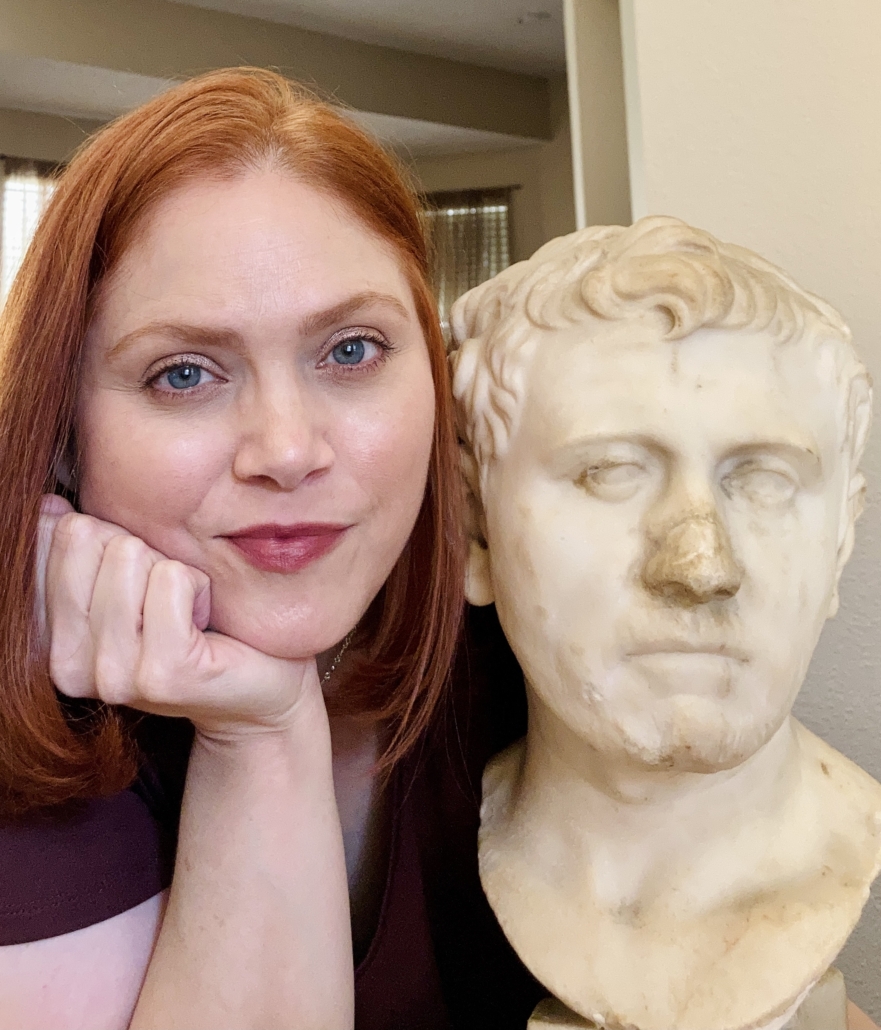
Laura Young with the Roman sculpture she found at a Goodwill in Austin, Texas.

Here’s a fun story. You may have heard it before as it was all over the media for a while. This version is by Matt Largey, reporting for KUT, an NPR station in Austin, Texas.

“When Laura Young found a human head under a table at the Goodwill store on Far West Boulevard in 2018, she had no idea what she was getting herself into.

“The price tag said $34.99. Seemed like a deal. It was all white. Made of marble. Weighed about 50 pounds.

“ ‘Clearly antique — clearly old,’ said Young, who runs her own business as an antiques dealer and goes to a lot of thrift stores looking for treasures.

“So she bought the head and lugged it out to her car, buckled it into the passenger seat and took it home.

“Young wanted to figure out what the sculpture was, so she did some Googling and she started to piece things together. She contacted an auction house in London that confirmed it was really old — like first century old. Another auction house managed to find the head in a catalog of items from a German museum in the 1920s and 1930s.

“It was listed as a portrait bust of a man named Drusus Germanicus.

“And so began Young’s four-year ordeal trying to get rid of a 2,000-year-old sculpture.

“How did a 2,000-year-old sculpture of a Roman general’s head wind up in a Goodwill in Austin, Texas?

“ ‘There are plenty of Roman portrait sculptures in the world. There’s a lot of them around. They’re generally not in Goodwills,’ joked Stephennie Mulder, an art history professor at UT Austin. ‘So the object itself is not terribly unusual, but the presence of it here is what makes it extraordinary.’ …

“The marble bust was cataloged at a museum called Pompejanum in the German city of Aschaffenburg. The museum was a replica of a villa in Pompeii, which was buried in volcanic ash in the first century. The German king, Ludwig the First, had something of an obsession with Pompeii, so he built this villa in the 1840s to house a bunch of Roman art. Germanicus was among the collection.

“Almost 100 years later, World War II was raging. In spring of 1945, Aschaffenburg was the site of a battle between the Nazis and the U.S. Army. …

“ ‘We know that many of the objects [in the museum] were either destroyed in the Allied bombing campaign or looted afterward,’ Mulder said. ‘So unfortunately in this case, it might have been a U.S. soldier who either looted it himself or purchased it from someone who had looted the object.’ …

“Perhaps the person who took it died or perhaps they gave it away. But somehow, someone decided they didn’t want it anymore and dropped it off at Goodwill. Workers slapped a price tag for $34.99 on it and put it out for sale. …

“Back at home, Young had a problem: She was in possession of a looted piece of ancient art. She couldn’t keep it. She couldn’t sell it. And giving it back to its rightful owners was a lot harder than it sounds.

“ ‘At that point, I realized I was probably going to need some help,’ Young says. ‘I was probably going to need an attorney.’

“So she hired a lawyer in New York who specializes in international art law, Leila Amineddoleh.

“Negotiations began. It was complicated. It takes a long time to figure out all this stuff — even in the best of times. But the pandemic complicated things even further. It was slow going and in the meantime, she was stuck with this 2,000-year-old head on display at her house. …

“It looked great in the house, she says. In a weird way, Young started to get attached. She named him — half-jokingly — after Dennis Reynolds, a narcissist character from the TV show It’s Always Sunny in Philadelphia.

“ ‘He was attractive, he was cold, he was aloof. I couldn’t really have him. He was difficult,’ she says. ‘So, yeah, my nickname for him was Dennis.’ …

“Finally, they got a deal: The Germans would take Dennis back. The exact terms of the deal are confidential, but the head will stay in Texas — on display — for about a year. Last month, the movers came to get him. …

“Young says, ‘It’ll be a little bittersweet to see him in the museum, but he needs to go home. He wasn’t supposed to be here.’

“[You] can see Dennis at the San Antonio Museum of Art, which already has a significant Roman antiquities collection.

“ ‘It actually ended up being a really, really good fit. He’s just right down the road,’ Young says. …

“In a way, Dennis will always be with Young. Before she let him go, she had a half-size copy of him 3D-printed. ‘I do have a collection of busts at home,’ she says. ‘So he’s with my other heads.’ “

More at station KUT, here.

Read Full Post »

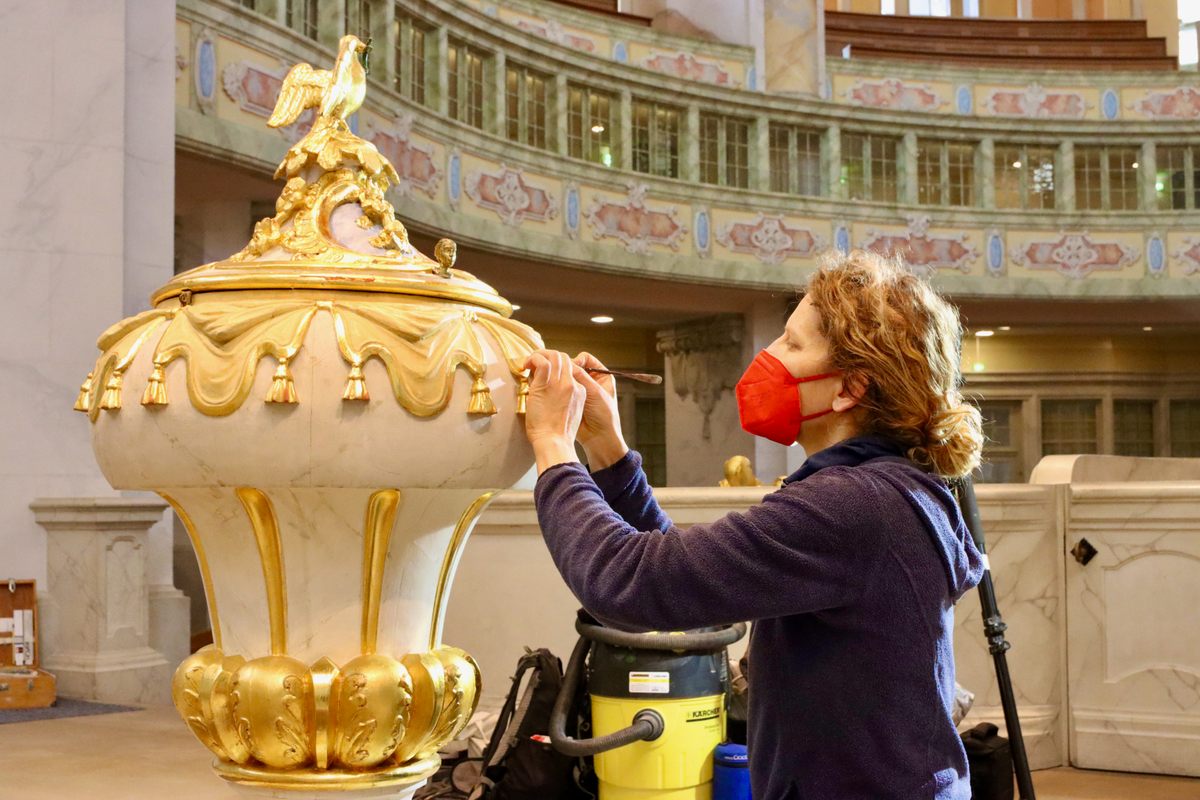
Photo: Grit Jandura/Frauenkirche Dresden.
Sweat from fingers and scratches from coat buttons take their toll on the highly ornamented interior of this historic German church. Every January, the doors close for a week so cleaners and craftspeople can get to work.

I’ve always admired people who do a real spring cleaning, a thorough “clean-up, fix-up, paint-up.” It’s not in my DNA, but I admire it. And I don’t mind lending a hand to someone else. I once helped an Orthodox friend prep her house for Passover. My job was to dig every bit of crumb and masticated baby food out of the high chair. Whew!

In Germany, a church is kept gorgeous by this kind of attention to detail. Gemma Tarlach reported at Atlas Obscura about “cleaning week at Dresden’s glorious Frauenkirche, a beloved house of worship and international symbol of reconciliation and resilience.

“ ‘It’s just a big praying room,’ says its lead architect Thomas Gottschlich, a soft-spoken man. … Gottschlich’s duties include overseeing the iconic church’s maintenance, including the annual January spruce-up, when every inch of the interior gets a once-over. …

“The Frauenkirche has been a part of the German city for a millennium, though its most famous iteration was a Baroque building envisioned by George Bähr and completed in 1743. The church earned the nickname Steinernen Glocke, or Stone Bell, thanks to Bähr’s unique design. ‘The dome construction is very special, you don’t have it that way in any other building in Europe,’ says Gottschlich. ‘Normally, the domes in other cathedrals are made with a wooden construction, which is covered with copper, lead, or whatever.’ Instead, Bähr used local sandstone for the entire dome.

“Because it is not the seat of a bishop, the Frauenkirche is technically a church, though it rivals many cathedrals in size. During construction, critics worried about the stability of that massive stone dome, which rises more than 300 feet above central Dresden. But it endured for centuries — until World War II. Although the church initially survived an intense bombing raid in February 1945, it collapsed days later.”

This is me again. In case you don’t know about the tragic US-British fire bombing of Dresden or haven’t read the novel Kurt Vonnegut wrote after he lived through it as a prisoner, Slaughter-House Five, I just want to state the obvious. Wars are bad. Let’s not have any.

Tarlach continues, “For decades the ruins of the Frauenkirche served as a war memorial and gathering point for peaceful protests under East German rule. Shortly after Germany’s reunification, an ambitious, decade-long project reconstructed the church using much of the original 18th-century sandstone. It quickly became a symbol of reconciliation and renewal. …

“While Gottschlich and his team also monitor the church’s exterior, where moss and crumbling mortar can be problematic, he says that it is the interior that demands much more attention. So, for the last 15 years, for one week in January, the church closes to visitors, and dozens of carpenters, painters, and other craftspeople and cleaners get to work. The crew repairs wobbly benches and worn wood, touches up paint, and scrubs, sands, and vacuums every nook and cranny of the highly ornamented space.

“Although the number of visitors has fallen since 2020 due to pandemic restrictions, the annual cleaning event went on as usual in early 2022. Like the constant monitoring of different climate zones around the building to ensure optimal conditions for the church’s organ, art, and load-bearing supports, the annual deep clean is an integral part of ensuring the Frauenkirche stays healthy and stands witness for several more centuries.

“Gottschlich notes that, during the reconstruction, the team chose a conspicuous interior location for the 18th-century cross that once topped the church’s tower. ‘We placed it so that, whenever you leave the church, you pass the old cross, and get an inkling of what it means to be both in history and in present time,’ he says.”

More at Atlas Obscura, here.

Read Full Post »

Photo: Cologne, Germany, police.
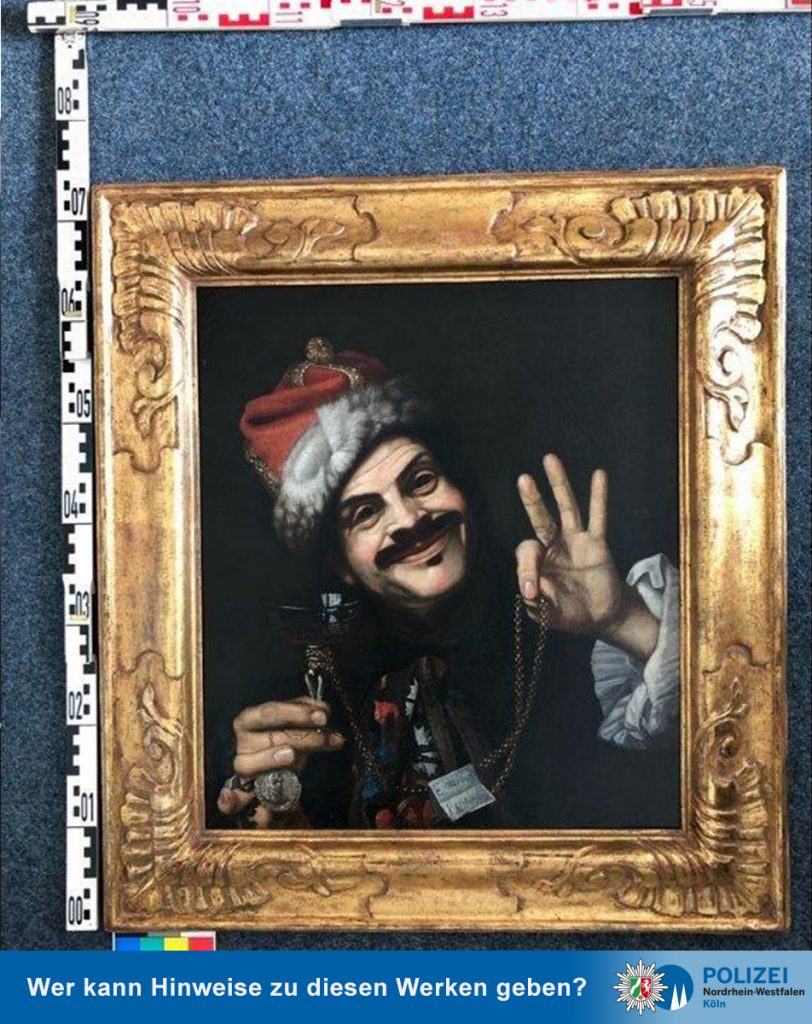
This painting by the artist Pietro Bellotti was found in a dumpster in Germany.

German dumpsters are yielding up treasures these days. In one case the rightful owners are unknown and being sought; in another, an owner realized in time that he’d left a valuable painting in an airport. (We all know how that can happen when our flight is called and we jump up. But we’re more likely to leave a sweater than a Tanguy.)

Naomi Rea writes about the unknown owners at Artnet News: “Police in Germany are appealing to the public for tips about the origins of two 17th-century paintings that mysteriously ended up in the garbage at a highway rest stop last month.

“According to authorities in the western city of Cologne, a 64-year-old man stumbled upon the two oil paintings in a dumpster at a rest stop near Ohrenbach on May 18. The man, who was taking a driving break at the stop at around 4 p.m., took the paintings with him and later turned them in to police in Cologne.

“After the paintings were examined by an expert, police concluded that they are both 17th-century originals, and have put out a public appeal to find their owner: ‘Who knows the paintings shown and / or how they got into the dumpster at the service area?’

“The first painting is a raucous self-portrait by the Italian painter Pietro Bellotti, dated to 1665. The other is a portrait of a boy by the Dutch Old Master Samuel van Hoogstraten, which has not been dated.

“The auction record for a Belloti is $190,000, achieved at the Swiss house Koller Auktionen in 2010, according to Artnet’s Price Database. There are multiple versions of the painting, and a very similar portrait, titled Self-Portrait of the Artist as Laughter, was put up for sale at Christie’s London in 2006 (estimate: $55,000–$91,000). … Other versions of the Bellotti painting are in the collection of the Uffizi Galleries in Florence, the Pinacoteca di Brera, and a third was once part of the Scheufelen Collection in Stuttgart.

“Meanwhile, works by Van Hoogstraten, who studied under Rembrandt in Amsterdam, have sold for as much as $788,000 (at Christie’s Monaco in 1993). The artist is best known for his experiments with perspective.” More at Artnet News, here.

In related news, a surrealist work turned up in another German dumpster. Check out Jesse O’Neill’s New York Post article from December.

“A surrealist painting worth $340,000 was recovered from a paper-recycling dumpster in Germany, police say.

“The valuable artwork, by French painter Yves Tanguy, was accidentally left behind by a businessman at Duesseldorf’s airport. The flier had forgotten the painting, which was packaged in cardboard, at an airport check-in counter before he boarded a flight to Tel Aviv, Israel, on Nov. 27.

“By the time the man landed in Israel, realized what he’d done and contacted police, the 16-by-24-inch masterpiece had disappeared. The mystery was solved only after the businessman’s nephew traveled to the airport from Belgium and talked with police. An inspector was able to trace the painting to a recycling dumpster used by the airport’s cleaning company.”

More at the New York Post, here. At least in that case, the owner knew where to look.

Read Full Post »

Photo: Christian Jungeblodt/The Guardian.
City wildflower meadow with central Berlin’s skyline in the background. It’s all about love for pollinators.

The other day, Asakiyume pointed me to a charming thread on Twitter about volunteers in San Francisco who move bee swarms to safer places.

@Annaleen tweeted, “I have an amazing and wholesome story about a wayward swarm of bees who decided to take up residence on a lamp post in the middle of a residential neighborhood in San Francisco. … love that my city has a volunteer bee swarm emergency hotline! The dispatcher said that exterminators generally call them when they find a swarm. This city is very ‘pro life’ for bees, he told us. When I imagine a better world, this is the kind of experience I think of.”

Meanwhile, in Germany …

Philip Oltermann has this report at the Guardian. “To escape the Berlin bustle on a summer afternoon, all that Derek O’Doyle and his dog Frida have to do is lap the noisy building site outside their inner-city apartment, weave their way through the queue in front of the ice-cream van, and squeeze between two gridlocked lorries to cross over Baerwaldstrasse.

“Bordered by a one-way traffic system lies a bucolic 1,720 sq metre haven as colourful as a Monet landscape: blue cornflowers, red poppies, white cow parsley and purple field scabious dot a sea of nettles and wild grass as armies of insects buzz through the air. Two endangered carpenter bees, larger than their honey bee cousins and with pitch-black abdomens, gorge themselves on a bush of yellow gorse.

“The mini-wilderness on Baerwaldstrasse is one of more than 100 wildflower meadows that have been planted in Germany’s largest cities over the past three years and are coming into full bloom this summer to transform urban landscapes.

“Berlin has set aside [$1.79 million] to seed and nurture more than 50 wild gardens over a five-year period, while Munich has set up about 30 meadows since 2018. There are similar initiatives in Stuttgart, Leipzig and Braunschweig. Hamburg, which started the trend in 2015, this month unveiled the first of a series of bee-friendly flower beds atop bus shelters.

“Juliana Schlaberg of Germany’s Nature and Biodiversity Conservation Union (NABU) said her NGO was receiving more and more requests from city residents who either wanted to grow their own wildflower patches or pressure their council to stop cutting green spaces into manicured lawns. …

“The rain-heavy start to this year’s German summer has created a bloom so spectacular that many a doubter has been swayed. The organisers behind the scheme deliberately mixed in endangered flowers that take two years to come into their prime with populist Akzeptanzpflanzen (‘acceptance plants’) like poppies and cornflowers, which blossom after only a year. Three years on, the full floral array is on display.

” ‘I’ve changed my mind,’ said O’Doyle. ‘It’s become an incredibly attractive addition to our neighbourhood. You experience the seasons in a whole new way.’ Yet aesthetics are a mere bonus for a scheme with serious purpose: the protection of Germany’s population of wild bees.

The country is home to about 580 species of wild bee, of which an estimated 300 can be found in Berlin. More than half are endangered or on the verge of extinction.

“A 2017 study by the Entomological Society of Krefeld showed a 75% decline in total flying insect biomass in protected areas in Germany since 1989, with the use of insecticides, exposure to toxic exhaust fumes and above all a loss of diverse habitats cited as reasons for the drastic decline.

“The findings inspired a 2019 ‘save the bees’ petition in Bavaria that became the most successful in the southern state’s history, nudging politicians to pass into law its demands without putting them to a referendum first. A similar petition will be handed over to the parliament of the large state of North-Rhine Westphalia in July.

“Christian Schmid-Egger, who coordinates Berlin’s wildflower meadows on behalf of the German Wildlife Foundation, said any conservation effort would ultimate require broader changes in agricultural practices: ‘If we are going to save the bees, we won’t be doing it in cities.”’ …

“Unlike the hive-building honey bee, wild bees are solitary creatures always on the look out for new temporary accommodation. … Others have picky dietary requirements: one Berlin species of mason bee, osmia adunca, only collects pollen off viper’s bugloss, a type of plant that only grows in dry grasslands and waste spaces.” More at the Guardian, here.

Asakiyume understood that Annalee’s final statement in the Twitter thread on bee swarms is more or less my philosophy: “Sometimes, if you’re lucky, you get to glimpse a better world in the present. It’s like looking through a pinhole at something huge and distant and almost imperceptible. But you can see just enough of it that you know it’s possible, one day.”

Read Full Post »

Photo: Bode-Museum, Berlin, Germany.
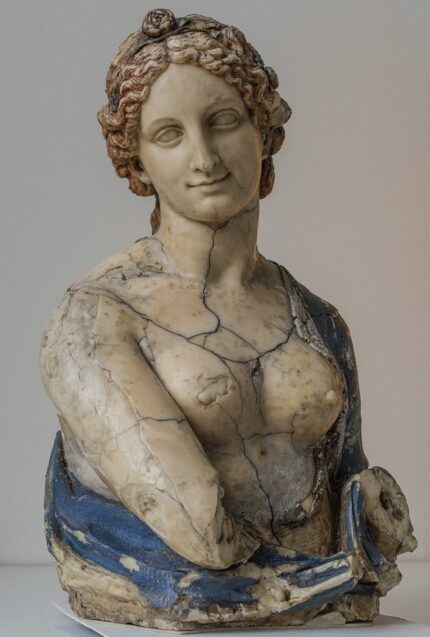
A wax bust once attributed to Leonardo da Vinci (1452-1519) has been conclusively shown to be no earlier than the 18th century.

There are always new things to discover. In today’s story, decades of fierce arguments about the artist behind a wax bust in a Berlin museum were laid to rest when researchers mastered the dating of the wax. The History Blog has the report.

“A wax bust whose attribution to Leonardo da Vinci once caused art historians to threaten violence has been conclusively shown to be a modern work from the 18th century at the earliest.

“The bust of Flora, goddess of flowers and springtime, now in the National Museums in Berlin, was spotted by general director of the Royal Museum of Berlin Wilhelm von Bode in an antique store in London in 1907. Her downcast eyes, half-smile and finely-modeled features impressed Bode as a work by Leonardo da Vinci. German art historian Max Friedländer, assistant director of the Kaiser-Friedrich Museum under Bode, was convinced by its high quality and wear patterns that it was a Renaissance work. Bode bought it for a princely sum (185,000 Goldmark) in 1909 and announced with much fanfare that it was a work by no less a Renaissance luminary than Leonardo da Vinci, the only known wax sculpture surviving from the period.

“Bode was held in high regard in Germany. He had been involved in the creation of a national collection for the royal museums since he was hired as assistant curator of sculpture in 1872 and his career would span the entire five decades of the second German Empire from Unification to Republic. …

“Within months, the Times published a story contesting the attribution and alleging Flora was in fact it was created by 19th century British sculptor and photographer Richard Cockle Lucas who had copied it in 1860 from a painting of Flora in the Hermitage once attributed to Leonardo but later determined to be the work of his student and right-hand-man Francesco Melzi.

Lucas’ son Albert Dürer Lucas, then 80 years old, swore that his father had made it and that Albert had helped stuff old newspapers and wood chips into the hollow of the bust.

“Even though newspapers and wood chips were indeed found inside, including an article from 1840, Bode dismissed out of hand the possibility that Lucas was the sculptor. Lucas, Bode contended, was simply not good enough to model so superlative a piece. Unlike Flora, Lucas’ known wax pieces were greyish in color, lacked any polychromy and still smelled of wax. Bode was sure that at most, Lucas had been employed to fill its empty core to reinforce the structure and had fashioned some arms to match.

“In the next two years, more than 730 heated articles were written debating the attribution. There were debates on the floor of the Prussian parliament. Two scholars challenged each other to a duel. Bode died in 1929, still convinced that his attribution to Leonardo was correct. The debate got less aggressive over the decades, but never died down. Even modern technology hasn’t been able to settle the issue conclusively, because wax, as it happens, is a complicated medium to date.

“Albert Dürer Lucas said his father made the bust by melting down a bunch of burned candle ends. Analysis of wax samples found it is composed almost entirely of spermaceti, a waxy substance produced in the head cavity of the sperm whale commonly used in 19th century candles, and a small amount of beeswax. The decay of C14 occurs in the atmosphere in a calculable way, but under water the C14 is absorbed much more slowly and is much older than the carbon absorbed on land. The Marine Reservoir Effect makes radiocarbon dating results difficult to calibrate because you would need to know that specific whale’s full biography — track its movements from equator to ice shelves — to produce any semblance of accurate results. …

“The new study utilized two calibration curves, marine and terrestrial, and applied them to samples of the wax from Flora as well as to another work by Lucas, an 1850 relief of Leda and the Swan. The result was a date range of between 1704 and 1950, admittedly wide, but it conclusively precludes that the bust was made by Leonardo or anyone else in the Renaissance. The study has been published in the journal Scientific Reports and can be read here.”

For additional details, check out the History Blog, here.

Read Full Post »

Photo: Angelika Porst.
New examinations of John the Baptist wall paintings in Augsburg cathedral date them to more than 1,000 years ago
. Above, a decorative detail of the frescoes in the southern transept, which were only revealed in the 1930s.

A word to the wise for artists who hope their work will still be enjoyed in 1,000 years: try frescoes. The Oxford dictionary describes a fresco as “a painting done rapidly in watercolor on wet plaster on a wall or ceiling, so that the colors penetrate the plaster and become fixed as it dries.”

So even though watercolor is transient, plaster holds it.

Catherine Hickley reports at the Art Newspaper, “A series of frescoes showing the life and death of John the Baptist in the cathedral of the Bavarian city of Augsburg have been recently dated to the first decade of the 11th century, ranking them among the oldest wall paintings in a medieval church north of the Alps.

“The frescoes, located high in the southern transept of the church, were whitewashed over and forgotten until the 1930s, when they were uncovered. But it was not until conservation work began on the roof structure in 2009 that they could be proven to date back to the construction of the cathedral more than 1,000 years ago.

Dendrochronological tests revealed that wood in the masonry dated from AD1000, contradicting the previously held dating of the cathedral to around AD1065. The new dating ‘fits with what we know about a massive destruction in 994,’ says Birgit Neuhäuser, a spokeswoman for the Bavarian State Office for Heritage Protection.

“ ‘The oldest frescoes are the first layer above the masonry, and are therefore part of the original decor of the church,’ Neuhäuser says. ‘We can assume that in the case of an important Episcopal church, the frescoes would have been painted soon after the construction, so soon after AD1000.’

“In artistic style, the frescoes bear a strong resemblance to the tenth-century wall paintings at the Church of St George on the island of Reichenau on Lake Constance, near Germany’s border with Switzerland. The island owes its Unesco World Heritage status [read about a World Heritage site I visited, here] in part to the frescoes. Apart from the Reichenau church frescoes, the Augsburg paintings are the biggest preserved frescoes of their era in the German-speaking countries, says Mathias Pfeil, the head of the Bavarian State Office for Heritage Protection. …

“Given the height of the frescoes in the church, there is no need for special conservation measures in the long term, according to Neuhäuser. ‘They are not under any particular stress’ from the humidity or heat generated by visitors’ traffic, she says. ‘After cleaning and conservation, they are in a stable and sustainable condition.’

“The team plans to examine the roof area and the northern transept of the church for further fresco remnants. The research and conservation work is financed by the Beate and Hans Peter Autenrieth Foundation, the Siegfried and Elfriede Denzel Foundation and the Augsburg diocese.” More at the Art Newspaper, here.

Have you ever seen any frescoes? I saw Leonardo da Vinci’s frequently restored Last Supper in Milan when I was a teen. I really liked doing a research project about the frescoes of Giotto in high school although I’m pretty sure I’ve never seen any Giottos except in pictures. Below, I’ve added a nice dragon fresco from the Cloisters. (I wrote about my 2019 visit there in this post.)

Twelfth Century Spanish fresco at the Met Cloisters in New York City.

Read Full Post »

16overlooked-reiniger3-jumbo

Photo: SZ Photo/Bridgeman Images
A scene from the animated film “The Adventures of Prince Achmed,” by the late Lotte Reiniger. Before there was such a thing as Disney Studios, she was using intricate hand-cut silhouettes to make movies.

Society has become so accustomed to Disney and Pixar types of animations that it has lost sight of predecessors in the field.

In a step toward restitution, Devi Lockwood wrote for the New York Times series Overlooked (“obituaries about remarkable people whose deaths, beginning in 1851, went unreported in the Times“) about an early animation artist we all should know.

“A decade before Walt Disney Productions came into existence, making its name synonymous with animated films, there was another pioneer of the art form — Lotte Reiniger.

“Reiniger’s filmmaking career spanned 60 years, during which she created more than 70 silhouette animation films. … She’s perhaps best known for her 1926 silent film ‘The Adventures of Prince Achmed,’ a fantastical adaptation of ‘The Arabian Nights’ that was among the first full-length animated features ever made.

“Charlotte Reiniger was born on June 2, 1899, in the Charlottenburg district of Berlin to Karl and Eleanor (Raquette) Reiniger. She studied at the Charlottenburger Waldschule, where she learned about scherenschnitte, the art of cutting shapes and designs in paper with scissors. The art form originated in China and later became popular in Germany. …

” ‘I began to use my silhouettes for my playacting, constructing a little shadow theater in which to stage Shakespeare,’ she wrote in 1936 in Sight and Sound magazine.

“At first she wanted to be an actress, but that ambition changed when, as a teenager, she encountered the film director and actor Paul Wegener after a lecture he had delivered in Berlin on the possibilities of animation in cinema. Fascinated by his films, like ‘The Student of Prague’ (1913) and ‘The Golem’ (1915), she persuaded her parents to enroll her in a theater group at the Max Reinhardt School of Acting, where Wegener taught.

“For fun she cut silhouettes of the actors in the group. Wegener was impressed [and] enlisted her to help with his 1918 film, ‘The Pied Piper of Hamelin.’ …

“Her work with Wegener led to her admission to the Institute of Cultural Research in Berlin, where she met the art historian Carl Koch. He would become her husband and a collaborator on her films. …

“Reiniger’s editing was meticulous. Starting with more than 250,000 frames [for ‘Prince Achmed’], she and her crew used just over 100,000 in the film, which ran for an hour and 21 minutes, each second requiring 24 frames. It took three years to complete, and premiered in the Volksbühne, or People’s Theater, in Berlin, when Reiniger was 27. …

“Reiniger designed a complex process to make her films. She cut each limb of each figure out of black cardboard and thin lead, then joined them together with wire hinges. For research, she spent hours at the Zoo Berlin, watching how the animals moved. …

“When Hitler was in power, Reiniger and her husband left Germany for France, Italy and England, where they collaborated with other puppeteers, funders and artists before returning to Berlin in 1944 to look after Reiniger’s mother. In 1948 they moved to London, where they joined a nearby artists’ colony. Reiniger then directed a series of short children’s films for the BBC.

“Her husband died in 1963, and she stopped making films. But in 1972 she was recognized with the Golden Reel Award at the Berlin Film Festival for her contributions to German cinema. Two years later, the Goethe Institute sponsored her on a lecture tour of Canada and the United States.

“ ‘A Reiniger revival swept North America,’ the Canadian newspaper the Globe and Mail wrote.

“The tour inspired her to make a few final short films, including ‘The Rose and the Ring’ (1979), a 24-minute adaptation of the 1854 satirical work of fiction by William Makepeace Thackeray, and ‘Düsselchen and the Four Seasons,’ a two-minute film completed in 1980. She died on June 19, 1981, in Dettenhausen, Germany. She was 82.

“[The] Times film critic A.O. Scott recalled her in a 2018 article about the unsung women who had advanced the art of filmmaking. Praising Reiniger’s ‘blend of whimsy and spookiness,’ Mr. Scott wrote that her ‘dreamy images that seem to tap right into the collective unconscious suggest both an antidote to Disney and a precursor to Tim Burton.’ ”

More at the New York Times, here.

You might also be interested in the Armenian shadow puppets I wrote about in 2018, here.

Lotte Renniger’s film about Jack and the Beanstalk.


Read Full Post »

lowest-vocal-note-header_tcm25-584243Photo: Guinness World Records
Helen Leahey, a Welsh musician living in Germany, recently broke the record for the lowest vocal note (female).

Hello, friends, are you ready for another story on the unusual world records that adventurous humans can’t wait to break? (Remember this one on a poetry recitation in 111 languages and this one on running backwards?)

Well, let me introduce you to Helen Leahey, the “Bass Queen.”

Connie Suggitt writes at the Guinness World Records website that Leahey “sang from a D5 to a D2 note at an incredibly deep 72.5 hertz(es) in her attempt at the Music School Wagner in Koblenz, Germany.

“Helen, originally from St Asaph in Wales but now living in Germany, has recently returned to singing after the birth of her first child. …

” ‘I have been encouraged for some years to pursue a musical career professionally, in part because of my unique voice,’ Helen explained. ‘Everywhere I sing, I hear that nobody has heard a woman who can hit the low notes like me. I guess I wanted to see how unique my voice truly is.’ …

“During her attempt, Helen had eight industry professionals present, including qualified music teachers and sound engineers. Her witnesses were Tatjana Botow, a singing teacher, and Elmar Wald, a sound engineer. …

“After a couple of attempts, sound engineer Tobias Jacobs confirmed Helen had achieved the record-breaking low note. …

“Helen’s naturally deep voice has helped define and shape her music career, as has Celtic roots. In her songs, many instruments can be heard, including the guitar, Irish bouzouki, harmonica and the Irish drum (Bodhrán). …

” ‘When I play music, there is no filter, nothing, nowhere, where I can hide. Singing my own songs in front of an audience is incredibly humbling and intimate,’ Helen says on her website.” More at Guinness, here.

I have known women in a cappella groups who have deep enough voices to sing the bass line, but this takes the cake.

Read Full Post »

In honor of my 3,000th post today, Suzanne is offering a 20 percent discount on anything at Luna & Stella, the site for contemporary and vintage jewelry with which this blog is associated. Just use the code 3000. The offer is good for all of June 2019!

Turning now to two of my blog’s favorite themes — paying it forward and refugees — I want to tell you about England’s Dame Stephanie Shirley, a former kindertransport evacuee, who plans to donate German government compensation to modern-day refugee children.

Are you familiar with the kindertransport that rescued children from Nazi Germany and brought them to England? According to Wikipedia, “The Kindertransport (German for ‘children’s transport’) was an organised rescue effort that took place during the nine months prior to the outbreak of the Second World War. The United Kingdom took in nearly 10,000 predominantly Jewish children from Germany, Austria, Czechoslovakia, Poland, and the Free City of Danzig. The children were placed in British foster homes, hostels, schools and farms. Often they were the only members of their families who survived the Holocaust. Most importantly, the programme was supported, publicised and encouraged by the British Government, which waived some immigration requirements.”

Imagine that. The government responded to the urgency!

I like that Dame Stephanie, having grown up to be a successful entrepreneur and philanthropist, will pay her German compensation forward to help other refugee children. There is still a crisis, just for children from different countries this time.

According to the Jewish News, “Dame Stephanie Shirley, 85, who boarded a train from Vienna in 1939 aged five, founded a software company in 1962 which was later valued at over £3 billion. … She said: ‘I intend to donate my €2,500 windfall to the Safe Passage charity which supports today’s child refugees. …

“ ‘I’m trying to encourage others to donate theirs as well. There are an estimated 500 of us Kinder still in the UK, so that adds up. I’m discussing it with [Lord] Alf Dubs and [Sir] Erich Reich, how we can combine to make a really big donation. …

‘I’m ashamed of how little this country has done to save child refugees in recent years. It couldn’t be more different to the monumental effort that saved so many of us.’

Read more here and here.

P.S. Please buy something gorgeous at Luna & Stella — for yourself, or maybe a June bride — and use that 20 percent discount so my daughter knows my eclectic blog actually sends folks her way.

Dame Stephanie Shirley, a former kindertransport child, who is paying it forward to help young refugees.

Read Full Post »

merlin_141970665_3226dcb4-ae59-4f88-aa9e-53ad5880d80e-jumbo

Photo: Lisa Marie Summer for the New York Times
A German opera company invited current refugees to be part of its production of “Moses,” lending immediacy to the story of exile.

Powerful stories from any century speak to the human condition in any other century. Thus, for example, the story of exile in the opera “Moses” speaks to the sense of dislocation that today’s refugees experience. To drive home that point, an opera company in Germany has invited current refugees to participate in a production.

Joshua Barone reports at the New York Times, ” ‘We tell the story of Moses because it is actually our story,’ one teenager, a refugee from Afghanistan by way of Iran, said in the Hazaragi dialect to the German-speaking audience at the Bavarian State Opera here on a recent Sunday evening.

“Others chimed in: ‘The story of Moses is also my story,’ they said in French, Kurdish, Greek and Arabic.

“They were the cast of ‘Moses,’ a feel-good yet sobering new production by the Bavarian State Opera’s youth program, written for refugees, children of immigrants and born-and-raised Bavarians.

“In the opera, a mixture of new music by Benedikt Brachtel and adapted excerpts from Rossini’s “Mosè in Egitto” [“Moses in Egypt”], the teenagers tell the story of Moses — common ground for followers of the Bible, Torah and Quran — with Brechtian interludes about refugee experiences and current events.

“The director Jessica Glause, who created the libretto based on interviews with refugees in the cast, has concocted a blend of humor, horror and youthful energy that hardly feels like a didactic documentary about Europe’s refugee crisis. Behind the scenes, ‘Moses’ has provided a way to learn German and make friends — in short, to make the process of migration a little less painful. And audiences have responded favorably. …

“Theater about the refugee crisis has proliferated in Germany since migration into the country reached its peak in 2016. But rarely has the hot-button issue — which continues to threaten Chancellor Angela Merkel’s power and fuel the rise of the far-right party Alternative for Germany, or AfD — entered the realm of opera, much less children’s opera. …

“Ms. Glause, who had volunteered on boats in the Mediterranean, also wrote the libretto for ‘Noah,’ after interviewing many of the same young refugees who are in ‘Moses.’ She described the process — hearing stories of loss, danger and fear from teenagers — as acting as both an artist and a counselor.

“Among the people she spoke with were Ali Madad Qorbani, a young man from Afghanistan who fled to Iran, then Europe, after his father had disappeared; and Zahra Akhlaqi, also from Afghanistan, whose mother came to Europe first while she and her sister waited in Iran, where, she said, they were forbidden from going to school but would dress up like students at home and play pretend.

“Now, their lives are slightly more stable, though just as precarious as any refugee’s. …

“There are still monologues of how and why some of the cast members came to Europe, but much of the material is about reconciling their faiths and cultures with those of Germany — including one humorous passage about trying German beer for the first time. But they also describe how they don’t always feel welcome, such as a scene in which the plagues in Moses’s story give way to one person describing signs near Munich that say refugees overrun Germany like locusts. …

“In interviews, [youth program director Ursula Gessat] and Ms. Glause were quick to say that their job is to reflect the world around them, and that it would be irresponsible to ignore the refugee crisis. Indeed, Ms. Glause said that conservative politicians may change their minds if they met the cast of ‘Moses.’

“ ‘I would tell them to come see this show,’ she said. ‘Come hear these stories.’ ”

More at the New York Times, here.


Read Full Post »

Photo:  Diana Markosian / Magnum Photos
Yazidi refugee children are overcoming fear of the water in Germany.

One reason I was interested in the following story is that I have worked with Yazidi refugees from Iraq like these. One of the people in the family I know actually has relatives in Germany, where the story takes place.

Philip Oltermann writes at the Guardian, “When Hanan Elias Abdo looked over the side of the rubber boat into the deep blue sea, she could make out two large shapes, moving at speed. Were those dolphins? Or sharks? ‘Did you see the fishes?’ she shouted at her siblings.

“Six-year-old Sulin, the youngest, … was lying on top of a thin patch on the boat’s floor and could feel the water moving underneath her. At home, in the Sinjar mountains in Iraq, she had never more than splashed through an ankle-deep brook. What if the floor gave way and she got pushed into the bottomless depths? What, she thought, if the fishes started nibbling at her feet?

“That was in September 2015. Two and a half years later, Sulin stands atop a starting block in northern Germany, takes a two-step run-up, waggles her arms and legs mid-air, before landing in the 2-metre-deep turquoise water and splashing her giggling sisters who are paddling near the edges. Surfacing, she pulls a funny face at the man with the white beard and white slippers applauding her from the side of the pool. ‘That’s it!’ says Günter Schütte, Germany’s first swimming instructor to specialise in helping to cure refugees’ fear of water.

“Schütte is a teacher with 40 years’ experience teaching politics and sport at schools in Wolfsburg, and a passionate swimmer since he was 13. Throughout his career, he says with pride, he made sure that by the end of the school year there was never a non-swimmer in any of his classes. …

“When Schütte realised that many refugees who arrived in Wolfsburg were families from countries with little open water, and that many children had been traumatised by the journey across the Mediterranean, he decided that swimming could become a tool for better integration.

“From October 2015, he booked a two-hour slot every Sunday at a municipal swimming pool and handed out flyers advertising the course at asylum seekers’ shelters in the area. …

” ‘We take our time,’ he says, ‘because when you are scared, time-pressure is the last thing you need.’

“The purpose of the course was to help the new arrivals ease into an unfamiliar element – in a metaphorical sense, too. ‘By learning how to swim, refugees are no longer shut out from the sports lessons at school,” Schütte says. ‘Some of them also get a head start on their German peers – they have a sense of achievement.’ …

“Sinjar province, where Hanan, Helin and Sulin, now nine years old, grew up, is a traditional stronghold of the Yazidi minority who were declared infidels by al-Qaida and actively targeted by Isis in 2014. Helin, now 12, recalls a phone call late that summer from her grandmother, who lived in the next valley along: Isis fighters were approaching and the villagers had run out of ammunition. …

“There was no time to wait any longer. Their mother, the six siblings and a neighbouring couple all piled into a single car and headed for the Turkish border, leaving behind the two family goats and the cherry and orange trees in their garden. Months later, after crossing the Mediterranean and seven different countries, someone sent Helin a photograph of their village. ‘The war had flattened everything,’ she says. …

“For now, the pool can suspend the pressures bearing on them outside. … Hanan wants to go a step further and get the rescue swimming badge in silver, for which she has to take a jump from a 3-metre board, swim 25 metres underwater in one breath, and rescue a drowning person with pull stroke. Asked what she wants to do when she grows up, she doesn’t take long to come up with an answer. ‘I want to become a sports teacher.’ ”

More here.

Read Full Post »

Older Posts »