Feeds:
Posts
Comments

Posts Tagged ‘health’

Photo: John Okot.
A volunteer for The Mango Project places mango slices in a solar dryer for preservation in Midigo, Uganda, where malnutrition is a serious issue.

One of my grandsons has had an interest in Uganda for several years — first, through learning about endangered mountain gorillas, then through helping support a start-up water business in the country. As a result, I pay extra attention to Ugandan news.

John Okot reports at the Christian Science Monitor about two brothers in Uganda who launched a mango initiative to help their neighbors.

“Francis Asiku’s plan to fight hunger in his village began, quite naturally, under a bountiful mango tree. It was 2011, and he had just landed his first nursing job at Midigo Health Centre IV in Yumbe district in northern Uganda. He was excited and joyful. But in his first month at work, Mr. Asiku was surprised to learn that what many infants and expectant mothers seeking care needed wasn’t necessarily medicine. It was nutritious food.

“He recalls one hot afternoon, in particular, when a young mother rushed into the health center with a 4-year-old child in her arms. Mr. Asiku hurried to help. He quickly diagnosed poor feeding as the root of the child’s problem. …

“He headed home on a dirt road in the inky-dark evening. When he spotted birds feasting on rotting mangoes along his path, a question struck him: Why were so many people in his community malnourished when it experienced two plentiful mango seasons a year?

“He raised the issue later that night with his younger brother, farmer Emmanuel Mao. Soon afterward, the brothers met with village elders under the huge mango tree where community meetings were held. That was the start of their nonprofit, The Mango Project, which distributes glass jars full of mangoes to schools, to health centers, and directly to hungry individuals.

“The toll of hunger in Uganda is staggering, according to the Global Hunger Index, a report published by several global nonprofits. Almost 37% of the population is undernourished, and about one-quarter of children have stunting, a condition that is associated with malnutrition.

“When Mr. Asiku and Mr. Mao met with the Midigo elders, [they said] the brothers needed to figure out a way to preserve Midigo’s abundant mangoes throughout dry periods, when they are scarce. …

“Mr. Asiku and Mr. Mao embarked on researching a simple way to preserve food. They began ‘jarrying’ – cutting fruit pulp into thin slices and putting them in a glass container of boiling-hot water and sugar. While canning is practiced throughout the world, many Midigo villagers can’t afford sugar, not to mention glass jars with secure lids. The relatively easy preservation method – and the brothers’ fundraising efforts to obtain the necessary supplies – delighted village elders. …

“The brothers initially collected mangoes that were scattered throughout the village, but have since expanded their initiative to preserve the fruit from their family’s ancestral land. The jarred fruit is safe to eat for up to a year.

“Mr. Asiku knows that the mangoes alone will not end malnutrition in the community, since humans need a balanced diet. But the initiative, he says, is a great start to breaking the hunger cycle in Midigo. …

“Irene Andruzu, who supervises one of the Midigo Health Centre’s facilities, says she receives at least 50 jars of mangoes monthly to help malnourished patients. During the pandemic alone, more than 12,000 jars of mangoes were distributed to health clinics and refugee settlements.

“Scovia Anderu, a social worker for Calvary Chapel Midigo, lauds The Mango Project for instructing villagers. She says that most villagers lack knowledge about nutrition and that there are few qualified personnel who can educate them on the subject at the grassroots.

“Zuberi Ojjo, the district health officer for Yumbe, [says] The Mango Project ‘reminds people of the importance of nutrition to our well-being.’ …

“One obstacle for The Mango Project is that charcoal, which is needed to heat the water used to sterilize jars, can be difficult to obtain. Since 2023, the government has banned commercial charcoal production in the northern region over concerns about the alarming depletion of trees there. Nevertheless, illegal, large-scale tree-cutting has disrupted weather patterns in the region, where communities rely mainly on agriculture amid erratic, unpredictable rainfall. …

“Mr. Asiku has found one alternate form of fuel. Over the years, he has been scrimping and saving, and last year he purchased a solar-powered dryer worth $600. Besides mangoes, he dries vegetables such as okra and eggplant to give to villagers.

“He hopes to distribute the food more widely as he acquires a license from the government to do so – and more dryers. He also has an orchard with 310 hybrid mango trees. This is meant to supplement the seasonal mangoes in case there is low supply because of damage caused by fruit flies.

“ ‘It’s fulfilling to see my people smiling at the end of the day,’ Mr. Asiku says.”

More at the Monitor, here.

Read Full Post »

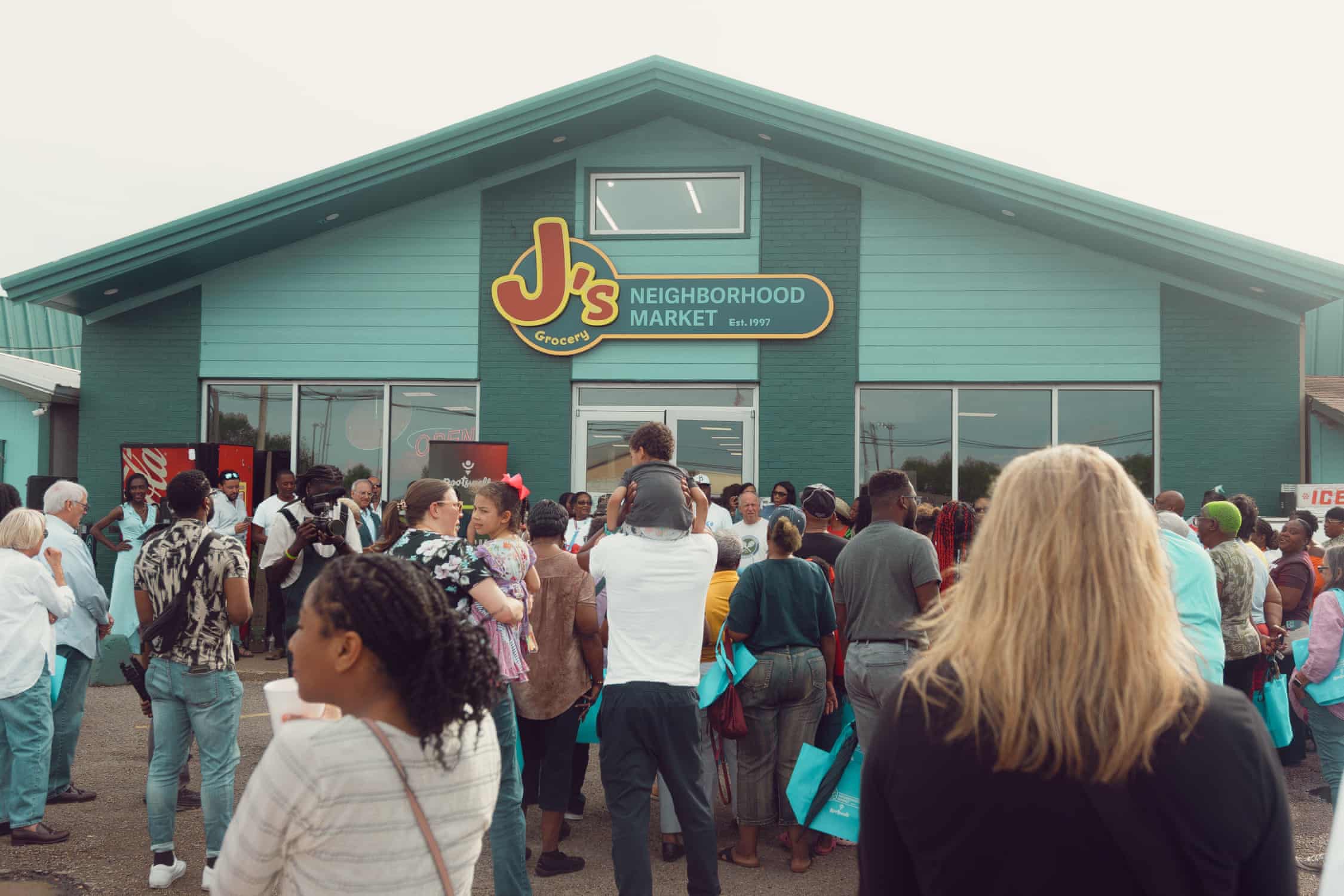
Photo: Noah Stewart.
On 2 May, J’s Grocery in Clarksdale, Mississippi, reopened after a yearlong renovation. Through a new food-access initiative, J’s Grocery provides its mostly Black community with hard-to-come-by fresh produce.

The best medicine is often a healthful diet. But in many communities around the US, nourishing food is hard to access. That’s why a community in Mississippi is rejoicing about a newly renovated grocery store.

Adria R Walker writes at the Guardian about J’s Grocery revitalizing its majority-Black town with fresh produce.

“With the recent release of Ryan Coogler’s Sinners, Clarksdale, Mississippi, known as the home of the blues, has been thrust into the spotlight. But while the nation and world are captivated by a version of Clarksdale from more than 90 years ago, residents today are focused on the future.

“On 2 May, rain and warnings of thunderstorms were not enough to keep people in Clarksdale’s Brickyard neighborhood away from the reopening of J’s Grocery, a local staple since 1997 that had been under renovation for the last year.

“A collaboration between the store owner, Al Jones, and local farmers, J’s, the only Black-owned supermarket in the area, now carries fresh produce. …

“The new stock and collaboration was made possible by a deal among Jones; Partnership for a Healthier America (PHA), a nonprofit that works to provide access to nutritious food; Rootswell, a Mississippi Delta-based group that was formed to ‘shift the paradigm of food apartheid‘; Novo Nordisk, a pharmaceutical company; and other groups.

“ ‘At a time in our country when the federal government is just pulling money back everywhere, we invested in people and community,’ Noreen Springstead, PHA’s president and CEO said at the opening. …

“Jarvis Howard of Tunica, Mississippi, a visual artist who goes by DudeThatDraw, painted a mural, a smaller version of one he is installing at nearby George H Oliver elementary school. ‘Food is medicine,’ the mural reads over vibrantly colored vegetables. …

“Clarksdale, which today has a population of nearly 14,000 people, is primarily Black. The grocery store is in a walkable, mixed-income community, with an elementary school almost right across the street. A middle school, a Head Start center, a nursing home and senior citizen housing, low-income apartments and single-family homes are all in close proximity. In addition to the newly offered produce, the store also features a third space: a seated, shaded area surrounded by raised beds planted with herbs, where residents can gather and chat.

“The Mississippi Delta is abundant in fertile land and crops; agriculture is the state’s No 1 industry. Though some 30% of the state is farmland, most of that land is dedicated to cash crops, which are exported. In 2022, nearly 20% of Mississippians were food-insecure.

“Farms in the region ‘produce a lot of commodity crops, like corn, soybean, cotton. They don’t produce a lot of food that we eat,’ said Robbie Pollard, one of the farmers whose produce is now sold at J’s. ‘We’re trying to change the landscape to start producing more food in the Delta, like converting some of that land that’s used for row-crop production.’ …

“Pollard said that while the Mississippi Delta region is abundant in farmland, there’s a gap in what reaches the community. His initiative, Happy Foods Project, which is part of his farm, Start 2 Finish, is working to remedy that by collaborating with other farmers, and introducing youth to farming through farm visits and farm-to-school programs.

“J’s Grocery reopening will be a gamechanger for the neighborhood, he said. Some residents lack transportation to be able to get to big box stores that sell imported produce. Rural counties in the Mississippi Delta, like Coahoma county in which Clarksdale is the largest town, average one supermarket per 190.5 sq miles . …

“After Clarksdale lost its Kroger in 2017, residents initially pushed for another big box store to move in. But Tyler Yarbrough, the director of Mississippi Delta Programs for PHA, and others wanted the town to be able to return to its locally owned, locally operated roots. …

“Yarbrough said that stories from his grandmother and other older residents of shopping in the 1960s provided inspiration for what they might be able to bring back to the town. At the time, locals didn’t need to leave their communities to procure groceries. Instead, they went to the local grocery stores, which, like J’s, had a butcher who sold chicken, pork, freshly sliced bacon and produce.

“ ‘It is in our food-system history of having these neighborhood corner stores,’ he said, noting that the Brickyard and downtown Clarksdale once had 12 such shops. ‘This project is honoring that legacy and reminding us that we can own our food and the stores that we shop from.’ ”

More at the Guardian, here. No paywall, but donations keep this reliable news source alive. Help if you can.

Read Full Post »

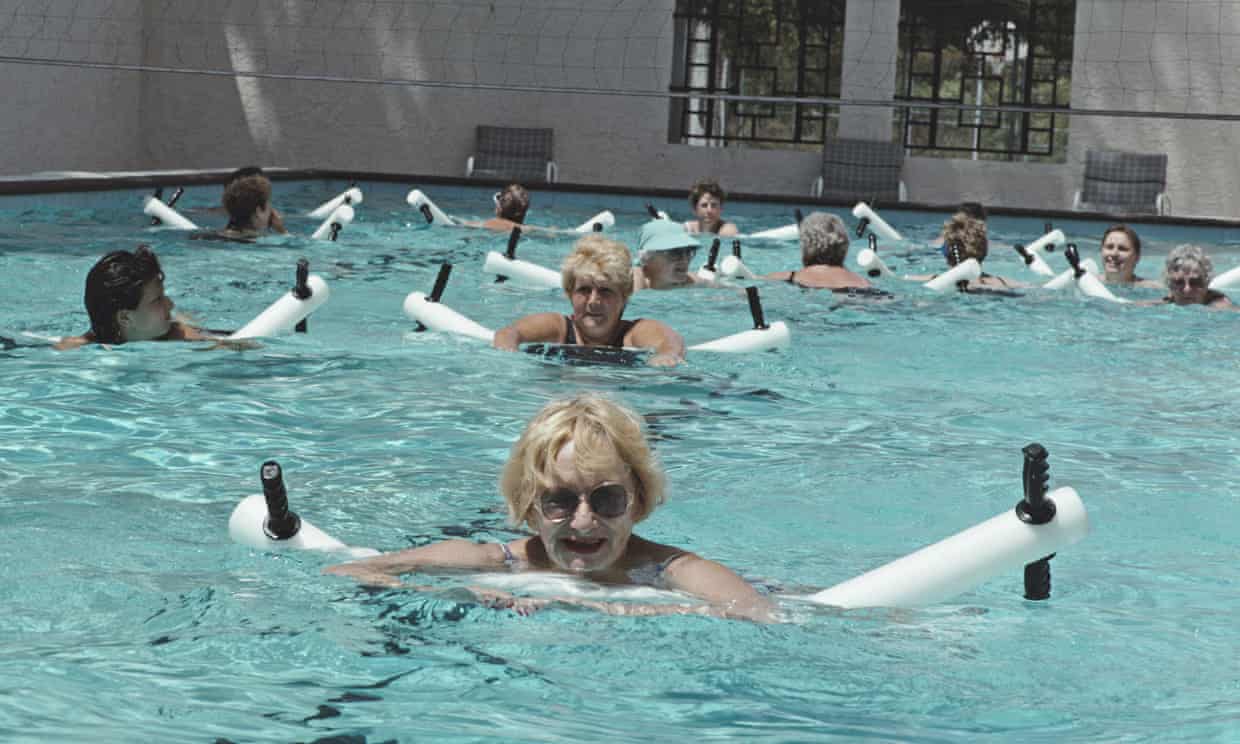
Photo: Barbara Alper/Getty Images.
Aqua aerobics is pitched at those who are ‘young at heart, recovering from pregnancy, or rehabilitating,’ writes Kate Leaver.

Since I moved to a retirement community with many excellent exercise instructors, I’ve been impressed to see how many seniors are really serious about staying in shape — even people close to 100. Today’s story is about a particular kind of class for older people, but not just older people. It comes from Sydney, Australia, via the Guardian.

Kate Leaver writes about her experience with a water aerobics class.

“At my first class, we sang Barbara ‘Happy Birthday.’ She was turning 80, doing fly-kicks underwater with the rest of us. …

“That’s the main demographic for aqua aerobics at the Manly’s Andrew Boy Charlton aquatic center in Sydney: women born in the era of Barbaras, Margarets and Gladyses, many of them wearing a full face of makeup and gold earrings. They keep their faces immaculate by extending their necks and keeping their heads above water (I’ve asked).

“Each week, 30 people turn up for 45 minutes of guided exercise, half-submerged in a heated, chlorinated lap pool. It’s popular: tickets go on sale three days in advance and it’s sold out within hours. …

“Aqua aerobics is pitched at those who are ‘young at heart, recovering from pregnancy, or rehabilitating.’ My mum and I are in that third category: rehab. She, from cancer; me, from long Covid (I contracted the virus at a Harry Styles concert in June 2022 and am yet to fully recover). Having spent a displeasing number of days/months/years lying down, we felt ready for some gentle exercise.

“It’s probably the most fun I’ve ever had in the pursuit of mild fitness. … The vibes are unmatched – it’s all ‘Very nice, Susan’ and ‘Lift those legs, Carol,’ never ‘No pain, no gain.’ One time, a young man with a six-pack walked the length of the pool in Speedos and I watched as a wave of giggles spread across the pool in his wake. …

“It’s a great workout, too, especially for anyone easing back into movement. The buoyancy of the water reduces strain on your joints and makes injuries less likely than routines on dry land. It’s adaptable in that you can glide your limbs for a mobility exercise or you can work up a sweat against the resistance of the water. I have to take it slow, but if you went hell for leather with some of these moves, you could really get your heart pumping.

“We do knee raises, lunges, kicks, punches and bicep curls. We jog back and forth in the water. We hold on to the edge of the pool and kick, kick, kick. We dance underwater to get our heart rates up and alternate between cardio and strengthening. Our leader is a loud, fit, flexible, brilliant middle-aged woman who has a special place in my heart because of the way she speaks to anyone who looks as though they might be struggling with her choreo. ‘You OK there, Maggie?’ she’ll say. ‘Don’t make me come in there and get you.’ She remembers people’s names, gently reminds the gossipers down the shallow end to concentrate, and winks at anyone who needs encouragement.

“She has a Britney microphone and a killer playlist of hits from the 70s and 80s. I don’t think I had truly lived until I’d done a kick-jump-kick sequence underwater while singing ‘There lived a certain man in Russia long ago / He was big and strong, in his eyes a flaming glow’ (Rasputin by Boney M, 1978).

“I will never again take a spin class run by a shouting bodybuilder or think of exercise as punishment. Not when this is an option. It’s a joy from start to finish, a truly adorable mother-daughter activity.” More at the Guardian, here.

I’m zeroing in on the soundtrack. In one of my classes we’ve had the same ’50s-’60s mix twice a week for 10 months. As much as I love music from those decades, would welcome a change to almost anything!

Read Full Post »

Above: In Chinese medicine, massaging different parts of the foot improves the health of body regions thought to correspond.

I’ve been interested in reflexology since 2007, when I ventured behind a Shanghai sandwich board that read “foot massage” and engaged with a young woman who spoke no English. It was a pretty aggressive massage, but I walked on air afterward.

Back in the States, I went to a place called Joyful Feet a couple times, and recently took a short class to learn about the philosophy. That class focused on hand massage, which was interesting but not the same.

Phil Daoust explored the topic of foot care, starting with pedicures, at the Guardian.

“I am in a south London nail bar,” he wrote, “reclining in a motorized armchair, mechanical fingers kneading my back while my feet soak in a little whirlpool bath. Someone has brought me coffee. …

“It has taken me 61 years to have my first-ever pedicure, and the moment I sat down all I could think was: ‘Why did it take me so long?’

“The next 40 minutes are bliss. … I leave Jolie Nails & Spa with a spring in my step, on feet that … well, no, you still wouldn’t call them beautiful – that will take several more sessions (and something to put a shine on my nails; I quite like the look of Boy de Chanel, probably in black) – but at least I’m no longer ashamed to show them to the world.

“This is not about getting beach-ready. … I have belatedly realised that if I want to make it to 100, I’ll have to take care of my feet. Unless I keep them strong, and flexible, and sensitive, more and more activities will slip out of reach. In the worst of all possible worlds, I will have a fall and end up in hospital. …

‘Our feet are literally the foundation for any movement we might make,’ the longevity guru Peter Attia reminds us in his book Outlive.

” ‘Whether we’re lifting something heavy, walking or running, climbing stairs, or standing waiting for a bus, we’re always channelling force through our feet.’

“They’re also crucial to balance. ‘They’re the feedback point for the brain to know where it is in its environment,’ says Asha Melanie, a York-based personal trainer with an interest in longevity. In their natural, unshod state, feet are our main point of contact with the earth. ‘There are hundreds of thousands of sensory receptors in each foot,’ Melanie says. ‘And then we put our clumpy shoes on and stop them from being able to feel anything.’

“More than that, I’d argue: we forget they should feel anything. We wrap them up and it’s out of sight, out of mind. … I’ve only really become aware of mine in the few months since I started yoga. There they were, naked, ugly and surprisingly unstable. Yoga teachers would tell me to spread my toes, or to ground ‘all four corners of my feet’ and I’d think ‘How?’ and ‘All four whats?‘ …

“This pedicure is my way of telling my feet: ‘I see you. I will do better by you.’ …

“Melanie says, now they’re fit for polite company, I must stop hiding them away. ‘Go barefoot as much as possible,’ she advises. … That doesn’t mean I should immediately chuck away my shoes, Melanie says, but I should try to transition towards something less chunky and cushioned, with plenty of room for the toes to spread and wriggle. ‘It has to be a gradual process, so that all your ligaments, tendons and joints can adapt.’

“But this is just the first step. Now I’ve freed my toes, I need to re-educate them, so I can spread them when I need a more stable base, or put my weight precisely where it’s needed. I could start by just splaying them out: simply standing or sitting in bare feet, then willing the toes to separate and spread a little. … I am embarrassed at how hard it is to isolate – or try to isolate – individual toes or groups of toes. … I struggle to move just the two biggies without taking everything with them. …

“How long will it take to make real progress, I ask Melanie. ‘How long is a piece of string?’ she says. ‘The more you put in, the more you’re going to get out of it. But doing a couple of minutes every day, you could see a difference in weeks.’

“I should also keep an eye on my big toes, where any weakness can lead to knee, hip and back pain. ‘It sounds ridiculous,’ Melanie admits, but when you’re walking this is where you push off, so problems here will affect the rest of your body. One way to build strength is to sit on a chair and lift your big toe as far as you can with your index and middle finger. Then, without moving any other muscles, press down with your toe while lifting with your fingers, so that nothing is moving yet both your toe and fingers are trying to. Hold for seven or eight seconds, relax and repeat four or five times.

“What else should be on my to-do list? Improving my ankle mobility, apparently. ‘Everyone should be doing ankle cars [controlled articular rotations],’ says Melanie. This is as simple as sitting down with one leg out in front of you, then keeping the leg immobile while slowly rotating the foot through its full range of motion, five times clockwise, then five times anti-clockwise, before repeating with the other leg.”

Much good advice on soles and arches, too, at the Guardian, here. No paywall.

Read Full Post »

Photo: Sushmita Pathak.
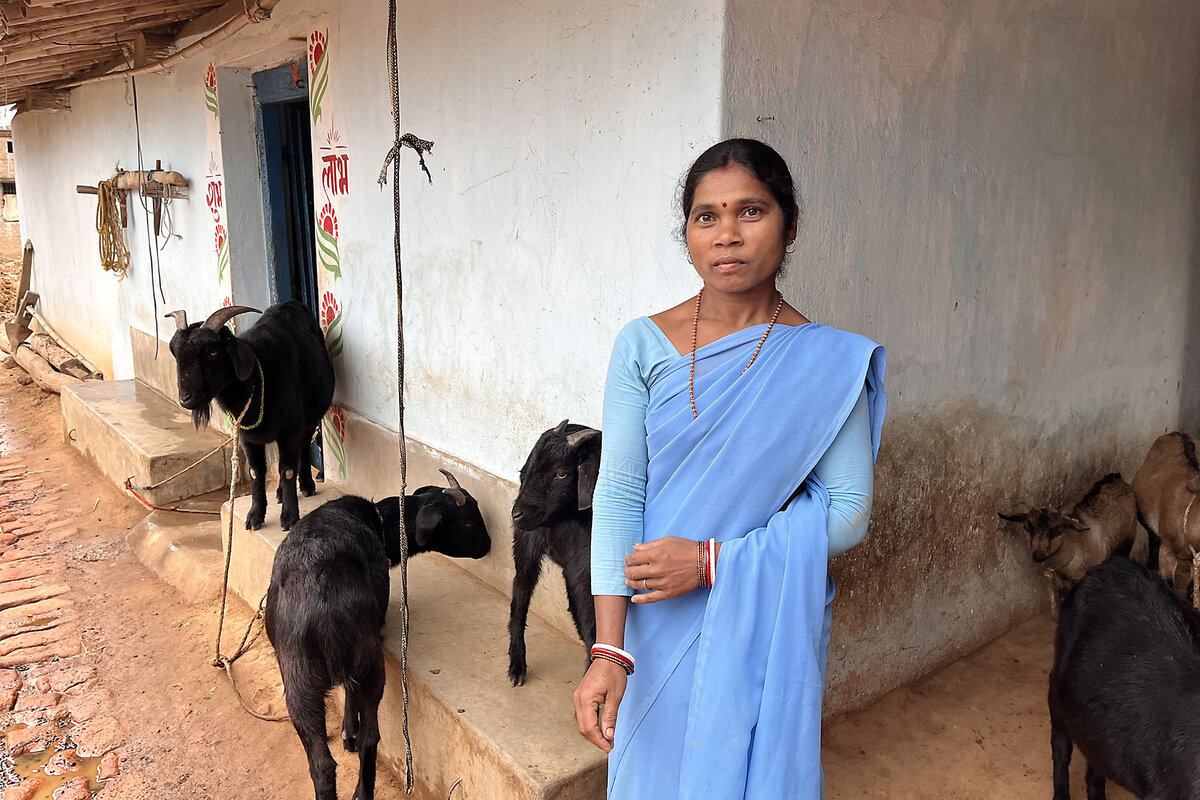
Ritmani Devi, one of roughly 60,000 women in India trained as goat nurses under the Pashu Sakhi initiative, stands with her herd in Angara, India, March 19, 2024.

It seems wrong somehow that there should ever be a need to “empower” women, anymore than there is a need to empower men.

But such is the case, whether women live in rich countries or in the most impoverished villages of India.

Still, it’s better to have empowerment initiatives for women than to do nothing about the imbalance.

At the Christian Science Monitor, Sushmita Pathak reports from India about one such initiative, “Dressed in a light-blue sari, Ritmani Devi cradles two black baby goats as she guides a flock of ducks toward its coop. …

“A few years ago, this muddy yard was much less lively. Ritmani Devi’s goats would often die, she says, and the ones that survived weren’t very healthy. This was common here in the east Indian state of Jharkhand and throughout the country.

“India is home to one-sixth of the world’s goat population. A goat is a valuable asset for a low-income family, ready to be sold at a moment’s notice in case of emergencies. But with owners lacking basic animal health knowledge, that’s all they were – a one-time, last-ditch safety net, rather than an alternative stream of income. Plus, poor access to veterinary services led to high mortality and morbidity rates among goats.

“Now, results from one novel initiative that began a decade ago indicate the tide may be turning. The Pashu Sakhi, or ‘friend of the animal,’ program works to fill gaps in veterinary care by transforming rural, semiliterate women into community animal health care workers, or ‘goat nurses.’ With support from the Indian government, the World Bank, the Gates Foundation, and others, around 60,000 women across India have been trained to provide services like vaccination and deworming, leading to a spurt in goat populations in several states. They are paid for the care they provide, and gain a sense of pride and independence. …

“At the community hall near Ritmani Devi’s home in Getalsud village, the walls are painted with training material, including illustrations of common symptoms to look out for, like swelling under the animal’s mouth or pale eyes, and tips on how to negotiate better rates for goats in the market. 

“Jharkhand was one of the first states in India to adopt the Pashu Sakhi model. Having women at the forefront of the initiative was a natural choice, says Swadesh Singh, a livestock specialist at the Jharkhand State Livelihood Promotion Society, the government agency that runs the program.

“In rural India, the responsibility of managing small ruminants and poultry usually falls on women. Meanwhile, veterinary doctors – who sometimes serve multiple village clusters alone – focus on larger, more valuable animals like cows and buffalo. Before the program, goat mortality in Jharkhand was 50%, says Dr. Singh. Authorities say that figure is now below 15% – thanks in large part to the state’s goat nurses.

“The typical Pashu Sakhi candidate has at least eight years of schooling. After being selected by the state’s livestock department, they’re taught how to administer vaccines, what type of fodder is best for the animals, and how to give preventative care. More advanced nurses also get trained in managing disease, performing castration, goat breeding and marketing, and more. 

“Goat nurses are often the first responders in any livestock-related medical emergency, in addition to conducting regular check-ups and advising others on goat rearing. Their proximity is a huge advantage. Hailing from the same community that they serve makes it easier to build trust, and the women can take on as much work as they like. 

“Livestock owners pay a fixed sum for each service – about 12 cents for every vaccination, for example – and goat nurses also receive a small stipend from the government. Ahilya Devi says she makes anywhere from $25 to $85 a month. That money goes toward her children’s school fees, groceries, and other household expenses – and, occasionally, a personal treat like makeup. 

“ ‘Earlier, I had to consult my husband for every expense,’ she says. …

“To be sure, the work comes with challenges. Farmers are often reluctant to pay for services, says Dr. Singh, and there’s the risk that goat nurses may be threatened or harmed if an animal dies under their care. …

“Still, the initiative has paid rich dividends. In some districts of Bihar, Maharashtra, and Haryana, goat mortality fell to single digits. Between 2012 and 2019, Jharkhand’s goat population – which had become stagnant – grew by nearly 40%, and another livestock census is expected to take place this year. Spurred by the program’s success, goat nurses in some parts of Jharkhand are also being trained to cater to larger animals like cattle, says Dr. Singh. …

“The initiative has contributed to ‘the building of social capital and self esteem’ among urban women, wrote [Observer Research Foundation senior fellow Arundhatie Biswas Kundal]. People often refer to the goat nurses as ‘doctor didi,’ meaning an elder sister or person you think highly of. …

“But none of this happens overnight. When Ahilya Devi first started as a goat nurse, people would look at her with some suspicion. ‘Even those from my own village did not recognize me, because I did not step out of the house much,’ she says.

“Now, nearly a decade later, they welcome her into their homes with respect.”

More at the Monitor, here.

Read Full Post »

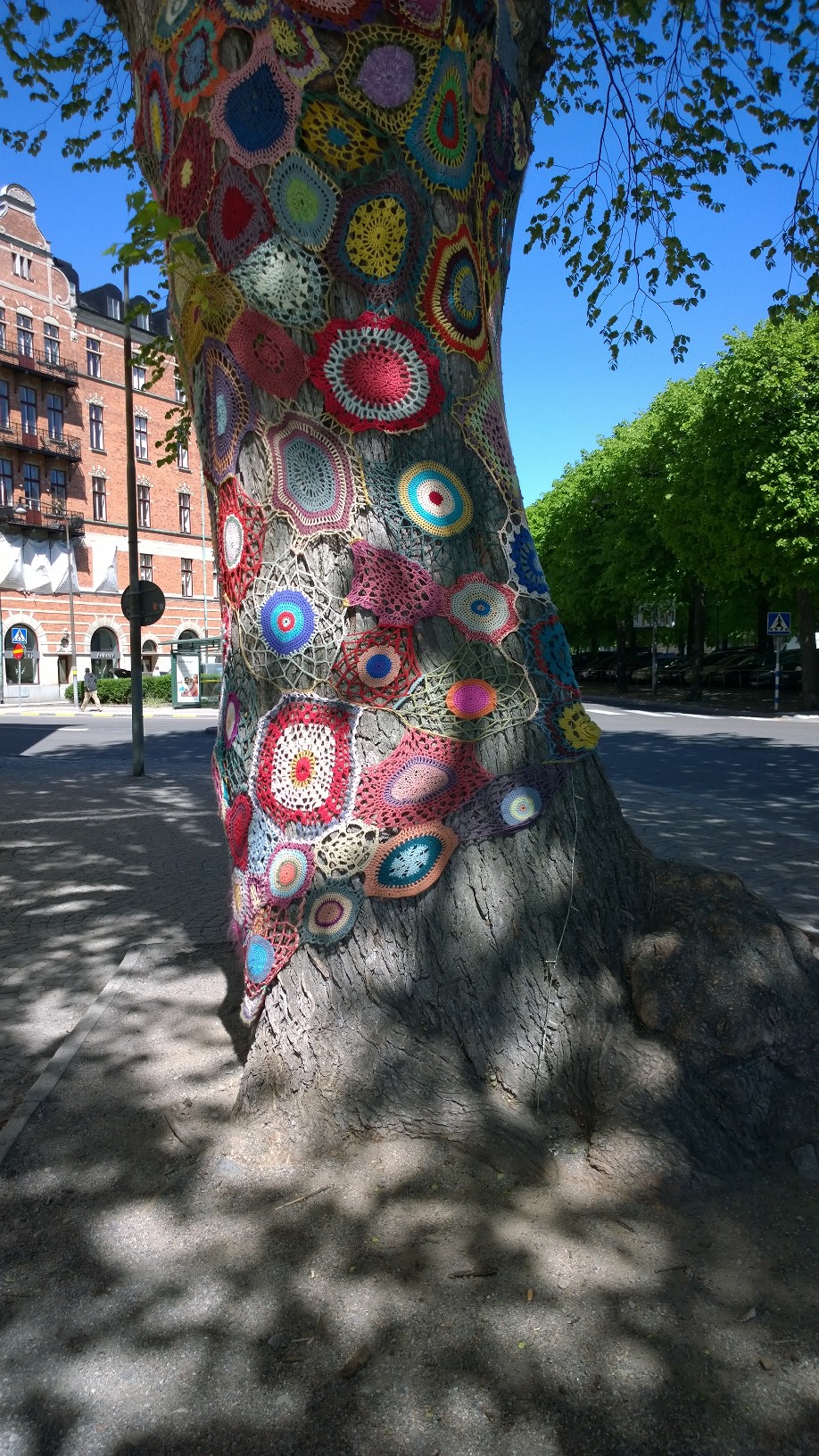
052917--crocheted-tree-Stockholm

Photos: Suzanne and John’s Mom.
Crocheted tree in Stockholm, 2017.

Working with your hands, creating something that is all you — how satisfying that can be! Today’s story is on the latest research showing that that can be good for you and the people around you.

As Nicola Davis wrote at the Guardian, “Winston Churchill had painting, Judi Dench is famous for her rude embroidery and Tom Daley has been known to knit at the Olympics. Now researchers say we could all benefit from creative endeavors and that such pursuits have a bigger influence on life satisfaction than having a job.

“While arts and crafts have long been used to aid mental health, experts said most research has looked at their effect on patients rather than the general population, and tend to look at specific activities.

“However, the researchers have now said such interests could be an important tool for improving public health in general.

“Dr Helen Keyes, a co-author of the research from Anglia Ruskin University, said: ‘It’s quite an affordable, accessible and ultimately popular thing for people to do. And that’s key. You’re not going to be shoving something down people’s throats that they don’t want to do.’

“Writing in the journal Frontiers in Public HealthKeyes and colleagues reported how they analyzed data from more than 7,000 people aged 16 or over who took part in the face-to-face ‘taking part survey’ by the UK Department for Culture, Media and Sport between April 2019 and March 2020.

“As part of the survey participants were asked to rate various aspects of their well-being on 10-point scales, report whether they took part in arts or crafts, and provide demographic details.

“The team found that just over 37% of participants reported taking part in at least one art or craft activity in the past 12 months – ranging from painting to pottery and photography. …

“The results revealed that people who engaged with creating arts and crafting had greater ratings for happiness, life satisfaction and feeling that life was worthwhile than those who did not, even after taking into account other factors known to have an impact – including age, gender, deprivation, poor health, and employment status. …

“Among other results the team found engaging in arts and crafts was associated with an increase in happiness on a par with aging by 20 years (as Keyes notes, well-being goes up slightly with age), while the sense that life was worthwhile was more strongly associated with crafting than being in employment.

“Keyes said [the reults] might reflect that not everybody is in a job they find fulfilling, while people often have a sense of mastery or ‘flow’ when undertaking arts and crafts – experiencing control, achievement and self-expression. …

“Keyes said smaller clinical trials have suggested engaging in arts and crafts can increase well-being. Keyes also acknowledged the increases in well-being associated with creating arts and crafting were very small – on average engaging in such activities was only linked with a 2% higher rating for the feeling that life was worthwhile. But, she said, the results remained meaningful at a population level. …

“Keyes said that backing such activities would offer a simpler route for governments to improve the nation’s well-being than other factors that are known to have a big effect. …

“ ‘But it’s a really quite cheap, easy, accessible thing for us to engage people in.’ ”

What was the last craft you tried your hand at? I made a pottery vase.

More at the Guardian, here. No paywall.

I used to make collage greeting cards.

Read Full Post »

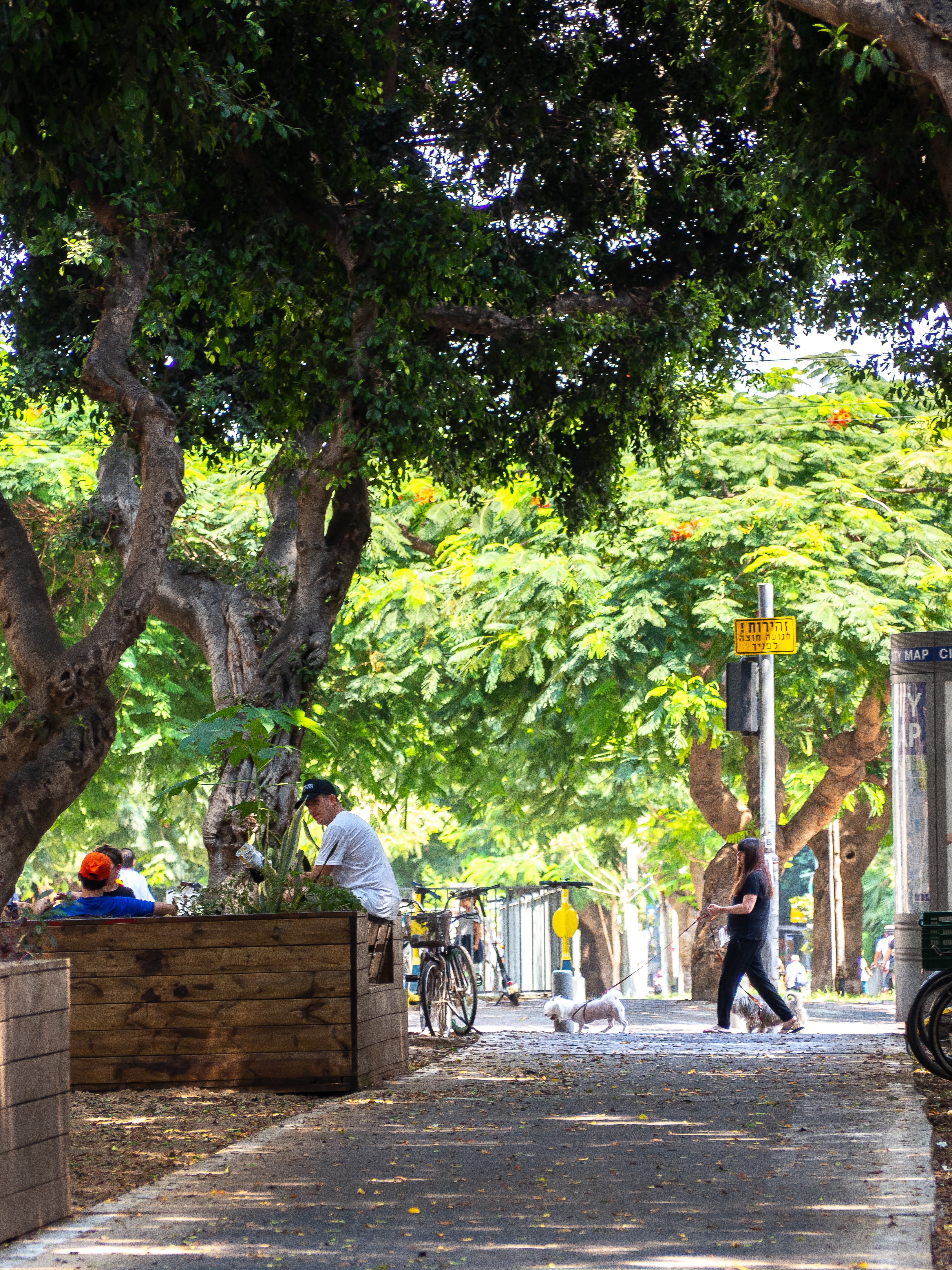
Photo: Yoav Aziz/Unsplash.
Urban trees on Rothschild Boulevard, Tel Aviv, Israel.

If you search this blog on “urban trees,” you will see many posts showing how trees in cities are beneficial both for the environment and human health. I never tire of new research on this topic. Today’s research comes from medical journal the Lancet via Forbes magazine.

Robert Hart reports, “Planting more trees in cities could cut the number of people dying from high temperatures in summer, according to a study published in the Lancet medical journal … a strategy that could help mitigate the effects of climate change as it continues to drive temperatures upwards.

“Cities experience much warmer temperatures than the rural areas surrounding them—a phenomenon known as the urban heat island effect—a result of vegetation and green spaces being replaced with structures like roads and buildings that absorb heat.

“The effect is particularly problematic in summer, when temperatures can soar to dangerous levels and more people die of heat-related causes, but can be tackled by planting more trees, researchers suggest.

“An analysis of mortality data from some 57 million people living in 93 European cities in the summer of 2015—the most recent year for which data is available — revealed that 6,700 deaths could be attributed to the hotter urban environment.

“The researchers estimated nearly 40% of these deaths could have been prevented if urban tree cover were increased up to 30% (the average was 15%).

“The researchers said their study … is the first to estimate the burden associated with urban heat islands and the first to estimate how increasing tree coverage, which helps reduce temperature, could combat this.

“Study co-author Mark Nieuwenhuijsen, director of urban planning, environment and health at the Barcelona Institute for Global Health, said the findings should encourage city planners and policymakers to include green spaces in their developments, particularly as we already know green spaces have other health benefits like ‘reducing cardiovascular disease, dementia and poor mental health’ and improve cognitive function.

“The research identifies a way for city planners to combat the impact of rising temperatures, wrote Kristie Ebi, a professor for health and the environment at the University of Washington, in a linked comment. Such action is especially important as climate change continues to drive temperatures upwards and it must be combined with other initiatives like modifying infrastructure to reduce heat, added Ebi, who was not involved in the research. …

“Heat has a profound impact on our health. Extreme heat is responsible for hundreds of thousands of deaths around the world every year, according to the World Health Organization, and is associated with an increased risk of conditions including heart diseasediabetes and obesity. Heat also exacerbates mental health conditions, hampers cognitive functioning and makes us more aggressive.

“Climate change, which experts say is indisputably linked to human use of fossil fuels, is set to drive temperatures higher and a slew of countries around the world have broken heat records over the last few years. This is expected to continue and extreme weather events, including flooding and major storms are set to increase in both severity and frequency as a result. Beyond the direct impact, this can help other diseases spread through water and expand the range of animals that carry them.” More at Forbes.

This 2017 post mentions John’s work with the Arlington Tree Committee to get sidewalk trees to homeowners. Another post, from 2018, says lack of trees increases depression. This 2019 post is on trees in Paris. I also wrote a 2020 entry about preserving the tree canopy in Baltimore, here.

And those are just a few angles I’ve covered. The other day on Mastodon, someone wrote that trees make her incredibly happy. I guess I am not the only one.

Read Full Post »

Photo: Caroline Hernandez/Unsplash.
Few things matter as much as a good friend.

I’m thinking a lot about friends today because one of my friends has been in the hospital more than a week, having had a serious fall. She lives alone and has health issues that cause her to fall. Her only family, a nephew, lives far away. So her health proxy (and good friend) designated four of us as her family. The ICU admits only family.

My friend has come out of her coma and ditched the ventilator, and we have been rejoicing over the smallest things: eyes opening, head nodding for answers to questions, the lifting of a hand.

Friends have always meant a lot to me (see post “Time with Friends Boosts Health“), and today’s article suggests one of the reasons why: they are good for my health. They certainly have been good for my friend’s health.

Sharon Barbour (@SharonBarbour on Twitter) reports at the BBC, “A new approach to helping people with depression is becoming more and more popular. ‘Social Prescribing’ sees GPs sending patients on trips to places like allotments (community gardens) rather than pharmacies. Healthcare professionals say it works, and reduces pressure on GPs and A&E [emergency rooms] too.

“Craig Denton, from Gateshead, has struggled with depression and loneliness for years. … He is one of more than eight million adults in England now taking antidepressants. But, in the North East, a new approach to helping people with depression is growing.

” ‘Social prescribing’ is part of a plan by health and council bosses to tackle what Gateshead’s director of public health described as ‘really shocking’ health outcomes in the region.

“It has seen Craig enjoy a day out at an allotment run by his GP’s surgery where he has dug and cleared, but also chatted with other people, and not been alone.

” ‘Instead of just sitting down in your house, where you can just dwell on things, you can use this as a distraction, meet new people,’ he said.

“Julie Bray, from Oxford Terrace and Rawling Road Medical Group in Gateshead, was one of the first NHS social prescribers in the country and said she was ‘really passionate’ about it. … ‘They build their confidence up, it reduces GP appointments, it reduces A&E appointments, and it just makes them connect with the community and be resilient.’

“The North East has among the highest rates of drug-related deaths, heart disease, liver disease and suicide in England.

“Rates of child poverty are double the England average in some areas with poverty underpinning much of the ill health. Social prescribing is only one part of a plan by the NHS, local councils, and community groups to make improvements by 2030.

“Alice Wiseman, Gateshead director of public health, said a report in 2020 showed that, while life expectancy across the UK had stalled, it had started getting shorter for those in the bottom 10% income bracket in the North East.

” ‘Nine of all 13 areas within this plan have a healthy life expectancy of less than 60 years,’ she said. ‘People aren’t even reaching retirement age without having a life-limiting illness. It is really shocking.’ …

“What is needed is ‘forming friendships and feeling as if they’ve valued, as if they’re worth something,’ she said.”

Tell me about the importance of your own friends. It may not be enough for serious depression, but as the saying goes about chicken soup, “It wouldn’t hurt.”

More at the BBC, here. No firewall.

Read Full Post »

Photo: Dan Cook/Unsplash.
Ha ha ha ha ha.

Back in the 1990s, I had a stint as the editor of a publication called Minnesota Physician, where I interviewed a local physician who referred to himself as “the laugh doctor.” He convinced me that even forcing yourself to laugh can create endorphins in your body that are good for your health.

More recently, I saw research about this at the Washington Post. Daryl Austin has the story.

“My three young daughters like to watch pets doing silly things. Almost daily, they ask to see animal video clips on my phone and are quickly entertained. But once my 7-year-old lets out a belly laugh, the laughter floodgates are opened and her two sisters double over as well.

“This is just what science would predict.

“ ‘Laughter is a social phenomenon,’ says Sophie Scott, a neuroscientist at University College London who has studied laughter and other human reactions for more than two decades. Scott co-wrote a study showing how the brain responds to the sound of laughter by preparing one’s facial muscles to join in, laying the foundation for laughs to spread from person to person.

‘Contagious laughter demonstrates affection and affiliation,’ Scott says. ‘Even being in the presence of people you expect to be funny will prime laughter within you.’

“Scientists have yet to definitively find a funny bone, but they are revealing nuances about the laugh impulse. Laughter’s positive psychological and physiological responses include lessening depression and anxiety symptoms, increasing feelings of relaxationimproving cardiovascular healthreleasing endorphins that boost mood and even increasing tolerance for pain.

“Laughing has also been shown to lower stress levels. ‘Cortisol is a stress hormone that laughter lowers,’ says Scott, adding that anticipation of laughter also ‘drops your adrenaline’ and the body’s heightened fight-or-flight response. ‘All of these things contribute to you feeling better when you’ve been laughing,’ she says.

“Because humans are wired to mirror one another, laughs spread around a room just like yawns, says Lauri Nummenmaa, a brain researcher and professor at Aalto University School of Science in Finland whose work appears in a recent special issue on laughter in the journal Royal Society.

“ ‘We simply copy the behavior and laughter of others,’ Nummenmaa says. ‘Someone else’s act of laughing is first perceived when seen or heard, and this sensory information is then converted into the same area of the observers’ brain.’

“Studies also indicate that laughter can strengthen relationship connections. This happens, in part, because people naturally want to be around those who make them feel good the way laughing does. ‘We crave the company of the individuals who can give us such feelings,’ Nummenmaa says. …

“Contagious laughter isn’t necessarily a phenomenon unique to humans. Great apes, for instance, have been documented behaving similarly.

“ ‘Laughter is a play signal in humans and many other animals,’ says Disa Sauter, a social behavior professor at the University of Amsterdam. ‘It is used in rough-and-tumble play across species.’ …

“ ‘Vocal play signals frequently accompany other nonvocal behaviors, such as the play face in primates … or the play bow in dogs,’ according to a 2021 study in the journal Bioacoustics. The cues help differentiate threatening actions from play fighting and wrestling. …

“You can, of course, laugh alone, but the contagious nature of laughter means we’re more likely to laugh harder and longer in groups, as at a comedy club or in a movie theater.

“Psychologist Robert Provine showed that ‘you’re 30 times more likely to laugh with other people than you are on your own,’ Scott says. In his seminal book, Laughter: A Scientific Investigation, Provine wrote that the ‘contagious laugh response is immediate and involuntary, involving the most direct communication possible between people: brain to brain.’ …

“ ‘Laughter has many subtle rules that make adults highly attuned to when it’s socially appropriate,’ says Harry Witchel, a physiologist and neuroscientist at Brighton and Sussex Medical School in Brighton, England.

“There are circumstances, he notes, when people laugh at something that is not humorous: ‘Laughter is regularly linked to joy, relief, tickling, sudden incongruity, social discomfort, dominance, humiliating another and many other causes.’ …

“In Laughter, Provine described ‘laugh epidemics’ [like] the plague of laughter’ that befell numerous Central African schools starting in 1962: Contagious ‘laugh attacks’ among several groups of students lasted several hours to many days and continued until two schools had to close for extended periods of time. …

“Although scientists have uncovered much about laughter’s health benefits and its contagious element, there remain many unknowns, including how contagious laughter is learned in the first place.” More at the Post, here.

I wonder how blogger Laurie Graves — whose fictional characters can communicate through thoughts — reacts to the idea that “contagious laugh response [is] the most direct communication possible between people: brain to brain.” Might be something to use.

Contagious laugh response in Mongolia.

Read Full Post »

Photo: Suzanne and John’s Mom.
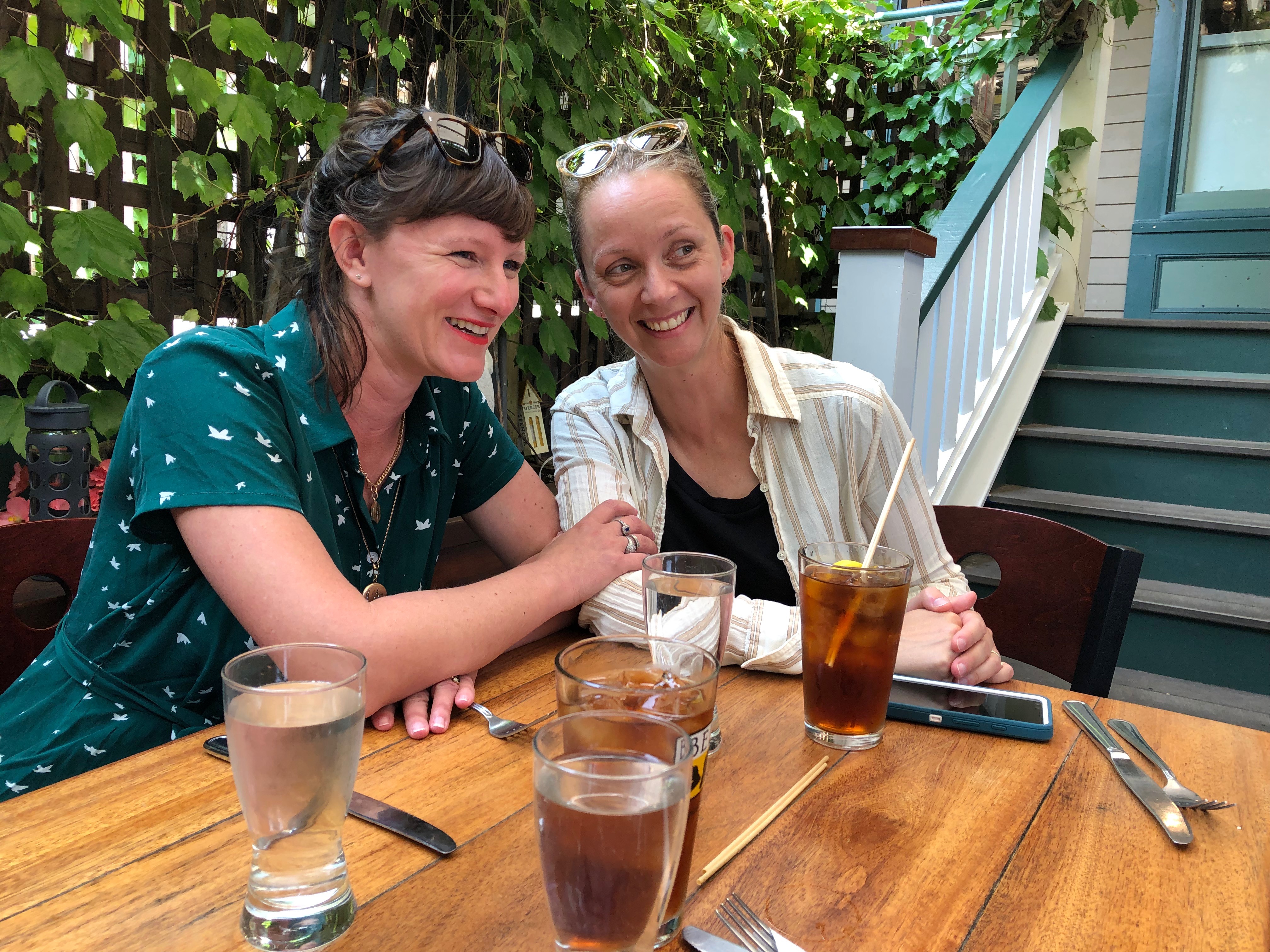
Suzanne and Kate on Cape Cod. They laugh a lot.

When I saw today’s article by Teddy Amenabar at the Washington Post, I knew it would be blog material. That’s not just because friends have been important to me since childhood (Hello, Hannah!), but because I’ve been learning about the particular virtues that conversation with friends has for older people. There’s the value of relaxing, having fun. But there are also cognitive benefits from focusing on what friends are saying and responding thoughtfully.

Amenabar writes, “One of the more surprising findings in the science of relationships is that both romance and friendship often start the same way — with a spark. … A growing body of research shows friends are essential to a healthy life — and they are just as important for our well-being as healthy eating habits or a good night’s sleep.

“ ‘We’ve always had this hierarchy of love with romantic love at the top and friendship seen as second class,’ said Marisa G. Franco, a professor at the University of Maryland and author of Platonic: How The Science of Attachment Can Help You Make — and Keep — Friends. …

“Platonic love trumps romantic love in a number of ways. People with strong friendships tend to have better mental health and studies suggest they’re in better physical health, as well. Researchers have found large social networks lower our risk of premature death more than exercise or dieting alone.

A six-year study of 736 middle-aged Swedish men found having a life partner didn’t affect the risk of heart attack or fatal coronary heart disease — but having friends did.

“A 10-year Australian study found that older people with a lot of friends were 22 percent less likely to die during the study period than those with few friends. Notably, having a social network of children and relatives did not affect survival rates. …

“There are multiple theories about the association between friendship and better health. Part of the effect may be due to the fact that it’s easier for healthy people to make friends. A strong social network could be an indicator that someone has more access to medical care. And, someone with more friends may just have a better support system to get a ride to the doctor’s office.

“But there is also a psychological effect of friendship that likely plays a role. Friends help us cope with stress. In one study at the University of Virginia, many people were intimidated at the prospect of climbing a steep hill. But researchers found that when people were standing next to a friend, they rated the hill less challenging than those who were alone.

Brain imaging studies suggest that friendship affects brain systems associated with reward, stress and negative emotions, offering an explanation for why social connection benefits mental health and well-being. Friendship even seems to affect our immune response. In one remarkable study, 276 healthy volunteers were given nose drops containing a cold virus. Those with diverse social ties were less likely to develop cold symptoms. …

“Friends don’t just appear out of thin air, Franco said. Here’s her advice for making new connections and maintaining the old ones.

Take the initiative. Trust your gut when you’re meeting new people. We’re particularly good at knowing when someone is a potential new friend (remember that spark). And, you should assume people like you. We often underestimate how positively others think of us, Franco said. …

Start with a text. Start small by scrolling through your phone and shooting a text message to an old friend you’ve been meaning to reconnect with.

Show your gratitude. If a potential friend reaches out to you to grab coffee or pizza, tell them how happy you are they reached out, and that you appreciate the effort, Franco said. In a University of Utah study, researchers asked 70 college freshman to keep a check list of certain interactions — like going to see a movie together or calling just to say hello — they did with new friends. After three months, the researchers found that close friendships were more likely to form when the pairs expressed affection to each other. …

Invite friends to things you’ve already planned. If it’s hard to find time for friends, think of the tasks you already have to accomplish and tag on a friend, Franco said. The next time you workout at the gym, for example, you could invite someone to join. ‘Ask yourself: Are there parts of your day right now that you’re doing anyway that you can just do in community with other people?’ Franco said.

Join a book club, take a class or play a sport. Regular interaction with people who share the same interests as you could lead to friendship. Another University of Maryland study that found cadets who sat next to each other in police academy were more likely to become close friends. …

“While having friends is good for your health, not having them can be detrimental.According to the Centers for Disease Control and Prevention, loneliness has been associated with higher rates of depression, anxiety, and suicide. For older women, loneliness and social isolation can increase the risk of heart disease by as much as 27 percent.

“Loneliness is essentially the perceived gap between the relationships you have and the relationships you want in your life, said Adam Smiley Poswolsky, the author of Friendship in the Age of Loneliness.

“A 2018 study found that loneliness is common across age groups. … Social media can exacerbate our perception of loneliness by bombarding us with photos and videos of friends and acquaintances seemingly spending their time without us, said Poswolsky.

“[Said] Poswolsky, ‘No one feels like they can talk about it because there’s a lot of shame associated with loneliness.’

Billy Baker, the author of We Need to Hang Out, a memoir of his personal journey to find new friends as a middle-aged man, said he realized he needed to build beyond the lifelong friendships he made in high school or college.

“Baker said he didn’t have very many people he could call in the middle of the night if there was an emergency. To remedy this, he started a fraternity for neighborhood dads to meet every Wednesday night, and the group now gets together on other days and on the weekends.

“Baker said he’s spent years ‘checking off so many other boxes,’ to be a good father and husband, but he’s never had ‘hanging out with my buddies’ on the list.

“ ‘We all know how to do this,’ he said. ‘What very often happens in those moments is you feel that spark with someone and you say: “Hey, we should grab a beer some time!” But, how often do you go grab that beer?’ ”

As Suzanne and her fellow Girl Scouts used to sing,

“Make new friends
“But keep the old.
“One is silver
“And the other gold.”

More at the Post, here.

Read Full Post »

Photo: NeuroscienceNews.
Latinos aged 55 and older who participated in Latin dance classes for eight months showed significant improvement in working memory over their peers who did not partake in Latin dance.

When I expressed worry about signs of aging, my scientist brother chided me for not being more upbeat, saying, “The brain can look like Swiss cheese and one can still have a happy hour, or more maybe, left.”

He was right. Today’s article on the virtues of dance for older people underscores that point and suggests that for some, dance can even reverse decline.

NeuroscienceNews describes a recent study from the University of Illinois.

“Latinos age 55 and over who participated in a culturally relevant Latin dance program for eight months significantly improved their working memory compared with peers in the control group who attended health education workshops, according to the study’s lead author, Susan Aguiñaga, a professor of kinesiology and community health at the University of Illinois Urbana-Champaign.

Working memory – the ability to temporarily keep a small amount of information in mind while performing other cognitive tasks – is integral to planning, organizing and decision-making in everyday life.

“The dance program used in the study, Balance and Activity in Latinos, Addressing Mobility in Older Adults – or BAILAMOS – showed promise at enticing older Latinos to become more physically active and help stave off age-related cognitive decline, Aguiñaga said.

“ ‘Dance can be cognitively challenging,’ Aguiñaga said. ‘When you’re learning new steps, you have to learn how to combine them into sequences. And as the lessons progress over time, you must recall the steps you learned in a previous class to add on additional movements.’

“BAILAMOS was co-created by study co-author David X. Marquez, a professor of kinesiology and nutrition, and the director of the Exercise and Psychology Lab at the University of Illinois Chicago; and Miguel Mendez, the creator and owner of the Dance Academy for Salsa.

“BAILAMOS incorporates four types of Latin dance styles: merengue, salsa, bachata and cha cha cha, said Aguiñaga, who has worked with the program since its inception when she was a graduate student at the U. of I. Chicago.

“ ‘It’s an appealing type of physical modality,’ she said. ‘Older Latinos are drawn to Latin dance because most of them grew up with it in some way.’

“Latin dance can evoke positive emotions that prompt listeners to participate, increasing levels of physical activity in a population that tends to be sedentary, according to the study, published in the journal Frontiers in Aging Neuroscience.

“More than 330 Spanish-speaking Latino adults who were middle-aged or older were recruited for the study, primarily through community outreach in local churches. Participants were randomly assigned to either the dance group or the control group, which met once a week for two-hour health education classes that covered topics such as nutrition, diabetes and stress reduction.

“Participants in the BAILAMOS groups met twice weekly for the dance sessions, taught by a professional instructor for the first four months and later by a ‘program champion’ – an outstanding participant in each group who displayed enthusiasm and leadership qualities.

“The program’s champions were selected and trained by the instructor to lead the sessions during the four-month maintenance phase.

“Over the different waves of the four-year study, the dance lessons were held at 12 different locations across Chicago, such as neighborhood senior centers and churches that were familiar and easily accessible to participants, Aguiñaga said.

“Participants’ working memory – along with their episodic memory and executive function – was assessed with a set of seven neuropsychological tests before the intervention began, when it concluded after four months and again at the end of the maintenance phase.

“Participants also completed questionnaires that assessed the number of minutes per week they engaged in light, moderate and vigorous physical activity through tasks associated with their employment, leisure activities, household maintenance and other activities. …

“As with a small pilot study of BAILAMOS conducted previously, the current study found no differences in any of the cognitive measures between the dance participants and their counterparts in the health education group at four months. However, after eight months, people in the dance group performed significantly better on tests that assessed their working memory.

“ ‘That’s probably one of the most important findings – we saw cognitive changes after eight months, where participants themselves had been leading the dance classes during the maintenance phase,’ Aguiñaga said. ‘All of our previous studies were three or four months long. The take-home message here is we need longer programs to show effects.

“ ‘But to make these programs sustainable and create a culture of health, we also need to empower participants to conduct these activities themselves and make them their own.’ “

The open-access study, “Latin Dance and Working Memory: The Mediating Effects of Physical Activity Among Middle-Aged and Older Latinos,” by Susan Aguiñaga et al appears in Frontiers in Aging Neuroscience.

This really intrigues me. Even though I have no Latin background, music like salsa makes me want to dance, too. I suppose if I were in a research study, though, I’d probably need doo-wop to trigger a primordial urge to leap out of my chair.

More at NeuroscienceNews, here.

Read Full Post »

Today’s article is about an environmental health advocate from rural Alabama who was honored recently by the MacArthur Foundation. One thing her story suggests to me is that when parents demonstrate concern for the world around them, later generations can work miracles. The parents of Catherine Coleman Flowers were civil rights activists in the 1960s.

Sarah Kaplan writes at the Washington Post, “To Catherine Coleman Flowers, this is ‘holy ground’: the place where her ancestors were enslaved and her parents fought for civil rights and she came of age. …

“Yet this ground also harbors a threat, one made worse by climate change. Untreated sewage is coursing through this rural community, a consequence of historic government disinvestment, basic geology and recent changes in the soil. On rainy days, foul effluent burbles up into bathtubs and sinks, and pools in yards. Some residents have hookworm, an illness rarely seen in developed nations.

“It’s America’s ‘dirty secret,’ Flowers said. … Heavier rainfall caused by climate change is saturating soil and raising water tables — confounding septic systems. From the flooded coasts of Florida to thawing Alaska towns, an estimated half-million U.S. households lack adequate sanitation.

“Now Flowers, a MacArthur Foundation ‘genius,’ is partnering with environmental engineers at Columbia University on a solution. They are working on a new kind of toilet that will act as a mini sewage treatment facility.

Instead of flushing waste, the system they’re working to build will filter, clean and recycle waste on site. Instead of sending raw sewage into the soil, it will turn it into water for use in washing machines, and into nutrients for fertilizer, and perhaps even energy for homes. …

“What was once a problem can become a solution, Flowers said. And the change will start in Lowndes County, as it has before.

“To Flowers, 62, the Lowndes County of her childhood was part rural idyll, part activism hotbed. … In 1965, about 80 percent of the county’s population was Black, but not a single Black person was registered to vote. …

“But then protesters from Selma marched down Lowndes’s dirt roads on their way to Montgomery, and a wave of activism erupted. … Flowers’s father, a military veteran and salesman, and her mother, a teacher’s aide, were heavily involved. Civil rights leaders streamed to their cinder-block home. …

“Her parents’ activism connected Flowers to the world beyond Lowndes County. As a teenager, she joined the Alabama Students for Civil Rights and spent a summer in D.C. as a youth fellow at the Robert F. Kennedy Memorial Foundation. She read ‘The Autobiography of Malcolm X,’ wrote politics-infused poetry and dreamed of becoming the first Black woman on the U.S. Supreme Court.

“In 11th grade, frustrated with subpar conditions at her high school, Flowers wrote an exposé for a local newsletter. That led to the formation of a community group, then a lawsuit and, ultimately, to the resignation of the principal and school board superintendent.

“ ‘My father’s famous thing he would always say was, “Catherine, if you take one step, God will take two,” ‘ Flowers said. It meant that change was possible, but you had to do the work.”

The article goes on to say that after Flowers had moved away, she learned her home county was suffering and that part of the problem was that the soil had changed and no longer worked for septic systems, which “require permeable soil. … All over the county, septic systems were breaking down. Heavy rainfall would seal up the soil until effluent had nowhere to go but up onto lawns or back into homes. …

“Flowers — then director of the nonprofit Alabama Center for Rural Enterprise (ACRE) — set out to determine the scale of the problem. …

“ ‘This is America,’ Flowers said. ‘We’re not supposed to have these kinds of problems — at least, that’s what we tell ourselves. But we do.’ …

“Climate change is making existing deficiencies worse. Rising sea levels have elevated the water table in coastal areas, shrinking the depth of leach fields and increasing contamination. Days of extreme rainfall — which have doubled in the Southeast as a consequence of warming — stymie septic systems. …

“ ‘Climate change is like a magnifying glass for everything,’ Flowers said. It exacerbates neglect, widens inequality and exposes problems once hidden. …

“Flowers has a vision for a better septic system. It’s cheap to buy and easy to run. It’s equipped with sensors that can monitor for signs of pathogens, including the coronavirus. Instead of allowing sewage to seep into the ground, the system separates waste into its component parts, which can then be recycled. …

“In Kartik Chandran, she found a partner who shares that vision. They met five years ago at a conference on wastewater issues. Chandran, an environmental engineer at Columbia University, was struck by how similar Lowndes County’s waste problems were to those in his native India. Flowers remembered hearing about Chandran’s research and thinking, ‘This is the technological solution we need.’ ” Read how it would work here.

Read Full Post »

As a volunteer in English classes (all online these days), I am aware that most immigrants are determined to contribute to the countries they arrive in. Consider, for example, the Muslim husband and wife in Germany who were largely responsible for the miracle vaccine developed in one year against the odds.

In the Netherlands, the Refugee Company has immigrants employed in making face masks to protect the Dutch against Covid-19.

Michal van der Toorn at the Local Europe has the story.

“Why be dependent on factories on the other side of the world if you can produce face masks locally? That’s exactly what Dutch entrepreneurs Jaap Stelwagen, Fleur Bakker, Johan Blom and Naz Kawan thought in March. The Netherlands, like many other countries at the time, was dealing with a big deficit of surgical face masks.

“Stelwagen, who lived in China, together with his wife who is originally from China, called several people there to ask whether it would be possible to get material. Bakker’s sister, a KLM pilot, managed to get hold of a roll of [fabric] that you need to make face masks, and brought it to the Netherlands on a plane full of other health equipment. Later that month, on one of the few flights that were running at the time, two face mask machines flew 7,000 kilometres to Amsterdam.

“But who would operate them? [One] Company already had a sewing workshop and restaurants in place where people with a refugee background were able to acquire work experience. [The company writes its name Refugee Company to focus on the work, not immigration status.]

“ ‘As a response to the pandemic,’ project spokesperson Peter-Paul de Jong explains, ‘we decided to set up a face mask factory: the Mondmaskerfabriek. … The project not only responded to the deficit of masks in Dutch healthcare,’ de Jong explains, “but also provides people with a refugee background with work experience and knowledge about the labour market in the Netherlands.’

“Firas al Naif, 33, is one of the employees in the factory. ‘I’m doing different tasks,’ he says. ‘I for example have to make sure the masks are properly wrapped and check if the machines work.’ It is all new for Al Naif, as in Syria, he worked as a biology teacher. ‘I wasn’t used to doing technical tasks. The first month was pretty hard, but now it’s going really well. …

” ‘We have a paid four-hour programme next to work, in which we can improve our language and become more familiar with the labour market, and we make for example a CV, application letters, we see how you can find work. …

“ ‘The one thing I like most about this work is solving problems,’ says Al Naif. ‘If there is a problem with the machine from China, I like to look for ways to get it working again.’

“And there were other problems, de Jong explains. After the challenges of getting the right machines and material, the next problem arose: getting certification to create surgical face masks for healthcare professionals. In order to be used in the healthcare sector, the face masks have to be certified by a laboratory to say they meet strict standards. And that took some time. …

“As the building is old, ventilation is a problem and it’s hard to get it up to the antibacterial standards, Bakker writes on the website. The location caused occasional deviations that stood in the way of the factory’s certification.

“The project tried different ways to ensure the masks were up to medical standards, including sterilizing them with gamma radiation and setting up a special sterile production room within the factory with purified air and an antibacterial floor.

“In mid October the certification was acquired and the factory started supplying the Dutch centralized point for healthcare products. …

“ ‘That distinguishes the Mondmaskerfabriek from other projects from the Refugee Company,’ de Jong explains, ‘as we can use the profits to pay employees, instead of only relying on funds and donations.’ …

“ ‘I love how much I learned about technology,’ [al Naif] says. But he would rather be a biology teacher again. ‘When my Dutch is good enough, I want to go back to the classroom.’ ”

More at the Local Europe, here.

Read Full Post »

One of my brothers, the science professor, used to perform regularly as a clown, particularly at church and Sunday School. Clowns-in-ministry is actually a thing, a way to engage parishioners and provide a different perspective on teachings.

In San Francisco during the pandemic, clowns and performers of all kinds have heard the call to keep people healthy using laughter, entertainment, and public-service messaging.

Lily Janiak has the story at the San Francisco Chronicle.

“Robin Lara and Stella Adelman of Dance Mission Theater were strapping on stilts. Michael Houston of San Francisco Bay Area Theatre Company was affixing a red clown nose on top of his face mask. Marcelo Javier, also of SFBATCO, was trying out a jury-rigged pandemic-era clown prop — two extendable massage rollers tied together, allowing him to interact with passersby from a safer distance.

“If these artists were backstage — at a side room in the Mission District restaurant West of Pecos — their theater was Valencia Street on a recent sunny afternoon. And if they were about to open a show, their message was public health.

“These four, along with Rodney E. Jackson Jr. of SFBATCO and Aura Barba of SF Carnaval, were just one shift of artists in San Francisco Creative Corps, a pilot program that recruits underemployed local artists as community health ambassadors to promote healthy behavior during the pandemic.

“A partnership between the San Francisco mayor’s office, Yerba Buena Center for the Arts, the Office of Economic and Workforce Development, and the San Francisco Parks Alliance, the program launched last month. It employs 30 performing artists to encourage mask wearing and other best practices and 30 visual artists to paint murals about public health on boarded-up storefronts.

“The city chose Valencia Street and Washington Square in North Beach as pilot sites because of their high pedestrian traffic, significant amounts of outdoor eating and drinking, low mask compliance and high or increasing case rates, according to Jeff Cretan, director of communications at the mayor’s office. …

“Deborah Cullinan, YBCA’s chief executive officer, approached the city with the idea after being part of Gov. Gavin Newsom’s Task Force on Business and Jobs Recovery.

‘What’s the WPA program for today?’ she recalls thinking, referring to Depression-era initiatives such as the Federal Theatre Project and the Federal Art Project that employed artists not just as work relief but as a broad public investment in art. …

” ‘Artists are very effective in driving health outcomes in communities,’ she said, citing projects ranging from a radio drama combating the spread of Ebola in Sierra Leone to National Endowment for the Arts-backed therapy helping veterans with PTSD and traumatic brain injury at Walter Reed Army Medical Center. …

“On Nov. 29, Lara and Adelman — decked in feathers, bustiers and leg flares in addition to their stilts — paraded down Valencia Street. … Houston, with blazer, tie, rainbow wig and microphone, in addition to the red nose and mask, approached passersby for man-on-the-street interviews, asking — in a news announcer baritone — what they were doing to keep themselves safe from COVID-19. …

“The artists never scolded those without masks — emphatically not the point of the program — and pedestrians who were offered masks usually weren’t hostile. Only once in the first two hours did someone yell in response. Most either kept going or accepted, smiling sheepishly as if to say, ‘Yeah, you’re right. I knew I should have been wearing one.’ …

“ ‘If we need people to take care of one another, they have to feel taken care of first,’ said Cullinan. ‘Messages that make us feel bad aren’t going to work. Messages that make us feel good and want to be a part of something. … That’s what theater makers do.’ ”

More at the San Francisco Chronicle, here.

Read Full Post »

merlin_99210046_e422bfb4-003b-41b1-9127-bf8dc2edb60e-jumbo

Photo: Tom Jamieson for the New York Times
“London’s bike-rental program has proved popular. Now, patients at two medical centers in Cardiff, Wales, will be offered six-month subscriptions to a bike-rental service, with free rides of up to 30 minutes,” reported the
New York Times last year.

Last week, as I watched two grandchildren painstakingly donning piles of bulky ice hockey gear, I remarked that for me, walking is the best exercise because you don’t have to do any prep. You just open the door and go out. My granddaughter, age 7, opined that walking is boring, and I have to admit that ice hockey may be more heart-pumping.

But I am not bored. And after walking every day for many years, I no longer feel surprised that I like to exercise. At first, I was resistant to doing anything. But a friend who was an internist leaned on me about exercising. And I knew if I were going to do anything regularly over a long period of time, it would have to be something I liked. So, walking was it.

Given that I go quite slow, I was surprised that when I told various doctors I just ambled, they didn’t seem bothered. Then I heard one refer to walking as a “weight-bearing activity,” and the penny dropped!

In the United Kingdom, doctors are making it easy for patients to exercise by means of bicycles. And like me, many former non-exercisers are surprised to find that they like it.

The BBC reports, “A cycling-on-prescription scheme trialled in Yorkshire has been so successful it could be rolled out across the UK, the organisers said. The scheme allows health professionals to offer those with long-term conditions 12 weeks of cycle training.

“More than 1,000 people have been referred to the scheme since it launched four years ago, according to the West Yorkshire Combined Authority. Cycle UK said the scheme showed cycling was good for overall wellbeing. …

“The initiative is funded by West Yorkshire Combined Authority, which covers Barnsley, Bradford, Calderdale, Craven, Harrogate, Kirklees, Leeds, Selby, Wakefield and York.

“Figures from 2018/2019 showed people using the scheme reporting a marked increase in feeling more confident and relaxed. …

“At the start of the programme, only 18% of participants were meeting the NHS [National Health Service] activity guidelines of 150 minutes per week — a figure that rose to 73% afterwards.

“Andrea, 47, from Wakefield, was referred as she has suffered from anxiety. ‘I’m more confident. I’m able to be out with other people more than I would normally,’ she said. ‘My fitness has improved, my lung function is a lot better than it has been and now I actually want to go out and do other things, and keep cycling, keep active and really start living my life.’ …

“Cycling UK said the scheme started in Yorkshire, and has since been trialled in areas including Wales, Manchester and London, but is not yet available nationwide.”  More at the BBC, here.

The New York Times, here, talks about the biking-rx trial in Wales, noting, “Nextbike, the company that offers the bicycle service for patients in Cardiff, provides rentals in many other European cities. Mareike Rauchhaus, a spokeswoman for the company, said that it participated in a program called By Bike to Work, which allowed people to claim prizes from their health insurance providers if they cycled to work. …

“Dr. Karen Pardy, a family doctor who is participating in the program in Cardiff, said in the statement [that] she hoped prescriptions would encourage people to ‘have a go at cycling around Cardiff’ and realize how the activity can support their well-being.”

P.S. If you search Suzanne’s Mom’s Blog for the word “prescription,” you’ll find a lot of posts on doctors’ unusual prescriptions to encourage more healthful living, including  biking in Boston, woodland walks, gardening, museum visits, poetry, music, dance, art …

Read Full Post »

Older Posts »