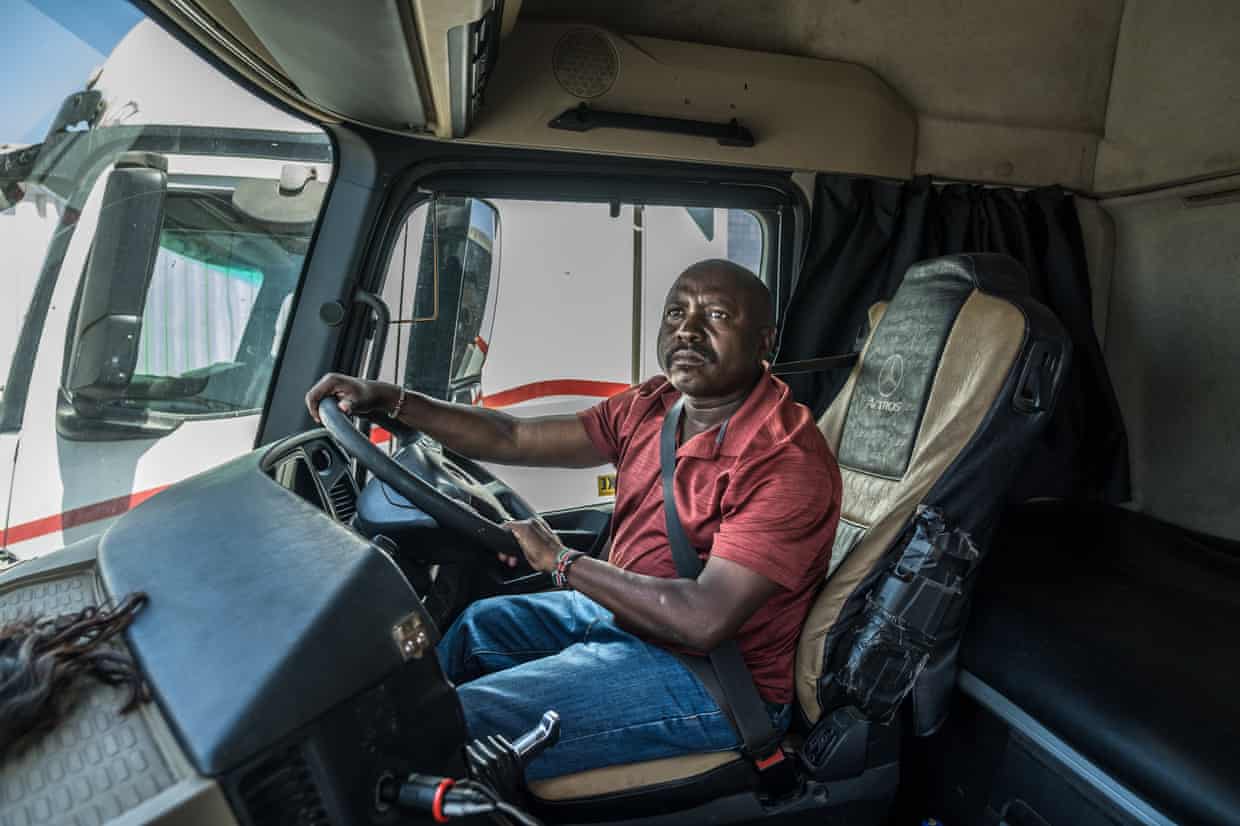
Photo: Brian Otieno/The Guardian.
Thanks to a roadside health service in Africa, Alphonse Wambua learned he had hypertension and also how to treat it.
Every country has different ways of handling the challenges of providing health services to its people. We can learn from each other. In the US, the Covid pandemic showed us we had cut back too much on public health programs. Many people who needed help were not being reached, which caused the disease to spread more than it should have.
Today’s story suggests that you reach the hard-to-reach by meeting them wherever they are.
Caroline Kimeu writes for the Guardian from Kenya, “A life on the road had caught up with Alphonce Wambua. Twenty-five years of transporting cargo between the Kenyan capital, Nairobi, and the coastal city of Mombasa, nine hours’ drive away, had resulted in long days, a poor diet and an irregular sleep routine for the trucker. Still, it came as a shock when doctors told him he had hypertension a few years ago.
“ ‘I wasn’t expecting it – I thought I just had serious fatigue,’ says Wambua, who has stopped by the clinic where he was diagnosed to pick up his monthly prescription. ‘This job is high pressure. There’s not much rest.’ …
“The health facility, based in Mlolongo, on the busy Nairobi-Mombasa highway, attracts a steady flow of patients. As well as workers and residents from the area, it also treats drivers from the truckers’ rest stop across the road, as one of 19 roadside health facilities run by the nonprofit North Star Alliance, offering priority healthcare to mobile populations.
“The organization, which constructs clinics out of shipping containers, has set up facilities along major transport routes, transit towns, and border crossings across east and southern Africa to increase mobile workers’ access to medical services.
” ‘When governments do their health planning, they usually plan for communities, but no one plans for mobile workers,’ says Jacob Okoth, a [program] manager at North Star Alliance. ‘Their operating hours are different, so you can’t reach them with the traditional 8am-5pm healthcare service delivery model, and many can only afford to queue for short wait times.’
“North Star was founded in 2006 to tackle HIV and STD cases in the transport sector during the height of the Aids epidemic, when some transport companies were losing more than 50% of their drivers to the disease. It extended its services to cover broader health issues after identifying other recurring health concerns among mobile workers, including non-communicable diseases.
“NCDs such as hypertension and diabetes are responsible for more than half of hospital admissions and deaths in Kenya. Health practitioners warn that the growing burden demands new approaches for prevention, diagnosis and treatment. …
“Many of the NGO’s health centres are along the northern corridor, one of east Africa’s busiest transport routes, which connects several countries in the region. Truck drivers who transport cargo along the corridor can travel for 12-hour stretches with short breaks in between, sometimes for weeks or months at a time. In some areas, the distances between hospitals are long; drivers often delay seeking care due to time pressures or irregular work cycles. …
“Regular health checkups are essential for truckers. … Many rely on high-carbohydrate meals to keep them full on long drives, and they struggle to maintain a balanced diet due to time and cost pressures, says Wambua, whose go-to meal is the Kenyan staple ugali (boiled maize meal). …
“ ‘You’re not focused on eating healthy food – you eat what you find and continue with the journey,’ he says, while a clinician takes his blood pressure and writes him a new prescription. …
“Each health center tailors its opening hours to the needs of mobile workers in the area. Some, like the Mlolongo health center, have regular 9am-6pm opening hours, but run outreach programs in which clinicians and trained volunteers offer free health screenings to target groups, such as truckers, sex workers and informal traders.”
More at the Guardian, here.




 Photo: Martina Bacigalupo for The New York Times


 Suzanne's Mom's Blog