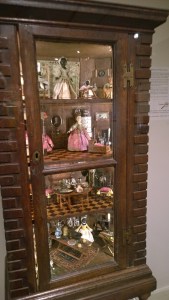
The Concord Museum has an exhibit on dollhouses right now, and I walked over to check it out. I’ve always liked dollhouses and even sought out one for Suzanne when she was in utero.
At the museum, children were playing happily with the sturdy contemporary dollhouse they were allowed to touch, but I suspect the people most intrigued by the glassed-in displays from the Strong Museum and various private collectors were the adults.
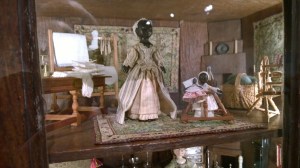
The Concord Museum is a history museum, and so I was less troubled by the accurate recreation of inequality in the miniature scenes than by the lack of relevant commentary in the placards. I couldn’t help thinking, for example, that some of the black schoolchildren who pass through the museum might be troubled by one dollhouse and might appreciate some discussion of the life of the servants in the attic and kitchen. But the placard was silent about wealth, poverty, and the legacy of slavery.
Another aspect of social history that seems fundamental to a discussion of dollhouses involves the many women who created them as a hobby.
Women who had servants in the attic and the kitchen were not folding the laundry. They were not cooking or tidying up. They were not raising their children. They did not have jobs. In short, they had almost nothing useful to do — a recipe for depression.
I often wonder about the psychological constraints that kept such women from giving themselves permission to go out into the world, as Jane Addams or Beatrix Potter did, each in her own way.
If making exquisite little worlds at home gave the dollhouse creators and their friends and families pleasure, that is a great thing in itself. If it represents a determination to create something fine when hardly any meaningful activity was allowed, then that is an even greater thing.
The dollhouse exhibit is up through January 15. Related events may be found here.






 Suzanne's Mom's Blog