Feeds:
Posts
Comments

Posts Tagged ‘india’

Photo: Fahad Shah.
In Srinagar, India, Syed Maqbool Rizvi paints intricate floral patterns on a decorative box made of papier-mâché. The ancient craft is dying out.

In reading about traditional crafts in danger of dying out as its elderly practitioners die, I keep thinking about recent posts on young artists taking crafts in new directions. (Consider the Navajo weaver, here, and the bojagi artist, here.) I wonder if such an evolution can emerge in a politically turbulent place like Kashmir. Ancient decorations now cover more than boxes, but who will take it to the next level? The current popularity belies the unsustainable bottom line for the workers themselves.

Reporting from India for the Christian Science Monitor, Fahad Shah writes, “Papier-mâché dates back hundreds of years in Kashmir. Local folklore credits the 14th century Sufi saint Mir Sayyid Ali Hamadani with bringing the craft to this Himalayan region from Iran, and it flourished under a series of sultans, quickly becoming a symbol of Kashmir’s cultural identity.

“But for a long time, the art form was limited to decorative boxes and other items molded from paper pulp. … These days, the iconic designs popularized by traditional papier-mâché items can be found on bags, leather jackets, and home decor. Artisans apply their intricate designs on unconventional materials like steel, glass, and porcelain, using industrial paints for durability.

“This creative evolution has expanded papier-mâché’s market appeal, with a new generation of clientele emerging – a group that includes interior designers, a local urban bourgeoisie, and international buyers. …

“It’s a relief – of sorts – to the Kashmiri artisans who have watched similar local crafts die out in recent years. To be sure, papier-mâché artisans continue to struggle with low wages and a lack of new talent entering the craft. Yet Hakim Sameer Hamdani, an architectural historian and design director for the Kashmir section of the Indian National Trust for Art and Cultural Heritage, says the industry itself is performing better now compared with 20 or 30 years ago. …

“He says, ‘The internet’s role, especially social media and WhatsApp, in design inspiration and market expansion has further driven demand, allowing artisans to reach global buyers directly and removing middlemen.’

“In Srinagar city, Jammu and Kashmir’s summer capital, papier-mâché art adorns the walls and ceilings of everything from Sufi shrines and mosques to homes and hotels. It can also be spotted in the windows of boutiques, where tourists and locals alike browse ornate bags or leather jackets. Mohammad Ismail, a retired educationist in Srinagar who collects papier-mâché art, says artists are always innovating.

“In papier-mâché, ‘the main focus is the design,’ he says, as he leaves a shop with a newly purchased bag. ‘It is the color and the pattern, whether it is on a glass or paper, that is authentic.’

“Around the world, demand for classic papier-mâché designs – applied to modern products – is growing, says Rahul Dhar, founder of e-commerce platform Treasures of Kashmir. He’s been selling Kashmiri handicrafts since 2020, and in the last few years, interest in papier-mâché jewelry has surged on his platform. …

“For artists, customer enthusiasm doesn’t always translate into prosperity. From his home in a historic neighborhood of Srinagar, Syed Maqbool Rizvi paints intricate floral patterns on a decorative box. His day started at 9 a.m. and will end at midnight. Despite having a loyal customer base that he communicates with via WhatsApp, he only earns the equivalent of about $5 for an entire day’s labor.

“The award-winning, seventh-generation papier-mâché artisan will be the last in his family to master the craft. His children – a son and a daughter – have chosen different paths.  

“ ‘There were many families known for this craft, but their children have moved on,’ Mr. Rizvi says. ‘Everyone looks for private jobs these days – who can afford to sit from morning till night for this kind of work?’  

“Government loans during the pandemic helped, he says, but it’s become almost impossible to make ends meet through papier-mâché alone. 

“Historian Bashir Ahmad Maliyar, whose doctoral thesis examined the evolution of Kashmir’s Mughal-era arts, crafts, and trade, says it will take more aggressive interventions to reverse the decline in active artisans.

“Without policies that ensure fair wages, incentivize arts education, and promote the region’s crafts, ‘papier-mâché will vanish within 10 to 20 years,’ he says. ‘People may still practice it in isolated ways, but once the art dies, reviving it will be difficult.’ ”

More at the Monitor, here.

Read Full Post »

Photo: Marvin Joseph/The Washington Post.
Until Jagadish Shukla, meteorologists generally believed that predicting the weather beyond 10 days was a hopeless pursuit. He wanted to help farmers anticipate monsoons.

Did you ever read Erik Larson’s Isaac’s Storm, a book about a devastating hurricane in Texas before there was good weather prediction? That was the first time I heard about the “butterfly effect,” tiny changes in weather conditions with powerful results.

A researcher interested in chaos theory asked himself what could happen with more butterflies than one.

Anusha Mathur writes at the Washington Post, “Standing in his home office in Rockville, Maryland, meteorologist Jagadish Shukla gestured at the high-resolution satellite map of India hung on the wall. It shows every groove of his home country’s geological landscape in vivid detail. …

“ ‘The trick is how to find predictable components in a chaotic system,’ Shukla told me. …

“He’s come a long way from his childhood village in northern India, where he spent his summers playing outside and praying for rain.

“The most anticipated season of each year was the annual monsoon, he writes in his memoir, A Billion Butterflies: A Life in Climate and Chaos Theory. Monsoons follow India’s hottest period and last for months, providing both relief from the sun and fertility for the land.

“But the monsoon also can be a source of suffering. Some years the rain brings intense flooding, while in others there’s too little for a good harvest — or worst of all, drought and famine. …

In 1970, 26-year-old Shukla arrived in Boston to pursue a doctorate at MIT.  “His goal: find a way to predict the Indian monsoon’s seasonal impact.

“At the time, weather forecasters relied heavily on ‘initial conditions’ — how volatile factors such as temperature, pressure, wind or jet stream today might affect the weather tomorrow. As a result, meteorologists generally believed that predicting the weather beyond 10 days was a hopeless pursuit.

“Soon after arriving at MIT, Shukla learned about the ‘butterfly effect,’ coined by renowned meteorologist Edward Lorenz. Lorenz observed that even the tiniest changes in initial weather conditions — something as small as a butterfly flapping its wings — could make an entire system chaotic over time.

” ‘The idea is that if you change just one decimal point in your initial condition, you will get a different forecast after 10 days,’ Shukla said.

“Lorenz’s work made many scientists skeptical about whether seasonal predictability was worth focusing time [on]. But Shukla’s felt sure that — at least for the monsoon — there was knowledge to be gleaned from the chaos. …

“Then came the breakthrough. While daily weather is driven by volatile initial conditions, seasonal averages are shaped by something else, ‘boundary conditions’ such as ocean temperature, soil moisture, snow cover and vegetation. And these boundary conditions are a source of predictability. …

“Said David Straus, a climate dynamics professor at George Mason University who worked with Shukla, ‘Shukla had a really outsize role in saying, ‘Look, all these little pieces of evidence in the past are there, we can use them together.” ‘ …

“Shukla’s team ran simulations in which they dramatically changed the initial conditions — the metaphoric flutter of billions of Lorenz’s butterflies — while keeping the boundary conditions fixed. Despite the day-to-day instability, the seasonal outcomes remained consistent. It was the origin of the phrase ‘predictability in the midst of chaos,’ which became the title of Shukla’s bellwether paper, published in the journal Science in 1998. …

“As Shukla deepened his work on dynamic seasonal prediction, a new scientific field was emerging: climate change. Throughout the 1970s and ’80s, Shukla’s colleagues repeatedly asked if he would turn his attention to global warming. …

“He ‘wasn’t convinced yet’ about global warming. He worried the claim of human-induced climate change was too bold, too early.

“Finally, in 2004, he accepted an invitation to serve on the United Nation’s Intergovernmental Panel on Climate Change (IPCC) to work on its fourth comprehensive assessment of the climate. …

“In the bombshell IPCC report, published in 2007, Shukla and his fellow scientists declared that the ‘warming of the climate system is unequivocal’ and identified ‘discernible human influences.’ That year, the panel received the Nobel Peace Prize for its work, along with former vice president Al Gore, with Shukla sharing in the honor.

“ ‘I cannot accept something simply on faith and belief,’ Shukla said. ‘The reason 2007 got the Peace Prize was because it was the first time our model said, “Oh, it’s now beyond the uncertainty.” ‘ “

Read at the Washington Post, here, how climate-denying members of the US House put Shukla under an intense and vicious investigation in 2015. Despite the misery of that period, he says, “It’s a small price to pay to defend the integrity of climate science. … If we don’t defend it, who will?”

Read Full Post »

Photo: Niharika Kulkarni/AFP via Getty Images.
People fill up their bottles from a water tank on a hot summer day in Varanasi, Uttar Pradesh, India.

We are all experiencing a new level of heat wave.Where I go in the summer, sea breezes used to be enough to cool us down, but no more. Some places, however, are experiencing the new intensity more than others. Parts of India, for example, were pretty hot in the first place, and global warming has made it worse.

Charlotte Steiner, Sameer Kwatra, and Prima Madan write at the Natural Resources Defense Council (NRDC) about new Heat Action Plans (HAPs) in parts of India.

“As India grapples with yet another season of intense heat, the cities of Churu, Rajasthan, and Varanasi, Uttar Pradesh, are taking action to strengthen local preparedness and resilience. These cities launched their comprehensive Heat Action Plans (HAPs) in May of this year. Developed in collaboration with city authorities, health experts, and [NRDC] partners — Mahila Housing Trust (MHT) and Indian Institute of Public Health-Gandhinagar (IIPHG) — the Churu Heat Action Plan and Varanasi Heat Action Plan represent a significant milestone. …

“For Varanasi and Churu, building resilience to extreme heat is critical. Varanasi, a city of significant cultural and spiritual importance, gets more than 85 million tourists and pilgrims every year and has been grappling with worsening heat waves, year over year. In 2024, the city recorded a scorching 47.2 degrees Celsius (117 degrees Fahrenheit) — the highest temperature in 140 years. Churu, often referred to as the gateway to the Thar Desert, is not only one of the hottest places in India, but it is also particularly at risk for extreme heat events. …

“Historically, HAPs did not include climate projections to highlight the future increase in temperatures to assess risk. However, without concrete data on future projections, it’s hard for city officials and policy makers to move from planning to long-term action. Including robust climate analysis in HAPs strengthens the scientific credibility of the HAP, as well as helping city officials and urban planners to justify budget allocations for long-term heat resilience. It also builds a case for investment in public health and infrastructure to plan for not just saving lives today but reducing the risk over the long run.

“Both the Churu and Varanasi HAPs include tailored climate analysis in addition to a detailed assessment of historical trends (typically included in HAPs), highlighting rising baseline temperatures during both the day and night. The climate analysis for the two cities revealed that, by 2049, the temperatures in Churu are projected to increase by approximately 3.89 degrees Celsius and in Varanasi, by an additional 3.29 degrees Celsius. This could imply more days above 45 degrees Celsius, longer heat waves, and more nighttime heat stress. These HAPs also incorporate the U.S. National Oceanic and Atmospheric Administration Heat Index, which combines air temperature and relative humidity to indicate how hot it actually feels to the human body and thereby highlight the human thermal discomfort more realistically.

“Based on hyperlocal analysis, these HAPs also identify specific hot spot areas or account for localized vulnerabilities; they also include ward-level geographic information system (GIS) spatial vulnerability assessments, offering a detailed view of how extreme heat impacts different parts of each city differently. These assessments will help local authorities target interventions more effectively and equitably as they work on implementing each HAP.  …

“Timely early warnings, joint response protocols, and localized capacity building are essential to reducing heat-related morbidity and mortality and maintaining critical services during peak summer months. Keeping up with this expectation, the Churu and Varanasi plans embed institutional accountability by outlining a detailed stakeholder responsibility matrix. This framework defines clear roles, timelines, and coordination mechanisms across state, district, and municipal levels, ensuring that each actor — from government departments to civil society — knows when and how to act.” More at the nonprofit NRDC, here.

NRDC articles are quite technical and full of data charts, but even I can understand the drift, and I hope you find it interesting. I think every town in the world is going to need a HAP.

Read Full Post »

Photo: Swach Cooperative, Pune.
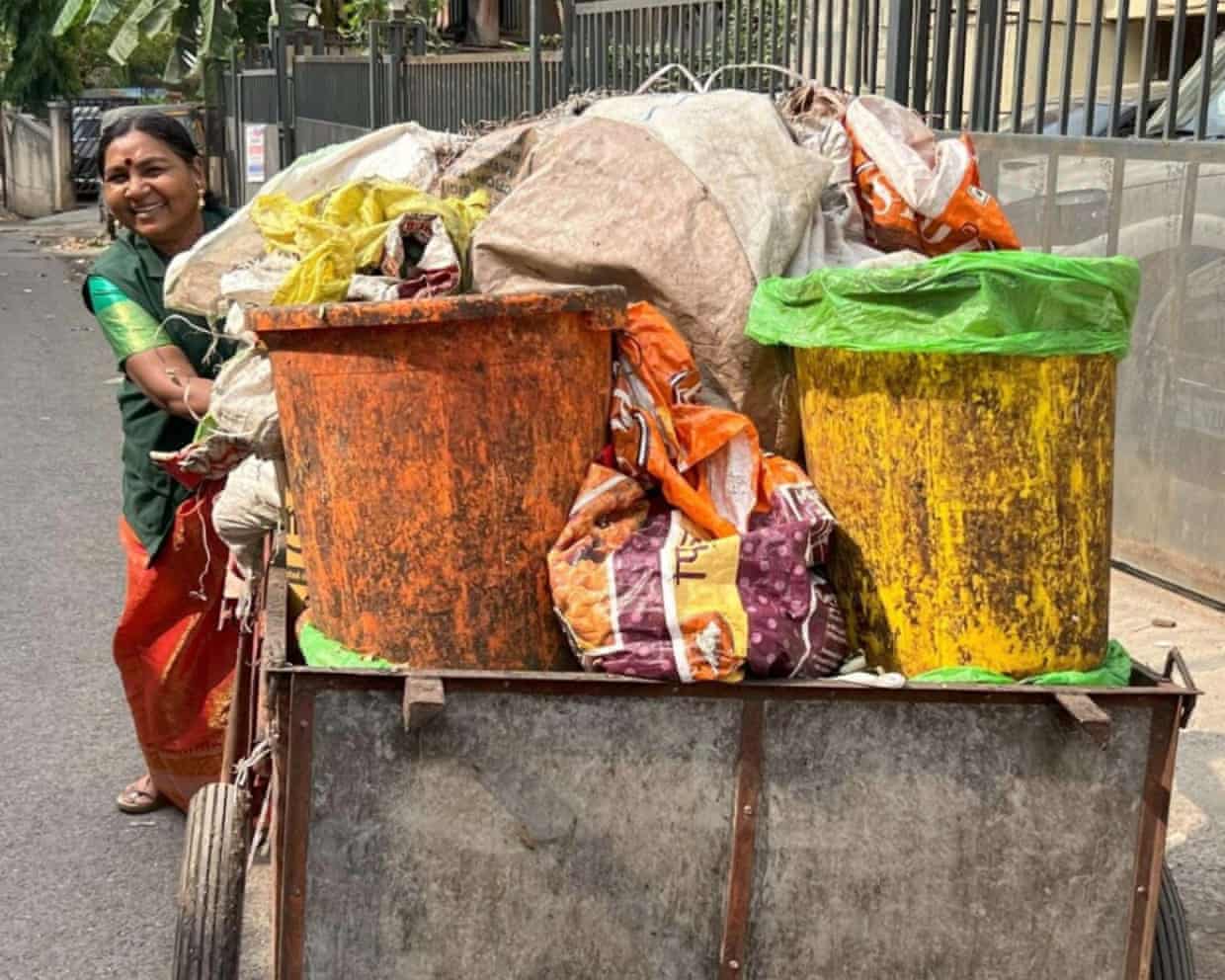
More than 70% of Swach waste collectors in Pune, India, are women.

I like stories about win-win-wins. Today Shatakshi Gawade writes at the Guardian about a cooperative in Pune, India, that is diverting waste from the landfill and cleaning a city while also alleviating poverty. Trash collection is a job the mostly female workforce fought hard to retain when the city failed to renew the contract.

“Three decades ago, Rajabai Sawant used to pick and sort waste on the streets of Pune with a sack on her back. The plastic she collected from a public waste site would be sold for some money that saved her children from begging.

“Today, dressed in a dark green jacket monogrammed with the acronym Swach (solid waste collection and handling) over a colourful sari, the 53-year-old is one among an organized group of waste collectors and climate educators who teach residents in urban Pune how to segregate and manage waste, based on a PPPP – a pro-poor private public partnership.

“ ‘Even though we were earning money and running our homes by collecting and selling recyclable waste in the past, our job was not valued and we were not respected for the work we did,’ Sawant says as she pushes a loaded four-wheeled metal cart up a gentle slope. …

“Swach was set up in 2005 by a trade union of waste pickers, Kagad Kach Patra Kashtakari Panchayat (KKPKP), which was not in favor of contractor-run private models and envisioned a scheme that enhanced waste collectors’ work instead of displacing them.

“Lakshmi Narayan, one of the co-founders of Swach and KKPKP, says: ‘Contractor models typically end up hiring males and displacing the people who traditionally did the work. We strongly felt that a person who has been doing the work for so long brings in the knowledge, experience and intelligence to handle the material in a particular way, and should be the first claimant of that work.’ …

“Rehabilitating the waste workers by teaching them a new skill such as embroidery, and taking them away from their work of waste collection, segregation and sale was not the long-term solution, Narayan says. ‘The waste sector generates a large number of jobs not just in Pune but across the world.’ …

“Through detailed discussions with waste pickers, KKPKP realized that they were diverting a significant amount of waste from the landfill. Segregation at source, plus recycling material recovered from the waste, was contributing to climate change mitigation by minimizing landfill waste, reducing greenhouse gas (particularly methane) emissions, lowering the demand for scarce raw materials and saving taxpayers money by reducing solid waste management costs. …

“The waste sector is the third-largest source of anthropogenic methane emissions, one of the most potent of greenhouse gases, and Swach calculates that its work saves 100,000 tons of CO2 every year.

“In negotiations over a global plastics treaty in Busan, South Korea, last year, the chair’s text highlighted that countries should take measures to ‘promote a just transition for plastic waste management workers, especially waste pickers and other informal workers.’

“Narayan says: ‘We have argued that waste collection itself is green work but it’s not necessarily decent work. And there has to be a way to make it decent.’ Narayan says the Swach model helped transition the work of waste collectors from the informal sector, in which they spent their whole day at public bins and roadsides in tattered clothes, to a more formalized setup, where they began wearing a uniform and started speaking directly to residents.

“Rani Shivsharan, a waste picker and board member of Swach, says: ‘We did not know how to talk to people, since we had never been included in society. We wouldn’t have dared to talk in front of even two people, but now we can fearlessly articulate our demands and thoughts with conviction in front of an audience of 500.’ “

Read at the Guardian, here, about current threats to employment of the traditional waste picker. This story is an abridged version of a piece originally published by Mongabay.

Read Full Post »

Photo: Mark Vonesch / Modern Biology.
“Fungi whisperer” Tarun Nayar started experimenting with connecting a synthesizer to plants and fungi during the early days of the COVID-19 pandemic. 

Today we have another example of the creative work that got a lift during the pandemic. Not that we ever want a pandemic, but it doesn’t hurt to remember that good things can flourish in the shelter of nothing-much-going-on.

Radhika Iyengar writes at Atlas Obscura about some pandemic-era experiments. “On a pleasant December morning, Tarun Nayar was at a mangrove reserve in Mumbai, where he plugged his synthesizer into a thick leaf. The sound that emerged was hypnotic and otherworldly, blending a sense of the future with nostalgic echoes of 1980s synthwave. It felt like something right out of Stranger Things.

“Nayar is not your traditional musician—he’s a fungi whisperer. By connecting cables from his custom-built modular synthesizers to mushrooms, fruits, and leaves, he transforms their natural bioelectric signals into captivating sounds. …

“Over the last five years, Nayar has jammed with myriad types of fungi, including trumpet-shaped chanterelles and the glorious, red-roofed fly agaric mushrooms. He has also collaborated with a giant ficus tree, clumps of bamboo, sword ferns, a pineapple, and even the odd-looking citrus fruit called Buddha’s Hand. ‘It’s an intoxicating feeling to be able to make all these crazy sounds and program really interesting melodies, many of which will probably be impossible to play on a traditional instrument,’ he muses.

“Music has always been central to Nayar’s life. Born to a Punjabi father and a Canadian mother, he was immersed in Indian classical music from an early age, particularly through his training in tabla, a type of hand drum. But for the past four years, the former biologist, who is based in Montreal, has been experimenting with what one may describe as plant music.

“Nayar’s journey into this experimental soundscape began during the COVID-19 pandemic, when he was living on a tiny island north of Vancouver, surrounded by nature. That’s when he began ‘messing around’ with flora. He recalls plugging a software synthesizer into a salmonberry bush. ‘All of a sudden, the synthesizer started playing a piano patch,’ he says. ‘I could actually “listen” to the salmonberry bush.’ …

“In 2021, Nayar started posting videos of his ‘little experiments’ on the internet under the stage name Modern Biology. While initially his videos on TikTok received only three to four views, slowly they gained momentum and worldwide attention, leading to tens of thousands of people appreciating his work. ‘To be honest, I was quite surprised that people were interested in this relatively niche practice. It really gave me a feeling of community during the pandemic when my bubble was quite small,’ admits Nayar. Today, he has over 379,000 followers on Instagram alone.

“To be clear, fruits, fungi, and trees don’t make music. They don’t even produce sounds that lie within the audible range of human hearing. But as Nayar explains, ‘almost every behavior in plants and fungi is mediated by electrical impulses, just like in humans. Every thought, every movement, every little cellular division is associated with an electrical activity. These signals or processes are all reflected in the conductivity of the organism’s body. All I’m doing is tapping into these fluctuating electrical fields and translating the electrical signals into musical notes.’…

“His interest in sound synthesis began several years before the pandemic, sparking a deep fascination that eventually led him to build his own analog synthesizers at home. He pursued courses focused on DIY synthesizers made out of breadboards—versatile plastic boards with perforated holes, designed for assembling electronic circuits by plugging in jumper cables. …

“One of the first exercises in the online course involved the humble orange. ‘We had to use it in a circuit as a resistor,’ Nayar recalls. ‘Everything has electrical resistance, but some materials are so resistant that current can’t even pass through them. Fruits and vegetables, however, are effective conductors, allowing electrical current to flow through them.’

“When Nayar squeezed the orange, he realized that its conductivity changed, and the sound changed with it. ‘The pitch of the oscillator went up or down depending on whether you were squeezing it or not,’ he says, adding with a hint of amusement, you can actually play the synthesizer just by squeezing the orange!’

“From holding festivals in parks to conducting intimate gatherings at restaurants, Nayar has been gaining attention for his experimental music. His goal is to encourage people to reconnect with nature. ‘For the most part, as human beings we kind of forget that the world is alive,’ he says.”

Lots more at Atlas Obscura, here, where you can also listen to some musical results.

Read Full Post »

Photo: Shefali Rafiq.
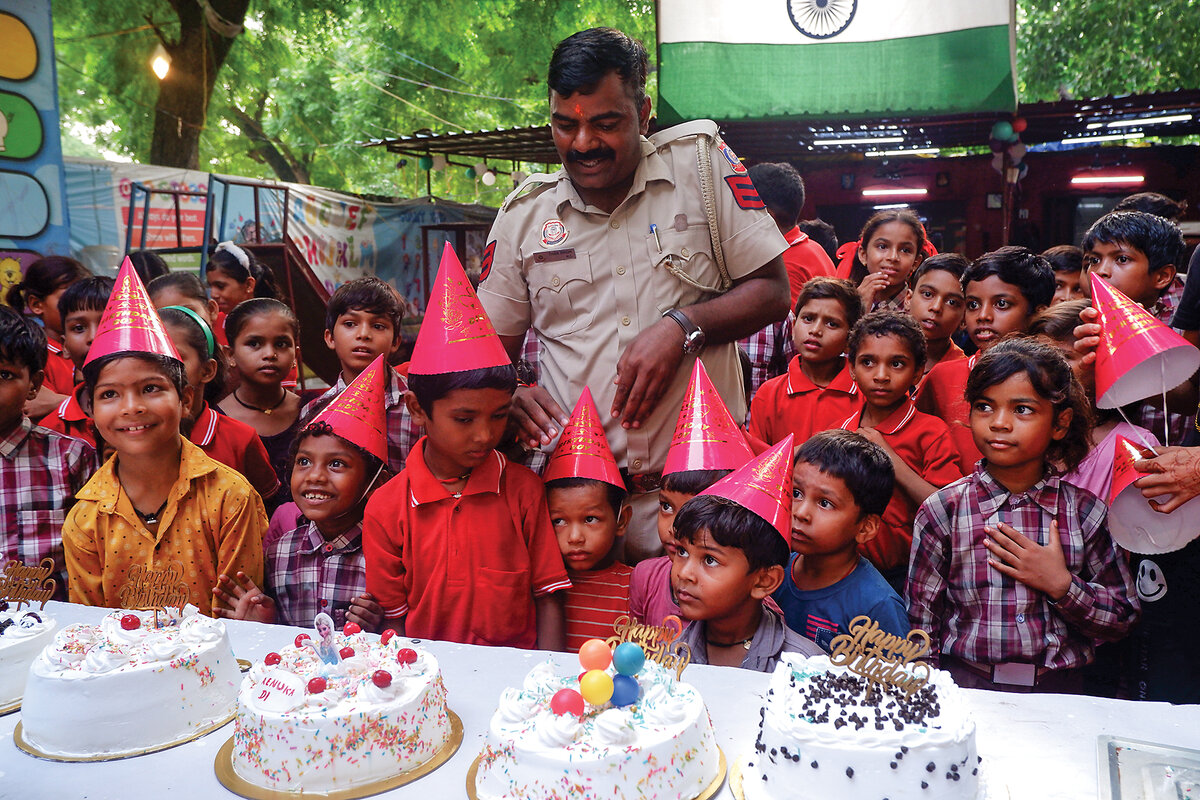
Students celebrate a classmate’s birthday at an informal school, or
pathshala, set up by police officer Than Singh (center), in a Delhi, India.

Today’s story is about one compassionate person in India who wanted to make a difference in children’s lives. Shefali Rafiq and Saqib Mugloo wrote the photo essay for the Christian Science Monitor.

“It wasn’t until Than Singh came along that learning became a favorite pastime for the children who typically roam Delhi’s streets begging, rifling through garbage, or engaging in petty crimes.

“In 2015, the Delhi police officer started a pathshala, or place of learning, where he teaches 80 students a day in a temple set up near the Red Fort. ‘It was heartbreaking to see children scavenging for plastic bottles in the trash,’ he recalls. ‘That’s when I decided to do something.’

“More than half of India’s children are malnourished, and about 30% of those ages 6 to 18 do not attend school. Mr. Singh, who grew up poor in northwestern Rajasthan state, is determined to change these statistics. ‘My dream is to see every underprivileged child in school,’ he says with a broad, charming smile, adding that he is confident that, with God’s help, he will make it happen.

“He starts his day early, patrolling the busy lanes of Old Delhi, the capital’s historic heart, as part of his duties. But every day after work, he holds classes at his pathshala, where students eagerly await him. Among them are Ajay Ahirwar and Neelu Ahirwar (no relation).

“Ajay says he aspires to become a high-ranking officer in the government so that he can improve the conditions of his family and those living like him. Neelu is fond of her teacher and the pathshala. ‘I would rather be here, even on holidays, than at home,’ says the young girl, who aspires to become an officer in the Indian Police Service.

“Initially, only four children attended Mr. Singh’s pathshala. He contributed money from his salary to buy books, notebooks, pencils, and schoolbags. Nine years down the line, he has now taught hundreds of children.

“ ‘Beyond basic lessons, I try to instill manners and discipline in these students,’ Mr. Singh says. ‘Even if they come to this school just for a meal, I’ll be happy because, seeing others, they may also want to study.’

“Mr. Singh organizes extracurricular activities, too, including cricket. For those children who do attend school in the city, he celebrates good exam results at his pathshala. ‘I just want these children to stay away from all the bad influences they’re vulnerable to,’ he says, referring to the crimes that affect Delhi.

“ ‘Our aim in the world is to spread goodness and happiness.’ ”

More at the Monitor, here. Wonderful photos. No firewall.

Read Full Post »

Photo: Sushmita Pathak.
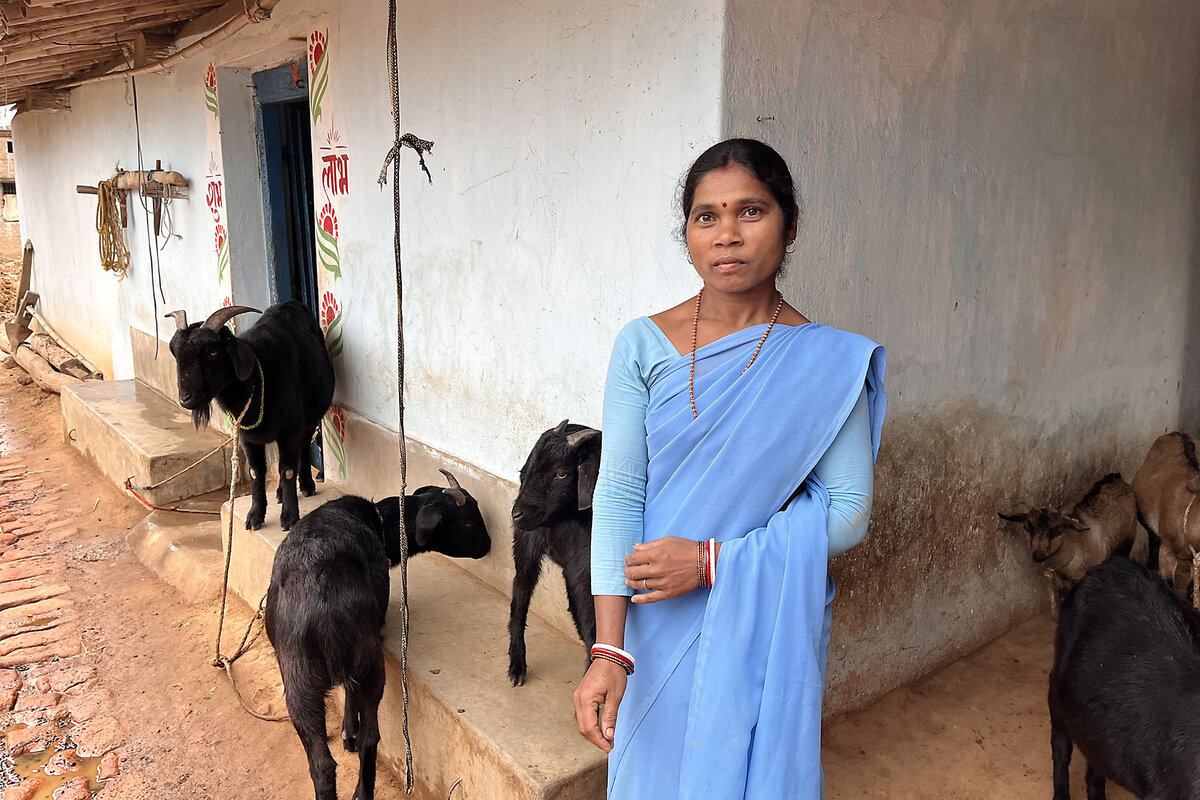
Ritmani Devi, one of roughly 60,000 women in India trained as goat nurses under the Pashu Sakhi initiative, stands with her herd in Angara, India, March 19, 2024.

It seems wrong somehow that there should ever be a need to “empower” women, anymore than there is a need to empower men.

But such is the case, whether women live in rich countries or in the most impoverished villages of India.

Still, it’s better to have empowerment initiatives for women than to do nothing about the imbalance.

At the Christian Science Monitor, Sushmita Pathak reports from India about one such initiative, “Dressed in a light-blue sari, Ritmani Devi cradles two black baby goats as she guides a flock of ducks toward its coop. …

“A few years ago, this muddy yard was much less lively. Ritmani Devi’s goats would often die, she says, and the ones that survived weren’t very healthy. This was common here in the east Indian state of Jharkhand and throughout the country.

“India is home to one-sixth of the world’s goat population. A goat is a valuable asset for a low-income family, ready to be sold at a moment’s notice in case of emergencies. But with owners lacking basic animal health knowledge, that’s all they were – a one-time, last-ditch safety net, rather than an alternative stream of income. Plus, poor access to veterinary services led to high mortality and morbidity rates among goats.

“Now, results from one novel initiative that began a decade ago indicate the tide may be turning. The Pashu Sakhi, or ‘friend of the animal,’ program works to fill gaps in veterinary care by transforming rural, semiliterate women into community animal health care workers, or ‘goat nurses.’ With support from the Indian government, the World Bank, the Gates Foundation, and others, around 60,000 women across India have been trained to provide services like vaccination and deworming, leading to a spurt in goat populations in several states. They are paid for the care they provide, and gain a sense of pride and independence. …

“At the community hall near Ritmani Devi’s home in Getalsud village, the walls are painted with training material, including illustrations of common symptoms to look out for, like swelling under the animal’s mouth or pale eyes, and tips on how to negotiate better rates for goats in the market. 

“Jharkhand was one of the first states in India to adopt the Pashu Sakhi model. Having women at the forefront of the initiative was a natural choice, says Swadesh Singh, a livestock specialist at the Jharkhand State Livelihood Promotion Society, the government agency that runs the program.

“In rural India, the responsibility of managing small ruminants and poultry usually falls on women. Meanwhile, veterinary doctors – who sometimes serve multiple village clusters alone – focus on larger, more valuable animals like cows and buffalo. Before the program, goat mortality in Jharkhand was 50%, says Dr. Singh. Authorities say that figure is now below 15% – thanks in large part to the state’s goat nurses.

“The typical Pashu Sakhi candidate has at least eight years of schooling. After being selected by the state’s livestock department, they’re taught how to administer vaccines, what type of fodder is best for the animals, and how to give preventative care. More advanced nurses also get trained in managing disease, performing castration, goat breeding and marketing, and more. 

“Goat nurses are often the first responders in any livestock-related medical emergency, in addition to conducting regular check-ups and advising others on goat rearing. Their proximity is a huge advantage. Hailing from the same community that they serve makes it easier to build trust, and the women can take on as much work as they like. 

“Livestock owners pay a fixed sum for each service – about 12 cents for every vaccination, for example – and goat nurses also receive a small stipend from the government. Ahilya Devi says she makes anywhere from $25 to $85 a month. That money goes toward her children’s school fees, groceries, and other household expenses – and, occasionally, a personal treat like makeup. 

“ ‘Earlier, I had to consult my husband for every expense,’ she says. …

“To be sure, the work comes with challenges. Farmers are often reluctant to pay for services, says Dr. Singh, and there’s the risk that goat nurses may be threatened or harmed if an animal dies under their care. …

“Still, the initiative has paid rich dividends. In some districts of Bihar, Maharashtra, and Haryana, goat mortality fell to single digits. Between 2012 and 2019, Jharkhand’s goat population – which had become stagnant – grew by nearly 40%, and another livestock census is expected to take place this year. Spurred by the program’s success, goat nurses in some parts of Jharkhand are also being trained to cater to larger animals like cattle, says Dr. Singh. …

“The initiative has contributed to ‘the building of social capital and self esteem’ among urban women, wrote [Observer Research Foundation senior fellow Arundhatie Biswas Kundal]. People often refer to the goat nurses as ‘doctor didi,’ meaning an elder sister or person you think highly of. …

“But none of this happens overnight. When Ahilya Devi first started as a goat nurse, people would look at her with some suspicion. ‘Even those from my own village did not recognize me, because I did not step out of the house much,’ she says.

“Now, nearly a decade later, they welcome her into their homes with respect.”

More at the Monitor, here.

Read Full Post »

Photo: Ahmad Masood/Reuters.
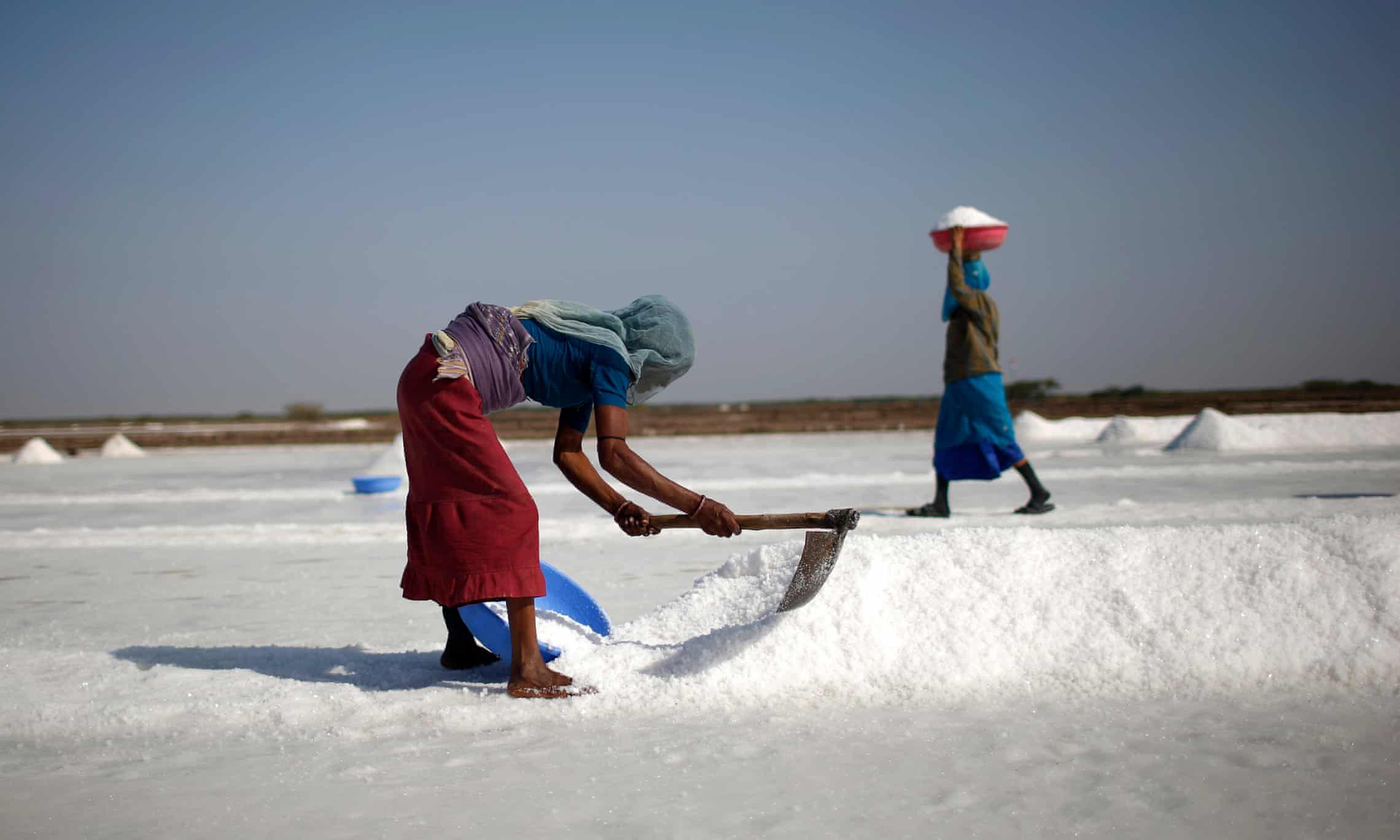
Working on a salt pan in the western Indian state of Gujarat. The marshes produce 30% of India’s inland salt. 

I’m always up for a little good news from distance places, as I hope you are, too. Today we learn about the benefits of solar energy for one hands-on industry in India.

Suchak Patel writes at the Guardian, “In the expansive salt marshes of the Little Rann of Kutch the bleakness of the sunburnt, treeless landscape is matched only by the drudgery of the salt farmers who toil there for eight months of the year.

“In October, as the monsoon recedes and the flooded salt pans dry out, farmers and their families hop on to trucks and tractors to migrate to the Little Rann of Kutch in Kutch district, Gujarat, where they pitch tarpaulin shelters and begin mining the underground deposits.

“An estimated 10,000 families of farmers, known as agariyas in Gujarati, migrate to the marshes from across the state. They start each season by digging wells to pump out brine using diesel pumps; the brine is then poured into shallow, squarish plots carved on the salt pans and left to evaporate under the sun to produce salt crystals. These marshes produce 30% of India’s inland salt, typically table salt.

“Life in the salt marshes is uniquely challenging. Drinking water comes not from pipes but tankers, children attend schools inside buses not buildings, and the only avenue to healthcare is weekly mobile vans from the health department. Basic amenities such as an electricity grid and toilets are nonexistent.

“ ‘My entire family, including my brother’s two daughters, lives in the desert these eight months, and my nieces attend primary school in a mobile school bus,’ says Bharatbhai Shyamjibhai Mandviya, 45.

“Contracts made with salt traders before each season, where the traders pay an advance to the farmers to buy pumps, diesel, and to meet household expenses mean most farmers start the season in debt, with the harvest income barely enough to cover their costs, let alone allow them to save.

“Diesel constitutes nearly 65% of the input costs in salt farming, and about 1,800 litres [~476 gallons] of the fuel is needed to produce [about] 750 tons of salt, according to Purshottam Sonagra, area manager of nonprofit Vikas Centre for Development that works with salt producers in the region. …

“But the introduction of solar panels to the pans has triggered a significant shift in the lives and lifestyles of the impoverished salt workers. In 2017, the Gujarat government gave solar pumps to salt farmers at nearly 80% subsidy, as part of a larger push to cut emissions and bring down the costs involved in salt production.

“ ‘Solar-powered pumps have reduced the cost of salt farming to one-third of what it was,’ says Sonagra.

“Mandviya has installed three pumps on the salt pan he works on, the savings from which have led to many firsts in his life.

“ ‘We have now built a two-bedroom house with a separate hall and a kitchen in Kharaghoda [his home village],’ says Mandviya. The new home with tiled walls and built-in cupboards which he will share with his brother and family, is a big upgrade from the kuccha [mud and straw] house they lived in before.

“The brothers also bought a motorcycle and a refrigerator from the money they managed to save.

“With more than 5,500 solar-powered pumps now dotting the region, energy costs have fallen [and] the agariyas such as Mandviya are no longer as dependent on the capital from traders, which gives them greater negotiating power over salt prices. …

“Solar pumps and the financial stability they grant have improved access to health, education and mobility, while also offering freedom to salt farmers from an endless work cycle, campaigners say.

“ ‘Steady supply from the solar panels is powering not only pumps but also televisions. Children of salt makers are switching to state-run ‘edutainment’ programs to make up for the loss of education,’ says Bhavna Harchandani, a research scholar at the Indian Institute of Technology Gandhinagar, who has tracked the agariya community as part of her studies. …

“Sonagra says it was difficult to find an office assistant with basic secondary-school education among agariyas until a few years ago.

“ ‘Today, many agariya children attend private schools, complete ITI (vocational) courses, and some manage to go to college. Solar pumps have opened up educational opportunities for the next generation of the community,’ he says.”

More at the Guardian, here.


Read Full Post »

Photo: Corey Favino/Elephant Family USA/Newport Restoration Foundation.
The Great Elephant Migration installation outside Rough Point mansion in Newport, Rhode Island.
The elephants are made by indigenous people from an invasive plant.

Here’s a new way to reach audiences with a message about the importance of conservation: a giant “elephant” exhibit in a beautiful seaside setting that tourists visit anyway.

At Forbes magazine, Chadd Scott begins the story by talking about India.

“India has experienced a remarkable population explosion over the past 40 years. Several actually. One is well known. India’s human population has more than doubled since 1980. … Lesser known, and even more extraordinary in light of the country’s surging human population, has been a doubling of its elephant population over that same period, from a bottom-out of around 15,000 individuals to nearly 30,000 today. Populations of Asiatic lionstigers, and the greater one-horned rhinoceros are also increasing across the country.

“India offers a remarkable example for how humans and wildlife, even the largest of wildlife, can coexist in an ever-developing world. Sharing that message with the world is the mission of the Great Elephant Migration which debuted 100 life-sized Asian elephants in Newport, RI on July 1.

“The elephants — each based on a real, wild elephant from the Nilgiri Hills known by name and personality living alongside people in their coffee and tea plantations — were made by members of the Coexistence Collective, a group of 200 Indigenous artisans from the Nilgiri Biosphere Reserve

“The herd was produced from the Lantana camara, a toxic, invasive plant overtaking the Indian forest, pushing elephants and other wildlife out and into closer proximity to humans, with greater potential for conflict. …

“ ‘It’s a conservation miracle; it’s contrary to what’s happening everywhere else in the world and it’s definitely owed to an incredibly beautiful perspective on nature and our place within nature,’ Ruth Ganesh, trustee, Elephant Family USA, co-organizer of the Newport presentation along with Art&Newport, and co-founder of the Coexistence Collective, said at The Great Elephant Migration’s opening at Rough Point. ‘That’s what we hope the herd will spread, this beautiful perspective of coexistence and seeing other species as our biological kin.’

“The elephants, and the Indians, prove conservation is as much a mindset as a management plan.

“ ‘That culture of being able to live with animals is the most important thing, more than any of the natural variables about habitat and prey, and all of that,’ Asian elephant expert and co-founder of the Real Elephant Collective in India, Tarsh Thekaekara, told Forbes.com. The Great Elephant Migration exhibition and tour is the brainchild of he and Ganesh. His research in India has focused on human-elephant coexistence. ‘Animals will survive in human dominated landscapes if people tolerate them. That is the bottom line.’ …

” ‘The people who made the elephants [practice] kind of a fusion of Hinduism and animism,’ Ganesh told Forbes.com. Animism attributes a soul and living spirit to animals, rivers, mountains, plants, and other objects often considered inanimate. ‘There’s a spiritual tapestry that underpins the answer to the question why is India succeeding in this way despite so many challenges? It’s the spirituality. It’s this perspective.’ …

“Research published this year by scientists at Colorado State University indicates that elephants have names for each other.

“Research from 2022 demonstrates the numerous ways elephants grieve their dead and participate in post-death rituals like burial, same as humans. They communicate. Feel pain. Play. Look out for each other. …

“Seeing animals as beautiful people, seeing mountains as deities and rivers as our veins, that it’s a beautiful perspective,’ Ganesh added. …

“ ‘Not just India, in lots of traditional cultures there wasn’t a decimation of wildlife. If you look at conservation in most of the First World, it happened because there was a systematic decimation of all the wildlife,’ Thekaekara explains. ‘When settlers arrived on the North American continent, they wiped out most animals. So, then you had nothing, and you had to conserve.’ …

” ‘Set aside land for nature because you assume people cannot coexist with nature — that model of conservation was inherently separationist.’ …

“Indigenous people the world over have lived more or less harmoniously with wildlife for millennia. That has not been the case with Europeans and their descendants. …

“ ‘If people stopped killing, [animals are] going to come back,’ Thekaekara said. … ‘In coffee and tea plantations, the core of the local economy isn’t upset by the elephants. They don’t eat the coffee or tea, so people’s livelihoods are not affected. It’s only a minor adjustment to your lifestyle to be able to coexist.’ ”

More at Forbes, here. No paywall for your first articles.

Read Full Post »

Photo: Nadja Wohlleben.
Meenakshi Raghavan at the school she runs in Vatakara, Kerala, India, teaching more than 200 students, mostly girls. 

Women have had to fight for every freedom they’ve gained, and they have to fight to keep those freedoms, too. Maybe not with swords, but as today’s story suggests, a little knowledge of martial arts wouldn’t hurt.

At the Guardian, Haziq Qadri reported recently on an elderly woman in India who teaches younger females how to protect themselves.

“Today the pupils are mostly schoolchildren, aged from seven up to teenagers. The teacher is an 82-year-old woman known to all as Sword Granny. Inside her martial arts school – a large hall with walls adorned with trophies and mementoes – in Vatakara, in the southern Indian state of Kerala, the session begins with prayers and warmup exercises.

“Then Meenakshi Raghavan takes the class through the precise movements of Kalaripayattu, India’s oldest martial art, their bare feet padding across a floor of red dust mixed with medicinal herbs.

“Every day, this formidable women teaches Kalaripayattu to youngsters and the older men and women of the town alike.

“Raghavan has built a team of teachers who work alongside her at the Kadathanad Kalari Sangham school, but she has become especially renowned in this region not for her age, but for her focus and commitment to empowering the next generation of young women.

“Sword fighting is an essential part of Kalaripayattu, and the grandmother moves swiftly and with great grace when she swings her sword at the opponent.

“Kalaripayattu [was] banned by India’s British colonial rulers in 1804. But the art form survived underground, experiencing a resurgence in the early 20th century and gaining new life after India’s independence in 1947.

“Raghavan’s martial arts school was started by her late husband, Raghavan Gurukkal, in 1949. … ‘Anyone is welcome here, we do not charge anything to our students,’ she says.

“Raghavan began practising martial arts at seven, under the guidance of her father, who recognized the importance of self-defense in a society where women were often vulnerable. …

“ ‘When young girls and women look at me, they feel inspired that if I can do such a thing at this age, so can they at their age,’ she says.

“Raghavan says self-defense techniques are essential for young women in these times and martial arts is the best way to equip them.

“For her, the teachings of Kalaripayattu instill self-confidence and mental resilience, crucial in a society where women face systematic marginalization and violence. Crimes against women have been on the rise in the past decade, according to India’s National Crime Records Bureau. Of nearly 6m crimes recorded by police in India in 2022, 445,256 involved crimes against women, a rise of more than 30% since 2016.

“ ‘Kalaripayattu plays an important role in building mental strength and self-confidence,’ she says. ‘Offering girls hope and empowerment.’ …

“The red-sand training ground – or kalari – of her school is filled with energy and determination as her students engage in their rigorous drills and intricate movements, mastering the techniques passed down through generations.

“ ‘When I train young girls and women, I keep in mind to teach them Kalaripayattu for its essence and their self-defense,’ she says.

“Raghavan is now connecting with people beyond Kerala too. ‘I also have special groups with people coming from different countries who seek one-on-one training,’ she says proudly.”

More at the Guardian, here.

Read Full Post »

Map: Jacob Turcotte/CSM.
There are still people in India who appreciate having friends from other religions.

There is not much to celebrate about Hindu-Muslim relations in India these days, where the current power structure seems to have turned its back on peaceful coexistence. But trust the Christian Science Monitor to come up with a rare upbeat story! It’s about an interfaith friendship between Sadiq Ali, a Muslim, and Mahant Gyan Das, a Hindu, that has survived many political storms.

Shweta Desai  writes, “The light blue walls of Sadiq Ali’s living room are adorned with photos of Hindu seer Mahant Gyan Das. The two have been friends since the 1980s, when Mr. Ali was a volleyball player and Mr. Gyan Das a wrestler. They bonded over their shared love of sports, and Mr. Gyan Das regularly visited Mr. Ali’s family tailoring shop to get his tunics stitched. 

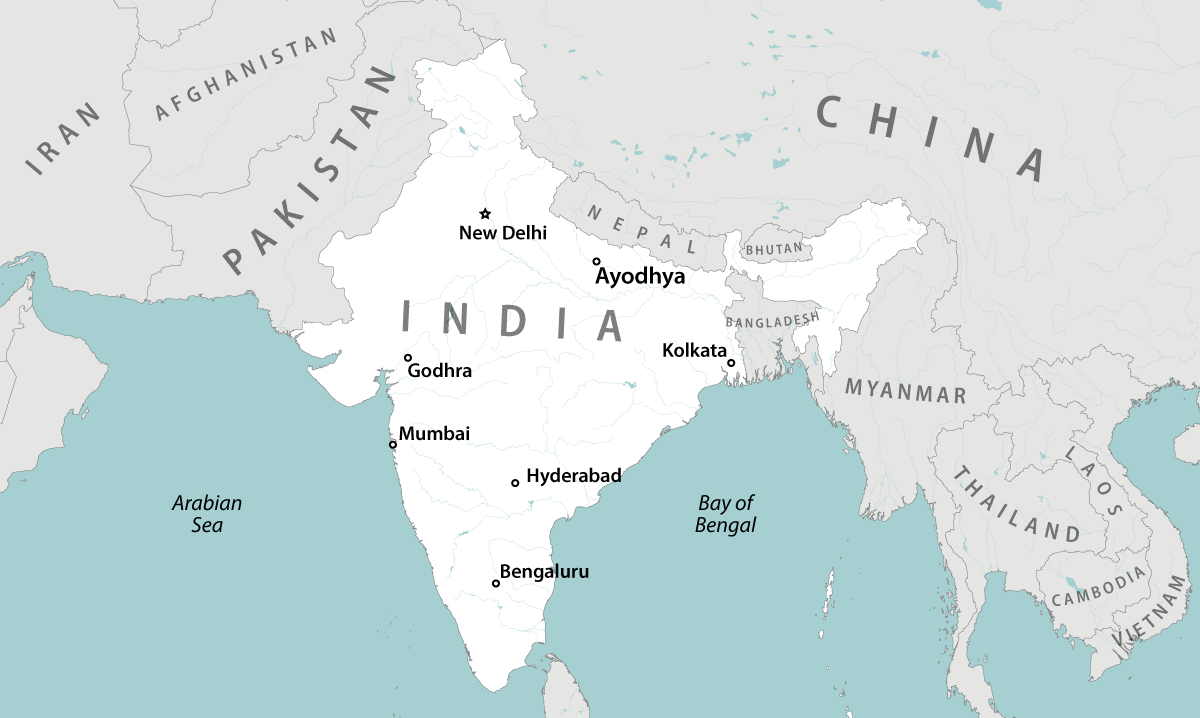
“About 20 years ago, their friendship took on a new meaning. Days of violent riots had rocked the nation and left more than 700 Muslims dead. It tore open old wounds in Ayodhya, a north Indian city where the Muslim community was still reeling from the destruction of the historic Babri mosque by a Hindu mob in 1992.  

“Sensing the need for an olive branch, Mr. Gyan Das, then head priest of the city’s historic Hanuman Garhi temple, invited 1,000 Muslims to the temple premises during Ramadan to break their daily fast. Mr. Ali helped host the feast, which still fills its organizers with pride and nostalgia – especially as Ayodhya is once again in the spotlight for Hindu-Muslim tensions.

“[Recently] Prime Minister Narendra Modi unveiled an opulent Hindu temple on the site where the Babri mosque once stood. 

“Like the mob which leveled the mosque, Mr. Modi and his supporters in the ruling Bharatiya Janata Party (BJP) claim that Babri was built over the birthplace of Hindu deity Ram, and the construction of the new Ram temple has become a rallying point for India’s growing Hindu nationalist movement. …

“In such polarized times, Mr. Gyan Das and Mr. Ali’s friendship offers a reminder of what Ayodhya could have – and perhaps still can – become: a symbol of multiculturalism and tolerance.

‘Ordinary people here want to live in peace,’ says Valay Singh, author of Ayodhya: City of Faith, City of Discord.

“He argues that the city’s reputation as India’s ‘ground zero’ of communal conflict overshadows its history as a heartland where different religious traditions have long intersected. In fact, he notes, the land for the Hanuman Garhi temple was donated to the region’s Hindu community by Muslim ruler Shuja-ud-Daula in the 18th century.

“ ‘It was a common tradition for the religious establishments to receive patronage from the Muslim rulers,’ he says. …

“[The] religious strife has deep roots – several weaving back toward Ayodhya. The destruction of the Babri mosque, for instance, came after decades of campaigning by right-wing Hindu groups, such as the Vishva Hindu Parishad (VHP), and led to months of communal violence across India. In Ayodhya, Muslims and their properties were singled out. Mr. Ali’s shop was plundered multiple times. …

“Indeed, the mosque’s demolition and resulting chaos left deep fissures between the Hindu majority and Muslim minority throughout the country. 

“Those rifts grew during the 2002 Gujarat riots, which were sparked by a deadly fire on a train carrying Hindu pilgrims from Ayodhya to Godhra, Gujarat. …The following year, Mr. Gyan Das approached Mr. Ali with his idea to organize an interfaith iftar fast-breaking meal at Hanuman Garhi.

“At first, the tailor was baffled. He reminded Ayodhya’s most influential seer that after breaking fast, Muslims must offer the namaz prayers. Will the Hindu seers accept prayers to Allah on the temple’s premises? Mr. Gyan Das was confident they would.

“In November 2003, with fanfare and high security, saffron-robed priests from several local temples welcomed their Muslim guests, serving them fruits and yogurt. Around sunset, calls of ‘Allahu Akbar!’ mingled with the sounds of conch shells and temple bells, as rows of Muslims bowed down to read the namaz. Both sides prayed together for peace and brotherhood to prevail across the country.

“The Muslim community reciprocated. After the iftar, hundreds of seers marched to Mr. Ali’s home to break the Hindu Ekadashi fast with seviyan, a traditional sweet prepared by Muslims on festive occasions. …

“The iftar [inspired] Yugal Kishore Shastri, one of few outspoken Hindu priests who have left the far-right and put their faith in the spirit of Indian secularism. Mr. Shastri says he split from the VHP after discovering that there was ‘no evidence of an ancient Ram temple under the mosque structure.’ …

“Although it’s getting harder for activists to cut through the vitriol and bring communities together … ‘There will always be a place for people who work for Hindu-Muslim peace,’ he says.”

More at the Monitor, here.

Read Full Post »

Photo: Sarah Aziz.
Muslims and Jews in Kolkata, India, have a long history of friendship.
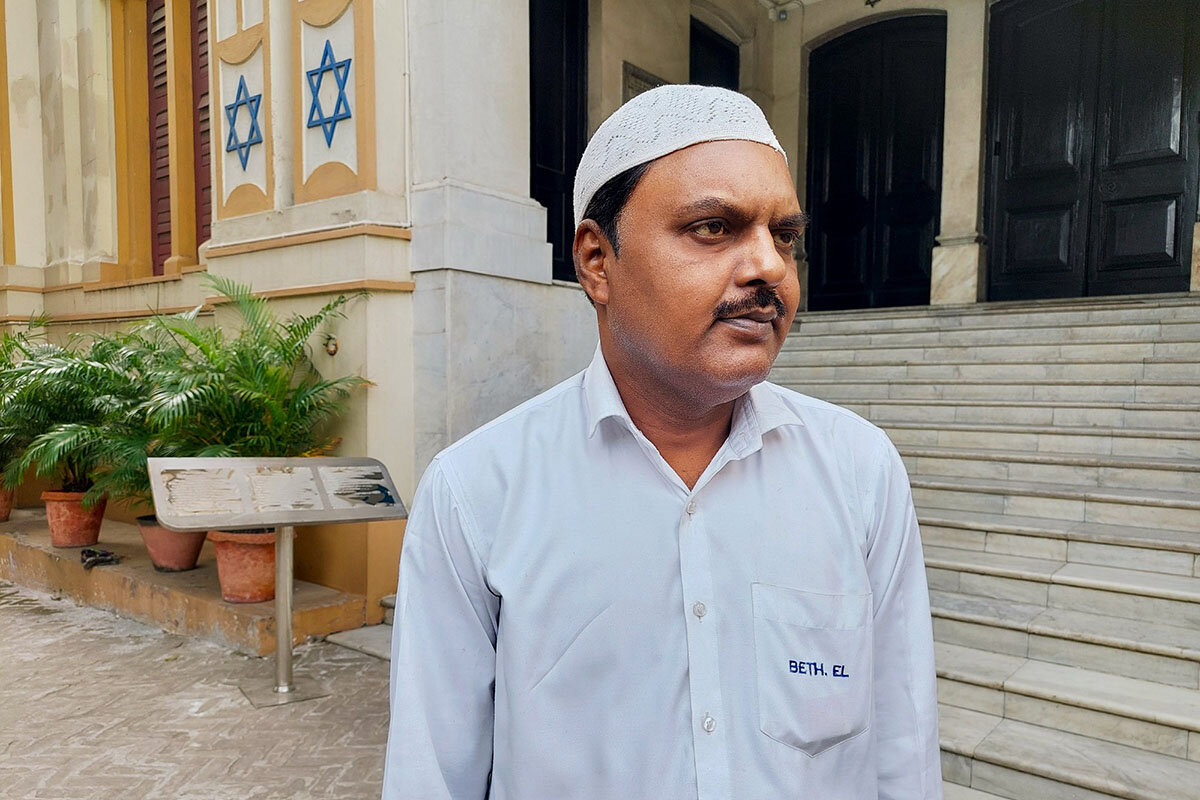
Shaikh Wasim, one of six Muslims who work as caretakers in Kolkata’s synagogues, stands outside his place of work.

All religions teach peace and friendship. So why do they go to war with each other? Sometimes humans make no sense.

In India, which under the current Hindu prime minister is known for repression of Muslims, one city has a surprising story to tell. Not about Hindus and Muslims, alas, but about Jews and Muslims. And the story is especially welcome in this time, when the war in Gaza has made relations worse in other parts of the world.

At the Christian Science Monitor, Sarah Aziz explains how Kolkata, India, is different.

‘The Oct. 7 attack profoundly affected the Jewish community in Kolkata, but failed to sour Jewish-Muslim relations.’

“Dilawar Mondal gently bends the stems of a centuries-old myrtle plant to examine its aromatic leaves, used in the Jewish ritual bath for the dead. It is among the myriad plants, shrubs, and trees that he has tended to for the last eight years in Kolkata’s only Jewish cemetery, established in the early 19th century by Jewish merchants from Baghdad and Aleppo.

“He pauses to check the time – the sun is overhead, which means he’ll soon need to take a break to perform Zuhr, the afternoon Muslim prayer.

“Many of the city’s Jewish institutions – including synagogues, schools, and the cemetery – are maintained by Muslim caretakers. The intertwined communities have offered each other hope, security, and strength amid rising global hostilities following Hamas’ Oct. 7 attack and Israel’s military campaign in Gaza. …

“The camaraderie and respect between the Jewish and Muslim communities of Kolkata can be traced back to the establishment of the cemetery, says Owaiz Aslam, founder of the Kolkata-based Indian Pluralism Foundation, which promotes interfaith harmony among Indian youth.

“Historical records show Shalom Aaron Obadiah Cohen, the founder of the Baghdadi Jewish community in Kolkata, reached out to a Bengali Muslim friend regarding the cemetery.

“ ‘They were new to the country and needed help,’ Mr. Aslam says. ‘The Muslim friend offered him a plot of his own land free of cost, but … Cohen insisted on giving his friend a gold ring as a token of solidarity between the two communities, which continues even today.’ … 

“More than a century later, the Baghdadi Jews in Kolkata assigned a Muslim family from the neighboring state of Odisha the job of caring for their synagogues, explains Navras Jaat Aafreedi, an expert in Jewish history who teaches at Presidency University in Kolkata.

“Since then, several generations of that family have continued to serve the three synagogues in Kolkata – Beth El, Maghen David, and Neveh Shalom – even as the Jewish population here has dwindled.

“Fewer than 15 Jewish residents remain, most of them older. But women’s rights activist Jael Silliman, who grew up Jewish in Kolkata, says that the synagogues still hold special significance.

“ ‘These three beautiful spiritual spaces mark our presence in the city, and recall and embody our history in a place where we flourished and prospered through trade and business endeavors,’ says the scholar, noting with pride that Kolkata is home to the only two synagogues protected by the Archaeological Survey of India as important heritage sites.

“Today, the synagogues draw tourists from all over the world, and in November, Mr. Aslam initiated an interfaith Jewish-Muslim prayer ceremony at the Beth El Synagogue, where he prayed for the safe return of the hostages taken from Israel by Hamas on Oct. 7.

“ ‘As a Muslim, my heart cries for innocent children and adults suffering in Israel as well as Gaza,’ he says.

“At the same synagogue, Shaikh Wasim shows up for work in his pristine uniform, Beth. El’ embroidered on his breast pocket and a white topi, or Muslim skullcap, on his head. With reports of a global uptick in antisemitic attacks against synagogues and other Jewish institutions, Mr. Wasim and the five other caretakers who currently oversee Kolkata’s synagogues are no strangers to fear. 

“ ‘I am afraid, like any other human being,’ he says. ‘But the deep love that the Jewish and Muslim people in Kolkata share always pulls me back to the synagogue, no matter the circumstance.’

“[Jo Cohen, secretary for Jewish Community Affairs in Kolkata] says the Oct. 7 attack profoundly affected the Jewish community in Kolkata, but failed to sour Jewish-Muslim relations.

“ ‘The Muslim caretakers of the synagogues and the cemetery, alongside my Muslim friends, are as close to me as ever. The Israel-Gaza situation has not affected our relationships in the slightest,’ says Ms. Cohen, who also serves as honorary secretary at the city’s Jewish Girls’ School, where the majority of the students are Muslim. 

“Later, while cleaning around the synagogue, Mr. Wasim echoes Ms. Cohen’s sentiments. ‘I pray for the violence and bloodshed to end, so that Jewish and Muslim communities can coexist in peace like they do in Kolkata,’ he says. …

“ ‘Ultimately, a Jew and a Muslim are praying to the same God, even if they call Him by different names,’ [Cohen] says.”

More at the Monitor, here.

Read Full Post »

Map: Jacob Turcotte/CSM Staff.
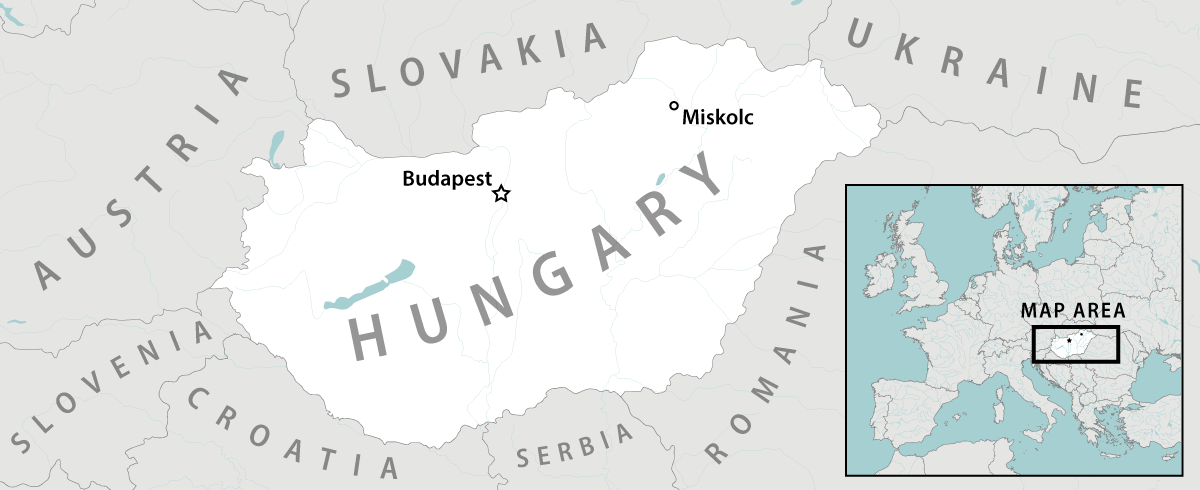
Map showing the location of the Roma school that borrows from Buddhism.

Oppressed people have many things in common even when they live on opposite sides of the world. So the wonder is that they don’t learn from each other more often, as the Roma in today’s article have learned from the “untouchables” of India.

Marc Loustau has the story at the Christian Science Monitor.

In Miskolc, Hungary, “Classes begin with a gong, not a bell, at the Dr. Ambedkar School. Each morning, 125 students in grades nine through 12, all from the local Romani community, enter the school grounds beneath a brass plaque embossed in both Hungarian and Hindi. The text marks the life of the school’s namesake, Bhimrao Ramji Ambedkar, India’s first post-independence minister for law and justice.

“The inscription finishes by invoking the school’s religious mission: ‘[Dr. Ambedkar] is a Buddhist saint,’ it reads.

“Dr. Ambedkar never set foot in Hungary, much less in the provincial northwestern city of Miskolc where the school was established in 2006. But members of Hungary’s Roma community learned about Dr. Ambedkar’s transformative work, in which he helped outlaw India’s caste system last century and improved the lives of his fellow Dalits in India. And they recognized a kindred spirit.

“The Dr. Ambedkar School is working to empower intellectual and political leaders from within Hungary’s Roma community, based on the Indian social reformer’s example. And while his neo-Buddhist worldview may seem like an odd bedfellow for Roma activism, the two are finding remarkable synchronicity among the school’s students.

“ ‘The role of the school is more than that of an educational institution, but rather a community institution that treats students with respect and dignity, providing a sense of hope and respect to Roma who are otherwise treated as outcasts by the mainstream society,’ says Jekatyerina Dunajeva, a political scientist with Central European University’s Romani Studies Program. ‘What permeates the culture of the school is a keen awareness of justice, fairness, and opposition to oppression.’

“Dr. Ambedkar was a leader in India’s independence movement in the 1930s as well as a member of the country’s oppressed Dalit group. In 1956, he founded the neo-Buddhist movement, also known as Ambedkarite Buddhism, which looked at Buddhism as a vehicle for social reform. In particular, neo-Buddhism turned into a means for Dalits – who face rampant discrimination at the bottom of Hinduism’s caste ladder – to leave the system that was oppressing them.

“Romani activist János Orsós learned about neo-Buddhism in the late 1990s by reading a biography of Dr. Ambedkar.

Then in 2005, he traveled to India, from which the Roma ethnic minority originally emigrated nearly 1,000 years ago. There he saw that both members of the Roma community and Indian Dalits struggle with problems like racism, discrimination, and segregation.

“In his memoir about finding Buddhism, Mr. Orsós noted he was most impressed by his visits to Dalit Buddhists’ schools.

“ ‘The Dalit people run these institutions themselves, not white people,’ he wrote, ‘I saw people like me take their destiny into their own hands through Buddhism and that is what I wanted to do.’

“Hungary’s educational system is highly segregated. Many Romani children attend Roma-only schools that are often underfunded and staffed by poorly trained teachers who do not understand Roma’s distinctive culture and history. Today, 60% of Romani children drop out of school, compared with 8.9% of the general population.

“Mr. Orsós believed that his Roma community could be empowered and emboldened by Ambedkarite Buddhism’s basic principles: educate, agitate, organize. So he founded the Dr. Ambedkar School in 2006.

“The school draws its 125 students from Miskolc, which has a population of around 161,000, and its surrounding villages, of which around 58,000 are Romani, according to Hungary’s 2012 census. Teachers prepare students for Hungary’s national graduation exams in areas like mathematics, literature, and history. But students also learn lessons drawn from Dr. Ambedkar’s life of activism.

“ ‘I would call myself an activist, too,’ student János Kun says. Like Dr. Ambedkar, Mr. Kun has grown up in extreme poverty and struggles against racism.

“ ‘There are eight of us in my family,’ the 20-year-old says. ‘Six of us children live in one room.’ His parents have only a sixth grade education, and he will be the first of his family to graduate from high school. He is the eldest child and helps care for his younger siblings in a house without running water.

“Romanis and the Dalits are the same, Mr. Kun says, down to their social status. ‘We are a caste,’ he declares. ‘We are at the very bottom level of society. But I’m not embarrassed to be poor.’ …

“The biggest threat to the school’s future [is the government’s] ‘work-based society’ program. Under this scheme, the government lowered the mandated school attendance age from 18 to 16, and expanded government work programs to provide employment to young people. [Prime Minister Viktor Orbán] has promoted the idea that those who aren’t succeeding in school should be diverted into the workplace where they can practice practical trades.

“But the work-based society program creates problematic incentives for Romani students, who are already struggling against discrimination in hostile school environments, to leave and seek out an easy and immediate paycheck.”

Find out why at the Monitor, here. No paywall.

Read Full Post »

Photo: Anne Pinto-Rodrigues.
Phungbili Basumatary (left) completes a pass during in ultimate Frisbee in Rowmari village, India. She says the sport has allowed her to bond with teammates from different ethnic backgrounds.

The reason I share so many stories from the Christian Science Monitor is that they seek out good news whenever possible. In India, where ethnic violence has grown worse in recent years, a happy kind of game is drawing young people of different faiths together.

Anne Pinto-Rodrigues writes at the Christian Science Monitor, “On a cool Sunday afternoon, a white disc whizzes through the air in Rowmari village, located in the Indian state of Assam. A teenage girl snatches it out of the air, earning applause and supportive whoops from the other players on the field, who all come from different villages.

“The American flying disc game officially known as ultimate – or ‘ultimate Frisbee,’ for those not worried about trademark infringement – was virtually unheard of in this part of the world till a few years ago. But it’s rapidly gaining popularity throughout northeast India. That includes Assam’s Chirang district, where over 30 girls and boys gathered in Rowmari village last December for a coaching session organized by the Action Northeast Trust (ant), a rural development nonprofit. …

“Chirang was not always this idyllic. Starting in the 1980s, the region experienced over two decades of ethno-religious conflict between the majority Bodos, Muslims, and the several other groups. Poverty is rampant, as are gender inequality and child marriage. But ultimate, with its emphasis on self-governance, provides an opportunity to foster peace among Assam’s newest generation.

“Today, 3,500 children and youth from nearly 100 villages participate. …

“ ‘I’ve observed a substantial transformation in the behavior and attitudes of the young people in communities where the [Frisbee] program is active,’ says Dr. Deben Bachaspatimayum, a social activist and teacher of peace studies based in Manipur, another state contending with violence in northeast India.

‘This bottom-up peace-building approach is helping youth discover a society based on equality and justice.’ …

“The region is largely peaceful now, but as recently as 2014, outbreaks of violence in Chirang and neighboring areas left over 100 dead and thousands homeless. 

“ ‘After the 2014 conflict, we were looking for something that would bring communities together,’ says Jennifer Liang, co-founder of the ant. “Something girls could get involved in.’ …

“It’s a mixed-gender, noncontact, and relatively new sport, meaning everyone in the community would be building their skills from scratch. The game involves two teams of seven players each, who score points by completing passes. There are no referees – instead, players must communicate with each other to call fouls and resolve conflicts. …

“So in 2015, the ant introduced a very simple version of the game to a cluster of villages known as Deosri that had been struggling with violence. … The league recruits young people between the ages of 11 and 14. Team members all come from the same village and, as a result, tend to be from the same ethnic group. The challenge is learning to work with the opposite gender. 

“ ‘Initially in these villages, the boys were skeptical about being in a mixed-gender team,’ says Ms. Liang. ‘In due course, they realized that the girls are equally important.’ …

“Manoranjan players can graduate to the more competitive Rainbow league, where the ant introduces more rules to promote peace building. Each team must include players from a minimum of three different villages, three different ethnicities, and three different mother tongues. … Rainbow sessions end with group discussions on burning social issues like child marriage and suicide. …

“Ms. Ray, who’s part of Durgapur village’s Rajbongshi ethnic group, [said that ultimate came] to the region, ‘there were times we would tell children from other communities or religions not to play with us,’ she says, with great remorse. ‘Now I treat everyone equally.’

“Although ubiquitous in America, Frisbees and other flying discs are available only in one sporting goods store in Assam’s capital city. Ms. Liang hopes that in the future, discs will become available in every village shop, as easy to come by as a soccer ball.

“ ‘My dream is that Frisbee doesn’t remain a nonprofit-led program, but rather something all children can play,’ says Ms. Liang.”

More at the Monitor, here.

Read Full Post »

Photo: Pawan Sharma/AFP via Getty Images.
The flooded banks of the Yamuna river near the Taj Mahal in Agra, India.

“It’s an ill wind that blows nobody good.” Maybe so, but how can severe flooding ever benefit a landmark?

First, let’s look at the worries about flooding near the Taj Mahal. In a July 20 Nikkei Asia report, Neeta Lal wrote, “Indians watched with alarm this week as the surging Yamuna River reached the outer walls of the country’s most recognizable landmark — the white-marbled Taj Mahal — for the first time in 45 years, due to heavy monsoon rains that have wreaked havoc and killed scores in the north of the country.

“Apart from highlighting the vulnerability of the 17th-century mausoleum in Agra, into which officials on Wednesday assured media the water was unlikely to enter, flooding has disrupted life across several states in recent weeks. Tens of thousands of people have been displaced, roads have caved in, homes have collapsed, and schools have been forced to close. Waist-deep water at Kaziranga National Park sent rare one-horned rhinos, elephants and deer fleeing to nearby villages, authorities said.

“A State Bank of India report this week made an early estimate of economic damage at nearly $2 billion.

“The crisis comes in a year when many parts of the world are experiencing severe heat waves and other extreme conditions attributed to climate change. Although flooding is nothing new in India, experts warn that global warming means the country can expect more extreme weather and must plan accordingly.

“New Delhi has not been spared. In the capital, nearly 10,000 people were forced into 33 makeshift relief camps arranged by the local Aam Admi Party (AAP) government, according to an official statement last week. Some were still in the shelters this week.

“Residents holed up at a camp in Delhi’s Civil Lines area complained of a lack of amenities. ‘We’ve been here for three days after losing all our belongings in floods but are struggling to get basics like food and water. Mosquitoes are also posing a problem,’ said Rashida Bai, 48, a widow and mother of three. However, her neighbor, Amina Yusuf, praised the government ‘for providing rations and promising 10,000 rupees ($122) per family as financial support.’ “

Meanwhile at Bloomberg CityLab, Sreeja Biswas addresses the Taj Mahal angle. “Extreme weather is a threat to cultural sites all over the world, but northern India’s latest monsoon may turn out to be positive for the Taj Mahal.from the Yamuna river, a major tributary of the Ganges, reached the compound walls of the UNESCO World Heritage Site on July 18, following a period of heavy rain that left thousands displaced in the neighboring state of New Delhi and caused devastating floods around the region. It was the closest Yamuna waters had come to the Taj Mahal in 45 years, flooding the visitor viewing area, according to local media reports.

“The Taj Mahal’s white marble exterior may suffer minimal damage, but the heightened water level will likely raise the moisture content of the structure’s wooden foundation, increasing its life span, said Raj Kumar Patel, superintendent archaeologist for the Archaeological Survey of India, a government agency responsible for archaeological research and preservation of historical monuments.

“The Taj Mahal is supported in part by a base of deodar wood, which becomes stronger when it absorbs water, Patel said. Drainage pipes divert the river water, and deep wells filled with rock, wood and other solid material provide stability to the massive building above.

“A drying Yamuna river has previously been a concern for the Taj Mahal — built in the 17th century by Mughal Emperor Shah Jahan in memory of his queen Mumtaz Mahal — as a lack of moisture shrank the supporting rafters at its base. The building has also suffered years of extreme air pollution and acid rain that has turned the monument yellow-green. …

“The recent flooding in northern India has been far less fortunate for other sites. The Mehtab Bagh, or Moonlight Garden, near the Taj Mahal, was mostly submerged in the recent rains and will likely need new grass, according to Patel.”

More at CityLab, here, and at Nikkei Asia, here.

Read Full Post »

Older Posts »