Feeds:
Posts
Comments

Posts Tagged ‘indigenous’

indigenous-grocery-language

Photo: CBC News
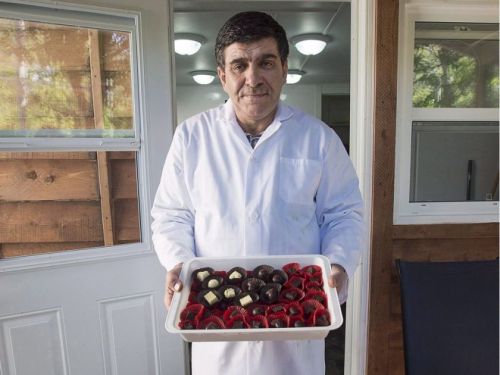
Canadian grocery stores and art galleries are starting to include indigenous languages on their labels. North West Company, which has grocery stores in more than 120 communities across northern Canada, embraced the idea after it was piloted by a 2015 school project. Snapping QR codes lets you hear word pronunciation, too.

Yesterday, for the first time, Native American women were elected to Congress: in Kansas, a Ho-Chunk, and in New Mexico, a member of the Laguna Pueblo tribe. Of course, it’s about time, but it also seems to be part of a trend bringing more visibility to indigenous people. Very belated, but good.

Canada is actually farther along in trying to address and rectify transgressions against First Nations. The following story covers one aspect of that effort.

Judith H. Dobrzynski writes at the Art Newspaper, “Canada Day, 1 July, [ushered] in a new era for the presentation of Modern and contemporary Canadian art at the Art Gallery of Ontario (AGO) in Toronto. The 13,000 sq ft J.S. McLean Centre for Indigenous and Canadian Art — which added the ‘Indigenous’ to its name last year when the museum established a Department of Canadian and Indigenous Art — [has] reimagined galleries that give primacy to First Nations and Inuit art for the first time.

“In each McLean gallery, ‘contemporary indigenous art starts the conversation with Canadian art.’ says Wanda Nanibush, who became the AGO’s first curator of indigenous art in 2016. Nanibush and Georgiana Uhlyarik, the AGO’s curator of Canadian art, have designed the centre’s display of 75 works around six themes: origins, self, land, water, transformations and ‘indigenous2indigenous.’ …

“Works by Canadian artists such as Emily Carr and Florence Carlyle are hung in dialogue with works by indigenous artists including Carl Beam and Rebecca Belmore … For instance, in the ‘self’ gallery, Belmore’s ‘Rising to the Occasion’ (1987-91), a dress that the Anishinaabe-kwe artist wore in a performance responding to a royal visit to Ontario, is paired with Joanne Tod’s painting ‘Chapeau Entaillé’ (1989) of a woman in a similar dress. … Labels in the McLean Centre are now written in indigenous languages (either the local Anishinaabemowin language or Inuktitut), as well as English and French.”

More at the Art Newspaper, here.

Art: Rebecca Belmore
Belmore’s “Rising to the Occasion” (1987-91) is a dress that the Anishinaabe-kwe artist wore in a performance responding to a royal visit to Ontario. It was recently displayed at the Art Gallery of Ontario in Toronto.

303_mu_jd_ago_01_rebecca_belmore

Read Full Post »

tribesonthebrink

Photo: The Explorers Club

You remember the great marine explorer Jacques Cousteau? Well, his granddaughter has grown up to be an explorer of vanishing cultures, and recently she made a movie about endangered tribes in the Amazon.

The film by Céline S. Cousteau is called Tribes on the Edge, and according to its website, it’s “more than a narrative of tribal reality in the Amazon [as it] suggests the universal story of our human tribe and how our future is interwoven with each other and with nature. This is a story that invokes the critical importance of respect and care – for land, culture, and humanity. …

“[The film] explores the timely topics of land threats, health crises, and human rights issues of indigenous peoples, expanding the view to how this is relevant to our world. More than a film, it has grown into a movement driven by a passionate effort to enact tangible impact in the Javari [Valley of Brazil] through education, advocacy, and activism. …

“Spanning more than 85,000 km2 (an area the size of Portugal), the Vale do Javari is the second largest indigenous territory in Brazil and is home to 5000 indigenous peoples from 6 tribes as well as the largest population of people living without any contact with the outside world in the entire Amazon and some say the world.

“Though the Javari has been designated for the tribes living there, there is looming pressure to increase harmful resource extraction which in other parts of the Amazon has led to environmental degradation. … It is estimated that the Amazon produces 20% the world’s oxygen and releases 55 gallons of water into the Atlantic ocean every second.”

Read more at the website, here, about what the International Union for Conservation of Nature calls “one of the irreplaceable areas of our planet.” And at the website for New York’s Explorers Club, which screened the film this past April, you can also can read about speaker Beto Marubo. A Marubo Indian, he has served with the national Indian foundation of Brazil, FUNAI, an initiative threatened by the likely election of someone Wikipedia calls “a polarizing and controversial politician” to the country’s presidency.

The movie is more timely than ever.

beto_250

Read Full Post »

05lenape2-superjumbo

Photo: Dolly Faibyshev for The New York Times
In a ceremony at the Abrons Arts Center in New York, Emily Johnson acknowledges the Lenape tribe, which inhabited Manhattan before Europeans arrived. The bonfire event is part of an initiative by artists called “land acknowledgment.”

It’s interesting to me that at the same time that nationalism and harsh attitudes about migration are sweeping the Western world, some very different movements are gaining traction. One is the increased acknowledgment in some English-speaking countries that Europeans were once interlopers, too.

Siobhan Burke writes at the New York Times about arts groups starting to pay attention to first residents.

“On an evening in early June, before the sun had gone down, a bonfire blazed outside Abrons Arts Center on the Lower East Side. Handmade quilts lined the steps of the outdoor amphitheater. Anyone walking down Grand Street could come in and take a seat. As a group of singers arranged themselves around a large cylindrical drum, the choreographer Emily Johnson stood up to speak a few careful, welcoming words.

“ ‘I’d like to acknowledge and pay my deep respect to Lenape people and elders and ancestors — past, present and future,’ she said. She gestured toward the ground and in the direction of the East River. ‘I acknowledge and offer deep gratitude to this Lenape land and water that supports us, as we’re gathered here right now together, and I invite you to join me in that acknowledgment, that respect and that gratitude.’

“In recognizing Manhattan’s original inhabitants — the Lenape (pronounced len-AH-pay) — and their ancestral homeland, Lenapehoking, Ms. Johnson was taking part in a ritual that, with her guidance, has become increasingly common at New York performing arts spaces in the past year.

“Routine at public gatherings in Australia, New Zealand and Canada, the custom of Indigenous land acknowledgment, or acknowledgment of country, has only recently started to gain traction in the United States outside of tribal nations. In New York City the practice is sporadic but growing, occasionally heard at high-profile cultural and educational institutions like the Whitney Museum of American Art and New York University. …

“Ms. Johnson, 42, a Native Alaskan artist of Yupik descent, has been the catalyst for much of that progress in the city’s dance scene. … Wherever she tours, she publicly honors — and engages with — the Indigenous people of that place.

“And behind the scenes she has been working to strengthen relationships between predominantly white institutions and Indigenous communities, to ensure that more Indigenous voices are heard at all organizational levels, from the artists onstage to the board of directors. That process, she said, begins with institutions recognizing where they are: on land taken from Indigenous peoples. …

“For the inexperienced, speaking an acknowledgment can be awkward at first. Hadrien Coumans, a co-founder of the Lenape Center, said false starts were to be expected. …

“While land acknowledgment might be a mere formality in some contexts, Mr. Coumans emphasized that he sees it as something much greater, an invitation to consider and appreciate where, really, you are standing.

“ ‘We’re part of a living being,’ he said. ‘Earth is a living entity, so in acknowledging land, what we’re really doing is acknowledging life. Not nationalism, not patriotism. Life.’ ”

More at the New York Times, here.

Read Full Post »

nerisgarden

Photos: Lucy Sherriff/PRI
Neris Uriana, the Wayuu tribe’s first-ever female chieftain, stands in her garden. With her leadership and new water-saving techniques, the northern Colombia tribe is finally able to grow food year-round.

I’ve been reading articles by my friend Ann Tickner on Jane Addams, best known for founding Hull House in Chicago in the early 20th Century. Addams, an international peace activist who influenced the thinking of world leaders after WW I, was a more extraordinary woman than I realized in third grade, reading one of those little orange biographies in the school library. She was a model of all that women can be if they choose.

In South America, there’s another surprising example of female leadership that I just heard about. It’s in an indigenous tribe, where the women are making sure that the people achieve their potential while living in harmony with nature.

Global Post reporter Lucy Sherriff writes at Public Radio International (PRI), “For years, the Wayuu tribe in La Guajira, a remote area in northernmost Colombia, was run by a male chieftain. But 13 years ago, male elders decided to appoint a woman as its leader. After the success of being led by a female head, the community changed its governance traditions and now exclusively appoints women to lead.

“ ‘When I first started, I didn’t know anything,’ Neris Uriana, the tribe’s first-ever female chieftain, told PRI. ‘But over time, one learns how to lead, the required skills you need to be head of a community.’

“Neris Uriana was elected in 2005. She was already involved in providing support to the community’s mothers, and Jorge Uriana, along with other elders, believed she had the qualities needed to lead the tribe. It was a first for Wayuu communities in Albania, in La Guajira.

“ ‘We had had some problems with communicating with leaders of other tribes and in our own village,’ explained Jorge Uriana, who was the community leader until 2005 and is Neris Uriana’s husband.

“Jorge Uriana explained that traditionally, Wayuu men negotiate and resolve disputes but that some male leaders can come off as confrontational and even aggressive at times.

“ ‘Whereas women, when they speak, they address the human side. They tend to be more peace-loving and more humanitarian in their outlook.’ ”

Excuse me, I have to stop here and marvel: that is exactly why Jane Addams and her contemporaries in the peace movement are considered the founders of what is known today as feminist diplomacy.

Back to my story.

” ‘We wanted to turn the way things were on its head. We wanted women to use their way of dialogue to resolve our conflicts, and we wanted to transform our culture,’ [said Jorge Uriana].

“ ‘I realized I had a commitment and an obligation to my people,’ said Neris Uriana, who will lead for as long as she likes (or until someone else steps up). ‘I really trained myself in leadership, and now, I feel like I am able to really achieve great things.’

“Marta Pushiana is one of the many women who have become more involved in the tribe’s community since Neris Uriana’s appointment.

“ ‘Now, we have a female leader; more women are taking more responsibility in the tribe. Before, we always had to stay at home and look after the children and cook and clean,’ said Pushiana. ‘Now, the men share those responsibilities with us, so that women have the opportunity to work, to help build, to be involved in leadership. The whole dynamic in the tribe has changed for the better.’ …

“Although Wayuu tribes have traditionally treated women as equals to men and have a more matriarchal culture than other nonindigenous Colombians, few tribes are led by women, and even less — if any — have permanently pledged to only appoint women. …

“Since Neris Uriana took up her position, she has introduced a long-term agricultural initiative to help sustain her community, rather than continually living hand to mouth. Neris Uriana sought the help of outsiders to teach her and other women in the tribe about irrigation, crop cycles and land use, so they could have ample produce throughout the year. The women also use their ancestral knowledge of lunar cycles to plant food and strongly believe the can use their connection with the Earth to sustain themselves.”

Oh, my, I am in love with these people! Read more about them at PRI, here.

A woman from the Wayuu tribe who is part of the female chieftain’s food initiative waters the saplings. The initiative has been such a success that the tribe now produces surplus food and sells it to other communities.

watering_plants

Read Full Post »

Photo: Tim McDonnell /for NPR 
Samuel-Richard Bogobley holds a GPS-enabled tablet to capture the location of one corner of an underwater clam “farm.” Collecting data is the first step in protecting indigenous livelihoods.

I love reading about how people around the world come up with constructive ways to use technology. This story is about clam farmers in Africa enlisting GPS data as a first step in protecting indigenous rights.

Writes Tim McDonnell at National Public Radio, “Samuel-Richard Bogobley is wearing a bright orange life vest and leaning precariously over the edge of a fishing canoe on the Volta River estuary, a gorgeous wildlife refuge where Ghana’s biggest river meets the Gulf of Guinea.

“He’s looking for a bamboo rod poking a couple feet above the surface. When he finds it, he holds out a computer tablet and taps the screen. Then he motions for the captain to move the boat forward as he scans the water for the next rod. …

” ‘Before you can start to recognize a fishery, you need to have a lot of data,’ says Bogobley, a researcher with Hen Mpoano, a Ghanaian nonprofit that supports small-scale fishers. ‘These people don’t have any platform to fight for what is theirs.’

“The Volta River is rich with clams, harvested year-round by a bustling community of several hundred fishermen and women. The meat is packaged for sale across West Africa, while the shells are ground into an additive for whitewash and chicken feed.

“The riverbed itself is divided into intricate real-estate parcels, each one an underwater clam ‘farm’ with its own caretaker.

“The farms have become a flashpoint in a broader conflict over the land rights of indigenous peoples in Africa: The clam fishers have no legal claim to their farms, and are under increasing pressure as they compete for prime real estate with the booming tourism industry and cope with the impacts of climate change. …

“[Clam farmer Kofi] Amatey spends most of every day working here about ten feet below the surface, gathering clams into a basket. Wearing eye goggles and a weighted belt, he breathes through a makeshift scuba apparatus that pumps air from a compressor on his canoe.

“It’s a subsistence living: Amatey estimates that he earns less than $1,000 per year. And in recent years, it’s gotten even harder.

“A crop of new luxury resort hotels now crowd the riverbanks, forcing the clam fishers off of land where they used to live, dock canoes and process clams. Tourists’ speedboats and jet skis churn the water, threatening to topple the narrow dugout canoes loaded with clams. …

“Without a formal, legal claim to the clam farms, Amatey and his neighbors say they have no way to protect themselves from hoteliers and other developers who acquire deeds from the government. …

“Many indigenous land rights lack protection because of a scarcity of data. …

“That’s where the GPS tablets come in. A growing number of research groups and international aid organizations are rolling out software aimed at making it easier for anyone with a tablet or smartphone to accurately map community-held land and record basic information about its proprietors. This data alone doesn’t offer any legal protection, but it’s an essential starting place.”

More here.

Read Full Post »

Photo: David Bedard
An example of the resurgence of indigenous theater is
Our Voices Will Be Heard, directed by Larissa FastHorse. It was performed at Perseverance Theatre in 2016 in Alaska. 

Another way that culture gets shared, revitalized, and preserved is through theatrical performances. Alaska and Hawaii, in particular, are seeing a resurgence of indigenous theater.

As Frances Madeson writes at American Theatre, “The pace at which producers of Hawaiian and Alaskan Native theatres are creating original offerings specific to their lands and peoples and mounting them on their mainstages ranges somewhere in the giddy spectrum between prestissimo and full-tilt boogie.

“ ‘We’re experiencing a Native arts revival right now,’ said Alaska Native playwright Vera Starbard, whose autobiographical advocacy play Our Voices Will be Heard was performed in Juneau, Anchorage, Hoonah, and Fairbanks. …

“Part of the exhilaration comes as a result of resources to match the rhetoric of support for Native theatre arts. In 2016 Starbard was granted $205,000 from the Andrew W. Mellon Foundation to sustain her while she creates three full-length Alaska Native plays over three years. …

“There is also an attitudinal shift by institutional gatekeepers toward inclusion of Native theatre artists, some of whom have been maintaining the vision for a very long time with minimal support.

“The first Hawaiian-language play presented at the Kennedy Theatre at the University of Hawai‘i at Mānoa was in February 2015, ‘in the theatre’s 51st season,’ said Tammy Haili’ōpua Baker, who wrote it. … She repeated for emphasis: ‘Half a century to get anything Hawaiian on that stage.’

“But now that the vessel’s been unstoppered, there’s a growing groundswell of audience demand for shows with Native-centric realities and expression.

“ ‘The success of Our Voices was completely community-driven,’ said Starbard. …

“Tlingit actor and playwright Frank Henry Kaash Katasse said he sees a category shift. ‘Indigenous stories are now seen as American stories.’ …

“Katasse teaches theatre in schools to Alaska Native kids, and encourages them to take acting seriously. ‘They didn’t even know this was a career option,’ he said.

“Indeed, to keep pace with demand, artistic directors Harry Wong III at Kumu Kahua Theatre and Eric Johnson at Honolulu Theatre for Youth (HTY) on Oahu, and Art Rotch of Perseverance Theatre in Juneau and Anchorage, are prioritizing both actor training and play development. …

“In Fairbanks, Alaska, [Allan Hayton, language revitalization program director at Doyon Foundation] pursues theatre as a vehicle for cultural and linguistic survival.

“ ‘We are restoring balance,’ Hayton said. ‘In indigenous tradition theatre is performed to achieve something for the people and balance for the world in the natural environment. Theatre is a healing art form in which we can address very serious and difficult issues safely, and offer a larger healing for society.’ …

“For Starbard, Alaska Native theatre artists literally standing on thousands of years of storytelling tradition have nothing to prove.

” ‘Our goal as Native artists and theatremakers is not to develop this “uncultured” audience so they can come in and understand what a Western theatre is like. I think that’s the attitude taken sometimes,’ she said, choosing her words with great care. ‘I’m proud of Native artists who are pushing back against this mindset. It’s not about how we can help our people adapt to the Western theatre, but how we can help Western theatre to be an even more dynamic and beautiful thing.’ ”

More here.

Read Full Post »

Photo: Zuma Press
A game called pelota mixteca helps to keep an ancient language alive.

I never thought about it before, but there are languages that go with certain pursuits. For example, the vocabulary of ballet is French, so when you are learning ballet, you are learning a little French.

Here’s a story about a sport that relies on the vocabulary of an indigenous people, helping to preserve not only the words but also cultural pride.

Walter Thompson-Hernández writes at the New York Times, “The men gather at an open field in a recreation area of the San Fernando Valley [of California] every Sunday, putting chalk to the dusty ground to draw the boundaries of a game that has been a weekly ritual as long as many can remember. After they are done, these men and others who filter in cluster into distinct teams, tossing a six-pound rubber ball to warm up.

“On a recent Sunday, one of them, Jorge Cruz, 39, lifted a 15-pound glove studded with nails and other ornamentation in the air. He glanced back at his teammates and asked, ‘You guys ready?’ in Zapotec, an indigenous Oaxacan language, before bouncing the ball on a cement slab known as el saque and hitting it toward the opposing team.

“This is how you start a game of pelota mixteca, a ballgame said by its players in California to have originated hundreds of years ago in Oaxaca, Mexico, though theories abound about whether it is an offshoot of an ancient Mesoamerican game or a European sport brought to the New World. Wherever it arrived, it serves not only as a pastime: It is also a way of keeping its players’ culture alive, and serves as a network for an immigrant community throughout the West Coast. It has even spawned an under-the-radar international tournament. …

“Oaxacan players who speak indigenous languages like Zapotec and Mixtec travel to the pasajuegos (games) every week from Southern and Northern California cities, and each makes the journey to the San Fernando Valley for many of the same reasons. …

“Because a majority of the pelota mixteca players live in communities where Spanish or English are spoken rather than Zapotec, second-generation Oaxacan children are less likely to preserve that language or any of the other indigenous languages spoken during play. …

“A number of Oaxacan youths are making efforts to ‘revitalize’ these indigenous languages by playing sports like pelota mixteca and making frequent trips to Oaxaca. It provides an environment free from the stigma or the expectation to adopt Spanish. …

“Pelota mixteca continues to be played in relative obscurity every Sunday, but a younger generation of players has appeared on the field. Mr. Cruz now brings his son Jorge, 15, and his nephew, Miguel Angel, 9, to the games with him every weekend, as his father once did more than 20 years ago.”

Says the younger Jorge Cruz, ” ‘I feel empowered and excited that I’m playing the same game that my ancestors did. … If I have children one day, I’m going to teach them this game, too, so that they don’t lose our heritage.’ ”

More here.

Read Full Post »

Photo: Richard Vogel/AP
A statue of Gene Autry and Champion at the entrance to the Autry Museum of the American West in Los Angeles. The museum opened in 1988
.

My family had one of the early televisions because my father was writing a story about Dumont for Fortune. It was a clunky little thing, showing black and white only, of course, but we loved it, and all the kids in the neighborhood came to watch.

My hero was Gene Autry, the singing cowboy. (Want me to sing the opening number for you, the one Autry sang when he rode Champion up close to the camera and reined him in with a little bounce?)

Recently I learned that in 1988, Autry founded a museum in Los Angeles about the American West. Here’s an Associated Press report by John Rogers at US News on the museum’s 2016 expansion.

“The Autry Museum of the American West [is expanding] to include a garden of native Western flora, as well as new galleries showcasing hundreds of Native American works, some from present day, others centuries old, many never seen publicly.

“The expansion, named California Continued, adds 20,000 square feet of gallery and garden space to the museum that, with its red-tiled courtyard and distinctive beige bell tower, evokes images of an 18th century, Spanish-styled California mission . …

“Museum officials say visitors will now see one of the largest collections of Native American artifacts found anywhere. Also included will be more than 70 plants native to California — many medicinal and some endangered — as well as new displays that include Western mixed-media paintings and interactive works showing such sights as California from the highest point in the continental United States (Mount Whitney in the state’s midsection) to its lowest (Death Valley on the Nevada border).

“Because it’s the Autry Museum, visitors also will still see such venerable Hollywood artifacts as the Singin’ Cowboy’s Martin guitar, TV Lone Ranger Clayton Moore’s mask and a wealth of silent cowboy star Tom Mix memorabilia. …

“[Autry] died at age 91 in 1998, just a few years before … its 2003 merger with Los Angeles’ Southwest Museum of the American Indian. …

” ‘This collection that is now in the Autry Museum is a native collection of the very same rank, and in some quarters even better, than the Smithsonian’s,’ said [the museum’s president, W. Richard West Jr.,] who was founding director of the Smithsonian’s National Museum of the American Indian.

“Some of the best of the collection on display is contained in the exhibition ‘The Life and Work of Mabel McKay,’ a Pomo Indian basket weaver, healer, civil rights activist and person believed to be the last speaker of her tribal language when she died in 1993. Her intricately woven, often colorful baskets are accompanied by a recreation of her workroom, narration by her son and other works. …

“The garden contains native plants that caretaker Nicholas Hummingbird hopes will make people realize there is more to Western flora than cactus and sagebrush.”

More at US News, here.

Read Full Post »

Photo: Colombia Games
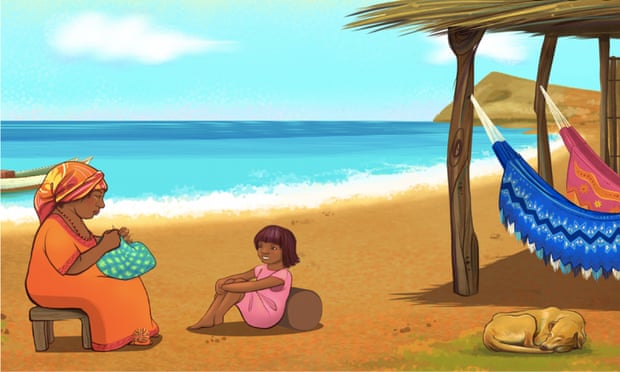
A scene from the ‘Ancient Wisdom’ smartphone games, which allow players to learn about Colombia’s indigenous peoples.

As we have discussed before, there are many cultures and languages in danger of dying out, often because few people know about them.

A Colombian game company has taken a step toward addressing that ignorance, providing school children with entertaining phone games to help them learn about their indigenous neighbors.

Joe Parkin Daniels writes for the Guardian, “In a simple wooden hut on a Caribbean beach, a young girl sits at the feet of her grandmother, who is crocheting a brightly coloured shoulder bag whose intricate design draws on the mythology of the Wayuu people.

“It’s the opening scene from a smartphone game that seeks to educate Colombian children about their country’s endangered indigenous cultures.

“Some 3.4% of the Colombia’s population belongs to 87 different indigenous groups that speak 71 languages. But experts warn that these diverse cultures are at risk of dying out, threatened by climate change and violent armed groups operating in isolated regions the state has not reached. The National Indigenous Organisation of Colombia (Onic) estimates that 35 ethnic groups are at risk. …

“The games, available for iOS and Android devices, challenge players to learn the languages and cultures of the country’s indigenous groups, which vary from farming communities in the northern Darién jungle to nomadic hunter-gatherers in the Amazon. …

“The games narrate indigenous creation stories, and players must solve puzzles and draw the wild animals that populate indigenous myths.

“ ‘From one day to another these cultures could be lost,’ said Juan Nates, the CEO of Colombia Games, which recently relaunched the games. ‘When we started this project, I assumed there were three or four indigenous tribes; it was a shock to know how many there are – and how little we know about them.’

“The project was funded by the Sura Foundation, an educational subsidiary of the Sura banking group. The Sura Foundation has also sent about 200 teachers to schools to educate children about endangered cultures. …

“For Nates, raising awareness is key to preserving at-risk indigenous cultures. ‘People can’t worry about something, can’t do something, if they don’t know about it,’ he said. ‘It feels good to help with that.’ ”

Unfortunately, native children themselves usually don’t have smartphones, so it seems like the next step for a kindly philanthropist or foundation would be to get them some to use in school. (Can’t imagine anyone wants children looking at phones more than that.) And it would be nice if the different groups of kids could actually meet.

But what a good start! I’d love to see a game like this in parts of the US where there are large indigenous populations.

Finally, I don’t want to close without giving a shout-out to the Tomaquag Museum, which works to improve New Englanders’ knowledge of Rhode Island tribal culture through educational activities for children.

More at the Guardian, here.

Read Full Post »

Photo: Jon Cattapan/Dominik Mersch Gallery
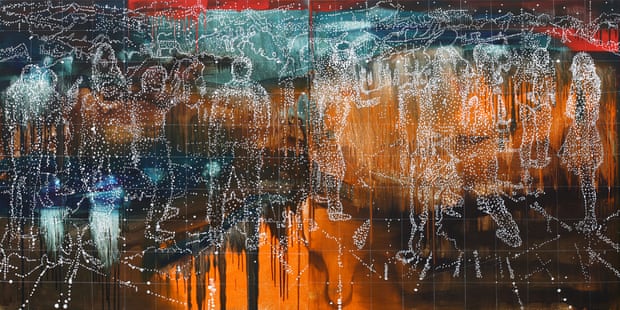
The Decade Positions, by Jon Cattapan (2017).

I’ve been reading arguments lately about “cultural appropriation” — both from those who think artists should stick to their own culture and from those who think that artists who imagine how people from a different culture feel are building understanding.

I thought about the controversy as I read this article on Australia’s indigenous dot art by Brigid Delaney at the Guardian.

“For a long time,” she writes, “the dot painting has been synonymous with Aboriginal art. Emerging out of the remote Northern Territory community of Papunya in the early 1970s, the first dot paintings were produced when art teacher Geoffrey Bardon encouraged his Indigenous students to paint their stories in murals on the school wall.

“But long before that, circles and dots were used in ceremonies in the form of body paint or marks on the ground. The Papunya people drew on this knowledge in their art, painting stories, ceremonies and rituals, first on walls and then on canvas and board.

“dot, dot, dot […], a new exhibition at Sydney College of the Arts, tackles some of the issues around the use of Papunya dots in paintings, but also looks at why so many artists – Indigenous and non-Indigenous – are attracted to using dots in their work.

“Curator Janelle Evans, a lecturer at Sydney University, a Wingara Mura fellow and Dharug artist, told Guardian Australia that the exhibition had its genesis in 2006, when she conducted an interview with Australian artist and political activist, Richard Bell. ‘He was talking about Aboriginal art as something constructed by the art market.’ …

“The ubiquity of the dot painting was so powerful that Indigenous artists working in different mediums had trouble attracting the interest of the international art market. At the same time, the market became flooded with cheap fakes and rip offs, alongside mass-produced tack such as tea towels made overseas and sold to tourists. …

“In situations like this, Indigenous people rarely see the profits of their artefacts being used, perpetuating a cycle of poverty and appropriation.

“Queensland MP Bob Katter has taken up the cause, putting a private member’s bill before parliament that seeks to amend consumer law to ensure that profits from Indigenous art and artefacts go back to Indigenous communities. …

“What about artists using the dot who are non-Indigenous? It could be seen as cultural appropriation, although Evans says it’s not that clear cut.

“ ‘Non-Indigenous artists who work with dots can work without appropriation. Within the dot, there’s a whole world that can be created. Artists have always referred to other artists in their work but appropriation becomes an issue when you are copying someone’s style. You need to bring your own inquiry to into what you are doing.’ …

“dot, dot, dot […] … focuses on showing work from artists who interpret the dot beyond the style of central and western desert artists and ‘in ways that are non-derivative,’ says Evans.”

More here.

Read Full Post »

Art: Rene Meshake
Ojibwe artist Rene Meshake was part of a group of indigenous storytellers from Canada who attended the Untold Stories conference in Ireland in May.

As many people know, there was a dark period in US history when authorities thought is would be a good idea for indigenous children to be separated from their language, families, and culture. The same thing happened in Canada. Today, those children and their children are reclaiming their voices and telling their own stories.

Here is Catherine Conroy at the Irish Times: “On a Friday morning in a house in Dublin, I sit down to speak with three indigenous storytellers from Canada. They are here for a conference called The Untold Stories of the Past 150 Years/Canada 150 at [University College Dublin]. …

“Maria Campbell, Rene Meshake, and Sylvia Maracle, from Canada’s ‘Indian Country,’ accompanied by indigenous historian Kim Anderson, tell me a story of pain, resilience and the rebuilding of a shattered community through stories.

“Sylvia Maracle is an activist and storyteller from the Tyendinaga Mohawks. She believes their stories will resonate with Irish people, ‘with colonisers having come and disrupted what was probably the natural order.’ …

“She tells me of a conversation she had with an Irish taxi driver when she arrived. ‘He asked, “Are people recovering their memories?” I said, “They were always there, we just didn’t have the conversation.” He said, “That’s what happened here.” ‘ …

“Maracle believes in the power of storytelling as a force for rebuilding their communities. She feels privileged to have been ‘old woman raised’ by her traditional grandmother. …

“Maracle tells me that people now visit Maria Campbell ‘because they want this good medicine, this traditional stuff.’

“Campbell agrees that storytelling is medicine. ‘I grew up with a great grandmother and she never spoke English, she was a total “savage” according to the priest because she never converted.’

“But while Campbell grew up with stories, she always felt split between her traditional home life and her life outside. It was only after she stopped using drugs and attended her first ceremony in her late 20s that she realised the healing power of the stories, which came from ‘the old ladies, always women laughing.’ It was a revelation to realise ‘that you’d got this medicine, everything you need to help put yourself back together.’

“Campbell tells a story about the effects of colonisation that she learned from her teacher, the Old Man. …

“He had been trying to explain to her the effect of colonisation on their community’s wahkotowin, which in English means kinship, ‘but if you look at the word bundle, it’s all of our laws, it’s the way that we talk to each other, the way that we laugh.’

“He threw [a] jigsaw in the air. ‘He said, ‘”That’s what happened to us, everything was shattered and wahkotowin flew. Maybe you have three pieces, maybe she’s got half of one, if we come back together and we start to rebuild that, you bring your three pieces, you bring yours, and soon we’ll make the picture.” ‘…

“She recalls one story she wanted from her father that he would not give. ‘Then he got diagnosed with a terminal illness and I had to do the translating for him [in hospital]. I kind of went to pieces when we were driving home. He pulled to the side of the road, rolled me a cigarette, and he said, “That story you want, I’ll give it to you now.” He retold it and she understood now that it was a story about death, not the funny story she’d always thought it was.

“She translated and published the story. ‘In my family’s way, they were telling me that they trusted that I would treat it with integrity.’ ”

More at the Irish Times, here.

Read Full Post »

Although I didn’t get to see it in person, I was excited to learn from Timmons Roberts by way of Erik that the indigenous Hawaiian canoe Hōkūleʻa was making a stop in Rhode Island.

Lars Trodson writes at the Block Island Times, “The island welcomed the crew of the Polynesian catamaran Hōkūle‘a [June 21] at a ceremony held at the Block Island Maritime Center in New Harbor. The crew was greeted with songs sung by the students from the Block Island School, as well as greetings and tribal gifts from Loren Spears, an educator and former Council Member of the Narragansett Tribe of Rhode Island. Capt. Kalepa Baybayan of the Hōkūle‘a also offered brief remarks.

“The Hōkūle‘a is traveling around the world to teach about ocean conservation. ‘We live on a blue planet,’said capt. Baybayan. ‘Without the blue there would be no green.’ …

“Block Island is the Hōkūle‘a’s  only stop in Rhode Island.”

From the Hōkūleʻa website: “Our Polynesian voyaging canoes, Hōkūleʻa and Hikianalia, are traveling over 60,000 nautical miles around the earth, bringing people around the world together to set a course for a sustainable future.

“We are sailing like our ancestors have for a thousand years—using wayfinding. On board, there is no compass, sextant, or cellphone, watch, or GPS for direction. In wayfinding, the sun, moon, and stars are a map that surrounds the navigators. When clouds and storms make it impossible to see that map, wave patterns, currents, and animal behavior give a navigator directional clues to find tiny islands in the vast ocean. …

“Everyone can be the navigator our earth needs. Every person on earth can help navigate us to a healthy future where our Island Earth is safe and thriving again. …

“We are asking kids, families, governments, communities, and businesses to share how they mālama honua—take care of our Island Earth.  Please visit our Mālama Honua map, and help us grow the movement by adding stories of hope that can inspire and educate us all. …

“Hōkūleʻa, our Star of Gladness, began as a dream of reviving the legacy of exploration, courage, and ingenuity that brought the first Polynesians to the archipelago of Hawaiʻi. The canoes that brought the first Hawaiians to their island home had disappeared from earth. Cultural extinction felt dangerously close to many Hawaiians when artist Herb Kane dreamed of rebuilding a double-hulled sailing canoe similar to the ones that his ancestors sailed.

“Though more than 600 years had passed since the last of these canoes had been seen, this dream brought together people of diverse backgrounds and professions. Since she was first built and launched in the 1970s, Hōkūle’a continues to bring people together from all walks of life. She is more than a voyaging canoe—she represents the common desire shared by the people of Hawaii, the Pacific, and the World to protect our most cherished values and places from disappearing.”

Lots more at www-dot-hokulea-dot-com.

Photo: Block Island Times

Read Full Post »


I’ve been telling Suzanne and John about a free children’s hour on Thursdays at the Tomaquag Museum in Exeter, Rhode Island. I thought it sounded like fun for the kids.

According to the website, the program teaches “the history and culture of the Narragansett Tribal Nation through music, dance and storytelling. … Children’s Hour targets pre-school and homeschoolers during the school year and the families during school vacation. …

“Each week will have a different theme or focus. It will include music, dance, storytelling, engagement with exhibits and art or science activities. Each activity will be scaled to fit the ages and abilities of the youth. We will encourage peer mentoring between older and younger participants.

A typical Children’s Hour consists of: Traditional Greeting & Narragansett Welcome Dance (weather permitting); Narragansett Lesson/cultural concept (in our museum); Scavenger Hunt connected to theme where kids can explore exhibits; Social Dance to our Pavilion building; Storytelling/book share; craft or game depending on the content; Closing circle

The museum just won a national award for museum and library services. Executive Director Lorén Spears and Narragansett tribal leaders went to Washington last week, where Michelle Obama presented the award.

More here.

Photo: Tomaquag Museum Executive Director Lorén Spears


Read Full Post »

In Bolivia, an indigenous woman who would have been disenfranchised before the presidency of Evo Morales has become a popular wrestler. And  she loves what she does.

connects with Angela La Folklorista in La Paz to report her story at WBUR’s Only a Game.

“She calls herself, ‘Una mujer de la pollera.’ Woman of the skirt. That’s another way of saying ‘I’m a cholita.’ Cholitas are indigenous women of Bolivia, usually ethnically Quechuan or Ayamaran. You can recognize cholitas by their ankle-length puffy skirts and their tiny bowler hats, which seem like they’ll fall off any minute. …

“Until recently, cholitas were second-class citizens, boxed out from higher education and often stuck cleaning homes,” generally relegated to the kitchen.

“Where Angela works is nothing like a kitchen.

” ‘In the ring,’ Angela says in Spanish, ‘I have a technical fighter style. I’m not rough. I’m on the nice side. There are bad cholitas, as you would call them, but my style is technical.’

“Angela is a cholita luchadora — a Bolivian pro-wrestler. She fights in a league similar to Lucha Libre in Mexico or the WWE in the United States. It’s the kind of wrestling with heroes and villains, entrance songs. Angela gives me two ringside tickets for the upcoming bout in El Alto – La Paz’s sister city. She’s the headliner. …

“Angela doesn’t fight other women. She fights the men. There’s some weird sexist stuff happening, but by the end of the match Angela is always the winner. …

“ ‘I’m very happy and content to have another night of fighting,’ she says in Spanish, ‘another night of art, adrenaline and strength, another night that I’m in the center of the ring, happy, doing what I like most.’ She’s covered in sweat.

“ ‘Mi madre es luchadora,’ Angela’s middle-school aged daughter Theresa says.

“ ‘It’s a pleasure for me that she’s a wrestler,’ Theresa says in Spanish, ‘I’m very proud of her, I’m her number one fan.’

“Theresa describes the cholitas luchadoras as one of the Seven Wonders of the World. But she doesn’t want her mom’s job. It’s too dangerous for her. And unlike the cholitas who came before her, Theresa can choose her own dream.”

More here.

Photo: Trevin Spencer/Only A Game
The cholitas luchadoras of El Alto. Angela La Folklorista is on the far right.

Read Full Post »

You know that Adam named the animals and T.S. Eliot the cats. Now Maria Popova at Brain Pickings delves into a Native American author’s book on the naming of mosses and other aspects of the natural environment.

“To name a thing is to acknowledge its existence as separate from everything else that has a name,” says Popova, “to confer upon it the dignity of autonomy while at the same time affirming its belonging with the rest of the nameable world; to transform its strangeness into familiarity, which is the root of empathy. …

“And yet names are words, and words have a way of obscuring or warping the true meanings of their objects. ‘Words belong to each other,’ Virginia Woolf observed in the only surviving recording of her voice, and so they are more accountable to other words than to the often unnameable essences of the things they signify.

“That duality of naming is what Robin Wall Kimmerer, a Thoreau of botany, explores with extraordinary elegance in Gathering Moss: A Natural and Cultural History of Mosses (public library) — her beautiful meditation on the art of attentiveness to life at all scales.

“As a scientist who studies the 22,000 known species of moss — so diverse yet so unfamiliar to the general public that most are known solely by their Latin names rather than the colloquial names we have for trees and flowers — Kimmerer sees the power of naming as an intimate mode of knowing. As the progeny of a long lineage of Native American storytellers, she sees the power of naming as a mode of sacramental communion with the world. …

“Drawing on her heritage — her family comes from the Bear Clan of the Potawatomi — Kimmerer adds:

In indigenous ways of knowing, all beings are recognized as non-human persons, and all have their own names. It is a sign of respect to call a being by its name, and a sign of disrespect to ignore it. Words and names are the ways we humans build relationships, not only with each other, but also with plants.

[…]

Intimate connection allows recognition in an all-too-often anonymous world… Intimacy gives us a different way of seeing.

More at Brain Pickings.

At the suggestion of Brain Pickings, I am deep into a biography of Beatrix Potter and her scientific work drawing and learning the names of mushrooms. Like mosses, they are multitudinous but generally lacking common names.

Photo: Robin Wall Kimmerer

Read Full Post »

« Newer Posts - Older Posts »