Feeds:
Posts
Comments

Posts Tagged ‘ireland’

Photo: Submitted to CBC by Elinor O’Donovan.
Visual artist Elinor O’Donovan was chosen to be part of the Irish government’s basic universal income program for creatives. She says the money she receives every month is ‘transformative.’ 

A couple years back, I blogged about Ireland’s experiment in basic income for artists, here. Looks like it met its goals, because now the government is making the experiment permanent.

CBC’a As It Happens guest host Saroja Coelho has an interview with a beneficiary.

“Elinor O’Donovan says Ireland’s basic income program for artists completely changed her life and her work for the better.

“The Dublin-based multidisciplinary artist was a participant in Ireland’s three-year pilot program that saw 2,000 artists and creative arts workers receive a weekly stipend of €325 ($528.90 Cdn) between 2022 and 2025.

“ ‘It’s pretty huge,’ O’Donovan told As It Happens guest host Saroja Coelho. ‘It’s been transformative for my work, and for my well-being in general.”

“Now, Ireland has decided to make the program permanent, saying its benefits to society have far outweighed the costs to the government.

“Advocates for basic income in Canada are celebrating the announcement, hoping it drives momentum to enact a similar — and more widespread — program in this country. 

“But, despite evidence from the Parliamentary Budget Office that basic income could alleviate poverty, economists are warning Canadians not to hold their breath. 

“Basic income is any policy in which the government gives individuals unconditional cash transfers to meet basic needs.

“In 2022, Ireland launched Basic Income for the Arts (BIA), a pilot program designed to help the arts sector recover from losses sustained during the COVID-19 pandemic.

“ ‘This scheme is the envy of the world, and a tremendous achievement for Ireland, and must be made futureproof and sustainable,’ Patrick O’Donovan, Ireland’s culture minister, told reporters last week as his government unveiled its 2026 budget.

“The pilot, while expensive, generated a lot of bang for its buck, the minister said. 

“Overall, the government says it spent €105 million ($170.8 million Cdn) on the BIA. But an external report from Alma Economics found those costs were offset by a boost in audience engagement with the arts, increased tax generation, a reduction in social welfare payments, and improved psychological wellbeing for participants.

“With those benefits factored in, the report estimates the net cost of the pilot was €72 million ($117.1 million Cdn). …

“Basic income is something that artists in Canada have long been calling for. 

“In 2020, at the height of the pandemic, 75,000 Canadian artists, writers, technicians and performers, organizations and labour unions launched a campaign and public letter to the federal government calling for a universal guaranteed basic income.

“Now, they’re hoping the news out of Ireland can act as a springboard for the movement here at home. 

“ ‘We’re thrilled. What can I say?’ said Craig Berggold, spokesperson for the Ontario Basic Income Network, the organization behind the campaign. ‘It’s harder and harder for people to not only live, but also to get into the arts.’

“While basic income has massive support in creative industries, Berggold says he and his colleagues are campaigning for something more all-encompassing than Ireland’s BIA — guaranteed basic income for all Canadians who earn under a certain threshold.

“In a report published this summer, the Parliamentary Budget Office, the federal government’s fiscal watchdog, found that a guaranteed basic income program at the federal level could cut poverty rates in Canada by up to 40 per cent.

“ ‘Poverty is expensive for people and for the government,’ said Berggold, an artist based in Kingston, Ont.

“Berggold says basic income reduces spending on social welfare systems that don’t allow recipients to live with dignity and independence.

“ ‘It empowers people to make choices so that they can be bettering their lives, rather than having the kind of a system we have now which is surveillance based, which is checking in on you,’ he said.”

More at CBC, here. I’ve had a number of posts on basic income around the world. Search this site on the phrase.

Read Full Post »

Photo: Creatives Rebuild New York.
Painter Athesia Benjamin created a self-portrait while participating in the guaranteed income program.

From time to time this blog has checked in on experiments in basic income taking place around the world. If you use search terms like “basic income” or “guaranteed income” in my search box, you will find many related articles, including ones on helping Kenyan villagers, keeping New Orleans teens in school, slashing homelessness in Finland, and supporting artists in Ireland.

New York has also piloted a basic income for artists.

Maya Pontone writes at Hyperallergic, “Early findings from a guaranteed income program for artists across New York State reveal that such initiatives can provide crucial support for artists’ financial stability, professional advancement, and individual well-being. 

“While more comprehensive results are slated to be released at the end of the year, preliminary outcomes show that when artists receive guaranteed income, they generally concentrate on addressing outstanding debt, bills, and increasing their personal savings. They also have more freedom to work on their practice and more time for caregiving responsibilities.

“The report was compiled by Creatives Rebuild New York (CRNY), a $125 million guaranteed income and work opportunity initiative that began in 2021 and is chiefly funded by the Andrew W. Mellon Foundation, the Stavros Niarchos Foundation, and the Ford Foundation. Under the program, CRNY provided 2,400 artists across New York no-strings-attached monthly payments of $1,000 for 18 consecutive months, prioritizing individuals who are acutely impacted by institutional barriers to financial security based on their race, physical ability, sexual orientation, citizenship status, and caregiving tasks.

“On average, the survey found that 17% of the guaranteed monthly payments were used to pay off debt, principally outstanding credit card balances and loans and mortgages. Furthermore, artists saved approximately $150 more each month and put nearly $140 of the payments toward expenses like rent and utilities. The initiative also showed that participants generally reported feeling improved mental and emotional health in comparison to those who did not receive guaranteed monthly payments. …

“ ‘Going through a breast cancer diagnosis during a pandemic was the most difficult experience of my life,’ shared one anonymous participant quoted in the report. …

‘Guaranteed Income gave me the support I needed to slowly build my life back, become strong and healthy again, and has truly led me back to this industry feeling safe, valued and supported,’ the participant wrote.

“In an interview with Hyperallergic, Maura Cuffie-Peterson, CRNY’s director of strategic initiatives, explained that critics of guaranteed income programs generally ‘claim that they disincentivize work. … Our report shows that not only are artists working with a guaranteed income, but they’re really shaping work that is meaningful to them and in their community life.’

“The report’s findings add to survey results released by CRNY this summer that showed a majority of NY artists are in precarious financial positions, currently earning significantly below living wage standards.

“ ‘When done ethically and in collaboration of those who are directly impacted, research can lead us to better designed programs and even policy solutions,’ Cuffie-Peterson said, adding that guaranteed income programs could be more beneficial if they ran for longer periods of time.

“As an example, she cited Minnesota arts organization Springboard for the Arts’s recent announcement that it is extending its guaranteed income pilot for artists to five years and offering additional financial counseling services.

“ ‘It’s less what should be researched next, but more how these things that are all being researched are building up into something bigger, more impactful, and more meaningful to more people,’ Cuffie-Peterson said.”

More at Hyperallergic, here.

Read Full Post »

Photo: Cross Border Orchestra of Ireland.
The peace proms involves 6,000 children from schools all over the island, from diverse backgrounds and abilities.

Today’s story is not necessarily a holiday topic unless peace is a holiday topic. … Well, there’s that.

Niall McCracken wrote at the BBC about one longstanding Irish peace initiative.

“The passion of 15-year-old Cara is written all over her face as she takes her handmade violin from its case. She is one of the youngest musicians in the Cross Border Orchestra of Ireland.

“I’m in Dundalk, County Louth, in the Republic of Ireland,” McCracken continues, “to watch her and more than 100 other young musicians rehearse ahead of a series of concerts. Cara, from County Down, plays in the strings section of the orchestra that emerged out of the Northern Ireland peace process.

“It was set up in 1995, a year after republican and loyalist paramilitaries announced ceasefires. This followed more than a quarter of a century of violence in Northern Ireland.

“The key aim was to use music to connect young people from Catholic and Protestant backgrounds on both sides of the Irish border. Almost 30 years on, this remains the central goal of the 140-member orchestra.

“Cara attends a Catholic girls’ grammar school in Ballynahinch and has always loved music.

” ‘I started playing violin and piano when I was young. You have to practise a lot but it’s taught me so much about perseverance,’ she said. … ‘There are still aspects of life in Northern Ireland that can make it difficult to meet people from different backgrounds. … Going to the orchestra has been great because I’ve made friends from all sides of the community, all over the country.’

“The orchestra has also ignited Cara’s love for different types of music. ‘I just wouldn’t have listened to things like Ulster-Scots music, simply because I just wouldn’t have been exposed to it because it wasn’t played where I live. But I love the pipes they use and getting to become immersed in that Ulster-Scots music and culture has given me a whole new perspective.’

“The orchestra combines Ulster-Scots culture, including bagpipes and Lambeg drums, with Irish traditional instruments such as uilleann pipes, the harp, the fiddle and bodhrán (drum). They also have their own take on some of the biggest pop, rock and dance songs in the charts.

“A diverse range of music has been key to the project’s success, according to the orchestra’s founder Sharon Treacy-Dunne.

“She is originally from Hackballscross, a rural village in County Louth in the Republic of Ireland, a few miles south of the border with Northern Ireland.

” ‘Growing up in the 1970s and 80s, and as a young teacher in Dundalk in the early to mid-90s, before the ceasefire and the Good Friday peace agreement, I remember being really worried about what I was seeing,’ she said. … ‘Then in 1994 when we reached this momentous ceasefire, as a teacher I thought I needed to be some sort of role model. The only thing I knew was music.’

“Sharon began writing to schools on both sides of the Irish border about taking part in the orchestra. She said: ‘To be honest it took a while to bring some of the Protestant schools on board, but music was the answer. Once we made it clear that we were also using music that was important to them with instruments such as pipes and Lambeg drums, that was a huge turning point.’ …

“Being part of the orchestra also means young people like Cara had the chance to perform at New York’s famous Carnegie Hall on St Patrick’s Day earlier [in 2022].

” ‘It was unbelievable, I could never have imagined having an opportunity like that, but music just opens up so many doors,’ she said.

“The New York concert was part of a series of events to mark the 25th anniversary of the 1998 Good Friday Agreement. The deal brought an end to 30 years of conflict in Northern Ireland, known as the Troubles.”

More at the BBC, here. No paywall. Upcoming events orchestra here.

Read Full Post »

Photo: Melanie Stetson Freeman/CMS Staff.
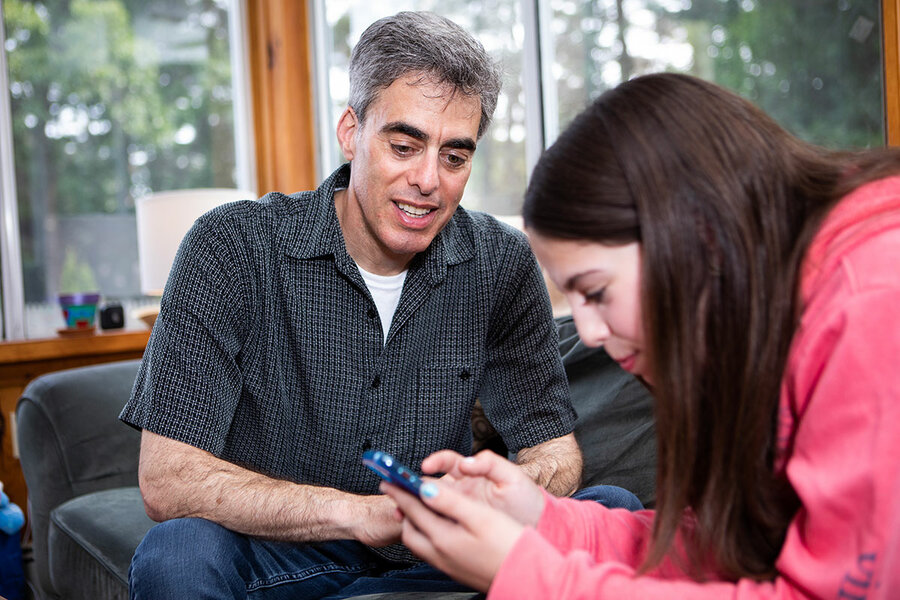
Andy Saks of Southborough, Massachusetts, says he is concerned about the constant presence of technology and its effect on children’s minds. His daughter Cara got an iPhone only after negotiating limits on social media use with her parents.

Our oldest grandson turned 13 this year and was able to get a phone, the first of our grandchildren to do so. He was already using an iPod for many of the same purposes and took a lot of nice pictures with it, so he wasn’t a neophyte. But as American children seem to get phones at younger and younger ages, his parents decided to go slowly.

Other parents are exercising caution, too, as Sophie Hills reports at the Christian Science Monitor.

She writes, “When Tanvi Chawla got a phone in fifth grade, she wanted access to ‘everything’ – all social media. But her parents said no until she was 13. Now in 10th grade at an all-girls school in Pasadena, California, Tanvi’s views on social media have almost entirely reversed.

“In early 2020, when Tanvi – along with the rest of the world – found herself stuck at home, social media became her ‘entire life,’ she says. ‘I didn’t post much but it was a means of communication with my friends.’ …

“But after a few months of life online, Tanvi deleted Instagram in the beginning of eighth grade. She hasn’t replaced it with any other social media. ‘I just saw how harmful it was to my mental health and I think it was negatively impacting my peers, too,’ she says. ‘So I made that decision for myself to stop using it.’ …

“Many students enter high school with their phones seemingly glued to the palms of their hands. And rates of anxiety and depression, particularly among girls, have skyrocketed since 2010.

“ ‘[Technology] is just so present that it’s impossible to completely disconnect and function for many people,’  says Liz Kolb, a clinical professor of education technologies and teacher education at the University of Michigan. …

“As a teacher, Ms. Kolb understands the inclination to go straight to cellphone bans. But whether a school bans phones or not, it’s worth taking the time to teach students good habits, she says. …

“In May, the U.S. surgeon general issued a public warning about the risks posed by social media to youth mental health. … A new poll found that most Americans, regardless of age, would like to return to a time when society was unplugged. The desire was highest among Americans ages 35-54 (77%), but 63% of 18- to 34-year-olds said they’d prefer to live in a simpler era, too.

In Ireland, parents and schools in the town of Greystones implemented a townwide voluntary cellphone ban for children.

“Rachel Harper, principal of St. Patrick’s primary school in Greystones, has noticed increasing anxiety among her 8-, 9-, and 10-year-old students. Parents report the same, adding that it’s hard to get their kids to sleep at night. Students are concerned about their bodies and self-image in a way Ms. Harper hasn’t noticed in that age group before. …

“Both parents and teachers are concerned for students’ online safety. ‘They’re just not emotionally ready to maneuver everything on a smart device,’ she explains.

“So she reached out to the principals of the other seven schools in Greystones. Together with parents, they started a community-led initiative to shelter children by agreeing that, across the town, students wouldn’t have phones until after primary school.

“The collective effort makes all the difference, says Ms. Harper. ‘From a kid’s point of view, there’s that sense of fairness, that it’s not just them’ without a phone.

The voluntary ban has attracted positive attention from all around the world, says Ms. Harper. She’s heard from many educators saying they’ve wished to implement a similar approach in their schools, though they didn’t think it was possible. …

“The Buxton School, a private day and boarding school in northwestern Massachusetts, last year banned cellphones entirely during the semester. Buxton offered students an alternative: the Light Phone, which texts, calls, and offers basic functions like a calculator, but has no capacity for email or accessing the internet.

“After one full school year, the experiment appears ‘largely successful,’ says assistant head of school John Kalapos, who also teaches English and wood shop. … Students do say they want to be on their phones less, he says, though not all of them love Buxton’s no-smartphone policy. …

“When students’ whole lives suddenly shifted online in 2020, Mr. Kalapos became much more aware of cyberbullying. It tends to be based on exclusion, which is challenging for teachers to mediate when it takes place in the form of ‘likes’ – or the lack thereof – online.

“It’s countercultural to not have a smartphone, says Joe Hollier, co-founder of Light. And while something like the Light Phone is a useful product, actually cutting back on technology exposure ‘takes user will.’

“Fear of missing out is what prevents most people – himself included – from moving away from smartphones, says Mr. Kalapos of the Buxton school. But once you do it, ‘you realize it’s not as valuable as you think.’ ”

In the anecdote from Ireland, kids were glad that it wasn’t just their school setting limits. All the schools in town did it. The importance of fairness made me think. Real fairness would involve parents agreeing to phone restrictions, too — maybe certain times of day when no one in the family uses their phone. What about that?

More at the Monitor, here. No firewall. Subscriptions encouraged.

Read Full Post »

Photo: Mark McGuinness.
Mark McGuinness, a photographer, said the income from Ireland’s government allowed him to devote two days a week to making work for exhibitions.

It’s hard to say which part of the story on Ireland’s experiment with guaranteed income for artists I love most, but “cross-party support” sure feels like heaven.

Alex Marshall reports at the New York Times, “Ian Fay had toiled for years to make it as a comic book artist and illustrator, and last fall, he was ready to call it a day.

“Fay, 32, who lives in Kilkenny in southern Ireland and specializes in drawing muscly superheroes, was only earning enough money to pay his bills, he recalled recently. He couldn’t afford vacations. He was considering boxing up his art supplies and getting a job in a grocery store.

“Then, in September, a lifeline appeared in his email inbox. A message from Ireland’s government said that Fay had been selected for a program guaranteeing 2,000 artists a basic income. For three years, participants — including musicians, novelists and circus performers — would be paid 16,900 euros a year, about $18,200, no strings attached.

“Fay stared at the email in disbelief. The payments — in weekly installments of €325 — would cover his rent, and lower his anxiety about making ends meet, he said. For the first time in years, he added, he would have ‘time to practice and develop my craft.’ …

“The Irish pilot project is the latest sign of growing international interest in universal basic income — when governments pay ‌their citizens, employed or not, a lump sum each month. Proponents of the idea, including antipoverty groups, left-wing politicians and libertarian organizations, say guaranteed income ensures a population’s sustenance and health better than other social welfare policies. Opponents say it’s simply giving the work-shy cash for nothing.

“In early experiments in Finland, California and Germany, people were paid regardless of their profession. But several pilots are now focused on cultural workers, who can spend months, or even years, on unpaid projects. Painters, dancers and musicians often rely on precarious, part-time jobs to fund their passions, and basic incomes are seen as a way to let them focus on artistic pursuits.

“Last year, in the United States, a privately funded initiative called Creatives Rebuild New York began giving 2,400 artists $1,000 a month. Similar programs are underway in San Francisco and Minnesota. But of these artist-focused efforts, Ireland’s stands out because it is government-run and involves rigorous analysis of the recipients’ finances, work patterns and well-being to gauge the handouts’ impact. The recipients’ livelihoods will be compared with those of 1,000 artists in a control group, who are not receiving any payments.

“Catherine Martin, Ireland’s culture minister — a trained singer and former street busker — said in a telephone interview that the idea for the policy emerged three years ago during the coronavirus pandemic. With Ireland’s music venues, theaters and museums shuttered, Martin commissioned a task force to explore how the government could help cultural workers survive. Its main recommendation was a basic income trial. …

The pilot, which has cross-party support, has a budget of €33.8 million a year — and that’s on top of the €130 million that Ireland spends on culture via the Arts Council, its main arts funding body.

“Applications opened last April for people working in the visual arts, theater, literature, music, dance, opera, movies, circuses and architecture. … The applicants had to submit two pieces of evidence to show they were genuine cultural workers, such as membership in a professional body, proof of income from art sales or newspaper reviews. Martin said the government didn’t consider the quality of the applicants’ work.

“More than 9,000 people applied, with 8,200 deemed eligible. From that pool, 2,000 were randomly selected to receive payments and 1,000 for the control group. …

“Lydia Mulvey, 47, a screenwriter, said that she quit her job in a telecommunications firm as soon as she heard she’d made it into the program. Now she spends her time writing pilot scripts for thrillers and sci-fi shows, rather than trying to squeeze that into evenings and weekends. ‘I knew it’d be transformative and give me my life back,’ Mulvey said, although she added that, if she didn’t already own her own home, she’d struggle to live on such a low income, especially in Ireland’s squeezed property market.

“Mark McGuinness, 31, a photographer, said that before receiving the basic income he had spent the whole week seeking commercial photography work to pay his rent and the cost of supplies, and had let his artistic practice slip away. Now, he’d ‘clawed back’ two days a week to make work for exhibitions, he said. …

“Ireland’s government is sending recipients questionnaires every six months that ask about the state of their finances, artistic career and health. … Last year, those taking part received a survey to collect baseline data. It asked if they could adequately heat their homes, replace worn furniture or ‘afford a meal with meat, chicken or fish every second day.’ …

“Aengus Ó Snodaigh, a spokesman on cultural issues for the opposition Sinn Fein party, which supports the program, said he wanted data long before the trial concluded so artists didn’t face a ‘cliff edge’ at the end. He added that he had many questions about the program, including whether payments benefited early-career artists more than established names, and whether the handouts were having unintended consequences, like causing tensions in rock bands if some members were selected, but others weren’t.

“ ‘Maybe the money would be better spent on hardship funds for artists who can prove they can’t afford the mortgage, or can’t rent a studio,’ Ó Snodaigh said.

“Few recipients are taking the windfall for granted. Mulvey, the screenwriter, said she’d recently met television companies about developing shows, and was often working long into the night. ‘I keep reminding myself that three years is a really short time, and we’ve already had six months,’ she said, adding that she wanted to make sure ‘I don’t have to go back to a day job when this stops.’ ”

More at the Times, here.

Read Full Post »

Photo: Murray Sanders via the Daily Mail.
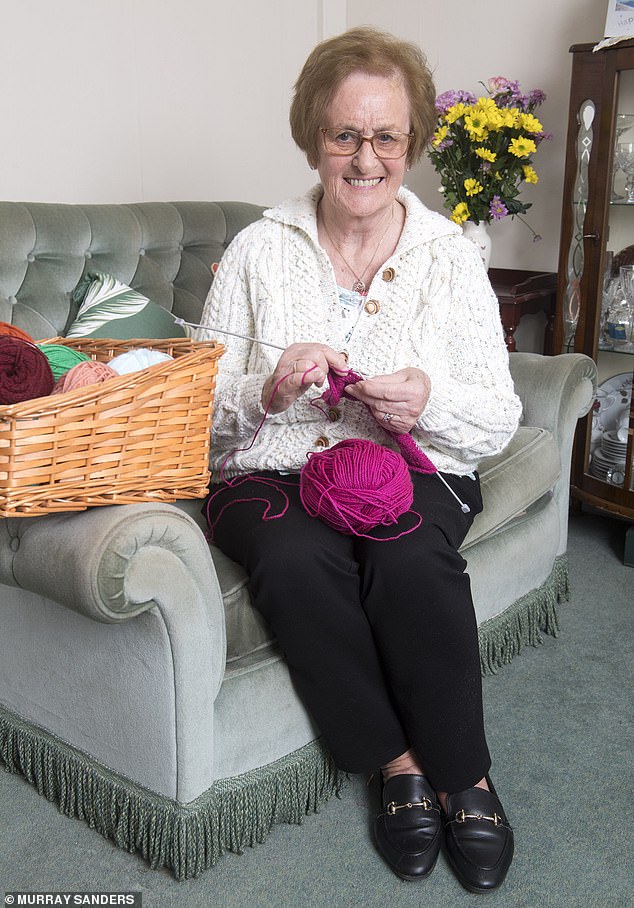
Delia Barry, an 83-year-old widow from Greystones, County Wicklow, started knitting classes to improve her skills for a cancer charity after her husband of 48 years died suddenly in 2010. Now she’s a knitter to the stars.

How many ways are there to love this story? An Irish woman gets serious about knitting late in life and becomes so highly skilled that she’s in demand. An acclaimed movie director’s team seeks her out to make sweaters (“jumpers”) for actors in a film that turns out to get an Oscar nomination. She has to watch the movie twice because the first time, she is only looking at the sweaters. And when the New York Times calls, she says to call back because she’s playing bingo!

Lou Stoppard reports at the Times, “When I first contacted Delia Barry, she asked to be called back later. It was a Wednesday afternoon in Greystones, Ireland, where she lives, and she was playing bingo. ‘It’s just more of a social gathering for local senior citizens, which I am one of,’ Ms. Barry, 83, said by telephone.

“When not at bingo, Ms. Barry is usually knitting. Four of her sweaters appear in the Oscar-nominated film The Banshees of Inisherin, which is set on a fictional island in 1923, toward the end of the Irish civil war. These include a navy roll-neck and a red pullover with a distinctive long collar, both worn by Colin Farrell; a thick blue knit worn by Brendan Gleeson; and a purplish ribbed fisherman’s sweater worn by Barry Keoghan. Esquire U.K. called Banshees the “Next Great Knitwear Film.”

“ ‘It’s pure madness,’ she said of the attention. ‘I’ve knitted so many jumpers, they are just another jumper to me.’ She hopes to see the film a second time soon, she said, to better appreciate the acting and Martin McDonagh’s direction. ‘When I went the first time, I was just looking for the knitwear,’ she said.

“Ms. Barry learned to knit at school in Cahir, County Tipperary, at age 7. As a teenager, she made her own clothes, trying out new patterns, perfecting shapes. At 20, she moved to London with her future husband and worked in a telephone factory. More than a decade later, they returned to Tipperary, where Ms. Barry worked in a bar before moving to her husband’s birthplace of County Wicklow, where the town of Greystones is. …

“Ms. Barry knitted throughout her marriage, she said, but her commitment grew when her husband died in 2010, and she began knitting to raise funds for Greystones Cancer Support. ‘They were very good when he was diagnosed,’ she said. She donated a portion of her film earnings to the organization. …

“On an average week, Ms. Barry rises at 6 a.m. and knits until 8:30 a.m. She always knits in the same spot — on her sofa, with the light from the window behind her. At 9:30, she goes for a walk to the beach with a friend, about two miles away. She has never owned a car, she said, and has walked everywhere her whole life. …

“Back home, she’ll knit for another three to four hours. She’ll take a short break for dinner, then knit throughout the evening. ‘I get up and walk around every so often,’ she said. … ‘When you’re living on your own, it’s nice to have something to do.’ she said. …

“Eimer Ni Mhaoldomhnaigh, the film’s costume designer, commissioned Ms. Barry to create the sweaters. After the release of the movie, Ms. Ni Mhaoldomhnaigh recalled, ‘My daughter, who is 20, came and said Delia is a TikTok sensation.’

“Ms. Ni Mhaoldomhnaigh came across Ms. Barry’s work when she was sourcing knitwear for a 2017 television adaptation of Little Women. A woman working on the production knew that Ms. Barry had helped on other films, including Dancing at Lughnasa, for which she created knitwear for Meryl Streep’s character.

“ ‘Ireland is very small,’ Ms. Ni Mhaoldomhnaigh said, laughing. ‘It’s all word of mouth.’

“Ms. Barry credits her success to being willing to take on a job without a pattern, something many knitters would be wary of. For The Banshees of Inisherin, Ms. Ni Mhaoldomhnaigh provided photographs of Irish fishermen from the 1920s, which Ms. Barry studied with a magnifying glass. One showed a sweater with a distinctive long collar, the inspiration for the red piece that would become Mr. Farrell’s. …

“Once each item was complete, it went to the aging department, where pieces are dyed and distressed. ‘People think they just take a cheese grater to it, but it’s not as simple as that,’ Ms. Ni Mhaoldomhnaigh said. She sees the process as a means of communicating subtleties about a character — somebody who walks purposefully with their hands wedged in their pockets, somebody who gets nervous and wipes their hands on the front of their clothing.”

More at the Times, here. For the story at the Daily Mail, here, there is no firewall.

Read Full Post »

Rent-a-Pub

Photo: Suzanne Kreiter/Globe.
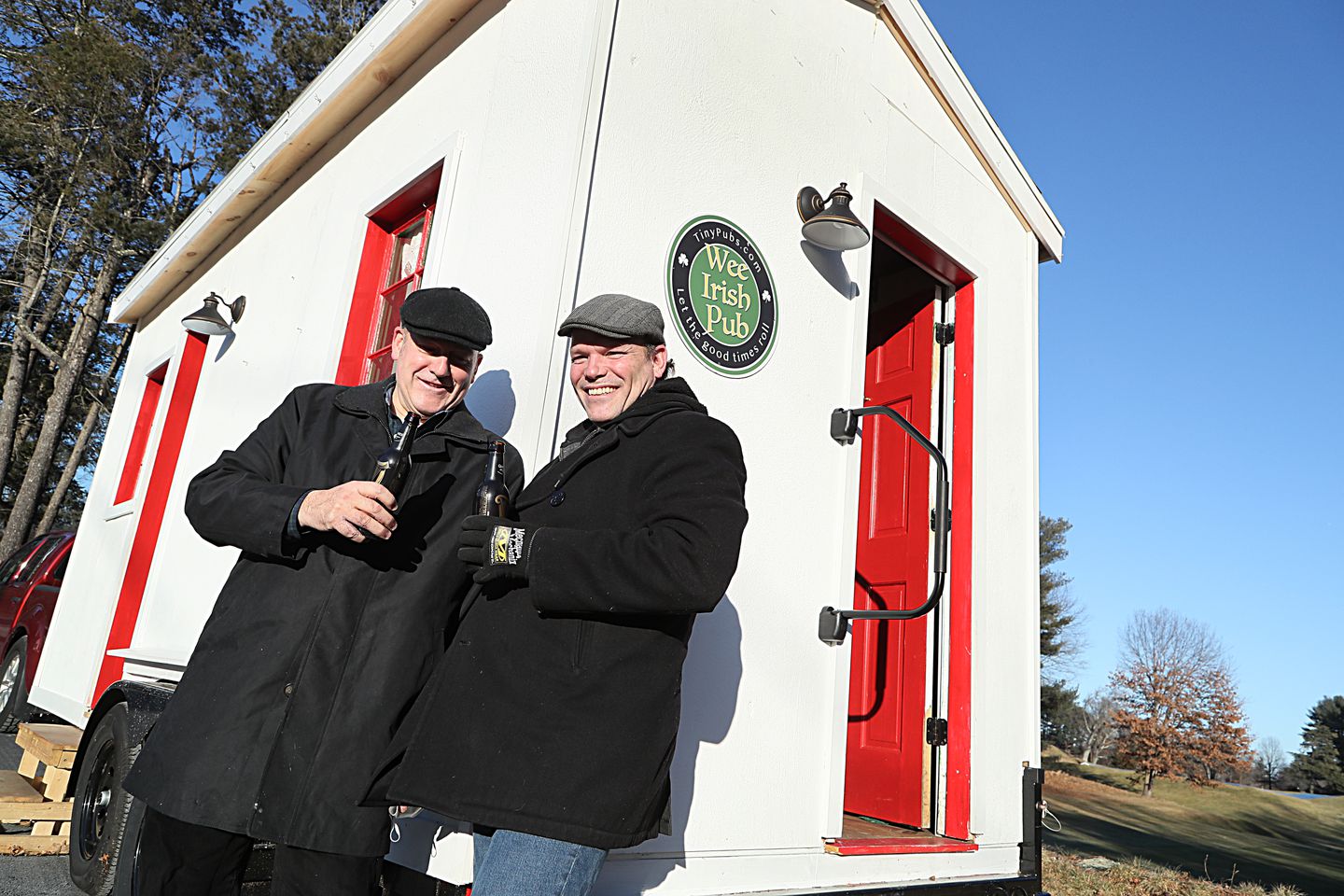
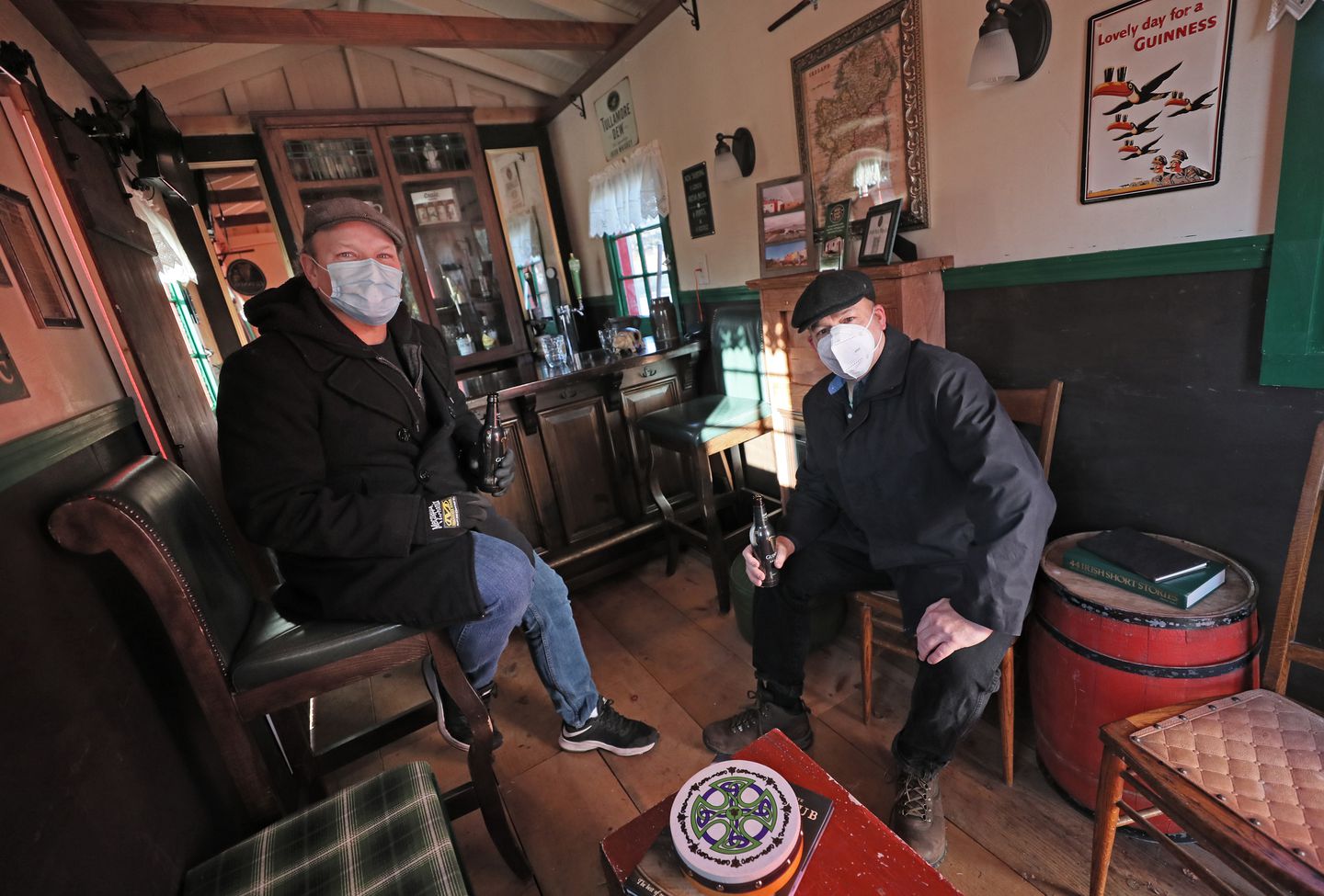
Brothers Craig and Matt Taylor built a miniature Irish-style pub on wheels, dubbed the Wee Irish Pub. Want to rent it?

Journalist Steve Annear at the Boston Globe gets all the fun assignments. This report is about a perfect little Irish pub available for rent.

“At first, brothers Craig and Matt Taylor thought building a miniature Irish-style pub on wheels, a traveling taproom they could rent for private events and parties, would just be a hobby — a pandemic project that would take their minds off the world’s problems and let people enjoy the familiar comforts of crowding into a bar (albeit a very small one) at a time when it had become almost impossible to do so.

“But within days of launching the ‘Wee Irish Pub’ in September, it became clear that the fireside chat-turned-business venture was going to be much more than a side gig. …

“ ‘The floodgates have opened,’ said Craig, 58. ‘We are getting requests [to rent it], at least two an hour, for the last week.’

“The idea to construct a tiny Irish pub, complete with a small bar, stools, bench seating, and many of the other features found in traditional venues of its kind, had been in the back of Craig’s mind for years, since he read about an inflatable Irish bar that people could rent for a day in their own backyard. …

“ ‘I had been talking about it sort of as a pipe dream that would never happen,’ said Craig, who works in marketing.

“But as the Reading residents found themselves spending a lot of time around a fire pit in Matt’s backyard early in the pandemic — one of the few activities that was still safe and allowed — the possibility surged to the forefront, like the head on a perfectly poured pint of Guinness.

“ ‘We’d talk about it night after night,’ said Matt, 49. ‘Finally it was like, “Alright, let’s just do this.”

‘It’s kind of the perfect pandemic project because people were having backyard get-togethers and staying outside.’

“Last February, after batting around the notion and discussing logistics, they decided to try their luck. They bought a large trailer for the tiny pub to be built on, so it could be towed from place-to-place upon request.

“When it was finally delivered in April, they got to work on construction, a joint effort bolstered by Matt — ‘an IT guy by trade’ with a penchant for carpentry.

“ ‘I’m definitely more about the overall impression and the ambiance,’ said Craig, who took a genealogical tour of Ireland in 2018 with his family, visiting the homeland of his wife’s ancestors. ‘Matt is precise to the micro inch on making sure that every rafter is exact.’ …

“They sourced materials from online marketplaces like Craigslist, and repurposed and recycled old furniture and other items to try and give it an authentic look and feel. Their siblings and other close family members pitched in considerably.

“Within months, the cozy pub had it all: A Sláinte sign graced one wall, under a weathered horseshoe. A framed map of Ireland hung above an electric fireplace. The small bar was installed, with a refrigerator and taps for kegs. A plaque dedicating the project to Craig’s late father-in-law — who was of Irish descent — went up behind the benches, forever holding a seat for him.

“The design of the cream-colored cottage is similar to mobile pubs built by the Irish-based company The Shebeen, which brought one of its units to Boston in 2015.

“The Wee Irish Pub, which can fit up to 12 people inside, finally rolled to its first event — a company gathering in Melrose — in September. It hasn’t slowed down since. …

“The company, officially dubbed ‘Tiny Pubs,’ is based in Reading. But the brothers will deliver the bar to people’s doorsteps up to 30 miles away (or more, depending on the situation). Rentals cost between $800 and $1,200 per day, with Craig and Matt arriving to help with the set-up in the afternoon and then whisking it away the following day. …

Photo: Suzanne Kreiter/Globe.

“Most people are renting it to celebrate a milestone birthdays and retirement parties, the brothers said. But they recently received one call from a customer who has a terminally ill relative who had always wanted to visit Ireland, but no longer can.

“Instead, ‘they’re bringing the pub over to her in the driveway, to have a little taste of Ireland,’ Craig said. ‘It’s very sweet.’ More at the Globe, here.

I want to expand on the idea of bringing a bit of Ireland to a patient who can no longer travel. I remember when Animals as Intermediaries (now the Nature Connection) was founded in Massachusetts in 1983. It all started with asking an elderly, disabled woman what would cheer her up and receiving the answer, “Bring me the ocean.” The nonprofit’s founder was able to bring her a collection of items that really made her feel like she was near the ocean. Read about that early, perhaps better, version of virtual reality here.

Read Full Post »

Photo: National Museum of Ireland.
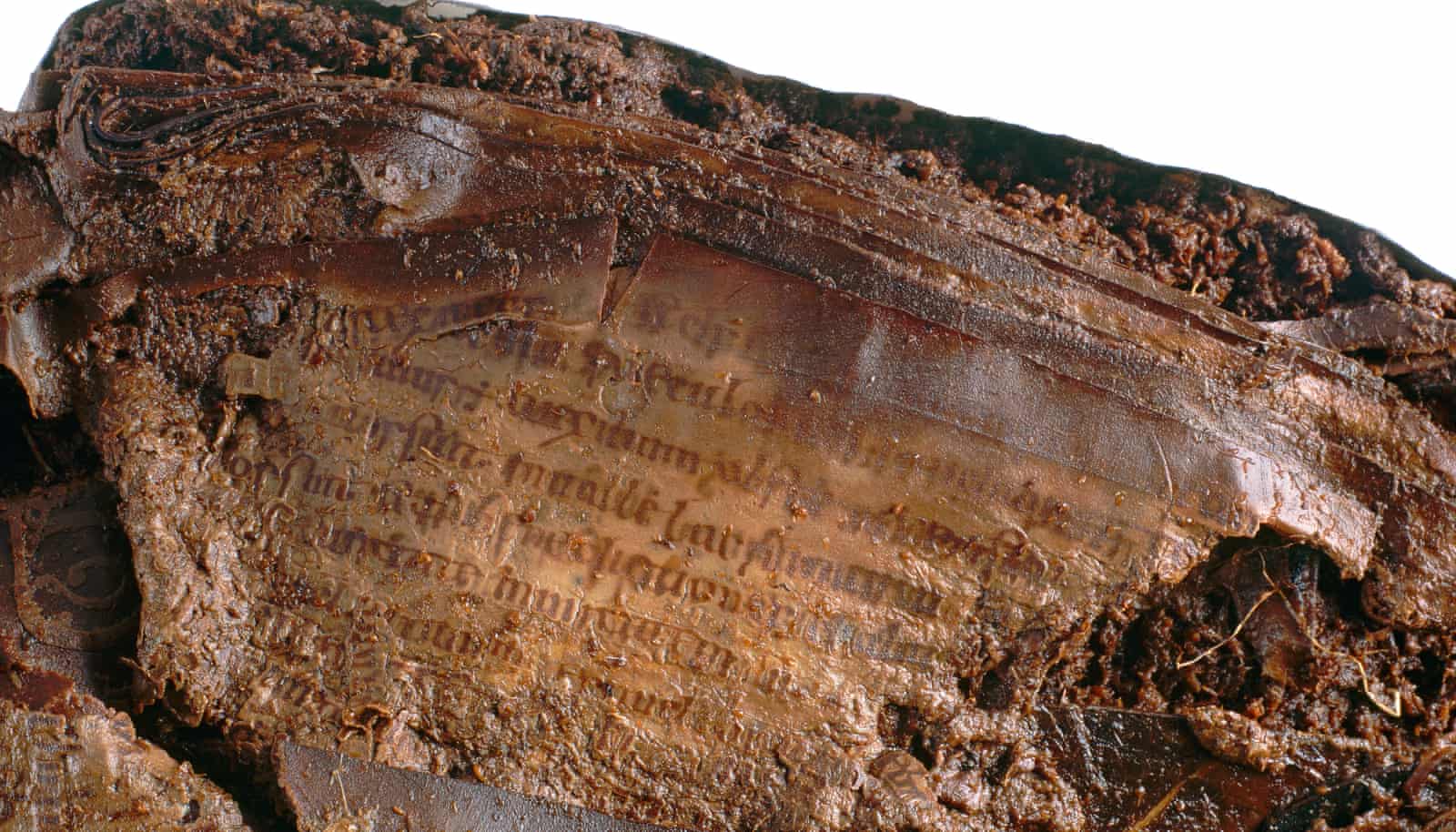
Found in an Irish bog. The psalter is shown here pre-conservation – lines of psalms clearly visible.

In the miracles-all-around-us department, imagine finding in a peat bog a medieval book of psalms that looked like the monastic compilers might have had links with Egypt! Lisa O’Carroll writes for the Guardian about a book on the psalter’s discovery and painstaking restoration.

“One summer’s day in Tipperary as peat was being dug from a bog, a button peered out from the freshly cut earth. The find set off a five-year journey of conservation to retrieve and preserve what lay beyond: a 1,200-year-old psalm book in its original cover.

“Bogs across Europe have thrown up all sorts of relics of the ancient past, from naturally preserved bodies to vessels containing butter more than a millennium old, but the 2006 discovery of an entire early medieval manuscript, entombed in a wet time capsule for so long, was unprecedented, said the National Museum of Ireland.

“The book fell open upon discovery to reveal the Latin words in ualle lacrimarum (in the valley of tears), which identified it as a book of psalms. One particularly unexpected feature was the vegetable-tanned leather cover with a papyrus reed lining, suggesting the monks could have had trade links with Egypt.

“ ‘It still blows me away,’ said John Gillis, the chief manuscript conservator at Trinity College Dublin, home of the Book of Kells, the Book of Armagh and 450 other medieval Latin manuscripts. ‘It was by far and away the most challenging, most interesting project I have ever undertaken – and to put that in context, I am surrounded by these iconic manuscripts.’

“Ten years after going on display at the National Museum in Dublin, the Faddan More Psalter is one of Ireland’s top 10 treasures and now the subject of a 340-page book from the institution documenting every stage of the ‘terrifying’ preservation process for future scholars. …

“The process of stabilising the book outside the bog, drying it and then unpicking and unfolding pages where possible was painstaking. Archaeologists placed the ‘conglomeration’ of squashed pages, leather and turf in a walk-in cold store in the museum at 4C. But there was no manual in the world to guide Gillis on how to go about the task. …

“Initial examination was limited in order to mitigate further trauma. CT scans and X-rays to find 3D structures were excluded owing to concerns that they could accelerate the degradation.

“After trying sophisticated versions of freeze-drying, vacuum-sealing, and drying with blotting paper, Gillis settled on a dewatering method using a vacuum chamber installed in the museum lab for four years to minimise shrinkage and decay.

“It would take two years before all the folio fragments were in a dry and stable state before the daunting task of dismantling could begin, a process chronicled in the book out later this month, The Faddan More Psalter, The Discovery and Conservation of a Medieval Treasure.

“ ‘It was absolutely terrifying,’ Gillis said of the responsibility he felt.

‘I heard from someone in the British Museum that there was a picture of the [book fragments] on the walls in a staff area there with the words “If you think you have a bad day ahead …”

” ‘You had this nerve-racking scenario of disturbing this material, which meant losing evidence, when the whole point was trying to gain as much information as possible.’

“Many of the spaces between the iron gall letters had dissolved into the bog, leaving an alphabet soup of several thousand standalone letters. It would take months after the drying process to piece them all together, in sequence on the right pages.

“ ‘The rewards when you slowly lifted up a fragment, and suddenly beneath this little bit of decoration would appear, particularly the yellow pigment they used. It would kind of shine back at you,’ Gillis said. ‘And you’d go: “Wow, I am the first person to see this in 1,200 years.” So that kind of privilege made all the sleepless nights and racking of the brain worthwhile.

“ ‘It was the purest conservation I’ve ever carried out. There is no repair, I’ve attached nothing new. All I’ve done is captured and stabilised.’ ”

More at the Guardian, here.

Read Full Post »

image-1

Photo: Cory Weaver
Wexford Festival Opera:
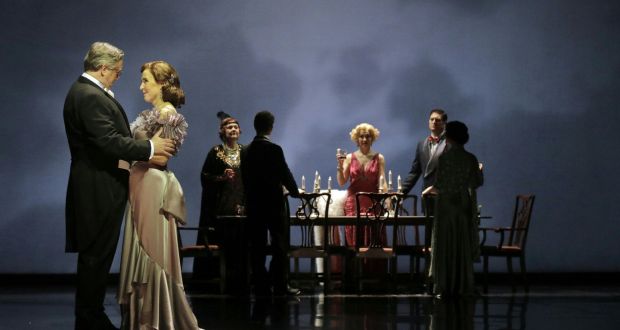
Dinner at Eight, by William Bolcom, got its European premiere at last fall’s event.

Back in the 1990s, I worked with a woman whose father was an opera buff. He loved opera so much that, although he had no real connections in the field, he managed to organize a high-quality company in the part of New York State where he lived. Westchester, if I remember correctly.

It wasn’t his day job: it was what he did for love. In another example of opera lovers who go out of their way to lend support, US Supreme Court Justice Ruth Bader Ginsburg has taken small, non-singing parts on stage, attracting some new audiences.

At the Irish Times, David McLoughlin has another example of what some folks will do for opera.

“Never intimidated by the weight of cultural heritage, each new generation of Irish artists continues to reimagine, reinvent and reinvigorate. The arts are constantly changing, finding new forms of expression and igniting new flames. …

“Wexford Festival Opera was founded on an idea and ethos which still remains at its core today, 67 years later – to present rarely performed operas, to unearth and shine a light on hidden gems.

“I was once told by the then chairman of a leading American opera company that the reason Wexford has rightly survived is because from the outset its rationale was plain wrong.

“He was right: the dream by a small group of local people, including a GP, a hotelier and a postman, in the early 1950s, of bringing international singers to a remote corner of Ireland to present rarely performed operas, wouldn’t even get past the first page of a modern-day feasibility study.

“But they weren’t dissuaded, and the minor detail of no real financial underpinning was from the outset not even considered a hindrance. The dream they were determined to see become a reality was enthusiastically shared and championed by the local community, who volunteered their time and skills. …

“The festival opened up not just Wexford itself, but Ireland and its arts sector, to the international performing world in a way no other cultural venture had done up until then – nor, I would argue, since. The spin-off has been enormous – artistically, culturally, and economically, generating [$14 million] annually. …

“Wexford is often defined as what it is not: a national opera company. It isn’t. Wexford is an annual festival, an international event, proudly Irish, presenting Irish and international audiences with a distinctly international repertoire, featuring Irish and international performers and attracting an audience that stretches well beyond these shores. It makes a vital contribution to the profile, development and reputation of the Irish opera sector. It may be niche but it’s broad enough to accommodate new audiences.”

More at the Irish Times, here. It will be interesting to see how this festival fares after Brexit, when Ireland will still be part of the European Union and its closest neighbors won’t.

Read Full Post »

Kurds in Ireland


Photo: Paulo Nunes dos Santos for The New York Times
Carrick-on-Shannon, a small town in the west of Ireland, where a group of Kurdish refugees were resettled from Iraq over a decade ago.

No one should claim that adjustment to life in a completely unfamiliar world is easy, but when refugees have no choice but to try and when communities have many kindhearted people, it can work.

Here is a story of how Kurdish refugees adapted to life in Ireland, of all places — and how their new home adapted to them.

Megan Specia writes at the New York Times, “A bold black-and-red sign announces Jamshid Ghafur’s business — ‘Kurdish Barber’ — up a narrow flight of stairs just off the main street of Carrick-on-Shannon in western Ireland. …

“ ‘I am happy with this small business,’ he said as he gestured around the shop with pride. ‘I feel like home here.’

“Mr. Ghafur, 37, is part of a thriving group of Kurds who adopted this small town as their own after a United Nations-supervised refugee resettlement program brought them here more than a decade ago.

“Kajal Allakarami, 29, was 17 when she arrived. … ‘Maybe it wasn’t our ways, maybe it wasn’t our traditions,’ she said, ‘but the way they respected us was huge.’

“In 2005 and 2006, around 100 Kurdish refugees, most Muslim, arrived in Carrick-on-Shannon, population 5,000, plucked from decades of displacement. …

“The government provided social welfare and language courses for the adults, while the children enrolled in the local schools. Volunteers brought food and clothes, [Fawzieh] Amiri said. Among them was Nora Burke, a Roman Catholic nun, who visited Mrs. Amiri weekly to help her practice English.

“Still, the adjustment was not easy. Sister Nora said some locals resented the state-funded support the Kurds received.

“ ‘Carrick-on-Shannon was not prepared,’ she said. ‘They just arrived and some in Carrick thought: “God, who are these people? Where did they come from? What are they here for?” ‘ …

“But bit by bit, the Kurds established themselves. …

“For members of the younger generation, resettlement has been a complex process of not just understanding Ireland but of coming to terms with their Kurdish and Irish identities. …

“Some found the adjustment more difficult. Jabar Azizi and his twin brother were 16 when their family arrived.

“ ‘My age group, it was really, really difficult for us,’ Mr. Azizi said. ‘Even though I was in Ireland, my mind was somewhere else.’

“Still, he made it through school, and credits the small town.

“ ‘They respected us and our religion,’ Mr. Azizi said. ‘They respected the way we wanted to live.’ …

“But it took tragedy for the Azizi family and the rest of the Kurdish community to know they had found a true home with their new Irish neighbors.

“In March 2012, Jalal Azizi, Jabar’s twin, was swimming with friends in the Shannon river during a rare warm snap when he got into difficulty and drowned. The whole town was shaken. Shops shut their doors and residents lined the road to pay their respects as the 21-year-old’s funeral cortege passed by.

“ ‘To be honest, we didn’t expect that with our brother,’ Mr. Azizi said. ‘His death really touched everyone.’ …

“ ‘When he passed away, we saw all the community from Carrick-on-Shannon gathering in my house,’ Mr. Azizi said. ‘It is something I will never forget in the years to come; it is something I will tell my son about.’ ”

More here.

Read Full Post »

Art: Rene Meshake
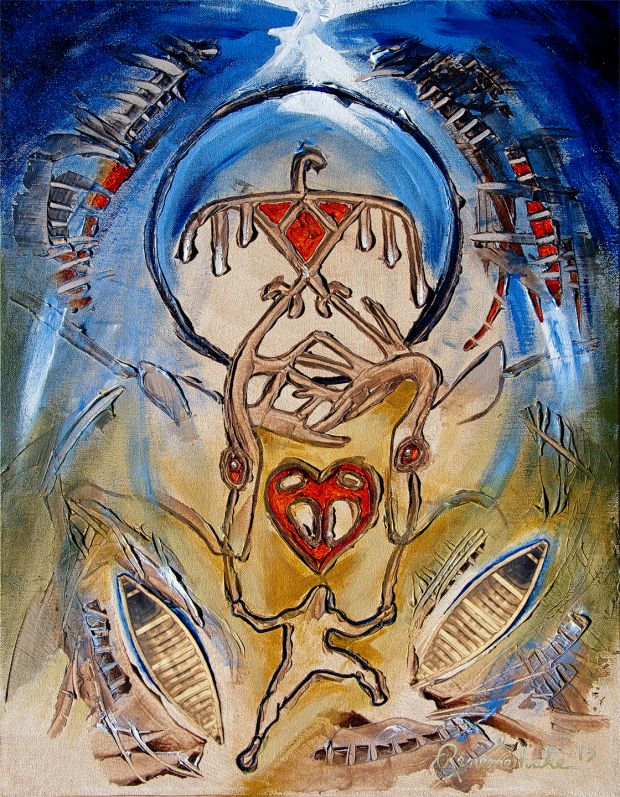
Ojibwe artist Rene Meshake was part of a group of indigenous storytellers from Canada who attended the Untold Stories conference in Ireland in May.

As many people know, there was a dark period in US history when authorities thought is would be a good idea for indigenous children to be separated from their language, families, and culture. The same thing happened in Canada. Today, those children and their children are reclaiming their voices and telling their own stories.

Here is Catherine Conroy at the Irish Times: “On a Friday morning in a house in Dublin, I sit down to speak with three indigenous storytellers from Canada. They are here for a conference called The Untold Stories of the Past 150 Years/Canada 150 at [University College Dublin]. …

“Maria Campbell, Rene Meshake, and Sylvia Maracle, from Canada’s ‘Indian Country,’ accompanied by indigenous historian Kim Anderson, tell me a story of pain, resilience and the rebuilding of a shattered community through stories.

“Sylvia Maracle is an activist and storyteller from the Tyendinaga Mohawks. She believes their stories will resonate with Irish people, ‘with colonisers having come and disrupted what was probably the natural order.’ …

“She tells me of a conversation she had with an Irish taxi driver when she arrived. ‘He asked, “Are people recovering their memories?” I said, “They were always there, we just didn’t have the conversation.” He said, “That’s what happened here.” ‘ …

“Maracle believes in the power of storytelling as a force for rebuilding their communities. She feels privileged to have been ‘old woman raised’ by her traditional grandmother. …

“Maracle tells me that people now visit Maria Campbell ‘because they want this good medicine, this traditional stuff.’

“Campbell agrees that storytelling is medicine. ‘I grew up with a great grandmother and she never spoke English, she was a total “savage” according to the priest because she never converted.’

“But while Campbell grew up with stories, she always felt split between her traditional home life and her life outside. It was only after she stopped using drugs and attended her first ceremony in her late 20s that she realised the healing power of the stories, which came from ‘the old ladies, always women laughing.’ It was a revelation to realise ‘that you’d got this medicine, everything you need to help put yourself back together.’

“Campbell tells a story about the effects of colonisation that she learned from her teacher, the Old Man. …

“He had been trying to explain to her the effect of colonisation on their community’s wahkotowin, which in English means kinship, ‘but if you look at the word bundle, it’s all of our laws, it’s the way that we talk to each other, the way that we laugh.’

“He threw [a] jigsaw in the air. ‘He said, ‘”That’s what happened to us, everything was shattered and wahkotowin flew. Maybe you have three pieces, maybe she’s got half of one, if we come back together and we start to rebuild that, you bring your three pieces, you bring yours, and soon we’ll make the picture.” ‘…

“She recalls one story she wanted from her father that he would not give. ‘Then he got diagnosed with a terminal illness and I had to do the translating for him [in hospital]. I kind of went to pieces when we were driving home. He pulled to the side of the road, rolled me a cigarette, and he said, “That story you want, I’ll give it to you now.” He retold it and she understood now that it was a story about death, not the funny story she’d always thought it was.

“She translated and published the story. ‘In my family’s way, they were telling me that they trusted that I would treat it with integrity.’ ”

More at the Irish Times, here.

Read Full Post »

In environmental news, Lloyd Alter at Treehugger reports that an Irish county now requires new homes to meet the very high standard of energy efficiency called passive.

“In Ireland’s Dún Laoghaire-Rathdown County, a near suburb of Dublin, it’s now the law. …

“The building codes there are pretty tight already. And it’s not completely a done deal; the national Minister of the Environment, of all people, may challenge it out of concern that it might raise the cost of housing. However the local Passive House Association says that it’s not necessarily true, and showed case studies demonstrating that in fact they could build passive houses ‘at or below conventional build costs.’

“Writing in Passive House Plus, Pat Barry of the Irish Green Building Council noted that really, it’s all about just trades having the skills and doing the job right. …

“As many as 20,000 houses could be built in the county, houses that cost almost nothing to heat, produce almost no CO2, and are comfy as can be day or night, sun or no sun.”

More here.

Photo: Kelvin Gillmor
Irish passive house built on a budget
. Hmmm. Does it burn wood?

Read Full Post »

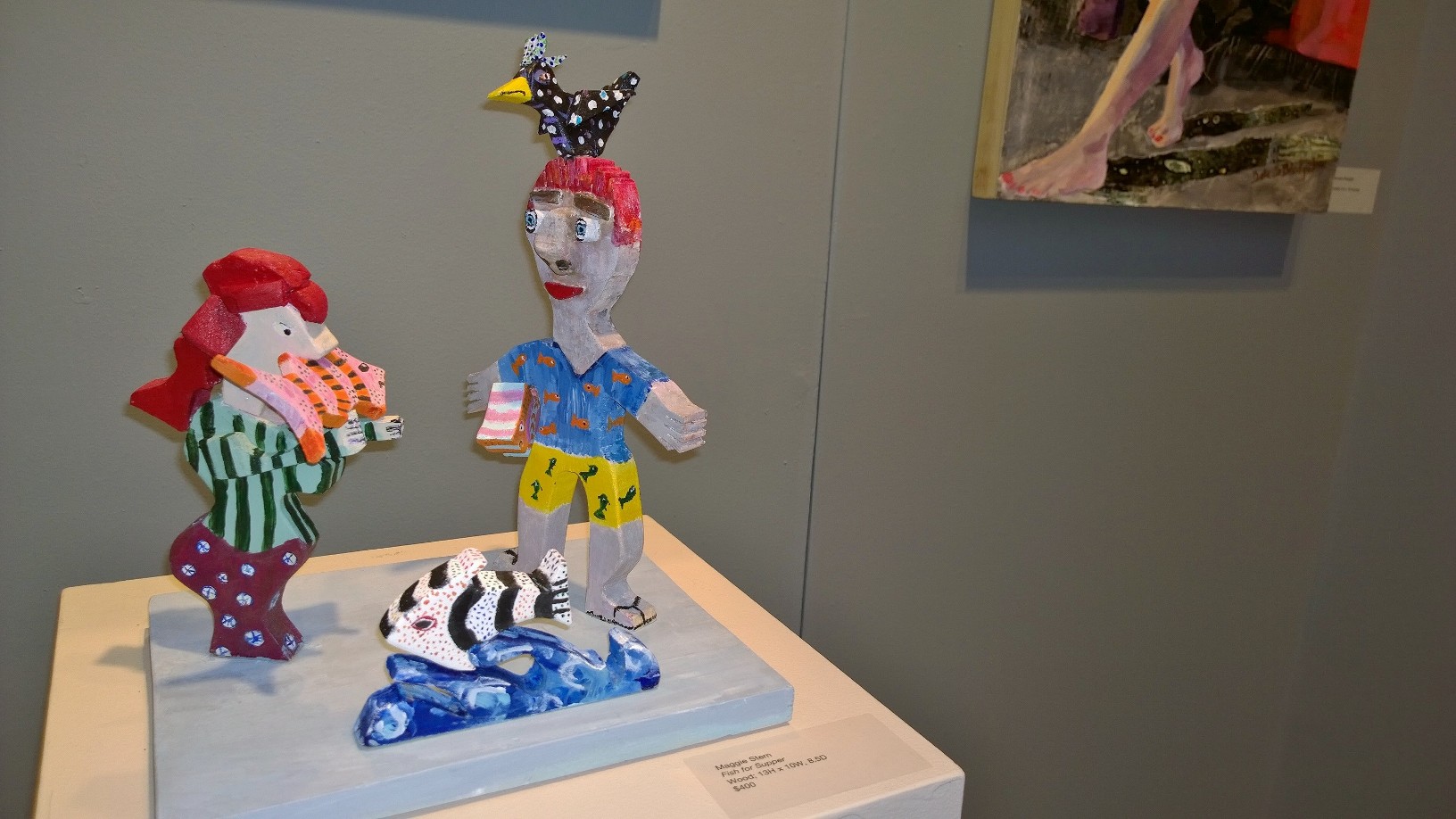
012116-fish-for-supper

Art: Maggie Stern
“Fish for Supper”

Concord Art has mounted a juried show of member works. I have been twice this week. It’s accessible and stimulating.

When you first enter, you hear a strange clattering and turn to see a beat-up old medicine cabinet with vintage pill bottles inside that are rattling around like ghosts. Very amusing.

My former boss, Meredith Fife Day, had two lovely country scenes in acrylic from her travels in Ireland, and she was the one who reminded me to see the show.

I took a photo of Maggie Stern’s playful “Fish for Supper,” above. Stern says, “What I love most about art is that you get to make up the rules.” I Googled her and found that she has connections with the Fuller Craft Museum in Brockton, Mass., and has excelled in a variety of artistic realms, including illustrating children’s books and making kits for crafty folks to reproduce her original stitchery.

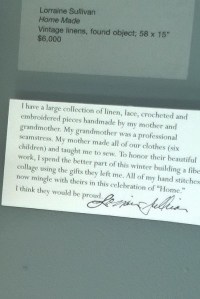
I was also drawn to Lorraine Sullivan’s use of vintage linens. There must be something in the air about vintage. I’ve been doing a little prospecting (along with Erik’s mother) to add to Suzanne’s new vintage locket collection at Luna & Stella, and have learned that the idea of mixing vintage with contemporary birthstone jewelry is quite popular.

In fact, all sorts of vintage items are being cherished now, to the point that it was not only wonderful but a bit painful to see how Sullivan used her seamstress grandmother’s handiwork in the piece below. Creative destruction. Happy-sad.

012216-vintage-linen-art-1

012116-vintage-linens-now-art


Read Full Post »

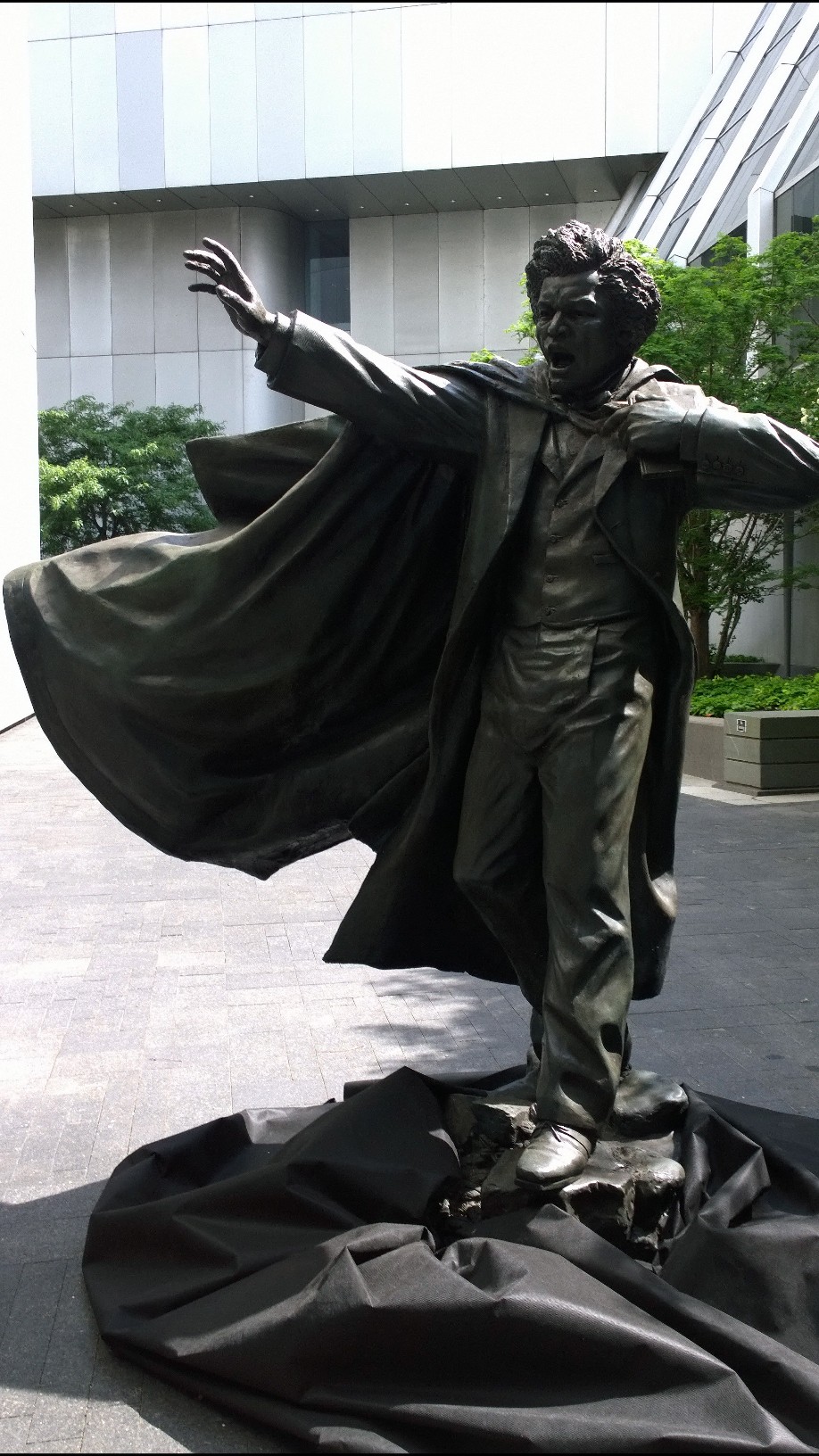
Irish-statue-Frederick-Douglass

I probably wouldn’t have known that Frederick Douglass spent time in Ireland if I hadn’t read the Colum McCann novel TransAtlantic. McCann likes to take historical events of different time periods and imagine the parts we can’t really know. In TransAtlantic, he wove together a historic 1919 flight from Canada to Ireland, the Douglass lecture tour of Ireland and his horrified witness to the famine there, a servant girl’s emigration to the United States and her role in the Civil War, and the rather thrilling negotiations to bring resolution to the Troubles between Protestants in Northern Ireland and Catholics.

According to an initiative called the Douglass/O’Connell Project, “Douglass was greeted in Dublin, Belfast, and Cork by enthusiastic crowds and formed many friendships on his trip, most significantly with Daniel O’Connell, a figure still revered in Ireland today for his role in Catholic emancipation and his fierce opposition to slavery. O’Connell and Douglass shared the stage just once, in September 1845 at a rally in Dublin, but retained a mutual respect and affection until O’Connell’s death less than two years later — and Douglass acknowledged O’Connell’s influence on his philosophy and worldview for the rest of his life.

“The Frederick Douglass/Daniel O’Connell Project is a living legacy to the leadership of these two men and the causes they championed by strengthening the bonds of friendship between Ireland and the United States, encouraging greater understanding between the diasporas of Africa and Ireland in America, and fighting injustice and human rights abuses throughout the world.”

Which brings me to how I happened to be able to take a photo of the Irish statue of Douglass today. The Center for Race Amity in Boston is partnering with the Douglass/O’Connell Project on a celebration this weekend, before the statue goes on tour. Isn’t it magnificent? Andrew Edwards is the sculptor.

There will be a preview of the public television film Douglass and O’Connell Saturday at the Museum of African American History at 7 pm, followed by a lecture by Don Mullen, the author of Bloody Sunday. On Sunday there will be festivities in the Greenway from 1 pm to 5 pm.

Read Full Post »

When John was in fifth grade, the parent-teacher association held a “cakewalk” as a fundraiser. It was kind of like Musical Chairs except players didn’t sit down. People would get eliminated in each session, and the last one standing would win one of the cakes. At the time, the idea was new to me.

Now, as I’ve been looking into James Hackett’s Days Gone By again, I am realizing the cakewalk was based on a much older custom.

Writes James, “The cake dance, to which references were made frequently in the 18th and 19th century, was not a particular dance but rather a baire or session of dancing of which a cake was offered to the couple who proved themselves the best dancers. These events were usually sponsored by the local alehouse or tavern, and such gatherings were associated with hurling and other athletic contests. …

“The cake to be danced for is provided at the expense of the publican, or alehouse keeper, is placed on a board, which in turn is put on top of a pike that stands ten feet high, and from it hangs a garland of meadow flowers and also some apples fastened with pegs on the outside of the garland. … Those who are able to dance the longest around the cake are declared winners.”

Photo found here.
If you know where to find a photo of an actual Irish cake dance, let me know. In the meantime, here is an Irish piper accompanying a couple dancers.

Read Full Post »

Older Posts »