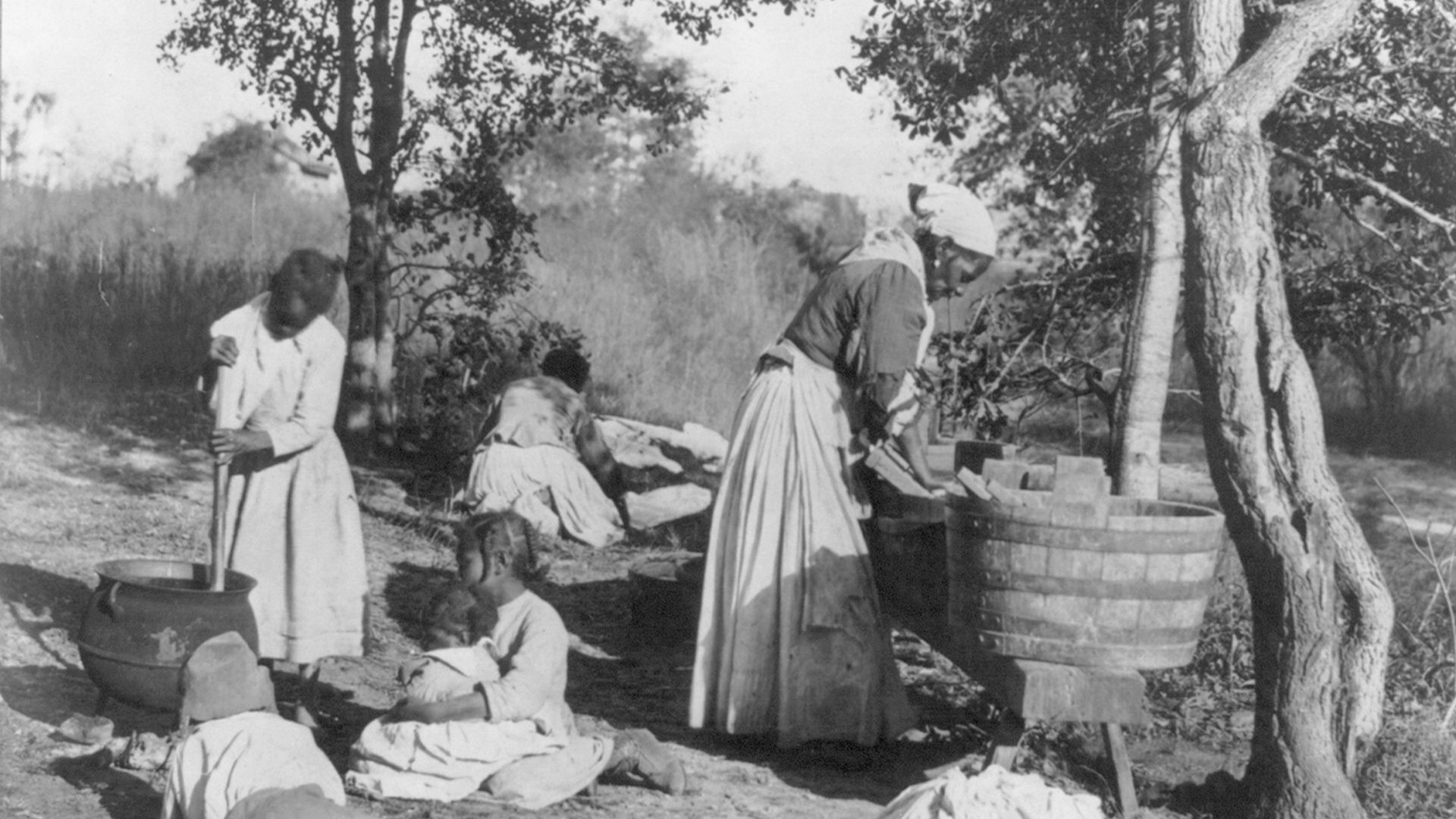
Photo: Library of Congress, LC-USZ62-51058, via Axios.
African American women and girls doing laundry with a scrub board and tub, c. 1900.
Today I’m thinking about how good things get accomplished when people submerge their differences and focus on what they have in common. And I’m remembering that even people who say they don’t like unions routinely reap the benefits of the labor movement.
One early labor milestone happened when Black washerwomen in the South had just had enough. Kim Kelly wrote up the story for the Washington Post.
“There is no one location or event that can lay a definitive claim to the founding of the American labor movement, but what is certain is the enormous debt it owes to women.
“During the Victorian era … waged labor was seen as the exclusive realm of men, and for most middle- and upper-class women, the thought of earning money for their toil was wholly foreign.
“Of course, these standards were applied specifically to native-born White women, whose status as a protected class separated their experiences from those of working-class women of color in the United States — particularly Black women, whose relationship with work in this country began with enslavement, violence and forced labor. Following Emancipation, their lives were still often defined by exploitation, abuse and wage theft. Whether held in bondage or living freely, Black women were expected to work from the moment they were old enough to hold a broom.
“These women were hardly alone. By the 1830s, the American genocide against Indigenous people had been well underway for decades, and the few Indigenous women allowed into the workforce were treated abominably. As immigration ramped up during the middle of the 19th century, female workers from other ethnic groups — including Irish immigrants fleeing a colonial famine and Russian Jews seeking to escape brutal repression — were also targeted. …
“But that restrictive social fabric quickly began to fray as the Industrial Revolution took flight. … On a balmy spring 1824 day in Pawtucket, R.I., 102 young women launched the country’s very first factory strike, and brought the city’s humming textile industry to a standstill.
“The 19th-century Northern U.S. textile industry was almost entirely White. It wasn’t until 1866, a year after Emancipation, that formerly enslaved Black female workers were able to launch a widespread work stoppage of their own — and by doing so, jump-start a wave of Black-led labor organizing that would spread through multiple industries and set the stage for decades of labor struggles to come.
On June 16, 1866, laundry workers in Jackson, Miss., called for a citywide meeting.
“The women — for they were all women, and all were Black — were tired of being paid next to nothing to spend their days hunched over steaming tubs of other (White) people’s laundry, scrubbing out stains, smoothing the wrinkles with red-hot irons, and hauling the baskets of heavy cloth through the streets. At the time, nearly all Black female workers were employed as domestics by White families, to handle the cooking, cleaning and child care, hauling water, emptying chamber pots, and performing various and sundry other tasks that the lady of the house preferred to avoid.
“Laundry, at the time a labor-intensive day-long process, topped that list in an era in which families were large, personal hygiene was negligible, and running water was scarce. The washerwomen’s wages were kept so low that even poor White families could afford to send their laundry out for Black women to clean.
“The work itself was onerous, but the relative flexibility and independence it afforded was attractive to Black female workers: They were able to work out of their own homes, which in turn allowed them to plan around their own familial and community obligations, and it was a trade that could be passed down to their own daughters. …
“In modern terms, the washerwomen were independent contractors, with lists of clients who paid a set rate for weekly service. … White employers were shocked and appalled whenever Black workers exercised their rights as free wage-earning people or dared to engage in small acts of resistance against mistreatment. One of their most powerful weapons was, simply, to quit, and go looking for more desirable clients as their former employers scrambled to hire replacements.
“This growing tension between employer and employee came to a head in 1866, when the washerwomen of Jackson presented Mayor D.N. Barrows with a petition decrying the low wages that plagued their industry and announcing their intention to ‘join in charging a uniform rate’ for their labor. As their petition read: ‘Any washerwoman who charges less will be fined by our group. We do not want to charge high prices, we just want to be able to live comfortably from our work.’ The prices they’d agreed upon were far from exorbitant: $1.50 per day for washing, $15 a month for ‘family washing,’ and $10 a month for single people. They signed their letter ‘The Washerwomen of Jackson,’ and in doing so, gave a name to Mississippi’s first trade union.
“The media response to their action was withering, dismissing the women’s intelligence and skills, predicting abject failure, and, in a move that would become common as more Black workers’ organizing efforts spread, assuming that the strike had been planned by Northern White male agitators.
“There is no record of the 1866 strike’s outcome, but the action itself had an immediate ripple effect in Jackson and farther afield. Throughout the Reconstruction era of 1865 to 1877, Black workers rose up and struck in Virginia, Tennessee, Alabama, Georgia, Louisiana, South Carolina and Washington, D.C.
“In 1869, the Colored National Labor Union was formed to represent the unique interests of Black workers who had been shut out of the larger National Labor Union. Its second president was Frederick Douglass, elected in 1872. The Great Railroad Strike of 1877, a series of often violent work stoppages in which more than 100,000 railroad workers struck over wages and dangerous working conditions, temporarily brought the railroad barons to their knees and unleashed a roving spirit of dissent that captured the imagination of workers across industries from coast to coast.
“Those winds of change arrived in Galveston, Tex., in July and August, when hundreds of workers crossed the color line and struck together several times to protest their low wages.”
For the long and interesting article at the Post, click here. A summary of the washerwomen’s strike is at the AFL-CIO site, here. No firewall for that.











 Suzanne's Mom's Blog