Feeds:
Posts
Comments

Posts Tagged ‘marine’

I have been learning all sorts of strange marine facts from Suzanne and Erik’s children. They are hooked on a video series called The Octonauts, which features cartoon characters living in the sea. One piece of wisdom from the grandchildren was about wraith-like creatures called siphonophorae, a word that gives me trouble but rolls right off a child’s tongue. Siphonophorae live even deeper in the ocean than the Octonauts and some are light emitting, which makes for a good storyline.

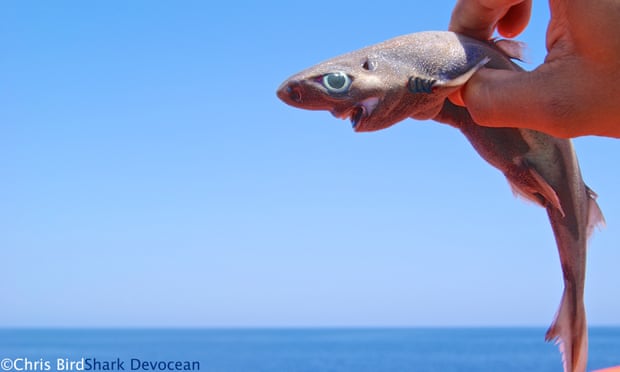
All this leads me to another light-emitting sea creature recently discovered near Hawaii, a shark.

Lauren Smith writes at the Guardian, “Light emitted by a new species of lanternshark, Etmopterus lailae, is camouflage and helps them to hunt, communicate and find partners. Early [in 2017] a new species of deep water shark, Etmopterus lailae, was discovered in waters surrounding the Northwestern Hawaiian Islands in the Pacific Ocean.

“Measurements of external features, teeth, vertebrae and intestines, along with specific external markings and patterns confirmed that it was indeed a new species – a member of the lanternshark family. Lanternsharks (Etmopteridae) are one of the most species-rich shark genera. …

“The lanternsharks are one of two deep sea shark families to possess the ability to bioluminesce – in other words, they are able to glow in the dark. The other shark family with the ability to do this are the kitefin sharks (Dalatiidae). This family houses the infamous cookie cutter shark, which was known for its impressive ability to disable US Navy submarines in the 70s and 80s. …

“Bioluminescence is the emission of light as a result of a biochemical reaction. In contrast to fluorescence and phosphorescence, bioluminescenct reactions do not require the initial absorption of sunlight or other electromagnetic radiation by a molecule or pigment to emit light. …

“Bioluminescence in vertebrates is found exclusively among fishes living in marine environments. At present the only known terrestrial animals capable of bioluminescence are arthropods. …

“It is also worth noting that bioluminescence is not just exhibited by deep sea dwellers existing in perpetual darkness. [One study] analysed 17 years of video footage taken from the sea’s surface down to a depths of almost 4000 metres. Observations showed that the percentage of bioluminescent animals is remarkably uniform regardless of depth.”

More at the Guardian, here.

Read Full Post »

Photo: Dinghua Yang/AFP/Getty Images
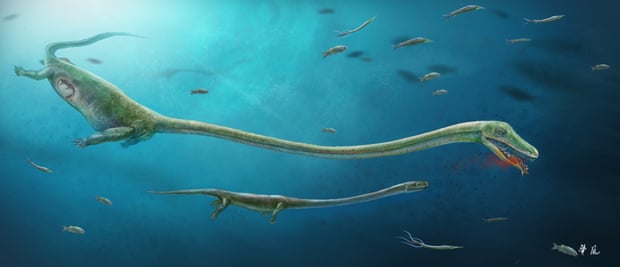
This pregnant Dinocephalosaurus, a long-necked marine reptile, didn’t lay eggs but instead gave birth to live young 245m years ago.

After uncovering new evidence, surprised scientists are revising a long-held understanding of the pre-dinosaur Dinocephalosaurus.

According to a Reuters story at the Guardian, “An extraordinary fossil unearthed in southwestern China shows a pregnant long-necked marine reptile that lived millions of years before the dinosaurs with its developing embryo, indicating the creature gave birth to live babies rather than laying eggs.

“Scientists said [in February that] the fossil of the unusual fish-eating reptile called Dinocephalosaurus, which lived about 245m years ago during the Triassic Period, changes the understanding of the evolution of vertebrate reproductive systems.

“Mammals and some reptiles including certain snakes and lizards are viviparous, meaning they give birth to live young.

“Dinocephalosaurus is the first member of a broad vertebrate group called archosauromorphs that includes birds, crocodilians, dinosaurs and extinct flying reptiles known as pterosaurs known to give birth this way, paleontologist Jun Liu of China’s Hefei University of Technology said. …

“ ‘I think you’d be amazed to see it, with its tiny head and long snaky neck,’ said University of Bristol paleontologist Mike Benton, who also participated in the research published in the journal Nature Communications.

“Its body plan was similar to plesiosaurs, long-necked marine reptiles akin to Scotland’s mythical Loch Ness Monster that thrived later during the dinosaur age, though they were not closely related.

“Not laying eggs provided advantages to Dinocephalosaurus, the researchers said. It indicated the creature was fully marine, not having to leave the ocean to lay eggs on land like sea turtles, exposing the eggs or hatchlings to land predators.” More here.

I admire scientists for continuously revisiting accepted wisdom when they find new data. The only complaint I have about the story concerns the Loch Ness Monster, an old friend of mine. Should one really call it mythical? Perhaps the data just haven’t floated to the surface yet.

Read Full Post »

Video: PBS NewsHour

Not long ago, Julia Griffin of PBS NewsHour interviewed an artist who has turned plastic trash into sculptures with a message.

“JULIA GRIFFIN: Octavia the octopus, Priscilla the parrot fish, and Flash the marlin, all sculptures now on display at Smithsonian’s National Zoo in Washington, D.C., and all made of trash pulled from the Pacific Ocean. …

“Angela Haseltine Pozzi is the lead artist and executive director of Washed Ashore, a nonprofit seeking to educate the public on the plastics polluting the word’s oceans.

“ANGELA HASELTINE POZZI: We create sculptures that can teach people about the problem. And, as an artist, it is a real challenge to use everything that comes up off the beach.

“JULIA GRIFFIN: In six years, Haseltine Pozzi and her team of volunteers have created 66 sculptures from more than 38,000 pounds of debris collected from a stretch of Oregon’s coastline.

“The countless bottle caps, flip-flops and beach toys are just a fraction of the more than 315 billion pounds of plastic estimated to be in the world’s oceans.

“Such plastics not only pose entanglement threats to Marine animals, but are often mistaken for food. …

“JULIA GRIFFIN: As scientists debate how to clean the water, Haseltine Pozzi hopes her sculptures will inspire visitors to curb pollution in the first place.”

The exhibit can be seen at the zoo until September 16, 2016. More at PBS here. Check out the Smithsonian’s site, too.

Photo: Smithsonian

Read Full Post »

I like reading that the numbers of socially conscious companies are increasing. Recently, Naz Akyol at Social Enterprise Greenhouse in Providence wrote about one such business.

“Three years ago, active duty airman Michael Gnoato lost his life in a fatal car accident in Wyoming. Major Pettaway, a Marine who knew Mikey since high school, missed the funeral because he was deployed in Afghanistan at the time, but Navy Seabee Sadam Salas was there to speak at their best friend’s funeral. …

“The two young men are the co-founders (as well as CEO and CFO, respectively) of Mike’s Ice, a deliciously novel idea that pays tribute to their fallen friend, and also a social enterprise committed to fighting veteran homelessness and more.

“Sadam and Major [sell] Thai style ice cream rolls that come in seven fun flavors, … a commodity that only recently hit US markets with only a handful of stores in New York City. They also decided to give their venture four wheels and make Mike’s Ice a mobile truck. …

“Everything that is sold at Mike’s Ice is made from scratch, which means the truck needs to be equipped with special ice cream making machines as well as equipment for storing their ice cream bases and toppings. When asked about the greatest challenge they have faced so far, Sadam smiles and says: ‘You don’t sleep a lot.’ …

“Mike’s Ice received a SEG Hub Scholarship from Social Enterprise Greenhouse … [and] is partnered with Backpacks For Life, a nonprofit that provides homeless veterans with backpacks that contain essentials for survival.

‘We are both veterans, and now we are also entrepreneurs, and entrepreneurs exist to solve problems,’ Sadam says. ‘Veteran homelessness, suicide …. these problems shouldn’t exist. These are people who fought for their country.’

More here.

Photo: Social Enterprise Greenhouse

Read Full Post »

Photo: National Oceanic and Atmospheric Administration
A sponge the size of a minivan was found in summer 2015 in the Papahānaumokuākea Marine National Monument off Hawaii.

One of Earth’s oldest living animals is a sea sponge. As big as a minivan, it has been growing for generations unnoticed and undisturbed in waters off Hawaii.

Elahe Izadi writes in the Washington Post that a remotely operated vehicle (ROV) “captured footage of the spectacularly large sponge during a National Oceanic and Atmospheric Administration deep-sea expedition, and the species was identified for the first time in a study published [in May] in the journal Marine Biodiversity. …

“There’s more to this sponge than its girth: It could also be among the oldest living animals on earth. … Sponges can live for hundreds or even thousands of years. ‘While not much is known about the lifespan of sponges, some massive species found in shallow waters are estimated to live for more than 2,300 years,’ the study authors write. …

“ ‘Finding such an enormous and presumably old sponge emphasizes how much can be learned from studying deep and pristine environments such as those found in the remote Papahānaumokuākea Marine National Monument,’ Daniel Wagner, Papahānaumokuākea research specialist, said in a statement. …

“Christopher Kelly, NOAA research scientist and co-lead for the expedition, said the sponge ‘just appeared’ on the ROV’s high-definition camera, Australia’s Pacific Beat radio reported.

” ‘We were looking for deep water corals and sponges, and we had just gotten some close ups of some corals, then turned away to continue the survey and the sponge appeared out of nowhere.’ ”

I can just picture that cinematic moment of discovery.

More at the Washington Post, here.

Read Full Post »

My friend Kristina is an artist with a long-time interest in shells. At a Harvard-based shell club that she frequents, she meets many interesting artists and scientists — including George Buckley, a Caribbean coral reef researcher who made the video below.

Buckley says, “Little did I know in 1976 that my first visit to Bonaire to study land snails … and dive with Captain Don Stewart would lead to a career interconnected with Bonaire and to some 100 more return trips!

“Bonaire became the focus of case study after case study of marine management and biodiversity in my Harvard University environmental management program. [Dozens] of research and study groups, students, magazine writers and photographers that I brought to the island all fell in love with the landscapes and the emerald sea of Bonaire.

“The early years of the Bonaire Marine Park [BMP] and STINAPA [Dutch acronym for national park] … were a great adventure and while my efforts with the Carco Project and Marecultura were not as successful as hoped, both helped to lay the groundwork for future efforts around the world as to best practices in that field.

“The BMP’s pioneering leadership in education, moorings, gloves policies, banning light sticks and spearfishing, creating the ‘Nature Fee’ and so much more led to Bonaire’s well-deserved world-wide recognition. The efforts to save Klein Bonaire were a testament to international collaboration and stand to this day as the Hallmark of what a committed group of concerned people can accomplish. It is indeed true that Bonaire is to conservation of nature as Greenwich is to time – with credit to Captain Don.”

If you are on Facebook, check out the rest of Buckley’s post.

Photo: Sand Dollar in Bonaire


Read Full Post »

What is going on with the oceans? Warming trends are bringing sea creatures further north and for longer periods.

In January, Oliver Milman reported at the Guardian about a sea snake with a suggestive name (“Why you yellow-bellied sea snake, you …!”) that has suddenly shown up in California.

“California beachgoers have been urged to steer clear of a species of highly venomous sea snake following a third, and unprecedented, instance of an aquatic serpent washing up on to the state’s beaches.

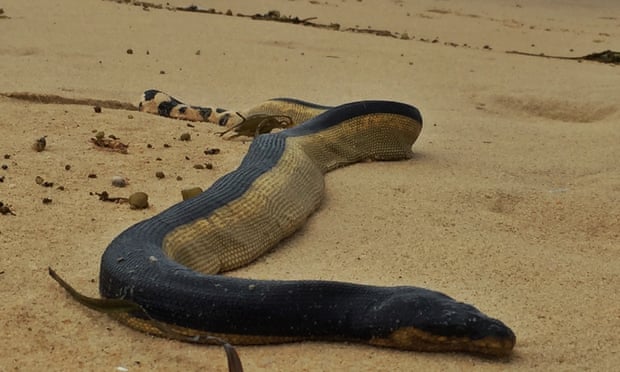
“A 20-inch yellow-bellied sea snake was discovered on a beach near San Diego … The sighting was the third reported instance since October of the species, which prefers the tropical waters of the Pacific and Indian oceans, washing up on California’s beaches.

“The only previous verified sighting of a washed-up yellow-bellied sea snake was in 1972. Experts believe the snakes have ridden a warm current of water, fueled by the exceptionally strong El Niño climatic event, farther north than they have ever previously ventured. …

“ ‘It’s been an incredibly interesting year for southern California. We’ve seen tuna and marlin and tropical bird species such as red-footed boobies,’ said Greg Pauly, curator of herpetology at the Natural History Museum of Los Angeles County. …

“Yellow-bellied sea snakes are fully aquatic snakes capable of swimming vast distances. Although they are highly venomous, their targets are small fish and it’s thought they have yet to cause a recorded human death. However, Pauly said people should keep their distance if they encounter another washed-up snake.

“ ‘They are fairly docile and it’s unlikely for someone to be envenomated,’ he said. ‘It’s rare for them to bite people, it’s usually fishermen who are carelessly pulling up fishing nets.’ ”

More here.

Photo: Carolyn Larcombe/Wandiyali Images
Seen in California after el Niño, yellow-bellied sea snakes usually live in the deep waters of the Pacific and Indian oceans. 

Read Full Post »

Photo: Bob Plain

I do love the inventiveness of entrepreneurs. A friend of Suzanne and Erik’s is an inventive entrepreneur — an oyster entrepreneur, to be specific. Since oysters are a seasonal crop, he looked for something that might become his winter crop.

Bob Plain’s Narragansett Bay Blog has the story on Jules Opton-Himmel, RI’s first kelp farmer.

“Kelp, you may or may not have heard, is the next super food. It’s nutritious, sustainable and ecologically beneficial,” writes Plain.

He continues with a quote from a recent New Yorker article by Dana Goodyear: ” ‘Seaweed, which requires neither fresh water nor fertilizer, is one of the world’s most sustainable and nutritious crops. It absorbs dissolved nitrogen, phosphorous, and carbon dioxide directly from the sea — its footprint is negative — and proliferates at a terrific rate.’ …

“Coincidentally – and quite auspiciously – just as the blockbuster New Yorker article hit the newsstands, Opton-Himmel was gearing up to introduce kelp farming to Rhode Island. …

“Farm-raised kelp is grown on a longline – a submersible thick rope, held in place by anchors and buoys, that is used to hold in place seafood harvesting equipment. A thin string of kelp spores is wrapped around the longline, and the kelp grows toward the bottom. Opton-Himmel, with the help of Scott Lindell and David Bailey from the Marine Biological Laboratory in Woods Hole, Mass, planted 1,000 feet. …

“Unlike oysters, which grow in the warmer months, kelp only grows when it’s cold. That means it could prove an off-season bumper crop for otherwise summertime-only seafood harvesters. Walrus and Carpenter downsizes from 7 to 3 employees in the winter, Opton-Himmel said, and kelp could help him keep the other four on the payroll all year long.

“ ‘I’d love to keep all 6 on year-round,’ Opton-Himmel said.”

More here.

Read Full Post »

Don’t you love it when something that is extinct turns out not to be extinct at all? Like coelacanths, which, according to Wikipedia, “were thought to have become extinct in the Late Cretaceous, around 66 million years ago, but were rediscovered in 1938 off the coast of South Africa.”

While I’m waiting for someone to prove unequivocally the existence of the Ivory Billed Woodpecker, I will regale myself with Lazarus-like sea snakes in Australia.

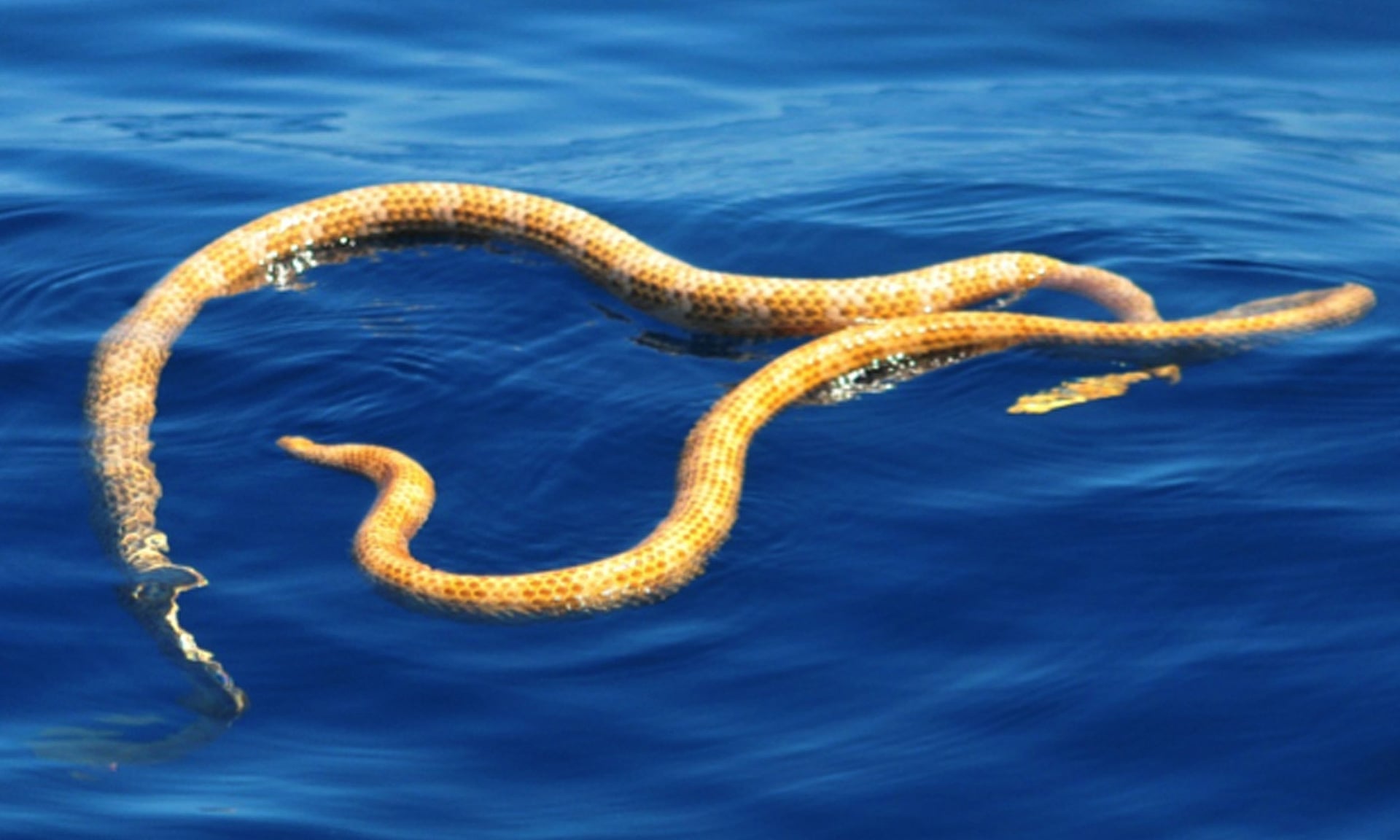
I saw this Australian Associated Press story at the Guardian: “A species of sea snake thought to be extinct has been rediscovered off the Western Australian coast. A wildlife officer spotted two courting short-nosed sea snakes while patrolling in Ningaloo marine park on the state’s mid-north coast. …

“The Western Australian environment minister, Albert Jacob, said the discovery was especially important because they had never been seen at Ningaloo reef.

“A Department of Parks and Wildlife officer photographed the snakes on Ningaloo Reef and James Cook university scientists identified them.”

Maybe marine creatures such as sea snakes and coelacanths are more likely to be preserved than woodpeckers — hidden away in the ocean’s unexplored depths. Still, as a movie I reviewed, Revolution, made clear, the seas are threatened, too.

More on courting sea snakes at the Guardian.

Photo: Grant Giffen/AFP/Getty Images
The discovery of the short-nosed sea snake, previously thought to have been extinct, is significant because the species had never been seen in the Ningaloo marine park in Western Australia before.

Read Full Post »

Maria Popova linked to this story on twitter. It’s about how climate change is affecting a way of life for Fiji Islanders.

Meehan Crist writes at the blog Nautil.us, “The day that conservation biologist Joshua Drew, his two students, and I arrive in the Fijian village of Nagigi, the wind is blowing so hard that the coconut palms are bent sideways. ‘Trade winds,’ we are told. And, ‘El Nino. The villagers here also know that climate change is affecting the weather, but their more immediate problem, shared across the Pacific—and, indeed, the world—is an ocean ecosystem sorely depleted by overfishing.

“Nagigi is a village of about 240 people living in tin-roofed wooden homes strung along a sandy coastline. A single paved road runs the length of the village, parallel to the ocean, and along this road are homes clustered by family, painted in cheerful pastels, and connected by well-worn paths through the crab grass. ‘Before,’ said Avisake Nasi, a woman in her late 50s who has been fishing this reef her whole life, ‘you just go out and you find plenty fish. Now, you have to look.’ …

“If pressures mount from too many sides at once—rising ocean temperatures, acidification, pollution, overfishing—the combined pressure will be too much even for Fiji’s remarkably resilient reefs to bear. …

“Conservationists and humanitarian groups have recently united in the call for sustainable resource management, and in this trend, Nagigi is ahead of much of the Western world. Villagers have been discussing how they might use a traditional ban on fishing known as a tabu (tam-bu) to help manage their marine resources in new ways. …

“Drew presents his findings about how fish here are interconnected with other reefs, and how to best protect the species most important to the village in terms of food and income. He talks about how, for the last three years, he has been collecting baseline data about the species present on the reef so that if the village sets up a tabu, its effects can be measured.

“His audience is most interested in what Drew has to say about where to set up a tabu—include the mangroves at the left side of the village shore, because they act as fish nurseries—and for how long—three years would give crucial species enough time to mature and spawn. There has been some talk of a one-year tabu, which would be less of a hardship for villagers who will have to walk a mile or more to reach ocean where they are allowed to fish. But Drew’s data suggest this wouldn’t be long enough to make the sort of difference the village wants to see. ‘I can only offer information,’ Drew says at the end of his presentation, ‘the decision is yours.’ ”

The reporting for Crist’s  story was made possible by a grant from the Mindlin Foundation.

Try to see the related climate-change movie Revolution, which I wrote about here.

Photo: Meehan Crist
The view from Nagigi’s school to the sea, where many locals make their living

Read Full Post »

I was charmed by Sy Montgomery’s recent article in the Boston Globe on the intelligence of octopi (she says “octopuses”).

The author of The Soul of an Octopus: A Surprising Exploration into the Wonder of Consciousness, Montgomery describes getting to know a clever and apparently affectionate octopus called Octavia.

“Everyone wanted to pet Octavia,” she writes. “And no wonder. She was beautiful, graceful, and affectionate. The fact that she was boneless, slimy, and living in painfully cold, 47-degree water deterred none of us.

“What thrilled us — me, New England Aquarium volunteer Wilson Menashi, and four visitors from the environmental radio show Living on Earth was the surprising fact that Octavia, who clearly wanted to be petted, was a giant Pacific octopus.

“When her keeper, Bill Murphy, opened the top of her exhibit, Octavia recognized Menashi and me immediately; we’d been working with her for several weeks. Turning red with excitement, she flowed over toward us from the far side of her tank. When we put our hands in the water, her arms rose to meet ours, embracing us with dozens of her strong, sensitive, white suckers. Occasionally Wilson handed her a fish from the plastic bucket perched on the edge of her tank. …

“Then, as Menashi reached for another capelin to feed her, we realized the bucket of fish was gone. While no fewer than six people were watching, and three of us had our arms in her tank, Octavia had stolen the bucket right out from under us.

“ ‘Octopuses are phenomenally smart,’ Menashi says. And he should know: He has worked with them for 20 years, and is expert in keeping these intelligent invertebrates occupied. Otherwise, they become bored. Aquariums design elaborate escape-proof lids for their octopus tanks, and still they are often thwarted. Octopuses not infrequently slip out of their exhibits and turn up in other tanks to eat the inhabitants.

“Many aquariums give their octopuses Legos to dismantle, jars with lids to unscrew, and Mr. Potato Head to play with. Menashi, a retired inventor, designed a series of nesting Plexiglas cubes, each with a different lock, which Boston’s octopuses quickly learned to open to get at a tasty crab inside. And just this spring, New Zealand Sea Life aquarists teamed up with Sony engineers to teach a female octopus named Rambo to press the red shutter button on a waterproof camera to take photos of visitors, which the aquarium sells for $2 each to benefit its conservation programs. Rambo learned in three attempts.”

What a different perspective on the scary beast in the film 20,000 Leagues Under the Sea, which I saw as a child.

I’d love to copy the whole intriguing article, but I’m afraid that would not be “fair use.” So read it all here.

Photo: Tia Strombeck
Sy Montgomery pets Octavia, an octopus at the New England Aquarium in Boston.

Read Full Post »

As a longtime believer in “one and one and 50 make a million,” I am not surprised to learn that some big environmental problems are being successfully tackled through small-dollar grants.

Karen Weintraub writes at the NY Times, “In Pakistan and India, the blind Indus River dolphin, one of the most endangered species, swims a shrinking stretch of water, trapped by development and dams. …

“Overfishing, habitat loss and pollution threaten species in so many places that research and conservation organizations cannot do all that is needed. So, with the aim of making a dent through small, targeted efforts, the New England Aquarium, which sits on Boston’s downtown waterfront, has for 15 years awarded microgrants to projects across the globe. …

“The aquarium’s Marine Conservation Action Fund has paid out $700,000 since 1999, supporting 122 projects in 40 countries on six continents. Elizabeth Stephenson, the fund’s manager, calls these projects ‘stories of hope for the ocean.’

“The grants are modest. One researcher, Rohan Arthur, used his $6,700 payout from the fund to buy a ‘secondhand, beat-up compressor’ to fill his scuba tanks. But the support allowed him to maintain his critical assessment of coral reefs in the Arabian Sea off the west coast of India.

“Dr. Arthur, a senior scientist at the Nature Conservation Foundation in Karnataka, India, said that in some ways, he preferred the scale of the New England Aquarium gifts. …

“Small grants, he said, offer more freedom, but can still be transformative. …

“Gill Braulik, a dolphin expert based in Tanzania, used a … grant in 2011 to teach Pakistani scientists to take over her research on a blind dolphin species that lives only in the Indus River. …

“In 2011, a $6,000 aquarium grant allowed her to train the local researchers in complex survey methods and analysis. Now, two groups of local scientists have led the work. ‘They really don’t need me anymore,’ she said.”

Read more here.

Photo: Gill Braulik
Najam Ul-Huda Khan, left, interviews village elders about sightings of Indus River dolphins. 

Read Full Post »

Suzanne’s Mom was asked to review Revolution, a film by the young environmentalist, biologist, diver, and Sharkwater filmmaker Rob Stewart.

Encompassing gorgeous deep-sea photography, scientific climate-change testimony, a representative of the drowning country of Seychelles, and many youth demonstrations, the documentary forces you to think about what the burning of fossil fuels is doing to the oceans and what it means for the future of the planet. It also gives you the sense that anyone can do something about it — take up a camera, make a poster, or write a letter that makes a change.

The film is infused with a sense of youth, of young people saying, “Enough!” I particularly loved the moment early on when Stewart, who had read only two books on filmmaking, is flubbing his lines in front of Darwin’s Arch. What comes across in addition to the humorous inexperience is a feeling of energy, optimism, and determination.

The film has many engaging details about sea life that Stewart can’t resist throwing in, like how the endangered pygmy seahorse, which camouflages itself to look like coral, “mates for life — and the guy gets pregnant!”

He talks about how the burning of fossil fuels creates too much carbon dioxide, which is absorbed by the ocean and is harmful to anything that needs to grow a skeleton, which is pretty much everything but nasty, poisonous creatures that flourish in the muck where corals died, like the flamboyant cuttlefish. Coral expert Charlie Veron comments that at the same rate of ocean acidification caused by too much CO2, there will be no coral reefs in 50 years.

Stewart also looks at the island nation Madagascar, sole home of lemurs, explaining that endangered tropical forests are responsible for 1/4 of the world’s species and 1/3 of our oxygen. Madagascar scientist Serge Rajaobelina says that population growth on the island and the burning of the trees for development has meant the loss of 80 percent of the forest in 40 years, more than in 55 million years.

The movie goes on to cover perhaps a few too many youth protests, including one in which an inspired, tree-planting young boy says, “We have found we have to save our own future,” and is later arrested in tears.

But then we get to see that children and young adults are actually having an impact.

A sixth-grade class in Saipan writes letters to the Saipan government against killing sharks for shark fin soup, and the government signs a law preventing the practice. In fact, we are told, since the first Stewart film, China, the main adherent of shark-fin soup, has dropped the practice by 70 percent, and 100 countries have banned it.

The upbeat Saipan children who comment on their successful advocacy embody the truth of my favorite Pete Seeger line, “one and one and 50 make a million.” Says one, “Maybe the world might not end because of what we are doing.”

Watch the Revolution trailer here.

[We do not accept gifts here, so the DVD that the film company sends me for screening and reviewing will be forwarded to Save the Bay, RI.]

The late Rob Stewart. The filmmaker did not come up from a dive 1/31/17 near Key Largo.
rob_stewart_memdf

Read Full Post »

The radio show Living on Earth (LOE) reported recently on work to restore seaweeds that are a key part of the ecosystem.

From the LOE website: “Ripped from the seafloor by strong swells, massive amounts of kelp recently washed ashore in southern California. But the uprooted algae may actually be a sign of successful kelp restoration efforts. Marine biologist Nancy Caruso discusses the fragile ecosystem and how she and a community are helping to rebuild the majestic kelp forests.”

Radio host Steve Curwood interviewed Caruso. She recounts how she began 12 years ago with a group of students and volunteers “to restore the kelp forests off of Orange County’s coast.”

After a storm, she says, big holes get ripped in the forest of kelp, often 10 feet high. Then “new life can grow from the bottom up, and so if we see this happen, which we’re seeing right now, the kelp returns immediately after this event, then we know that our restoration efforts are successful, and after 30 years of our local ecosystem not having healthy kelp forests, we can rest assured that it’s now restored.”

To Curwood’s question about how restoration is done, Caruso answers, “It was actually quite an effort because I had the help of 5,000 students from ages 11 to 18 as well as 250 skilled volunteer divers, and we planted this kelp in 15 different areas in Orange County. There’s a spot down in Dana Point. It’s the only kelp forest that was left in Orange County so we would collect the reproductive blades from those kelp plants, and I would take them into the classrooms for the students to clean them and we would actually stress them out overnight. We would leave them out of water in the refrigerator, kind covered with paper towels, and then the next morning we would put them back in the ice-cold seawater and the kelp blade would release millions of spores” that would then be raised in nurseries and returned to the ocean.

“All those animals that get washed up on the beach inside the wrangled tangled kelp become a food source for shorebirds that live along our coast.”

More from Living on Earth here. For more on the importance of seaweed, see also Derrick Z. Jackson’s article in the Boston Sunday Globe: “Eelgrass Could Save the Planet.”

Photo: NOAA’s National Ocean Service
Kelp forests can be seen along much of the west coast of North America.

Read Full Post »

John sent a link to a story at Business Insider about a science fair project that could have a real impact on the environment.

Jessica Orwig writes, “This 13-year-old is trying to save the world one ecosystem at a time. Chythanya Murali, an eighth grader from Arkansas, has created a safe, effective, non-conventional method to clean oil spills, by harnessing the cleaning properties of bacteria — specifically the enzymes they use to break down oil particles. These enzymes disassemble oil molecules, making way for the bacteria to convert it into harmless compounds. …

“In 2012, a study found a chilling discovery about the oil-cleaning agents dispersed in the Gulf of Mexico after the Deepwater Horizon oil spill of 2010. When combined with the oil itself, the resulting mixture was 52 times more toxic to small animals like plankton than oil alone. …

” ‘My inspiration for this project began [from] the immense damage caused by the BP oil spill in early 2010.’

“To improve oil-cleaning methods, Murali designed a science fair project that explored the different mixtures of oil-eating enzymes and oil-breaking-down bacterias, to see how they effect the marine environment.

” ‘The combination of bio-additive enzymes and oil-degrading bacteria as a novel combination for short and long-term cleaning, and its effect on ecosystems, was not explored before,’ Murali told Business Insider.

“So it only seemed natural to Murali to combine the two and see what happened. She discovered that in a small-scale aquarium, the combination of her chosen oil-cleaning agents could help remove oil while preserving the health of the overall ecosystem, something that some of the oil-cleaning agents we use today cannot achieve.” Read more here.

Kids are going to save the world, I think.

Photo: Chythanya Murali
Chythanya Murali with her science fair poster.

Read Full Post »

« Newer Posts - Older Posts »