Feeds:
Posts
Comments

Posts Tagged ‘math’

Photo: MSG Entertainment/Victoria Lewis.
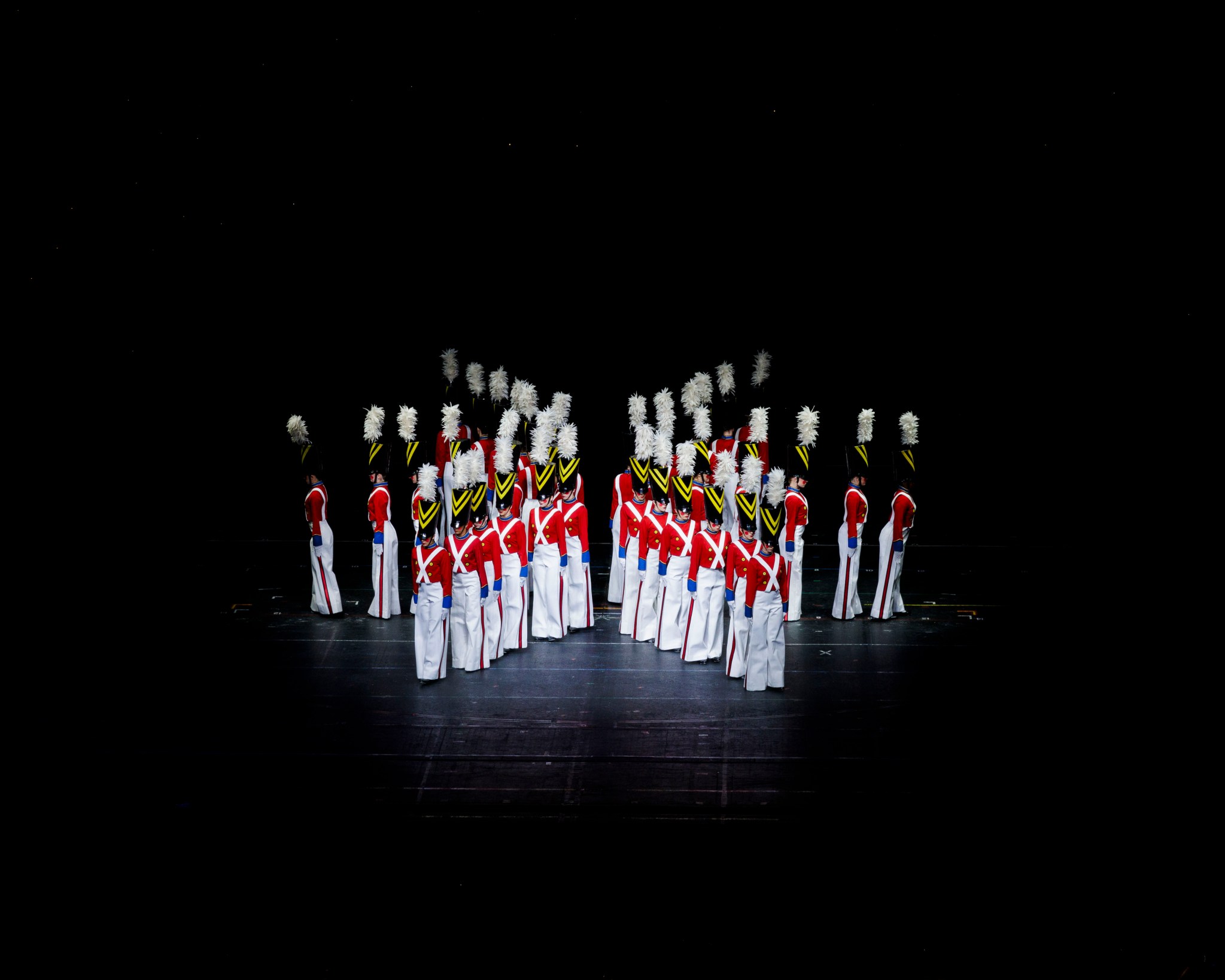
In “Parade of the Wooden Soldiers,” the 36 Rockettes on stage imitate the stiff movements of toy soldiers. This photo was taken during a dress rehearsal on November 6, 2024. 

For many New Yorkers and visitors to New York, the holiday season is a time to see the Rockettes at Radio City Music Hall. I went there once as a child with my babysitter. We saw the Rockettes, and then we saw the featured movie. The movie was Million Dollar Mermaid, a biopic about an Australian swimming legend. It starred Esther Williams and it made a big impression on me. Maybe an even bigger impression than the Rockettes did.

But the Rockettes are a wonder of the world. And today’s article — from Popular Science, of all things — explains just how they do what they do.

Laura Baisas writes, “Every holiday season, the Radio City Rockettes dazzle with their eye-high kicks that seemingly defy gravity. During the precision dance company’s roughly 200 shows over eight weeks, a dancer can do up to 650 kicks in a single day. For all this kicking, Rockettes must stay in peak physical condition. While this signature kick is a festive feat of physics in its own right, the math on stage also makes the magic.

“The Rockette’s home at Radio City Music Hall in New York City first opened its doors in 1932. … With this storied stage history, it should come as no surprise that a show that has been running for close to a century continues to use some tried-and-true, but admittedly low-tech methods. 

‘Our stage is set up like a giant piece of graph paper.’ 

“ ‘Our stage is set up like a giant piece of graph paper,’ Julie Branam, a former Rockette herself and the current director and choreographer of the Radio City Christmas Spectacular, tells Popular Science. ‘Every two feet, there’s a number and a dash or a solid line. There are also colored lines, so you will see red, green, blue, white, and upstage of each one of those lines is a dotted line. So everywhere you look, is a giant piece of graph paper and that’s how we figure things out.’ …

“Rehearsals typically start in October and the whole show is plotted onto actual paper so that the choreographers and dancers can get an idea of how their dances will look from the audience. For example, the iconic ‘Parade of Wooden Soldiers‘ number is seven pages long for roughly five to six minutes of dancing. 

“ ‘As we are learning choreography, I can sort of see almost an overhead visual of where my coordinate is,’ Danelle Morgan, a current Rockette who also serves as an Assistant Choreographer and Dance Captain, tells Popular Science. …

“ ‘Parade of the Wooden Soldiers’ is one of the original numbers from the show, which has been performed since the Christmas Spectacular first premiered in 1933. It’s a fan favorite, for its military-like steps and the iconic slow fall at the piece’s conclusion. …

“ ‘Every four counts they’re going to replace the line in front of them and we have 24 counts. And then that spoke [of the wheel] will revolve,’ explains Branam. ‘So you can really see where you’re going and know where everybody is and how far they’re traveling.’

“Choreographers will also use design softwares like OmniGraffle to create a digital version of these stage puzzles and plot the movements of the 36 dancers on stage. Each dancer follows an individual track, so she knows what order and where to go on the stage. Everyone is also lettered so that they can refer back to the plot points and quickly see where they need to be. Still, it’s all easier said than done on paper. 

“ ‘As a dancer, I challenge my body so much, but each Rockette has to challenge their brain so much as well.’ … says Morgan. ‘When you step into this position, then it’s a completely different brain game and a different brain challenge. It’s puzzles.’ …

“Since uniformity is key to making the precise patterns that the Rockettes are famous for, the company has what are called swings. In performing, swings are sort of an understudy times 10, who has to learn multiple parts instead of just one. Morgan is currently one of 12 swings in the company. …

“ ‘We know every single Rockette’s individual track, with the help of our charts and the information that we get in rehearsal, so we’re ready to jump in at a moment’s notice,’ says Morgan. … ‘We can jump in costume and then give the audience the same show that they deserve every single show. It’s a high adrenaline situation every time.’

“The festive costumes might make being Rockette look glamorous, but it takes a lot of grit to be a Rockette. In addition to the precision of their dancing, costume changes as short as 78 seconds, and physical challenges, there is also the mental load of performing in up to four shows a day for eight weeks. 

“That comes down to ‘training your resilience,’ putting mind over matter, and importantly, leaning on your fellow Rockettes when you think you just can’t do another kick. The special appearances at major events like the Macy’s Thanksgiving Day Parade or Rockefeller Center Christmas Tree Lighting or working with younger dancers also help boost company morale. 

“ ‘It’s just constantly having that reminder that what we do is something super unique that brings so much joy to so many people,’ says Morgan. ‘I think that helps us get through and keeps us motivated.’ “

More at Popular Science, here.
Read Full Post »

Photo: Earth.com.
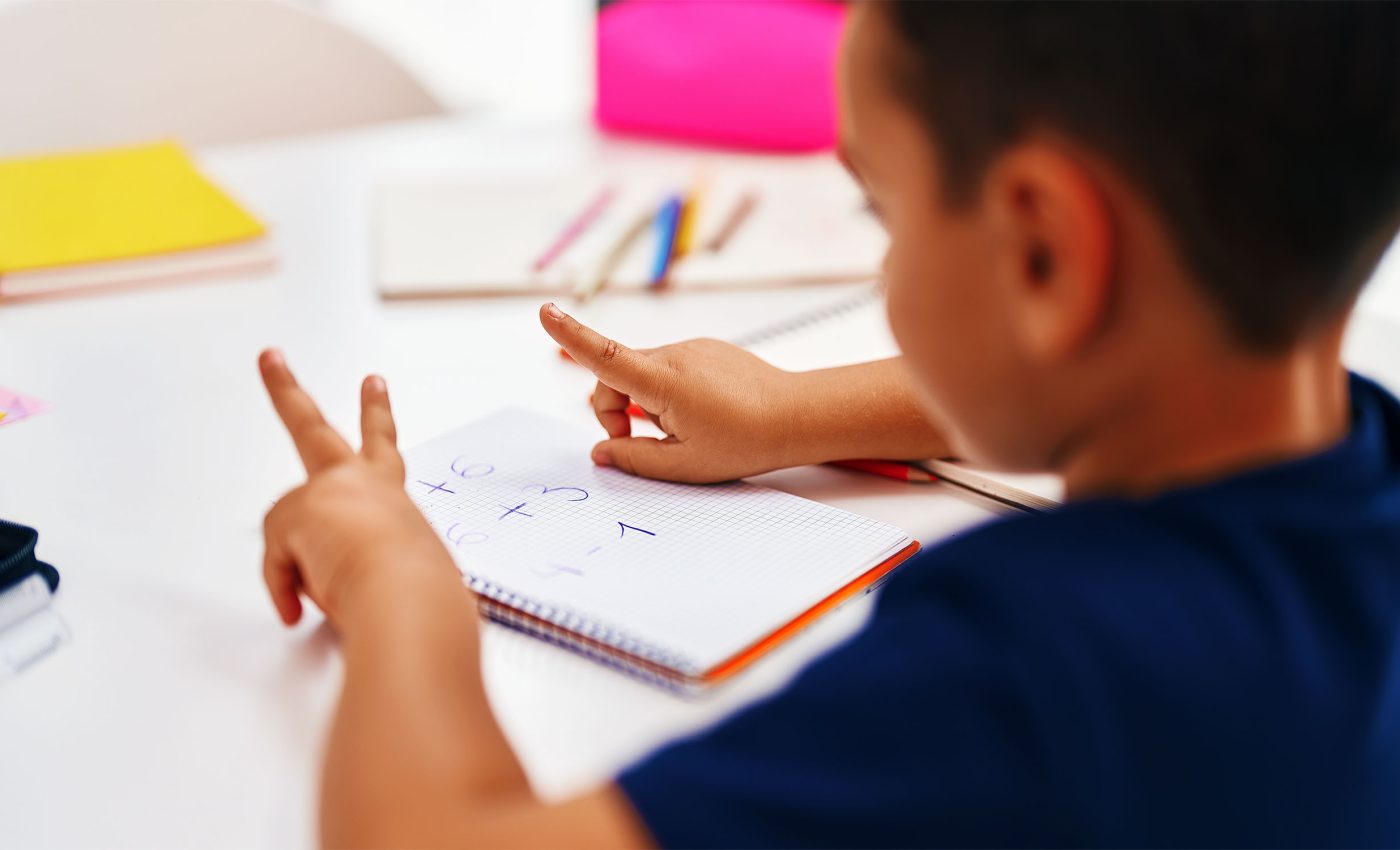
In the bad old days, parents were misled about what was good for children. Remember forcing left-handed kids to use their right? Remember that counting on fingers was wrong? Fortunately, humans do learn from mistakes.

Everything old is new again. But you knew that. Here’s new old news from the world of elementary school arithmetic. Stephen Beech wrote the story at TalkerNews and many outlets carried it, including NBC.

“Counting on fingers really does help youngsters improve their math skills, according to a new study. The research is the first to show that children’s performance in arithmetic can show a ‘huge’ improvement through the teaching of a finger-counting method. …

“Swiss and French researchers explored whether finger counting can help primary school-aged children to solve maths problems in a new study, published in the journal Child Development. …

“Young children who use their fingers to solve such problems are recognized as intelligent, probably because they have already reached a level that allows them to understand that a quantity can be represented by different means.

“It is only from the age of eight that using finger counting to solve very simple problems can indicate math difficulties, according to the study.

“The research aimed to determine whether children who don’t count on their fingers can be trained to do so, and whether such training would result in enhanced arithmetic performance.

“The study focused on 328 five- and six-year-old children at kindergarten, mainly living in France, and tested their abilities to solve simple addition problems. Participating children were recruited through their teachers who voluntarily took part in the experiment.

“The study included a pre-test, training held over two weeks, a post-test closely after the training’s end, and a delayed post-test.

“The results showed an ‘important increase’ in performance between pre- and post-test for the trained children who did not count on their fingers originally — from 37% to 77% of correct responses – compared to non-finger users in the control group.

“The research team suggests that since children who use their fingers to help solve math problems outperform those who do not, teaching a finger-counting strategy could help reduce inequity among children in math.

“However, they say whether children who use finger counting are using it as an arithmetic procedure or understand something deeper about numbers will still need to be determined with future research.

“Study leader Dr. Catherine Thevenot said: ‘Our findings are highly valuable because, for the first time, we provide a concrete answer to the long-standing question of whether teachers should explicitly teach children to use their fingers for solving addition problems — especially those who don’t do so naturally. Our study demonstrates that finger calculation training is effective for over 75% of kindergartners.

” ‘The next step is to explore how we can support the remaining 25% of children who didn’t respond as well to the intervention.’

“Dr. Thevenot, of the Institute of Psychology at the University of Lausanne in Switzerland, says the study came about as a result of conversations with primary school teachers.

“She said: ‘They often asked me whether they should encourage or discourage children from using their fingers to solve calculations. Surprisingly, the existing research didn’t offer a clear answer, which left teachers understandably frustrated with my frequent response of “I don’t know.” …

” ‘The best way to provide a meaningful answer was through experimental studies — so that’s exactly what I set out to do.

” ‘When I first saw the results, I was amazed by the huge improvement in performance among children who didn’t initially use their fingers to solve the problems. Before our intervention, these children were only able to solve about one-third of the addition problems at pre-test.

” ‘After training, however, they were solving over three-quarters of them. The difference was striking, especially compared to the control groups, where gains were insignificant. The extent of this improvement truly exceeded my expectations. …

” ‘An important question now is to determine whether what we taught to children goes beyond a mere procedure to solve the problems. In other words, we want to know whether our intervention led to a deeper conceptual understanding of numbers, specifically whether children better grasp how to manipulate the quantities represented by their fingers.

” ‘In fact, we have already started addressing this question and the initial results are very promising. However, we still need to carry out additional experiments to confirm that these improvements are indeed a direct result of our training program.’ “

More at NBC, here, and at Earth.com, here.

Trust those Swiss to figure things out!

Read Full Post »

Photo: Institute For Figuring.
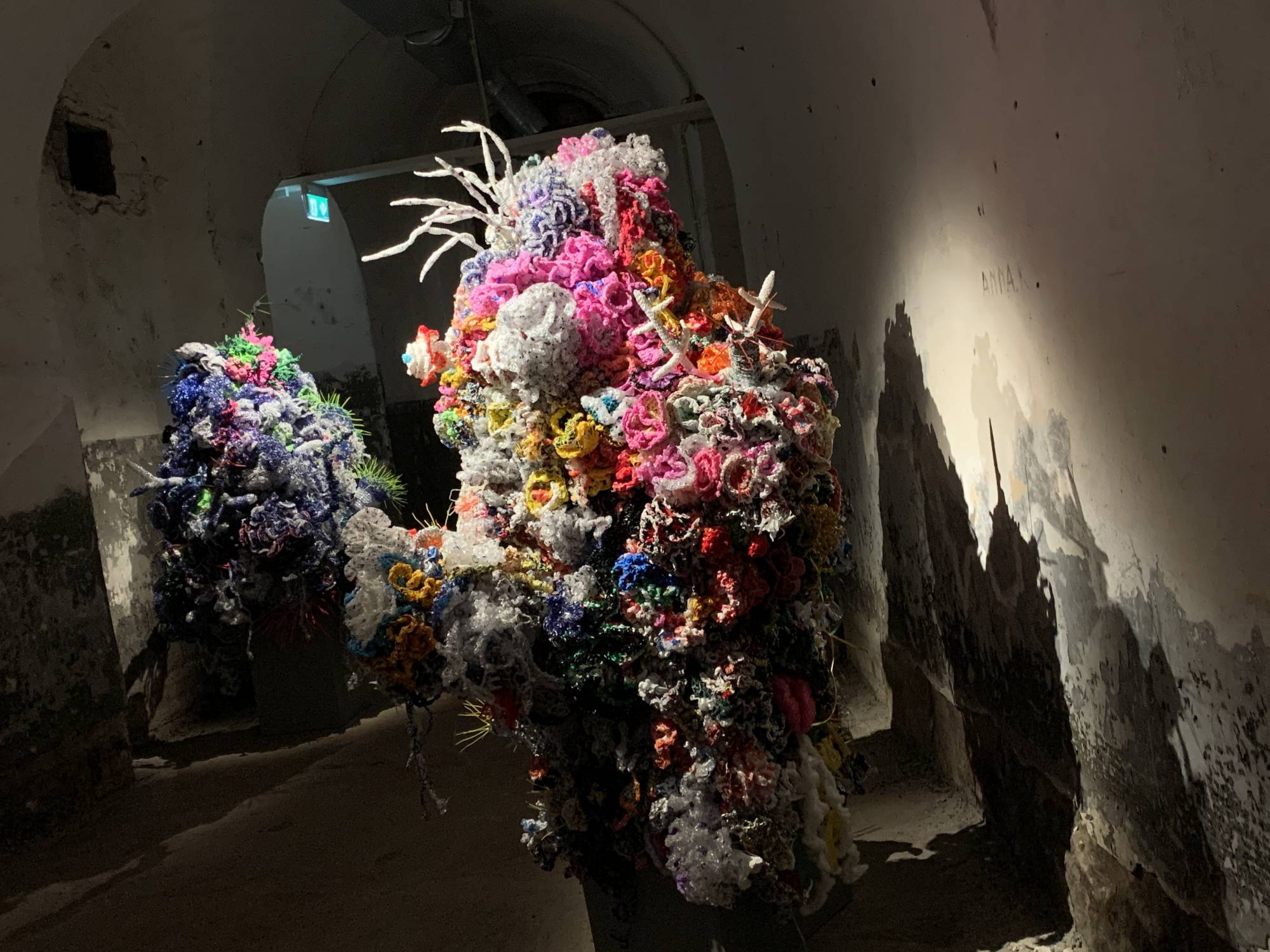
Coral Forest – Helsinki, crocheted from recycled plastic. A collaboration between Christine and Margaret Wertheim and the Helsinki Satellite Reefers, hosted by Helsink Art Museum and Helsinki Biennial 2021.

Remember my post on how crochet art was drawing attention to dying coral reefs? (See it here.) Well, after my friend Kristina told me about seeing some of the new additions to the crochet project, I decided to post a follow-up.

Siobhan Roberts reported at the New York Times in January, “Every year after the full moons in late October and November, Australia’s Great Barrier Reef begins its annual spawning — first the coral species inshore, where waters are warmer, then the offshore corals, the main event. Last year, this natural spectacle coincided with the woolly propagation of two new colonies of the Crochet Coral Reef, a long-running craft-science collaborative artwork now inhabiting the Schlossmuseum in Linz, Austria, and the Carnegie Museum of Art in Pittsburgh.

“To date, nearly 25,000 crocheters (‘reefers’) have created a worldwide archipelago of more than 50 reefs — both a paean to and a plea for these ecosystems, rainforests of the sea, which are threatened by climate change. The project also explores mathematical themes, since many living reef organisms biologically approximate the quirky curvature of hyperbolic geometry. …

“The surface of a sphere displays constant positive curvature; at all points, the surface bends inward toward itself. And a hyperbolic plane exhibits constant negative curvature; at all points, the surface curves away from itself. Reef life thrives on hyperbolism, so to speak; the curvy surface structure of coral maximizes nutrient intake, and nudibranchs propel through water with frilly flanges.

“In the artworks, marine morphologies are modeled — crocheted — with loopy verisimilitude. A bit like Monet’s water lilies, the crochet corals are abstract representations of nature, said Christine Wertheim, an artist and writer now retired from the California Institute of the Arts. Dr. Wertheim is the driving artistic force behind the project, which she created with Margaret Wertheim, her twin sister, a science writer who is in charge of scientific and mathematical components as well as management. …

“Crochet Coral Reef exhibitions typically have two main components: The Wertheims provide an anchor, of sorts, with works from their collection that they have crocheted over the years. They also incorporate pieces by select skilled international contributors. One is a ‘bleached reef,’ evoking corals stressed by increases in ocean temperature; another, a ‘coral forest’ made from yarn and plastic, laments the debris that pollutes reef systems.

“Then in response to an open call, volunteers far and wide crochet a pageant of individual specimens that agglomerate in a ‘satellite reef,’ staged by a local curatorial team with guidance from the Wertheims. … All contributors are credited.

“The largest satellite reef thus far coalesced in 2022 at the Museum Frieder Burda in Baden-Baden, Germany, with some 40,000 coral pieces by about 4,000 contributors. The Wertheims call this the Sistine Chapel of crochet reefs (documented in a splashy exhibition catalog). But the show at the Linz Schlossmuseum, which is dedicated to natural science as well as art and culture, is reminiscent of the work of the painter Giuseppe Arcimboldo, whose collage portraits from depictions of fruits, vegetables and flowers are ‘fantastically heterogeneous, also very funny and clever,’ Ms. Wertheim said.

“The Linz satellite reef unites some 30,000 pieces by 2,000 crocheters. The disparate parts take colorful inspiration from traditional Austrian ‘craftswomanship,’ as the exhibit text puts it, and there is a vast, glittery coral wall that gives a nod to the artist Gustav Klimt. In the Wertheims’ view, however, the crochet coral project is proof that it is not always lone geniuses who create great art, but also communities. In the art world, that is a radical idea, they noted, yet in science big collaborative projects and papers with thousands of authors are not unprecedented. …

“The mathematical dimension of the story intersects (from afar) with research by the applied mathematician Shankar Venkataramani and his students at the University of Arizona. They use idealized models to study hyperbolic surfaces in nature. [The] benefit, he said, is that it helps optimize processes like circulation and nutrient absorption. …

“When Margaret Wertheim, who studied math, physics and computer science at university, learned hyperbolic geometry, she found it ‘a bit bamboozling.’ She took the principles more on faith than understanding. Yet through crocheting models, she said, ‘you really do learn in a very deep way what a hyperbolic structure is, and in a way that I think is very powerfully pedagogical.’ “

More at the Times, here. Gorgeous photos.

See also Crochet Coral Reef, here. As the website notes, “Every crafter who contributes to the project is free to create new species of crochet reef organisms by changing the pattern of stitches or working with novel materials. Over time, a Darwinian landscape of wooly possibility has been brought into being. What started from simple seeds is now an ever-evolving, artifactual, hand-made ‘tree of life.’ “

Read Full Post »

image-1

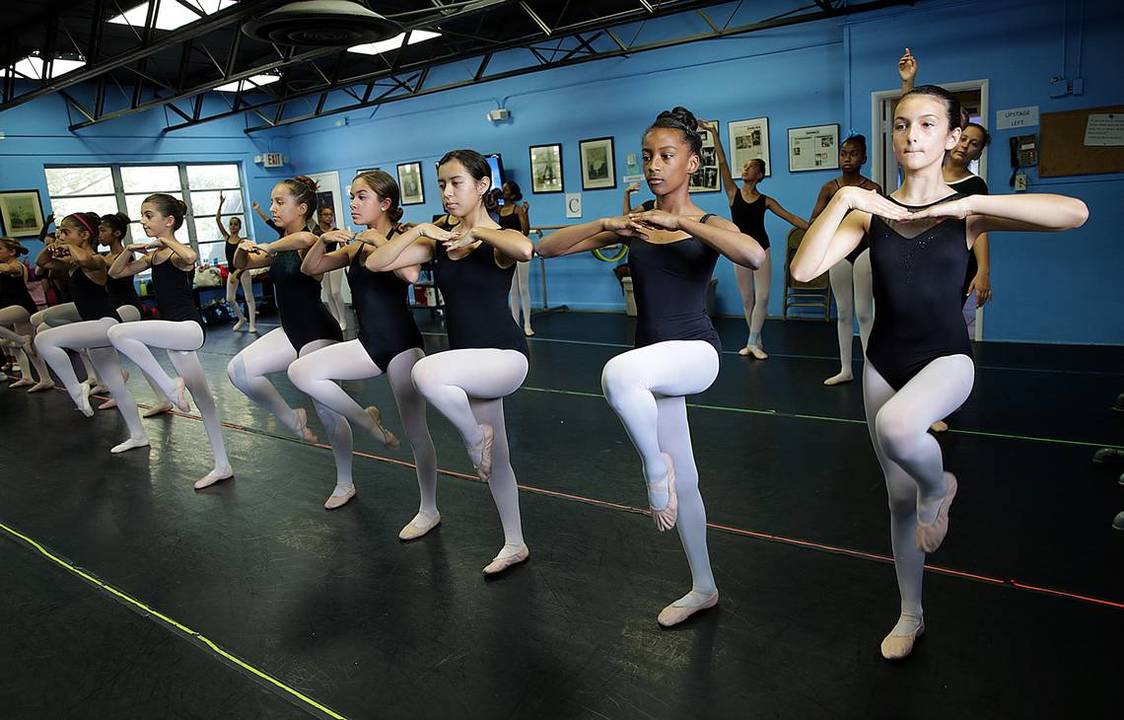
Photo: Thomas Armour Youth Ballet
An unusual ballet company in Miami provides ballet, reading, math and etiquette classes along with access to mental health professionals as needed.

In the fall, my younger granddaughter will start ballet lessons in Rhode Island. “I’m going to be on the stage,” she announced to my neighbor. I’m not sure what, at age 4, ballet classes mean to her, but they have a mighty big aura.

In Miami, an unusual ballet company has been growing an even bigger aura. Thomas Armour Youth Ballet offers dance lessons, yes, but as I learned from this Miami Herald article by Rodolfo Roman, its goals extend well beyond dance.

“When sports journalist Claudia Chang Trejos faced a difficult period in her life, an after-school ballet program helped her overcome obstacles.

“Now, her daughter, Glades Middle School student Sophia Chang Trejos, 14, is following her mother, attending the after-school program at the Thomas Armour Youth Ballet in South Miami.

“The program provides ballet, reading, math and etiquette classes along with access to mental health professionals [and] delivers professionally taught dance classes in multiple genres, at little or no cost to 500 students ages 5-11.

” ‘When she started, I was going through a nasty divorce,’ Claudia said. ‘We were broke. I had no one to help me out with Sophia, so this was a place she could go to, and go with her peers. I went to work and I had a peace of mind.’ …

“ ‘Ballet is not for everybody,’ said Sophia, who credits the program with her getting into the New World School of Arts, the Miami-Dade arts magnet high school, where she will start in the fall.

“ ‘You can start when you are 4 and love it, but when you grow, the technique gets harder and that’s when people quit. What I like about ballet is it’s a different way to train a person. I like the music and the way people are when you are dancing. It is like a movie.’ …

“Director Ruth Wiesen said the program’s goal is to be a vehicle of success.

“ ‘Every now and then, I step back and I am shocked we are able to see these kids succeed and coming back to Miami,’ she said. ‘That is the biggest thrill. They come back, settle down and act like role models.’ …

“No matter what her future holds, Sophia said the program will always have a place in her heart.

“ ‘I plan on coming back when I am older, and teach classes to give back,’ she said.”

More at the Miami Herald, here.

Read Full Post »

I’ve read before about inventive approaches to teaching math — and my daughter-in-law, who coaches teachers of math, probably knows most of them. But recently, the Washington Post examined a new method, one that uses dance.

Reporter Moriah Balingit described observing a kindergarten game that “actually was a serious math lesson about big and small and non-standard measurements. Dreamed up by [drama teacher Melissa] Richardson and kindergarten teacher Carol Hunt, it aims to get the children to think of animal steps as units of measurement, using them to mark how many it takes each animal to get from a starting line to the target.

“[Today] teachers are using dance, drama and the visual arts to teach a variety of academic subjects in a more engaging way. …

“The Wolf Trap Institute, based at the Wolf Trap Foundation for the Performing Arts, brought Richardson to Westlawn Elementary through a program that pairs art teachers with early-childhood educators to formulate math lessons. The program also provides professional development to teachers.

“And the program appears to have been effective: A study by the American Institutes for Research found that students in classes headed by Wolf Trap-trained teachers performed better on math assessments than did their peers being taught by teachers who were not in the program. …

“Researcher Mengli Song said the students in the program did not necessarily learn additional math content but they did demonstrate a better grasp of the material. And the effect was comparable to other early-childhood interventions. …

“Jennifer Cooper, director of the Wolf Trap Institute for Early Learning Through the Arts, said arts integration — particularly lessons where children get to move and play — is a good way to reach a lot of children who struggle with traditional book lessons.

“ ‘By embodying a concept . . . and putting it through your body in a multi-sensory way, you’re going to reach a lot of different kinds of learners,’ Cooper said.”

Read more at the Washington Post, here.

Photo: Bill O’Leary/The Washington Post
Teaching artist Melissa Richardson, right, from the Wolf Trap Institute, watches her kindergarten students at Westlawn Elementary School take large bear steps during a math lesson in Falls Church, Va.

Read Full Post »

Where was mime-matics when I was a child convinced I was bad at math? Pretty sure I would have changed my mind after a few laughs at this comedy show.

Robert Strauss describes it for the New York Times.

“Without saying a word, a man walks on stage carrying a case full of small plungers. Each time he reaches in the case to take some plungers out, he tries to array them in order on a table in front of him, but he always has one left over. Five, seven, 13: No matter what number, there is still that one left alone, and the man gets visibly, but silently, more exasperated at each turn.

“The man is a mime named Tim Chartier, whose day job is associate professor in the department of mathematics and computer science at Davidson College in North Carolina. The plunger skit and many others that he and his wife, Tanya, have developed are part of their Mime-matics business. Having learned from the master of the craft, Marcel Marceau, they use their skills in mime to teach mathematics in a decidedly unconventional way. …

“At Davidson, he teaches a course called Finite Math, which often fills the math/science requirement for history and English majors.

“ ‘It is probably the last time these students will ever take a math course, so I see myself as the last chance they have to have a good experience with math,’ he said. ‘On the first day, I tell them that many of them will one day sit at a table where their kid will ask whether he or she should like math and science. I tell them I want them to get one story to tell that kid that will be positive in the next 16 weeks. It is an important moment in that class. They start looking for a good experience.’

“The Chartiers, who themselves have two children, 8 and 12, said they wanted their approach to Mime-matics to deliver the same positive experience. Even when they perform at colleges, the audiences are filled with children and their parents.

“ ‘Kids start laughing at the sketches and that frees up their parents, who might have long been afraid of math. The kids break the ice,’ said Ms. Chartier, who added that she particularly wants to fight the perception that math is for boys and writing is for girls, and hopes that Mime-matics entices girls to become more attracted to math.” More here.

Photo: Andy McMillan for The New York Times
Tim Chartier practicing a skit. He and his wife perform at colleges, math conferences, festivals and schools across the country.
 

Read Full Post »

Holmes-School-Dorchester-MaA new employee goes to the Oliver Wendell Holmes School in Dorchester with the team I’m on. He can’t get over how great it is to work for an organization that gives you time to do this. We go out once a month from January to June, and other teams go once a month so that we cover every week.

I started eight years ago with the team that read picture books to a room of first graders. Then I read for a few years with fifth or fourth graders who received chapter books from the librarian. These were students whose teachers thought they would appreciate the extra reading. We all read aloud, with the adult volunteers only taking a turn if the story seemed to lag.

Holmes is a minority-majority urban school with many dedicated teachers who are tolerant of the extra work it takes to herd volunteers. (We also have volunteers who work on math.)

This year, the team I’m on includes the woman who started the whole relationship with Holmes 20 years ago and is now retired. We are assigned to read copies of printed passages and help the children answer multiple-choice questions from tests they have had in the past.

Given the current nationwide emphasis on testing and these third graders’ tendency to keep guessing wildly, I consider it my role to focus on the thought process and deemphasize getting the right answer. I ask, Why do you think that’s the answer? How did you get there?

The administrators often tell us that we make a difference. We’re probably just a drop in the bucket. But, you know, One and One and 50 Make a Million.

More employers should make it so easy to improve the world in which they operate. Other employees probably spend the hour and a half it takes to go out, tutor, and get back once a month in less valuable ways.

Read Full Post »

Catch this story on National Public Radio today?

Jake Scott, a math teacher and wrestling coach in Silver Spring, Maryland, draws students in with clever ways to memorize formulas.

“Keeping control of the class is one thing, but holding their attention through complicated calculations and theorems is another challenge altogether. So Scott gets a little extra help from his alter ego, 2 Pi.

“About three years ago, Scott started infusing rap into his lessons.”

He describes to NPR’s David Greene his early lack of success in school, his time on the streets, the help he received from taking up wrestling, and the reasons he eventually got into math.

” ‘You know, when my dad lost his sight, I started doing accounting for him, and math was the one area that I was able to succeed in,’ Scott says. ‘Because of my time in the streets, my vocabulary wasn’t very extensive, and so I shied away from English. I was bored to death by history. Math, on the other hand — I didn’t need to know how to speak well in order to do well in math, so that was very helpful, when I look back. It helped me to grow in my appreciation for numbers.’

“Scott says that one of his most important goals as a teacher is to make meaningful connections with his students. This drive to connect with the kids in his classroom influenced him to begin rapping as 2 Pi.

” ‘I mean, I think that we can preach to kids until they turn blue and we turn blue, but if there’s no connection, then there’s no response,’ Scott says. ‘I mean, I constantly search for ways to connect with students — with the language, with conversations, music.” Read more here.


Read Full Post »

The Puritan thinker Roger Williams got fed up with the rigid Puritans in the Massachusetts Bay Colony and went off to found the state of Rhode Island and advocate for freedom of religion.

Recently Lucas Mason-Brown, a Brown University math major, worked with a small group of undergraduates to crack the shorthand code Williams used while making notes.

According to Martine Powers in today’s Boston Globe, here, translation of the notes was an achievement that had resisted scholars for centuries. No major insights about Roger Williams were revealed, but some were confirmed.

For example, the notes show that Williams was against baptizing Indian children — a new example of how adamantly he opposed pressure to convince anyone of any religious belief.

In an earlier AP article in the Herald Online, Erika Niedowski writes, “College history professor emeritus J. Stanley Lemons and others at Brown started trying to unravel the so-called ‘Mystery Book’ a few years ago. But the most intense work began this year after the university opened up the challenge to undergraduates, several of whom launched an independent project.

” ‘No one had ever looked at it systematically like this in generations,’ Widmer said. ‘I think people probably looked at it and shrugged.’

“Senior math major Lucas Mason-Brown, who has done the majority of the decoding, said his first instinct was to develop a statistical tool. The 21-year-old from Belmont, Mass., used frequency analysis, which looks at the frequency of letters or groups of letters in a text, but initially didn’t get far.

“He picked up critical clues after learning Williams had been trained in shorthand as a court stenographer in London, and built his own proprietary shorthand off an existing system. Mason-Brown refined his analysis and came up with a rough key.” Read more.

AP Photograph
The preface page of the Mystery Book from Brown University’s John Carter Brown Library. Lucas Mason-Brown, a senior mathematics major, helped crack a mysterious shorthand code developed and used by religious dissident Roger Williams in the 17th century. The handwritten code surrounds the printed text on the preface page.

Read Full Post »