Photo: Matt McClain/Washington Post. Albert Villa, center, and his grandmother, Jean Fratzke, right, during a practice for the Forgetful Friends Chorus on Oct. 7 in Springfield, Virginia. The chorus is for people with memory challenges and their caregivers.
I have blogged before about the ways people with dementia respond to music, how they can remember a song even when they can’t remember much else. Today’s story touched me particularly because one of the interviewees was so confident she was dementia-free. Her doctor had given her a list of conditions older people get, including dementia. “But that hasn’t happened,” she says stoutly.
Kendall Staton writes at the Washington Post, “Drema Yates, 86, wobbles into the sanctuary of Manassas Church of the Brethren, clutching tightly onto the arm of her husband, Mike Yates. She relies on Mike, who’s eight years younger, to keep her standing with each unsteady step. …
“A dozen people are talking in hushed voices, waiting for the rehearsal of the Forgetful Friends Chorus to begin. There’s no auditioning, because the only people allowed to participate are singers who have dementia and their caregivers.
“ ‘Singing brings me closer to God,’ Drema says. ‘God is in my world. Without God I wouldn’t know anything.’
“Drema can’t remember what she had for breakfast, but she knows she’s been married to Mike for 51 years. He reminds her that he made eggs, toast and coffee. Drema says matter-of-factly that she has a great memory.
“She was diagnosed with dementia four years ago.
“Says Mike, who is 78, ‘She refuses to accept that she’s got dementia.’ So, he avoids the subject altogether.
“The chorus is rehearsing ‘The Star Spangled Banner’ to open the Walk to End Alzheimer’s, an annual fundraiser hosted by the Alzheimer’s Association. Director Connie Young, who started the choir in 2016, says today is a better turnout than usual.
“The group gets together twice a month to rehearse and travels to local senior living facilities to perform. Before the coronavirus pandemic began in 2020, the choir sang for a crowd once every few months. Now the group performs only occasionally.
“Most recently, they sang at the funeral of Lisa Bosley, a member who died in May. Her husband, Dave Bosley, still sings with Forgetful Friends. He wants to feel connected to Lisa, he says: ‘We were married 56 years, 11 months, and 19 days.’ About a year ago, Bosley invited Drema and Mike to join the chorus. They’ve been coming ever since. …
“Mike makes Drema breakfast, drives her around and tries to make her happy. Their life is all he has, but it’s slipping away.
“ ‘We really had a good life together. To watch all that go away and to know there’s nothing you can do about it,’ Mike says. ‘That’s the hard part.’ …
“Procedural memory, a type of long-term memory, is what makes it possible for dementia patients to summon long-ago lyrics, experts say — even as they forget their loved ones’ names. …
“The morning of the fundraiser is 54 degrees. People pull coats tight around their bodies as the morning air nips at their skin.
“Mike convinced Drema to use a wheelchair, which he pushes to the pavilion on a street in downtown Manassas. She burrows her hands under the blanket on her lap. …
“Drema says she feels sorry for people who have Alzheimer’s: ‘We never know who’s going to have it. The doctor put it on my list of stuff that I might get because I’m old. But that hasn’t happened.’
“She looks at Mike and asks what they’re doing. He pinches her nose; she giggles. He looks at her tenderly. He wheels her back to the car.”
What courage it takes to be a caregiver! I can’t imagine how hard it must be.
Photo: Lorianne Willett/KUT News. Dr. Tyler Jorgensen sets “A Charlie Brown Christmas” on a record player at Dell Seton Medical Center in Austin, Texas. He uses vinyl records as a form of music therapy for palliative care patients.
We’ve had a lot of posts about how playing music from a patient’s youth affects those with dementia. It’s like watering a dry plant. The patient perks right up and often starts singing along. Now a doctor in Texas has found that old musical memories have a pleasing affect on people in palliative care, too.
Olivia Aldridge writes at National Public Radio [NPR], “Lying in her bed at Dell Seton Medical Center at the University of Texas at Austin, 64-year-old Pamela Mansfield sways her feet to the rhythm of George Jones’ ‘She Thinks I Still Care.’ Mansfield is still recovering much of her mobility after a recent neck surgery, but she finds a way to move to the music floating from a record player that was wheeled into her room.
” ‘Seems to be the worst part is the stiffness in my ankles and the no feeling in the hands,’ she says. ‘But music makes everything better.’
“The record player is courtesy of the ATX-VINyL program, a project dreamed up by Dr. Tyler Jorgensen to bring music to the bedside of patients dealing with difficult diagnoses and treatments. …
” ‘I think of this record player as a time machine,’ he said. ‘You know, something starts spinning — an old, familiar song on a record player — and now you’re back at home. …
“The man who gave Jorgensen the idea for ATX-VINyL loved classic rock. That was around three years ago, when Jorgensen, a long-time emergency medicine physician, began a fellowship in palliative care — a specialty aimed at improving quality of life for people with serious conditions, including terminal illnesses.
“Shortly after he began the fellowship, he says he struggled to connect with a particular patient. …
“He had the idea to try playing the patient some music.
“He went with ‘The Boys Are Back in Town,’ by the 1970s Irish rock group Thin Lizzy, and saw an immediate change in the patient.
” ‘He was telling me old stories about his life. He was getting more honest and vulnerable about the health challenges he was facing,’ Jorgensen said. …
“Jorgensen realized records could lift the spirits of patients dealing with heavy circumstances in hospital spaces that are often aesthetically bare. And he thought vinyl would offer a more personal touch than streaming a digital track through a smartphone or speaker.
” ‘There’s just something inherently warm about the friction of a record — the pops, the scratches,’ he said. ‘It sort of resonates through the wooden record player, and it just feels different.’
“Since then, he has built up a collection of 60 records and counting at the hospital. The most-requested album, by a landslide, is Fleetwood Mac’s ‘Rumours’ from 1977. Willie is also popular, along with Etta James and John Denver. And around the holidays, the Vince Guaraldi Trio’s ‘A Charlie Brown Christmas’ gets a lot of spins.
“These days, it’s often a volunteer who rolls the record player from room to room after consulting nursing staff about patients and family members who are struggling and could use a visit. …
“Often, the palliative care patients visited by ATX-VINyL are near the end of life. Jorgensen feels that the record player provides an interruption of the heaviness those patients and their families are experiencing. Suddenly, it’s possible to create a new, positive shared experience at a profoundly difficult time. …
“Other patients, like Pamela Mansfield, are working painstakingly toward recovery. She has had six neck surgeries since April, when she had a serious fall. But on the day she listened to the George Jones album, she had a small victory to celebrate: She stood up for three minutes, a record since her most recent surgery. With the record spinning, she couldn’t help but think about the victories she’s still pursuing.
” ‘It’s motivating,’ she said. ‘Me and my broom could dance really well to some of this stuff.’ “
More at NPR, here. For a different angle on music at the end of life, check out a Guardian story on a documentary about the Threshold singers, here.
Photo: Kasia Stręk/The Guardian. Actors from Mariupol theatre and new recruits of the renewed theater, now in Uzhorod, rehearse for a piece called Poets Lived Here, depicting how lives have been changed by the war.
As with all stories about war zones like Ukraine, one hopes that positive news published yesterday — or a few months ago — is still true today. Consider an article by the Guardian’s Shaun Walker written in March that was a testament to the resilient spirit of the Ukrainian people.
“When the bombs hit the Mariupol Drama theatre, Vira Lebedynska did not hear a boom or a blast. From the recording studio in the theatre’s basement, where she was sheltering along with a few other theatre employees, the sensation was more like a vacuum.
“ ‘There was a whoosh, and a feeling that the air was being sucked out of the room,’ she recalled. A few seconds earlier, her cat Gabriel had suddenly tensed, perhaps sensing the sound of a plane overhead. … The 65-year-old actor and vocal trainer was one of about 20 theatre employees among the more than 1,000 people sheltering in the theatre as the Russian army laid siege to Mariupol in March 2022.
“The strike, believed to have been carried out with two 500kg bombs dropped from a Russian aircraft, came despite widespread knowledge that it was the biggest civilian shelter in the city. …
“[Now] in Kyiv, Lebedynska will perform in Mariupol Drama, a play based on the memories of four actors who were sheltering inside the theatre, all of whom speak about their own experiences from the stage.
“The four are among a small group of actors and staff from the theatre who have resurrected the troupe in Uzhhorod, in the far west of Ukraine. Performances take place in the vast, boxy auditorium of the city’s main theatre, which has offered up its stage for the Mariupol troupe. There are also occasional tours; [The March 16] performance will be the Kyiv premiere of Mariupol Drama. Props are minimal while costumes have been sewn from scratch or bought in local secondhand shops, but the spirit and sense of duty is high.
‘The body of our theatre has been destroyed, but the heart still beats here in Uzhhorod,’ said Hennadiy Dybovskiy, the theatre’s recently appointed 63-year-old director, who is originally from Donetsk.
“In Mariupol Drama, each of the actors brings a real artifact on to the stage that reminds them of their time sheltering in the theatre. For Lebedynska, it is cloakroom tag number 392; staff of the theatre wore the tags around their necks to identify themselves to others who might need help finding their way around. For 24-year-old Dmytro Murantsev, it’s the one-piece Spider-Man pyjama suit that he wore throughout the siege, as it was his warmest item of clothing.
“Also on stage in the play are Ihor Kytrysh, 43, and his wife, Olena Bila, 42 who have both acted at the Mariupol theatre for more than two decades. They left the theatre the day before the explosion, risking a drive across the frontline to get out of the city.
“They feel grateful they made it out, with their son, but like most people from Mariupol, they feel a sharp sense of loss for everything they left behind. …
“Lebedynska said she ignored her son’s pleas to leave Mariupol in the buildup to the war because she did not think full-scale war was possible. When the hostilities started, she took a rucksack of important possessions and Gabriel the cat, and made her way to the theatre. She and a few other theatre colleagues set up camp in the recording studio in the basement. …
“ ‘There weren’t that many people at first, but then someone opened the theatre doors and people started streaming in. They had heard there would be an organized evacuation from the theatre, but there was no evacuation so in the end everyone stayed there,’ she recalled.
“People cooked food on open fires outside, and carried various sets and props from the storerooms to sleep on. On occasion, some people tried to leave and drive out of Mariupol, but they often came back some hours later, saying they had been shot at.
“Lebedynska does not remember the aftermath of the strike clearly. … She walked for two hours through the ruined city, in a dressing gown, before stopping to stay the night in an apartment on the edge of Mariupol with the windows blown out. …
“It can feel strange playing with a skeleton troupe to a mostly empty auditorium, in a theatre a thousand miles from Mariupol in the opposite corner of Ukraine. But Dybovskiy said it was an important act of defiance to keep going. ‘This is the only professional collective that is flying the flag of Donetsk region. We won’t let the Russian Orcs appropriate our Donetsk theatre traditions,’ he said. …
“[Meanwhile, a] newly Russianized troupe has already been on several tours to Russian regions, and Moscow has sent in actors and directors to work in occupied Ukrainian territory. The theatre frequently takes part in ‘patriotic’ concerts devoted to Russian national holidays and its orchestra is called on to play military marches. …
“Lebedynska said that in the months after she had fled to Ukraine-controlled territory, she still had some contact by telephone with fellow actors who had stayed. ‘I think a lot of them had simply been waiting for the “Russian world” to come.’ …
“Murantsev said he thought these views were more of a coping mechanism, for people who could not bear to leave their home town. ‘I don’t think there were many super pro-Russian people there, I think they just feel “outside politics” and want to stay quiet,’ he said.”
There will come a time after the war, a time of rebuilding. And it will have to start with healing these sorts of divisions. Meanwhile, a reduced but feisty Mariupol theater will grow in the west.
More at the Guardian, here. No firewall. Donations encouraged.
Photo: Juan Rumimpunu via Unsplash. Thinking? This pensive character looks like me when I’m struggling with word retrieval.
With every passing year, most of us take a bit longer to retrieve le not juste. Sometimes a lot longer.
The research of Nichol Castro, assistant professor of communicative disorders and sciences at the State University of New York at Buffalo, looks at “word retrieval in aging adults and adults with language impairments (e.g., aphasia, dementia), with a particular focus on how words are organized in memory.” What I loved about this story is learning that no two people have the same way to retrieve words because no two people have built up exactly the same associations with words.
Castro writes at the Conversation, “Just like a physical dictionary, your mental dictionary contains information about words. This includes the letters, sounds and meaning, or semantics, of words, as well as information about parts of speech and how you can fit words together to form grammatical sentences. Your mental dictionary is also like a thesaurus. It can help you connect words and see how they might be similar in meaning, sound or spelling.
“As a researcher who studies word retrieval … I’m intrigued by how words are organized in our mental dictionaries. Everyone’s mental dictionary is a little bit different. And I’m even more intrigued by how we can restore the content of our mental dictionaries or improve our use of them, particularly for those who have language disorders. …
Your personal mental dictionary is customized based on your individual experiences.
“What words are in my mental dictionary might overlap with the mental dictionary of someone else who also speaks the same language, but there will also be a lot of differences between the content of our dictionaries.
“You add words to your mental dictionary through your educational, occupational, cultural and other life experiences. This customization also means that the size of mental dictionaries is a little bit different from person to person. …
“There is a lot of debate about how mental dictionaries are organized. Many scholars agree that it’s probably not like an alphabetized book.
“One widely rejected theory, the grandmother cell theory, suggests that each concept is encoded by a single neuron. This implies that you would have a neuron for every word that you know, including ‘grandmother.’
“While not accepted as accurate, the aspect of the grandmother cell theory suggesting that certain parts of the brain are more important for some types of information than others is likely true. For example, the left temporal lobe on the side of your brain has many regions that are important for language processing, including word retrieval and production. Rather than a single neuron responsible for processing a concept, a model called parallel distributed processing proposes that large networks of neurons across the brain work together to bring about word knowledge when they fire together.
“For example, when I say the word ‘dog,’ there are lots of different aspects of the word that your brain is retrieving, even if unconsciously. You might be thinking about what a dog smells like after being out in the rain, what a dog sounds like when it barks, or what a dog feels like when you pet it. You might be thinking about a specific dog you grew up with, or you might have a variety of emotions about dogs based on your past experiences with them. All of these different features of ‘dog’ are processed in slightly different parts of your brain. …
“Your mental dictionary can’t be like a physical dictionary [because] it is dynamic and quickly accessed. Your brain’s ability to retrieve a word is very fast. In one study, researchers mapped the time course of word retrieval among 24 college students by recording their brain activity while they named pictures. They found evidence that participants selected words within 200 milliseconds of seeing the image. After word selection, their brain continued to process information about that word, like what sounds are needed to say that chosen word and ignoring related words. This is why you can retrieve words with such speed in real-time conversations. … Until you have a breakdown in word retrieval. One common failure in word retrieval is called the tip-of-the-tongue phenomenon.
It’s the feeling when you know what word you want to use but are unable to find it in that moment.
“You might even know specific details about the word you want, like other words with similar meaning or maybe the first letter or sound of that word. With enough time, the word you wanted might pop into your mind.
“These tip-of-the-tongue experiences are a normal part of human language experience across the life span, and they increase as you grow older. One proposed reason for this increase is that they’re due to an age-related disruption in the ability to turn on the right sounds needed to say the selected word.
“For some people, though, tip-of-the-tongue experiences and other speech errors can be quite impairing. This is commonly seen in aphasia, a language disorder that often occurs after injury to the language centers of the brain, such as stroke, or neurodegeneration, such as dementia. …
“Fortunately, there are treatments available that can help someone improve their word retrieval abilities. For example, semantic feature analysis focuses on strengthening the semantic relationships between words. There are also treatments like phonomotor treatment that focus on strengthening the selection and production of speech sounds needed for word production. There are even apps that remotely provide word retrieval therapy on phones or computers.” Find out more at the Conversation, here.
Photo: Trude Jonsson Stengel via Unsplash. An artistic nose from Sweden. New research finds a connection between a healthy sense of smell and a healthy memory — meaning less dementia.
Back in the 1980s, we experimented with using a kerosene space heater for a cold room. The first time I smelled that burning kerosene, I was taken back to age 4 and the week my brother and I spent in a home that used kerosene heat. What about you? Can you think of memories triggered by a smell?
Nicola Davis reports at the Guardian, “Whether it is the waft of clove-studded oranges or the crisp fragrance of a fir tree, the festive season is filled with aromas that conjure Christmases past. Now researchers say our sense of smell, and its connection to our memory, could be used to help fight dementia.
“Our senses can worsen as a result of disease and old age. But while impairment to hearing or vision is quickly apparent, a decline in our sense of smell can be insidious, with months or even years passing before it becomes obvious.
“ ‘Although it can have other causes, losing your sense of smell can be an early sign of dementia,’ said Dr Leah Mursaleen, the head of research at Alzheimer’s Research UK, adding it was a potential indicator of damage in the olfactory region of the brain – that is, the part of the brain responsible for smell.
“ ‘Olfaction is intimately involved in many brain processes, and especially the emotional processing of stimuli,’ said Prof Thomas Hummel, of Technische Universität Dresden. Indeed, smells, memories and emotions are often tightly bound, with research revealing recollections triggered by scent tend to be rooted in our childhood. …
“Neurons involved in the olfactory system are also involved in other systems in the brain. Indeed, as Hummel and others note, some areas of the brain play a key role in cognitive and olfactory processes. As a result, if the sense of smell becomes dysfunctional, cognitive processing might also be affected.
“A number of studies have found that exposure to certain odors can either boost or hinder cognition. …
“More pertinent still, a small study published last year, by researchers in Korea, revealed that intensive smell training led to improvements in depression, attention, memory and language functions in 34 patients with dementia compared with 31 participants with dementia who did not retrieve such training. …
“Intensive scent training takes time and effort. In an attempt to solve this problem, Dr Michael Leon, professor emeritus at the University of California, Irvine, and his team have come up with a device called Memory Air that emits 40 different smells twice a night, while people are sleeping – an approach Leon says allows ‘universal compliance.’ The hope is that exposing people to more smells, even when they are asleep, could strengthen their olfactory abilities.
“In another small study, Dr Alex Bahar-Fuchs, a clinical neuropsychologist at Deakin University, Australia, is looking at whether training cognitively healthy older adults to distinguish smells using a scent-matching memory game can help improve wider aspects of memory and cognition, compared with using a similar game based on matching pictures. The approach, he said, goes further than passive exposure to odors by setting cognitive tasks for participants.
” ‘We believe that the neuroplastic properties of the olfactory centers in the brain might make it more likely that improved performance on olfactory memory will generalize, or transfer, to memory functions more broadly,’ he said.
“Meanwhile, Prof Victoria Tischler, at the University of Surrey, is working to learn more about how our olfactory function changes as we age normally.
“As part of their work, the team hopes to produce olfactory training kits suitable for healthy older people, those with mild cognitive impairment, and those living with dementia in care homes.
“Tischler said it was important to cherish our most enigmatic sense. ‘I would advise the public to look after their sense of smell, much like they look after other aspects of their sensory health,’ such as their eyesight, she said.”
Well, I’m convinced. I’m now going around ripping orange peels and sniffing them, breathing in ground coffee, chocolate, Christmas tree needles.
More at the Guardian, here. No firewall; donations encouraged.
Art: John Tenniel. The Dormouse in Alice in Wonderland tells a story of sisters at the bottom of a well who were learning to draw “all manner of things — everything that begins with an M … such as mouse-traps, and the moon, and memory.”
When periodicals like the Washington Post block bloggers from linking to their images, we scavenge around for alternative illustrations. Today’s Post article on music and memory made me think of words that begin with an “m,” as the Dormouse did in Alice in Wonderland. The Dormouse even talks about “drawing” memory. Look it up.
Marlene Cimons has a report on music and dementia.
“When Laura Nye Falsone’s first child was born in 1996, the Wallflowers album ‘Bringing Down the Horse’ was a big hit. ‘All I have to hear are the first notes from “One Headlight,” and I am back to dancing … with my brand-new baby boy in my arms,’ she says. …
“When Carol Howard’s early-onset Alzheimer’s worsened, often she couldn’t recognize her husband. She once introduced him as her father. But if she heard a 1960s Simon & Garfunkel song playing, Howard, a marine biologist who died in 2019, could sing every word ‘effortlessly,’ her husband says.
“This ability of music to conjure up vivid memories is a phenomenon well known to brain researchers. It can trigger intense recollections from years past — for many, more strongly than other senses such as taste and smell — and provoke strong emotions from those earlier experiences.
“ ‘Music can open forgotten doors to your memory,’ says Andrew Budson, chief of cognitive and behavioral neurology, associate chief of staff for education and director of the Center for Translational Cognitive Neuroscience at Veterans Affairs Boston Healthcare System.
“ ‘Music can take you back in time, as well as act like a jolt of electricity that can fire up your brain and get it going,’ he says. ‘We all have the familiar experience of going back to our hometown, visiting our high school and feeling the memories come flooding back. Music can do same thing. It provides an auditory and emotional setting that allows us to retrieve all those memories.’
“Evidence also exists that music prompts the secretion of brain neurotransmitters, such as dopamine, a chemical messenger that plays a role in the brain’s reward/pleasure system. Other studies have shown that music reduces the stress-producing hormone cortisol and increases the secretion of oxytocin, which plays a role in labor and childbirth, as well as in infant-parental bonding, trust and romantic attachment.
“ ‘Music activates different parts of the brain,’ making it an especially versatile tool, says Amy Belfi, assistant professor of psychological science at Missouri University of Science and Technology and principal investigator in its Music Cognition and Aesthetics Lab. ‘We can use it to improve mood, to help us learn, to socially bond with other people. It becomes part of our identity.’ …
“Some experts also see a role for music — which can ease agitation in those with dementia — as an alternative to sedating medications, for example, or as a means of enabling patients to keep living at home.
“Frank Russo, professor of psychology at Toronto Metropolitan University, says he believes this ultimately will be possible. He is chief scientific officer of a company that is developing a music player that uses artificial intelligence to curate an individualized play list designed to guide a patient from a state of anxiety to one of calm.
“ ‘One of the really challenging things for caregivers is the anxiety and agitation,’ says Russo, whose research focuses on the intersection of neuroscience and music. … ‘Music has a real opportunity here.’
“Melissa Owens, a music therapist at Virginia Commonwealth University Health, already has seen this in her work. ‘I still find myself in awe of music’s ability to positively change behavior, emotion and even the relationship between a caregiver and their loved one, if even only for the duration of the specific song,’ she says. It provides ‘a moment of normalcy which so much of the time seems lost.’ ”
Read how experts look at the different types of memory involved at the Post, here.
Photo: Harv Greenberg via Etsy. How to illustrate a story on the brain’s mysterious remembering and forgetting? Do you approve of this shot of Arizona’s Antelope Canyon for the purpose?
As forgetful moments become more common for me, I tend to think of them only as bad news. This article by Sanjay Sarma and Luke Yoquinto at BBC Future asks me to look on the bright side.
“On 25 February 1988, at a performance in Worcester, Massachusetts,” they write, “Bruce Springsteen forgot the opening lines to his all-time greatest hit, ‘Born to Run.’
“According to the conventional wisdom about the nature of forgetting, set down in the decades straddling the turn of 20th Century, this simply should not have happened. Forgetting seems like the inevitable consequence of entropy: where memory formation represents a sort of order in our brains that inevitably turns to disorder. …
“In such a model, the preservation of information like song lyrics requires constant upkeep – which, in the case of ‘Born to Run,’ no one could accuse Springsteen of neglecting. … According to the entropic model of forgetting, such a slip-up made little sense. … Schools and education systems around the world had been built based on the best psychological theories of the early 20th Century. If these models of learning – and its supposed opposite number, forgetting – were wrong, who could tell how many learners had been done a disservice? …
“Efforts to explain forgetting date back to the late 1800s, when psychological researchers began – slowly, at first – to incorporate mathematical tools into their experiments. The German psychologist Hermann Ebbinghaus studied his own powers of recall by memorising long series of nonsense syllables, then recording how well he remembered them as time elapsed. His ability to summon up this meaningless information, he discovered, sloped downward over time in a curved distribution: he lost most of his hard-won syllables quickly, but a small percentage of them persisted in his memory long after his initial memorization efforts.
“These results seemed to support the intuitive idea that forgetting was the result of the simple erosion of information. But even in these early efforts, wrinkles appeared in the data suggesting that there might be more to forgetting than met the eye. Importantly, the timing of Ebbinghaus’s rehearsals wielded enormous influence over how well he remembered items, with a spaced-out practice schedule outperforming rehearsal sessions that were bunched together.
“This finding was mysterious, hinting at some unexplained requirements of the memorizing mind, but at the same time it was unsurprising. Indeed, the benefits of spacing out one’s studies were known to most students. …
“In Ebbinghaus’s time [quantitative] methods were the exception in psychological research, but a generation later, they were rapidly gaining adherents. Perhaps no psychologist was more responsible for this change than Columbia University’s number-loving psychologist Edward L. Thorndike. … His research laid the groundwork for the influential mid-century movement in psychology known as Behaviorism, which attempts to explain behaviors purely as a function of environmental conditioning, not any intervening mental processes. …
“From his observations he produced three basic laws of learning for human and non-human animals alike. These concerned how the brain ‘stamps in‘ associations (which he dubbed his Law of Effect); under what conditions learning occurs (his Law of Readiness); and how memories are maintained or forgotten: his Law of Exercise, which breaks down into sub-theories of use and disuse. …
“Thorndike’s theory of forgetting largely aligned with Ebbinghaus’s observations, except it didn’t account for the still-mysterious fact that spaced rehearsal of information seemed to steel-plate information against forgetfulness. It would take decades for cognitive scientists to come up with a model of forgetting that satisfactorily accounted for this issue. …
“In both the standardization of education and the ongoing research into learning, forgetting became something of a sideshow. Its status began to improve, however, thanks to two separate research traditions begun in the 1960s and 1970s. One operates at the level of neurons and is detectable through tiny electrodes implanted in cells, while the other operates at the level of cognitive psychology and is detectable through cleverly designed quizzes.
“At the cellular level, Eric Kandel, in a Nobel-winning series of studies, demonstrated that memories are preserved in the form of strengthened connections between neurons. Training regimes, he showed, whether conducted on intact, living, learning animals, or by electrically prodding neurons in a dish, create such beefed-up connections. And, as Ebbinghaus first observed, training (or rehearsal, or study) with extra time scheduled in between led these connections to be longer-lasting. This is a fact that holds true throughout the animalkingdom, from sea slugs to mammals. …
“At the cellular level, part of the answer may be that some of the mechanisms involved in preserving memories seem to require downtime: recharging periods, in effect, before neurons can get back to the work of strengthening their connections.
“A different, yet perhaps complementary, answer is forthcoming in the research tradition of cognitive psychology. Here, a variety of studies suggest that gaps in one’s rehearsal or study schedule are so helpful because, counterintuitively, they create the opportunity for a salutary bit of forgetting. To understanding how forgetting can be useful, it’s important to first recognize that a memory is never simply strong or weak.
Forgetting, it seemed, was less like a cliff slowly collapsing into the sea, and more like a house deep in the woods that becomes harder and harder to find.
“Rather, the ease with which you can summon up a memory (its retrieval strength) is different from how fully represented it is in your mind (its storage strength). The name of your parent, for instance, would be one example of a memory with both high storage and retrieval strength. A phone number you held in your head only momentarily a decade ago could be said to have low storage and retrieval strength. The name of someone you met a party mere minutes ago might have high retrieval but low storage strength. …
“Psychologists became aware of the distinction between storage and retrieval as early as the 1930s, when John Alexander McGeoch, a psychologist at the University of Missouri, tasked study subjects with memorizing pairs of unrelated words. For example, every time I say pencil, for instance, you say chessboard. That task became far more difficult, he discovered, when, before asking his subjects to recite what they’d memorized, he confronted them with decoy pairs: pencil and cheese,pencil and table. The decoy pairs, it seemed, competed with the true pair for the memorizer’s attention.
“As this line of research gained traction, the metaphor for forgetting changed. Forgetting, it seemed, was less like a cliff slowly collapsing into the sea, and more like a house deep in the woods that becomes harder and harder to find. The house might be perfectly sound – that is, its storage strength remains high – but if the path leading to it becomes surrounded by equally plausible paths leading the wrong way, one’s formerly clear mental map can transform into a maze.
“In Springsteen’s case, it’s easy to see how his mental wayfinding might have gotten thrown off track. ‘The reason for the muff, apparently was that he was concentrating so much on the spoken introduction, telling the audience how the song has assumed a new meaning to him over the years,’ the Los Angeles Times’ music critic wrote several days after the event. The new introduction meant he was approaching the same old memory from a different set of cues: a different starting point. Suddenly, the once-reliable path to the opening lines of the song was surrounded by false starts. But soon, the lyrics came roaring back.” The idea is that now the memory is more accessible and the heightened accessibility will stick around.
Pretty cool stuff. More at the BBC, here. No firewall.
Photo: BBC. Carer Beth Forster leads music workshopsfor seniors with dementia in the UK.
At Thanksgiving, we had the pleasure of meeting Meg, a relatively new member of our family who shared a bit about using music therapy with hospitalized patients suffering from mental illness. So I was interested to read today’s story about a similar music program in the UK, one that focuses on people with dementia.
Sarah Gwynne and Woody Morris had this report at the BBC.
“An orchestra is attempting to bring people living with dementia back into the present. The work being done by Manchester Camerata has never been more important, given that there are about 900,000 people with the condition in the UK, a number that is predicted to nearly double by 2040. …
“People with dementia often find listening to music can reignite old memories from long ago. Much more overlooked, though, is the impact that making music can have on the present.
“While some with dementia can often feel trapped in the past, some researchers believe the act of creating music – as well as listening to it – can help to reconnect them to the here and now.
“A new BBC documentary — Dementia, Music and Us — follows the work of Manchester Camerata and its principal flautist Amina Hussain.
“Amina, who is also a professional music therapist, leads classes across the north-west of England that have been described as life-changing.
” ‘Taking part in the ‘Music in Mind’ workshops has been an enormous privilege for me as a musician,’ she said. …
“Classes for the community consist of improvisation, singing, and writing their own music and lyrics.
“Keith Taylor, 62, was diagnosed with frontotemporal dementia when he was 53. … Like many, he really struggled to come to terms with his new reality.
” ‘The best way I could explain it,’ he said, ‘is if you’re in a pine-wooded area and all of the trees are in grids and blocks and you’re walking through that and it’s dark and you can see the mist coming up behind you and you can feel it catching you.’ …
“Keith’s partner of 14 years, Joan, said they had found the sessions to be genuinely life-changing. ‘I think the thing that saved us was the first ever music group we went to because from that group it opened other groups up for us,’ she said. ‘It’s been fantastic.’
“Keith added: ‘I live life every week. Not every day — every week because I’ve got music sessions.’ He said the workshops ‘make him smile, enjoy life and it just brings the best out of you.’
“Researcher Dr Robyn Dowlen is seeking to better understand the ‘in the moment’ benefits of music-making for people with dementia. … She believes the improvisational music workshop experience allows people to ‘create something that is held now in the moment.’
“Keith described how the sessions and being in what Dr Dowlen calls the ‘musical spotlight’ had helped him ‘stand up taller.’
“Dr Dowlen added: ‘Improvisational music-making is particularly important for people with dementia, especially when it comes to building their confidence and their self-esteem.’
“Beth Forster, from Liverpool, started her career in caring as a volunteer two years ago when she found herself furloughed during the pandemic. When a staff position subsequently became available she applied and has never looked back.
“The 28-year-old decided to get involved in the music workshops after news began to spread about the positive impact they could have on those living in care homes. A musician herself, Beth received training from Manchester Camerata’s professional music therapists so she could lead her own workshops.
“Beth said: ‘I feel like I’ve got more strategies to bring residents into the present to help them if they’re distressed… I can’t really believe this is my job. … it is a real privilege.’ “
Photo:NeuroscienceNews. Latinos aged 55 and older who participated in Latin dance classes for eight months showed significantimprovement in working memory over their peers who did not partake in Latin dance.
When I expressed worry about signs of aging, my scientist brother chided me for not being more upbeat, saying, “The brain can look like Swiss cheese and one can still have a happy hour, or more maybe, left.”
He was right. Today’s article on the virtues of dance for older people underscores that point and suggests that for some, dance can even reverse decline.
NeuroscienceNews describes a recent study from the University of Illinois.
“Latinos age 55 and over who participated in a culturally relevant Latin dance program for eight months significantly improved their working memory compared with peers in the control group who attended health education workshops, according to the study’s lead author, Susan Aguiñaga, a professor of kinesiology and community health at the University of Illinois Urbana-Champaign.
Working memory – the ability to temporarily keep a small amount of information in mind while performing other cognitive tasks – is integral to planning, organizing and decision-making in everyday life.
“The dance program used in the study, Balance and Activity in Latinos, Addressing Mobility in Older Adults – or BAILAMOS – showed promise at enticing older Latinos to become more physically active and help stave off age-related cognitive decline, Aguiñaga said.
“ ‘Dance can be cognitively challenging,’ Aguiñaga said. ‘When you’re learning new steps, you have to learn how to combine them into sequences. And as the lessons progress over time, you must recall the steps you learned in a previous class to add on additional movements.’
“BAILAMOS was co-created by study co-author David X. Marquez, a professor of kinesiology and nutrition, and the director of the Exercise and Psychology Lab at the University of Illinois Chicago; and Miguel Mendez, the creator and owner of the Dance Academy for Salsa.
“BAILAMOS incorporates four types of Latin dance styles: merengue, salsa, bachata and cha cha cha, said Aguiñaga, who has worked with the program since its inception when she was a graduate student at the U. of I. Chicago.
“ ‘It’s an appealing type of physical modality,’ she said. ‘Older Latinos are drawn to Latin dance because most of them grew up with it in some way.’
“Latin dance can evoke positive emotions that prompt listeners to participate, increasing levels of physical activity in a population that tends to be sedentary, according to the study, published in the journal Frontiers in Aging Neuroscience.
“More than 330 Spanish-speaking Latino adults who were middle-aged or older were recruited for the study, primarily through community outreach in local churches. Participants were randomly assigned to either the dance group or the control group, which met once a week for two-hour health education classes that covered topics such as nutrition, diabetes and stress reduction.
“Participants in the BAILAMOS groups met twice weekly for the dance sessions, taught by a professional instructor for the first four months and later by a ‘program champion’ – an outstanding participant in each group who displayed enthusiasm and leadership qualities.
“The program’s champions were selected and trained by the instructor to lead the sessions during the four-month maintenance phase.
“Over the different waves of the four-year study, the dance lessons were held at 12 different locations across Chicago, such as neighborhood senior centers and churches that were familiar and easily accessible to participants, Aguiñaga said.
“Participants’ working memory – along with their episodic memory and executive function – was assessed with a set of seven neuropsychological tests before the intervention began, when it concluded after four months and again at the end of the maintenance phase.
“Participants also completed questionnaires that assessed the number of minutes per week they engaged in light, moderate and vigorous physical activity through tasks associated with their employment, leisure activities, household maintenance and other activities. …
“As with a small pilot study of BAILAMOS conducted previously, the current study found no differences in any of the cognitive measures between the dance participants and their counterparts in the health education group at four months. However, after eight months, people in the dance group performed significantly better on tests that assessed their working memory.
“ ‘That’s probably one of the most important findings – we saw cognitive changes after eight months, where participants themselves had been leading the dance classes during the maintenance phase,’ Aguiñaga said. ‘All of our previous studies were three or four months long. The take-home message here is we need longer programs to show effects.
“ ‘But to make these programs sustainable and create a culture of health, we also need to empower participants to conduct these activities themselves and make them their own.’ “
This really intrigues me. Even though I have no Latin background, music like salsa makes me want to dance, too. I suppose if I were in a research study, though, I’d probably need doo-wop to trigger a primordial urge to leap out of my chair.
Even though we’re buying smaller and smaller Christmas trees each year and you’d think I wouldn’t be able to cram on decades’ worth of ornaments, I hate to leave anything out.
There’s a cross-stitched ornament that John made from a kit when he was four. Numerous decorations were created by my husband’s Aunt Mae, who had an active life past age 100 and made knitted, crocheted, and sequined ornaments that she kept secret as she worked on them during the year.
There are many items made in the Crafts for Christmas workshops at church, which encourages children to make, rather than buy, presents to give. Most were the work of John and Suzanne in the 1980s. Others were made by their own children in pre-Covid church workshops. The wide range of workshop items include everything from Christmas doorknob covers to reindeer ornaments constructed of clothespins.
I love looking at the tiny crocheted figures from China that I found in a shop at Niagara on the Lake when Suzanne was two. They remind me of our time at the Shaw Festival in Canada. My husband and I traded off babysitting so he could see a play and I could laugh myself silly at a performance by the concert comedienne Anna Russell.
I also have an origami star in shiny green paper from someone in an Esperanto group that used to meet monthly at my house.
A little baseball ornament and a tiny box of fishing tackle remind me of early interests of John, who now coaches baseball and teaches kids in the family to fish.
Really far back in time, I acquired a small Christmas stocking for one of my dolls — that goes on the tree, too.
There’s a horse-saddle ornament, a memento from a vacation that the Clymers took out West. And I still hang up a large glass ball from the Lillian Vernon surprise box. I painted “1980” on it back then.
I also hang up quotations looped with a green ribbon, an idea my husband got on a business trip to Singapore, where they hang sayings outdoors.
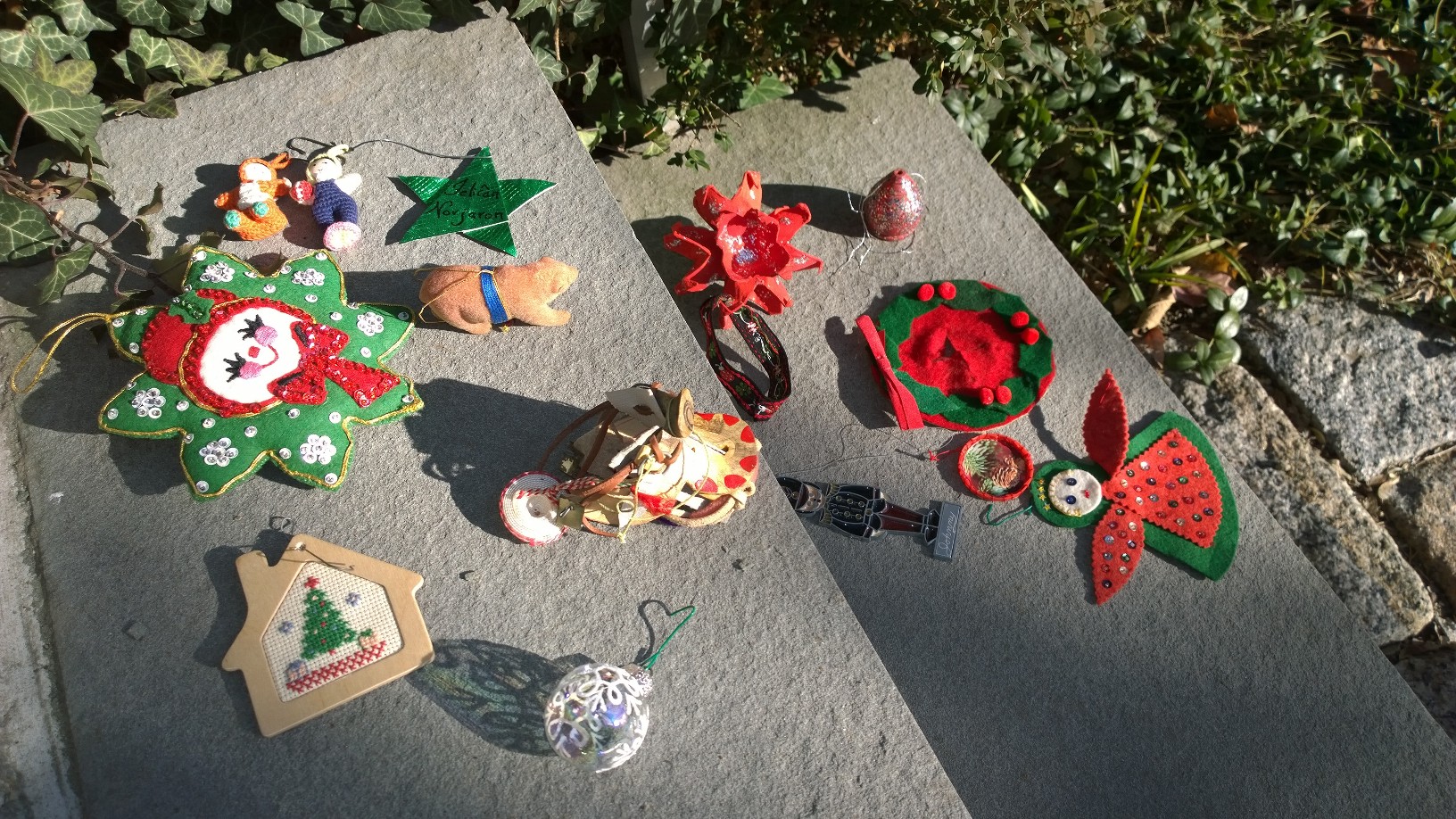
The clunky red-paint-and-sparkles thing you see below is something I made from an egg carton years ago. Recently married, I thought it would be fun to take Crafts for Christmas at the local adult ed after work while my husband took a different class. Can’t imagine how I stayed awake in those days!
Please be sure to notice that hanging near a bear ornament is something white that has the same shape. That is what my husband made for a three-year-old John, who asked him to make another bear. Though not usually into crafts, the guy did his best, and I like seeing his white cardboard bear every year.
Are you ever annoyed by the same tune going ’round and ’round in your head for hours — maybe even days? Drives me crazy. As fast as I can get to a radio, I put on a music station to drive the tune out. Here’s a theory about that repeating phenomenon.
Jeremy Reynolds reports at the Pittsburgh Post-Gazette, “In the dark corners of the internet hides a playlist of some of the most torturous, addictive music known to man. That’s right, Spotify, SoundCloud and Apple Music all have playlists of ‘Baby Shark’ remixes. Do doo, do do, do do, do.
“Would you walk 500 miles to get away from that tune? Will your poker face crack the thousandth time it plays in your head? Does it remind you of somebody that you used to know? Do you value the sound of silence?
“You aren’t alone. These so-called earworms — gross — are annoying but useful, as new research published in the Journal of Experimental Psychology in June helps illuminate the exact function these loops play. …
“Music therapists and shrewd marketers have long taken advantage of music’s ability to trigger memory. As research continues to illuminate how the process works, their techniques and goals are likely to become increasingly refined and targeted.
[Per Janata, a researcher at the University of California, Davis] says earworms help your brain encode and parse through daily memories and sensations that may not have anything to do with the exact moment when you first heard the tune. As it plays over and over in your head, you may come to associate memories or sensations different from those you experienced on first listening.
“In general, musicians and scientists alike have concluded that faster music with simple, repetitive melodies and harmonies are more likely to loop in the brain. …
“[Pittsburg composer Nancy Galbraith] differentiates between musical ‘hooks,’ a fragment designed to catch the ear, and earworms. Many earworms come from song hooks, but not all hooks become earworms. …
“ ‘Tchaikovsky was a really great hook writer, but we don’t really call them that in classical music,’ she said. ‘Personally I don’t associate them with anything specific. It’s more of an emotion or sensation.’ …
“Music therapists already use music’s ability to trigger a range of emotional states with their patients. According to Brittany Meyer, a neurologic music therapist at UPMC Children’s Hospital of Pittsburgh, music’s ability to activate multiple parts of the brain simultaneously makes it a useful tool for rebuilding and strengthening pathways in the brain.
“ ‘Repetition is really great for creating earworms,’ Ms. Meyer said. ‘And we know that music is great for both encoding and retrieving memories.’
“She explained that music can trigger reaction in both the hippocampus, which plays a role in learning and memory, and the amygdala, which is involved in experiencing emotions. So listening to the same music at a later date can trigger the same emotions as when the listener last experienced the music.
“Ms. Meyer also said that a patient’s prior associations with a tune are more important than the inherent characteristics of the tune itself. For example, she cited an experience working with a child on the autism spectrum who didn’t want to brush his teeth. Ms. Meyer made up a song about brushing teeth to the tune of a song he liked. Then his mother could sing with him every night, which helped him remember to brush his teeth.
“Mr. Janata wonders how long it will be before this research is used in a more targeted way. Many Americans above a certain age can recall a few jingles from their childhoods and the products they advertised, and some educators use songs or tunes to help memorize information.
“But the possibilities don’t stop there. Mr. Janata’s recent study found that music can function as a targeted memory aid. That means learning names or new faces or places could one day be paired with an individual tune, almost like a personalized musical tag.
“Mr. Janata is exploring that idea in his research and attempting to observe how the brain responds to musical stimuli and earworms using neural imaging technology. …
“ ‘That’s what our current experiments are trying to show and see whether that’s possible.’ ”
Photo: Newshub
Sans Forgetica is a typeface meant to aid memory. It was invented by researchers at RMIT in Melbourne, Australia.
There’s a new memory-boosting font that you can download for free and use for short texts. The inventors say you wouldn’t want to use it for long texts like a novel because it would give you a headache. But I say, what good is a typeface if you can’t read novels with it?
Lisa Martin writes at the Guardian, “Australian researchers say they have developed a new tool that could help students cramming for exams – a font that helps the reader remember information.
“Melbourne-based RMIT University’s behavioural business lab and design school teamed up to create ‘Sans Forgetica,’ which they say uses psychological and design theories to aid memory retention.
“About 400 university students have been involved in a study that found a small increase in the amount participants remembered – 57% of text written in Sans Forgetica compared with 50% in a plain Arial.
“Typography lecturer Stephen Banham said the font had an unusual seven-degree back slant to the left and gaps in each letter.
“ ‘The mind will naturally seek to complete those shapes and so by doing that it slows the reading and triggers memory,’ Banham told the Guardian.
“Senior marketing lecturer Janneke Blijlevens said the concept of ‘desirable difficulty’ underpinned the font’s design. …
“The font was designed with year 12 students cramming for exams in mind but could also be used to help people studying foreign languages and elderly people grappling with memory loss.” More at the Guardian, here.
I can see that having to work harder to read something may cause memory to fire on more burners, but when I was a kid, a friend who purported to analyze handwriting told me that broken letters like this indicated a criminal mind!
Credit: Tjflex2/Flickr
Inside the pupa (or chrysalis), the caterpillar actually turns to liquid during metamorphosis. Despite such an extreme transformation, the butterfly or moth can retain learning from its caterpillar days.
Do you remember being a newborn? I don’t think our species is capable of that kind of remembering. What about other species? Recent research suggests that butterflies have a kind of muscle memory from the good old days of their caterpillar-hood.
An article from Curious Kids — a series that gets experts to answer questions that kids send in — has the scoop. Evan, age 5, asked the question.
“We have caterpillars at home. I would like to know whether they will remember being caterpillars when they are butterflies.”
“Dear Evan,
“I think it is highly unlikely that a butterfly or moth remembers being a caterpillar. However, it may well remember some experiences it learned as a caterpillar.
“That fact in itself is especially amazing because inside the pupa (or chrysalis), the caterpillar actually turns to liquid as it transforms into a butterfly or moth (the adult stage).
“The transformation from the pupa to the adult is the most dramatic change in the life cycle of a butterfly, and scientists refer to this change as metamorphosis. During metamorphosis, the body tissues of the caterpillar are completely reorganised to produce the beautiful adult butterfly that emerges from the pupa.
“Scientists have known for a long time that caterpillars can learn and remember things when they are caterpillars, and adult butterflies can do the same when they are butterflies. However, because of metamorphosis, we were not sure if an adult butterfly could remember things it learned as a caterpillar.
“This ability to remember caterpillar experiences as an adult was tested in a study by a team of scientists at Georgetown University in the US.
“The researchers trained the caterpillars to dislike the smell of ethyl acetate, a chemical often found in nail polish remover. They did this by giving the caterpillars little electric shocks every time they smelled the chemical. Soon, these caterpillars were trained to avoid that smell because it reminded them of the electric shock.
“They let the caterpillars transform into adult moths, and then tested the moths again to see if they still remembered to stay away from the ethyl acetate smell.
“And guess what? Most of them did! The scientists had shown that the memories of avoiding the bad smell experienced as a caterpillar had been carried over into the moth stage. …
“Thank you for sending in this very interesting question.
Photo: Richard Saker for the Guardian “Oh, this is fun. I feel as if I’m at the party.” Seniors fighting off dementia benefit from Wayback Virtual Reality.
I often think I overdid it in early 2000 repeating myself over and over to encourage an impaired relative to remember her childhood, but an article by Giulia Rhodes in the Guardian suggests that stirring up old memories can indeed be helpful to seniors with dementia.
“In a comfortable armchair, glass of sherry at her side,” writes Rhodes, “Elspeth Ford is getting to grips with her 3D goggles. …
“Elspeth, 79, is a resident at Langham Court, a dementia care home in Surrey, and today she is trialling a virtual reality project, Wayback, that has been designed especially for those living with dementia. Peering into her headset, Elspeth is temporarily transported to 2 June 1953, and a street party for the Queen’s coronation. She is enjoying a children’s fancy-dress competition. ‘I love that boy dressed as an Oxo cube,’ she laughs.
“This is the first in what will become a series of virtual reality films set at historic moments, and available free for those with dementia, their families and carers to enjoy together through a mobile phone and a pair of inexpensive 3D goggles. The idea was developed by three advertising creatives with family experience of dementia.
“For Camilla Ford, Elspeth’s daughter, it is an exciting concept. ‘It gave Mum a huge amount of pleasure and really engaged her,’ she says. … ‘She was immersed in this and it took her back to a time of happy memories, when she was productive and emotionally fulfilled.’
“Elspeth has had vascular dementia for seven years, and finding a point of contact increasingly involves moving to where she is, rather than trying to bring her into the present, says Camilla. ‘If she is in a place she can identify with, and we can see it too, we are somehow equalised. We are at a stage where we aren’t trying to create memories but to relish positive emotions, dropping the expectation of who Mum was and just being with the person in front of us.’
“Elspeth sets off for lunch with her son Dominic, still smiling. It is unlikely, says Camilla, that her mother will remember what has made her feel happy. ‘The point is that she feels uplifted, not necessarily that she knows why.’
“Dan Cole, one of Wayback’s creators, agrees. ‘If the film can open some memories, start a conversation or bring a smile, that’s a success,’ he says. The idea began to form after a drive around Camden, north London, with his father, then in the early stages of Alzheimer’s. ‘It was his old stomping ground and he kept recognising places and telling me little tales; the pub his dad drank in, where he hung about with his mates, even an alley where he once got into a scrap,’ says Dan. ‘In that fleeting moment it was so clear in his mind. I could ask questions. He could tell me things.’ …
“The resulting film was made over two days in a north-London street (satellite dishes and other modern trappings digitally removed) with a volunteer cast and crew of 187 and painstakingly sourced period props, costumes and menu (fish-paste sandwiches, notes one Langham Court resident approvingly). …
“Langham Court’s philosophy is based on the Butterfly Household model, devised by Dr David Sheard, a dementia specialist and CEO of Dementia Care Matters, who is supporting Wayback. ‘People living with dementia become more feeling beings than thinking beings,’ he says. ‘Feelings endure and are more to be trusted when facts diminish.’ ”
Here is Suzanne the one year we cut our own tree. I think she had the most fun of the four of us. The thermos had hot chocolate.
We set our sights on smaller trees nowadays, and my husband just put this year’s in the stand. I’ve been gearing up to decorate, first looking through the ornaments. It’s like greeting old friends after a year. Some of them are very familiar and beloved, but I can’t remember their stories. Here are a few whose stories I do remember.
The big red one on the lower step: from the Crafts for Christmas class I took the year we were married. Amazing what you can do cutting up egg cartons!
The sparkly tear-drop shape and the doorknob cover: from the church’s craft workshop when John and Suzanne were young. The angel with sequins: made by Aunt Mae in her 90s. She also made the smiling snowman backed by a green star and many other items — in secret, to surprise everyone. The round milk-bottle-cap ornament: don’t get me started now on highly educated women with no occupation spending their time on that. But I like to think of the woman who made it, with sympathy.
The soldier with John’s name on it: that was a gift from Aunt Peggy.
The Esperanto green star: from a friend in my Esperanto group. The two crocheted Chinese dolls: from a trip to the Shaw Festival at Niagara-on-the-Lake when Suzanne was about 1. My husband went to see a Shaw play while I babysat. I went to see hilarious concert comedienne Anna Russell while he babysat.
The bear: John was 3, and I was spending considerable time in graduate classes. John insisted my husband make a bear ornament just like that one out of cardboard. We have that too, somewhere. It doesn’t look just like that one, but we love it.
The Clymers brought the saddle from a trip to South America. John stitched the cross-stitch tree at a ridiculously young age (3? 4?).
The see-through snowball: a gift at DeAnna’s December wedding to Mairtin at the Peabody-Essex Museum.


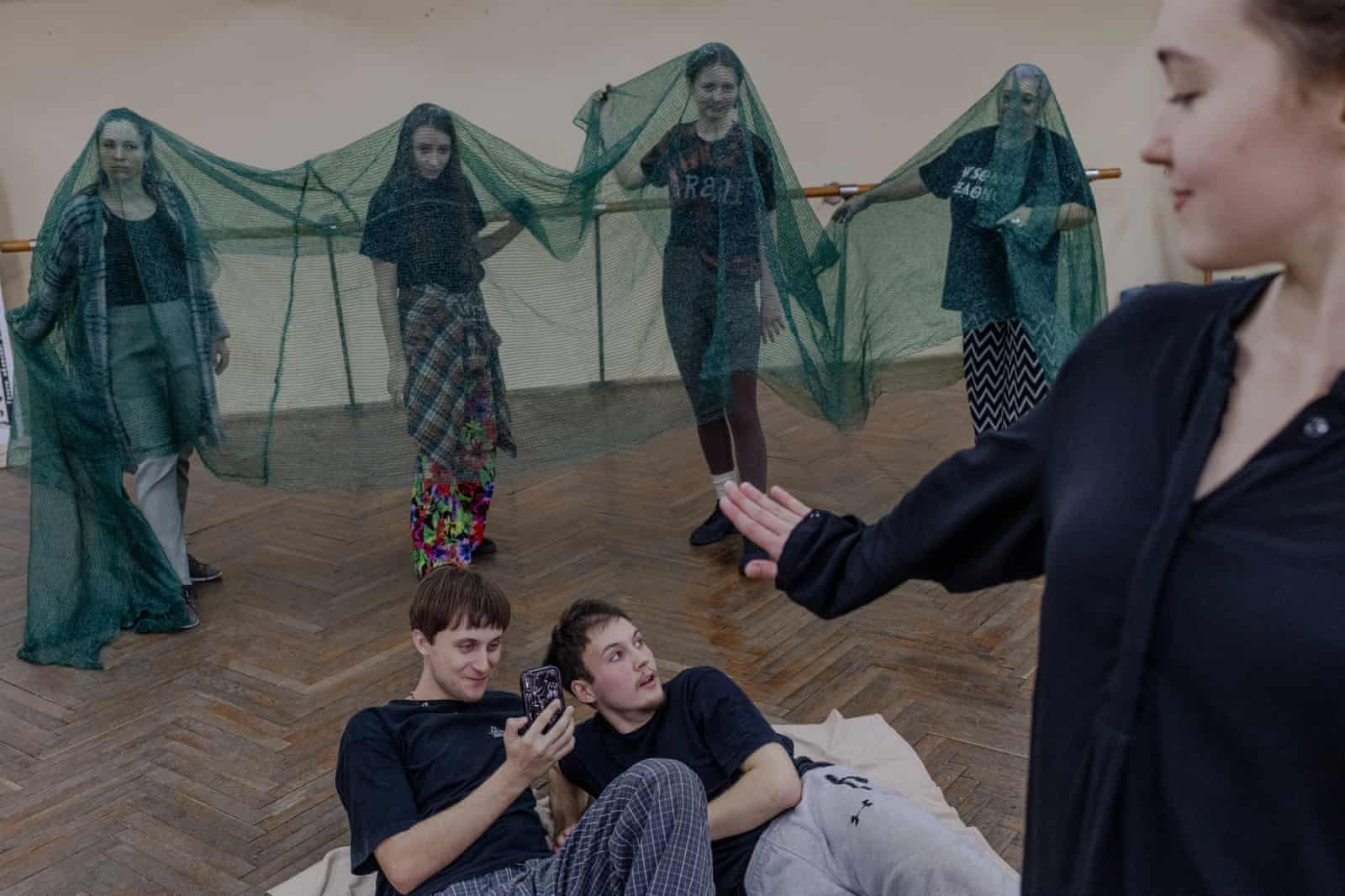
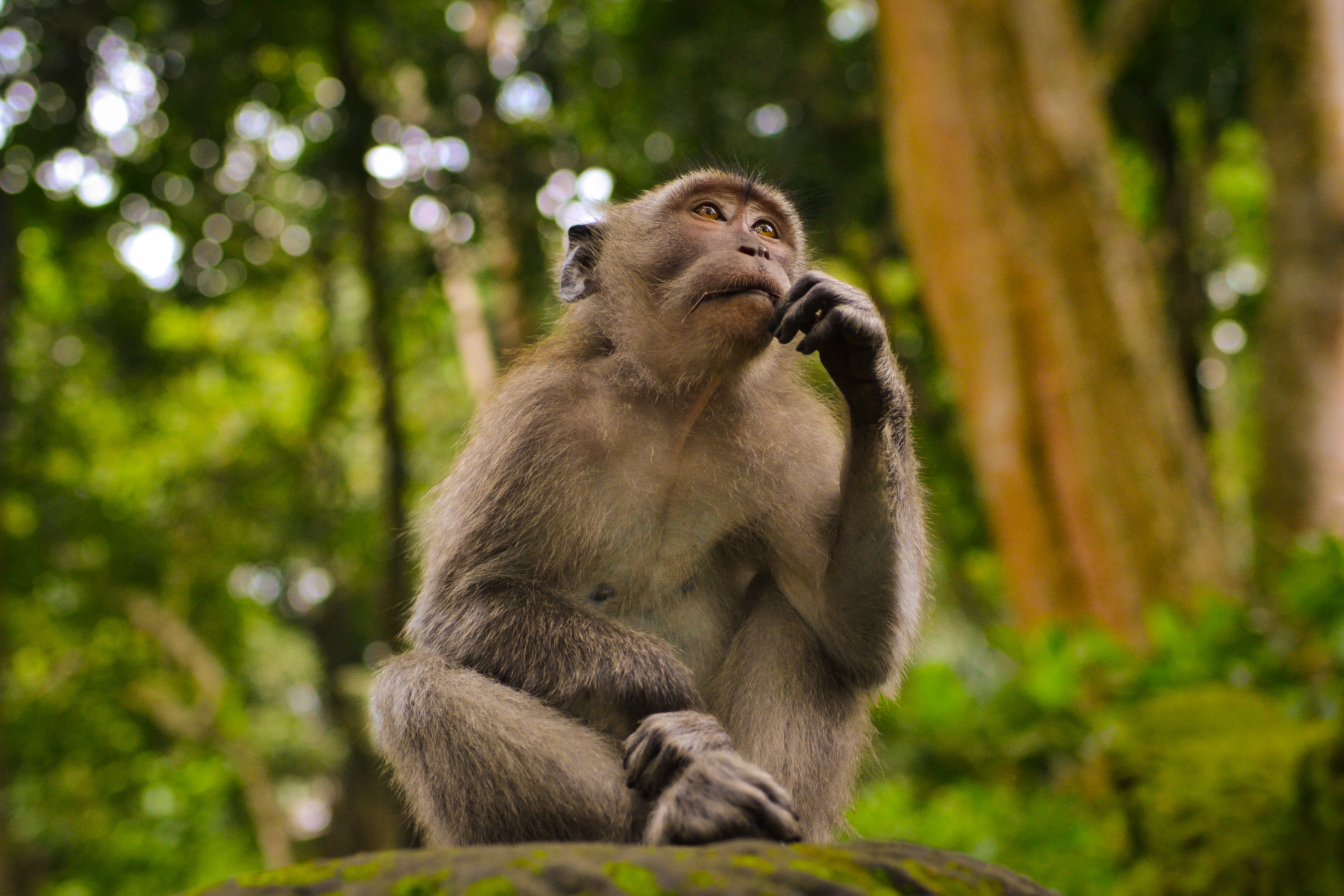
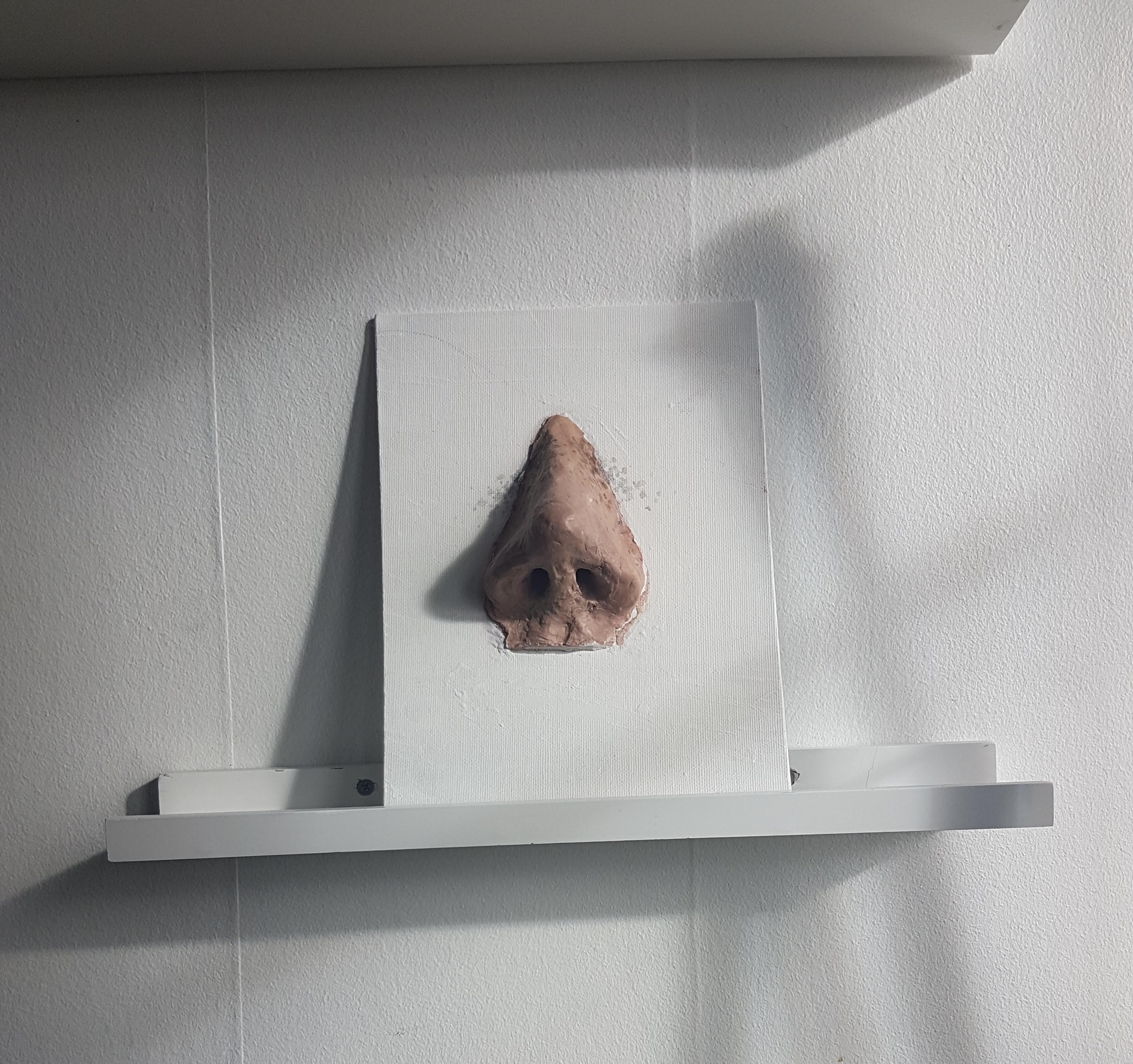
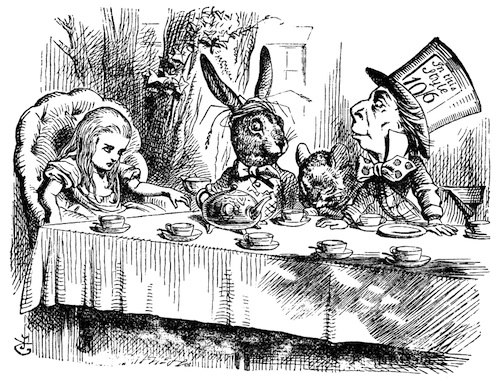

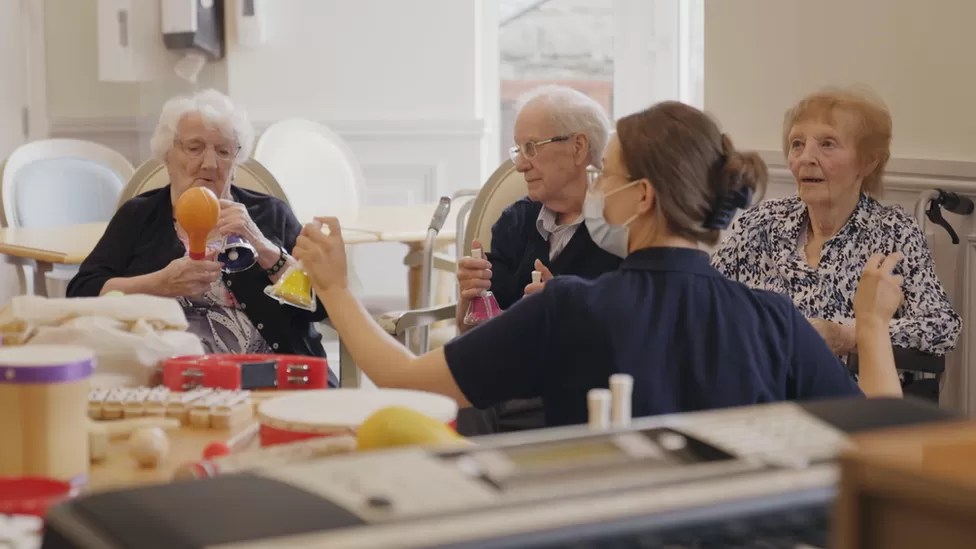

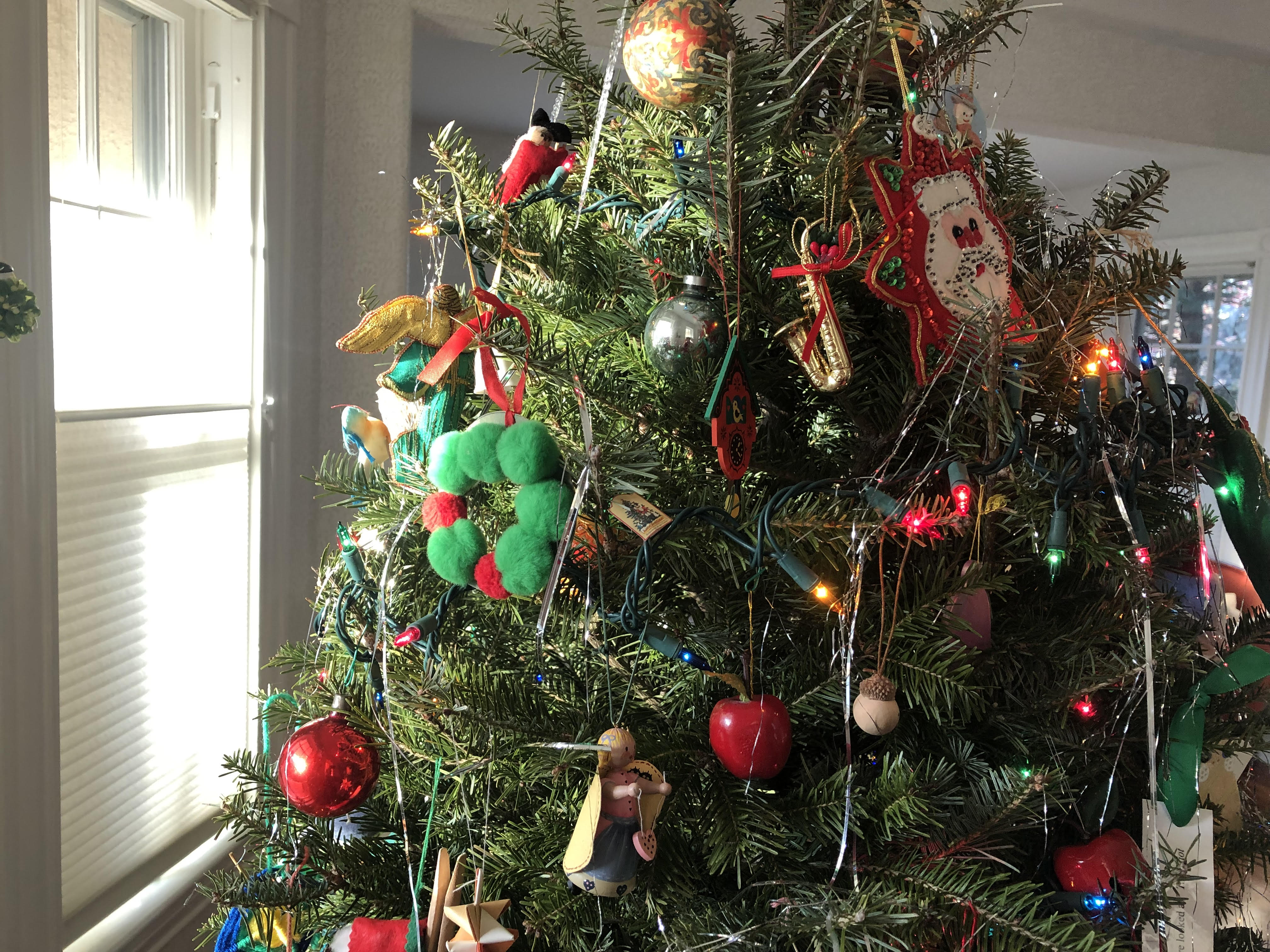
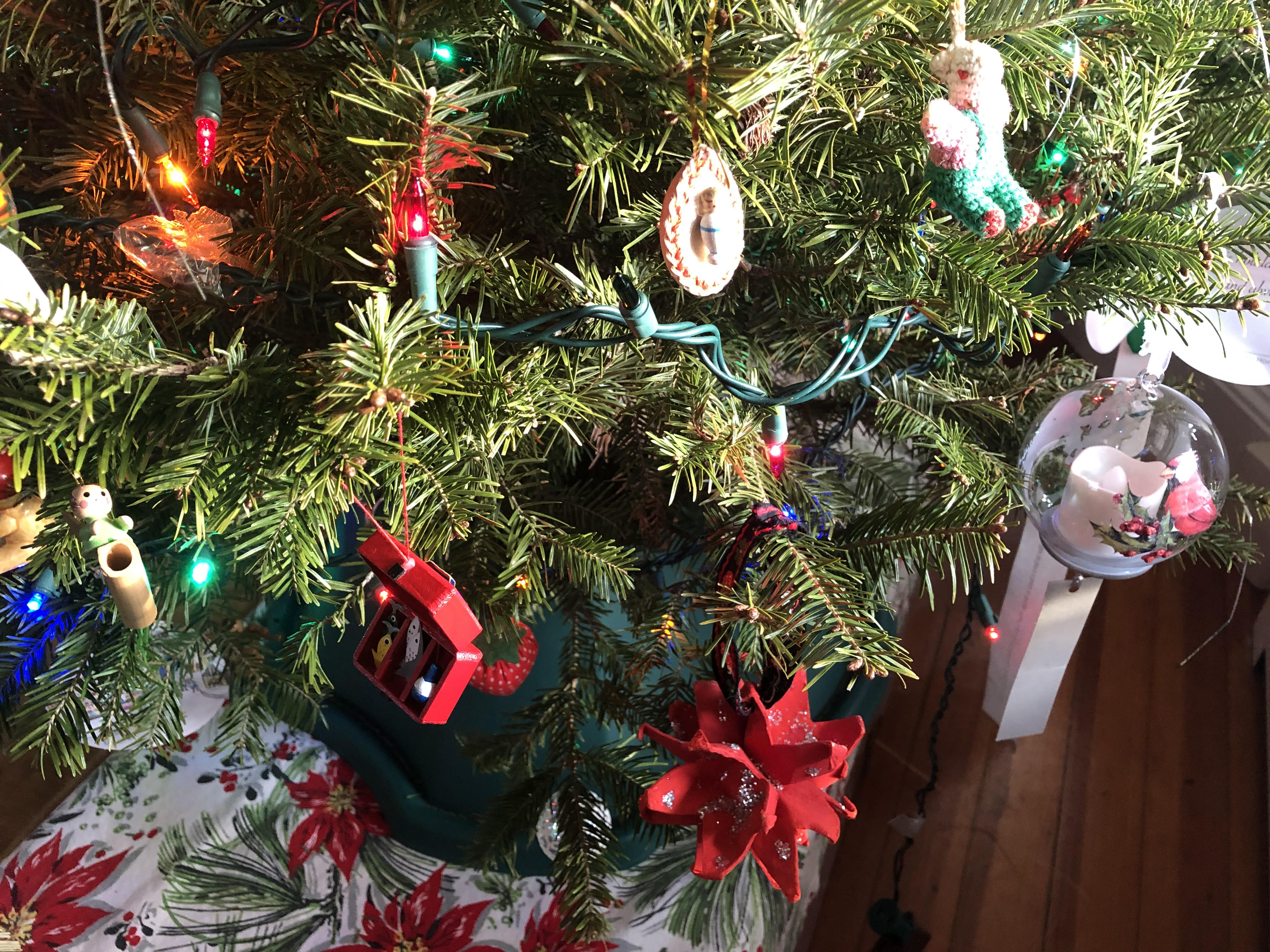
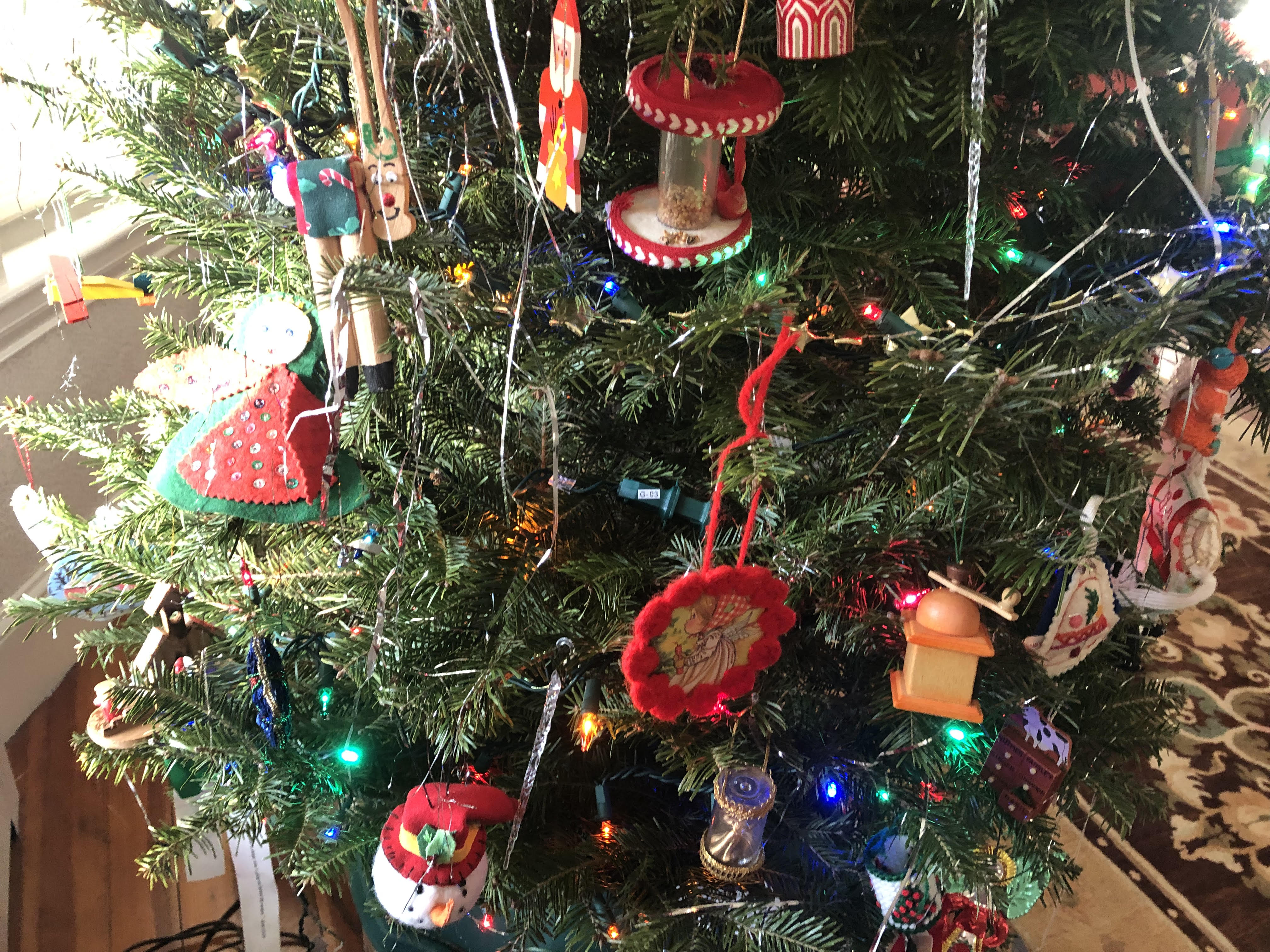
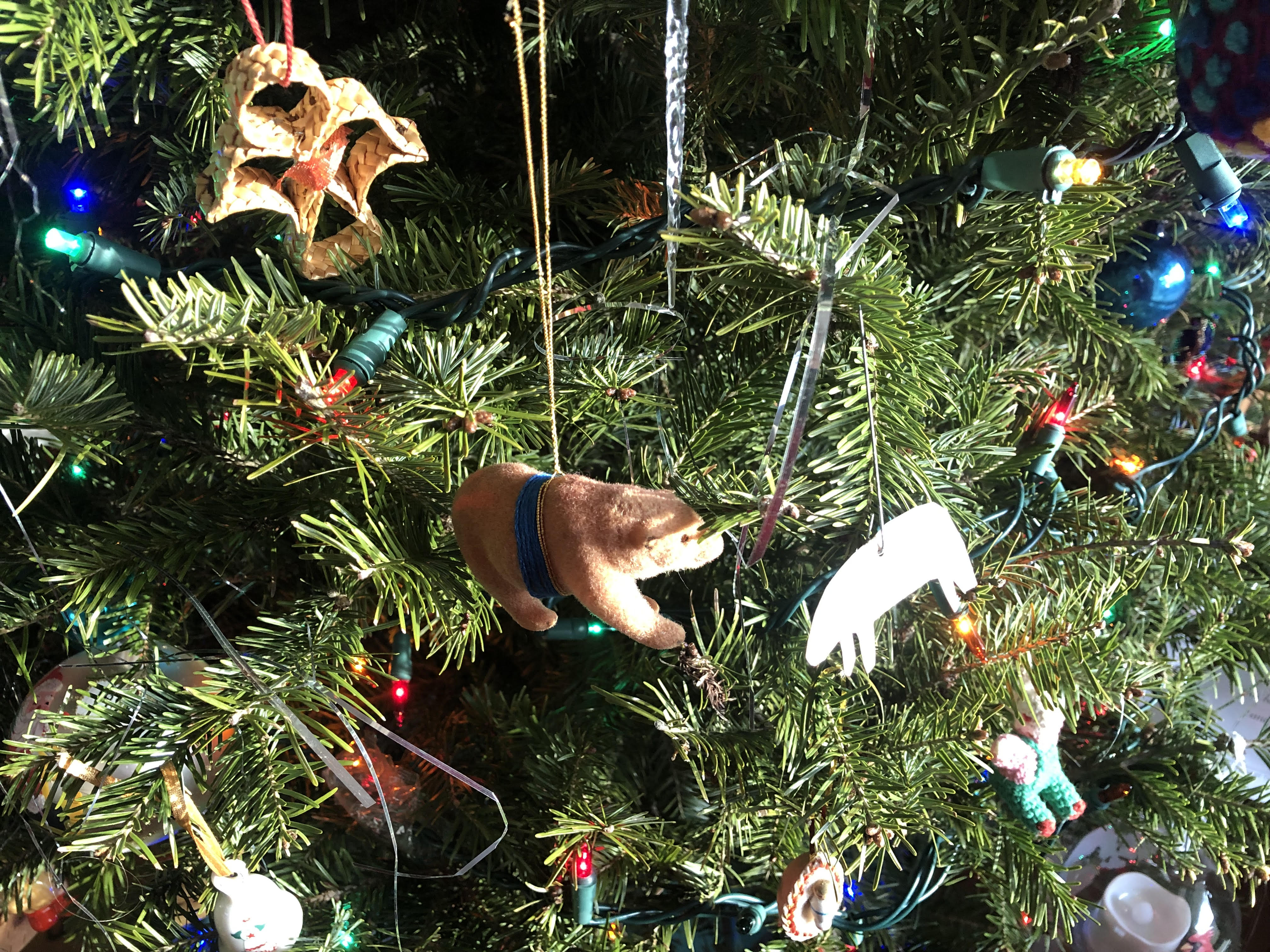
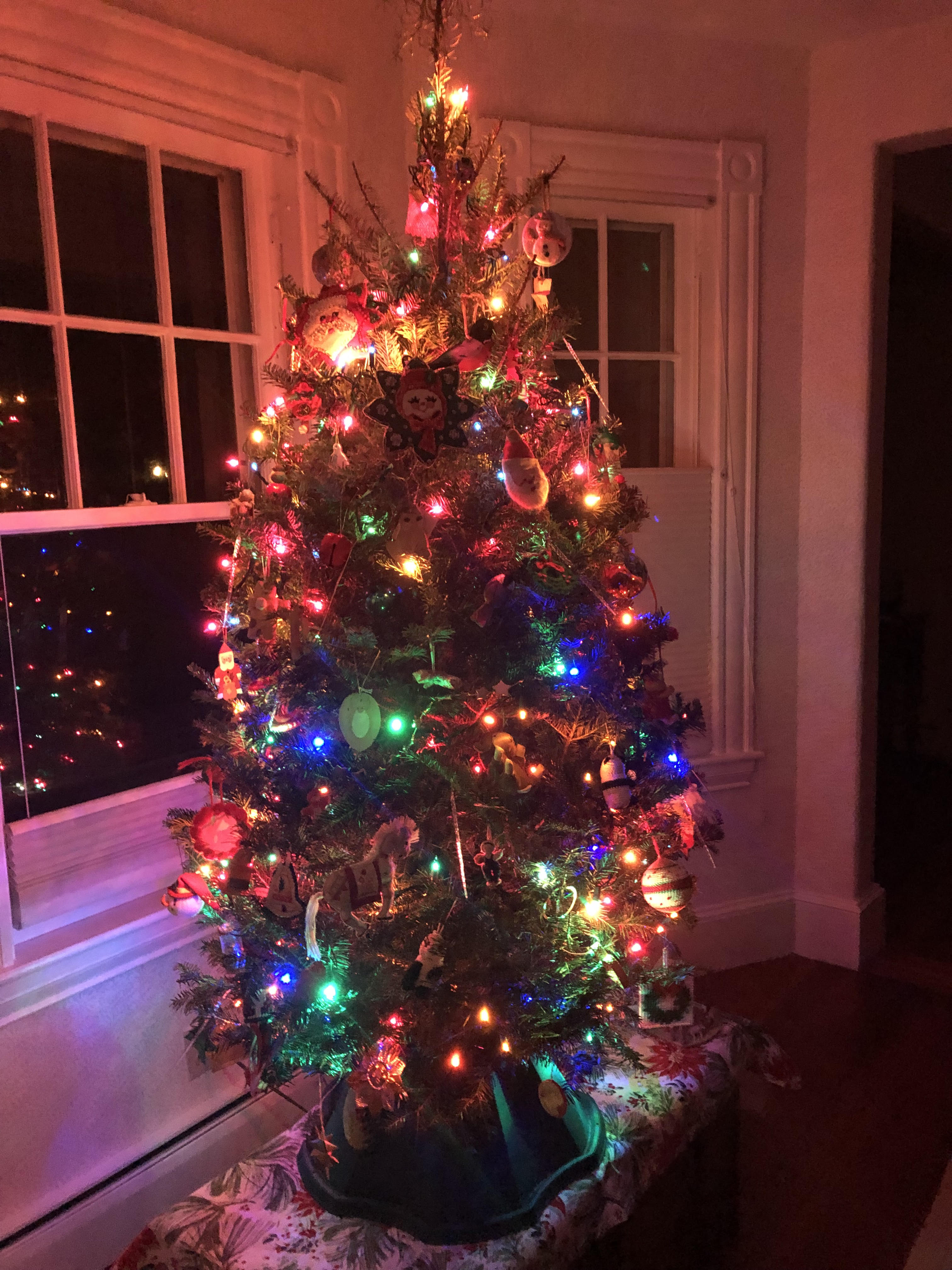
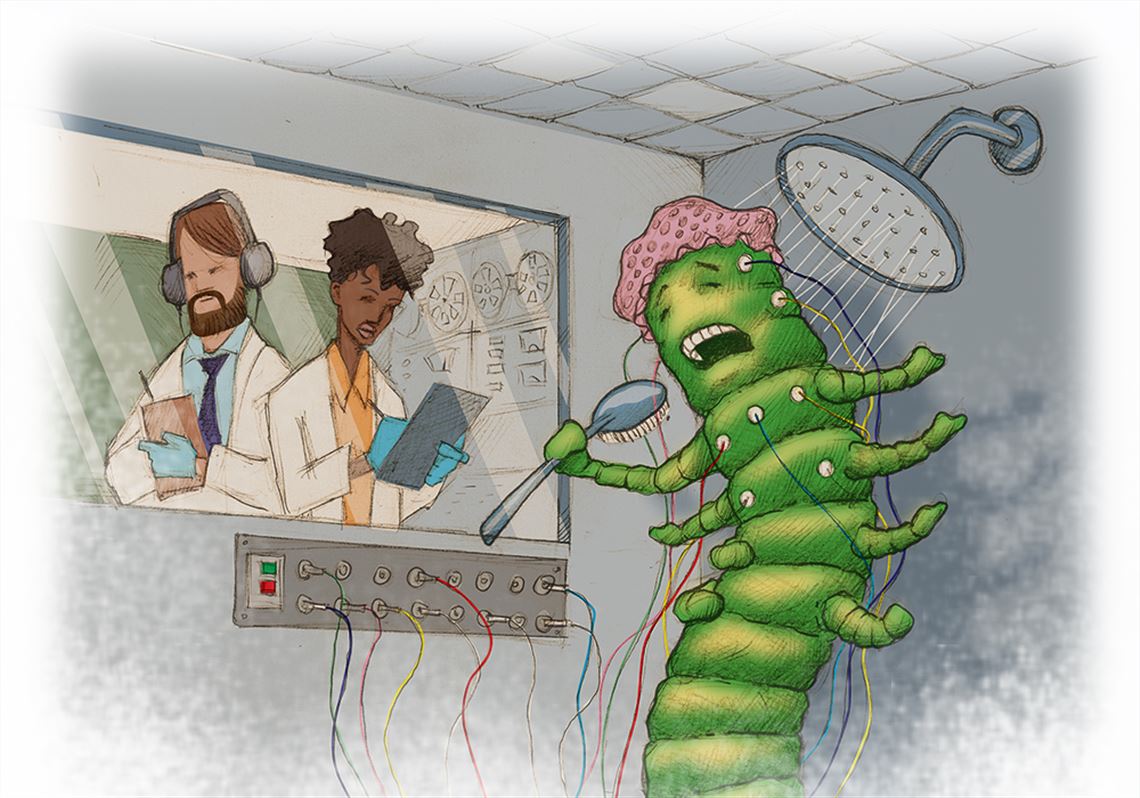

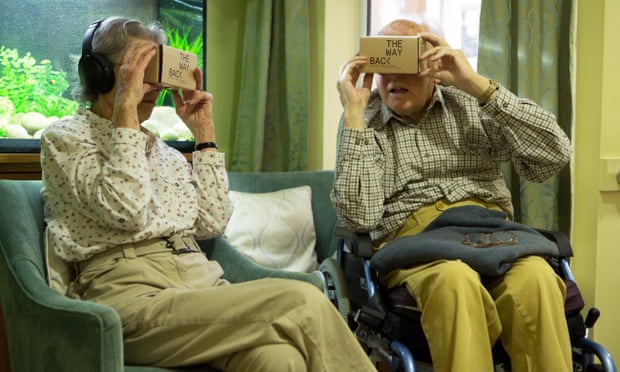 Photo: Richard Saker for the Guardian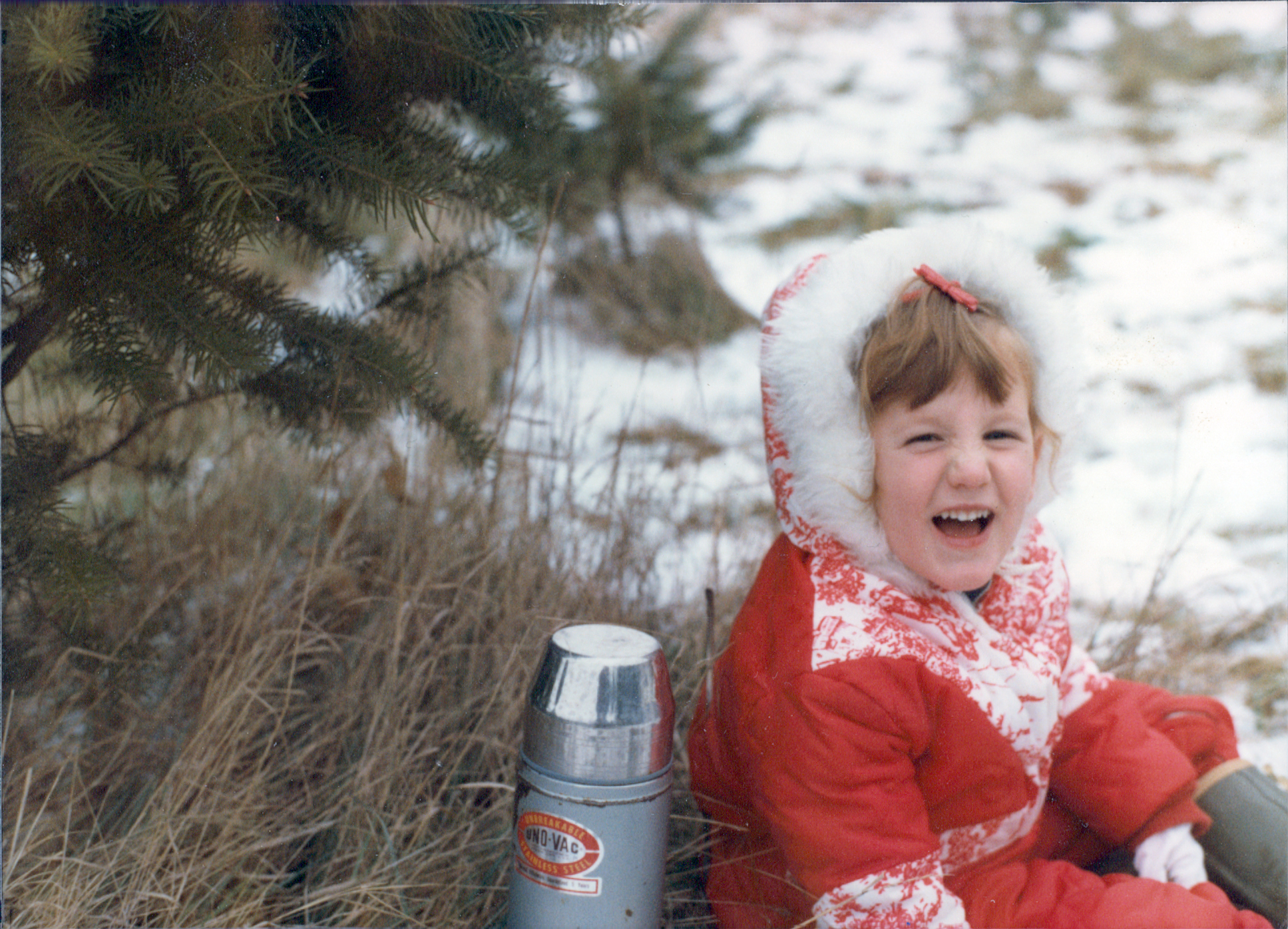

 Suzanne's Mom's Blog