Feeds:
Posts
Comments

Posts Tagged ‘migration’

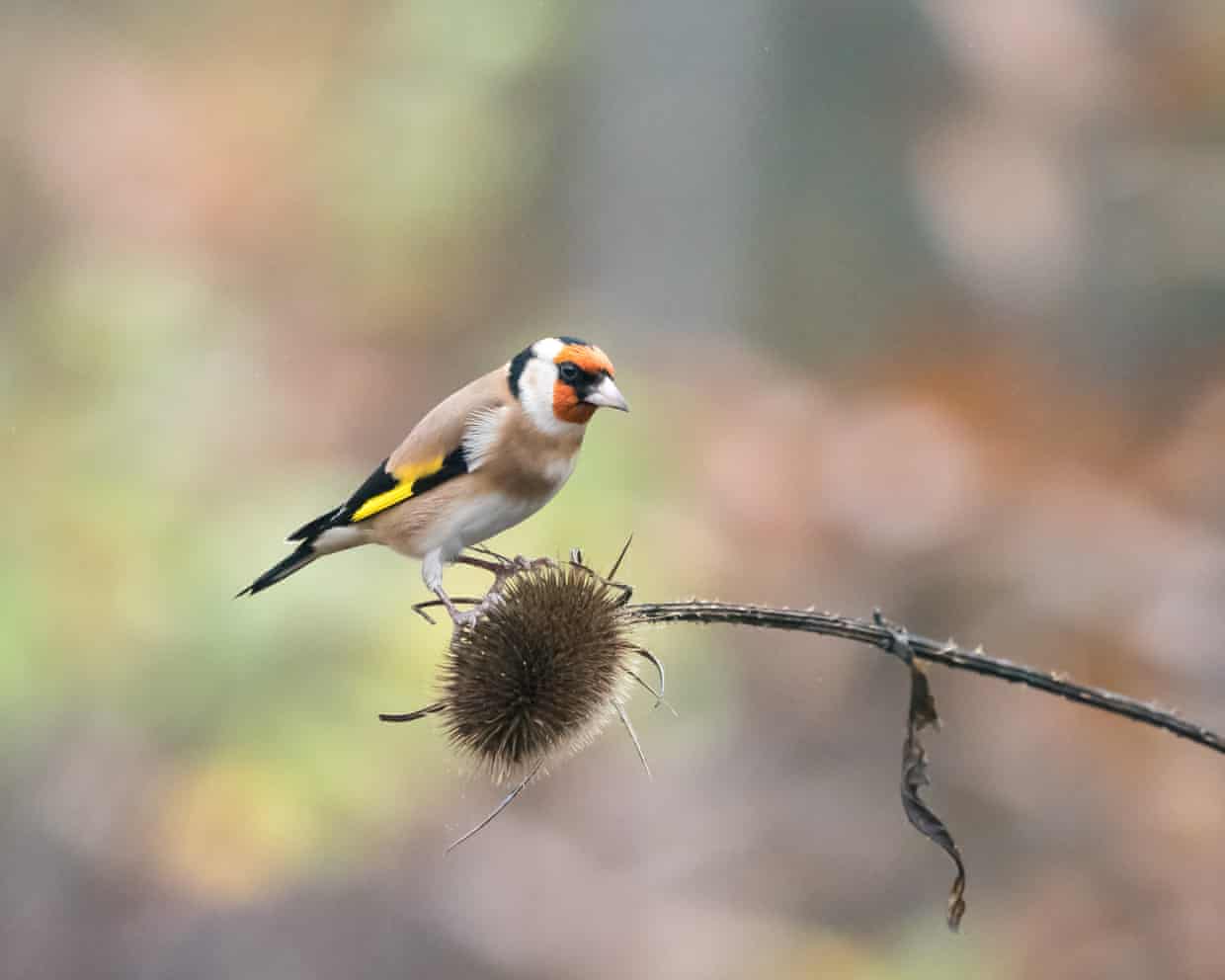
Photo: Suerob/Getty Images/iStockphoto.
The European goldfinch, above, was one of the species most affected by the growing amount of light-polluted areas. 

I am not a scientific kind of birdwatcher, but I love trying to identifying the birds around here, sometimes by their song. I’ve learned that one “song” of the red-bellied woodpecker, for instance, sounds a lot like a metal windup toy.

Citizen scientists the world over are contributing to what scientists know about birds. Consider how a recent study was able to use a bird lovers’ website to take our knowledge of avian behavior a step farther.

Hannah Devlin, science correspondent at the Guardian, reports that “urban birds stay up significantly later than their rural counterparts, according to research that highlights the impact of light pollution on wildlife.

“The study, based on recordings submitted by bird enthusiasts to a popular species identification and mapping website, showed that light pollution caused birds to sing for an average of 50 minutes longer each day, with some species waking up an hour earlier and settling down for the evening an hour later.

“ ‘We were shocked by our findings,’ said Dr Brent Pease, an assistant professor of biodiversity conservation at Southern Illinois University Carbondale. ‘Under the brightest night skies, a bird’s day is extended by nearly an hour.’

“Light pollution now affects 23% of Earth’s surface and is rapidly growing in extent and intensity, data suggests. There is already evidence for detrimental effects on human health and concerns that many species are affected, with negative consequences including die-offs of insects and the disruption of migration patterns in bats and sea turtles.

“The latest study used bird recordings submitted to BirdWeather, a citizen science project that allows users to submit recordings from birds in their local area to produce a global live library of birdsong and which uses AI to allow users to identify birds in their gardens. In total the scientists analyzed 2.6m observations of onset (morning) bird vocalization and 1.8m observations of cessation (evening) bird calls, for hundreds of species. This data was combined with global satellite imagery measurements of light pollution. …

“The analysis found that for birds in light-polluted areas, the waking day was extended by 50 minutes on average.

Species with large eyes, relative to their body size, had the strongest response to artificial light.

“ ‘The American robin, Northern mockingbird and European goldfinch all extended their day by more than average,’ said Pease. …

“The impact of a longer day for birds was not yet clear, the researchers said. ‘We know that sleep loss is not great for humans, but birds are different,’ said Pease. ‘They have developed interesting strategies to cope with loss of sleep during migratory periods.’

“A disturbance of natural behavior patterns was of concern, Pease added, although there is evidence, in some species, that artificial lighting may increase foraging and mating time and improve the survival rate of fledglings.

“The findings are published in the journal Science.”

Sounds like this is a case of “more research is needed.” More at the Guardian, here.

Read Full Post »

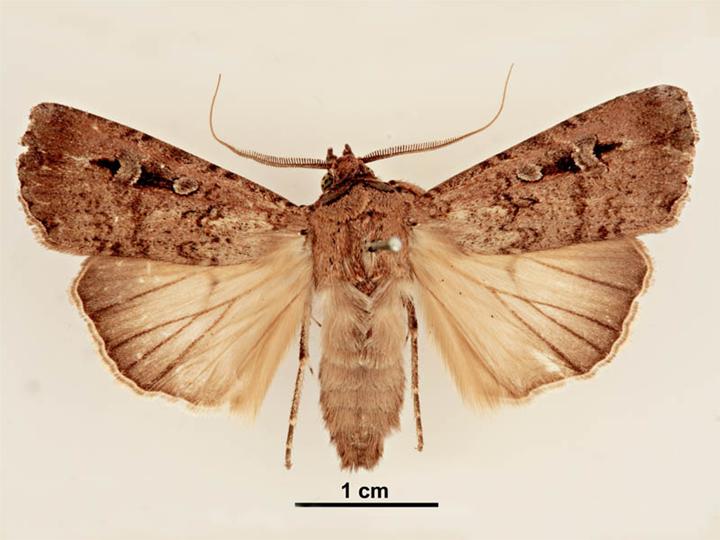
Photo: Lucinda Gibson and Ken Walker/Museum Victoria.
The endangered bogong moth can travel great distances to a place it has never been to before. It uses the stars to navigate.

Some of the least prepossessing critters in nature often have interesting attributes that could teach us a lot if we pay attention.

Ari Daniel reports at National Public Radio (NPR), “The Bogong moths of Australia aren’t much to look at, says Andrea Adden, a neurobiologist at the Francis Crick Institute. ‘They’re small brown moths with arrow-like markings on the wings. They’re pretty nondescript.’

“But these insects undertake an epic migration twice in their lifetime, traveling hundreds of miles in each direction.

“Researchers have shown that the Earth’s magnetic field helps the moths orient, but that alone wasn’t sufficient. ‘They needed something visual to go with it,’ says Adden.

“She wanted to know what that cue might be over such a vast landscape — especially at night when there’s little light.

“In a paper published in the journal Nature, Adden and her colleagues show that the cue comes from the heavens. That is, the starry sky allows the Bogong moths to both orient and navigate.

“Bogong moths follow an annual rhythm. They hatch in their breeding grounds in the spring in southeast Australia where it gets really hot in the summertime. ‘So if they were to reproduce immediately, their larvae would starve because there is not enough food,’ says Adden.

“Instead, the moths migrate over multiple nights more than 600 miles south to the Australian Alps where they settle in cooler caves, entering into a dormant phase called estivation (like hibernation but in the summer), by the millions. …

“In the fall, they return to their breeding grounds, mate, lay their eggs, and die.

” ‘Then the next year, the new moths hatch,’ says Adden. ‘And they’ve never been to the mountains. They have no parents who can tell them how to get there.’ And yet they make it.

“She suspected the stars might offer just the cue they need. To test her theory, Adden, who was doing her Ph.D. at Lund University in Sweden at the time, and her colleagues caught moths in the Australian Alps and ran them through one of two experiments in the dead of night.

“The first was a behavioral test. It involved placing a moth inside what was basically a mini-planetarium that contained a projection of the night sky and no magnetic field. … The result surprised the researchers.

” ‘They didn’t just circle and do twists and turns, but they actually chose a fairly stable direction,’ she said. ‘Not only that, it was their migratory direction.’ In other words, the moths were using the starry sky as a compass cue to orient and navigate.

“Adden’s next question involved what was happening in the moth’s brain. She recorded the electrical activity of individual neurons while rotating a projection of the Milky Way.

“When she looked in the brain regions that process visual information, the majority of neurons were active when the moth was facing south. This specific direction suggests that the moths’ brains encode direction by processing visual cues of the Milky Way. …

“The moths’ ability to use both visual and magnetic information to navigate can be essential for survival — in case it’s cloudy, say, or the magnetic field is unreliable. ‘If one fails, they have a backup system,’ says [biologist Pauline Fleischmann at the University of Oldenburg].

“The Bogong moths are endangered. Adden says her findings could help conserve these insects — and everything that relies on them for food.”

More at NPR, here.

Read Full Post »

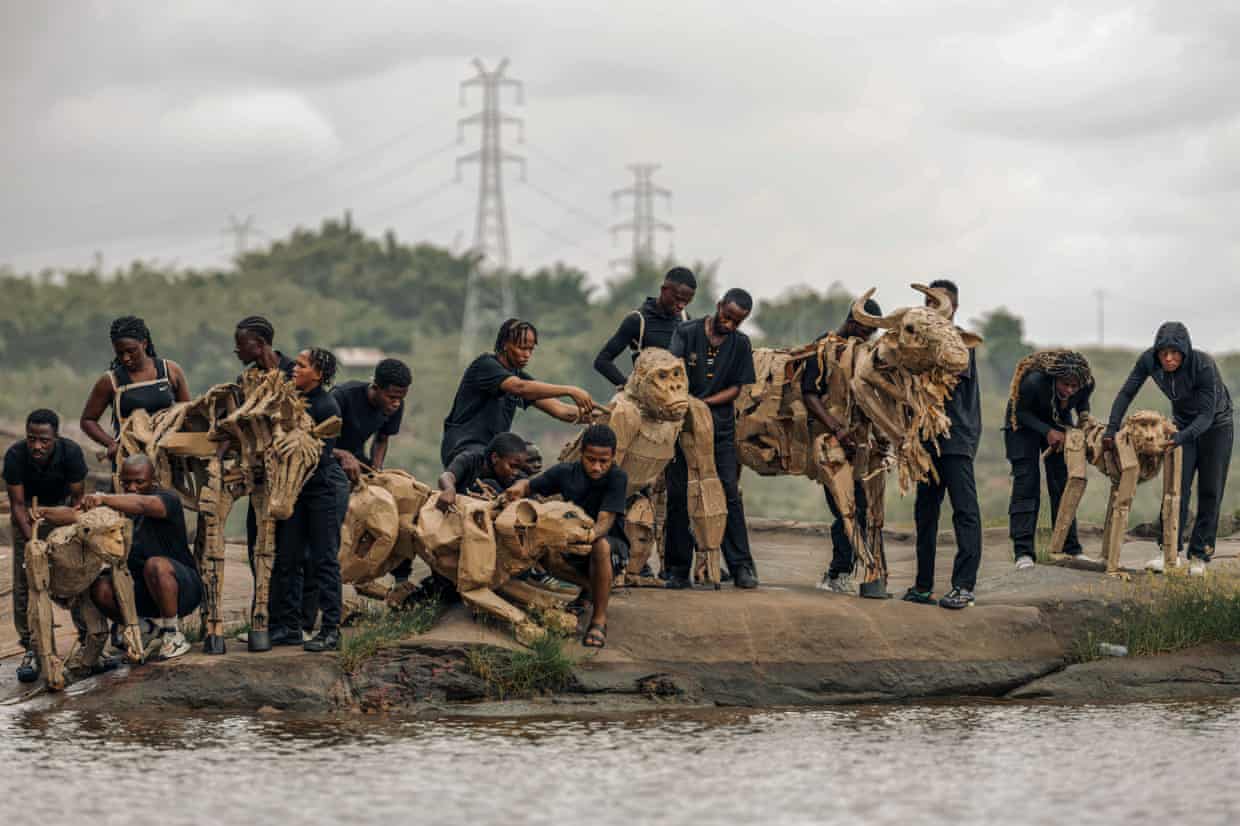
Photo: Berclaire/walk productions.
Above, a puppet herd beginning its 20,000km [~2,400 mile] journey in Kinshasa, the Democratic Republic of the Congo. The caravan of zebras, wildebeest, monkeys, giraffes and baboons “will make its way from Dakar to Morocco, then into Europe, including London and Paris, arriving in the Arctic Circle in early August,” the Guardian reports.

Do you remember Little Amal, the world-traveling puppet designed to spread empathy for asylum seekers, especially children? Well, now the creators of Little Amal have launched a slew of puppet animals to bring attention to another cause — the effects of global warming on all living things.

In April, Isabel Choat wrote at the Guardian about the project. “Hundreds of life-size animal puppets have begun a 20,000km (12,400 mile) journey from central Africa to the Arctic Circle as part of an ambitious project created by the team behind Little Amal, the giant puppet of a Syrian girl that travelled across the world.

“The public art initiative called The Herds, which has already visited Kinshasa and Lagos, will travel to 20 cities over four months to raise awareness of the climate crisis.

“It is the second major project from The Walk Productions, which introduced Little Amal, a 12-foot puppet, to the world in Gaziantep, near the Turkey-Syria border, in 2021. The award-winning project, co-founded by the Palestinian playwright and director Amir Nizar Zuabi, reached 2 million people in 17 countries as she travelled from Turkey to the UK.

In Dakar more than 300 artists applied for 80 roles as artists and puppet guides.

“The Herds’ journey began in Kinshasa’s Botanical Gardens on 10 April, kicking off four days of events. It moved on to Lagos, Nigeria, the following week, where up to 5,000 people attended events performed by more than 60 puppeteers.

“On Friday the streets of Dakar in Senegal will be filled with more than 40 puppet zebras, wildebeest, monkeys, giraffes and baboons as they run through Médina, one of the busiest neighborhoods, where they will encounter a creation by Fabrice Monteiro, a Belgium-born artist who lives in Senegal, and is known for his large-scale sculptures. …

“The first set of animal puppets was created by Ukwanda Puppetry and Designs Art Collective in Cape Town using recycled materials, but in each location local volunteers are taught how to make their own animals using prototypes provided by Ukwanda. The project has already attracted huge interest from people keen to get involved. In Dakar more than 300 artists applied for 80 roles as artists and puppet guides. About 2,000 people will be trained to make the puppets over the duration of the project. …

“Zuabi has spoken of The Herds as a continuation of Little Amal’s journey, which was inspired by refugees, who often cite climate disaster as a trigger for forced migration. The Herds will put the environmental emergency center stage, and will encourage communities to launch their own events to discuss the significance of the project and get involved in climate activism. …

“The Herds’ Senegal producer, Sarah Desbois [expects] thousands of people to view the four events being staged over the weekend. ‘We don’t have a tradition of puppetry in Senegal. As soon as the project started, when people were shown pictures of the puppets, they were going crazy.’ “

More at the Guardian, here.

Read Full Post »

Photo: TiVa.
Installation of the fish counter at Gamla Stan in Slussen. The new fish highway in Stockholm has some of the first fish passages between the Baltic Sea and Lake Mälaren at Söderström in nearly 400 years.

Today’s story is about how Sweden is giving a helping hand to migrating fish that are not strong swimmers.

TiVa, an AI-powered fish-counting company, reports, “In mid-2024, a TiVA FC was installed in connection to the newly built fish migration path at Slussen in Stockholm. This long-awaited passage allows fish to freely migrate between Lake Mälaren and Saltsjön at Söderström for the first time in almost 400 years. As part of the reconstruction of Slussen, a new fish migration path has been constructed under the northern sluice quay on the side of Gamla Stan. The old Nils Ericson sluice has been converted into a passage to facilitate the free movement of weak-swimming species such as eel, roach, and perch – species that were previously hindered by human infrastructure.

The TiVA FC fish counter delivers [improved] results, both in image quality and AI-based species and length classification. … The TiVA FC at Slussen is connected to our cloud platform fiskdata.se. Here, data is available for both the client and, in this case, for the public. … The City of Stockholm has chosen to broadcast a live stream via TiVA’s YouTube channel. Shorter streams can also be broadcasted to other platforms, like Facebook, depending on the client’s needs.

“The City of Stockholm will install an informational screen for ‘Fish TV’ on the crane structure by the fish counter. Passersby in Gamla Stan will be able to learn more about the project, see selected videos, and get updates on the latest migrations.” More at the TiVa website, here.

And from Stockholm’s website: “You can watch online the fish swimming between Lake Mälaren and Saltsjön [at fiskdata.se].

“Moving between different areas is a natural part of life for many fish species. They migrate from their breeding grounds to spawning grounds to reproduce. When humans have blocked various watercourses, this has prevented fish species from passing through. To protect the fish and promote the environment, watercourses can be restored, or, as here at Slussen, a fish migration route can be opened up.

“The primary purpose of the fish migration route is to enable passage between Lake Mälaren and Saltsjön for [fish] that do not jump, which is basically all species except salmon and sea trout. By building this route, we hope that species such as eel, roach and perch will once again be able to pass here.

“The trail is designed by experts to mimic as natural an environment as possible. Stones of various sizes have been carefully placed along the trail. Some of the stones come from Gustav Vasa’s 16th-century defensive wall, which was found during the excavations of Södermalmstorg in 2022. The water flow needs to be calm so that the fish can stop and rest. There is lighting here so that the fish can swim in pleasant light.

“The fish walking trail is located under the quay on the Old Town side and is not visible from the outside. But you can watch the fish swimming through at fiskdata.se.” More here.

Looking for comments — from Swedes and fish lovers everywhere.

Read Full Post »

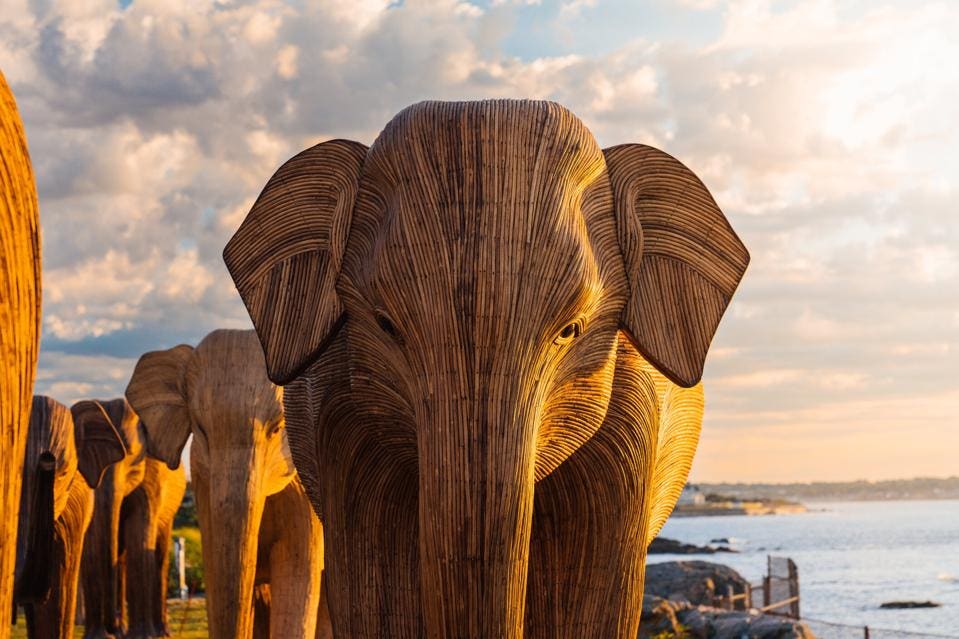
Photo: Corey Favino/Elephant Family USA/Newport Restoration Foundation.
The Great Elephant Migration installation outside Rough Point mansion in Newport, Rhode Island.
The elephants are made by indigenous people from an invasive plant.

Here’s a new way to reach audiences with a message about the importance of conservation: a giant “elephant” exhibit in a beautiful seaside setting that tourists visit anyway.

At Forbes magazine, Chadd Scott begins the story by talking about India.

“India has experienced a remarkable population explosion over the past 40 years. Several actually. One is well known. India’s human population has more than doubled since 1980. … Lesser known, and even more extraordinary in light of the country’s surging human population, has been a doubling of its elephant population over that same period, from a bottom-out of around 15,000 individuals to nearly 30,000 today. Populations of Asiatic lionstigers, and the greater one-horned rhinoceros are also increasing across the country.

“India offers a remarkable example for how humans and wildlife, even the largest of wildlife, can coexist in an ever-developing world. Sharing that message with the world is the mission of the Great Elephant Migration which debuted 100 life-sized Asian elephants in Newport, RI on July 1.

“The elephants — each based on a real, wild elephant from the Nilgiri Hills known by name and personality living alongside people in their coffee and tea plantations — were made by members of the Coexistence Collective, a group of 200 Indigenous artisans from the Nilgiri Biosphere Reserve

“The herd was produced from the Lantana camara, a toxic, invasive plant overtaking the Indian forest, pushing elephants and other wildlife out and into closer proximity to humans, with greater potential for conflict. …

“ ‘It’s a conservation miracle; it’s contrary to what’s happening everywhere else in the world and it’s definitely owed to an incredibly beautiful perspective on nature and our place within nature,’ Ruth Ganesh, trustee, Elephant Family USA, co-organizer of the Newport presentation along with Art&Newport, and co-founder of the Coexistence Collective, said at The Great Elephant Migration’s opening at Rough Point. ‘That’s what we hope the herd will spread, this beautiful perspective of coexistence and seeing other species as our biological kin.’

“The elephants, and the Indians, prove conservation is as much a mindset as a management plan.

“ ‘That culture of being able to live with animals is the most important thing, more than any of the natural variables about habitat and prey, and all of that,’ Asian elephant expert and co-founder of the Real Elephant Collective in India, Tarsh Thekaekara, told Forbes.com. The Great Elephant Migration exhibition and tour is the brainchild of he and Ganesh. His research in India has focused on human-elephant coexistence. ‘Animals will survive in human dominated landscapes if people tolerate them. That is the bottom line.’ …

” ‘The people who made the elephants [practice] kind of a fusion of Hinduism and animism,’ Ganesh told Forbes.com. Animism attributes a soul and living spirit to animals, rivers, mountains, plants, and other objects often considered inanimate. ‘There’s a spiritual tapestry that underpins the answer to the question why is India succeeding in this way despite so many challenges? It’s the spirituality. It’s this perspective.’ …

“Research published this year by scientists at Colorado State University indicates that elephants have names for each other.

“Research from 2022 demonstrates the numerous ways elephants grieve their dead and participate in post-death rituals like burial, same as humans. They communicate. Feel pain. Play. Look out for each other. …

“Seeing animals as beautiful people, seeing mountains as deities and rivers as our veins, that it’s a beautiful perspective,’ Ganesh added. …

“ ‘Not just India, in lots of traditional cultures there wasn’t a decimation of wildlife. If you look at conservation in most of the First World, it happened because there was a systematic decimation of all the wildlife,’ Thekaekara explains. ‘When settlers arrived on the North American continent, they wiped out most animals. So, then you had nothing, and you had to conserve.’ …

” ‘Set aside land for nature because you assume people cannot coexist with nature — that model of conservation was inherently separationist.’ …

“Indigenous people the world over have lived more or less harmoniously with wildlife for millennia. That has not been the case with Europeans and their descendants. …

“ ‘If people stopped killing, [animals are] going to come back,’ Thekaekara said. … ‘In coffee and tea plantations, the core of the local economy isn’t upset by the elephants. They don’t eat the coffee or tea, so people’s livelihoods are not affected. It’s only a minor adjustment to your lifestyle to be able to coexist.’ ”

More at Forbes, here. No paywall for your first articles.

Read Full Post »

Photo: Arnold Gold/Hearst Connecticut Media via Middletown Press.
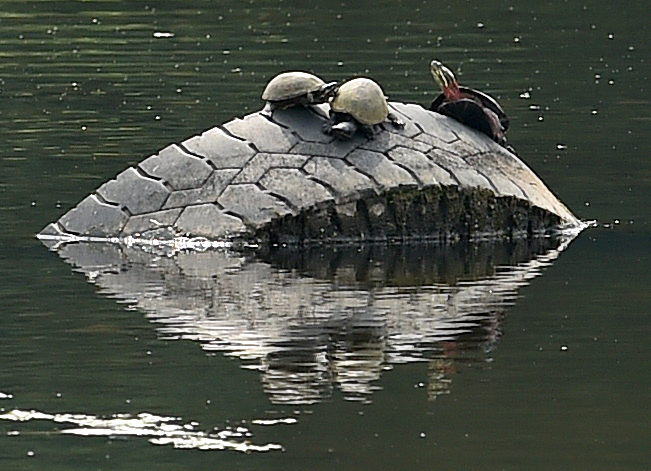
Turtles stand on a tire in Pameacha Pond in Middletown on June 30, 2023.

How do people end up protecting wildlife? They are not necessarily longtime nature lovers. Maybe they just work at a dry cleaner.

Cathy Free reports at the Washington Post, “Every summer at Best Cleaners in Middletown, Conn., employees throw open the front and back doors and the slow parade begins. Very slow.

“During nesting season from May through September, turtles ramble into the store, ease their way past the front counter and racks of freshly cleaned jackets and skirts, and crawl for the opposite door.

“They’re among dozens of female Eastern painted turtles on their annual summer migration from Middletown’s Pameacha Pond to lay their eggs at a grassy marsh behind the dry-cleaning store. In late summer and early fall, the trek changes direction, with tiny hatchlings making their way back to the pond.

“To head either direction, the turtles need to cross South Main Street, a busy two-lane road that is part of Route 17.

“Some of the turtles are smashed by cars during their precarious annual journey, so current employees at Best Cleaners decided about five years ago to start saving as many turtles as they could, including the ones they saw wandering around the store and in the parking lot.

“ ‘I believe that people who were at the shop in the years before us also helped out,’ said Matt Dionne, regional manager for Best Cleaners, adding that the Middletown South Main Street location has always opened the doors and windows every summer to help cool things off. …

“Looking down and finding turtles in the shop is pretty common [in July], often several times a week. That’s when the employees know it’s time to help them safely cross the street. …

“The store’s eight employees routinely monitor the parking lot for stray turtles every summer, he said, noting that they’ll gently scoop them up and carry them to where they’re going — either to the marsh or the 19-acre pond.

“ ‘The babies can be as small as a quarter,’ Dionne, 36, said. ‘There’s a good chance they won’t make it across the road by themselves.’

“Assistant manager Jennifer Malon is among those who regularly makes a trip across the road with a turtle or two in hand. She also gives a lift to the occasional snapping turtle, but she makes sure to carry those in a dustpan. …

“ ‘Every summer, we’re always looking at our feet because we don’t want to step on them,’ said Malon, 37. ‘They’re important to the environment.’

“Although painted turtles are the most common turtles in North America and aren’t endangered in Connecticut like bog turtles and spotted turtles, they’re important indicators of healthy ecosystems, said Brian Hess, a wildlife biologist with Connecticut’s Department of Energy and Environmental Protection.

“They’re also vulnerable to land development that imperils habitat and migration paths, he said.

“ ‘An adult turtle might survive a raccoon trying to eat it, but it can’t survive an encounter with a car,’ Hess said. …

“Dionne hopes that rescuing the turtles will give them a better chance to make it to breeding age — usually about age 10 or so.

“ ‘Humans are the ones who built infrastructure around their habit, so we owe it to the turtles to do anything we can to give back,’ Dionne said.

“He and Malon were among those in Middletown who rallied last year to save Pameacha Pond from being turned into a city park. Students from Wesleyan University made an eight-minute documentary about the community’s efforts to keep the centuries-old haven for a variety of turtles, birds and frogs.

“ ‘They were going to drain the water from the pond, then because of the turtles, they decided not to,’ Malon said. ‘A lot of people love the turtles.’ …

“Mac Falco, manager of the Best Cleaners shop in Middletown, said many of his customers can’t imagine a summer without seeing a few slow-moving turtles in the shop when they pick up their dry cleaning.

“ ‘It’s part of the summer experience — everyone thinks it’s wonderful that we’re helping them across,’ Falco said. …

“He and other employees carefully place rescued baby turtles at the top of the pond bank across the street, then enjoy watching them climb down to the water.

“Painted turtles — named for their colorful markings — are often spotted basking in the sun on rocks and logs by kayakers on the pond, Dionne said.

“ ‘They’re fascinating, instinctual little creatures with built-in GPS systems that know where the water is,’ he said. ‘But if for some reason they end up lost in our shop, we’re happy to stop what we’re doing and pick them up.’ ”

More at the Post, here.

Read Full Post »

Photo: Jesse Granger, Duke University.
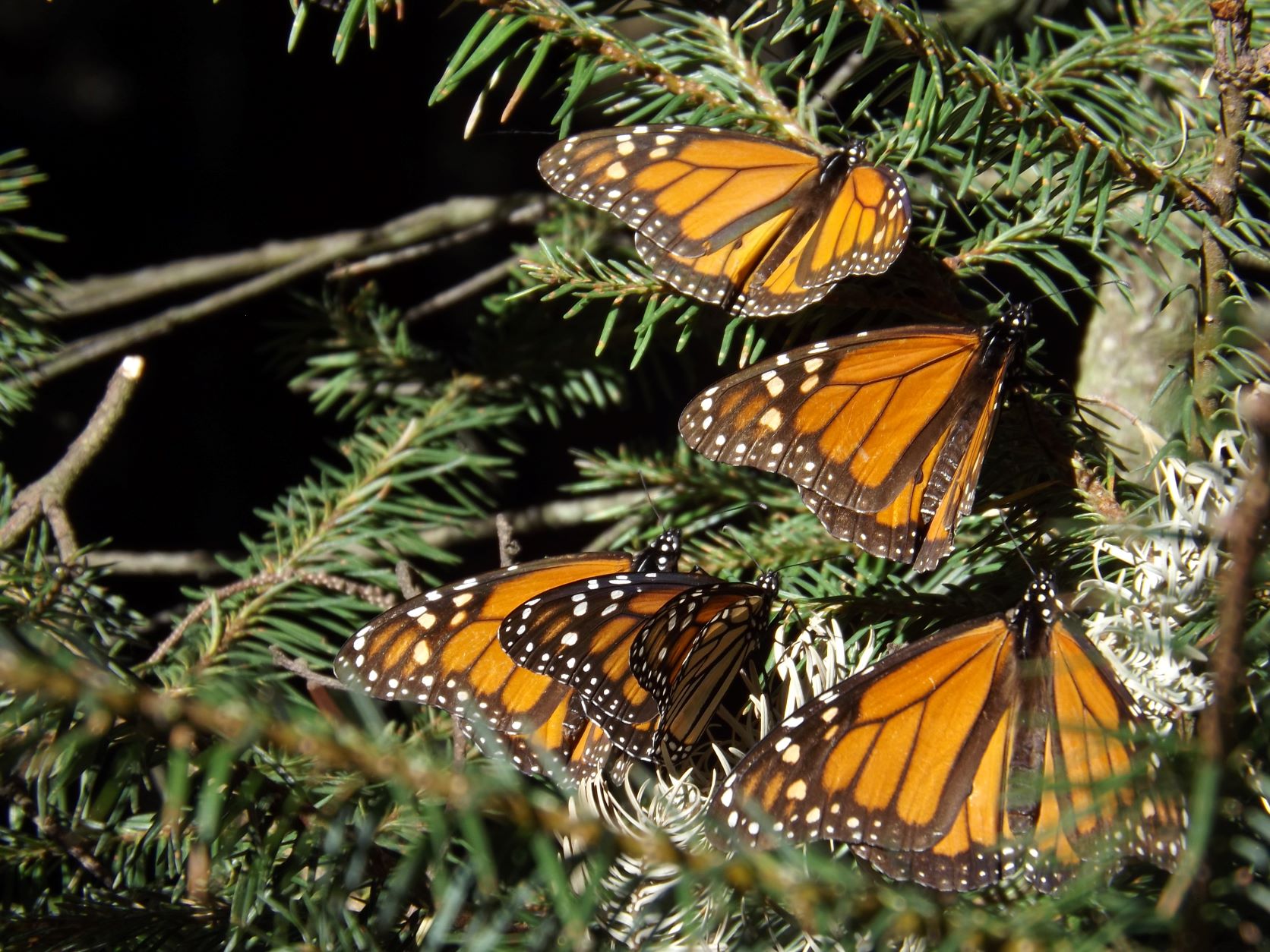
North American monarch butterflies migrate each winter to just a few mountaintops in central Mexico, with help from an internal compass,” say Duke University. “New computer modeling research offers clues to how migrating animals get to where they need to go, even when their magnetic compass leads them astray.” But as populations decline, so do the mutual-support possibilities.

Continuing the subject of friends (see the post from a few days ago), it seems that associating with others can be beneficial for many life forms. Robin Smith reports on the latest research from Duke University.

“Animals can find their way across vast distances with amazing accuracy,” Smith writes. “Take monarch butterflies, for example. Millions of them fly up to 2,500 miles across the eastern half of North America to the same overwintering grounds each year, using the Earth’s magnetic field to help them reach a small region in central Mexico that’s about the size of Disney World.

“Or sockeye salmon: starting out in the open ocean, they head home each year to spawn. Using geomagnetic cues they manage to identify their home stream from among thousands of possibilities, often returning to within feet of their birthplace.

“Now new research offers clues to how migrating animals get to where they need to go, even when they lose the signal or their inner compass leads them astray. The key, said Duke Ph.D. student Jesse Granger: ‘they can get there faster and more efficiently if they travel with a friend’ [Collective Movement as a Solution to Noisy Navigation and its Vulnerability to Population Loss, Jesse Granger and Sönke Johnsen].

“Many animals can sense the Earth’s magnetic field and use it as a compass. What has puzzled scientists, Granger said, is the magnetic sense is not fail-safe. These signals coming from the planet’s molten core are subtle at the surface. Phenomena such as solar storms and man-made electromagnetic noise can disrupt them or drown them out. … How do some animals manage to chart a course with such a noisy sensory system and still get it right?

“ ‘This is the question that keeps me up at night,’ said Granger, who did the work with her adviser, Duke Biology Professor Sönke Johnsen.

“Multiple hypotheses have been put forward to explain how they do it. Perhaps, some scientists say, migrating animals average multiple measurements taken over time to get more accurate information. Or maybe they switch from consulting their magnetic compass to using other ways of navigating as they near the end of their journey — such as smell, or landmarks — to narrow in on their goal.

“In a paper published Nov. 16 in the journal Proceedings of the Royal Society B, the Duke team wanted to pit these ideas against a third possibility: That some animals still manage to find their way, even when their compass readings are unreliable, simply by sticking together.

“To test the idea, they created a computer model to simulate virtual groups of migrating animals, and analyzed how different navigation tactics affected their performance.

“The animals in the model begin their journey spread out over a wide area, encountering others along the route. The direction an animal takes at each step along the way is a balance between two competing impulses: to band together and stay with the group, or to head towards a specific destination, but with some degree of error in finding their bearings.

“The scientists found that, even when the simulated animals started to make more mistakes in reading their magnetic map, the ones that stuck with their neighbors still reached their destination, whereas those that didn’t care about staying together didn’t make it.

‘We showed that animals are better at navigating in a group than they are at navigating alone,’ Granger said.

“Even when their magnetic compass veered them off course, more than 70% of animals in the model still made it home, simply by joining with others and following their lead. Other ways of compensating didn’t measure up, or would need to guide them perfectly for most of the journey to accomplish the same feat.

“But the strategy breaks down when species decline in number, the researchers found. The team showed that animals who need friends to find their way are more likely to get lost when their population shrinks below a certain density.

“ ‘If the population density starts dropping, it takes them longer and longer along their migratory route before they find anyone else,’ Granger said.

“Previous studies have made similar predictions, but the Duke team’s model could help future researchers quantify the effect for different species. In some runs of the model, for example, they found that if a hypothetical population dropped by 50% — akin to what monarchs have experienced in the last decade, and some salmon in the last century — 37% fewer of the remaining individuals would make it to their destination.”

More at Duke, here. No firewall.

Read Full Post »

Photo: Christopher Andrew Bray/Wikimedia.
A massive red-crab migration happens on Christmas Island, 932 miles northwest of Perth, Australia.

The annual red-crab migration on Christmas Island would be something to see. I hope the crabs survive human invasion better than the armadillo-like mole crabs (sand crabs) of my childhood on Fire Island. A Google search tells me that those have survived in North Carolina at least.

Photo: Outer Banks.
Mole crab, also called sand crab.

Here’s a report from the Ocean Conservancy on red crabs.

Katie Hogge writes that the name Christmas Island “traces back to 1643, when an English voyager sailed past it on Christmas Day. Today, nearly two-thirds of this incredibly biodiverse island is protected as a national park. While Christmas Island contains wetland, rainforest and marine ecosystems that host many remarkable creatures, there’s one species that steals the spotlight each year: Gecarcoidea natalis, appropriately nicknamed the Christmas Island red crab. …

“Every year as the first notable shower of the rainy season begins, a truly awe-inspiring event happens on Christmas Island: Millions of red crabs begin their annual migration across the island, moving with unwavering determination to reach the shoreline where mating and spawning occur. It’s estimated that 40 to 50 million of these crabs participate in the migration each year, braving tough terrain and prowling predators to play their part in establishing the species’ next generation.

“Once the migration begins, it will continue for around three weeks until the optimal spawning time when female crabs propel their eggs into the sea. The actual calendar dates for this event vary each year, but they usually occur sometime in October or November. ….

“The lunar cycle is why this migration, mating and spawning happens so consistently within the same time frame year after year. Without fail, the red crabs always spawn together before the sun rises during the final quarter of the moon as the high tide begins to turn. However, depending on how close the first rainfall occurs to this optimal lunar time frame, the crabs may have to dash to their destination faster in some years than others … and somehow, they always know exactly how fast they need to move to make their deadline.

“This mission to the sea isn’t an easy one, either. The journey across the island requires the crabs to avoid the threat of traffic as they move across roads (though some wildlife bridges have helped with this), and the heat of the sun can cause them to become dehydrated and easily exhausted. Although adult red crabs have no natural predators on land, their populations have been greatly affected by an invasive species known as ‘yellow crazy ants’ (Anoplolepis gracilipes). These invasive insects blind the crabs with acid, and scientists estimate they’ve killed tens of millions of crabs since they first arrived on the island.

“The challenges don’t end when the crabs reach their destination, though. First, male crabs who complete the journey must dig their own breeding burrows, and since millions of crabs are looking for space to burrow at the same time, this can become quite the competitive task. Once a male and female crab have successfully mated within a burrow, females will stay put, incubating their broods for a couple of weeks as the eggs develop. An amazing fact about mommy red crabs: They can produce up to 100,000 eggs per brood! …

“Once the moon reaches its last quarter phase, all the mother crabs know: It’s time to move! As the tide moves out before the sun breaks the horizon in the early morning, the females gather at the water’s edge and release their eggs into the waves. …

“As soon as the eggs are released into the water, larvae are triggered to hatch from the eggs, eventually developing to their final larval stage known as megalopae. For a couple of days, these tiny ‘almost baby crabs’ will group together near the shore until they finally grow into their full form as baby crustaceans. …

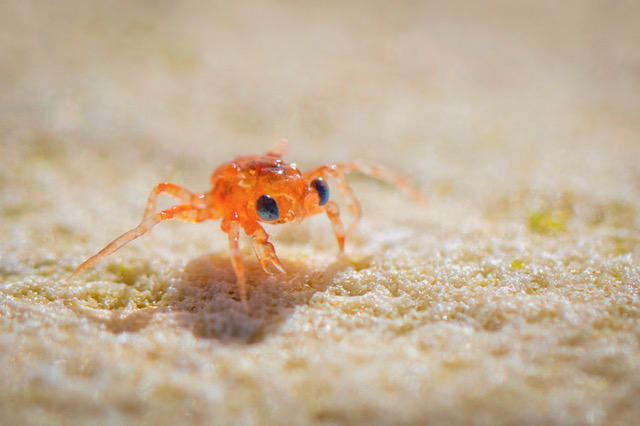
“These babies are tiny! Only about half a centimeter when they first arrive onshore, they’re so tiny that as millions of them emerge onto the shore, the unassuming eye may mistake them for a reddish algae covering the rocks and sandy shoreline. It will take these tiny trekkers a little more than a week to reach the protection of the edge of the forest, where they live and grow for the first few years of life. Once they reach ages four or five, the young crabs will participate in the migration that their species is famous for.

“Unfortunately, while so many eggs are released into the water, the majority of red crab larvae never get the chance to begin the trip home. These millions of larvae are an important food source for marine animals like manta rays and whale sharks that gather near Christmas Island each year for a festive seasonal feast. Most years, few baby crabs ever come out of the sea, and some years, no crabs make it out at all. But fear not: one to two times each decade, a massive number of baby crabs somehow make it to the beach, establishing a troop of enough survivors to keep the population at a healthy level. …

“Yet, as arduous as the red crabs’ annual journey to lay the foundation of the next generation is, there’s another danger to their survival that’s becoming increasingly threatening each and every year: climate change. Research notes that because these animals rely on the seasonal natural cycle of a wet season, anything causing potential changes in rainfall can throw off the entire process (or even eliminate the chance a migration will happen at all).  As such, both the red crabs and animals that depend on them for sustenance face new and greater risks to their survival.”


Are there critters where you grew up as a child that seem to have disappeared? I miss the mole crabs, fireflies, and those salamanders called red efts. I know they are still around, but I haven’t seen any in decades.

More at Ocean Conservancy, here.

Read Full Post »

Photo: Jeff Abbott.
Martín Zapil stands among the lettuce plants growing in one of his plots of land on June 10, 2021, in the village of San Martín la Calera in Zunil, Guatemala. He chose to build a future in Guatemala instead of migrating to the U.S.

It was with considerable disappointment but not much surprise that I heard the message that our vice president was dispatched to relay to Central Americans: Stay home.

But, you know, people leave home only as a last resort. If you want them not to, you have to help make it possible to stay. Today’s article indicates how that might work.

Jeff Abbott and Whitney Eulich reported the story from Guatemala and Mexico for the Christian Science Monitor.

“Martín Zapil crouches down and examines the lush green leaves of a lettuce plant growing on one of his small plots of land here in Guatemala’s western highlands. Access to this land – parcels that he rents from neighbors and family – has given Mr. Zapil the opportunity to build an organic agricultural business, supplying restaurants and local markets with his fresh vegetables.

“And it’s done something else that few in rural Guatemala can claim: It’s given him hope, and alleviated his drive to migrate to the United States. 

“ ‘I’m tied down here; these lands have absorbed me and told me living here is possible,’ says Mr. Zapil, taking a seat on a nearby boulder where he surveys his onion, lettuce, and spinach crops.

“Guatemalans make up one of the largest groups of migrants apprehended on the U.S.-Mexico border in recent years. Many are fleeing rural areas, where climate change and lack of access to land and food have severely limited opportunities to thrive. Rates of chronic malnutrition are some of the highest in the world, racism is rampant toward the nearly 44% of the population that identifies as Indigenous, and corruption is rife, with high rates of violence and crime.

“U.S. conversation about halting migrants and asylum-seekers along its southern border tends to center on ‘push-pull’ factors. Crime, violence, hunger, lack of public services, and limited formal job opportunities push migrants away from home, while promises of employment, family reunification, safety, and education pull them north. But rarely does the conversation focus on learning from cases like Mr. Zapil’s: those who fit the profile of someone prone to migrate, yet decide there’s a way to build a future at home.

“It’s a perspective migration experts say could make or break the success of new U.S. initiatives. …

“Kamala Harris visited the region – her first international visits as vice president – and was criticized for telling Guatemalans, ‘Do not come.’

“ ‘The United States will continue to enforce our laws and secure our borders. … I believe if you come to our border, you will be turned back,’ she said at a press conference.

‘It’s not about telling people not to come to the United States; it’s about explaining or showing them why they should stay’ in their home countries, says Nicole Kast, head of programs in Guatemala for Catholic Relief Services (CRS).

“The international aid organization, which receives the vast majority of its funding from the U.S., recently published a study exploring factors that tend to decrease someone’s likelihood of leaving Guatemala – like education and training opportunities that feed into formal employment, access to fertile land, and a sense of connection to one’s community.

“The U.S. has traditionally looked at migration from Central America ‘as what are the problems that exist in those countries that are pushing people out, and not from an opportunity or resilience perspective,’ Ms. Kast says. She’s hopeful there could be a broader shift in the future to focus on what’s keeping people at home and tailoring aid initiatives accordingly.

“ ‘People don’t migrate because they want to,’ says Juan José Hurtado, executive director of the migrant advocacy group Pop N’oj, based in Guatemala’s western highlands. ‘The lack of hope, the despair is something that pushes [migration].’ Like most people, Guatemalans want to remain in their communities, he says – if they can.

“Mr. Zapil, single and in his 20s, fits the profile of many Guatemalans who head to the U.S. in search of opportunity. He estimates four of his seven closest friends have left in recent years.

“He half expected to do it himself. Zunil is an agricultural town, where children can attend school locally through junior high. If they want to continue studying – as Mr. Zapil did – they have to travel to a nearby city, making a diploma a sometimes cost-prohibitive prospect.

“His father migrated, like many before him, when Mr. Zapil was just 2 years old. The elder Zapil couldn’t read or write, and spent 10 years in the U.S., driven by poverty and a desire to provide for his family. The children’s grandfather raised them, while their father sent paychecks home to put food on the table and keep them in school. When Mr. Zapil was 13, a cousin proposed they migrate north together, and he considered the offer. But his dad had just returned home, and his grandfather raised him with an emphasis on the value of working the land and connecting to his K’iche’ Maya history.

“ ‘I don’t know what would have happened if I had gone,’ he says. ‘My connection to the land helps maintain me. … This is what opened opportunities for me,’ he says. …

“His access to land is key to building what he refers to as the Guatemalan dream. It allowed him to develop his company, Sorel Granjas Ecológicas – a project he’s been working on and dreaming about for at least five years. The pandemic shuttered many markets and restaurants, but he’s continued making connections with potential partners.

“ ‘Those who have sufficient land to live on will not migrate,’ says Mr. Hurtado.”

More at the Monitor, here.

Read Full Post »

10000

Photo: Christie’s
Alireza Hosseini, a refugee from Afghanistan, says of his 2019 painting “Embrace God”: “I was a man who did not know a god. I went to a sage and he told me to imagine two chairs: one for me, the other for God.” (Story at the
Guardian,)

It can be discouraging being a refugee if your new countrymen see you more as a concept than an individual. That is why a program in France, though struggling itself, has been determined to do something that opens minds.

PBS NewsHour‘s “Arts Canvas” recently posted a report by Jeffrey Brown on letting refugees tell their stories through their art.

“JEFFREY BROWN: Portraits of migration, the troubles faced along the way, the trauma of making a new home.

“ABDUL SABOOR: I’m from Afghanistan, but, sometimes, I say from nowhere.

“BROWN: Photographer Abdul Saboor experienced it himself. In Afghanistan, he says, he worked in transportation for the U.S. Army, but fled when the Taliban began threatening him and his family. During a harrowing two-year journey, part of it spent in an abandoned train station in Serbia, he began taking pictures with a donated camera.

“SABOOR: When I show to the people, I say, that’s not normal, how we lived there.

“BROWN: His photographs became a bridge to overcome language and other barriers and raise awareness about the plight of refugees, which he continues to do in Paris. … Saboor is one of some 200 refugee artists from more than 40 countries now getting support from the Agency of Artists in Exile.

“On our visit to its makeshift building off the Seine River, an Ethiopian man belted out a traditional song with accompaniment from this phone. Across the hall, a Yemeni woman used her vast trail of official asylum-seeking papers, accumulated over two years of navigating France’s legal process, to create an art installation. … And a Kurdish actor who fled Turkey practiced a monologue about his first days in Paris. …

“Judith Depaule is director of the studio, which opened in 2017 with funding from the French Ministry of Culture.

“JUDITH DEPAULE: In the beginning, you are, like, in the state of shock. … because nobody wants you there. It’s difficult. You have to do a lot of papers. … It’s like a panic. …

“BROWN: President Emmanuel Macron has sought to criminalize illegal border crossings, while tightening restrictions on asylum, even as far-right parties in the country call for more.

“But France also has a long tradition of being a sanctuary for artists, including Pablo Picasso and James Baldwin. The idea here was to give artists a place to connect with one another, to work on and exhibit their crafts, and to help with all the practical challenges of living as a refugee.

“ARAM TASTEKIN (through translator): First of all, they helped us find a place to live. Secondly, they helped us get a work visa, find a lawyer. Some people needed psychologists, things like that.

“BROWN: Kurdish actor and drama teacher Aram Tastekin fled Turkey in late 2017. So, why did you leave Turkey?

“TASTEKIN (through translator): Because it’s complicated living there. I’m a conscientious objector. I am anti-military. I’m an artist who tries to make art and theater in the Kurdish language, to protect the Kurdish language. But when we make Kurdish art or theater, they always say it is terrorist propaganda. And that really hurts. How can a language be terrorist propaganda?

“BROWN: In 2018, graffiti artist and painter Ahlam Jarban fled her native Yemen amid its years-long civil war. She says she faced added persecution for her family’s Somali and Ethiopian roots and for her wanting to be an artist as a woman. She left everyone and everything behind, and says she still doesn’t know if it was the right decision.

“AHLAM JARBAN: Because, all of us, we are we are without our families. So we feel lonely. We feel — there is a lot of problem. But when we are together, when we speak, when we share this story, it makes us a little less stressed, make us little — keep fighting. So it is good to have this place. …

“BROWN: To further make its case and showcase its artists, the agency recently presented its third annual month-long festival titled Visions of Exile. …

“JARBAN: When they see our artwork, they don’t see it as a refugee. This see it as artist, and artist make this thing. We do all this journey to be something. We have hope, and we are human before we come.” More here.

Read Full Post »

arrival-of-colonists-at-jamestown-in-virginia-colony-1607-adwcha

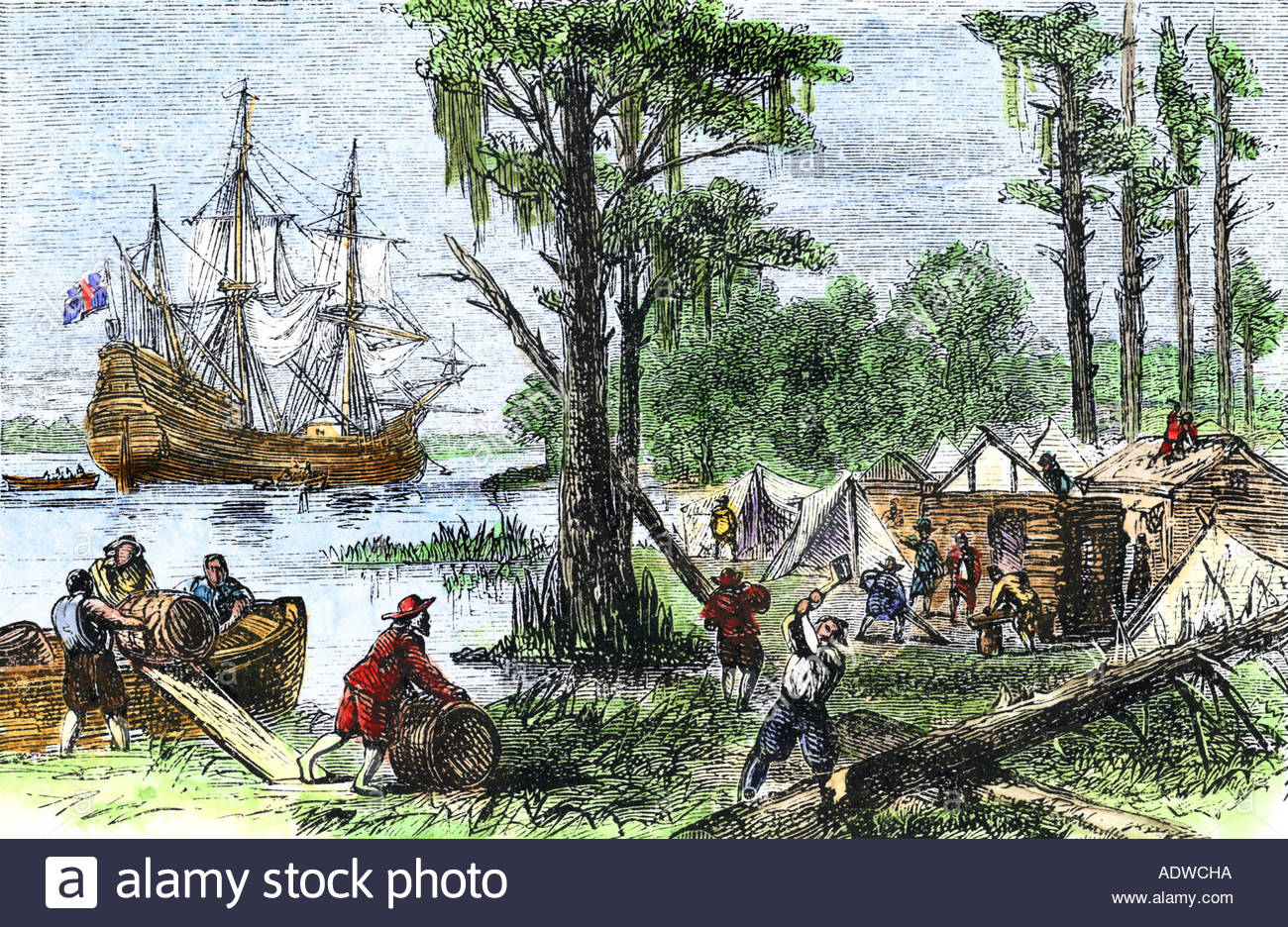
As you know from your earliest history classes, the first immigrants arrived in Virginia in 1607.

For good or evil, depending on how much you identify with an indigenous heritage, immigrants have made America what it is today. The migration started as early as 1607 in Virginia.

That’s what came to mind when I read this news story about the contribution of immigrants to the economy of present-day Virginia.

Katie O’Connor writes at the Virginia Mercury, “A new report from the Commonwealth Institute for Fiscal Analysis says immigrants are key contributors to the state’s overall economy, despite challenges that include health insurance access, discrimination, language barriers, ‘brain waste’ and housing costs. …

“As many parts of Virginia struggle to find enough workers, many immigrants are ‘relatively young, well educated, fluent in English and more likely to participate in the workforce.’

“The one million immigrants in Virginia make up 12.5 percent of the state population. … And while immigration from Mexico tends to dominate the national debate, Virginia’s immigrant population comes from a wide variety of countries.

“ ‘Mexican immigrants make up just 5% of all immigrants in Virginia, fourth after people born in El Salvador (11%), India (9%), and Korea (6%),’ the report says. ‘Looking at continent of birth, rather than country of birth, there is a similar diversity. Forty-three percent of Virginia’s immigrant population was born in Asia, the largest group from any continent.’ Most of them are also between the prime working ages of 25 and 54. …

“ ‘Immigrants participate in Virginia’s workforce at a much higher rate than U.S.-born residents — 72 percent compared to 65 percent — and at a rate six percentage points higher than the national participation for foreign-born residents.’

“But the report also points to public policies that would help address the challenges immigrants face. More than one in three noncitizen residents lack access to health insurance in Virginia, ‘even worse than in the country as a whole,’ the report states. …

“Immigrants face all the challenges that come with lack of health insurance, like large medical bills and a lack of preventative care. Virginia is also one of only six states to require legal, noncitizens to work for at least 10 years before they qualify for Medicaid.

“Housing and poverty remain problems for the state’s immigrants, as does what’s called ‘brain waste’: when people aren’t working jobs that match their educational attainment.

“ ‘In Virginia, 21 percent of college-educated immigrants 25 and older are working in low-skill jobs or are unemployed. This is well above the average for U.S.-born Virginians,’ the report states. ‘Lawmakers, employers, and workforce development officials all have a role to play in reducing this needless inefficiency and maximizing opportunity for the state.’ ” More.

When a much-needed resource is right under our noses, it’s penny wise and pound foolish not to help it flourish.

Hat tip: Economic Policy Institute on twitter.

P.S. I can’t resist adding this poem by Emily Dickinson from today’s Boston Globe:
“These Strangers, in a foreign World,
“Protection asked of me—
“Befriend them, lest Yourself in Heaven
“Be found a Refugee—”

Read Full Post »

More and more people are recognizing that the mass migrations we’re seeing today — and the wars that seem to be the main cause — are tied to climate change.

Here is a story about a small city in Georgia, home to many immigrants, that has put two and two together and is determined to be part of the solution.

Writes Jason Margolis at Public Radio International’s show The World, “Clarkston, Georgia, is often referred to as the Ellis Island of the South. Some 60 languages are spoken in this city of 13,000 just outside of Atlanta, and perhaps half the population is foreign born. Many are refugees.

“Felix Hategekimana is a refugee from Rwanda, a soft-spoken man who doesn’t talk much about his backstory, except to say that he fled violence back home: ‘We have political issues and security [issues].’

“But Hategekimana says there’s more to the troubles in Rwanda. Droughts and floods have plagued his country in recent years, and that’s led to more people migrating.

“ ‘Some people lose life in the disaster of the rain,’ Hategekimana said. ‘Some people lose life, others lose their homes and they lose their property, like their farms where they plant their vegetables.’

“You hear a lot of stories like this from refugees in Clarkston. Legally, there’s no such thing as a ‘climate change refugee.’ Refugee status is only awarded based on a well-founded fear of persecution due to race, religion, nationality, political opinion or membership in a social group — not because your home got wiped out by a flood, or your crops were destroyed by a drought.

“But Clarkston’s mayor, Ted Terry, says the impacts of more extreme weather are woven throughout the lives of many new residents here. …

“Climate scientists agree that storms are becoming more severe, and the trend is only going to continue. Case in point, the Category 4 cyclone that struck southern Africa recently has left at least 600,000 people displaced. The immediate needs there — food, clean drinking water and shelter — are stark. After that, a big question: rebuild or relocate?

“It’s a dilemma that many people across the globe are facing, which will inevitably lead to more people on the move. But the world still hasn’t agreed on what to do with so-called climate refugees. Take a place like Syria.

“ ‘It becomes more drier, I think,’ said Malk Alarmash, a Syrian refugee now living in Clarkston. … But Alarmash can’t say that a lack of rainfall led people to flee Syria.

“ ‘I don’t know. I don’t have any information about that, like climate change,’ Alarmash said.

“An inability to pin the seeds of conflict on climatic shifts isn’t unusual; the relationship between climate change and forced migration is immensely complicated. … A drought can destroy people’s food supplies and livelihoods. That can lead to internal migration, inflame tensions and maybe even contribute to conflict and a refugee crisis. But all of this can unfold over years. …

“ ‘The climate is the last thing in their mind. They know it’s all related, but they just say, “This is from God,” ‘ said Omar Shekhey, a Clarkston resident who is originally from Somalia. …  ‘It goes together — the civil war, the war and the climate, you cannot separate them.’ …

“Shekhey says most Somali refugees aren’t connecting the dots to climate change. But as global temperatures continue to rise, Mayor Terry, who also works with the Sierra Club, believes that those dots will become clearer, even in the US.

“ ‘We’re looking at a future, I think, if we don’t take steps to reverse global warming, we’re looking at potentially hundreds of millions of people around the world, including you know, in America, Louisiana. Their coastline is disappearing,’ Terry said. ‘And so, at some point, there has to be some sort of recognition and define what it means to be a climate refugee.’ …

“Clarkston’s mayor [wants] to address the root of the problem, starting in his own community. It’s one reason Clarkston is committing to 100 percent renewable energy — instead of fossil fuels — by midcentury.

“ ‘In some way, we’re trying to alleviate future calamities. We just have to do our part; we have to consider ourselves part of the global community.’ ”

More at PRI, here.

dsc5861

Read Full Post »

If the five unexpected salmon are a sign of a comeback in the Connecticut River, this could be really exciting.

Nate Schweber writes at Al Jazeera America, “By the fall of 2015, the salmon of the Connecticut River were supposed to be doomed. The silvery fish … went extinct because of dams and industrial pollution in the 1700s that turned the river deadly. In the late 1800s a nascent salmon stocking program failed. Then in 2012, despite nearly a half-century of work and an investment of $25 million, the federal government and three New England states pulled the plug on another attempt to resurrect the prized fish.

“But five Atlantic salmon didn’t get the memo. In November, fisheries biologists found something in the waters of the Farmington River — which pours into the Connecticut River — that historians say had not appeared since the Revolutionary War: three salmon nests full of eggs.

“ ‘It’s a great story,’ said John Burrows, of the Atlantic Salmon Federation, a conservation group, ‘whether it’s the beginning of something great or the beginning of the end.’ …

“The streamlined wild Atlantic salmon, genetically different from their fattened domesticated counterparts, which are mass-produced for human consumption, are so rare that anglers spend small fortunes chasing them across Canada, Iceland and Russia. …

“The stocked salmon continued to die off through the early 1970s. Gradually, scientists began to learn the importance of different strains of salmon and their close relatives, trout. In 1976 the program was able to acquire Atlantic salmon eggs from the Penobscot River in Maine, the closest surviving population both physically and genetically. This strain was still different from the lost native strain of the Connecticut River, but less so than their Canadian cousins, previously stocked there. In 1978, 90 fish from the Maine strain managed to make the two-year, 6,000-mile migration out to the food-rich Labrador Sea off of Greenland and then return to the Connecticut River. …

“As only 54 salmon returned to the Connecticut River in 2012, the U.S. Fish and Wildlife Service pulled out of the restoration program. New Hampshire, Vermont and Massachusetts followed. Connecticut opted to continue stocking a small number of salmon …

“Then in the fall of 2015, biologists found five adult Atlantic salmon swimming past the Rainbow Dam on the lower Farmington River. On a hunch, they searched likely upstream spawning habitat and there found the three nests full of eggs.

In the spring of 2016 they will hatch the first wild salmon into that river in two centuries.”

More here.

Photo: Design Pics Inc / Alamy Stock Photo
In North America, Atlantic salmon migrate up rivers and streams to reach spawning grounds in New England and Canada.

Read Full Post »

Sometimes I wish I lived closer to where the migrants are pouring into Europe. When I read, for example, about all that Germany is doing, how organized the country is about getting people acclimated, helping with housing and language, it makes me want to sign up. In Samos, Greece, Suzanne’s friend’s family spent weeks buying and distributing food, diapers, and other necessities.

Mark Turner writes at UNHCR Tracks about a chef who acted on his impulse to do his bit. He “packed his knives, drove to Croatia and started cooking.

“After serving up 6,000 piping-hot meals for refugees, the Swedish chef’s big wooden spoon is looking worse for wear.

“ ‘It wasn’t broken when I began,’ says Victor Ullman, a 27-year-old from Lund, displaying a large wedge-shaped hole as he pulls it from a simmering pot.

“But long days and nights serving stew to thousands of Syrians, Afghans, Iraqis and many others have taken their toll. ‘As long as I am awake, I am cooking,’ he says. …

“We’re in Bapska, Croatia, a few hundred metres from the border with Serbia, where tens of thousands of refugees have [crossed], seeking safety in Europe.

“They arrive by foot, in baby strollers, in wheelchairs, hour after hour, day after day, wet, hungry, exhausted, on an epic trek towards the unknown.

“And all along the way they are met by an army of volunteers from across Europe, drawn by an overwhelming desire to help.

“There’s Florian, the small farmer from Austria; Ghais, a Syrian who made it to Europe last year; Livija, a trainee pizza maker from Berlin; Stefan, a long-distance walker (‘3,200 kilometres in 82 days!”’); Danjella, a former refugee from Bosnia.

“There are activists and BMW workers, students, sociologists and physiotherapists, sporting fluorescent yellow waistcoats marked with their name and spoken languages, reassuring the crowds, united by a sense of shared humanity.”

Victor “also feeds the aid workers and the Croatian police, who he says are good guys doing their best. ‘They call me the crazy Swede,’ he adds.

“Victor shows me a pair of boots given to him by one policeman, after he’d given his own shoes away to a refugee. ‘I love these shoes,’ he says. ‘They’re like a memory from here – one of them. Spread the love!’ ” More here.

(Jane D: thanks for the lead on twitter.)

Photo: Igor Pavicevic

Read Full Post »

I’ve never managed to catch the herring run, but I’d like to see it with grandchildren sometime. The celebration for the Mystic River herring migration offers all sorts of extras, as I learned from the newsletter of the Mystic River Watershed Association, or MyRWA. (I’ve been receiving the newsletter since John’s stint on the board some years back.)

“The annual Herring Run and Paddle includes a 5K run/walk race, three paddling races (3, 9, and 12 miles), educational booths, children’s activities, and more. All events are held at the [Department of Conservation and Recreation] Blessing of the Bay Boathouse in Somerville.”

MyRWA reports, “The Mystic River Watershed supports two species of herring: Alewife (Alosa psuedoharenous) and Blueback Herring (Alosa aestivalis). Both species, collectively called river herring, are anadromous. This means they spend most of their lives at sea and return to rivers—like the Mystic—to spawn, or lay their eggs.

“In colonial times and earlier, herring in the Mystic River were extraordinarily abundant.  But from the 1900’s until today a much smaller population of river herring is present. …

“According to the Herring Alliance some river herring runs on the Atlantic Coast have declined by 95% or more over the past 20 years. In 2006 the National Marine Fisheries Service designated river herring as a species of concern. Population decline may be associated with numerous factors including by-catch [catching them by accident when fishing for something else], habitat loss and degradation, water pollution, poaching, access to spawning habitat, and natural predators.”

Read more here. And remind me next May that I want to visit a fish ladder.

Read Full Post »

Older Posts »