Feeds:
Posts
Comments

Posts Tagged ‘music’

Photo: Music & Youth.
The Music Clubhouse, one of several music-focused hangouts for teens in Massachusetts, opened unexpected doors for Kristiana — forming a band, participating in a music event with the Red Sox, being accepted to the Berklee College City Music Program.

Teens always need a place to hang out with other teens. The centers in today’s story offer a lot more than hanging out.

Catherine Hurley writes at GBH radio, “Eden Troderman knew where she wanted to spend her first afternoon as a student attending the Berklee College of Music: at BTC Records, the music production space at the Brookline Teen Center that she knew well. …

“The Brookline High School graduate, who releases songs under the name Aruna, has been playing music her whole life — which included writing some ‘really cringey songs in sixth grade,’ she said. But [Aruna] didn’t start releasing music until receiving some help from BTC Records.

“Founded in 2013, the Brookline Teen Center offers a community hub for teenagers who live or go to school in Brookline. It’s one of more than 800 active youth development nonprofits in Massachusetts, according to ProPublica’s Nonprofit Explorer.

“On that cold and icy afternoon in January, the center was active with teens playing basketball in the gym and huddling around small tables with snacks after school. Others were working on music in the BTC Records studio space. …

“Bri Skywall, teen technology coordinator at the Boston Public Library, said the library’s Teen Central aims to ‘provide what we call the “third space”: a space that isn’t their home and isn’t school or work, that they can come and just be themselves.’ A space where teens ‘don’t have to pay to exist,’ she said.

“Third spaces, which broadly include include free and publicly available spaces, social services organizations and low-cost commercial establishments, are known to strengthen communities. But research shows third spaces are declining, and disparities are more present along income, race and geographic lines.

“Connections in these spaces are informal, but the plans to expand them are in writing. Strengthening the BPL’s role as a third space is listed in the city’s Imagine Boston 2030 plan. And Boston’s Third Spaces Lab, in collaboration with New Urban Mechanics, aims to ‘make it easier for grassroots organizations and individuals to grow and nurture community-based third spaces from the bottom up,’ according to the program’s website.

“BTC Music Coordinator Pablo Muñoz said the center’s goal has always been to develop a space where teens can make music, whether they have big dreams in mind or are looking to express themselves day-to-day. …

“ ‘Whenever they’re having maybe not the best week, they’ll come in here and they’ll be like, “I want to do a song. I want to talk about this.” … They’ll get it out, and then they feel better, and they’ll work on their craft,’ Muñoz said. …

“With 60-70 hours of work, Troderman writing and Muñoz producing, she released her first song, ‘Crave‘ last May, which recently surpassed 1,000 streams.

“ ‘It’s a small milestone, but it means a lot to me. If people are even listening to my music, that’s crazy,’ Troderman said.

“Tom Goldberg, a junior at Brookline High School, started taking a music production class with Muñoz in early November. He’s still learning the basics, he said, but Muñoz has already helped him create a vocal-less track, teaching him how to establish a beat.

“ ‘I think I’m more confident in myself,’ Goldberg said. … [He] said if he were to show people at school the music he likes, there would be a different reaction than at BTC Records. ‘Here, [it’s] way more welcoming,’ he said. ‘Like the sense of community is way bigger here.’ …

“Teens at the center that day milled in and out of the control room, pushing open the heavy, soundproof door in search of Muñoz, their admired teacher and collaborator. Muñoz himself started at BTC in 2022, about a year after he graduated from Berklee. …

“The next day, on a colder and icier afternoon in Back Bay, four teens huddled around computers and small keyboards. They were there for Music Production with Hamstank, a weekly digital music creation session at the Boston Public Library. Somerville-based record producer Tony ‘Hamstank’ Hamoui has led the program for the last seven years. …

“Hamstank’s routine during the hourlong sessions differs from week to week. Sometimes he’s helping teens get started — like a participant that day who opened the music software for the first time and was already making a song — but he also supports kids with more advanced music skills.

“Hamstank glanced over to another teen, calling him a ‘master-level composer and vocalist.’ The student was working on a song he started the week prior, this time re-recording vocals in the space’s audio booth. …

“Hamstank said some kids come to the session with their headphones on, wanting to work solely on their own projects. ‘And that’s fine, but you always find them slowly taking the headphones off and listening and asking questions and talking to other teens,’ he said.”

More at GBH, here. No firewall. [Note: I may have used the wrong pronouns for Troderman. The GBH article was inconsistent.]

Read Full Post »

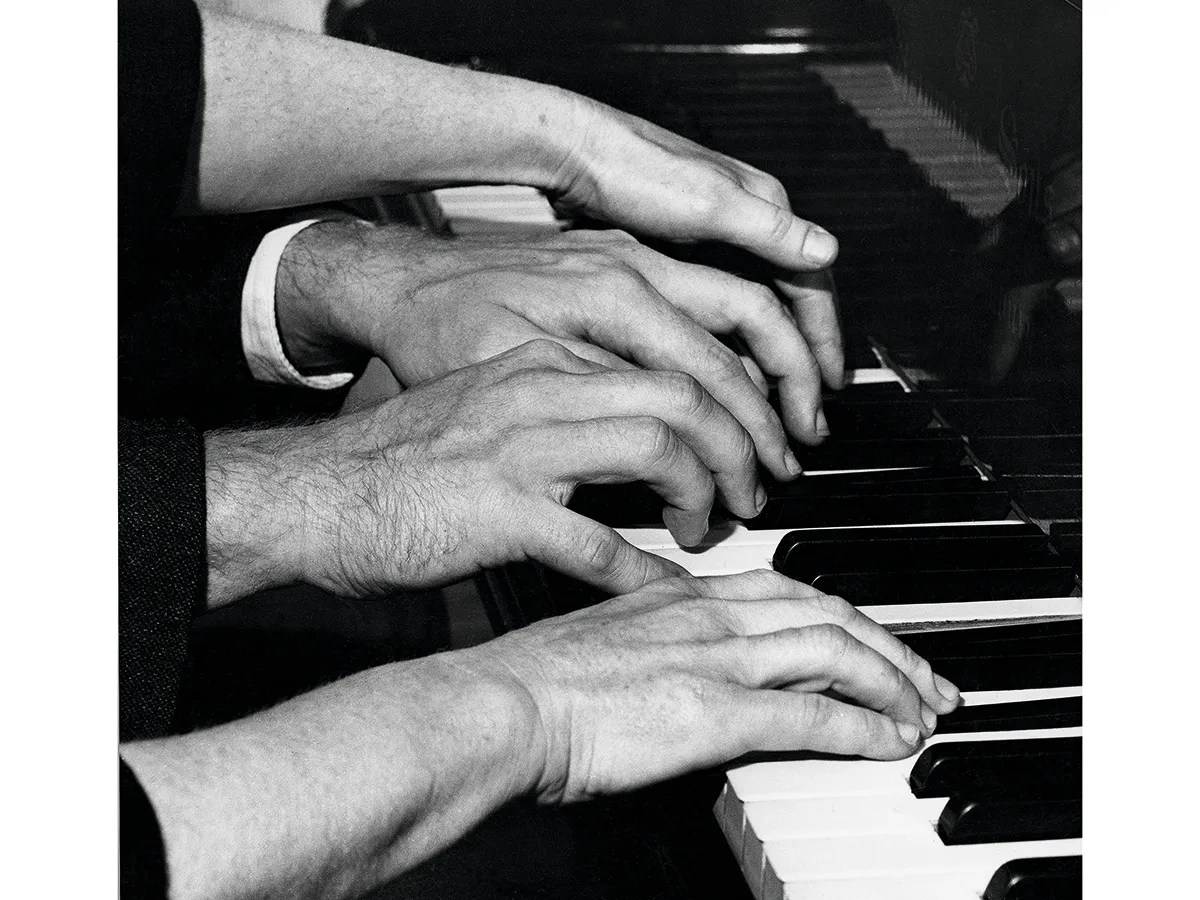
Photo: Classical-Music.com.
Playing piano four-hands.

Where I live now, we think a lot about brain health. We know that parts of our brains are not working as well as they used to. It takes longer to remember a word. Sometimes a memory is completely gone, and then we worry.

I like to think of a young man I know whose father helped him use other parts of his brain for daily functioning after he was born without a cerebral cortex. This young man now lives independently, has a job in the city to which he takes a train, and is the subject of study by amazed doctors. He’s my hero these days. Brains can learn new tricks.

BBC health reporter Aurelia Foster wrote recently about one way to teach your brain new tricks, and that’s through music.

She wrote, “Playing a musical instrument or singing could help keep the brain healthy in older age, UK researchers suggest. Practicing and reading music may help sustain good memory and the ability to solve complex tasks, their study says. In their report, published in the International Journal of Geriatric Psychiatry, they say music should be considered as part of a lifestyle approach to maintain the brain.

“More than 1,100 people aged over 40, with a mean age of 68, were studied. Scientists at the University of Exeter observed their brain function data as part of a wider study that has been finding out how brains age, and why people develop dementia.

“They looked at the effects of playing an instrument, singing, reading and listening to music, and musical ability.

“The researchers compared the cognitive data of those in the study who engaged in music in some way in their lives, with those who never had. Their results showed that people who played musical instruments benefitted the most, which may be because of the ‘multiple cognitive demands’ of the activity.

“Playing the piano or keyboard appeared to be particularly beneficial, while brass and woodwind instruments were good too. Simply listening to music did not appear to help cognitive health. The benefit seen with singing might be partly because of the known social aspects of being in a choir or group, the researchers say.

” ‘Because we have such sensitive brain tests for this study, we are able to look at individual aspects of the brain function, such as short-term memory, long-term memory, and problem-solving and how engaging music effects that,’ lead author Prof Anne Corbett told the BBC. …

” ‘Playing an instrument has a particularly big effect, and people who continue to play into an older age saw an additional benefit,’ she said. In the study, people who read music regularly had better numerical memory.

“Prof Corbett said: ‘Our brain is a muscle like anything else and it needs to be exercised, and learning to read music is a bit like learning a new language, it’s challenging.’

“Researchers did not test potential benefits of taking up a musical hobby for the first time later in life, but Prof Corbett said she believed, based on current evidence, it would be ‘very beneficial. …

” ‘The message is around how people can proactively reduce their risk of cognitive decline or dementia, and really thinking about engaging with music as a way of doing that.’ … However, she said: ‘It would be naïve to think taking up a musical instrument would mean you won’t develop dementia. It’s not as simple as that.’ “

More at the BBC, here.

Read Full Post »

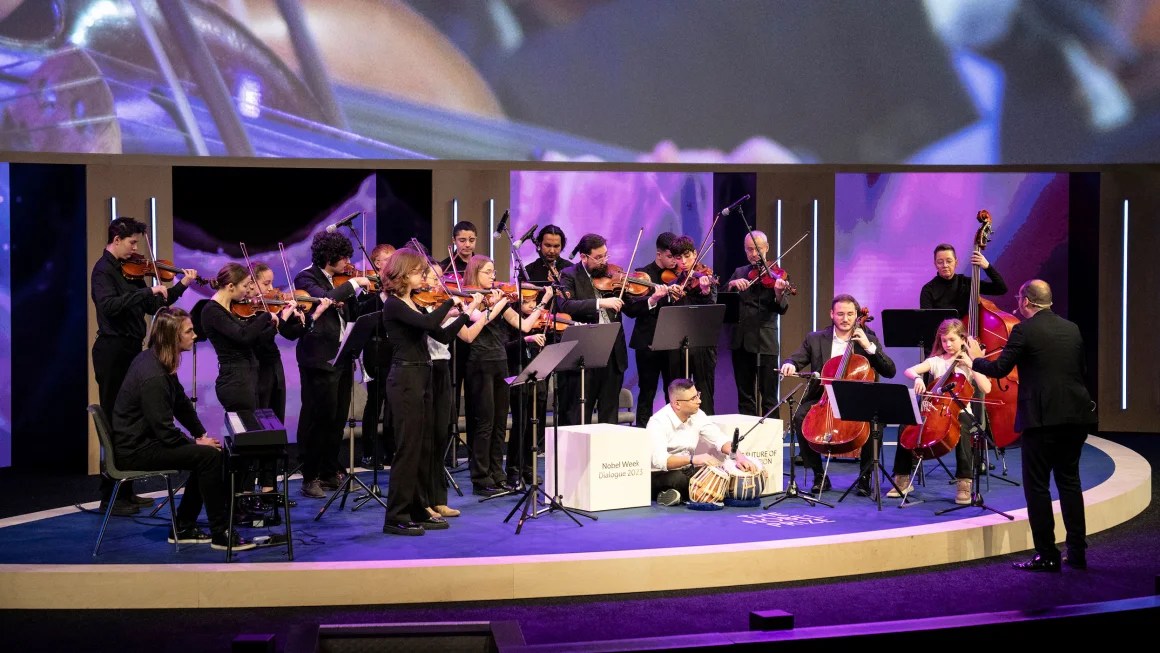
Photo: Anna Svanberg/Nobel Prize Outreach.
The Dream Orchestra started with just 13 members. Now there are more than 400, including this group performing at a Nobel Foundation event in Gothenburg, Sweden, in December 2023. 

Sweden has long been a country that took in refugees, but what I know from family members there is that Sweden doesn’t always do a good job helping immigrants integrate and feel at home. That’s why the orchestra leader in today’s story stands out.

As Mostafa Kazemi, originally from Afghanistan, recalls, the conductor told him that of course he could play an instrument even though he thought he couldn’t. “He’d been in Sweden for a matter of months,” Catherine E. Shoichet at CNN reports. “No one had talked to him like this before.”

The long and interesting article about the Dream Orchestra begins, “Ron Davis Álvarez stood on a train platform in Stockholm, stunned by what he saw. The Venezuelan orchestra conductor was visiting Sweden as part of a university exchange program. … He watched throngs of people getting off trains, their faces drawn and exhausted. Volunteers raced past him to hand out bananas and water to the new arrivals.

“ ‘I was completely in shock, seeing all of these young boys arriving,’ Álvarez recalls. He asked someone what was going on.

“The answer: ‘They are from Syria and Afghanistan. Many of them are unaccompanied. They traveled here alone.’

“ ‘What will happen to them?’ Álvarez asked. No one knew. …

“Álvarez was there watching, and he had an idea. That idea would change his life, and the lives of hundreds of others he hadn’t met yet. …

“It wasn’t long before Álvarez was back in Sweden. He’d been tapped as the artistic director of El Sistema Sweden, based in the coastal city of Gothenburg. … As he began his new role, the memory of what he’d seen months earlier on the train platform remained seared in his mind.

“El Sistema Sweden’s work was focused on younger children enrolled in Swedish schools. The youth he’d seen pouring into the train station were already in their later teenage years. It’s an age when many might assume it’s too late to learn an instrument.

“Álvarez knew it wasn’t. And he knew he had to try to help them. … With a handful of instruments on loan, he visited schools to drum up interest. Eventually, he recruited a group of 13 youth from Afghanistan, Syria, Eritrea and Albania. He dubbed them the Dream Orchestra.

“ ‘I remember coming into the room and there were a lot of girls and boys, and I was nervous,’ Álvarez says in a short film about the orchestra featured on its website. … Many of the Dream Orchestra’s members had never played an instrument before they joined. They came from different countries. They didn’t speak the same languages. …

“Mostafa Kazemi lights up when he recalls the day he met Álvarez in 2016.

“ ‘Which instrument do you play?’ the conductor asked him.

“ ‘I can’t play,’ Kazemi replied.

“Álvarez’s response was confident and unflinching: ‘Yes, you can. Come and pick which one you want.’

“Kazemi, originally from Afghanistan, was 16 years old at the time. He’d been in Sweden for a matter of months. No one had talked to him like this before. So a few weeks after the Dream Orchestra began, Kazemi became one of its first members. He picked the cello. …

“The small ensemble rehearsed on Fridays and Saturdays. Those were Álvarez’s days off, and also a time when he knew it was important to keep young people occupied and off the streets.

“At first, teaching the group wasn’t easy, Álvarez recalls. He was used to instructing younger Spanish-speaking students who came from similar backgrounds. This would require a different approach.

“Álvarez spoke English, and some of the other members of the Dream Orchestra did, too. But still, misunderstandings were frequent, even comical at times. Body language was key to overcoming those obstacles. So was finding a way to connect more deeply with each person – to learn what music they liked and where they came from and who they were.

“Another key part of Álvarez’s approach with these older students: giving them the confidence to make mistakes.

“I tried to build confidence – first the confidence of the sound.’ …

“ ‘Ron was full of energy all the time,’ Kazemi says. ‘And that made us want to do more and more and more. We were practicing at home. I even brought some more students. I told my friends. … And everyone told their friends, and everyone came to orchestra.’ …

“Now, eight years later, the Dream Orchestra has more than 400 members from nearly 20 countries who speak around 20 languages between them. …

“As [Álvarez] sees it, politicians and world leaders could learn a lot from this music ensemble.

“ ‘I see the orchestra like society,’ he says. ‘When you are in an orchestra, you need to learn how to hear each other, how to listen to each other, compassion, how to empathize.’

“That’s not to say there haven’t been challenges over the years. Some students at first struggled with taking direction from female conductors and teachers, Álvarez says, and tensions have boiled over at times between members of the orchestra whose home countries have a history of conflict with each other.

“Some conductors might direct their orchestras simply to play on and ignore these difficulties. Álvarez says he addresses them directly. He wants the orchestra not only to be a safe space, but a place where its members can grow and learn to live together.

“ ‘We are all people that need to respect each other. It’s difficult because you cannot erase this history, but you can rewrite the future,’ he says.”

More at CNN, here. No firewall.

Read Full Post »

Photo: Sarah Matusek/The Christian Science Monitor.
Nixon Garcia, a teaching artist at El Sistema Colorado, conducts students at the music school in Denver.

People sometimes forget that we need more immigrants, not fewer. Their contributions to the economy are well documented. In 2021, for example, they contributed more than $500 billion just in taxes (see Forbes here). Not to mention that they willingly apply for necessary jobs that go begging, sometimes for years.

And there are other contributions getting less attention. Consider what this one musician is doing. Sarah Matusek wrote about his work recently at the Christian Science Monitor.

“A few dozen children in Denver settle into seats, violins and violas in hand. With short cropped hair and a focused gaze, Nixon Garcia observes from off to one side. …

“This is a fall show-and-tell for parents at El Sistema Colorado, a free music school that prioritizes kids from low-income families. The Denver program was inspired by the original El Sistema in Venezuela, which since its founding in 1975 has sparked similar projects around the world. …

“With flutters of his hands and flicks of his wrists, the 22-year-old conjures up simple songs that he learned as a boy in the Venezuelan program. He’s brought that same sheet music to students in the United States, along with hopes for asylum. Working as a teaching artist at the Colorado program, he’s come full circle.

“ ‘El Sistema has been my second home throughout my whole life,’ says Mr. Garcia, who teaches in Spanish and English. 

“The original program’s catchphrase, ‘tocar y luchar‘ – or ‘play and fight’ in English – has evolved into a personal mantra of perseverance for the young conductor who can’t imagine returning home.  By the time he left Venezuela, in 2022, says Mr. Garcia, he’d been kidnapped three times. 

“Backdropped by mountains in northwest Venezuela, the town of La Fría sits near the Colombian border. Mr. Garcia’s family, who ran a poultry farm there, enrolled their son in the popular music program at a young age. …

“At age 5, he began learning the Venezuelan cuatro, which has four strings. Later on came the clarinet. As a teenager, Mr. Garcia began teaching other El Sistema students – a key mentorship feature of the program – and developed a love of conducting. But basic needs were stark; some students he taught sat on the floor, because there weren’t enough chairs. And beyond the solace of class, violence lurked.

“When he was a young teenager, in 2015, a criminal group, called a colectivo, kidnapped him and his family at a gas station. The group held them for several hours, his family says, and demanded thousands of dollars for their release. 

“Venezuela, meanwhile, devolved into further economic, political, and human rights crises under President Nicolás Maduro, causing millions to flee. Mr. Garcia began attending pro-democracy protests. …

‘You can see how everything is terrible. But in the end, you still love your country,’ he says. ‘You don’t want to leave.’ …

“Mr. Garcia was captured again by an insurgent group on his family farm in La Fría. Yet neither was he safe at college in another city, Mérida, where he studied engineering. … Although his family had arranged private security for him in La Fría, they decided that he had to leave. …

“A tourist visa that his family had secured some years prior still hadn’t expired. That became his ticket to the U.S. last year. Yet even as he moved into his cousin’s home in Monument, Colorado, an hour south of Denver, the adjustment was isolating. … A family member suggested he retreat to nature, take a moment to breathe. A prayerful hike in the nearby mountains, Mr. Garcia says, helped right his course. 

“Inspiration struck, tuning-fork clear: Why not return to music?  A Google search for nearby orchestras yielded a name he knew. The young conductor, in awe, reached out to El Sistema Colorado. …

“Mr. Garcia started out as a volunteer at El Sistema Colorado before the federal government issued the asylum-seeker his work authorization. That allows him to work legally while his asylum case moves forward. Now paid, he teaches groups of strings-learning students in an orchestra group called Allegro.

“The teaching artist is a ‘positive light’ at the music school, says Ingrid Larragoity-Martin, executive director of El Sistema Colorado. ‘He’s passionate about kids, and he knows how to work with them.’ …

“Meanwhile, he awaits the outcome of his asylum application, which may take years. Mr. Garcia says he wants to ‘work, make a life, and try to share as many things as we can from our country.’ ” 

More at the Monitor, here.

Read Full Post »

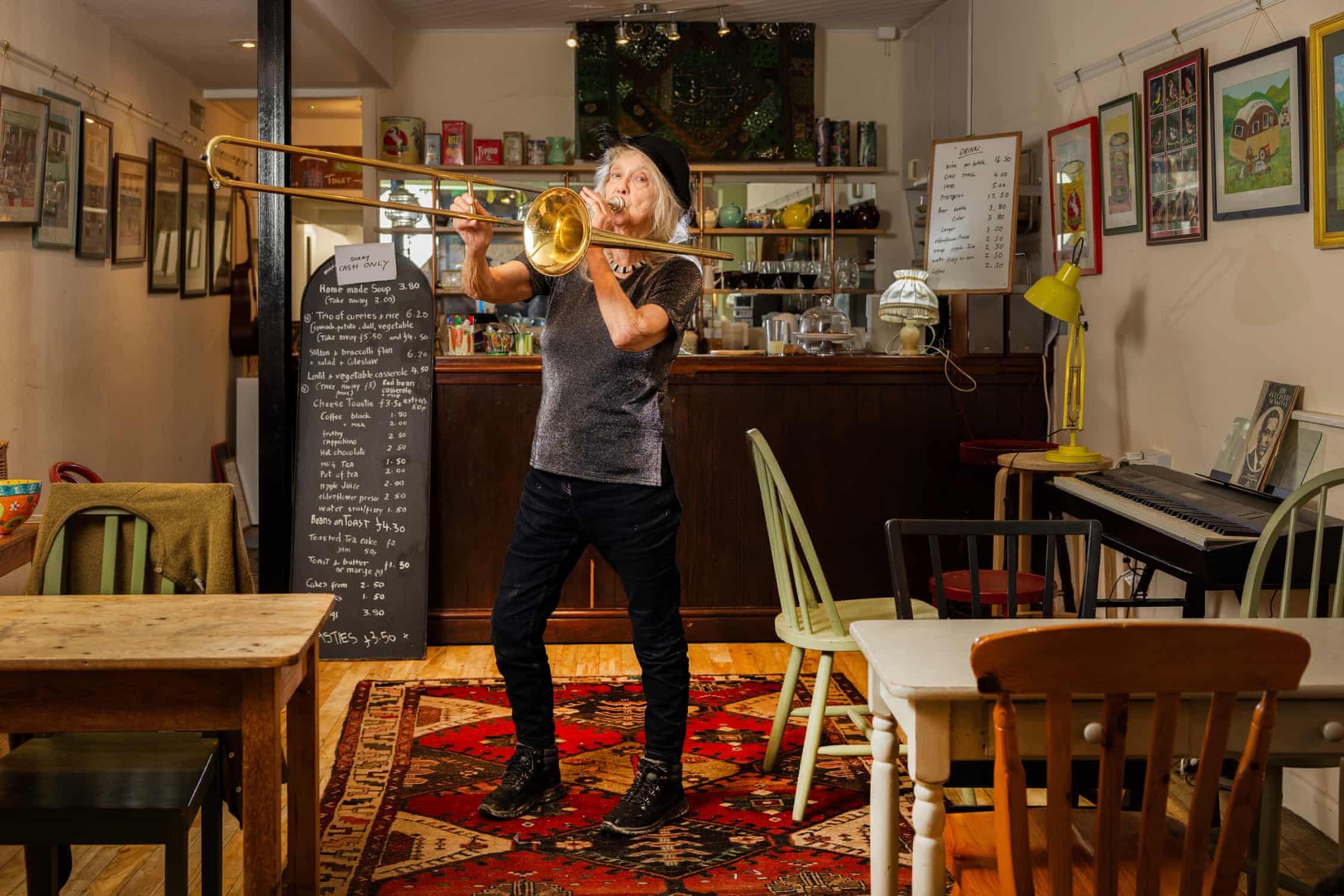
Photo: Fabio De Paola/The Guardian.
Eighty-four-year-old Noreen Davis took up trombone at 72 and never looked back.

Where I live now, it’s nice to see people taking up some pursuit that always interested them but seemed out of reach. For example, there’s a retired radiologist across the hall whose wife is an artist whose work he has always admired. Nowadays, he’s throwing himself heart and soul into some high-level art classes here and is doing an impressive job.

Today’s story is similar. It starts with a woman in the UK Midlands paying attention to a dream she had when she was sound asleep.

Ammar Kalia writes at the Guardian, “Twelve years ago, Noreen Davies had a dream. In it, the artist and cafe owner, then 72, saw herself wielding an unusual instrument. ‘There was a jazzy tune on in the background and I was playing along on a trombone, bending the notes and having a great time,’ she says. ‘When I woke up, I knew I had to learn it.’

“She headed to her cafe in Leominster, Herefordshire, and had a [routine] meeting with her accountant. ‘At the end, I asked him if he knew anyone with a trombone I could try out and he said he had five! Turns out he played in a local brass band with his wife, so he ended up bringing one round to me, along with an old music book on the instrument, and that’s how it all started.’

“Now 84, Davies has gigged throughout the West Midlands with groups exploring everything from the blues to vintage jazz and big band funk. No matter the tune, she has stayed true to her vision of bending the notes on the giant horn, twisting and wailing like a held string on an electric guitar. ‘I’ve only had two lessons and in the first one the teacher told me to just play what was written, but I do whatever I want to,’ she says. ‘I use it more like a percussion instrument, improvising over the tunes.’

“The trombone is notoriously difficult to learn, since players have to judge the distance between notes by pulling and pushing its tubing, rather than pressing fixed keys. Davies, though, found the instrument easy, thanks to her musical history. At 14, she took up the guitar and taught herself to play chords with her younger brother. ‘I forced him to play along with me. I taught myself the piano, too, by working out songs I liked listening to,’ she says. …

“Davies’ confidence to play live grew through hosting monthly music nights at the cafe, including a jam session with Ric Sanders of Fairport Convention, although she faced a setback when a series of operations on her lungs meant she was unable to play for several months.

“One evening in 2018, when she had regained her strength, she went along to a jam session in nearby Bromyard and met two young musicians who were looking for a trombone to round out their trio. Luckily, she had hers in the boot of her car in case such an opportunity arose. ‘We did a few numbers together and they ended up adopting me,’ she says. ‘We played for a couple of years, until Covid. It was great fun.’

“The open world of jam sessions and gigs has since led Davies to more instruments. She is back on the piano and has added the accordion, the washboard and the baritone ukulele. ‘I ended up in a vintage jazz band because they needed a washboard player and I was the only one who took it up in the local area. I also play Bob Dylan tunes on the ukulele and I’m trying to learn some Cole Porter on the accordion,’ she says. … ‘Everyone should try it out – just get yourself to a jam session somewhere and see what happens.’ “

More at the Guardian, here.

Read Full Post »

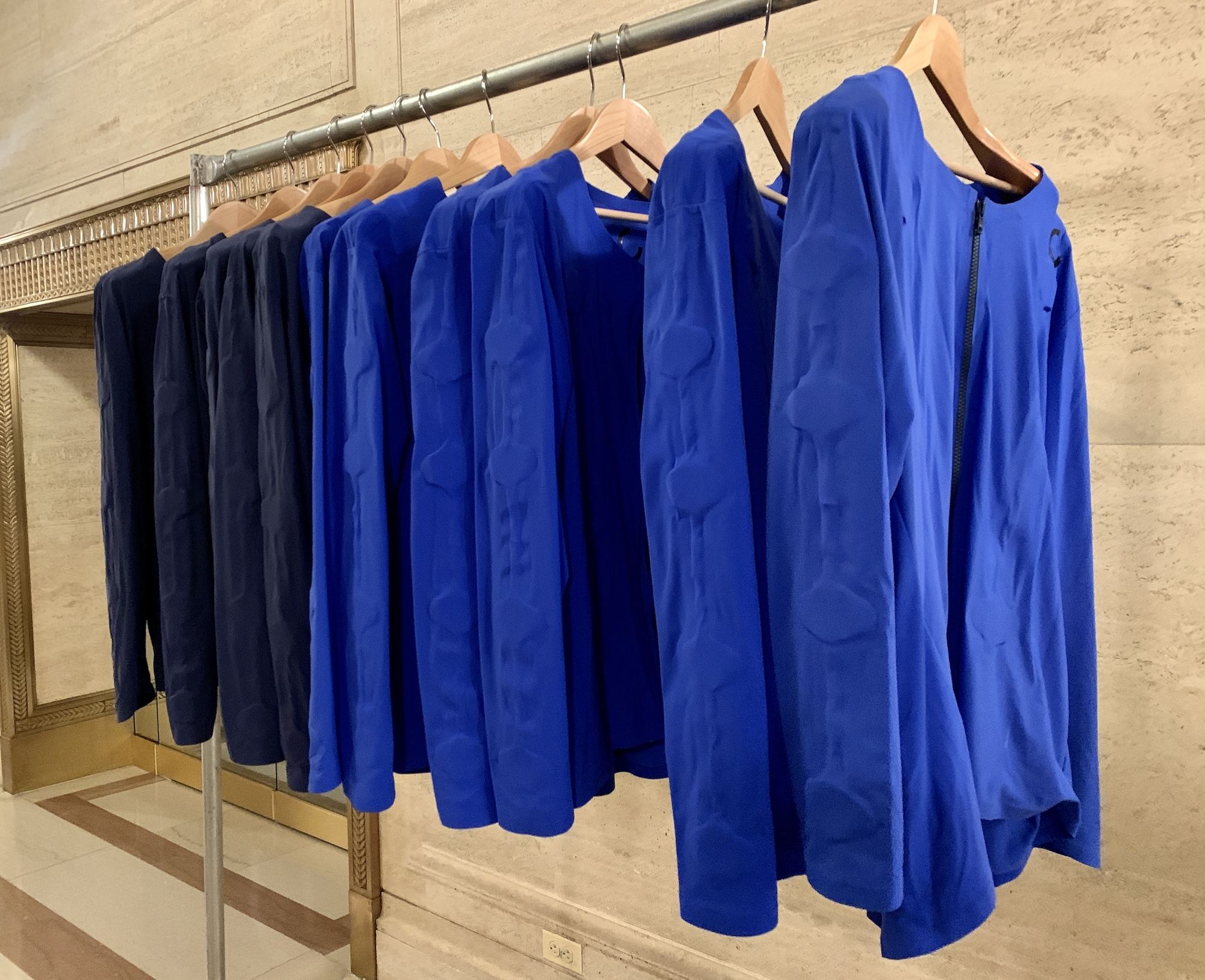
Photo: Carrie Shepherd/Axios.
The Lyric Opera of Chicago’s SoundShirts use “patterns and pulses” to make opera more accessible for the deaf.

It used to be that, for people with a disability, there were certain experiences they knew they would probably never access. With technology, that is changing. Consider how “feeling” the music in new, more subtle ways is helping those with hearing loss.

Michael Andor Brodeur reports at the Washington Post about the SoundShirt.

“Opera is everything all at once: music and drama, poetry and dance, grandeur and intimacy, spectacle and sound. This all-encompassing aspect makes it one of the most accessible art forms yet one of the most challenging to make accessible.

“For audience members who are deaf or hard of hearing, or who are blind or have low vision, attending an opera can be a deeply frustrating experience.

“A pilot program at the Lyric Opera of Chicago is trying on a new approach for deaf and hard-of-hearing people to experience opera: the SoundShirt, a jacketlike garment equipped with 16 haptic actuators* that transmit sound from the orchestra and stage into pulses, vibrations and other forms of haptic feedback in the shirt itself. …

“In addition to accommodations for mobility disabilities such as ramps and wheelchair seating, like many opera houses, the Lyric offers performances with American Sign Language interpretation, projected subtitles, and assisted listening devices for deaf and hard-of-hearing patrons. For blind people and those with low vision, the Lyric provides Braille and large-print programs, audio-described performances, high-powered glasses and pre-performance ‘touch tours,’ allowing audience members to feel various props, costumes and surfaces before the curtain rises.

“The SoundShirt, though, is cut from a different cloth than most accessibility technology, providing a mediated experience of the music that registers as physical and personal.

‘It doesn’t re-create the experience of listening to music,’ [director of digital initiatives Brad Dunn] says. ‘It’s its own thing.’

” ‘It translates the music into a different sensory experience that can be felt by people. And what I’ve seen through all of the early testing that we did is that audiences who are deaf or hard of hearing have responded very viscerally to it.’ …

“For attendees at a Lyric production of West Side Story earlier this year, input from the SoundShirt didn’t just help provide additional detail to the performance — it also illuminated the musical spaces in between, the interludes and interstitial passages of music, the overtures overloaded with crucial cues. Dunn recalls one tester’s eyes welling up with tears after the performance. …

“Lyric’s SoundShirt project was launched in partnership with the city of Chicago’s Mayor’s Office for People With Disabilities (MOPD), but the garment itself was designed by CuteCircuit, a London-based wearable technology design firm. …

“At the Lyric, an array of microphones positioned over various sections of the orchestra feeds audio information to a central computer. Dunn and his crew adapt the software to respond to the specific instrumentation of a given piece. … Those audio signals are divided across seven channels, each mapped to one of 16 different ‘zones’ on the SoundShirt, where motifs and melodies register as patterns and pulses across the garment’s 16 actuators.

“Thus, for a production of The Flying Dutchman, the violins and cellos are assigned to trigger haptic feedback along the right and left shoulders and upper arms. Timpani and bass, meanwhile, are sent down to the lower torso and hips. Wagner’s mighty horns are split across the upper arms like goose bumps, while vocals register at the wrists like a pulse. …

“Rachel Arfa is a longtime disability advocate and civil rights attorney who serves as commissioner of MOPD. As a deaf person who wears bilateral cochlear implants, the issue of accessibility has been close to her heart for a long time. … But while expanding accessibility is her life’s work, Arfa also knows that good intentions can often pave the road to nowhere.

“ ‘When Lyric approached me with this shirt, I was highly skeptical,’ Arfa said via email. [But she] agreed to test the SoundShirt at a recent Lyric production of West Side Story. Arfa was surprised to find the shirt actually felt like a good fit for the problem it is trying to solve. …

“ ‘I began to understand that the haptics on the SoundShirt vibrated in conjunction with the orchestra sounds. One example is when string instruments were played, the haptics followed the pitch and rhythm. A second example is when a singer was singing a long melody, the haptics picked up on this and I could experience this through the vibration. I am not able to hear this sound, but I could feel it. It was such a surprise and a thrill.’

“Tina Childress, an audiologist who lives in Champaign, Ill., is a late-deafened adult who wears cochlear implants and works as an advocate for accessibility in the arts. … Childress appreciated the haptic feedback at the wrists to indicate dialogue, and the way the shirt clarified the various elements of the score. After intermission, she lent the shirt to another audience member to try out. ‘I didn’t realize how much I was using it until I didn’t have it.’ ”

More at the Post, here. Axios Chicago has still more, here.
* haptic actuators are gizmos that provide localized bodily sensations and tactile effects

Read Full Post »

Photo: Marica S. Tacconi, CC BY-SA.
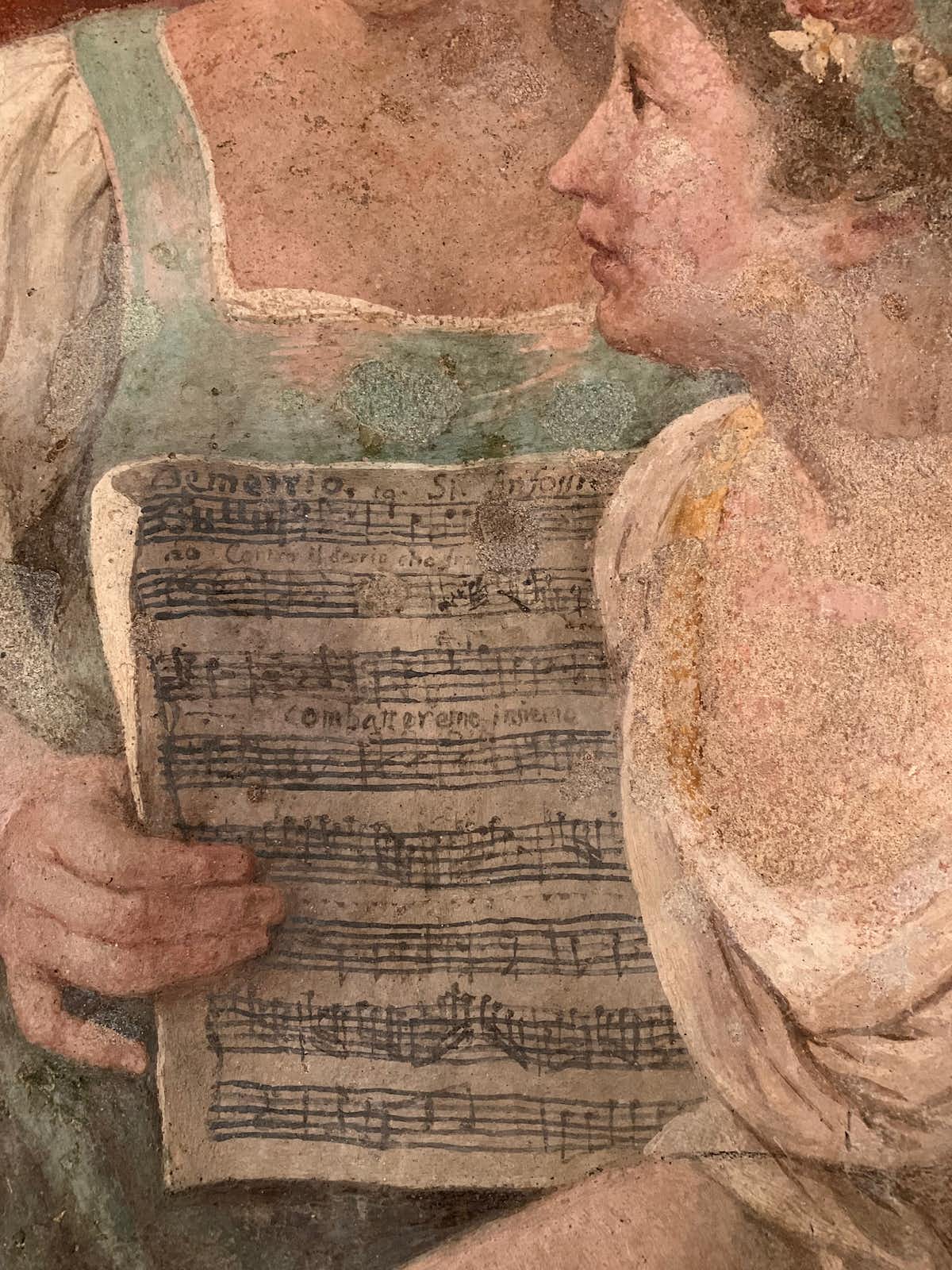
The musical score depicted in Jacopo Guarana’s fresco in a Venetian orphanage. 

I know there is a lot of drudgery in historical research and archaeology, but what fun to discover clues about the past that can be brought to life in the present!

That’s what Marica S. Tacconi, professor of musicology and art history at Penn State, does. At the Conversation, she writes about her determination to bring back music painted on the walls of a Venetian orphanage centuries ago.

She begins by asking the reader to imagine today’s rock stars “teaching at an orphanage or homeless shelter, offering daily music lessons” and says “that’s what took place at Venice’s four Ospedali Grandi, which were charitable institutions that took in the needy – including orphaned and foundling girls – from the 16th century to the turn of the 19th century.

“Remarkably, all four Ospedali hired some of the greatest musicians and composers of the time, such as Antonio Vivaldi and Nicola Porpora, to provide the young women – known as the ‘putte’ – with a superb music education.

“In the summer of 2019, while in Venice on a research trip, I had the opportunity to visit the Ospedale di Santa Maria dei Derelitti, more commonly known as the Ospedaletto, or ‘Little Hospital, because it was the smallest of the four Ospedali Grandi.

“As a musicologist specializing in the music of early modern Venice, I was especially excited to visit one of the hidden gems of the city: the Ospedaletto’s music room, which was built in the mid-1770s. …. Little did I know that I would encounter music that hasn’t been performed in nearly 250 years.

“As we entered the stunning music room, I was immediately struck by its elegance and relatively small size. In my mind, I had envisioned a large concert hall; instead, the space is intimate, ellipse-shaped and richly decorated.

“Overshadowed by the more prominent Ospedale della Pietà, not much is known about the music-making that took place for centuries behind the walls of the Ospedaletto. But one of the greatest clues to its venerable history as a music school is literally on one of its walls.

“A fresco on the far wall of the room, painted in 1776-77 by Jacopo Guarana, depicts a group of female musicians – likely portraits of some of the putte – at the feet of Apollo, the Greek god of music. Some of them play string instruments; one, gazing toward the viewer, holds a page of sheet music. …

“The music notation was quite legible, and the composer’s name was inscribed in the upper-right corner: ‘Sig. Anfossi.’

“I took several photos of the fresco. I wanted to learn as much as I could about that piece of music painted on the wall. …

“Armed with those clues on the wall, I continued my research in the days following the visit to the Ospedaletto. I learned that the music by ‘Signor Anfossi’ shown in the fresco was drawn from the opera Antigono, composed by Pasquale Anfossi (1727-97) on a libretto by Pietro Metastasio. The work premiered in Venice at the Teatro San Benedetto in 1773.

“The text of the [aria] is legible in the excerpt on the wall. It reads, ‘Contro il destin che freme, combatteremo insieme’ – ‘Against quivering destiny, we shall battle together.’

“Like many works from the 17th and 18th centuries, the entire opera is lost. I was determined to find out, however, if that particular aria had survived. … Luck was on my side: To my delight, I found a copy of the aria in a library in Montecassino, a small town southeast of Rome. Why was that particular excerpt chosen to be displayed so prominently on the wall?

“Like other institutions in Venice, the Ospedaletto faced financial hardship in the 1770s. Evidence suggests that the putte of the Ospedaletto were likely involved in raising the funds for the decoration of the music room. The new hall enabled them to give performances for special guests and benefactors, which brought in substantial donations. Together with Pasquale Anfossi, who was their music teacher from 1773 to 1777, they rallied behind their beloved institution, saving it – at least temporarily – from financial destitution. …

“Incidentally, the putte may also have wanted to honor their teacher, as Pasquale Anfossi, too, is portrayed in Guarana’s fresco, directly behind the young woman holding up his music.

“One of the aspects I find most rewarding about the study of older music is the process of discovering a work that has been neglected and unheard for hundreds of years and bringing it back to modern audiences.

“Inspired by the Ospedaletto’s music room, [my colleague] Liesl Odenweller and I have embarked on a collaborative project that brings back not only the aria on the wall but also other music from the institution that has gone unheard for centuries … thanks to a generous grant from the Gladys Krieble Delmas Foundation, the Venice Music Project. …

“Because the music of the past was written in a notation that’s different from that used today, it’s necessary to translate and input every mark of the original score – notes, dynamics and other expressive marks – into a music notation software to produce a modern score that can be easily read by today’s musicians.

“By performing on period instruments and using a historically informed approach, the musicians of the Venice Music Project and I are excited to revive this remarkably beautiful and meaningful music. Its neglect is certainly not a reflection of its artistic quality but rather likely the result of other composers, such as Vivaldi and Mozart, taking over the spotlight and overshadowing the works of other masters.”

More at the Conversation, here. The author has a nice description of her colleague testing the room’s exceptional acoustics.

Read Full Post »

Photo: Thibaut Roger/NCCR PlanetS/PA.
The planets surrounding the HD110076 star orbit it in neat ratios depending on their closeness to it. 

Where I went to high school, we memorized Bible verses every week. I always liked the words from this time of year: “The star, which they saw in the east, went before them till it came and stood over where the young child was.” So I’m going to say that today’s post on stars is a seasonal post.

At the Guardian, Nicola Davis delves into new star research from the journal Nature.

“Six planets that orbit their star in a coordinated dance have been discovered by scientists, who say the finding could help shed light on why planets in our own solar system move to their own beat.

“The newly discovered planets orbit a star that sits about 100 light years away in the constellation Coma Berenices, with a mass about 20% smaller than our Sun.

“Not only is their makeup different from planets within our solar system, but their movements appear to be tied together: the team said the time it takes one planet to travel around the star was related to that of the next planet by a neat ratio.

“ ‘This system has this very delicate resonant configuration,’ [said] Dr Rafael Luque, co-author of the research from the University of Chicago. The team said such ‘resonance’ should be common within planetary systems, arising from gravitational interactions between planets that begin as they form.

Astronomer Hugh Osborn, a co-author from the University of Bern, converted the resonance among these planets’ orbits into music.

“However, in reality only about 1% of observed planetary systems show resonance – and even fewer involve as many as six planets moving in a coordinated fashion. …

“The team added that the newly discovered planets sit close to their star, with temperatures of 170-650C, and have diameters two to three times that of Earth but smaller than Neptune, making them ‘sub-Neptunes.’ The masses of the planets and their densities were elucidated using ground-based measurements. …

“ ‘Even though we have found so many planets like these ones outside of the solar system, we do not know much about them,’ said Luque.

“Luque added that with six sub-Neptunes of varying sizes, temperatures and masses around the same, bright star, astronomers now had a way to explore how and why such planets differed. …

“Data from [Nasa’s Transiting Exoplanet Survey Satellite] has revealed that one planet had a nine-day orbit while another took 13 days to orbit the star. Subsequent data from the European Space Agency’s Characterizing Exoplanet Satellite (Cheops), suggested yet another planet took 20.5 days to orbit the star.

“The team realized these orbits formed neat ratios: the first planet from the star makes three orbits in the time it takes the second planet to make two orbits, and the second planet makes three orbits in the time it takes the third planet to make two orbits.

“The discovery led the team to propose that the orbits of the other three planets in the system also would be related by simple ratios. Further observations confirmed they were right.”

More at the Guardian, here. You should know that Dr Hugh Osborn, a co-author from the University of Bern, converted the resonance among these planets’ orbits into music. Listen to that music in an audio clip of about 2-1/2 minutes at Public Radio International’s The World, here. Very special.

Read Full Post »

Photo: Laura Chouette/Unsplash.
A study by McGill University in Montreal, Canada, asked participants to listen to different types of music and rate how it affected their pain levels.

The other day on the radio I heard a doctor talk about treating pain in the age of the opioid crisis. His ideas sounded risky and seemed based on a study of one — himself. Having been in recovery from opioid addiction for 15 years, he found he could handle a lot of opioids when he broke his leg. He didn’t get addicted again.

Can every recovering addict do that? Seems like there ought to be better ways. So far, opioids are the only thing that works for severe pain. Today’s story talks about a way to reduce suffering, but only a little.

Nicola Davis writes at the Guardian, “If you are heading to the dentist, you may want to turn up a rousing Adele ballad. Researchers say our preferred tunes can not only prove to be powerful painkillers, but that moving music may be particularly potent.

“Music has long been found to relieve pain, with recent research suggesting the effect may even occur in babies and other studies revealing that people’s preferred tunes could have a stronger painkilling effect than the relaxing music selected for them.

“Now, researchers say there is evidence that the emotional responses generated by the music also matter.

“ ‘We can approximate that favorite music reduced pain by about one point on a 10-point scale, which is at least as strong as an over-the-counter painkiller like Advil [ibuprofen] under the same conditions. Moving music may have an even stronger effect,’ said Darius Valevicius, the first author of the research from McGill University in Montreal, Canada.

Writing in the journal Frontiers in Pain Research, Valevicius and colleagues report how they asked 63 healthy participants to attend the Roy pain laboratory on the McGill campus, where researchers used a probe device to heat an area on their left arm – a sensation akin to a hot cup of coffee being held against the skin.

“While undergoing the process, the participants [listened] to two of their favorite tracks, relaxing music selected for them, scrambled music, or silence.

“As the music, sound or silence continued, the participants were asked to rate the intensity and unpleasantness of the pain. …

“When the auditory period ended, participants were asked to rate the music’s pleasantness, their emotional arousal, and the number of ‘chills’ they experienced – a phenomenon linked to sudden emotions or heightened attention, that can be felt as tingling, shivers or goosebumps.

“The results reveal participants rated the pain as less intense by about four points on a 100-point scale, and less unpleasant by about nine points, when listening to their favorite tracks compared with silence or scrambled sound. Relaxing music selected for them did not produce such an effect. …

“Further work revealed music that produced more chills was associated with lower pain intensity and pain unpleasantness, with lower scores for the latter also associated with music rated more pleasant.

“ ‘The difference in effect on pain intensity implies two mechanisms – chills may have a physiological sensory-gating effect, blocking ascending pain signals, while pleasantness may affect the emotional value of pain without affecting the sensation, so more at a cognitive-emotional level involving prefrontal brain areas,’ said Valevicius, although he cautioned more work is needed to test these ideas. …

“The researchers say it is not yet known if moving music would have a similar chill-creating effect in those who do not favor it, or if people who favor such music are simply more prone to musical chills.

“What’s more, they say the size of the study might mean some relationships cannot be detected, while the relaxing music may not have been played for long enough for an effect to have been seen.”

More at the Guardian, here. No paywall. Guardian readers voluntarily donate to support the news.

Read Full Post »

Photo: Sam Odgden via Chamber Music America.
Composer Tod Machover.

With all the furor about artificial intelligence, Rebecca Schmid decided to check in with MIT’s Tod Machover, “a pioneer of the connections between classical music and computers.” Their conversation about how AI applies to music appears on the Chamber Music America website.

“Sitting at his home in Waltham, Massachusetts, the composer Tod Machover speaks with the energy of someone half his 69 years as he reflects on the evolution of digital technology toward the current boom in artificial intelligence.

“ ‘I think the other time when things moved really quickly was 1984,’ he says — the year when the personal computer came out. Yet he sees this moment as distinct. ‘What’s going on in A.I. is like a major, major difference, conceptually, in how we think about music and who can make it.’

“Perhaps no other figure is better poised than Machover to analyze A.I.’s practical and ethical challenges. The son of a pianist and computer graphics pioneer, he has been probing the interface of classical music and computer programming since the 1970s.

“As the first Director of Musical Research at the then freshly opened Institut de Recherche et Coordination Acoustique/Musique (I.R.C.A.M.) in Paris, he was charged with exploring the possibilities of what became the first digital synthesizer while working closely alongside Pierre Boulez.

“In 1987, Machover introduced Hyperinstruments for the first time in his chamber opera VALIS, a commission from the Pompidou Center in Paris. This technology incorporates innovative sensors and A.I. software to analyze the expression of performers, allowing changes in articulation and phrasing to turn, in the case of VALIS, keyboard and percussion soloists into multiple layers of carefully controlled sound.

“Machover had helped to launch the M.I.T. Media Lab two years earlier in 1985, and now serves as both Muriel R. Cooper Professor of Music and Media and director of the Lab’s Opera of the Future group. …

“Machover emphasizes the need to blend the capabilities of [AI] technology with the human hand. For his new stage work, Overstory Overture, which premiered last March at Lincoln Center, he used A.I. as a multiplier of handmade recordings to recreate the sounds of forest trees ‘in underground communication with one another.’

“Machover’s ongoing series of ‘City Symphonies,’ for which he involves the citizens of a given location as he creates a sonic portrait of their hometown, also uses A.I. to organize sound samples. Another recent piece, Resolve Remote, for violin and electronics, deployed specially designed algorithms to create variations on acoustic violin. …

“Machover has long pursued his interest in using technology to involve amateurs in musical processes. His 2002 Toy Symphony allows children to shape a composition, among other things, by means of ‘beat bugs’ that generate rhythms. This work, in turn, spawned the Fisher-Price toy Symphony Painter and has been customized to help the disabled imagine their own compositions. …

“Rebecca Schmid: How is the use of A.I. a natural development from what you began back in the 1970s, and what is different?
“Tod Machover: There are lots of things that could only be done with physical instruments 30 years ago that are now done in software: you can create amazing things on a laptop. But what’s going on in A.I. is like a major, major difference, conceptually, in how we think about music and who can make it.

“One of my mentors and heroes is Marvin Minsky, who was one of the founders of A.I., and a kind of music prodigy. And his dream for A.I. was to really figure out how the mind works. He wrote a famous book called The Society of Mind in the mid-eighties based on an incredibly radical, really beautiful theory: that your mind is a group of committees that get together to solve simple problems, with a very precise description of how that works. He wanted a full explanation of how we feel, how we think, how we create — and to build computers modeled on that.

“Little by little, A.I. moved away from that dream, and instead of actually modeling what people do, started looking for techniques that create what people do without following the processes at all. A lot of systems in the 1980 and 1990s were based on pretty simple rules for a particular kind of problem, like medical diagnosis. You could do a pretty good job of finding out some similarities in pathology in order to diagnose something. But that system could never figure out how to walk across the street without getting hit by a car. It had no general knowledge of the world.

“We spent a lot of time in the seventies, eighties, and nineties trying to figure out how we listen — what goes on in the brain when you hear music, how you can have a machine listen to an instrument — to know how to respond. A lot of the systems which are coming out now don’t do that at all. They don’t pretend to be brains. Some of the most kind of powerful systems right now, especially ones generating really crazy and interesting stuff, look at pictures of the sound — a spectrogram, a kind of image processing. I think it’s going to reach a limit because it doesn’t have any real knowledge of what’s there. So, there’s a question of, what does it mean and how is it making these decisions?

What systems have you used successfully in your work?
“One is R.A.V.E., which comes from I.R.C.A.M. and was originally developed to analyze audio, especially live audio, so that you can reconstruct and manipulate it. The voice is a really good example. Ever since the 1950s, people have been doing live processing of singing. The problem is that it’s really hard to analyze everything that’s in the voice: The pitch and spectrum are changing all the time.

“What you really want to do is be able to understand what’s in the voice, pull it apart and then have all the separate elements so that you can tune and tweak things differently on the other side. And that’s what R.A.V.E. was invented to do. It’s an A.I. analysis of an acoustic signal. It reconstructs it in some form, and then ideally it comes out the other side sounding exactly like it did originally, but now it’s got all these handles so that I can change the pitch without changing the timbre. And it works pretty well for that. You can have it as an accompanist, or your own voice can accompany you. It can change pitch and sing along. And it can sing things that you never sang because it understands your voice. …

“The great thing about A.I. models now is that you can use them not just to make a variation in the sound, but also a variation in what’s being played. So, if you think about early electronic music serving to kind of color a sound — or add a kind of texture around the sound, but being fairly static — with this, if you tweak it properly, it’s a kind of complex variation closely connected to what comes in but not exactly the same. And it changes all the time, because every second the A.I. is trying to figure out, How am I going to match this? How far am I going to go? Where in the space am I? You can think of it as a really rich way of transforming something or creating a kind of dialogue with the performer.” Lots more at Chamber Music America, here. No firewall.

I myself have posted about the composer a few times: for example, here (“Tod Machover,” 2012); here (“Stanford’s Laptop Orchestra,” 2018); and here (“Symphony of the Street,” 2017).

“AI Finished My Story. Does It Matter?” at Wired, here, offers additional insight.

Read Full Post »

Photo: Shah Meer Baloch.
Afghan refugee Mohammed Hasan Zamri in his shop in Pakistan, where he keeps his collection of rare music cassettes from his homeland.

For the Afghan diaspora, you have to celebrate joy where you find it. In October, for example, Afghan friends lit up social media because of an unexpected triumph in cricket.

“I had a quick shower and was heading towards the office when I learned about Afghanistan’s phenomenal cricket victory against Pakistan, with the news dominating my socials,” Shadi Khan Saif exclaimed in the Guardian. …

“The team’s phenomenal performance has lifted up not just the devastated nation but millions in the Afghan diaspora, including in Australia. At Dandenong Park in Melbourne’s south-east, hundreds joined in on the traditional Attan dance to mark the victory. The scenes in Kabul and other cities in Afghanistan were equally charged with joy and celebration.

“Amid international isolation, Afghanistan’s cricket team has once again proved itself as the only source for the Afghans to connect with the outer world. Afghanistan’s tri-color flag – now replaced with the white Taliban flag – and the Republic-era anthem are still kept alive by the cricketers on the world stage.”

As unusual as was that moment of delight, it is clearly not the only way Afghans seek out joy. Some turn to a collector in Pakistan who is saving Afghan music for posterity.

Shah Meer Baloch reports for the Guardian, “Afghan music fans from Kabul and Jalalabad have crossed the border to the city of Peshawar in Pakistan to offer thousands of rupees to Mohammed Hasan Zamri’s workshop for just one cassette.

“Zamri, an Afghan refugee, refuses them all as he continues his quest to copy and, one day he hopes, digitize his collection of more than 1,000 rare and old Afghan music cassettes of various genres.

“It is his contribution to help preserve a musical culture that existed for centuries before the Taliban existed.

“Since retaking control of the country in 2021, the Taliban have imposed their rigid interpretation of Islam, restricting and even criminalising music and arts. In July, they publicised a bonfire of seized ‘illegal’ musical instruments, reminding Afghans that the sale of instruments was a punishable offense.

“ ‘The Taliban just use religion as an excuse to ban music and say it is haram, prohibited, in Islam. This is not true and it is part of our culture for centuries, but the Taliban have senselessly put a ban on it, says Zamri.

“Zamri fled Afghanistan during the Soviet invasion and went back for a few years after the war had ended and the Taliban had started to consolidate their power. He left again in 1996 and has been running a workshop fixing tape recorders and TVs ever since.

“Most of the space in his small workshop is taken up by stacks of cassettes, neatly arranged on a wall opposite the entrance. His collection includes tapes of renowned Afghan musicians including Munawar, Nashenas, Taj Mohammad and Haikal.

“ ‘I have done recordings of many singers myself who had fled Afghanistan in the 1990s or had come to Peshawar, which has been a thriving hub for Afghan refugees and musicians,’ he says.

“ ‘The love for music is there but the musicians, music and art is banned in the Taliban’s Afghanistan. Today, we have many singers but because of the ban, they cannot perform. They have fled Afghanistan.’

“Listening and copying his cassettes, Zamri reminisces of times when Afghan audiences could enjoy music and culture with freedom – the same freedom afforded to musicians and artists, men and women. … ‘The people who have heard these songs or lived through the era are the ones who come to buy cassettes. …

“ ‘Naseema, Kashan, Benazir and Zarghona were the best female singers who dominated Afghan music three to four decades ago. Now, if they do not allow men to sing or create music, how will they allow women?’

“Until [August], Zamri was unknown to many Pashto-speaking people until local media featured his attempts at saving Afghan music cassettes. He has since received both threats and messages of appreciation.

“ ‘I have been threatened on Facebook from people to stop my work and they would burn down my shop and that this is against Islam. But there were some positive and appreciative comments too. …

” ‘Some people are addicted to smoking, some people love pets and some are fond of many other things. I am addicted to Afghan music. It is my hobby and passion,’ he says.”

More at the Guardian, here.

Read Full Post »

Photo: The Nicholson Project.
The Uptown Singerz are a DC-based intertribal Native American Northern powwow drum group that performs powwow, ceremonial, and in some cases political songs.

We are all enriched when previously below-the-radar groups begin to share their culture more widely. The featured article for today is from the Washington Post and highlights a cultural collaboration by members of several indigenous tribes.

Dana Hedgpeth writes, “When Nick Courtney came to D.C. seven years ago to work on education issues, he missed his Native American tribe in Washington state.

“Longing to connect with other Native Americans in the region, the 31-year-old member of the Makah Tribe helped form the Uptown Singerz, a Native American drum group that shares and celebrates their heritage.

“ ‘D.C. is a transient city because folks come and go, so that can be hard,’ said Courtney, who lives in Baltimore. ‘I still long for my own culture, but this fills my cup. It’s a bond, and I’m a part of something that’s allowed me to build a community here. It’s like a family for me.’

“In the United States, roughly 9.7 million people — or about 3 percent — of the overall population — identified themselves as being American Indian or Alaska Native in the 2020 Census. Fewer than 1 percent of people in the District, Maryland and Virginia said they are American Indian or Alaska Native.

“There are more than 500 federally recognized tribes in the country, and more than 70 percent of American Indians live away from their tribal reservations or communities.

“Being a part of Uptown Singerz gives members who are far from their tribes’ home ‘a renewed sense of community and family every time we sing, every time we drum,’ said Mary Phillips, the group’s lady backup singer (as the role is officially called by Native Americans), who is from the Omaha Tribe in Nebraska and the Laguna Pueblo Tribe in New Mexico. …

“The Uptown Singerz … practice several times a month and perform up to 20 events a year in theaters, rallies, community events and Native American gatherings and powwows in the D.C. region to showcase their talents and educate the public. They, along with the Zotigh Singers — who are from the Kiowa Tribe of Oklahoma and live in Waldorf, Md. — are one of the few American Indian drum groups in the D.C. region.

“ ‘Having the Uptown Singerz is so important because they help keep our culture alive here in D.C.,’ said Angela Gladue, 38, who is a powwow and hoop dancer. A Cree and a member of the Frog Lake First Nation in Alberta, Canada, Gladue moved to Northeast Washington six years ago and got to know other American Indians in the area, along with the drum groups. …

“The Uptown Singerz typically play around one large drum made from wood and dried animal hide. Sometimes they play smaller hand drums. Considered sacred and often used at events and some ceremonies, the drum for many American Indians represents the heartbeat of Mother Earth.

“They follow the Native American tradition of having only men sit around the drum. Women stand behind them and join in the singing because ‘women carry the sacred water of life,’ empowering them to ‘absorb or change the energy of the people around them or the energy of the drum,’ Phillips said. …

“For Gladue, hearing the drum and seeing American Indians from different tribes gather and dance was a special moment. … ‘People will ask, “Indians are still here?” To be around other Natives and not have to explain myself makes me feel good.’ “

More at the Post, here.

Read Full Post »

Since ancient times, people have found all sorts of ways to get themselves on an even keel when they are feeling down. I’m the last person to say folk remedies can cure real depression, but I am interested in the many ways people lift their spirits.

At the New York Times, Christina Caron writes about people who use art.

“When Dr. Frank Clark was in medical school studying to be a psychiatrist, he decided to write his first poem.

“ ‘All that chatter that is in my head, everything that I’ve been feeling, I can now just put it on paper and my pen can do the talking,’ he said, recalling his thoughts at the time.

“Back then, he was struggling with depression and had been relying on a number of things to keep it at bay, including running, therapy, medication and his faith.

“ ‘I had to find something else to fill the void,’ he said. It turned out that poetry was the missing piece in his ‘wellness puzzle.’

“But there’s a ‘really robust body of evidence’ that suggests that creating art, as well as activities like attending a concert or visiting a museum, can benefit mental health, said Jill Sonke, research director of the University of Florida Center for Arts in Medicine. …

“Dr. James S. Gordon, a psychiatrist and the founder of The Center for Mind-Body Medicine, pioneered something called the ‘three drawing technique.’ It is featured in the new book Your Brain on Art: How the Arts Transform Us. …

“If you are one of the many people who have turned to adult coloring books, it may not come as a surprise that research suggests this activity can help ease anxiety.

“Coloring within the lines — of an intricate pattern, for example — appears to be especially effective. One study that evaluated college students, and another that assessed older adults, found that spending 20 minutes coloring a mandala (a complex geometric design) was more helpful at reducing anxiety than free-form coloring for the same length of time.

“Susan Albers, a clinical psychologist at the Cleveland Clinic and the author of 50 Ways to Soothe Yourself Without Food, described coloring as a ‘mini mental vacation.’ When we focus on the texture of the paper and choose the colors that please us, it becomes easier to tune out distractions and stay in the moment, she said.

“ ‘It’s a great form of meditation for people who hate meditation.’

“Listening to music, playing an instrument or singing can all be beneficial, research shows.

“A 2022 study, for example, surveyed more than 650 people in four age groups and asked them to rank the artistic activities that helped them ‘feel better’ during the 2020 pandemic lockdowns. The youngest participants, ages 18 to 24, overwhelmingly rated musical activities as most effective. Across all age groups, ‘singing’ was ranked among the top activities. …

“[Susan Magsamen, an assistant professor of neurology at the Johns Hopkins University School of Medicine and a co-author of the book] noted that music can be effective at reducing stress because things like rhythm and repetitive lyrics and chords engage multiple regions of the brain.

“ ‘I sing in the shower,’ Ms. Magsamen said. ‘I sing at the top of my lungs to the radio.’

“Dr. Clark has continued to write poetry since graduating from medical school and offered some tips for those interested in trying.

“First, banish any thoughts that you aren’t creative enough. … Start with a simple haiku, Dr. Clark suggested. Haikus consist of just three lines — the first and last lines have five syllables and the middle has seven.”

That’s not all there is to a haiku, of course, but it can really get you going with poems. I used it with sixth grade students a lot when I was teaching, not for mental health, but it sure lifted spirits.

More at the Times, here.

Photo: Making art can make you happy. More here.

Read Full Post »

Art: Mo Willems.

One day in spring, the school that two of my grandchildren attend had a dress-as-your-favorite-character day. The school principal wore a Mo Willems T-shirt that warned, “Don’t let the Pigeon drive the bus.”

Did you love that book series? Now that all four grandkids are reading advanced books, I feel a certain nostalgia for the Pigeon days. Fortunately, I can still see Pigeon at the opera.

David Allen writes at the New York Times, “Do you know the words to the Queen of the Night’s stratospheric showcase from ‘The Magic Flute’? Maybe the Duke’s famous tune from ‘Rigoletto’? Carmen’s Habanera?

“No, not those words. The other ones: the words, at least, as they are now known to my 6-year-old daughter and the hundreds of children who took grown-ups like me to the Kennedy Center here recently for the premiere of ‘The Ice Cream Truck Is Broken! & Other Emotional Arias,‘ an experiment, including a short new work by the composer Carlos Simon, in what it might mean to draw a very young and impossibly demanding audience into a life in opera.

“See, you might think that Carmen is relating her views on love, but no. Listen closely, and you’ll find that the singer should have shared her cotton candy with her friends, and absolutely will … tomorrow. ‘La donna è mobile’? That’s about how milk squirts out your nose if you happen to laugh at exactly the wrong time. The Queen’s aria? That’s still about anger, but it now invokes something far worse than the vengeance of hell.

“ ‘This bicycle,’ it begins, in a fit of preschool pique, ‘is such a poo-poo vehicle.’

“Opera’s great composers have a new librettist, and he is almost certainly the only person who could induce an institution like the Kennedy Center to do something like this, let alone get Renée Fleming to join him in hosting it; inspire a quintet of young singers to ham their way through it; and persuade Simon, one of the busiest composers around, to crown the show with a 20-minute piece that gives an attention-seeking, picture-book Pigeon the prima donna spotlight it has surely always craved.

“The writer for it all? Mo Willems, who, it turns out, really loves opera! …

“ ‘It’s big emotions. … It’s direct communication. It’s interior dialogue. It’s self-discovery.’ …

“Willems has always been a broader artist than just a writer of picture books, though that task alone is such that he calls it ‘as easy as describing the history of Byzantium in three words.’ Some of his most celebrated characters — who include a venturesome plushie called Knuffle Bunny, the on-and-off best friends Elephant and Piggie, and that insatiable, inimitable Pigeon — had already starred in musicals that he had written before he formalized his long association with the Kennedy Center in 2019, when he became its education artist in residence. That three-year position coincided with the pandemic, to which he responded with invaluable ‘Lunch Doodles‘ videos, but it still let him explore a range of genres, including symphonic music, which he said ‘has always been important to me.’

“ ‘Beethoven’s Fifth is the easiest example,’ he explained, ‘but it’s basically the arc of an episode of television, or a movie: “Ba-ba-ba-baaam,” oh, it’s exciting — and then you take the theme, you take the theme, and then you build with it. So when I was writing a show called “Codename: Kids Next Door,” which is a silly sort of action comedy, I would literally write to the symphony.’

“For the National Symphony Orchestra, Willems painted giant abstractions to accompany a cycle of Beethoven’s nine symphonies, and he worked with the musician Ben Folds to adapt one of his books, ‘Goldilocks and the Three Dinosaurs,‘ for the concert hall. Hearing plans for ‘Goldilocks’ led Tim O’Leary, the general director of the Washington National Opera and a Willems-reading father of three, to inquire about a commission. …

“The author quickly sent him a copy of an Elephant and Piggie book — ‘I Really Like Slop!‘ — with the inscription ‘Tim, this book really sings.’ By their second encounter, Willems had the libretto in his head, a sketch of the characters in concert dress and a title: ‘SLOPERA!

“ ‘Obviously, once it was called the “SLOPERA!” we had to do it,’ O’Leary said.

“ ‘SLOPERA!’ could only be performed live outdoors on account of the pandemic, but an indoor recording, with piano accompaniment, was shown virtually to more than 300,000 schoolchildren. Piggie gets Gerald the Elephant to try slop, a stinky green delicacy among porcine foodies. He does, after his initial refusals upset his companion, and he endures the consequences in something like a bel canto mad (or death) scene. He recovers, though, and tells Piggie that while he might not like her food, he still likes her. …

“Willems said, reflecting on what writing his first libretto taught him, aside from the importance of placing consonants carefully. ‘If you look at a picture book manuscript, and you can understand it, it has too many words. If you look at just the illustrations, and you can understand it, the drawings are too detailed. They both have to be incomprehensible. It’s very similar with writing an opera, that the words that you’re using have to be dependent on the music, but the music has to be dependent on the words, and either of them shouldn’t really be able to stand alone.’ …

“[Oznur] Tuluoglu, a young soprano whose most recent prior role was Barbarina at the Annapolis Opera, took on the title character. ‘When you train, you have to be able to sing Mozart, you gotta be able to be a pigeon.’ “

More at the Times, here.

Read Full Post »

Photo: Suzanne and John’s Mom.
Porchfest events in Massachusetts towns promote neighborliness.

When Sara and I traveled together at age 16, one of the many things I learned from her was that it was perfectly fine to be friendly to strangers under some circumstances. You know, for example, how women who don’t know each other may strike up a conversation in a restaurant ladies room? That’s the kind of thing that was a revelation to me.

Nowadays, some folks have gotten more wary. Too wary. It is one factor in an epidemic of loneliness.

Sophie Hills  writes at the Christian Science Monitor, “Lida and Mark Simpson sit on the steps of their porch with friends while the blues rock band Red Medicine plays in a yard across the street. People crowd all four corners of the intersection, dancing and chatting. It’s PorchFest in Petworth, a neighborhood of Washington, D.C. Some 100 performers will play on porches and yards throughout the day. A new group of people walks up, searching for space with a view of the band. ‘Sit, sit,’ says Ms. Simpson with a big smile, gesturing toward the wall at the edge of the yard.

“The Simpsons, who have a 4-year-old and a 6-year-old, chose Petworth because it’s walkable, close to restaurants and playgrounds and public transit, and still has a neighborhood feeling. When they first moved in eight years ago, Ms. Simpson says she hoped for an active front porch culture. But it didn’t quite coalesce until people began socializing from their yards in 2020. Happily, says Ms. Simpson, ‘porch and stoop culture restarted during the pandemic, and it’s stayed around.’

“[This spring], the U.S. surgeon general declared an epidemic of loneliness and isolation, saying that 1 in 2 adults reported experiencing loneliness even before the pandemic. At a time when neighborliness is decreasing and Americans are growing further apart, some, like the Simpsons, are intentionally building relationships within their communities. And events like porch fests are growing in popularity. Central to a culture of neighborliness, many say, are front porches. …

“ ‘As it has built for decades, the epidemic of loneliness and isolation has fueled other problems that are killing us and threaten to rip our country apart,’ wrote Surgeon General Vivek Murthy in the New York Times on April 30, announcing a framework to rebuild community. …

“A front porch is a liminal space, says Michael Dolan, a writer and editor in Washington. ‘It’s the outside of the inside and the inside of the outside. … When people who have [porches and stoops] don’t use them, they’re missing out on the opportunity to interact with the environment. [And] the environment includes humans and includes passersby, includes somebody coming up to ask directions, includes somebody coming by to say hello.’

“The type of neighborliness embodied by Mister Rogers is no longer the norm. Over half of Americans say they only know some of their neighbors. … Over half of Americans who say they know some of their neighbors say they never get together socially, according to a Pew study from 2019.

“It takes curious and open people to build the kind of community that has block parties, borrows ingredients, and watches each other’s kids, but social spaces like front yards and porches are important too, says [Campbell McCool, founder of a Mississippi development that centers community life]. ‘A front porch is central to the whole personality of a neighborhood,’ he says. …

“Historically, Mr. McCool says, three things sped the decline of the front porch in suburbia in the 1950s: air conditioning, television, and the car. Air conditioning and TV coaxed people indoors. Cars meant more people lived further apart from each other.

“When sociologists began studying differences between residents in neighborhoods with and without porches, they found that in the latter there was little to no interaction. People drove straight into their garages, and private backyard decks grew in popularity. …

“Today, polls show that older Americans are more likely to have neighborly connections. Just 4% of Americans over 65 say they don’t know any of their neighbors, compared with 23% of adults under 30. …

“Karen Goddard, who prefers porches to private decks, calls herself a ‘professional porch sitter’ in her attempt to make neighborliness popular again. …

“The point, Ms. Goddard says, is to meet on front porches without agendas, minutes, or formality – ‘just meeting and conversation.’

“It resonated with Ms. Goddard as something she was already doing. ‘My friends in my neighborhood in New Hampshire knew that they could come to my house any Friday night and hang out on the porch,’ she says. …

“ ‘I like to smile and make eye contact and say “hello” if possible, because I just think that’s important for human connection and for neighbors.’

“The porch has always been a place of social interaction, says Mr. Dolan. That’s been his experience for the four decades he’s lived in the Palisades neighborhood of Washington, where he says neighborliness shines. …

” ‘I like to answer my door and say hello to the people who come to my house,’ he says. ‘[One gains] the feeling of trust in the neighborly compact, the ability to rely on one’s neighbors and call one’s neighbors. … Or even if your neighbors bother you, … you tolerate them because they’re neighbors. So it’s a sense of place that reinforces your feeling of being part of something.’ ”

More at the Monitor, here. No firewall. Subscriptions welcome.

Read Full Post »

« Newer Posts - Older Posts »