Feeds:
Posts
Comments

Posts Tagged ‘nonprofit’

Photo: Andrew Harnick/AP file photo.
Mellon Foundation president Elizabeth Alexander is one of the people behind a new fund for the literary arts.

Among the many worthy causes clamoring for our attention at this time of year and in this political climate are those that support the First Amendment, including freedom of the press.

Where I live, we have a nonprofit local newspaper that is sent free to every post box. it was launched with funds from donors and grants and now has the enthusiastic support of all sorts of local advertisers.

For national and international news, I subscribe to the Guardian and the Christian Science Monitor, which are independent of the kind of corporate pressure that contaminates many large television networks and newspapers. Who owns news purveyors really matters. And I believe that ordinary people can help a lot.

Another First Amendment realm that philanthropists have realized need support involves the literary arts — the freedom to write poetry, novels, and other kinds of high-quality books. That’s why a new fund has been started.

HILLEL ITALIE writes at the Associated Press, “Citing a chronic shortage of financial backing for independent publishers and nonprofits dedicated to writing and reading, a coalition of seven charitable foundations has established a Literary Arts Fund that will distribute a minimum of $50 million over the next five years.

“The idea for the fund was initiated by the Andrew W. Mellon Foundation, the country’s largest philanthropic supporter of the arts. Mellon President Elizabeth Alexander cited literature as a vital source of expression.

“ ‘Novelists, poets, and all manner of creative writers have shaped and driven our collective discourse and capacity for invention since the nation’s founding,’ Alexander, an acclaimed poet who joined Mellon in 2018, said in a statement. ‘American philanthropy can and must play a bigger role in strengthening the financial infrastructure of the literary organizations and nonprofits that serve these literary artists.’

“The other participants are the Ford Foundation, Hawthornden Foundation, Lannan Foundation, John D. and Catherine T. MacArthur Foundation, the Poetry Foundation and an anonymous foundation. The project will be overseen by Jennifer Benka, whose previous experience includes serving as executive director of the Academy of American Poets. …

“During a telephone interview with the Associated Press, Alexander emphasized that the literary fund had been in the works well before the National Endowment of the Arts and National Endowment of the Humanities drastically cut back their support this year for virtually every art form. She referred to a 2023 study from the research organization Candid that found literary organizations and individuals were receiving less than 2% of some $5 billion in arts grants awarded in the U.S. … Alexander said support will likely extend across a wide range of recipients, from poetry festivals to writer residencies to small publishers. …

Percival Everett, the Pulitzer Prize-winning novelist, said in a statement that ‘without nonprofit publishers American letters would have stalled long ago.’ Everett himself was published for decades by an independent press, Graywolf, before moving to Penguin Random House and breaking through commercially with James, which received the Pulitzer in 2024.”

More at AP, here. Please let me know if you have experience with nonprofit publishers.

Read Full Post »

Photo: Southside Community Land Trust.
Southside Community Land Trust high school interns making pizza. SCLT has numerous programs to ensure that locally grown produce gets to community members.  

Today’s story is about regular folks doing good things. It isn’t news. It’s common. As I scroll through all my feeds, I like to remind myself that it’s actually common.

Brooke Warner wrote at the Providence Eye about a neighborhood I know.

“The term ‘produce aggregation’ may not conjure up an image of healthy kids and families and farmers bringing good food to communities facing food insecurity. But Southside Community Land Trust’s Produce Aggregation Program is working to do just that. It’s a way to connect urban farmers to their neighbors with healthy food while at the same time connecting their small farms to new markets.

“It ‘gets fresh local food into the local community,’ said Amelia Lopez, food access associate at Southside Community Land Trust (SCLT), who works on the Produce Aggregation Program.

“Small-scale farmers typically face numerous challenges to access wholesale markets: they lack the capacity to grow large quantities; may not have access to processing facilities; and must manage the complexities of logistics and distribution required to fulfill wholesale orders.

“The Produce Aggregation Program addresses these challenges by acting as a wholesale buyer that combines the harvest of numerous urban farmers to distribute in larger quantities. The program has its own farm-to-market processing center to collect and process crops grown by the farmers and manages the logistics and distribution of the produce, making it possible for small farms to increase the scale of their businesses.

“Twenty-seven farmers regularly sell their produce through the program. Most of the farmers are refugees, immigrants, or part of other marginalized communities. More than half of the farmers who participate have plots at SCLT’s Urban Edge Farm or Good Earth Farm properties, where farmers are able to farm on larger plots of land.

“As their businesses expand and they run out of space, many farm on numerous plots in multiple community gardens and farms. Most of the farmers in the program also sell at farmers markets, but income from farmers markets can be unpredictable and unsteady, Lopez said. The aggregation program gives them another, more reliable, outlet to sell their produce. In addition, there are many years of experience among the farmers, and they are able to share this knowledge with the high school students who take part in the SCLT’s paid internship program. ..

“ ‘Sometimes there are moments when we have an abundance of some products and the program helps us to sell them,’ said Margarita Martinez, translating her husband’s comment from Spanish. Teo Martinez, a farmer from the Dominican Republic, and Margarita are commercial growers based at Urban Edge Farm. …

“Marcel De Los Santos, SCLT’s grants and communications manager, said, ‘The fight against food insecurity faces several significant obstacles that threaten its sustainability. Reducing crucial funding sources, such as the expiration of ARPA [American Rescue Plan Act] funds, has left many food assistance programs needing help to maintain their service levels. Land acquisition for food production and community gardens has become increasingly difficult as urban development drives up property costs and reduces available space.’

“Additionally, rising food and transportation costs and persistent supply chain disruptions strain food banks’ operational capacities. These challenges are compounded by the growing demand for food assistance services, climate change impacts on agricultural production, and the need for consistent volunteer engagement. …

“The [aggregation] program runs two distribution cycles each week during the growing season. SCLT orders different products in various quantities from different participating farmers and notifies them in advance of each cycle what they will be purchasing. Farmers deliver their produce to the food hub, where it is processed and packed into bags with other farmers’ produce. Each bag contains about $20 worth of fresh produce, sourced from different farmers, and is ready to be distributed … through numerous community partners that in turn give it out to their participants at no cost. Distribution partners include organizations such as health clinics, day care programs, and recreation centers. Health clinic partners … give out the produce through the VeggieRx program, where doctors give patients a ‘prescription’ of produce. …

“[As of this writing] the program us funded primarily by the USDA’s Local Food Purchase Assistance Cooperative Agreement program (LFPA), which began during the pandemic to expand access to local, healthy food and increase economic opportunities for underserved farmers. [The] program has a new home in the SCLT’s new Healthy Food Hub. …

“SCLT’s mission is to help local urban farmers by providing land access, agricultural resources, and agriculture and business training. The nonprofit supports the operation of 60 community gardens in Providence, Pawtucket, and Central Falls, including 20 land trust-owned properties.

“The Produce Aggregation Program is one of many that the SCLT runs or partners with to address food insecurity in the Providence area. Farmers markets, gardens, education programs, and internships are among further examples of the SCLT’s mission. All of these activities, like the Produce Aggregation Program, help increase access to fresh, healthy, and culturally relevant food for these urban communities and feed roughly 1,200 families annually.

“Although the growing season typically ends at Thanksgiving, the work of the SCLT continues year-round, along with its partner organizations and local businesses, farmers, volunteers, students, families, and the local community.”

Not being sure that USDA will still fund programs like those, I suspect this could be another worthy cause that will have to rely on private fund raising.

More from the Providence Eye via ecoRI News, here.

Read Full Post »

Photo: NiemanLab.
Now nonprofit, the Salt Lake Tribune has achieved something rare for a local newspaper: financial sustainability.

Yesterday we talked about getting news from a whistler in the mountains. Today we look at a more traditional approach, but one that is also seeing changes. Here’s one of NiemanLab’s deep dives into what’s going on in US news delivery.

Sarah Scire writes, “It started when Andy Larsen, sports reporter and data columnist for the Salt Lake Tribune, got annoyed with an ‘obnoxious’ ad on the Tribune’s own site. He brought his frustration about the digital clutter to someone else who happened to be working late in the newsroom — chief development officer Ciel Hunter.

“ ‘I asked her: “Hey, how much money do we make on this? Is it really worth it?” ‘ Larsen said. ‘That led into a conversation about how much we make from digital ad revenue overall, when compared to sponsorships and donations, which then led to talks on everything else. I was pretty floored and impressed with her transparency on everything over the course of the next couple of hours, which then led me to ask about making those same numbers public, and if I could help with the project.’

“That’s how Larsen ended up writing an annual report that gives the public — including nosy newshounds like you and me — a look at the inner workings of the first legacy newspaper in the U.S. to become a nonprofit.

“Larsen said he was given access to ‘internal financials and metrics of every kind.’ … He also interviewed [chief executive officer Lauren Gustus], Hunter, and director of finance Doug Ryle about the company’s finances and future plans. …

“This public-facing report is a first for the 153-year-old Salt Lake Tribune, which took inspiration from Defector and the Texas Tribune. It imagines an audience that includes subscribers, local residents, potential donors, news industry followers, and — as its origin story suggests — at least some of the Tribune’s own employees.

“News organizations have historically sought to maintain a strict separation between business and editorial operations to protect newsroom independence, and it’s been said — maybe not unfairly — that journalists don’t know much about the business of news. There are signs that is changing. … We’ve seen news organizations open communication that gives journalists a better idea of what, exactly, needs to happen for their publication to survive and thrive — and where they fit in.

“ ‘A firewall between business and editorial is essential for the integrity of the product, IMO,’ Larsen said. ‘On the other hand, that firewall can also be limiting when it comes to belief between the two groups — frankly, I think some of our own writers, including myself, had just assumed that our business was in worse shape than it was, just based on us operating in the newspaper biz in 2024. One way to get the information out to staff without breaking that firewall was just publishing everything to everyone.’

“Larsen said some expenditures stood out to him but that, mostly, he was happily surprised with what he found poking around his employer’s finances. ‘Honestly, that we were seeking donations to specifically address my biggest Tribune if-I-was-czar wants — a better website, free to all — brought me joy.’ …

“Larsen also takes time to address some common misconceptions and criticisms he encounters as a Tribune reporter, including readers who believe Paul Huntsman runs the paper (Huntsman, who rescued the paper from hedge fund ownership eight years ago, stepped down as board chair in February) or assume the Tribune is failing financially. …

“ ‘People in Utah appreciate knowing how we’re doing,’ Gustus said. ‘This is understandable, both because everyone thinks local news is on the rocks and here in Utah it’s the Tribune that can publish stories nobody else does.’ …

“The Tribune expects revenue and expenses to dip in 2024 after chief revenue officer Chris Stegman departed the Tribune in May and brought several Tribune advertising employees with him. Executive editor Gustus praised Stegman for helping turn the Tribune toward financial sustainability but said the change has allowed the newspaper to reorganize its business-side operations to better reflect the nonprofit mission, including moving philanthropy and advertising into the same division, and reduce expenses. …

“The newspaper has not made layoffs — which Larsen describes as ‘damaging to the soul of the Tribune‘ — since 2018 and has grown the newsroom by 10%.

“In July, staff at the Salt Lake Tribune announced their intention to form a union — including, as he disclosed in the annual report, Larsen himself. The newspaper’s management voluntarily recognized the Salt Lake News Guild four days later. …

“The paper edition (now printed twice a week) of the Salt Lake Tribune has 9,165 subscribers — down from 36,000 print subscribers when the Tribune ended its 149-year run as a daily paper back in 2020 and 200,000 subscribers at its peak.

“As of early June 2024, the Salt Lake Tribune also has 30,362 digital subscribers. Digital access costs $8 for the first three months and $8 per month after that. … The newspaper anticipates digital subscription revenue will edge out print revenue for the first time in 2024.”

Larsen also stated in the report, “Our goal is, at some point in the years to come, to remove that paywall. To allow all, regardless of their ability to pay, to read more Tribune journalism.” I would follow it then because Utah is a whole different world to me. “Free” is possible. Thanks to ads and donations, the nonprofit paper in my town is free to all.

More at NiemanLab, here. No paywall.

Read Full Post »

Photo: Anne Pinto-Rodrigues.
Phungbili Basumatary (left) completes a pass during in ultimate Frisbee in Rowmari village, India. She says the sport has allowed her to bond with teammates from different ethnic backgrounds.

The reason I share so many stories from the Christian Science Monitor is that they seek out good news whenever possible. In India, where ethnic violence has grown worse in recent years, a happy kind of game is drawing young people of different faiths together.

Anne Pinto-Rodrigues writes at the Christian Science Monitor, “On a cool Sunday afternoon, a white disc whizzes through the air in Rowmari village, located in the Indian state of Assam. A teenage girl snatches it out of the air, earning applause and supportive whoops from the other players on the field, who all come from different villages.

“The American flying disc game officially known as ultimate – or ‘ultimate Frisbee,’ for those not worried about trademark infringement – was virtually unheard of in this part of the world till a few years ago. But it’s rapidly gaining popularity throughout northeast India. That includes Assam’s Chirang district, where over 30 girls and boys gathered in Rowmari village last December for a coaching session organized by the Action Northeast Trust (ant), a rural development nonprofit. …

“Chirang was not always this idyllic. Starting in the 1980s, the region experienced over two decades of ethno-religious conflict between the majority Bodos, Muslims, and the several other groups. Poverty is rampant, as are gender inequality and child marriage. But ultimate, with its emphasis on self-governance, provides an opportunity to foster peace among Assam’s newest generation.

“Today, 3,500 children and youth from nearly 100 villages participate. …

“ ‘I’ve observed a substantial transformation in the behavior and attitudes of the young people in communities where the [Frisbee] program is active,’ says Dr. Deben Bachaspatimayum, a social activist and teacher of peace studies based in Manipur, another state contending with violence in northeast India.

‘This bottom-up peace-building approach is helping youth discover a society based on equality and justice.’ …

“The region is largely peaceful now, but as recently as 2014, outbreaks of violence in Chirang and neighboring areas left over 100 dead and thousands homeless. 

“ ‘After the 2014 conflict, we were looking for something that would bring communities together,’ says Jennifer Liang, co-founder of the ant. “Something girls could get involved in.’ …

“It’s a mixed-gender, noncontact, and relatively new sport, meaning everyone in the community would be building their skills from scratch. The game involves two teams of seven players each, who score points by completing passes. There are no referees – instead, players must communicate with each other to call fouls and resolve conflicts. …

“So in 2015, the ant introduced a very simple version of the game to a cluster of villages known as Deosri that had been struggling with violence. … The league recruits young people between the ages of 11 and 14. Team members all come from the same village and, as a result, tend to be from the same ethnic group. The challenge is learning to work with the opposite gender. 

“ ‘Initially in these villages, the boys were skeptical about being in a mixed-gender team,’ says Ms. Liang. ‘In due course, they realized that the girls are equally important.’ …

“Manoranjan players can graduate to the more competitive Rainbow league, where the ant introduces more rules to promote peace building. Each team must include players from a minimum of three different villages, three different ethnicities, and three different mother tongues. … Rainbow sessions end with group discussions on burning social issues like child marriage and suicide. …

“Ms. Ray, who’s part of Durgapur village’s Rajbongshi ethnic group, [said that ultimate came] to the region, ‘there were times we would tell children from other communities or religions not to play with us,’ she says, with great remorse. ‘Now I treat everyone equally.’

“Although ubiquitous in America, Frisbees and other flying discs are available only in one sporting goods store in Assam’s capital city. Ms. Liang hopes that in the future, discs will become available in every village shop, as easy to come by as a soccer ball.

“ ‘My dream is that Frisbee doesn’t remain a nonprofit-led program, but rather something all children can play,’ says Ms. Liang.”

More at the Monitor, here.

Read Full Post »

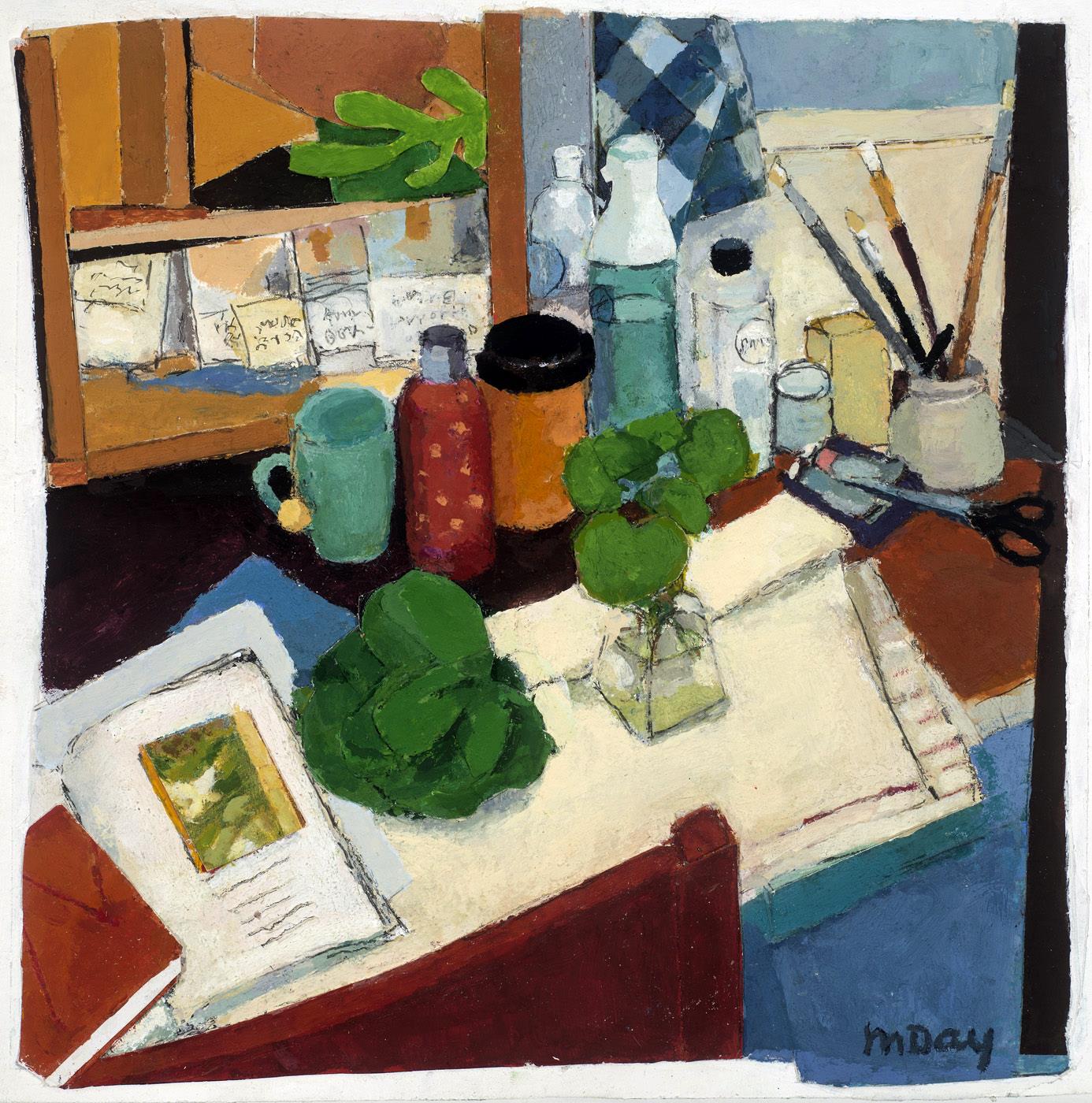
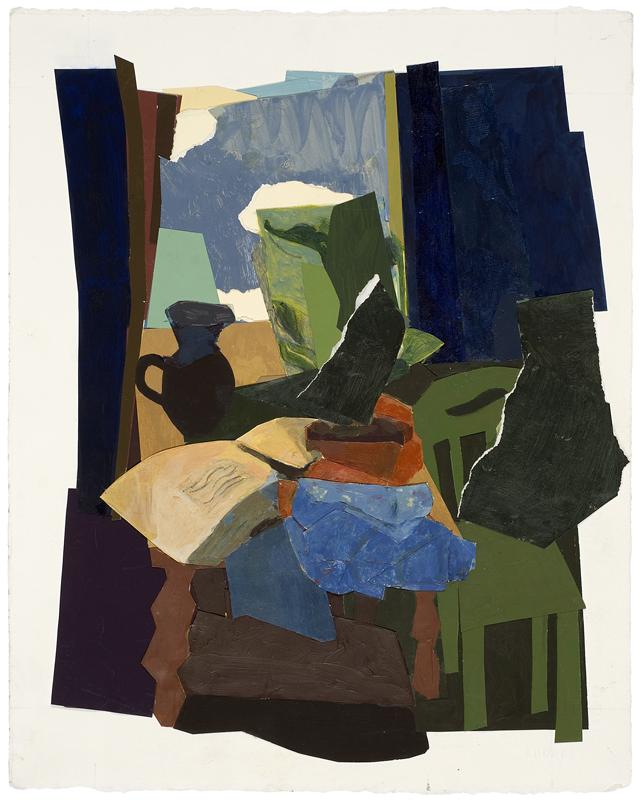
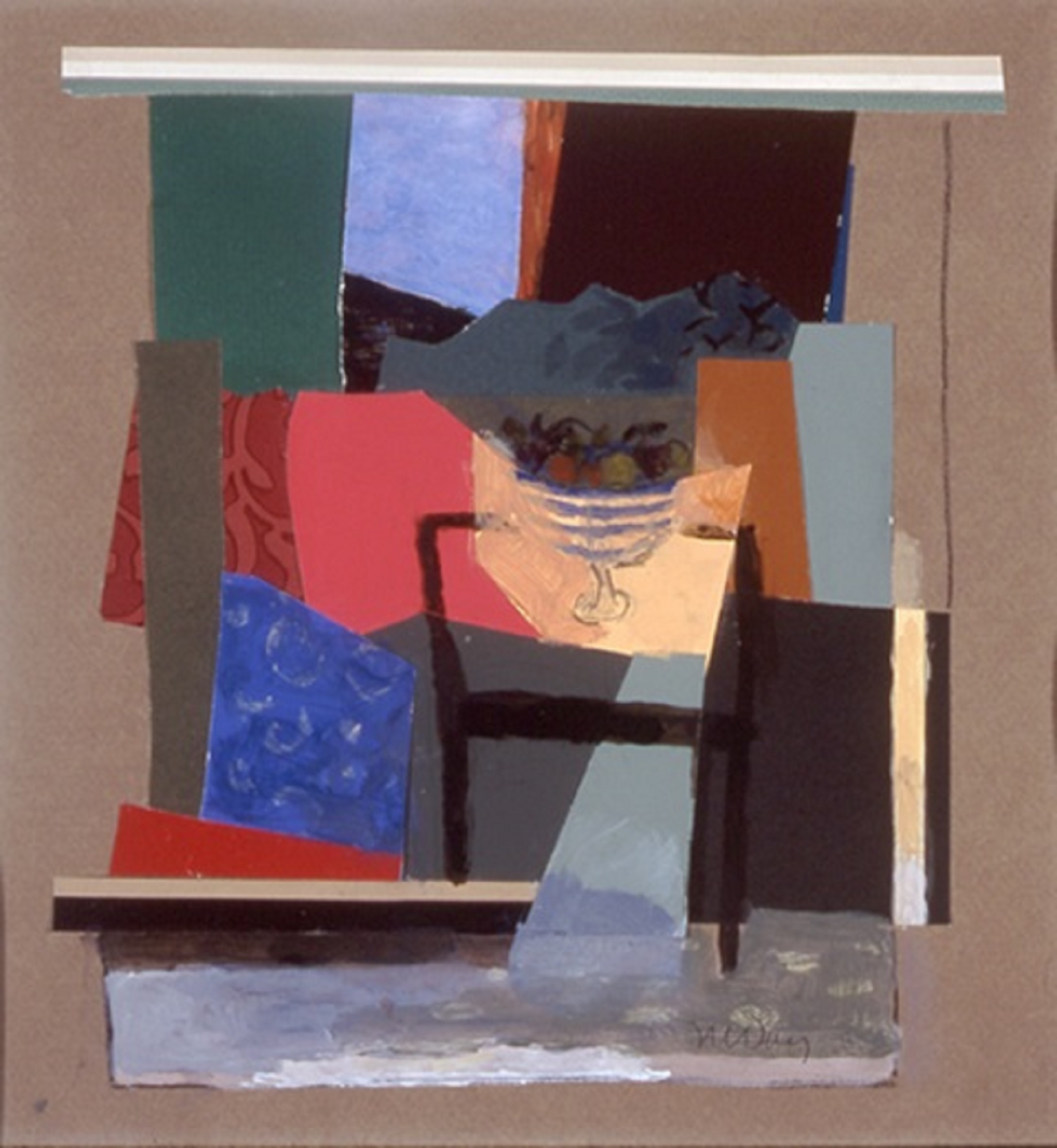
Art: Meredith Fife Day.
Studio Life.

The day job of artist Meredith Fife Day was for many years running a department at a community newspaper chain in Massachusetts. That is where I met her. She was my first boss in publishing. After retiring from the newspaper, Meredith focused on her art while teaching art at a local college during the day and working with the amazing nonprofit she founded, Making Art with Artists (MAwA). MAwA enabled low-income urban kids to practice art under the guidance of working artists. I wrote about the award Meredith received for that work here.

Recently, I asked her if I could do a post on her art, and she sent me these riches.

From her bio: “Her art reviews and essays have appeared in a variety of publications for more than 25 years and she chronicles her days through journaling. She writes poems which, like her paintings, are frequently in homage to observational response, memory and imagination.

“She has exhibited paintings for more than four decades in numerous invitational shows and national competitions. She earned an MFA degree from Boston University after receiving BA and MFA degrees from Louisiana State University in her native Baton Rouge. Meredith has been awarded fellowships at Virginia Center for the Creative Arts in Amherst, Va., and Auvillar, France, and Millay Colony for the Arts in Austerlitz, N.Y.  She has taught at Art New England/Mass Art summer workshops in Vermont and Cullowhee Mountain Arts in North Carolina.” 

Note how much the ficus plant below returns Meredith’s love by modeling for her on repeated occasions. And do you sense the joy the artist takes in homely things lifted to a spiritual level? I love her work.

Read Full Post »

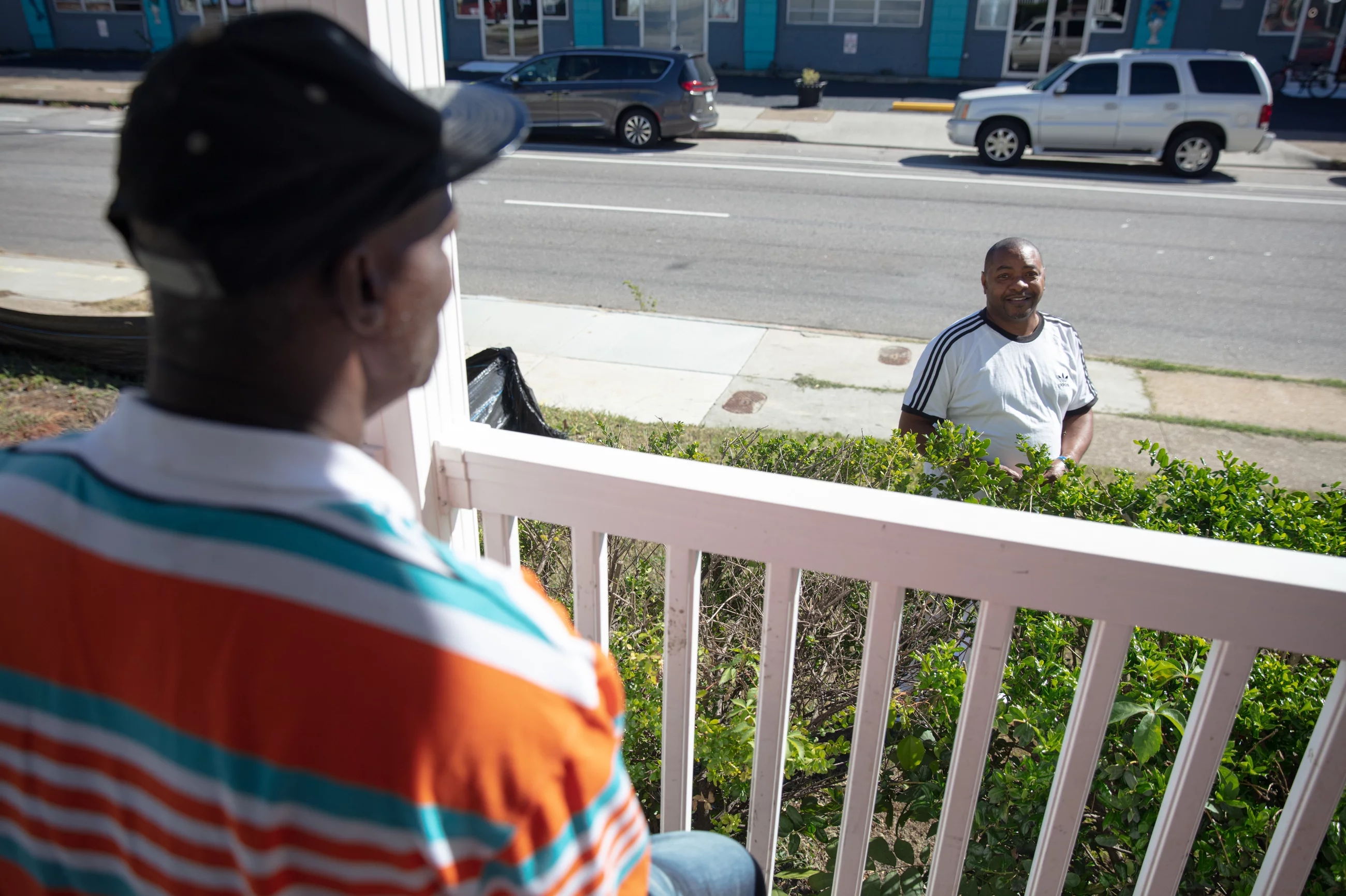
Photo: Parker Michels-Boyce for NPR.
Eric Perkins (right)
says lived on the beach, then a shelter and then in a hotel during the pandemic before moving into the Norfolk apartment,” NPR reports.”The median local rent for a one-bedroom apartment is over $1,000. Perkins’ rent is $600.

This is a story about an approach to housing that hasn’t always worked in the past but, when carefully managed, really can move people out of homelessness and into eventual independence. It’s called the roommate.

Jennifer Ludden has a report at National Public Radio (NPR).

“Even after three years of homelessness, Eric Perkins did not want to move into an apartment with another person who had been unhoused.

” ‘I was real skeptical because of the things I was seeing inside the shelter,’ he says. ‘A lot of drug use, lot of alcohol abuse, PTSD, there was a lot of veterans there. …

“But the arrangement suggested by a local housing provider has turned out better than he expected. On a recent afternoon, Perkins gave a tour of the two-story house where he has lived for more than two years. It’s divided into two apartments, and he shares the one on the first floor. The place came furnished, including with some homey knickknacks. Perkins has his own bedroom but shares a bathroom.

” ‘It’s small, but it’s enough for us,’ he says.

“Farther down the hall is what sold him on the place — a roomy kitchen with a window onto the small yard. ‘I like to cook,’ he says. ‘This is where I want to be.’

“Before he moved in, Perkins had lived on the beach in Virginia Beach, then a shelter and — during the pandemic — a hotel. He ended up without housing after a heart attack in 2017 and double-bypass surgery with no health insurance. He also has chronic lung disease that limits his ability to work. Perkins’ monthly disability payment is just under $800. The median local rent for a one-bedroom apartment is more than $1,000.

“After seeing the apartment and meeting the roommate he’d be paired with, Perkins decided to try it out. His rent is $600, and he gets a lot of help from housing aid. He says his roommate was also a good match with his personality, neat and quiet.

” ‘We got to know each other, we respected each other’s space, we shared everything,’ he says. ‘It was really nice.’

“That roommate ended up reuniting with his family and moved out, and in April 2021, Leon Corprew moved in. Corprew is 59 and Perkins is 56. They say they get along well, though they mostly keep to themselves and give each other space. Perkins used to cook for both of them, but Corprew makes his own meals now because, he says with a laugh, ‘I eat a lot!’

“Getting homeless people into their own apartment, without roommates, is considered the ‘gold standard’ for achieving independence, says Ann Oliva, CEO of the National Alliance to End Homelessness. But record high rents and a historic housing shortage are making it all but impossible in many places in the U.S. …

“Rents in many places around the country have gone up by double digits in the past couple of years, and in June, the median listed rent for an available apartment rose above $2,000 a month for the first time. Federal benefits like Supplemental Security Income — or disability — have been unable to keep up. …

“Oliva says she’s seeing more interest in offering roommate arrangements to homeless people out of necessity. When vacancy rates are as low as 1% or 2%, she says expanding the search to two- or three-bedroom apartments can make it easier to find a place.

“It may also lead to housing in nicer neighborhoods, says Todd Walker, executive director of the Judeo-Christian Outreach Center in Virginia Beach, which found the shared apartment for Eric Perkins.

“Walker started trying out this kind of shared housing eight years ago when one of his volunteers offered to rent out a four-bedroom family home. And he says he quickly learned some of the pitfalls.

” ‘We had clients that weren’t paying [rent], other clients giving that client their money to pay for the utility and it wasn’t getting paid,’ he says. ‘It was a catastrophe.’

“The first major lesson Walker learned was to have a separate lease for each roommate. That way, if one person is a problem they can be moved — or evicted — without everyone else being kicked out. Also, he says it’s important to keep utilities in the landlord’s name and include that cost in the rent.

“Another rule that Walker considers nonnegotiable: No doubling up in bedrooms, and there must be locks on the bedroom doors so that each renter is guaranteed a safe space. …

“The whole idea can also be a tough sell to landlords, who might worry about property damage. Walker talks it up to mom-and-pop landlords at every chance and offers incentives like a bonus or double deposit. He says these arrangements often let him house people who would otherwise be denied a lease, because of lack of income, a criminal record or past eviction. …

“Landlord Sophia Sills-Tailor owns the house where Perkins and Corprew live. When she heard about Walker’s program five years ago, she was desperate to rent out a couple of places. She’d been using Craigslist but found those tenants ‘fly-by-night.’ Working with a nonprofit seemed more stable, even if its clients were homeless.

” ‘When they come in, they don’t just say, “OK, here is the person, goodbye,” ‘ she says. They help them set up the household, donating things like blankets, pots and pans. ‘”‘And then they’re coming to see them.’ “

More at NPR, here. No firewall.

I love that when Perkins says the shared apartment is small, he adds that it’s “enough for us.” The roommates are not friends, but they are still an “us.”

Read Full Post »

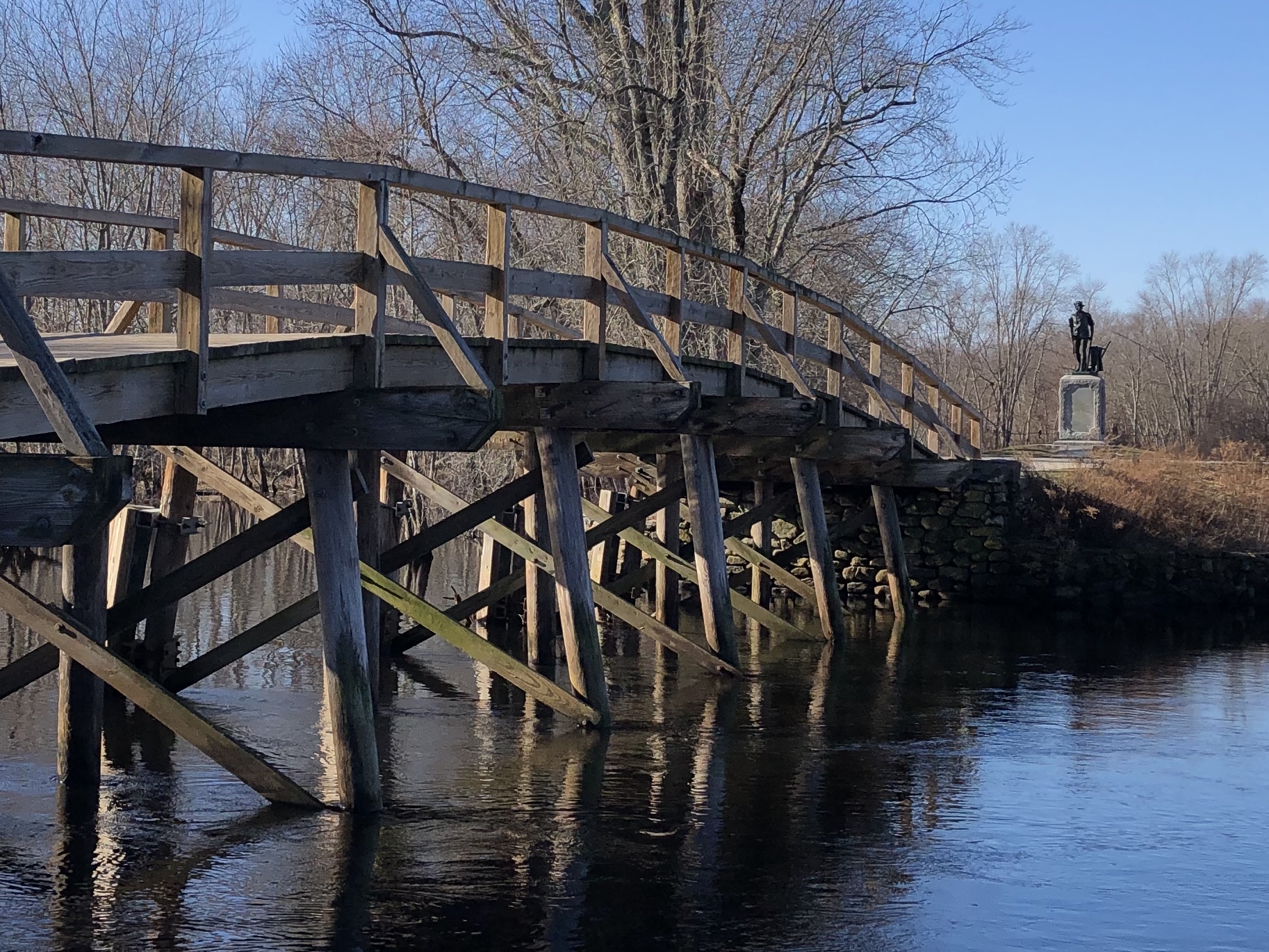
Photo: Suzanne and John’s Mom.
Remember Ralph Waldo Emerson’s lines, “By the rude bridge that arched the flood …”? A nonprofit news site named after this bridge will expand on a local-news trend led by the
Texas Tribune.

Hope is coming for one of the cornerstones of democracy, local journalism. Nowadays, it looks like the for-profit model ends in acquisitions, hedge fund ownership, and generalized stories that can be plugged into any town. Which is why we are seeing more nonprofit efforts for community news.

Margaret Sullivan writes at the Washington Post that if local journalism manages to survive, we need to “give Evan Smith some credit for it. The Texas Tribune founder has been a ‘true pioneer’ in finding ways to cover local communities as a nonprofit.

“When Evan Smith co-founded the Texas Tribune back in 2009, digital-first nonprofit newsrooms were something of a rarity. There was ProPublica, only two years old at the time, MinnPost in Minneapolis, the Voice of San Diego, and a few others.

“So his move from top editor of the award-winning Texas Monthly magazine, at the urging of venture capitalist John Thornton, was considered slightly bizarre.

“ ‘The tone of the coverage was almost mocking,’ Smith recalled last week, soon after he announced he would step down as the Tribune’s CEO at the end of this year. ‘It was, “What does this joker think he’s doing?” ‘

“As it turns out, Smith and company — he and Thornton recruited Texas Weekly editor Ross Ramsey to join the endeavor — had a good idea of what they were doing, or figured it out along the way.

“The Austin-based Tribune has grown from 17 employees to around 80 (more than 50 are journalists), raising $100 million through philanthropy, membership and events, including its annual Texas Tribune Festival that has attracted speakers including Nancy Pelosi and Willie Nelson.

Most important, it has done a huge amount of statewide news coverage with a focus on holding powerful people and institutions accountable.

“These days, such newsrooms are springing up everywhere; there are now hundreds of them. They are easily the most promising development in the troubled world of local journalism, where newspapers are going out of business or vastly shrinking their staffs as print revenue plummets and ownership increasingly falls to large chains, sometimes owned by hedge funds.

“In Baltimore, the Banner — funded by Maryland hotel magnate Stewart Bainum — is hiring staff and expects to start publishing soon. In Chicago, the Sun-Times is converting from a traditional newspaper to a nonprofit as it merges operations with public radio station WBEZ. And in Houston, three local philanthropies working with the American Journalism Project (also co-founded by Thornton) announced a $20 million venture that will create one of the largest nonprofit news organizations in the country.

“ ‘These newsrooms are popping up like mushrooms after a rainstorm,’ Smith, 55, told me. …

“As a speaker at Trib Fest myself, I’ve seen Smith in action — a promotional force of nature, energetic organizer, prodigious fundraiser, and lively onstage interviewer.

“Emily Ramshaw, who started at the Trib as a reporter and was named its top editor in 2016, called him ‘an innovator, a ringleader and a fearlessly ambitious local news entrepreneur.’ What’s more, she told me, Smith has brought along ‘a whole series of news leaders who have grown up in his image.’

“Ramshaw counts herself among them; she left the Trib in 2020 to found a new nonprofit news organization, the 19th, which covers the intersection of gender, politics and society.

“The Trib’s new editor is Sewell Chan, most recently at the Los Angeles Times, where he was the top opinion-side editor, and previously at the New York Times and the Washington Post. Smith considers it a triumph for nonprofit newsrooms that it’s no longer unusual for them to attract the likes of Chan, or of Kimi Yoshino, who was managing editor of the L.A. Times before being named editor in chief of the Baltimore Banner. …

“The Trib’s journalism is influential well beyond its own free website. More than 400 Texas Tribune stories appeared on the front pages of newspapers throughout the state last year, provided free of charge. The site has done investigative projects on the effect of sex trafficking on young girls, the influence of religious belief on the lawmaking of Texas legislators, and an investigation, part of its voting rights coverage, into the state’s review of voting rolls. In 2019, it announced it was joining forces with ProPublica to form a new investigative unit based in Austin. …

“With local news outlets withering in many communities — statehouse coverage, in particular, has dwindled despite its importance — and democratic norms under attack in many states, the need for that kind of watchdog reporting is acute everywhere.” More at the Post, here.

Another nonprofit news site will launch locally in fall, The Concord Bridge. Hooray. A world for which the “embattled farmers” fought doesn’t have to be merely aspirational. Neither does good local journalism.

Read Full Post »

Photo: federico-giampieri-R0lftflMYPw-unsplash.
Generations share the love of fishing.

Today’s story is about a guy who provides outings to fatherless children — on Father’s Day and year-round.

Cathy Free wrote about him at the Washington Post.

“It was hard not to notice the 8-year-old boy across the street who stormed in and out of his own house. The boy, a neighbor of William Dunn in Lakeland, Fla., did it often enough that Dunn wanted to see if he could help.

“ ‘I wondered what was going on in his life, so one day, I decided to ask him,’ said Dunn, 57. ‘He told me that he didn’t have a father, and I realized there might be something I could do for him.’

“Dunn had grown up fishing with his dad and had helped him for a time with his lobster business in the Florida Keys.

‘Fishing always brought me peace and it taught me how to be patient,’ he said. ‘When you’re on the water, you can forget about your problems and just appreciate the moment.’

“Dunn, who has three children of his own, approached the boy’s mother and asked for permission to take him fishing.

“One Saturday afternoon on the water soon led to another, and pretty soon he was teaching the boys’ friends and other kids in the neighborhood how to rig a line, hold a fishing pole and reel in a big catch. That was 15 years ago.

“Since then, he’s taken groups of kids out almost every weekend to fish. Most of them didn’t have father figures in their lives, and had never fished before.

“Some of them were foster kids who had shuffled for years from one home to the next, he said. ‘They’d been through a lot and they’d seen a lot, and their lives were difficult,’ Dunn said. ‘But when they were fishing, all of that faded away.’ …

“In the beginning, Dunn spent a good chunk of his paycheck from his job selling tires to help fund the weekend fishing expeditions on charter boats, he said. Then in 2018, he started the nonprofit Take a Kid Fishing Inc. in Lakeland, a city with dozens of lakes located between Tampa and Orlando.

“In the past 3½ years, he and a small group of volunteers have introduced more than 2,500 kids — most without fathers around — to the experience of spending peaceful time on the water, and the exhilaration of nabbing a fish. …

“ ‘I’m the youngest of six and I always had a great relationship with my dad,’ he said. … ‘He told me that fishing isn’t about what you catch — it’s about the memories you make.’ …

“Through public and private donations to his nonprofit, he said he’s able to go deep-sea fishing with up to 20 kids at a time, or take smaller groups on Saturday lake outings on a charter boat.

“ ‘We only keep the fish we need and toss the rest back,’ he said. ‘And at the end of the day, I’ll help to fry up the catch and feed the kids fish tacos for dinner.’ …

“Terra Pryor of Lakeland, Fla., said all three of her children have struggled emotionally since their dad, Richard Pryor, died in a car accident in January 2020. ‘I was especially worried about my son, Jayden, who was 10 then,’ said Pryor, 32. ‘He was really close to his dad and felt he needed to take over the man of the house role immediately … I was wondering what to do to help him, and then I learned about Take a Kid Fishing.’

“Jayden, now 12, has become a devoted fisherman thanks to regular outings with Dunn, he said.

“ ‘Will has helped me to grow by taking me fishing,’ he said, noting that he once caught a shark that Dunn helped him to cut loose.

“ ‘I hope he knows I mean it when I say, “Thank you,” ‘ Jayden said.”

More at the Post, here.

Read Full Post »

Photo: Capital Area New Mainers Project.
Abdalnabi family members (left) are seen here with property manager Efrain Ferrusca (right). The family lives in what used to be St. Matthew’s Episcopal Church in Hallowell, Maine, a building managed by Capital Area New Mainers Project [CANMP].

As church attendance decreases and buildings can no longer be supported by the remaining congregants, some properties are sold or donated to worthy causes. Tara Adhikari and Erika Page write about church transitions at the Christian Science Monitor.

“Victoria Stadnik glides on roller skates down one side of a wooden halfpipe decorated in neon spray paint. Light pours in through stained-glass windows, catching her body as she rotates through the air in the nave of what used to be St. Liborius Catholic Church [in St. Louis]. 

“After the church shut down in 1992, the building served briefly as a homeless shelter. Now, St. Liborius is better known as Sk8 Liborius – a skate park in use informally for a decade, with plans to open officially in three years.

“St. Liborius is one of hundreds of churches across the United States beginning a second life. As congregations dwindle – only 47% of American adults reported membership in a religious organization in 2020, down from 70% in 1999 according to a Gallup poll – churches are closing doors and changing hands. Developers have jumped at the chance to transform the consecrated spaces into luxury condos, cafes, mansions – even a Dollar Tree

“For some, the trend brings with it a sense of dismay. … But in some cities, residents are breathing new life into sacred spaces by giving fresh thought to what it means to serve, and who can constitute a congregation. Groups in St. Louis, Philadelphia, and Hallowell, Maine, are finding that one fundamental purpose of church – community uplift – can take many forms. 

“ ‘These places are very powerful links to the history and the evolution of our neighborhoods,’ says Bob Jaeger, president of Partners for Sacred Places, based in Philadelphia. Even though a church ‘may need repair, even though it may be empty, … it’s a bundle of assets. It’s a bundle of opportunities.’ …

“When Dave Blum, co-owner of Sk8 Liborius, speaks about his plans for the church, his voice echoes out across the sanctuary, ringing with the hope and certainty of a sermon. His team is creating not only a skate park but also an urban art studio where local artists can display and sell their work and children can learn skills ranging from metalworking to photography.  

“In every empty nook and cranny, he sees the potential to support a new congregation: underserved urban youth. He hopes skateboarding will get kids in the door – where vital lessons await. …

“The church was completed in 1889, and after years of neglect, it has a long way to go before it can pass an inspection and be formally opened to the public. Emergency exits, bathrooms, window repair, plumbing, electricity, and heat are just a few of the items on a to-do list of fixes estimated at $1 million. But donations are pouring in from supporters, and local skaters like Ms. Stadnik, who also works as a skating coach, spend weekends helping with repair work.

“ ‘A whole community came together to build these structures because it was important to them. And now, what we’re trying to do is have a whole community come together to maintain this structure,’ says Mr. Blum. 

“Welcoming newcomers into the fold is another function churches often fulfill. In Maine, a local nonprofit is continuing that mission by turning a former holy space into a home and community center.

He appreciates the sacredness of his new home and is just happy to finally have enough space to study. 

“Ali Al Braihi and Mohammed Abdalnabi came to the U.S. as refugees because war – in Iraq for the first and Syria for the second – made staying home impossible. Their journeys were different, but their families both ended up in Hallowell, Maine. Housing was limited, says Mr. Abdalnabi, and squeezing all nine members of his family into a two-bedroom apartment was ‘rough.’ Mr. Al Braihi had the same difficulty.

“Now, the 18 people that make up both families live in what used to be St. Matthew’s Episcopal Church. … 

“ ‘What I feel is fortunate and thankful,’ says Mr. Al Braihi, now a college student. His family is Muslim, but he says he appreciates the sacredness of his new home and is just happy to finally have enough space to study. 

“After closing last summer, St. Matthew’s offered the building to Capital Area New Mainers Project (CANMP), which supports the growing number of refugees and other immigrants in the area.

“The congregation chose CANMP because it ‘felt like we would be carrying on the mission,’ says Chris Myers Asch, CANMP’s co-founder and executive director. ‘We take that responsibility very seriously. It’s hallowed ground.’ 

“Mr. Myers Asch and his team of volunteers are currently renovating the sanctuary to create the Hallowell Multicultural Center. When it’s ready, anyone in the community will be able to host events: dinners, talks, movie screenings, weddings – whatever brings people of different backgrounds together.”

More about church reuse at the Monitor, here. No firewall.

Read Full Post »

Photo: Cardinal News.
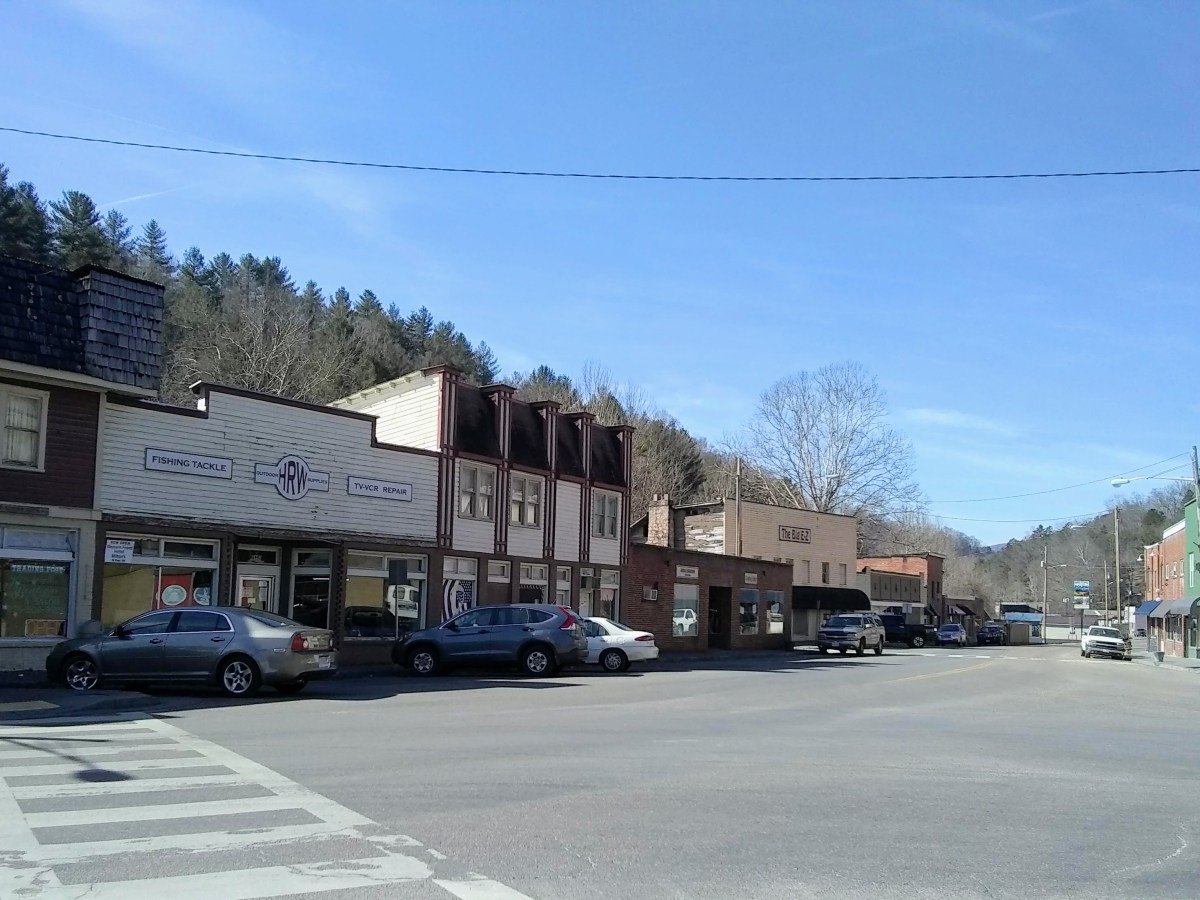
Cardinal News calls itself “an independent, nonprofit, nonpartisan news site serving Southwest and Southside Virginia.”

Local news is desperately needed as chains buy up papers for their advertising potential and show little interest in actual communities. The need is especially dire in rural areas.

Margaret Sullivan reports at the Washington Post on one hopeful development in western Virginia, where “veterans of a once-great newspaper are starting something small with big ambitions for serving Appalachian readers.”

She writes, “Two photographs tell the story of Cardinal News, a start-up news site in a mostly rural section of Virginia.

“One shows a lawn chair and small table set up just outside the Fincastle branch of the Botetourt County public library. It’s where editor Dwayne Yancey sometimes goes to use the broadband Internet access that he lacks at his nearby home. When he needs to upload big digital files — particularly photographs he wants to publish on the news site — his mobile hotspot can’t get the job done.

“The other photo is of the ravaged interior of Patty Coleman’s home in Hurley, a community close to the Kentucky and West Virginia state lines, where a flood and mudslide destroyed dozens of homes and caused one death last summer. After Yancey sent Megan Schnabel, one of Cardinal’s two reporters, to Hurley for several days, along with a photographer, their in-depth reporting about the devastation brought much-needed attention to Hurley’s suffering residents — and may help them get $11 million of state aid.

“ ‘Without that story, we wouldn’t have had the awareness we needed,’ said Will Morefield, a state legislator who has proposed a funding bill that is moving forward; the money is sorely needed after the Federal Emergency Management Agency denied the state’s request for financial help to individual homeowners. …

“Like many similar start-ups around the nation, Cardinal — named for Virginia’s state bird — is helping to fill the gap left by the shrinking of traditional local news organizations, particularly newspapers. Most of the staff came from the Roanoke Times.

“Yancey made the move after watching the Times scale back its staff in recent years, especially after its sale by longtime owner Landmark Communications in 2013.

Now the Times, like many other Virginia newspapers, is in the hands of Lee Enterprises, which has been fighting off a takeover bid by Alden Global Capital, a hedge fund that is perhaps the worst newspaper owner in the country. …

“More than 1,800 local papers have closed since 2004 as print advertising revenue plummeted and reader habits shifted to online sources. The shuttering of those papers, along with the shrinking of other local news sources, is having profound negative effects on society. …

“ ‘It was basically like getting the band back together,’ Yancey told me last week. They have also been joined by Markus Schmidt, the Cardinal’s second reporter, who is a veteran of the state politics beat at the Richmond Times-Dispatch. He remains based in Richmond, focused on reporting government news of particular interest to Cardinal’s part of the state.

“[Chief development officer, Luanne Rife, a former Times health reporter] told me she took a buyout from the Roanoke paper after she was told she would no longer be able to do many in-depth stories on the health beat, even in the midst of a pandemic.

“ ‘I had always enjoyed my work, but I was burned out,’ she told me. ‘I would go to my keyboard in the morning and start to feel tears rolling down my face.’ When a foundation approached her about a reporting project it wanted to fund, it lit a spark of inspiration for her — and she started exploring whether she could start her own project, one that would be more ambitious and permanent.

“Cardinal’s territory extends far beyond the Roanoke metro area; its mission is to … what Yancey calls ‘Cumberland County to the Cumberland Gap.’

“Much of it is considered part of Appalachia — ‘an easy part of the state to stereotype,’ Yancey noted. Cardinal’s mission includes providing a more nuanced picture of the region to the rest of the state.

“With no paywall, the site’s funding comes from foundations, businesses and individual donors; it has applied for nonprofit status.

“Rife says she’s heartened by the way those contributions have grown from a handful when the site launched last September to more than 700. A new grant will allow Cardinal to add a reporter soon in Danville, along the North Carolina border; Rife also would like to hire an education reporter and one dedicated to health coverage.

“ ‘We’ve been amazed, overwhelmed and humbled by the support,’ Rife told me. The other day, she picked up the mail to find five checks — one for $25, another for $10,000. Cardinal lists its donors on the site and discloses in stories if a person or organization it writes about is a significant contributor.

“In Cardinal’s first big story about the devastation in Hurley, Schnabel describes Coleman’s house: ‘A blue tarp partially draped the door frame where the mud had rushed in. The floor had caved in, and mold and mildew covered the walls.’

“The house was beyond repair. Coleman didn’t have flood insurance; she did have a homeowner’s policy, but the insurer, according to the story, had given her the crushing news that nothing would be covered.

“Now there may be help on the way after all. And a tiny news start-up with big ambitions will have made a difference.”

More at the Post, here.

Read Full Post »

Photo: Capital Canvas Prints.
Salt Lake City, Utah.

Our local paper is owned by a national chain, Gannett, that cares nothing about our town. It prints generic articles from national outlets like USA Today or towns in other parts of New England and doesn’t get around to printing the library’s schedule or candidate letters until the events are over. Once in a while, it covers a controversial meeting or interviews a school coach — exceptions that prove the rule.

So I was not surprised to learn that a group of prominent citizens, including an experienced journalist, is working to establish a nonprofit competitor here. This is not unheard of. Today’s article from NiemanLab describes one successful effort to save local journalism, only in this case, the nonprofit board built on an established newspaper.

As Sarah Scire wrote last November, “The Salt Lake Tribune has plenty to celebrate in 2021. The first (and so far only) major newspaper to become a nonprofit is financially sustainable and, after years of layoffs and cuts, is growing its newsroom. Executive editor Lauren Gustus announced the news in a note to readers in which the relief of escaping hedge fund ownership was palpable.

“ ‘We celebrate 150 years this year and we are healthy,’ Gustus wrote. ‘We are sustainable in 2021, and we have no plans to return to a previously precarious position.’

“It’s been quite the turnaround. Utah’s largest newspaper escaped the clutches of the hedge fund Alden Global Capital in 2016 only to see its local owner, Paul Huntsman, lay off a third of staff two years later in the face of plunging ad revenue. In 2019, the Tribune made history as the first daily newspaper to become a nonprofit. And then amid the height of the pandemic last year, the Tribune ended a 149-year run of printing a daily newspaper and a 68-year-old joint partnership with the Deseret News. …

Gustus pointed out that hundreds of American newspapers are owned by financial institutions with a well-deserved reputation for making every newspaper they touch worse by gutting newsrooms, selling off assets, and jacking up subscription prices for readers.

“Gustus herself joined the Tribune from McClatchy (owned by a hedge fund) and spent years at Gannett (once managed by one hedge fund, and now deeply in debt to a different one). …

“The Salt Lake Tribune’s transition to nonprofit status has been closely watched in the news industry. Does that put additional pressure on Gustus and the rest of the Tribune team? ‘The opportunity for us to prove that this can work is significant and so is the responsibility,’ she said.

“The Tribune grew its newsroom 23% in the last year and will add new reporting roles focused on education, business, solutions journalism, food, and culture in 2022. Gustus also expects to follow the Utah News Collaborative (launched in April to make the Tribune’s reporting available to any news organization in the state) with more multi-newsroom projects centered on saving the Great Salt Lake and the centenary of the Colorado River Compact.

“Other changes include introducing six weeks of paid parental leave and a 401(k) match for employees. In response to readers who said they missed the ‘daily drumbeat‘ amid the weekend edition’s in-depth reporting, the newsroom will publish an e-edition to accompany the Sunday paper. They’re also introducing a second printed edition — delivered by mail, rather than carriers — on Wednesdays at no additional cost to subscribers.

“The Salt Lake Tribune draws revenue chiefly from subscriptions, donations, and advertising. … Subscribers pay for a digital subscription ($80/year), while ‘supporting subscribers’ ($150/year) add a donation on top. In the donations category, members of The First Amendment Society pledge to donate at least $1,000/year for three years while major donors provide one-off gifts and grants.

“The Tribune has about 6,500 supporting subscribers, more than 50 members of its First Amendment Society, and dozens of major donors. (In a bid for transparency, The Tribune forbids donations over $5,000 to be anonymous. You can see the full list here.) Gustus stressed that consistency of support is invaluable.

“ ‘We are so grateful to them [supporting subscribers] because it enables us to plan.’ …

“Gustus says that being ‘relatively lean’ — the newsroom currently stands around 33 reporters, with a handful of open positions — sometimes lends itself to some unusual experiments. The Salt Lake Tribune’s NBA beat writer, Andy Larsen, told his sizable Twitter following he wanted to get 500 new subscribers for the Tribune by the end of the year.

“Larsen had to clarify that this was his own idea and not something his bosses were making him do. … Roughly 24 hours after his first tweet, the thread had earned the Tribune 82 new subscribers. In November, roughly halfway through the self-assigned challenge, Larsen said that number had grown to 294 new subscribers.

“ ‘Andy is a gift to Utah,’ Gustus said, noting that Larsen wrote a popular column that dug into Covid data in the state when professional basketball ground to a halt. ‘He has really taken his curiosity and run with it.’

“Looking ahead to 2022, Gustus was brimming with ideas for the newly-enlarged newsroom. The Tribune will continue to investigate the dark history of Indigenous boarding schools in the state, start a conversation about the long-term impacts of children being educated during the pandemic, address water resource issues, and make sure readers have the information they need to vote in November elections.

“Gustus says The Salt Lake Tribune will also be wrestling with what it means to be a nonprofit news organization, beyond its official 501(c)(3) tax status.

“ ‘2021 has been all about finding stability for the Tribune,’ Gustus said. ‘We are so happy to say we’ve arrived in that spot and we don’t want to go back to where we were.’ “

More at NiemanLab, here, and at the newspaper’s website, here.

Read Full Post »

Photo: Margaret Jankowski.
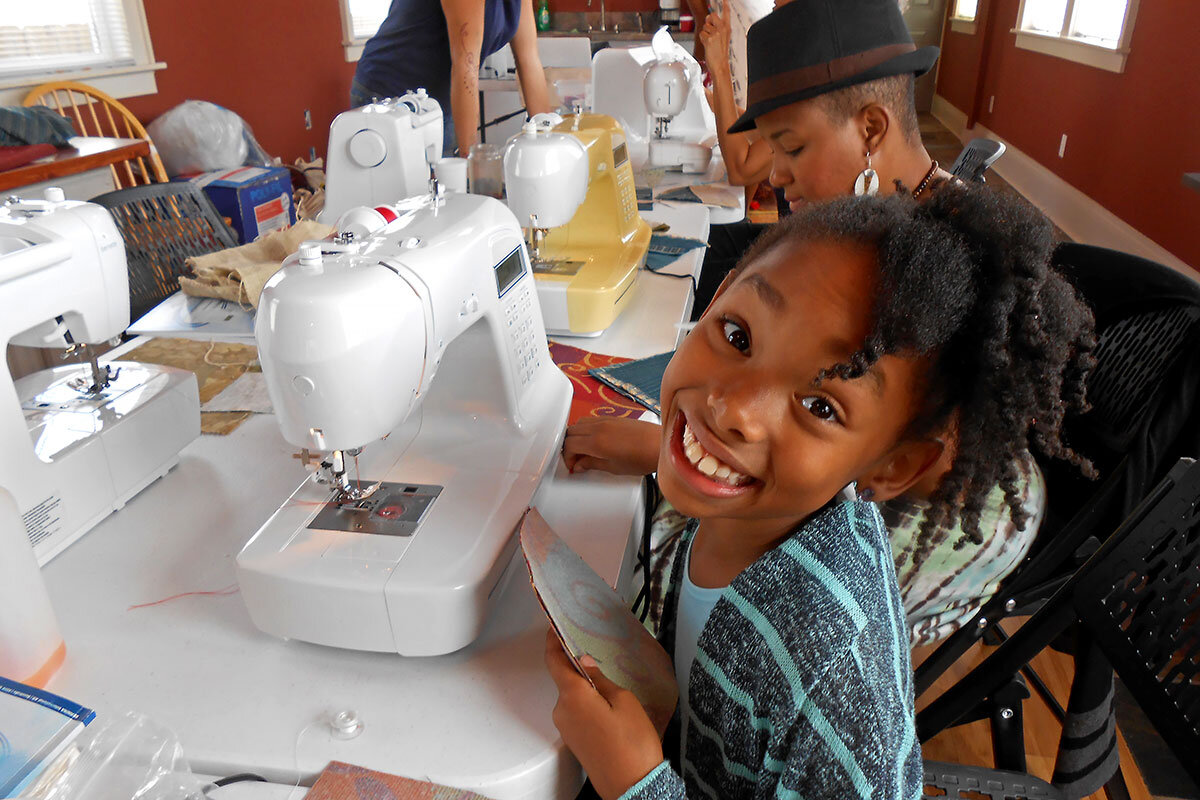
Students in a 2013 sewing class test their new skills on a suite of machines donated by the nonprofit Sewing Machine Project to a community center in New Orleans. 

There have always been a few followers of this blog who quilt, weave, knit, crochet, or sew, and I’m hoping they will like today’s focus on a nonprofit that harnesses the multifaceted power of sewing. Richard Mertens reported about it at the Christian Science Monitor.

“A tsunami helped Margaret Jankowski understand the real value of a sewing machine. Like many girls of her generation, she had learned to sew at an early age. Her mother taught her on an old Singer Featherweight, and she learned the basics by hemming her father’s handkerchiefs. As an adult, she bought her own clothes off the rack but sewed for her first child. … She taught classes at a sewing shop, ‘preaching the gospel of sewing,’ she says. …

“Then, in December 2004, a tsunami hit Sri Lanka and other coasts around the Indian Ocean, leveling communities, hurling wooden fishing boats far inland, and killing 230,000 people. … What touched Ms. Jankowski most deeply was the story of a woman returning to her ruined village. The woman had worked for years to save enough to buy a sewing machine, enabling her to work as a tailor and giving her a future. Now it was gone. …

“She resolved to send sewing machines to Sri Lanka. ‘I thought maybe I could collect a few of these machines that people are getting rid of anyway,’ she says. She explained her idea on a local news program and was inundated with machines. She raised money for voltage converters and shipping, and in 2005, with the help of the American Hindu Association, sent five boxes each to five orphanages in India and Sri Lanka, each packed with toys, medical supplies, fabric, and the most precious cargo – a sewing machine.

“ ‘They were used to sew for kids,’ she says. ‘They were also used to teach kids a trade, which I felt was really important.’

“It didn’t end there. Ms. Jankowski went on to start the Sewing Machine Project, a small organization that redistributes used machines. It’s a mission that springs from a love for an old craft and a belief in its practical and redemptive possibilities today. …

“In 16 years the project has shipped 3,350 machines around the world – and across town. It’s sent them to coffee pickers in Guatemala, women who help vulnerable girls in Guam, and war widows in Kosovo. It’s sent them to programs that help refugee women in Detroit, incarcerated women in Mississippi, and sewers of Mardi Gras outfits. … In these and other places, unwanted machines find new uses. In many places sewing can be a livelihood, whether in a factory job or at home.

For those trapped in poverty, Ms. Jankowski says, sewing ‘is a way out.’

“Sewing is also a way forward for immigrant and refugee women in Detroit, says Gigi Salka. Ms. Salka is the director of the B.O.O.S.T. training program at Zaman International, a nonprofit that serves poor and marginalized women and children, including immigrants and refugees, in the Detroit area. … Zaman began offering a two-year sewing instruction program. Graduates earn money doing alterations and creating made-to-order clothing, often from their homes. …

“The pandemic disrupted the classes but also created new opportunities for the women. ‘We gave them fabric. They took machines home. They made masks,’ Ms. Salka says. ‘In a population where five dollars makes a big difference, any supplemental income, any extra dollar is a dollar they can have. … Sewing is very empowering. You see it in a population that’s lost hope; the ability to create a product is very powerful to them. They’re so proud.’ …

“This idea is being tested in Rankin County, Mississippi, where a local woman, Renee Smith, persuaded prison officials to allow her to start a sewing program for women in the Central Mississippi Correctional Facility. Her aim was to get help producing reusable menstrual pads for girls in countries like Uganda and Haiti where girls frequently stay home from school while menstruating, or quit school altogether because they lack access to sanitary supplies. … The inmates were glad to have something to do, she says, but sewing for distant schoolgirls also gave them a sense of purpose. …

“Some of the biggest beneficiaries of the Sewing Machine Project have been the Mardi Gras Indians of New Orleans, an African American community known for the elaborate feathered and beaded suits they wear for Mardi Gras. That effort, too, started with a disaster. In 2005, Hurricane Katrina struck the city, hitting African American neighborhoods especially hard. Cherice Harrison-Nelson, also known as Queen Reesie and an early collaborator with the Sewing Machine Project, says that making Mardi Gras suits is an important cottage industry in the city, but that many people lost their machines in the hurricane.”

Read more at the Monitor, here.

Read Full Post »

Photo: Cairo Scene.
Last fall, the Mersal Foundation, a health-care nonprofit in Egypt, received one large award from AstraZeneca for its work with lung cancer patients and another to aid those afflicted with the Coronavirus.

When I read a story like today’s, which is about a nonprofit that’s filling the gaps in a health-care system, I think of my favorite Allen Ginsberg poem:

“When Music was needed, Music sounded
“When a ceremony was needed, a teacher appeared
“When students were needed, telephones rang
“When cars were needed, wheels rolled in …”

It reminds that good people can make things happen.

Sudarsan Raghavan reported recently at the Washington Post, “The pleas for help were flooding in. By 2 p.m., Raba Mokhtar was picking up the 131st call of the day to the Mersal Foundation’s 24-hour hotline. Like the vast majority, it was related to the coronavirus pandemic.

“On the other end of the line, a woman was frantically describing the condition of a relative, a 67-year-old man who had tested positive for the virus. He had a 100-degree fever and could hardly breathe. They had first tried the Health Ministry’s hotline to look for a bed in a government hospital, with no luck. …

“In a country where government health resources can be either stretched or inadequate and where most people cannot afford hospitalization, a once little-known charity has become a lifeline for thousands of Egyptians. For the past year, and especially during the latest coronavirus wave, the Mersal Foundation has contracted and paid for beds in private hospitals or provided oxygen tanks to people in need.

“Mersal and its founder, Heba Rashed, have become so trusted that more than a quarter-million people now follow her social media accounts to learn the true impact of the pandemic in Egypt. …

“Egypt has reported about 165,000 infections and 9,100 deaths since the start of the outbreak. Medical experts and even government ministers have publicly said the real numbers are far higher.

“Doubts among the public deepened in January when a video went viral online claiming that coronavirus patients at a government hospital had died because of a lack of oxygen. The government denied the report, but a week later Sissi ordered a doubling of oxygen production to meet increased demand.

“Against this backdrop, the Mersal Foundation has emerged as a trusted oasis of care. And Rashed, 40, has become a coronavirus prognosticator for her legions of followers.  

‘It makes me feel very responsible for every word I utter,’ she said. ‘People get affected by everything I say.’

“Growing up in Jordan and the Egyptian desert town of Fayoum, Rashed never intended to start a charity. In college, she studied Spanish and Arabic and later earned a master’s degree in linguistics and several diplomas in other fields. She later worked as a linguist and as a project manager. In her spare time, she volunteered at a local charity.

“Soon, Rashed said, she realized she had ‘no passion’ for her job and found her charitable work more fulfilling. She also noticed there were few nonprofit groups in Egypt specializing in health issues. So with two friends, she launched Mersal five years ago. ‘It was truly hard at the start,’ Rashed recalled. ‘We had no connections.’

“Eventually, they found a sympathetic donor. He gave roughly $1,300, and they set up the charity in Rashed’s apartment. Slowly they grew, soliciting donations mostly on social media. They began to get noticed by some larger donors.

“Today, the foundation has four offices in Cairo and one in the northern city of Alexandria, with roughly 200 employees, according to Rashed. …

“ ‘The second wave is much more vicious than the first one, in terms of the intensity of the infection,’ Rashed said. ‘The number of infections is bigger than the last wave. The symptoms are much more.’

“She was infected. So were more than half of her 100 employees in the office, forcing mass isolations. ‘It made it very hard to do our work,’ Rashed said matter-of-factly. …

“The case of the 67-year-old man who had been struggling to breathe was typical. His oxygen levels were extremely low, though he was using a tank. … Mokhtar, the employee who took the call, asked the man’s relative to send a complete medical report, X-rays of his lungs and any bloodwork. Mokhtar gave her the WhatsApp number.

“ ‘We will show them to the medical department, and we will get you a bed when one becomes available,’ Mokhtar said. ‘Peace be with you.’

“Finding a bed usually takes a few hours but can stretch into a day or two, employees said. … The foundation has contracted with more than 30 private hospitals. In some cases, patients who need help getting care can pay some or all costs. Mostly, though, the charity pays as much as $1,300 per day for hospital beds in intensive care units, money obtained in large part through online appeals for donations.”

More at the Washington Post, here. Grateful stories may be found at the Mersal Foundation Facebook page, here,

Read Full Post »

Photo: David Sowells via Upworthy
Henry Sowells, 16, in his garage in Bethesda, Maryland. Sowells is selling homemade furniture and donating the profits to Bethesda Cares to help people experiencing homelessness.

Enterprising folks have taken advantage of being home all day to take on a new challenge. This high school student and his father enrolled in an online woodworking class. But they didn’t stop there.

As Teddy Amenabar reported in a July Washington Post article, “Three months ago, 16-year-old Henry Sowells didn’t know the first thing about woodworking. Now, he has people asking him to renovate their kitchens.

“Henry is quick to say he can’t install your granite countertops, but he can build you furniture out of pine. Henry, a rising junior at Walt Whitman High, has turned his budding hobby into an act of goodwill with help from his father, David. For every piece of furniture Henry builds and sells to neighbors, he is donating [the profits] to a local nonprofit, Bethesda Cares, which serves those experiencing homelessness in Montgomery County. …

“After schools shut down in the Washington region in mid-March because of the growing number of novel coronavirus cases, David and Henry started a six-week online woodworking course from Steve Ramsey, a YouTube creator who uploads instructional videos for those interested in learning the craft.

“When Henry’s high school classes moved online, Henry and his family noticed that the school district’s priority was making sure students with free and reduced-price meals had food.

There were frequent discussions around the Sowellses’ dinner table about the wealth disparity in the United States, which led Henry to his idea — to sell the furniture he has built and donate the profits to people nearby who are fighting hunger. …

“Henry sells seven different products for a variety of prices — a small bench costs $100, wooden crates are $35, and a patio table is $85. Each item on the website includes a cost breakdown for the parts and how much money would go to Bethesda Cares.

“For example, he explains that for the $100 bench, parts cost $60 and $40 goes to Bethesda Cares. Henry said some customers have paid more than the asking price, and he donates any extra money to the nonprofit.

“Most of the designs come from the tutorials that Henry followed with his dad. But he also created his own design for a raised planter bed after a request from a customer. …

“David Sowells learned the basics of woodworking along with Henry, but he said Henry runs the show. David’s contribution is that he drives three times a week to Home Depot so he can stock up on wood and other supplies. …

“Henry’s first orders came from dog walkers in his neighborhood, Woodhaven. To get the ball rolling, Henry made one of every product he offers and set up a display in his driveway. That way, when people walked by, they could see the furniture and take a flier to learn more about how to buy their own stool or bench. …

“Heading into the summer, Henry was going to intern at a local dentist’s office, but the coronavirus made that impossible. … Depending on how the school year goes, Henry’s plan is to keep building and selling furniture through the end of the year. Henry said he already has ideas to make cutting boards or other gifts around the holidays.”

More here.

Read Full Post »

Photo: Ann Hermes/Christian Science Monitor
Men in need of a suit for a funeral, say, or a job interview can get one fitted to perfection at the nonprofit Sharp Dressed Man in Baltimore and Los Angeles.

When my daughter-in-law’s parents were doing spring cleaning one year, they donated boxes of clothes in excellent condition to one of the Providence agencies where I’m an ESL volunteer. Dorcas International has many services besides English classes, and one of them is a secondhand shop that provides household goods and clothes for refugees (if you are used to Africa, you definitely need a warm coat for Rhode Island winters) and for needy residents referred by other agencies.

I was glad to learn that there are similar services in other cities.

David Karas writes at the Christian Science Monitor, “On a frigid December afternoon, Tyler Freburger is standing in front of a set of mirrors wearing a suit picked out for him by a tailor. He sorely needs the attire for a funeral later in the week.

“A homeless veteran living in Baltimore, Mr. Freburger would usually have difficulty securing such an outfit, especially one selected for him personally. But in this instance, he was referred to the nonprofit Sharp Dressed Man.

“Since 2011, the organization has been helping men improve their lives by equipping them for job interviews and other occasions with well-fitting suits and accessories. …

“ ‘It’s a blessing that they are here,’ says Freburger, who notes that the organization has treated him well and has been working to supply what he needs – something he is not accustomed to in his daily life. …

The nonprofit was founded by clothing designer Christopher Schafer, who sought to give those in need an experience more like a visit to his custom clothing shop than stopping at a warehouse. …

“[Some years ago,] When Schafer was delivering some custom suits to a client, he was handed two bags of gently worn suits in return.

“ ‘He said I spoiled him with how I made his custom suits fit, and he couldn’t wear his old suits anymore,’ Schafer says. ‘They were still very nice, and he didn’t know where to take them.’

“Schafer found a nonprofit that would accept the suits and put them to good use, but as time went on, more of his clients did the same thing. At the suggestion of a friend, he decided to launch his own nonprofit, Sharp Dressed Man. …

” ‘Since those two bags of clothes, I believe we have dressed about 7,000 people,’ Schafer says. .. ‘If you treat a guy with dignity, he has a better chance of treating himself with dignity. … It is really powerful when you see guys when they are suited up and they are kind of glowing,’ he says. …

” ‘I had a battle with drugs and alcohol for 20 years, and if I wouldn’t have changed my life, I either would have been dead or I would have been in line asking for free soup,’ he says. … ‘That’s why I do it.’ ”

More at the Christian Science Monitor, here.

Read Full Post »

Older Posts »