Feeds:
Posts
Comments

Posts Tagged ‘opportunity’

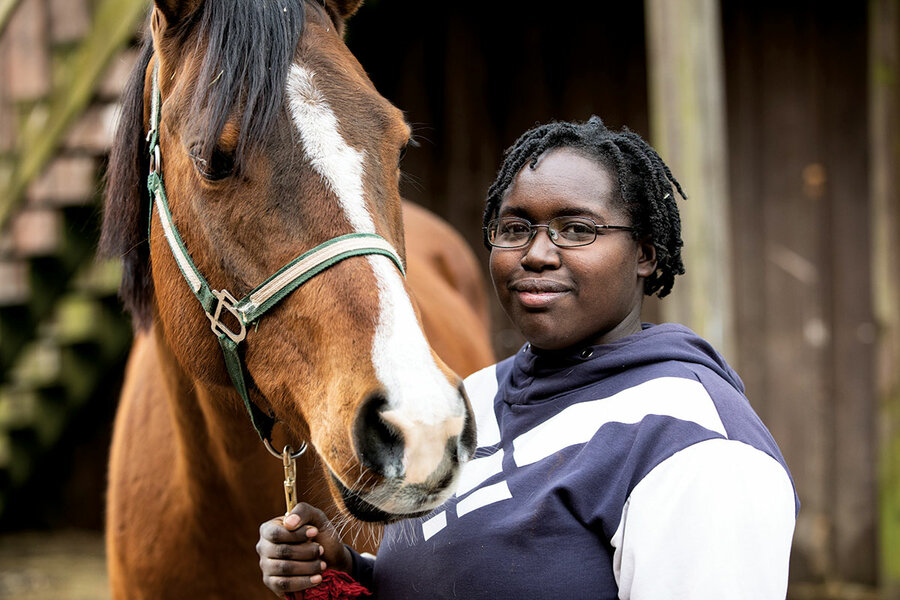
Photo: Melanie Stetson Freeman/CSM.
LaShawnda Phillips flourished thanks to the Ebony Horsewomen opportunity. She is now a barn manager for the program and is graduating from the University of Connecticut in animal science.

In Hartford, Connecticut, a remarkable woman called Patricia Kelly founded Ebony Horsewomen Inc. and soon expanded it to reach local children who never had exposure to the joy of horses. Sara Lang reports about her program at the Christian Science Monitor.

“A sleek chestnut stallion circles the edge of the indoor riding ring heading for a jump. The horse isn’t running quite fast enough and stumbles. 

“ ‘That’s right, keep going. You got it,’ urges Patricia Kelly from just inside the door, encouraging both horse and trainer with hands on her hips, boots firmly planted. 

“After some urging from the trainer in the center of the ring, the horse picks up the pace and clears the next jump effortlessly. Ms. Kelly, who runs this riding stable in Hartford, Connecticut, smiles and cheers. She’s been encouraging both horses and riders for decades. 

“Ms. Kelly established Ebony Horsewomen Inc. in 1984 as a way to introduce the joys of horseback riding to women in the Hartford area. In the three decades since, EHI has grown to include 16 horses, 25 miles of well-maintained trails, stables, riding rings, public lessons, and advanced jumping and dressage team training. It has also drawn accolades for its leadership in equine therapy training – using horses to help riders heal from trauma.

“Through this work, Ms. Kelly is raising awareness around Black equestrians. People of color make up just 10% of the U.S. Equestrian Foundation, which oversees equine competition of all levels across the country. 

“One challenge for underrepresented communities is access to stables and riding centers. EHI, situated within Hartford’s 693-acre Keney Park and accessible by public transportation, draws nearly 400 young people to its programs. And that’s not all. In January, EHI awarded its first annual Black Boots Award to recognize ‘the work, presence, and accolades of Black equestrians in the horse industry.’ 

“ ‘African Americans have been unsung individuals in the equestrian field,’ says Jeffrey Fletcher, president of the Ruby & Calvin Fletcher African American History Museum in Stratford, Connecticut, who co-sponsored the Black Boots Award. ‘She broke the glass ceiling.’ …

“Ms. Kelly and the work of EHI have been noticed across the country. In Connecticut, she was inducted into the Women’s Hall of Fame and earned the state’s African American Affairs woman of the year. She earned a community service award from the National Black Caucus of Local Elected Officials. And in Texas, she’s been inducted into halls of fame for both the National Cowboys of Color Museum and National Cowgirl Museum. …

“ ‘There is not the stuff out there on women of color,’ says Diane Vela, associate executive director of the National Cowgirl Museum. ‘It takes a champion like Patricia Kelly out there talking about it.’ …

“In March, EHI [opened] the Mary Fields Museum and Training Space, honoring the first African American woman to serve as a horseback-riding mail carrier for the U.S. Postal Service at the turn of the 20th century. ‘There’s someone everyone should know about,’ says Ms. Vela. ‘This incredible woman who protected these stagecoaches.’ …

“Ms. Kelly never set out to open an equestrian center, let alone one specially designed to help children and veterans recover from unseen wounds. After serving as a message decoder in the Marines during the Vietnam War, then practicing law and raising a family in Hartford, Ms. Kelly created Ebony Horsewomen to lead rides for Black women as a way to unwind and connect.

One day the riders encountered a group of children playing in a park. ‘Is that a real horse?’ one child asked.

“And in that moment, Ms. Kelly knew that her group would take on a bigger purpose. ‘It became quite apparent that what the kids needed was greater than what we needed,’ she says.

“At first, Ms. Kelly took horses and riding lessons out to children in different neighborhoods. Eventually, EHI purchased its first building in the park and gradually expanded its offerings. 

“ ‘This is something that they might never have had the opportunity to experience,’ she says, ‘because, one, the equestrian sport is very, very expensive, and, two, it is never located in their community, and, three, they’re not operated by people of their culture. Until we came along.’ …

“Soon EHI went beyond horses to include a summer garden where students can learn to grow and cook with fresh produce, spend time reading, and undertake science experiments.

“One of those students was Fred Wright, who is now in charge of Keney Park’s equestrian rangers – and recipient of the 2023 Black Boots Award in the Equine Tradesmen category. He started in the program when he was 7 years old, with riding lessons, mentorship, reading classes, science classes, and horsemanship.

“Mr. Wright went on to attend Cornell University and its farrier program, where he learned how to trim a horse’s hoofs and nail on shoes. He now travels around the country as a farrier, in addition to looking after the EHI horses. …

“ ‘I always had the choice to go back home to … the gangs and the drugs and all that other stuff,’ he says. ‘As long as I’m here, I’m safe.’ …

“Students from every Hartford-area school have come through [EHI]. And thanks to her continually expanding efforts, Ms. Kelly has made EHI – and Hartford – a leader in access and opportunities for future equestrians from all backgrounds. 

“ ‘It’s life altering,’ she says. ‘It changes your direction to something you didn’t even know existed.’ ”

More at the Monitor, here. No firewall.

Read Full Post »

Photo: Everybody Dance.
Summer dance participant in Los Angeles.

There are certain kinds of opportunities that are taken for granted in higher-income families. Being able to participate in sports that require equipment, tutors, summer camp, music and dance and art classes, college. Mary McNamara writes at the Los Angeles Times about a dance class that gets lower-income children and families thinking that opportunity might be possible for them, too.

“We could all use some good news these days, and that’s what Natasha Kaneda offered when she said [‘You can’t be scared when you’re dancing’] to her Jazz I class of 8- and 9-year-olds. …

“She was reminding them to stay focused even if something went wrong during a routine — to resume their dance without fear. She said it quickly, almost as an afterthought, but it should be on a T-shirt, like the Everybody Dance LA! T-shirts these kids were wearing.

“Practicing for their upcoming spring recital, these boys and girls could be part of any dance program. Well, maybe not any — their execution of steps exhibit grace, precision and energy, and their teachers, though unfailingly patient, are not about to let an imperfectly pointed toe or lethargic arm movement pass uncorrected.

“Whatever the skill level, the courses at Burlington studios, part of the building that also holds Camino Nuevo Charter Academy, are so instantly familiar they could be anywhere.

“Except that … for kids living below a certain income bracket, dance class is too often an impossibility. Clothing and lessons cost money; access to those mirrored rooms, even the ones at the local Y, is often out of reach.

“The dancers and the parents at the Burlington studios … wouldn’t ordinarily be taking pride in last summer’s performance with the Youth Orchestra of Los Angeles and the Los Angeles Dance Project, or preparing to send all of their graduating seniors off to college.

“Yet here they all are, part of the Everybody Dance LA!, an almost-too-good-to-be-true program founded more than 20 years ago by a grieving mother who believed that things should not remain unequal — and that you can’t be scared when you’re dancing.

“In 1999, 13-year old Gabriella Axelrad was hit by a car while biking in the Grand Tetons National Park. After Gabriella died, her mother, Liza Bercovici, found herself unable to simply return to her life as a family law specialist. Instead, she decided to commemorate her daughter, who loved to dance, by creating a program for low-income children. She would employ top dance teachers at professional wages and emphasize excellence and life skills along with creativity and collaboration.

“Bercovici’s biggest fear when she opened the doors to those first classes a year later, in the ballroom of the renovated Sheraton Town House hotel near Lafayette Park, was that no one would come.

“ ‘I looked out the window and saw this huge crowd,’ she says now. ‘I thought it was people wanting to rent apartments in the [low-cost] building. But it was people who had come for the dance classes.’

“What started as 35 children in 12 extra-curricular classes grew to more than 5,000 served by in-school, after-school and summer camp classes; in 2014, Everybody Dance won a 2014 National Arts and Humanities Youth Program Award.

“Many students enter the program when they are 4 or 5 and stay until they graduate high school; a few, like Zuleny Ordonez and Kimberly Gomez, returned to work for EDLA!

“ ‘When you’re a low-income family, there’s a stigma about asking for help,’ says Gomez, now a teaching artist with the program, who joined the staff as a dance site coordinator after graduating from UC Irvine. ‘The teachers here gave us someone to talk to, someone to listen to us. I would be here from right after school until 9. Change in the car, do homework here, it was my second home.’

“Ordonez works here as teacher’s assistant while taking classes at Santa Monica College. ‘I was very hyper as a child and my mom found this,’ she says. ‘I grew up with the other students here.’ …

“Bercovici realized she could do even more good if she ‘had the kids for eight hours instead of two.’ So she founded the Gabriella Charter Schools; in 2015, she stepped down as Everybody Dance’s director, turning it over to Tina Banchero, a former dancer and artistic director of Dance Mission Theater’s Youth Program in San Francisco. Banchero has run it ever since. …

“EDLA! lost about 1,100 students during the peak of the pandemic. For those who stayed, dance class, like everything else, went virtual. ‘We pivoted to online in less than two weeks,’ Banchero says. ‘I was so proud of everyone.’

“Children across the country were trapped at home for more than a year, struggling with online learning and isolation. But Banchero’s students, Banchero’s families, have had a harder time than most. For low-income, urban families, COVID-19 has been particularly devastating. Many parents lost their jobs and many of those who didn’t continued to work in person. Cramped housing, which often included multiple generations, left little space for kids to study, much less dance.

“ ‘We had kids dancing between two bunk beds,’ Banchero said. ‘But it was so important for them to turn their cameras on, see our teachers and other students, and dance. We had a number of kids who were struggling with depression. So many of our families lost a loved one. …

“ ‘I realized how much l love my job during that time,’ Kaneda says. ‘Because when I ended my Zoom class, I would feel happy for the first time that day.’ “

More at the LA Times, here.

Read Full Post »

vyc-camryn-jordan-wn-1684w

Photo: Celeste Sloman for The New York Times
Camryn Cowan and Jordan Millar, 11-year-old students in the Philharmonic’s Very Young Composers (VYC) program, received a burst of media attention after being featured along with their compositions in the New York Philharmonic Concerts in the Parks.

The young composers in this story got a boost for their musical talent thanks to a New York Philharmonic program. Just imagine what could be accomplished with similar programs in all areas of the arts — playwriting, painting, poetry, sculpture, etc.! Giving kids an opportunity to blossom benefits us all.

Joshua Barone described the experience of two gifted girls in a New York Times article: “It was the kind of debut most musicians only dream of: a world-class orchestra, tens of thousands of listeners.

“At its outdoor parks concerts [in June], the New York Philharmonic performed works by two 11-year-old girls, Camryn Cowan and Jordan Millar — newcomers to the world of composing. They won over the crowds, who gave standing ovations. Anthony Tommasini of The New York Times gave them an effusive review. …

“Where does a composer go from here? Ms. Cowan and Ms. Millar — two students from Brooklyn who are part of the Philharmonic’s Very Young Composers initiative — followed up on their victorious tour of New York City by, well, returning to class. …

“Both girls … were confident in explaining their works, originally written for a Harlem Renaissance-theme program earlier this year. Ms. Cowan, who was 10 at the time, said that her ‘Harlem Shake’ was an exercise in layering, but with saxophone improvisations that nodded to the neighborhood’s past.

“Ms. Millar’s ‘Boogie Down Uptown’ conjures stepping out of the subway onto the streets of Harlem for the first time, with musical textures inspired by the shadowy movement of Aaron Douglas paintings. (For all this seriousness, they are still children: Ms. Millar said her fascination with Douglas’s art comes from her favorite Disney movie, ‘The Princess and the Frog,’ which borrows its aesthetic from his paintings.) …

“Jon Deak — a composer, the Philharmonic’s longtime associate principal bassist, and the founder of its Very Young Composers initiative — said that … all children are creative. ‘People ask whether I’ve found the next little Mozart, and I say yes, I’ve found dozens of them,’ he said. ‘They’re all over the place. We just need to listen to them.’

“Participants in the program come from about 15 partner schools in New York. … Eventually, they graduate to writing complex scores that they workshop with one another and try out at Young People’s Concerts.

“In the process, Mr. Deak said, the students have to become leaders: ‘Look at a 10-year-old who comes up to a bassoonist’s kneecaps and says “That’s too fast” or “There’s something wrong with that note.” They have to defend their pieces, and boy, do they … do it.’ ”

More at the New York Times, here.

Read Full Post »

Photo: Boston Globe
Students at Abaarso, the secondary school that a former hedge fund manager founded in Somaliland. Over the past eight years, the school has placed more than 80 students in international boarding schools or colleges.

Some people in tech start-ups or finance make a lot of money at a young age and then decide to do something for the world. Johnathan Starr is such a person.

James Sullivan has the story at the Boston Globe.

“It was no ordinary test for Mubarik Mohamoud. As the first student from the Abaarso School of Science and Technology to be accepted into an American school, Mubarik could create untold opportunities for his schoolmates with a successful transition to Worcester Academy.

“On the other hand, if he stumbled, his peers’ hopes might be dashed.

“Jonathan Starr, a former hedge fund manager who started Abaarso eight years ago in the breakaway African republic of Somaliland, chuckles as he recalls his demanding expectations for Mubarik. When he learned that his prize student was worried ‘the entire future is on his shoulders,’ he responded, ‘Good! He’s been listening.’

“Starr … has just published a book, ‘It Takes a School: The Extraordinary Story of an American School in the World’s No. 1 Failed State,’ about his rash decision to bring a rigorous education to the former region of Somalia, and the remarkable group of teachers and students who brought that vision to reality.

“By his early 30s, Starr had amassed significant wealth and achievement as a systems savant for Fidelity Investments and later with his own hedge fund, Cambridge-based Flagg Street Capital. But he still felt a nagging desire to do something meaningful with his life. …

“A movie buff, he was drawn to inspirational classroom films like ‘Stand and Deliver,’ the 1988 story of East Los Angeles math teacher Jaime Escalante. And for some time, he writes in his book, he had harbored an idea ‘to start a school for really talented kids who have great potential that will otherwise go wasted.’ …

“When he first arrived in Somaliland, almost all of the republic’s schools had been destroyed or run into the ground by the Somali civil war. Covering grades 7-12, Abaarso, named for the town the school is in, now serves 212 students on its walled, multibuilding campus. Acceptance is competitive. …

“Mubarik graduated from Worcester Academy — Starr’s alma mater — in 2013. This spring, after majoring in electrical engineering and computer science, he’ll graduate from M.I.T. Having specialized in autonomous robotics, he’d like to help engineer driverless cars. It’s an astounding trajectory for a boy who grew up in a world so rural, he mistook the first motor vehicles he saw to be some kind of bizarre domesticated animal.

“ ‘I do not feel exceptional,’ says Mubarik, ‘but I do feel lucky.’ ”

More here.

Read Full Post »

Photo: Craig F. Walker/Globe Staff
From left, Army veteran Kevin Faherty speaking with Paul Connor, veteran services coordinator, and Middlesex County Sheriff Peter Koutoujian in January.

A sad fact of war is that those who serve too often come back suffering from emotional trauma or addiction.

Fortunately, there are understanding people who can help them move on. We just need more of them.

Kevin Cullen at the Boston Globe describes what one Massachusetts sheriff is doing to make veterans’ lives more hopeful.

“For the past year, with hardly any attention, Middlesex County Sheriff Peter Koutoujian and his staff have developed an innovative approach that is transforming lives for the better, lowering recidivism rates and raising the odds that those who have served their country can become more responsible, productive citizens.

“[Jan. 13] marked the first anniversary of the Housing Unit for Military Veterans at the Middlesex jail and house of correction, the first of its kind in New England, and really the only one quite like it nationwide. Its acronym is HUMV, or Humvee, an armored vehicle that once protected many of the younger vets in the unit. …

“Koutoujian tapped Paul Connor, an Army veteran, to run the unit. They got a waiver from the state, so that pre-trial prisoners and inmates already serving their sentences could be housed together. The HUMV is set up like a barracks, bunks lined up in the self-contained unit. …

“The men in the unit are broken down into squads, sharing chores and other duties, which builds camaraderie and accountability. …

“Connor’s veteran status makes a real connection with those in the unit. His decade of sobriety, meanwhile, makes him a role model. Like the vast majority of inmates in the general population, most of the vets in the HUMV have struggled with alcohol and substance abuse. …

“Amy Bonneau, a social worker from the Boston Vets Center, runs a support group at the HUMV.

” ‘For a lot of these guys, their underlying issues can be traced back to their service,’ she said. ‘If we don’t treat what got them here, they end up coming back. What we see is the camaraderie that this unit fosters makes them more willing to take the treatment seriously. It’s more than helping themselves. They don’t want to let down their brothers.’

“Connor, still a captain in the National Guard, puts it in terms that everybody in the unit understands.

“ ‘In boot camp, they break you down,’ he said. ‘A lot of these guys come in here broken. We are building them back up.’ ”

More here.

Read Full Post »

Speaking of libraries, if any of you decide to publish a collection of stories on the value of libraries, be sure to include this one about a family in India.

The nonprofit Read Global provided opportunity to them. “Om Prakash and his wife Sheela Devi raised three daughters and a son in the rural community of Geejgarh, in Rajasthan India. There were no educational resources nearby except for underfunded public schools, where books and computers were rare. …

“When we opened a READ Center in their village, the whole family was excited to join.

“ ‘It is a safe place for my daughters and wife to visit because it is close by, and it’s community owned and operated,’ Om Prakash says, ‘The staff are like family members. Anyone can visit and see what’s going on.’

“Their daughter Anuradha was the first to join the local READ Center. She took trainings in English, computer skills, and radio, where she created programs on health and women’s rights to help spread awareness in her community.  …

“Their daughter Archana started an online college program, and uses the books and computers at the Center for school. After graduating, she wants to become a teacher …

“Their son Pankaj is applying for government jobs. He took computer training from the Center and uses the library daily to prepare for the government’s required entrance exam.

“Mahima is the youngest. She participated in beautician training at the Center, and now she plans to become a makeup artist and open a beauty parlor of her own. …

“Anuradha says there has been a change in social norms in her community because of the Center: ‘Earlier, villagers were totally against letting their wives and daughters work, but now many of them have changed. They see women with respect, and they value their opinions.’ ”

More at Read Global.

Photo: ReadGlobal.org 

Read Full Post »

Pamela Boykoff at CNN has a nice story about a ballet school in the Philippines and the hope it offers children from very poor families.

“Jessa Balote is 14-years-old and training to be a professional ballerina in Manila,” writes Boykoff.

“It is a task that takes enormous amounts of dedication for even the most determined of young women, but Balote’s challenge is nothing compared to life outside the dance studio where she has to support her entire family.

” ‘I’m the only one they expect to bring the family out of poverty,’ she says.

“Balote is one of 54 students enrolled in ‘Project Ballet Futures,’ a program run by Ballet Manila to provide free ballet training to children from some of the city’s most deprived neighborhoods.

“Balote lives in Tondo, a slum built next to a major waste dump in Manila. Her parents make what little money they have by selling trash. If Balote was not involved in the dance program, she says she wouldn’t be able to eat everyday.

” ‘They want to earn money to be able to survive,’ says Lisa Macuja-Elizalde, founder of the program and the Philippines’ first prima ballerina. She believes in her students, personally paying for their lessons and uniforms.

“Macuja-Elizalde’s goal is to help these children become professional members of the company with incomes to match. They are among her most focused students, she says, not afraid to work hard and to push themselves and their bodies.”

Read more.

Photograph: CNN

Read Full Post »

The other day John brought up the topic of Andrew Carnegie. Whatever else might be said about this 19th Century steel baron, you have to give him credit for putting so much of his fortune into philanthropy, especially libraries.

Today John Wood is carrying on that work in impoverished countries around the world. As Nicholas Kristof writes in the NY Times, “Wood’s charity, Room to Read, has opened 12,000 … libraries around the world, along with 1,500 schools. …

“He has opened nearly five times as many libraries as Carnegie, even if his are mostly single-room affairs that look nothing like the grand Carnegie libraries. Room to Read is one of America’s fastest-growing charities and is now opening new libraries at an astonishing clip of six a day. …

“He also runs Room to Read with an aggressive businesslike efficiency that he learned at Microsoft, attacking illiteracy as if it were Netscape. He tells supporters that they aren’t donating to charity but making an investment: Where can you get more bang for the buck than starting a library for $5,000? …

“ ‘In 20 years,’ Wood told me, ‘I’d like to have 100,000 libraries, reaching 50 million kids. Our 50-year goal is to reverse the notion that any child can be told “you were born in the wrong place at the wrong time and so you will not get educated.” ‘ ” Read more.

Photograph of John Wood: Room to Read

Read Full Post »

Don’t you love “secret benefactor” stories? You remember, of course, that in Great Expectations Pip was convinced Miss Havisham was his secret benefactor. (Spoiler alert! she wasn’t.)

A similar theme is found in Frances Hodgson Burnett‘s A Little Princess, about a much-abused but uncomplaining orphan who one day trudges the weary steps to her bare-bones garret and discovers a magical world of comfort has been created for her.

In 1912, the American writer Jean Webster wrote an epistolary novel in the same vein, Daddy LongLegs. It’s about a poor girl in an orphanage whose little essays capture the attention of a man on the orphanage board. He doesn’t like girls and wants nothing to do with her other than to send her to college anonymously and see if she can be a success. He keeps tabs by reading letters he has required her to write every month.

Well, you can imagine …

The book was hugely popular in its day and has been made into all manner of anime and films, including one with Shirley Temple and one with Fred Astaire ( both of which have snippets on YouTube and seem to be in pure gag-me-with-a-spoon territory).

Last night we saw a musical version of Daddy LongLegs at the Merrimack Rep and liked it very much. Some might find it too epistolary for the stage or too sweet for 2012, but it wasn’t Shirley Temple and the audience was crazy for it.

John Caird, famous in part for the Royal Shakespeare Theater’s Nicholas Nickleby, wrote the book and directed. Paul Gordon wrote the music and lyrics. Megan McGinnis was the orphan, and Rob Hancock was the benefactor she assumed to be 83 and bald. (Spoiler alert! he isn’t.)

What was surprising was the strong feminist and socialist vibe, which the program notes explain were characteristic of the author. “Webster was actively involved in remedying the plight of the impoverished, not only from a financial standpoint, but from a cultural standpoint as well.” She believed that no matter what the poor had missed out on in their early years (we discussed that here), many could succeed if just given a chance.

Read Full Post »

A while back I watched the movie The Little Red Truck, a documentary by producer Pam Voth and director Rob Whitehair highlighting the work of the Missoula Children’s Theatre. It was a moving experience.

The Missoula (Montana) Children’s Theatre travels by truck from city to city all over America to put on productions with children in low-income urban and rural areas. The transformation of some of these children in the week it takes to produce a full-scale, one-hour musical is something to see, with many insecure children discovering talents that no one, including the children themselves, knew they had.

For kids who have never seen a play and have no place to rehearse — nor any props or costumes or sets other than what the theater company can pack into the truck —  putting on a production seems unimaginable.

As the movie unfolds, you see how doing the unimaginable builds self-confidence, and generates both laughter and ideas about possible futures. It’s not about growing up to be actors. It’s about seeing that there are options, and starting to think differently.

And in case anyone is more interested in the academic skills boosted through theater, this Education Week article makes that case. Not a bad case to be made, but it’s the magic of Queen Mab that speaks to me.

Read Full Post »

I went to a conference today on how industry and higher-education entities can collaborate better to prepare students for the jobs that companies want to fill. There was a big crowd, and among the speakers were U.S. Senator Sheldon Whitehouse of Rhode Island and Connecticut Governor Dannel Malloy.

I was especially pleased to hear panel member Gerald Chertavian and catch up with what his nonprofit has accomplished in the past few years.

Starting in college, Chertavian volunteered as a Big Brother, and the experience had a profound effect on him. After he went to Harvard Business School, launched a company, and sold it, he decided to invest in helping motivated youths aged 18-24 who lacked the money, networks, or opportunity to get a good education or decent job.

So he founded Year Up. He built on his list of corporate contacts to make internships a key part of a training program that ended in jobs.

Interested young people had to have a high school diploma or GED and demonstrate through the application process (which involves getting references) that they are serious. They earn a stipend during a year of training in either financial-industry or tech skills. They learn workplace behavior and business communication. At the same time they get college credits at an affiliated school, which most students decide to put toward a degree after their year in the program. Companies have found the Year Up youths invaluable, and some are changing their HR requirements to allow in more people without a bachelor’s already in hand.

At the conference, Chertavian acknowledged that in spite of having helped 5,000 students over a decade through Year Up programs around the country, the organization was not big enough to achieve its ambition of a major impact on the opportunity divide. To scale up, he said, Year Up is partnering first with a college in Baltimore that will use the approach. It hopes to keep expanding the new model after Baltimore.

There are a lot of great You Tube videos that might interest you — some about the Year Up program, some about Chertavian, some about the students. Here is one.

Read Full Post »