Feeds:
Posts
Comments

Posts Tagged ‘police’

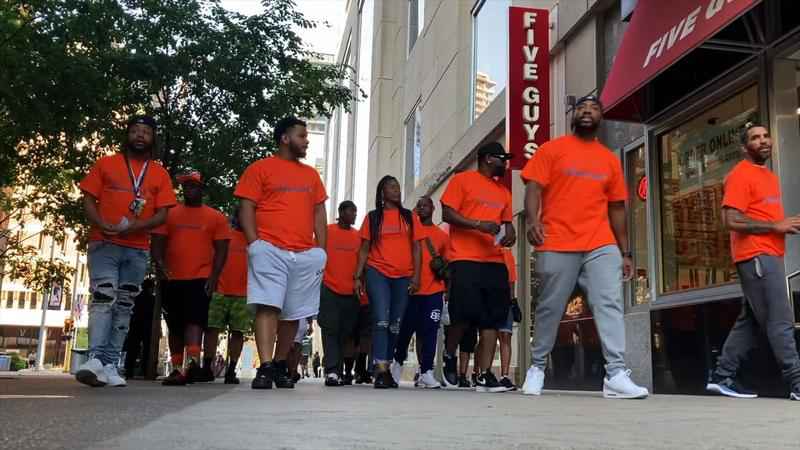
Photo: Alfredo Sosa/CSM.
Police officers at a headquarters briefing before departing on assignment in Columbus, Ohio, Nov. 24, 2024.
Columbus is learning to deal with protest marches differently. And with more success.

As a country, the US is not exactly on the cutting edge when it comes to handling large protests. As Clifford Stott, professor of social psychology at Keele University in England and visiting professor at Ohio State, says, “Policing of crowds in America is about 20 years behind what it is in Europe.”

This is in spite of the fact that an American, Gene Sharp, practically wrote the book on peaceful protests. (See my post, here.) We seem to have an issue of learning, unlearning, and relearning.

In January, Simon Montlake wrote at the Christian Science Monitor about how the police in Columbus, Ohio, have been handling pro-Palestinian protests.

“At a pro-Palestinian street protest in Columbus, Ohio, last fall, demonstrators march to the rhythm of liberation chants, punctuated by occasional horns from passing cars. ‘Free, free Palestine,’ they cry, waving flags and banners.

“But mingling among the demonstrators are four uniformed police officers wearing powder-blue police vests emblazoned with ‘Columbus Police Dialogue.’ One of them is Sgt. Steve Dyer, the team leader of a special unit that talks with protesters rather than confronting them with riot gear.

“ ‘Their goal is to have their voices heard,’ Sergeant Dyer says. ‘We will walk and work with those who are there to peacefully protest.’ By walking with and talking to protesters, police hope to build legitimacy – a bridge of communication that could deescalate potential conflicts.

“This kind of policing stems from a more nuanced understanding of crowd dynamics, researchers say. It seeks to measure how officers’ words and deeds can steer participants toward peaceful self-expression.

“It appears the approach is working. Since October 2023, there have been more than 50 pro-Palestinian demonstrations with a total of about 13,000 protesters in Columbus. During this time, police made only three arrests, despite ‘significant public order challenges.’ …

“[At a recent event] Jineen Musa, a student leader wearing round, tortoiseshell glasses and a black hoodie, is holding a bullhorn to her lips. ‘Don’t talk to any cops, even the dialogue cops!’ she says. …

” ‘Some have already talked with officers who have radioed the information to Sgt. Steve Dyer, the dialogue unit’s team leader at the steps of the Statehouse.

“He learns they plan to march north behind a black pickup truck as they protest on one of the city’s main roads. Now Sergeant Dyer can alert the nine-officer bicycle patrol that will help direct traffic during the demonstration. The cruisers will follow the protesters. At the same time, the dialogue team will continue to mingle among the crowd.

“There are only a few units in the United States specially trained for this type of policing. Columbus police try to ensure that marchers are able to exercise their rights to free speech and assembly. At the same time, they use engagement and dialogue with an aim to maintain peace and order. …

“ ‘It’s been more of a one-way conversation in the past,’ says Robert Sagle, a deputy chief of police in Columbus who oversees the dialogue team. … Police officers are now trying to do more than issue warnings. Staying on the ground and walking with and talking to protesters, police hope to build legitimacy – a bridge of communication that could de-escalate potential conflicts. …

“As word has spread of what Columbus is doing, the department has begun to train police officers from other cities in crowd management. Last July, its dialogue officers worked outside the Republican National Convention in Milwaukee to help facilitate order and defuse tensions during protests. …

“Columbus is a case study into these kinds of reforms. Still, the violent responses of its police department during the racial justice protests of 2020 still hover over it. …

“As in many U.S. cities, the Columbus police were unprepared for the intensity and duration of the protests that followed. It was a destabilizing experience to try to maintain peace and order, many say, in a crowd directing its anger precisely at them. …

“ ‘The intensity of what happened in 2020 was nothing like anything I experienced as a police officer before,’ says Sgt. Kolin Straub, a Black officer who worked the front lines.

“Still, police responded aggressively, using rubber bullets, pepper spray, tear gas, and other violent tactics against protesters. … In July 2020, over 30 people filed a federal lawsuit against Columbus police, seeking damages for unnecessary brutality and violations of their constitutional rights. In December 2021, Columbus settled the lawsuit, paying out $5.75 million in damages. …

“In June 2021, Mayor Andrew Ginther, a Democrat who had clashed publicly with police leadership over the need for reform, appointed Elaine Bryant, a Black deputy chief from Detroit, to head the department.”

Read what happened next at the Monitor, here.
Read Full Post »

Photo: Roberto Salomone/The Guardian.
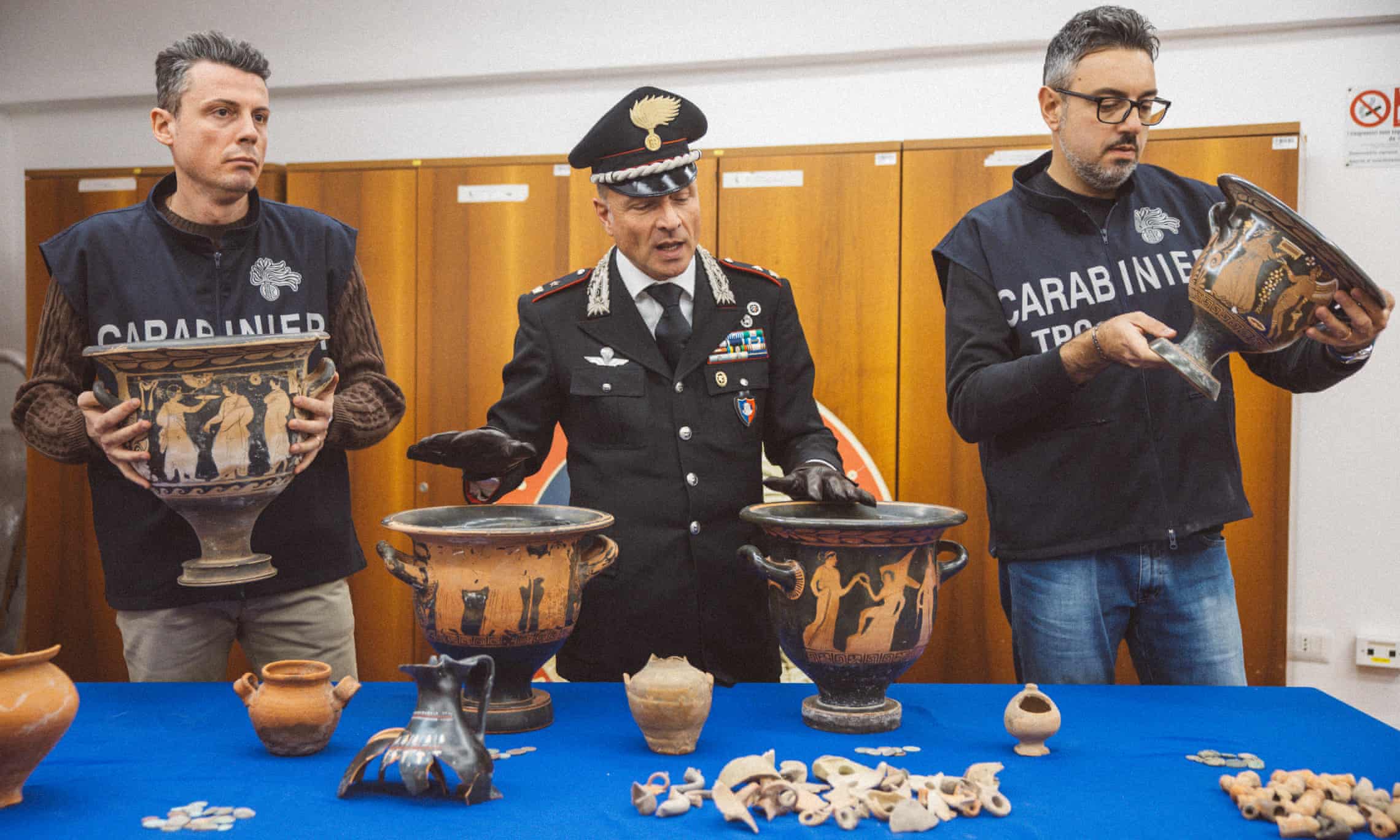
Italy’s Carabinieri cultural heritage protection squad at work. The force recently uncovered a clandestine dig in the middle of Naples
.

Every morning on the social network Mastodon, German archaeologist Nina Willburger (@ninawillburger) posts a beautiful, or at least curious, artifact from a dig. The history of archaeology suggests that not all of them were unearthed in legal ways, but they are in museums.

Nowadays there are strict laws around digging. Which is why Italy needs its cultural heritage protection squad.

At the Guardian, Angela Giuffrida wrote about the team’s latest success.

“Looking towards the semicircular apse with a frescoed image of a partially identifiable Christ on a throne staring back at them, the archaeologists crouching in the small space deep beneath a residential building in Naples were left speechless. They were amid the remains of an 11th-century church.

“The archaeologists, however, could not take the credit: the historic jewel, which had just been seized by police, was dug up by tombaroli, or tomb-raiders, illicit gangs who for decades have been plundering Italian cultural sites, in turn fueling the global market for stolen art and antiquities.

“Investigators believe the group’s leader was a local entrepreneur, currently under investigation, who owns two apartments in the building above. His cellar was turned into a well-organized excavation site, from where the tomb-raiders dug a warren of tunnels leading them about 8 metres [~26 feet] down into ancient Naples, where they unearthed medieval art. …

“But impressive though their workmanship was – they even installed concrete pillars to prevent the structure from collapsing – officers from the Naples unit of Italy’s Carabinieri cultural heritage protection squad unmasked the gang and confiscated the church after a covert investigation.

“The force also recovered 10,000 fragments of Roman and medieval pottery from the alleged gangmasters’ homes and 453 intact artifacts, including vases, terracotta lamps and coins. …

“The gangs commonly work by marking out clandestine excavation spots close to known archaeological sites, which in the Campania region surrounding Naples can include Pompeii, Herculaneum, Paestum or areas where there were Roman settlements. So uncovering a clandestine dig in the middle of the city took the specialist squad by surprise.

“ ‘When you think of Pompeii, for example, you know a dig can lead to a wealthy domus where prestigious objects can be found,’ says Massimo Esposito, the chief of the squad’s unit in Naples. ‘But it’s rare to find one in the heart of Naples.’

“The group’s alleged leader is believed to have had an inkling that there might be something beneath his home when construction works nearby on the city’s metro were interrupted and the site cordoned off after a small part of the remains of another, albeit less historically interesting, church emerged.

“The group worked for several months, carrying out their noisiest activity during the day, but not loud enough to attract complaints from the building’s residents. Little did the gang know that their comings and goings were being observed by Esposito’s team, with the squad staking out the building and wiretapping its alleged leader’s phone. Suspicions were especially aroused after seeing him carrying boxes filled with materials. …

“The Carabinieri’s cultural heritage protection squad was established in 1969 with the task of protecting Italy’s priceless cultural assets. Since then, more than 3m stolen artworks and relics have been retrieved, including those that ended up on display in some of the world’s biggest museums, such as the Getty in Los Angeles.

“Art and relics thieves in Campania especially thrived in the 1980s, taking advantage of a devastating earthquake at the beginning of that decade to ransack churches of paintings. The long-lost La Desposizione, a 2-metre high masterpiece painted by Angelo Solimena in 1664 depicting the crucifixion, was recently returned to Campania only after it was spotted on display in a museum in the Marche region. …

“Esposito met the Guardian in his unit’s office located in Castel Sant’Elmo, a medieval fortress overlooking Naples. He was surrounded by relics … including a wine amphora and a house-shaped sarcophagus believed to have contained the remains of a child, and various other funerary objects dating back to the fourth century AD. The artifacts are usually kept there pending the conclusion of judicial cases, before being either returned to their origin or entrusted to museums. …

“Data in recent years indicates a gradual decrease in crimes against cultural heritage. Laws for crimes against cultural heritage have been tightened, and work intensified to return stolen assets from abroad. … Use of social media, especially over the past decade, has also made it easier for the squad to identify thieves. A trove of funerary treasures, believed to have belonged to Etruscan princesses and illegally excavated from an underground tomb in Umbria, was retrieved in November after police came across a photo of the bungling thieves posing on Facebook as they attempted to sell it online.

“ ‘Despite the risk, there is sometimes this egotistical element: they want to boast about the beautiful items they’ve found,’ says Esposito.”

Check out the treasures at the Guardian, here. No paywall. Donations are important to the Guardian‘s journalism.

Read Full Post »

Photo: NYPD Dance Team via WYRK.
People of good will may disagree on whether recreation for stressed police officers is money well spent.

Controversy over the New York Police Department has broken out. But it’s not about the usual law enforcement complaints (that they’re not hard enough on crime; that they’re too hard). It’s about the dance team.

Maria Cramer has background at the New York Times, “Officer Lauren Pagán looked at the line of dancers in the overheated cafeteria at a Queens high school on a recent Monday night and frowned. They were gyrating through moves choreographed to ‘Mamacita,’ a pulsating, Reggaeton-inflected song by the Black Eyed Peas and Ozuna. …

“The seven-officer team has mastered hip-hop and salsa and is playing around with bachata and bhangra, the fast-paced, energetic movements drawn from the traditional folk dance of India’s Punjab region. The group is figuring out how to fold in step and pom, where dancers wave pompons while synchronizing their moves.

“But what they really need is recruits to fill out a robust, diverse roster of at least two dozen dancers who can travel and compete against other groups, ideally other officers (although they would be happy to dance off against paramedics and firefighters).

“The dance team, which was formed in 2022, is among about four dozen competitive groups within the department that include traditionally macho squads like N.Y.P.D. Paint Ball, the N.Y.P.D. Rugby Football Club and the N.Y.P.D. Pistol Team.

“Department employees have been branching out. There is a chess club, yoga is popular and there is interest in starting a reading group and even a knitting circle, said Inspector Mark Wachter, a commanding officer with the department’s health and wellness unit, which approves applications. Dance team members hope that more of their brothers in blue will find the rhythm within. …

“In September, on the department’s Fraternal Day, when all of the clubs sought recruits at the Police Academy, 33 people signed up to try out for the dance team, said [Officer Autumn-Raine Martinez, who works in crime analysis at the 108th Precinct and is the team’s president]. Three were men trying to sign up their daughters. …

“She suspects that men fear being mocked. The group’s original emblem — a teal silhouette of a lithe dancer mid-leap — did not help.

“ ‘They’re like fifth-graders,’ Officer Pagán said. ‘They saw a ballerina and they went, “Ew.” ‘ The team redesigned its emblem. …

“The groups’s schedule is intense, a tough sell for police officers who work long hours. The dancers rehearse twice a week for two hours. … They perform at parades, schools, neighborhood fairs and at halftime during games of other Police Department sports teams. The expectation is that members will make it to rehearsals and shows, Officer Pagán, 39, said. …

“Detective Jessica Gutierrez came to the practice at the school cafeteria while nursing a case of conjunctivitis. … Officer Martinez arrived after working 12 hours starting at 5 a.m. Sgt. Benely Santos was scheduled to work an overnight shift at the 111th Precinct after practice. …

“The women range in age — from 26 to 42 — and experience. Sergeant Santos was a novice when she joined. Officer Martinez, on the other hand, has been dancing since she was 4, but has been bedeviled by her height. As a girl, she tried out for the role of Nala in the Broadway cast of The Lion King, but was too tall to make the cut. Later, when she considered auditioning for the Rockettes as a teenager, she was unable to: At 5-foot-5, she was an inch shy of the minimum height requirement at the time.

“Officer Alyssa Blenk, 32, who danced competitively in high school and college, joined the team when she saw pictures of it on Instagram. Her desire to be part of a squad was especially strong following the stress she was feeling as a result of the pandemic and the protests that erupted in New York in 2020 after the police killing of George Floyd in Minneapolis.

“ ‘I need to do this,’ she thought when she saw the Instagram posts.”

More at the Times, here. People of good will may disagree on whether recreation for stressed police forces is money well spent. What do you think? All I can say is I’d rather not have tense, strung-out officers answering a call.

Read Full Post »

Photo: Getty Images via New York Post.
Helping recent migrants put a strain on overworked cops in Chicago.

There are no easy stories about migration. Although most people would rather make a good life at home if they could, many launch themselves into the unknown with a vague idea that someplace else will be safer. As a popular destination, however, the US has not been on top of things for a very long time.

In one example, described by Eric Cox and Ted Hesson at Reuters in May, our confused system left “Chicago’s new mayor [grappling] with how to house hundreds of migrants arriving on buses from the U.S.-Mexico border, with some sleeping in police stations and shelters strained after border crossings. …

“Officials in the third-largest U.S. city have said they cannot afford to rent hotel rooms for all arriving migrants and have pressed for more federal funding. Some migrants seeking a safe place to sleep have turned to police stations.

” ‘We’re waiting to see where they’re going to place us,’ said Tomas Orozco, a 55-year-old migrant who arrived at a Chicago shelter on Wednesday with his family after an arduous seven-week journey from his home country, Venezuela.

“The trip took them through the Darien Gap, an inhospitable jungle separating Colombia and Panama, and his family members were still sick from drinking contaminated water, Orozco said. …

“Earlier this month, Texas Governor Greg Abbott [resumed] a campaign of busing migrants to Democratic strongholds further north, including Chicago and New York City. The busing aims to alleviate pressure on border cities and call attention to what Abbott says were overly lenient policies by Biden’s [administration].

“On Thursday, Texas began busing migrants to Denver, where [Mayor] Michael Hancock is already struggling to house new arrivals.

“New York City Mayor Eric Adams … has called on the Biden administration to provide more funding to cities. Adams suspended some of New York’s right-to-shelter rules last week, citing the strain of housing asylum seekers, and is considering using school gyms as shelters.

“Chicago Mayor Brandon Johnson … reaffirmed the city’s commitment to welcoming asylum seekers in his inauguration speech, saying ‘there’s enough room for everyone.’ …

“Dean Wynne, who owns a Chicago building serving as a temporary shelter for nearly 200 migrants, said families were ‘subdued and quiet’ on the first day they arrived.

” ‘By the second day, I could see little kids were playing around, playing catch, kicking the ball and stuff,’ Wynne said. ‘They were just happy.’

More at Reuters, here.

A more recent article, from July, may be read at the Chicago Sun-Times, here. Said one migrant through a translator, “You can rest, but this isn’t life. … I’m happy to work because that’s my goal. Because I want to fight and learn each day a little more than what I knew.”

The immigrants I’ve worked with as a volunteer in ESL classes are often suspicious of police in their home countries. I imagine the Chicago experience is unsettling, but then, maybe not as unsettling as that dangerous trip.

Read Full Post »

Photo: KSTP.
Violence interrupters in Minneapolis (above) made 1,400 contacts with community members between May and November and successfully mediated 210 incidents that threatened to escalate into gun violence, according to a city official. Other interrupters may be elderly church members sitting in chairs at key locales.

In a recent opinion piece in the Washington Post, Louis King and Jerry McAfee write about “interrupters,” who work to stop gang violence. Louis King is president and chief executive of Summit Academy OIC in Minneapolis. Jerry McAfee is pastor of the city’s New Salem Missionary Baptist Church.

They write, “On May 28, Gloria Howard, an elder with Shiloh Temple, opened a lawn chair and sat down on one of the most dangerous street corners in North Minneapolis. Every day since, as part of the 21 Days of Peace community organizing project, she and others like her in our city have sat on street corners that are threatened by violence. Through the simple act of publicly taking a seat — staking their claim to a peaceful neighborhood by interrupting violence — they have undoubtedly saved lives.

“The campaign began after three children were shot in Minneapolis over a period of a few weeks this spring [and one]was critically injured.

“Tragic stories such as theirs are occurring in cities across the country, as alarm bells ring in city halls and state capitols about rising violent crime. The problem is due in large part to a loss of trust between communities and law enforcement; disinvestment in neighborhoods and schools where more help, not less, is needed; and decades of failure to keep guns off the streets. …

“Too many leaders are responding by adopting a Nixonian ‘tough on crime’ stance — which usually translates into over-policing and under-supporting these communities. That is a shortsighted non-solution — George Floyd’s murder beneath the knee of a police officer in Minneapolis last year can be traced directly back to policies that respond to crime by emboldening and insulating the police from the community rather than encouraging deeper engagement with the community.

Being a violence interrupter isn’t the only answer, but it is clearly helping in Minneapolis.

“In late May, we joined dozens of community members like Howard as churches and neighborhood associations mobilized in the effort called 21 Days of Peace — based on the idea that it would take at least three weeks for habits to start changing.

“Our group asked the Minneapolis Police Department to identify the most dangerous spots in our neighborhood, the 4th Precinct, and then we went there, pulled out our chairs and sat down. For the past three months, we have conferred daily with the precinct about the number of volunteers (two to 15, usually) and hours needed. We work in shifts, using a sign-up log online. In the winter, we’ll work on relationship-building with young people in the community.

“The precinct’s police inspector, Charlie Adams, tells us that since 21 Days of Peace began setting up in the Northside in ‘hot spots,’ the precinct ‘has seen a reduction in violent crimes in those areas.’ …

“The city’s overall violent-crime statistics have improved across the summer. In June, homicides in Minneapolis declined from June 2020, the first such drop this year. Then the same thing happened in July and August. …

“What makes this simple act of sitting apparently so powerful?

“The people sitting on these corners in their chairs are members of the community. We know our young people, and they know us. But more important, we represent one of the strongest bastions of moral authority left in these areas: the Black church. We draw on the power of congregation — of family, of friends and of community — to try to interrupt the violence.”

Read about other groups doing this work in other cities at the Post, here.

Read Full Post »

Photo: CNN
Eugene, Oregon, a town of 170,000, replaced some cops with medics and mental health workers. It’s worked for more than 30 years.

Often when society wants to find a better way of doing something, it’s possible to find a model with a track record showing what works and what doesn’t. Consider this non-police response to crises.

Scottie Andrew writes at CNN, “Around 30 years ago, a town in Oregon retrofitted an old van, staffed it with young medics and mental health counselors and sent them out to respond to the kinds of 911 calls that wouldn’t necessarily require police intervention.

“In the town of 172,000, they were the first responders for mental health crises, homelessness, substance abuse, threats of suicide — the problems for which there are no easy fixes. The problems that, in the hands of police, have often turned violent. Today, the program, called CAHOOTS, has three vans, more than double the number of staffers and the attention of a country in crisis.

CAHOOTS is already doing what police reform advocates say is necessary to fundamentally change the US criminal justice system — pass off some responsibilities to unarmed civilians.

“Cities much larger and more diverse than Eugene have asked CAHOOTS staff to help them build their own version of the program. CAHOOTS wouldn’t work everywhere, at least not in the form it exists in in Eugene. But it’s a template for what it’s like to live in a city with limited police.

“CAHOOTS comes from White Bird Clinic, a social services center that’s operated in Eugene since the late 1960s. It was the brainchild of some counterculture activists who’d felt the hole where a community health center should be. And in 1989, after 20 years of earning the community’s trust, CAHOOTS was created.

“It stands for Crisis Assistance Helping Out on the Streets and cheekily refers to the relationship between the community health center that started it and the Eugene Police Department. …

“Said David Zeiss, the program’s co-founder, ‘We knew that we were good at it, [and] we knew it was something of value to a lot of people … we needed to be known and used by other agencies that commonly encounter crisis situation.’

“It works this way: 911 dispatchers filter calls they receive — if they’re violent or criminal, they’re sent to police. If they’re within CAHOOTS’ purview, the van-bound staff will take the call. … It always paired one medic, usually a nurse or EMT, with a crisis responder trained in behavioral health. That holistic approach is core to its model. …

“White Bird’s counterculture roots ran deep — the clinic used to fundraise at Grateful Dead concerts in the West, where volunteer medics would treat Deadheads — so the pairing between police and the clinic wasn’t an immediately fruitful one. There was ‘mutual mistrust’ between them, said Zeiss. … ‘It was an obstacle we had to overcome.’

“And for the most part, both groups have: Eugene Police Chief Chris Skinner called theirs a ‘symbiotic relationship’ that better serves some residents of Eugene:  ‘When they show up, they have better success than police officers do.’ …

“Police encounters with the homeless often end in citations or arrests. Of homeless people with mental health conditions, anywhere from 62.0% to 90% of them will be arrested, per one journal review of homelessness studies. They may end up in jail, not in treatment or housing, and thus begins the cycle of incarceration that doesn’t benefit either party. …

“Most of CAHOOTS’ clients are homeless, and just under a third of them have severe mental illnesses. It’s a weight off the shoulders of police, Skinner said.

” ‘I believe it’s time for law enforcement to quit being a catch-base for everything our community and society needs,’ Skinner said. ‘We need to get law enforcement professionals back to doing the core mission of protecting communities and enforcing the law, and then match resources with other services like behavioral health.’ …

“June Fothergill, a pastor at a Springfield church, [calls] CAHOOTS to pick up the homeless people or people with substance use issues that stop by for free meals.

“Fothergill said while CAHOOTS does its part well — providing immediate services to someone in crisis — there’s still a void when it comes to long-term solutions.

” ‘You can call someone for the crisis, but what are they supposed to do for it?’ …

“They’re better equipped than police to care for the people she serves, she said. But if there isn’t space in affordable housing, Eugene’s detoxing center or mental health facilities, those clients will turn into regulars.’They’re doing what they can do,’ she said. ‘There’s wonderful work going on, but it isn’t adequate at the moment.’ …

“Advocates for limiting the role of police have pointed to Eugene as an example of social service providers and law enforcement working in harmony. But a growing group of dissenters feel there’s little room for police in the movement to fundamentally change the American criminal justice system. Services like CAHOOTS, they say, may function better and more broadly without the assistance of police. Zeiss isn’t sure he agrees.

” ‘Partnership with police has always been essential to our model,’ he said. ‘A CAHOOTS-like program without a close relationship with police would be very different from anything we’ve done. I don’t have a coherent vision of a society that has no police force.’ ”

More at CNN, here.

Read Full Post »

3466

Photo: The Guardian
What it looked like when a swarm of bees attacked a New York City hotdog stand.

As you know, I think New York City is an endlessly unspooling entertainment reel. This adventure with swarming bees is a typical example. Wish I had seen it. The police officer in charge must have been surprised to discover that a bit of obscure training would actually come in handy someday.

As Adam Gabbatt reported at the Guardian, “Productivity came to a halt across New York City offices on Tuesday afternoon, as hordes of people eagerly followed the removal of 20,000 bees from a hotdog stand. …

“Thousands watched a Reuters livestream – the stand is located outside the news agency’s New York headquarters – and followed on Twitter as a police officer was called in to remove the bees. With a vacuum cleaner. …

“Officers from the New York police department stood guard, some more willingly than others, as one of their colleagues donned a beekeeper’s hat and approached the hotdog stand.

“The bees had gathered in a densely packed, roughly 15-square-foot clump, and the unidentified officer, who wore a white jacket, thick gloves and has a moustache, proceeded to vacuum up the bees. The bee cleansing took about 40 minutes, much of which was watched online.

“By around 3 pm, the officer, who told journalists he ‘has training,’ had removed the bulk of the bees, but many remained in the area, swarming around a selection of soft drinks displayed on the hotdog stall. …

“Andrew Coté, who runs the New York City beekeepers’ association, had answered a call from the NYPD and was watching as the bees were removed. Removal by vacuum cleaner – it was a specially adapted vacuum cleaner – was common, Coté said. He estimated there were 20,000 bees on the umbrella, but said: ‘You’ve got to count the legs and divide by six to be sure.’

“Coté said … this late-August swarm had likely occurred because of an ill-managed beehive. He said there were a number of hives within a block of the hotdog stand.

“By 3.15 pm police had re-opened the street, although a number of bees were still on the scene.” More here.

You definitely have to know what you’re doing with bees. I’m sure a transplanted Minnesota beekeeper I know in Berlin, Massachusetts, would have managed his hives better if he had set up in a city. Beekeeping is serious business, and you don’t want to be responsible for anyone with an allergy getting stung.

Video: Reuters

Read Full Post »

Photo: Matt Nemeth for WESA, Pittsburgh’s NPR station
Former football player Baron Batch reinvented himself as a street artist.

I enjoyed this story from the sports radio show Only a Game about a former football player who became an accomplished street artist. Sarah Kovash reported.

“It wasn’t until after Baron Batch left the NFL that he attracted the attention of the Pittsburgh police department. … It was while riding his bike along one of Pittsburgh’s riverfront trails that he stopped to spray paint a message.

” ‘You know, I just got so comfortable with painting on things outside,’ Batch says. ‘Like, I just was riding my bike and just tagged the trail.’ He didn’t stop there.

” ‘I had this tag that said “all your scars are lovely” down by the wharf. That’s where I like ride my bike, and I always get off my bike there and stretch my ankle. I have no cartilage in my ankle. It’s just grinding bones. I deal with chronic pain every single day. So, at that spot, you know, I was riding one day and stretching. And that hit me. Like, all your scars are lovely.’ …

“Batch started his company, Studio AM, about a year after leaving the Steelers. Young Pittsburgh residents took notice and began sharing his work on social media. Batch relished the attention.

“He started doing what he calls ‘art drops,’ where he would leave one of his paintings in a public area and post its location on social media — free to the first person who could find it. …

“He turned his studio — located in the Pittsburgh-adjacent, Rust-Belt town of Homestead — into a brunch venue and gallery. On Sundays, visitors eat fruit-covered french toast and savory rice dishes while chatting with the artist. It’s not the same crowd you’d find at a Steelers tailgate.

“Last year, Batch was commissioned for a mural project. He created 20 pieces throughout the city, mostly on the sides of buildings. …

“As Batch spent more time on outdoor murals, he moved from the surfaces he had permission to paint to … some he didn’t. …

“He painted other colorful messages — some on a bridge and a parking lot. It never occurred to him that he was breaking the law. …

“Batch was creating some of the most inspired art of his career, but his project was quickly halted when the police showed up. …

“In all, police said Batch caused more than $16,000 worth of damage. They charged him with 30 counts of criminal mischief. …

“Batch had to pay $30,000 in fines and legal fees. But he says his arrest also led to a much needed discussion about public art.

“Part of that conversation was with the Friends of the Riverfront. That’s the group that manages the trail Batch graffitied. The group gave Batch permission to paint a section of the trail that’s lined with concrete barriers.”

And it turned out that the arresting officer, Detective Alphonso Sloan of the Pittsburgh police graffiti squad, had empathy for Batch. He told the ex-football player, ” ‘Hey, I admire your artwork. Even though some of it’s, you know, it’s illegal.’

” ‘[He] said “OK, I’m an artist, and you’re an artist. How about we get together sometime?” We worked on several projects.’ …

“Detective Sloan hopes Batch doesn’t test the city’s graffiti laws again.

” ‘[I’m] hoping it’s just a one-time thing because I hate to arrest someone … you get to work with them and you actually like them.’ ”

More at Only a Game, here.

Read Full Post »

Photo: Star Tribune
Police officers working to build a free-standing Little Free Library in Minneapolis as part of an initiative to encourage reading.

According to Libor Jany at the Star Tribune, some Minneapolis police officers are starting to engage with communities in a new way.

“In a partnership with Little Free Library, the department will turn a pair of its police cruisers into bookmobiles with the hope of teaching the importance of reading.

“Community policing officers will carry books while they are making their rounds on the city’s North and South sides. They’ll still respond to certain emergencies, but won’t be dispatched to calls for help, freeing them up to visit neighborhoods without libraries and give away books to anyone who wants them.

“The program is the first of its kind in the country, organizers say. …

“From a distance, the [Little Free Library] boxes could be mistaken for a birdhouse or an oversized mailbox. An unfinished dollhouse, even. But when they’re finished, officials say they’ll be stocked with dozens of all kinds books. People are encouraged to take a book or leave a book, without fear of overdue fines. …

“Police Chief Medaria Arradondo said in a statement that he was thrilled by the exercise in community building, ‘an incredible way to empower our youth and reach them in a positive way.’ …

“Little Free Library Executive Director Todd Bol started the book exchange in his hometown of Hudson, Wis., in 2009, building the first mini-library out of an old garage door in honor of his late mother. Today, there are more than 60,000 libraries in all 50 states and more than 80 countries around the world. In recent years, the little book boxes have sprung up in far-flung places like Australia and Qatar. …

“For now, available titles to be given away range from children’s books like ‘Camp Wildhog’ and ‘The Box Car Children: The Yellow House Mystery’ to more adult fare, including a well-thumbed unauthorized biography of Martha Stewart.” More.

Trust those Minnesotans to take a great concept a step farther!

A couple of my other posts on Little Free Libraries may be found here and here.

Read Full Post »

As in other cities nationwide, relations between communities and police are often tense in Boston, but here is a small effort that focuses on reducing arrests and getting help for people who are troubled.

Evan Allen writes at the Boston Globe, “When Officers Michael Sullivan and Jeff Driscoll and senior crisis clinician Ben Linsky head out on their beat in Mattapan, they seek out the most vulnerable citizens: the drug-addicted, the homeless, and the mentally ill. Theirs is the only unit of its kind in the city, and its mission since it was started in February is to help, not arrest, people [with problems]. It’s part of a broader effort in the Police Department to work with the community. …

“Sullivan, Driscoll, and Linsky, who make up Mattapan’s ‘Operation Helping Hands,’ spend two nights a week freed from dispatch calls. Instead, they get to know the people on the streets, figure out what services they need, and try to provide them.

“ ‘You’re one part social worker, one part cop, and one part older brother,’ Sullivan said. …

“The number that [Police Chief William] Evans is most proud of is arrests: for the past year and a half, officers have been locking up fewer and fewer people. The city saw a 15 percent reduction in 2015, followed by the 10 percent drop so far this year.

” ‘When I came on the job, you measured what kind of an officer someone was by quantitative statistics. How many arrests. How many moving violations. We don’t do that anymore,’ Evans said. ‘I think our officers get it: It’s not about throwing people behind bars, it’s about getting them services and opportunities.’

“Driscoll, a 39-year-old father of two, has been on the force for 10 years, all of them in Mattapan. Before that, he served for several years in Watertown. He and Sullivan, a 32-year-old father of a 2-year-old boy, who joined the force three years ago, both grew up in police families, wanting to be officers. When Mattapan Captain Haseeb Hosein decided to start Helping Hands, they were an easy choice.

“ ‘With everything that’s going on in this country, the biggest thing is trust and fear. So how do we break those two barriers down? I think we break it down by building relationships,’ Hosein said. ‘They’re really good guys who understand the environment that we’re in, that we need to go the extra mile.’ ” More.

Getting people services that really create lasting change would be ideal, but who can cavil with de-escalating potential blowups? Ensuring that you don’t make matters worse than they are already is surely an important step.

Photo: Jessica Rinaldi/Globe Staff
“Operation Helping Hands,” made up of two officers and a crisis clinician, is the only Boston Police unit of its kind.

Read Full Post »

Central Falls, Rhode Island, may be best known today for going bankrupt and forcing its police and fire unions to accept cuts to pension benefits, but it has more going for it than angst.

It has people who care, like Mike Ritz and chocolatier Andrew Shotts, who are selling Chocolateville chocolate bars to help children at risk.

It also has a charter school that has quietly improved children’s reading skills, spreading its success to public schools in the city.

Joe Nocera writes in the NY Times that before starting The Learning Community in Central Falls, Meg O’Leary and Sarah Friedman “spent three years working with the Providence school system on a pilot program designed to come up with ways to ‘transform teaching practices and improve outcomes.’ ”

In 2007, when Frances Gallo became the Central Falls Schools superintendent, she began to investigate why families were so excited about getting into The Learning Community.

“The school drew from the same population as the public schools. It had the same relatively large class sizes. It did not screen out students with learning disabilities. Yet the percentage of students who read at or above their grade level was significantly higher than the public school students. When Gallo asked O’Leary and Friedman if they would apply their methods to the public schools, they jumped at it.

“ ‘At first it was, “Oh, here comes another initiative,” ‘ recalls Friedman. There were plenty of venting sessions at the beginning, along with both resentment and resistance. But The Learning Community invited the teachers to visit its classrooms, where the public school teachers saw the same thing Gallo had seen. And very quickly they also began to see results.”

Read about how they do it here.

Read Full Post »

Not an appropriate quote, but I can’t keep it from coming into my head:
“Like the leaves of the forest when Summer is green,
“That host with their banners at sunset were seen:
“Like the leaves of the forest when Autumn hath blown,
“That host on the morrow lay withered and strown.”

Read Full Post »