Feeds:
Posts
Comments

Posts Tagged ‘postaday’

In honor of the Kentucky Derby last month, Karen Given reported a story on Only a Game about the naming of thoroughbred horses. At the end, the radio show’s host, Bill Littlefield, did a  funny imitation of calling a race. I won’t be able to do it justice. You’ll have to listen to the clip.

“Since 2004,” Given reports, “Rick Bailey has been the registrar for the Jockey Club, and he really enjoys the creativity he gets to witness in his job. Bailey and his staff review about 40,000 names every year and approve two-thirds to three-quarters of them. The numbers add up pretty quickly.

” ‘We do have 350,000 to 400,000 names that are considered active,’ Bailey says.

“With that many names off the table, maybe owners are just running out of normal horse names to choose from? …

“The list of available names is getting bigger, Bailey says, because the horse racing industry is getting smaller.

“There will never be another Secretariat or Seabiscuit. Those names have been permanently retired. But the names of less successful horses are eventually released. Bailey publishes those names on the Jockey Club’s website every year. This year, that list included more than 45,000 names. …

“The list includes Bambi le Bleu, Fabulous Rex, and Zippity Doodah Day. …

“Most ancient horses, says [Philip Sidnell, who has written the book on ancient warhorses], are named for pretty mundane reasons. Take the horses who ran in the ancient Roman chariot races.

” ‘They had names like “Swift” or another called “Snotty” and one called “Chatterbox.” ‘ “

Listen to Littlefield showcase some unusual horse names in the clip, here. “It’s Cookie Monster, Maple Syrup and Spineless Jellyfish  … Cookie Monster is hungry on the outside …”

 Photo: Only a Game

Read Full Post »

Members of a family separated for 77 years were recently reunited through the wonders of the Internet. Caitlin Gibson has the story at the Washington Post.

“The five women crowded together around the kitchen table in New Jersey, their eyes fixed on a laptop screen. It was 7 a.m., and none of them had slept well the night before; they were too anxious and excited for this moment. Jess Katz logged into Skype as her mother and three sisters watched.

“A face flickered into view: their cousin, the son of a long-missing uncle, the family they thought they had lost forever in the Holocaust.

“On the other side of the screen, on the other side of the world, Evgeny Belzhitsky sat with his daughter, his granddaughter and a translator in his home on Sakhalin Island, Russia.

The eight family members smiled at each other, speechless. Then, Katz recalls, they all started to cry. …

“More than 70 years had passed since Katz’s grandfather, Abram Belz, first tried to find his younger brother, Chaim. Abram last saw Chaim in 1939, the year their family was relocated along with thousands of other Polish Jews to the Piotrków Trybunalski ghetto at the start of World War II.

“The brothers died without seeing each other again, but on April 20 their families had been joyfully reunited. …

“ ‘My grandfather, because he was the oldest son, felt an obligation to stay,’ [Katz] says. ‘But it was important to their mom that Chaim try to escape.’

“With his mother’s help, Chaim slipped through a gap in the ghetto wall and fled across the border to the Soviet Union. The family knew he made it there, Katz says, because he sent letters and packages to his family. But then the letters and packages stopped coming. …

“In April, Katz — a tech-savvy 25-year-old who works for a software company in New York City and has blogged about her family’s Jewish roots — had extra time on her hands as she recovered from minor surgery at home. She decided to take up the search.

“After decades of tedious research and letter-writing, it took Katz two weeks to find Chaim’s son.

“It was a success born of an improbable alchemy: the serendipity of social media, the generosity of helpful strangers, and access to technology that allowed distant relatives to bridge thousands of miles, a 14-hour time difference and a language barrier.” Read the read the happy ending here.

Let’s hope that technology will also help the refugee families that are getting separated today. There is nothing in the world like the pull of family.

Photo: Jess Katz
The Katz and Belzhitsky families Skype together on Passover.

Read Full Post »

Although I didn’t get to see it in person, I was excited to learn from Timmons Roberts by way of Erik that the indigenous Hawaiian canoe Hōkūleʻa was making a stop in Rhode Island.

Lars Trodson writes at the Block Island Times, “The island welcomed the crew of the Polynesian catamaran Hōkūle‘a [June 21] at a ceremony held at the Block Island Maritime Center in New Harbor. The crew was greeted with songs sung by the students from the Block Island School, as well as greetings and tribal gifts from Loren Spears, an educator and former Council Member of the Narragansett Tribe of Rhode Island. Capt. Kalepa Baybayan of the Hōkūle‘a also offered brief remarks.

“The Hōkūle‘a is traveling around the world to teach about ocean conservation. ‘We live on a blue planet,’said capt. Baybayan. ‘Without the blue there would be no green.’ …

“Block Island is the Hōkūle‘a’s  only stop in Rhode Island.”

From the Hōkūleʻa website: “Our Polynesian voyaging canoes, Hōkūleʻa and Hikianalia, are traveling over 60,000 nautical miles around the earth, bringing people around the world together to set a course for a sustainable future.

“We are sailing like our ancestors have for a thousand years—using wayfinding. On board, there is no compass, sextant, or cellphone, watch, or GPS for direction. In wayfinding, the sun, moon, and stars are a map that surrounds the navigators. When clouds and storms make it impossible to see that map, wave patterns, currents, and animal behavior give a navigator directional clues to find tiny islands in the vast ocean. …

“Everyone can be the navigator our earth needs. Every person on earth can help navigate us to a healthy future where our Island Earth is safe and thriving again. …

“We are asking kids, families, governments, communities, and businesses to share how they mālama honua—take care of our Island Earth.  Please visit our Mālama Honua map, and help us grow the movement by adding stories of hope that can inspire and educate us all. …

“Hōkūleʻa, our Star of Gladness, began as a dream of reviving the legacy of exploration, courage, and ingenuity that brought the first Polynesians to the archipelago of Hawaiʻi. The canoes that brought the first Hawaiians to their island home had disappeared from earth. Cultural extinction felt dangerously close to many Hawaiians when artist Herb Kane dreamed of rebuilding a double-hulled sailing canoe similar to the ones that his ancestors sailed.

“Though more than 600 years had passed since the last of these canoes had been seen, this dream brought together people of diverse backgrounds and professions. Since she was first built and launched in the 1970s, Hōkūle’a continues to bring people together from all walks of life. She is more than a voyaging canoe—she represents the common desire shared by the people of Hawaii, the Pacific, and the World to protect our most cherished values and places from disappearing.”

Lots more at www-dot-hokulea-dot-com.

Photo: Block Island Times

Read Full Post »

I find so many more photo ops in summer than in winter, although that may mean I am not paying enough attention when it’s cold out. Surely there are great shadows everywhere.

Here are a few pictures from the last two weeks.

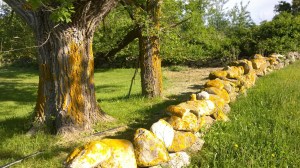
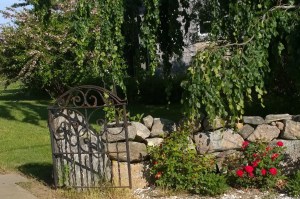
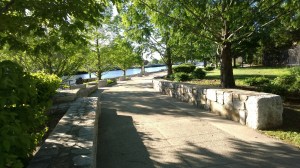
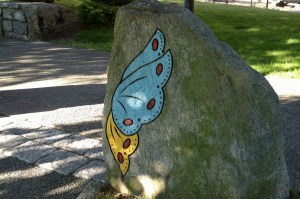
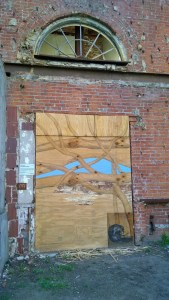
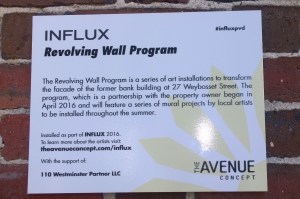
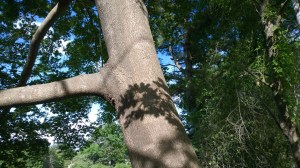
From New Shoreham: a field with Fresh Pond in the upper left corner, yellow lichen taking over a stone wall and trees, roses growing by a gate, children warming up in the dark sand. In Providence: a shady walk on the west side of the Providence River, a painted butterfly on the path, a swan preening, a distant view of the so-called Superman Building, public art with a muskrat fishing (?), a poster explaining the art project. In Massachusetts: shadows on a tree, a chipmunk on a lichen-covered rock.

061116-Fresh-Pond

061116-yellow-lichen


061116-stone-wall-roses

061216-warm-dark-sand


061416-riverwalk-Providence

061416-butterfly-art-Providence


0615`6-swan-Providence

061516-distant-Superman-bldg-Providence


061516-is-it-a-muskrat

061516-streetart-explanation


061016-shadow-on-tree-trunk

061616-chipmunk-and-lichen

Read Full Post »

MilfordStreet is on WordPress, and we’ve been clicking “like” on each other’s posts for a while. His Boston-area photography has been especially noteworthy.

Recently he announced he was leaving his job to teach for several months in El Salvador, after which he would get a master’s that he hoped would enable him to find work teaching English as a second language back in the States.

Wow. I’m so impressed.

Now he is creating blog posts about El Salvador. In “Too Young,” he writes about the school children he teaches who have to work in markets and restaurants to help support their desperately poor families.

The post from MilfordStreet referenced Humanium.org (an international child sponsorship NGO dedicated to stopping violations of children’s rights throughout the world), which called to mind a children’s rights movement in the United States.

Michael Schmidt in Communities & Banking magazine describes increasing efforts to ensure that proposed governmental and other policies don’t inadvertently harm children. He provides these elements of a child-rights impact assessment:

A description of the proposed policy; a description of how it is likely to impact children; an indication of whether it is consistent with the U.N. Convention on the Rights of the Child; identification of any disagreements over the likely impact on children; where adverse impacts are predicted, how they might be avoided or mitigated; an indication of the report’s limitations; parents’ and children’s views; a description of what the measure could have done instead and what needs to be monitored and evaluated after the decision has been implemented; explanations of conflicts (that is, where the interests of children conflict with the interests of others); an analysis of the proposed legislation or policy that weighs the costs and benefits associated with children’s well-being.

Check it out.

Photo: Milford Street

Read Full Post »

I  noticed the Eric Carle picture book Mister Seahorse at Suzanne and Erik’s house today, and it got me thinking about seahorses as fathers.

Did you know seahorse fathers carry the babies from conception to birth, not the mothers?

According to Wikipedia, “The male seahorse is equipped with a pouch on the ventral, or front-facing, side of the tail. When mating, the female seahorse deposits up to 1,500 eggs in the male’s pouch. The male carries the eggs for 9 to 45 days until the seahorses emerge fully developed, but very small. Once the young are released into the water, the male’s role is done and he offers no further care.”

It’s kind of the reverse of today’s devoted fathers. With no direct role in giving birth to babies, they sure do get involved in the daily care and feeding. Grandfathers, too. My husband babysits regularly, and can handle most anything, including diapers.

For more on seahorses, and how to protect them, check out the Sea Horse Trust, here. And if you’re up for a refresher on how increased carbon dioxide in the atmosphere is endangering sea creatures with spines, including the pygmy seahorse, reread my review of the climate-change movie Revolution, here.

Art: Eric Carle

Read Full Post »

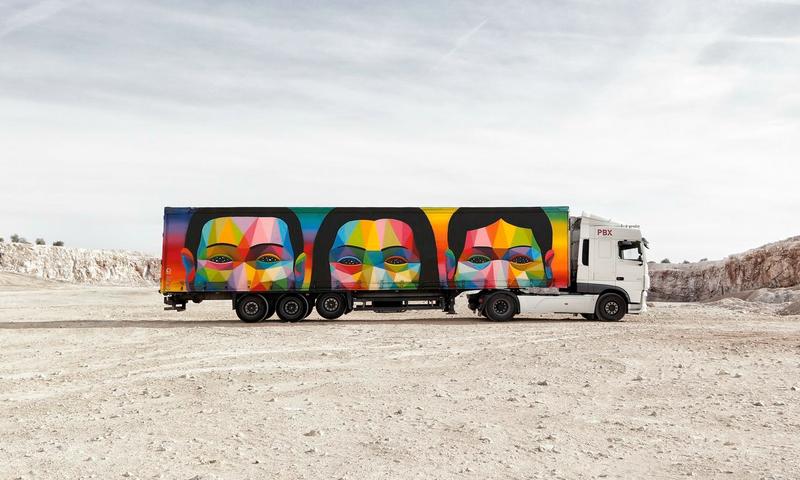
Street art is not just for stationary walls any more. According to Kate Essig at WNYC radio, some pretty amazing specimens are now on the move.

“Art in Spain got a sweet new set of wheels thanks to the Truck Art Project,” she writes. “In this collaboration between a transport company and the local art community,  street art takes the form of stunning mobile murals on  — you guessed it —  trucks.

“The project works with popular urban artists like Javier Arce, Suso33, and Marina Vargas to take their works off the wall and put them in motion. …

“The goal of the project is to make contemporary artwork accessible to all, even if it’s just a surprise sighting at a stoplight — so those in Spain who aren’t frequent gallery go-ers can still glimpse this art on the go.” An inspiring array of truck-art photos can be seen here.

And be sure to check out the project website, which reads in part, “Truck Art Project is an original art patronage project launched by the entrepreneur and collector Jaime Colsa, and curated by Fer Francés in contemporary art and Óscar Sanz in urban art. …

“The trucks working with the project will be the gigantic backdrops for the artworks. The initiative thereby becomes a living display of the most current tendencies in the country’s painting, drawing, and urban art (although the ambitious program intends to be even more multidisciplinary, involving other art forms such as photography, music, or cinema), away from the confines of a museum and aimed at non-traditional spectators and contexts that don’t usually lend themselves to contemporary art.”

Read Full Post »


On my walk this morning I saw an official-looking sign on a fence in a residential neighborhood. The sign read “Certified Wildlife Habitat.”

I had to look it up when I got home. The website of the National Wildlife Federation says, “Wildlife needs our help. … You can invite wildlife back to your own yard and neighborhood by planting a simple garden that provides habitat. …

“Providing a sustainable habitat for wildlife begins with your plants. That’s why we call it  a wildlife habitat ‘garden.’ When you plant the native plant species that wildlife depend on, you create habitat and begin to restore your local environment. Adding water sources, nesting boxes and other habitat features enhances the habitat value of your garden to wildlife. By choosing natural gardening practices, you make your yard a safe place for wildlife. …

“Here is what your wildlife garden should include:

“Food: Native plants provide nectar, seeds, nuts, fruits, berries, foliage, pollen and insects eaten by an exciting variety of wildlife. Feeders can supplement natural food sources.

“Water: All animals need water to survive and some need it for bathing or breeding as well.

“Cover: Wildlife needs places to find shelter from bad weather and places to hide from predators or stalk prey.

“Places to Raise Young: Wildlife needs resources to reproduce and keep their species going. Some species have totally different habitat needs in their juvenile phase than they do as adults.

“Sustainable Practices: How you manage your garden can have an effect on the health of the soil, air, water and habitat for native wildlife as well as the human community.

“Already have all these elements in your wildlife garden? Certify today!” And there’s a box to click on if you think you are ready.

Now I’m wondering if the chipmunk on our back steps today thinks our yard could qualify. It’s a small yard, so not much cover. And we’d need to provide water. Hmm.

More at the National Wildlife Federation, here.

Read Full Post »

I liked this story from the “People Making a Difference” series at the Christian Science Monitor. It’s about refugee musicians in Europe finding one another and bringing beauty and deeper understanding to their new countries.

Isabelle de Pommereau writes, “On a March evening in Berlin, bassist Raed Jazbeh and other musicians play the melancholic tones of ‘Sea Waves’ by Syrian composer MAias Alyamani. Mr. Alyamani wrote the song a decade ago after leaving his homeland, ‘to hold in my mind a piece from my country in my music.’

“Now, with hundreds of thousands of Syrian refugees flooding Germany, ‘Sea Waves’ takes on new meaning.

“Mr. Jazbeh himself fled Syria three years ago, as war tore it apart. So did many of the other musicians – also Syrians – performing ‘Sea Waves.’ Some had risked their lives and lost their instruments crossing Turkey and the Mediterranean Sea and then trekking into Europe.

“Jazbeh is the one who brought these musicians together. Last fall, he created the world’s first philharmonic orchestra of Syrian musicians in exile, reuniting the violinists and harpists, percussionists and trumpet players …

“The Syrian Expat Philharmonic Orchestra (SEPO) has been giving Syrians and Germans a chance to connect in a fresh way, around music. The ensemble is helping to shatter stereotypical images of refugees, instead offering a portrayal of them as hardworking, creative people who have much to contribute to society. …

“Jazbeh grew up in the city of Aleppo, in northern Syria, with music at the center of his life. … After he landed at a refugee center in Bremen, he played chamber music for friends and at community centers. [He also] began looking for friends from his days at the Damascus conservatory. ‘Facebook was so important,’ he notes.

“Gradually, he found them. In Italy. Sweden. The Netherlands. France. …

“In all, about 30 Syrian musicians came together for that first concert. ‘It was very emotional,’ Jazbeh remembers. …

“ ‘The music touched my heart,’ said concertgoer Abdulrhman Hamdan, fighting back tears. At home, in Damascus, he had had to stop his engineering studies. He arrived in Berlin last winter after a journey by foot, bus, and boat.

“ ‘It makes me feel sad and happy,’ he added. ‘On the one hand, the music [evoked the] war. On the other hand, it was hope that there is peace again.’ ”

Read how the concert changed the impressions of one German audience member here.

Photo: Isabelle de Pommereau
Raed Jazbeh, a Syrian refugee, had to play a borrowed instrument until an anonymous German donor sent him this double bass as a gift.

Read Full Post »

You never know what you will pick up from twitter. I started following Ferguson Library tweets after the death of Michael Brown. The library has wonderful tidbits about books, among other topics.

A tweeted tidbit on the antiquity of fairy tales is from Science magazine.

David Shultz writes, “A new study, which treats these fables like an evolving species, finds that some may have originated as long as 6000 years ago.

“The basis for the new study, published in Royal Society Open Science, is a massive online repository of more than 2000 distinct tales from different Indo-European cultures known as the Aarne–Thompson–Uther Index, which was compiled in 2004. Although not all researchers agree on the specifics, all modern Indo-European cultures (encompassing all of Europe and much of Asia) descended from the Proto-Indo-European people who lived during the Neolithic Period (10,200 B.C.E.–2000 B.C.E.) in Eastern Europe. Much of the world’s modern language is thought to have evolved from them.

“To conduct the study, Jamshid Tehrani, an anthropologist at Durham University in the United Kingdom, and colleagues scanned the repository. They limited their analysis to tales that contained magic and supernatural elements because this category contained nearly all the famous tales people are familiar with. This narrowed the sample size to 275 stories, including classics such as Hansel and Gretel and Beauty and the Beast. …

“Tehrani says that the successful fairy tales may persist because they’re ‘minimally counterintuitive narratives.’ That means they all contain some cognitively dissonant elements—like fantastic creatures or magic—but are mostly easy to comprehend.

“Beauty and the Beast, for example contains a man who has been magically transformed into a hideous creature, but it also tells a simple story about family, romance, and not judging people based on appearance. The fantasy makes these tales stand out, but the ordinary elements make them easy to understand and remember. This combination of strange, but not too strange, Tehrani says, may be the key to their persistence across millennia.”

More.

(from a Ferguson Library tweet)

An illustration of Beauty and the Beast from 1913.

Read Full Post »

Laura Bliss at the Atlantic‘s City Lab has a story on young people you may have seen performing in a New York subway car. She reports that in the film We Live This, the teens’ hopes seem hemmed in by poverty.

“ ‘Showtime’ dancing is a hallmark of the New York City transit scene,” writes Bliss. “Hoping for donations, crews of young black and Latino men perform exuberant choreographies for subway passengers, twisting and leaping from pole to pole with artful ‘lite-feet‘ dancing in between—and never before shouting, ‘It’s showtime!’

“Who are these dancers scraping by on their earnings? A new, short cinéma vérité documentary, We Live This, shines a light on the world of one crew, whose four young members perform on the J train. They are talented, hardworking, committed, and full of dreams, the film shows. But for some, the obstacles are high, and the alternatives slim. …

“Forty, is homeless.

‘As I’m dancing on the train, I’m thinking about where am I sleeping at night,’ he says. ‘Who should I call? Who is going to pick up? What if they don’t answer?’

“Showtime is the best way he he knows to a better life, a way into a community, he says. …

“Of course, the subway is no simple launchpad to success. While some passengers love the dancing, many others avoid eye contact, and some even yell at crews to switch cars. …

“ ‘I hope people will watch this and look at these young men as human beings,’ the film’s director, James Burns, tells CityLab. ‘And see the last vestiges of a culture that may be dying out.’ ”

More.

WE LIVE THIS – OFFICIAL TRAILER from HAYDEN 5 on Vimeo.

Read Full Post »

Here’s a creative way to address the urgent need for housing in this country: make a deal with Canada to take the houses it doesn’t want anymore.

Kirk Johnson has the story at the NY Times.

“In the San Juan Islands of northwest Washington State, where a severe shortage of affordable housing threatens the economy and the community, a small nonprofit group has found an unlikely way to help anchor families that are struggling to stay — by lifting up unloved houses in Canada, hoisting them onto barges and hauling them to where they are needed. …

“The structures had what builders call good bones, and the group, the San Juan Community HomeTrust, discovered that the cost of transporting them across the Haro Strait from Canada and restoring them here was comparable to the cost of building from scratch. …

“The number of people living in poverty in the county has risen about 17 percent since the end of the recession in 2009, according to census figures, even as the economic recovery in Washington and around the nation gained steam.

“ ‘It’s kind life or death to keep our working families here,’ said Peter Kilpatrick, the project manager in refitting the houses to be imported by the San Juan Community HomeTrust. When the rewiring, painting and structural repairs are finished in June, buyers who have already met income and residency requirements can take possession.

“Through a combination of donated land, government and foundation grants and local fund-raising, the homes will cost the buyers — a hospital worker, several teachers and a massage therapist among them — from $160,000 to $210,000. The median market price here was almost $500,000 at the end of last year.” More here.

Nothing like a little recycling ingenuity applied to a problem! In fact, I was just commenting to a blogger who’s teaching in El Salvador that the locals’ skill at repairing and reusing items is a great foundation for creative problem solving in general. (Please read Milford Street’s report from El Salvador, here.)

Photo: Nancy DeVaux
Houses from Canada were transported by barge to the San Juan Islands in Washington State, where affordable housing is badly needed.

Read Full Post »

Providence has to be the New England capital of playful graffiti. After PVD Fest a week ago, I caught three new bits of cheerful vandalism around town — new to me anyway.

Pasted on a wall near my office was a duck in a suit, which a younger friend informs me should be understood as “ducktales” because the suit has tails.

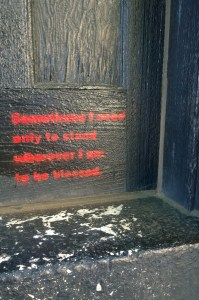
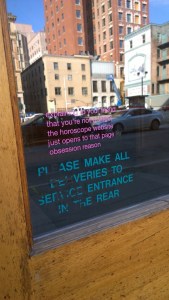
I especially love graffiti sayings, like the one about being blessed where you stand and the one about explaining to a friend that you are not a Virgo.

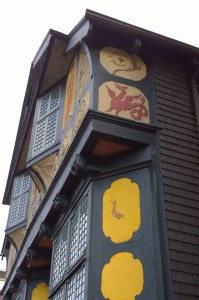
Artistic adventurism is not new for Providence. Take a look at the exotic Fleur-de-lis Studio, for example, on Angell Street.

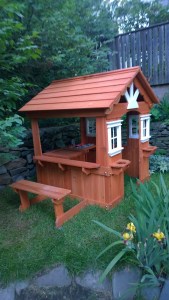
In other Rhode Island photos, we have the playhouse that Farmor gave her Providence grandchildren. Erik put it together, with help from Suzanne and the kids. The 18-month-old now thinks she’s in charge of screwdrivers.

The picture of berries has a robin eating them. You may have to take my word on that. And if you walk around looking up all the time, you’re sure to see interesting tops of buildings.

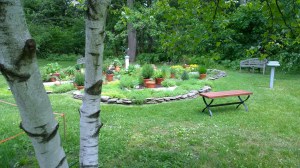
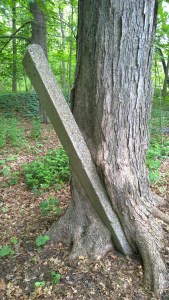
I’m winding up this photographic array in Massachusetts, with the herb garden behind the church, the sexton’s bonsai trees, and another tree that reminds me of a line from a hymn: “roots, hold me close.”

060616-ducktales-Provience

060716-a-blessing-where-I-stand.


060716-I-am-not-vrigo

060616-fleur-de-lys-studio.


060816-adorable-playhouse

060816-robin-and-berries


060816-enjoy-Prov-by-looking-up.

060916-Doug-Baker-bonsai


060916-1st-Parish-herb-garden

060916-roots-hold-me-close

Read Full Post »

I’ve often wondered if a pay-what-you-want model could work for all the parties involved. I know Panera tested an approach that allowed well-wishers to pay for food that someone else couldn’t afford, but I believe that they eventually closed it down.

Another approach was covered in a recent Providence Journal article.

John Kostrzewa wrote, “Customers are always questioning the price — and they’re not the only ones.

“Stephen Atlas, an assistant professor of marketing at the University of Rhode Island, has been trying to find some answers. Atlas, who has a background in economics and a doctorate in marketing from Columbia, has been doing experiments in a local restaurant to learn what people will pay.

“He’s trying to advance existing studies of the ‘Pay What You Want’ model deployed in some urban areas, where customers decide on the price of a good or service. …

“Atlas has added a new twist to the research by asking what would happen if a vendor used a different strategy called ‘Rebate What You Want’ that would allow customers to get back what they have already paid. …

“The test worked this way: At the end of a meal, 231 randomly selected diners were given a card with one of three payment options, which differed from table to table.

“The options on the cards were: They could pay any portion of the menu price. They could agree to pay the posted price but request a full or partial rebate immediately. Or they could pay full price and later mail in a rebate form to get back up to a full refund. (The URI grant helped pay for the rebates.) One set of diners also received a regular bill with no card as a control for the test.

“The results showed the payment options did affect how much diners wanted to pay for their meal. The diners paid the most up front if they picked the option to mail in the rebate later. They paid less up front if they picked their own price directly. And they paid the least when they picked their own instant rebate. …

” ‘The most surprising outcome was how much diners paid across all the options despite being told when they received their bill that they could have received a free meal,’ Atlas said. Including the tip, ‘diners in all the pay-what-you-want conditions paid more than the asking price.’ ”

More here.

Photo: The Atlantic

Read Full Post »

Tim is an architect and WordPress blogger who is concerned with, among other things, how real communities develop organically. He has a strong sense that creating places top-down should not be regarded as sustainable place making.

Being a bit of a contrarian, I’d love to think of a contrary example, but so far I can’t.

Here Tim takes off on a planned community in his neck of the Florida woods.

“The problem with the Love Street / Jupiter Inlet Village project is that nobody will live there. … The planners, architects and developer of the project say the project is all about real place making.  Fortunately, we have a large amount of accepted research and knowledgeable writing on the subject of place making dating back over 40 years …

“First, 2 things need to be clear about place making – 1) It is a human phenomenon that is, therefore, very personal, varying, and not measurable; 2) ‘Real’ place making happens anywhere, and anytime there are humans present. …

“Wasteful land use in the form of a high percentage of non-places is the critical flaw with all drive-to places that claim to be urban or have high quality place making at their core. They simply do not, and they perpetuate the car-centric development pattern that exacerbates quality-of-life negatives in South Florida – traffic, loss of identity, and the replacement of real places with faux places.

“For Love Street / Jupiter Inlet Village to become the real place in claims it will be, it should do the following:

  1. Embrace the residential patterns that are still in the area, and were once far more prominent, and include residential units of a similar urban village quality.
  2. All parking should be metered, and of the on-street variety, and the parking lot should be replaced with a public green.
  3. Retail, commercial, and office space should be geared toward neighborhood uses, with the goal of replacing vehicle trips with bicycle or pedestrian trips to a very high degree.
  4. The lighthouse promenade must actually align with the lighthouse, and, thereby, solidify a framed street scape view of this landmark in perpetuity for all to share in. The promenade is presently a few degrees off, and focuses on a point well east of the lighthouse.

“Development and redevelopment projects are not inherently bad things, in fact, many developments create great pedestrian and transit oriented places that foster living, working and playing within a tight-knit community. However, developments that pretended to be great place makers, and really are not, represent a continuation of the very harmful growth patterns of the last half-century in disguise.

“Jupiter Inlet Village can be a great place, and an asset to the community, but it will not get there by pretending to be something that it is not.” More at Tim’s WordPress blog, here.

Map: https://www.jupiter.fl.us/index.aspx?NID=884

Read Full Post »

« Newer Posts - Older Posts »