Feeds:
Posts
Comments

Posts Tagged ‘preservation’

Art: NC Wyeth.
N.C. Wyeth’s “Apotheosis of the Family,” which hung behind the tellers in the downtown Wilmington Savings Fund Society for three quarters of a century, has been readied for public viewing at the artist’s grandson’s home in Wilmington, Delaware.

I have always loved the monumental paintings of NC Wyeth. Today we learn about his largest mural, which was created during the Depression and is getting a new lease on life.

Ralph Blumenthal writes at the New York Times, “As the Great Depression savaged America, a bank in Wilmington, Del., commissioned the protean illustrator N.C. Wyeth to soothe anxious customers with an epic tribute to the bounteous land and its laboring families.

“Known more by his initials than his given name, Newell Convers, he had long been a towering figure in American art, embellishing classics like Treasure Island. … Wyeth’s mural, in oil in five panels, came in at 60 feet long and 19 feet high — his biggest and one of the largest ever created for a public space in the United States. For three quarters of a century, it hung behind the tellers in the downtown Wilmington Savings Fund Society, inspiring visions of thrift and industry. And then it came down and disappeared.

“Now it has re-emerged in a gleaming new round barn on N.C.’s grandson Jamie Wyeth’s Point Lookout Farm outside Wilmington and near the Wyeth studios in Chadds Ford, Pa. …

“The 1932 work, ‘Apotheosis of the Family,” aims to welcome visitors by jitney from the nearby Brandywine Museum of Art [soon].

“N.C. Wyeth is enjoying a renaissance of sorts. His work will be included in the filmmaker George Lucas’s new Museum of Narrative Art, scheduled to open next year in Los Angeles. Five years ago, Wyeth had a retrospective at the Taft Museum of Art in Cincinnati, an exhibition that cited his influence on cinema. …

“In ‘Apotheosis,’ which celebrates the pinnacle of family, Wyeth … looms bare-chested dead center as a kind of superman, beside his wife, Carol, amid vignettes of harvesting, fishing, weaving and timbering as the seasons change. Pan plays the pipes, smoke boils from a campfire, and ships with billowing sails race for a distant shore. The foreground sprouts strange flowers hardly seen in nature.

“Prominent among other family models is Wyeth’s flaxen-haired son, Andrew, then 15 — destined to eclipse the rest of the famous art clan with his starkly realistic landscapes and portraits — drawing a bow and arrow and nude but for a modest blurry G-string. Next to him stands his sister Carolyn as a toddler, although she was actually eight years older. …

‘The work enshrines two of N.C.’s core beliefs — ‘love of family and the importance of land’ — at a terrible time when such values were especially precious. …

“After periodic restorations, most recently in 1998, the painting was pried off the wall and damagingly rolled up 10 years later when the bank was sold for conversion into apartments.

“The mural went to the Delaware Historical Society, which couldn’t place it. It was then bequeathed to the Wyeth Foundation for conservation, with Jamie, now 79, committing about $1 million for its reinstallation in a new round barn on his 250-acre Brandywine farm.

“Jamie is the widower of Phyllis Mills Wyeth, a philanthropist and socialite racehorse breeder. … As a tribute to his wife after her death at 78 in 2019, Jamie opened the pastures as a lifetime sanctuary for former racehorses. It also became a refuge for the nearly-century-old artwork. …

“ ‘I adore my grandfather’s work,’ he said. ‘He had more influence on me than my father.’ …

“Jamie, who was born the year after N.C. was killed in a bizarre train collision in 1945, recalled visits to his grandfather’s painting studio crammed with old muskets and cutlasses for his illustrations. …

“The story of the mural’s resurrection has many beginnings, but let’s start with the Wyeth patriarch: N.C., a descendant of early English colonists and maternal grandparents from Switzerland, who settled in Needham, Mass., where he was born in 1882. His father wanted him to go into farming but he was strongly drawn to art, winning acceptance as a star protégé of the pre-eminent illustrator Howard Pyle.”

Lots more at the Times, here. You will love how the Times animated restoration visuals by Caroline Gutman.

Read Full Post »

Photo: @risdmuseum on Instagram.
Conservator Ingrid Neuman (left) with Rhode Island School of Design undergrad student Sophie Bugat, doing repair work on a statue of Pan.

When a new artwork is acquired by a museum, it doesn’t go right on display. At least one expert must look it over and make sure it’s in good shape.

At the Rhode Island School of Design [RISD ] in Providence that expert is often Ingrid Neuman.

Kristine Yang writes at the Providence Eye, “This past November, Ingrid Neuman, senior conservator at the RISD Museum, wheeled a twelfth-century Japanese wooden Bodhisattva Avalokiteshvara into Hasbro Children’s Hospital for a CAT scan. Conservators have repaired the ancient figure, a revered Buddhist symbol, over centuries — Neuman’s examination would reveal exactly where and how they had carried out those repairs. …

“Over time, sculptures accumulate dirt and often chip, show wear, or even break. Some arrive with broken parts or past repair attempts that complicate restoration. Preparing these pieces for public exhibition falls to the museum’s conservation team.

“Through a meticulous process that integrates chemistry, art history, and craftsmanship, conservators work to stabilize and restore each object. … Neuman’s background in organic chemistry is essential to her work. Sculptures are vulnerable to a host of natural forces over time such as ultraviolet radiation, pollution, humidity, and fluctuations in temperature – all of which can degrade original materials. Pieces with organic materials like wood and ivory, along with metals such as bronze or iron, are particularly prone to these ‘agents of deterioration’ and can experience accelerated degradation if not properly maintained, says Neuman.

‘An ancient bronze beaker from China wants to corrode. It wants to go back to its original copper ore,’ says Neuman. ‘We’re trying to keep it from doing that.’

“Corrosion is a natural chemical reaction that occurs when metals like bronze are exposed to oxygen, moisture, or pollutants over time. This reaction, called oxidation, causes the metal to slowly break down. Left unchecked, this chemical process can eat away at the surface of a sculpture. …

” ‘We borrow a lot of techniques from dentists and doctors,’ says Neuman. ‘There’s a lot of overlap with the medical field.’ With limited in-house instrumentation at the RISD Museum, Neuman often relies on nearby hospitals such as Hasbro’s and research institutions for specialized evaluations.

“Understanding a sculpture’s composition and preservation history is crucial, as it directly informs the selection of repair materials. … Conservators intentionally choose repair materials that are visually similar to the original but chemically distinct, ensuring that their work can be easily differentiated from the artist’s upon chemical evaluation.

“ ‘We don’t like to use the same materials as the artist,’ Neuman says. ‘We’re not trying to be the artist, or be better than the artist, or confuse people.’ 

“The ease with which any added materials can be removed is also a crucial consideration for conservators, as they must ensure that any restoration work can be undone without damaging the original piece. …

“For this reason, conservators use inpainting – a technique used to fill in missing parts of an artwork – with materials that can be easily distinguished and removed. For example, Neuman says conservators often use acrylic paint when filling in an oil painting. Acrylic is water-based and chemically different from oil paint, allowing it to be safely removed. …

“Neuman emphasizes the importance of reversibility and the chemical properties of adhesives. ‘There’s so many glues in the world. A zillion,’ she says. ‘Everyone uses epoxy or Gorilla Glue, but we never use them because they’re too strong.’

“If conservators use a glue that is stronger than the sculpture’s original material, any physical stress on the object could result in new fractures, rather than breaking along existing lines. … She prepares her own adhesives in the lab, including wheat starch paste and Funori, a traditional Japanese adhesive made from seaweed — both of which are gentle yet effective enough for conservation work.

“While conservators intentionally make their repairs distinguishable from the original through their selection of materials, their work must remain invisible to the viewer. … This means conservators must address each deformity with painstaking precision and care. Inpainting demands an especially detailed approach. … Neuman says, ‘You have to use a very tiny brush, with only a few hairs in it, and you have to be really good at color matching.’

“One of the challenges of inpainting is a color perception phenomenon called metamerism, where colors that match under one light source may look different under another. … To navigate this, she moves the piece back and forth on wheeled carts between her sunlit lab and the gallery space to ensure the colors match under different lighting conditions.

“Once the restoration is complete, detailed documentation is essential, Neuman says. Photographs of the piece before, during, and after the process, along with written records, are uploaded to the museum’s database for future conservators’ reference. ‘It’s important to leave a record,’ Neuman says.”

More at the Providence Eye, here. This story reminds me of the work that Sotheby’s did on one of my mother’s Pousette-Dart paintings, one that had been too close to a chimney fire!

Read Full Post »

Photo: The Japanese Food Lab.
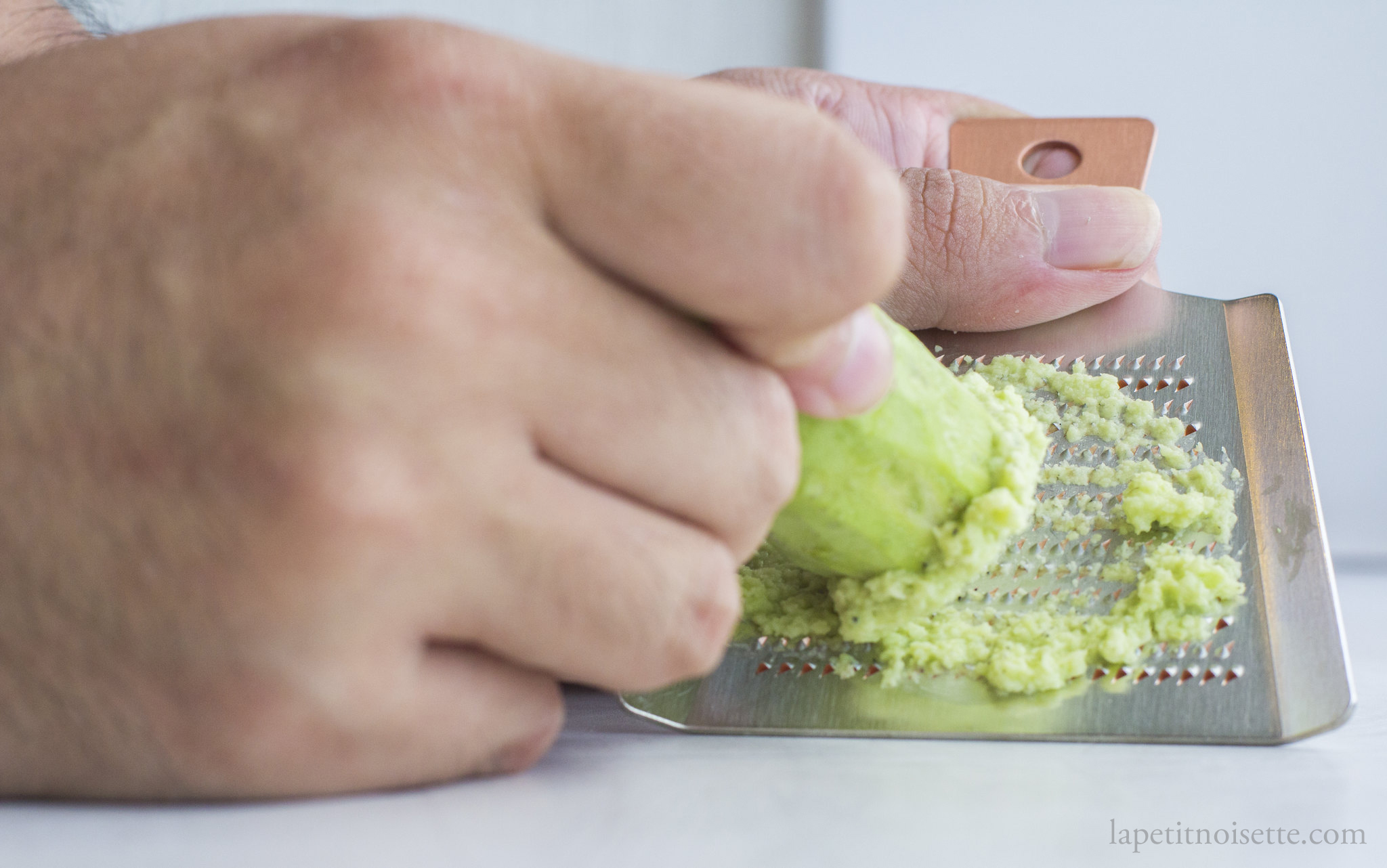
Grating a wasabi root. The fumes from this horseradish relative have been found to kill fungus on papyrus.

I love stories of great discoveries made by accident, but was the discovery in today’s post made by accident? I haven’t succeeded in finding out. Perhaps it was just a matter of understanding how chemicals work, as in the case of the Bryn Mawr professor who wrote that a pinch of salt improves a cup of tea. (Read about that tempest in a teapot here.)

Verity Babbs writes at Artnet, “A new study reveals that Japanese horseradish isn’t just good as a sinus-clearing part of a plate of sushi, but is also effective in art conservation.

“Wasabi vapors have been found to effectively treat fungal infections on both painted and unpainted samples of mock ancient Egyptian papyrus, and to do so without impacting the papyrus’ delicate chemicals or painted pigments.

“A study led by Hanadi Saada of the Conservation Center of the Grand Egyptian Museum and published in March’s volume of the Journal of Archaeological Science shares the results of treating fungally infected replicas of ancient papyri with wasabi.

“To create accurate replicas for the study, the team heated modern papyri (painted with accurately replicated ancient pigments) to 212°F for 120 days, mimicking a 1,000-year aging process. They then exposed the replicas to fungal species and treated them with vapors from wasabi left on nearby aluminum foil after three days.

“Exposure to the wasabi vapors was found to completely eradicate microbial growth and increase the sample papyri’s strength by 26 percent. The treatment only negligibly impacted the chemical makeup of the pigments used, and no noticeable change was observed in the color of both painted and unpainted samples of papyri.

“Papyrus — made from the stems of the plant Cyperus papyrus — was used in the ancient world for baskets, sails, and boat-making in addition to being a popular writing material. …

“Famous papyri include the Ebers Papyrus, which documents ancient Egyptian medical practices and is considered the world’s best-preserved and most extensive example. Dating to around 1550 B.C.E., it is kept at the Leipzig University Library in Germany. …

“Native to Japan as well as Korea and the far east of Russia, wasabi is a popular condiment, made from the plant Wasabia japonica, which is similar to the horseradish.

“This new conservation solution is a much greener and safer treatment than disinfectants previously used, which were known to harm the artifacts, possibly as badly as the fungus itself. Further research will be carried out to test the efficacy of wasabi for treating fungal infections on other organic, textile, and paper artifacts. The Grand Egyptian Museum in Giza plans to use the wasabi treatment for future preservation.  The study concluded that ‘Wasabi can be considered a safety biocide for controlling biodegradation of archaeological painted papyri.’ ”

More at Artnet, here.

Read Full Post »

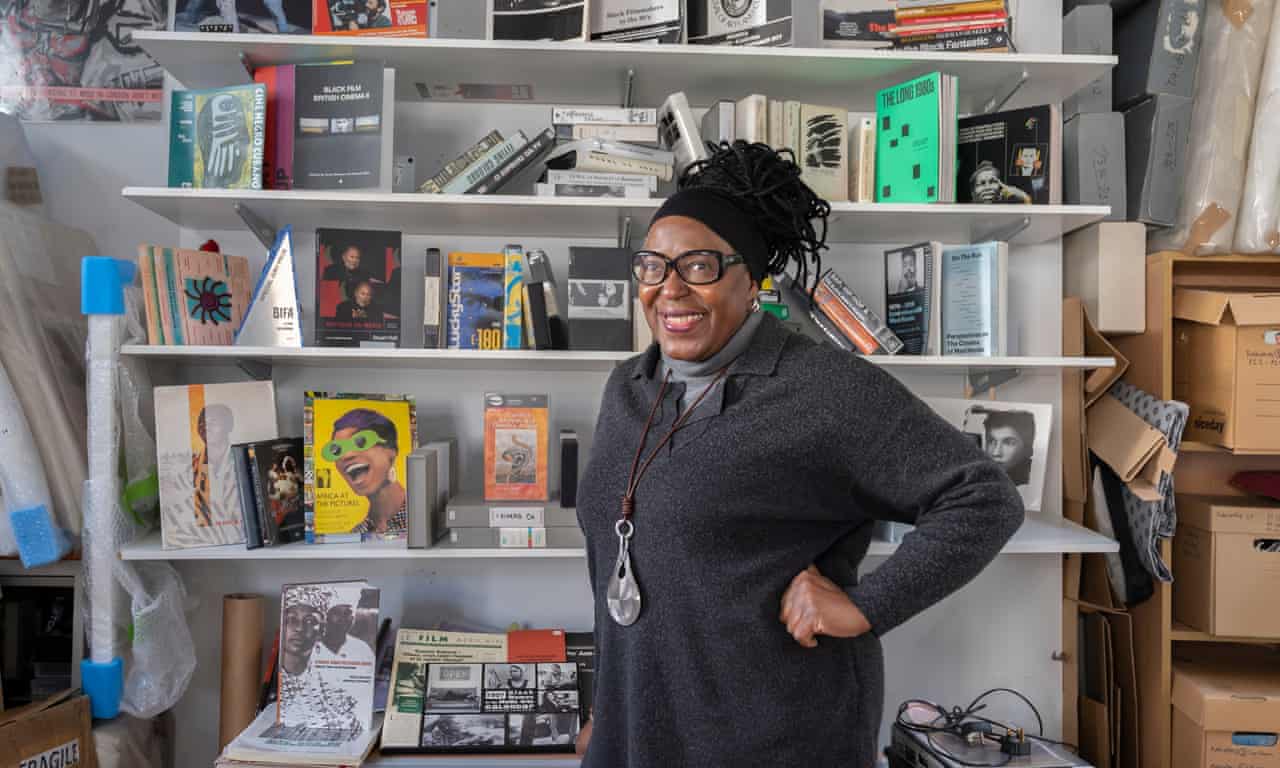
Photo: Amaal Said/JGPACA [June Givanni Pan African Cinema Archive].
From a Mogadishu film week
poster to VHS videos of pioneering art movies, June Givanni has collected a range of Black film artifacts and is now ready to share.

Sometimes people whose childhood struggles involve race-based discrimination grow up to embrace and trumpet the beauty of their heritage. I enjoy stories like that.

At the Guardian, Leila Latif interviews one such person, the founder of June Givanni Pan African Cinema Archive.

Discussing her recent exhibition, “PerAnkh: The June Givanni Pan African Cinema Archive,” Givanni played down the show’s title. Says Latif, “The Black British film curator, activist and archivist who created it is hesitant about positioning herself front and center.

“ ‘I don’t want it to sound like it’s all me, me, me,’ she worries. ‘My name is part of it because I worked as a curator for many years and collected work throughout the non-digital era, which developed into this archive.’

“Though she wants the films, documents, artworks and objects she has preserved to be the focus of people’s attention – from an installation of the earliest audiovisual works by the Black Audio Film Collective to new works by the Chimurenga collective from South Africa – Givanni is more than worthy of the spotlight. When she received the British independent film awards’ grand jury prize in 2021, the organizers said that she had ‘made an extraordinary, selfless and lifelong contribution to documenting a pivotal period of film history.’

Born in British Guiana 72 years ago, Givanni moved to the UK aged seven and was immediately underestimated.

“ ‘They put me with the five-year-olds because I was Black and I’d come from the Caribbean,’ she remembers. ‘My mum went to the school twice before they moved me up to my age range.’

“As an adult, Givanni collaborated with some of the most significant figures and institutions in pan-African cinema and across ‘different territories, different continents.’ She kept adding elements to her collection, she says, ‘because I needed to use them for subsequent programs and as part of building a body of knowledge and a whole series of resources that can be shared with others.’

“Lack of preservation has meant many of pan-African cinema’s masterworks have disappeared. In America alone, it is estimated more than 80% of Black films from the silent era are lost, and technological advances endanger film further. While physical film has a potential shelf life of hundreds of years, digital preservation requires constant migration to keep up with changing technology. …

“Givanni has faced changes in technology, politics and culture since she began in the early 80s. The first film festival she worked on was called Third Eye, inspired by the Latin American Third Cinema movement which set out to challenge Europe and North America’s dominance in film. For Givanni, the festival provided ‘an area to develop our own ideas about representation and taking charge. Pan-African cinema has always been a cinema of resistance. I can’t tell you how inspiring it was that there were all these people out there doing things that really chimed with what I thought should be happening.’ …

“She programmed festivals on five continents; worked for Greater London Council’s ethnic minorities unit and the Independent Television Commission; ran the BFI’s African Caribbean film unit and co-edited Black Film Bulletin, which relaunched in 2021 as a quarterly collaboration with Sight and Sound magazine, and has celebrated the under-sung work of film-makers. …

“The spirit of pan-Africanism was a guiding light, connecting all cultures that originated on the continent without treating them as a monolith. Givanni explains, ‘When I say pan-African, it’s not just the African continent; it’s the entire diaspora. All those significant histories are interconnected and cinema is very much part of that.’

“Choosing how to represent that history at Raven Row, with selections from an archive that now surpasses 10,000 items, was a gargantuan task. But Givanni immediately knew she wanted to include ‘a poster of the Mogadishu film week, given to me at my first attendance at the Fespaco film festival in 1985 by a Somali film-maker. Now people mention Somalia and they don’t picture these vibrant and strategic cultural events taking place there. …

“ ‘At the Havana film festival I bought a collection of silkscreen posters that will be exhibited. Lots of art can be seen digitally, but to see a silkscreen poster, the texture and the color of it – there’s an experience of culture and artifacts that goes beyond digital representation.’

“Beyond allowing the public to admire key objects from Givanni’s collection, the exhibition is structured around a program of films from the likes of Sarah Maldoror and Ousmane Sembène (the mother and father of African cinema). There is also an archive studio and reading room in the spirit of the exhibition’s title, PerAnkh – an Egyptian term for ‘a place of learning and memory.’ “

More at the Guardian, here. No firewall.

Read Full Post »

Photo: Philip Brown/Unsplash.
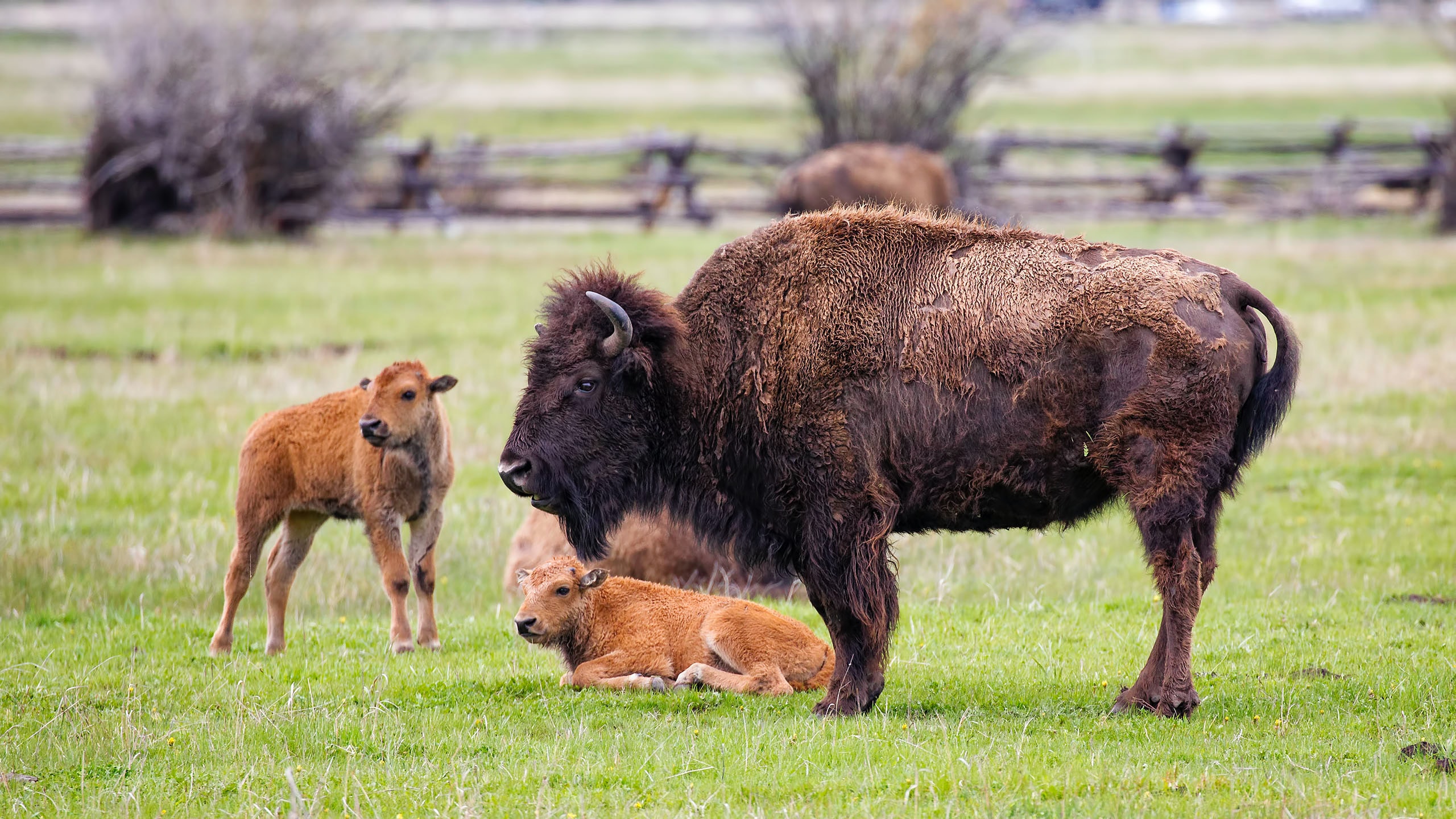
Led by tribes, conservationists are helping bison make a comeback.

Having recently watched an appalling old Annie Get Your Gun film with Betty Hutton (appalling on the subjects of poverty, women, and especially indigenous people), I was relieved to learned from today’s article that attitudes may have evolved into something more promising.

Back in the day, settlers fought natives in underhanded ways. One way was killing bison, a sacred food source. Today European descendants and tribes are actually collaborating to bring the animals back from the edge of extinction.

Jess McHugh reports at the Washington Post, “Miles of prairie stretched out across the Wichita Mountains Wildlife Refuge in southern Oklahoma, acre after acre of brush, grasses and hearty vegetation creeping toward the low-range granite mountains rising in the distance. Like in much of Oklahoma, the road is flat here, but the speed limit remains 30 mph. That’s because of the bison.

“They appeared seemingly out of nowhere: dozens of massive animals lumbering up the shoulder of the road to cross to the fresh vegetation on the other side. The herd moved slowly, their soft, bovine eyes barely registering the stopped cars awaiting their passage. They quickly set to work mowing down the fresh springtime grass.

“The bison’s quiet munching does more than nourish their bodies — it’s one of many things they do to nurture their entire ecosystem, one that is increasingly under threat from climate change. Grazing bison shaving down acres of vegetation leave more than dung behind:

Their aggressive chewing spurs growth of nutritious new plant shoots, and their natural behaviors — the microhabitats they create by rolling in the ground, the many birds that forged symbiotic relationships with them — trickle down the food chain.

“Once bordering on extinction, bison now serve as a great provider for their ecosystems, standing as an example of the ways in which animal conservation and ecological protection can work in tandem.

“ ‘Buffalo is the original climate regulator,’ said Troy Heinert, a member of the Sicangu Lakota (Rosebud Sioux) tribe and executive director of the InterTribal Buffalo Council, a coalition working to restore the animal on tribal lands. ‘Just by how they use the grass, how they graze, how their hoofs are designed, the way they move.’ …

“Tribes are leading the effort to bring back the bison, Heinert says, which in turn allows for the return of other native grasses, animals and insects — all of which will ‘help fight this changing climate.’

“Bison, called buffalo by some Indigenous peoples, are mammoth creatures. Weighing up to 2,000 pounds, they are the largest land mammal in North America. … Two centuries ago, bison dominated much of the continent from Canada to Mexico, when tens of millions roamed North America. They were so numerous that the pounding of their hoofs beating across the land sounded like rolling thunder. For the many tribes of the plains region — the Lakota, the Shoshone, the Arapaho, to name a few — buffalo was a sacred animal that nourished their people and played an important ceremonial role.

“For European colonizers, the bison were both a commodity and a weapon. Americans massacred them by the thousands, selling their pelts and organizing vast sport hunts. As the United States pushed West in the 1800s, bison became a pawn in their quest to wrest Indigenous tribes off their ancestral homes. …

“By the turn-of-the-20th century, millions of bison had been killed. In 1900, fewer than 1,000 — of an estimated 30 to 60 million — remained, many in zoos.

“President Theodore Roosevelt ordered federal bison herds to be put into place (some, such as Custer State Park, were ironically sourced from tribal herds). The bison observed in the Wichita Mountains are descended from 15 animals commandeered from the Bronx Zoo in 1907 and brought to Oklahoma via train car. In the intervening century, federal, tribal and private herds have brought the species back from the brink of extinction. The estimated number of bison nationwide — while far from the millions — now hovers in the low hundreds of thousands.

“Indigenous peoples have been integral to this effort from the start, both by managing herds and by introducing legislation to protect and expand bison territory. In the past few decades, tribal herd numbers have soared: The InterTribal Buffalo Council, which began as a modest coalition of fewer than 10 tribes in the early 1990s, will soon count 76 tribes across 20 states from New York to Hawaii among its members, managing a total of more than 20,000 animals across 32 million acres.

“The return of the bison is a victory not only for the sake of biodiversity but for the entire ecosystem in which they live. As a keystone species, the bison sustain their environment from the top down.

“ ‘They move through, graze everything down. It’s a type of disturbance — like fire would be,’ said Dan McDonald, lead wildlife biologist at the Wichita Mountains Wildlife Refuge. ‘The fresh green [draws] other animals that would feed on it: elk and deer and whatever other type of grazers that would consume some of that new forage.’

“The herd in Oklahoma is approximately 625 animals, but when large herds move synchronously across the land, they create what scientists have dubbed a ‘green wave.’ The bison’s vigorous grazing stimulates plant growth, creating a flood of new vegetation that follows in the bison’s wake to be ‘surfed’ by animals large and small. Green waves can be so dramatic that some — such as the one created by Yellowstone’s bison herd — can be seen from space.”

Read about the extraordinary side benefits of herd restoration at the Post, here.

Read Full Post »

Photo: Hugh Warwick.
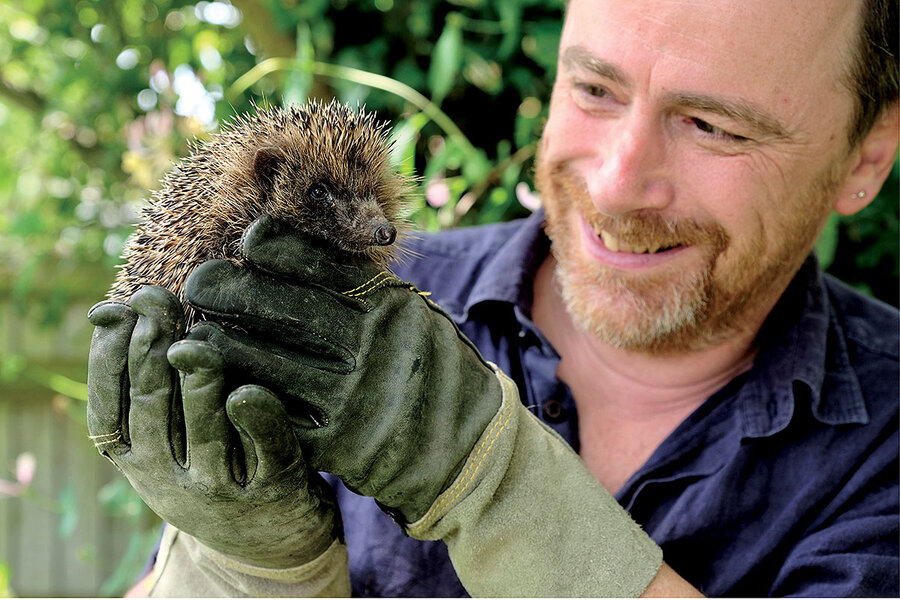
Hugh Warwick has collected over a million signatures calling for legislation to require planners and construction companies to create “hedgehog highways”

When we lived in Minneapolis, we had friends with a pet hedgehog called Hazel. I didn’t know if there were any rules about keeping hedgehogs as pets in those days. All I knew was that hedgehogs were adorable. And the way they curled up in a ball when anxious reminded me of myself. Or an ostrich.

Time to give up our ostrich behavior and do something about hedgehogs’ loss of habitat. Shafi Musaddique has a report at the Christian Science Monitor.

“Jo Wilkinson realized she was losing her students’ attention, so she turned to an old friend: the hedgehog. As a sustainability and engagement officer at Britain’s University of Sheffield, she wanted to rally students around sustainable foods and energy conservation. But it could be hard to hold students’ interest. That was until she proposed building a ‘hedgehog safari’ trail on campus. …

“ ‘I recognized straightaway that hedgehogs captured everyone’s imagination,’ says Ms. Wilkinson. ‘There’s something about them that does that to people.’

“Her effort to expand hedgehog habitats at Sheffield earned British Hedgehog Preservation Society (BHPS) funding in 2019. … Within 18 months, she had a fully funded national project that has certified 110 ‘hedgehog-friendly’ campuses across the country. …

“Britain’s hedgehogs need all the help they can get. The country’s ‘red lists’ categorize species based on how threatened they are. Hedgehogs joined the lists in 2020, officially classified as vulnerable to extinction. But advocates and organizations like Ms. Wilkinson and BHPS, which maintains her Hedgehog Friendly Campus accreditation program, are working to save the iconic British garden dweller.

“Researchers estimate there were about 1.5 million hedgehogs across England, Scotland, and Wales collectively in the mid-1990s.

The population size is difficult to keep track of, but studies show that British hedgehog numbers in rural areas have declined by 50% since 2000, though in cities and towns the decline is closer to 30%.

“ ‘It’s almost as if hedgehogs are moving out and doing the opposite of humans,’ says Ms. Wilkinson. ‘They’re moving into towns and cities because perhaps those places are providing them a bit of a refuge.’ Hedgehogs tend to follow people, she says, and have found that they can scavenge on cat and dog food in gardens. …

“That’s become more valuable as rural areas have lost wildflowers, bramble patches, and leaf and log piles in the countryside. Pesticides from intensive, modern farming practices and ‘habitat fragmentation’ – the ‘chopping up’ of Britain’s landscape into smaller pieces – have added to the rural challenges facing hedgehogs, says Hugh Warwick, author of four books dedicated to the spiky critters.

“The self-dubbed hedgehog connoisseur leads the fight in finding solutions to the destruction of hedgehog habitats due to ‘manicured gardens.’ From his garden shed in Oxford, Mr. Warwick has drummed up over a million signatures for a petition calling for British planning law requiring all new developments to include ‘hedgehog highways’: holes to allow hedgehogs to move freely between gardens.

“Mr. Warwick – once described by a British politician as the ‘Lorax of hedgehogs’ in reference to Dr. Seuss’ literary character who ‘speaks for the trees’ and fights suburban development – has managed to convince the government to change planning law guidance through his petition and online campaigning. …

“[The] hamlet of Kirtlington has already devised a hedgehog highway featuring eccentric holes, miniature stairs, and knocked-down walls that knit gardens together. Villagers took a map of the hamlet and spent time working out the minimum number of holes to connect a maximum number of gardens. A map of the hedgehog highway helps tourists trace the paths of the tiny inhabitants. … Recognizing the threat toward one of the U.K.’s favorite creatures is an opportunity for people to reconnect with their surroundings.

“For Ryan Wallace, sustainability officer at the University of London, which is part of the Hedgehog Friendly Campus initiative, that means ensuring hedgehogs thrive in the most unlikely of places: central London. Though surrounded by Regency-era houses and within walking distance of busy tourist attractions, the public squares of Bloomsbury offer overgrown bushes and ample foliage. That makes them – and the neighboring university – fertile ground for hedgehogs, though none were seen last year.

“ ‘They can travel up to 2 miles through the streets of London,’ says Mr. Wallace. … ‘Hedgehogs have loads of benefits people don’t realize. They keep the slug population down, and they’re natural pest killers,’ he says. ‘They’re also a good indicator of how well the natural environment is doing.’ …

“ ‘If there’s a space in your garden where you can let the weeds grow, do that and stop cutting the grass,’ says Ms. Wilkinson. ‘Let nature be nature.’ …

“[At] Nottingham Trent University, a ‘bronze-winning’ Hedgehog Friendly Campus … the school’s sustainable development projects officer has plans to add special hedgehog accommodations like ramps to provide safe exit from ponds. ‘They can swim really well, but they get tired,’ she says. ‘If they can’t climb out, they’ll get into trouble.’ …

“For many advocates, hedgehog conservation isn’t just about the survival of a species. It’s a chance to connect with bigger environmental issues such as climate change. ‘You can start with hedgehogs, because that doesn’t scare people off. Everybody has an anecdote about a hedgehog.’ “

Do you?

More at the Monitor, here.

Read Full Post »

Photo: Hill Museum & Manuscript Library.
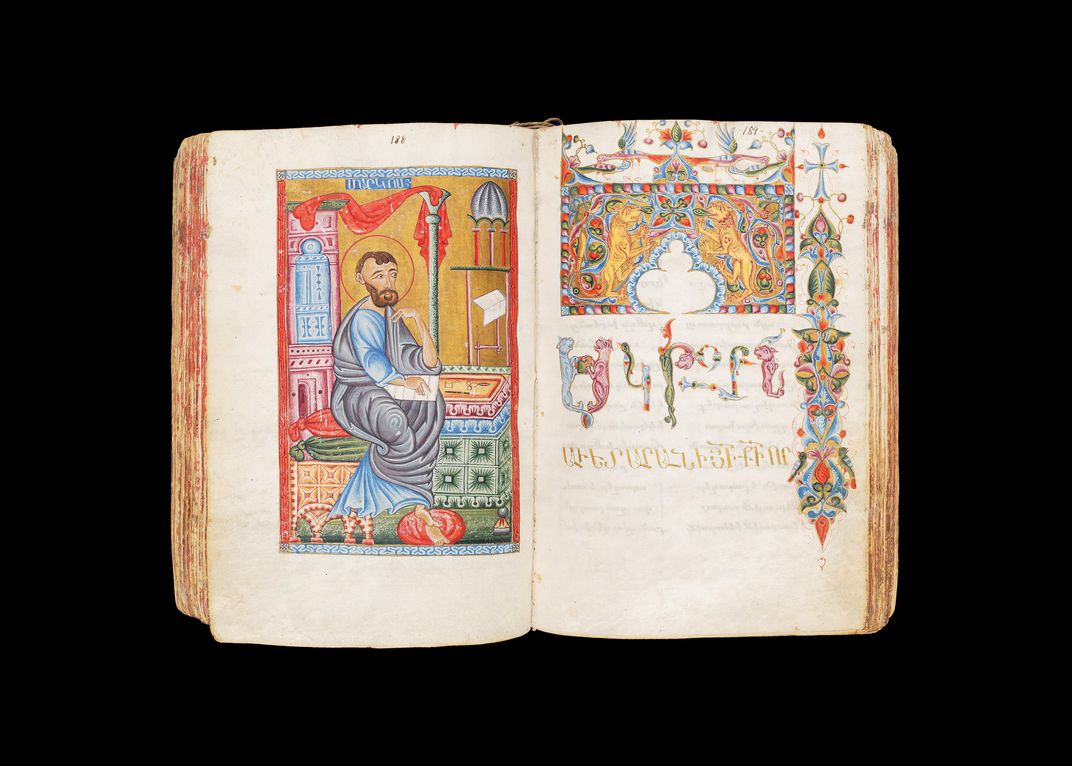
A 1600s Armenian Gospel, with a depiction of the evangelist Mark, has been digitized by Benedictine monk Columba Stewart’s project.

I love learning about the many unusual careers and pursuits out there. In today’s story, a monk who was working on preserving old manuscripts by digitizing them, accidentally became a sleuth in dangerous regions.

Joshua Hammer writes at the Smithsonian, “When Columba Stewart, a 63-year-old Benedictine monkbased in Minnesota, arrived at the Kaiser Library, a government-affiliated archive in Kathmandu, Nepal, he stared up at the three-story building — wobbly, riven by cracks, too unsafe to use.

“It was three years after the massive Nepalese earthquake of 2015 that had killed 9,000 and laid flat much of the Kathmandu Valley. Rain leaked through holes in the roof, inundating broken masonry and congealing into gray mud on the floor. Many of the library’s manuscripts, some dating to the ninth century and written in Devanagari script (an ancient orthography system still used across the Indian subcontinent) on birch bark and palm leaves rolled up and held by clay seals, had been moved downstairs. The scrolls were stacked in bags and shoved into old glass cabinets on the ground floor. Exposed to the dust of an ongoing construction project to shore up the building’s weakened structure, as well as occasional seismic vibrations, the works were at risk of rapid disintegration.

“Stewart had flown to the Himalayas at the behest of Bidur Bhattarai, a Nepalese scholar at the Centre for the Studies of Manuscript Cultures at the University of Hamburg, who had traveled to his homeland after the quake to assess the damage. Library employees recounted their panic as books crashed to the floor and chunks of bricks and rocks came hurtling down: For months they had been forced to work outside under a tarp. …

“Stewart made three trips to Nepal in 2018 and 2019 (a spring 2020 visit was called off at the start of the Covid-19 worldwide lockdown), continuing discussions to begin digitizing the Kaiser Library’s collection, while initiating a pilot project at a nearby private institution: the Asha Archives. Its collection of 7,000 richly ornamented manuscripts on bound paper and rolled palm leaves was built up by Prem Bahadur Kansakar, and named after his father, Asha Man Singh Kansakar, a prominent early 20th-century social activist and writer from the Newari ethnic group — the historical inhabitants of the Kathmandu Valley and the dominating force in Nepali politics and culture — and donated to the public in 1987. …

“Working remotely from his stateside base, Stewart supported Bhattarai in training a team of four Nepalese staffers to begin digitizing 1,000 manuscripts newly donated to the archives. Almost all were written on traditional Nepalese paper by Newari scribes. The works treat subjects including Buddhist and Hindu philosophy, religious rituals, Ayurvedic medicine (a holistic approach based on ancient Hindu writings) and grammar, along with poetry, written in Sanskrit, Newari and Nepali and dating to the 15th through early 20th centuries. Most had been wrapped in red- or yellow-dyed cotton for centuries, and recently have been rewrapped in undyed muslin or locally produced paper for conservation. …

” ‘Everybody knows Nepal because of Tibetan Buddhist monasteries,’ Stewart says, ‘but there’s also strong Hindu presence. The manuscript tradition witnesses that mix, in a variety of languages. Nepal is a meeting place; that’s what makes it so interesting.’

“Stewart lives and works at St. John’s Abbey in Collegeville, Minnesota, where he is a professor of theology at the affiliated St. John’s University and the executive director of the Hill Museum and Manuscript Library (HMML). …

Over the past 20 years his work has taken him from the Balkans to the Himalayas, from the Sahel region of Africa to the Middle East, injecting him into the heart of conflict zones and resulting in several narrow escapes from rebel movements and religious extremists. …

“ ‘Sometimes I feel like a war correspondent. Other times I’m cast in a religious role. In northern Iraq, I’ll be in my habit at Mass with 1,500 worshipers chanting in Aramaic. Then I’ll be going around in a tank.’ …

“Stewart has built up an extensive rare-book collection for the library. On a virtual tour using his iPad, he takes me down to the basement, and removes from a shelf one of his favorite recent additions: a four-volume Old and New Testament, bound in oak, and printed in Nuremberg in 1480, twenty-five years after the Gutenberg Bible rolled off the world’s first printing press. … ‘The paper looks like it was made yesterday,’ he tells me. ‘The ink is black as can be, mixed with linseed oil to take the bite out of the type,’ he says. ‘Every piece of type was set by hand, backwards. They had to do that for every single page. That’s an extraordinary achievement in the service of knowledge.’ …

“Stewart’s work represents a high-tech evolution of the Benedictine mission. He conducted his first digitization project in 2003, in Lebanon, and went on to the rest of the Middle East and the Balkans, where Christian minorities have grown increasingly vulnerable, their cultural patrimony put at risk. Word of his deeds spread. Malian librarians who had rescued 250,000 Islamic and secular manuscripts from Al Qaeda in Timbuktu by smuggling them to Bamako enlisted his aid. Muslim communities in India, threatened by the Hindu extremist rhetoric of Prime Minister Narendra Modi, have turned to him for help digitizing their archives.”

Stewart’s life path emerged accidentally after he “joined the St. John’s faculty. He was prepared, he said, for a life of teaching and religious devotion. That bucolic vision was disrupted when the university president, aware of Stewart’s knowledge of early Christian sites in the Middle East, asked him to take on a manuscript preservation project for the Orthodox Christian church in northern Lebanon.”

At the Smithsonian, here, you can read what happened next.

Read Full Post »

Photo: Corita Art Center, Immaculate Heart Community.
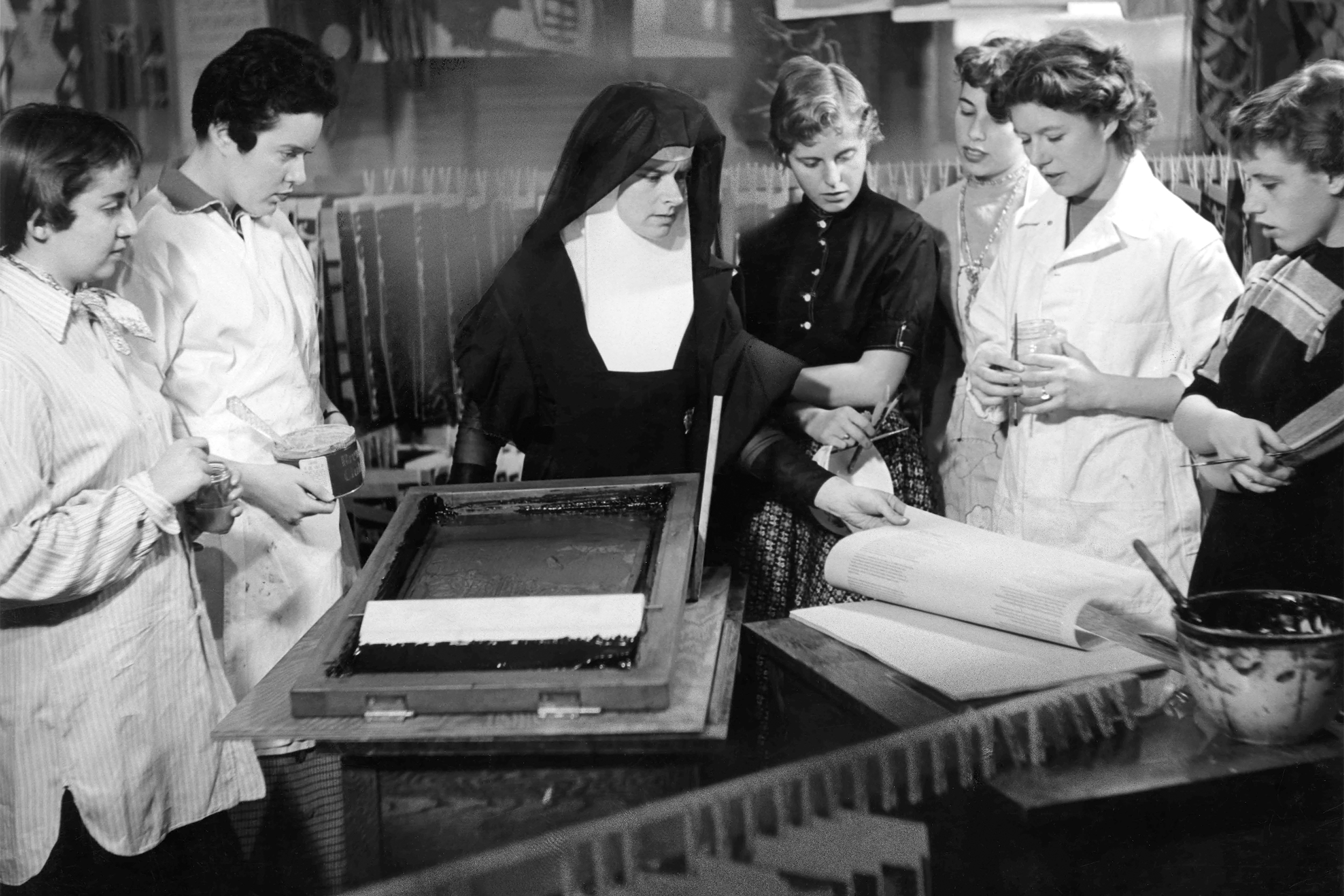
Corita Kent, then known as Sister Mary Corita, with students. “By the 1960s,” notes the Corita Art Center, “her vibrant serigraphs were drawing international acclaim. Corita’s work reflected her concerns about poverty, racism, and war.”

Talent will out. That was certainly the case with Sister Mary Corita, or Corita Kent, who became a force in the Pop Art scene of the 1960s with her focus on social justice.

At the Los Angeles Times, Carolina A. Miranda recently wrote, that 35 years after her death, the L.A. City Council approved historic-cultural monument status for her former studio — “a humble storefront on Franklin Avenue, near Western Avenue that in recent years had been inhabited by a dry cleaner.”

Miranda continues, “If you drew a Venn diagram that brought together Charles Eames, Pop Art, commercial printing, social justice movements, the Second Vatican Council and 1960s Los Angeles, only one person could inhabit the space where those areas intersect: Corita Kent.

“A nun in the order of the Immaculate Heart of Mary for more than three decades, Sister Mary Corita was a well-known educator and artist dubbed the ‘Pop Art nun’ by the press. … In her classroom at Immaculate Heart College, Kent taught the art of silkscreen printing — a commercial form that she adapted to the era of Pop. In the wake of the Second Vatican Council in 1962, which called for a liberalization and modernization of the Catholic liturgy to the realities of 20th century life, she delved into creating work that echoed calls for social justice — be it antiwar efforts, labor campaigns or Black and Chicano civil rights.

“Her work at its most innovative took vernacular culture — commercial logos and graphics, bits of corporate slogans, images from mass media — and reconfigured them into fine art. Art that not only advanced the ways in which these elements were used formally, but that grounded Pop. … As independent curator Michael Duncan wrote of her work in a 2013 catalog: ‘She addressed consumers not of products but of life.’ …

“The [historic-cultural] designation is important not just because Kent was an artist whose work was a critical part of the artistic dialogues Los Angeles was having in the 1960s, but also because she represents the rare woman to be honored in the city’s landscape.

“As the Los Angeles Conservancy noted in its advocacy for preserving Kent’s studio building, only 3% of the city’s more than 1,200 historic-cultural monuments are associated with women’s heritage. … The designation is reflective of a shift in preservationists’ thinking about how we acknowledge history — thinking that is less preoccupied with the pristine historical details of a site than in making sure a wide range of histories are acknowledged in a city’s landscape. Late last year, the 1970 protest route of the Chicano Moratorium was listed in the National Register of Historic Places; early this year, the Church of the Epiphany in Lincoln Heights — a key site of Chicano activism — was added to the list. …

“The storefront that Kent inhabited, where she taught and collaborated with students and created some of her most memorable work, no longer bears traces of her presence. …

“Kent left the space — and Los Angeles — after she withdrew from the Immaculate Heart of Mary order in favor of a secular life in the late 1960s. Part of her departure may have been due to pressures related to her increasingly high profile: At one point, she was featured on the cover of Newsweek. It may have also stemmed from simmering tensions between the liberal Immaculate Heart order and the staunchly conservative Archbishop James Francis McIntyre, who once complained that that the work produced by Kent and the college’s art department was ‘an affront to me and a scandal to the archdiocese.’ In 1970, Immaculate Heart split from the church and is today an independent ecumenical community.

“The studio storefront, which is currently unoccupied, sits on a small corner of a 1.7-acre parcel that also contains a shuttered Rite-Aid. Recently, the plot was acquired by a pair of real estate development companies who intend to turn the site into a Lazy Acres natural foods market. Part of their original plan had been to tear down the studio to make way for additional parking. (Yes, parking.) That plan has since been amended to leave the old studio building intact.

“This comes thanks to the work of many L.A. preservationists, among them the staff at the Corita Art Center, which is located just across the street in a complex of buildings still inhabited by the Immaculate Heart Community.

“ ‘The big question is what’s next,’ says the center’s director Nellie Scott. It’s too soon to say what the developers will do with the property — whether they would sell it or lease it for the purpose of an arts center. ‘We know that there are a thousand more conversations to happen.’ ”

So interesting that a nun used her natural gift in this way. I’m reminded of the French legend about the Juggler of Notre Dame, who was ridiculed for having nothing to give Mary but his juggling. In the story, her statue accepts the gift with a miraculous bow.

More at the Los Angeles Times, here.

Read Full Post »

Whether we know it or not, we’re always passing down family customs, sayings, songs, crafts, and more to the next generation. Sometimes I’m a bit sad that I stopped singing songs in the car as an adult, because there are a ton of old nursery rhymes and folk songs from my childhood that my kids never learned. One time my youngest brother said to them, “Does your mother still sing in the car?” and they had no idea what he meant.

I’ve blogged before about efforts to preserve marginalized languages, and any similar initiative gets my attention. Consider this story on preserving artisan techniques in danger of dying out.

Gareth Harris writes at the Arts Newspaper, “Centuries-old practices and traditions across communities worldwide that might be lost forever — from beekeeping in Kenya to creating the Dalai Lama’s clothes — are being quietly supported and documented online through the British Museum’s Endangered Material Knowledge Programme (EMKP).

“The scheme, launched in 2018, has been boosted by an [$11.7 million] grant awarded by Arcadia, a charitable fund founded by the philanthropists Peter Baldwin and Lisbet Rausing; the cash injection means the project has been extended for seven years (2021-28). …

“ ‘Locally informed knowledge is in danger of being lost — knowledge that has helped communities thrive in unique environmental, social and cultural contexts,’ says a statement from the British Museum. …

” ‘We are offering communities the resources to record themselves; that is so powerful. It’s a form of auto ethnography as such,’ says Ceri Ashley, the head of EMKP.

“ ‘Once this material has been collated, it is uploaded onto an open access digital database hosted by the British Museum, and a digital copy is also shared with a partner in the country of work so that it remains close to the community whose cultural heritage it represents,’ say museum officials. …

“This year’s supported schemes include a survey of the skills of Venerable Phuntsok Tsering, the Dalai Lama’s personal tailor. ‘Since 1959, he has been responsible for (re)constructing the tailoring requirements of the Dalai Lama in exile. He rebuilt the ceremonial wardrobe left behind in Tibet and developed new garments for use in the unfamiliar environmental and cultural conditions of India. Despite this singularity his practice has never been documented,’ says an online statement.

“Ashley points out that the EMKP team, working primarily online, has worked throughout lockdown, collaborating with an international advisory panel to review and select the next round of grants. …

“Another 2020 project focuses on the manufacture of Ostrich eggshell beads among the El Molo Community in Kenya, capturing their making and use through audio files, video clips and field notes.

“Last year, the EMKP recorded the dwindling practice of beekeeping amongst the Sengwer communities living in the Embobut Forest in western Kenya. ‘Some projects celebrate the everyday, which is so important,’ says Ashley, referring to a 2019 analysis of the traditional natural broom and fibre rope crafts of the Urhobo people of Nigeria.

“Applications are now open for the 2021 round of funding (deadline for applications is 31 January 2021). Instructions online stress that prospective candidates should ‘consider the viability and ethics of conducting this work within the context of the Covid-19 pandemic.’ ” Read more at the Art Newspaper, here.

The Kenya beekeeping reference makes me think of a wonderful documentary, Honeyland, about an isolated beekeeper in rural Macedonia. Do watch it if you get a chance. I hope her techniques are being preserved, too.

Read Full Post »

Buccleuch, Buccleuch. It has a familiar ring to it. Didn’t we stay at the Buccleuch Arms on our honeymoon trip through Scotland? I think so, but it’s been 50 years, so …

I do clearly remember the beautiful rolling hills of the Scottish Lowlands and the black-faced sheep wandering over the roads like they owned them, which of course, they did. So whether or not I was ever in the Buccleuch environs, I love today’s story about a Scottish village’s determination to preserve 8 square miles of beauty.

Severin Carrell writes at the Guardian, “A village in southern Scotland has succeeded in buying a large part of Langholm Moor, a famous grouse moor held for centuries by the dukes of Buccleuch, among the UK’s most powerful hereditary peers.

“Buccleuch Estates said on Monday it would be selling just over 2,000 hectares (about 5,000 acres) of Langholm Moor [to] the local community, which plans to create a leading new nature reserve and community regeneration project.

“The deal, the largest ever community buyout in the south of Scotland, follows months of fundraising by the Langholm Initiative, which only succeeded with hours to spare before the deadline of 31 October.

“Kevin Cumming, the initiative’s project leader, said he was thrilled with the deal. ‘Community ownership can be a catalyst for regeneration, which we want to show can be done with the environment at its heart,’ he said. …

“Buccleuch Estates told the campaigners it would continue talking about the possibility of buying the remaining 2,100 hectares that covers much of the former grouse moor, which would involve the Langholm Initiative raising [almost $3 million more]. …

“The Langholm buyout is one of three community land sales involving Buccleuch in south-west Scotland, all part-funded with taxpayers’ money.

“Earlier this year, Buccleuch Estates sold 300 hectares of land around the village of Newcastleton and has offered to sell 1,560 hectares of moorland, pasture and brownfield land to a community trust at Wanlockhead in the Leadhills for nearly [$2 million].

The Langholm Initiative hopes the moorland regeneration, ecotourism and rural industries it plans to fund will bring enough money to plough back into community regeneration and bring in new residents.

“The scheme will focus on creating a new nature reserve called Tarras Valley, including restoring Langholm’s ancient peatlands and protecting the area’s threatened populations of hen harrier. The initiative hopes its reforestation and peatland restoration projects will attract subsidies from programmes funding measures to combat global heating.”

People who inherit vast lands they cannot afford to keep up either have to sell them or get creative. They can end up being owned by the land — a status I do not envy. I’m thinking of people I knew who inherited Rokeby on the Hudson River and rented it out for weddings and such, including the shooting of a pretty wild art film. I’m glad the Buccleuch Estates are trying to help others preserve what is sold off.

More at the Guardian, here.

Read Full Post »

01_yvesmarchandromain20meffre_repurposedtheaters_photovertical

Photo: Yves Marchand and Romain Meffre
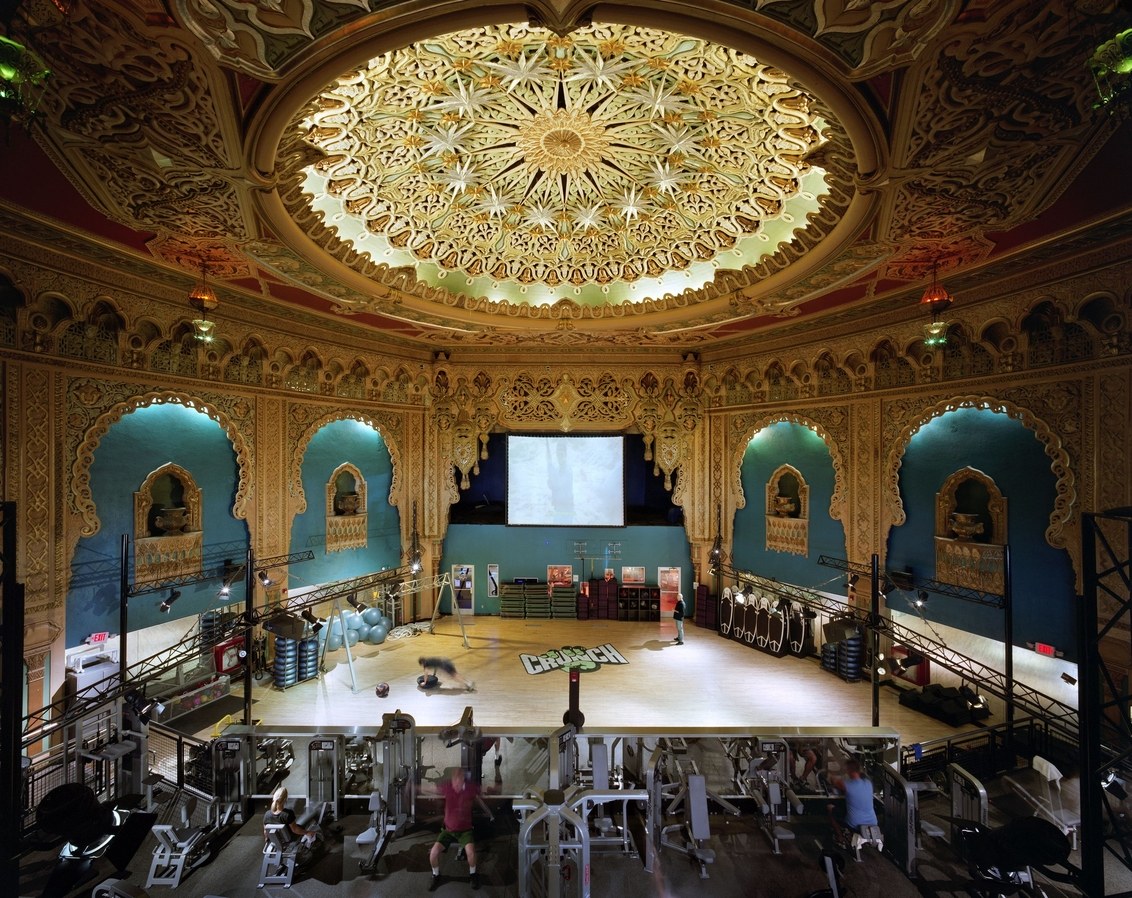
Two French photographers spent years capturing the new uses of old movie theaters, like this one. Now a gym, the building was once famed as the Alhambra Theater of San Francisco.

Sometimes spectacular old buildings simply cannot be returned to their original purpose. Times change. But as I learned from pictures by two French photographers, many people value the old movie theaters and are giving them new life.

Michael Hardy writes at Wired, “Between the 1920s and the 1950s, Hollywood studios built thousands of ornate movie palaces in cities across the United States. Warner Bros., Paramount, RKO, MGM, and others competed to build the biggest and gaudiest cinematic cathedrals to showcase their big-budget blockbusters. In this vertically integrated era of filmmaking, when the major studios tightly controlled the production, distribution, and exhibition of movies, these palaces served as the showrooms in which they displayed their wares. Seating thousands of spectators, the theaters were decorated in a fanciful array of styles, including art deco, art nouveau, and ancient Egyptian.

“In 1948 the US Supreme Court found that such vertical integration violated the Sherman Antitrust Act and ordered the biggest movie studios to divest themselves of their theater chains. The decision spelled the end for the era of the movie palace, as the studios were forced to sell or close their theater holdings. Television and suburbanization — the grand old theaters were mostly located in downtown areas — provided the coup de grâce.

“One of the grandest of the old palaces was Detroit’s United Artists Theatre, a 2,000-seat, Spanish Gothic–style venue that showed movies from 1928 until the 1970s. French photographers Yves Marchand and Romain Meffre stumbled across the abandoned theater in 2005 while working on a series about the effects of deindustrialization on the city.

“Stunned by the building’s fading grandeur, Marchand and Meffre began traveling the country, seeking out other abandoned theaters to photograph.

‘The amount of fantasy and detail are amazing in some of the theaters,’ Meffre says. ‘I don’t think we have anything comparable in Europe except for our cathedrals.’ …

“After discovering some tastefully repurposed palaces, such as Brooklyn’s cavernous Paramount Theater—now used as a gymnasium by Long Island University—they expanded the scope of their project. Not all renovations were so sensitive. Marchand and Meffre shot palaces that have been transformed into grocery stores, office buildings, even school bus depots. …

“Because the palaces are so expensive to tear down, many have survived more or less intact, a process the photographer calls ‘preservation by neglect.’ ”

Funny. Here’s to life-saving neglect!

More at Wired, here.

Read Full Post »

sai_photo_024Photos: Sai SanctuaryIn part to preserve the planet’s source of rainwater, this couple bought a sanctuary in India. As it expands, it protects more and more species.

A childhood friend on Facebook often posts interesting links. Her presence on that platform is a major reason I can’t bring myself to get off Facebook even though I feel extremely wary of what the company is doing with my data. But how many people from your nursery school do you connect with on a regular basis?

My friend recently alerted her followers to an animal sanctuary in India that sounded cool, and after a look at the website, I checked around for more information on the two wealthy nature lovers who saved the preserve from neglect.

Panna Munyal wrote this 2016 report at an Abu Dhabi publication called The National, “On most days, Pamela Gale ­Malhotra, co-owner of the Sai Sanctuary private forest in ­India, is fast asleep at 1.30am, after her typically full programme of organising walking safaris and animal feeds, and checking camera traps for signs of poaching.

“But a few years ago, Pamela and her husband, Anil Malhotra, woke up to the sound of trumpeting ­elephants. They assumed – rightly – that a baby elephant must have strayed too close to a partially covered pit and fallen in. As her husband switched on the rarely used floodlights and prepared to call on their neighbours for aid, Pamela stepped out to a magnificent sight.

Dozens of elephants from the Sai ­Sanctuary’s herds, as well as the neighbouring Bandipur, ­Brahmagiri and Nagarhole national parks, had gathered around the pit and were bellowing their assurances to the calf. Pamela describes the next hour as magical, as the enormously graceful creatures banded as one to lift the half-broken lid of the pit with their trunks, enabling the little one to clamber out.

“This show of concerned unity is typical of the environment the Malhotras have cultivated in Sai Sanctuary, which is nestled within southern India’s ­Western Ghats in the Coorg district. ‘Protecting what is left of the world’s forests is the only thing that will ensure our own survival,’ Pamela says. ‘Forests are directly responsible for rainfall, our primary source of water. Water, in turn, is the lifeline for plants, flowers, animals, birds and humans. We have nothing if not for our forests.’ …

” ‘When we bought our first parcel of land in India, it was just the two of us and 55 acres [22 hectares] of forest beside the Poddani River. We learnt from experience that if you want to protect a piece of land, you need to secure both sides of its water source. And here we both are 25 years later, managing 300 acres [121 hectares] on both sides of the river.’

“Pamela, who is part Native American, and her husband, a former banker, … follow a two-pronged approach to safeguard the forest, river and wildlife: purchase-to-protect and payment for environmental services. The first step is to buy private forested lands that border national parks or other reserve forests, and preserve them in their natural state. Next, the Malhotras offer compensation to members of the surrounding communities to, in turn, not harm the trees and animals around them. Compensation may be in the form of money, but it can also be a solution that works for both parties.

“ ‘We gifted all our cattle to some of our neighbours. The milk and dung give them an extra source of income, while for us it means less staff and more food for other grass-eaters,’ says Pamela. ‘Another time, some villagers approached my husband to help relocate a temple from the top of the mountain to the edge of the sanctuary. He agreed, on the condition that they would stop hunting.’ …

“Ingenious solutions and noble intentions aside, it’s undeniable that money – and large sums at that – is needed for a project of this magnitude. … ‘We now have four rooms in two eco-tourism cottages on the property alongside the main house in which we live.’ These cottages are open to visitors, and cost from [$42] per person, per night, which includes the stay, three nutritious vegetarian meals and daily treks. …

” ‘We outsource not only our housekeeping and laundry facilities, but also hire willing neighbours to cook the meals, some of which can be eaten in a local house or with the village priest. This ensures the money spreads through the community, and even our guests can get a feel for the culture,’ Pamela says. …

“Despite its size, Sai Sanctuary doesn’t have any safari vehicles. ‘You are always on foot here. It helps people to slow down and observe the flowers, birds and trees around them. … Guests are never taken to the same area twice during the course of their stay because ‘we want the wildlife to move freely even in the day. This is the purpose of a sanctuary.’

The National article is here. And if you explore the Sai website, here, you will find some beautiful pictures of the species that the sanctuary protects.

Thanks, Carole, for putting this on FB.

Photo: Sai Sanctuary
Anil Malhotra and Pamela Gale Malhotra put their money behind saving an animal sanctuary in Ind

Read Full Post »


Photo: Diego Ibarra Sanchez for The New York Times.
Ali Shehadeh, a plant conservationist from Syria who fled the war in his country, at work in Terbol, Lebanon.

The harm that wars do seems endless. Every aspect of life is affected. And yet, against all odds, good people rise up to save or try to reconstruct what might be lost. In this post, everyday heroes protect a seed bank from the war in Syria.

Somini Sengupta has the story at the New York Times. “Ali Shehadeh, a seed hunter, opened the folders with the greatest of care. Inside each was a carefully dried and pressed seed pod: a sweet clover from Egypt, a wild wheat found only in northern Syria, an ancient variety of bread wheat.

“He had thousands of these folders stacked neatly in a windowless office, a precious herbarium, containing seeds foraged from across the hot, arid and increasingly inhospitable region known as the Fertile Crescent, the birthplace of farming.

“Shehadeh is a plant conservationist from Syria. He hunts for the genes contained in the seeds we plant today and what he calls their ‘wild relatives’ from long ago. His goal is to safeguard those seeds that may be hardy enough to feed us in the future, when many more parts of the world could become as hot, arid and inhospitable as it is here.

“But searching for seeds that can endure the perils of a hotter planet has not been easy. It has thrown Shehadeh and his organization, the International Center for Agricultural Research in the Dry Areas, squarely at a messy intersection of food, weather, and war.

“The center, though it received no state funding, was once known as a darling of the Syrian government. Based in Aleppo, its research had helped to make Syria enviably self-sufficient in wheat production. …

“By 2014, the fighting drew closer to its headquarters in Aleppo and its sprawling field station in nearby Tal Hadya.

“Trucks were stolen. Generators vanished. Most of the fat-tailed Awassi sheep, bred to produce more milk and require less water, were stolen and killed for food. … And the center’s most vital project — a seed bank containing 155,000 varieties of the region’s main crops, a sort of agricultural archive of the Fertile Crescent — faced extinction.

“But researchers there had a backup copy. Beginning in 2008, long before the war, the center had begun to send seed samples — ‘accessions’ as they are called — to the Svalbard Global Seed Vault, the ‘doomsday vault,’ burrowed into the side of a mountain on a Norwegian island above the Arctic Circle. It was standard procedure, in case anything happened.

“War happened. In 2015, as Aleppo disintegrated, center scientists borrowed some of the seeds they had stored in Svalbard and began building anew. This time, they spread out, setting up one seed bank in Morocco and another just across Syria’s border with Lebanon in this vast valley of cypress and grapes known as the Bekaa. …

“Mr. Shehadeh … is obsessed with the wild relatives of the seeds that most farmers plant today. He eschews genetically modified seeds. He wants instead to tap the riches of those wild ancestors, which are often hardy and better adapted to harsh climates. ‘They’re the good stock,’ he said.

“He hunts for the genetic traits that he says will be most useful in the future: resistance to pests or blistering winds, or the ability to endure in intensely hot summers. He tries to select for those traits and breeds them into the next generation of seeds — in the very soil and air where they have always been grown.”

The experts believe that the seeds from plants that thrive in this arid part of the world will be needed for feeding the planet as it warms.

Read the whole article here.

Read Full Post »

Photo: Luke Spencer
Inside the main concourse of the abandoned art deco Buffalo, New York, train station. 

It seems everyone loves old art deco buildings, but no one knows how to preserve them. At least that is the feeling I get listening to the endless discussions of the future of Providence’s Superman Building, so-called because it looks like the Daily Planet building from the 1950s television series.

Meanwhile, as Luke Spencer writes at Atlas Obscura, preservationists in Buffalo, New York, are holding out hope for an art deco “train station, lying forlorn and mostly forgotten … the old Buffalo Central Terminal.

“Opened in 1929 for the New York Central Railroad, the Buffalo Central Terminal was every bit as grand and opulent as Manhattan’s Grand Central Terminal, Philadelphia’s 30th Street station and Washington DC’s Union Station.

“These were the days when Buffalo was known as the Queen City, built on the strength of automobiles, livestock, steel, and other heavy industries prospering along the seam of the Erie Canal, connecting New York to the Great Lakes. Buffalo thrived to such an extent it was chosen to host the prestigious 1901 Pan American World’s Fair. At this point, Buffalo was the eighth-largest city in the United States. … In its heyday, Buffalo Central Terminal was servicing 200 trains a day.

“But the decline in Buffalo’s economic fortunes, and the rise of domestic airlines and automobiles, spelled the end of the grand Terminal. In the early hours of the morning of October 28, 1979, the last Lake Shore Limited train service heading west left Buffalo. The grand old Terminal was never used again.

“For decades, the building was left abandoned, silently falling apart, while the surrounding neighborhood similarly declined. But the spirit of the Nickel City is strong. No more so than in the recent efforts of the non-profit, Central Terminal Restoration Corporation (CTRC), which has been fighting to not only preserve the Terminal, but restore it to its original magnificence. …

“The building itself would need extensive repairs. Forty years of neglect have seen much of the original fixtures either stolen or stripped, particularly in the mid 1980s, when the Terminal was sold off in a foreclosure sale. …

“Perhaps the best chance for the Terminal’s rejuvenation lies with Canadian property developer Harry Stinson, who was named as the designated developer of the site by the City of Buffalo and the CTRC in 2016.” More at Atlas Obscura, here.

It’s a treat to see historic buildings saved and turned to new and profitable uses. Let’s keep tabs on this one.

Photo: Luke Spencer
Is this the prison staircase in the opening scene of Little Dorrit, by Charles Dickens? Oh, guess not.

Read Full Post »

Art: Albrecht Dürer
“Virgin and Child With Pear,” at the Uffizi Gallery in Florence.  Heritage fruit archaeologist Isabella Dalla Ragione says it’s not a pear.

I loved reading about this side effect of an Italian woman’s work to preserve heritage fruits: she discovered that a fruit in a famous painting was mislabeled.

Elisabetta Povoledo writes at the NY Times, “On her farm, Isabella Dalla Ragione pursues a personal mission — saving ancient fruit trees from extinction — with a strong sense of urgency. Rescuing vanishing varieties is a race, she says, ‘and lots of times we arrived late.’ …

“To find and collect their forgotten varieties, for decades she and her father chatted up farmers and motley locals in the Umbrian and Tuscan countryside. They gathered branches, and with them the traditions and chronicles tied to the fruits. …

“But because fruit was not always described in detail in written records, she also began to examine the works of Renaissance and Baroque painters working in Umbria and Tuscany at a time when ‘artists had close relations to agriculture’ and were sensitive to the seasons and local varieties, she said. …

“A closer look at Albrecht Dürer’s ‘Virgin and Child With Pear,’ at the Uffizi Gallery in Florence, for example, reveals a clear misnomer, Ms. Dalla Ragione said.

“ ‘If it were a pear, it would show a stalk on top,’ she said. ‘Mary is clearly holding a muso di bue apple.’ …

“Ms. Dalla Ragione created a nonprofit foundation, the Arboreal Archaeology Foundation, in 2014 ‘because it made it easier to give a future to all this,’ she said.”

Read more about her quixotic but intriguing work here.

Photo: Francesco Lastrucci for The New York Times
Isabella Dalla Ragione picking apples on her farmstead in San Lorenzo di Lerchi, Italy.

Read Full Post »

Older Posts »