Feeds:
Posts
Comments

Posts Tagged ‘prisoner’

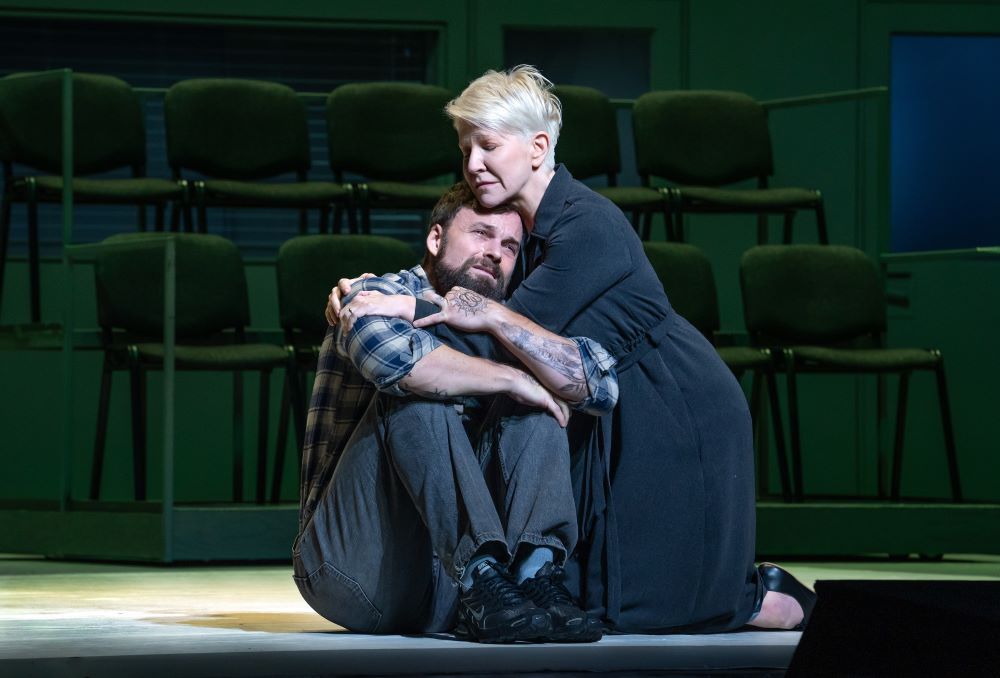
Photo: Met Opera/Karen Almond via National Catholic Register.
Ryan McKinny portrays inmate Joseph De Rocher and Joyce DiDonato portrays Sr. Helen Prejean in Jake Heggie’s opera Dead Man Walking.

My new friend Lynn S. is an opera lover. I met her when I was asked to interview someone for the newsletter at our current residence. She told me about attending a breathtaking Met opera broadcast in a local movie theater, Dead Man Walking. You may know the true story of the nun and the death row inmate.

As Javier C. Hernández reports for the New York Times, the opera generated an extra level of intensity when the Met took it to Sing Sing prison for a special performance.

“One by one, the inmates filed into a chapel at Sing Sing Correctional Facility in Ossining, N.Y. — past a line of security officers, past a sign reading, ‘Open wide the door to Christ.’ Under stained-glass windows, they formed a circle, introducing themselves to a crowd of visitors as composers, rappers, painters and poets. Then they began to sing.

“The inmates had gathered one recent afternoon for a rehearsal of Dead Man Walking, the death-row tale that opened the Metropolitan Opera season [in September]. Together, they formed a 14-member chorus that would accompany a group of Met singers for a one-night-only performance of the work before an audience of about 150 of their fellow inmates.

Michael Shane Hale, 51, a chorus member serving a sentence of 50 years to life for murder, said that he often thought of himself as a monster. 

“ ‘I feel like I’m at home,’ said a chorus member, Joseph Striplin, 47, who is serving a life sentence for murder, as the men warmed up with scales and stretches. ‘I feel I’m alive.’

Dead Man Walking, based on Sister Helen Prejean’s 1993 memoir about her experience trying to save the soul of a convicted murderer at the Louisiana State Penitentiary in Angola, has been staged more than 75 times around the world since its premiere in 2000.

“But the opera, with music by Jake Heggie and a libretto by Terrence McNally, had never been performed in a prison until last week at Sing Sing, which is home to more than 1,400 inmates.

“There were no costumes or props. Chorus members, who were dressed in prison-issued green pants, had to be counted and screened before entering the auditorium, lining up by cell block and building number. …

“Yet the opera, with its themes of sin and redemption — and of the pain endured by victims’ families — resonated with inmates.

“Michael Shane Hale, 51, a chorus member serving a sentence of 50 years to life for murder, said that he often thought of himself as a monster. In the 1990s, prosecutors sought the death penalty in his case. (New York suspended the practice in 2004.) Hale said the opera, which portrays the friendship between Sister Helen and Joseph De Rocher, a death-row prisoner, had taught him to see his own humanity. …

“Not everyone at Sing Sing, a maximum-security prison about 30 miles north of New York City, was enamored. Some prisoners declined to take part in the opera because of concerns about its dark themes, including the portrayal of a prisoner’s death by lethal injection. …

“The idea for bringing Dead Man Walking to Sing Sing emerged several years ago when an inmate promised the renowned singer Joyce DiDonato, who plays Sister Helen in the Met’s production, that the men could sing the chorus parts. …

“Paul Cortez, 43, who is serving a sentence of 25 years to life for murder, worked with [Bryan Wagorn, a Met pianist] to learn the score and held Saturday night rehearsals with small groups of prisoners at Sing Sing. Some were initially hesitant, unsure if the opera advanced prisoners’ rights and fearing they ‘might be exploited,’ he said, but eventually more people started showing up.

“ ‘It was daunting at first,’ said Cortez, who majored in theater in college. ‘I did not know how I was going to get the guys in shape. But they were so diligent. They took it seriously.’

“[In September] DiDonato, joined by Sister Helen, 84, visited the prison to work through the music and to get to know the participants. They discussed life in prison, morality, shame and stigma, as well as Sister Helen’s efforts to abolish the death penalty. Some inmates, saying they were still consumed by guilt about their crimes, asked about seeking forgiveness.

“DiDonato and Sister Helen returned [two days] after opening night at the Met, joined by singers and staff from the Met and Carnegie Hall. … The Met singers introduced themselves, taking pains to remind the inmates that they were only pretending to be prison guards and police officers. (‘Clemency!’ a prisoner shouted, after the bass Raymond Aceto announced he was playing the role of a warden.)

“Sister Helen, standing among the inmates, said that there was love and trust in the room. ‘This is a sacred gathering,’ she added. ‘There is no place on earth at this time that I’d rather be. We’re going to create beauty today, and you’re going to feel it.’

“For more than five hours, the men worked with the Met artists, under the conductor Steven Osgood, practicing rhythm, diction and dynamics in three sections that feature the chorus.

“They stomped their feet and clapped their hands in ‘He Will Gather Us Around,’ a spiritual that opens the opera, which is typically performed by women and children. And they sang with fiery intensity as De Rocher confesses his murder, shortly before his execution. …

“Then, around 6:30 p.m., an audience of inmates and corrections officials took their seats in the auditorium, adjacent to the chapel.

“ ‘The most beautiful thing in the world is a human being that does something and is transformed,’ Sister Helen said in introducing the opera. ‘Everybody’s worth more than the worst thing they ever did.’ ”

More at the Times, here. And there is no paywall at the National Catholic Register, here, where there’s an interview with Sister Helen. Really interesting!


Read Full Post »


Photo: YouTube
One of the calendars used in the Dutch prison system to encourage prisoners to help solve cold cases.

Here’s a new twist on solving cold cases. It’s being implemented in the Netherlands, and I was going to say, “Trust the creative Dutch to come up with this idea!” But it turns out they got the idea from the United States.

Daniel Boffey writes at the Guardian, “Prisoners across the Netherlands are to be issued with calendars for their cells featuring unsolved murders or disappearances as part of a drive by the Dutch police to crack unsolved cases.

“The so-called cold case calendars will be handed to all 30,000 prisoners in the country after a trial run in five jails in the north resulted in 160 tips to the police.

“Each week of the year in the brightly coloured 2018-19 calendars will be illustrated with a photograph of a missing person and details of the case. The hope is that many of those in jail will know details of some of the crimes or may have heard other criminals chatting about them. …

“Jeroen Hammer, the calendar’s inventor, told Dutch newspapers the calendars had also proved popular with bored prisoners, although some had regarded the initiative as an attempt to turn them against their own. …

“The calendar has been printed in Dutch, Arabic, Spanish, English and Russian to maximise its impact, and a €800,000 reward is being made available for those whose information ends in a successful conviction. …

“The police say they can offer anonymity to people in certain cases.

“ ‘There is no penalty for keeping information about a criminal offence committed. Therefore, you do not have to fear persecution if you have been sharing information, even after years of deliberation,’ they said.

“The idea of the calendars was borrowed from the United States, where every year several states distribute a deck of cards containing information about cold cases among prisoners.”

More here. Someone should study whether participating prisoners are motivated mostly by the reward, by boredom, by outrage at certain crimes, or something else.

Read Full Post »

Although I completely understand the indignation of civil libertarians about some Massachusetts prisoners being obliged to make business cards for state officials, I think prisoner job-training programs like Michigan’s show real promise.

Consider this Associated Press story by David Eggert about “a new program that removes soon-to-be-released inmates from the general population and assigns them to an exclusive ‘vocational village’ for job training. The idea is to send them out through the prison gates with marketable skills that lead to a stable job, the kind that will them out trouble long term. …

“Jesse Torrez, 41, is among the prisoners who were admitted to vocational housing at the Richard A. Handlon Correctional Facility in Ionia, about 110 miles northwest of Detroit. There, the inmates receive full days of training in high-demand skills such as welding, machining and carpentry.

“Torrez, who is imprisoned for unarmed robbery, served two previous prison terms. Each time after release, he said, he reverted to ‘drinking and drugging’ when he could not find steady work. If he lied about his criminal record, the employer would inevitably find out and fire him.

” ‘It was just real tough, due to my past, which I created and am totally accountable for,’ said Torrez, a father of five who is hoping to be paroled in 2017 and is being trained in construction trades.

“He said he has a job waiting for him with a manufacturer. …

” ‘We see an untapped talent pool here,’ said Mark Miller, president and CEO of Cascade Engineering Inc. in Grand Rapids, which makes automotive parts, trash carts, storage containers and other goods.

“Cascade does not ask job applicants about their crimes until they have been extended an offer. Depending on the job, inmates can make between $11.60 to start and $15.15 an hour within a year.”

More.

Photo: AP
Inmate William Garrett works on a cabinet at the Habitat for Humanity Prison Build at the Ionia Correctional Facility in Ionia, Mich.

Read Full Post »

I liked an op-ed Stan Stojkovic wrote for the NY Times about a positive sort of prison program founded by a warden.

“It’s the singular guest at a prison who receives a standing ovation from inmates,” writes Stojkovic. “I’ve heard of only two: Johnny Cash and Percy Pitzer, a retired warden who in 2012 started a nonprofit corporation to award college scholarships to children of inmates.

“I sit on the board of Mr. Pitzer’s group, called the Creative Corrections Education Foundation. I recently went with him to visit some of the inmates at the Milwaukee County House of Correction. …

“He started in H6, a 60-bed women’s dorm. ‘Good morning, ladies. I’m Percy Pitzer, from Beaumont, Texas,’ he began. He told them that he had made a living for his family by working for the Bureau of Prisons, and that he and his wife wanted to give back. So he’d kick-started a scholarship fund with $150,000 of his own money. But he wanted it to become an inmate-funded venture, and said it would not work without their help.

“ ‘Will you help me with the price of a candy bar a month?’ he asked.

“His audience probably had a sense of the odds working against their children. Close to seven million children in the United States have a parent involved in some form of correctional intervention — jail, prison, probation or parole. …

“ ‘I will,’ one inmate said.

“ ‘I will,’ said another.

“ ‘I will.’ …

“In all, 13 women in H6 donated $41; one signed up to donate $5 per month. …

“At some correctional facilities, inmates earn $10 a day. Either way, this is money that would otherwise go to small luxuries, like snacks and deodorant. And yet about 300 inmates in Texas, New Mexico, Ohio and Wisconsin have donated. Thanks to that money, in addition to private contributions, by the end of this year Creative Corrections will have awarded 40 $1,000 college scholarships.”

More on the program here.

Photo: Creative Corrections Education Foundation

Read Full Post »

My daughter-in-law passed this along. Her colleague, who is related to the founder, told her about it.

Becca Stevens, an Episcopal priest on Vanderbilt University’s campus in Tennessee, founded the Magdalene in 1997 to provide practical and emotional help to women often regarded as outcasts — ex-offenders, addicts, street people.

According to the website: “For two years, we offer housing, food, medical and dental needs, therapy, education and job training without charging the residents or receiving government funding.

  • Our six homes function without 24-hour live-in staff, relying on residents to create a supportive community, maintain recovery, and share household tasks.
  • Women come to Magdalene from prison, the streets and from across the Southeast and the country. …

“After four months, the women find work, return to school and/or enter Magdalene’s job training program at Thistle Farms, a social enterprise. …

“Magdalene’s programs are grounded in its 24 spiritual principles that advocate living gracefully in community with one another.”

The website also describes the Thistle Farms products: “By hand, the women create natural bath and body products that are as good for the earth as they are for the body. Purchases of Thistle Farms products directly benefit the women by whom they were made.

“Thistle Farms employs over 40 Magdalene residents or graduates. While working at Thistle Farms, women learn skills in manufacturing, packaging, marketing and sales, and administration. It is a supportive workplace where women acquire the skills they need to earn a living wage. Employees have the opportunity to put a percentage of their earnings in a matched savings account provided by Magdalene.” Read more.

Thistle Farms provides lots of ideas for holidays when you especially want to give gifts that help people. (This year I gave a few gifts from SERRV, for example, and my sister-in-law gave care packages from nonprofit San Francisco food incubator La Cocina, and people who bought charm necklaces at Luna & Stella, gave part of the cost to FreeArtsNYC.)

The products are all of such a quality as to make you want them at other times of year, too.

Photo: http://www.thistlefarms.org/
Women who work in the Thistle Farms Cafe head off for vacation Dec. 24.

Read Full Post »

I like stories about people who want to help others and then do it by sharing whatever skill they have.

Mary Wiltenburg writes in the Christian Science Monitor about a woman who conveys her love of knitting to men in prison. It took persistence to make it happen.

“The first warden Lynn Zwerling approached with her idea recoiled as if she might bite. The second wouldn’t meet with her. The third claimed to love the idea, then fell out of touch. Outrageous, said the fourth.

“The fifth, Margaret Chippendale, at a minimum-security men’s prison outside Baltimore, didn’t have much hope for Ms. Zwerling’s plan either.

” ‘She brought the program to me and told me: “Your inmates will get hooked. It will relax them, empower them,” ‘ remembers Ms. Chippendale, a 40-year veteran of Maryland’s Department of Public Safety and Correctional Services. ‘And my gut reaction is: “Lynn, I’m always looking for ways to do that, but I’m not sure I’m going to get a bunch of big, macho guys to sit around a table and knit.” ‘ …

“Now, nearly three years later, 254 felons have passed through the Knitting Behind Bars program. Its annual budget is $350, which Zwerling and fellow volunteers raise selling yarn-ball necklaces at the annual Maryland Sheep and Wool Festival. Other donations come through Ravelry.com, a social network for knitters. …

“Adam Hoover is working on an electric blue-and-black striped hat, a fresh pirate skeleton tattoo still raw on his pale forearm.

“The idea that participants give many of the knitted hats they make to local elementary school students appealed to Mr. Hoover. ‘I know how it feels to be out there in the winter sometimes,’ he says. …

“Hoover and [inmate] Harris say the group is a place where they can relax and let their guard down. As they say this, the group falls silent while a red-faced young man with a spider-web tattoo on his neck tells Zwerling about his little brother’s troubles in foster care.

“Nowhere else in the prison do guys share their personal struggles like this, whispers Hoover. ‘I think the ladies bring it out of you,’ says James Russell, working on a pale blue hat beside Hoover. ‘They just have an ease, like you can talk to them about anything. Like a mother would do.’ ”

Read more.

Photograph: Joanne Ciccarello/Christian Science Monitor
Lynn Zwerling, cofounder of Knitting Behind Bars, sits in front of the Jessup Pre-Release Unit in Jessup, Md., where she teaches inmates to knit.

Read Full Post »

An Associated Press story on an “innovative program that allows inmates to reduce their sentences in exchange for generating power” caught the attention of NPR today. It seems that prisoners may volunteer to help “illuminate the town of Santa Rita do Sapucai [Brazil] at night.

“By pedaling, the inmates charge a battery that powers 10 street lamps along a riverside promenade. For every three eight-hour days they spend on the bikes, [the volunteers] get one day shaved off their sentences.

“The project in the southeastern state of Minas Gerais is one of several across Brazil meant to cut recidivism by helping restore an inmate’s sense of self-worth. Prisoners elsewhere can trim their sentences by reading sentences — in books — or taking classes.

“Officials say they’ve heard a few complaints the initiatives are soft on criminals, but there’s been little criticism in the country’s press or in other public forums.” Read more at National Public Radio.

Here is what such a bike might look like.

Photograph: Eric Luse, The Chronicle / San Francisco

Read Full Post »

I liked a story in the January 25 Boston Globe. It’s about a gourmet chef taking a job at a homeless shelter and helping to train residents with the marketable skills he knows best.

“Frank Van Overbeeke used to prepare foie gras and filet mignon for the French brasserie crowd as executive chef at Bouchee on Newbury Street,” writes Katie Johnston. “Now he makes cheeseburger meatloaf for the residents at the Pine Street Inn.

“In the shelter’s kitchen, he also oversees the preparation of jerk chicken with pineapple rice pilaf for the Boston Foundation, chicken tikka masala for Simmons College, and baked ziti for doctors at Boston Medical Center.

“Van Overbeeke’s move two years ago from haute cuisine to homeless shelter was a key step in Pine Street Inn’s efforts to develop a corporate catering business to increase revenues to support its food service job-training program.” Read more.

Another job-training program in the culinary arts has been going since 1983 at a prisoner pre-release facility in Concord.

Betsy Levinson writes in a March 29 Globe article, “Four days a week, diners pay $3.21 to enter one of the drab gray buildings at the Concord rotary, drop off their licenses at security, and line up for a seat at one of nine tables in the cafe known as the Fife and Drum.

“Inmates serve as waiters, cooks, and busboys, all trained by chef Kim Luketich. Those who complete the 10-month culinary arts program get a Serve Safe food-handler certificate, making them eligible for work in restaurants.

“ ‘I love it,’ said Jacqueline Friedman, an Acton resident arriving for lunch. ‘It’s an experience. The guys are so nice and are trying so hard.’ …

“ ‘This is a premier program,’ said the superintendent. ‘No other facility has this kind of program that allows the community to come in and eat. We have some elderly who have come daily for years. It’s a great setting, a great atmosphere.’

“ ‘They learn quality skills,’ said Luketich. … “‘They learn social skills. The whole idea is that they will go back into society. That is what we focus on.’ ’’

Read more. As the article says, food service is one of the areas where there actually are jobs today, and it can be a way to get acclimated to dealing with the public.

Photograph: Bill Greene/Globe Staff

Read Full Post »

I blogged a while back about a prison arts program that seemed to help some offenders discover a more positive, less antisocial side of themselves. Today I have a similar story, this one from England.

“Allowing prisoners to take part in art [projects] can help cut reoffending rates in half, according to a report commissioned by the Arts Alliance. The group of charities has voiced concern that in tough economic times such projects may be cut.” Nick Higham of the BBC reports in a video clip here.

I admire people who have the faith in human nature to try to reach society’s lost souls with arts or yoga or meditation or any other enrichment.

My second cousin, Alex, went to college in Cambridge, Mass., and did an internship teaching meditation techniques to some serious cases at the Suffolk County jail. She loved it and was inspired to go to graduate school and work with others in trouble.

Her mother tells me her latest internship is with a social services agency an hour and 20 minutes away. “She is managing several extremely challenging cases and spends a lot of time making home visits in dismal housing projects. Her days include fighting for housing for her clients, calling the police when bruised and beaten women answer the door, mediating confrontations between single moms who are managing 3-9 children and school officials who won’t let a child ride the bus due to behavioral issues. Her clients have been victims of domestic and other forms of violence and most have substance abuse issues. Her job is to find resources to rehabilitate troubled families. She is learning fast how to be the ultimate problem solver, confidante and counselor.  Most of all, she is extremely happy and energized by the challenge.”

I am in awe that this tough work makes Alex happy and energized. We are lucky to have people like that on the front lines.


Read Full Post »

I believe that people must take responsibility for their actions, that crimes should have punishments, and that every effort should be made to protect society from danger. But I don’t think society is protected if the place of punishment makes a person who committed a crime more angry and hostile than when she did it.

That’s why I like to post about the many kinds of volunteers who work with inmates to turn their hearts to better purposes. It may not always work, but it seems worth trying.

A while back, I blogged about one friend who works with ex-offenders through an organization called OWLL (On With Living and Learning: Jobs Skills for the 21st Century).

Now another friend has written about being accepted into a volunteer program at a low-level women’s prison near her home. The way this friend writes about her orientation, I can see the whole thing.

“I had a letter telling me not to bring a cell phone, smoking paraphernalia, medications, or sharp objects, and not to wear tight clothing, open-toed shoes, dangly earrings, or anything green or orange. … About half the volunteers were people of color and half were white. About a quarter spoke to one another in Spanish. More than half were middle-aged or older. One woman was in a wheelchair. So, it was a pretty diverse group. … There was lots of impressive high-tech security. There are lots of things we’re not allowed to do, like buy things for the inmates, or bring them messages. Or–and the volunteer handbook says this explicitly–help them escape or cover up an escape attempt.” (!)

Are touchy-feely prison programs all too naïve? Well, a highly skeptical prison warden at a Florida prison where there is a dance program admits that he came to see the benefit of women inmates having more-positive ways of expressing themselves:


Read Full Post »

I wrote before about a program using the arts to help people in prisons get beyond the prisoner mindset. Here’s a similar story.

Michelle “Bankston, who has short, blond hair and a muscular build, has spent almost 20 years behind bars. She was incarcerated first at a medium-security facility here in Alabama, and then at a private prison in Louisiana (to relieve overcrowding, Alabama sends some inmates out of state), and finally here, at the Montgomery Women’s Facility, a sun-soused cluster of buildings on the outskirts of the capital city.

” ‘A while back I decided that I could either spend decades in the bunks, watching TV or playing cards,’ Bankston says, ‘or I could get out here and take the opportunity to write poetry and draw.’

“That she’s been given this opportunity to do her art is testament to the work of Kyes Stevens, an avuncular and outspoken educator, poet, and Alabama native. Since 2002, Ms. Stevens has headed The Alabama Prison Arts + Education Project (APAEP), which offers literature and art classes in a range of prisons across the state. The program is funded by Auburn University and an array of grants. The teaching staff consists of five Auburn-based instructors and a rotating cast of teaching fellows from the graduate creative-writing program at the University of Alabama in Tuscaloosa. Classes run for 14 weeks and are rigorously structured, like college courses, demanding a full commitment from students.”

Read the article in the Christian Science Monitor.

On a related note, I met a woman in my playwriting class who founded a nonprofit called On With Living and Learning, Inc. Mary Driscoll lives in the Fort Point Channel area of Boston and works with people who have been through the prison system. She uses theater to generate the catharsis that can result from their telling their stories and also to help them develop “job skills for the 21st century.” Read about her here. A script that Mary was working on in my playwriting class is now going to be made into an opera, with all sorts of helpers, like the Harvard-trained opera composer, the cabaret singer, and the reggae performer.

I can’t help thinking that when these creative people use their talents to help others, they are getting something special in return.

Read Full Post »

Today’s NY Times has an article on the cutbacks in prison arts programs and on the many ways they help convicts prepare to lead a better life outside. Tim Robbins and the Actors Gang is trying to raise funds to keep this theater program in a California prison alive.

“Two years ago, arts in corrections programs were a mainstay of prisons across the country, embraced by administrators as a way to channel aggression, break down racial barriers, teach social skills and prepare inmates for the outside world. There was an arts coordinator in each of the 33 California state prisons, overseeing a rich variety of theater, painting and dance. But these programs have become a fading memory, casualties of the budget crises.”

Read more here.

Read Full Post »