Feeds:
Posts
Comments

Posts Tagged ‘protest’

Photo: Alfredo Sosa/CSM.
Police officers at a headquarters briefing before departing on assignment in Columbus, Ohio, Nov. 24, 2024.
Columbus is learning to deal with protest marches differently. And with more success.

As a country, the US is not exactly on the cutting edge when it comes to handling large protests. As Clifford Stott, professor of social psychology at Keele University in England and visiting professor at Ohio State, says, “Policing of crowds in America is about 20 years behind what it is in Europe.”

This is in spite of the fact that an American, Gene Sharp, practically wrote the book on peaceful protests. (See my post, here.) We seem to have an issue of learning, unlearning, and relearning.

In January, Simon Montlake wrote at the Christian Science Monitor about how the police in Columbus, Ohio, have been handling pro-Palestinian protests.

“At a pro-Palestinian street protest in Columbus, Ohio, last fall, demonstrators march to the rhythm of liberation chants, punctuated by occasional horns from passing cars. ‘Free, free Palestine,’ they cry, waving flags and banners.

“But mingling among the demonstrators are four uniformed police officers wearing powder-blue police vests emblazoned with ‘Columbus Police Dialogue.’ One of them is Sgt. Steve Dyer, the team leader of a special unit that talks with protesters rather than confronting them with riot gear.

“ ‘Their goal is to have their voices heard,’ Sergeant Dyer says. ‘We will walk and work with those who are there to peacefully protest.’ By walking with and talking to protesters, police hope to build legitimacy – a bridge of communication that could deescalate potential conflicts.

“This kind of policing stems from a more nuanced understanding of crowd dynamics, researchers say. It seeks to measure how officers’ words and deeds can steer participants toward peaceful self-expression.

“It appears the approach is working. Since October 2023, there have been more than 50 pro-Palestinian demonstrations with a total of about 13,000 protesters in Columbus. During this time, police made only three arrests, despite ‘significant public order challenges.’ …

“[At a recent event] Jineen Musa, a student leader wearing round, tortoiseshell glasses and a black hoodie, is holding a bullhorn to her lips. ‘Don’t talk to any cops, even the dialogue cops!’ she says. …

” ‘Some have already talked with officers who have radioed the information to Sgt. Steve Dyer, the dialogue unit’s team leader at the steps of the Statehouse.

“He learns they plan to march north behind a black pickup truck as they protest on one of the city’s main roads. Now Sergeant Dyer can alert the nine-officer bicycle patrol that will help direct traffic during the demonstration. The cruisers will follow the protesters. At the same time, the dialogue team will continue to mingle among the crowd.

“There are only a few units in the United States specially trained for this type of policing. Columbus police try to ensure that marchers are able to exercise their rights to free speech and assembly. At the same time, they use engagement and dialogue with an aim to maintain peace and order. …

“ ‘It’s been more of a one-way conversation in the past,’ says Robert Sagle, a deputy chief of police in Columbus who oversees the dialogue team. … Police officers are now trying to do more than issue warnings. Staying on the ground and walking with and talking to protesters, police hope to build legitimacy – a bridge of communication that could de-escalate potential conflicts. …

“As word has spread of what Columbus is doing, the department has begun to train police officers from other cities in crowd management. Last July, its dialogue officers worked outside the Republican National Convention in Milwaukee to help facilitate order and defuse tensions during protests. …

“Columbus is a case study into these kinds of reforms. Still, the violent responses of its police department during the racial justice protests of 2020 still hover over it. …

“As in many U.S. cities, the Columbus police were unprepared for the intensity and duration of the protests that followed. It was a destabilizing experience to try to maintain peace and order, many say, in a crowd directing its anger precisely at them. …

“ ‘The intensity of what happened in 2020 was nothing like anything I experienced as a police officer before,’ says Sgt. Kolin Straub, a Black officer who worked the front lines.

“Still, police responded aggressively, using rubber bullets, pepper spray, tear gas, and other violent tactics against protesters. … In July 2020, over 30 people filed a federal lawsuit against Columbus police, seeking damages for unnecessary brutality and violations of their constitutional rights. In December 2021, Columbus settled the lawsuit, paying out $5.75 million in damages. …

“In June 2021, Mayor Andrew Ginther, a Democrat who had clashed publicly with police leadership over the need for reform, appointed Elaine Bryant, a Black deputy chief from Detroit, to head the department.”

Read what happened next at the Monitor, here.

Read Full Post »

Photo: Trilogy Captain’s Log.
“Lahaina Strong Paddle Out” expresses the determination of young Hawaiian climate activists after the fires in Maui.

I am so relieved to see young people taking charge of some of the issues that have messed up our planet. They focus on goals and don’t get distracted by the usual specious arguments for not upsetting the apple cart or for taking more time. Good things do happen when you don’t realize your goal is “impossible.”

Consider these young people in Hawaii.

Dharna Noor and Lois Beckett write at the Guardian, “Hawaii officials have announced a ‘groundbreaking’ legal settlement with a group of young climate activists, which they said will force the state’s department of transportation to move more aggressively towards a zero-emission transportation system.

“ ‘You have a constitutional right to fight for life-sustaining climate policy and you have mobilized our people in this case,’ Josh Green, the Hawaii governor, told the 13 young plaintiffs in the case, saying he hoped the settlement would inspire similar action across the country.

“Under what legal experts called a ‘historic’ settlement, announced [in June], Hawaii officials will release a roadmap ‘to fully decarbonize the state’s transportation systems, taking all actions necessary to achieve zero emissions no later than 2045 for ground transportation, sea and inter-island air transportation,’ Andrea Rodgers, one of the attorneys representing the plaintiffs in the case, said at a press conference with the governor.

“ ‘This is an extraordinary, unprecedented victory for the youth plaintiffs,’ Michael Gerrard, the faculty director of the Sabin Center for Climate Change Law at Columbia University, told the Guardian.

“While Hawaii has long embraced a progressive climate change agenda, with 2045 as a target year for decarbonization, the new settlement is ‘as big a deal as everyone said it is,’ said Denise Antolini, an emeritus professor of law at the University of Hawaii Law School, who has followed climate change litigation for decades. …

“The June 2022 lawsuit, Navahine F v Hawaii Department of Transportation, was filed by 13 young people who claimed the state’s pro-fossil fuel transportation policies violate their state constitutional rights. By prioritizing projects like highway expansion instead of efforts to electrify transit and promote walking and biking, the complaint says, the state created ‘untenable levels of greenhouse gas emissions.’ As a result, state officials harmed the plaintiffs’ ability to ‘live healthful lives in Hawaii.’ …

“It named the Hawaii Department of Transportation and its director, as well as the state of Hawaii and its former governor David Ige, as defendants.

“The plaintiffs, most of whom are Indigenous, alleged that by contributing to the climate crisis, the state hastened the ‘decline and disappearance of Hawaii’s natural and cultural heritage.’ When the case was filed, the plaintiffs were between the ages of nine and 18. …

“Navahine, whose name is on the lawsuit, is a 16-year-old Native Hawaiian whose family has been farming the land ‘for 10 generations.’ Drought, flooding and sea level rise were all having immediate effects on her family’s crops, she said. ‘Seeing the effects, how we were struggling to make any money for our farm, kind of pushed me to this case,’ she said.

“Officials said the legal settlement brings together activists with all three branches of the state’s government to focus on meeting climate change goals, including mobilizing the judicial branch. The court will oversee the settlement agreement through 2045 or until the state reaches its zero emission goals, Rodgers said.”

More at the Guardian, here. No paywall. Donations sought.

Read Full Post »

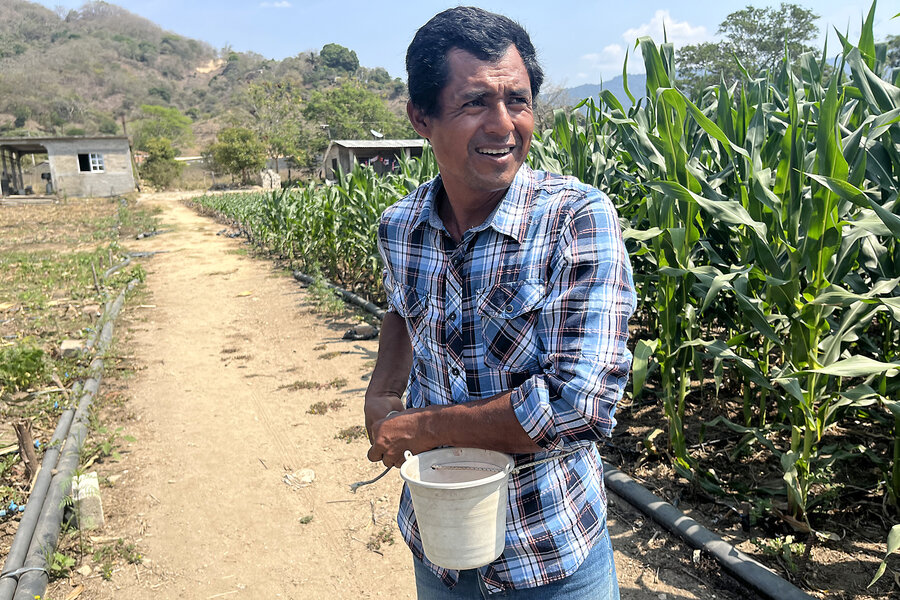
Photo: Whitney Eulich.
Fernando Matus Hernández ties a small bucket filled with heirloom corn kernels around his waist before planting them on his family’s farm in Oaxaca, Mexico.
Small farms like his are an endangered species.

Agricultural capitalism is making it hard for small farms to survive, but so are some environmental regulations, normally a public good. How can we protect both the environment and the small farms that feed us?

At the Christian Science Monitor, Erika Page, Whitney Eulich, and Srishti Jaswal have an in-depth report on the challenges facing farmers today.

“Julie De Smedt tries not to picture her future too often. When she does, she has trouble imagining herself anywhere but here, planted on this stretch of fertile land that runs from her childhood home to the River Scheldt.

“Her family’s cattle ranch is the last farm left on this sleepy Belgian country road. If she were a statistic, she would have left for the city. But at 21 years old, she’s made up her mind.

“ ‘I want to take over the farm,’ says Ms. De Smedt, who lives doors down from her grandparents and cousins on both sides. ‘I don’t want to be anywhere else.’

“But she knows how unlikely her dream is. Sometime soon, all her family farm’s land will be converted into a nature reserve. The European Union is pushing to restore ecosystems in the face of widespread environmental degradation, which contributes to climate change, so the state has expropriated their land.

“The family is not against green policies. ‘There has to be nature, and there have to be people who defend nature,’ says Wendy Vasseur, Ms. De Smedt’s mother, looking through the back door of a cow barn at the line of trees that marks the boundary of the future reserve. But nobody seems to care what will become of their family and the life they have built on this land, they say. …

“Small-farm owners around the globe, in fact, are feeling that same sense of helplessness. From Germany and Spain to India and Canada, farmers are rising up to protest not only burdensome new environmental regulations but also the impact of corporate mega-farms and cheap food imports, which have caused their costs to rise and their profits to fall dramatically. So, many around the world have driven their tractors into capital cities, sometimes spraying manure on city streets and sidewalks. They’ve blocked major freeways, set fires in urban metro stations, and demanded changes to policies that, to them, feel like death sentences. 

“ ‘What they want is a decent living,’ says Morgan Ody, general coordinator of La Via Campesina, an international small-farmers organization. ‘What they want is respect for their work.’

It would be a mistake, she says, to see the latest wave of protests as simply right-wing backlash against the green agenda.

“True, some farmers oppose green policies on political grounds, but many support them. As rural areas lose population, farmers on every continent say they are being sacrificed to meet the demands of a society that no longer values the people who feed it. …

“A cow and a pig were all Ms. De Smedt’s grandfather needed to open this farm in the 1950s. As agriculture intensified and industrialized, the farm, too, grew. Today, the wooden barns the family built itself hold 250 cattle, whose meat is sold mainly to French grocery chain Carrefour. 

“They fatten their cows on corn and beets they grow on the land destined for the nature reserve. And they will continue for as long as they can, Ms. Vasseur says. But it is a perpetual battle to keep the farm going, and Ms. Vasseur has to work a full-time job at a nearby factory to make ends meet.

“The price they can charge for their beef has not kept up with the rising costs of inputs such as fertilizer and pesticides needed to keep poisonous weeds at bay. Now, the family business has to deal with rules governing crop rotation and fallow land. …

“Their story has repeated itself around the world for decades, says Timothy Wise, a researcher and senior adviser at the Institute for Agriculture and Trade Policy, an international nonprofit that promotes sustainable food production. ‘Bigger farms get bigger, and smaller farms disappear. Rural communities just get hollowed out.’ 

“Between 2005 and 2020, the EU lost nearly 40% of its farms and over 5 million farmers, most of them smallholders. At the same time, the amount of land being farmed has stayed the same. …

“That isn’t how Lieven Nachtergale wants things to end. As coordinator of the Sigma Plan, the project responsible for Belgium’s new nature reserve, Mr. Nachtergale does not enjoy removing farmers from their land. He does, however, think it’s necessary: Natural habitats in the densely populated region of Flanders have been badly degraded, and floods pose a growing risk. In such cases, the needs of the land, if not the planet, must take precedence.

“But the real problem he sees is a model of intensified agriculture that has become so disconnected from the natural world. Fields treated with herbicides, pesticides, and heavy doses of fertilizer leave native species next to no room to thrive, he says. 

“The EU’s Nature Restoration Law requires countries to restore 30% of their natural ecosystems by 2030 and 90% by 2050. Mr. Nachtergale’s team is helping Flanders establish 36,000 hectares (almost 90,000 acres) of nature reserve, the equivalent of 5% of the land area being farmed.

“Over the years, he has grown increasingly interested in figuring out how nature and agriculture might better work together. He is working on a pilot project that would give farmers who want to produce in a ‘nature-inclusive’ way 2 hectares of land (5 acres) for every hectare of their own that they contribute. The goal is to restore ecosystems while keeping family farmers on the land. 

“ ‘We will need farmers in the future to do this kind of management,’ he says. But he recognizes the challenge of competing with bigger industrialized farms. ‘If we want to change the system and give the farmers a better future, I think we should pay more for what they are producing.’ “

More from farmers around the world at the Monitor, here. No paywall. Subscriptions welcome.

Read Full Post »

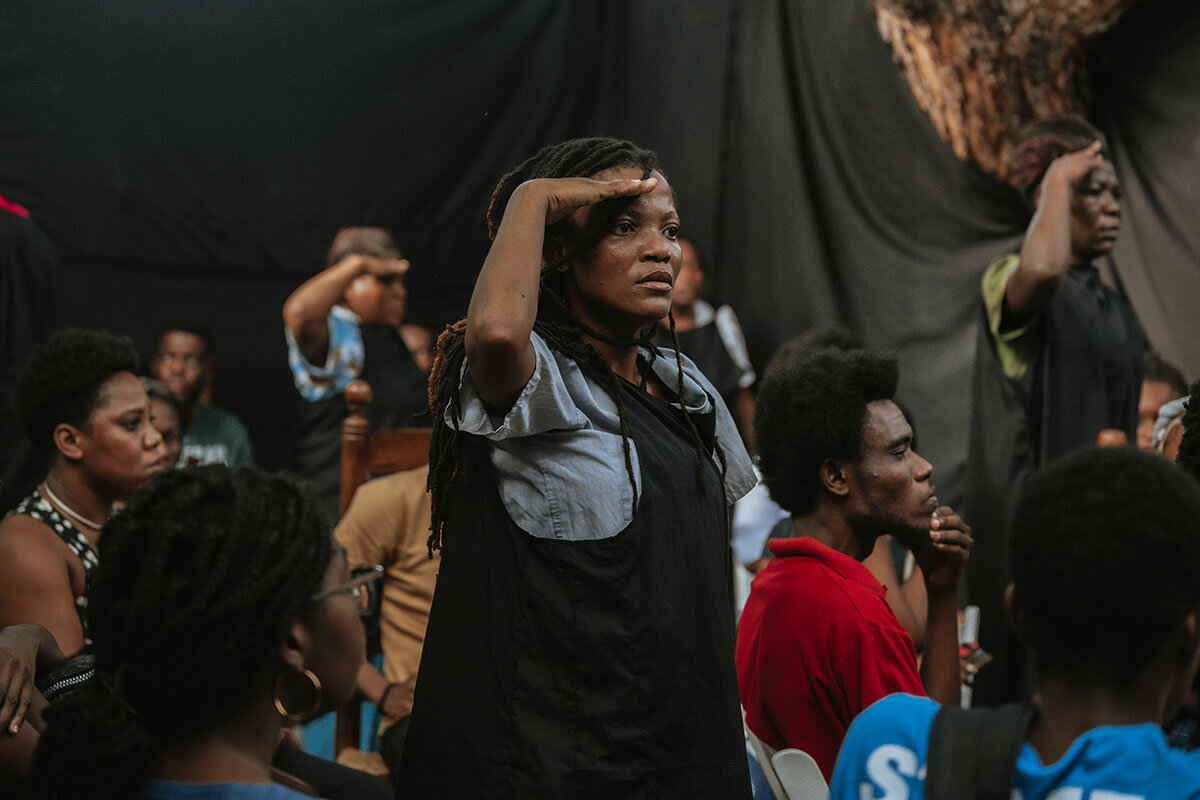
Photo: Victoria Onélien/Special to the Christian Science Monitor.
An immersive experience, “Dechouke Lanfè sou Latè” is performed within the audience and features formerly incarcerated women as well as actors to bring home the brutal reality of Haitian prisons. The Quatre Chemins theater festival took place in Port-au-Prince, Haiti, from Nov. 21 to Dec. 3, 2022.

Man, the resilience of the human spirit! Or maybe it’s stubbornness, not resilience. Doesn’t matter. Let us now praise whatever keeps people going in impossible circumstances. In Haiti. for example.

Websder Corneille reports at the Christian Science Monitor, “On a sunny afternoon, some 60 people gather in the small courtyard of Yanvalou Café, the unofficial home of Haiti’s theater scene. It’s the opening of the 19th annual Quatre Chemins (Four Paths) theater festival, but the fact that there’s a full house was never a given.

“For the past three years, Port-au-Prince, Haiti’s capital, has been overrun by criminal gangs. They’ve increasingly terrorized citizens, … blocking freedom of movement since the assassination of President Jovenel Moïse in July 2021. Many citizens have fled their homes in recent months, seeking safety elsewhere – in some cases camping out in public parks because their neighborhoods have become so dangerous.

“ ‘This city is scary these days,’ says Évens Dossous, an educator who came to see the reading of ‘Port-au-Prince et sa Douce Nuit (Port-au-Prince and Its Sweet Night),’ a new play by award-winning Haitian playwright Gaëlle Bien-Aimé. Before leaving home this afternoon, ‘I asked myself, “Is it really worth traveling? Will I be kidnapped?” ‘

“Art, and specifically theater, have a rich history of political resistance in Haiti. Although the unprecedented climate of insecurity has more to do with a vacuum of leadership – there have been no elections since 2016 – than with the overt oppression and censorship that citizens faced under dictatorships in the past, the crowd at Yanvalou today is a reminder that theater remains an act of defiance.

“ ‘You know, life can’t just be about insecurity,’ says Mr. Dossous.

“Colorful murals of well-known artists and thinkers cover the cement walls at Yanvalou, including singer Nina Simone, Haitian dancer Viviane Gauthier, and national anthropologist Jean Price-Mars. The audience at the opening in November makes its way from the courtyard into the restaurant, where chairs are set up facing two lecterns.

“The reading focuses on the lives of two young people, madly in love, in a home in Pacot, a wooded, formerly upscale neighborhood in the heart of Port-au-Prince. It underscores many real-life challenges, like the fragile state of the capital and the difficulty of leaving the house to get food, travel, or go to school or work. But it also dives into bigger questions, such as how to love – oneself and others – when a city is collapsing around you.

“ ‘Theater helps me ask questions about my life,’ says Ms. Bien-Aimé, the playwright, who was the second Haitian in a row to win the prestigious RFI Theatre prize, awarded to emerging Francophone artists. Theater ‘is a living art,’ she says.

“Since the assassination of President Moïse, armed gangs have taken control of some 70% of the capital. … Some 20,000 Haitians are facing starvation, according to the United Nations, the vast majority of whom are located in the capital.

“The insecurity, which includes using sexual violence as a weapon, has led to widespread displacement. Kidnappings increased by nearly 45% in Port-au-Prince in the second quarter of 2022, according to the National Network for the Defense of Human Rights, a Haitian nongovernmental organization. Many believe the gangs are protected by police, politicians, and business elite.

“ ‘The state has agreed to retreat so that armed groups can control the society,’ says Sabine Lamour, a Haitian sociologist at the State University of Haiti, citing research by Haiti’s leading human rights organization, the National Human Rights Defense Network. …

“Micaëlle Charles, the actor reading the lead role of Zily in today’s play, says a lot has changed in Haitian theater over the past three years. She and the entire team putting on today’s show take security precautions she never considered before, such as sleeping over at the rehearsal space. ‘This helps me to hold on, despite the problems in the country or any other problems life might throw my way,’ she says of her passion for the craft. …

“Using theater for social or political commentary isn’t unique to Haiti, but it has a long tradition here. Theater is ‘a weapon of mass awareness that gives the spectator the means to free themselves,’ wrote Félix Morisseau-Leroy in 1955. He was one of the nation’s first writers to create plays in Haitian Creole. Under the Duvalier regime, a father-son dictatorship that ruled Haiti for three decades starting in 1957, Mr. Morisseau-Leroy and others were targeted and exiled for their social commentary and what was perceived as anti-government messages in plays and literature.

“The Duvalier reign was characterized by violence and the suppression of free expression. One of Mr. Morisseau-Leroy’s most prominent works was his Haitian Creole translation of the Greek tragedy ‘Antigone.’ … It was an act of resistance for its message – and its use of the language of the masses. …

“Joubert Satyre, an expert on Haitian theater, told the Christian Science Monitor [that] theater in Haiti plays an important role in social and political struggles. He said, ‘It is this liberating and critical side of the theater that has made it, and that still makes it, suspect in the eyes of autocrats.’ 

“Not that the government is paying much attention to the arts in recent years, says Ms. Bien-Aimé. She’s firmly engaged in a ‘theater of protest,’ she says, but isn’t sure her artwork frightens the government as much as her outright activism. … ‘Today, the state doesn’t even go to the theater,’ she says.”

More at the Monitor, here. No firewall.

Meanwhile, in war-torn Ukraine, theater has gone into living rooms. See a New Yorker story about that.

Read Full Post »

Photo: Abelardo Morell.
“2016–Flowers for Lisa #30” (2016) at Edwynn Houk Gallery.

Lauren Moya Ford at Hyperallergic asks, “Can photographers capture the vitality of flowers compellingly, innovatively, and beautifully?” She reviews a new book that answers the question in the affirmative.

“In the late 1830s,” writes Ford, “the Welsh botanist John Dillwyn Llewelyn began making photographs of orchids he’d grown at his home near Swansea. Llewelyn’s pictures are thought to be among the first to use the photographic process to identify plant specimens, though he himself found them lacking. ‘I have amused myself with making Daguerreotype [sic] portraits [of several flowers], and from their exact accuracy they are interesting,’ he wrote in an 1842 letter to the director of London’s Kew Gardens, ‘though the want of color prevents them from being beautiful as pictures.’ …

Flora Photographica: The Flower in Contemporary Photography by William A. Ewing and Danaé Panchaud (Thames & Hudson, 2022), features 200 photos taken over the past 30 years. The lavishly illustrated book follows its 1991 predecessor, which covered the period from 1835 to 1990. The newest edition features more than 120 artists from 30 countries working with digital and analog photography in a variety of modes, including performance, collage, and textiles. 

“Some of the most provocative images come from artists who use flowers to take on today’s pressing political and social issues.

In the book’s first photo, taken at the 2020 Belarus protests by the Polish photojournalist Jędrzej Nowicki, we see the hand of a demonstrator gripping a small bouquet of white flowers tied with white ribbon, the color of the opposition.

“ ‘The Pansy Project’ by Paul Harfleet documents single pansies that the artist plants at the site of homophobic abuse. And Thirza Schaap’s brightly-colored, modern-day vanitas ‘Plastic Ocean Series’ features floral still lifes made of discarded waste. …

“Other photos are personal, documentary, and playful. Some of Ewing and Panchaud’s selections riff on the way flowers have been depicted in the past, while others push in new directions. Flowers are a well-worn subject matter in the history of art, appearing in human production well before Llewelyn’s snaps in the 19th century. This book shows that they remain a powerful springboard for visual experimentation and meaning.”

I have chosen to illustrate this post with Abelardo Morell‘s photo both because I like it and because Abe and his wife were friends of my late sister. Nell knew them decades ago at Columbia University, when as a relatively recent immigrant from Cuba, Abe was doing menial jobs and thinking he might like to take up photography. The rest is history. Now his photographs are collected in museums.

More at Hyperallergic, here. Read about Abe here. He’s an interesting guy.

Read Full Post »

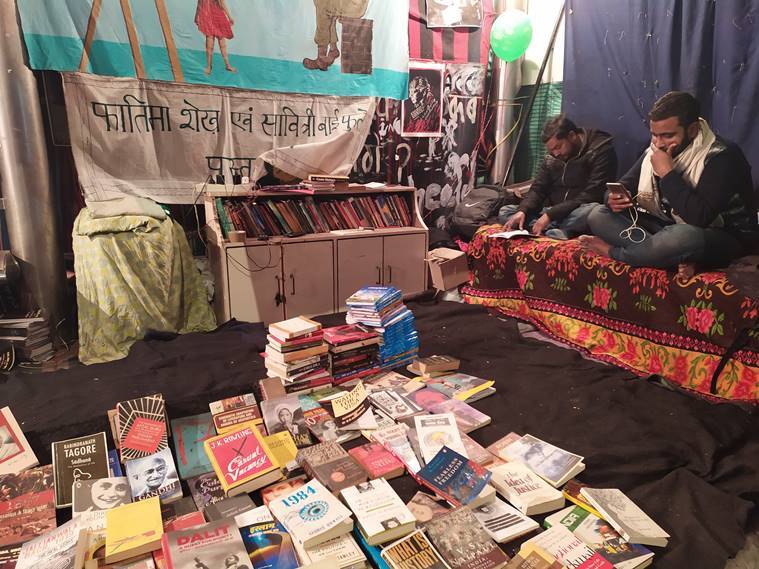
Photo: Anamni Gupta/Indian Express.
One aspect of the 2019 Shaheen Bagh protest organized by Muslim women against India’s Citizenship Amendment Act was the emergence of free libraries.

Most Americans don’t keep track of politics in India, but it was hard to miss the news back in 2019 when the Modi government decided to change the rules about who could be counted as a citizen. Muslim women organized a protest that spread across the country from the original site in Shaheen Bagh. One aspect has remained.

As Harshvardhan reported at India’s National Herald in January, “The Shaheen Bagh protest site is gone, but its legacy continues to inspire those who dream of a more egalitarian and democratic India. Led mostly by Muslim women, the Shaheen Bagh protest site inspired one of the most aesthetically-pleasing and thought-provoking experiments with protest art in recent times. Walls and streets of Jamia Millia Islamia and Shaheen Bagh protest site exploded with creativity as students and artists camped there and experimented with ideas. …

“One of the most distinctive contributions of the Shaheen Bagh movement was the introduction of a ‘protest site library.’ The idea of a ‘protest library’ came up during the Occupy Wall Street protest, one of the largest popular demonstrations in the United States. Occupy protesters erected a tent and established a ‘People’s Library’ in Manhattan’s Zuccotti Park in November 2011. This one of its kind library held over 5000 volumes of books along with magazines and newspapers, and was finally razed down by the police.

“Since then, the concept of a ‘People’s Library’ captured the imagination of protesters all across the world. It travelled to Gezi Park in Istanbul in 2013 when people resisted the commercialisation of public spaces. Make-shift libraries cropped up in different parts of Spain during the anti-austerity 15-M movement (2011-15) and then it travelled to Hong Kong during the pro-democracy movement there.

“At Shaheen Bagh, a group of students decided to convert a bus stand into a makeshift library in the heydays of the anti-CAA protests [CAA stands for the Citizenship Amendment Act of 2019]. The ‘Fatima Sheikh Savitribai Phule Library’ captured the imagination of people and soon the make-shift library started to attract a lot of donors and also inspired similar libraries at different anti-CAA protest sites.

“The year 2020, an otherwise gloomy year dominated by the COVID-19 pandemic … ended on a high note with the farmers’ uprising against the three farm bills, passed by the BJP-controlled Parliament in haste. … By blocking the entry points of nation’s capital, farmers are actually attempting to block the privatization and corporatization of Indian economy. Along with that, the protests are also a powerful assertion of the right to dissent. …

“It is but natural that such a huge protest in terms of both mobilization and concerns will also develop into a rich site for cultural production enriching the protest repertoire of the country. In one of the most innovative moves, protesting farmers launched their own bi-weekly newspaper. … They also set up libraries at the protest sites. [It] clearly carried on the legacy of the Shaheen Bagh protests. Now, we can be sure that protest site libraries are going to feature every time there is a sustained peoples’ movement.

“The first library came up at Tikri Border, Pillar no 783. On December 22 [2020], a group of students began the ‘Shaheed Bhagat Singh Library’ with a single book stand with almost 200 books standing against a yellow tent. Farmers at Tikri border welcomed the idea and people could be seen browsing through the limited books available there. Soon the idea picked up and similar libraries came up at Singhu border as well as Ghazipur border while attempts were being made to establish one at Shahjahanpur border. …

“From the anti-CAA movement to the anti-farm law movement, the protesters have been accused of being ‘uneducated’ and … of ‘not having ‘read the law’ or ‘not knowing what they are protesting against or for.’ …

“The protest-site libraries stand as proof that these people are not ‘uneducated folks’ [but] are mature enough to develop a concrete socio-economic-political understanding and act upon it.”

More at the National Herald, here. Search Suzanne’s Mom’s blog on the word “library” for examples of other unusual libraries around the world.

Read Full Post »


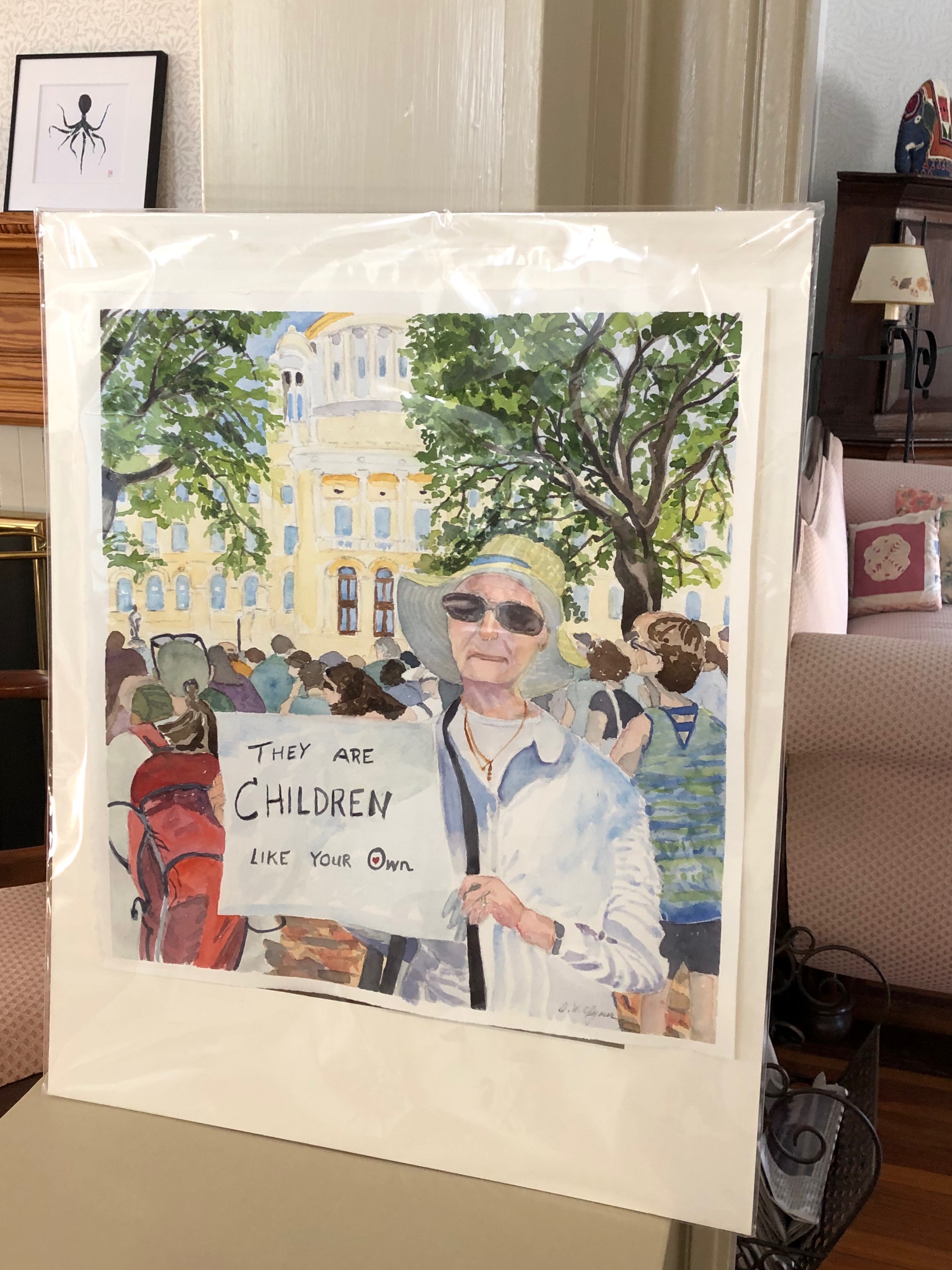
Diana-Clymer-painting-of-blogger-in-June-2018-RI-Statehouse

Something surprising happened the other day. Diana showed up with a portrait of me that I had no idea she was working on.

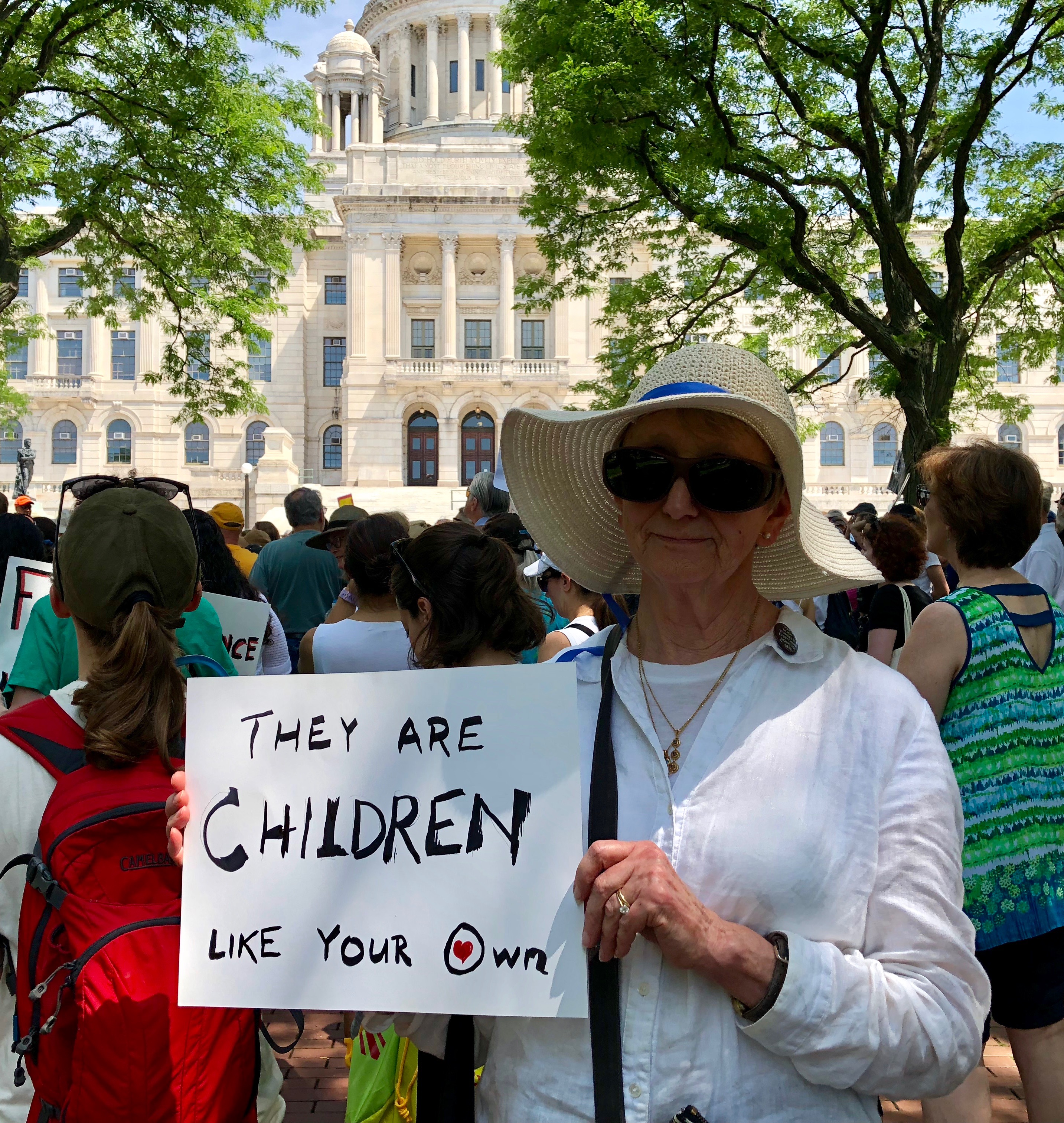
The teacher in her watercolor class had assigned the topic “umbrage.” Paint umbrage. My friend thought, How on earth? Then she remembered a photo I sent her in June after a #familiesbelongtogether protest. She decided to incorporate the “shade” meaning of umbrage with the “angry” meaning — the trees with the protest. I love the colors in this — and the light and shadow.

I’m including a couple other light and shadow themes today. My sister and I both took photos of frost on our windows. The main difference: her frost is on the inside! As much as she loves her New York apartment, the time has come for new windows. The landlord is finally interacting with the city as the historic building needs special permits for new windows.

Sandra M. Kelly caught the sunset at my favorite island. I love how the sun streams down through the clouds.

The next shot shows how the late afternoon light hits the river birches outside the library. That was the view behind the poets at the last poetry reading. It took me a few days to find the sun at that angle again so I could come back for a picture.

We had a lot of birds near our feeder during the recent polar vortex. Also squirrels. Maybe a rabbit. Can you read tracks? I would love to know if I had a rabbit.

My granddaughter (red shirt) chose an ice-skating theme for her birthday party this year, making good use of the backyard rink.

Janet Schwartz painted the lovely rainy traffic scene in a recent show at Concord Art. And John Brickels is the artist behind the collapsing house. Hmmm. Is that a metaphor for anything?

013119-indoor-frost-NYC

013119-frost-ivy-window-dawn

013019-Sandra-M-Kelly-sunset-from-heaven

020819-river-birch-library-window-2

020119-bird-tracks-in-snow

020319-birthday-girl-on-ice

012719-Concord-Art-Janet-SchwartzJPG

012719-Concord-Art-John-Brickels

063018-rally-for-separated-families


Read Full Post »

Photo: Caiaimage/Robert Daly
Canadian doctors who want less pay think the money would be better spent elsewhere.

At first blush, it seems counterintuitive that doctors would reject more money, but like the Oklahoma teachers who went on strike after getting a raise, they were concerned about the priorities of the whole system.

Catherine Clifford reports at CNBC, “In Canada, more than 500 doctors and residents, as well as over 150 medical students, have signed a public letter protesting their own pay raises.

” ‘We, Quebec doctors who believe in a strong public system, oppose the recent salary increases negotiated by our medical federations,’ the letter says.

“The group say they are offended that they would receive raises when nurses and patients are struggling.

” ‘These increases are all the more shocking because our nurses, clerks and other professionals face very difficult working conditions, while our patients live with the lack of access to required services because of the drastic cuts in recent years and the centralization of power in the Ministry of Health,’ reads the letter, which was published February 25. …

“Canada has a public health system which provides ‘universal coverage for medically necessary health care services provided on the basis of need, rather than the ability to pay,’ the government’s website says.

“The 213 general practitioners, 184 specialists, 149 resident medical doctors and 162 medical students … ‘believe that there is a way to redistribute the resources of the Quebec health system to promote the health of the population and meet the needs of patients without pushing workers to the end,’ the letter says.

” ‘We, Quebec doctors, are asking that the salary increases granted to physicians be canceled and that the resources of the system be better distributed for the good of the health care workers and to provide health services worthy to the people of Quebec.’ …

“On February 1, the [Médecins Québécois pour le Régime Public] published a letter denouncing working conditions of nurses. ‘The nurses are exhausted by a heavy workload. They argue that the chronic lack of staff and the fatigue caused by repeated overtime, sometimes mandatory, for lack of replacement of the team, have an impact on the safety of patient care,.’ ”

More here, at CNBC. I’m impressed by how well these doctors appreciate that overworking nurses and staff can interfere with their own jobs — and with patient outcomes.

Read Full Post »

Yesterday’s NY Times Dining section had a delightful story about all the food being delivered to Occupy Wall Street. Donations have come from far and wide, and people have self-organized to distribute it and do the washing up. The story is here.

“Requests for food go out on Twitter and various Web sites sympathetic to the protesters. And somehow, in spontaneous waves, day after day, the food pours in. …

“Platters and utensils are washed on site. The soapy runoff slides into a gray-water system that’s said to draw impurities out through a small network of mulch-like filters. …

“Members of the [food] crew sometimes fail to show up in the morning because they were arrested the night before. (Then again, as many a chef will tell you, that happens in a lot of restaurants.)” …

“Telly Liberatos, 29, the owner of Liberatos Pizza on Cedar Street in the Financial District, said he has received orders from places like Germany, France, England, Italy and Greece, as well as every region of the United States.

“ ‘It’s been nonstop,’ he said. ‘The phones don’t stop ringing. People from California order the most at one time.’ Someone from the West Coast had called in the biggest delivery: he wanted 50 pizzas dispatched to the park.”

You might enjoy knowing that Asakiyume’s blog offers music suggestions for the 99 percent. Check it out. (I borrowed the picture from downtownmonks.blogspot.com.)

Read Full Post »