Feeds:
Posts
Comments

Posts Tagged ‘refugee’

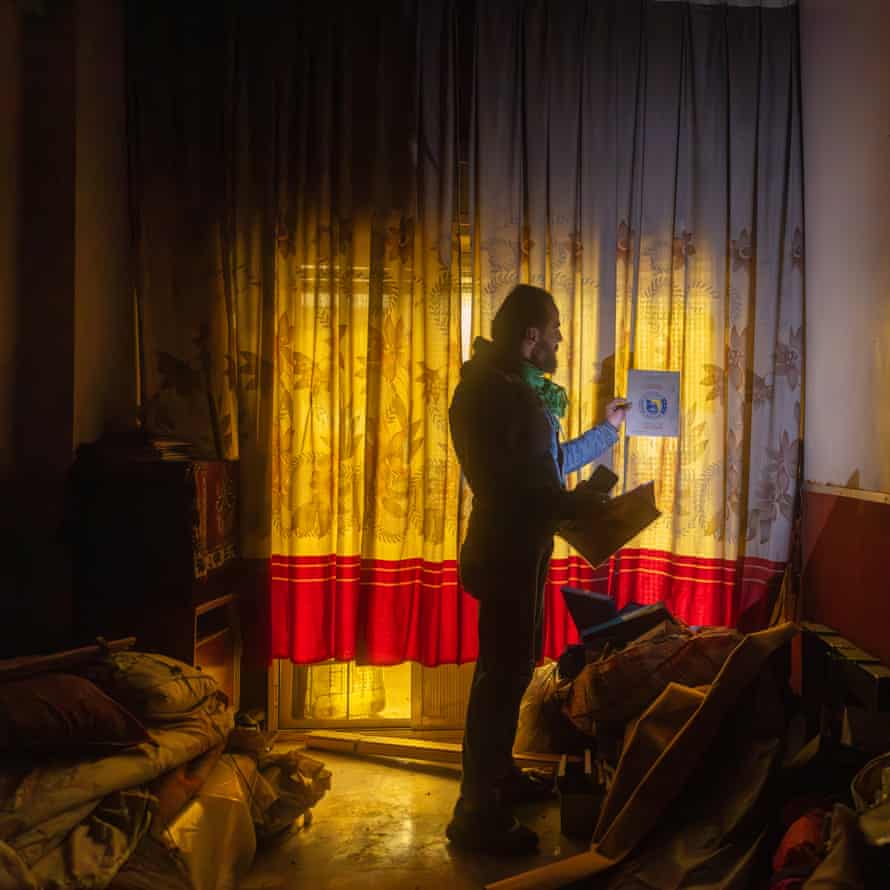
Photo: Alexandra Corcode.
Mohamad searching for memories in a suitcase in Damascus. Their apartment was a stage — until the Assad government arrested them.

In today’s post, we learn more about how people living under repressive regimes keep culture and freedom going.

Andrei Popoviciu writes at the Guardian, “Thick layers of dust shimmer in sunlight as Mohamad and Ahmad Malas sift through old belongings in their Damascus apartment, abandoned for 14 years. …

“On one of the walls portraits of their father and one of their brothers, who have died, hang frozen in time. There’s no electricity so they use their phone torches to light their way as they collect personal artifacts they long forgot about.

“ ‘Looking around brings back so many memories,’ Mohamad says. ‘It’s painful.’

“For the 41-year-old brothers, returning to their flat is bittersweet. Their apartment was more than just a home. It was once a stage, a space where they performed original theatre plays away from the watchful eye of the Bashar al-Assad regime, which tightly controlled and censored artistic expression. In the two years before they left Syria, they performed more than 200 plays in their home.

“But their lives changed in 2011 when they were arrested for participating in the popular movement that started on the heels of the Arab spring and sought to remove Assad from power. Ahmad was wanted by the political police for sharing a revolutionary magazine with a friend, so the day security forces came knocking he fled immediately. Mohamad stayed behind to gather a few belongings before they escaped to Lebanon.

“Life there was uncertain, with Syrians facing the constant threat of deportation. Egypt offered brief stability, despite them feeling they could not continue their work as actors. Europe was where they felt they could freely perform with no censorship or threat. In 2013, they arrived in France as asylum seekers and speaking no French.

“Their first year in France was a struggle, spent moving from city to city, unable to work and battling to learn the language. Eventually, they were granted asylum and settled in Reims, in the country’s north-east. There, they rebuilt their acting careers, landing roles in theatre plays, films, and television.

“As they found their footing, they wrote and performed a play, The Two Refugees, chronicling the experience of refugees in France and inspired by their story. The production was a success and gained international recognition, taking them from Iraq to Japan and Jordan, often with the support of French cultural institutions.

“ ‘France gave us security and a chance to continue our art in a free world,’ said Ahmad. …

“They never imagined they would return to Syria. But as rebel forces were taking city by city, advancing toward Damascus in late 2024, they closely followed events from afar. Mohamad was at a film festival in Jordan; Ahmad was in France.

“On the morning of 8 December, Mohamad sent Ahmad a video. It showed people celebrating in a Damascus square, waving the revolution’s green flag and singing slogans against Assad. Ahmad could hardly believe his eyes. A deep longing stirred within them both. Soon after, Mohamad traveled from Jordan, and Ahmad followed from France.

“ ‘It felt like a dream come true,’ said Mohamad of the moment they entered Syria. ‘We felt like we could fly, it was surreal to walk through the streets and not see Assad’s photos everywhere.’ …

“The brothers knew they had to bring their play home, so they started performing it across the country, from Aleppo in the north to the coastal city of Tartus. They were unsure how an audience that had never left would react to a story of exile.

“ ‘Everyone understood it,’ Mohamad said. ‘I get it now – because even though they never left, they felt trapped in their own country.’ “

More at the Guardian, here. No paywall. Nice pictures.

Read Full Post »

Photo: AP/Amr Nabil.
Sudanese Camirata troupe founder Dafallah el-Hag at the Russian cultural center in Cairo, Egypt, this past September.

There is too much war going on.

I struggle to think what alternative Ukraine had after an invasion, but I wish there had been some less lethal way to kick the invader out. In the Middle East, the fighting has gone on beyond anything the world at large can condone. And there are endless ethnic wars in places like Myanmar and Sudan that pain me to think about.

Today’s little story about cheering up Sudanese refugees through art will seem like a feeble attempt to find something positive, but to those who have been touched by the music of kindness, even a tearful, grateful moment can be valuable.

Fatma Khaled wrote recently for the Associated Press (AP), “As the performers took the stage and the traditional drum beat gained momentum, Sudanese refugees sitting in the audience were moved to tears. Hadia Moussa said the melody reminded her of the country’s Nuba Mountains, her family’s ancestral home.

“ ‘Performances like this help people mentally affected by the war. It reminds us of the Sudanese folklore and our culture,’ she said.

Sudan has been engulfed by violence since April 2023, when war between the Sudanese military and the paramilitary Rapid Support Forces broke out across the country. The conflict has turned the capital, Khartoum, into an urban battlefield and displaced 4.6 million people, according to the U.N. migration agency, including more than 419,000 people who fled to Egypt.”

[Think about that, a flight to Egypt.]

“A band with 12 Sudanese members now lives with thousands of refugees in Egypt. The troupe, called ‘Camirata,’ includes researchers, singers and poets who are determined to preserve the knowledge of traditional Sudanese folk music and dance to keep it from being lost in the ruinous war.

“Founded in 1997, the band rose to popularity in Khartoum before it began traveling to different states, enlisting diverse musicians, dancers and styles. They sing in 25 different Sudanese languages. Founder Dafallah el-Hag said the band’s members started relocating to Egypt … as Sudan struggled through a difficult economic and political transition after a 2019 popular uprising unseated longtime ruler Omar al-Bashir. …

“The band uses a variety of local musical instruments on stage. El-Hag says audiences are often surprised to see instruments such as the tanbour, a stringed instrument, being played with the nuggara drums, combined with tunes of the banimbo, a wooden xylophone. …

“Kawthar Osman, a native of Madani city who has been singing with the band since 1997, feels nostalgic when she sings about the Nile River, which forms in Sudan from two upper branches, the Blue and White Nile.

“ ‘It reminds me of what makes Sudan the way it is,’ she said, adding that the war only ‘pushed the band to sing more for peace.’

“Over 2 million Sudanese fled the country, mostly to neighboring Egypt and Chad, where the Global Hunger Index has reported a ‘serious’ level of hunger. …

“Living conditions for those who stayed in Sudan have worsened as the war spread beyond Khartoum. Many made hard decisions early in the war either to flee across frontlines or risk being caught in the middle of fighting. In Darfur, the war turned particularly brutal and created famine conditions. …

“Armed robberies, lootings and the seizure of homes for bases were some of the challenges faced by Sudanese who stayed in the country’s urban areas. Others struggled to secure food and water, find sources for electricity and obtain medical treatment since hospitals have been raided by fighters or hit by airstrikes. Communications networks are often barely functional.

“The performers say they struggle to speak with family and friends still in the country, much less think about returning. ‘We don’t know if we’ll return to Sudan again or will see Sudan again or walk in the same streets,’ Farid said.” More at AP, here.

During this tragic war, very little aid has gotten through, although nonprofits like Alight, one of my favorites, are always poised to help. Rachel Savage at the Guardian wrote that on Christmas, the first successful shipment since the war started a year and a half ago finally got through.

She wrote, “An aid convoy has reached a besieged area of Khartoum for the first time since Sudan’s civil war broke out in April 2023, bringing food and medicines in a country where half of the people are at risk of starvation.

“The 28 trucks arrived in southern Khartoum on 25 December, according to the World Food Program (WFP), which provided 22 trucks loaded with 750 tons of food.

“Unicef sent five trucks with medicines and malnutrition kits for children, while Médecins Sans Frontières (MSF) [Doctors Without Borders] contributed one truck of medical supplies, according to the Khartoum State Emergency Response Room (ERR), a grassroots aid group that is helping to coordinate the distribution.

“Sheldon Yett, Unicef’s Sudan representative, said: ‘Access to the area has been essentially cut off due the conflict dynamics. It took three months of often daily negotiations with government authorities at all levels and with other parties who controlled the access.’ ” More at the Guardian, here.

Read Full Post »

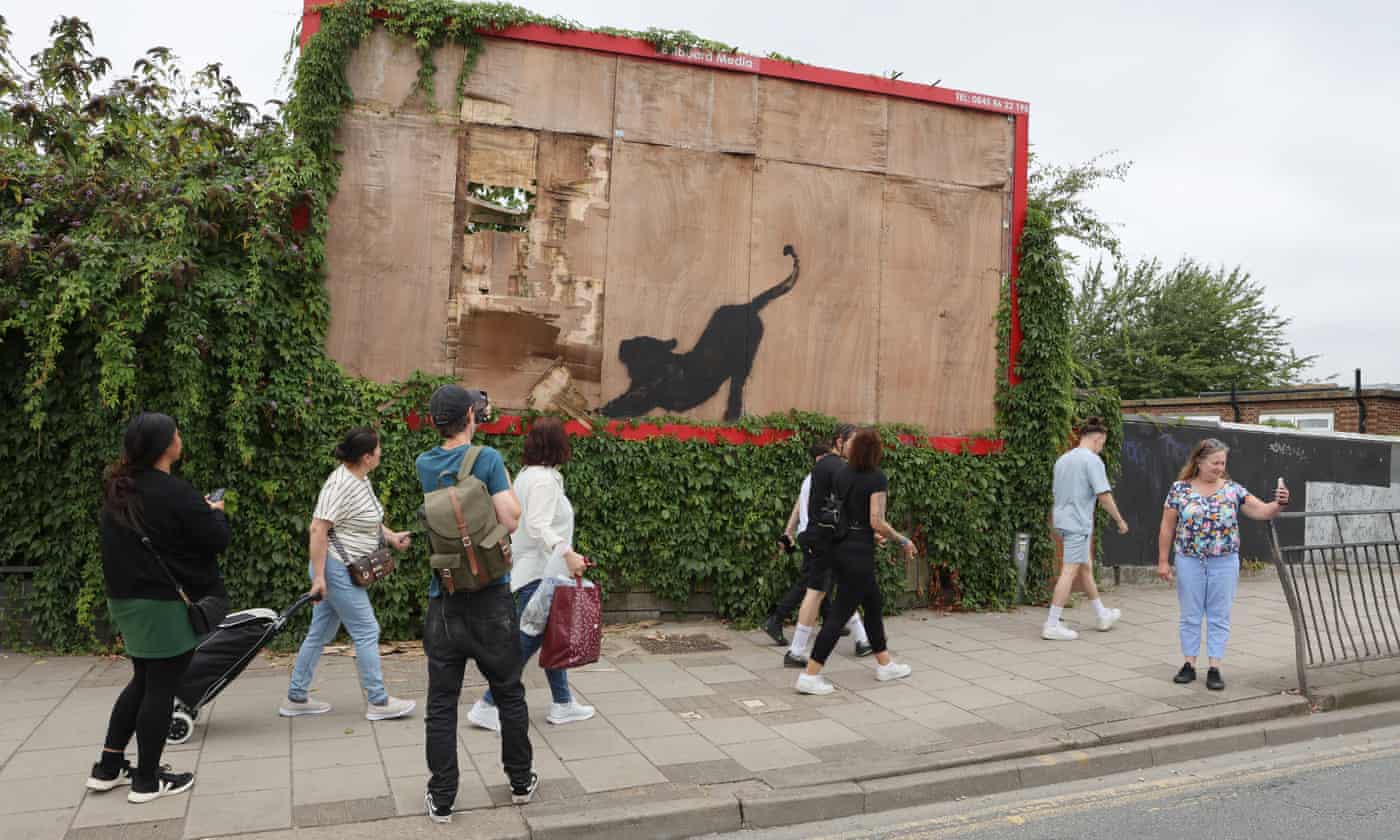
Photo: Andy Hall/The Observer.
The Banksy cat mural in Cricklewood, north-west London, before the billboard was removed last summer.

I love the stealth artworks of Banksy and have taken a few photos of murals that could have been his, except that they were in Boston and New York.

People love guessing what the pieces mean, what his angle is.

At the Guardian last August, Vanesa Thorpe demonstrated that Banksy’s views are increasingly transparent.

“A big cat by Banksy appeared briefly, ­stretching in the morning sun, on a bare advertising hoarding on Edgware Road in Cricklewood, north-west London, on Saturday. A few hours later,” Thorpe writes, “it had gone, removed by contractors who feared it would be ripped down.

“The anonymous artist known as Banksy, who confirmed the image was his at lunchtime on Saturday, also promised a little more summer fun to come. …

“For a week now, the streets of the capital have been ­populated by a string of unusual animal sightings, courtesy of Banksy, ­including ­pelicans, a goat and a trio of monkeys.

“The artist’s vision is ­simple: the latest street art has been designed to cheer up the public ­during a period when the news headlines have been bleak. … Banksy’s hope, it is understood, is that the uplifting works cheer ­people with a moment of unexpected ­amusement, as well as to ­gently underline the human capacity for ­creative play, rather than for destruction and negativity.

“Some recent theorizing about the deeper significance of each new image has been way too involved, Banksy’s support organization, Pest Control Office, has indicated.

“When a goat teetering on a ­precipice first appeared on Monday near Kew Bridge, in south-west London, some thought it might be a symbol of humanity’s folly. Others speculated it might be a visual pun on the idea of the goat, now standing for ‘greatest of all time’ in popular parlance.

“On Tuesday, two silhouetted elephant heads popped up, their trunks reaching out to each other through the bricked-up windows of a house in Chelsea.

“Next came perhaps the most joyous so far when a trio of monkeys was revealed on Wednesday, swinging their way across a bridge over Brick Lane in east London.

“On Thursday, an outline of a howling lone wolf, painted on to a large satellite dish on a roof in Peckham, was removed by two masked men with a ladder, who made off with their prize. …

“On Friday, a pair of hungry pelicans appeared above a Walthamstow fish and chip shop on a corner of Pretoria Avenue, their long beaks snapping at fish. …

“While Banksy’s new menagerie has been springing up, the rescue boat the artist funds has been working to help endangered asylum seekers to reach safety. The M V Louise Michel, a high-speed lifeboat, patrols migrant routes in the Mediterranean.

“It has picked up at least 85 ­survivors in the past couple of days, taking them safely to Pozzallo, Sicily. … Five years ago, Banksy announced that he would finance the vessel, named after a French feminist anarchist, with the intention of rescuing refugees in difficulty as they fled north Africa.

“In June, at Glastonbury, an inflatable migrant boat created by Banksy was used to crowdsurf during performances by Bristol indie punk band Idles and rapper Little Simz. The Conservative home secretary at the time, James Cleverly, said the artist was ‘trivializing‘ small boat ­crossings and ‘vile.’

“Banksy responded that the detention of the Louise Michel by Italian authorities at the time was the really ‘vile and unacceptable’ development.

“His latest street art, however, is deliberately lighthearted, like Banksy’s lockdown series the Great British Spraycation of 2020. Banksy’s seaside series also memorably featured chips, with an image of a seagull hovering over oversized ‘chips.’ …

“Another image from the lockdown campaign made reference to the ­refugee crisis. It showed three children sitting in a rickety boat made of scrap metal. Above them, Banksy had inscribed: ‘We’re all in the same boat.’ “

More at the Guardian, here. No paywall. Delightful photos.

Read Full Post »

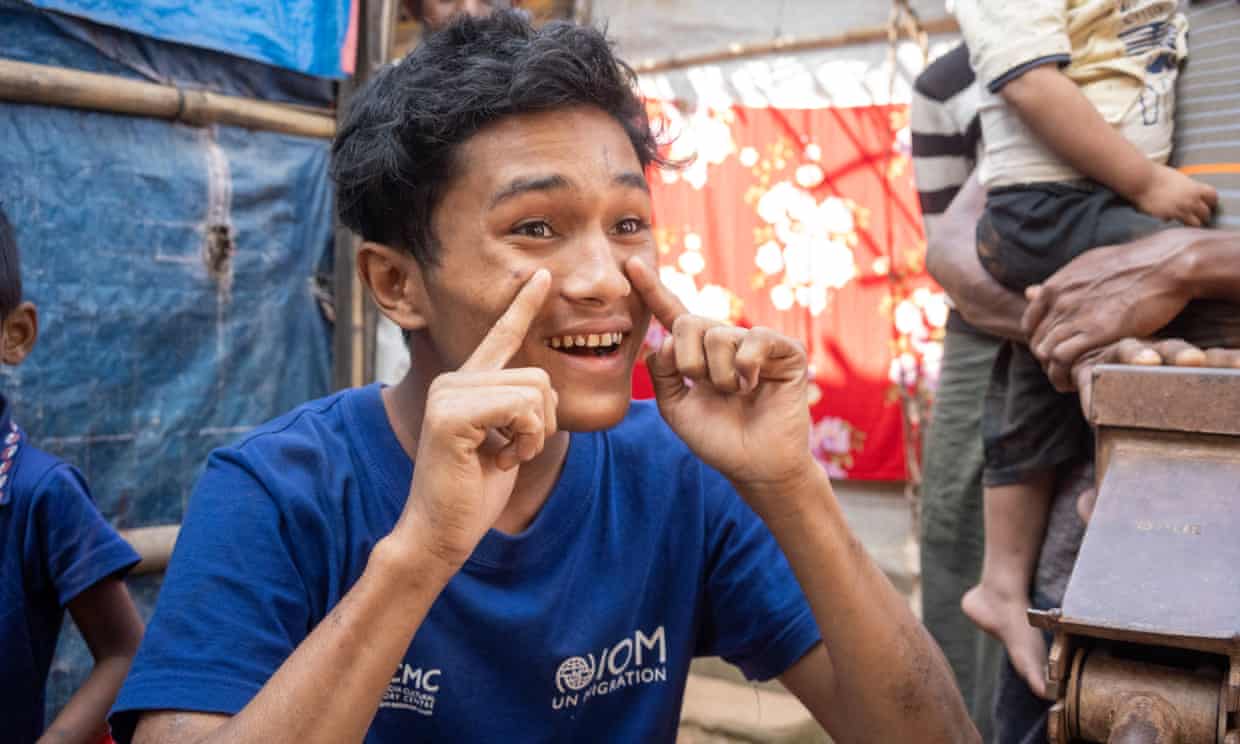
Photo: Kaamil Ahmed.
The Guardian writes: Asom Khan, who is deaf and mute, uses his own version of [signing] to communicate with friends and family in Bangladesh.” And he takes photos that speak, too. 

What a powerful need human have to communicate! Here’s a story of a boy with the deck stacked against him many times over who wanted badly to communicate and figured out his own way to do it.

Kaamil Ahmed  writes at the Guardian, “His own sign language of sweeping, dramatized gestures is rarely fully understood by those outside Asom Khan’s closest friends and family, but the 15-year-old is able to speak through his art and photography.

“From his shelter in the Rohingya refugee camps of south-east Bangladesh, Khan takes photos to share the stories of his community – of his elderly neighbors, disabled people, and of women at work and in times of crisis.

“It was a journey that started with a photograph of him in 2017 – tears running down his face as he hung on to the side of an aid truck – that won awards for a Canadian press photographer, Kevin Frayer, as 700,000 Rohingya fled to Bangladesh from massacres in what the UN described as ethnic cleansing by the Myanmar military.

“That photo has stuck with Khan, who is deaf and mute, and when he saw other Rohingya becoming photographers, using budget smartphones to document daily life, he fully understood the power of an image.

“ ‘I was inspired by other Rohingya photographers. When there were floods or fires or other issues, they would come and take pictures. I saw that there was some power in it,’ says Khan, whose friend interprets for him.

“Since arriving in Bangladesh, he has also been producing vivid paintings, sometimes of idyllic Myanmar villages scenes, others of those villages under attack and the chaos he witnessed.

“Raised by his aunt and uncle after his mother died in childbirth, Khan had no opportunity to learn formal sign language so he improvised, teaching his own version to those around him. But art and photography has given him a freedom to communicate without an interpreter. …

“The camps Khan arrived at six years ago quickly became the world’s largest, with almost 1 million Rohingya crammed into bamboo and plastic shelters. As conditions have worsened, with education, work and movement limited, international attention has died down, leaving the refugees to deal with their own problems. …

“ ‘I feel like when I show pictures of the Rohingya situation to the world, they understand a bit more what we face.’

“Frayer, the photographer now with Getty Images who took Khan’s photo in 2017, says … ‘I remember taking a few frames and then he disappeared into the crowd below. I remember feeling quite moved by how much courage this young boy showed,’ says Frayer.

“He found Khan again in 2018 and spent time with him, finally learning more of his story as they communicated through his sign language and his drawings.

“ ‘I was so moved and astounded to learn that he had taken an interest in photography. I saw in his artwork that he was incredibly talented at telling his story through his art, and that photography would indeed be a very strong tool for him,’ says Frayer.”

More at the Guardian, here. No firewall. Donations solicited.

Read Full Post »

The Arabic Sesame Street was designed especially for children in refugee camps, but it’s a delight for other children, too.

I posted about the development of a “Sesame Street” for Middle East refugees in 2016 (here) and for Bangladesh refugees in 2019 (here).

To give you the latest, I’m sharing a recent interview that National Public Radio’s Deborah Amos conducted in Beirut.

NPR Host Audie Cornish
” ‘Sesame Street’ is taking on one of the world’s biggest crises — the plight of Syrian refugee children. The Muppets are reaching out to millions of displaced children in a new program. Refugee children face special issues — losing their homes, missing time from school and frequent moves. They grapple with emotions and fears they barely understand. NPR’s Deborah Amos reports from Beirut.

Deborah Amos
“The Syrian refugees at this soccer practice are part of the target audience for ‘Ahlan Simsim’ — ‘Welcome Sesame,’ a new show on Arab TV stations and online — also for refugee kids in Jordan, Iraq and Syria. Some here are old enough to remember the war. Many more were born as refugees, raised by parents who fled violence and devastating loss and can pass on the trauma. …

Bassil Riche
“Definitely, these kids have experienced something that no kid should have to experience.

Amos
“Bassil Riche, the soccer coach, has seen the signs in these kids.

Riche
“Maybe the kid misses a shot or something. You know, you can see kind of over-the-top anger or frustration or disappointment in themselves. It’s important for them to talk about these things and not keep it inside.

Amos
“Getting those emotions out is the aim of the new program. … Produced in Amman, Jordan, the scripts are in consultation with regional educators and researchers. For 50 years, ‘Sesame Street’ has pioneered programs to address childhood challenges. The new challenge — to create a show for children who are likely to remain refugees throughout their childhood. Scott Cameron is the executive producer in New York.

Scott Cameron
“The show was developed to help children become smarter, stronger and kinder and give them skills to be — to thrive and be resilient. …

Amos
“[Grover] speaks Arabic in ‘Ahlan Simsim.’ The newcomers are Jad — bright yellow — Basma is purple. She becomes Jad’s best friend when he arrives in the neighborhood. Jad is sometimes sad because he’s had to leave everything behind, including his favorite toys. Research shows displaced children don’t have the language to identify emotions and the skills to cope, says Cameron. So that’s a key educational goal.

Cameron
” ‘Ahlan Simsim’ focusing an entire season on emotions is … a bold move that is born out of a need.

Amos
“The teaching techniques are sometimes silly. They’re always fun.

Cameron
“Debka dancers are three animated dancers whose sole function is to identify emotions and label them in a really funny way. … They pop into frame out of nowhere, sometimes. So it’s always fun to see where they’re going to come from. Sometimes, they pop up out of the bushes. They do a dance. They are a very important way for us to make sure that the children pay extra attention when we’re first introducing the vocabulary word that matches the emotion.

Amos
“Syrians are now the largest refugee population in the world. The statistics for going home are grim. Displacement lasts longer than ever before, sometimes for decades. Head writer Zaid Baqaeen says he never uses the label.

Zaid Baqaeen
“It was never put in any script that, oh, you’re labeled as a refugee or not because our focus is about welcoming. …

Amos
“The welcome is extended on the ground. In a partnership with the International Rescue Committee, the IRC is sending thousands of outreach workers to four countries and extend the lessons of the TV production and tackle some of the hardest subjects, says Cameron. … The ‘Ahlan Simsim’ project is a new way to correct the shortcomings of traditional humanitarian aid that provides for immediate needs but does little to prepare a generation to become resilient adults.”

NPR transcript and audio are here.

Read Full Post »

Photo: Shah Meer Baloch.
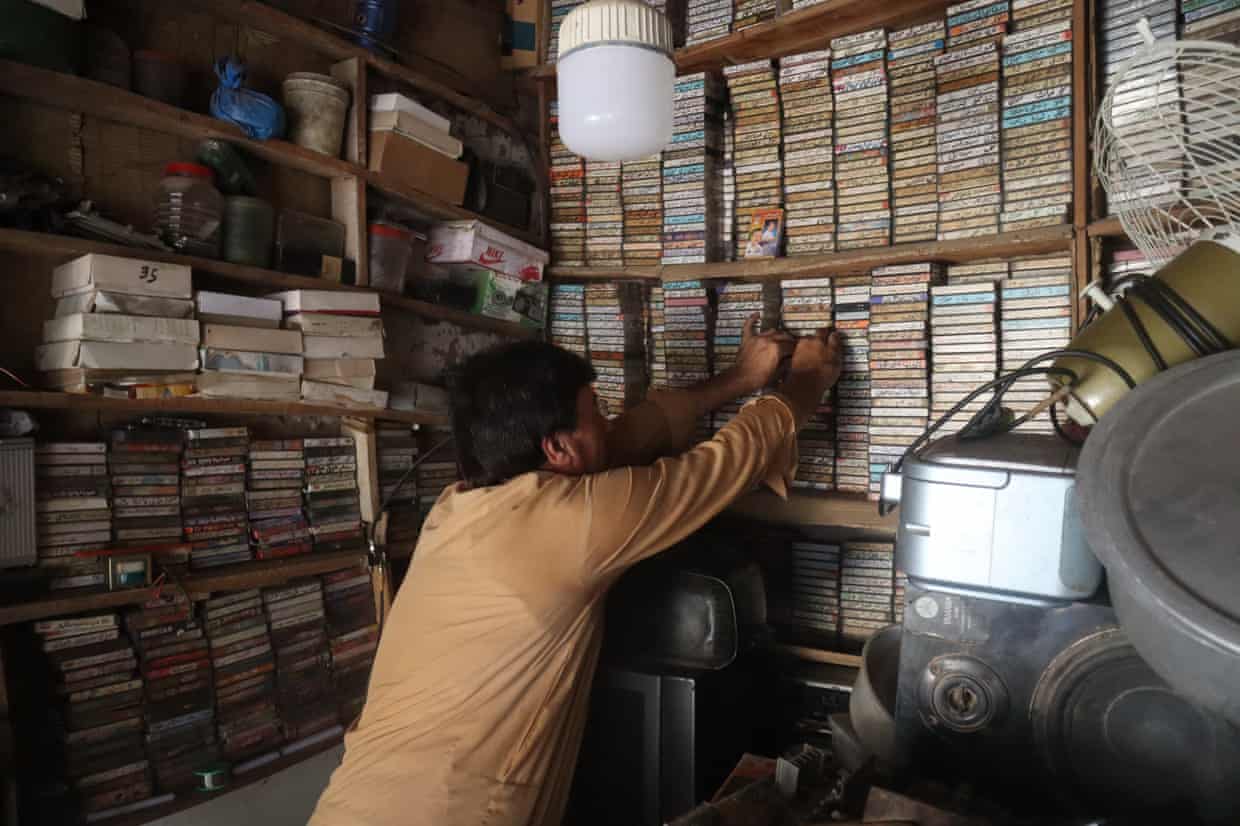
Afghan refugee Mohammed Hasan Zamri in his shop in Pakistan, where he keeps his collection of rare music cassettes from his homeland.

For the Afghan diaspora, you have to celebrate joy where you find it. In October, for example, Afghan friends lit up social media because of an unexpected triumph in cricket.

“I had a quick shower and was heading towards the office when I learned about Afghanistan’s phenomenal cricket victory against Pakistan, with the news dominating my socials,” Shadi Khan Saif exclaimed in the Guardian. …

“The team’s phenomenal performance has lifted up not just the devastated nation but millions in the Afghan diaspora, including in Australia. At Dandenong Park in Melbourne’s south-east, hundreds joined in on the traditional Attan dance to mark the victory. The scenes in Kabul and other cities in Afghanistan were equally charged with joy and celebration.

“Amid international isolation, Afghanistan’s cricket team has once again proved itself as the only source for the Afghans to connect with the outer world. Afghanistan’s tri-color flag – now replaced with the white Taliban flag – and the Republic-era anthem are still kept alive by the cricketers on the world stage.”

As unusual as was that moment of delight, it is clearly not the only way Afghans seek out joy. Some turn to a collector in Pakistan who is saving Afghan music for posterity.

Shah Meer Baloch reports for the Guardian, “Afghan music fans from Kabul and Jalalabad have crossed the border to the city of Peshawar in Pakistan to offer thousands of rupees to Mohammed Hasan Zamri’s workshop for just one cassette.

“Zamri, an Afghan refugee, refuses them all as he continues his quest to copy and, one day he hopes, digitize his collection of more than 1,000 rare and old Afghan music cassettes of various genres.

“It is his contribution to help preserve a musical culture that existed for centuries before the Taliban existed.

“Since retaking control of the country in 2021, the Taliban have imposed their rigid interpretation of Islam, restricting and even criminalising music and arts. In July, they publicised a bonfire of seized ‘illegal’ musical instruments, reminding Afghans that the sale of instruments was a punishable offense.

“ ‘The Taliban just use religion as an excuse to ban music and say it is haram, prohibited, in Islam. This is not true and it is part of our culture for centuries, but the Taliban have senselessly put a ban on it, says Zamri.

“Zamri fled Afghanistan during the Soviet invasion and went back for a few years after the war had ended and the Taliban had started to consolidate their power. He left again in 1996 and has been running a workshop fixing tape recorders and TVs ever since.

“Most of the space in his small workshop is taken up by stacks of cassettes, neatly arranged on a wall opposite the entrance. His collection includes tapes of renowned Afghan musicians including Munawar, Nashenas, Taj Mohammad and Haikal.

“ ‘I have done recordings of many singers myself who had fled Afghanistan in the 1990s or had come to Peshawar, which has been a thriving hub for Afghan refugees and musicians,’ he says.

“ ‘The love for music is there but the musicians, music and art is banned in the Taliban’s Afghanistan. Today, we have many singers but because of the ban, they cannot perform. They have fled Afghanistan.’

“Listening and copying his cassettes, Zamri reminisces of times when Afghan audiences could enjoy music and culture with freedom – the same freedom afforded to musicians and artists, men and women. … ‘The people who have heard these songs or lived through the era are the ones who come to buy cassettes. …

“ ‘Naseema, Kashan, Benazir and Zarghona were the best female singers who dominated Afghan music three to four decades ago. Now, if they do not allow men to sing or create music, how will they allow women?’

“Until [August], Zamri was unknown to many Pashto-speaking people until local media featured his attempts at saving Afghan music cassettes. He has since received both threats and messages of appreciation.

“ ‘I have been threatened on Facebook from people to stop my work and they would burn down my shop and that this is against Islam. But there were some positive and appreciative comments too. …

” ‘Some people are addicted to smoking, some people love pets and some are fond of many other things. I am addicted to Afghan music. It is my hobby and passion,’ he says.”

More at the Guardian, here.

Read Full Post »

Photo: Nicole Tung for NPR.
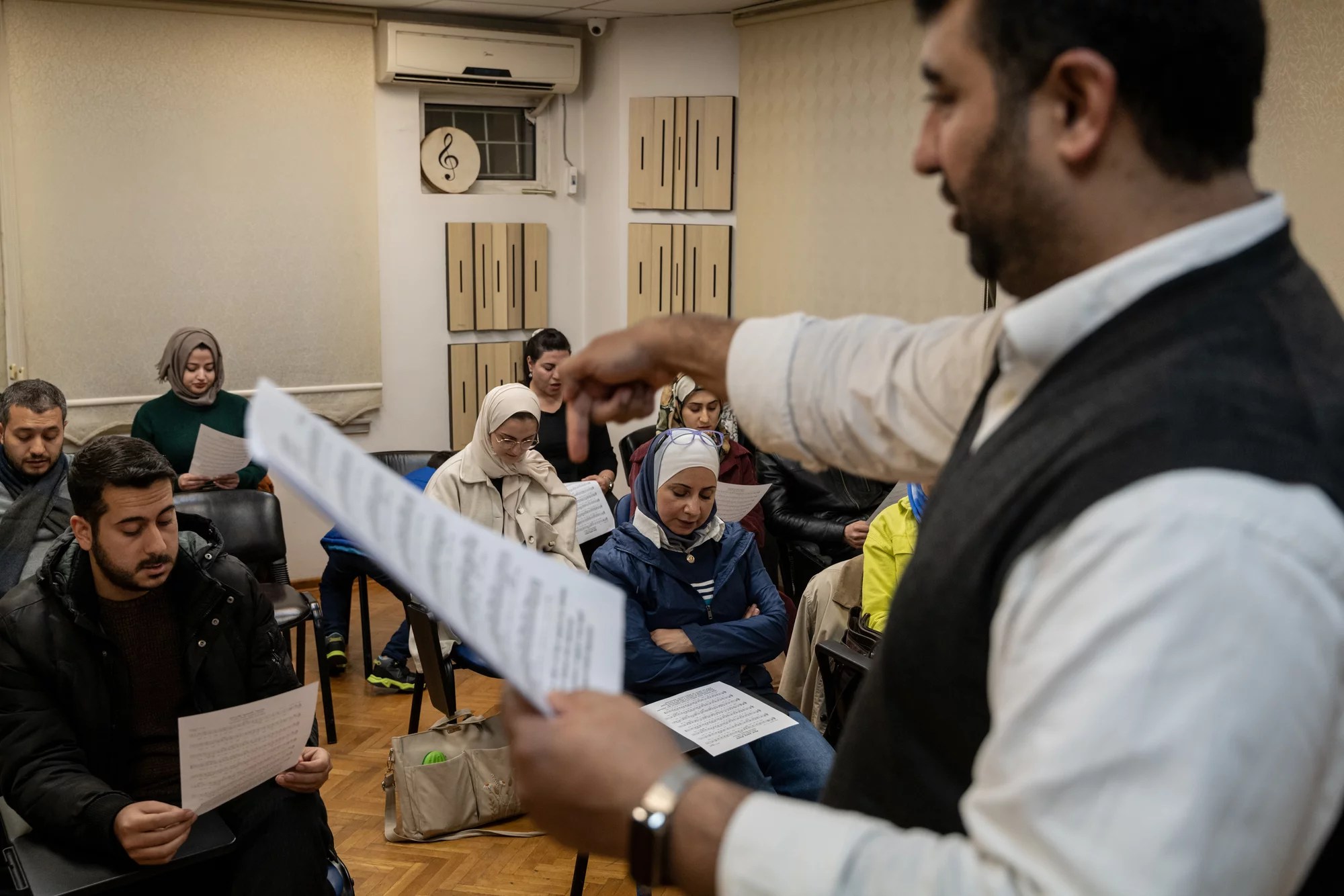
Ibrahim Muslimani, 30, speaks to a class about a piece of music blending different eras and languages at the Nefes Foundation for Arts and Culture, which he cofounded in 2016, in Gaziantep, Turkey.

Today’s story is about how the arts can help victims of disasters get their bearings again.

As Fatma Tanis reported recently at National Public Radio (NPR), “When the powerful earthquake rocked her home in early February, 18-year-old Sidra Mohammed Ali woke up and thought of one thing: her music school — was it OK?

“The next day, as survivors all over southern Turkey were taking stock of the destruction and checking on loved ones, Mohammed Ali rushed to the school, the Nefes Foundation for Arts and Culture, and took a deep breath of relief when she saw it was still standing, only having sustained some minor damage.

‘This school is my sanctuary from the stress of life as a Syrian refugee in Turkey,’ she said. ‘I couldn’t bear the thought of something happening to it.’

“The Nefes Foundation was created by Syrian and Turkish musicians in the city of Gaziantep in 2016. They have group classes where they try to revive forgotten Syrian classics and integrate Turkish and Syrian cultures with music that the two have shared for centuries.

“The school also offers private music lessons on the piano and Middle Eastern instruments like the oud (a pear-shaped string instrument), the kanun (a plucked zither) and the ney (an end-blown flute).

“But more than six weeks after the Feb. 6 disaster, life in the earthquake zone is far from back to normal. The magnitude 7.8 earthquake killed more than 55,000 people in Turkey and neighboring Syria. It damaged or destroyed hundreds of thousands of buildings and left 1.5 million people without a home in Turkey alone, according to the United Nations.

“The school had not been able to resume classes until [March 2023], when only three students, out of many dozens, showed up to sing and play.

“Before the earthquake, the school would be packed on weekday evenings, with students ranging from ages 6 to 50, mostly Syrian, but some Turks attended as well.

“The classes are bilingual — in Turkish and Arabic. And that was especially important, according to Ibrahim Muslimani, a Syrian classical musician from Aleppo, who is the brains behind the organization.

” ‘Because some of the young Syrian kids have spent most of their lives here in Turkey and are more fluent in Turkish,’ he told NPR in November 2022. ‘We’re trying to preserve our Syrian cultural identity but also getting to know the Turkish identity through art.’

“Turkey hosts 4 million refugees, the largest number of any country, according to the U.N. refugee agency. The vast majority are Syrians who fled the civil war.

“In the early years of the Syrian civil war, which started in 2011, Turkey had a generous open-door policy toward Syrian refugees. But without broad integration initiatives by the Turkish government, life for many of the refugees has been difficult.

“More recently, politicians in Turkey who oppose President Recep Tayyip Erdogan have scapegoated refugees for the country’s economic problems, leading to a rise in discrimination and hateful attacks. …

“Mohammed Ali, who studies medicine at university and the kanun at the music school, said last weekend the school has been a lifeline for her. She has a bleak outlook on her future, and doesn’t believe that the people in Turkey will ever accept her existence in the country.

” ‘But anytime I have an upsetting encounter, my Turkish teachers and friends here comfort me,’ she said. …

“Rafeef Saffaf Oflazoglu fled Aleppo in 2013 after a near-death encounter. She comes from a family that’s passionate about classical Arabic music. To be able to continue exploring her love of music in Gaziantep was priceless, she said.

“The school also introduced her to centuries-old Turkish songs from the Ottoman archives, and old tunes that traveled from Istanbul to Aleppo. Studying those shared melodies made her feel closer to the culture in her new home.

“Having to go without classes after the earthquake was harder than she expected. ‘After maybe 10 days, I just figured out, like the thing I miss most is art,’ she said, even though she was living in her car at the time. ‘People under trauma react in different ways. It’s not just about singing, you know? It’s spiritual.’

“For Muslimani, the earthquake was a triggering reminder of how he had lost everything a decade ago in Aleppo. … The civil war in Syria destroyed much of the country’s cultural output, along with the lives of millions of Syrians. Muslimani has a mission to keep Aleppo’s traditional form of music, al-Qudud al-Halabiya, alive from Gaziantep.

“He and other Syrian artists also record music at Nefes. ‘I promised my teacher that I would immortalize those precious pieces in the best form possible,’ he said. ‘With the proper orchestra and the glory that they deserve.’ …

“The Nefes Foundation, which survived on donations and fees for private lessons, is now at serious risk of closing down, said Muslimani. They don’t have the funds to pay for next month’s rent. …

” ‘The mere thought of losing this place… it’s unbearable.’ “

More at NPR, here.

Read Full Post »

Photo: Molly Haley for the Boston Globe.
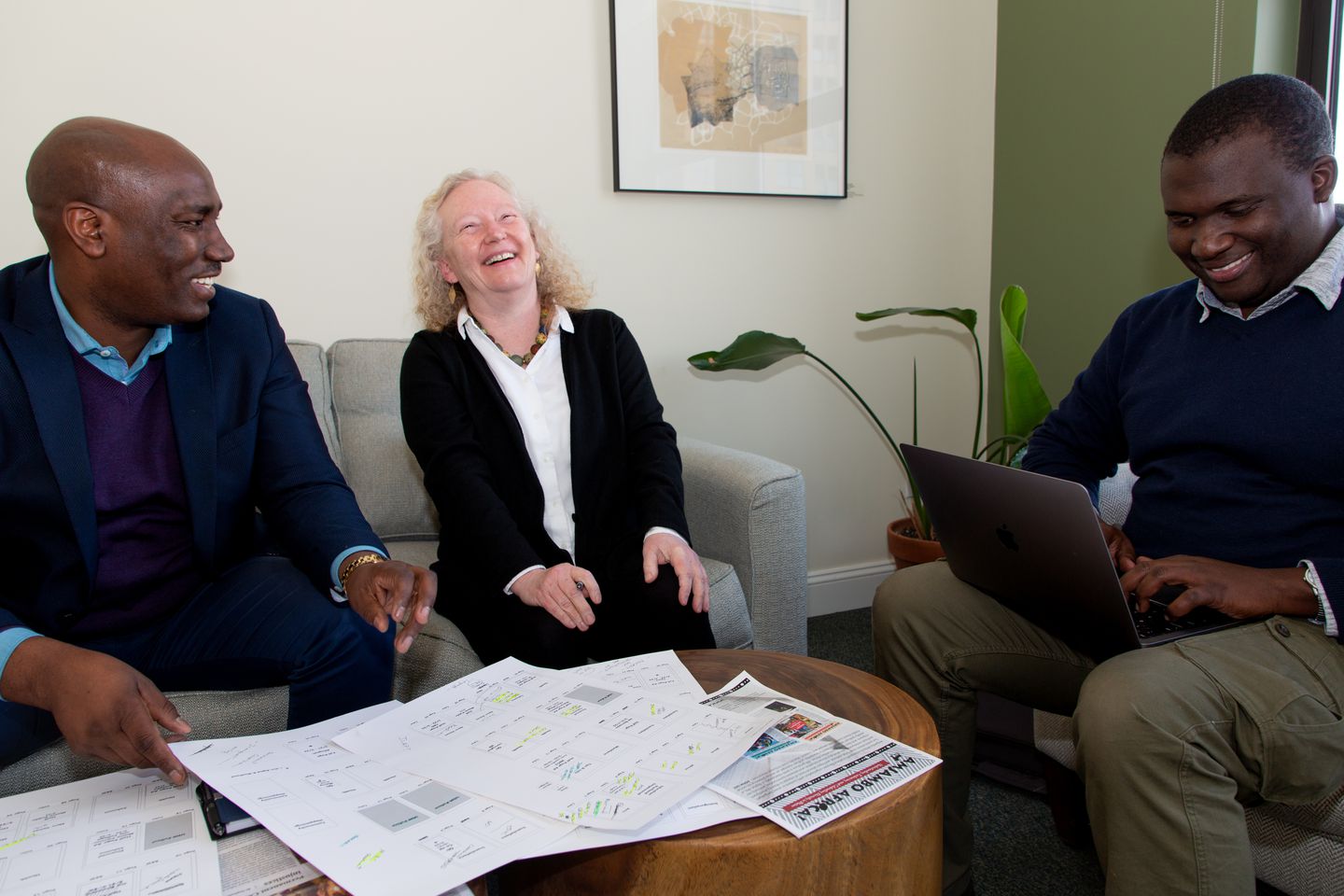
The Amjambo Africa! team: Georges Budagu Makoko, cofounder and publisher; Kit Harrison, cofounder and editor in chief; and Jean Damescène Hakuzimana, deputy editor and kinyarwanda translator [Bantu language]. They make use of a co-working space at the Greater Portland Immigrant Welcome Center.

When I edited a Boston Fed community-development magazine, we had several articles on the resettlement of Somalians in Lewiston, Maine. With some exceptions, Mainers welcomed the refugees because that part of the state had been losing population. But I also read that among the immigrants themselves, the Bantu had a hard time. Prejudices had carried over from Africa. Today’s story focuses on the Bantu community.

Thomas Farragher reports for the Boston Globe about an unusual partnership.

“She is the daughter of a celebrated Washington Post correspondent who wrote from New Delhi and Tokyo, seeking out truth and telling the essential stories of people’s lives. And so, Kit Harrison continues to nurture the journalistic flame. …

“It’s a passion shared, too, by Georges Budagu Makoko, who is the publisher of the newspaper that Harrison edits here called Amjambo Africa!

“It’s a free publication about the African diaspora and immigration. And it’s intended for the eyes of newcomers to Maine with this lofty goal: to build a community by spreading information about its readership throughout Maine.

” ‘We operate on chutzpah and brains and energy and teamwork,’ Harrison told me when I visited her offices here the other day. ‘I grew up abroad quite a bit with my journalist father. I also taught kids in the range of (kindergarten) through eighth grade and the focus for me was always international. … I was constantly trying to teach kids about what we all have in common around the world — and why we can live together peacefully if we try.’ …

Amjambo Africa! [chronicles] the efforts to curb hunger in Africa and the state of the forests of the Congo and the environmental challenges facing Burundian coffee farmers. There are stories about efforts underway in Nigeria, Kenya, and Uganda to address mental health issues — and another one about a center that helps kids in Nigeria with autism. …

“All of it done in seven languages: English, French, Kinyarwanda, Portuguese, Swahili, Somali, and Spanish. …

“Makoko first arrived in Maine in 2002 and thirsted for news about the Africa he had recently fled. He could find none. So, he set out to do something about it.

“ ‘When I came here,’ he told me the other day, ‘I didn’t speak English at the time. I had to take English classes. After that, I was hired by a nonprofit organization that develops housing.’

“The people for whom he provided housing wanted something else from him: help in navigating a bureaucracy without the language skills to do it.

“ ‘So I started thinking: “What can I do to help these people?” ‘ he said. … ‘They need information about how to find their way in the system.’

“Makoko had written a book, Ladder to the Moon. A Journey from the Congo to America.

“It told the story of a growing up in a beautiful peaceful village surrounded by family — a life upended during the genocide in Congo and Rwanda. …

“ ‘But then my book was not enough. I started thinking maybe we can come up with something that will regularly inform the immigrants about resources that are around here, but also the whole community as to why people are coming here and what’s happening where they are coming from.

“ ‘And that’s where the whole idea of the newspaper came from. I didn’t know how to do it. I didn’t know how to start a newspaper. I was thinking I have this idea. And I have zero background in journalism.’

“But Harrison did.

“And so a friendship and a critical collaboration and a partnership were forged.

“The first issue appeared on April 1, 2018, the product of a year’s worth of planning and answering critical questions: Who’s going to read it? Who’s going to advertise in it? How is this all going to work?

“ ‘You can’t print for free,’ Makoko said. ‘That’s an obvious cost that was there. We needed somebody to design the paper. Those are skills that we didn’t have. Kit was very good in writing and doing interviews and coming up with articles — but also translation. ‘You’ve got to understand that this newspaper is published in (multiple) languages.’

“All of that is a tall task. A monumental and important undertaking. And, yet, they have done it. It exists, telling stories about conflict in Ethiopia and about how to stay warm when Maine’s temperatures dip to dangerously low levels. …

“ ‘We’re about to celebrate our fifth anniversary,’ Harrison told me. ‘And we’ve grown. We’ve always been small and we still are. But within that smallness there’s been quite a lot of big reception and a lot of interest. We’re in it for the long haul. But it’s not easy. It’s very challenging to get the finances in place to do what we want to do, which is big stuff.’ …

“ ‘The word Amjambo — by the way — has meaning which you might want to know,’ Harrison said. “It means two things. It’s a greeting. But is also means W-O-R-D. Word.’ …

“ ‘You try to work for the common good, using whatever skills and attributes you happen to have,’ she said.”

More at the Globe, here. And at Amjambo Africa! here.

From a recent issue, you can read Bonnie Rukin’s article, for example. It’s on the Somali Bantu Community Association’s Liberation Farms in Lewiston, where farming skills have translated relatively easily from Africa to America.

“Two large building projects are planned for springtime at the farm – building a goat barn, and also a corn house for processing and storage. Local contractor Scott Doyon will oversee both projects. He has worked with the community before, on several projects. Good Shepherd Food Bank is supporting the goat barn; a State of Maine grant is funding the corn house. In addition, a new small commercial kitchen is going into the building that currently houses the farm stand. The space will allow community members to process produce grown at the farm.” More.

Read Full Post »

Photo: Erin Clark/Globe staff.
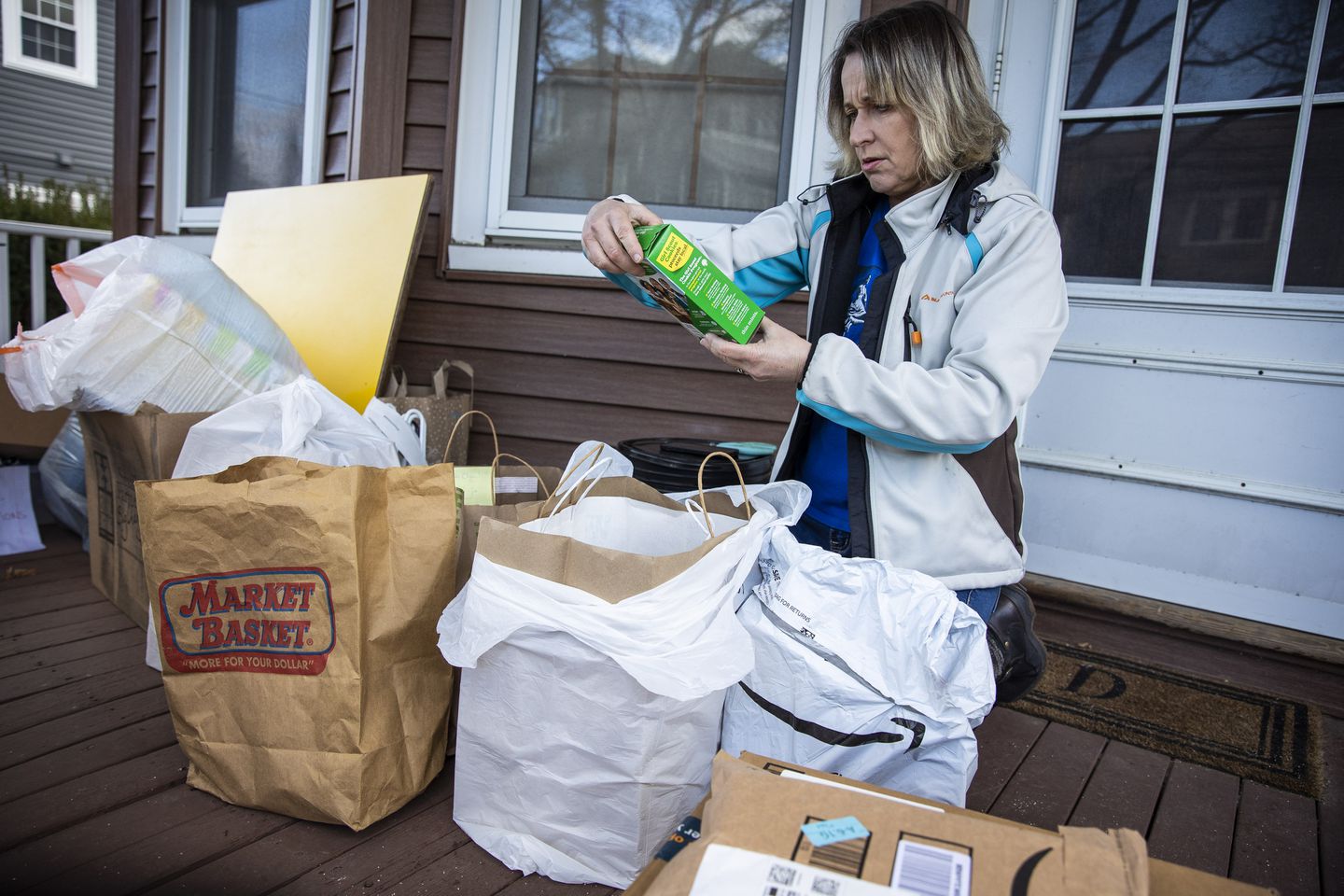
Olga Yulikova sorts through donations that people drop off “onto the front porch of her Arlington home to help a Ukrainian family fleeing war,” the Boston Globe reports.

Because I’m downsizing and complaining about how difficult it can be to get some items into the hands of people who need them, Suzanne told me about our community’s Buy Nothing Project on Facebook. So far, no one there has wanted an old ironing board, but lots of people were interested in beat-up posters. I picked the first to raise her hand.

Meanwhile, in Arlington, they call their Facebook group Everything Is Free and are using it to help refugees get settled. To me that’s a worthier cause than giving free things to people who could often afford to buy them ten times over.

Sonel Cutler writes at the Boston Globe, “In Ukraine, Olena had a fulfilling job in real estate and an apartment she loved. The only time she had ever left her home city of Zaporizhzhia was to go on vacation.

“[In] February 2022, Olena, who asked to be identified by her first name only for privacy, became scared for the safety of her young daughter and made the most difficult decision of her life: to flee her home.

“She and her daughter left Zaporizhzhia abruptly in March after Russian forces took over a nearby nuclear power station. They took only passports, her daughter’s birth certificate, and few other items before driving to western Ukraine and then to Germany.

“In April, the Biden administration launched the Uniting for Ukraine program, which helped Olena and her daughter seek refuge in the United States. They arrived in late June, staying with childhood friends in Arlington until January, when their hosts had to bring their own parents to the country from Ukraine. …

“Connecting on Facebook, Olena became friends with Arlington resident Olga Yulikova, who helped her secure an apartment and turned to the town’s ‘Everything is Free’ Facebook group for donations to furnish the place.

“Arlington residents overwhelmingly answered her request. In a matter of days, the previously bare apartment had a fridge, coffee maker, queen-sized mattress, dish soap, and more essentials for Olena and her daughter.

“ ‘I’m completely overwhelmed, and I’m so grateful for all the help,’ Olena told the Globe, with Yulikova translating. …

“Yulikova, who immigrated from Moscow as a refugee in 1989, had been organizing humanitarian aid for Ukrainian refugees since the war began last year.

“She and Olena became close friends after meeting online, sharing stories over cups of coffee, and connecting over the discovery that Yulikova’s great-grandmother hailed from Olena’s hometown in Ukraine.

‘I cannot stop the war. I’m very much against it,’ Yulikova said. ‘I cannot save the Ukrainian people that are suffering. I can only help one or two individuals.’

“Yulikova posted her request for donations or small amounts of money in the community Facebook group on Jan. 22, and set up a wish list, listing a drop-off location for donated items.

“ ‘She [had] an empty apartment with no money,’ Yulikova said. ‘She’s very happy, but she [didn’t] really have a mattress to sleep on. So I figured I’ll put it on our Arlington lists, just like I did for everything else when I was collecting donations to be sent to Ukraine.’

“Daniel Icekson, a 54-year-old Arlington resident and friend of Yulikova, had been following Olena’s story after they had met briefly months before.The tragedy of the war in Ukraine moved Icekson, whose relatives perished in the Holocaust. When he heard Olena was looking for donations, Icekson began disassembling a large wardrobe, planning to reassemble it in Olena’s apartment.

“ ‘I thought, Why not? We have this extra wardrobe. We’ll just give it away,’ Icekson said. ‘If I can just contribute in a small way to one family, then I guess that’s a good thing.’

“Yulikova said she initially worried about how she and Olena would transport hefty items like a kitchen table and a jumbo bean bag into the apartment by themselves. But, according to Yulikova, ‘people came out of the woodwork’ to help.

“ ‘[They] said “Oh, no problem. I will drive. I will bring. I will assemble, disassemble,” ‘ she said. ‘People just volunteer.’

“While she knew Icekson, the majority of donors were complete strangers to Yulikova, something she said helped restore her lost faith in humanity. …

“Though her young daughter has immersed herself in school, performing with the local theater, and learning English, Olena remains troubled by her separation from her son and father, who remain in Ukraine to support the army.

“ ‘Every day, I don’t know if my son and my father will live another day,’ she said. ‘Every day I keep the phone at my fingertips and check in on them 100 times a day.’ “

More at the Globe, here.

Read Full Post »

Photo: AP.
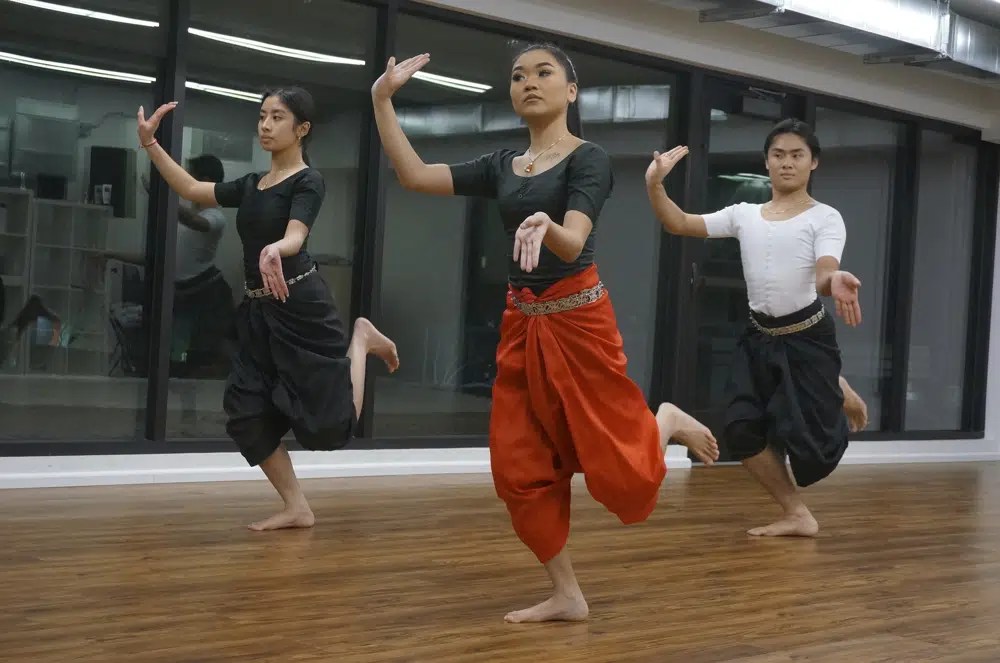
A Buddhist community anchored by a temple in Hampton, Minnesota, is drawing dancers of all ages.

It’s interesting to see what draws people to a faith community — besides faith. When we moved to a town where we didn’t know anyone, I visited several churches and chose the friendliest one. As we got involved, we got acclimated. The children made friends, and I got to know parents who filled me in on the best public school teachers.

Other people may join for other reasons. Consider the dance opportunity in today’s story.

Giovanna Dell ‘Orto reports at the Associated Press (AP), “The Buddhist community anchored by an ornate temple complex here in the Minnesota farmland is trying a new way to ensure its faith and ancestral culture stay vibrant for future generations — an open call for the sacred dance troupe.

“Founded by refugees fleeing the Khmer Rouge regime, which sought to eradicate most religious institutions, Watt Munisotaram and its troupe hope that teaching young children sacred dance will strengthen their ties to both Buddhism and Cambodian traditions.

“ ‘The connection is stronger when I dance,’ said Sabrina Sok, 22, a Wattanak Dance Troupe leader. ‘The thing that stays in my head is this dance form almost disappeared with the Khmer Rouge.’

“During their 1975-79 regime, the Khmer Rouge caused the deaths of an estimated 1.7 million in Cambodia. Hundreds of thousands fled, first to neighboring Thailand and later the United States, where Southeast Asians are one of the largest refugee communities.

“They carried this sacred dance tradition with them. On a frigid early February evening, Sok rehearsed for the upcoming Cambodian New Year holiday with fellow troupe leader Garrett Sour and his sister Gabriella, whose parents were among those refugees. …

“While recruitment was by word of mouth, this winter’s enrollment — open to anybody eager to learn the dance form — brought in the highest number ever after being posted on the temple’s Facebook page.

“Clothed in traditional thick silk shirts and pants from Cambodia, the three dancers sinuously stretched and bent every part of their bodies, from joint-defying toe curls on up. …

“ ‘We’re never ourselves, we’re just physical embodiments of higher spirits,’ said Garrett Sour, 20, as he meticulously coached the poses, urging a smaller step here, a deeper calf tilt there. ‘Dance was seen not as entertainment but a medium between heaven and earth.’

“The marketing student at a Twin Cities university started dancing when he was six and has learned Khmer to better delve into the sacred storytelling. He will be one of the teachers for the incoming dancers – about 20, which nearly doubles the troupe, and most of them younger than teens. …

“In the temple’s ornate higher room, where the ten monks in residence chant and meditate daily surrounded by sacred books and large Cambodian-made paintings of Buddha’s life, the Venerable Vicheth Chum also highlighted the importance of what he called ‘blessed dance.’

” ‘Very important to have, and to keep our ancestral tradition even when moved to (Minnesota),’ said Chum, who came to the United States more than 20 years ago from Cambodia. ‘Buddhist teaching is practice for peace and happiness, no matter the nation.’

“Monks at Watt Munisotaram – which roughly means the place to enjoy learning from wise men – practice Theravada, one of the oldest forms of Buddhism rooted in Southeast Asian cultures. …

“Dozens of faithful in equally bright white outfits [met] to celebrate Magha Puja, a holiday marking the gathering of 1,250 of Buddha’s first disciples and the establishment of his rules for the new community.

“Chum and seven other monks in elaborately folded, bright orange robes led a candlelit procession multiple times past an altar with several golden Buddha statues, glittery decorations and a profusion of flowers including lotus blossoms – most artificial, though in more clement weather some are grown locally or shipped from Florida.

“Several children marched along, carrying the U.S. flag and Cambodia’s state and Buddhist flags, before everyone sat in neat rows on the carpeted floor for two hours of chanting in Khmer.

“Chum said the monks worry about young people’s growing disenchantment with religion but believe that life’s inevitable struggles will eventually bring most back to the temple for guidance from Buddha’s teachings. …

“ ‘The world is using them to educate the other communities, I keep on reminding them,’ Sophia Sour said. She hopes to take Garrett and Gabriella to Cambodia to learn even more about the roots of their spirituality, whose fundamental values she listed as respect for the elders and good deeds.

“ ‘If you do good, good will come to you,’ she said. ‘I’m not sure if that’s religion, or just life.’ ”

More at AP, here.

Read Full Post »

Photo: Pat Greenhouse/Boston Globe.
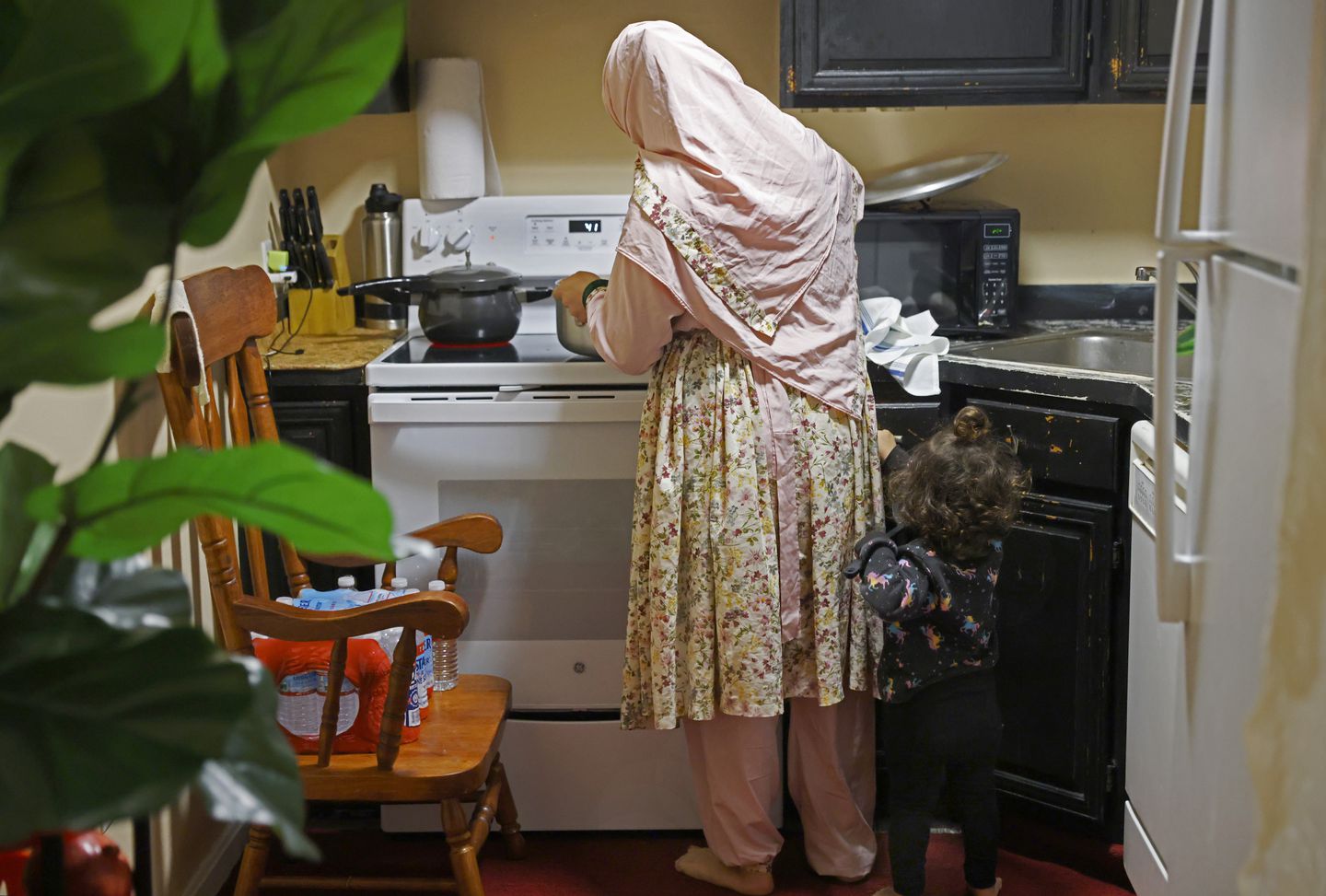
Samya prepares an evening meal. Back in Afghanistan, Samya and Noori’s fathers are out of work and their families struggle to find enough to eat. Noori sends them $200 to $400 a month.

In today’s story, an Afghan who worked as an interpreter for US troops builds a new life for his family in Lowell, Massachusetts, a longtime “gateway” city for new Americans.

Alexander Thompson reports at the Boston Globe, “Scarcely any of the 40 Afghans who trooped off planes at the Manchester, N.H., airport on an unseasonably warm day on Nov. 18, 2021, had ever heard of Lowell.

“Among the dazed and weary refugees at the airport was an irrepressibly optimistic former US military interpreter called Noori. His wife, Samya, and two young daughters, Taqwa and Zahra, were at his side. They were exhausted, but they were safe.

“Noori recalled that he didn’t know a single person in New England. He didn’t have a job. Or a car. Or an apartment. Or a winter coat. But he had his family. ,,,

“After a harrowing escape and a grueling journey halfway around the world, Noori and his fellow Afghans quickly found that life in Lowell is no Hollywood movie.

“ ‘We thought that in America all the facilities of life were going to be provided for you,’ he said. ‘It’s true that it has, if you work [for it].’

“Noori and several hundred other Afghan refugees who have been resettled in Lowell have set about doing what they could not in their own country. They’re building lives in peace while forging a united community that is, slowly, bridging the divides of language and creed that have riven Afghanistan for decades.

“ ‘The United States of America did not build a nation in Afghanistan, and now the Afghans who are here are trying to build a new nation here in the United States,’ said Jeff Thielman, president of the International Institute of New England, which resettled many of the Afghans.

“And in the past year, Noori has gone from being just another Afghan in the crowd to a community leader, always eager to help his compatriots even as he navigates his own obstacles in the new country he’s proud to now call home. …

“Getting his license at the end of March was a huge relief. It felt like a hard-earned victory after the family’s first few months in Lowell, which had been difficult at times.

“Noori was lucky that the Lowell Community Health Center hired him days after he arrived as a Dari and Pashto language interpreter for their influx of new Afghan patients. But rent, Wi-Fi, and heat were expensive. They also desperately missed their families back in Afghanistan.

“ ‘Whenever I’m talking to my mom, she was crying because we are away from her, so this is the hardest part,’ Samya said, with her husband interpreting from Pashto.

“[Samya’s] and Noori’s fathers are out of work and their families struggle to find enough to eat amid Afghanistan’s worsening humanitarian crisis. Noori sends back $200 to $400 a month.

“Worse still, as Noori would acknowledge many months later, the family was feeling trapped and helpless in a tiny apartment. Fortunately for Noori and the other 275 refugees who eventually settled in Lowell, there was a group of Afghans who had arrived in the area years earlier and who offered support and guidance. The group’s de facto leader, named Mohammad Bilal, is another former military interpreter, who arrived in 2014.

“Among the first things Bilal and the others did was establish a WhatsApp group for the new arrivals.

“ ‘We will just call to the community if there is someone available, just please help this family. … They were going to get [the refugees] food, they were there to get them to the hospital,’ Bilal said. ‘Whatever their need was, we were helping them.’

“Noori had an extra advantage: Major White [who helped him escape] was still looking out for him. White knew Noori needed a car, so he set up a GoFundMe page that raised $14,000 and bought Noori a used Ford Focus. …

“By May, doing checkups with every new Afghan, [Dr. Rob] Marlin and Noori were the clinic’s dynamic duo. Marlin brings the medical knowledge and Noori the linguistic and cultural savoir-faire. Each patient reveals aspects of Afghan life in Lowell. …

“Before one checkup, Noori pointed out to Marlin that a man’s name indicated he is a member of the persecuted Hazara ethnic group. That prompted Marlin to probe deeper about the man’s roommates and whether he feels safe.

“ ‘He will often find out something that I didn’t ask about, that I hadn’t thought about,’ Marlin said.”

Read more about the Marine who aided the family’s spine-tingling escape and about their new life, here.

Read Full Post »

Photo: Oxfam.
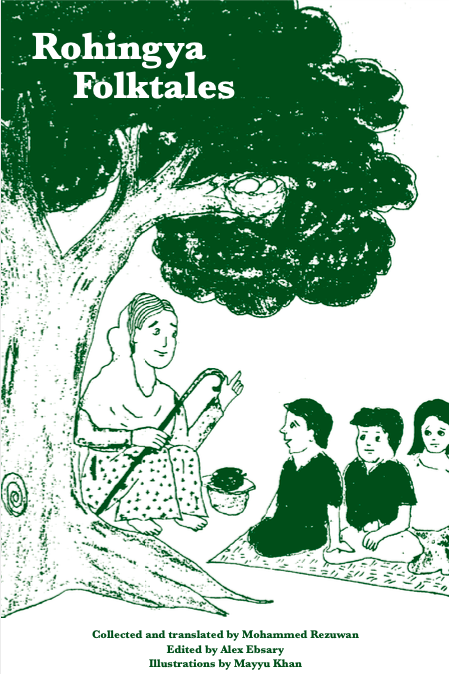
Folktales help preserve the threatened Rohingya culture.

To understand anything about a foreign culture, you need to turn to its arts: the music, the crafts, the folktales, for example.

Stephen Snyder at PRI’s the World reports about a threatened culture holding on by a thread far from home: “Mohammed Rezuwan is on a rescue mission: The 24-year-old who lives in Cox’s Bazar — the world’s largest refugee camp — is working to save Rohingya traditional stories before a generation of storytellers dies off.

“Rohingya people have lived in the region for over a thousand years, but Myanmar’s government considers them foreigners from neighboring Bangladesh. Over the last four years, hundreds of thousands of Rohingya have been driven out of Myanmar [Burma] by government troops and local militias. Many now live in dozens of refugee camps.

“ ‘We, Rohingya people, have our own culture, tradition. We are on the brink of losing all of them, unfortunately,’ Rezuwan said in a WhatsApp voice message from Kutupalong, one of more than two dozen encampments in Cox’s Bazar, on the coast of Bangladesh.

“The crowded area accommodates families who live in tents and shelters along narrow alleyways. United Nations figures put the exile population in the camp at nearly a million — four times the number of Rohingya still living in Myanmar.

“Rezuwan lives in a bamboo shelter with his wife, his mother, a brother and a sister. The family fled their home in Maung Daw, in the Rakhine district of Myanmar, on Aug. 25, 2017, as their village was set ablaze in a campaign that has forced most Rohingya out of Rakhine.

“ ‘I remember the gunshots ringing out like thunderclaps, the bullets strafing the sky like clouds of hungry locusts,’ Rezuwan wrote in the author’s note of his book, Rohingya Folktales: Stories from Arakan, as told by Rohingya refugees. …

“In 2020, after several years at Cox’s Bazar, he took on the role of folklorist — recording stories passed along in the oral tradition by Rohingya elders. …

“Rezuwan speaks his native Rohingya and learned to speak and write Burmese in school, but his English is largely self-taught. He spent a year collecting material for his English-language book, and the online version now includes 19 stories from storytellers in several of Cox’s Bazar’s camps.

“Research was no easy task. Rezuwan doesn’t have a car or bike, so he walked, sometimes up to five miles, to meet with each storyteller and record his or her story on the phone. …

“ ‘The hardest part is finding and meeting the people from different sorts of camps,’ Rezuwan said. ‘After all, not everyone has the same talents to remember the stories — just because they are uneducated — and so, finding the right person to tell the story was finding a gem from the ocean.’

“The Rohingya language is primarily spoken, without a standardized written script. Rezuwan translated the stories by playing back his recordings and, word by word, constructing English versions of the tales. He then pasted them into WhatsApp and sent them to his editor and friend, Alex Ebsary, in Buffalo, New York, who corrected grammar and word usage. Ebsary said he intentionally edited the stories with a light touch.

“ ‘Folktales are not a universal language,’ he said in a phone interview.

‘If you read these folktales, some of them are quirky. They’re kind of not even the morals that I would think of when thinking of a folktale.’ …

“Rezuwan said his mother used to tell him the story known as ‘A Hunter and a Flock of Heron.’ The version he collected from Rashid Ahmod, a 60-year-old resident of Kutapalong, was essentially the same story he heard as a boy, he said.

“The story is about a hunter who catches a group of beautiful herons in his net. The herons all try to escape by flying around in all directions, Ebsary explained. Rezuwan said the moral of the story is that birds — and people — can’t manage to go anywhere until they cooperate.

“Rezuwan and Ebsary both singled out a story from the collection called ‘A Queen’s Dream,’ which could serve as an allegory for Rohingya as an ethnic minority.

“The story is about a powerful queen who has a vivid dream about torrential rains after a period of drought. Everyone who drinks from the rain loses their minds. So the queen sends advisers to warn everyone.

“ ‘But of course, they don’t listen and everyone drinks the rain and goes mad. And in the end, the queen decides to join them by drinking the rain herself,’ Rezuwan said.

“The moral of the story is that if a country’s majority are wrongdoers, they have the power to ‘force [the] entire country into a very bad situation,’ Rezuwan said. ‘It’s what we are facing right now.’

“Rohingya have long faced discrimination and marginalization in their home country. The United Nations has called it ‘a textbook example of ethnic cleansing.’ If life in Myanmar was untenable, Rezuwan said, ‘in [the] camps, it seems like we are facing the second genocide.’

​​”Since coming to Kutupalong, Rezuwan has organized an educational network where Rohingya children — unable to attend schools — can follow the same curriculum taught in Myanmar. …

“ ‘I wanted the international community to know about our culture, about tradition and about the existence of Rohingya people in Arakan,’ he said.

“Arakan, the name Rohingya people give to their homeland in Myanmar, no longer appears on any maps of the region.”

More at PRI’s the World, here. There is no firewall. You can also listen to the recording of the show there.

Read Full Post »

Altruistic Granola

Photo: Maliss Coletta.
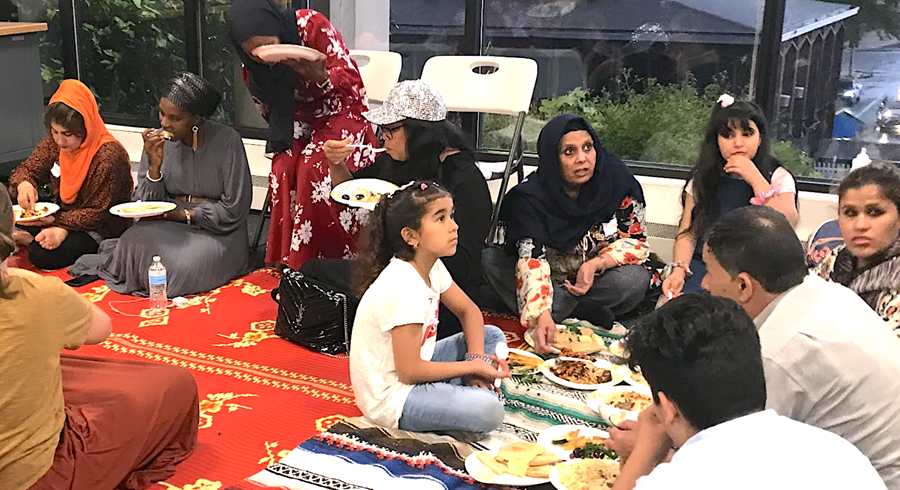
Afghan refugees enjoy a meal with the team at the granola nonprofit Beautiful Day RI in Providence.

In around 2015, I was writing blog posts for Anne Dombrokski at what was first called the Providence Granola Project and later Beautiful Day, a granola company with a mission to help acclimate refugees to American workplace norms and launch them into jobs. Anne died in a freak biking accident (despite a helmet) in 2016, but Beautiful Day remembers and honors her with the Granola for Good award.

Since Anne’s time, Beautiful Day has expanded its mission a little every year, and you can follow it by signing up for newsletters.

Here’s a recent example: “Since last fall when Afghans started arriving in Rhode Island, Beautiful Day has been reaching out in many ways. We contributed granola bars, hummus and messages of welcome to food baskets delivered weekly by the local food bank. We collected wool rugs to give to Afghan families to help them feel more at home. And we began welcoming Afghans into both our youth and adult job training programs. It’s critical to our mission to support the Afghan community, and we were always looking for chances to connect.

“A new opportunity arose two weeks ago when we partnered with the Refugee Dream Center (RDC) to host a group of Afghan women and their families at our kitchen. The Afghan women’s group had been meeting at RDC for several months and done a number of things together. But without access to a kitchen, they weren’t able to cook. And that’s where we could help. With our beautiful, newly renovated kitchen, we could offer the group the perfect place to cook up a storm! So we invited them to come and prepare a typical Afghan meal and share it with us in our space.

“People began arriving mid-afternoon and soon we had a crowd of over forty people, which included Afghan women, men and children as well as volunteers and staff from both Beautiful Day and RDC. The menu consisted of goat meat with vegetables over rice along with homemade Afghan bread. There was also a salad of fresh greens, picked straight from the overflowing garden boxes on our patio.

“Our time together might best be described as organized chaos. While we entertained the kids with games and puzzles on rugs spread out on our classroom floor, the adults took over the kitchen. The goat meat had to be marinated and tenderized, the dough kneaded and baked, and the rice boiled and seasoned. People broke into spontaneous groups and set to work.

“It took about three hours to prepare the meal and our space bustled with happy talk and laughter.

It’s amazing how well you can communicate even if you don’t share a common language! 

“And when the food was ready, everyone settled down on the rugs to enjoy the meal together. Afghans typically eat with their fingers sitting on rugs on the floor and we had prepared the space ahead of time. All the cooking and preparation led to hearty appetites and it was a happy, hungry crowd that enjoyed a delicious meal together. …

“As people were leaving, one Afghan woman said, ‘This felt just like home.’ It doesn’t get any better than that.”

Also in the latest Beautiful Day newsletter, we learn some good news on college scholarships.

“In July, we received a grant through the Beneficent Congregational Church Scholarship Endowments (specifically, the Lucinda Maxfield and Andrew Ferko Endowments) to provide college scholarships to our refugee youth. Three of our young people have been able to take advantage of this generous gift.

“Marvens, originally from Haiti, has a full-year scholarship to study at URI. This summer, he lived on campus as part of the Talent Development Program, an enrichment program designed to prepare first-generation college students for success. He’s now enrolled there as a freshman and will be studying computer science.

“Rama, originally from Syria, has a scholarship to Johnson & Wales University. For the fall semester, she will be enrolled in an English immersion program and next semester, she’ll attend regular classes. She hopes to complete the prerequisites needed to study neuroscience at URI.

“Our third scholarship recipient is Dahaba, originally from Eritrea and a member of a previous Refugee Youth Program cohort. She attended Holy Cross University last year and thanks to this endowment award, has started her sophomore year there debt-free. She’s majoring in mathematics.”

Other Beautiful Day news, here.

Read Full Post »

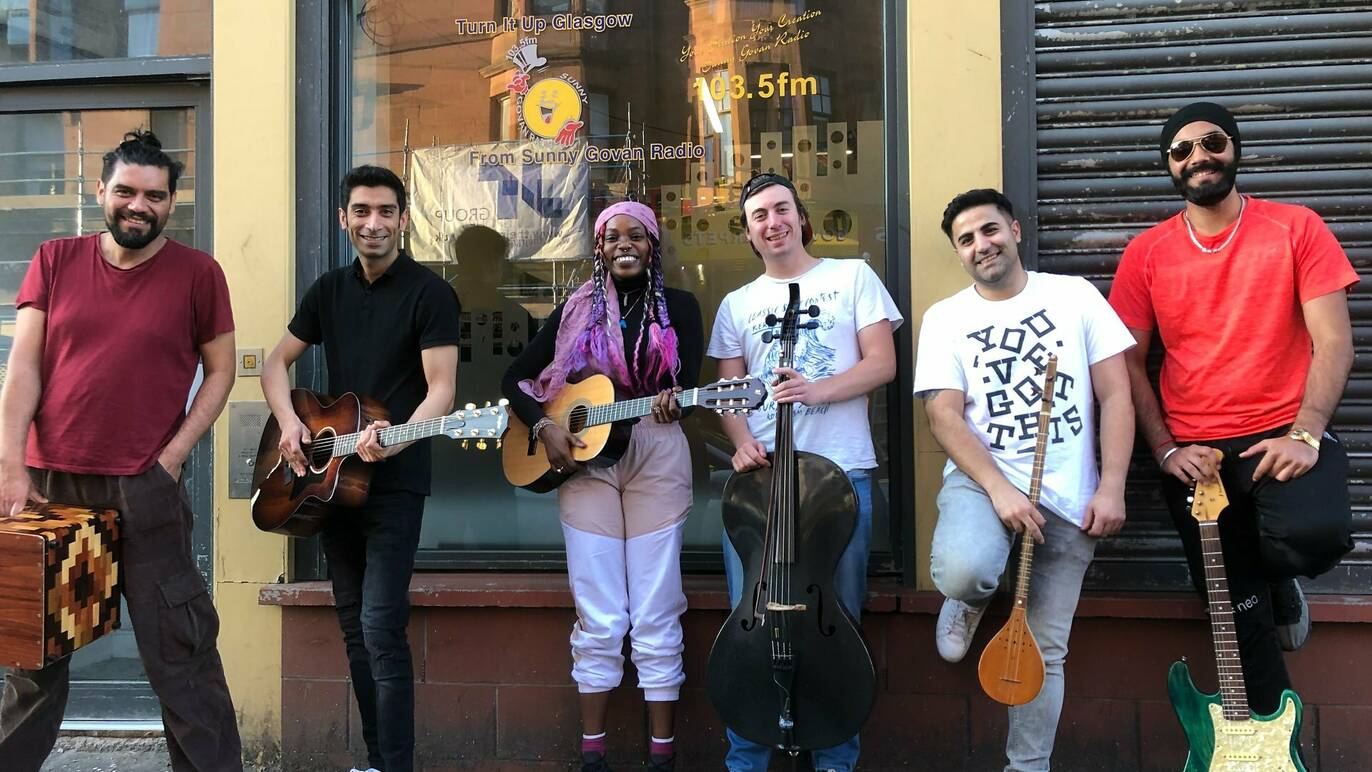
Photo: Musicians In Exile.
The Glasgow Barons.

When musicians bring their music to a new country, they influence and enrich the local music scene while healing themselves from the trauma of uprooted lives. Consider Musicians in Exile, a refugee orchestra in Scotland. Malcolm Jack wrote about it for Time Out.

“When Angaddeep Singh Vig arrived in Glasgow from India as an 18-year-old asylum seeker in January 2020, without any of his beloved musical instruments, he remembers feeling like ‘a guy without a soul.’ …

” ‘Music is part and parcel of my life,’ he says, and it has been ever since his father bought him a set of tabla hand drums aged just four. By his mid-teens Singh Vig had mastered not only that instrument but also the harmonium and flute, as well as singing. He had even begun teaching music. But when he and his parents were forced to flee India due to violent persecution by criminal gangs, they left with next to nothing, arriving in a strange and faraway land unable to work, study or begin rebuilding their lives.

“More than two years later, Singh Vig lives with his mother and father in temporary accommodation in Govan, as they continue their long and agonizing wait for leave to remain in the UK. But thanks to Musicians In Exile – Glasgow’s asylum seeker and refugee orchestra – he has got his soul back, and then some.

“Started in 2019, the project is the brainchild of Paul MacAlindin, a freelance conductor who has worked with orchestras and ensembles all over the world, from the New Zealand Symphony Orchestra to the Armenian Philharmonic and the Düsseldorf Symphoniker. From 2009 to 2014, MacAlindin was music director of the National Youth Orchestra of Iraq – a maverick mission to help young musicians in the country pull themselves out of the horrors of war. ‘And it worked,’ he says, ‘until the invasion of Islamic State.’

“The orchestra collapsed, and so did MacAlindin, ‘mentally and physically,’ he says, ‘because after investing all the energy of keeping that thing alive and then having it stopped in such a dramatic fashion, I was just left completely floored.’ He moved back to his native Scotland to heal, choosing Govan purely as a cheap place to put a roof over his head. There, quite by luck, he suddenly found himself among the diverse and in many cases displaced communities of the former shipbuilding district on the south bank of the River Clyde – which is also the location of a branch of the Home Office, and thus is home to a lot of asylum seekers and refugees.

“MacAlindin founded The Glasgow Barons – an award-winning ‘regeneration orchestra’ set up to help revitalize Govan through performances in local venues by musicians of all backgrounds. Musicians in Exile grew out of that, as a way of helping to give musician asylum seekers and refugees in the area a chance to gather every Tuesday evening to sing, play and share their talents, experiences, stories and songs. …

“If members don’t have instruments, then MacAlindin – who receives funding from the People’s Postcode Trust, the Robertson Trust, and Creative Scotland Lottery – sources and buys them one, however rare it may be (he’s currently in the market for an Albanian two-string plucked instrument called a çifteli).

During lockdowns, when sessions had to be moved online, he also helped his members to buy digital devices and access to the internet so they could keep communicating and playing together.

“Through Musicians in Exile, as well as the generosity of others in his local community, Singh Vig now not only has a tabla again, but also a harmonium, a violin, a mandolin and an electric guitar (which he quickly learned to play, despite never having touched one before). ‘Now I’ve got many souls,’ he laughs. His father and mother, who are also musicians, come along to sessions too – Singh Vig credits it with helping to pull them both out of a deep malaise and, in his father’s case, even clinical depression.

“Singh Vig and Musicians In Exile have played several high-profile concerts. They included … a pre-recorded video performance for the opening of the new parliamentary session in October 2021. It was broadcast in the chamber to an audience of dignitaries including, among others, The Queen. Singh Vig was impossible to miss, sat at the centre of the ensemble in a bright red turban and denim jacket. ‘The Queen is watching me,’ he remembers thinking. ‘I cannae believe it.’ “

More at Time Out, here.

Read Full Post »

Older Posts »