Feeds:
Posts
Comments

Posts Tagged ‘romania’

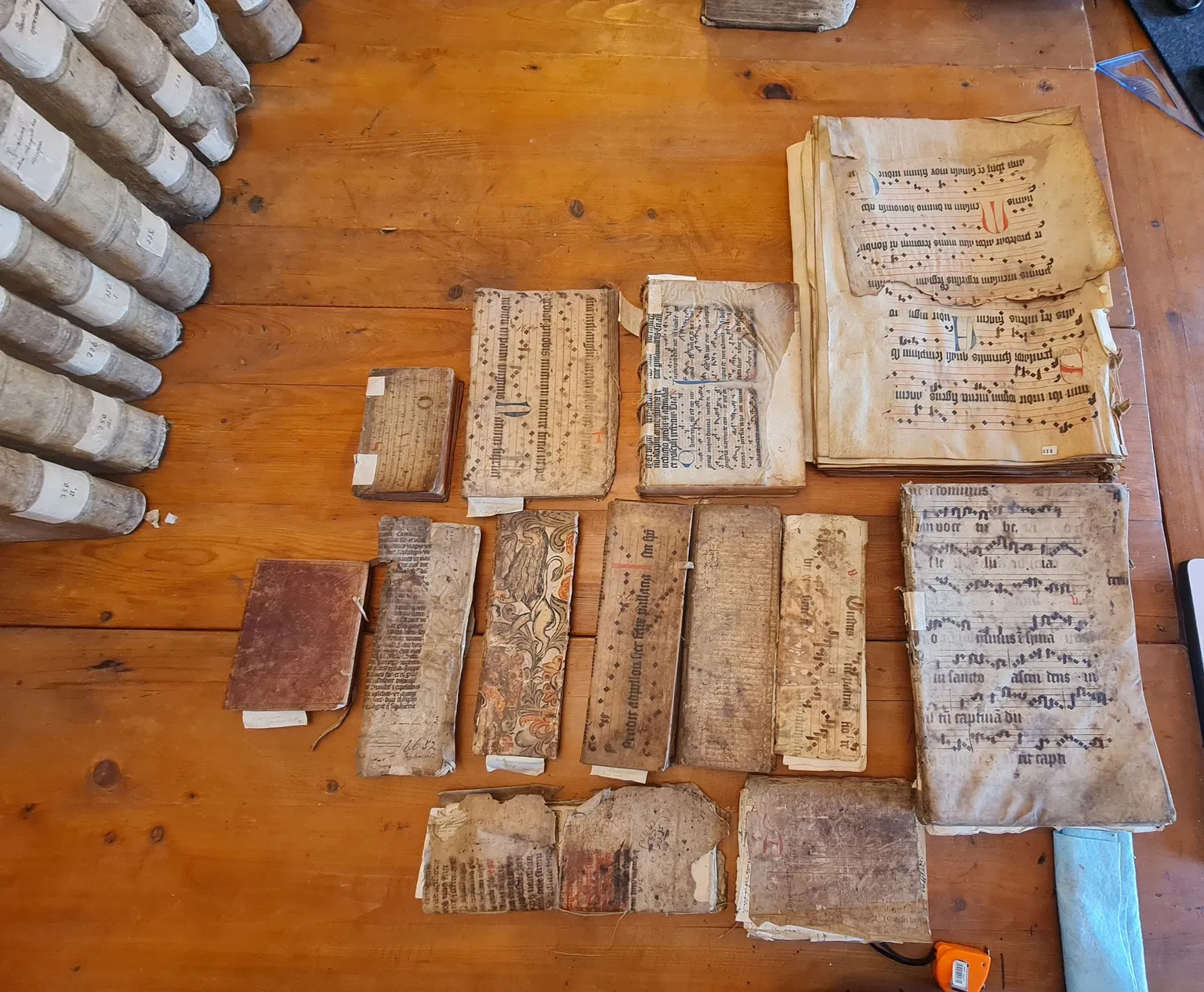
Photo: Adinel C. Dincă / Biblioteca Batthyaneum.
Buried for centuries in a Transylvanian church tower, a forgotten medieval library has come to light, offering a glimpse into the intellectual and cultural life of medieval Romania.

By Jove! How many treasure troves are yet to be discovered on Planet Earth? It makes me want to start a limerick using “Jove,” “trove,” “grove” …

The website Medievalists reports, “Hidden away for centuries in a Transylvanian church tower, a forgotten medieval library has come to light, revealing treasures as old as the 9th century. This extraordinary discovery of manuscripts, books, and documents offers a rare glimpse into the intellectual and cultural life of medieval Romania.

“The discovery was made two years ago in the Church of St. Margaret in Mediaș, a 15th-century Gothic structure built by the Transylvanian Saxons. A team led by Professor Adinel C. Dincă of Babeș-Bolyai University uncovered the collection in the church’s Ropemakers’ Tower, where it had remained hidden for decades, possibly centuries. Biblioteca Batthyaneum, which first announced the find, described it as a scene straight out of an Indiana Jones adventure, complete with a struggle against nesting pigeons to recover the precious volumes. The cache includes:

  • Printed Volumes: Approximately 139 books printed between 1470 and 1600.
  • Manuscript Volumes: Two manuscripts from the early 16th century.
  • Original Documents: Around 60 documents from the 14th to 16th centuries, with a few originals and copies from the 17th century.
  • Administrative Registers: About 10 registers from the 17th–18th centuries, containing fragments of medieval manuscripts. …

“Professor Dincă believes the library was deliberately hidden, possibly during a period of war or religious upheaval. The organization of the books suggests a carefully curated collection rather than a haphazard storage. ‘When I first encountered the books, I immediately noticed the disposition of the volumes according to a certain historical typology: bibles and biblical texts, patristic, theology etc,’ Dincă explained to Medievalists.net. ‘This order doesn’t look like an improvisation. …

“The items found are likely part of a larger collection held by the church. A catalogue from 1864 lists around 7,700 books in the church library, many of which were authored by key Protestant Reformers such as Martin Luther, John Calvin, and Philip Melanchthon. The cache provides researchers with the rare opportunity to match the recovered volumes with the historical records and explore what remains of this once vast repository.

“Among the most intriguing finds are fragments of medieval manuscripts, some dating as far back as the 9th century. These include texts written in Carolingian minuscule, a script commonly associated with the Carolingian Renaissance, as well as liturgical manuscripts from the 14th and 15th centuries. Many of these fragments were found recycled into administrative registers, offering insights into how older texts were reused within the community.

“ ‘One highlight of this historical collection is the large number of original 16th-century bindings, many of them dated,’ Dincă notes. ‘In addition to that, in the series of administrative registers of the parish, there are several fragments of mediaeval manuscripts, among them one copied in Carolingian minuscule, the rest of the “fragments collection” containing the usual liturgical manuscripts from the 14th to 15th century. The closed context of re-use makes it very likely that such recycled pieces of parchment are in fact remnants of a pre-Reformation stock of manuscripts locally used.’

“The discovery has launched a comprehensive research project. … Funded by Germany’s Ministry for Culture and Media, the project focuses on preserving the collection, digitally reconstructing it, and conducting detailed scientific analysis. …

“Researchers are particularly interested in the collection’s role in reflecting the intellectual and cultural life of the Transylvanian Saxons. The books and manuscripts provide unique insights into the circulation of ideas in medieval Europe. …

“Professor Dincă and his team believe the discovery represents more than just a hidden archive — it is a time capsule that offers a rare glimpse into the cultural and religious life of the region during the Middle Ages.”

More at Medievalists, here. No paywall. (Once I started thinking about rhymes for “ove,” I realized once again how weird English is. You can’t use “love” or “shove” with “trove” or “move” either.)

Read Full Post »

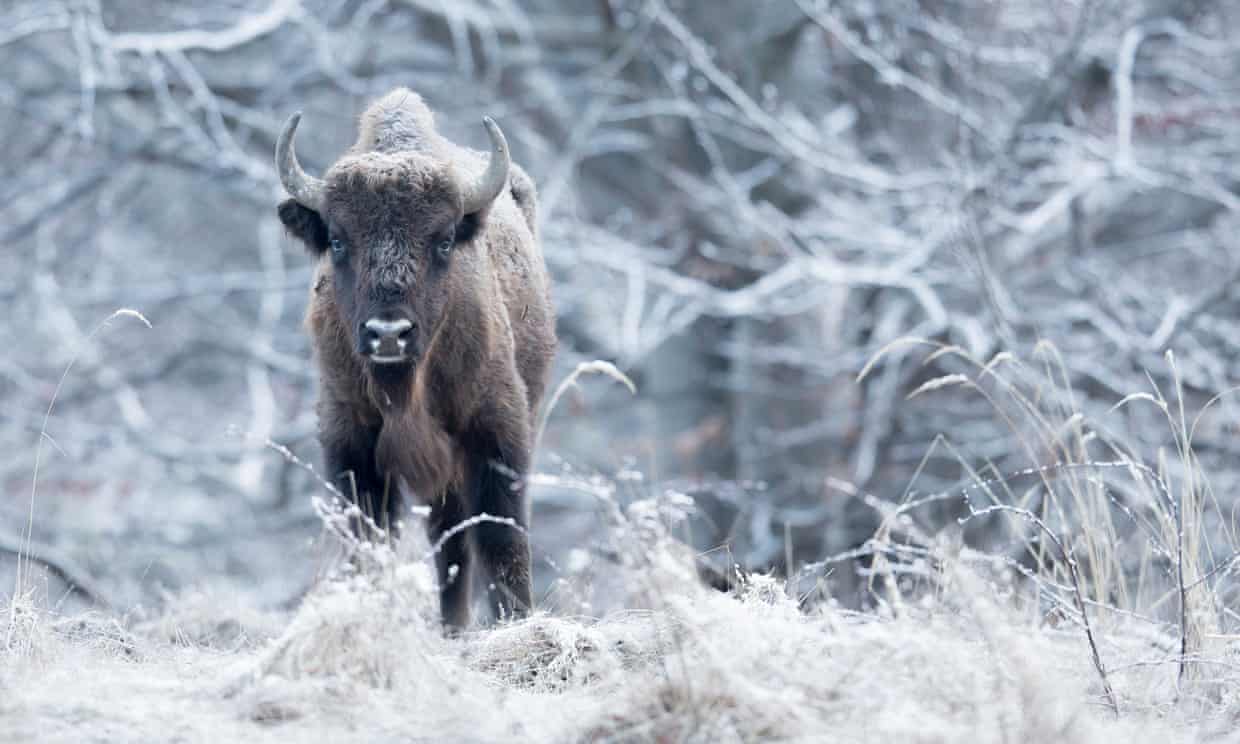
Photo: Michel Doutemont.
“European bison disappeared from Romania more than 200 years ago,” says the Guardian, “but the species was reintroduced to the southern Carpathian mountains in 2014.” 

We think of bison as iconically North American. Who knew about the bison in Europe — also nearly wiped out by humans? It turns out they are worth bringing back, if only to store carbon.

Graeme Green explains at the Guardian, “A herd of 170 bison reintroduced to Romania’s Țarcu mountains could help store CO2 emissions equivalent to removing 43,000 US cars from the road for a year, research has found, demonstrating how the animals can help mitigate some effects of the climate crisis.

“European bison disappeared from Romania more than 200 years ago, but Rewilding Europe and WWF Romania reintroduced the species to the southern Carpathian mountains in 2014. Since then, more than 100 bison have been given new homes in the Țarcu mountains, growing to more than 170 animals today, one of the largest free-roaming populations in Europe. The landscape holds the potential for 350-450 bison.

“The latest research, which has not been peer-reviewed, used a new model developed by scientists at the Yale School of the Environment and funded by the Global Rewilding Alliance, with the bison paper funded by WWF Netherlands. The model, which has been published and peer reviewed in the Journal of Geophysical Research: Biogeosciences, calculates the additional amount of atmospheric CO2 that wildlife species help to capture and store in soils through their interactions within ecosystems.

“The European bison herd grazing in an area of nearly 50 sq km [~19 square miles] of grasslands within the wider Țarcu mountains was found to potentially capture an additional 54,000 tonnes of carbon a yearThat is nearly 9.8 times more carbon than without the bison – although the report authors noted the 9.8 figure could be up to 55% higher or lower, so making the median estimate uncertain. This corresponds to the yearly CO2 released by a median of 43,000 average US petrol cars, or 84,000 using the higher figure, or a median of 123,000 average European cars, due to their higher energy efficiency, the researchers said.

“Prof Oswald Schmitz of the Yale School of the Environment in Connecticut in the US, who was the lead author of the report, said: ‘Bison influence grassland and forest ecosystems by grazing grasslands evenly, recycling nutrients to fertilize the soil and all of its life, dispersing seeds to enrich the ecosystem, and compacting the soil to prevent stored carbon from being released.

“ ‘These creatures evolved for millions of years with grassland and forest ecosystems, and their removal, especially where grasslands have been plowed up, has led to the release of vast amounts of carbon. Restoring these ecosystems can bring back balance, and “rewilded” bison are some of the climate heroes that can help achieve this.’

“[Alexander Lees, a reader in biodiversity at Manchester Metropolitan University, who was not involved with the study] said more in-the-field research would help validate the models and assist understanding of how long it would take for bison benefits to accrue, adding: ‘This study reinforces an emerging consensus that large mammals have very important roles in the carbon cycle.’ …

“A keystone species, bison play an important role in ecosystems – their grazing and browsing helps maintain a biodiverse landscape of forests, scrub, grasslands and microhabitats. In the Țarcu mountains, their return has also inspired nature-based tourism and businesses around rewilding. Schmitz noted that the Carpathian grasslands have specific soil and climate conditions, so the effect of the European bison could not necessarily be extrapolated internationally – American prairies, for example, have much lower productivity.

“ ‘This research opens up a whole new raft of options for climate policymakers around the world,’ said Magnus Sylvén, the director of science policy practice at Global Rewilding Alliance. ‘Until now, nature protection and restoration has largely been treated as another challenge and cost that we need to face alongside the climate emergency. This research shows we can address both challenges: we can bring back nature through rewilding and this will draw down vast amounts of carbon, helping to stabilize the global climate.’ …

“Schmitz said the team had looked at nine species in detail, including tropical forest elephants, musk oxen and sea otters, and had begun to investigate others. He added: ‘Many of them show similar promise to these bison, often doubling an ecosystem’s capacity to draw down and store carbon, and sometimes much more. This really is a policy option with massive potential.’ “

More at the Guardian, here.

Read Full Post »

Photo: Isabelle de Pommereau.
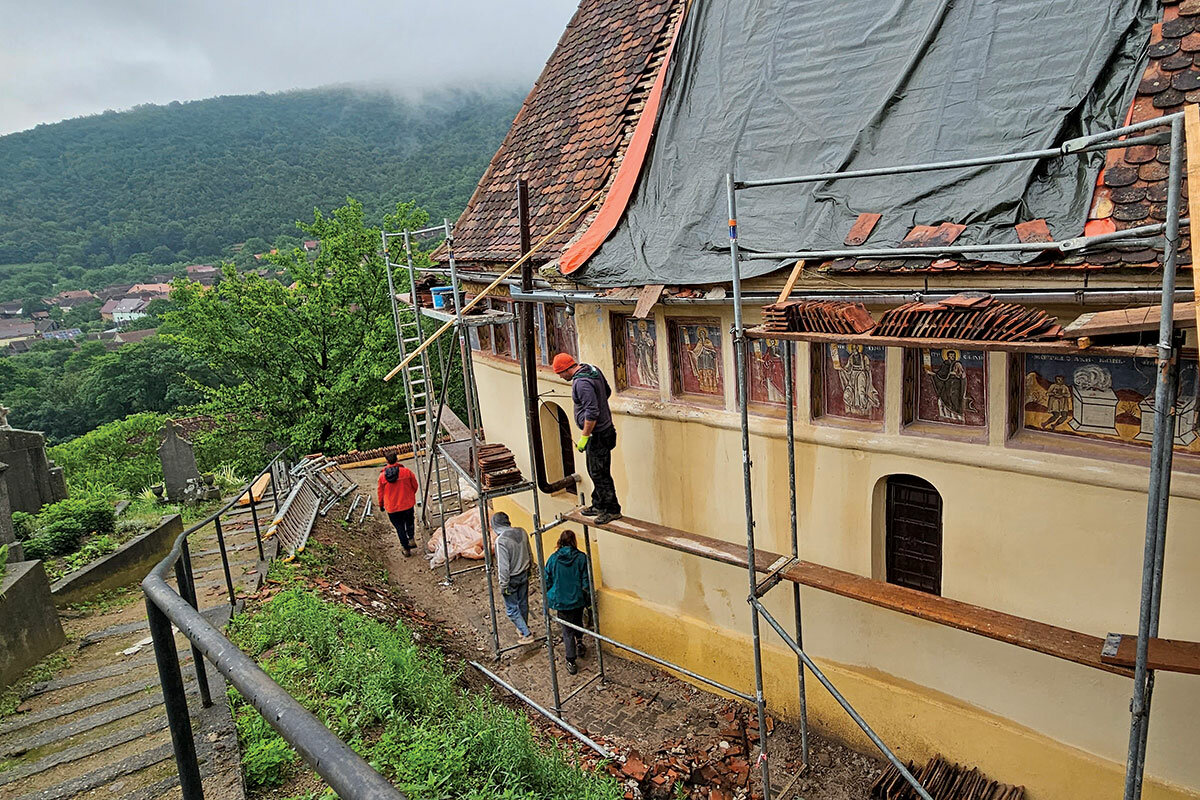
Eugen Vaida and an Ambulance for Monuments team repair the Church of St. Nicholas the Hierarch in Fântânele, Romania.

Today’s story is all about the Power of One. That is, one who organizes many. The setting is a post-Communist country that is struggling to build its economy and has little left over for preserving cultural monuments.

Isabelle de Pommereau writes at the Christian Science Monitor, “It is midday on a damp Friday. Eugen Vaida guides his team into the final phase of re-tiling the roof of a church, at the crest of a forested hill in this mountainous Transylvanian village.

“Village craftspeople and students from the city meticulously lay tiles on the roof timbers of the 18th-century Romanian Orthodox Church of St. Nicholas of the Hierarch. From the scaffolding, students respectfully and attentively watch Nicolae Gabriel Lungu, who is descended from a Romani family who all knew this skill. Soon an older woman summons the crew to share in a platter of clătite, thin cheese-filled crepes.

“Once bustling with families and culture, Mr. Vaida’s home region had become a string of largely empty villages surrounding abandoned stone churches. But now, watching this group interact, he has newfound hope. The repair by his group, Ambulance for Monuments, will help safeguard the church’s stunning outer frescoes. And the impact will ripple far beyond the building itself. 

“ ‘People are starting to understand the value of heritage,’ Mr. Vaida says. For the past seven years, he’s been driving around the country with a van equipped with tools and volunteers in a race against time to rescue endangered historic buildings. He has helped save more than 55 historical structures on the verge of collapse, from medieval churches and fortification walls to old watermills and UNESCO World Heritage Sites. He does so by impressing preservation methods and mindsets onto local communities. 

“ ‘I wanted to reconnect the members of the community to their roots, make them aware that those buildings are part of their cultural identity, and show them how they can continue the work we do,’ he says.

“Mr. Vaida offers a ‘best-practice example of how, with not so much effort, you can save the identity of Romania as a country,’ says Ciprian Stefan, director of the ASTRA Museum, Europe’s largest open-air ethnographic museum, in Sibiu.

“Romania’s rich cultural legacy of painted churches and fortified villages was shaped over centuries. But close to 600 historic monuments are in an acute state of degradation, victims of years of dictatorship, poor legislation, and plain neglect, experts say.

“Mr. Vaida experienced the destruction in a very personal way. He grew up playing with Romani and Hungarian friends, as well as the German Saxons who had literally built the region. When the 1989 collapse of communist dictatorship flung Romania’s doors wide open, half a million people left. The mass exodus tore the Romanian soul apart – and fractured Mr. Vaida’s own identity. Ambulance for Monuments is an attempt to reclaim both his identity and that of his country. …

“He, too, left for the city, to get an education, and he became a successful architect in Bucharest. But six years into the job, he quit to return home. The big city was not his future; his home village was.

“He soon discovered that many village craftspeople who had passed on their know-how from generation to generation had left for Western Europe. … Mr. Vaida wanted to use his architectural skills to save his region’s extraordinary architectural and cultural heritage. He started by teaching children about local history. …

“In 2016, he launched Ambulance for Monuments in hopes of connecting architectural students, craftspeople, and communities around a new effort to restore decaying historic buildings. …

“Volunteer students get hands-on practice in historical restoration; local craftspeople get jobs; and communities help house and feed the teams, and donate the material. … ‘It’s going from grassroots up, from down to up,’ says Mr. Vaida. …

” ‘He doesn’t go to villagers to ask for anything, but he goes there to give something,’ says Mr. Stefan. ‘The community stays in the shadows at first. When they see Eugen comes with material and manpower to restore their church, they say, “Let’s help him,” and, little by little, they come and help with housing, with food.’ …

“The task of rescuing Romania’s cultural legacy is huge, but Mr. Vaida sees signs of progress. … ‘People are moving back to the villages of their grandparents, because they feel they belong there,’ he says. ‘They are rediscovering old houses, their heritage, their villages, and are getting involved in the preservation of this type of living.’ ”

More at the Monitor, here. No paywall. Subscriptions solicited.

Read Full Post »

Photo: The Daily Mail
At the Ursul festival, Romany gypsies wear bear skins to ward off evil spirits from the year gone by. This scene in Comanesti, north of Bucharest, is replicated across Romania.

Today I saw a photo in the Boston Globe about an unusual custom in Romania. Inspired to do a Google search, I found a surprising amount of information.

Jay Akbar writes for Mailonline, “In a bizarre ritual every December between Christmas and New Year, Roma gypsies living in Comăneşti, 300km north of Bucharest … put on real bear skins and parade through the streets.

“The festival called Ursul — which is replicated across the country — originated from an ancient Indo-European tribe known as the Geto-Dacians, who believed bears were sacred.

“They and other tribes who lived in what is now Romania and Moldova — then known as Dacia — thought bears were the spirit of the forest and ‘the supreme master of cosmic energy’.

“According to Romanian mythology, the bear possesses the power to protect and heal.

“Villagers would long ago cover a newborn baby with bear fat, to give him strength and luck. And today they believe bear skins protect them from the spirits they are chasing out of the village.”

Read more at The Daily Mail, where you will find lots of terrific pictures.

The Ursul experiences of photographer Diana Zeyneb Alhindawi are at CNN. She recounts how her grandmother used to see Gypsies descending “into towns from the forests in which they lived, bringing with them real bears.”

Up until the 1930s, she says, “Townsfolk would pay the Gypsies in exchange for letting the bear cubs walk up and down their backs — seen as a cure for backache.”

No more live bears today — just people in bearskins.

(Even so, I wonder if I should ask a physical therapist about getting a bear cub treatment.)

Read Full Post »

Roma families (also called gypsies, tinkers or travelers) have a hard life in Europe. Recently, Elisabetta Povoledo wrote at the New York Times about some Roma women who are hoping to build a better life for their families by starting food businesses.

“On a muggy July evening, a handful of Italian hipsters milled around a food stand at an alternative music festival in Rome, trying to decipher some of the exotic offerings: mici, sarmale and dolma.

“These Balkan delicacies — barbecued meatballs, cabbage wraps and stuffed peppers — are the basic ingredients of an entrepreneurial scheme cooked up by a group of Roma women looking to better their lives and leave the overcrowded and insalubrious camp in Rome where they currently live.

“They call themselves the Gipsy Queens.

“ ‘Cooking? I’ve been cooking practically since I was born,’ said one of the chefs, Florentina Darmas, 33, a mother of three, who is originally from Romania. …

“Nowadays she is trying to break down some of the barriers faced by her traditionally marginalized group using the universal language of food. …

“ ‘We realized there was unexpressed potential in the community, especially on the part of women,’ said Mariangela De Blasi, a social worker with Arci Solidarietà Onlus, a Rome-based nonprofit organization that works with marginalized people and manages the burgeoning catering business. …

“If their entrepreneurial plans pan out, the Gipsy Queens hope to buy a food truck or rent a kitchen on a more permanent basis — foundations for steady work that will bring in rent money.

“ ‘Getting out [of the camp] is my first priority,’ said Hanifa Hokic, 31, a divorced mother of five children between 8 and 12 years old, who is originally from Bosnia. …

“Maria Miclescu, a 20-year-old mother of two, agreed that to give her children ‘a better future,’ she had to leave. Her husband is trying to establish a small-appliance repair business …

“The oldest member of the group, Mihaela Miclescu, 49, who is a grandmother, was happy to join the Gipsy Queens.

‘I wanted to show Italians that we are not bad people, that we want to work, not to beg.’

More here.

Photo: Gianni Cipriano for the New York Times
Maria Miclescu, left, and Codruca Balteanu at a food stand run by the Gipsy Queens during a music festival in Rome. 

Read Full Post »

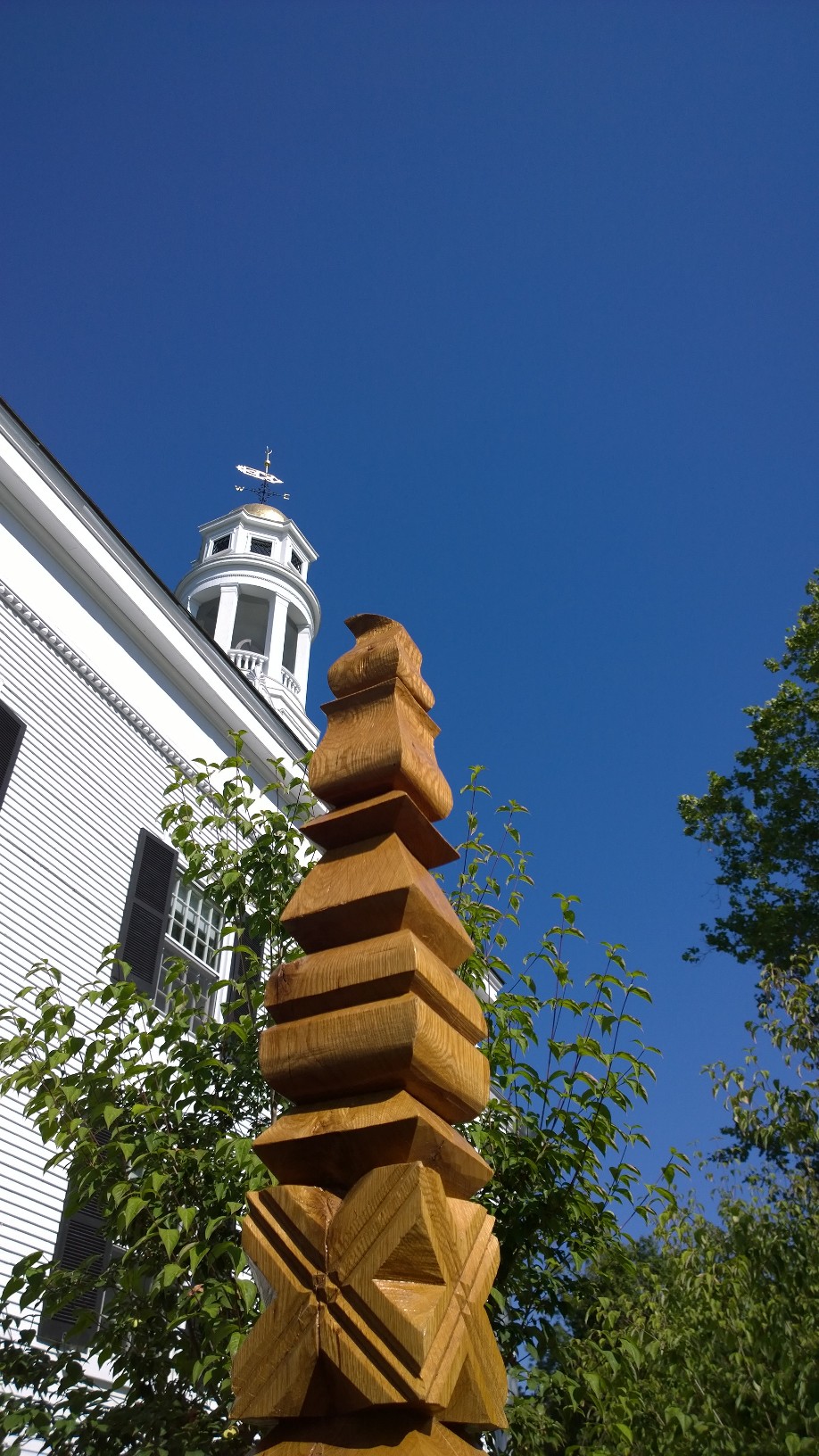
OK, it’s not really a totem pole, but I was afraid the word kopjafa wouldn’t ring any bells with readers.

Today at church we dedicated a wooden pole that was carved by the minister of our sister church in Transylvania when he visited Massachusetts last year.

A translated Wikipedia entry says that, originally, two kopjafa poles were to used to carry a coffin to a cemetery. The poles were then placed at the head and foot of the mound. But according to my minister, nowadays kopjafa poles are set outside churches and, as in our case, sometimes given to a partner church.

The minister read the poem below as he spoke about our church’s connection to Transylvanians of the (almost) same religion. The subject is a little sad for what we do at Suzanne’s Mom’s Blog, but it fits with our previous discussions about the value of preserving language and customs in minority communities. (Hungarian Transylvania was handed over to Romania after World War I, and has had some challenges, starting with language challenges.)

“Leave, if you can …
“Leave, if you think,
“That somewhere, anywhere in the world beyond
“It will be easier to bear your fate.
“Leave …
“Fly like a swallow, to the south,
“Or northward, like a bird of storm,
“And from high above in the wide skies
“Search for the place
“Where you can build a nest,
“Leave, if you can.
“Leave if you hope
“Against hope that homelessness
“Is less bitter abroad than at home.
“Leave, if you think
“That out in the world
“Memory will not carve new crosses from
“Your soul, from that sensitive
“Living tree.”

Read about the poem’s author, Hungarian poet Sandor Remenyik, here.

Transylvania-kopjafa-at-sister-church

Read Full Post »

A WordPress blogger who clicked on one of my posts has a nifty site, here. The blogger is Razvan, from Romania. Razvan apologizes for a lack of fluency in English, but I am grateful for any amount. Wish I could speak other languages.

You will like Razvan’s origami. Here’s a description of the fruit basket below.

“I want to introduce another model Origami3d origami fruit basket, this 3d origami model  consists of about 3,000 pieces. Origami 3d basket is 25 cm diameter and 9 cm tall and is made of around 1,100 pieces.Pieces are made from rectangles of paper with dimensions of 5.2-3.6 cm and took me about 16 hours to finish. 3D Origami fruit are  made of around 170-500  pieces . Pieces are made from rectangles of paper with dimensions of 3.8-2.7cm and took me about 24 hours all.”

I hope Razvan checks out a couple of my past posts on paper art. This one is from Tokyo Bling. This one involves a stealth project in English libraries. And Peter Gentenaar’s Flying Paper Jellyfish and other paper artworks are gorgeous.

3-D Fruit Basket Origami: Razvan at Razcaorigami.

Read Full Post »

Photograph: James Montague for The New York Times
Outside the Vakar Lajos rink, where the Hungarian name of the Romanian ice hockey team, Hoki Sport Club Csikszereda, is printed on the ice.

I don’t follow ice hockey, but a recent article on ethnic Hungarians playing for the Romanian ice hockey team caught my eye.

I already knew that a chunk of Romania is like a little Hungary because my church and a church in Transylvania (20 percent ethnic Hungarian) have a longstanding relationship. Exchanges back and forth occur nearly every year.

So in flipping past the sports section the other day, I couldn’t ignore an article by James Montague on the irony of Romania, a country that under communism repressed ethnic Hungarians, having so many of them on their national ice hockey team. A feeder team in Miercurea Ciuc, Romania, calls itself Szekely Land, after a former province of the Kingdom of Hungary.

“The Szekely Land, named for a warrior tribe that dates to the Middle Ages, is a Hungarian-dominated area of Romania, covering three counties in the center of the country. The roughly 1.2 million Hungarians represent Romania’s largest ethnic minority, about 6 percent of the country’s population. The fall of the Austro-Hungarian empire after World War I marooned millions of Hungarians in what is now Romania, Slovakia, Ukraine and Serbia. The Szekely found themselves cut off and subject to a policy of assimilation, including heavy restrictions on the use of their language, under the former communist leader Nicolae Ceausescu.”

Sometimes having so many ethnic Hungarians on the Romania team can lead to unhockeylike situations. The “anomaly reached a critical point during a 2011 game between Romania and Hungary in Miercurea Ciuc,” writes Montague. “After the game, almost all of Romania’s players joined with their opponents to sing the Hungarian anthem.

“ ‘Some of the paparazzi caught it, and it was a big scandal,’ said Attila Goga … who has played for the Romanian national team for a decade but holds dual Romanian-Hungarian citizenship. ‘It’s a little bit strange, but I can see that, too. They don’t understand our situation here.’ ” More.

My advice to autocrats: Don’t try to change people’s language. It always ends badly.

Read Full Post »