Feeds:
Posts
Comments

Posts Tagged ‘school’

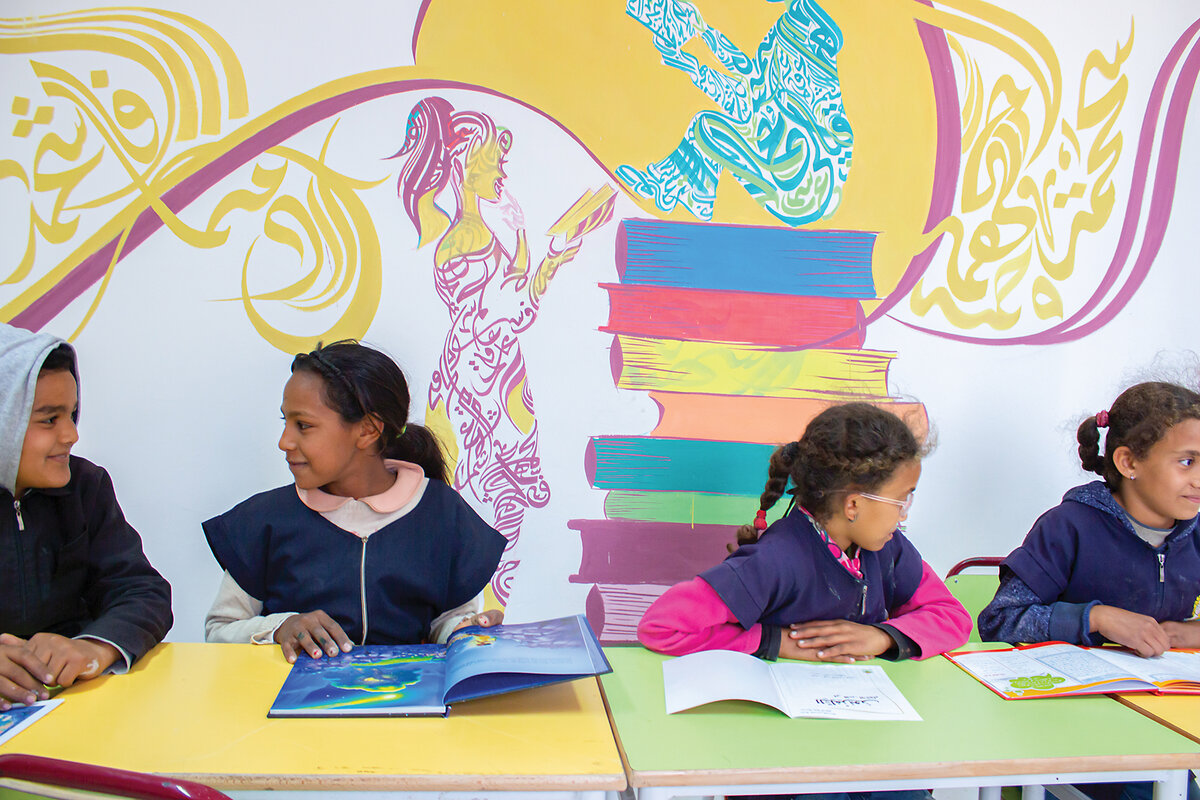
Photo: Meriem Belhiba.
Girls explore colorful storybooks in the newly inaugurated library at Bir El Euch Primary School in Tunisia.

Meriem Belhiba wrote this story for the Christian Science Monitor.

“To children in this hilltop village, their school library is a portal to another world.

“Israa Al Trabelsi and five other 9-year-olds barely stifle their giggles as they weave – wide-eyed with curiosity – through the colorful room. They can plop down into cushioned chairs, look at bright wall art, and, of course, browse shelves bursting with books. The transformative space was built for children to dream in.

“ ‘I’ve learned so much,’ Israa says after taking a seat with a book about faraway lands in her hands. ‘It is also helping me improve my vocabulary and my writing,’ she notes, quickly adding, ‘I want to be a judge.’

“That might seem an unusual ambition for a child in Bir El Euch, a rural community of 1,600 people southwest of Tunisia’s capital, Tunis. But it makes sense when one learns that the man behind the library, Omar Weslati, is himself a judge who knows how precious books can be to children. ‘This project began as a way to reconcile with the child I once was, who had nothing,’ he says.

“Economic inequality has long been a challenge in Tunisia, a country of 12 million people. Widespread poverty in rural areas, high unemployment, and poor infrastructure were key triggers behind the 2011 mass protests that toppled a 23-year dictatorship and touched off the Arab Spring uprisings. …

” ‘I grew up in a rural school without a library, without light, without transportation, and without heating,’ Judge Weslati recalls. ‘As a bookworm, I needed to walk long distances to reach the nearest public library.’

“Launched in 2016, the initiative is led by white-collar professionals, most of whom hail from rural communities. These journalists, writers, judges, and teachers have chipped in funding to create a new library every year. Each one serves hundreds of students and takes thousands of dollars to complete.

“The project’s launch could not have been timed better. The first ‘imagination libraries,’ as they were initially called, were built in the aftermath of the violent extremism that accompanied the Arab Spring. Amid the waves of unrest that ensued across the region, Tunisia has been the biggest contributor of foreign fighters in the world – with Tunisians joining extremist groups in Syria, Libya, Iraq, and elsewhere.

“This was a factor behind the library initiative. ‘Where the book doesn’t reach, the extremist arrives first,’ Judge Weslati says. …

“Besides offering books as a source of inspiration, Judge Weslati’s team began visiting remote schools and sharing members’ personal stories. ‘We wanted to show kids that people from their own soil once dreamed, created, and contributed,’ he says.

‘We never saw this as charity; it’s about cultivation,’ he adds. ‘Planting stories where they hadn’t taken root before.’

“Beyond reading, the initiative led to something more: a writing club for rural youths. Teenagers craft short stories together and publish their work. One of the teens, Molka Hammami, credits her former teacher Jamila Sherif for lighting a spark in her.

“ ‘Reading changed my life,’ Molka says. ‘It pushed me to do more. I was published in the [club’s] collective storybook last year.’ Now she helps run a radio show for the club.

“Ms. Sherif, who has since become a school inspector, emphasizes the stakes. ‘Many kids drop out after primary school,’ she says. … ‘We’re trying to change that – one library, one book at a time.’”’

“Reports have shown that, despite declining school dropout rates across Tunisia, the problem is most acute in rural areas. Donia Smaali Bouhlila, an expert on educational inequality at the University of Tunis El Manar, says inadequate schools and infrastructure in rural areas are among the biggest reasons that students drop out.

“ ‘When learning spaces lack comfort, resources, or consistency, they stop being places of growth and become sources of alienation,’ she says. ‘Every small success – helping a child learn to read, keeping a teenager engaged – represents a meaningful step forward.’

“Safahat, a cultural organization whose name translates to ‘pages’ in Arabic, aimed to serve schools when it was founded in 2020 [but] faced logistical and financial hurdles because of the region’s remoteness. This prompted its team to pivot to a more mobile model: public bookcases. …

“Through its Maktabtena (‘our library’) initiative, the group placed red-and-white boxes of books in hospitals, youth centers, and schools, and on street corners. … Readers are invited to take a book, read freely, and donate their own books if they can. ‘We want to make reading a habit, not a luxury,’ [Khawla Mondhri, a university professor and volunteer leading the initiative] says. ‘If someone takes a book and doesn’t return it, that just means it’s being read somewhere else. ‘And that’s enough for us.” …

“So far, the team has installed 35 bookcases in accessible, safe, and visible spots. To ensure a bookcase is never empty, the team has formed partnerships with municipalities, associations, and individuals.

“ ‘We send books as often as needed. We plant small oaks,’ Ms. Mondhri says. ‘But we dream of forests.’ ”

More at the Monitor, here.

Read Full Post »

Photo: Ogar Monday.
Two students sit outside an experimental Nigerian school’s computer lab, donated by the Irish Embassy.

Today’s article is about an educational experiment in Africa that makes it possible for the “poorest of the poor” to get an education. The experiment is focused on keeping payments low and teaching kids to become “problem solvers.”

Ogar Monday writes at the Christian Science Monitor, “Groups of students, deep in discussion, are huddled under a large schoolyard canopy on a sweltering morning. Flanked by two teachers, Kingsley Bangwell strolls among the students. He stops beside one group and asks, What problem are you solving?’

“Two students rise. Faridat Bakare, a girl with paper in hand, responds. ‘Our work is on the lack of proper business strategy among female-owned small businesses in Kuje,’ she says.

“She explains that many women in that Nigerian city unintentionally limit the growth of businesses they start by overlooking the four P’s of marketing: product, price, place, and promotion. The students’ solution is to start a mentorship cycle connecting established businesswomen with local budding entrepreneurs. Mr. Bangwell nods his approval and moves on to another group.

“Mr. Bangwell is a co-founder of the Knowledge, Solutions, Skills, and Kreativity (Knosk) school in Kuje, on the outskirts of Nigeria’s capital, Abuja. For 100 naira (6 cents) a day, the school provides six years of learning for students who would otherwise be unable to afford it.

“The exercise that Mr. Bangwell is observing is part of a solutions ‘hackathon.’ Over four days, students engage with small-business owners in their communities to identify real-world challenges and develop solutions.

“ ‘The goal is to help them think critically and work collaboratively,’ Mr. Bangwell says. Winning teams receive prizes, but the biggest takeaway, he insists, is that the students realize ‘they, too, can provide answers to questions around them.’

“In 2018, while she was at a hospital in Abuja, Irene Bangwell overheard a cleaner talking about her teenage daughter, who had dropped out of school to work alongside her. The cleaner explained that she couldn’t afford the $19-per-term school fees for the girl. She believed that it was better for her daughter to work and save money than to attend an underfunded public school with little promise of quality education.

“Mrs. Bangwell, who had spent years working with young people, understood the mother’s concerns. Although public schools in Nigeria are mostly free, they are chronically underfunded, which has led to crumbling infrastructure, teacher shortages, and frequent strikes. Private schools provide better alternatives, but with nearly 39% of Nigerians living below the poverty line, many families find such schools out of their reach.

“Mrs. Bangwell shared the cleaner’s story with her husband, who has a background in youth development. They started Knosk in September 2019 after reaching out to community leaders, churches, mosques, and public primary schools, asking them to refer students who couldn’t afford secondary education. …

“Parents contribute $4 per term.

“ ‘We cater to the poorest of the poor,’ Mrs. Bangwell says. ‘If we don’t take the child in, they have no other chance at an education.’

“The school provides a curriculum that integrates computer and vocational skills, daily lunch, menstrual supplies for female students, and a boarding facility for a few students. …

“Victoria Simon, one of Knosk’s pioneer students, was 6 months old when she lost her father. By age 9, she had also lost her mother, leaving her in the care of her older sister. After Victoria completed primary school in 2018, her family had no means to send her for further education.

“ ‘We were ready to give up when my sister heard about Knosk,’ Victoria recalls.

“The school sounded too good to be true. But two weeks later, Victoria took Knosk’s entrance exam and wrote a 300-word essay about her aspirations. ‘I wrote about creating a free six-month training program for women and giving them tools to start their businesses,’ she says. …

“For some families, even the small fees that Knosk charges are a struggle. And according to Mrs. Bangwell, those fees are not enough to sustain the school. ‘Between paying teachers, uniforms, feeding the kids, and providing learning materials, we need more support,’ she says. Yet no child is ever turned away for unpaid fees.

“The school, which started with 30 students and now has 170, relies heavily on what it calls ‘education angels.’ These are individuals and organizations that sponsor students, for $156 per year.

“Knosk’s impact hasn’t gone unnoticed. ‘The quality of teaching and learning there is comparable to any private school in this area,’ says Daudu Shedrach, an education inspector with the Federal Capital Development Authority. …

“At Knosk, every student is called ‘solver,’ a title that reflects expectations. ‘A solver sees problems and takes action,’ Mrs. Bangwell explains. ‘We build their capacity to see beyond their challenges and to think like contributors to society, not victims.’

“For solvers like Mustapha Ibrahim, who joined Knosk in 2019 after losing his father two years earlier, the title has become a compass for how he approaches life. ‘There is no problem that I cannot solve,’ he says. ‘I just have to think hard about it.’

“Mustapha recalls how he once struggled with self-doubt and anger, believing that his life had ended when his father died. … Today, Mustapha dreams of becoming an aeronautical engineer. ‘I’m always fascinated by how airplanes stay in the sky despite their weight,’ he says.

“He also hopes to give back to the school that changed his life.

“ ‘I want to make it,’ he says, ‘and then come back to help other kids like me. Because I honestly don’t know who I would have become without this place.’ ”

More at the Monitor, here. No firewall. Subscriptions are reasonable.

Read Full Post »

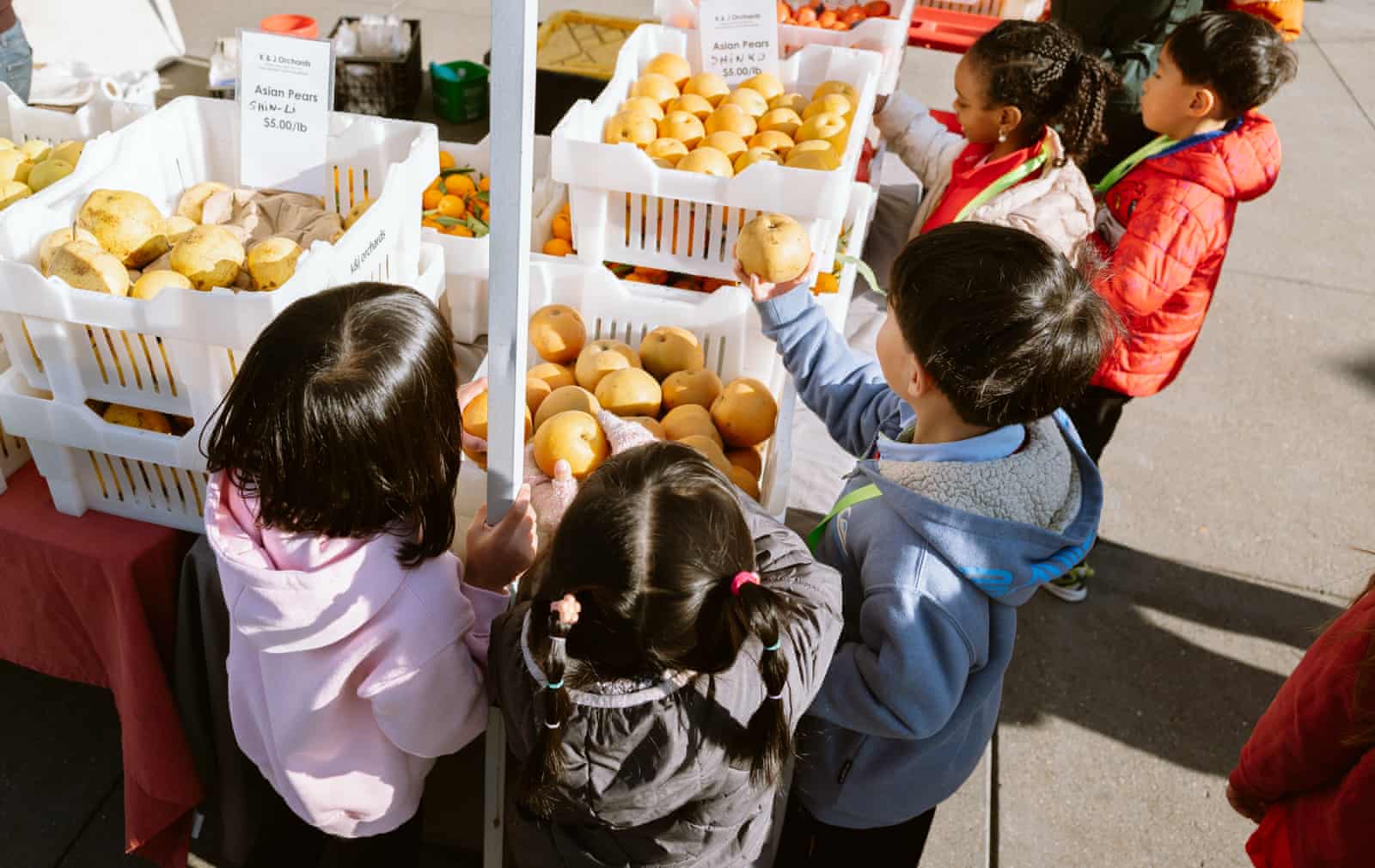
Photo:  Felix Uribe Jr/Guardian.
An organization called Foodwise Kids has brought more than 20,000 students to farmers’ markets to learn about the food system and taste new-to-them produce. Sometimes the teacher will challenge the students to join “the One-Bite Club.” 

When John came back from college the first time, one of the things he said, only half joking, was, “Why didn’t you tell me I liked mushrooms?”

He eats everything now, but as a kid, he had limited tastes, and I was no good at insisting he try something.

Today a special program for young children encourages tasting new things as part of a group.

Cecilia Nowell reports at the Guardian, “On a crisp winter morning in San Francisco, a team of six-year-olds declare that their favorite fruits and vegetables are peaches and broccoli – but then again, they have yet to venture out into the farmers’ market where produce they have never tried before awaits them. With handfuls of tokens, they will purchase persimmons, pomegranates, Asian pears, purple potatoes, kale and more from the farmers who grew them – then embark on a tasting journey, featuring new and familiar spices.

“The first-graders are visiting the Ferry Plaza Farmers Market – a Bay Area institution that draws more than 100 farmers to San Francisco’s waterfront three days a week – with 22 of their classmates from Lincoln elementary. That morning, the children had ridden the subway from their school in Oakland’s Chinatown into the city with parent chaperones and their teacher, Kathy Chen.

“Chen [knows] that at this age, her students are prone to becoming picky eaters – but what is cooked at home and what they try at school can change that. The hope is that after this field trip, when the cafeteria serves up an unfamiliar veggie or they’re offered a new fruit, the students might be a little more willing to take a bite.

“The trip is sponsored by Foodwise Kids, a nutrition and wellness program for elementary school students in the San Francisco Bay Area coordinated by the 30-year-old non-profit Foodwise. Since the program’s launch in 2012, it’s brought more than 20,000 local students out to the farmers’ market to learn about the food system. It’s focused primarily on schools with a high percentage of students of color or kids eligible for free or reduced-price school meals, and education director Tiffany Chung says the aim is to get ‘students excited about eating fruits and vegetables’ in the hopes that ‘they’ll incorporate them into their daily life and eventually lead to longer-term healthy eating options.’ …

“At folding tables, they introduce themselves to Foodwise’s staff and volunteers, and name their favorite fruits and vegetables. Chung jumps in for a moment to speak Mandarin with one student who doesn’t feel comfortable speaking English – she notes that many of the program’s volunteers are bilingual, usually in Spanish, to support the city’s diverse youth.

“While the majority of the classmates in her group prefer peaches, Temnit Desta says her favorite fruit is lemons. ‘She likes sour,’ her mom, Tehesh Hadush, explains. Although Temnit was born in California, her family is from Ethiopia and she has grown up eating lots of spicy foods. …

“Just a few years after the Loma Prieta earthquake devastated the highway running along San Francisco’s coast, community groups began discussing ways to connect downtown with the waterfront – and settled on a farmers’ market. Another aim was to educate urban dwellers about California’s farmland and sustainable agriculture while providing access to healthy, fresh produce. To this day, the market prioritizes urban families – not only by accepting Snap, previously known as food stamps, but by matching every dollar spent so families can double their Snap spending up to $15.

“After they’ve filled a basket with produce – so much that the six-year-olds are carrying the basket in teams of two – the small groups take off for a quick tour of the farmers market. When they return, Chung and other volunteers lead the groups in a game guessing which season different crops grow in. As they play, youth education manager Marcelo Clark starts chopping and roasting different trays of the produce – washing raspberries, flavoring cauliflower with jerk spice and roasting potatoes with cumin. He aims to use a mix of spices the children may have already tried at home – and others that might be new to them.

“ ‘A lot of our students are newer to America, and may not speak English,’ says Chung, but at the market ‘they’re able to see produce that is familiar to them. … They’re able to point out: “I know this. This is cilantro. I have this on tacos.” ‘ …

“When the food has been prepared, Clark carries trays of fruit and both raw and roasted veggies out to the class. The students dive into the purple potatoes, carrots, brussels sprouts, kale and cauliflower – but are more hesitant to try hummus and raw broccoli. Although her classmates and their parents exclaim at the fresh persimmon, Temnit is wary of the unfamiliar fruit.

“ ‘Today is all about trying new things and giving things a chance,’ Chung reminds the class, gently encouraging them to try just the smallest bite of everything.

“ ‘When students are unfamiliar with a fruit and vegetable, there is a lot of hesitation. We try to create this safe space where we’re telling them: “It’s OK if you don’t like it. The whole point is just to try it.” ‘ …

“By the end of the class, Temnit will be asking for more persimmon, and one of her classmates will be racing around trying to finish everyone’s leftover pomegranate seeds.”

More at the Guardian, here.

Read Full Post »

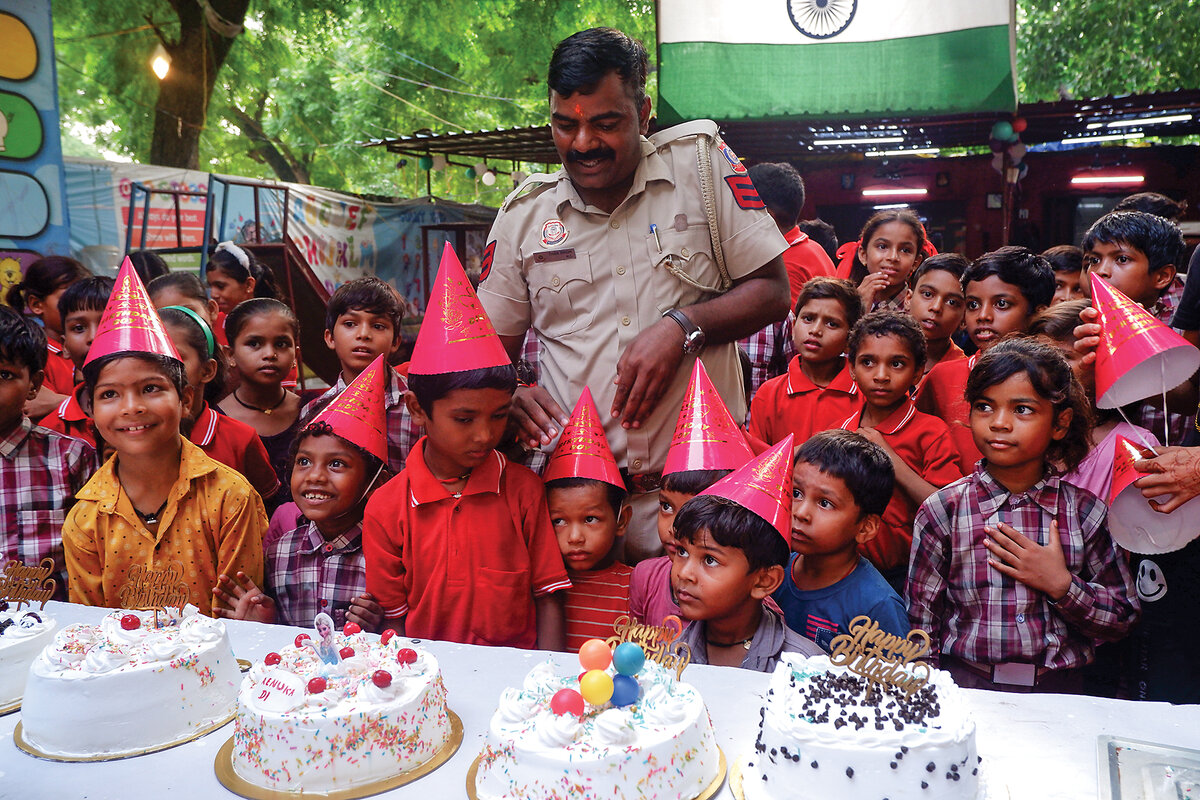
Photo: Shefali Rafiq.
Students celebrate a classmate’s birthday at an informal school, or
pathshala, set up by police officer Than Singh (center), in a Delhi, India.

Today’s story is about one compassionate person in India who wanted to make a difference in children’s lives. Shefali Rafiq and Saqib Mugloo wrote the photo essay for the Christian Science Monitor.

“It wasn’t until Than Singh came along that learning became a favorite pastime for the children who typically roam Delhi’s streets begging, rifling through garbage, or engaging in petty crimes.

“In 2015, the Delhi police officer started a pathshala, or place of learning, where he teaches 80 students a day in a temple set up near the Red Fort. ‘It was heartbreaking to see children scavenging for plastic bottles in the trash,’ he recalls. ‘That’s when I decided to do something.’

“More than half of India’s children are malnourished, and about 30% of those ages 6 to 18 do not attend school. Mr. Singh, who grew up poor in northwestern Rajasthan state, is determined to change these statistics. ‘My dream is to see every underprivileged child in school,’ he says with a broad, charming smile, adding that he is confident that, with God’s help, he will make it happen.

“He starts his day early, patrolling the busy lanes of Old Delhi, the capital’s historic heart, as part of his duties. But every day after work, he holds classes at his pathshala, where students eagerly await him. Among them are Ajay Ahirwar and Neelu Ahirwar (no relation).

“Ajay says he aspires to become a high-ranking officer in the government so that he can improve the conditions of his family and those living like him. Neelu is fond of her teacher and the pathshala. ‘I would rather be here, even on holidays, than at home,’ says the young girl, who aspires to become an officer in the Indian Police Service.

“Initially, only four children attended Mr. Singh’s pathshala. He contributed money from his salary to buy books, notebooks, pencils, and schoolbags. Nine years down the line, he has now taught hundreds of children.

“ ‘Beyond basic lessons, I try to instill manners and discipline in these students,’ Mr. Singh says. ‘Even if they come to this school just for a meal, I’ll be happy because, seeing others, they may also want to study.’

“Mr. Singh organizes extracurricular activities, too, including cricket. For those children who do attend school in the city, he celebrates good exam results at his pathshala. ‘I just want these children to stay away from all the bad influences they’re vulnerable to,’ he says, referring to the crimes that affect Delhi.

“ ‘Our aim in the world is to spread goodness and happiness.’ ”

More at the Monitor, here. Wonderful photos. No firewall.

Read Full Post »

Photo: Rhode Island School Recycling Club via ecoRI News.
The nonprofit’s mission is to help reduce school food waste.

My Rhode Island grandson has inhaled environmental lessons at home and in school to the point that he requests only such clothes as are made of recycled material and eschews beef. He’s in charge of composting the family’s fruits and vegetables, at least when the bin isn’t frozen solid.

Today I’m sharing news on a composting story involving both public and private Rhode Island schools.

Veteran environmental reporter Frank Carini writes at ecoRI News, “Rhode Island’s 450 or so public and private schools generate a lot of food waste, nearly 28,000 pounds every school day, according to more than a dozen food-waste audits conducted by a local nonprofit.

“Among the food wasted daily is some 4,000 pounds of milk, fruit, granola bars, yogurt, baby carrots, and other sustenance that is unopened and perfectly edible.

Here are some other findings from the Rhode Island School Recycling Project’s 15 lunch audits:

  • “About 5 million pounds, some 2,500 tons, of school food scrap is sent to the Central landfill in Johnston every year. Of that, some 750,000 pounds is edible.
  • “Each high school student generates an average of 0.23 pounds of food waste daily, and 41 pounds every school year.
  • “Each middle school student generates an average of 0.39 pounds of food waste daily, and 70 pounds every school year.
  • “Each elementary school student generates an average of 0.48 pounds of food waste daily, and 86 pounds every school year.

“The Rhode Island School Recycling Project was co-founded in 2001 by James Corwin, in partnership with the Rhode Island Resource Recovery Corporation (RIRRC) and the state Department of Environmental Management, to improve school recycling.

At that time, the number of schools recycling properly was 18%, which was among the lowest in New England. Today, it is close to 70%.

“The nonprofit quickly incorporated diverting cafeteria food from the state’s waste stream into its work. That’s where much of the Project’s focus is now centered. … The nonprofit’s mission is to reduce, recover, and recycle to help protect the environment and develop the next generation of environmentalists through project-based learning, according to Corwin.

“Currently, there are 21 schools participating in the Project’s waste-reduction efforts. Since its inception, the program has diverted nearly 150 tons of food and food scrap from the Central Landfill, according to Corwin.

“The cost per school is about $5,000 annually. The Project pays for the first year, and buys participating schools a refrigerator to store recovered food. Students can take food from the refrigerator when they are hungry.

“ ‘So we’re saying to custodians, listen, when you see that that dumpster is only half full let’s talk to the facilities director about reducing the amount of pickups to, you know, instead of one a day, one every other day, so that you can offset the cost of the organics hauling,’ Corwin said. …

“The Project’s program starts with an educational presentation by RIRRC, which operates the Central Landfill, about the many problems associated with food waste. Corwin and Warren Heyman, the nonprofit’s organizing director, then visit the participating school to discuss what the students learned during the RIRRC presentation and start training them, and staff, on a new waste-sorting system.

“Participating students — in groups called Green Teams in middle school and Cafeteria Rangers in elementary school — go to lunch early so they can spend the last 8 minutes of the period managing the station and making sure everything is sorted correctly. There’s usually four to five students working a sorting station. …

“Each station features a ‘share table’ that repurposes uneaten food. On the table is a cooler where students place leftover perishable items such as milk and yogurt. There’s a basket for leftover fruit. These provisions are then moved to the refrigerator.

“A 5-gallon bucket is where students pour out leftover milk. There’s a compost bin for food scrap and a recycling bin for milk cartons and plastic bottles. A landfill bin holds the trash that can’t be eaten, composted, or recycled. The compostable material is picked up weekly by one of two local composting outfits — Black Earth Compost or Bootstrap Compost. …

“Heyman noted that after Richmond Elementary School implemented the Project’s waste-reduction system, cafeteria trashed was reduced from eight bags a day to one. He also noted that the state Department of Education has been a supportive advocate of the Project’s work.

“Nearly 1 in 3 Rhode Island households can’t afford adequate food, according to the Rhode Island Community Food Bank. … About 40% of U.S. food is wasted, either buried or incinerated. In schools, the amount of wasted food increases. A 2019 study of school cafeteria waste found that 27% to 53% of the food served was thrown away. Another study has estimated that U.S. schools waste some 530,000 tons of food annually — about 39 pounds of food and 29 cartons of milk per student per year — costing $1.7 billion nationally.”

More at ecoRI News, here.

Read Full Post »

Photo: JRE.
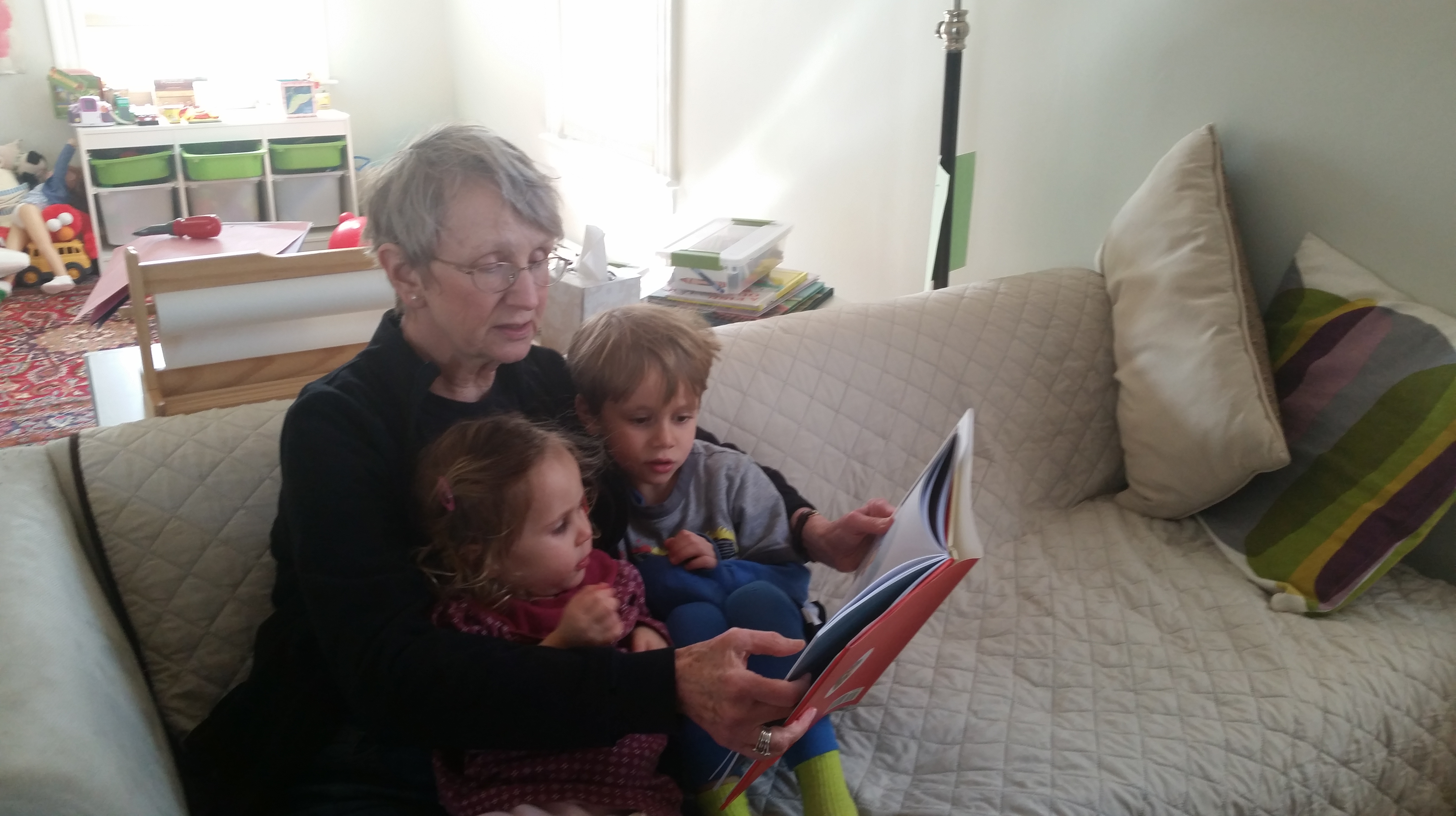
Now almost 12 and 15, these two are good readers.

I recently learned about a group called Grandparents for Truth, organized in reaction to other groups pushing book bans in schools and threatening librarians.

I am not a member, but I think reading is important and I understand enough history to know what happens to countries that start with book bans, so I thought I would share the information.

Huda Hassan wrote at MSN.com in late 2024, “Last August, a retired special-education teacher named Holly Hall joined a rally of grandparents warring against book censorship in Temecula, a small Southern California town. Locals had gathered to oppose a school-board decision to ban a social-studies reader, Social Studies Alive!, for citing Harvey Milk — the first openly gay politician elected in the state. ‘The Harvey Milk reference was in the supplemental materials,’ 72-year-old Hall says, ‘which meant that it wouldn’t have even been mentioned in some classes.’

“The world of literature is currently ablaze with rapidly escalating book bans targeting narratives and histories about gender and sexual identity, race, class, and just about anyone deemed ‘other.’

“[In 2024] alone, 1,128 books have been challenged, according to the American Library Association, which documents ongoing censorship attempts across the nation. Florida is the state with the most banned books (3,135 bans, according to PEN America), and in the 2022–23 school year, there were book bans in 153 districts across 33 states, including Texas, Missouri, Utah, and Pennsylvania.

“Earlier this year, schools in Escambia County, Florida, removed 1,600 books on gender and race from school libraries and, through this process, even banned multiple dictionaries. In August, New College of Florida, a public liberal-arts college, disposed of hundreds of library books, emptying the school’s Gender and Diversity Center. Then, this fall, major publishers — including Simon & Schuster, Penguin Random House, and HarperCollins Publishers — filed a lawsuit against book-removal provisions in Florida (through HB 1069, a law introduced in 2023).

“When Hall, who taught in California for 40 years, spoke out at that rally in Temecula, she gave an impassioned speech about censorship in her state. ‘I addressed the dangers of banning books,’ she says. ‘It’s not 1933 Germany.’ Opponents attended the Temecula rally too, such as Moms for Liberty, a Florida-based parenting group formed in 2021 that’s pushing for banning books on race and what it calls ‘gender ideology.’ A few months prior, the same three school-board trustees Hall spoke against had voted to ban the school’s study of critical race theory the day they were sworn into office. This preemptive act confused many, as no courses on critical race theory had been offered at the school. …

“As parents across the country and groups like Moms for Liberty have joined the attacks on literature, grandparents like Hall are mobilizing in response, and they are afraid. ‘I am so concerned about my country, our freedom, and the world,’ Hall says.

“But she felt encouraged to speak in front of her peers and opponents last year because she knew she was not alone. She was invited to the rally by Grandparents for Truth, a national organization formed in the summer of 2023 to fight for the right to read. ‘A neighbor walked by and told me about the group. He had a sign in his yard,’ says Hall. …

“In Philadelphia, Ruth Littner, one of the earliest members to join Grandparents for Truth last summer, discovered the collective through her daughter, Alana Byrd, the national field director of People for the American Way. Like Hall, the pair are committed to countering book banning despite heckling or pushback from the police. ‘I am the daughter of two Holocaust survivors,’ Littner says on the phone from her home. ‘When Alana told me she had an initiative to fight this kind of authoritarianism, I jumped right on that. I was the first one to get the Grandparents for Truth T-shirt.’

More at MSN, here. No paywall.

Read Full Post »

Photo: Michael Fox/The World.
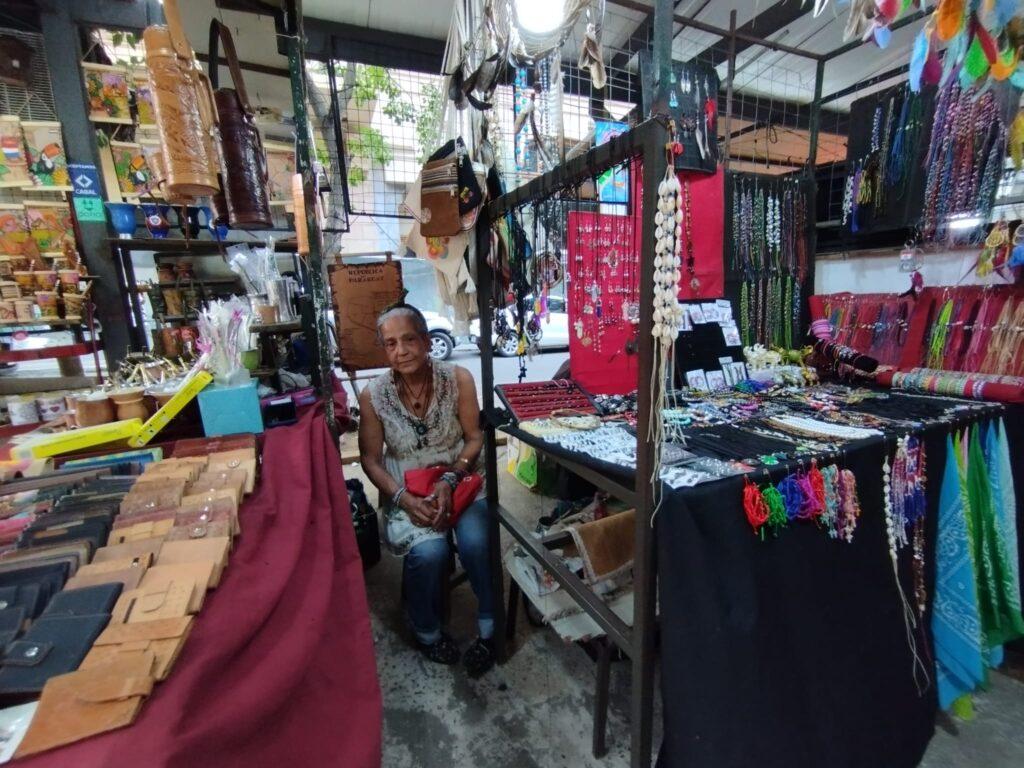
Rita Álvarez has been selling handicrafts and homemade jewelry on the streets of Asunción, Paraguay, for more than 40 years. She said that most of her customers in the city speak a combination of Guaraní with Spanish.

Most of our stories on indigenous languages are about struggles in the face of looming extinction.

It’s different for an indigenous language called Guaraní in Paraguay. Michael Fox reports on the phenomenon at Public Radio International’s The World.

Tomas Zayas, who lives in the Paraguayan countryside, spoke only the Indigenous Guaraní language until he was 22 years old. 

“Later, he started to speak Spanish to be better prepared as a community leader. But Guaraní has remained his main language.

“ ‘For me, Guaraní is identity,’ said Zayas, a longtime campesino leader with the Alto Parana Small Farmers Association. ‘It’s happiness. It’s beauty. Because a joke in Spanish isn’t funny at all.’ 

“The Guaraní language, along with its many dialects, comes from the Indigenous Guaraní people who have lived in this region since long before the Spanish conquest. 

“Today, nearly 300,000 Indigenous Guaraní still live in Paraguay, Brazil, Bolivia and Argentina. In some of these countries, their language has influenced Portuguese and Spanish. 

“But in Paraguay, Guaraní is spoken as an official language alongside Spanish. Most Paraguayans speak Guaraní or a mixture of Spanish and Guaraní as their first language, whether they are of Indigenous descent or not. 

“Although there are several theories about how Paraguayans have been able to preserve their Indigenous language, one that stands out focuses on the Triple Alliance War of the 1860s.

“Most of Paraguay’s male population was killed after Brazil, Argentina and Uruguay invaded the country. ‘As a question of survival, the women who were left would only speak Guaraní,’ Zayas said. ‘They passed it on to their children.’ …

“Under the dictatorship of Alfredo Stroessner, which lasted from the 1950s until the late 1980s, Guaraní was banned in Paraguay. It has also been stigmatized as a language of the poor.

“But many Paraguayans say that Guaraní is a language of metaphor and beauty.

“Rita Álvarez has been selling handicrafts and homemade jewelry on the streets of Asunción, Paraguay’s capital, for more than 40 years. ‘For me, it’s the sweetest language,’ she said. ‘Because you can say with one word in Guaraní what you would need 10 to say in Spanish.’

“She said that most of her customers in the city speak a combination of Guaraní with Spanish, or jopara, which means ‘mixture’ in Guaraní. …

“Blanca Estela González is a retired elementary schoolteacher who now teaches Guaraní at IDIPAR Language School in Asunción.

“Gonzalez said that foreigners often pick up Guaraní rather quickly, because, unlike Spanish, there are only three types of verb conjugations: past, present and future. And Gonzalez said the language has received a boost in recent decades.

“ ‘Now, it’s an official language,’ she said. ‘And half of the lessons at the public schools are taught in Guaraní.’ ” More at The World, here.

Happy New Year to all blog friends, whatever language you speak. Any plans for celebrating?

Read Full Post »

Photo: Daniel Ofman/The World.
Elena Chegodaeva is the founder of the Liberated School in Yerevan, Armenia. Most of the students are the kids of Russian immigrants who left Russia because of the war in Ukraine.

When tyrants like Putin have total control over the media, it’s easy to forget that there may be some people in the country who are not supportive of tyranny. In today’s story we learn about Russian dissenters who fled to Armenia after Russia’s full-scale invasion of Ukraine — and how they are trying to make a new life there. (Do you know why media outlets always say “full-scale” invasion? Because Russia has been doing other, more limited invasions for a long time.)

With contributions from Stepan Adamyan, Daniel Ofman reported the story for Public Radio International’s The World.

“Russian Elena Chegodaeva left Moscow in early March of 2022 — about a week after Russia began its full-scale invasion of Ukraine.

“Chegodaeva was against the war and fled to Yerevan, Armenia. … Chegodaeva is among the hundreds of thousands of Russians who have left their homeland since the invasion of Ukraine. Most of them oppose Russia’s war in Ukraine, or they fear getting drafted. 

“Many have wound up all over Europe — and Turkey, Georgia and Armenia have become some of the most-frequent destinations for exiled Russians. According to some estimates, more than 100,000 Russian citizens fled to Armenia alone. This reality has led to some changes within Yerevan, the Armenian capital, as the new residents try to put down roots.

“Chegodaeva, an educator, soon realized the need for a school for the Russian children coming to the city. So, after coordinating with families and securing teachers and a space within a couple of weeks, she started the Svobodnaya Shkola, which is Russian for Liberated School. …

“At first, the school only had 40 students — all kids of Russian immigrants. Back then, many of the families thought the war would end and they would soon return to Russia. The school operated out of an apartment. Now, 2 1/2 years later, many of the families are still here, and the student body has grown to 250, with classes held in two different buildings. Lessons are taught in Russian and English, while Armenian is also taught twice a week. …

“Yura Boguslavsky, a parent of two sons, ages 10 and 15, at Chegodaeva’s school, said that their education is one of the reasons he left Russia. … [And] when he and his family first arrived in Armenia, they also struggled. ‘I think the first two or three weeks was just a shock; we managed to find someplace to live, and all the streets in Yerevan were full of lost people with backpacks who were very sad.’ …

“Back in Russia, Boguslavsky attended anti-war protests, and was opposed to the Kremlin’s politics. Professionally though, Boguslavsky said, he was thriving. In Moscow, he ran a studio and an animation school. But once he got to Yerevan, he had to start from scratch. …

“A year after arriving in Yerevan, Boguslavsky started a new animation studio called Invisible Friends. He also teaches animation to students of all ages. He produced a Claymation, stop-motion documentary called, We flew, we came here, based on interviews that Armenian students conducted with Russian kids who had recently arrived in Yerevan.

“In the film, one child says that he didn’t know how long they were leaving Russia for — but when he found out, he says he ‘began missing his friends’ and sometimes cried at night. The kids described the toys they took with them and the ones they left behind.

“Boguslavsky said that the kids were a lot more expressive than the adults were. That’s why he chose to feature children in the film.

“ ‘All the adults … were saying almost the same things, just retelling the news. And the kids were sometimes even funny; they talked about how they understood what their parents told them. They were speaking a lot about their feelings.’

“Boguslavsky said that this film inspired him to find a way to keep teaching animation in Armenia. He said that nowadays, he feels comfortable in Armenia, but he knows that many other people are having a hard time.

“Finding affordable housing, and consistent work, is a challenge for many Russian immigrants who don’t work in the tech sector. A lot of people are also having trouble adjusting because they’re still hoping to return to Russia.

“ ‘I know many people who were suffering a lot, and not living their lives, and they were stuck in the past, and I don’t want to be like that, you know.’

“Boguslavsky said that it’s unlikely that he’ll return to Russia anytime soon. He said that he’s focused on making a life for himself and his family here in Armenia.

“Chegodaeva said that’s her mindset as well, and one of the reasons she founded the school. However, she said she still holds out hope that she’ll one day go back to Russia.”

More at The World, here.

Read Full Post »

Photo: Ayen Deng Bior.
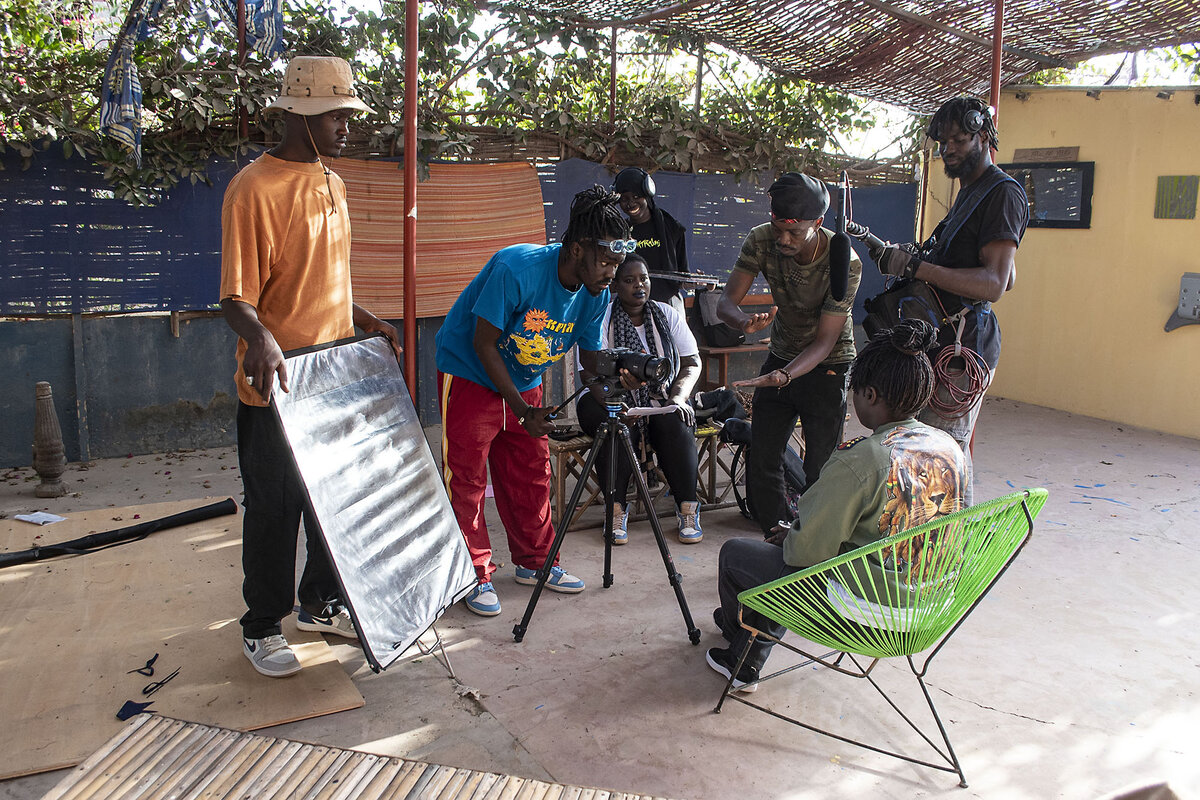
“Assistant director Pape Samba Tine (second from right) yells, ‘Action!’ on the set of a new Senegalese documentary about women’s lives,” the Christian Science Monitor reports.

For generations, films about Africa were written by non-Africans — in effect by the descendants of the colonizers. But over time, Africans have begun to tell their own stories in their own way.

Ayen Deng Bior, reporting from Senegal for the Christian Science Monitor, writes, “On a dusty Monday afternoon, the hallways of the Kourtrajmé film school buzz with nervous chatter and excitement. It is pitch day, and soon everyone files into a classroom to listen to the students present their screenplay ideas.

“The topics cover a wide sweep of Senegalese life, from the story of a 19th-century slave insurrection to a supernatural drama about a woman who can read people’s thoughts.

“When Leida Ndiaye’s turn comes, she is sweating. … But soon, she finds her rhythm, describing her idea for a rom-com about a woman in her early 30s who uses her job in human resources to ‘interview’ prospective dates to her birthday party. Ms. Ndiaye explains that she wants to provoke new conversations about dating and marriage.

“ ‘A lot of financially independent women are living the same situation here in Senegal,’ she says. ‘The tension between her professional life and her chaotic emotional life leads her to a deep introspection on her true desires and the nature of love.’

“Ms. Ndiaye and her classmates at Kourtrajmé are part of a new generation of Senegalese filmmakers who are setting out to tell their own stories on their own terms. With a film about Senegalese migrants, Io Capitano, up for best foreign film at the Oscars [2024], they know the world is eager to hear about their lives. 

“But Io Capitano’s success also highlights the challenges they face. The movie was made by Italian filmmakers, igniting conversation about what types of stories get told about Africa and by whom. 

“ ‘The Italian film is amazing, but it’s another story about migration,’ says Emma Sangaré, an American producer and screenwriter, and Kourtrajmé’s co-founder. For her students, she adds, there is so much more to say.

“Kourtrajmé’s popularity is a testament to hunger of young Africans to showcase a different kind of story. The school, which opened in 2022, gets hundreds of applications from all over the continent for about two dozen spots in its screenwriting and directing courses. Both six-month programs are fully funded.  

“The Dakar school is the third branch of Kourtrajmé, which French director Ladj Ly started in 2018 in a disadvantaged suburb of Paris in order to bring new and different voices into the film industry. Senegal’s Kourtrajmé was founded by Mr. Ly, Ms. Sangaré, and her husband, French Malian director Toumani Sangaré. …

“Last year, Banel & Adama, a magical realist romantic drama by French Senegalese director Ramata-Toulaye Sy, premiered to positive reviews at the Cannes film festival. But for many Senegalese filmmakers, a lack of resources and connections still makes the global film circuit hard to break into.

Io Capitano, for instance, had budget of more than $8 million. … But getting funding like that often means turning to American or European producers. In these situations, Ms. Sangaré says the power dynamic makes it hard for young Senegalese filmmakers to assert their authority about the kinds of stories they want to tell. …

“Mariama Niang is in director mode, supervising her team as it prepares to shoot an interview for her documentary, Elle, on a recent afternoon. …

“For Ms. Niang, an alumnus of Kourtrajmé who has wanted to be a filmmaker since she was a child, this moment has been a long time coming.

“ ‘Cinema is the world,’ she says. ‘In cinema, you can see everything. You can see one movie, and you see all your life in that movie.’

Elle, whose title means ‘she,’ follows five Senegalese women who have made names for themselves in their respective industries – from photography to financial consulting – while challenging the common narrative here that women are ‘just’ homemakers and childbearers. It’s a contentious topic that Ms. Niang has wanted to tackle for years, but she couldn’t figure out how to pay for it.

“Kourtrajmé changed that. The film school funded half the production, and Ms. Niang used the pitch skills she honed there to convince a private investor to pay for the rest.

“Back at Kourtrajmé, Ms. Ndiaye [says] ‘It’s better to tell our own story because if you don’t do it, people won’t know what exactly African people are living. … Westerners are doing it; they share their history; they share their culture. Why not us?’ ”

More at the Monitor, here. No paywall.

Read Full Post »

Photo: Ann Scott Tyson/Christian Science Monitor.
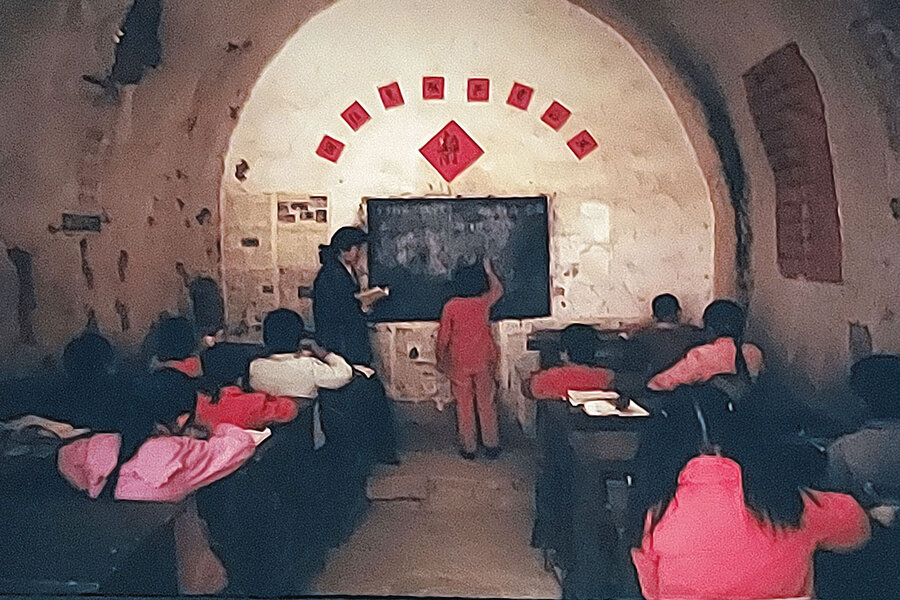
This photo from 1992 shows Bai Guiling teaching multi-grade primary students in a cave classroom carved from a hillside in the village of Yangjiagou. It had no electricity and few books.

Today’s story is about two women who transformed education in rural China. It’s written by Ann Scott Tyson of the Christian Science Monitor, who wanted to follow up on an article she wrote 30 years ago.

“After a 12-hour train ride, I’ve reached a remote village on China’s Loess Plateau, where I’m searching for a teacher I wrote about 30 years ago. I can still picture Bai Guiling juggling lessons for four grades in a dim cave classroom carved from the yellow earth. Her dedication to the needy village children was unforgettable. Now, I want to revisit her story as a window into education in rural China today. 

“But no one in the dusty hamlet in northern Shaanxi province has heard of Teacher Bai or even remembers the school. … I flip through my notebook looking for the phone number of the only person who might be able to help – a Chinese American woman who years ago took a special interest in Teacher Bai. 

“Sitting in my taxi while the police watch from down the road, I tap her U.S. number into my phone and wait for what seems like forever.

“ ‘Hello?’ a frail but chipper voice answers. It’s Lin-yi Wu.

“A few days earlier, in mid-May, I’d tracked down Ms. Wu, a retired librarian, at a senior living home in Walnut Creek, California. The nonagenarian was recovering from a fall – taken while jazz dancing – but was in good spirits. …

“Born the daughter of a well-to-do Shanghai antiques merchant in 1933, Ms. Wu received an elite education that bore no resemblance to Teacher Bai’s bare-bones cave classes. She rode rickshaws to a stately Shanghai middle school run by American missionaries. After graduating from the top-flight Peking University, she was retained to teach French. A formative moment came when Communist Party authorities exiled her and her husband-to-be, English professor Hung-sen Wu, to labor in a hardscrabble mountain village outside Beijing in 1958, during Mao Zedong’s commune movement.

“ ‘My eyes were opened to see how the majority of Chinese lived,’ Ms. Wu told me. For that, she was grateful. But she also witnessed how Mao’s failed communes slashed farm output, leaving bok choy wilting in the fields and piglets dying in the street. A massive famine ensued, forcing villagers to eat leaves and corncobs. ‘It was horrible,’ she said. From 1959 to 1961, tens of millions of Chinese starved. 

“Once back at Peking University, Ms. Wu was shocked when authorities spread propaganda about a bumper harvest, rejoicing with music and gongs. ‘People are dying, and they celebrate the big harvest? That was the last straw,’ she said. ‘I could never live under a government that tells such a lie to the detriment of its people.’ In 1961, the couple fled via Hong Kong to the United States. …

“Forging a life in America, the Wus never lost the desire to help their destitute countrymen. Then, in April 1992, they opened the Christian Science Monitor and read my article about Teacher Bai’s struggles. At once, they each decided – without a word between them – to use their savings to build the village a proper school. … She penned a letter to me in Beijing, asking to contact Teacher Bai.

“But where is Teacher Bai now? I ask over the phone. ‘I don’t know where she lives, but I remember her village was in Ansai County,’ Ms. Wu tells me. ‘And I have her daughter’s phone number.’

“I open my road atlas and scour the map of Ansai, two counties away from where I am. Suddenly it makes sense – there are two villages with the same name, Yangjiagou, and I’m in the wrong one.   

“Her smile and warmth are infectious. After 30 years, I instantly recognize Teacher Bai when I see her waiting for me at the train station in the nearby city of Yan’an, a meeting arranged by her daughter. It feels like we never lost a beat. Driving a borrowed car, she whisks me into the rugged countryside. …

“ ‘Look at this old classroom!’ she says, peering through the worn wooden lattice of the cave’s front window at the peeling mud-and-straw walls. ‘I taught here for five years. We were so poor,’ she says. …

“Born in 1964 to a farming couple in a cave high on a barren hillside a few miles away, Ms. Bai was the eldest of five children – four girls and a boy. Food was scarce in the wake of China’s famine. They ate boiled thistles and cornhusk buns. ‘That counted as good food,’ she says. …

“ ‘I want to popularize the importance of primary education,’ she told me back in 1992. … Her dream: to rally the villagers to build a new school. …

” ‘The article you wrote changed my fate, and the fate of three generations of my family.’

“Not long after my 1992 trip, a local official came to find Teacher Bai. Breathlessly, he told her a group of overseas Chinese and Americans wanted to build a new primary school at Yangjiagou – and they named her to be in charge. …

“Back in the U.S., Ms. Wu excitedly tallied the funds. After a benefit dinner, greeting card drive, and garage sale – combined with her $4,000 in savings – she’d amassed more than $8,000 as of 1994. It was enough to build Yangjiagou a new school, the first by her new organization, Friends of Rural China Education (FORCE). …

“Through a Catholic church with contacts in Hong Kong, she found a nun who would soon travel to mainland China to teach. They arranged for the nun to hand-deliver $8,000 in cash to Teacher Bai at the train station in Guangzhou, across the border from Hong Kong. ‘I will never forget what Teacher Bai told me,’ recalls Ms. Wu. ‘She said, “I will guard this money with my life.” ‘ “

It’s actually a very long article, but how can I not love it? Read the whole beautiful thing at the Monitor, here. No firewall.

Read Full Post »

Photo: Jenna Hauck/ Chilliwack Progress.
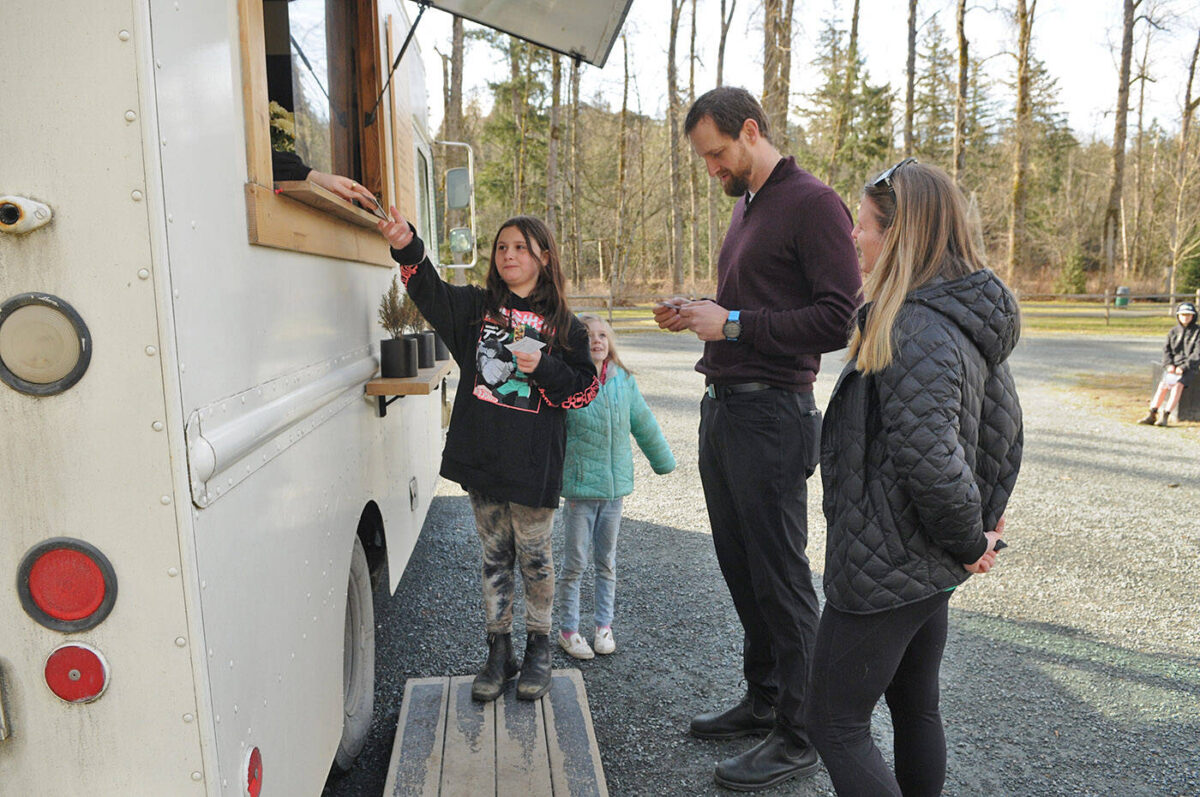
Children in Canada buying coffee for two strangers at Vedder Park during Watson Elementary’s Kindness Project on March 15. It’s all part of the curriculum.

How do you raise children who are kind? Partly by example. And maybe partly by putting generosity in the school curriculum. It can’t hurt to set aside a time for kids to know the satisfaction of committing random acts of kindness.

Sydney Page at the Washington Post writes about an experiment in Canada.

“While writing report cards several years ago, Jennifer Thiessen was troubled by something. Her third-grade students were being evaluated on subjects such as math and science, but not on life skills — such as social responsibility and kindness.

“ ‘That’s the stuff that I feel is really important for them to learn and carry forward in their lives,’ Thiessen said. … ‘There are so many important life lessons I wanted to teach them outside of the curriculum,’ said Thiessen, a teacher at Canada’s Watson Elementary School in Chilliwack, British Columbia.

“She mentioned her concerns to Kyla Stradling, then a fellow teacher at the school, and they hatched a plan. They assigned their students a project that had nothing to do with standard school subjects. Instead, it was centered on spreading goodwill. They called it the ‘Kindness Project.’

“ ‘If we could be that spark of kindness, we could inspire others to do acts of kindness,’ Thiessen told her third-graders in 2018.

“Students from two separate third-grade classes made cupcakes at home and sold them for $1 during a series of bake sales at the school. They raised about $400 and used the proceeds to purchase small gifts — things like bouquets of flowers, dog treats, chocolate bars and coffees — and handed them out to strangers near the school.

‘The students felt joy inside of them; that they did something that day that mattered,’ Thiessen said.

“Many of the gift recipients seemed ‘caught off guard’ at first, she said, though they were all in when the students explained what the project was about. Some were moved to tears. … She decided to make it a yearly activity for third-graders at the school.

“ ‘This project isn’t about who can read the best and who is best at math,’ she said. ‘This is an everybody project. It doesn’t have any limitations when it comes to ability.’

“For the past five years, third-grade students at Watson Elementary have embraced the Kindness Project. They host several bake sales to raise money, and each class adds their own spin to the assignment. During the pandemic, for instance, students collected funds to put together care packages for front-line workers.

“ ‘Every year, we sit down with them and ask them how they want to spend the money,’ Thiessen said. …

“Occasionally, students can be ‘a little overzealous,’ she said. As she brainstormed with her class this year, one child enthusiastically said: ‘Let’s buy someone a house!’ …

“Given the success of the project, the school decided to broaden it this year to involve five classes — including three third-grade classes, and some students in second and fourth grades. They started selling cupcakes each week at the school in February, and over five weeks, they raised more than $1,000 — the highest amount yet. …

“This year, the 100 students split up into several groups to focus on different initiatives. While one group wrote cards and bought small gifts to hand out to strangers, another put together care packages with essential supplies — including toothbrushes, snacks, gloves, socks and sanitizer — for homeless children and teens. Other students made a ‘teacher appreciation bin’ filled with treats and goodies and dropped it off at a nearby school.

“On March 15, the students and chaperones divided and carried out their various kindness missions. Some stayed at coffee shops surrounding the school, offering to buy beverages for strangers, while others waited around a local park, passing out dog treats and fresh flowers. Several students did a forest cleanup. …

“Though the goal of the project is to start a chain of kindness within the community (one man offered up $20 toward next year’s fundraising effort, Thiessen said), it’s also intended to show the students what they are capable of.

“ ‘I think what I want most for them is to know that it doesn’t matter where you come from or how old you are, you can do something that is good,’ Thiessen said.”

The idea of buying someone a house is not necessarily “overzealous,” I’d say. It shows the kid is already thinking about about adult-sized needs. Isn’t that the point?

More at the Post, here. For a version with no firewall, click on the Chilliwack Progress, here.

Read Full Post »

Photo: John and Suzanne’s Mom.
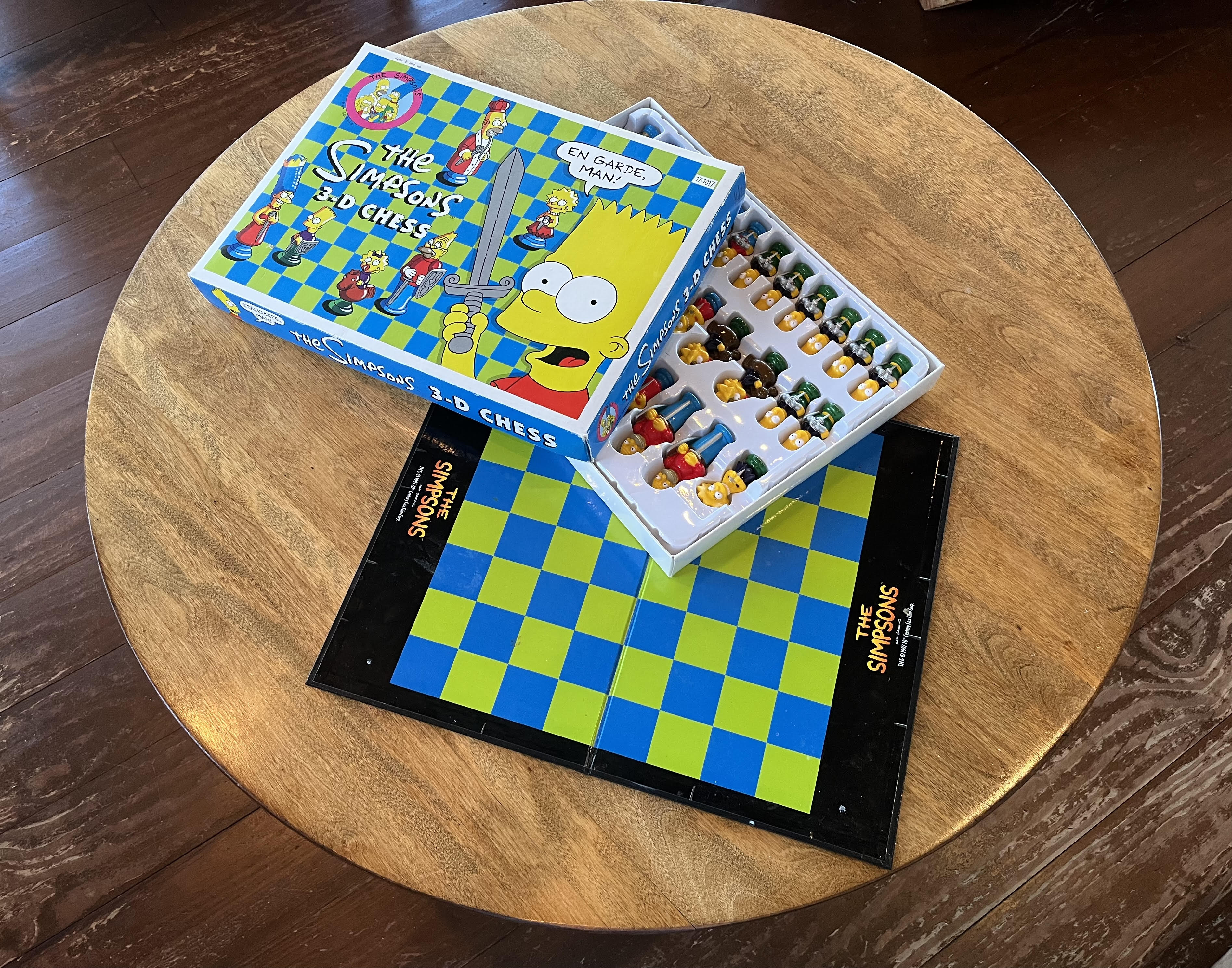
The Simpsons play chess, too.

One of my grandsons lives and breathes chess. He will represent his state and age group in a national competition in Grand Rapids this July. I told him his idea of beach reading is Ten Thousand Tried and True Pawn Structures to Terrify Your Opponent, and he couldn’t disagree.

Turns out, he is not alone.

Hannah Natanson writes at the Washington Post, “Jeffrey Otterby, a middle school teacher in Illinois, is facing an epidemic of student distraction. When his seventh-graders are supposed to be learning social studies, they are glued to their school-issued Chromebooks. He has taken to standing in the back of the room to monitor their screens, where he can see the online game they’re all playing:

“Chess.

“ ‘I guess I’m happier they are playing chess rather than some shoot-’em-up game. Actually, I love it,’ said Otterby, a chess enthusiast. ‘I just need them to do it at a better time.’ …

“Across the country, students from second grade to senior year have stumbled across a new obsession, which is, in fact, a centuries-old game. Interviews with teachers and students in eight states paint a picture of captivated students squeezing games in wherever and whenever they can: at lunch, at recess and illicitly during lessons, a phenomenon that is at once bemusing, frustrating and delighting teachers.

“Data from Chess.com, whose usership is the highest it’s ever been, and anecdotal evidence nationwide suggest a fervid, growing base of young users. This month’s U.S. Chess Federation National High School Championships in D.C. had to add overflow rooms to accommodate a record 1,750 attendees — spurring fears of a shortage of participation medals.

“A California school librarian this year set aside a portion of her library for chess-playing students to indulge their habit during lunchtime. An Illinois teacher bought 24 chess sets to meet surging student demand. And in Hawaii, passion for chess is messing up the morning routine. …

“It’s unclear what is driving the sudden adoration of chess among tweens and teens. Students and chess spectators point to the influence of chess stars and social media personalities such as Levy Rozman, whose YouTube channel GothamChess has more than 3.5 million subscribers; Hikaru Nakamura, an American grandmaster with 1.9 million YouTube subscribers; and the Botez sisters, elite American Canadian players who boast a combined following of close to 2 million on YouTube and Twitch.

“Max Magidin, a 15-year-old attending California’s Burlingame High School, said chess content began showing up on his and his friends’ TikTok feeds early this year. Almost immediately, it seemed everyone in the Bay Area’s San Mateo Union High School District was playing the game — including Magidin, who nowadays fits in between two and four hours of chess daily. …

“Chess has always been something of a faddish sport, said David Mehler, president of the U.S. Chess Center. He recalled a big jump in interest in the early 1990s after the release of the movie Searching for Bobby Fischer, which tells the story of a 7-year-old chess prodigy and is based on the life of Joshua Waitzkin.

“More recently, chess experienced a spike in popularity among adults at the start of the coronavirus pandemic, and again when many people confined to their homes streamed The Queen’s Gambit, a Netflix series, said Erik Allebest, the chief executive and a founder of Chess.com. After the virus arrived, Chess.com’s average daily user count of 1.5 million rose to between 5 million and 7 million, he said. …

“As of April, Chess.com is averaging 12 million users a day, Allebest said. Chess.com does not track users’ ages, Allebest said, but as best he and Chess.com staffers can tell, the latest wave of fandom is dominated by middle and high school students. …

“He sent links to viral Reddit posts in which K-12 teachers lament an outbreak of chess enthusiasm and grade school students share tales of administrative crackdowns limiting access to Chess.com. (The Washington Post found no examples of the latter.) Allebest also noted that his own son, 15, has become a chess convert — not because of his father’s job but through watching GothamChess on YouTube.

“Some teachers have mixed feelings about the clandestine playing of chess in their classes.

“Justine Wewers, a high school geography teacher in Minnesota’s Anoka-Hennepin district, said she has seen a wearying number of student infatuations over the years, including video games, ‘Uno’ and fidget spinners. By comparison, the chess craze strikes her as a healthy activity for young minds. …

“James Brown, a teacher in New York’s South Colonie Central School District, sees nothing but positives. Brown, who teaches computer science and programming at Sand Creek Middle School, has long set Fridays aside as a free period for children to pursue activities of their choice. Since January, many students have chosen chess, leading Brown to buy three more chess sets to augment the 10 he already owned. …

” ‘It’s all things we want to instill in the student,’ Brown said. ‘If they’re doing that on their own, in a format that is fun for them, it ties right into what I’m trying to do. I don’t see it as a distraction; I see it as a benefit.’

“Another benefit of playing chess is its transcendence of social groups, said Maurine Seto, a librarian at California’s Burlingame High School. In early 2023, she said, students started stampeding into her library before school, during lunch and in snatches between classes to play chess at a handful of tables.

“ ‘It pairs different sets of kids together that you don’t normally see,’ Seto said. ‘They come up and say, “Hey, do you wanna play chess?” and I normally would never see those two kids interact.’ ”

More at the Post, here.

Read Full Post »

Photo: Vesa Laitinen for the New York Times via the Jordan News.
Teacher Saara Martikka (in pink sweater) works with students to identify misinformation. Media literacy is taught in Finland starting in preschool.

I have long admired Finland for its educational system, but this beats all. The country starts teaching children how to identify misinformation at a very young age. That’s why it “ranked No. 1 of 41 European countries on resilience against misinformation for the fifth time in a row in a survey published in October by the Open Society Institute in Sofia, Bulgaria.”

Jenny Gross has the story at the New York Times.

“A typical lesson that Saara Martikka, a teacher in Hameenlinna, Finland, gives her students goes like this: She presents her eighth graders with news articles. Together, they discuss: What’s the purpose of the article? How and when was it written? What are the author’s central claims?

“ ‘Just because it’s a good thing or it’s a nice thing doesn’t mean it’s true or it’s valid,’ she said. In a class last month, she showed students three TikTok videos, and they discussed the creators’ motivations and the effect that the videos had on them.

“Her goal, like that of teachers around Finland, is to help students learn to identify false information. … Officials say Finland’s success is not just the result of its strong education system, which is one of the best in the world, but also because of a concerted effort to teach students about fake news. Media literacy is part of the national core curriculum starting in preschool.

“ ‘No matter what the teacher is teaching, whether it’s physical education or mathematics or language, you have to think, “OK, how do I include these elements in my work with children and young people?” ‘ said Leo Pekkala, the director of Finland’s National Audiovisual Institute, which oversees media education. …

“The survey results were calculated based on scores for press freedom, the level of trust in society and scores in reading, science and math. The United States was not included in the survey, but other polls show that misinformation and disinformation have become more prevalent since 2016 and that Americans’ trust in the news media is near a record low. …

“Finland has advantages in countering misinformation. Its public school system is among the best in the world. College is free. There is high trust in the government, and Finland was one of the European countries least affected by the pandemic. Teachers are highly respected.

On top of that, Finnish is spoken by about 5.4 million people. Articles containing falsehoods that are written by nonnative speakers can sometimes be easily identified because of grammatical or syntax errors. …

“While teachers in Finland are required to teach media literacy, they have significant discretion over how to carry out lessons. Mrs. Martikka, the middle school teacher, said she tasked students with editing their own videos and photos to see how easy it was to manipulate information. A teacher in Helsinki, Anna Airas, said she and her students searched words like ‘vaccination’ and discussed how search algorithms worked and why the first results might not always be the most reliable. Other teachers also said that in recent months, during the war in Ukraine, they had used Russian news sites and memes as the basis for a discussion about the effects of state-sponsored propaganda.

“Finland, which shares an 833-mile border with Russia, developed its national goals for media education in 2013 and accelerated its campaign to teach students to spot misinformation in the following years. Paivi Leppanen, a project coordinator at the Finnish National Agency for Education, a government agency, said the threat of Russian misinformation on topics such as Finland’s bid to join the North Atlantic Treaty Organization ‘hasn’t changed the basics of what we do, but it has shown us that this is the time for what we have been preparing.’

“Even though today’s teenagers have grown up with social media, that does not mean that they know how to identify and guard against manipulated videos of politicians or news articles on TikTok. In fact, a study published last year in the British Journal of Developmental Psychology found that adolescence could be a peak time for conspiracy theorizing. …

“For teachers of any age group, coming up with effective lessons can be challenging. ‘It’s so much easier to talk about literature, which we have been studying for hundreds of years,’ said Mari Uusitalo, a middle and high school teacher in Helsinki.

“She starts with the basics — by teaching students about the difference between what they see on Instagram and TikTok versus what they read in Finnish newspapers. … During Ms. Uusitalo’s 16 years as a teacher, she has noticed a clear decline in reading comprehension skills, a trend she attributes to students’ spending less time with books and more time with games and watching videos. With poorer reading skills and shorter attention spans, students are more vulnerable to believing fake news or not having enough knowledge about topics to identify misleading or wrong information, she said.

“When her students were talking this summer about leaked videos that showed Finland’s prime minister, Sanna Marin, dancing and singing at a party, Ms. Uusitalo moderated a discussion about how news stories can originate from videos circulating on social media. Some of her students had believed Ms. Marin was using drugs at the party after watching videos on TikTok and Twitter that suggested that. Ms. Marin denied having taken drugs, and a test later came back negative.

“Ms. Uusitalo said her goal was to teach students methods they could use to distinguish between truth and fiction. ‘I can’t make them think just like me,’ she said. ‘I just have to give them the tools to make up their own opinions.’ ”

More at the Times, here.

Read Full Post »

I wanted to share something from the Christian Science Monitor editor about about a reporter who died recently.

“David Clark Scott traveled the world: He roamed throughout Latin America as the Mexico City bureau chief and reached into Southeast Asia as Australia bureau chief. He supported and counseled dozens of Monitor reporters as international editor.

“When he wrote columns, his favorite stories were of people taking the time to help one another. He even produced an entire podcast.

In these times, when everyone is fixated on what went wrong, it’s important to look for what is going right, and sometimes, frankly, it needs to be at the top of the page.

“Dave passed on this week. On his last day of work, he pitched three stories, any one of which would have made a lovely column. But, he told me, he’d already ‘put a call in to the principal at the Nansemond Parkway Elementary School cuz, well, that’s the intro that tugs at my heart.’

“It did mine, too, so I wanted to share it with you.

“The Nansemond students in Suffolk, Virginia, have been learning a new language: sign language, so they can communicate with food nutrition service associate Leisa Duckwall, who is deaf. It started with a fourth grade teacher, Kari Maskelony, who has deaf family members and started teaching her class. This month it spread when Principal Janet Wright-Davis decided the whole school would learn a new sign every week in honor of Disabilities Awareness Month.

” ‘I don’t think [the students] saw it as a disability,’ Dr. Wright-Davis told me over the phone. It was just a new way to communicate. Her biggest surprise? ‘How much they want to learn it.’ Their favorite sign: pizza.

“The difference in the cafeteria is palpable, she says. Instead of pointing, as they used to, the students sign their requests. ‘She’s smiling and they’re smiling, and it’s just a different environment,’ says Dr. Wright-Davis.

“Ms. Duckwall has come to morning announcements to teach everyone new signs and has signed that day’s menu. Dr. Wright-Davis gets stopped in the hall by students signing good morning and wanting to show her what they’ve learned. Instead of stopping at the end of this month, the students are going to keep learning all year.

“The school had its Trunk or Treat event Thursday evening, and the children were signing as they celebrated Halloween. ‘One gentleman came out, and he was signing,’ Dr. Wright-Davis says. It made her realize the lessons wouldn’t be confined to the lunchroom or even the school. ‘They’re going to encounter someone, even if it’s just to say good morning, or please, or thank you. … Now they know a little bit more to show some gratitude.’

“There’s plenty to learn from Nansemond: Show some gratitude, look for ways to make people feel welcome, and seek out kindness and celebrate it when you find it. Dave always did.”

See the Monitor, here, and more at WAVY television, here. No firewalls.

Read Full Post »

Photo: School on Wheels.
A student at School on Wheels’ Skid Row Learning Center works with staff member Emma Gersh.

All children need an education, but those experiencing homelessness get a spotty one at best. That’s a situation the nonprofit School on Wheels is aiming to rectify.

Magda Hernandez wrote about it at the Christian Science Monitor. “The little girl was 6 years old, and life hadn’t been kind to her. 

“When Catherine Meek walked into a homeless shelter for their tutoring session, she found the child hiding under a desk. 

“No questions asked, the volunteer joined her on the floor and began reading to her. For an hour a week, the session would allow the girl to be just a kid, getting the assistance she needed, and for at least a moment forgetting about the circumstances that put the girl educationally behind by about a grade. 

“The space remained their meeting spot for six sessions until, one day, Ms. Meek walked in to find the girl sitting at the desk waiting for her. 

“ ‘I had, I remember, the biggest smile on my face, and she did too,’ Ms. Meek says. ‘I think even at that young, vulnerable age she understood that something had changed, that there was a set level of trust, that she could trust me.’

“Ms. Meek lights up recalling that moment – one of her greatest success stories as a volunteer tutor for School on Wheels, a nonprofit addressing educational needs of children K-12 who are experiencing homelessness. She and the girl worked together for about two years until the child moved out of state and they lost touch. 

“Recently, Ms. Meek – now executive adviser to the organization – attended that no-longer-little-girl’s wedding after they reconnected through social media. 

“A brainchild of the late Agnes Stevens, a retired schoolteacher, School on Wheels began in 1993 when she started tutoring kids living in shelters on Skid Row, an area of Los Angeles known for its large homeless population. In the next few years, she formalized her efforts, recruited more volunteers, and grew the organization with the help of Ms. Meek, who joined in 1999. 

“ ‘She was the inspiration and teacher and had the education background, and I had the business and financial background,’ says Ms. Meek.

‘The need was there in 1993, and it’s just grown astronomically since then. One in 30 kids in California in a classroom is homeless.’

“The organization grew steadily, partnering with shelters, school districts, motels, libraries, anywhere homeless families could be – even reaching those living in cars, in foster homes, and on the streets. With year-round operations in six counties, prior to the pandemic, the organization reached more than 3,000 homeless children a year, and it recruited and trained more than 2,000 tutors annually. …

“ ‘Students experiencing homelessness move on average about three to four times a year, and with each move, it’s estimated that they fall behind four months academically,’ says Charles Evans, the organization’s executive director. …

“School on Wheels doesn’t get into the students’ backgrounds but focuses solely on assessing the kids’ educational needs – like a fourth grader who is two grades behind in reading or a 10th grader who’s struggling with pre-algebra and biology – and matching them with tutors. …

“Says Mr. Evans. ‘We don’t pry and try to figure out why a family became homeless.’

“The children are assessed every few weeks to make sure they’re improving. Ms. Meek says that in 2021, K-4 students improved their literacy skills by 21%; in the past six months, fifth through eighth grade students increased math skills by almost one grade level, and self-efficacy surveys showed a 40% increase in confidence in ninth through 12th graders. 

” ‘Before the pandemic, tutors would meet students wherever they were – motels, shelters, libraries. But tutoring sessions have been remote – via donated Chromebooks and laptops – in the past couple of years. The drastic change had benefits and drawbacks. On one hand, students could stay in touch with tutors even on the move. On the other, School on Wheels had to pivot from handing out backpacks and school supplies to figuring out how to get digital equipment into kids’ hands and making sure they had Wi-Fi access. … Now, the organization is returning to in-person sessions, particularly for younger kids. But it will keep the hybrid model. …

“Outside of tutoring, School on Wheels is out to erase the stigma of homelessness. Many of the families the organization works with found themselves homeless through no negligence of their own – victims of domestic violence or economic hardship, doing their best to get back on their feet.

“For example, one single mother in her 20s, who for security reasons asked not to be named, left an abusive relationship, and ended up in a shelter with her four young kids. When she noticed her children falling behind in school, she connected with School on Wheels.

“ ‘It’s been the best thing ever, because my kids love their tutors,’ says the young woman, who works and goes to school. She now gets reports from school that her kids are doing much better: ‘The teacher did see a lot of improvement in [my daughter’s] math and her spelling.’ That motivates her to do better herself, says the mother.”

Read at the Monitor, here, about Angela Sanchez and how she got math help from a rocket scientist. No firewall.

Read Full Post »

Older Posts »