Feeds:
Posts
Comments

Posts Tagged ‘school’

Photo: nfait.wordpress.com

New research featured at WBUR radio’s “Only a Game” suggests that frequent physical activity in school boosts learning.

“Mid-morning on Tuesday at the South Lawrence 5th Grade Academy in Lawrence, Mass., a row of students prepares to learn science more efficiently…by stepping.

“At this kind of school within a school, the daily schedule for these fifth graders includes not one physical education class, but three. The students break during the day for physical activity, which, according to Kevin Qazilbash, the school’s principal, is not to say academics are being de-emphasized.” More.

“The curriculum at the South Lawrence 5th Grade Academy is based in part on the notion that exercise improves brain function and stimulates learning. According to Dr. Majid Fotuhi, the Chairman of the Neurology Institute for Brain Health and Fitness in Baltimore, studies support the idea that exercise can improve learning efficiency for children. …

“ ‘It’s so exciting,’ Fotuhi told Bill on … Only A Game. ‘There are actual new cells that are born in the memory parts of your brain. Literally, new cells are born, this has been shown in animal studies. So exercise is the best thing for [the] brain, especially for the memory part of the brain.’ …

“Though no study prescribes a perfect amount of exercise, Fotuhi offers guidelines to parents and educators.

“ ‘My recommendation would be at least one hour a day for children who are 6-12 and for high school kids, two hours a day,’ Fotuhi said. ” More.

I myself find that walking around helps me think, and I remember my father doing that, too. He was a writer. There is something about moving around while puzzling out how to express a complicated thought that is more productive than sitting in front of a computer (or in his case, a typewriter).

Photo of Dr. Fotuhi, Johns Hopkins

Read Full Post »

Author-illustrator Jarrett Krosoczka knows the power of a kind word. He found his calling largely because of two words from a children’s book author who visited his elementary school class.

And he got through a difficult childhood nourished on the kindness of strangers, including lunch ladies, an unjustly maligned species he has honored in a superhero series. (“Serving justice! And serving lunch!)

Linda Matchan has a lovely story at the Boston Globe about Krosoczka.  (I want to call your attention to how nicely she describes him, here: “with impossibly spiky hair that looks as though he penciled it in himself.”)

“Until recently,” writes Matchan, “Krosoczka was very guarded about his childhood. That changed last October when he got a call from the organizer of a TEDx program at Hampshire College, modeled after the TED Talks series. …

“Scrambling for a topic, his wife urged him to talk candidly about his childhood. With no time to come up with other options, he delivered a moving talk about his early years and the people who inspired and encouraged him. The talk caught the attention of the TED editorial team, which featured it in January on TED.com.

“He spoke in his talk about his mother — ‘the most talented artist I knew’ — who was addicted to heroin and often incarcerated. ‘When your parent is a drug addict it’s kind of like Charlie Brown trying to kick the football … Every time you open your heart, you end up on your back.’ …

“Third grade was the year something ‘monumental’ happened. Children’s book author Jack Gantos came to his school to talk about what he did for a living. He wandered into the classroom where Krosoczka was drawing, stopped at Krosoczka’s desk and studied his picture.

“ ‘Nice cat,’ Gantos said.

“ ‘Two words,’ said Krosoczka, ‘that made a colossal difference in my life.’ ”

More.

Photo: Bill Greene
Jarrett Krosoczka declared May 3 (his favorite lunch lady’s birthday) “School Lunch Superhero Day.”

Author-illustrator Jarrett Krosoczka knows the power of a kind word. He found his calling largely because of two words from a children’s book author who visited his elementary school class.
And he got through a difficult childhood nourished on the kindness of strangers, including lunch ladies, an unjustly maligned species he has honored in a superhero series. (“Serving justice! And serving lunch!)
Linda Matchan has a lovely story at the Boston Globe about Krosoczka.  (I want to call your attention to how nicely she describes him, here: “with impossibly spiky hair that looks as though he penciled it in himself.”)
“Until recently,” writes Matchan, “Krosoczka was very guarded about his childhood. That changed last October when he got a call from the organizer of a TEDx program at Hampshire College, modeled after the TED Talks series. …
“Scrambling for a topic, his wife urged him to talk candidly about his childhood. With no time to come up with other options, he delivered a moving talk about his early years and the people who inspired and encouraged him. The talk caught the attention of the TED editorial team, which featured it in January on TED.com.
“He spoke in his talk about his mother — ‘the most talented artist I knew’ — who was addicted to heroin and often incarcerated. ‘When your parent is a drug addict it’s kind of like Charlie Brown trying to kick the football … Every time you open your heart, you end up on your back.’ …
“Third grade was the year something ‘monumental’ happened. Children’s book author Jack Gantos came to his school to talk about what he did for a living. He wandered into the classroom where Krosoczka was drawing, stopped at Krosoczka’s desk and studied his picture.
“ ‘Nice cat,’ Gantos said.
“ ‘Two words,’ said Krosoczka, ‘that made a colossal difference in my life.’ ”

Read Full Post »

Back in first-grade, we learned to read from books featuring invariably blond, blue-eyed children. Today, primers have more variety, but multicultural pleasure reading, where it exists, is not always available to poor children.

Leslie Kaufman wrote recently at the NY Times that a  “nonprofit called First Book, which promotes literacy among children in low-income communities, announced the Stories for All project, a program intended to prod publishers to print more multicultural books. …

“In a 2012 study, the Cooperative Children’s Book Center at the University of Wisconsin-Madison evaluated some 3,600 books, looking for multicultural content. Of the books examined, 3.3 percent were found to be about African-Americans, 2.1 percent were about Asian-Pacific Americans, 1.5 percent were about Latinos and 0.6 percent were about American Indians.” More.

First Book picked two winning publishers in its first Stories for All competition — HarperCollins and Lee & Low Books — and purchased $500,000-worth of books from them. The books “will be available beginning in May through the First Book Marketplace, a website offering deeply discounted books and educational materials exclusively to schools and programs serving kids in need.”

Among the books are:  “Shooter”, Walter Dean Myers (HarperCollins); “Tofu Quilt”, Ching Yueng (Lee & Low Books); “In the Year of the Boar and Jackie Robinson”, Bette Bao Lord (HarperCollins); “The Storyteller’s Candle: La Velita de Los Cuentos”, Lucia Gonzalez (Lee & Low Books); “El Bronx Remembered: A Novella and Stories”, Nicholasa Mohr (HarperCollins); and “Passage to Freedom: The Sugihara Story”, Ken Mochizuki (Lee & Low Books).

More information at FirstBook.org.

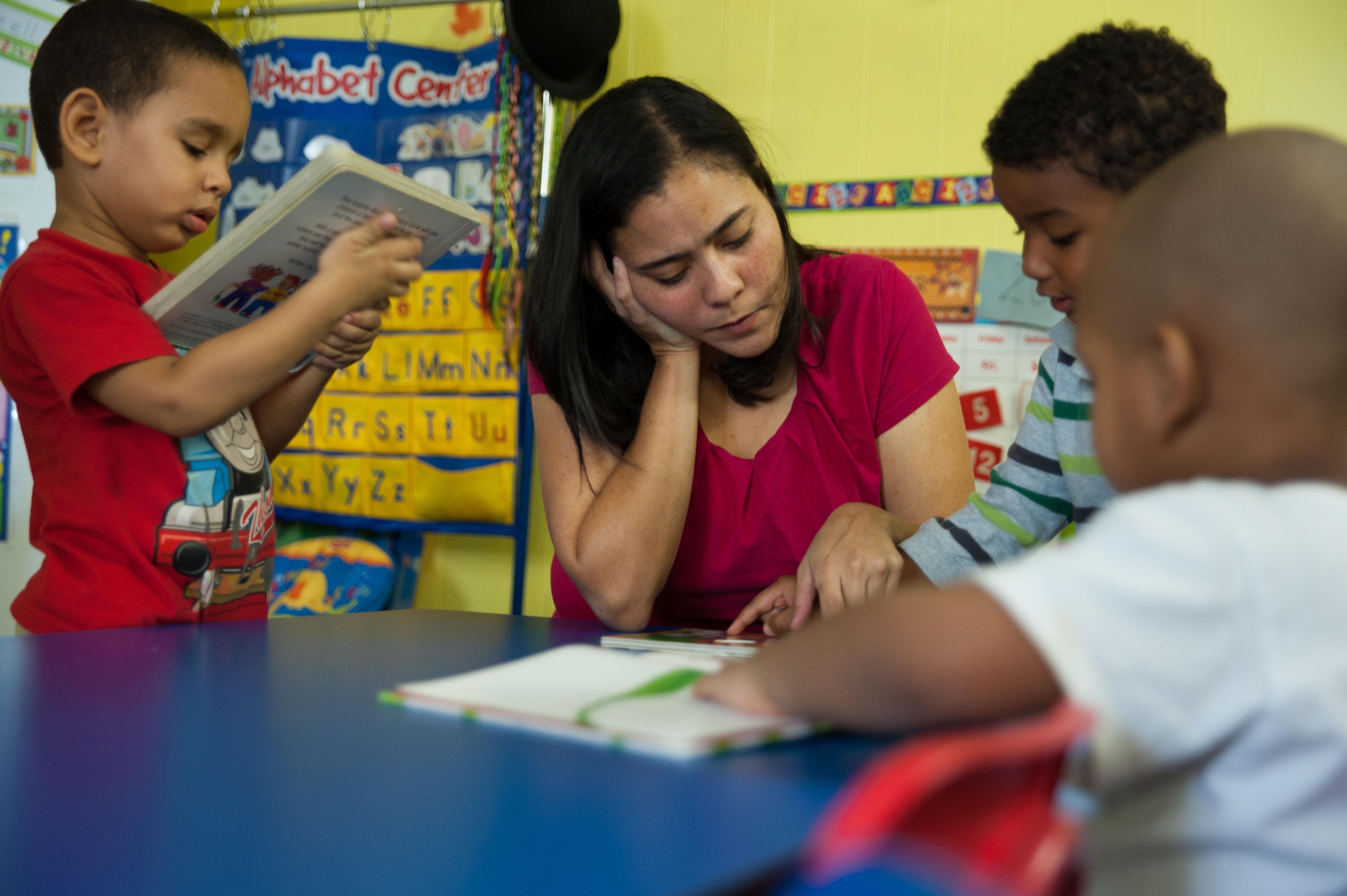
Photograph: Strategies for Children

kids--teacher

Read Full Post »

We blogged a while back about tutoring students via distance learning. Kyle Spencer at the NY Times wrote about it here:

“Newly designed software for the tutoring of beginning readers has bridged the gap, allowing volunteers to meet students online from a distance. P.S. 55 is testing the program with students in its four first-grade classes.”

Now it turns out that remote tutoring is not the only kind of remote volunteering possible. In this article by Casey Armstrong at Shareable, we learn more about why “volunteers don’t have to be in the room anymore to physically volunteer.”

“As far as fun volunteering opportunities go, playing with kittens at an animal shelter is probably unequaled. It’s no wonder that the option to do this over the internet is a popular one. The Oregon Humane Society gives volunteers the chance to control robotic arms wielding toys for bored cats waiting to be adopted. This opportunity is not only good for the cats and volunteers, but it’s a great way to encourage donations and adoptions.

“And, if you look beyond the surface, this is more than just a stunt. It proves a concept: Volunteering can be done from anywhere by anyone if you accommodate it with the right technology. … Check out Reach-In.com if you’re interested in setting up your own robot volunteer opportunity.”

Photograph: Librado Romero/The New York Times
Edward Muñoz, a first grader at P.S. 55 in the Bronx, works out tricky words with Jenny Chan, his tutor in Midtown Manhattan.

Read Full Post »

Erik’s mother saw yesterday’s post on poetry slams and sent this.

“I do not know if you are aware of a competition held in England in April for young people 14-18 years old who recite poems by heart. You can read about it on www.poetrybyheart.org.uk. I found out about it when I read a Swedish newspaper where they suggested it would be good if they had this type of competition in Swedish schools too.”

When I was in school, we were obliged to memorize both poetry and Bible verses. I still remember poems and verses going back decades, even some lines in French. The trend away from any sort of “rote learning” has an unfortunate side.

Having beautiful words and cadences in your head can help you so much with your writing. (It also helps when you are standing in a long line with nothing interesting to think about.) Educators threw out the baby with the bathwater when they decided kids should understand, not just memorize, historical facts, science, and math. Understanding is good, and sometimes it comes from memorization.

I’m going to reuse a funny little poetry recitation that I posted once before. Jim Clark, Poetry Reincarnations, copyrighted the animation and explains it on YouTube.

Read Full Post »

I’m not sure where I first read about Studio H, but I think you will be interested in this high school that engages students in hands-on construction from design to delivery.

The website explains: “Studio H is a public high school design/build curriculum that sparks community development through real-world, built projects. Originally launched in rural Bertie County, North Carolina, Studio H is now based at REALM Charter School in Berkeley, CA.

“By learning through a design sensibility, applied core subjects, and industry-relevant construction skills, students develop the creative capital, critical thinking, and citizenship necessary for their own success and for the future of their communities.

“Over the course of one semester, students earn high school credit and have the opportunity to design, prototype, and build a full-scale community project. Our students have designed and built some crazy chicken coops for families in need, and a 2,000-square-foot farmers market pavilion.”

More here.

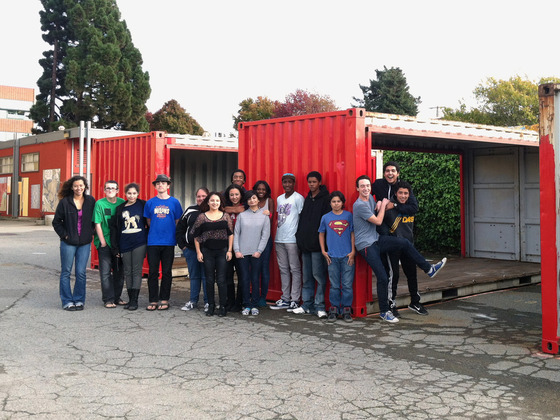
Photographs: http://www.studio-h.org

Read Full Post »

Paul Tough has written a book arguing that developing character is more critical to a child’s future success than IQ.

National Public Radio has the story: “Tough explores this idea in his new book, How Children Succeed: Grit, Curiosity and the Hidden Power of Character.

” ‘For some people, [the] path to college is so easy that they can get out into life and they’ve never really been challenged,’ he tells NPR’s David Greene. ‘I think they get into their 20s and 30s and they really feel lost — they feel like they never had those character-building experiences as adolescents, as kids, that really make a difference when they get to adulthood.’

“That wasn’t true for the teenagers Tough met during the time he spent in some of Chicago’s roughest neighborhoods. There, he worked with teenagers overcoming unimaginable challenges. One young woman …  was getting into fights in school and was on the verge of dropping out. But then she entered an intensive mentoring program that changed her life.

” ‘She made it through high school, overcame a lot of obstacles and now is getting a cosmetology degree,’ Tough says. ‘For some people, that wouldn’t be a huge success. But for her, she overcame obstacles that won’t only set her on a path for material success, but also psychological success.’

“The difference-maker really depends on the person, Tough says. Mentoring programs that focus on goal-setting can be helpful, and he also says parents should try to help their kids manage stress from a very early age.”

Do you agree with this? Overcoming obstacles is important, but the obstacles that some of the students Tough met were so severe, I can’t help wondering if the consequences have yet to play out. I’m for kids overcoming normal, age-appropriate obstacles that are part of any life — as they say in Italy, “the things that happen to the living.”

More at NPR, here.

Read Full Post »

Gwarlingo pointed me to Time In, an initiative that provides arts experiences for children who might not get such enrichment any other way.

Time In brings some of the youngest, most at-risk public school children OUT of underserved classrooms and INTO the world of the living arts every week of the school year.

“Starting from Pre-K, children {try] hands-on art in our studio one week, with hops to the world’s best galleries and museums the next! Regardless of their backgrounds, children are children. The world of imagination, creativity and fantasy is their most fertile ground. Time In acknowledges children’s phenomenal gifts and innate abilities and is dedicated to developing learning environments that stimulate, rather than stifle.

“We are proud to have changed the lives of more than 1,000 underserved Pre-K-2nd graders since 2006, and look forward to working with over 400 children this year. Time In will continue to foster not only wonderfully conceptual thinkers, but perceptive and aesthetically sensitive children, each of whom will be poised to nourish our society in the days to come.”

Read more. Or vote for the nonprofit on Facebook as Part of Chase Community Giving.

Read Full Post »

Ashoka, which defines itself as “a global organization that identifies and invests in leading social entrepreneurs,” has a blog called Changemakers that might interest readers. The March 26 post is on teaching and empathy.

Nora Cobo at the Center for Inspired Teaching writes, “While test-based assessments are essential, they reflect only one type of data and one kind of skill that students need. Schools must also focus on students’ social-emotional growth in order to create sound learning environments. Such settings help students develop interpersonal competence and improve short- and long-term academic and personal outcomes.

“Center for Inspired Teaching partners with teachers to change the school experience for students to include these critical skills. … Instead of looking at students’ behavior as something to be corrected, we train teachers to look at students’ behavior in terms of unmet needs. In particular, we ask teachers to consider students’ needs for Autonomy, Belonging, Competence, Developmental appropriateness, and Engagement — the ABCDE of learners’ needs.

“For example, a teacher may encounter a student who repeatedly gets frustrated and leaves his seat to chat with classmates when he encounters a complicated geometry problem. Rather than assuming the student has a bad attitude, the teacher strives to figure out which of the student’s needs is not being met. The teacher may discover that the student learns best when physically engaged – and offer him the option to tackle the equation by measuring distances by walking.

“Similarly, a teacher may find a student who refuses to work in a group setting, saying she just prefers to work alone. In examining the student’s unmet needs, that teacher may discover that the student longs for more autonomy with her work – and empower that student to create on her own.

“The teacher may discover, upon further engaging her skills of empathy, that other members of the group aren’t treating the student kindly, and therefore the student’s need for belonging is not being met when classroom groups are self-selected. …

“Placing empathy at the core of teachers’ practice ensures that students learn how to think, not just what to think – and go beyond covering the curriculum to learn the skills they need in order to thrive.”

More here.

Photograph: Kate Samp, Strategies for Children

Read Full Post »

I was interested in an article in today’s NY Times about a school that gives chronically failing students another chance. It succeeds against all odds, but success is a slow process. New York’s mayor is not a fan, because many kids take six years to graduate.

Aniah McAllister, once a lost and wandering soul, has one of the happier stories. Reporter Michael Powell writes that she seems amazed to have earned 46 credits and to be headed to college.

“ ‘This school made realize,’ she says, ‘that I am much better than I thought I was.’

“That’s a pretty fair bottom line for any school,” writes Powell, “although in the up-is-down world of public education in New York, it might just be an epitaph for this small marvel of a high school. Known as a transfer high school, Bushwick Community admits only those teenagers who have failed elsewhere. Most students enter at age 17 or 18, and most have fewer than 10 credits.

“You can muck around quite a bit trying to find someone who has walked the school’s corridors, talked to its students and faculty, and come away unmoved. Most sound like Kathleen M. Cashin, a member of the State Board of Regents and a former superintendent. ‘They care for the neediest with love and rigor,’ she said. ‘They are a tribute to public education.’ ”

Read the article. I’m hoping it will have an influence on the policymakers and let an initiative that sounds so positive keep going.

Aniah McAllister, left, Justin Soto and Kassandra Barrientos attend Bushwick Community High School. Photograph: Kirsten Luce, NY Times

Read Full Post »

A reason that poor children are sometimes unprepared for school is that the words they are starting to read in books may not convey meaning to them. What does it mean to park a car if you have never ridden in a car?

The NY Times has a lovely article about one NYC school’s unusual field trips, designed to fill some gaps in knowledge that textbook writers take for granted.

Michael Winerip writes, “Experiences that are routine in middle-class homes are not for P.S. 142 children. When Dao Krings, a second-grade teacher, asked her students recently how many had never been inside a car, several, including Tyler Rodriguez, raised their hands. ‘I’ve been inside a bus,’ Tyler said. ‘Does that count?’

“When a new shipment of books arrives, Rhonda Levy, the principal, frets. Reading with comprehension assumes a shared prior knowledge, and cars are not the only gap at P.S. 142. Many of the children have never been to a zoo or to New Jersey. Some think the emergency room of New York Downtown Hospital is the doctor’s office. …

“Working with Renée Dinnerstein, an early childhood specialist, [Ms. Levy] has made real life experiences the center of academic lessons, in hopes of improving reading and math skills by broadening children’s frames of reference.

“The goal is to make learning more fun for younger children. … While many schools have removed stations for play from kindergarten, Ms. Levy has added them in first and second grades. [And] several times a month they take what are known as field trips to the sidewalk. In early February the second graders went around the block to study Muni-Meters and parking signs. They learned new vocabulary words, like ‘parking,’ ‘violations’ and ‘bureau.’ JenLee Zhong calculated that if Ms. Krings put 50 cents in the Muni-Meter and could park for 10 minutes, for 40 minutes she would have to put in $2. They discovered that a sign that says ‘No Standing Any Time’ is not intended for kids like them on the sidewalk.” Read more.

One thinks of all the small daily interactions one has with one’s own children and the learning occurring without forethought. There are interactions and learning in poor families, too, but if the words and concepts are not what they kids will encounter in school, I think these excursions can be very helpful.

Photograph: Librado Romero, NY Times

Read Full Post »

People where I work have been volunteering in an inner-city school for years. It started with reading picture books to first graders and expanded to second grade reading, fourth grade math, and fifth grade “Book Club,” the one I do. I once taught fifth grade, and I would still read the books written for that age even if I weren’t volunteering in the school.

This past week, the NY Times had an interesting article on using technology to enable tutors to work with elementary school kids remotely.

“Edward’s tutor was not in the classroom. His school, a 20-minute walk from the nearest subway stop in a crime-plagued neighborhood, has long had trouble finding tutors willing to visit. ‘It is hard to get anyone to volunteer,’ said the school’s principal, Luis Torres, who sometimes cancels fire drills because of the gunfire he hears outside.

“Now, newly designed software for the tutoring of beginning readers has bridged the gap, allowing volunteers to meet students online from a distance. P.S. 55 is testing the program with students in its four first-grade classes.

“Edward’s tutor, Jenny Chan, was an hour away in Midtown, on a bustling trading floor at JPMorgan Chase, where she provides technology support. She was talking to Edward by phone and seeing the story he was reading with screen-sharing software on her desktop computer.

“JPMorgan Chase is sponsoring the remote tutoring program and encouraging its employees to get involved from their desks during the school day.” Read more.

There’s nothing like face-to-face contact, but if people can’t take work time for the commute, perhaps more people will tutor.

Photo: Librado Romero, NY Times

Read Full Post »

Creativity at Age 8

We have a fierce wind here today. A woman in the elevator where I work said she went outside to mail a letter, and all the pedestrians were walking at a 45 degree angle trying not to be blown off their feet. Which gives me a great opportunity to highlight the creative endeavors of a young relative (age 8) who, with a classmate, wrote a quite wonderful poem about the wind.

The Wind
By Axel L-R and Constantinos F

I may be scary
I may be cold
I’m all around you and I never get old
If you enter the woods you may hear me howl
Or maybe it´s just an owl
When I get angry I become a hurricane
Look out!
You may not want to come out
The apples tumble down the hill after I throw them off their branches
I shake things
I take things and sink all the ships
I am the wind
Something that´s everywhere and you should take care of me
Or I will never be there

You might be interested to know that Axel has other creative irons in the fire. While my husband was in Sweden, Axel interviewed him for a possible article in a magazine he was putting together. The interview didn’t make the cut, but the magazine came home, all in Swedish, crossword included. 5 kroner.

Here is Axel as the wily Ali Baba.

Read Full Post »

Among children’s books, I especially like books that are fifth-grade level. Although I enjoyed all the “color” fairy books when I was in third grade or so — Andrew Lang’s Blue Fairy Book, the Orange Fairy Book, the Rose Fairy Book, and so on — it wasn’t until about fifth grade that I really got hooked. Flashlights under the cover and all. I had a relative who worked for Dan Wickenden (The Amazing Vacation), and she sent me Mrs. Piggle Wiggle and the Narnia books. My cousin Patsy got me into George MacDonald’s The Princess and the Goblin. I reread that one a couple years ago, and it’s as great as ever.

After college, I  taught fifth and sixth grade for a few years and read to the kids as time allowed. I remember how one class only gradually realized they were really starting to like Frances Hodgson Burnett’s The Lost Prince. Reading can sneak up that way.

Today I am one of the volunteers who go out from our workplace to an inner-city school where there has long been a tutoring relationship. It started with a team who read picture books chosen by teachers to first graders. Then other teams were added (such as fourth grade math tutoring), and now there are teams reading with fifth graders. The books are chosen by the librarian. Each fifth-grade volunteer has a group of three children, and grownups and children all take turns reading and discussing. Even though the kids see teams once a week, most individual volunteers only go monthly. It’s not hard to fit into one’s schedule. I have learned about a lot of books by volunteering at the school. I already knew about From the Crazy Mixed-up Files of Mrs Basil E. Frankweiler, but not about Holes, Maniac Magee, Hatchet, or Hidden Talents, to name a few.

One colleague, having found out that I liked this age level, introduced me to the Golden Compass series. Heaven! I also like her suggestion of The Island of the Aunts and recommend it.

Better sign off. The last time we had a storm like the one outside my window, my computer was hit.

Read Full Post »

Last night we finally watched the DVD of “Waiting for Superman.” We had to wait until we were up for it. We knew it would be good, but painful to watch. It’s a documentary about the broken public education system in this country.

I see now why people come away from this movie saying, “It’s the unions.” But although we clearly need to find a way to dismiss bad teachers and reward good teachers, to just say, “It’s the unions,” seems too simple to me. Even if it is true, when you consider the context of poverty, unemployment, the highest rates of incarceration in the developed world, the War on Drugs, three other wars, confused approaches to immigration, Wall Street greed at the expense of the poor and middle class, antigovernment bias, and many skewed political priorities, to lay the problems of inequality in public education at any one door seems too simplistic.

Still, as the movie makes clear, we need to get rid of bad teachers immediately and make sure children get high-quality teachers before they give up hope. Lotteries to get into better schools are too cruel to too many. Activists can check out this site.

By the way, the film is very well done. We loved the creative graphics making the data real and the clips of Superman movies and past political speeches and TV shows.

Reader Asakiyune writes: “I very much agree with what you said about unions and teaching and the documentary–it bothers me when a problem as complex as that is reduced to one soundbite.”

Read Full Post »

« Newer Posts