Feeds:
Posts
Comments

Posts Tagged ‘senior’

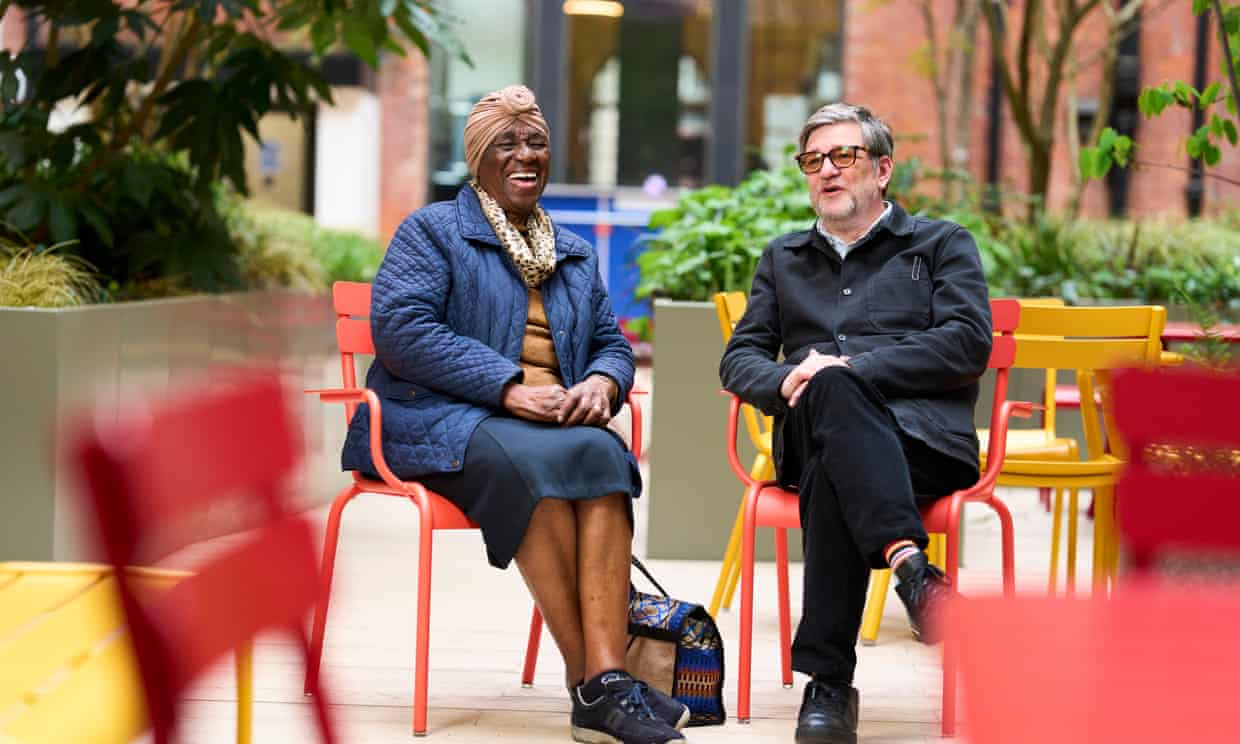
Photo: Christopher Thomond/The Guardian.
Elaine Unegbu, the chair of the Age Friendly Manchester [UK] older people’s board, and Paul McGarry, the head of the Greater Manchester aging hub. 

Where I live now, in a retirement community with various levels of care, the management favors pilot projects from academia and startup companies to test technology that can keep people independent longer. I haven’t volunteered for any of them, but I think it’s a good idea, especially as Erik still holds patents for something along those lines.

I recently read about some simple but ingenious innovations in Manchester, England, that I thought might interest readers like Making Home Home. I mean — how obvious but how overlooked is putting numbers on outdoor benches to aid in emergencies?

Chris Osuh  reports at the Guardian, “Futuristic planning for spaces where people can age well and live in an area designed for them to grow old in is accelerating in the UK with a radical project backed by £1.5bn [$1.7bn].

“The plan to transform a hospital into the first neighborhood in the country designed for people to thrive as they age will be a national testbed for holistic health and social care approaches. It will include hi-tech homes that adapt to occupants’ life stage and care needs, transport, a village green and a social calendar to combat isolation.

“The master plan for the North Manchester general hospital (NMGH) redevelopment in the Crumpsall district is the result of collaboration by public health officials, local politicians, experts and architects.

“Michelle Humphreys, the director of strategic projects for Manchester University NHS foundation trust (MFT), described it as a neighborhood that ‘adapts around people as they go through life,’ powered by advances in medical wearables and remote monitoring. …

“NMGH’s ‘healthy neighborhood‘ scheme is multigenerational. It will include family housing and will be built in line with age-friendly concepts, spearheaded by the World Health Organization (WHO) in response to two major trends – the aging population and urbanization.

“By 2050 60% of the global population will live in urban environments and 27% of people will be over the age of 65, the OECD predicts, yet experts say cities are often defined by spatial agism where environments are not set up for older people.

“The age-friendly movement aims to ensure older people can still play a part in civic life. The Elders Council of Newcastle, Northern Ireland’s older people’s commissioner and Wales’ commitment to becoming an age-friendly nation reflect how UK regions and devolved governments have been preparing for demographic change.

“The humble bench – improved with armrests, numbered to aid in a medical emergency, or placed strategically for wellbeing and intergenerational conversation – can be transformative, with dozens installed in Manchester, taking inspiration from New York’s CityBench initiative. However, the UK has further to go.

Akita, in northern Japan’s Tohoku region, where 30% of the population is over 65, has more than 60 heated roads to prevent slips on ice.

“In Singapore, where one in four are predicted to be over 65 by 2030, the Admiralty ‘vertical village’ has a central medical tier, so older residents, who live in slip-proof homes with alarms alerting neighbors in an emergency, can have surgery without leaving. In Germany in 2007, BMW made 70 changes to its Dingolfing factory to adapt to an older workforce. …

“Prof Stefan White, from Manchester Metropolitan University and Manchester School of Architecture, said the NMGH project would exemplify how to free up hospital space and allow people to ‘age in place’ with the type of support ordinarily provided in a care home made available to the whole neighborhood on a flexible basis.

“Elaine Unegbu, the chair of the Age Friendly Manchester older people’s board, has successfully lobbied the Greater Manchester mayor’s team for transport adaptations, benches and afternoon matinees. She said the healthy neighborhood would give residents peace of mind at a time when gentrification ‘whitewashed’ older urbanites, with many forced from their homes by health crises to the detriment of communities.

“Manchester, where previous age friendly projects include the Derek Jarman Pocket Park inspired by LGBTQ+ over-50s, has been pioneering the movement in the UK since 2008. Last month the city hosted international experts at the Age-Friendly Futures Summit.

“Paul McGarry, the head of the Greater Manchester aging hub, said: ‘The task is to get a national conversation on aging.’ “

More at the Guardian, here.

Read Full Post »

Photo: Oscar Espinosa.
Residents of a Japanese apartment building designed to combat loneliness in seniors are seen weeding with a boy from the child development center on the first floor.

Social media, working at home, and lack of face-to-face interaction are among the reasons for the increased isolation of all ages in our world. Isolation is not good for individuals or for society.

At the Christian Science Monitor, Oscar Espinosa describes an apartment building in Japan specially designed to bring people together more.

“A message on a small whiteboard near the elevator,” he writes, “is a reminder that dinner in this apartment building is tonight at 7 p.m., as it is once every month. Many of the residents are likely to attend, since being together is the point.

“Nagaya Tower, in the peaceful city of Kagoshima on the Japanese island of Kyushu, houses 43 people, ages 8 to 92, including a family with five children. With shared community spaces, the tower was built so that different generations could meet and interact. The staff is dedicated to supporting residents and connecting them with each other to generate that community life so important to combating the loneliness of older people, which has become a significant problem in Japan’s increasingly aging society.

“ ‘This community is inspired by the ancient nagayas of the Japanese Edo period,’ says Nomura Yasunori, who moved here five years ago with his wife. ‘From children to the elderly, families, singles, from different occupations, all lived together in the same long compartmentalized house.’

The building was designed in a V shape so that everyone could see each other when they enter or leave their homes.

“[In 2021], the Japanese Cabinet Office appointed a minister for loneliness and social isolation. … According to a survey conducted in 2017 by Japan’s National Institute of Population and Social Security Research, 15% of older men who live alone talk with one person or no one every two weeks, while 30% feel they have no reliable people they can turn to for help in their day-to-day lives.

“Dozono Haruhiko, founder of one of Japan’s first palliative care clinics, saw how his patients could suffer from social isolation. He believed that what these patients needed was human interaction, and so, in 2011, he applied for a government grant with his idea for Nagaya Tower, which was completed in 2013.

“By 6 p.m. on this evening, residents are starting to arrive with food for the communal dinner. Some of them rearrange tables to form a single one that takes up almost the entire room; others go to the kitchen to lend a hand.

“ ‘After coming to Nagaya Tower I feel rejuvenated,’ smiles Kukita, who arrived three years ago with his wife. … ‘Here you stay young because you are surrounded by children and young people.’ Kukita says he walks every day in the park, swims in the pool, participates in the art workshop once a month, and, above all, takes every opportunity to talk and spend time with the children.

“ ‘I can learn a lot from the elderly people through the exchange,’ says Takai, who is in his 30s and is one of the younger residents. ‘We help each other from time to time if we have a problem.’

“The building was designed in a V shape so that everyone could see each other when they enter or leave their homes, allowing them to greet each other, which is not common practice in other places, according to Moemu Nagano, age 27, who has lived here for two years. …

“After dinner, Kawasaki Masatoshi sings Bob Dylan’s ‘Blowin’ in the Wind’ to a standing ovation, making it clear that Nagaya Tower’s motto, ‘Life is happy when you have someone to smile with,’ is more than just a phrase on a piece of paper. He loves community life and boasts of being resident zero, when he moved in 10 years ago.

“ ‘I signed up before the construction of the building was finished, and I will stay here for the rest of my life,’ Mr. Kawasaki says.

More at the Monitor, here. No firewall. Charming photos. And for more insights on communal or supported living, read the blog Making Home Home, here.

Read Full Post »

Here’s a great story from the Japan Times about a theater group for people over 60. Where do I sign up?

Nobuko Tanaka writes, “At the age of 91, Saitama resident Izumi Noguchi is speaking at his first press conference — at least as an actor anyway.

“ ‘When I saw an advert in April inviting anyone aged 60 or older to audition for a new project called 10,000 Gold Theater, I just felt like challenging myself to do something I’d never had a chance to try before,’ he says.

“Noguchi is the oldest person to join the 10,000 Gold Theater ensemble. …  ‘Gold Symphony, my dream, your dream’ [is] a staging on an unparalleled scale that features some 1,600 performers (not 10,000 as the name suggests) who are all volunteers and almost all amateurs …

“Arts promoter Taneo Kato came up with the idea [when] he was watching a performance of ‘Hamlet’ in which stage icon Yukio Ninagawa directed members of the Saitama Gold Theater and Saitama Next Theater — troupes made up of older and younger actors that he formed in 2006 and 2009, respectively, after becoming artistic director at Saitama Arts Theater in 2006.

“ ‘Out of the blue, midway through “Hamlet,” veteran enka singers the Komadori Sisters — who are actually twins — appeared and sang “I Want to be Happy One Day,” ’ Kato says, recalling how striking a moment it was to see the women, born in 1938, sing those words.” More here.

I wonder how big an issue memorization is for the performers. My friend Dorothy started a group of older amateur actors in Concord, but they do readings and don’t have to memorize. I have many memorized stories, Bible verses, and poems in my head and can trot them out at a moment’s notice. Not sure if I could acquire new ones to the same extent.

Photo: Maiko Miyagawa
Massive undertaking: Seiji Nozoe directs elderly actors during rehearsals for the play ‘Gold Symphony, my dream, your dream,’ performed in Chuo-ku, Saitama City, December 2016.

Read Full Post »

Erik, this one’s for you. I saw a book on 100-year-olds in your kitchen, and I know you and your company aim to enable us all to be centenarians.

Sally Williams writes in the Guardian, “Three score and 10 may be the span of a man, but no one has broken the news to David Bailey who, at 76, still behaves like someone turning one score and eight.

“Last month he walked into a studio in London (not his: too many stairs) to photograph some of Britain’s oldest people. The youngest was just 100; the oldest 107. Dressed in a baggy polo shirt and a pair of old combat trousers, small but physically imposing, Bailey flirted, flattered, insulted his subjects in order to get the picture he wanted.

“ ‘We’ve been married for 62 years,’ Shirley Arkush told Bailey of her husband David, one of the centenarians waiting to be photographed. ‘Same as me,’ he replied, ‘but not to the same wife.’ And he gave a combative, high-pitched laugh. (Bailey’s marriage to his first wife, Rosemary Bramble, lasted three years, and his second, to Catherine Deneuve, two; he was married to Marie Helvin for 10 years, before marrying Catherine Dyer in 1986.) …

“He worked at an incredible pace – nine portraits in four hours, and on subjects with a collective age of 917 years. ‘I’ve always wanted to photograph old people,’ he said at one point, after pinning one centenarian in forensic close-up (he had requested no makeup, only ‘a tidy-up’ for the women).

“Not everyone was happy. Joe Britton, 103, Chelsea Pensioner and horseracing enthusiast, said he knew Bailey and had been looking forward to seeing him again. But, ‘That’s not David Bailey,’ he said with disappointment after the shoot – his David Bailey is the horse trainer.” More pictures, more story here.

Photograph: David Bailey/Guardian
Violet Butler: ‘I’m no paragon. I used to smoke and drink, but not to excess.’

Read Full Post »

In case you missed it, there’s a new movie about using elderly people’s favorite music to call them back from dementia or Alzheimer’s.

The website for Alive Inside: A Story of Music and Memory says the movie is an “exploration of music’s capacity to reawaken our souls and uncover the deepest parts of our humanity. Filmmaker Michael Rossato-Bennett chronicles the astonishing experiences of individuals around the country who have been revitalized through the simple experience of listening to music.”

The documentary follows “social worker Dan Cohen, founder of the nonprofit organization Music & Memory, as he fights against a broken healthcare system to demonstrate music’s ability to combat memory loss and restore a deep sense of self to those suffering from it. Rossato-Bennett visits family members who have witnessed the miraculous effects of personalized music on their loved ones, and offers illuminating interviews with experts including renowned neurologist and best-selling author Oliver Sacks (Musicophilia: Tales of Music and the Brain) and musician Bobby McFerrin (‘Don’t Worry, Be Happy’).”

At the Washington Post, Michael Sullivan writes, “The benefits of music to enliven and awaken the senses are not limited to those with dementia. ‘Alive Inside’ also focuses on a woman who suffers from schizophrenia and bipolar disorder, and on a man with multiple sclerosis. The scenes in which they and others are shown listening to music that has personal meaning are absolutely joyous, but they also might move you to tears.

“As the movie makes clear, none of these conditions are reversible. Music isn’t a cure for anything. But it does seem to be a key to unlocking long-closed doors and establishing connections with people who have become, through age or infirmity, imprisoned inside themselves.” More.

Hmmm. It seems that in addition to making wills, we should all be writing lists of the music that we have enjoyed in our lives so that people know what to play. Should I go with “Swan Lake” and “The New World Symphony” or “For the Beauty of the Earth” and “Mary’s Boychild”? Or how about the Platters and Elvis and Nina Simone and Edif Piaf or musicals like Nine and Chess. Anything in a minor key.

I haven’t even scratched the surface.

Read Full Post »

Being in the aging-happily business, Erik is always on the lookout for stories about how seniors are putting their own stamp on their later years, after they have given up skydiving.

He sent me an article about a gentleman called Martin Bayne, who has become a bit of an expert on assisted living, having tried one facility that literally drove him crazy and having eventually found one he loves.

Writes Judith Graham in the NY Times, “Sometimes Martin Bayne speaks in little more than a whisper, like many people with advanced Parkinson’s disease. But his voice has a way of carrying.

“Many consider him the nation’s foremost advocate for people in assisted living. … Dr. William Thomas, a geriatrician and nursing home reformer, wrote in an e-mail, ‘He has been able to do what very few others have done — he has told the story of life on the inside of long-term care.’

After his first assisted-living experience, says Graham, “Mr. Bayne relocated to a facility in northeastern Pennsylvania, where he has a single room and receives several hours of help from aides every day. From this perch, Mr. Bayne blogs about assisted living at thevoiceofagingboomers.com  …

Bayne tells Graham how critical he believes it is to reach out to the others around you when they feel down, “Sometimes just a hand on someone’s shoulder is all it takes. Sometimes picking up a fork that someone drops in the dining room on the floor. Sometimes, just sitting with someone. Trying to make people more comfortable. The simplest things in the world can lead to what I call incremental victories. That’s what I go for in my life.

“I sneak in touches whenever I can. I call them sneak attacks. I just go over and touch someone’s hand or some other part of them. Men are in need of it the most. Men are never touched, at least in this culture.”

Graham asks Bayne how he would run his dream facility, and he says, “First of all, when a prospective resident came to visit, I would have him sit down with 10 other residents. And we would ask, ‘What’s your passion? What motivates you? What’s your mission in life?’ If you don’t have an answer to those questions, then we don’t accept you. Because we want a community that is alive.

“There would be a welcoming committee for every new resident. You’d be taken around and treated like royalty when you first come in. We’d show you that we care about you.

“Once you’re here, you’d get a job. No matter how seemingly insignificant, you’d have responsibilities every day. And the emphasis wouldn’t be on you, the emphasis would be on the community.” More.

Some of the article is sad, but the idea that you can keep making things work for you — over a longer period of time than you may have thought —  is something to ponder.

“Dear Sir,” below, is the first art collaboration of Rhian and Ray Ferrer. Please visit Rhian’s WordPress blog for lots more art, http://artgland.wordpress.com.

Read Full Post »

Got to love this unemployment story on a 17-month job search by an older worker.
“Count 97-year-old Mary Poncin of Warwick (RI) among the long-term unemployed who have finally found work. Poncin has been hired as a greeter at Kent Hospital after nearly 17 months of being unemployed. She was laid off in January 2010 from a retail sales job. Her first job was as a waitress at a diner in the 1930s, earning $1 a day.” AP

If I were aged and sick and were fortunate enough to be greeted by her at the hospital, I think it would give me hope. Good for Kent Hospital to see a good thing!

Read Full Post »