Feeds:
Posts
Comments

Posts Tagged ‘shakespeare’

Actor Finn Wittrock wrote recently at the New York Times about helping to start a mini Shakespeare company in the 1990s to entertain his parents and other theater professionals. He recalls with wonder his young self’s confidence of success.

“I was born in the Berkshires in Western Massachusetts. I lived there until I was 6, then moved to Evanston, Ill., and later to Los Angeles. But every summer for most of my youth, I would go back East with my brother, my mom and my dad, who most summers was acting or teaching for Shakespeare & Company. I would often be cast as a page or an altar boy in one of the professional productions.

“I went in lieu of a summer camp; I went to romp in the Berkshires, see old friends, get out of the city. But mostly I went for the Very Young Company.

“Starting at the age of 8 and until I was 16, my oldest friends and I would get together every summer: Rory, Reilly, Wolfe, and later my brother, Dylan, and Wolfe’s brother, Tiger (yes, their real names) would arrange five or six scenes from Shakespeare, rehearse them on our own time in the sun-drenched Berkshire afternoons and perform them for the adult company after one of their Mainstage shows. We began the company ourselves and it ended when we were no longer ‘very young.’

“For a kid, it was an epic undertaking; an outlet for pre- and post-adolescent energies. We were totally self-motivated; nobody told us to do it, which was in itself an incentive. We’d choose a scene based on our own criteria: Had the company done it before? Could we make fun of them for it? Could we put Reilly in a wig and have him play a girl? And, most important: Did it end in a sword fight? …

Sometimes I yearn to have the boldness of one who knows nothing, who jumps onstage for no other reason than because he is young and has a loud voice.”

Later in his essay, Wittrock recalls something the celebrated director Mike Nichols once said about his own early years: ” ‘Why was I so confident back then? I had no business being that confident.’ And yet he attributed most of his early success to that unreasonable confidence. …

“No one gave us permission to do the Very Young Company; no one ordered us to do it, and no one had to boost our confidence to do it. We just did it. We were just kids howling Shakespeare to the Berkshire trees, and our readiness was all.” More at the New York Times, here.

At one point in my  childhood, I, too, was confident. I thought, if my parents would only call the movie theater and set it up, four of us kids — the Gordons, one of my brothers, and I — would be a smashing success performing our version of “Snow White and Rose Red” before the feature. The grownups didn’t quite believe in it.

Some neighbors and I did perform an original play about a snowman for family members. One of the actors returned a copy of the pencil-scrawled script to me at my aunt’s funeral in 2002, decades later.

Photo: Lauren Lancaster for the NY Times
Finn Wittrock, right, and Rory Hammond, enacting the killing of Lady Macduff and her son in a mini-“Macbeth.” The young actors formed their own company more than 20 years ago to entertain their parents and other professionals at Shakespeare & Company in Lenox, Mass.


Read Full Post »

Our 5-year-old grandson’s friend had been planning to attend an American Repertory Theater musical with her grandmother today at 10 a.m. We decided to go, too.

The show was The Pirate Princess and was loosely (very loosely) based on Shakespeare’s Twelfth Night. It was a hoot for me, and the young man in the photo seemed riveted. But whether he could make head or tail of the  convoluted plot, I have my doubts. It will be interesting to see down the road what he remembers — and whether he wants to see more plays.

The plot involves a brother and sister who get separated in a shipwreck (in this case, it’s thanks to a monster called the Kraken) and have separate adventures with characters who later mistake the sister dressed as a boy for the boy and vice versa. (I kept whispering in my grandson’s ear, “The pirate thinks he’s the girl that he thinks is a boy”; “The Queen thinks he’s his sister but doesn’t know his sister is a girl.” My grandson didn’t respond.)

There were songs, musical instruments, fancy costumes, pirates storming up lighted platforms in the middle of the audience, sword fights, and imaginative special effects. I especially like the jellyfish created by glowing umbrellas with streamers, carried along the aisles in the dark. The Kraken with his many legs was pretty great, too.

After the show, we had hot chocolate and cookies at the Darwin on Mt. Auburn Street. I’m not sure what our grandson will be able to tell his parents about the madcap entertainment he witnessed, but bits and pieces will likely emerge over time. I myself saw Peter Pan and Alice in Wonderland when I was four, but I didn’t become a theater nut until I was 10.

010216-hot-chocolater-after-theater

Read Full Post »

Today would have been Shakespeare’s 451st birthday, and I am seeing testimonials all over Facebook and twitter. So it seems like a good day to write about the Sonnet Project in New York City.

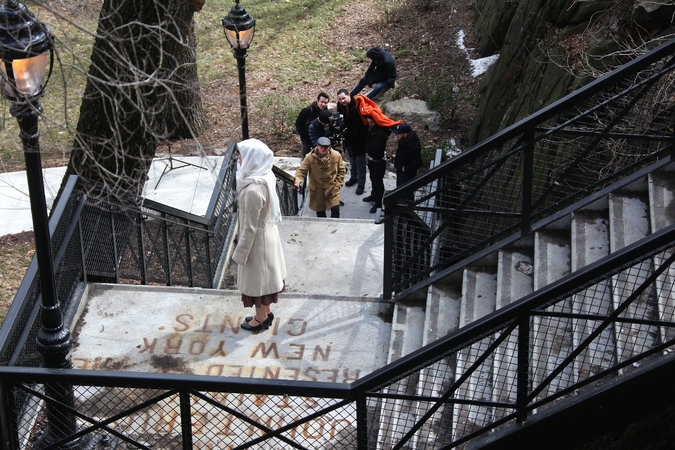
Stuart Miller wrote at the New York Times about “an ambitious project to create a short film for each of Shakespeare’s 154 sonnets, with each movie shot at a different New York City location.

“ ‘It brings Shakespeare to people who might not be in touch with it, and we can use social media like Twitter and Instagram to spread the word,’ [actor Billy] Magnussen said. The endeavor, called the Sonnet Project, grew from the work of the New York Shakespeare Exchange, a local theater group.

“The group, which started the project in 2013, just completed its 100th film: Sonnet 27, starring Carrie Preston, an Emmy award-winning actress, and filmed on the Verrazano-Narrows Bridge [and premiering] April 8 on the Sonnet Project website and app. …

“Some directors found inspiration at the location where the films were shot. At Leidy’s Shore Inn, a 110-year-old bar on Staten Island, Daniel Finley, who was making Sonnet 19, filmed Laurie Birmingham, an actress who works mostly in regional theater, as a world-weary regular musing over her drink.

“ ‘We walked in at 10 a.m. and the regulars were there watching OTB and scratching their lotto tickets,’ he said. ‘We learned some of their stories and Laurie based her character on those impressions.’ ” More at the New York Times, here.

Photo: Chang W. Lee/The New York Times
A crew filming Sonnet 108 at the John T. Brush stairway. 

Read Full Post »

National Public Radio recently featured a story on the discovery of the skeleton of Richard III, the English king that Shakespeare fans love to hate. What does the unearthing of the king’s 15th century remains have to tell the 21st century?

The woman who found him, Philippa Langley, is decribed by NPR as “an amateur historian with a passion for Richard III. And one day, a good decade ago, her research took her into Leicester, and she had a kind of bizarre experience in a car park in Leicester, where she suddenly thought, for no particular reason at all, that she was standing on Richard’s grave. And at that moment, she just said to herself, ‘I just want to excavate Richard.'”

It was as if Richard III was sending a message.

“It happened in stages. The remarkable thing was that they actually found it on the first day of the dig. They were just preparing the ground and [archaeologist Jo Appleby] found a small bit of leg, a leg bone. So she carries on digging, and gradually she uncovers this complete curved spine, and it connects up with the neck, and she sits back and she looks at it, and she says to herself, ‘This is Richard III.’

“The statistical likelihood of them hitting the skeleton is zero — there were so many coincidences and chances that made this happen. …

“The radiocarbon dating showed the man had died at the right time to be somebody who had died at the Battle of Bosworth. The anatomy of the man matched very precisely the phyiscal descriptions we have of Richard. For example, he’s described quite clearly as being quite a frail man, and that is exactly how the skeleton is.”

Richard’s defenders have always said that Shakespeare may have written an amazing play, but he gave Richard a bad rap. Since I have a tendency to believe the truth of fiction more than the facts of history, I better stay out of the argument and let you read the rest of the story for yourself. More here.

Art: Richard III (Reuters)

Read Full Post »

A Syrian actor who visited a refugee camp, felt compassion for the children, and returned to help them put on a play decided to start at the top. Only the best playwright would do.

From the Zaatari refugee camp in Jordan, NY Times reporter Ben Hubbard describes the scene: “On a rocky patch of earth in this sprawling city of tents and prefab trailers, the king, dressed in dirty jeans and a homemade cape, raised his wooden scepter and announced his intention to divide his kingdom. His elder daughters, wearing paper crowns and plastic jewelry, showered him with false praise, while the youngest spoke truthfully and lost her inheritance.

“So began a recent adaptation here of King Lear. For the 100 children in the cast, it was their first brush with Shakespeare, although they were already deeply acquainted with tragedy. All were refugees who had fled the civil war in Syria. …

“ ‘The show is to bring back laughter, joy and humanity,’ said its director, Nawar Bulbul, a 40-year-old Syrian actor known at home for his role in ‘Bab al-Hara,’ an enormously popular historical drama that was broadcast throughout the Arab world.

“Last year, he and his French wife moved to Jordan, where friends invited him to help distribute aid in Zaatari. …

“Children he met in the camp made him promise to return, and he did — with a plan to show the world that the least fortunate Syrian refugees could produce the loftiest theater. …

“The mere fact that the play was performed was enough for the few hundred spectators. Families living in nearby tents brought their children, hoisting them on their shoulders so they could see. …

“The crowd burst into applause, and a number of the leading girls broke into tears. Mr. Bulbul said they were overwhelmed because it was the first time anyone had clapped for them.”

More here, at the NY Times, where you can also see a slide show and watch a video about the refugee-camp theater initiative.

Photo: Warrick Page for The New York Times

Read Full Post »

I’ve blogged before about programs that use theater for healing purposes and programs that use the arts specifically to help veterans.

Now Dana Ferguson writes at The Los Angeles Times about Shakespeare getting into the act and easing vets into the job world.

“Fifteen years ago former Pfc. and military police officer Jerry Whiteside had two masks tattooed on his left bicep, one smiling, one frowning. …

“Little did he know that more than a decade later, he would be symbolically reunited with the images imprinted on his skin.

“His journey began at the end of a 30-year struggle with drugs and alcohol, he said. Whiteside, a Chicago native turned Angeleno who had served in the Marine Corps from 1972 to ’76, sought help from the Veterans Administration in Los Angeles. He completed a detoxification program in 2011 and for this summer was referred to the Shakespeare Center of Los Angeles to do various jobs on the set of A Midsummer Night’s Dream.

“Whiteside, 61, and some 30 other veterans of the Afghanistan, Iraq, Vietnam and the Gulf wars assisted in building the set and working odd jobs with the production, which continues through July 28.

“Shakespeare Center artistic director Ben Donenberg said employing veterans stemmed from another of the company’s outreach programs, Will Power to Youth, which hires young Angelenos to study and perform Shakespeare plays. After seeing alumni of the program serving in the armed services and later seeking jobs at home, Donenberg said, the company decided to extend its employment program opportunity to veterans, starting last year. …

“One of the things we want to do as a company is to ease the transition to civilian life, and part of that is on the civilians; there’s only so much the veterans can do,” [Chris Anthony, associate artistic director at the Shakespeare Center] said. “The rest of us have to see them in a different light. It’s something we need to work on as civilians.” More.

Photo: Ricardo DeAratanha / Los Angeles Times
Military veteran Jerry Whiteside passes out programs before each Shakespeare Center performance.

Read Full Post »

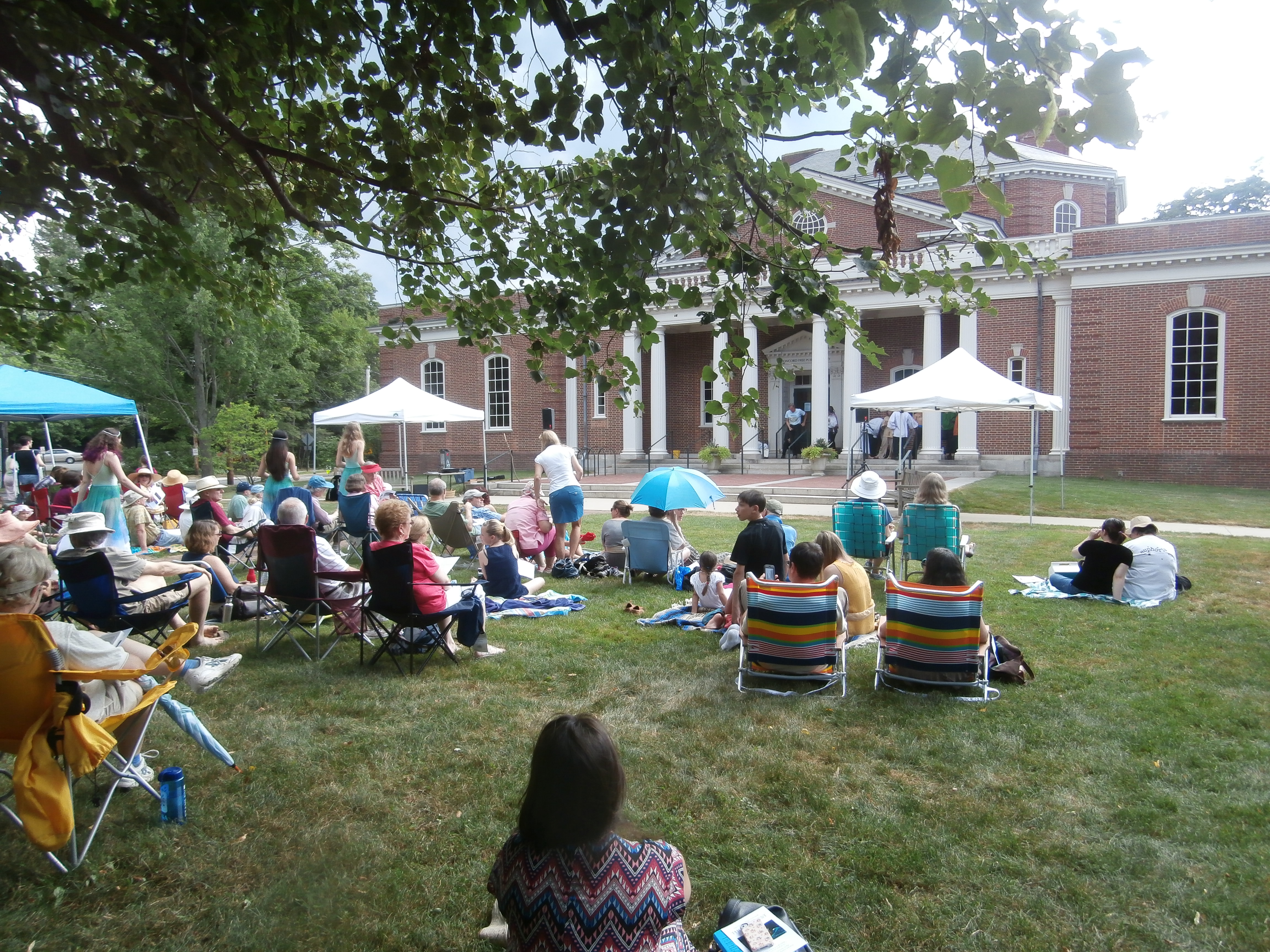
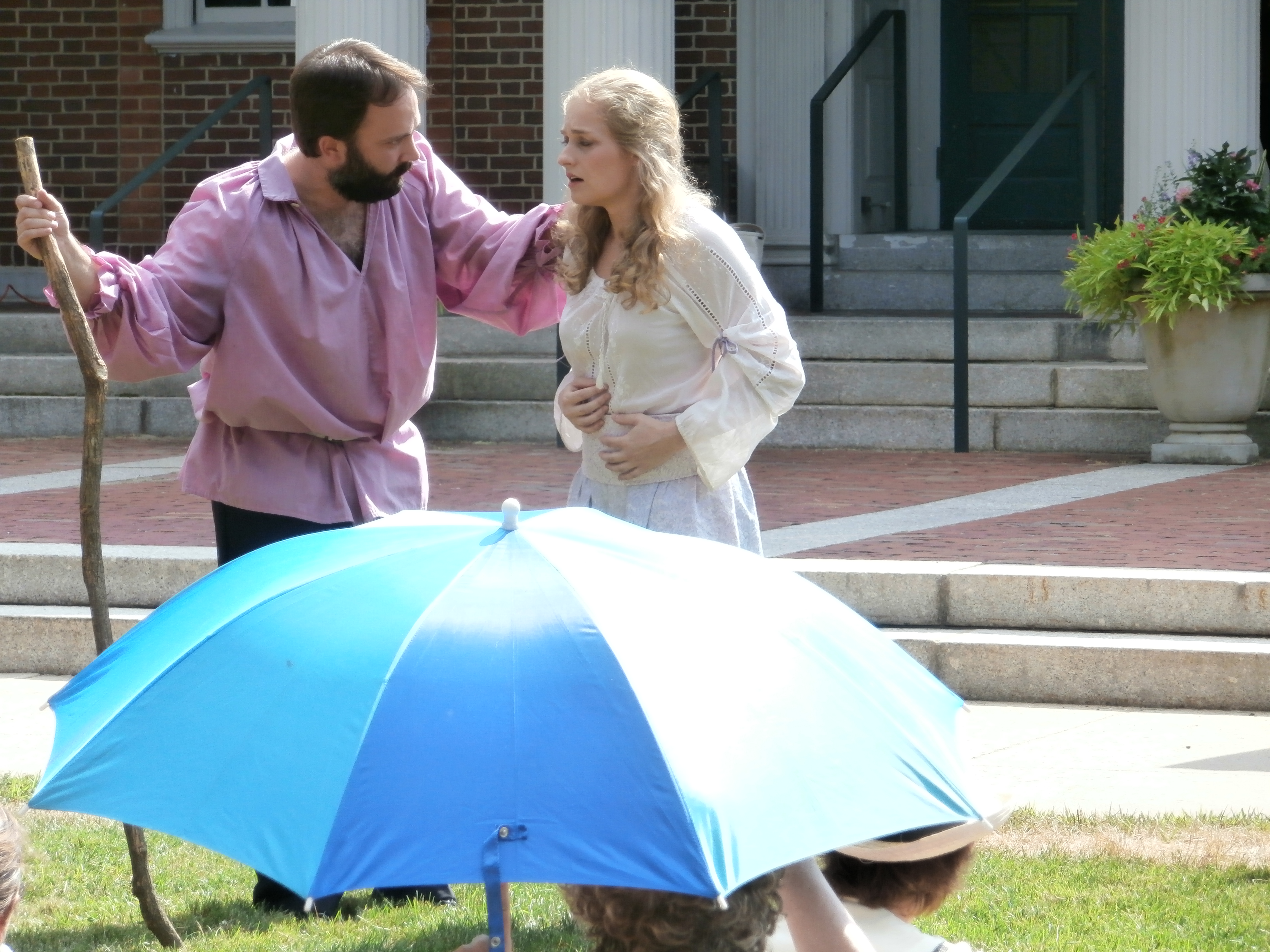
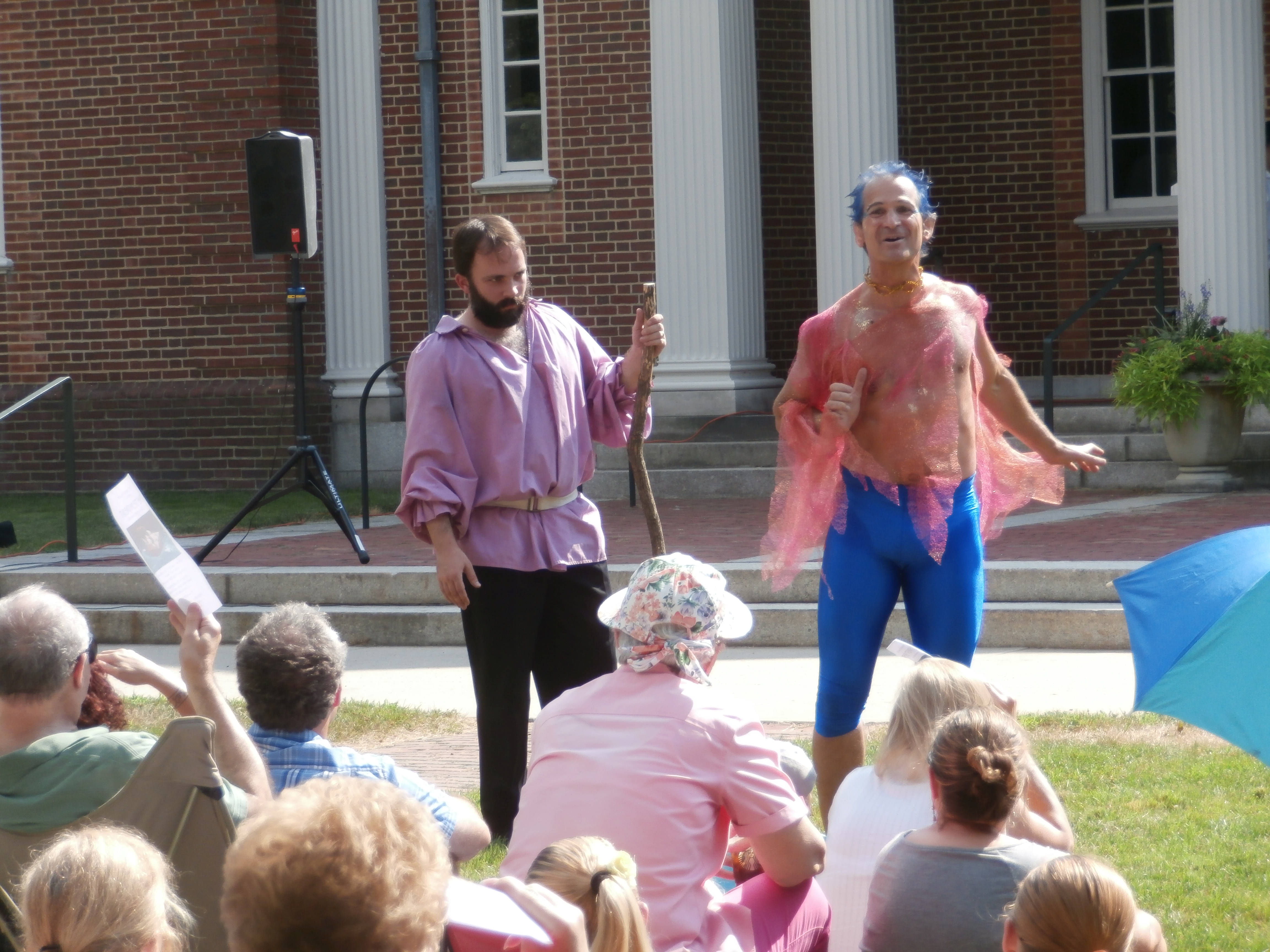
The Concord Players brought a one-hour version of Shakespeare’s “The Tempest” to the lawn of the library yesterday.

The Prospero was perhaps too young, considering that “The Tempest” is an aging Shakespeare’s valedictory, and there was some awkward overacting, but gee whiz, they had to shout to be heard outdoors. So, good for them to work so hard to give the public free theater in summer!

Several sea nymphs doubled as ushers and were lovely to behold.

concord-library-lawn-show

The-Tempest-sea-nymph

prospero-miranda-umbrella

jay-newlon-ariel-tempest

Read Full Post »

If you are going to London, try to see where archaeologists have recently located theaters used by Shakespeare.

Matt Trueman writes at the Guardian, “The sites of two Jacobean theatres in London, both used by William Shakespeare, could host drama once again, following planning applications for new theatres.

“The Curtain theatre in Shoreditch, once home turf for the Lord Chamberlain’s Men, was discovered last year after an extensive archeological dig. Under plans submitted to Hackney council, it would be transformed into a 250-seat open-air amphitheatre …

“Meanwhile, just around the corner, it could soon be joined by a six-storey theatre with a 235-seat auditorium, on the site of a performance space known simply as the Theatre.

“Launched a year before the Curtain, this was only the second permanent theatre built in England and hosted the Lord Chamberlain’s Men when its proprietor Richard Burbage joined the company. The Theatre’s remains were uncovered five years ago  …

“Alan Taylor of the Belvedere Trust, the organisation behind the plans, said, ‘We expect to have a Shakespearian piece to what we are offering, but it will by no means be all Shakespeare.’

“Meanwhile, planners at The Curtain, to be called The Stage, have reportedly approached Shakespeare’s Globe about jointly programming the space, but is aiming for similar plurality. Architect John Drew said: ‘It would be great if the performance space was used for all sorts of purposes, such as music as well as theatre.’ ” More.

Can’t help wondering what the characters in my favorite recent TV show, Slings and Arrows (who are completely real in my imagination), would think about adding the non-Shakespeare entertainments.

(By the way, if you rent Slings and Arrows from Netflix, skip the first episode. Not a good introduction.)

Photograph: The Guardian
Excavations at the Curtain theatre in London

Read Full Post »

I’ve blogged about Mary Driscoll and OWLL, the nonprofit she set up to help ex-offenders break vicious cycles. Soon she will launch her play Generational Legacy, about what happens to children when mothers are imprisoned. People who had experienced prison helped her write it.

Because I am very interested in this and other ways that people use the arts to help prisoners turn their lives around, an article about using Dante and Shakespeare in a women’s prison caught my eye.

Joel Brown writes in the February 24 Boston Globe,

“Lynda Gardner, Saundra Duncan, and Deborah Ranger will give a reading of a new play at a Harvard University conference next week. A different kind of alma mater qualifies them for this appearance: York Correctional Institution in Niantic, Conn., a high-security state facility for female offenders.

“While behind bars at York, all three joined theater workshops with Wesleyan University professor Ron Jenkins and students from his Activism and Outreach Through Theater course. They got to know Shakespeare and Dante, and it changed their lives.

“ ‘I spent my first six months [in York] trying to figure out ways to kill myself, and the next four and a half years trying to see how much more I can live,’ says Gardner. …

“Saundra Duncan said, ‘When I looked at Dante and saw how he was in exile . . . I saw a lot of that situation in [myself].’ ”

I especially liked this comment on the Inferno: “I’ve been in a lot of the circles of hell … It really isn’t about hell; it is about hope. Climbing out of those circles.’’

Read more.

Read Full Post »

Summer is over, and at 5:30 a.m. the morning walk starts out dark.

I think of the song that gambler Sky Masterson sings in Guys and Dolls: “My time of day is the dark time,/ A couple of deals before dawn./ When the street belongs to the cop/ And the janitor with the mop,/ And the grocery clerks are all gone./ When the smell from the rain-washed pavement/ Comes up clean and fresh and cold/ And the streetlamp light fills the gutter with gold …”

Of course, the song is about going to bed late, not getting up early, but as Sir Andrew Aguecheek says in Twelfth Night, “to be abed late is to be up betimes.” In other words, what’s the difference? (Sir Andrew was a role I played with distinction in my all-girls high school. My mother’s comment was she hoped never again to see me in that awful shade of pink.)

In the early morning, I don’t necessarily see streetlamp lights filling the gutter with gold, but they do make shifting oak-leaf shadows on the sidewalk. A porch light shining behind vines trained up ropes is pretty in the dark, too. Window-shopping can be peaceful with no crowds on the sidewalk, and there’s always at least one shop with something in the window I plan to check out on Saturday.

And should I suddenly feel a tune from Guys and Dolls coming on — well, there’s no one around to care if I go a bit flat.

Read Full Post »

« Newer Posts