Feeds:
Posts
Comments

Posts Tagged ‘support’

Photo: Mike Belleme for the New York Times.
Barbara Kingsolver said she felt indebted to the people who shared their stories when she was doing research for her novel about addiction, and wanted to give back. 

Long before popular author Barbara Kingsolver decided to base a novel on one by Charles Dickens, Mr. Dickens was taking controversial positions on social justice. I think he believed he was not having an influence, but he kept shouting, and over time other voices chimed in and change happened.

There’s a time and place for writers to be impartial, but not in novels. And recently Kingsolver put her money where her mouth is by deciding to take the profits of her novel on the opioid crisis and give it to an addiction center.

Alexandra Alter wrote at the New York Times about Kingsolver’s decision.

“When Barbara Kingsolver was writing Demon Copperhead, a novel that explores the devastating effects of the opioid crisis in southern Appalachia, she was doubtful that people would want to read about such a grim subject.

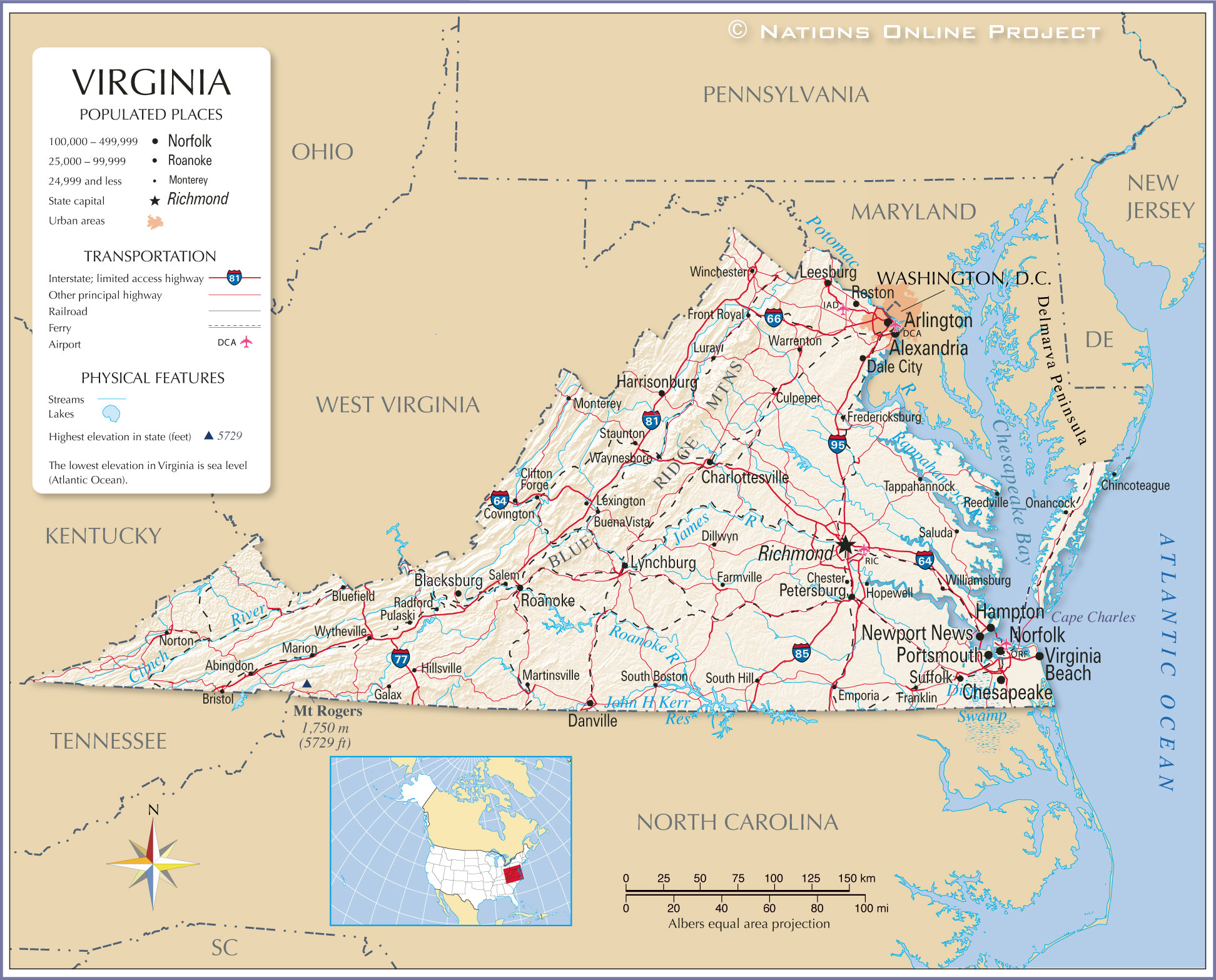
“To draw readers in, she knew she would have to ground the narrative in real stories and push against stereotypes about the region. So she traveled to Lee County, Va., a corner of Appalachia that’s been battered by drug abuse, and spoke to residents whose lives had been wrecked by opioids.

“ ‘I sat down and spent many hours with people talking about their addiction journey,’ Kingsolver said. …

“The novel was an instant success, in time selling three million copies and winning a Pulitzer Prize for fiction in 2023. But even before the novel came out, Kingsolver felt indebted to the people who shared their stories. …

“Kingsolver decided to use her royalties from Demon Copperhead to fund a recovery program for people battling addiction [and] founded a recovery house for women in Lee County, where the novel is set.

“The center, Higher Ground Women’s Recovery Residence, will house between eight and 12 women recovering from drug addiction, offering them a place to stay, for a small fee, for up to two years, as well as counseling and other forms of support, like free community college classes.

“Kingsolver grew up in rural Kentucky and lives on a farm in Virginia. As someone raised in the region, she said, she felt she couldn’t ignore the opioid epidemic in her fiction. But she struggled for years with how to write about the issue in a way that would make readers pay attention.

“While on a book tour in England, Kingsolver stayed in a bed-and-breakfast where Charles Dickens had worked on his novel David Copperfield, and found inspiration in the story and its resilient young narrator.

“In Demon Copperhead, which is loosely based on Dickens’ novel, Kingsolver tells the story of Damon Fields, a boy who is born to a single teenage mother who struggles with drug addiction. He ends up in foster care and later succumbs to opioid abuse. …

“ ‘I had these royalties that Demon brought me. I took that money and went back to Lee County and said, what can we do with this?’

“The biggest need, she learned, was for support for people in recovery, who often had no housing or job prospects. She and her husband, Steven Hopp, started a nonprofit, Higher Ground, to create a residential home for women, and provided the funds for the nonprofit to purchase the property last summer. …

“Kingsolver said she’s been heartened by support the project has received from local organizations, including church groups that have helped get the living space in shape, a local store that donated furniture and a grant from the Lee County Community Foundation.

“ ‘You might, in earlier times, have expected stigma, for people not to be open to this, but instead it’s been, “Yes in my backyard,” ‘ Kingsolver said.

“ ‘This is the reality of where we live,’ she continued. ‘Everybody knows someone touched by the opioid epidemic.’ ”

Have you read the novel or are you a Kingsolver fan? Say something about this.

More at the Times, here.

Read Full Post »

Photos: Suzanne and John’s Mom.
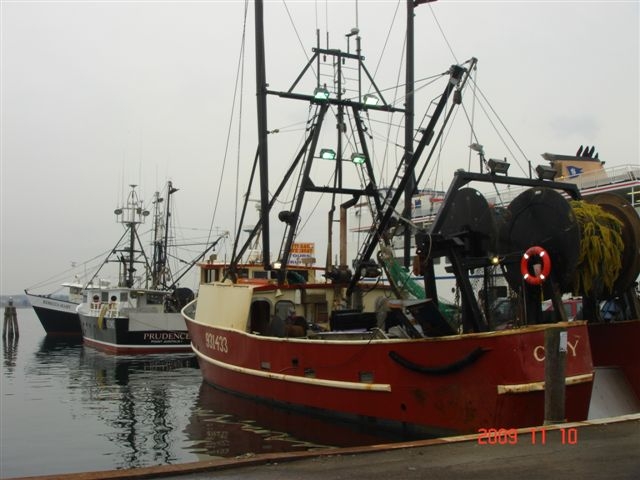
Commercial fishing is recognized as a high-stress job. Land & Sea Together offers a 24-hour help line and free counseling sessions with Coastline, a Rhode Island-based employee assistance program, for farming, fisheries, and forestry workers and their families.

Because I have never lived very far from the Atlantic, I have long known that the people who go out into deep water to catch the fish we buy are doing dangerous work. Fishermen may be injured handling boats in rough seas. Boats may be lost and the crew never seen again. The stress on families can be beyond belief.

That is why I was interested to read in this ecoRi News article that in Rhode Island, at least, help is available for workers in industries identified as especially stressful.

Bonnie Phillips writes, “Workers in Rhode Island’s farming, fisheries, and forestry [FFF] industries struggle with a number of stressors: the impacts of climate change; workforce issues; business and financial concerns; restrictive regulations, and more.

“Until recently, there were few ways workers in these industries — which have long working hours, often in isolation — could access support, whether financial, emotional, or physical. A new initiative, Land & Sea Together, is working to change that.

“ ‘Farmers and fishermen are among the professions most likely to commit suicide each year, and many more folks suffer silently as they tend their crops, equipment, and vessels,’ according to the organization’s website. Land & Sea aims to ‘reduce stress and build mental and financial resilience in the fisheries, forestry and farming communities’ by building a collaborative network of support services.

“The USDA-funded program, operated through the Rhode Island Department of Environmental Management and implemented by the Warwick-based Center for Collaboration and Mediation RI, was started in June 2022 with an initial $500,000 USDA grant. …

“To better understand the communities it wanted to help, Land & Sea put together a comprehensive needs assessment, released last December. For the 90-page report, L&ST studied existing data on the FFF industries in Rhode Island; surveyed individuals working in the industries about stressors; and convened a focus group of workers/owners in the industries. …

“Across the three industries, the main causes of stress were similar: financial management concerns; small-business operations; impacts of climate change; the inability to control the weather; labor shortages; succession planning; lack of access to resources; transportation barriers; housing challenges; longer working hours and increased workloads at peak times; and compliance with government regulations, according to the report. …

“Farmers, who often work where they live, said the lack of separation between work and home can blur the lines of family life, which often results in conflicts. And from spring to fall — the growing season — local farmers are under high amounts of stress, the report says, which can be exacerbated by the weather.

“Those in the fishing industry said heavy workloads, time pressure, lack of support due to isolated working conditions, and climate change were their main stressors. Employers in the fishing, aquaculture, and shellfishing industries reported difficulty hiring reliable workers, some of which they attributed to the lack of public transportation, especially in southern Rhode Island, and the difficulty of keeping employees during the winter. …

“A lack of mental health resources and a reluctance to seek help were identified as an issue across the FFF industries. Some employers, the report said, were unaware of available mental health resources they could offer their employees. Others said the nature of some of the jobs — lack of flexibility in the work schedule, uncompensated time off, and lack of insurance — prevented workers from seeking help. …

‘Most people in sea industries view themselves as a cross between Vikings and pirates, and they do not view themselves as people who need help,’ according to the report. …

“Employers interviewed for the report said they did not think their employees would seek help, and said they especially watch out for signs of concern in their younger employees. …

“Land & Sea offers a 24-hour help line and up to 12 free counseling sessions with Coastline EAP, a Rhode Island-based employee assistance program, for FFF workers and their families. Since the launch of the program in June 2022, [Laurel Witri, former director of the program] said, ’60 farming, fisheries, and forestry workers have called for assistance, receiving 286 hours of support with free outpatient services, financial counseling.’ …

The free, confidential help line with Coastline EAP is 1-800-445-1195, and support is available in English, Spanish, Portuguese, and Cape Verde Creole. The National Suicide and Crisis Hotline is 988, available by call or text.

More at ecoRI News, here. This nonprofit highlights environmental stories that often effect the whole country. It has no paywall, but please consider a donation.

Read Full Post »

Image: Nations Online Project.
At an unnamed trailer park in Northern Virginia, residents help one another.

One recent morning as I returned from my walk, I was stopped by a woman even older than me walking slowly with a cane. She wanted directions to the hospital, apparently to visit a patient. “But,” I said, “you can’t walk there! It’s over a mile!” “I have to get to the hospital,” she said.

After trying unsuccessfully to come up with other transportation options for her (my own car was in the shop), I gave her directions and off she went. I hope she made it. Sometimes women are beyond amazing.

In August, Theresa Vargas at the Washington Post, wrote about how a group of immigrant women turned a manufactured-housing park into a real community.

“The heat was unforgiving and the mosquitoes were biting, but the women who filled the foldout chairs in Imelda Castro’s backyard didn’t seem bothered. During the pandemic, that small strip of greenery tucked behind a Northern Virginia trailer park has been a haven for them. It has served as a classroom, an office and a community play space.

“That backyard is where the women learned from a health-care worker what medical services their children are entitled to receive. That backyard is where a DJ played music on Día del Niño, Day of the Child, and the community invited a police officer to take a swing at a piñata. ‘She had never hit one before!’ said a woman who captured that moment on video. That backyard is where, every Friday, the women form an assembly line and empty with impressive efficiency a truck filled with fresh produce and other goods, and then make sure everyone in the trailer park who needs food gets it.

“ ‘If we didn’t have this community we’ve built, we’d be very vulnerable,’ Rosalia Mendoza said in Spanish as she sat in one of those foldout chairs. ‘We’re united, and it makes us stronger. What affects one trailer affects the whole community.’ …

“That’s why the women want people to know what they’ve created in that trailer park on Route 1. From a shared struggle, they have built something special — a network of moms who regularly check on one another, inform one another and push one another.

To spend time with those moms is to recognize this: Alone, some could find themselves drowning. But together, they’ve been able to do more than tread water.

“ ‘This is unique,’ Patricia Moreno said of the community. ‘This is not everywhere.’

“Moreno has spent the last two decades as an outreach worker for Anthem HealthKeepers Plus, a job that takes her into low-income communities throughout Northern Virginia to teach residents about their Medicaid benefits. Her fluency in Spanish and willingness to go into even the most neglected of neighborhoods has made her a welcome presence among Latino immigrants who don’t trust easily authority figures.

“Moreno first learned about the women when one of them, Ana Delia Romero, called to ask whether she could come speak to them about health care. …

“The population of the trailer park is one that nonprofit workers often worry about. The majority of the residents are immigrants from Central and South America, and their families are tied to the local economy by threads that are usually among the first to be severed during economic downturns. Most of the men work in construction and restaurant jobs, two industries that were hit hard during the pandemic, and many of the women don’t work because of a lack of access to transportation and child care. In the last few years, several families have gone weeks without income, and some have faced eviction.

“Moreno said many people in the communities she visits are hesitant to ask for help, or accept it, but these mothers have worked hard to turn their trailer park into a village. They watch one another’s children. They give one another rides. They invite people to come teach them about subjects that will benefit their families and their neighbors. …

“ ‘I’ve been doing this for 20 years, and I’ve never seen a system like this,’ Moreno said.

“On the day I visited, she sat with eight of the women in the foldout chairs. Also there was Ivana Escobar, director of collective impact for United Community, a nonprofit that provides food to the trailer park and support to the women.

“ ‘We go to every community in this area,’ Escobar said, ‘and these women have made something stronger than anywhere else.’

“As the women tell it, Ana Delia Romero, who is partially blind, is the one who started bringing them together. She was the first person in the community to test positive for the coronavirus, and she ended up in the hospital for six days. After she recovered, she started volunteering with the Health Department. She knew many Latinos were hesitant to learn about the virus and the safety precautions they could take, and she wanted to help get that information to more people.

“She also wanted to make sure none of her neighbors was going hungry during the pandemic. She got involved with free food-distribution efforts and started knocking on her neighbors’ doors to ask whether they had enough to eat. …

“Escobar said that Romero asked United Community whether a truck could deliver food to the trailer park, and now, a truck comes every Friday. When it arrives, the women unload the contents and distribute them. On the day I met the women, all but one were wearing a United Community T-shirt. Escobar said they don’t get paid by the organization. They handle the food distribution as volunteers.

“ ‘The women here, they mobilized themselves,’ Escobar said. ‘You wouldn’t even know they’re struggling because of how they show up.’ …

“ ‘When Ana asked, “Who wants to volunteer?” the answer was “Me, me, me,” ‘ Elizabeth Villatoro said. ‘This community doesn’t have excuses. Ana doesn’t say, “I lost my vision, I can’t do anything.” Alberta doesn’t say, “I have children with special needs, I can’t do anything.” We do what we need to do.’ “

More at the Post, here.

Read Full Post »

Photo: Erika Page/The Christian Science Monitor.
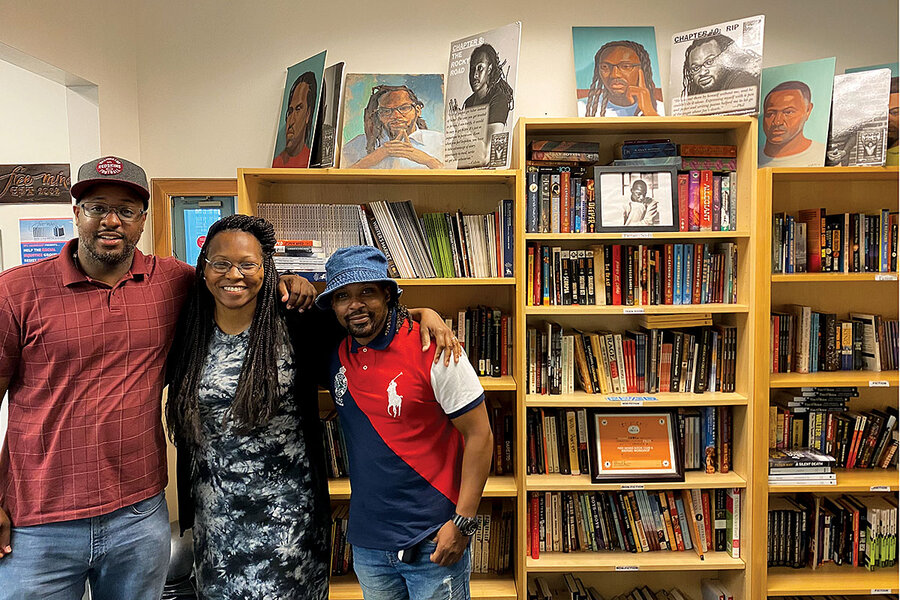
“Craig Watson (left), Keela Hailes (center), and Shannon Battle – seen here at the office of Free Minds Book Club & Writing Workshop in Washington on June 21, 2021 – form a network of support for formerly incarcerated individuals
,” reports the Monitor.

If you were following this blog five years ago, you might have caught the post about Norway’s enlightened prison system, which focuses less on punishment than on rehabilitation (here). Whenever I read about the system in the US and remember Norway’s impressive success, I just feel sad.

In this country, it’s pretty much up to nonprofits and volunteers to reacclimate ex-offenders to society and prevent recidivism. Today’s story is about one such effort, one that a certain US prison allows to enter its walls.

Erika Page reports at the Christian Science Monitor, “Craig Watson only showed up at that poetry workshop back in 2015 because his prison compound’s championship basketball game was canceled. ‘I was just sitting there, like, “I don’t write poems. I don’t rhyme,” ‘ he recalls, chuckling.

“The facilitator from Free Minds Book Club & Writing Workshop told him to forget about rhyming and just express himself. The blank page in front of him began to fill up. Poetry offered an outlet for expressing difficult feelings about a childhood marked by violence. During community ‘write nights,’ Free Minds members gave him positive feedback, and he began to lean into that network of support.

“Free Minds, founded in 2002, operates book clubs and writing workshops in prisons around the United States and at the jail and juvenile detention center in Washington, offering constructive connections among its nearly 2,000 members. Members never ‘graduate’ but remain part of the organization for life; thousands are on its waitlist.

When incarcerated people are released, Free Minds helps them find their feet back home through its reentry program. 

“When Mr. Watson returned from prison through the Second Look Amendment Act in 2019, he had 22 years of catching up to do. Free Minds helped him with practical things, like finding his first job, but most important, the organization became an extended family that kept Mr. Watson from becoming another statistic.  

“Every year, the U.S. releases 7 million people from jail and more than 600,000 from prison. Of the latter, more than two-thirds are rearrested within three years. Many return to communities of historical underinvestment with limited education and weak social support. Criminal records make the job search difficult, and drug use and suicide rates are high, according to a report by the Office of Disease Prevention and Health Promotion. 

“Free Minds offers its 330 reentry members workshops, coaching, counseling, group support, and connections to opportunities. But during the pandemic, Mr. Watson, who was serving as a Free Minds poetry ambassador, noticed he wasn’t hearing from a lot of reentry members.

“So in January, he presented his idea: a formalized peer support program, with the goal that every reentry member would have someone to talk to who had been through it themselves. Today, Mr. Watson is one of 12 peer supporters guiding others through the emotional and logistical challenges of starting over after incarceration. That level of peer involvement is key to the success of reentry, experts say. …

“Mr. Watson traces his journey as a peer supporter back to a time in solitary confinement in 2005. In many prisons, incarcerated people sent to solitary confinement end up doubled up in cells together. His cellmate had just learned of the death of his mother. Mr. Watson sat with the man, though he barely knew him. The two talked, heart to heart. Mostly, Mr. Watson listened. When his time in solitary confinement ended, Mr. Watson voluntarily stayed longer, to be there for his new friend. 

“ ‘I know how important it is to have somebody when you’re going through something,’ says Mr. Watson. …

” ‘The prison system is designed to break ties, to separate the person who is incarcerated from their community,’ says Tara Libert, co-founder and executive director of Free Minds. She says that peer support does the opposite. ‘They repair, restore, and create new community connections which are essential to successful reentry.’ …

“The peer supporters say that helping others helps them heal, too.

“ ‘After talking with them, we understand what our family was going through – our mothers, our sisters, our brothers,’ says Mr. Watson. ‘That’s where that connection really builds.’ ” 

More at the Monitor, here.

Read Full Post »

Photo: Georgia State University.
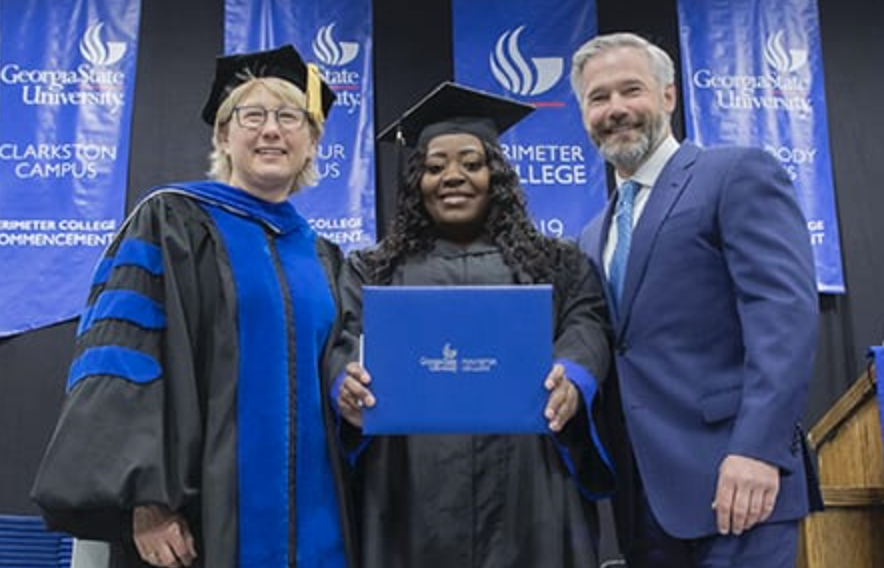
Latonya Young was able to finish college after Kevin Esch, her Uber passenger, secretly paid off previous school costs.

This feel-good story was widely reported, but just in case you missed it, I want you to know that once upon a time when an Uber driver mentioned to a passenger that she couldn’t finish college because of a debt for classes already taken, the passenger knew he had to help out. And — secretly at first — he did. But it may have been the ongoing friendship and support that had the biggest effect.

Sydney Page has the story at the Washington Post. “Latonya Young, a 44-year-old single mother of three, received a bachelor’s degree [in May]. It was a lifelong goal — and she credits one of her Uber passengers with making it possible.

“She met the passenger three years ago when she pulled over in downtown Atlanta to pick him up. Kevin Esch, who had just come from an Atlanta United soccer game, got into her car. The two started chatting.

“ ‘The conversation was easy and felt authentic,’ said Esch, 45.

“He shared details about his recent divorce, and Young — whose marriage ended in 2011 — offered advice.

“During the half-hour ride to Esch’s home, he learned that Young, who had been an Uber driver for three years, was working late that night because she needed money to pay a utility bill.

“And he learned something else: Young wanted to be the first member of her family to graduate from college. Although Young started taking classes at Georgia State University in 2010, she dropped out a year later because she couldn’t pay the tuition.

“Once they arrived at his home, Esch, an estate manager, tipped Young $150 — enough to cover the utility bill — and gave her his phone number.

“ ‘She promised me that she would go back to school,’ he said, adding that he asked her to keep him informed throughout the enrollment process. It was the start of an unexpected friendship.

“After the Uber ride, ‘I had my mind made up that I wanted to go back to school,’ she said. ‘He motivated me.’

“But a few weeks later, when Young tried to re-enroll at Georgia State, she was told that she wasn’t permitted to register until her balance from eight years earlier was paid in full. She owed $693 — a sum she couldn’t afford.

“When she told Esch about the financial hold, he immediately went to the university, without Young’s knowledge, and paid off her debt.

‘I didn’t want that to be a roadblock, because it was something that I could change,’ Esch said. ‘I was in a place to be able to do it, and it was the right thing to do.’ …

“ ‘I was in shock,’ Young said. ‘This person barely knew me, and yet he wanted to help me.’

“She vowed to pay him back, but his response was: ‘Pay me back by graduating.’

“Young was grateful for the support, she said, after years of working multiple jobs and putting off her education. …

“ ‘It was like I was stuck inside a box and couldn’t get out. I was just trying to do whatever I had to do to take care of my kids,’ Young said, adding that she was also in a car accident in 2015, which further set her back financially. …

“After meeting Esch, though, ‘I felt it was time for me to do something for myself, and to set an example for my kids,’ Young said. Plus, she added, ‘I wanted to remain a woman of my word and do exactly what I told Kevin I was going to do.’

“She re-enrolled in courses, and in December 2019, Young received her associate’s degree in criminal justice from Georgia State’s Perimeter College. Esch was there on graduation day, cheering her on in the stands. …

“Still, ‘I knew I wasn’t finished,’ she said. Getting a bachelor’s degree was her ultimate goal, ‘so I went straight ahead. Not only was I aiming for that, but I was aiming to raise my GPA as much as I could before I graduated.’

“Young continued with her studies while working part time as a substitute teacher, as well as a hairstylist. She also received support from the Jeanette Rankin Women’s Scholarship Fund, which offers financial aid to low-income women older than 35 pursuing postsecondary education. …

“ ‘The funding helped me get through the hardships,’ Young said, adding that it was often difficult to manage being a single mother while working two jobs and keeping up with her classes. …

“Despite the challenges, though, Young graduated with her bachelor’s degree in criminal justice from Georgia State’s Andrew Young School of Policy Studies on May 6. Of course, alongside her family, Esch was in the stands once again — beaming with joy.”

Read the rest of the story at the Post, here.

Read Full Post »

Photo: Folio.
Are newspapers really dead? Maybe it’s just taking a while to find new ways to support them.

As consumers of the news and traditional advertisers increasingly go online, there has been understandable handwringing about how local reporting and investigative journalism is to survive.

Sarah Scire writes for Nieman Lab about a philanthropic model.

The Guardian — through its U.S.-based philanthropic arm theguardian.org — raised $9 million between April 2020 and April 2021. Rachel White, who has been president of theguardian.org since its founding in 2016, said [donations for news organizations continued].

“New multi-year reporting projects were funded and launched, too. Humanity United, which has funded reporting on modern day slavery and labor exploitation with a pair of two-year $800,000 grants, expanded its support in 2021 with a $1.5 million grant for a series on human rights around the world. … In another example, Open Society Foundations, which has funded reporting on gender inequality in the U.S. at the Guardian in the past, reupped its contributions to fund work on climate justice and the intersection of inequality and Covid-19. Other grants have boosted the climate journalism … and made a U.S. voting rights project possible.

“With bleak-and-getting-bleaker advertising figures, we’ve seen a number of new newsrooms choose to go the nonprofit route and look to fund their journalism through individual contributions and direct support from foundations and other charitable organizations.

“Philanthropy at the Guardian is a little less straightforward. The news organization, owned by Scott Trust Limited, is not a nonprofit like. … Instead, in 2016, the Guardian formed an independent, U.S.-based charitable organization specifically to find financial support for its journalism. It’s part of a growing trend of U.S. newspapers seeking philanthropic support; the same year, the New York Times launched its own philanthropic arm. …

“White, who joined from New America Foundation, says … ‘For a place like the Guardian, we wouldn’t and shouldn’t be seeking the same kind of funding that nonprofit newsrooms split, because we have lots of different revenue streams that support the news organization. [We] really needed to define why and how we would seek philanthropic support.’

“The ‘how’ was relatively straightforward; setting up a 501(c)(3) made it easier for more nonprofits to contribute. The ‘why,’ White says, has been driven entirely by the newsroom.

“ ‘We’re fierce — and always will be — about editorial independence,’ she said. ‘Every one of the ideas that we take to philanthropy comes first from senior editors at the Guardian.’ …

“Every project funded through theguardian.org has a prominently placed badge noting the institution(s) that made the work possible. A gene editing documentary was funded by the U.K.-based Wellcome Trust, for example, while articles in a series on the threats facing public lands in the United States and Canada discloses its support from the Society of Environmental Journalists. The full list of more than 40 grant-supported projects appears on theguardian.org. …

“White is quick to point out that philanthropy is not the primary way the Guardian supports its journalism. Annual revenue for the Guardian was £223.5 million (USD $308 million) in 2020, including digital-driven revenue — now making up 56% of all revenue — at £125.9 million. In contrast, theguardian.org has reliably contributed between $5.1 million and $5.4 million per year. … The philanthropic arm focuses on reporting projects that might be difficult to justify funding while facing budget shortfalls. …

“The organizations and individuals that White works with are, unsurprisingly, very interested in the impact of the journalism they fund. The Guardian has developed a suite of tools and procedures to try and measure who their journalism is reaching — and what effect it has. …

“Looking ahead, White says the newsroom is looking at finding funding for topics like ‘the future of the American worker’ and ‘the long tail of inequality and poverty’ post-pandemic. …

“Toward the end of our conversation, I asked White — who has been working to secure philanthropic support for journalism for nearly six years now — what has surprised her most in her role.

“ ‘I really did believe in 2016 … that everyone would immediately see the role of journalism and philanthropy would rise triumphantly to the challenge and that there would be this outpouring of support. While the market has expanded and this commitment to the idea of supporting journalism has grown, it certainly hasn’t grown at the pace of the crisis for journalism. …

“ ‘I just continue to hope that the philanthropic market will expand to meet the needs of news organizations, because they’re substantial.’ ”

More at Nieman Lab, here.

Read Full Post »

Photo: John Tlumacki/Globe Staff
Cathy Corbett got her hair cut at HER on a recent Saturday. HER is a weekly event from the Boston Health Care for the Homeless Program.

When I think of all the health care I’m able to utilize (cataract surgery today, for example), my heart breaks for people who don’t have coverage. A special program in Boston aims to help homeless women get some of what they need while also lifting their spirits with fun activities.

Elise Takahama writes at the Boston Globe, “Linda Winn … sobered up six months ago, but she’s been battling homelessness for the past year. Winn, a 51-year-old Somerville native, said she’s working with a few organizations to find permanent housing, but for now, she is staying at Woods-Mullen, a South End homeless shelter.

“A few months ago, she discovered a haven of medical care — and free haircuts — just around the corner..

” ‘I started coming a few months ago. I love the staff. It’s been helping with depression, helping with any problem I might have,’ said Winn. …

“In one corner, a group of women played bingo, while others danced and sang karaoke in the middle of the room. A table near the back was filled with markers, beads, and nail polish. Movies were shown in a separate room.

“All these activities are part of HER Saturday, a program that offers a medical clinic for women who have suffered abuse, are homeless, or are in need of health care services, said Melinda Thomas, the program’s associate medical director. …

“The HER Saturday program was launched in February 2016, Thomas said. When it first started, about 30 to 50 women would wander through the doors. Now, at least 100 women — sometimes up to 200 — line up at 7 a.m. every week, she said.

“The Saturday clinic not only gives the women a chance to get manicures and watch romantic comedies but also provides preventative health care services and cancer screenings, which include mammograms and Pap smears. Homeless women have higher rates of mortality from breast and cervical cancer, Thomas said. A medical provider, a nurse, a case manager, a social worker, and a behavioral health counselor are available every week.” More at the Globe, here.

Those of us who can have a medical check-up, a haircut, or a tasty meal whenever we want really should feel gratitude every day. I also feel gratitude for the people behind programs like this, which benefit us all if only indirectly.

Read Full Post »

I learn some really cool things from the Christian Science Monitor. (I’m on their listserv for stories about people helping people, the CMS Change Agent newsletter.)

A recent newsletter highlighted an initiative by successful Mexicans living in New York who have decided to offer practical support to poor immigrants from their homeland.

Tyler J. Kelly writes, “The view from Carlos Valverde’s 38th-floor office tells a story by itself – New York stretching below, the mighty skyscrapers of the World Trade Center rising all around.

“Mr. Valverde is the construction manager of the World Trade Center’s Tower Three, responsible for 2 million square feet of real estate, and the vista from his office is, in many ways, the realized vision of many immigrants’ dreams.

“From Brooklyn’s workaday Sunset Park, however, the view is quite different. There, at classes put on by a nonprofit, the Mixteca Organization, six to eight immigrants sit in folding chairs around plastic tables struggling to spell tarea, Spanish for ‘homework,’ or trying to understand the concept of the hundreds’ place in math. …

“In Mexican culture – both in Mexico and here in New York – there’s little tradition of people bridging these two worlds. But that is changing. Valverde is part of a slowly growing effort to bring the resources of New York’s Mexican-American 1 percent to bear on the problems of the 99 percent.

“The benefits for the immigrant community here are plain. Edgar Morales, for one, has gone from being a construction worker to getting a college education paid for by a Mexican philanthropist. He’s now a computer science major with dreams of interning at Google or Microsoft.

“But it has also changed Valverde, who volunteers at Mixteca in Sunset Park, and others like him. In Mexico, the wealthy travel with bodyguards and live in houses surrounded by electrified wire; in the US, some are reaching and gaining a new perspective.

“After spending hours talking with clients about every conceivable detail of an elevator’s interior, Valverde says, ‘I go to Sunset Park and talk to a graduate [at Mixteca] who just finished English 3 and is a baker.’

“Compared with the baker’s reality, he says, the elevator issues seem ‘minute, minuscule.’ ”

More here.

Photo: Ann Hermes/Christian Science Monitor
Carlos Valverde (standing outside 3 World Trade Center in New York) helps new, less affluent Mexican immigrants go to school and find work.

Read Full Post »

A few years ago Amy Wyeth wrote an article about Massachusetts veterans services for a magazine I edit. As I was thinking about what I could post here for Veterans Day, I remembered how much I appreciated learning from Amy about an organization for homeless veterans in Leeds, Massachusetts. It has since expanded to other locations.

The emphatic gentleman in the video below (“The Mission Continues”) really moved me. I got the points he made about not telling grownups what to do — instead being there to support them, one by one, in what they need. He advocates decriminalizing substance abuse so that veterans who need treatment can get it.

He notes that all the Solider On staff work directly with the veterans. Even if their job doesn’t entail social services, they all need to understand what the veterans are going through. At the end of the video, he says that the 90 percent of us who didn’t offer to give our lives for our country owe it to the 10 percent who did that, after their service, they can have a place to live and adequate support for what they want to do with the rest of their lives.

Soldier On now serves Mississippi, New York, Western Massachusetts, Pennsylvania, and New Jersey. And it offers a separate program for women veterans, run by women veterans.

More here.

Read Full Post »

A week or so ago, I wrote about CSA, community-supported arts, a concept that borrows from the community-supported agriculture movement. In case you missed it, here’s the post.

Another creative idea for supporting the arts is crowd funding. I learned about it from the Backstage blog by way of ArtsJournal.com.

” ‘I saw people believing in themselves enough to try and make money for their projects,’ said Monica Mirabile, a co-founder of the Copycat Theatre. Earlier this year, Mirabile was applying for grants for her Baltimore-based theater troupe when a friend suggested she look into Kickstarter, a ‘crowd-funding’ website that promotes artistic projects through social media and allows donors to
support fundraising campaigns with any amount of money they desire. Crowd-funding sites have grown in popularity over the last few years and continue to attract artists and benefactors. …

” ‘This is not the newest idea on the block. It’s very traditional. But we’ve become very used to the idea of someone in a boardroom giving us a check and we hand them a piece of art and cross our fingers. The longer history of art is actually one of patronage that involves the artist’s audience. …

” Users of crowd funding must summarize their projects and goals for potential donors, a process that can help artists sharpen the skills needed to pitch or develop those projects in the future. ‘I learned how to better articulate why I’m doing the project and my artwork and what we’re trying to gain,’ said Mirabile. ‘I made friends because, by promoting, I got to talk to different
people in my community and made connections.’ ”

Read more here. And if you try an approach like Kickstarter, would you let me know how it worked for you? Leave a comment.

Read Full Post »