Feeds:
Posts
Comments

Posts Tagged ‘teens’

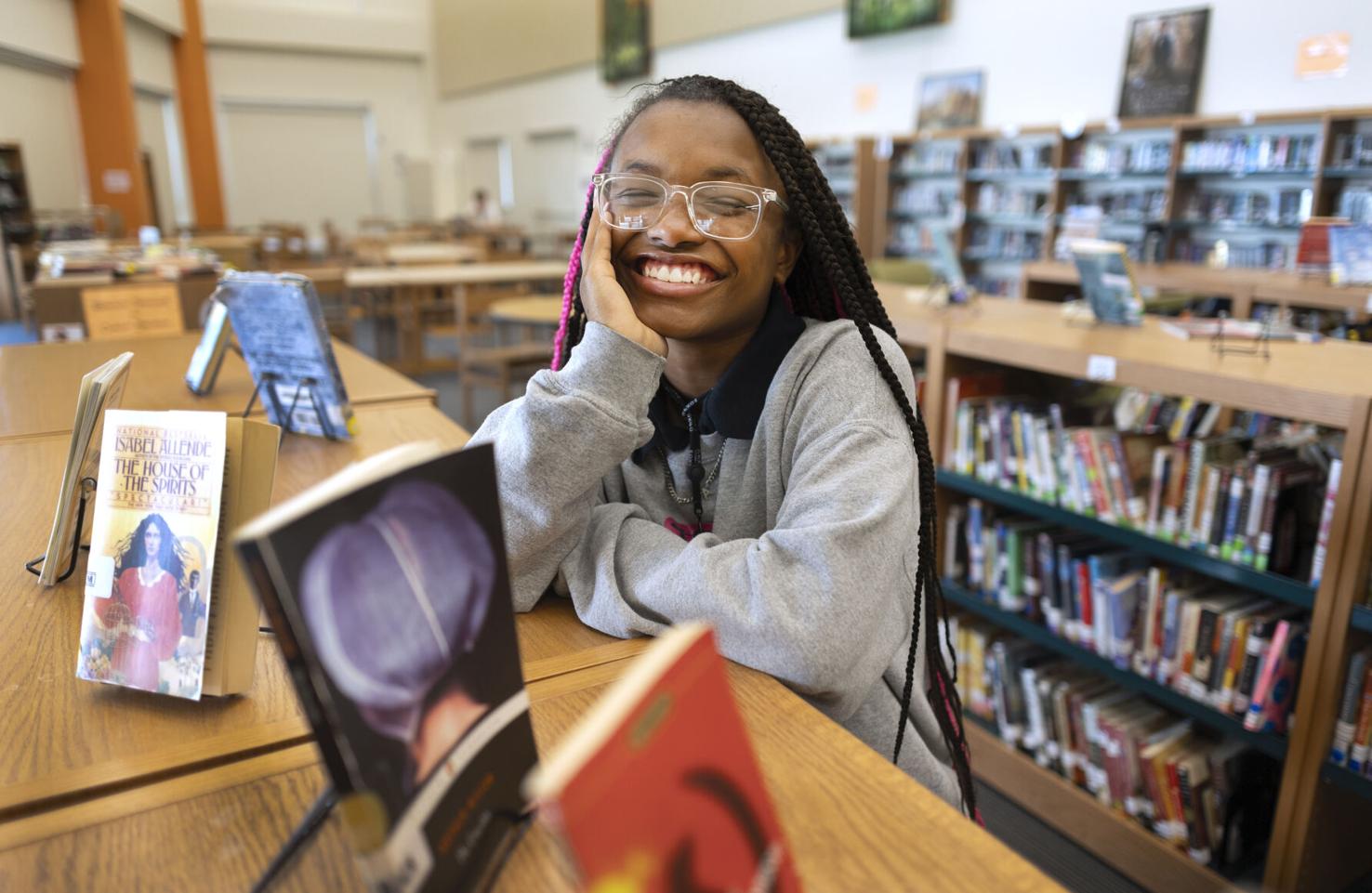
Photo: Chris Granger/Times-Picayune.
New Orleans 12th grader Dejah Grimes was part of a pilot program, soon to be expanded, that gives students $50 per week with no strings attached.

Paying kids to do something they should be doing anyway — for their own sake — does not always have the intended result. But I can see that to keep some teens in school, it might help. And for those who’d stay in school anyway, what a nice bonus!

Marie Fazio writes at the Times-Picayune, “Every Wednesday morning for nearly a year, Dejah Grimes woke up to a $50 deposit in her account, money she was free to spend however she chose.

“Most weeks she gave the card to her mom, who put it towards the water or electric bill. Occasionally she used it to go to the movies or the mall with her friends, or to pay for school expenses, including the recent purchase of a black polo shirt with the G. W. Carver school logo embroidered on the breast, a privilege reserved for seniors.

“ ‘It helped my family a lot,’ Grimes said. ‘It really made life easier.’

“Now, hundreds of other New Orleans teens are set to receive similar assistance as part of a groundbreaking study on the impact of providing young people with a ‘universal basic income,’ or recurring cash payments with no strings attached. 

“After promising preliminary findings and a $1 million investment from the city of New Orleans, a guaranteed income program that began with 20 students at The Rooted School in 2020 will expand this fall to 1,600 high school seniors at schools across the city over the next three years. Deemed the ‘$50 Study,’ the program gives students $50 per week and follows their academic and financial progress. It’s one of the first of its kind to study the impact of universal basic income on youth. 

“Researchers said that high schoolers over the past two years — 386 students from The Rooted School in New Orleans, The Rooted School Indianapolis and G. W. Carver High School — who received payments missed fewer days of school, showed more literacy growth and enjoyed more financial stability than their peers who did not receive money. …

“At the height of the pandemic in 2020, [Jonathan] Johnson, then executive director of Rooted New Orleans, noticed an alarming spike in absenteeism among his students, many of whom had to take on extra shifts at work to help their families make ends meet. 

“Hoping to alleviate some of the financial stress on students, they launched a ‘micropilot’ with 20 Rooted seniors, ten of whom received weekly payments. From 2022 to 2024, they expanded to a randomized control trial with 386 students over two cohorts.

“According to preliminary data, which has not yet been peer reviewed, students who were given the funds attended an average of two more school days per semester and their reading test scores grew by nearly double that of the control group. Researchers also found students who received the money demonstrated better ‘financial capability,’ a term used to refer to financial literacy and real-world application, and scored higher on tests measuring their financial well-being.

“Stacia West, who co-founded the Center for Guaranteed Income Research at University of Pennsylvania and acts as lead researcher for the $50 study, said the program can provide young people with valuable lessons, including how to navigate — or avoid — risky financial instruments such as payday loans and credit cards.

“ ‘The fact that these kids are able to interact with these financial markets so early,’ said West, who is also an associate professor at the University of Tennessee, ‘means they’re going to be better equipped when they get into their 20s to make better financial decisions.’

“Students in phase one of the study, which took place from 2022 to 2023, only used about half of cash assistance. About 47% of the money remains in the students’ bank accounts, suggesting many are saving.

“Of the money they did spend, about 50% went towards food and groceries, 30% to goods and services, 12% to transportation, 3% to healthcare and the rest to other expenses.

“Results from the second phase of the study, which followed 28 students from Rooted Indianapolis, 47 students from Rooted New Orleans and 155 students from G. W. Carver — a Collegiate Academy-run high school — will be published in the spring.

“Grimes, who participated in the second phase, said having the money helped her family with unexpected expenses, like food and travel purchases while out-of-town for her great-grandmother’s funeral. This summer, she used it to pay for Ubers back and forth to work as a camp counselor-in-training at Live Oak Camp. …

“Malik Williams, a junior at G. W. Carver, said he spent money on food and school supplies, including a pair of New Balance sneakers and a pair of headphones.

“New Orleans used to have a guaranteed basic income program aimed at young people ages 18-24 that was part of a national initiative called Mayors for Guaranteed Income. An effort to expand the program in December was not funded by the city council.

“Jeff Schwartz, Director of Economic Development at the City of New Orleans, said in a statement that the agency is ‘thrilled to be an investor’ in the $50 study. …

“West said that the Rooted School’s study is the first to track the impact of guaranteed income on young people. … ‘I think this could be a new way to think about educating and socializing our children financially.’ “

Not to mention relieving some of the stress that interferes with learning, I’d say. Financial literacy shouldn’t be the only goal. Staying in school, learning more, having a better shot at a good future as a result … what about that? I hope to track down the newer study once it’s completed.

More at the Times-Picayune (Nola.com), here.

Read Full Post »

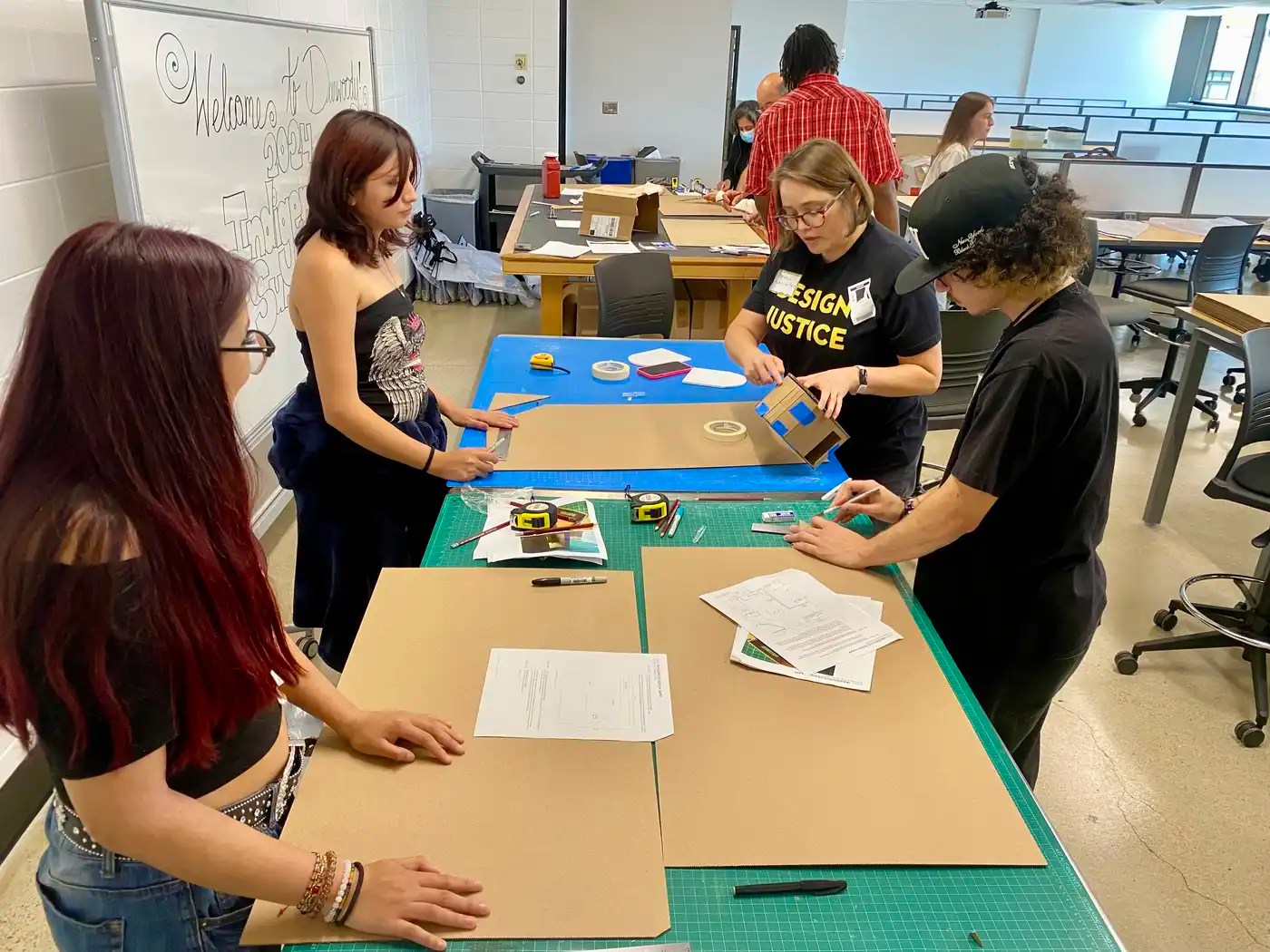
Photo: Alex V. Cipolle.
University of Minnesota architecture professor Jessica Garcia Fritz teaches Indigenous Design Camp campers cardboard scoring techniques on day one.

It seems like every year, the first question on the first day of school is, “What did you do over the summer?” This past summer, if you were an indigenous teen in the Twin Cities of Minnesota, you might have had some new experiences to report.

In July, Alex V. Cipolle at Minnesota Public Radio wrote about an unusual class at the Dunwoody College of Technology.

“A group of teens cuts cardboard with X-ACTO Knives. They will soon shape this cardboard into architectural models of their bedrooms. …

“ ‘It’s my first time doing something in architectural-related study,’ says Dominic Stewart of Burnsville.

“ ‘I’m excited to get that hands-on experience,’ says Carsyn Johnson of Elk River.

“They are here for the weeklong Indigenous Design Camp, the first camp of its kind in the U.S. The goal is to teach Indigenous teens about career options in architecture and design, a field where Native Americans are underrepresented.

“Two of the founders of the new camp — architects and friends Mike Laverdure and Sam Olbekson — estimate that there are only about 30 Indigenous architects total in the U.S.

“Laverdure is an enrolled member of the Turtle Mountain Band of Chippewa and a partner at DSGW Architects as well as the president of First American Design Studio. Olbekson is a citizen of the White Earth Nation and founded the firm Full Circle Indigenous Planning and Design. They are the only two practicing Native architects in Minnesota. 

“ ‘The need for creating a space for kids to become designers, Indigenous designers, is great,’ says Laverdure, who has wanted to start this camp for years. ‘Representation matters for these kids to see us as architects and designers. A lot of us who grew up in reservations or urban Indigenous communities only see a few career types.’ …

“The campers are Indigenous teens ages 14-18 from the metro area. They will be constructing architectural models all week. Campers will also tour the University of Minnesota School of Architecture and local architecture firms.

“They will also visit the American Indian Cultural Corridor on Franklin Avenue, where both Laverdure and Olbekson have designed buildings, as well as another Olbekson project, the recently completed expansion of the Red Lake Nation College downtown.

“Olbekson says, ‘to actually go and see [the buildings] and see the impact that they’re having on the community, not only as individual buildings, but how they’re forming an identity for the American Indian Cultural Corridor and how these projects are supporting education, economic development, community building, cultural development, and youth and elder spaces, I think is going to be a great way for them to understand the impact of what design, urban design, interiors, landscape, can have on creating a healthy, Indigenous urban community.’

“The camp began [with] a welcome from Laverdure, Olbekson and University of Minnesota assistant architecture professor Jessica Garcia Fritz, a citizen of the Cheyenne River Sioux Tribe. Fritz also helped start the camp.

“ ‘If you think about your home reservations, or your urban communities, you think about all the buildings that are there,’ Laverdure told the class, ‘Ninety-nine percent of all the buildings built that Indigenous people sit in are not designed by indigenous designers. … When you have Indigenous designers be a part of that process, what happens is that those buildings have a special kind of connection to the communities and that makes those buildings extra special.’

“Next came a presentation on Indigenous architecture, past and present, by Tammy Eagle Bull, who did a video call from her home in Arizona. Eagle Bull is a member of the Oglala Lakota Nation of Pine Ridge, South Dakota. In 1994, she became the first Native woman in the U.S. to become a licensed architect. …

“For the remainder of the first day of camp, Jessica Garcia Fritz guided campers in a design exercise to create their sleep space or bedroom.

“First, they taped 10 by 10-foot squares on the classroom floor to help them visualize the scale. Then they sketched blueprints of their bedrooms. Finally, they cut and scored cardboard to build shoebox-size models. …

“ ‘One of the things Tammy Eagle Bull had said this morning was, “I wish that a camp like this had existed when I was young.” I think that’s the sentiment among many of us,’ Garcia Fritz says. …

“Garcia Fritz, Laverdure and Olbekson hope this camp is the first of many. One of the goals is to expand the camp to greater Minnesota.

“ ‘Right now, it’s in the Twin Cities, but there are so many Indigenous communities regionally, up north and even in other states that could really benefit from this,’ Olbekson says. 

“ ‘Long term, we want to create a space where five to 10 years from now, we’ve got 10, 15, 20, Native designers that are out there and being a force for change,’ Laverdure says.”

More at MPR News, here.

Read Full Post »

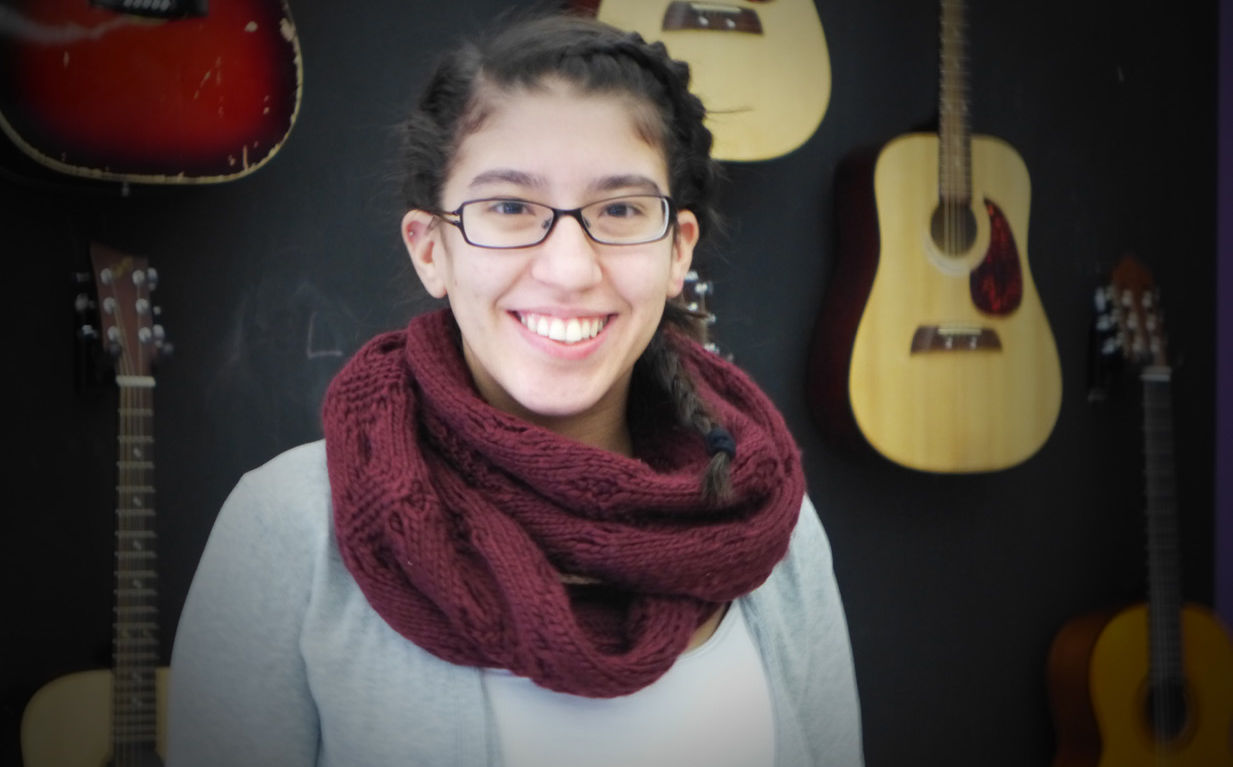
Photo: Music & Youth.
The Music Clubhouse, one of several music-focused hangouts for teens in Massachusetts, opened unexpected doors for Kristiana — forming a band, participating in a music event with the Red Sox, being accepted to the Berklee College City Music Program.

Teens always need a place to hang out with other teens. The centers in today’s story offer a lot more than hanging out.

Catherine Hurley writes at GBH radio, “Eden Troderman knew where she wanted to spend her first afternoon as a student attending the Berklee College of Music: at BTC Records, the music production space at the Brookline Teen Center that she knew well. …

“The Brookline High School graduate, who releases songs under the name Aruna, has been playing music her whole life — which included writing some ‘really cringey songs in sixth grade,’ she said. But [Aruna] didn’t start releasing music until receiving some help from BTC Records.

“Founded in 2013, the Brookline Teen Center offers a community hub for teenagers who live or go to school in Brookline. It’s one of more than 800 active youth development nonprofits in Massachusetts, according to ProPublica’s Nonprofit Explorer.

“On that cold and icy afternoon in January, the center was active with teens playing basketball in the gym and huddling around small tables with snacks after school. Others were working on music in the BTC Records studio space. …

“Bri Skywall, teen technology coordinator at the Boston Public Library, said the library’s Teen Central aims to ‘provide what we call the “third space”: a space that isn’t their home and isn’t school or work, that they can come and just be themselves.’ A space where teens ‘don’t have to pay to exist,’ she said.

“Third spaces, which broadly include include free and publicly available spaces, social services organizations and low-cost commercial establishments, are known to strengthen communities. But research shows third spaces are declining, and disparities are more present along income, race and geographic lines.

“Connections in these spaces are informal, but the plans to expand them are in writing. Strengthening the BPL’s role as a third space is listed in the city’s Imagine Boston 2030 plan. And Boston’s Third Spaces Lab, in collaboration with New Urban Mechanics, aims to ‘make it easier for grassroots organizations and individuals to grow and nurture community-based third spaces from the bottom up,’ according to the program’s website.

“BTC Music Coordinator Pablo Muñoz said the center’s goal has always been to develop a space where teens can make music, whether they have big dreams in mind or are looking to express themselves day-to-day. …

“ ‘Whenever they’re having maybe not the best week, they’ll come in here and they’ll be like, “I want to do a song. I want to talk about this.” … They’ll get it out, and then they feel better, and they’ll work on their craft,’ Muñoz said. …

“With 60-70 hours of work, Troderman writing and Muñoz producing, she released her first song, ‘Crave‘ last May, which recently surpassed 1,000 streams.

“ ‘It’s a small milestone, but it means a lot to me. If people are even listening to my music, that’s crazy,’ Troderman said.

“Tom Goldberg, a junior at Brookline High School, started taking a music production class with Muñoz in early November. He’s still learning the basics, he said, but Muñoz has already helped him create a vocal-less track, teaching him how to establish a beat.

“ ‘I think I’m more confident in myself,’ Goldberg said. … [He] said if he were to show people at school the music he likes, there would be a different reaction than at BTC Records. ‘Here, [it’s] way more welcoming,’ he said. ‘Like the sense of community is way bigger here.’ …

“Teens at the center that day milled in and out of the control room, pushing open the heavy, soundproof door in search of Muñoz, their admired teacher and collaborator. Muñoz himself started at BTC in 2022, about a year after he graduated from Berklee. …

“The next day, on a colder and icier afternoon in Back Bay, four teens huddled around computers and small keyboards. They were there for Music Production with Hamstank, a weekly digital music creation session at the Boston Public Library. Somerville-based record producer Tony ‘Hamstank’ Hamoui has led the program for the last seven years. …

“Hamstank’s routine during the hourlong sessions differs from week to week. Sometimes he’s helping teens get started — like a participant that day who opened the music software for the first time and was already making a song — but he also supports kids with more advanced music skills.

“Hamstank glanced over to another teen, calling him a ‘master-level composer and vocalist.’ The student was working on a song he started the week prior, this time re-recording vocals in the space’s audio booth. …

“Hamstank said some kids come to the session with their headphones on, wanting to work solely on their own projects. ‘And that’s fine, but you always find them slowly taking the headphones off and listening and asking questions and talking to other teens,’ he said.”

More at GBH, here. No firewall. [Note: I may have used the wrong pronouns for Troderman. The GBH article was inconsistent.]

Read Full Post »

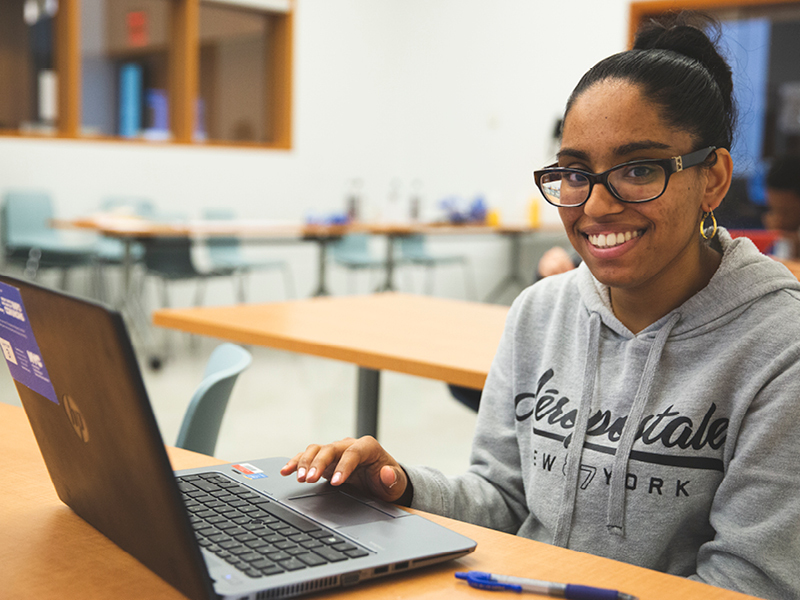
Photo: Brooklyn Public Library.
Teens in towns where some books are banned were given access to a card from the Brooklyn Public Library, just like one the New Yorker above enjoys.

It’s hard to imagine, but this is where we are. We don’t ban websites that tell you how to make a lethal weapon, but there are apparently ideas in books young people shouldn’t think about.

In one small step for humankind, the Brooklyn Public Library decided not to be passive about the situation.

I’m sorry to be late with this story, but I only just learned about the initiative and believe you might be interested. On April 13 last year, the library posted the following release on its website.

“Brooklyn Public Library (BPL) is launching a new campaign today, titled Books Unbanned, to help teens combat the negative impact of increased censorship and book bans in libraries across the country. For a limited time, young adults ages 13 to 21 nationwide, will be able to apply for a free eCard from BPL, unlocking access to the library’s extensive collection of eBooks.

“ ‘Access to information is the great promise upon which public libraries were founded,’ said Linda E. Johnson, President and CEO, Brooklyn Public Library. ‘We cannot sit idly by while books rejected by a few are removed from the library shelves for all.’ …

“The card will be good for one year and is designed to complement access to resources for teens in their local communities. The Brooklyn Public Library eCard provides access to 350,00 eBooks; 200,000 audiobooks and over 100 databases. Teens will also be connected to their peers in Brooklyn, including members of BPL’s Intellectual Freedom Teen Council, to help one another with information and resources to fight censorship. …

“To apply for the card, teens can send a note to BooksUnbanned@bklynlibrary.org, or via the Library’s s teen-run Instagram account, @bklynfuture. The $50 fee normally associated with out-of-state cards will be waived. Teens are encouraged to share videos, essays, and stories on the importance of intellectual freedom and the impact that book challenges and bans have had on their lives. 

“The Library will also make a selection of frequently challenged books available with no holds or wait times for all BPL cardholders, available through the library’s online catalog or Libby app. The titles include: The Black Flamingo by Dean Atta, Tomboy by Liz Prince, The Bluest Eye by Toni Morrison, The 1619 Project by Nikole Hannah-Jones, Juliet Takes a Breath by Gabby Rivera, On Earth We’re Briefly Gorgeous by Ocean Vuong, and Lawn Boy by Jonathan Evison.

“While challenges to books and ideas are nothing new, the initiative was conceived in response to an increasingly coordinated and effective effort to remove books tackling a wide range of topics from library shelves. The American Library Association’s Office of Intellectual Freedom counted more than 700 complaints last year, the most since it began keeping records more than 20 years ago.  

“In Texas, Matt Krause, chairman of the Texas House of Representatives General Investigating Committee, has called for public school libraries to ‘account’ for 850 sexually explicit or racially preferential books. The list includes a wide range of titles from National Book Award winner How to be an Antiracist by Ibram Kendi to John Irving’s bestselling Cider House Rules. Books which feature LBGQT characters; advice for dealing with bullies; and tips for teens on relationships are all included on the list, along with titles on historical events including the rise of the KKK, the Indian Removal Act and the election of Harvey Milk. …

“Locally, the New York State Education Department (NYSED) removed a tweet by the New York State Librarian after she recommended the book Gender Queer: A Memoir. NYSED said it was not aware of the graphic contents in the book. …

“Said Nick Higgins, Chief Librarian, ‘Limiting access or providing one-sided information is a threat to democracy itself.’ ”

The only one of the books mentioned that I have read is The Bluest Eye, by Toni Morrison, a Nobel winner. There is no doubt it is heavy-duty stuff, but that doesn’t mean people should be bliocked from reading it. The ideas are serious, and, I think, important, and even if they weren’t, I don’t see that any group of people should make decisions about what to read for any other group.

More at the Brooklyn Public Library, here.

Read Full Post »

France is experimenting with giving free money to kids to spend on culture. Most are buying media they already like, not high art, but maybe that’s OK.

Aurelien Breeden presents the controversy at the New York Times. “When the French government launched a smartphone app that gives 300 euros (about $348) to every 18-year-old in the country for cultural purchases like books and music, or exhibition and performance tickets, most young people’s impulse wasn’t to buy Proust’s greatest works or to line up and see Molière.

“Instead, France’s teenagers flocked to manga.

“ ‘It’s a really good initiative,’ said Juliette Sega, who lives in a small town in southeastern France and has used €40 (about $47) to buy Japanese comic books and ‘The Maze Runner,’ a dystopian novel. …

“As of this month, books represented over 75 percent of all purchases made through the app since it was introduced nationwide in May — and roughly two-thirds of those books were manga, according to the organization that runs the app, called the Culture Pass.

“The French news media has written of a ‘manga rush,‘ fueled by a ‘manga pass‘ — observations that came via a slightly distorted lens, since the app arrived just as theaters, cinemas and music festivals, emerging from pandemic-related restrictions, had less to offer. And manga were already wildly popular in France.

“But the focus on comic books reveals a subtle tension at the heart of the Culture Pass’s design, between the almost total freedom it affords it young users — including to buy the mass media they already love — and its architects’ aim of guiding users toward lesser-known and more highbrow arts. …

“Teenagers can buy physical goods from bookstores, record shops and arts supply or instrument stores. They can purchase tickets to movie showings, plays, concerts or museum exhibits. And they can sign up for dance, painting or drawing classes.

“Noël Corbin, a Culture Ministry official who oversees the project, said the pass gave France’s newly minted adults a way of looking up nearby cultural offerings — the app has a geolocation feature — and encouraged them to indulge their cultural passions.

“But it also uses incentives to push teenagers toward new, more challenging art forms, he said. … Those include recommendation lists curated by Culture Pass staff members and by popular artists and celebrities, as well as access to V.I.P. events, like a live-streamed concert at the Soulages Museum in southern France and a behind-the-scenes look at the Avignon theater festival. …

“Jean-Michel Tobelem, an associate professor at the University Paris 1 Panthéon-Sorbonne who specializes in the economics of culture, said that it was a laudable effort but that it would largely benefit the mainstream media. …

“There is nothing wrong with pop music or blockbusters, he stressed, acknowledging that ‘you can enter Korean culture through K-Pop and then discover that there is a whole cinema, a literature, painters and composers that go with it.’ But Tobelem said that he was unconvinced that the no-strings-attached approach of the Culture Pass would do that. …

“Naza Chiffert, who runs two independent bookstores in Paris, said the Culture Pass had already had a positive impact on her business. ‘Getting young people who read but who are more used to Amazon or big-box stores to come to us isn’t easy,’ she said, but now she has teenagers in her stores every day.

“Still, some worry that the pass will be a financial windfall for people from privileged backgrounds while doing little to help others expand their cultural horizons. …

“Opponents accuse Macron of throwing cash at young people to court their vote before next year’s presidential election and choosing an unregulated approach instead of funding existing cash-strapped outreach programs, like those run by youth community centers, that broaden access to culture in a more structured way.

“France’s Culture Ministry counters that it plans to introduce the pass to middle-school students, first in a teacher-managed classroom setting, and gradually increasing amounts of autonomy and money, until students reach 18. It also says the pass enables cultural institutions to reach young audiences, which are usually hard to attract, directly on their smartphones. …

“Gabriel Tiné, an 18-year-old osteopathy student in Paris, has spent over €200 from his pass at Citeaux Sphère, a Parisian record store, where he and a friend were thumbing through vinyls on a recent afternoon. … Tiné said he liked the idea, especially the ability to splurge on musical instruments or art classes.

“ ‘I wouldn’t say no to attending a jazz concert or something like that,’ Tiné said, although he added that the app hadn’t enticed him to buy those tickets.”

More at the Times, here.

Read Full Post »

screen-shot-2019-04-21-at-2-01-03-pm_orig

Photo: theCramm
Olivia Seltzer is the 15-year-old founder and sole writer of
theCramm. She started theCramm after the 2016 presidential election to help young people keep abreast of news they care about. 

I am dazzled by the young people who are making themselves heard above the din of these trying times: environmentalists such as Greta Thunberg and ThisIsZeroHour, gun-safety-advocates such as David Hogg and Emma González, who both survived the February 2018 Stoneman Douglas High School shooting in Parkland, Florida — and many others. Now from TeenVogue, a remarkably mature truth-telling magazine, comes this story about a teen who saw a void and started her own news outlet. And she’s not the only one.

Rainesford Stauffer writes at Teen Vogue, “In the aftermath of the 2016 presidential election, Olivia Seltzer, now 15, noticed a shift at school.

” ‘Basically overnight, all we could talk about was politics and what was going on in the world,’ she tells Teen Vogue. Many of her peers in Santa Barbara, California, had parents who were undocumented immigrants, so the issues in the news hit close to home. Suddenly the personal felt very much political. ‘This massive interest in the news and politics came with an equally massive gap in the media,’ Seltzer continues. ‘Traditional news sources are primarily written by and geared toward an older demographic, and unfortunately, they don’t always connect to my generation.’

“That’s a problem, and an urgent one. Though a free press is crucial to democracy, more than one in four local newspapers have closed since 2004, and more Americans are getting their news from social media than traditional print media. Keeping young people engaged is necessary to foster civic engagement, and Seltzer wants to help close the gap.

“In February 2017, she launched theCramm, which offers a daily look at major stories from around the world, distilled into a newsletter that lands in email and text inboxes each weekday. Every day, she rises at 5 AM to read the news before school, poring over outlets, including the BBC, CBS, NBC, The New York Times, Politico, and Reuters, among others, to ensure readers are receiving an ‘unbiased point of view with the news.’

“Seltzer works with an editorial team that helps research stories and finds inspiring individuals to interview for the newsletter, an advisory board comprised of ‘trusted adults,’ and ‘theCramm Fam,’ ambassadors from around the world who promote theCramm. …

“A recent survey by Common Sense Media found that 78% of American teens ages 13 to 17 say it’s important to them to follow current events. Young adults are more likely to consume news through social media sites than they are traditional news organizations, online or in print, but that isn’t necessarily a negative when it comes to news. Teens who use social media are more likely to be civically engaged, and smartphone users who engage with social media report they’re more regularly exposed to people who have different backgrounds, and feel like they have more diverse networks. …

“Instead of staring at cable news, they’re pioneering new ways to engage with the stories that meet them where they are. This isn’t just a matter of style, like how theCramm breaks down big stories into witty, need-to-know facts; it’s medium too. Seltzer … decided to create an option for people to receive theCramm via text. ‘I don’t think other news sources or a lot of people are aware that young people don’t really use email addresses,’ she says. …

“Sofia Frazer, a 16-year-old activist, runs the account @dailydoseofwokeness, which has over 30,000 followers and features story highlights on Sudan, mental health, and the 2020 presidential candidates, among others. After reading about the murder of Virginia teen Nabra Hassanen and the livestreamed police killing of Philando Castile, Frazer realized important stories weren’t being discussed with the depth they deserved. ‘In this day and age, the news is more inflammatory than it is informative,’ she tells Teen Vogue. …

“Frazer feels that Instagram makes it possible to get young people thinking about current issues. … She says, ‘If we want to continue the global conversation about young people taking the lead, people need to know how to access these kids and how to grab their attention.’…

“Within Instagram, there are different ways of reaching audiences and starting conversations. [Sixteen-year-old Anjali Kanda, an admin for the Instagram account @brown.politics,] engages followers via polls on Instagram stories and records videos, like the one she recently posted explaining the scandal surrounding financier and accused pedophile Jeffrey Epstein. ‘People also tend to reply back to stories with questions or actually wanting to start an open discussion,’ she says. ‘I’ve gotten some really thoughtful insights from people replying to stories.’ …

“Seltzer points out that textbooks exist for math, science, English, and history — areas of study and focus from kindergarten onward. Media literacy doesn’t receive the same kind of attention in school. ‘We don’t have any source to learn about politics and what’s going on in the world,’ she says. ‘We’re just expected, when we turn 18, to all of a sudden be able to vote and know who we’re going to vote for. It takes time to actually cultivate a political knowledge and standing.’ ”

More here.


Read Full Post »

13mikhail01-jumbo-v2

Photos: Local Council of Daraya City
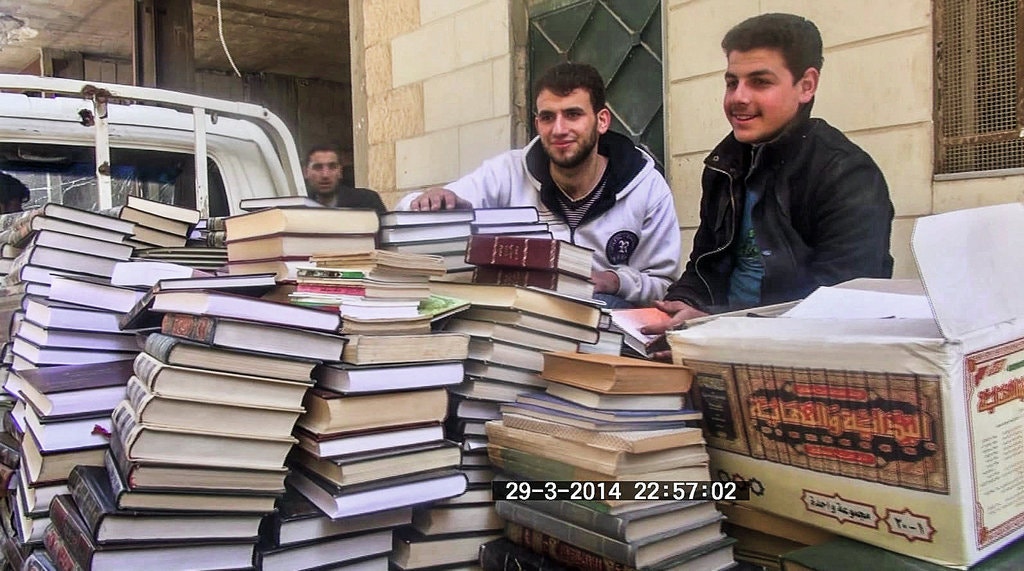
This image from 2014 shows young people who rescued books for a secret library in besieged Daraya, Syria.

As much as I love stories about good things happening in bad times, I always wonder when I post them whether the oasis in Kabul or the library in Syria is still going. Was it there in July when a news outlet’s article was written? Was it there yesterday? Sometimes I search the internet to find a follow-up on, say, the multireligion soccer team that was never expected to win. Sometimes I leave it to you.

Despite the ambiguity of this July 2019 comment from VOA, a book on the heroic library started by Syrian teens is still worth talking about:

[Abdul] Basit and his team of volunteers were among those who had to flee Daraya to northern Syria, leaving the library behind. Unable to take the books, the members tried to conceal the library by blocking its entrance with pieces of shattered concrete. Despite their efforts, Syrian government forces were able to find the makeshift library. The fate of thousands of books remains unclear, according to Basit, who has been unable to return home.

At The New York Times, Dunya Mikhail reviews Mike Thomson’s book Syria’s Secret Library: Reading and Redemption in a Town Under Siege.

“In a region that sways ‘on the palm of a genie,’ as the Arabic saying goes, where bullets and explosions are more familiar than bread, you would not expect people to read, let alone to risk their lives for the sake of books.

“Yet in 2013 a group of enthusiastic readers in Daraya, five miles southwest of Damascus, salvaged thousands of books from ruined homes, wrapping them in blankets just as they would victims of the war raging around them. They brought the books into the basement of a building whose upper floors had been wrecked by bombs and set up a library. As Mike Thomson recounts this unlikely story in Syria’s Secret Library, this underground book collection surrounded by sandbags functioned, as one user put it, as an ‘oasis of normality in this sea of destruction.’

“There, the self-appointed chief librarian, a 14-year-old named Amjad, would write down in a large file the names of people who borrowed the books, and then return to his seat to continue reading. He had all the books he could ever want, apart from ones on high shelves that he couldn’t reach. He told his friends: ‘You don’t have TV now anyway, so why not come here and educate yourself? It’s fun.’ The library hosted a weekly book club, as well as classes on English, math and world history, and debates over literature and religion.

“Advertising the library’s activities without compromising its security was a dilemma; patrons relied on word of mouth for fear that it would be targeted by the Syrian Army. By the time the library was founded, Daraya, a site of anti-government uprising and calls for reforms, had been under siege by the army for more than a year. Its 8,000 remaining residents — from a prewar population of about 80,000 — faced near-constant bombardment and shortages of food, water and power….

“Thomson, a radio and television reporter who covered the war in Syria for the BBC, dedicated months to interviewing the library’s founders and their friends via Skype and social media. When the internet went down in Daraya, his sources recorded comments on their phones as audio diaries they could send on to Thomson when the connection was restored. His book is a compassionate and inspiring portrait of a town where, one of the founders tells him, ‘fuel for our souls’ was an essential need.

“The books ‘help us understand the outside world better,’ another founder, a local dental student, said. Likewise, Thomson’s book may help the outside world better understand Syrians. …

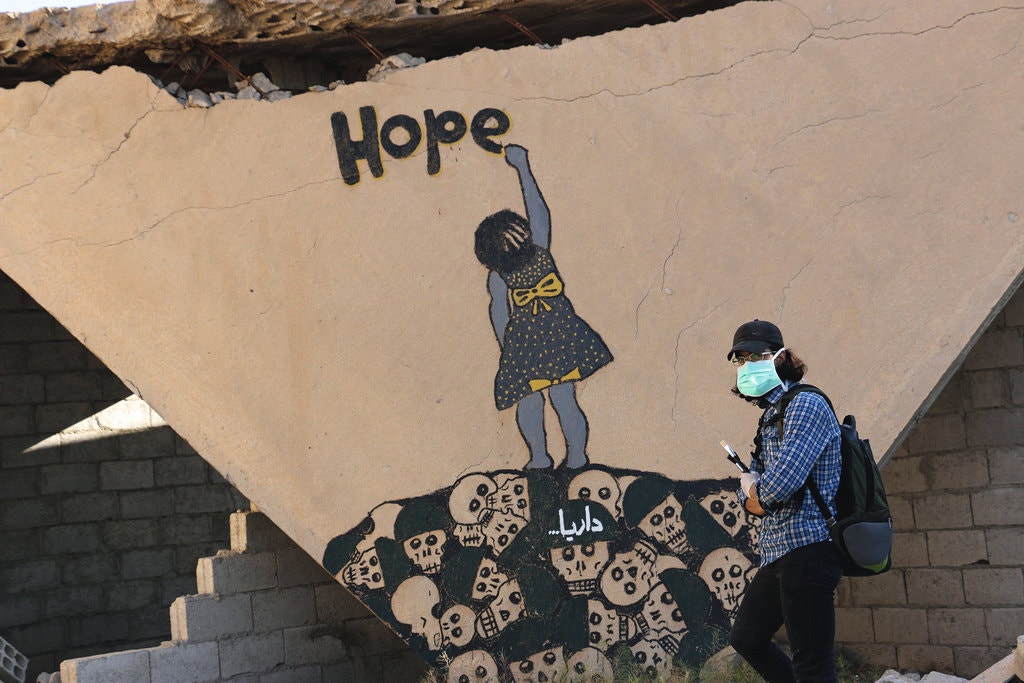
“In the same spirit of piling books under Daraya’s shattered streets, local artists painted graffiti art on the walls of ruined buildings. In a moving image drawn by Abu Malik, a local artist nicknamed Banksy, a little girl stands on a pile of skulls writing the word ‘hope’ high above her head.” More.

Are you good at research? Maybe you could help me find out what has since happened to the library. I volunteer with displaced Syrians and others at a resettlement agency in Providence, and I feel a personal interest in this war-torn country.

The artist Abu Malik next to his mural amid the ruins of Daraya in 2014.

merlin_159489402_df23a867-e7d6-4b71-81a6-dd1128e961d6-jumbo

Read Full Post »

merlin_159679986_d3615b91-38f7-4db2-9e77-3294fc012e46-jumbo

Photo: Nina Westervelt for the New York Times
Thursday Williams and Rosdely Ciprian on the last day of Broadway performances for
What the Constitution Means to Me.

Imagine getting an opportunity as a teenager to be in a Broadway show — and not because you’re you’re especially good at theater! In this instance, two girls were chosen because of their experience on debate teams.

Elizabeth A. Harris writes at the New York Times, “Sitting in the balcony of the Helen Hayes Theater on Saturday evening, two teenagers munched on Welch’s Fruit Snacks and said goodbye to their Broadway show, ‘What the Constitution Means to Me.’

“Rosdely Ciprian, 14, and Thursday Williams, 18, make up half the cast of ‘Constitution,’ a play by Heidi Schreck that was extended three times Off Broadway and played five months at the Hayes, a longer and more life-changing commitment than they had ever expected.

“In the play, Ms. Schreck revisited her personal history of giving presentations about the Constitution as a high school student. Ms. Ciprian or Ms. Williams appeared toward the end of the show — they alternated performances — for a formal debate with the playwright over whether the founding document, with its history of enshrined inequities, should be abolished.

“The young women, who were cast because of their involvement in debate at their respective New York City schools, embodied the future generations who would face down the country’s unmet promises. …

“They sat down to talk about their experience, and what comes next. Ms. Ciprian will continue with the show for its 11-day run at the Kennedy Center in Washington, D.C., while Ms. Williams goes off to college. The conversation has been edited and condensed.

“HARRIS How are you feeling?

“WILLIAMS I’m sad, I’m happy. I’m sad that this is the end — you know, I’ve been on the show for one year and I have so much fun onstage. So I’m going to miss that part. But I’m happy I get to start a new chapter of my life. … I’m going to Trinity College in Hartford, Conn.

“CIPRIAN Lucky you! Going to college! I’ve always wanted to act. But this gave me more of an intense feeling of what it’s like to act. So I would love to do that, but I would also like to go into the medical field. I don’t know if I can do both. But I’ve been bit by the theater bug. All the lights! All the people watching me! I love that.

“WILLIAMS Before I started this show, I wanted to be a lawyer, and now I want to run for office. I’ve had the opportunity to meet senators and politicians. It was a real eye opener. …

“HARRIS How did you balance Broadway with being a student?

“CIPRIAN Broadway and high school — that was weird. I would have to leave at 12 o’clock for some matinees and have to email my teachers to do my work and take tests online, and submit them. …

“WILLIAMS When I got this part, kids in my school were like, ‘What do you know about Broadway?’ And I’m like, ‘Absolutely nothing — but I’m on it!’ …

“HARRIS Who has come backstage to say hello?

“CIPRIAN Sonia Sotomayor, Ruth Bader Ginsburg, Barbra Streisand.

“WILLIAMS I [had done] the Sonia and Celina Sotomayor judicial internship program. I met Sonia Sotomayor for five seconds at the elevator, and when they snatched her away from me, I said, ‘I’ll see you soon!’ not knowing when I was going to see her or how I was going to see her. But this show gave me the opportunity.

“HARRIS What happened when you saw her at the theater?

“WILLIAMS She looked me in my eyes and she goes, ‘I’m really happy that you chose college.’ … Sonia Sotomayor came from the Bronx, R.B.G. came from Brooklyn, I’m coming from Queens. Seeing these people say ‘I love you and I’m so proud of you’ really makes me think I can get to their level.

CIPRIAN We’re kind of obsessed with three things: R.B.G., unicorns and doughnuts. Those three things are our vibe.

“We have a life-size poster of R.B.G. in our green room. When she came, everybody was freaking out. And I think the audience members knew she was here, because the show brings up R.B.G. multiple times. …

“WILLIAMS She said, ‘Sonia and I have been talking about you.’ It’s so like — I just really want to go college and I want to get my 3.9 G.P.A. and I want to go to Columbia Law School and I want to be a lawyer — right now! I want to start tomorrow.”

One of my brothers took our sister and her husband to this show in August, a month before she died. I thought that was great because she had talked about it a lot, convincing me to read the interesting New Yorker review. Apparently, it was a play that really got audiences thinking about some of the things that are problematic in that much-revered document.

More at the New York Times, here.

Read Full Post »

Photo: Bruce Mendelsohn

A teen at a Youth Services center in Massachusetts takes a turn at conducting musicians from the Sarasa Chamber Music Ensemble.

Years ago, just before Christmas every year, I would receive a funding request from a volunteer who was concerned for teens held in state custody. He would write that these young people were largely forgotten at the holidays, and he would take whatever donations he could round up and go buy them small gifts. I always thought he sounded like a very kind person.

This past holiday season, I heard about a similar outreach to youth in trouble and wanted to tell you about it.

Cintia Lopez reported at WBUR radio, “On a recent morning, a teen living at the Metro Regional Center, a Department of Youth Services facility, nervously stood in front of a string quartet in a windowless recreation room. Trying his hand at conducting a group of classically trained musicians, he tentatively moved his hands like a conductor, setting the tempo for the musicians as they played Bach’s ‘The Art of Fugue.’

“His peers laughed in the background, while the musicians offered words of encouragement. When he got a better feel for the music, he began to dance, pointing his fingers up and down, bobbing his head and rolling his arms to the rhythm of the music.

“ ‘It kind of gave me a warm and kind of calm feeling and then as the tempo got a little bit higher it kind of gave me like a little adrenaline rush,’ another teen said of the classical performance. …

“The teens were being visited by musicians from Sarasa, a Boston-based chamber ensemble. Artistic Director Timothy Merton said he likes helping the teens talk about the music.

“ ‘They don’t have much contact with the outside while they’re there. And certainly not with arts programs,’ Merton said. He founded Sarasa about 20 years ago. … The group now performs in youth service facilities about a dozen times a year.

“For the teen, Sarasa taught him that he can listen to classical music to calm down when he is feeling angry.

‘I think it’s a very good experience for the youth here,’ he said. ‘Just to show culture that people aren’t always exposed to and it’s kind of like getting everyone to see other parts of cultures and kind of the diversity that the world has.’ …

“Later in the visit, violinist Rodolfo Richter played Krzysztof Penderecki’s ‘Cadenza’ for a second group of teens. The teens perked up at the speed at which Richter played, seemingly with ease. One teen likened the piece to an old ‘Tom and Jerry’ cartoon. …

“Here are teens, who in some ways have been hardened by life’s turns, awed by the sounds of a cartoon, revealing how much innocence they still possess.

“Seeing the teens connect with the music reminds cellist Jennifer Morsches of her own discovery of classical music.

“ ‘That’s where I learned much about classical music, watching “Bugs Bunny,” ‘ Morsches said. ‘And a lot of people react, young kids, react that way. It’s true and it does sound like Tom and Jerry chasing.’ ”

More at WBUR, here.

Read Full Post »

Photo: Melanie Stetson Freeman/Christian Science Monitor
Iceland has cut teen alcohol and drug use with fun after-school activities and a 10 pm curfew (age 18 and under).

Sometimes it takes a huge, intractable problem to motivate people to find serious solutions. That’s what Iceland discovered after it was overwhelmed by an epidemic of teen substance abuse.

Sara Miller Llana writes at the Christian Science Monitor, “In the late 1980s, when Björgvin Ívar Guðbrandsson was a teenager, alcohol and school dances went hand-in-hand. While he was later to drinking than his peers – more interested in playing soccer and guitar – when he did start around age 16, he would smuggle alcohol in his guitar case into school events.

“ ‘I think the adults just turned a blind eye,’ says Mr. Guðbrandsson. ‘The culture was, I think, “they’re just kids. As long as they aren’t fighting, it’s okay.” ‘

“Today, as a teacher at Langholt school in Reykjavik where he once studied, he says that if a student were to show up drunk to a dance, it would  be such a scandal that the school principal would likely call child protective services.

“In reality, that rarely happens because substance abuse on a wide scale has essentially become a ‘non-issue,’ says Guðbrandsson. Alcohol and school dances, in other words, don’t go together in Iceland today.

“This school is hardly alone. Teen drinking – as well as teen smoking, marijuana use, and abuse of other drugs – has plummeted across Iceland in the past two decades as academics, policy makers, and parents joined forces to clamp down. …

“Beyond adolescent alcohol and drug use, Iceland has shifted thinking on youth culture itself, making it by many accounts more innocent and carefree. It has expanded parents’ notions of childhood and the importance of family time, while reinforcing the maxim that it ‘takes a village’ to raise a child, says Hrefna Sigurjónsdóttir, director of the national umbrella for parental organizations in schools, Home and School, one of the key players in the federal-state government program now known as Youth in Iceland.

“She calls it an ‘awakening’ that has taken place at home, school, and beyond. ‘I think people are not confused anymore about, “is this kid an adult or not.” ‘ ”

Just-say-no substance-abuse prevention programs didn’t work.

“Substance use kept going up, says Inga Dora Sigfúsdóttir, cofounder of the Icelandic Center for Social Research and Analysis (ICSRA), which is the data hub for Youth in Iceland. ‘A group of people came together, sat down and said, “we need to find a different approach. This is obviously not working.” ‘

“One of the problems was an ambiguous view of the line between child and adulthood, she says.

“One of the most absolute rules to take effect was legal curfews: Kids ages 12 and younger must be home at 8 p.m. in the winter and 10 p.m. in the summer. Thirteen to 16-year-olds must be home at 10 p.m. in the winter and by midnight in the summer, even when the sun is still blazing. …

“Parents began to sign agreements, through schools and parental organizations, with various pledges such as not allowing unsupervised parties in their homes or spending at least an hour a day with their children. …

“Municipalities funded and expanded after-school activities, from sports to gymnastics, to music, art, and ballet. The basic idea is to keep kids busy – and out of trouble – and help them find meaning in their lives that dissuades them from seeking alcohol or drugs in the first place.

“At its heart, it takes the onus off the teens themselves – the opposite of the D.A.R.E. approach – and places it on the community. …

“ ‘It does not concern teaching individual children about responsible choices, or even about making them responsible for their own behavior,’ says Álfgeir Kristjánsson, a former data analyst at ICSRA who is now an assistant professor of public health at West Virginia University. ‘The Icelandic approach … is to strengthen the societal and protective factors and drive down risk factors.’ ”

Makes such sense. When I was a teacher decades ago, I really didn’t buy into the idea that students who got in trouble were always making “choices.” If there was trouble at home, for example, kids were often tumbling into risky behaviors because of depression or other psychological stressors. The Icelandic approach seems to have opened the eyes of more adults to the complexity of the issue.

More here.

Read Full Post »

Love this story by Leigh Vincola at EcoRI News.

“The Harvest Kitchen Project is one of the many arms of Farm Fresh Rhode Island that keeps local food circulating in our communities. The program takes area youth, ages 16-19, who are involved with juvenile corrections, and puts them to work making sauces, pickles and other preserves.

“The teenagers participate in a 20-week job-readiness program that prepares them for employment in the food industry. The program touches not only on kitchen skills but the on the many aspects of work in the culinary industry, from sales and customer service to local farm sourcing to teamwork and cooperation. …

“For the past several years, Harvest Kitchen has operated out of a commercial kitchen space in Pawtucket.”

But when Pawtucket Central Falls Development (PCF) “approached Farm Fresh with its rehabilitation plan for 2 Bayley St., a downtown [Pawtucket] multi-use building that would include affordable housing, retail space and job-training opportunities, the match seemed perfect.” More  at EcoRI, here.

I’ve been buying Harvest Kitchen’s applesauce at the Burnside Farmers Market, and I’m being completely honest when I say it’s the best applesauce I’ve had in years. That’s partly because I love chunks in my applesauce, but also because it’s sweet with no sugar added. If you return the empty jar, you get 25 cents back on the next jar.

Harvest Kitchen offers cranberry and strawberry applesauce, too. Other products include dried apple slices, peach slices in season, whole tomatoes, pickles with veggies, dilly beans and onion relish.

In addition to PCF, organizations that have helped to make this happen include Rhode Island Housing, RI Department of Children Youth and Families (Division of Juvenile Correction), Amgen Foundation, Fresh Sound Foundation, The Rhode Island Foundation and TriMix Foundation.

Find sales locations here.

Photo: FarmFreshRI

Read Full Post »

Do you ever read Kevin Lewis’s Sunday Globe column, “Uncommon Knowledge”? He covers new research in the social sciences. Thanks to him, I learned about this study on helping minority boys get engaged in education.

“A disproportionate number of students struggling academically are minorities, ” he writes. “Can we do better?

“In what they claim is the first credible study of the effect of an ethnically grounded education, researchers at Stanford analyzed the effect of a ninth-grade course offered in several San Francisco public schools covering ‘themes of social justice, discrimination, stereotypes, and social movements from US history spanning the late 18th century until the 1970s’ and requiring students ‘to design and implement service-learning projects based on their study of their local community.’…

“The researchers found that taking the course ‘increased attendance by 21 percentage points, GPA by 1.4 grade points, and credits earned by 23 credits (or roughly four courses).’ They call the results ‘surprisingly large effects,’ which were concentrated among boys.”

The paper, by Thomas S. Dee, and Emily Penner, is The Causal Effects of Cultural Relevance: Evidence from an Ethnic Studies Curriculum.” It was posted at the National Bureau of Economic Research in January.

More here.

Photo: Stanford University
Teacher David Ko instructs an ethnic studies class at Washington High School in San Francisco. A Stanford study found students benefit from such courses. Here, Ko is explaining an assignment about the role of advertising in reinforcing cultural stereotypes.

Read Full Post »

Holly Hall writes at the Chronicle of Philanthropy that teens are more likely to do volunteer work if there’s a social aspect.

“More than half of American teenagers and young adults volunteered [in 2011], and the best way to enlist this group turns out to be peer pressure: Three quarters of people ages 13 to 22 whose friends volunteer regularly also do so, which is nearly twice the number of those who pursue voluntary activities based on their concern about particular social issues. …

“Those were the key findings of new research results released [Oct. 24] by DoSomething.org, a group working to get young people involved in social change.” More.

At the high school Suzanne and John attended, volunteering was required. But they also did things that just interested them. I remember Suzanne in a play targeting the cycle of domestic violence and John working on peace and justice activities.

The organization pictured below is City Year, “an education focused, nonprofit organization that unites young people of all backgrounds for a year of full-time service to keep students in school and on track to graduation.”

Suzanne’s friend Lisa did a City Year and thought it very worthwhile. Today, I often see the kids in their distinctive jackets on the train, and I once went door-to-door to help City Year’s public-spirited cofounder in a primary election for the Senate.

Photograph: Charles Krupa/AP/File
City Year volunteers sing the national anthem outside Faneuil Hall in Boston. The volunteers age 17 to 24 will work in a variety of community-service programs. The best way to encourage teens to volunteer is to make it a way to get together with their friends, a new report suggests.


Read Full Post »

My colleague Bob put me on to a NY Times blog called “Lens,” and in particular, a post by James Estrin about a modest 2013 version of the Farm Security Administration’s photographic outreach of the 1930s.

He writes, “Just as the Farm Security Administration unleashed a team of photographers to chronicle the United States in the 1930s, Lens is beginning a new interactive project called ‘My Hometown.’

“In the coming months, we are asking high school students to help create a 21st century portrait of America, turning their cameras on their neighborhoods, families, friends and schools. …

“Participants must either be enrolled in high school or be 14 to 18 years old. All submissions must be uploaded under the supervision of a photography class teacher or program instructor by the May 1 deadline. …

“The resulting collection of photographs will be shown in an interactive gallery of several thousand pictures that will be sortable by geography or theme. We will also highlight select images in a series of posts on the Lens Blog. Many of the photos will be archived at the Library of Congress (just like the Farm Security Administration) photos. …

“If your high school or community-based photography program wants to participate, the instructor should contact the Lens editors by e-mail at lens.projects@gmail.com. …

“We will start accepting entries on March 20.” More.

As Bob commented to me, an initiative like this is likely to appeal to kids. Writing essays about one’s hometown might be harder to get charged up about, especially if you don’t feel like a writer. But everyone takes pictures, and some teens will be inspired to be artful with them.


Photograph: Dorothea Lange/Library of Congress/Farm Security Administration

Read Full Post »