Feeds:
Posts
Comments

Posts Tagged ‘theater’

108525880_grannies5

Photo: NTV
Led by a grandmother, an amateur theater group in Turkey is raising awareness about climate change and the lives of rural women.

Wherever you live, whatever age you are, you have the power to do something valuable for the world. A grandmother in rural Turkey understood that from an early age and is making her voice heard.

The BBC garnered this story from NTV, the Turkish television news channel.

Dilay Yalcin and Krassi Twigg reported, “A 62-year-old grandmother from rural Turkey who rose to national fame with her all-women village theatre group is now set to stage a play raising awareness about climate change.

“Ummiye Kocak from the village of Arslankoy in the Mediterranean province of Mersin recently began rehearsals for her new play ‘Mother, the Sky is Pierced!’

“She told Anadolu news agency that she wanted ‘people to realise just how serious it is.’

The climate crisis is ‘not only our problem, it is the world’s problem,’ she says. ‘I am shouting as loud as I can — this world is ours, we need to take good care of it!’

“Ummiye Kocak has written plays for many years, always aiming to change perceptions. Her previous works have tackled issues from poverty and domestic violence to Alzheimer’s Disease. … In 2013 she won an award at a New York festival with a film focusing on the difficulties of women’s lives in a Turkish village. …

“Ummiye Kocak grew up in a conservative rural area, and only got primary education ‘by chance — as each family was required to send one girl to school.

“But she says her father was open-minded enough to take all his children to the cinema at a time when no other dad in the village would, sparking her love of drama.

“She says that when she first arrived in the village of Arslankoy as a young bride, she noticed that women there had to do all the work — in the fields as well as in the house. She thought that wasn’t right and told herself: ‘Ummiye, you have to make the voices of these women heard!’

“Her village doesn’t have a stage, so she gathers her performers under a walnut tree in her garden for rehearsals while they do their domestic chores. …

“People in other parts of the country want a piece of the action, issuing invitations on social media for the group to perform locally.

“One woman in Istanbul wrote: ‘I’m proud and honoured on behalf of all women every time I see you, Aunt Ummiye. … I hope all women lead their lives knowing they have this power like you do.’ ”

More at the BBC, here.

Read Full Post »

190820102009-01-service-dogs-theater-trnd-0820-exlarge-169

Photo: CNN
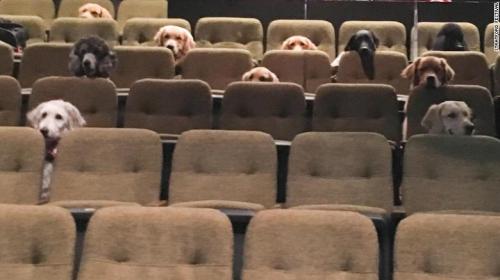
A group of service dogs attend a performance of
Billy Elliot: The Musical as part of their training.

Service dogs must learn to go everywhere with their person and be unobtrusive in settings like concert halls and theaters. That’s why trainers are getting creative about giving dogs practice. One place they get performance-attendance training is at the Stratford, Ontario, Festival, where Sandra and Pat’s great niece has been performing the last two summer to great acclaim.

Scottie Andrew explains about the dog training at CNN. “When the cast of a Canadian production of ‘Billy Elliot: The Musical’ took their final bow after a recent show, the audience didn’t make a single sound — not even a woof.

“A polite crowd of about a dozen future service dogs attended an August performance at Ontario’s Stratford Festival as part of their training. While a silent curtain call might disappoint actors, the dogs’ spellbound stillness is a great sign for their future handlers.

“The event was part of a two-year training program by K-9 Country Inn Working Service Dogs, head trainer Laura MacKenzie told CNN. The future service dogs have toured zoos, subways and crowded fairs to acclimate them to the unfamiliar lights and sounds, rapid movements and bustling crowds they might encounter with their handler, she said.

“At the theater, the dogs are expected to sit under the seat or curl up at their handlers’ feet while their humans enjoy the show, she said.

“They stayed calm and quiet throughout the performance, but a few curious pups peeked their furry heads over the seats to catch a few minutes of the show, she said.

“Ann Swerdfager of the Stratford Festival told CNN that many of the theater’s patrons bring their service dogs to performances, so the company was ‘thrilled’ to host the dogs for training. The non-profit theater company hosts ‘relaxed performances’ designed for audiences sensitive to light, sound and noise — a perfect training ground for service-dog hopefuls.” More here.

Such a well-behaved audience! Nine-yeat-old Sadie Markowitz, recognized as the new Emily Post, would approve. She’s received attention on social media lately with dictums like “never sing along.” It’s just as well that my grandchildren didn’t read that advice before they went to the Lion King in October. They would not have been able to follow it.

Read Full Post »

orjalo_yee

Photo: The Toronto Star
A Canadian theater critic interviewed actors who give 10-minute dramatic performances in people’s cars.

More than five years ago, I wrote about actors creating theater in taxis in Iran and linked to a separate article on taxi performances in New York (check out the post). So that’s just to say there is no new thing under the sun.

Still, people think up creative ideas for their own reasons and don’t necessarily know about similar efforts anywhere else. In today’s example, providing entertainment in cars was devised as a way to bring theater to Toronto suburbs where there are large Asian populations that seldom brave the downtown scene.

Karen Fricker wrote at the Toronto Star about picking up a series of actors in her car who put on 10-minute plays for her as a demonstration.

“[I] picked up three actors who directed me around streets previously unknown to me in downtown Markham and its environs, and who each made me believe in ten short minutes that their situations were really happening.

“I did this as a test driver for fu-GEN Theatre Company’s wildly ambitious show Fearless, which involves micro-performances for individual spectators in their own cars, and a web app which lets the show work, as artistic director David Yee describes it, like ‘Uber in reverse.’

“Fu-GEN is a Toronto-based company dedicated to reflecting Asian-Canadian experiences. This show ‘began as outreach, as a way to engage with the large Asian Canadian community who live in Markham, Richmond Hill, North York, etc., who we know exist, but don’t make it downtown to see our work,’ says Yee. …

“The goal of the project is to give Markhamites something new and curated for them … “Fu-GEN commissioned [writers] to author short scripts that address the themes of fear and fearlessness, and at the same time found a developer, Shawn Li, ‘who works at Microsoft during the day, then builds us a weird little theatre-in-cars app in his off hours,’ says Yee.

“From my user perspective I found the show streamlined and easy to navigate. In order to participate, you need to have a car you are insured to operate. You book online, choosing between a series of timed slots, and are given a link to an online app you can use from a browser on your phone (you don’t have to download anything).

“When the app goes live, photos of the 20 performers appear on a live map along with the titles and authors of their shows and a one-sentence description of the content. Once you confirm your choice of performer, the app guides you to their location — and you know it’s them because they’re wearing a bright yellow backpack (and they know it’s you because you’ve uploaded a photo to your online profile). The performer disappears from the live map during the ride and reappears once you’ve dropped them off. You then start over by clicking on another performer photo. …

“Yee says that safety was one of the core tenets of the project. ‘Every aspect of this experience, from the ground up, has been built with both audience and performer safety in mind. … How eerie is it for a stranger to greet you by your name? It can be comforting or it can be unsettling; all that potential is alive in just having that information at hand. The writers had the choice to use that for whatever purpose is useful to them.’ ”

For me, this experience sounds like fun, but I am also not afraid to go downtown for a show. I really wonder if people who are afraid of something that simple and distancing would pick up a stranger for an in-your-face performance.Would you try it?

More here.

Read Full Post »

Photo: Dezeen magazine
Note the Nebraska storefront lowering itself to become a movie theater.

I don’t know much about Nebraska other than that some friends who grew up there said that New England’s trees and mountains made them feel too closed in, but now I have a reason to think about going there. That’s because I just love the idea behind a new cinema and would like to see how it works.

Sebastian Jordahn writes at Dezeen magazine, “Artist Matthew Mazzotta says the success of The Storefront Theater, which won him Architecture Project of the Year at the inaugural Dezeen Awards, comes down to the way the local community has made use of it.

“The Storefront Theater is a retractable theatre disguised as a shop. It was built to re-invigorate the main street in the town of Lyons, Nebraska, and create a community space for its residents.

“Mazzotta told Dezeen that local community has embraced the structure, using it for a variety of activities. …

“Using two hydraulic cylinders, a false storefront folds over the sidewalk of Lyons’ Main Street and rolls out seating for 100 people. A rollable screen can then be paired with the structure in order to create a public theatre.

” ‘Basically it’s a facade that bends down over main street, bleachers come out, a screen comes in and turns main street into a movie theatre,’ Mazzotta said. … ‘They’ve had events that are anti-bullying, they’ve had movies and concerts. Recently I went to one where a very prominent Egyptian musician came and played. …

” ‘Once I learned that one of the buildings downtown was just a storefront, it had no building behind it, [that’s] when we started taking that as the site.’ …

“The architect’s motivation was to reinvigorate Lyons Main Street, which according to Mazzotta has seen a decline in community life due to economic pressures and globalisation.

” ‘This project came about through investigation with the people. They told me how downtown was the centre of the community life and how that has been destroyed over time by globalisation that has pulled all these businesses away,’ Mazzotta said. …

” ‘Architecture has an enormous power over how we feel about ourselves and how we relate to each other. I think architecture is expanding beyond the envelope and I think it starts to think about who feels welcome in these spaces,’ he added.

“Mazotta’s theatre was also named for Rebirth Project of the Year at the inaugural Dezeen Awards ceremony last year.”

More here.

Video: Dezeen
Note the tractor pulling in the movie screen.

Read Full Post »

01_yvesmarchandromain20meffre_repurposedtheaters_photovertical

Photo: Yves Marchand and Romain Meffre
Two French photographers spent years capturing the new uses of old movie theaters, like this one. Now a gym, the building was once famed as the Alhambra Theater of San Francisco.

Sometimes spectacular old buildings simply cannot be returned to their original purpose. Times change. But as I learned from pictures by two French photographers, many people value the old movie theaters and are giving them new life.

Michael Hardy writes at Wired, “Between the 1920s and the 1950s, Hollywood studios built thousands of ornate movie palaces in cities across the United States. Warner Bros., Paramount, RKO, MGM, and others competed to build the biggest and gaudiest cinematic cathedrals to showcase their big-budget blockbusters. In this vertically integrated era of filmmaking, when the major studios tightly controlled the production, distribution, and exhibition of movies, these palaces served as the showrooms in which they displayed their wares. Seating thousands of spectators, the theaters were decorated in a fanciful array of styles, including art deco, art nouveau, and ancient Egyptian.

“In 1948 the US Supreme Court found that such vertical integration violated the Sherman Antitrust Act and ordered the biggest movie studios to divest themselves of their theater chains. The decision spelled the end for the era of the movie palace, as the studios were forced to sell or close their theater holdings. Television and suburbanization — the grand old theaters were mostly located in downtown areas — provided the coup de grâce.

“One of the grandest of the old palaces was Detroit’s United Artists Theatre, a 2,000-seat, Spanish Gothic–style venue that showed movies from 1928 until the 1970s. French photographers Yves Marchand and Romain Meffre stumbled across the abandoned theater in 2005 while working on a series about the effects of deindustrialization on the city.

“Stunned by the building’s fading grandeur, Marchand and Meffre began traveling the country, seeking out other abandoned theaters to photograph.

‘The amount of fantasy and detail are amazing in some of the theaters,’ Meffre says. ‘I don’t think we have anything comparable in Europe except for our cathedrals.’ …

“After discovering some tastefully repurposed palaces, such as Brooklyn’s cavernous Paramount Theater—now used as a gymnasium by Long Island University—they expanded the scope of their project. Not all renovations were so sensitive. Marchand and Meffre shot palaces that have been transformed into grocery stores, office buildings, even school bus depots. …

“Because the palaces are so expensive to tear down, many have survived more or less intact, a process the photographer calls ‘preservation by neglect.’ ”

Funny. Here’s to life-saving neglect!

More at Wired, here.

Read Full Post »

Photo: All Nippon Airways
In addition to the male Kabuki performers, there’s an onnagata (man in female role) in the in-flight safety video of a Japanese airline.

After seeing one too many airline safety videos about how to buckle a seat belt, passengers tend to tune out. That is, unless the video is really entertaining. Consider this safety video using Kabuki dancers. I know that would make me pay attention.

Andrew Bender wrote about it at Forbes. “Let’s call it like it is: those airline safety presentations have always felt a little like a kabuki dance, no? Now Japan’s largest airline, All Nippon Airways, has taken that literally, with actual kabuki performers in its newest in-flight safety video. I, for one, can’t stop watching it. …

“Supervised by a kabuki performer, the four-minute-plus production opens with an ANA flight attendant wearing a red-and-white striped kabuki mask, before the striped curtain behind her (in the traditional kabuki colors of black, deep-green and the orange-red the Japanese call persimmon) slides to reveal an airplane cabin set.

“Kabuki actors stow their elegantly lacquered bamboo boxes in the overhead bins and under the seats (not in the aisles, thank you), fasten seat belts over their elaborate kimono and dutifully turn off electronic devices displaying scenes from classic ukiyo-e woodblock prints on their screens. The same style is used to show how high heels, in this case chunky wooden geta sandals, can tear the evacuation slide.

“In another section, an actor wearing an oversized wig and robe and fearsome makeup tries on the oxygen mask, and a child in the classic pure white face makeup demonstrates the ‘brace for impact’ position. And it’s quite a sight to see an onnagata (male performer in a female role, a longstanding kabuki tradition) perform the life vest demonstration.

“Kabuki theater traces its roots to 1603, the early Edo Period, and is on the UNESCO list of the world’s Intangible Cultural Heritage. Among its unique features are stunning costumes, stylized dialogue and poses (immortalized in ukiyoe woodblock prints, kind of like iconic modern-day movie posters; see 1:38 in the video), a revolving stage and musicians who sit onstage and animate the action with music and narration. Many of the leading performers have family lineage in kabuki going back more than a dozen generations.

“At various times the safety video shows another feature of kabuki, on-stage assistants covered head to toe like ninjas. Called kurogo, they’re typically dressed in black implying that they’re not visible onstage, but in this video they’re instead in ANA’s signature blue and white. …

“ANA’s safety video debuted late last year and went worldwide on flights this January. As a bonus, a behind-the-scenes video of the production plays during deplaning.”

More at Forbes.

Read Full Post »

Photo: Wikimedia Commons
A Wan Smolbag Theatre youth show. The Pacific islander drama company is celebrating its 30th year.

Any troupe that corners the market for theatrical productions in a particular geographical area might understandably be inclined to rest on its laurels. Not the one in this Pacific archipelago. It provides many services besides entertainment and even manages to stay humble.

Nick Awde writes at the Stage, “Wan Smolbag Theatre takes its name from ‘one small bag’ in Bislama, the South Pacific nation’s lingua franca. ‘It stems from our idea in the beginning to show that theatre could be made from what you could carry in a small suitcase,’ says artistic director Peter Walker. And for a nation spread across 70 islands, that’s a handy ethic.

“ ‘Obviously, we have to choose between being an “in-out, do a show” kind of group or working with individual communities and islands in a more detailed way over a longer period,’ adds Walker. And so the latter course was duly chosen.

“Walker, who did an East 15 postgraduate course in 1981, started the company in 1989 with partner Jo Dorras. Now, 30 years on, it is the South Pacific’s only full-time theatre group in which all the actors are Pacific Islanders. …

Based in the capital and largest town Port Vila, Wan Smolbag is also the biggest local NGO in Vanuatu. It employs more than 100 people, 40 of whom work in theatre and film, and runs other services, such as clinics, a nutrition centre and youth centres with a thriving hip hop scene. Theatre led to film-making in the mid-1990s, which brought a Pacific-wide audience. …

“For its 30th-anniversary season, Wan Smolbag is producing a play with 60 volunteer actors with some of the main group, all set in the main Port Vila market. Also participating is UK director Laurie Sansom, artistic director of Northern Broadsides, who has already made two visits to run workshops. …

“Meanwhile, there are plans for visits from New Zealand’s the Musical Island Boys and Australia’s Djuki Mala.

“How does training work? ‘Basically by doing. Over the years we’ve had occasional workshops with people from overseas in different performance styles … but the whole year is spent acting in plays from January to July and film from August to November – the dry season,’ says Walker.

“ ‘Some actors have been with the group for more than 20 years and as there are no other professional groups most are loath to leave. … We do take on new actors every three or four years. In recent years they have come through the youth centre drama club, which does a production every year, usually featuring 30 or so young people not in school who perform it for schools around Port Vila.

“ ‘There was no theatre of this kind when we started in 1989. There was an expat amdram group that did musicals or dramatisations of Fawlty Towers episodes, and local church youth groups would put on skits with the devil having all the best lines. To be honest, I’ve never thought of us as anything but a community theatre group who over time have become more professional and skilled.’ ”

More at the Stage, here. And if you are still on Facebook, you can keep up to date at the troupe’s page, here.

Read Full Post »

bees-at-the-lyric-final_0

Photo: Omari Daniel
Bees at the Lyric Hammersmith Theater in West London.

The arts are always struggling for funds, so it’s lucky that artistic people are by definition creative. In this story, some creative theater people thought up a way to help the environment while simultaneously raising a little cash for their work. It’s all part of a theater’s broad sustainability plan.

Sian Alexander writes, “As a leading producing theatre and the largest creative hub in west London, the Lyric Hammersmith welcomes around 200,000 people a year to its building, including 30,000 young people at classes and activities. We have nine Young Lyric partners based here, three resident companies, 50 permanent staff and over 500 freelancers each year – all under one roof.

“Our roof is also now a symbol of our long-standing commitment to environmental sustainability. As well as our public roof terrace, a green oasis in the heart of an urban environment, we have a green sedum roof — covered in plants — installed in 2015 during our last major capital redevelopment.

“Last year we teamed up with the local business improvement district, HammersmithLondon, to install three beehives on the roof, now home to 180,000 Buckfast honey bees. They seem to be happy here, and this summer we enjoyed a substantial honey harvest. We sell the honey in our café and at local markets, where it is a great conversation starter about our efforts to go green. …

“Bees have a critical role in food production, as around a third of the food we consume relies on pollination. The bees also help our green roof mature through pollination, and help improve air quality and biodiversity in the local area. …

“We strive to ensure our green values run through all elements of our business. For example, our building has air-source heat pumps and predominantly LED lighting; we send zero waste to landfill, working with First Mile and Scenery Salvage; our energy supply is 100% renewable electricity and green, frack-free gas; our finance and administration teams run on a paperless system; and all new staff and creative teams are given a reusable water bottle on their first day. …

“We are introducing a vegetarian and vegan specials menu in our bar and grill, visiting allotments and trying alternative foods. We are also running a stall at the local food market to engage the public on food packaging, as well as addressing food waste.”

More at Arts Professional, here.

Read Full Post »

Photo: Roger Mastroianni
Audiences in depressed regions nationwide identify with characters who lose their jobs in Lynn Nottage’s award-winning play
Sweat.

Oskar Eustis, artistic director of the Public Theater in New York City, has done a service to struggling communities around the country where his Mobile Unit has performed a play about factory closings.

Although I myself usually like a little something upbeat at the end of a play, I totally get the relief and catharsis of a bleak story that replicates an audience member’s bleak situation. Being heard, being recognized, can be the beginning of moving forward.

Elizabeth Pochoda explains how the show that did one tour of the country and hopes to get funding for more is helping people move beyond the devastation of communitywide job loss.

“Oskar Eustis, the Public’s artistic director, may be best known for commissioning Angels in America,” Pochoda writes, “but his most radical move is a recent one: sending the theater’s Mobile Unit on its recent five-state, 18-city tour through the heartland to perform Lynn Nottage’s Pulitzer Prize–winning Sweat, a traditional theater piece about race and class in Reading, Pennsylvania, as a metal-tubing plant closes and lives are fractured. Most of the action takes place in a local bar as friends experience the loss of every certainty that work bestows, including that of friendship. …

“The Mobile Unit has done far more than drop in for an evening of theater. Along with community organizations, public libraries, Rotary clubs, humanities councils, and whoever else is interested, it has encouraged lectures, discussion groups, story circles, and art pieces in the weeks before and after staging a free performance of Sweat. …

“I met [Chiara Klein, the Mobile Unit’s national project leader,] in Kenosha, Wisconsin, where Sweat played at the local headquarters of the United Auto Workers, the once-powerful union that ruled the city until American Motors and Daimler-Chrysler closed all but one of their plants in 1988, putting 5,300 people out of work and blighting the cityscape for years to come.

“The union-hall venue might seem too obvious for a play about a city where labor is flat on its back, but Sweat has also played to receptive crowds in Minnesota towns with no history of manufacturing and in places as tiny as Hayward, Wisconsin, a town in the rural north where 150 people, both tribal and non-tribal, were as receptive as the audience in Erie, Pennsylvania. That doesn’t surprise Lynn Nottage, who has visited five of the tour cities; people who feel invisible and unheard, she tells me, whether they are black, white, old, young, rural or urban recognize themselves in her play….

“By performing in high-school gyms, a Masonic temple, a cafeteria, and a food pantry — places that don’t announce the evening as an exclusionary arts event, the Public’s Mobile unit has attracted the people it wants to reach.

“Some 200 of them entered the union hall on October 16 and not all of them were white and over 50. A number of older African Americans and some young people of both races were there as well. The Mobile Unit frames the evening to create an atmosphere of mutual regard and goodwill deliberately at odds with that in the play. …

“There is a stage here, but the players will not use it. Instead, they will perform in a small space hemmed in by our chairs. It works well for the barroom scenes where friendships are frayed and no one has anywhere to turn. We are in on the action. …

“At the play’s end, its uneasy note of hope fades away and the audience is given time to reflect by filling out a questionnaire asking them their ZIP Code, ethnicity, gender, emotional response to the play, its relevance to their community, and even what media outlets they turn to for news. … This interlude may be responsible for the candor of the ensuing conversation led by Klein. …

“An African-American woman described it this way: ‘It’s a feeling of being overpowered. A job goes away, a family has to find its way in a new place; then the drugs.’ A 21-year-old white man said he saw himself in the characters and cried that he too had no future. Several people responded to the decibel level of anger in the play and saw it as emblematic of how quickly everything now turns to shouting.”

Read the article at the Nation, here. The play itself is grim, but with the release of emotions some in the audience may feel strengthened in their efforts to build a future on top of the ruins.

Read Full Post »

Photo: Colin Mandlin
Ubuntu Theater Project in Oakland, California, is using a pay-as-you-can model to expand their audience. Their production of
Othello, pictured above, was presented in a rug shop.

I have posted about finding unusual venues, like rug shops, for artistic performances (click here) and also about establishing pay-as-you-can models for a range of purposes (for example, the food business). Today’s post is about a California theater company that does both.

Ashley Lee reports at the American Theatre website, “Amid the dense arts scene of California’s Bay Area, Ubuntu Theater Project has proudly distinguished itself with a mission statement of being ‘radically inclusive.’

“Founded in 2012 as a handful of summer theatre festivals, Ubuntu — named after a Zulu proverb that means ‘I am because we are’ — now programs year-round shows at various venues throughout Oakland, Calif., one of America’s most diverse cities. They often stage American classics with predominantly casts of color, a majority of whom are Oakland natives. Though a seat at each performance costs between $15 and $45, the company has regularly drawn a percentage of patrons from low-income communities through pay-as-you-can tickets sold at the door, and has offset those costs with a bucket donation ask after the curtain call.

“But all that wasn’t inclusive — or radical — enough for Ubuntu. So last summer, the theatre adopted a pay-as-you-can subscription model, guaranteeing tickets to its seven shows for a single amount named by the ticketholder. …

“ ‘There was a financial risk — we had no idea what people were gonna pay,’ concedes Simone Finney, the organization’s marketing director. … ‘This is a way to invite someone into a continued conversation, rather than just an affordable experience of one show. It’s not just transactional; it’s saying, “I want to be part of this community.” ‘ …

“It was a huge gamble — and it’s paid off surprisingly well, both in terms of cash flow and feedback. Ubuntu’s subscriber base grew from just 25 devoted patrons to around 300 and counting. … Finney attributes the generosity of their higher-end subscribers to word of mouth, since her marketing budget didn’t suddenly multiply over the past season. ‘We’re trying to do a lot on not a lot,’ she admits.

“Leigh Rondon-Davis, Ubuntu’s executive associate, [says] ‘A lot of the feedback we’ve gotten is, “Thank you, I can finally afford to see theatre.” ‘ …

“As with any first-time initiative, the program had its share of hitches. … Their online ticketing platform, Vendini, doesn’t allow buyers to input their own prices; the current two-step work-around involves making a donation via the Square Cash app, waiting for a manually sent email from Rondon-Davis, and then booking tickets with a coupon code. …

“If their expanded subscriber base returns for next season, the organization hopes to offer shows that reflect their audience even more.

“ ‘Our bread and butter for a while was classics or established works, and humanitarian world premieres of new works,’ says Rondon-Davis. ‘Now, edgier works.’ …

“Adds Finney: ‘People don’t just come to things because they’re free. … You still want to earn people’s time, interest, and enthusiasm.’ …

“While other theatre companies might be hesitant to make this drastic leap, no one needs to jump into the deep end immediately. Instead Finney and Rondon-Davis suggest following in Ubuntu’s footsteps and experimenting with PAYC tickets at the door for each performance. Most important, they suggest, talk to your audiences to identify what their primary challenges are when it comes to seeing theatre. …

“ ‘It’s not always cost — it can be location, the type of work, not having people to go with, not feeling welcome in a theatre space,’ notes Finney. “These are conversations we will continue to have. … This hasn’t made us take a financial hit and has been, in fact, very beneficial to us. I hope that makes more companies consider accessible pricing, not just as a sacrifice you make, but something that could be a viable part in the life of a company.’ ” More.

Read Full Post »

13-mobilehomestead-atsidewalkdetroit-2018-720x405

Photos: Museum of Contemporary Art Detroit (MOCAD)
Visitors to the Sidewalk Festival enjoy a µTopian Dinner with Hinterlands performers outside the Mobile Homestead.

Kristina and I were discussing the other day all the different kinds of yoga that are popping up. Suzanne’s friend Liz tried goat yoga. Kristina had heard of knitting yoga and laughter yoga.

Similarly, it seems like I’m constantly hearing about new ways of extending the boundaries of theater. In this story from Hyperallergic, sharing food with audiences in person and through Skype is the focus.

As Sarah Rose Sharp writes, artists are practiced “in finding ways to forge interpersonal connections through gesture, metaphor, and performance — or sometimes just by inviting people to dinner.

“ ‘Food is so interesting, because it evokes memory, and it’s a multi-sensory experience,’ said Liza Beilby, in an interview with Hyperallergic during preparations for one in a series of µTopian Dinners, staged by Detroit-based experimental theater ensemble The Hinterlands and co-produced with Poetic Societies, a performance lab fostering cross-cultural and poetic connections. …

“Since 2017, the group has been staging permutations of the µTopian Dinners as a subset of a larger work, The Enemy of My Enemy, a hybrid, digital-live performance project that simultaneously links performers and audiences in the US and so-called ‘enemy’ nations of China, Russia, and Iran. …

“The Hinterlands views the µTopian Dinner projects as a kind of a laboratory to investigate the cultural values that are reinforced through eating, meals, and cooking. [In August], µTopian Dinners took literally to the streets, as the ensemble presented a four-part performance and rotating series of events, during the homegrown and wildly popular Sidewalk Festival of Performing Arts. …

“[The group] — as well as their foreign counterparts tuning in from Moscow, Bejing, and Tehran — operated out of the modular traveling unit from Mike Kelley’s Mobile Homestead, which is permanently housed at the [Museum of Contemporary Art], making one of the rare forays into the farther-flung Detroit neighborhoods for which it was expressly designed. …

“Artist and designer Yi Zhou, who runs a studio out of Beijing called Body Memory, met The Hinterlands during her 2016 residency at Popps Packing, and the ensemble has visited her twice over the last two years, touring with their previous show, The Radicalization Process, and other performances.

“ ‘In between the first year that we went and the second year that we went, she and a bunch of friends who are designers and architects started this group called TGIS,’ said Beilby. ‘It’s a Sunday brunch in this little courtyard at the studio of one of the members, and they invite people to come and have brunch, and then there’s a lecture, or talk, or conversation, which are themed.’ During the Sidewalk performance, Hinterlands Skyped into the beginning of the brunch taking place in Bejing. …

“ ‘It’s like translation, in a way. You’re trying to contextualize something for the people where you are, that’s meaningful, and then express something about the people here to another group. … It’s an interesting way to try to bridge two spaces or times or peoples, through sensory experiences that aren’t just talking.’ …

“One could call it a new medium, enabled by the tools of our increasingly interconnected world, or one might consider it the mission of any meal undertaken by people who begin as strangers, and perhaps leave with a better understanding of each other.”

More here.

Mike Kelley’s Mobile Homestead traveling unit at the Sidewalk Festival for the Performing Arts in Detroit.

14-mobilehomestead-atsidewalkdetroit-2018-720x405

Read Full Post »

PUBLIC WORKS Musical Adaptation of William Shakespeare's
TWELFTH NIGHT

Conceived by Kwame Kwei-Armah and Shaina Taub 
Music and Lyrics by Shaina Taub
Choreography by Lorin Latarro
Directed by Oskar Eustis and Kwame Kwei-Armah

Featuring Kim Blanck (Femal

Photo: Joan Marcus
From left, Daniel Hall, Lori Brown-Niang, Shaina Taub, and Shuler Hensley in “Twelfth Night” at the Public Theater’s Shakespeare in the Park. Brown-Niang’s peignoir is usually “the first to go” on exceptionally hot nights when the feathers start shedding.

On this second day of fall in Massachusetts, the temperature was only 45 degrees at 6 a.m., when I wrote this. I felt very glad that 2018’s overpowering heat and humidity were past.

I can only imagine what it must have been like for outdoor actors under fierce stage lighting in summer 2018. At American Theatre, there’s a fun article about designing costumes for actors performing in all kinds of weather.

Billy McEntee wrote, “Across the country, as actors and audiences endure rain, heat, and bugs to present and partake of free professional performances of the Bard’s classics, one group of designers has a special challenge: costume designers. …

“ ‘Designing for outdoor environments is challenging yet fascinating,’ said Ying-Jung Chen, the costume designer for Independent Shakespeare Company’s ‘Titus Andronicus’ in Los Angeles. … ‘I’ve learned a lot through each outdoor experience about fabric technology and construction techniques.’ …

“It’s the dry heat that can prove most threatening. Evenings in the summer can stay above 80 degrees in Southern California; couple that with acrobatic performances, bushy wigs, and blaring stage lights, and actors are sure to sweat through even the thinnest of fabrics. …

“But heat invites more than just exhaustion and sweat; it’s also a magnet for bugs, something that Chen had to account for when creating stage blood for her costumes.

” ‘Blood is integral to Titus,’ Chen says. ‘My recipe was successful in past indoor productions. With a corn syrup base, it’s easy to wash out, edible, and realistic. But when doing outdoor performances, the sugar-based corn syrup attracts bugs. Fortunately, the theatre company has years of outdoor performance experience and provided a great recipe that’s washable, edible, and doesn’t allure insects.’ …

“Rain is no stranger to American Players Theatre in Spring Green, Wisc., though the threat of precipitation doesn’t change the creative process. As costume designer Robert Morgan succinctly puts it: ‘Design first, problem-solve later.’ He’s the costume designer for APT’s ‘As You Like It’ (running through Oct. 7). …

“ ‘Shoes are covered with non-slip dance rubber,’ he says. ‘But evening dew can make our outdoor stage slippery, so at APT we add sand to paint’ to give the stage’s surface extra traction.

“As in L.A., Morgan must also consider sweltering temperatures. This includes having freezer packs on hand for actors to wear beneath their costumes and crafting a ‘heat plan.’ which is ‘meant to accommodate the actors’ well-being on exceptionally hot, muggy nights and matinees under an unforgiving midsummer sun,’ Morgan said. …

“Oppressive heat and humidity are staples of New York summers as well. After a successful first run in 2016, Andrea Hood returned to design costumes for the Public Theater’s current Shakespeare in the Park production, ‘Twelfth Night,’ a Public Works musical adaptation with songs by Shaina Taub. …

“Hood plans not only the intricacies of [the] fabrics but also how costume pieces may adjust with unexpected precipitation. ‘Fuchsia feathers often come loose on [the character] Maria’s peignoir in “Twelfth Night,” ‘ she notes. ‘It isn’t the most practical costume for an outdoor space, so if it’s raining she would likely skip that change altogether. It’s the one piece that would probably not go onstage in the rain.’

“But a light drizzle doesn’t always signal a costume adjustment, or even a cancelled performance. In fact, its effect—combined with stellar acting, of course—can be as spellbinding as any theatrical flourish, more dazzling than any stage magic.

“ ‘Last year it was pouring for the first night of tech for “As You Like It,” ‘ Hood recalled. ‘The actors didn’t get into costume at all.’ Instead they wore street clothes, covered with plastic ponchos. ‘It was wonderful,’ she enthuses. ‘By midnight there were only five actors left running a number over and over again, still managing to smile. I loved being in the audience watching them—the rain didn’t even matter.’ ”

More at American Theatre, here.

Read Full Post »


800px-savinien_de_cyrano_de_bergeracArt: Zacharie Heince (1611-1669)
The 19th Century Edmond Rostand comedy
Cyrano de Bergerac was recently performed in a New York prison that has unusual rehabilitation programs.

Sometimes when an article I want to share with you has its photos under lock and key, I look for alternative images on Google. It was interesting to see that modern renditions of the outsize nose on Cyrano de Bergerac are much more extreme than the one above. Today’s productions really go overboard trying to make the silver-tongued hero look as ugly as possible. A recent production in a prison also exaggerated the nose, which you can see if you click on the original article.

Jesse Wegman wrote about the show at the New York Times, “Cyrano de Bergerac will be eligible for parole in 2022. For the time being, he is a vision in Gallic effrontery, pinballing around the stage in the gymnasium at Fishkill Correctional Facility in Beacon, N.Y.

“The production of Edmond Rostand’s canonical 19th-century comedy, which enjoyed a well-attended two-day run early [in June], was the work of Rehabilitation Through the Arts, a 20-year-old organization that operates in prisons across New York State. The program introduces inmates to theater, dance, writing and other creative arts in the hope of teaching them life skills and improving their chances at success upon release. …

“When [inmates] proposed ‘Cyrano de Bergerac,’ the show’s director, Charlie Scatamacchia, was skeptical. ‘I thought, yeah, that’s not gonna happen,’ he said. ‘It’s got multiple scene changes, costume changes. It’s got sword fighting. I doubted my ability to direct them, and their ability to pick up these skills in the time we had. I’ve never been happier to be proved so wrong.’

“Behind the title character’s plastered-on proboscis and feathered chapeau is Rodney Spivey-Jones, a 35-year-old from Syracuse. Mr. Spivey-Jones, who had never acted before, first auditioned for the role of Le Bret, the play’s narrator. But Mr. Scatamacchia quickly realized that he was a good fit to play the lead — one of the most verbose roles in theater.

“Mr. Spivey-Jones is no stranger to addressing a crowd — he helped form an inmate debate team at another prison that beat a team from Harvard in 2015. Still, he had not given any thought to playing Cyrano and didn’t understand how big the role was until he kept getting called back to read for it. …

“When the show went up, Mr. Spivey-Jones realized that he had memorized not only his own lines but every other character’s as well — a handy trick when a castmate ran into trouble, and he could provide a cue on the spot. …

“A bigger obstacle than memorization, it turned out, was getting swords inside the prison. Corrections officials nixed various materials, like a hard plastic foil. … The cast of 13 men took the setbacks in stride, as people in prison learn to do with most things. Along with a professional actress, Kate Kenney, who played the role of Cyrano’s love interest, Roxane, the crew worked every week through the winter and spring to get the show into shape. …

“The program, which has about 400 alumni who were released from prison, is popular among both inmates and New York’s prison administrators, who have seen its philosophy pay off. Studies of prison-arts programs around the country, including R.T.A., have found that their participants are better behaved than other inmates, earned educational degrees earlier and in some cases are less likely to wind up back behind bars after release.”

It would be wrong to minimize the crimes these guys have committed or the pain they have caused their victims, but if there’s a way for offenders to become engaged with the world in more positive ways, that’s a good thing in my book.

And I love that play.

More at the New York Times, here.

Read Full Post »

trtheatre-gill_sans-1-2

Photo: Gil Sans
These folks started a theater with no money and filled a gap in neighbors’ lives. “If you build it, they will come.”

A recent article at Arts Professional shows that money isn’t the only tool for getting things done. Where there’s a will, there’s a way.

Anthony Briggs writes about what happened after he agreed to join Peter Tate in implementing a dream of creating truly relevant theater in London.

“When Peter asked me to join him as Co-Artistic Director of The Playground Theatre in May last year, I had been looking for a new challenge. [The] Playground’s previous life as a developmental space intrigued me, and Peter and I shared a vision of bold, imaginative and highly theatrical new work, developed with the local community in Latimer Road.

“Within a few weeks of us joining forces, the fire swept through the nearby Grenfell Tower. The events of that night had a huge impact on our vision for the theatre and our role in the local community. It was immediately apparent that what was needed was a place where people could share stories and grieve, and also hope and aspire for a better future for our area.

“North Kensington is a postcode of extremes with huge wealth sitting next to appalling poverty. It also includes probably the broadest ethnic mix of people in the UK. Finding a way to appeal to all our residents would be a challenge.

“When we first walked around the space there were only wall lights, so the first thing was to raise the money to kit the venue out and turn it into something fully functioning. … At the same time as raising funds and getting the theatre up and running, we faced the challenge of raising awareness and attracting an audience. …

“Doing anything for the first time can be an anxious experience, so we do all we can to make people feel welcome. We regularly post on local social media boards and leaflet along Portobello Road. Slowly the word is getting out.

“Everyone has an opinion about what we should be doing and that can be tiring. But to be a community theatre you have to be part of that community and that means engaging in constant conversation, even if it isn’t what you want to hear. We are dedicated to reflecting the diversity of our community through the diversity of our programming. …

“We have established good relationships with a nearby secondary school, Kensington Aldridge Academy, which is on a temporary site while its main building is being repaired following the Grenfell Fire. … Another partner is Grief Encounter, a child bereavement charity that has been active in our area following the fire.”

Read more here about how this new group is making theater that is relevant to people’s lives and thereby filling a gap.

Read Full Post »

henry-iv-tom-hanks-falstaff

Photo: Craig Schwartz
Tom Hanks as Falstaff in the recent Shakespeare Center of Los Angeles production of Henry IV — the actor’s “Los Angeles stage debut.” Hanks went off the script when a medical emergency in the audience interrupted the show.

One always wonders if an actor known for subtlety in close-ups can make the shift to the grand gesture on the big stage. It’s such a different kind of acting, and I have sometimes been disappointed (e.g. the otherwise brilliant Liv Ullmann, the amazing-on-screen Sally Hawkins). But Tom Hanks, apparently, rose to the occasion in his recent performance as Falstaff at the Shakespeare Center of Los Angeles presentation of Henry IV. He channeled Falstaff so well, in fact, he was able to ad-lib in an emergency.

As Tara Bitran  reported at Variety in June, “A few scenes into Wednesday night’s performance of Shakespeare’s ‘Henry IV’ Tom Hanks had to go off script. …

“ ‘An audience member became dehydrated and had to be taken out,’ Heath Harper, Hanks’ theatrical dialect coach, told Variety. …

“One of the crew members with medical training assisted the audience member until they regained consciousness and the paramedics arrived. The medics performed tests on the guest in the crossover under the seats. Because this is the actor crossover as well, the show could not restart.

“ ‘I’ve never seen anything like it,’ Harper said. “It credits the work we’ve done and Tom’s commitment to the character that he was able to just jump on the stage and improv as Falstaff like that. The audience absolutely ate it up.’ …

“Hanks addressed the ‘scurvy rogues who stood up from their seats’ to leave during the 20 minute pause, describing their departures as an ‘insult to all actors and to Shakespeare himself.’

“The video also shows Hanks-as-Falstaff warn: ‘Get back here or find this sword and many a dagger placed neatly in the tires of your carriage’ to laughs from the still-seated audience members.

“Hanks then returned back to center stage, inviting audience members to ‘come sit here, and I shall give thee a haircut,’ he offered. …

“Once Hanks and the production team received word that the audience member had recovered, ‘the show went on and the crowd was completely behind us to the end, giving us standing ovations all around,’ Harper said. … ‘All in all, I think it was a fantastic true-to-Shakespearean moment in LA,’ Harper said. ‘The crowd definitely got their money’s worth.’ ”

I love seeing this kind of thing happen. In fact, I still remembering seeing René Auberjonois do something similar in Alice in Wonderland when he wasn’t more than 14, presaging the brilliant career he would later have. And there’s a funny scene in Thorton Wilder’s The Skin of Our Teeth, in which the actors are supposed to pretend that someone backstage got sick and that they are all discussing it chaotically downstage. I loved the line of the actor at the Antrim Players in Suffern: “It must have been the chocolate matzohs.”

Theater can be such a good training for life: Something always goes wrong.

More at Variety, here.

Read Full Post »

« Newer Posts - Older Posts »