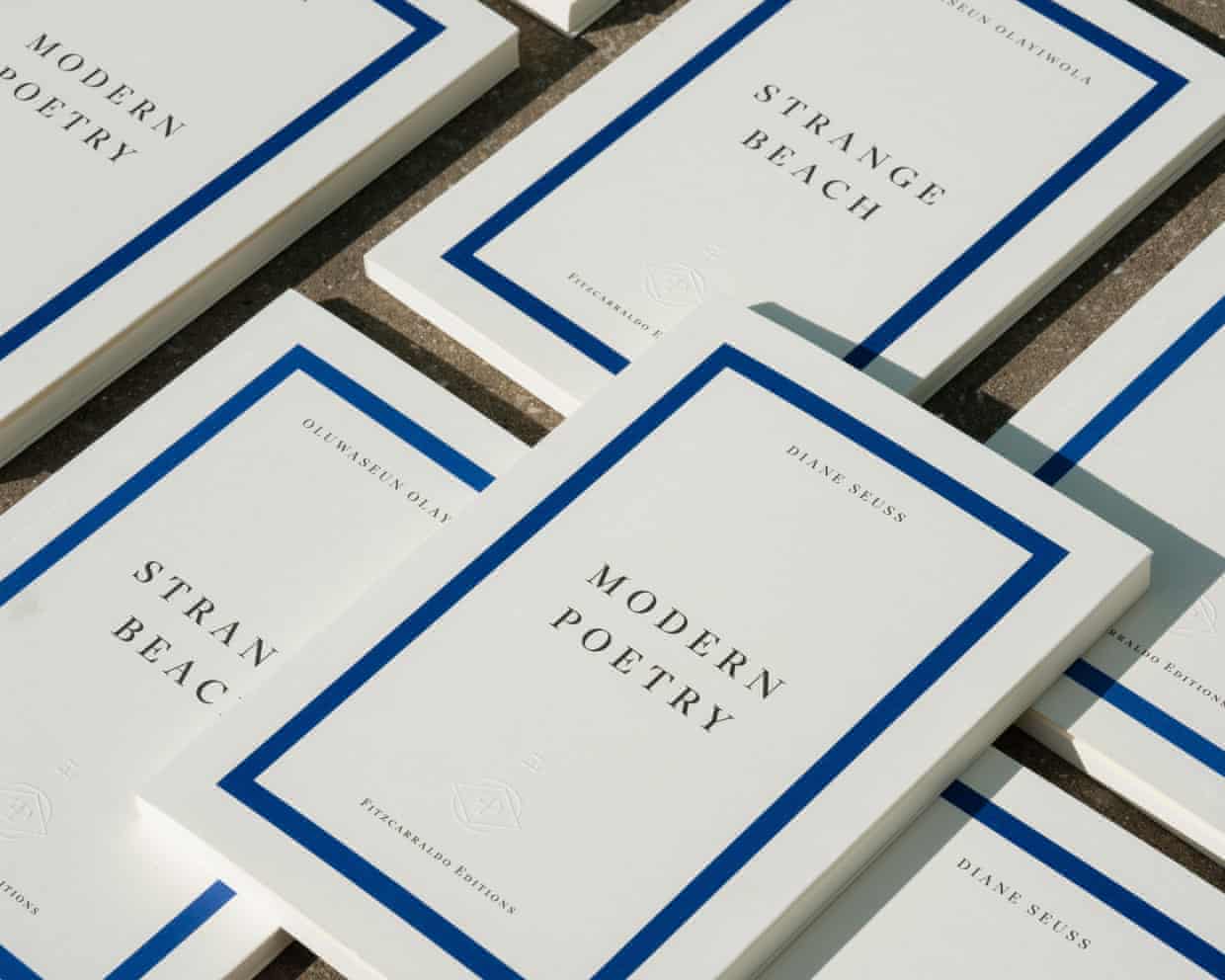
Photo: Fitzcarraldo Editions. Three publishing companies have launched the biennial Poetry in Translation prize, which will award an advance of $5,000 to be shared equally between poet and translator.
Anyone who has used Google Translate for a simple sentence knows that AI is not going to be doing quality translations of whole books anytime soon. There is too much subtlety needed.
And if that’s true for, say, a murder mystery, imagine how important a human translator is for poetry!
That’s why a new prize for poetry translation from publishers in the UK, Australia, and the US is arriving just in time — before the world gets lulled into thinking an AI translation is just fine.
Ella Creamer reports at the Guardian, “A new poetry prize for collections translated into English is opening for entries. …
“Publishers Fitzcarraldo Editions, Giramondo Publishing and New Directions have launched the biennial Poetry in Translation prize, which will award an advance of $5,000 (£3,700) to be shared equally between poet and translator.
“The winning collection will be published in the UK and Ireland by Fitzcarraldo Editions, in Australia and New Zealand by Giramondo and in North America by New Directions.
“ ‘We wanted to open our doors to new poetry in translation to give space and gain exposure to poetries we may not be aware of,’ said Fitzcarraldo poetry editor Rachael Allen. …
“The prize announcement comes amid a sales boom in translated fiction in the UK. Joely Day, Allen’s co-editor at Fitzcarraldo, believes that ‘the space the work of translators has opened up in the reading lives of English speakers through the success of fiction in translation will also extend to poetry.’ …
“Fitzcarraldo has published translated works by Nobel prize winners Olga Tokarczuk, Jon Fosse and Annie Ernaux. ‘Our prose lists have always maintained a roughly equitable balance between English-language and translation, and some of our greatest successes have been books in translation,’ said Day. ‘We’d like to bring the same diversity of voices to our poetry publishing.’ …
“The prize is open to living poets from around the world, writing in any language other than English.
“The prize is being launched to find works ‘which are formally innovative, which feel new, which have a strong and distinctive voice, which surprise and energize and move us,’ said Day. ‘My personal hope is that the prize reaches fledgling or aspiring translators and provides an opening for them.’ …
“Submissions will be open from 15 July to 15 August. A shortlist will be announced later this year, with the winner announced in January 2026 and publication of the winning collection scheduled for 2027.
“The ‘unique’ award ‘brings poetry from around the world into English, and foregrounds the essential role of translation in our literature,’ said Nick Tapper, associate publisher at Giramondo. ‘Its global outlook will bring new readers to poets whose work deserves wide and sustained attention.’ ”
This is my favorite version of the Christmas story. There may be more-accurate translations of the original, but none that sounds as lovely to me or has as many associations with my younger years, when we memorized Bible verses in school.
“And it came to pass in those days, that there went out a decree from Caesar Augustus that all the world should be taxed.
“(And this taxing was first made when Cyrenius was governor of Syria.)
“And all went to be taxed, every one into his own city.
“And Joseph also went up from Galilee, out of the city of Nazareth, into Judaea, unto the city of David, which is called Bethlehem; (because he was of the house and lineage of David:)
“To be taxed with Mary his espoused wife, being great with child.
“And so it was, that, while they were there, the days were accomplished that she should be delivered.
“And she brought forth her firstborn son, and wrapped him in swaddling clothes, and laid him in a manger; because there was no room for them in the inn.”
In ancient times, Arabic translations of Greek helped spur scientific inquiry.
You may have seen that there are contemporary publishers planning to use artificial intelligence to translate texts. Ha! What could possibly go wrong? If you have ever used Google Translate, you know the answer to that: AI works only up to a point.
Today’s excerpt from Josephine Quinn’s book How the World Made the West, focuses on benefits that came from the traditional type of translation.
“In the eighth-century CE the Abbasids undertook to collect the wisdom of the world in their new capital at Baghdad. … The operation was lavishly funded by [the second Abbasid caliph, al-Mansur] as well as by members of his household, courtiers, merchants, bankers, and military leaders. …
“What is often now called the ‘Translation Movement’ … was part of a wider commitment by Islamic scholars and political leaders to scientific investigation that also saw caliphs commission new works of science, geography, poetry, history, and medicine.
The real legacy of the Arabic translations is the impetus they gave to further thought.
“It is well-known that classic works of Greek science and philosophy were translated into Arabic before they were translated into other European languages — including Latin. What is less well-known is that the point of translating foreign works was not to preserve them but to build on them. As links around the Mediterranean continued to increase, that Arabic scholarship began to reach western Europe, and to change the way people there thought.
“Back in Baghdad, as so often happened, cultural change began from the outside — and in this case with the collection and comparison of foreign knowledge. The fundamental model and first material for the Abbasid translation project came from Iran, where sixth-century Sasanian shahs had commissioned Persian translations of important Indian and Greek works.
“Living Iranians were an inspiration too. … Persian scholars had already started to translate classic works of their own literature into Arabic. This ensured their preservation, and advertised the history and high culture of Iranian lands. Sasanian intellectuals also maintained useful links with scientific traditions farther east, above all with Indian mathematicians, the most advanced in the ancient world, and they had already translated important works from Sanskrit into their own language. …
“Incorporating the work of Greek thinkers into the Arabic canon was by contrast a declaration of cultural hegemony over the rump Roman empire at Constantinople, where older learning had been set aside in favor of Christian genres from sermons to saints’ lives, and where ancient science and philosophy now moldered in archives and monasteries.
“More immediately, the project took inspiration from the contemporary intellectual culture of western Asia, revitalized by the unification under Islam of regions once subject to either Persia or Rome. … This world produced well-traveled intellectuals expert in topics from military strategy to astrology, and comfortable in Greek, Syriac, Middle Persian (Pahlavi), and now Arabic as well.
“The final key component came from farther east. Paper had been invented in China in the second century BCE and by the second century CE it is found in the trading oases of the Tarim Basin. … As paper was much cheaper to produce than papyrus, it finally made writing in great quantity a practical prospect.
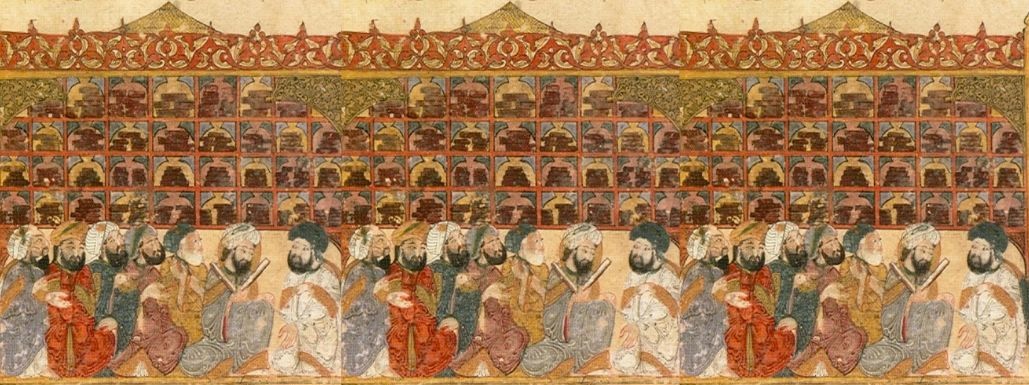
“In the early ninth century scientific scholarship in Baghdad coalesced around a library called the ‘House of Wisdom’ (Bayt al-Hikma), and the translation efforts were put on a more organized footing. … Persian scholars translated into Arabic works that had already been translated from other languages into their own, and since there was comparatively little direct Greco-Arabic bilingualism, Arabic translations of Greek works were often made from Syriac versions. …
“We have a useful guide to the foreign works considered worthy of investigation in the form of an encyclopedia entitled Keys of the Sciences written by Muhammad ibn Musa al-Khwarizmi (c. 780–850), a Persian-speaking mathematician and astronomer from the central Asian oasis of Khwarazm, south of the Aral Sea, who worked at the House of Wisdom.
“He divided the work into two books: one describes ‘Islamic religious law and Arabic sciences,’ defined as law, theology, grammar, secretaryship, poetry, and history; the other is devoted to ‘the sciences of foreigners such as the Greeks and other nations’: philosophy, logic, law, medicine, arithmetic, geometry, astronomy/astrology, music, mechanics, and alchemy. …
“Practical Greek texts also found their way into the collection, on topics from engineering to military tactics to falconry. Popular literature included books of fables, ‘wisdom sayings,’ and letters supposedly exchanged between famous historical figures. …
“Some of the Greek texts were acquired through personal request, even from the caliph himself. Other manuscripts were found on investigative missions. [A] tenth-century compendium of literature written in Baghdad reports that camel-loads of old works were discovered in a pagan Greek temple that had been locked since the arrival of Christianity, getting worn and gnawed at by pests. …
“Most ancient science was indeed lost to western Europe for almost a millennium: such works were usually written in Greek, even by Romans, and they disappeared with the knowledge of that language. …
“Greek texts were far from the only inspiration for Arabic science. [But the] manipulation, criticism, and sometimes outright rejection of foreign works by intellectuals working in the Islamic world catalyzed a scientific revolution.”
Claudia was first to alert me to the the New York Times story about Lin-Manuel Miranda’s musical Hamilton getting translated into German for an upcoming tour. The art of translation is really interesting to me, especially when the translator is supposed to render a play on words in a different language or convey the sense of something deeply embedded in another country’s culture.
Michael Paulson wrote from Hamburg, ” ‘Hamilton’ is a mouthful, even in English. Forty-seven songs; more than 20,000 words; fast-paced lyrics, abundant wordplay, complex rhyming patterns, plus allusions not only to hip-hop and musical theater but also to arcane aspects of early American history.
“So imagine the challenge, then, of adapting the story of America’s first treasury secretary for a German-speaking audience — preserving the rhythm, the sound, and the sensibility of the original musical while translating its dense libretto into a language characterized by multisyllabic compound nouns and sentences that often end with verbs, and all in a society that has minimal familiarity with the show’s subject matter.
“For the last four years — a timeline prolonged, like so many others, by the coronavirus pandemic — a team of translators has been working with the ‘Hamilton’ creators to develop a German version, the first production of the juggernaut musical in a language other than English. The German-speaking cast — most of them actors of color — [reflect] the show’s defining decision to retell America’s revolutionary origins with the voices of today’s diverse society. …
“Hamburg has emerged, somewhat improbably, as a commercial theater destination — the third biggest city for musical theater in the world, after New York and London — with a sizable market of German-speaking tourists. The market began with ‘Cats’ and ‘The Phantom of the Opera,’ and Disney shows are a big draw. …
“But less familiar shows have had a harder time here — “Kinky Boots” closed after a year. Sure, there are hard-core German “Hamilton” fans (some of them upset that the show is being performed in a different language from that of the cast album they love), but there are also plenty of Germans who have never even heard of Alexander Hamilton.
“ ‘It’s not like “Frozen,” which everybody knows,’ said Simone Linhof, the artistic producer of Stage Entertainment, an Amsterdam-based production company that operates four theaters in Hamburg and has the license to present ‘Hamilton’ in German. …
The German cast has already adopted its own take on the show: Whereas in New York, the musical is celebrated for its dramatization of America’s founding, almost every actor interviewed here described it as a universal human story about the rise and fall of a gifted but flawed man. …
“International productions have become an important contributor to the immense profitability of a handful of shows birthed on Broadway or in the West End, and they are often staged in the vernacular to make them more accessible. …
“For ‘Hamilton,’ Stage Entertainment executives invited translators to apply for the job by sending in sample songs, and then, not satisfied with any of the submissions, asked two of the applicants who had never met one another to collaborate. One of them, Kevin Schroeder, was a veteran musical theater translator whose proposal was clear but cautious; the other was Sera Finale, a rapper-turned-songwriter whose proposal was imaginative but imprecise.
“ ‘Kevin was like the kindergarten teacher, and I was that child who wanted to run in every direction and be punky,’ said Finale. … Both of them were wary of working together. ‘I thought, “What does he know?” ‘ Schroeder said. ‘And he thought, “I’ll show this musical theater guy.” ‘
“But they gave it a go. They wrote three songs together, and then flew to New York to pitch them to Lin-Manuel Miranda, who wrote the book, music, and lyrics for ‘Hamilton.’ Miranda can curse and coo in German (his wife is half Austrian), but that’s about it; he surprised the would-be translators by showing up for their meeting with his wife’s Austrian cousin. …
“Miranda had been on the other side once — he translated some of the lyrics of ‘West Side Story’ into Spanish for a 2009 Broadway revival — and he remembered observing how that show’s lyricist, Stephen Sondheim, listened for the sounds of the Spanish words. Miranda applied that experience to the German ‘Hamilton.’
“ ‘I’m going to feel the internal rhyme, or lack of internal rhyme, of which there is a lot in this show, and so it’s important to me whenever that can be maintained without losing comprehensibility,’ Miranda said. …
“Once Finale and Schroeder got the job, the process was painstaking, reflecting not only the complexity of the original language but also the fact that the show is almost entirely sung-through, meaning there is very little of the spoken dialogue that is generally easier to translate, because it is unconstrained by melody. They tried divvying up the songs and writing separately, but didn’t like the results, so instead they spent a half year sitting across from one another at the kitchen table in Finale’s Berlin apartment, debating ideas until both were satisfied. They would send Miranda and his team proposed German lyrics as well as a literal translation back into English, allowing Miranda to understand how their proposal differed from his original. …
“Figures of speech and wordplay rarely survive translation, but Miranda encouraged the translators to come up with their own metaphors. One example that Finale is proud of concerns Hamilton’s fixation on mortality. In English, he says ‘I imagine death so much it feels more like a memory.’ In German, he will say words meaning, ‘Every day death is writing between the lines of my diary.’ ”
More at the Times, here. At National Public Radio you can read some details without a firewall.
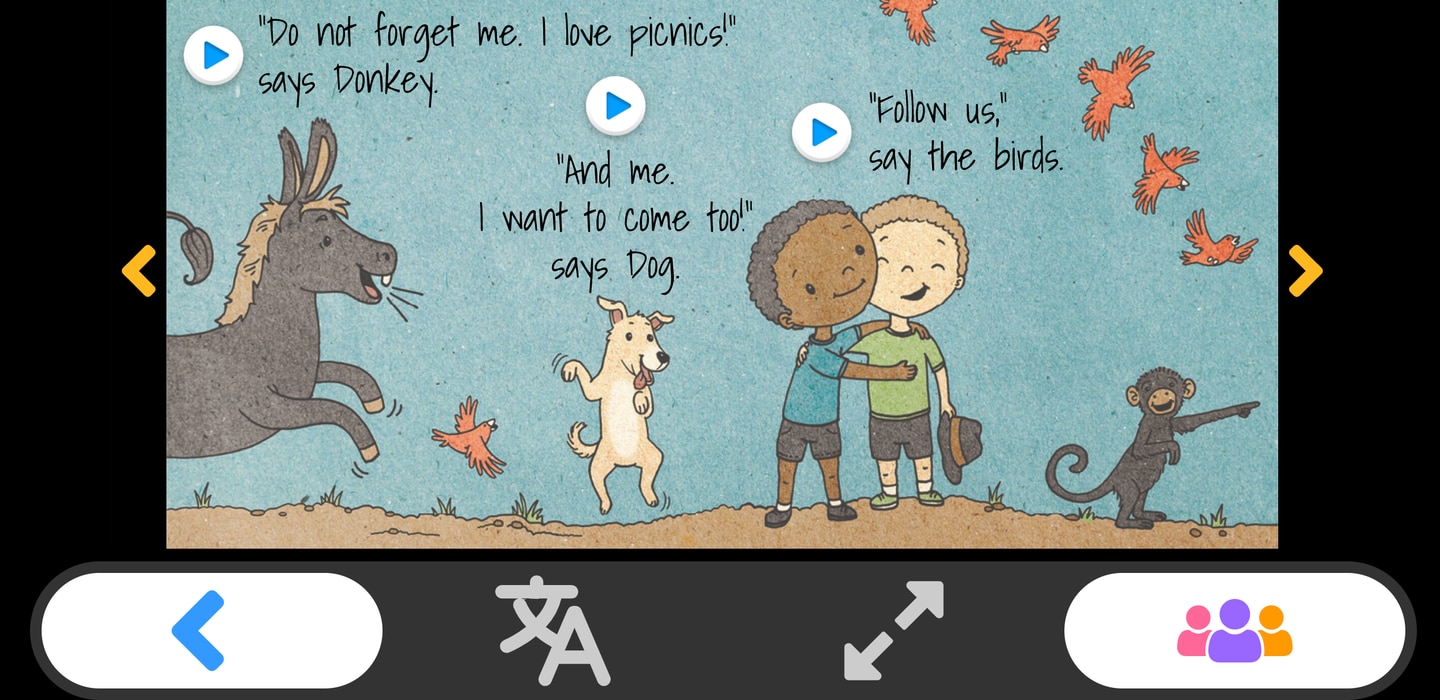
Photo: Storytime Online. An inside page of “A Beautiful Day,” which is currently available in English, Spanish, and German.
Speaking of languages, today’s post is about making children’s books available in more languages. It’s from an interview that Boston Globe reporter Alexa Gagosz conducted with Andreas von Sachsen-Altenburg, founder of Storytime Online.
Writes Gagosz, “Storytime Online is a new German-Rhode Island educational technology platform where children can read and listen to interactive children’s books from cultures around the world, translated and narrated in more than 15 different languages.
“It works with authors and artists to digitize and publish stories on a global scale. … Founder Andreas von Sachsen-Altenburg is launching the Storytime Online platform internationally this month.
“Globe: How did you come up with this idea?
“von Sachsen-Altenburg: I was back in Germany with my family when I was with my sister Julia, who was 9 at the time, and had just moved there from Georgia (the country). I’d bring her to bookstores there, but we didn’t always actually purchase a book. She was just learning German as her second language, and she would quickly advance to the next level or simply get bored with reading the same book — like most kids. At the same time, while around the rest of my family, she was learning English; so, trying to learn two different languages at the same time. I looked for resources for her, but it was difficult to find anything in German, especially for a Georgian. I could find resources in English, but they were expensive. …
“If you go to another country where your language isn’t supported, especially as a child, it makes learning in school nearly impossible. Julia made me aware of this problem, so it became our problem. And I built my own solution.
“How does Storytime Online work?
“It’s really easy to use, which was the key. The point is to allow a child to use this technology on their own, even as young as 3. After choosing a language and reading level, various book covers are displayed, and then the child can flip through the pages of the book online. You can read the book to the child, clicking through the pages on your own, or have a narrator read the book by clicking the play buttons.
You can also alter the language of each book in any of the other languages that it is available in.
“Which languages are available?
“The languages that are currently on deck or in development include English, Spanish, French, German, Italian, Portuguese (European and Brazilian); Armenian, Georgian, Hungarian, Polish, Romanian, Russian, Slovak, Ukrainian, Arabic (Modern Standard); Kurdish, Pashto, Persian (Farsi/Dari), Swahili, Turkish, and Urdu. …
“How much does it cost?
“For unlimited access to all languages, it’s an average of $5 each month. It’s designed to be affordable, even in developing countries.
“How do you get authors and artists to be on the platform?
“Our model is similar to Spotify for artists. You get published and then get royalties, not just for that one language that you wrote the book in, but in all the languages I get it translated and narrated in. But this also multiplies their reach to other cultural markets without doing any additional work.
“Also, all authors, designers, illustrators, translators, and narrators get credit for being part of this effort right on the book’s landing page. If your child wants to continue reading a book from one particular author or narrator, you can click on the person’s profile to see what other books they worked on. …
“How are you identifying global refugees to work with?
“I just started working with a digital skills and marketing firm in the UK that trains and employs refugees in Africa. Also, the CEO of the Cambridge Innovation Center recently sent out a newsletter about the company’s initiatives to support Ukraine during the war, and I replied to it regarding Storytime Online. I was connected with a CIC director in Poland, and he was able to put me in touch with more translators.
“I developed a partnership with the Ukrainian National Women’s League of America, and they have a network of thousands of migrants. Right now, I’m prioritizing Ukrainian narrations and translations, but also working with Ukrainian refugees to support them during this time. With the League’s help, I’m looking to quickly translate and narrate 100 stories in Ukrainian.
“How does Storytime Online fit into your background?
“I grew up between the US and Germany. Learning another language was much different in Europe than here in the US. I took Spanish classes in both Germany and the US, but I actually learned Spanish in Germany. In Germany, you’re not just learning for the next test, you’re learning to become fluent.”
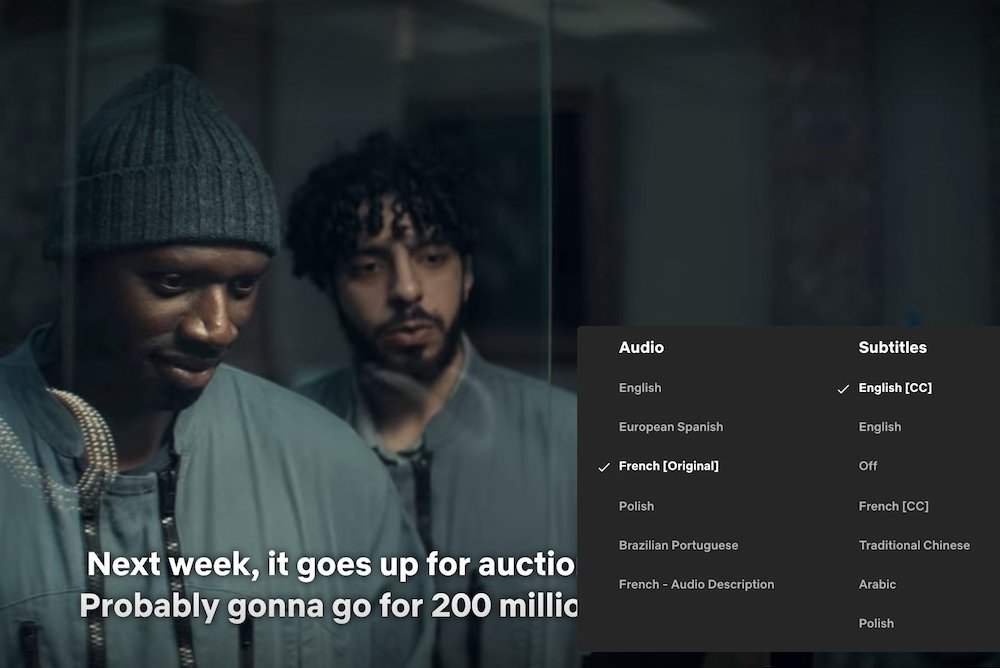
Photo: Netflix/Lupin. “The French mystery thriller Lupin became the most-watched non-English series on Netflix and is also the platform’s most popular series of 2021; it’s been lauded for its seamless translations,” reports Zocalo.
I’ve spent many months plowing my way through The Magic Mountain mainly because I’d read about the challenges Thomas Mann’s first English translator, Helen Tracy Lowe-Porter, faced. I was curious. If characters suddenly start speaking French, how do you show they aren’t speaking German anymore? One character is a real Mrs. Malaprop. In German. What do you do? If a different character purposefully makes a play on words, how do you translate that and still make sense?
Most people are exposed to this sort of thing when they read subtitles on foreign films. Although I like having subtitles on all films (British accents can be hard to understand; Americans mumble), if I know a bit of a foreign language being badly subtitled, I find it really distracting. There’s an art to translating well.
Recently, translator David Buchanan wrote about subtitling at Zocalo Public Square. “If you don’t notice my work,” he says, “it means I’m doing my job properly.
“I’m an audiovisual translator, which means that I — and others like me — help you understand the languages spoken on screen: You just click that little speech bubble icon in the bottom-right corner of your preferred streaming service, select the subtitles or the dub, and away you go. …
“I decided to become an audiovisual translator because it allows me to combine cinema and French culture, my two favorite things. But there is also something about the anonymity of the work that appeals to me, which is the name of the game for our craft. As Bruce Goldstein, director of repertory programming at New York’s Film Forum, put it in The Art of Subtitling, ‘Good subtitles are designed to be inconspicuous, almost invisible.’
“Of course, it’s impossible to be truly invisible. Translating film and TV always involves some form of compromise. … Whether working (as I do) from French into English, from Spanish into German, or Japanese into Swedish, the process is always the same: We pay close attention not only to the meaning of the words, but to the actors’ emotions, the cadence of their speech, their body language, the themes and narrative structure of the script, the historical period, and the social context. Together, these cues provide a host of tiny hints, all of which add extra layers of meaning and must be accounted for in the translation.
Translating all these layers is a bit like solving a Rubik’s Cube — it’s easy to do one side, but what about all of the others?
“Say I’m dubbing a ghost story set in a bourgeois Parisian household in the year 1850. The French grandmother stands in a doorway and whispers, ‘A tout de suite, mon petit.‘ How would you dub that into English? I might try, ‘See you in a minute, my darling,’ but that doesn’t sound stuffy enough for the 19th-century bourgeoisie. It needs to be more uptight, more formal. So what about, ‘See you in a moment?’
“The issue there is the cinematographer has lit the scene so the actor casts a sinister shadow into the room. She’s not just standing there, she’s lurking, and if I were a grandmother trying to lurk in a doorway, I wouldn’t say, ‘See you in a moment.’ However, I might say ‘See you soon.’ That could work — especially when you consider the spooky quality about the alliterative s’s and the ghostly ‘ooh’ in ‘soon.’
“ ‘See you soon, my darling’ perfectly fits the atmosphere of the scene. Except this introduces a new dilemma: ‘my darling’ doesn’t sync with the actor’s lip movements. Her mouth is closed for the ‘p’ in ‘petit,’ whereas the ‘d’ in ‘darling’ would require it to be open. In dubbing, the end of a sentence is one of the most important parts to get right: If the last word is poorly lip-synced, it sticks out like a sore thumb. …
“In an ideal world, I’d find a new term of endearment that syncs with ‘mon petit.’ … In this case, a compromise is necessary. At the end of the day, a loose translation is less distracting than bad lip sync.
“At times, I also must compromise when it comes to personal taste. For example, I might be subtitling a rapper renowned for Eminem-style punchlines, like: ‘C’est le retour de la légende de Jimmy, même si j’peux craquer à tout moment comme Djibril.‘ With these lyrics, they’re making a tasteless joke, comparing themselves to Djibril Cissé, a French footballer who has broken both of his legs. I don’t find broken legs especially funny, nor is it a joke that I would ever make myself. Still, this sick humor is a key element of their controversial persona, and the English-speaking audience deserves to understand what they’re saying so they can make up their own minds. A translator must never censor the source material: I must put my own opinion to one side and render the translation as faithfully as possible. It’s a challenging task, but also an instructive one.
“In this case, since most Americans are unlikely to have heard of Cissé, I start by ‘translating’ his name into that of another famous sportsman, a popular figure that an American audience would recognize by name. In order for the punchline to work, I need someone who would have suffered some kind of terrible injury. A fairly gruesome Googling session suggests the late basketball player Kobe Bryant, who died in a helicopter crash. Now I need to reverse-engineer the scenario. At first, the rapper pretends to be arrogant (légende), then undercuts themself by admitting they’re scared of failure (craquer… comme Djibril). After looking for an arrogant-sounding phrase that rhymes with ‘Bryant’ —eventually settling on ‘rap giant’ — I must find a way to describe Bryant’s accident that also acts as a metaphor for failure. … The offensive punchline leaves a bad taste in my mouth, but because it leaves the same bad taste as the original French, it feels like a faithful translation. …
“These days, though there are more films and TV from around the world than ever before, in many countries (such as the UK, where I live, or Spain, where my colleagues assure me the situation is even tougher), rates are falling and deadlines are getting tighter. This has inevitable repercussions on quality, not to mention our livelihoods. It can be hard to publicize our achievements because we usually sign non-disclosure agreements, and more often than not, filmmakers regard us as an afterthought, something to be rushed through at the distribution stage. Thankfully, many of the best filmmakers realize how important the translation stage is and are closely involved in the subtitling and dubbing process. They also pay fairly, so that we can take our time getting it just right.
“It’s possible for subtitles and dubs to be so seamless that they feel invisible without pushing audiovisual translators ourselves out of sight. I’m proud of what I do, and I want the world to know how much care and consideration I, and thousands like me, put into our work. That being said, there is still a certain satisfaction in being the hidden conduit between cultures, the solitary name that appears in a film’s credits after everyone has left the cinema. …
“Translation is about helping people to understand each other, and it feels good to be able to do that on a daily basis.”
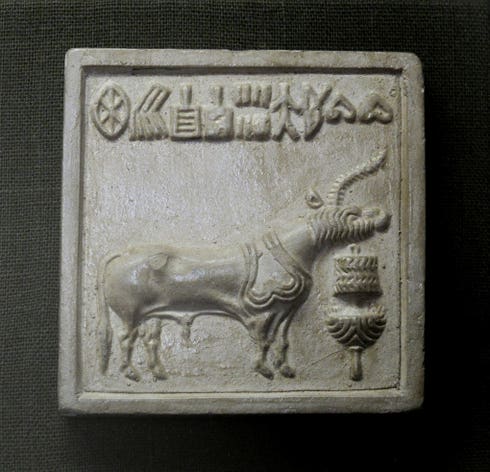
Photo: Ismoon The earliest recognized form of “written” communication may have been small bits of clay, called tokens. This charming one is from the Indus Valley.
Nowadays, one reads almost too much about artificial intelligence, AI. I myself have an ever increasing list of things I’d rather not have AI managing for me. But using it to translate ancient texts is one application that seems to make perfect sense.
Ruth Schuster writes at Haaretz, “Understanding texts written using an unknown system in a tongue that’s been dead for thousands of years is quite the challenge. Reconstructing missing bits of the ancient text is even harder. …
“Filling in missing text starts with being able to read and understand the original text. That requires much donkey work. Now an Israeli team led by Shai Gordin at Ariel University in the West Bank has reinvented the donkey in digital form, harnessing artificial intelligence to help complete fragmented Akkadian cuneiform tablets.
“ ‘Neural networks’ … means software inspired by biological nervous systems. The concept dates back more than 70 years. … The base concept is to teach machines to learn, think and make decisions. In this case, the computer decides on the plausible completion of missing text. …
“Gordin and the team feed their machine transliterations of the extant Babylonian texts i.e., what the text would have sounded like.
“Then what? When it comes to missing bits in a papyrus or tablet, humans can intuit that “’…ow is your moth…’ isn’t a query into the well-being of your mothball.
With machines, it’s all about mathematics and probabilities based on knowledge gained so far. …
“It may have been trading that inspired the earliest recognized form of communication: ‘pseudo-writing’ on small bits of clay in Mesopotamia around 7,000 years ago. The clay bits, called tokens, were shaped into simplistic imagery such as a cow or other ancient commodities. …
“Then we start seeing abstract signs; repetitive strokes or depressions are interpreted as numbers (price, perhaps); and possibly also personal names, using the first sounds of different imprints to put together words you can’t draw. …
“Anyway, after pseudo-writing came proto-writing: figurative proto-cuneiform inscribed on tablets, which arose about 5,500 years ago in the city of Uruk. … Within mere centuries, proto-cuneiform evolved to become increasingly schematic and Sumer was apparently where it happened, [Gordin] says. And figurative hieroglyphic script began to appear in ancient Egypt at about the same time, about 5,000 years ago. …
“By the time cuneiform became a thing, writing had passed the stage of ‘Sheep : four : Yerachmiel’ and reached the stage of official records, letters and formulaic recounts of the wondrousness of the ruler. …
“And over decades, linguists slowly interpreted the languages of Babylon and Assyria, thanks to Darius’ monumental ego. …
“Interpreting a dead language is a mathematical game, Gordin says. … Neural networks are a computerized model that can understand text. How? They turn each symbol or word into a number, he explains. …
“When humans reconstruct missing text, their interpretation may be subjective. To be human is to err with bias, and quantifying the likely accuracy of the completion is impossible. Enter the machine. …
“The machine proved capable of identifying sentence structures – and did better than expected in making semantic identifications on the basis of context-based statistical inference, Gordin says. Its talents were further deduced by designing a completion test, in which the machine-learning model had to answer a multiple-choice question: which word fits in the blank space of a given sentence.”
Not sure how many readers are into that kind of thing, but I do find it intriguing. More at Haaretz,here.
John told me that my efforts to learn Swedish online with Duolingo help to improve Google Translate and similar translation services, which purchase the history of users’ mistakes in order to refine their translation algorithms. I think Google Translate has fewer howlers lately. Maybe I helped.
Now along comes a product that claims to translate as you converse with a speaker of another language. Spenser Mestel has the story at the Atlantic.
“Last week, New York City-based Waverly Labs announced its recent invention, Pilot, a set of two ear buds that costs $299. Scheduled to be released by spring of 2017, the device purports to offer near-simultaneous translation for four languages.
“Inspired ‘when he met a French girl,’ Andrew Ochoa, the company’s founder, says that Pilot promises ‘a life untethered, free of language barriers.’ …
“Despite how quickly machine translation has progressed in the last few decades, language is a data set that’s far more complex than it seems, so no matter how quickly translation technology evolves, the stochastic messiness of speech will always outpace it. …
“In 1949, the scientist Warren Weaver proposed an alternative to rule-based translation called statistical machine translation (SMT). Instead of attacking language one minutia at a time, Weaver suggested a two-pronged approach: First, the computer would mine millions of documents looking for statistically significant linguistic patterns, thereby discovering the grammar, syntax, and morphology rules for itself. At the same time, the program would create a model to predict how certain phrases are translated and where in the sentence they should appear. …
“Waverly Labs hasn’t yet released the details of its software, but it likely works in the same fundamental way as Google Translate, which uses these rules and the predictive model to give the most statistically likely translation, the one that best mirrors the patterns it already found. …
“Even if it lags and stutters, Waverly Labs’s Pilot … could allow for more substantive engagement with the world.” More here.
Photo: Waverly Labs The Pilot in-ear translators from Waverly Labs
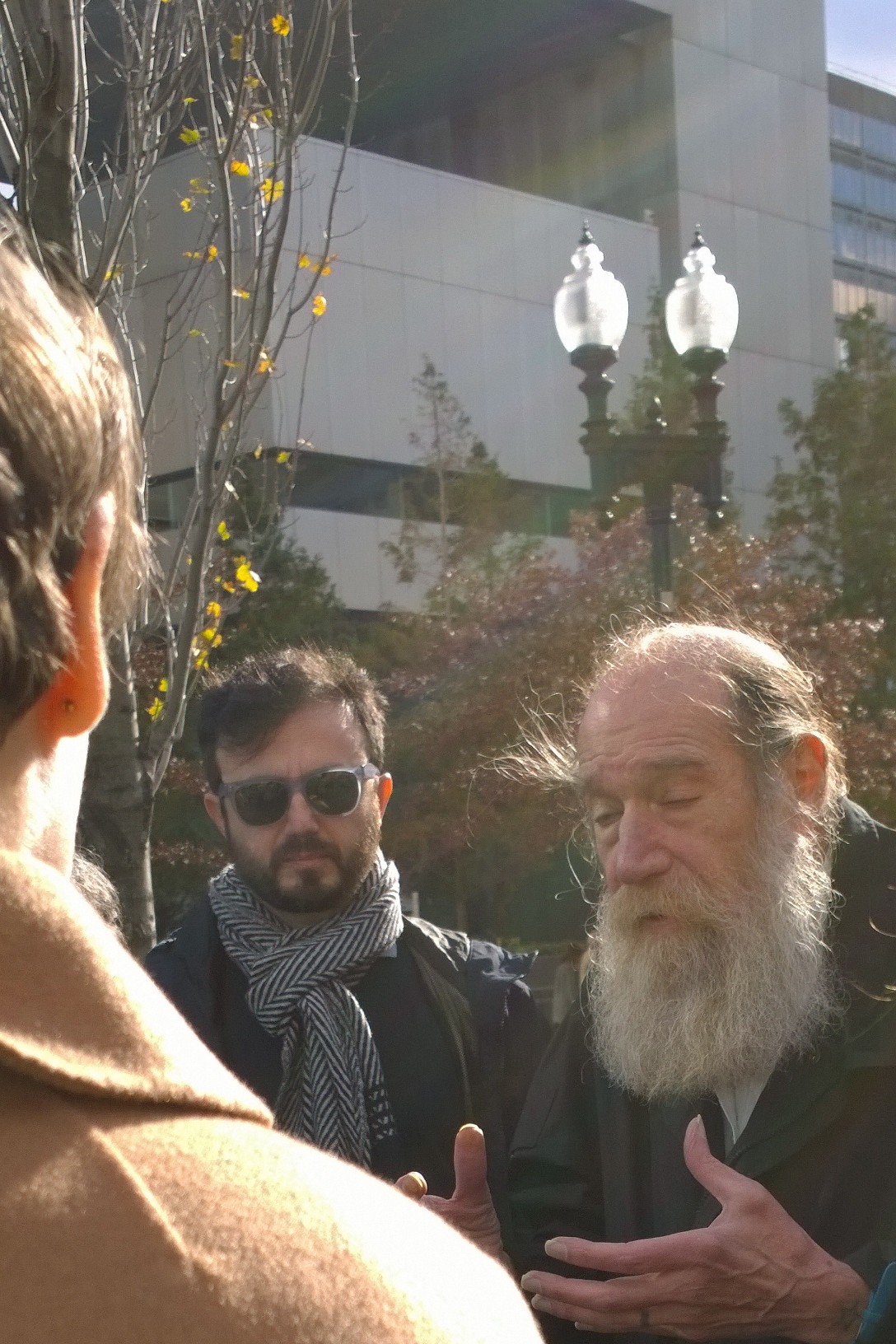
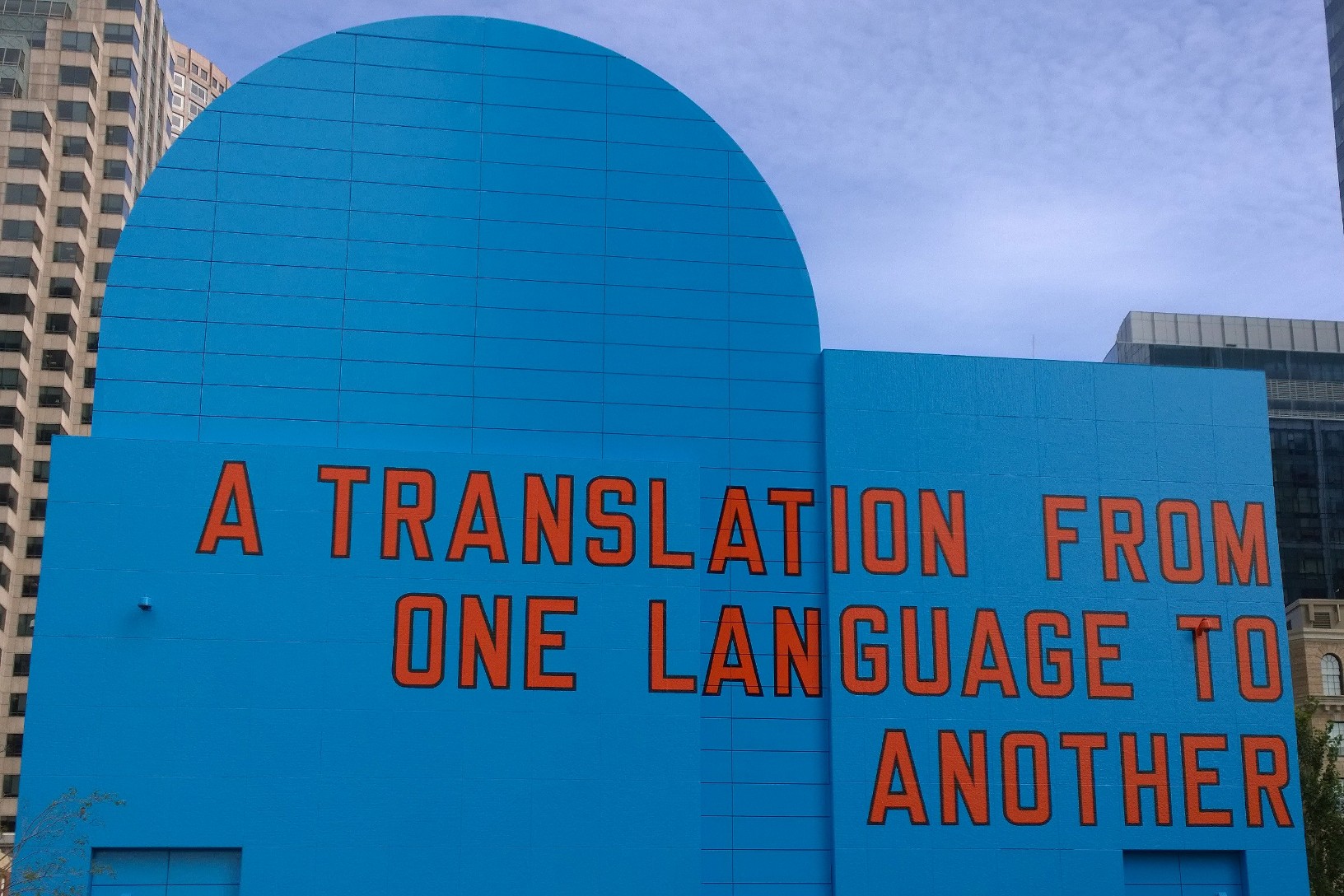
The latest Greenway mural in Dewey Square comes courtesy of MIT’s List gallery and is the work of Lawrence Weiner. I admit to liking it even though it seems to be nothing more than bright orange letters on a blue background, with words saying, “A translation from one language to another.”
I am letting it sink in. Perhaps it’s about the translation from the artist’s idea to a work that others see. Perhaps something is lost in the translation. Perhaps it’s about how differently we understand one another, even without so-called language barriers.
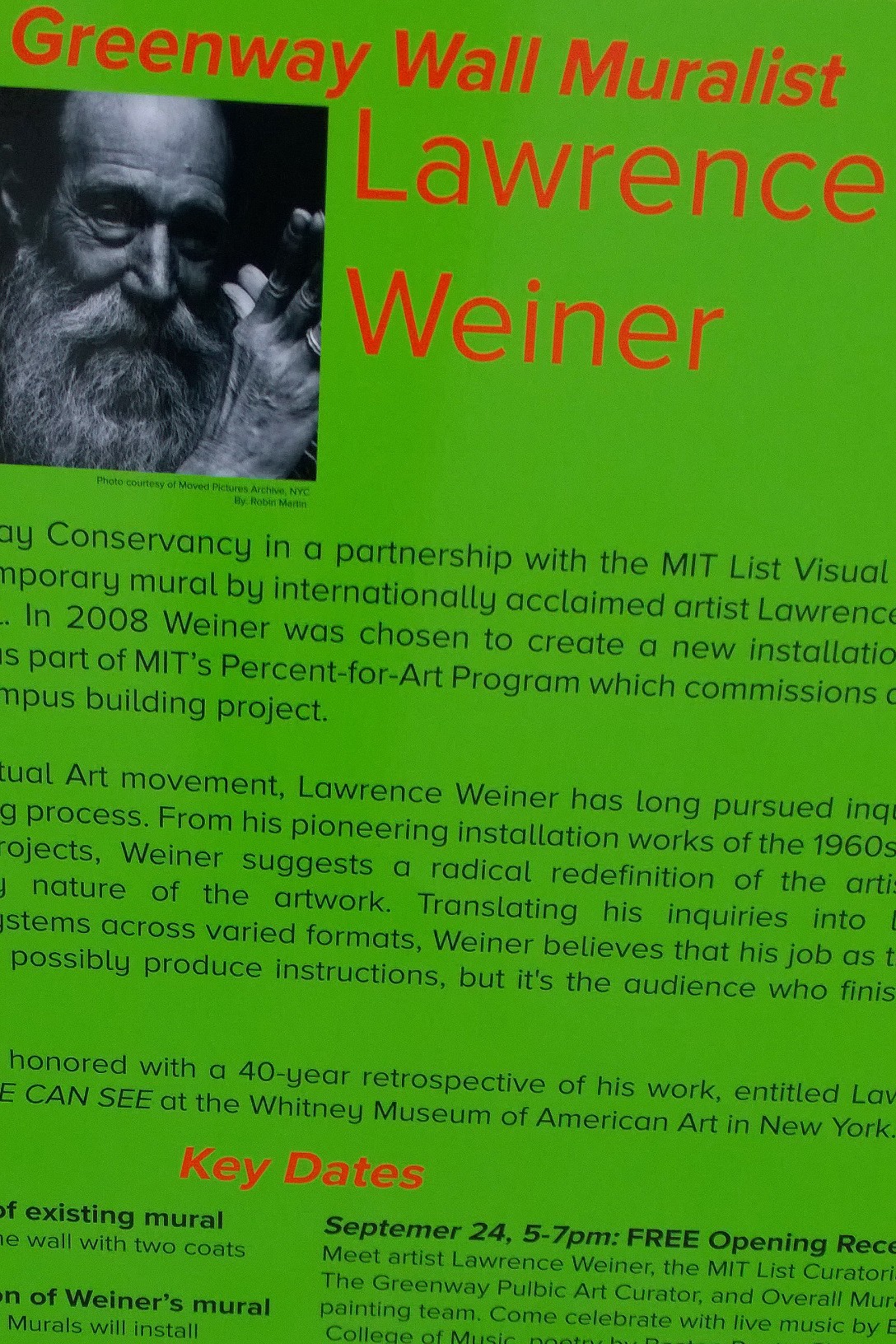
Here’s what the Greenway writes, “Lawrence Weiner is considered a key figure in the Conceptual Art movement, which includes artists like Douglas Huebler, Robert Barry, Joseph Kosuth, and Sol LeWitt.
“A primary motivating factor behind Weiner’s work is the desire to make it accessible, without needing to purchase a ticket or understand a secret visual language. He contended that language reaches a broader audience, and situating language in contexts outside traditional art-viewing settings, such as art museums, furthers that reach.
“Thus, he began creating works consisting of words and sentences or sentence fragments that he displayed in public spaces, books, films, and other accessible media, as opposed to the cultural institutions that might deter broad and diverse viewership. Click here for an interview with Lawrence Weiner.” More at the Greenway site.
Malcolm Gay at the Boston Globe adds, “For Weiner, the work is less about art historical knowledge, outrage, or relating to other people. It’s about a viewer’s individual response to an object in the world — an object that’s been created by another person.
“ ‘Our job is not to throw things at people,’ he said. ‘The work doesn’t exist unless somebody decides to deal with it. You can pass it on your way work, and it’s not going to screw up your day. But if you pay attention to it, it might screw up your life.’ ”
In Sweden, mangata is the word for the roadlike reflection the moon casts on the water. In Finland there’s a word for the distance reindeer can travel comfortably before taking a break: poronkusema. A terrific German word that people familiar with Concord, Massachusetts, will appreciate is Waldeinsamkeit. What do you think it means? Yep. “A feeling of solitude, being alone in the woods and a connectedness to nature.”
National Public Radio staff say: “Just as good writing demands brevity, so, too, does spoken language. Sentences and phrases get whittled down over time. One result: single words that are packed with meaning, words that are so succinct and detailed in what they connote in one language that they may have no corresponding word in another language.
“Such words aroused the curiosity of the folks at a website called Maptia, which aims to encourage people to tell stories about places.
” ‘We wanted to know how they used their language to tell their stories,’ Maptia co-founder and CEO Dorothy Sanders tells All Things Considered host Robert Siegel.
“So they asked people across the globe to give them examples of words that didn’t translate easily to English.”
I loved this report. You will, too. Read more at NPR, here.
Art: National Public Radio, “All Things Considered”
The NY Times had an article today about the subtleties of standup comedy in different languages.
Not only can jokes get lost in translation, but an immigrant from one country may be completely hilarious to an immigrant from another country while falling flat with temporary visitors from his own country.
Sarah Maslin Nir writes, “In a city where a priest, an imam and a rabbi really could walk into a bar on any given day — along with just about anyone from around the globe — what different cultures laugh at is as diverse as the city itself. …
“Cultural stumbles are a theme in immigrant comedy in New York, said Oleg Boksner, a Brooklyn comedian who is preparing a one-man show called ‘From Russia With Laughs.’ In it he has fun with his heritage through caricatures like the transplant from Communist Russia who tries to join in with the American custom of Halloween, but scares away trick-or-treaters with his Soviet-style treats: a raw potato and an onion. ‘I’ve had people from Mexico relate to it as well,’ Mr. Boksner said of his act, ‘because they relate to the difficulties of being an immigrant in one form or another.’
“But when he played before a crowd of Russian visitors at B. B. King Blues Club and Grill in Midtown a few years ago, those jokes bombed. …
“And every foreign comedian must tackle the thorny task of figuring out which jokes just will not translate. Take the Mexican one about the chicken who was the height of foolishness. Why? Because he was looking for a pencil when he was surrounded by pens! ‘Plumas’ in Spanish, means ‘pens’ but also, critical to the joke, ‘feathers.’ ”
Photograph: Yana Paskova/NY Times
Ali Sultan, a Yemeni-American comedian who lives in Minnesota and performed at the Comic Strip in Manhattan last month, claims to have studied at the University of I’ll Just Google It.



 Suzanne's Mom's Blog