Feeds:
Posts
Comments

Posts Tagged ‘trust’

Photo: Alfredo Sosa/CSM Staff.
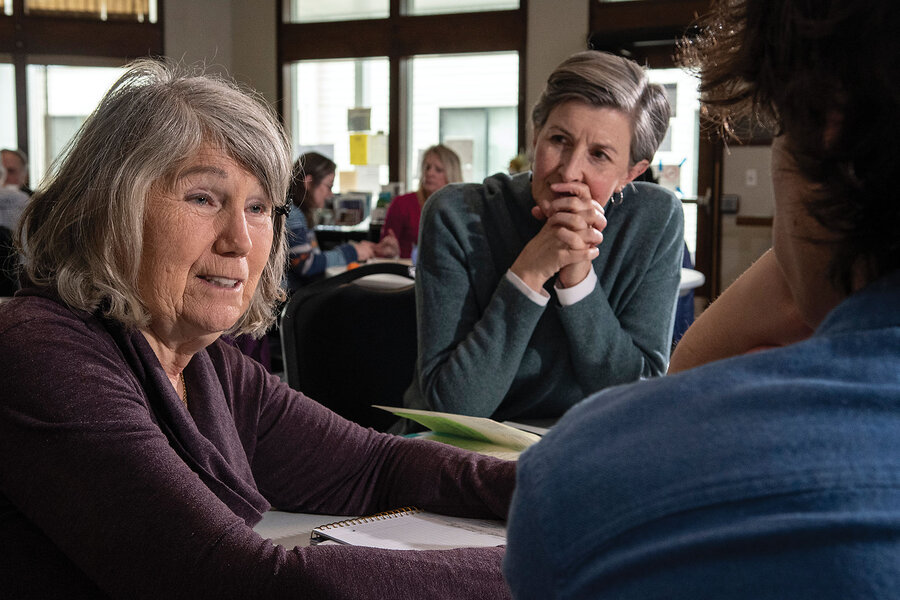
Virginia Frederick (left) and Sarah Duncan (center) participate in a conversation table training workshop hosted by the East County Citizens’ Alliance in Washougal, Washington.

Sometimes it seems we have nothing in common with other passengers on spaceship Earth, and it sure is anxiety making. But if we were invaded by aliens from deep space, you know, we’d suddenly all band together. We’d realize what we have in common.

What else do we have in common? What can we build on? Some people in the state of Washington reaiized they could start with trash.

Stephen Humphries has the story at the Christian Science Monitor. “Before the troubles started, Melanie Wilson believed she’d finally found paradise. 

“She and her husband had moved from Washington, D.C., to Washougal, Washington, in 2019. After the cacophonies of the U.S. capital, they immediately felt at home with tranquil views of the mountains, including the snowcapped peak of Mount Hood in the Oregon distance. … The pace of life here is as unhurried as the logging barges wending through its gorge.

“ ‘I’ve been looking for a home my whole life,’ Ms. Wilson says of the town of 17,000 people. ‘I want to make friends here. I want to put down roots here.’

“That was five years ago. Then the pandemic hit in March 2020. Two months after that, George Floyd was murdered by Minneapolis police. And the Wilsons’ paradise, it seemed, suddenly erupted into the kind of rancor they thought they had left in Washington, D.C. 

“Protests sprang up in the conjoined towns of Washougal and Camas that summer. By August, pro-police rallies were attracting hundreds of supporters waving American flags in support of law enforcement. On opposite sides of the street, half as many counterprotesters hoisted Black Lives Matter signs in a clash of highly charged remonstrations.

“The area has been called the ‘crossroads to discovery.’ Today both towns are at the crossroads of America’s deepening political and cultural divides. The bedroom communities are just a 30-minute drive west from progressive Portland, Oregon. A few miles to the east, however, horses, cows, and alpacas graze on gentle swells of verdant farmland, scattered with barns. …

“The protests in Washougal and Camas were mostly peaceful. Mostly. The police broke up a couple of push-and-shove scuffles. …

“Ms. Wilson was getting increasingly worried. Then, at a school board meeting in 2021, the vitriol she’d been witnessing reached a tipping point, jolting the sense of home that had become so important to her life.

“During the meeting, a man stood up and jabbed his finger at the elected officials sitting in front of them. ‘ “Civil war is almost here. We’re sharpening our bullets,” ‘ Ms. Wilson recalls the man saying. …

“She was startled once again by the crowd’s response. ‘People around the room clapped and stamped their feet on the floor,’ she says. ‘It seemed to me, that’s a flashing red warning in a community.’

“After the meeting, she began talking to others in the community about the violent rhetoric. She joined a group of citizens in Washougal and Camas to think about how to counter the civic vitriol that seemed to be tearing their community apart. Over time, she conceived a simple idea: People would gather to pick up trash, together.

“Today, Ms. Wilson is the co-founder and executive director of the East County Citizens’ Alliance. Its volunteers don’t chant and shout. They don’t tote signs and megaphones, let alone AR-15s. What they do carry, however, are seedlings, paintbrushes, and trash bags. One volunteer even brings his tractor. 

“The organization engages in other projects, too, from feeding the hungry to mentoring students. It’s all in service of an underlying mission: Getting people out of their news silos and partisan bubbles to gather together outside – their outside, their gorgeous, scenic, pastoral part of the world – and make an effort to work together and get to know each other. 

“This idea, too, is simple: To fix our politics, we must first mend our culture.

“There are groups like Ms. Wilson’s springing up all over America, in fact. From Wilkesboro, North Carolina, to Madison, Wisconsin, to Compton, California, small bands of volunteers are working to improve their quality of life, not only in their neighborhoods, but also in their hearts. 

“There’s little glory in it. Sometimes, volunteers may even wonder if they’re making any progress at all. But with each small act of kindness, they’re working to weave a social fabric of grace, stitch by stitch, and rooted in tolerance, respect, and faith in each other, as different as that other may be. …

“Ms. Wilson, riding shotgun, plays tour guide to Monitor journalists along for the ride [with Barbara Seaman]. A few days previously, the duo transported braised barbecue to ReFuel Washougal, a program that serves free meals to residents in need. The East County Citizens’ Alliance took a turn hosting a dinner in collaboration with Washougal High School’s culinary arts program. 

“ ‘If you were in my car, it’d be full of traffic cones and trash bags and trash,’ Ms. Wilson says. ‘This is what community-building looks like. It doesn’t look like fancy discussions about policy.’

“But the group’s members did get their start with discussions. About 90 residents, including Ms. Wilson and Ms. Seaman, held regular meetings in 2021 about the culture war issues roiling their schools. The topic of political extremism in the area started cropping up more and more. 

“The discussions soon grew into the organized alliance. People decided they were done focusing on politics as a community. ‘I’m so sick and tired of everybody labeling everybody,’ says Ms. Seaman, the group’s assistant executive director. ‘I just want to get people together to build relationships.’ …

“The emerging alliance needed a project that could both build community ties and be free of controversy. So it decided to start simply, getting people with opposing political views outside, working together for a common purpose in the offline world.

“ ‘Nobody likes trash,’ says Ms. Wilson. ‘They’re both picking up trash next to each other. They’re talking about, “Who would leave a tire on here? … And I’m sick of these beer cans out here. What are people doing?” ‘

“That could lead to conversations about drinking and driving, she continues. ‘We’re all against drinking and driving. They’re finding what they’re against and for, together, in the moment. And if you have to start out small because everybody hates trash, that’s where you start.’ ”

Lots more at the Monitor, here. No paywall.
Read Full Post »

Photo: Mindaugas Kulbis/AP.
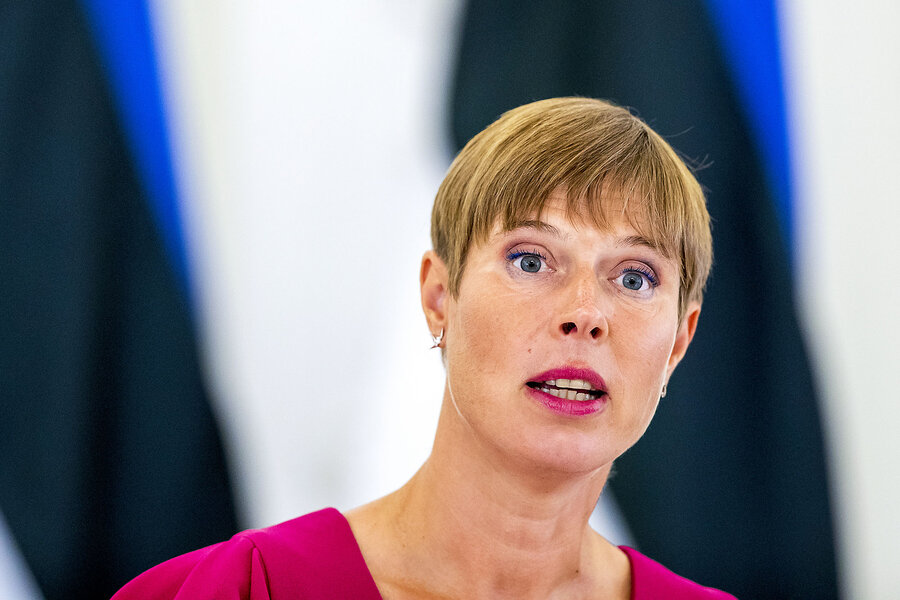
Estonian President Kersti Kaljulaid speaks during a news conference in Lithuania, Aug. 14, 2020.

Americans these days do not have much trust in government. It’s unfortunate because government does many good things. But a suspicious attitude has gained hold over the American mindset in the last few years. That’s why I look with envy at an Eastern European country that’s working really well because of a high level of trust — plus the efficient use of technology.

Lenora Chu explains at the Christian Science Monitor.

“Getting married is now one appointment easier in Estonia. The world’s most digitally integrated country launched the sacred union into the e-governance stratosphere last year – where it joined nearly every other government service you can imagine.

“Estonian citizens were already able to file taxes online, vote online, and access digital prescriptions. All of this digital activity hinges upon the Estonian smart identification system – which allows for state-recognized digital signatures – and a public trust in digital governance that’s been hard to replicate in other countries.

“ ‘I actually own my data – I can always track when someone looks at my data,’ says Kristiina Veerde-Toompalu. ‘I trust [my government].’ …

“Ms. Veerde-Toompalu got married in July, and applying online for the certificate saved her and her fiancé a special trip to her hometown’s city registrar. ‘We don’t have to go somewhere and announce our intention to get married,’ she says. …

“To deploy digital services successfully requires Estonians to trust the act of offering up to the cloud everything from birthdate and birthplace to tax information, salary, and medical diagnoses. That public trust took decades to cultivate, and ultimately relies on Estonia’s tight and transparent system of regulation.

“ ‘Paper files are not safer, because you cannot tell who looked at an analog file,’ says Kersti Kaljulaid, who served as president of Estonia from 2016 to 2021. ‘Estonian e-governance is a tightly regulated environment. … The data belongs to citizens, and you have control over who looks at your data, and you can ask them why they did. This is a luxury compared to an analog world, and I believe this is why we have this in-built trust.’

“It takes decades to build up the kind of comfort Estonia has with digitization, says Linnar Viik, a leading Estonian information technology scientist and government adviser since 1995.

‘Trust in digital channels didn’t happen overnight. It was kind of word of mouth and private and personal experience.’ …

“Trust also had to flow from leadership to the tech industry, and it did. ‘That is another layer of trust, whether you as a leader trust the experts on something you don’t understand. The politicians started to listen to the technology people and gave them space,’ says Mr. Viik.

“One such example: In 2000, Mr. Viik was allowed to convert Cabinet meetings from paper-based – at the time, they required knee-high stacks of printouts – to completely digital after one conversation with the prime minister.

“ ‘He asked, “Do we have any other examples around the world of paperless government?” ‘ recounts Mr. Viik. ‘I said, “No.” He said, “Cool, OK, do we have money for that?” ‘

“The Cabinet budget had $85,000 left for printing in that fiscal year, and Mr. Viik spent it on hardware, software, and training for Cabinet ministers and staff. What resulted was the paperless e-Cabinet: a fully wired room that drew global media attention. …

“Now Estonians not only vote and pay taxes online, but also buy property, register cars, sign job and rental contracts, and apply for unemployment benefits digitally. Nearly every service linked with a government office can be done digitally. And for many services,  citizens need not even apply, as certain entitlements are automated. That includes parental allowances and child support. Digitization also extends to health care, with every provider required to submit patient information to a centralized digital health authority. …

“ ‘The connotations [around trust] are different in different countries,’ says Mr. Viik. … ‘Other European Union governments – particularly Germany, which has a long history with government surveillance – want to mitigate all risk before digitizing. In Estonia, we would rather say, “Let’s start doing things,” and only then we can find out what are the problems we need to mitigate,’ he says.

“The paradox is that people already offer up enormous amounts of personal data to Google, Facebook, and other companies that are not only foreign but also governed independently, Mr. Viik says. ‘The institution you can control and govern is your own government – but you don’t trust? Why you don’t trust your government who is under your control?’ “

More at the Monitor, here. No firewall.

Read Full Post »

Photo: Sunday Alamba/AP.
Nigerian women find it hard to secure the bank loans needed to start a business, but social media platforms are providing alternative credit lines.

Do you know about lending circles? I learned about them when I worked at the Fed. Immigrants in the US sometimes use them to save money, waiting for their turn to get the whole pot. The circles can be risky, but they are needed.

Ogar Monday wrote for the Christian Science Monitor about a What’sApp lending circle in Africa.

“When Pricilla Yaor found a dream job that meant moving to the Nigerian capital, Abuja, there was just one hitch: There was no way she could afford rent in the country’s most expensive city. For the supermarket cashier, it was a struggle to raise the 300,000 naira ($390) she needed for a single-room flat on the outskirts of the city. Like most renters, she was expected to pay her entire annual rent in one lump sum – a typical practice among Nigerian landlords.

“Still, armed with a new job, Ms. Yaor thought she could get a loan from the bank. ‘I was given plenty of forms to fill, asked to bring two sureties, and I was asked if I had any property that I could use as collateral,’ she recalls. 

“None of this was surprising. In Nigeria, 98% of women have no access to formal credit, limiting their ability to run businesses, pay for studies, or buy a home. Ms. Yaor never returned to the bank. Even if she had met its criteria, she could not afford the 18.75% interest on a bank loan, a typical charge.

“Instead, her saving grace – and a lifeline for a growing number of women in Africa’s most populous nation – came in the form of a women-only WhatsApp group that she was invited to by a cousin. Members of the group each pool in an equal sum every month and rotate who receives the payout. …

“There were no processing charges, and a trusted member of the group was appointed as an admin. A month after joining, Ms. Yaor received 400,000 naira ($506).Soon, she joined another group to raise funds for her younger brother’s school fees. The groups also helped her buy a fridge for her apartment and later a generator to keep the lights on during daily blackouts.

Rotating saving programs, as they’re officially called, provide a safety net across much of Africa. … The use of these programs has skyrocketed in Nigeria recently – aided by technology such as WhatsApp and boosted by inflation that has soared to its highest level in two decades. 

“In the past year, some 4 million Nigerians have been pushed into poverty by inflation that has caused eye-watering price rises for everything from food staples to transport. Women have borne the brunt of the country’s debt crisis. …

“Opportunities for women lag in many fields ranging from education to income; on average, their wages are 22% lower than those of men. Meanwhile, culture and tradition have subjected women to the role of caregiver at home, for which they are not paid. What’s more, women face historical biases embedded in the formal banking system, says Okpetoritse Akperi, a financial expert with a multinational company based in Nigeria.

“As in many other developing countries, Nigerian women struggle to get loans because “creditworthiness is typically judged by the ability to repay. … Even when banking services are available, they are not accessible to half of the women who run businesses, who have to rely on cash for all transactions. 

“But that is slowly changing. Mobile credit companies such as Branch and FairMoney, boasting a combined 20 million downloads on the Google Play Store, are gaining popularity due to their lenient lending regulations.

“ ‘Technology now allows alternative credit assessments, helping women to access financial services without traditional barriers,’ says Iyonuluwa Pikuda, a financial analyst with Lagos-based Money Africa. Using WhatsApp lending groups, though, allows users to bypass any kind of formal structure altogether. …

“While the program has few overall downsides, the risks that do exist are not negligible. ‘We have had cause to report the admin of a group to the police because she refused to release the funds after everyone had sent in theirs,’ Ms. Yaor says of one such experience. But because everyone in the group is known to at least one other person, such matters are usually quickly resolved. … Members are united by their shared interest in helping each other raise funds, she points out. And the alternative is the banking sector’s bureaucracy and high interest rates.”

More at the Monitor, here.

Read Full Post »

Photo: Enita Jubrey.
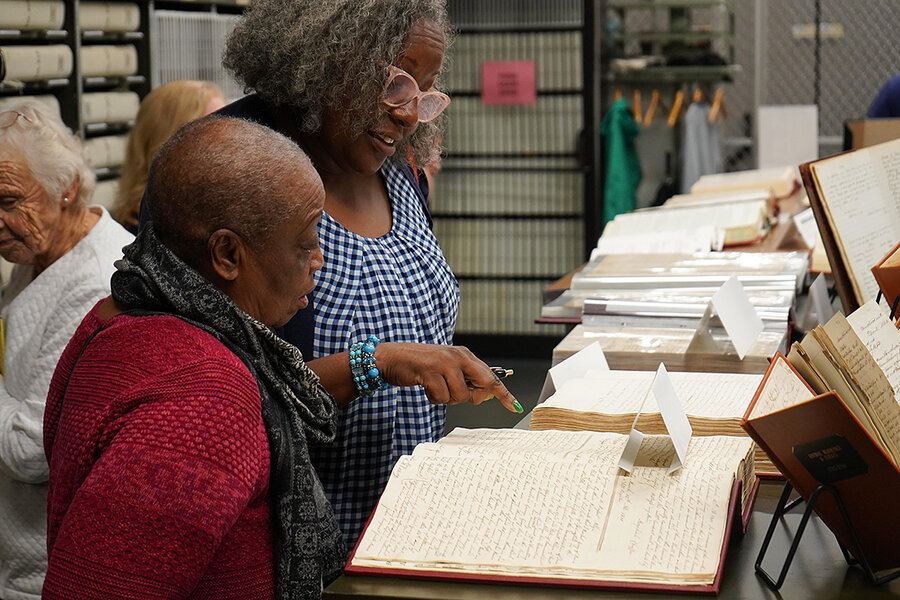
The Citizen’s Academy of Windsor, Connecticut, lets participants view historical documents dating back to the 1600s in the town clerk’s vault. 

Have you heard of the Citizen’s Academy movement? It was new to me. According to the Christian Science Monitor, there are about 1,000 in the United States. They help to build trust in local government and a sense of community.

Sarah Matusek and Sara Lang have a report at the Christian Science Monitor.

“The lifeguard’s legs disappear into the pool. A few tense seconds pass. He emerges with an arm around a limp young man whom he hauls to the deck for CPR.

“The audience applauds. Over a dozen Coloradans on bleacher seats are touring Woodland Park’s aquatic center, a sparkling, tiled complex with ample lap lanes. They convened earlier that April evening to learn about Parks and Recreation … the city department that hires local teens as lifeguards. The evening’s visit is part of an eight-week citizens academy, which ends with a graduation ceremony.

“ ‘It’s been super interesting,’ says Dan Carroll in the pool parking lot. His doubts about the building’s $11.9 million expense to the city were quelled, he says, after learning about its use.

“ ‘I’m going to promote it,’ says Mr. Carroll about the academy program. ‘I think more and more people need to know how the city operates.’ …

“The programs educate civic-minded folks about the gears of local government, and how they might chip in. Proponents also say they have a role to play in shoring up trust.

“ ‘It’s a cheap, easy, very direct way to get meaningful community engagement,’ says Michael Lawson, Woodland Park city manager. …

“The town of roughly 8,000 in conservative Teller County has had its share of community tension recently, with national attention on its school board, which has sparked local protests.

“The city itself, however, doesn’t run schools. Neither does it handle social services like food benefits – that’s the county. Explaining the limited purview of what the city does is a key feature of the citizens academy, Mr. Lawson says. …

“The programs, which go by different names, can last several weeks and are often free. Participants meet local officials like the mayor and visit a range of departments – public safety, waste management, zoning offices – led by local staff. 

“Citizens take advantage of local services daily, like when they turn on the tap or take trash to the curb, but that exists as ‘background noise for most people,’ says [Rick Morse, professor at the University of North Carolina at Chapel Hill School of Government]. Through citizens academies, he adds, ‘that faceless bureaucracy now becomes a person.’

“That’s a lesson the Decatur 101 program in Georgia tries to hit home. Participants receive ‘a book with a picture of all the people that have talked and what their job description is and what they do,’ says Shirley Baylis, business development manager, ‘so they know how to reach each of those people.’

“Dr. Morse conducted a 2016 survey of 658 citizens academy participants across six states. He found 84% of respondents said their program ‘somewhat or significantly positively’ shaped their level of trust in local government.

“A behind-the-scenes look at the water treatment plant in Wichita, Kansas, inspired a perception shift for participant Christopher Parisho. 

“ ‘I already knew it took a while and that it was really expensive, but now I had a better understanding of why,’ he says. … Understanding how your city works doesn’t just help in knowing the right person to field complaints, he adds. It can help someone ‘reach out to the right people when something is done right.’ …

“Several participants say learning about the fiscal responsibility and budgets of their towns is compelling – after all, cities and states can’t rack up debt as easily as the federal government. That includes longtime Woodland Park resident Catherine Nakai. She joined the program in early 2020, between volunteering on a local land-use board and running for City Council. 

‘I understand the budget a whole lot more,’ because of the program, says Council member Nakai. …

“Staffing is one area that citizens academies report as a challenge, in terms of the time commitments the programming demands. [And] broadening access to a wide range of residents presents another hurdle.  

“That’s why Alachua County Citizens Academy in Florida tries to ensure its sessions take place along community bus loops. In Georgia, Decatur 101 offers evening and morning sessions to accommodate different schedules.

“Matt Leighninger, director of the Center for Democracy Innovation at the National Civic League, challenges programs to think beyond the hope that spreading the gospel of government functions will automatically invoke trust. That’s a ‘defensive posture,’ he says, and not always earned. Public officials can also work to better trust their constituents.

“ ‘It’s not enough just to say: Here’s how government works,’ says Mr. Leighninger. ‘The question really should be: Here’s how a government could work,’ with more citizen input.”

More at the Monitor, here. No firewall.

Read Full Post »

Photo: Noah Robertson/Christian Science Monitor.
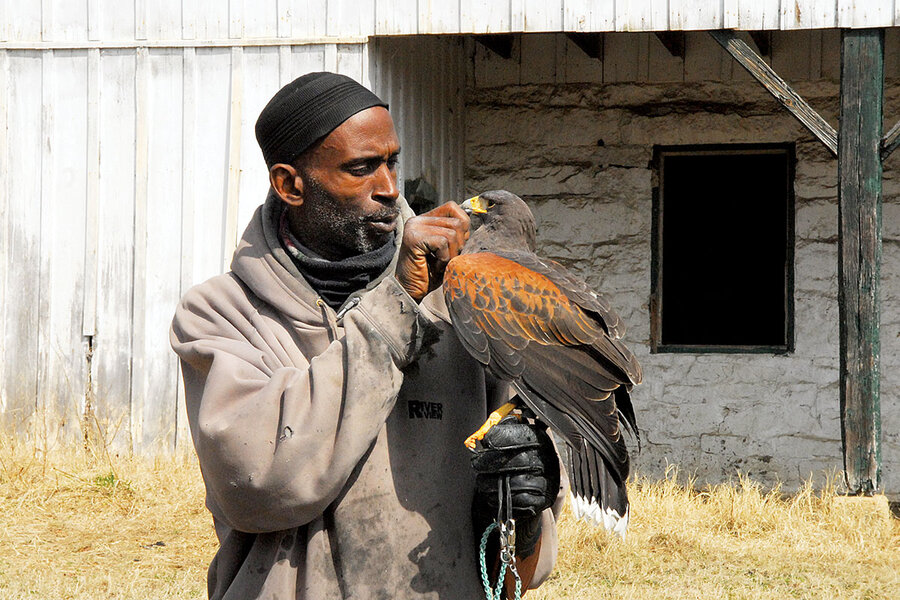
Master falconer Rodney Stotts, founder of Rodney’s Raptors, holds a Harris hawk at the Earth Conservation Corps campus in Laurel, Maryland. At ECC, Stotts works with young people who may be at risk, just as he was once.

There’s more than one way to connect with troubled teens, but sharing an interest can be key. In today’s story, we learn how getting involved with birds of prey transformed the life of a young Rodney Stotts and how he later commmitted himself to helping other kids.

Noah Robertson writes at the Christian Science Monitor, “Before young Jamaal Hyatt met falconer Rodney Stotts, the youth had never seen a bird fly from a person’s finger, disappear out of sight, and return at the sound of a whistle. He’d never fed a bird of prey, or understood the trust it takes for one to calmly perch on a person’s arm. He’d never even seen a raptor up close.

“Mr. Hyatt grew up in downtown Washington, D.C., where birds rest on traffic lights as often as trees. Two years ago, when his family felt he wasn’t focused on school, they decided to send him to Capital Guardian Youth Challenge Academy, a military school for at-risk students in Washington high schools. It was in the woods here that he met Mr. Stotts – a master falconer, mentor, conservationist, and Dr. Dolittle of sorts. 

“Mr. Stotts, too, grew up in Washington, and, like Mr. Hyatt, once barely knew a pigeon from a peregrine falcon. But more than 30 years ago, working with animals transformed him from a man of the streets to a man of the woods. He’s since become a mentor for young people facing similar challenges. 

“That mission brought him to Laurel, where his office is sandwiched between Capital Guardian and New Beginnings Youth Development Center, a youth detention and rehabilitation facility. He works with young people in each facility, giving them an outlet, a role model, and a chance to learn to trust others by learning to trust animals. …

“In three decades Mr. Stotts has worked with thousands of people on the streets and in schools, parks, jails, barns, and Zoom calls. Along the way, he founded his own nonprofit, Rodney’s Raptors, and earned his falconry license. The work is low in pay and often poignant, forcing him to confront violence, substance misuse, and loss. 

“But for Mr. Stotts, whose life is profiled in a new documentary, ‘The Falconer,’ it’s highest in personal reward. If he could change, he tells the young people he works with, so can they. …

“With a mother who struggled with heavy substance use (before later quitting cold turkey), Mr. Stotts grew up in southeast Washington during the crack epidemic. In early adulthood, he reflected his circumstances; he dealt drugs and was likely to cross up with law enforcement, he says. Then, by accident, he found animals. 

“In the early 1990s, he needed a pay stub to sign on an apartment and took a position at Earth Conservation Corps (ECC), a nonprofit then focused on cleaning the notoriously polluted Anacostia River. Bob Nixon, the program’s de facto founder and a falconer himself, helped introduce Mr. Stotts to animals and eventually birds of prey. 

‘The first time I held a bird, period, it took me somewhere else, says Mr. Stotts. …

“After a year, he stayed with ECC and eventually took charge of its raptor program, based in Laurel. … ‘He’s been engaged since the get-go – that’s the impressive thing,’ says Mr. Nixon, of ECC. ‘He really feels the nature in his bones and gets a real reward in sharing that with people.’ … 

“ ‘There’s a lot of kids out here that don’t really have anything or don’t even believe in [themselves],’ says Mr. Hyatt. ‘Seeing somebody like that … can uplift them and give them a little bit more hope.’ ”

More here.

Read Full Post »

andyandersen_st.fauci_-1080x1080-1

Art: Andy Andersen via Hyperallergic
Andy Andersen’s depiction of Dr. Anthony Fauci, of the National Institute of Allergy and Infectious Diseases, as Saint Pantaleon the Healer. Andersen, a Los Angeles area illustrator, is one of many artists reimagining the doctor as pandemic cultural icon.

Don’t you love how creative people always find ways to have fun with current events, no matter how dire? Consider this charming story by Hakim Bishara at Hyperallergic, where we learn about the art community’s take on the doctor at the center of federal Covid-19 communications, the doctor that people trust.

“Dr. Anthony Fauci, head of the National Institute of Allergy and Infectious Diseases and a member of the White House coronavirus task force, is by all accounts the man of the hour [and] being showered with praise and admiration, sometimes uncomfortably, as he became the most recognized voice in the United States on the coronavirus pandemic.

“On social media, Fauci is being celebrated with thousands of artistic tributes, from admiring portraits and cartoons to tattoos, sock puppets, and saint icons bearing his image.

“One of the most intricate tributes to Fauci belongs to Andy Andersen, an illustrator based outside of Los Angeles. His illustration depicts the famed doctor as the late-medieval Saint Pantaleon the healer. ‘Saint Fauci’ holds a box of medicine, flanked by angels of death and spikey coronaviruses.

“ ‘I based it on some of the classic saint iconography that exists,’ Andersen explained to Hyperallergic in an email. ‘The pose, the composition, the elements all reference those iconic images, but updated with references to the virus.’

“ ‘To me, Fauci is the calming, reassuring voice during this confusing and unpredictable time,’ Andersen wrote. ‘He reminds me of a grandfather who assures you that everything will be ok. It will be hard, it will most likely suck, and sh#!t will happen, but in the end, everything will be ok. The silver lining is that humanity has such a competent, intellectual powerhouse on its side.’

“Several other fans also elevated Fauci to saintdom. One of them created a ‘Saint Fauci’ votive candle with the caption: ‘Not all heroes wear capes! 🙏🙏🙏🙏’ [See @taintedsaint_ on Instagram.]

“One of the most famous public images of Fauci captures him facepalming … during a coronavirus briefing at the White House. For many Americans, the image highlighted Fauci as a voice of reason …

“Brad Albright, an artist and an illustrator based in Texas, decided to perpetuate Fauci’s facepalm with a sticker. ‘Somebody get this man some (more) medals, honors and awards!!! Seriously. He’s a saint,’ he wrote in the caption.

“In addition, there are myriad admiring portraits of Fauci online, from pencil sketches to paintings and GIFs. One such artwork, titled ‘The Explainer in Chief,’ captures Fauci explaining the disease to the press cameras. The artist, Phil Bateman, writes in the caption: ‘Who else but Anthony Fauci could tell you terrifying things and yet whose terrifying explanations made you feel better because you believed only him.’ …

“How does this intense level of attention affect Fauci himself? When asked in an interview with CBS’s Gayle King if he feels personal pressure he calmly answered, ‘It’s my job. This is the life I’ve chosen and I’m doing it.’ ”

Read Hyperallergic here. And for more on the curious manifestations of Fauci fandom, check out the Verge.

By the way, did you ever see the documentary How to Survive a Plague, about the AIDS crisis?  Dr. Fauci was in government back then, too, and in the the early 1980s, before his hair turned gray, he was definitely not considered a hero by terrified AIDS victims. Clearly, he has learned a lot. Which proves that there really are second chances in life.

Photo: Donut Crazy via the Hartford Courant
Donut Crazy has honored infectious disease expert Dr. Anthony Fauci with special doughnuts bearing his image.

oiwoz6yjrnbpjpvre2mrkujbhu

Read Full Post »

In our town, the library has launched a big campaign to raise money for an addition that will meet the evolving needs of library users. It’s already a wonderful library, and because it is the purview partly of the town and partly of an independent corporation, it has been protected from the budget cuts that have plagued many municipal libraries.

Libraries will always be important for books, but today they are also multiservice community centers that people trust. I think, for example, of the Ferguson Library, which sheltered frightened residents during days of violent clashes after the death of Michael Brown.

At the Nonprofit Quarterly (NPQ), Steve Dubb adds, “Libraries have continued to grow as their role as community hubs deepens. Here at NPQ, we have profiled libraries that have become maker spaces, supported gardening, and rented out musical instruments. …

“Yet another growing role, Emily Nonko reports in Next City, is in social service provision. Nonko notes that up to 30 libraries nationally, including in places like Chicago, Brooklyn, Denver, San Francisco, and Washington DC, have social workers on staff. A Chicago Tribune article last year mentioned  that Justine Janis, a clinical social worker at the Chicago library, was leading a national monthly conference call of social service workers on library staff.

“Nonko in particular focuses on efforts in San Francisco and Denver. [For instance, in] 2019, Denver Public Library budgeted for a team of 10, including four social workers and six peer navigators. The team, Nonko adds, supports all 26 branch locations.

“[Denver social worker Elissa] Hardy explains the Denver program’s rationale: ‘In social work we have this term called a “protective factor.” The library is a protective factor for people, which is basically a place or a thing where we’re helping to support people, and not change things negatively for them.’

“Certainly, anything that increases social supports is likely to improve public health. As the Brookings Institution and the Robert Wood Johnson Foundation have argued, the US underspends on social supports (and overspends on clinical care). In the American Journal of Managed Care, Ara Ohanian notes that, ‘On average, OECD [Organization for Economic Cooperation and Development] nations spend $1.70 on social services for every $1 on health services; whereas the US spends just 56 cents.’ …

“Libraries, of course, are just one piece of a larger puzzle, but they do make a difference. Leah Esguerra, who was the first clinical social worker hired by the San Francisco library system, tells Nonko that, ‘The idea was to reach out in a way that’s compassionate.’ Now, Nonko explains, the San Francisco Public Library now has a team of five that supports Esguerra. These social workers inform patrons about resources and services and have helped at least 130 people find stable housing.”

More at NPQ, here. My local library is not planning those kinds of services, but it’s positioning itself for the future. And to that end, it has interviewed an impressive range of constituencies, sometimes more than once. Very soon there will be new items available like seeds and tools you need only once in a while. There will be spaces just for teens or for adults to have coffee and chat. There will be improved areas for children, a shared garden, and more.

Read Full Post »

Photo: Francis Pakes
The view from the Icelandic prison that a criminology researcher asked to stay in.

Abusing people who commit crimes is no longer considered effective for keeping them on the straight and narrow after they serve their time. For a different approach, consider Iceland, where two of the five prisons actually have no locks.

Francis Pakes, a professor of criminology at the UK’s University of Portsmouth, took a firsthand look and wrote about his experience for the Conversation.

“Iceland is a small country tucked away on the edge of Europe. It has a population of only about 340,000 people. Iceland’s prisons are small too. There are only five, altogether housing fewer than 200 prisoners. Of these five, two are open prisons. …

“When I asked the prison authorities in Iceland if I could spend a week in each of the two open prisons they were surprisingly receptive. I got the impression that they quite liked the idea: a foreign academic who wanted to get under the skin of these places by assuming the role of a prisoner. They promised to keep a room free for me. I was grateful and excited. I was going to experience both prisons from the inside. …

“The absence of security features was striking. The first prison I stayed in, Kvíabryggja prison in the west of the country, had little in the way of perimeter security. There is, however, a sign instructing passers by to keep out – mainly aimed at tourists. I could simply drive up to the small, mostly single-storey building and park up. I then walked in (yes, the doors were open) and said hello. …

“It was clear from the outset that prisoners and staff do things together. Food is important in prisons and in Kvíabryggja the communal dining room is a central space. It is where prisoners have breakfast, lunch and dinner together with staff. Prisoners cook the food, and with an officer they do the weekly food shop in a nearby village. Food was plentiful and tasty. It is considered bad form not to thank the prisoner chefs for their efforts. And you have to clean up after yourself. …

“Prisoners have their own room keys but they leave their doors unlocked, pretty much at all times. This is a potent symbol: life in Kvíabryggja is all about trust. I found that difficult at first, knowing that my passport, rental car keys and research notes were all in my room. In the end I did what prisoners do and even slept with the door unlocked. I slept like a baby. …

“It was the informality of the interactions that struck me most. We watched football together. … I got teased a bit of course, as all prison researchers do. But prisoners also shared gossip and many prisoners and staff alike shared very personal, even intimate feelings and stories with me. When Pétur gained his freedom and his dad arrived to pick him up, he hugged many prisoners and staff goodbye, including me. We all got a bit emotional.

“Kvíabryggja is of course still a prison. Many prisoners feel frustrated, angry, anxious, struggle with their health and worry about the future. But the environment is safe and the food a delight. There is contact with the outside world, generous visiting arrangements, and there is always a listening ear. As prisons go, this means a lot.

“This remote prison and with no more than 20 prisoners, and around three staff around at most at any time, is a tiny community. Prisoners and staff smoke together in the cramped but ever busy smoking room. They need to get on.

“Life is defined by these informal interactions. This is not necessarily easy. This prison population is highly mixed. There are female prisoners, foreign nationals and prisoners of pensionable age or with a disability all mixed in together. …

“The importance of getting on is a take away message. This is far harder to achieve in large busy prisons where new prisoners arrive and leave every day. But just like community policing works best if most public interactions are friendly, a prison is a more positive place if most interactions are friendly and benign too.”

More at the Conversation, here.

Read Full Post »

Photo: Clay Masters/IPR
Storm Lake Times Editor Art Cullen stands outside newspaper he started with his brother in 1990. The newspaper won a Pulitzer Prize this year for its editorial writing.

I’ve been following a twitter discussion about why big newspapers are doing more reporting via video. Critics contend the move is about pleasing advertisers and is hurting quality.

Judging from a recent National Public Radio (NPR) story on small-town newspapers, I think the big outlets would be better off focusing on building trust with readers.

Clay Masters reported, “Large media outlets could learn from small town newspapers about being authentic and winning the trust of readers. …

“Take the Storm Lake Times [in Iowa], for example. It recently gained national attention when this twice-a-week newspaper for this town of around 11,000 people won a Pulitzer Prize for its editorials. They won the prestigious journalism award for challenging powerful corporate agribusiness interests in the state.

” ‘We inform each other through the newspaper about the reality of Storm Lake,” says Editor Art Cullen. …

“Their classified section is pretty robust … and there’s even a section devoted to local birthdays. Art Cullen says newspapers like his are the thread that holds the fabric of a small town together.

” ‘They know we’re honest and they know we love Storm Lake … that we stick to the facts of a story, and we will argue, argue, argue on our editorial page.’ …

“One of the big differences between larger metro newspapers and community journalism is the staff has to face its audience every day.

” ‘People have no problem coming up to me and telling me what they think of the newspaper,’ says Jim Johnson, who owns newspapers in Kalona and Anamosa, two small newspapers in eastern Iowa. …

“Johnson has the advantage of owning small town newspapers near metro areas. When this former Omaha World-Herald editor bought the papers in Kalona and Anamosa, he wanted to show community newspapers can do just as good or better than large papers.”

More at NPR, here.

Read Full Post »

In spring 2008, during a sometimes distressing primary season, an African American coworker and I decided to try something under the radar at work.

We decided to invite other colleagues of good will to help create a monthly lunch-hour discussion group on Race in America.

At first it was slow going. Some people we invited were suspicious. Would we be seen as troublemakers? Was it “legal”? Would it be just a gripe fest about our workplace?

My friend was supervising our high school interns at the time, and several of those showed up. One or two white employees came. Black colleagues were more wary. On days that no one came, one of us was bound to say to the other, Maybe this isn’t going to work. At which point, the other would say, Let’s give it another month.

Little by little, attendance grew. We kept the focus on topics in the news and participants’ life experiences. There was no agenda. We’d say, Does anyone have a topic they want to discuss today? There were always topics. We agreed to keep what was said inside our basement meeting room. There was zero hierarchy. What everyone brought to the table was openness and a willingness to listen.

We listened. We asked questions. We argued, with respect. We laughed. We worried. We learned. There were so many gradations of opinions, based on individuals’ experiences. There was never unanimity of one race versus another.

One participant said last year the monthly discussions had really opened his eyes and changed some of his views profoundly.

My friend retired a couple years ago and I left in January, but the group is still going strong under new leaders. I really miss it. I cannot tell you how many times I have wanted to hear what members have to say about something in the news or something I see in my town. I feel like I hardly know my own views without adding the nuances of what my former colleagues are thinking and feeling.

This past week, I’ve read lots of advice about what people of good will can do about race relations and injustice: join demonstrations and meetings, write government representatives, open their hearts to losses on both sides, listen to young activists, stand on their right not to show an I.D. (Fifth Amendment). Maybe some of those ideas are good.

But I still love the idea of creating a group where people of different races and backgrounds listen to one another’s way of seeing things. Over the eight years, Race in America members have come and gone, but participants routinely say that the group works because of the trust that is built.

For getting started, it worked well that we were two friends — one identifying as African American, one as Caucasian. She needed me, and I needed her. I never felt I should go up to a black colleague I didn’t know and pitch a discussion on race. She was a star at that.

Maybe it’s a hopelessly small thing for combating what we see in the news. But I do think people of different races have too few opportunities to listen to one another about matters that touch the heart.

120715-Fed

Read Full Post »

bitcoin-machine-at-South-StationA friend is doing research on bitcoin and other virtual currencies.

Although it sounds like phoney money to me, I still honor the lesson I got in fourth grade about how a dollar represents trust. You trust when you receive it that it will be accepted by someone else in exchange for something you want. You trust the entity that backs it. Today people are using virtual currencies like real money, so trust is working so far.

But does it all remind you of the company that used to accept your money and promise to do your worrying for you? Or how about virtual gift giving, which enjoyed a flurry of attention in the media a while back. (The gift company will e-mail your friend that you “bought” a virtual gift. The concept is based on the premise that it’s the thought that counts. VirtualGifts4U.com, for one, just asks you to support its sponsors.)

I took this picture at Boston’s South Station, where, during specified hours, a friendly young man will explain how you can buy bitcoins at this machine. I haven’t chatted with him, so I don’t know if he also explains that the value of your bitcoins can not only go up in an hour or two but go way down.

There is no significance to the fact that the machine is located right next to an endlessly running “If you see something, say something” security video.

Read Full Post »