Feeds:
Posts
Comments

Posts Tagged ‘Turkey’

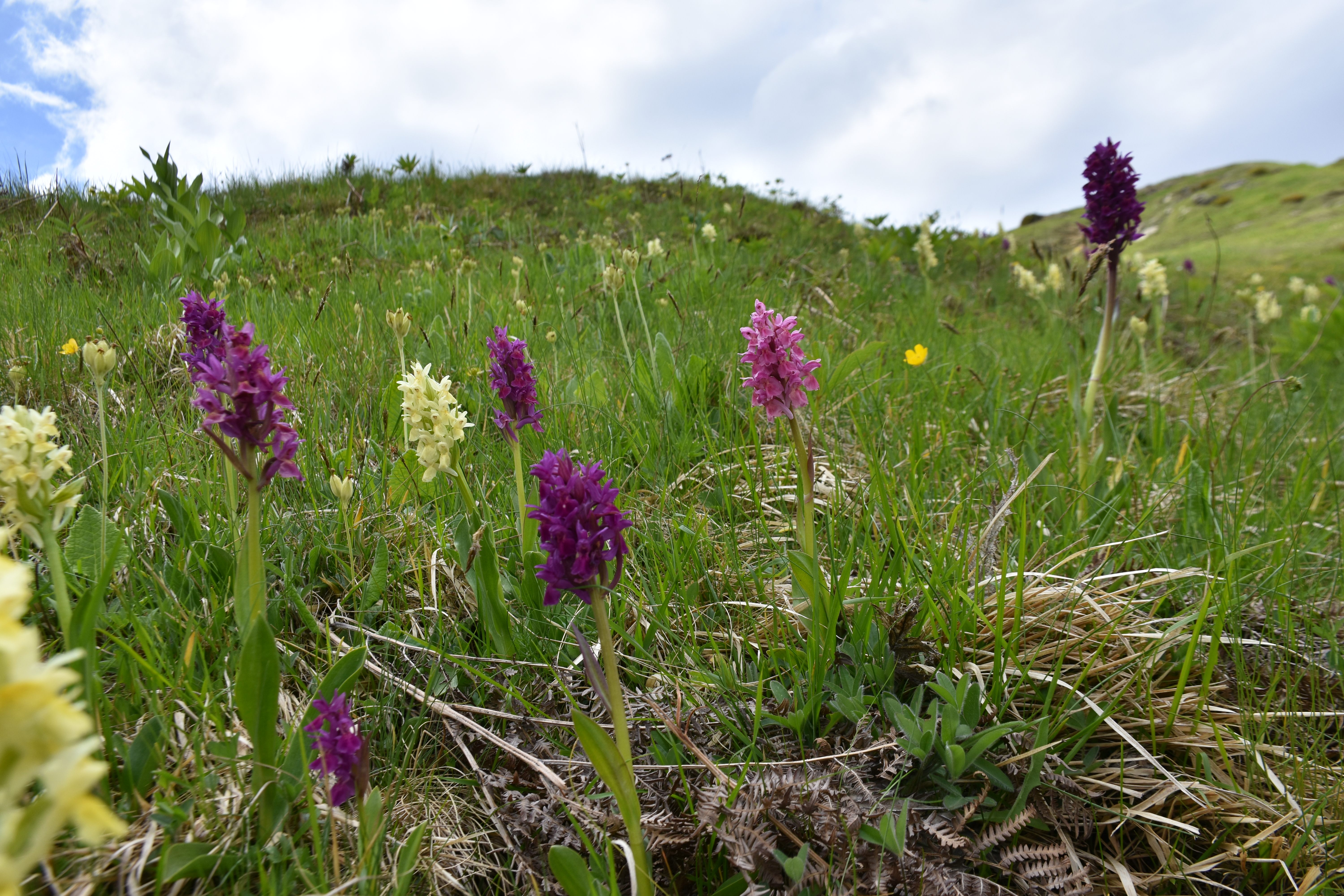
Photo: Kalliopi Stara.
Powdered orchid bulbs are the main ingredient of the popular Middle Eastern drink called salep, or sahlep. But the orchids are endangered.

One of my sources for this blog is the international radio show called The World. It posts recordings of episodes and sometimes transcripts. I like to have a transcript, and if there isn’t one, I try to see if I can find the story elsewhere. Durrie Bouscaren at The World got me interested in today’s topic on some endangered orchids, and then I was able to find a 2023 Atlas Obscura piece to use as text.

Here is Vittoria Traverso writing about the Turkish beverage called salep at Atlas Obscura.

“For Kerem Özcan, a data scientist based in Amsterdam, winters in his home country of Turkey would not have been the same without salep, a hot drink made of crushed orchid roots, milk, and sugar. On ski trips to the mountains of Uludağ, ‘we’d always end the cold and tiring day with a salep,’ he says. Özcan, who left Turkey in 2013, is one of the many Turkish people living abroad who thirsts for salep. ‘I tried to quench it with eggnog a couple times, but it didn’t cut it for me,’ he says.

“Much like eggnog, salep is a staple winter drink, and it is enjoyed throughout Turkey, Greece, and parts of the Middle East. Part comfort food and part medicine, it is a popular folk remedy for everything from stomachache to impotence.

“In recent years, increased interest towards plant-based drinks and traditional foods has fueled a surge in demand for salep. But the craze is taking a toll on the drink’s key ingredient.

It can take as many as 13 orchid bulbs to make one cup.

“Currently, wild orchids are considered endangered in many parts of Greece and Turkey due to overharvesting, drought, and habitat degradation.

“It’s hard to say when and where salep originated but historical evidence suggests ancient Greeks and Romans consumed a similar beverage. Özge Samanci, head of the Gastronomy and Culinary Arts Department at Özyeğin University in Istanbul, explains that the Greek doctor Dioscorides described the medical properties of orchid roots in his first-century treatise De materia medica. Roman doctors also used bulbs to prepare a beverage called satyrion, a Latin word for orchid, as an aphrodisiac.

“During the Ottoman Empire, salep was a medicinal staple. ‘There is evidence that salep was consumed in palaces of the Ottoman Empire as early as the 15th century,’ Samanci explains. …

A journal entry by Jane Austen in 1826 describes the taste of salop as ‘nectar.’

“ ‘Tea is great, coffee greater; chocolate, properly made, is for epicures; but these are thin and characterless compared with the salop swallowed in 1826,’ Austen wrote.

“While salep is no longer a part of English daily life, it is still considered a winter must in Turkey. … Until recent times, salep was considered a special treat. ‘Drinking salep is usually a moment of luxury,’ Samenci says. ‘It’s not something you drink four times a day like coffee.’ …

“Interest in traditional and more wholesome foods is putting pressure on salep’s key ingredient. Orchid powder is made from the bulbs from the OrchisOphrys, and Dactylorhiza which include about 109 species of orchids mostly native to North Africa and Eurasia. In order to make salep powder, also known as ‘white gold’ for its market value, foragers dig orchid plants out of the soil with small shovels. Then, the round roots of each plant are harvested, cleaned, boiled, dried, and crushed into powder. This orchid powder can sell for up to 80 US dollars per pound.

“A few farms do cultivate orchids for salep, but it’s a difficult and expensive endeavor. The vast majority are still foraged in the wild. Most wild orchids used to make salep are listed as protected species under the Convention on International Trade in Endangered Species (CITES) which regulates the trade of endangered animals and plants. In theory, protected orchid plants should be traded across national borders only with documentation certifying that they have been harvested or cultivated sustainably. However, orchids are one of the most sought-after species on online platforms that sell illegally sourced wildlife. …

“Susanne Masters, an ethnobotanist at Naturalis Biodiversity Center in the Netherlands [advises] people to avoid consuming salep at all to avoid further endangering wild orchids. ‘To consume salep sustainably you would need to be growing your own, or personally know and trust a person who is a custodian of a landscape in which the orchids used for salep are growing.’ ”

The long, fascinating article is at Atlas Obscura, here.

Durrie Bouscaren first got me interested with her update at Public Radio International’s The World. You can listen to her story here. No paywall for either site.

Read Full Post »

Photo: Serhat Cetinkaya/Anadolu/Getty Images.
A 8,600-year-old bread was found at the Neolithic archeological site at Cumra district in Konya, Turkey. 

You never know what you’ll find once you start digging. That’s true for many kinds of knowledge — and of course, for archeological sites. Consider this site in Turkey and the world’s oldest piece of bread.

Vishwam Sankaran has an interesting report at the Independent.

Archaeologists in Turkey have uncovered what could be the oldest known piece of fermented bread made by humans at a site dating back to around 6,600 BC.

“The piece of bread was discovered in Turkey’s central Anatolia in the ancient stone age site of Çatalhöyük – one of the largest and best-preserved remains of an early agrarian society around 8,600 years old. Researchers suspect the early human settlement in the Turkish province of Konya flourished between 6,700 to 6,500 BC. …

“Artifacts and structures uncovered at the site over the years suggest the residents of Çatalhöyük were pioneers of early farming, known to have cultivated wheat and barley as well as herding sheep and goats.

“The Unesco World Heritage site was one of the world’s first places of urbanization, accommodating over 8,000 people in its heyday between around 10,000 BC to 2,000 BC.”

For more details, listen to an audio at Public Radio International’s The World, here.

And at PNAS, here, you can read related research on the origins of bread. Amaia Arranz-Otaegui et al describe “the earliest empirical evidence for the preparation of bread-like products by Natufian hunter-gatherers, 4,000 years before the emergence of the Neolithic agricultural way of life. The discovery of charred food remains has allowed for the reconstruction of … the early production of bread-like products. [The] results suggest the use of the wild ancestors of domesticated cereals (e.g. wild einkorn) and club-rush tubers to produce flat bread-like products.”

Read Full Post »

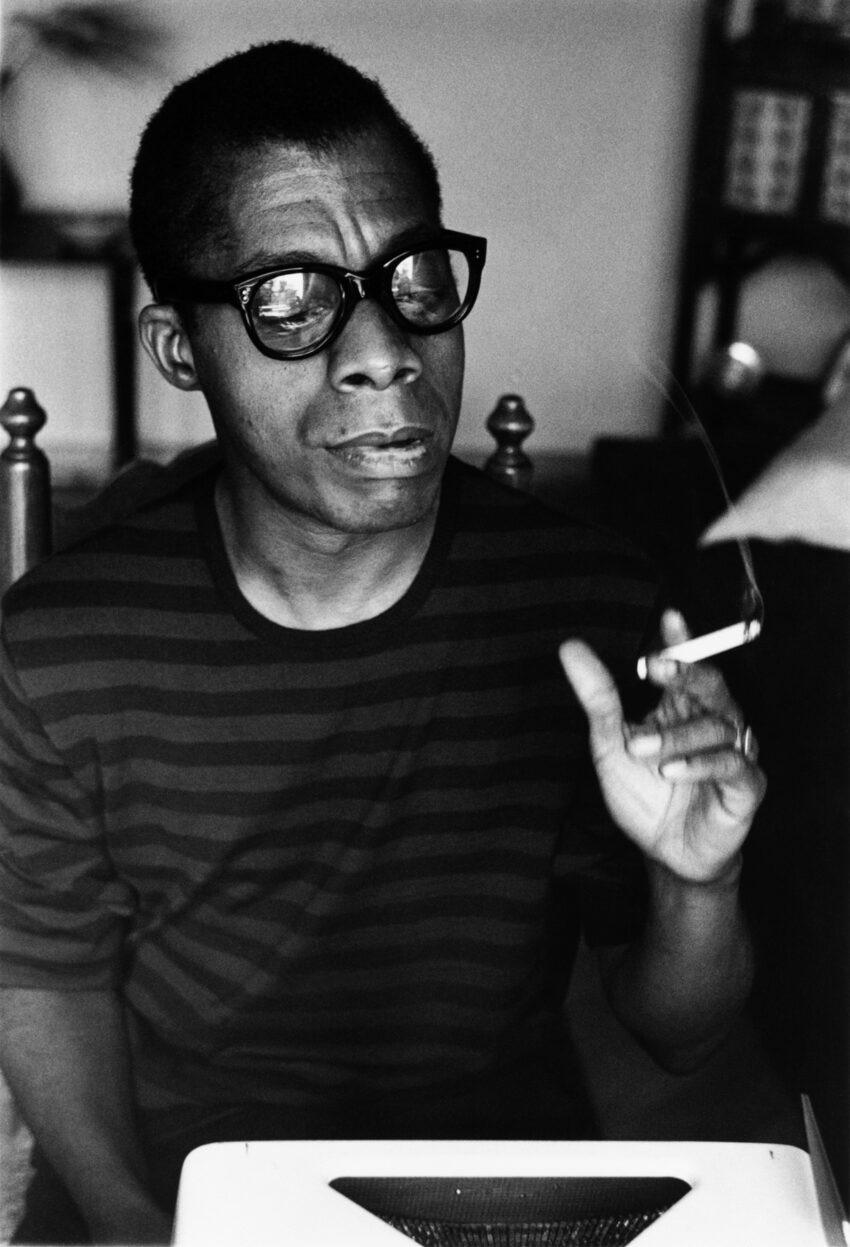
Photo: Sedat Pakay, Hudson Film Works II.
James Baldwin in Istanbul in 1966.

James Baldwin didn’t kid himself about life in America for a gay Black man in the 1960s. He traveled widely and lived for long stretches in countries he found more hospitable. (A 2016 post, here, addresses an effort to preserve a house he bought on the Côte d’Azur.)

I knew about France but not Turkey, which Azareen Van der Vliet Oloomi writes about in the Yale Review.

At the beginning of the “11-minute black and white documentary, James Baldwin: From Another Place, directed by Sedat Pakay and filmed in Istanbul in May 1970, … he turns his back to the cam­era and opens the curtains. A sharp Mediterranean light floods in. Baldwin scratches the small of his back, and we hear him say in voiceover: ‘I suppose that many people do blame me for being out of the States as often as I am, but one can’t afford to worry about that because one does, you know, you do what you have to do the way you have to do it. And as someone who is outside of the States you realize that it’s impossible to get out, the American powers are everywhere.’

“The camera pans over the glittering Bosphorus Strait as American ships glide silently through the passage connecting Asia and Europe.

“Pakay’s film has long been almost impossible to see in the United States, aside from a short clip on YouTube. But in February, it began streaming on the Criterion Channel, and its reappearance is a useful occasion to re-examine one of the most important, and yet relatively unknown, aspects of Baldwin’s career: his time in Turkey.

“At the time Pakay made his film, Baldwin had been living in Istanbul intermittently for almost a decade. He first arrived there in 1961, broke, emotionally spent, and struggling to complete his third novel, Another Country. The Turkish actor Engin Cezzar, who had met Baldwin in New York in 1957 when he was cast as Giovanni in the Actors Studio adaptation of Giovanni’s Room (Baldwin’s sec­ond novel), had given him an open invitation to visit, and follow­ing a demoralizing trip to Israel, Baldwin showed up on Cezzar’s doorstep.

“He quickly made himself at home, and over the next ten years lived irregularly in Istanbul, Erdek, and Bodrum, socializing with the Turkish intelligentsia and a small circle of Black artists and activists who were living in Turkey or passing through.

“Istanbul offered Baldwin a refuge during the tumultuous decade of the 1960s. In a 1970 conversation with Ida Lewis for Essence mag­azine, Baldwin said of his decision to move to the city, ‘It was very useful for me to go to a place like Istanbul at that point in my life, because it was so far out of the way from what I called home and the pressures.’ …

“Baldwin had first left the United States, for Paris, in 1948, and had lived out of the United States for years prior to his arrival in Istanbul. But the clarity and safety afforded by his time there allowed him to more sharply articulate America’s assaultive realities and to give expression to the connections between his personal wounds and the scars of racialized political history. …

“[His] layered inner landscape mir­ror the city’s multifaceted character, with its refusal of neat distinc­tions between tradition and modernity, East and West, Christianity and Islam.

“Istanbul was a liminal space of healing for Baldwin, a writing haven that he saw as having saved his life. As [Magdalena Zaborowska, author of James Baldwin’s Turkish Decade] notes, this may explain why the Baldwin we see in Pakay’s documentary is far more relaxed and at ease than the Baldwin we are accustomed to seeing in American media from that era.

“And yet, Baldwin’s decade in Turkey remains an enigma and a lacuna in our collective imagi­nation. Zaborowska’s is the only book-length treatment of Baldwin’s time there, and even people familiar with Baldwin’s writing are often unaware he ever lived in Istanbul. … What does the warm, vul­nerable, and playful Baldwin captured on film by Pakay tell us about his need to leave America time and again in search of safety?

“The respite Turkey offered Baldwin, combined with Istanbul’s vibrancy and the warmth with which he was received, sparked one of the most prolific periods of his artistic life. In 1961, when he first arrived, he was haggard and exhausted. 

“His trip to Israel had deep­ened his disillusionment with Christianity, and he was still mourn­ing Eugene Worth, a Black socialist and dear friend, who, in 1946, had killed himself by jumping off the George Washington Bridge. In addition, Baldwin had been trying without success to complete Another Country, his courageous and groundbreaking exploration of bisexuality and interracial love.

“Worth’s death, which Baldwin memorializes in Another Country, had devastated Baldwin for years, and he had tried and failed again and again to finish the novel until he was delivered from the strain of severe writer’s block in Istanbul. Baldwin wrote the book’s final sentence while at a party at Cezzar’s house in what he described as ‘the city which the people from heaven had made their home.’ …

“The years Baldwin spent off and on in Turkey coincided with one of the country’s most vibrant and expansive periods. The 1950s in Turkey had been a period of economic decline, ruthless author­itarianism, and iron-fisted censorship, a confluence of negative forces that gave rise to mass mobilization and to student-led pop­ular protests. …

“By 1965, free elections had been restored, and liberal constitutional reform had significantly expanded freedom of speech. The nation’s position as a strategic U.S. ally had been salvaged, but its cultural flowering continued, along with anti-imperialist and anti-capitalist move­ments similar to those that were emerging elsewhere around the world. Baldwin’s work and lived experience spoke directly to the political and aesthetic debates of the time. In Turkey, in a context of cultural ferment, Baldwin was revered as a major American and transnational writer, rather than being put in a position of having to prove his legitimacy over and over.

“Still, even in Turkey, Baldwin could not fully escape America. During the Cold War, relations between the United States and Turkey were founded on military collaboration and cooperation; the United States sent ships to Turkish waters to counter the threat of Soviet expansion, making Turkey a source of anti-Soviet mil­itary aid. As Baldwin said to Sedat Pakay, ‘American powers are everywhere.’ His feelings fluctuated between entrapment, the sense that no matter how far he traveled from the violence in the United States he could not, existentially speaking, ‘get out,’ and the feelings of transcendence and revival that Cezzar’s warm hos­pitality and Turkey itself afforded him.”

More at the Yale Review, here. No firewall.

Read Full Post »

Photo: Jay Thakkar.
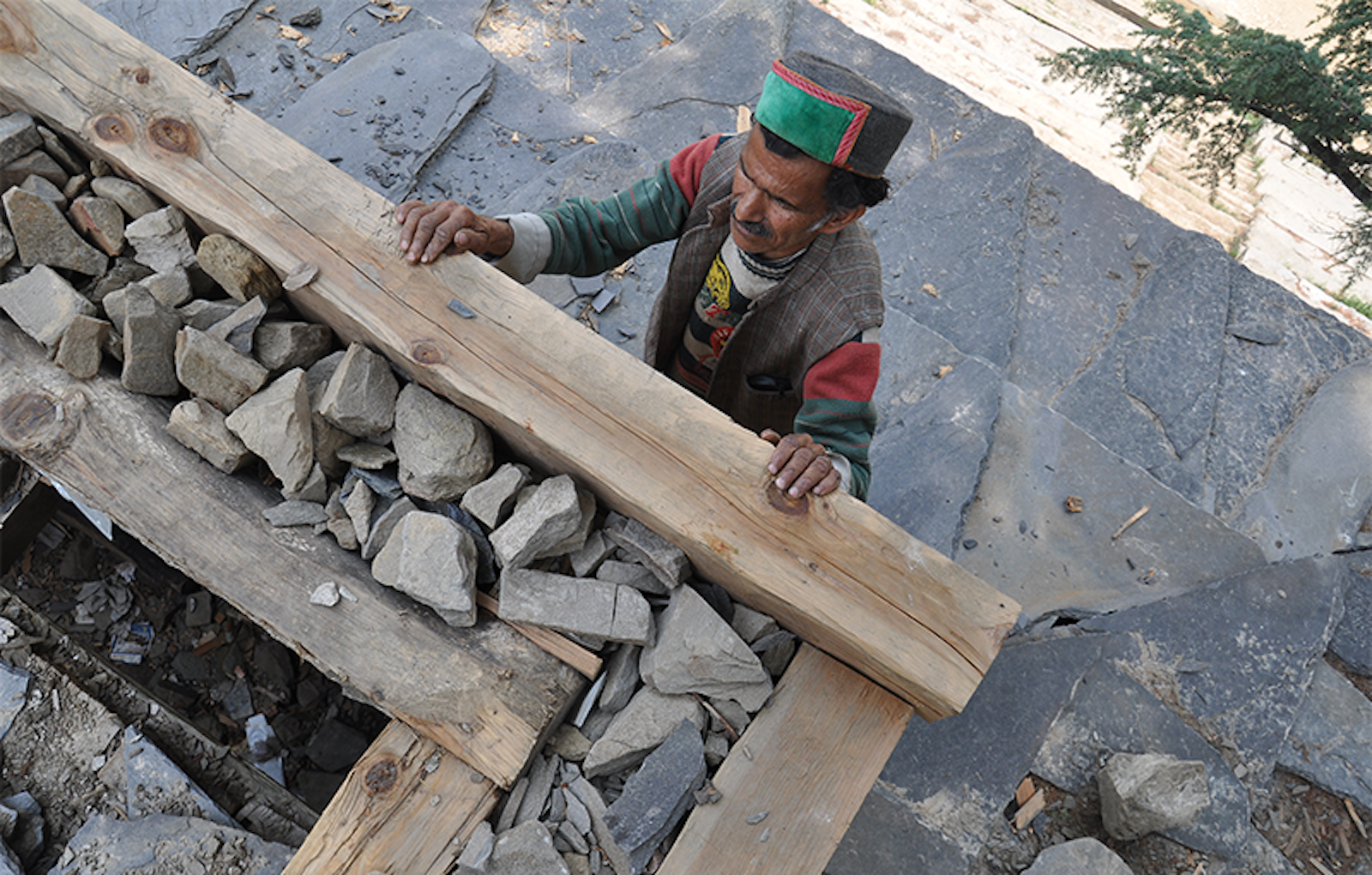
A worker examines a wooden beam in a traditional Indian kath kuni building. These earthquake-resistant structures lack metal and mortar, allowing them to flex as needed during a tremor.

I keep learning about ancient construction techniques that beat modern ones. Remember the post about self-healing concrete, here? That was in Rome. Today’s story explains why some buildings in Turkey and Syria withstood the earthquakes in February and points to ancient buildings in northern India.

Shoma Abhyankar writes at Nautilus, “The powerful 7.8 magnitude earthquake that struck Turkey and Syria on February 6 killed almost 50,000 people, most of whom died under rubble.

“The tragedy falls in a decades-long history of outsized death and destruction from recent earthquakes: The 1999 İzmit earthquake near Istanbul killed at least 17,000 people. … The immediate cause of the human tragedies was not the shaking ground itself, but the buildings people were in, most of which were constructed of reinforced cement concrete, a relatively quick and cheap building method.

“Earthquakes don’t have to be so deadly, say scholars who study this issue. Many traditional buildings have stood the test of time in regions that have endured high seismic activity for centuries.

“In Japan, people had long built earthquake-resistant structures mostly from wood. But a different tradition shows that even stone buildings can withstand vigorous shaking — if they are built with clever physics and architectural adaptations, honed over the centuries.

“In the mountainous region of Himachal Pradesh in India, near where the Indian Plate is colliding with the Eurasian Plate, many structures built in the kath kuni style have survived at least a century of earthquakes. In this traditional building method, the name, which translates to ‘wood corner,’ in part explains the method: Wood is laced with layers of stone, resulting in improbably sturdy multi-story buildings.

“It is one of several ancient techniques that trace fault lines across Asia. The foundations for the timber lacing system of architecture may have originally been laid in Istanbul around the fifth century. … Despite their ancient origins, this model of construction has mostly fared better over centuries than much of the contemporary building across the continent’s many active seismic zones.

“Built along the natural contours of the hills, kath kuni buildings typically get their signature corners from giant deodar cedars, which grow upward of 150 feet tall and 9 feet across in the Himalayas. These wooden beams layer between dry stones, which create walls. A single wooden ‘nail’ joins the beams where they come together.

“As the ponderous-looking structures rise vertically, usually up to two to three stories, the heavy stone masonry reduces, giving way to more wood. The overhanging roof typically has slate shingles resting on wooden beams. ‘The structure is like a body with heavy base, the projecting wooden balconies are limbs, and the heavy slate roof is like a head adding stability to the structure,’ says Jay Thakkar, a faculty member at the Centre for Environmental Planning and Technology University in Ahmedabad, India, who co-authored the book Prathaa: Kath-kuni Architecture of Himachal Pradesh

“The buildings stand free of any mortar or metal, which makes them more capable of shifting and flexing along with torques in the ground. This brilliance of mobility even continues underground. They are built over a trench at least a few feet deep filled with loose stone pieces that works as a flexible plinth. While a building constructed out of what seems almost like rubble to begin with might seem a strange defense against earthquake damage, it works. The gravitational force of the structure itself holds the stones in place.

“ ‘Unlike the cement brick wall, which becomes a single solid mass, the dry stone masonry is flexible,’ Thakkar says. ‘Staggered joints allow the external forces like tremors of earthquakes to be dispersed through the masonry thus preventing cracks in walls.’ He adds, ‘The wooden pin at the corner joint of two beams also allows movement. So when an earthquake hits, the structure sways and shakes but doesn’t collapse.’ ”

More at Nautilus, here. No firewall.

Read Full Post »

Photo: Nicole Tung for NPR.
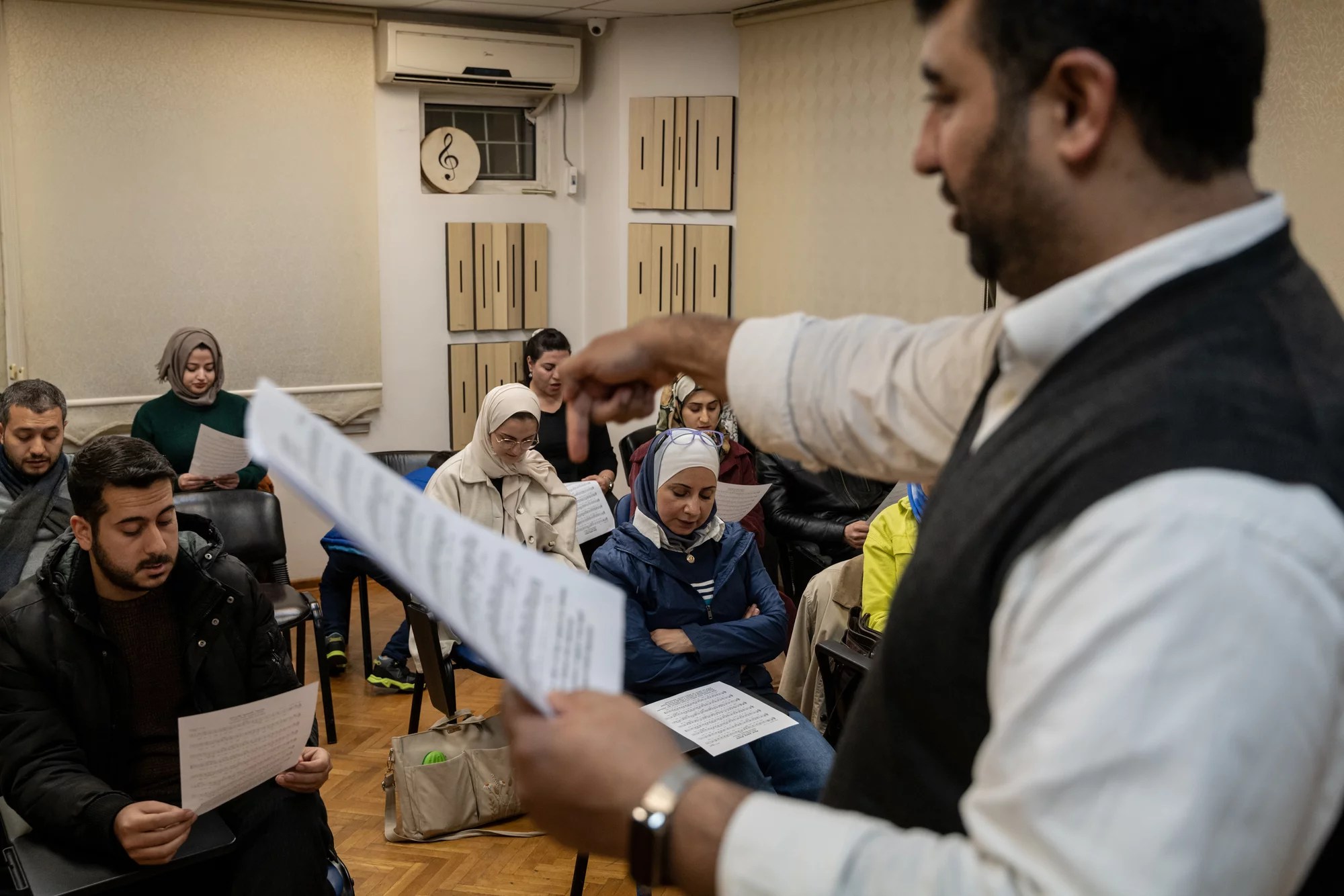
Ibrahim Muslimani, 30, speaks to a class about a piece of music blending different eras and languages at the Nefes Foundation for Arts and Culture, which he cofounded in 2016, in Gaziantep, Turkey.

Today’s story is about how the arts can help victims of disasters get their bearings again.

As Fatma Tanis reported recently at National Public Radio (NPR), “When the powerful earthquake rocked her home in early February, 18-year-old Sidra Mohammed Ali woke up and thought of one thing: her music school — was it OK?

“The next day, as survivors all over southern Turkey were taking stock of the destruction and checking on loved ones, Mohammed Ali rushed to the school, the Nefes Foundation for Arts and Culture, and took a deep breath of relief when she saw it was still standing, only having sustained some minor damage.

‘This school is my sanctuary from the stress of life as a Syrian refugee in Turkey,’ she said. ‘I couldn’t bear the thought of something happening to it.’

“The Nefes Foundation was created by Syrian and Turkish musicians in the city of Gaziantep in 2016. They have group classes where they try to revive forgotten Syrian classics and integrate Turkish and Syrian cultures with music that the two have shared for centuries.

“The school also offers private music lessons on the piano and Middle Eastern instruments like the oud (a pear-shaped string instrument), the kanun (a plucked zither) and the ney (an end-blown flute).

“But more than six weeks after the Feb. 6 disaster, life in the earthquake zone is far from back to normal. The magnitude 7.8 earthquake killed more than 55,000 people in Turkey and neighboring Syria. It damaged or destroyed hundreds of thousands of buildings and left 1.5 million people without a home in Turkey alone, according to the United Nations.

“The school had not been able to resume classes until [March 2023], when only three students, out of many dozens, showed up to sing and play.

“Before the earthquake, the school would be packed on weekday evenings, with students ranging from ages 6 to 50, mostly Syrian, but some Turks attended as well.

“The classes are bilingual — in Turkish and Arabic. And that was especially important, according to Ibrahim Muslimani, a Syrian classical musician from Aleppo, who is the brains behind the organization.

” ‘Because some of the young Syrian kids have spent most of their lives here in Turkey and are more fluent in Turkish,’ he told NPR in November 2022. ‘We’re trying to preserve our Syrian cultural identity but also getting to know the Turkish identity through art.’

“Turkey hosts 4 million refugees, the largest number of any country, according to the U.N. refugee agency. The vast majority are Syrians who fled the civil war.

“In the early years of the Syrian civil war, which started in 2011, Turkey had a generous open-door policy toward Syrian refugees. But without broad integration initiatives by the Turkish government, life for many of the refugees has been difficult.

“More recently, politicians in Turkey who oppose President Recep Tayyip Erdogan have scapegoated refugees for the country’s economic problems, leading to a rise in discrimination and hateful attacks. …

“Mohammed Ali, who studies medicine at university and the kanun at the music school, said last weekend the school has been a lifeline for her. She has a bleak outlook on her future, and doesn’t believe that the people in Turkey will ever accept her existence in the country.

” ‘But anytime I have an upsetting encounter, my Turkish teachers and friends here comfort me,’ she said. …

“Rafeef Saffaf Oflazoglu fled Aleppo in 2013 after a near-death encounter. She comes from a family that’s passionate about classical Arabic music. To be able to continue exploring her love of music in Gaziantep was priceless, she said.

“The school also introduced her to centuries-old Turkish songs from the Ottoman archives, and old tunes that traveled from Istanbul to Aleppo. Studying those shared melodies made her feel closer to the culture in her new home.

“Having to go without classes after the earthquake was harder than she expected. ‘After maybe 10 days, I just figured out, like the thing I miss most is art,’ she said, even though she was living in her car at the time. ‘People under trauma react in different ways. It’s not just about singing, you know? It’s spiritual.’

“For Muslimani, the earthquake was a triggering reminder of how he had lost everything a decade ago in Aleppo. … The civil war in Syria destroyed much of the country’s cultural output, along with the lives of millions of Syrians. Muslimani has a mission to keep Aleppo’s traditional form of music, al-Qudud al-Halabiya, alive from Gaziantep.

“He and other Syrian artists also record music at Nefes. ‘I promised my teacher that I would immortalize those precious pieces in the best form possible,’ he said. ‘With the proper orchestra and the glory that they deserve.’ …

“The Nefes Foundation, which survived on donations and fees for private lessons, is now at serious risk of closing down, said Muslimani. They don’t have the funds to pay for next month’s rent. …

” ‘The mere thought of losing this place… it’s unbearable.’ “

More at NPR, here.

Read Full Post »

Photo: Tunisia Guru.
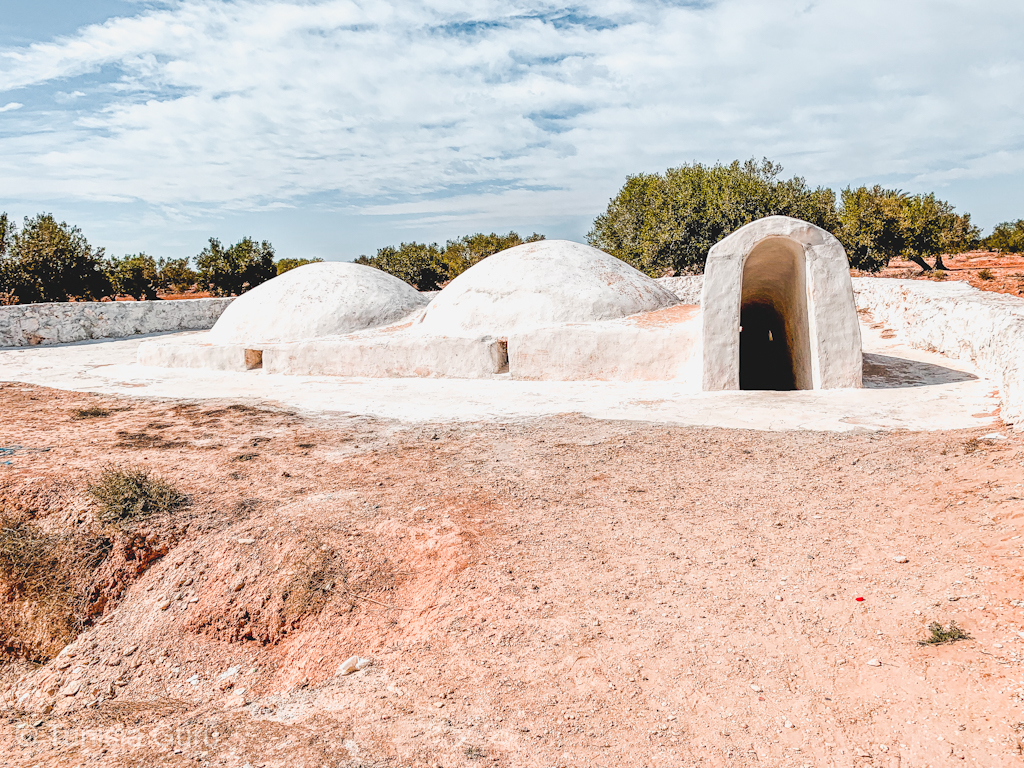
An underground mosque on the island of Djerba in Tunisia.

I got interested in finding out more about underground mosques after seeing a photo of one on the island of Djerba in Tunisia — an island thought to be the same that Homer had in mind when writing about the Lotus Eaters in the Odyssey.

An entry at Wikipedia says that underground mosques are “either erected beneath other buildings or lay freely in the ground with an inconspicuous appearance. The prayer rooms in underground mosques are usually very small, and they also have no minarets. Underground mosques are very rare. [The Djerba mosque] served as a hidden place of prayer for the Ibadis.”

From a different Wikipedia page, we learn that the mosque is near Sedouikech, Tunisia, and dates from the 12th or 13th century. “Surrounded by an olive grove, it opens to the outside by a very steep staircase that leads to the main room; next to it is a large underground tank fed by a well. Another of these underground mosques is located on the Ajim road. Not being used for worship, these mosques can be freely visited.”

An underground mosque in Turkey was built only recently, not because worshippers needed to hide like the Ibadis but because underground worship can feel peaceful.

Menekse Tokyay writes at Alarabiya, “The uniqueness of the Sancaklar mosque is that it departs from standard mosque design in a bid to break architectural taboos and encourage worshippers to focus on the essence of the religious space and on the Islamic faith. …

“Strolling around the mosque’s outdoor area, you will notice a long canopy running along one side where two olive trees and one linden tree are located. From this point, you have to descend natural stone stairs to reach the building.

“The cavernous prayer hall of the mosque is large enough to host more than 650 worshippers, while it aims to isolate believers from the outside world and invite them to delve deeper into their inner world.

“What strikes one about the Sancaklar mosque is that its design is humble and simple, perhaps to deepen worshippers’ relationship with their faith, and with this underground concept, visitors can leave behind all the challenges of the outside world. …

“Sancaklar mosque stands in Istanbul’s suburban Buyukcekmece district and is spread over an area of 1,200 square meters. The architecture combines Islamic and Ottoman designs with a modern touch, seemingly free from mainstream architectural typology.

“In 2013, out of 704 projects from 50 countries, the building won first prize in the World Architecture Festival competition for religious places. In 2015, the project was selected for the Design of the Year award, organized by the London Design Museum and it was also shortlisted among the 40 nominees for the Mies Van der Rohe Award.

“The mosque was designed by Turkish architect Emre Arolat for the Sancaklar Foundation. …

“The only decoration on the walls is the Arabic letter ‘waw’ and verse 41 of Surat al-Ahzab, a chapter in the Quran: ‘O you who have believed, remember Allah with much remembrance.’

“The main space is free of any decorative ornaments unlike many modern mosques built recently in Turkey. Daylight penetrates the prayer hall along the Qibla, or Mecca-facing, wall. …

“ Every time I come here for worship I feel an enormous [sense of] inner peace. It is also a place of meditation for me when praying under daylight infiltrating into the hall,’ Asli Karacan, a youngster living nearby, told Alarabiya.”

More at Wikipedia, here and here — also at Alarabiya, here.

Read Full Post »

Photo: Tohumtoprak.
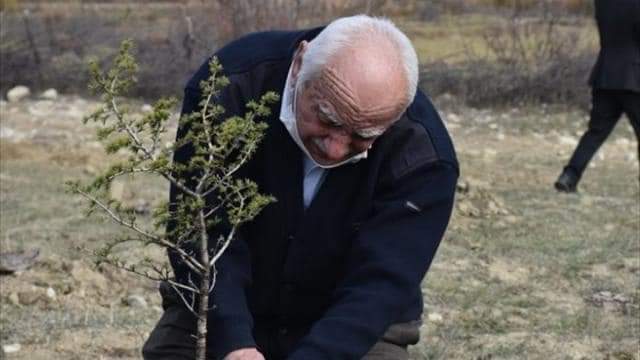
Working with his team and villagers, retired forest chief Hikmet Kaya has helped create a forest on once-barren land in Turkey.

Around the world, people have learned that planting trees can help us fight back against global warming. But it’s not as easy as sticking them in the ground. You have to ensure they live. And thrive.

Jessica Stewart reports on one initiative at My Modern Met, “Hikmet Kaya has proved that good intentions and hard work can yield big rewards. The retired Turkish forest management chief has posed proudly in front of the barren land that he and his team have transformed into a lush forest.

“He began his career in the town of Sinop in 1978 and while he retired 19 years later, his legacy has continued to grow — literally.

“Working together with his team and villagers, he brought in and planted 30 million saplings over the course of his tenure. Long after his retirement, these trees have continued to grow; and today, this barren stepped land has undergone an incredible transformation. … Needless to say, he admits he’s very happy with the results.

“It’s a wonderful example to set for the rest of the country. According to Global Forest Watch, Turkey has seen a 5.4% decrease in tree cover since 2000. … Combatting deforestation often comes down to governmental policy changes, which makes it important for individuals to know who they are voting for and to make sure their environmental concerns are heard. Still, that hasn’t stopped people from taking matters into their own hands and taking action.”

More at My Modern Met, here (where you’ll also find links to tree-planting stories from the Philippines, Pakistan, and Ethiopia).

There’s a tree maven in India who worked without help. You may have read about him. I’ll share Andrei Tapalaga‘s History of Yesterday story in case you missed the news.

“When talking about saving the environment, most people come with the comment of ‘how much difference will I make?’ … In this article, I want to present a man who has defied any kind of odds and showed the world that if you set your mind to something it will become possible.

“Jadav ‘Molai’ Payeng spent 40 years of his life planting trees, gaining the nickname of ‘Forest Man’ in India for transforming a [barren island] into a forest. [At this point] Payeng had covered 1,400 acres with trees. There is no exact number of trees as he never kept track, but we are looking at around 1.5 million trees planted in 40 years.

“Payeng was born in 1963 near the small rural town of Jorhat, India. From a young age, he saw a small island near the coast of the Brahmaputra River suffering from erosion. In many of his interviews taken by the media in India, he described that he had spent some of his [childhood] playing in that forest and it was heartbreaking seeing its vegetation slowly die.

“That is why in 1979, when Payeng was 16 years of age, he decided to plant at least one tree a day for as long as he lives, calling it giving back to Mother Nature. … The start to this incredible journey was difficult, not only [considering] the road ahead, but it was simply difficult to find tree seeds to plant. His vision was not to plant only one type of tree, but many different types. …

“As the years went by, the problem of finding seeds was solved as the trees he had planted years ago started to give seeds. With more seeds, he was able to plant even more trees every day. The island is surrounded by a flowing river, so the water supply was never a problem. …

“There are many people out there just like Payneg who have dedicated most of their life toward an honorable cause but rarely get noticed. The media in India actually discovered Payeng by mistake when in 2008, a herd of over 100 wild elephants strayed into the forest he had created.

“Payeng notified the forest department about the elephants and they thought he was crazy at first as there was no forest on the island. Upon the forest department’s inspection of the island, the community around Jorhat told them about Payeng’s efforts, at which point the media from India bombarded Payeng. [He] was also made an official forester for the forest he had created on Majuli island.

“In 2012 Payeng was interviewed by the Times, where he confessed that he had always asked for help but no one wanted to assist him. … Now the island is greener than ever whilst being inhabited by all sorts of wildlife from rabbits to tigers and even rhinos. The plantation of trees had slowed down as Payeng is becoming old and tired. However, he is trying to make his children continue what he had started.”

For more on Payeng’s initiative, click at History of Yesterday, here.

Read Full Post »

Photo: turkey.theglobepost.com via History Daily.
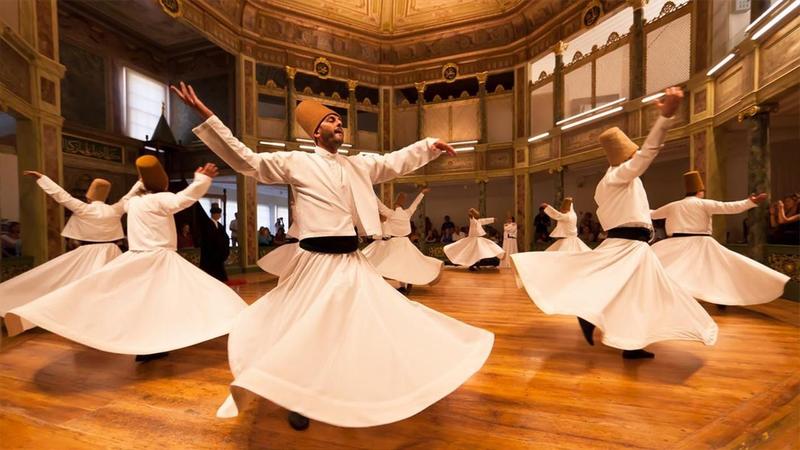
Turkey’s ‘whirling dervishes’ strive to keep the practice sacred amid tourist demand.

Each of us in our own way tries to maintain some sort of balance in our lives. It might be a balance between hours spent at a job and hours spent with family, a balance between work and play, between nutritious foods and sweets, between ideals and pragmatism. I myself would like to keep a balance between being well informed and getting depressed. Although it’s impossible to unsee what one has just read, there has to be a way to stop oneself when more information is just going to be upsetting.

At the radio show The World, Durrie Bouscaren reported recently on Turkey’s whirling dervishes and the challenge they face keeping a balance between a wish to share their culture and respecting their religion.

Bouscaren writes, “On a recent Friday evening, spectators gathered around a circular, wooden stage at a cultural center in Konya, Turkey. A single beam of light shined down on a man who placed a red sheepskin cloth on the floor. 

‘A procession of semazen appeared wearing tall headpieces and long, white robes covered by dark cloaks. They ranged widely in age, but are all were men who enact the sema, a ritual meditation known in popular culture as actions of the ‘whirling dervishes.’ 

“ ‘The acts of the sema represent the other world,’ said 32-year-old Osman Sariyer, a semazen and tour guide with the Irfan Civilization Research and Community Center in Konya, where the ritual demonstration took place. ‘Remembering the other world, remembering the creator, all the time.’ 

“Countless semazen — those who do the sema — live in the modern Turkish city of Konya, the final resting place of Jalalluddin Rumi, the 13th-century Persian poet, Islamic philosopher, and Sufi mystic who first popularized the sema. 

Today, semazen must grapple with the push and pull between the promise of tourism income for the community and the nagging feeling that the sema should be a private affair.

“In December, Konya hotels sell out for weeks as tourists arrive from around the world to pay their respects on the anniversary of Rumi’s death. In 2008, UNESCO inscribed the sema as one of the ‘masterpieces of the oral and intangible heritage of humanity.’

“In this hubbub — where busloads of tourists arrive to buy tickets to sold-out ‘dervish shows,’ and flock to the shops where they sell tiny figures of semazen souvenirs — it can start to feel overwhelmingly commercialized. 

“But performing the sema for tourists is a way to share this ritual, Sariyer said. At the cultural center, the tickets are free, according to a long-held tradition that prohibits the exchange of money or engagement with politics when it comes to this practice. 

“As semazens, we believe in the brotherhood of other religions, and we do not exclude anyone. Anyone coming here from any religious energy will feel that energy, and that’s what we’re trying to do here,” he said.

“As the music begins, a solo from a type of flute known as the ney symbolizes the breath of God, blowing life into human forms. The semazen shed the outer layer of their clothing — an act of shedding the ego. They bow and begin to spin. …

“It’s a slow, controlled spin. One foot stays planted on the floor. At times, one hand reaches up to the sky, while the other points downward — a position meant to bring love from God down to Earth and its people. 

“But outside the ritual, Sariyer explained, most semazens live regular lives. They get married, have kids and work desk jobs. …

“Historically, semazens were organized in orders throughout the Ottoman Empire and beyond. The orders were banned in 1925, as Turkey became a secular republic. So, they went underground.

“The semazens grew and learned about the practice within these orders, explained Nadir Karnıbüyükler Dede, a leader at the International Mevlana Foundation. When they were abolished, it became harder to pass on the traditions to the new generation. …

“In his office at a construction firm, Adnan Küçük keeps a small square board on the floor — just 3-feet tall and 3-feet wide — to practice the turns of the sema. 

“ ‘It gives you this excitement, this feeling of being overjoyed,’ … Küçük said.  He’s been practicing sema for over 20 years.

“Küçük’s father was one of those who upheld the tradition in those difficult decades, from the 1920s through the 1990s. …

“By the 1990s, when Küçük was a teenager, there were very few young semazens in Konya. But one day, a Polish official called Konya’s tourism office to ask if they had any whirling dervishes they could send to participate in a youth festival. …

“ ‘They’d take us to a hotel, people would be eating — and as we’re preparing the sema they’re serving alcohol,’ he said. ‘Which completely contradicts the ritual.’ Alcohol is forbidden in Islam. …

“Now he only gathers with a small group of friends to do the sema privately, meeting at least once a week before the pandemic began.”

More at PRI’s The World, here.

Read Full Post »

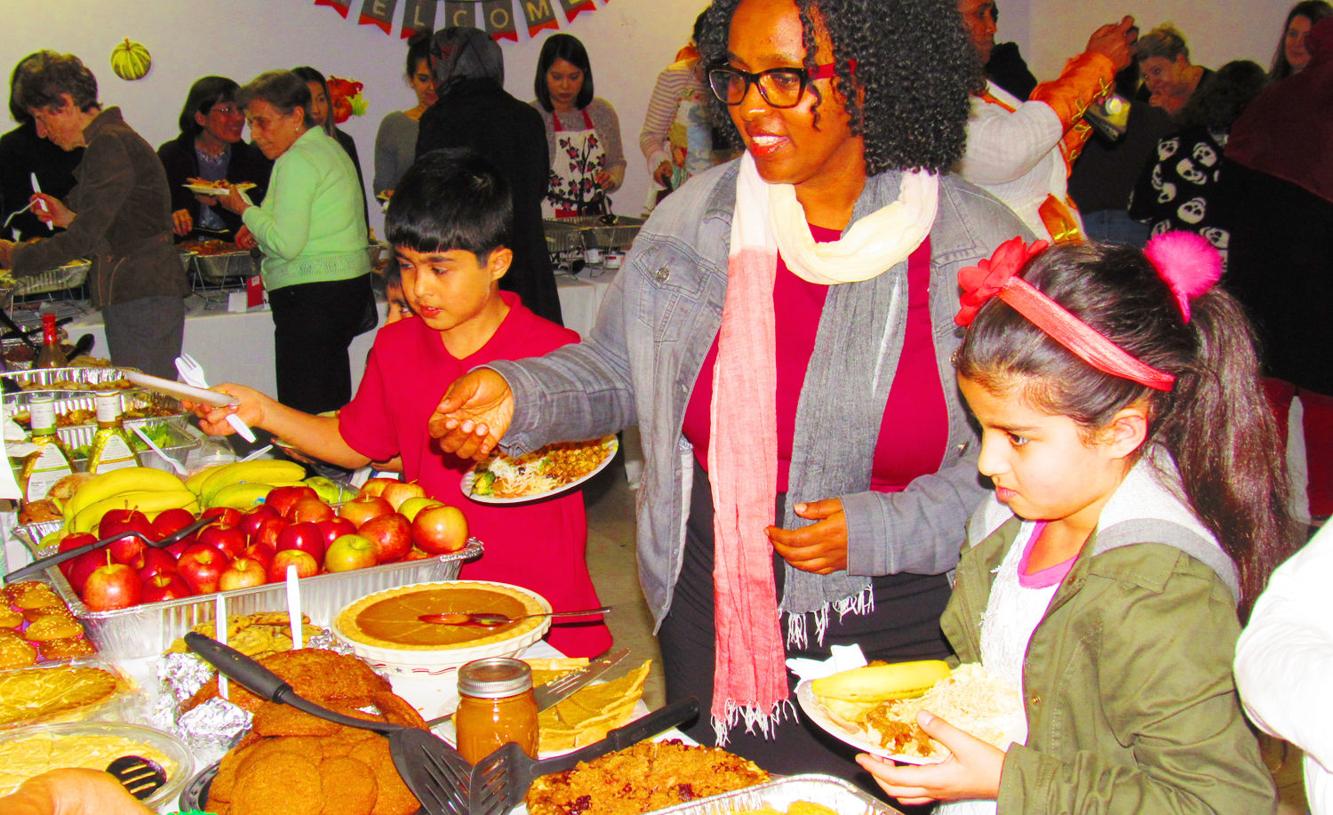
Photo: InsideNova.
A scene from the sixth annual Refugees’ First Thanksgiving Dinner, held Nov. 18, 2018, and sponsored by the Ethiopian Community Development Council in Virginia.

Thanksgiving can be a fraught holiday not only because of occasional family feuds but because, as more of us now know, the story of our First Thanksgiving story has been distorting reality. It was not all about Pilgrims and Indian people sharing wild turkey and pledging eternal friendship. For indigenous tribes, the first European contact was the beginning of endless tragedy.

This year Edward Fitzpatrick at the Boston Globe added to our knowledge after interviewing a member of a New England tribe called the Narragansett.

Lorén Spears, also Tomaquag Museum executive director, says, “There’s no US history without Indigenous people’s history. [People] really need to dig in and come visit places like Tomaquag Museum. … Go to the Mashpee Museum, go to the Aquinnah Cultural Center, go to the Pequot Museum, and find out the real history.”

Even if Indigenous people spend Thanksgiving with family and festivities, she says, “They still know that this isn’t always a happy time for us because it reminds us of all the trauma and loss that our communities have felt due to the conquest that took place here and how it still affects us today economically: health disparities, educational disparities, the list goes on.”

I have read other accounts of indigenous people gathering with family, making it a day of gratitude for the harvest and for community. Immigrants also make the occasion their own.

When I asked students in one English as a Second Language class about Thanksgiving, a young woman from Egypt said that last year, her first US Thanksgiving, she didn’t know anything about the holiday, but she prepared a turkey along with the family’s favorite Egyptian dishes. I said, “Well, if you had a turkey, you had Thanksgiving.” But what do I know? It’s about being thankful. Turkey not necessary.

Plenty of people don’t like turkey. When my family went to a restaurant one Thanksgiving, my Swedish son-in-law ordered beef. And Latinx immigrants have told me they like to serve ham and pineapple, with or without turkey.

Our family tends to stick with turkey, stuffing, gravy, potatoes, another vegetable, cranberry sauce, salad, and a dessert using apples. But before Covid, my sister and her husband always brought bagels and lox. And if we had a guests from another country, they would bring national dishes. Does your gathering have dishes that are unique to your celebration?

Read Full Post »

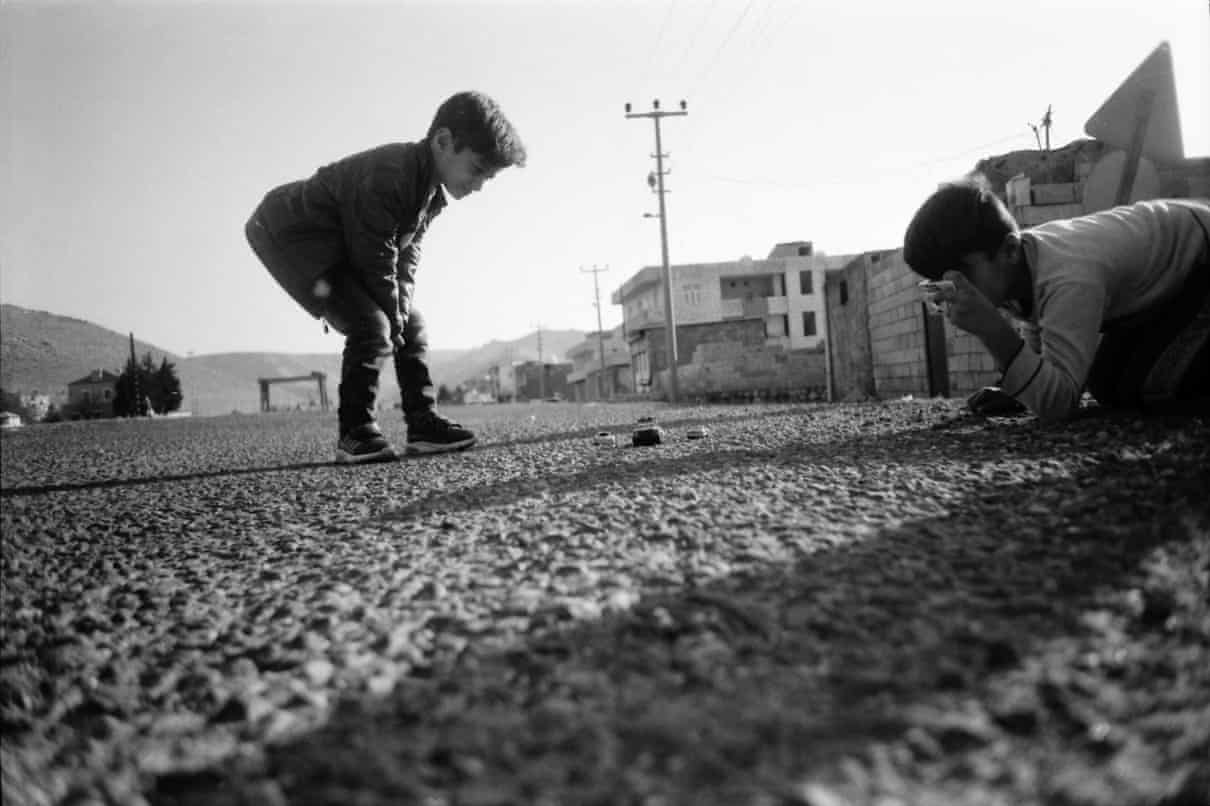
Image: Ibrahim, 13.
The photography of Ibrahim, a Syrian refugee in Turkey, is featured with the work of other boys and girls in the book i saw the air fly, by Sirkhane Darkroom (Mack, 2021). Proceeds go to the Her Yerde Sanat-Sirkhane charity.

Today’s story is about trying to provide some fun for children caught in the failures of a grownup world. Adults of good will can’t fix everything for these youngsters, but whatever they manage to do can mean a lot.

Sean O’Hagan reports at the Guardian, “Serbest Salih studied photography at college in Aleppo, before fleeing Syria with his family in 2014 as Islamic State fighters advanced on his home town of Kobani. He is now one of an estimated 100,000 refugees living in the historic city of Mardin in south-eastern Turkey, just a few miles from the Syrian border. Having initially found work as a photographer for a German NGO, Salih’s life changed dramatically in 2017 when, while wandering with a friend through the city, he discovered a sprawling refugee community living in a group of abandoned government buildings in the working-class Kurdish district of Istayson.

“ ‘It was a place where Turkish Kurds and Syrian Kurds lived as neighbours, but did not communicate,’ he says, ‘They were strangers who spoke the same language. It was at that moment that I thought to use analogue photography as a means to integrate the different communities.’

“Working with Sirkhane, a community organisation, and with initial funding from a German aid organisation, Welthungerhilfe, he began hosting photography workshops using donated cheap analogue cameras. ‘Digital is easier and quicker,’ he tells me, ‘but the analogue process teaches children to look more carefully and also to be patient, because they have to take a picture without seeing the result instantly. For them, there is something therapeutic and healing about the whole process.’

“Salih now runs the Sirkhane Darkroom in Mardin and, since 2019, has travelled to neighbouring towns and villages with the Sirkhane Caravan, a mobile version of the same. Children from the age of seven come to his workshops to learn the traditional skills of shooting on film and processing the results in a darkroom. …

The results, as a new book, i saw the air fly, shows, are often surprising. Rather than reflect the traumas of their displacement, the pictures tend towards the innocent and joyous …

“Family portraits, blurred shots of their friends at play, children jumping, hiding, posing with their friends or tending their animals. Throughout, there are more intricately formal compositions that catch the eye: a cluster of hilltop buildings, the irregular geometry of electricity wires crisscrossing the sky. …

“The book has parallels with Wendy Ewald’s Portraits and Dreams: Photographs and Stories by Children of the Appalachians, also published by Mack, in which she taught practical photography to kids from a poor rural community with often startling results. Like that project, i saw the air fly is a testament to the undimmed imagination of the very young, however impoverished their circumstances, but also to Salih’s faith in the transformative power of analogue photography. …

“As the children progress though the workshops, he tells me, they are given specific subjects to photograph. These can range from the everyday (the garden, the home) to the more socially aware – child labour, child marriage and, tentatively, gender issues. ‘Often, when we begin, the girls don’t think they can be as good as the boys,’ he says. ‘Sadly, that is what the adult world has taught them, but soon they are shooting pictures about their lives and experiences. The camera gives them the confidence to do that.’

“On the Sirkhane website, videos and photographs attest to the sense of wonder the children experience in the darkroom as the images they have shot finally appear. …

“Salih’s plans to ‘expand the caravan workshops so we can go to the most affected places’ have been put on hold since the pandemic began and he has had to teach online. ‘It has been difficult,’ he says, ‘because most of the children do not have smartphones or internet access.’ …

“The publication of i saw the air fly is a singular achievement. It is also, in many ways, a humble book – all the images have been selected by the children themselves, their often low-key charm attesting to the essentially democratic nature of the medium, and its ability to surprise. ‘People think that if you give a refugee child a camera, the results will be sad,’ says Salih, ‘but instead most of these photographs are all about joy. They are small moments of private happiness.’

“All proceeds from the sale of i saw the air fly will go to the Her Yerde Sanat-Sirkhane charity, whose aim is to provide ‘a safe, friendly and embracing environment’ for children caught up in conflicts.”

More at the Guardian, here.

Read Full Post »

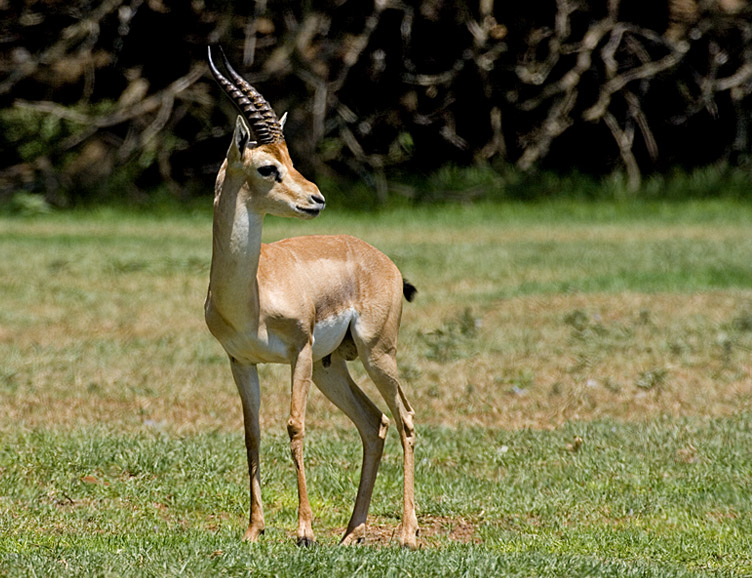
Photo: Bassem18/Wikipedia.
The rare Mountain Gazelle is returning to Turkey.

Today’s story is about both environmental rescue and the power of one individual to make a difference.

Carlotta Gall writes at the New York Times, “Turkey’s southern border with Syria has become a place of hardship and misery, with tented camps for people displaced by a decade of war on the Syrian side and a concrete wall blocking entrance to Turkey for all but the most determined.

“Yet amid the rocky outcrops in one small area on the Turkish side, life is abounding as an endangered species of wild gazelle is recovering its stocks and multiplying.

“The mountain gazelle, a dainty antelope with a striped face and spiraling horns, once roamed widely across the Middle East, and as Roman mosaics reveal, across southern Turkey as well. But by the end of the last century, it was hunted almost to extinction, with only a dwindling population of 2,500 left in Israel, according to the International Union for Conservation of Nature.

“In Turkey, the gazelle was forgotten and thought to no longer exist. The only ones officially recorded were a subspecies, known as goitered gazelles, in Sanliurfa Province in the southeast of the country.

The rediscovery and survival of the mountain gazelle in Turkey has been largely thanks to one man and his love of nature.

“Yasar Ergun, a village teacher who became a veterinarian and professor at Hatay Mustafa Kemal University in the city of Antakya, heard in the mid-1990s from an old hunter that there were wild gazelles in the mountains along the border with Syria.

“A keen hiker, he set out to try to find them. Barely 25 miles from Antakya — the ancient city of Antioch — Kurdish villagers knew about them and shepherds occasionally saw them. The gazelles live on the rocky hillsides, where their markings and coloring make them almost invisible. But they come down in groups to graze and find water on the surrounding agricultural land.

“The professor spotted his first one in 1998 and, after a decade of observing them, estimated that there were about 100 living in the area.

“With a small grant for a teaching project, he bought a camera and telephoto lens, which led to a close encounter and a breakthrough discovery.

” ‘It was the mating season,’ he recalled. ‘I ran to the road, and the male ran toward me to defend his females. It was very unusual.’

“When he examined the photos, he realized the gazelles differed from those in southeastern Turkey.

“ ‘This one was light brown, with some parts white, and the horns were completely different,’ he said. He was sure he was looking at the mountain gazelle, but found little interest in his claims in academic circles, he said.

‘I sent the photographs around — professors just laughed,’ he said.

“He drew on the help of Tolga Kankilic, a biologist, who gathered samples of dung, fur and skin from the remains of dead gazelles for genetic testing, and found that the DNA matched that of mountain gazelles.

“The discovery presented Mr. Ergun with an altogether more important task: to help the gazelles survive. There were several threats to them — lack of water and habitat especially — but by far the greatest danger was illegal hunting. Hunting is allowed only under license in designated areas in Turkey, but illegal hunting is rife.

“The gazelles had disappeared completely from other regions, including Adana, farther west, where American soldiers stationed at Incirlik air base used to hunt them 20 years ago, he said.

“ ‘The end of a genetic source is the same as the collapse of Earth,’ he said. ‘Nature needs biodiversity.’

“He won a grant from the World Wildlife Fund in Turkey for a grass-roots project with local villagers and bought mountain gear and amateur walkie-talkies for several shepherds, who began monitoring the gazelles. They dug basins in the rock to collect water for the gazelles, though it took the animals months to trust the water source.

“With his knowledge of village life, Mr. Ergun began softly, gaining the support of local shepherds, educating children to protect the gazelles and even encouraging a local Kurdish legend of a holy man who lived with the gazelles and milked them.

“With the hunters, Mr. Ergun and his helpers adopted an approach of traditional courtesy and respect, drinking tea with them but never mentioning their hunting.

“ ‘We never tried to use force to stop them,’ he said. ‘We would say, “Hello, we are from the Nature Project.” Sometimes silence is more powerful than talking.’

“The local people were Kurds, a mountain people with their own language and culture — and a history of resistance to the Turkish state.

“ ‘If you make an enemy, just one, in 10 years you will have 10 enemies, and in 100 years you will have 1,000,’ Mr. Ergun said. But as the shepherds began monitoring the gazelles, the hunters got the message.”

More here.

Read Full Post »

d8a7d993d8b3db8cd8a7d8a8_d987d8a7db8c_d986d8b4d8aadb8cd981d8a7d986_d8b4d987d8b1d8b3d8aad8a7d986_d8aed988d8a7d981d88c_d8b1d988d8b3d8aad8a7db8c_d986d8b4d8aadb8cd981d8a7d986_d982d8b1d8a7d8b

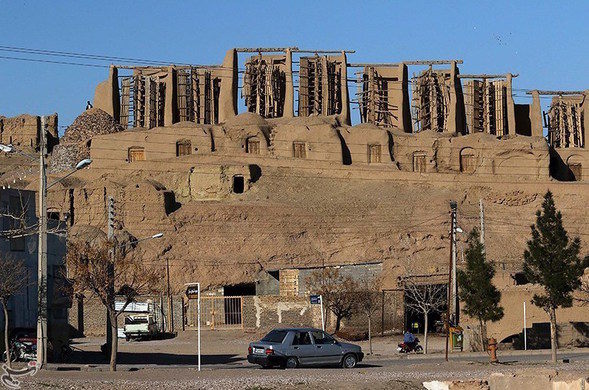
Photo: Mohammad Hossein Taghi
Ancient vertical windmills in Iran’s Nashtifan village. Proof that “the sun also rises and goeth to his downsetting, and there is no new thing under the sun.”

There’s been a lot of excitement in recent years about using windmills for energy, as if we invented the giants I see on summer visits to New Shoreham (below) before Iran did, Don Quixote, the Dutch, or Denmark.

080516-first-deepwater-windmill

The website Atlas Obscura corrects the misapprehension.

“Located on the arid and windswept plains of northeastern Iran, 30 miles from the Afghan border, the small village of Nashtifan is keeping ancient traditions alive amid the winds of change. The town is home to some of the earliest windmills in the world, and the structures are still in use today.

“Along the southern edge of town, a towering 65-foot-tall earthen wall shelters residents from the abrasive gales. The high wall houses two dozen mostly functional vertical axis windmills that date back to ancient Persian times. It’s estimated the structures, made of clay, straw, and wood, are around 1,000 years old, used for milling grain into flour.

“The area is known for its uniquely powerful winds, and in fact the name Nashtifan is derived from words that translate to ‘storm’s sting.’ During turbulent winter months the handcrafted wooden blades whirl with a surprising velocity and power grindstones in a marvel of engineering and passive ventilation. …

“The tall walls framing the windmills both support the turbines, and funnel the airflow like the elliptical throat in a primitive windtunnel.

Unlike European Don Quixote-style windmills, the Persian design is powered by drag as opposed to lift.

“And since the blades are arrayed on a vertical axis, energy is translated down the mast to the grindstone without the need for any of the intermediary gears found on horizontal axis windmills.”

More at Atlas Obscura, here.

Video: Deveci Tech
Note that today’s hybrid vertical-axis turbines in Turkey are using the same principles to generate wind energy from vehicles speeding by. More on that here.

Read Full Post »

108525880_grannies5

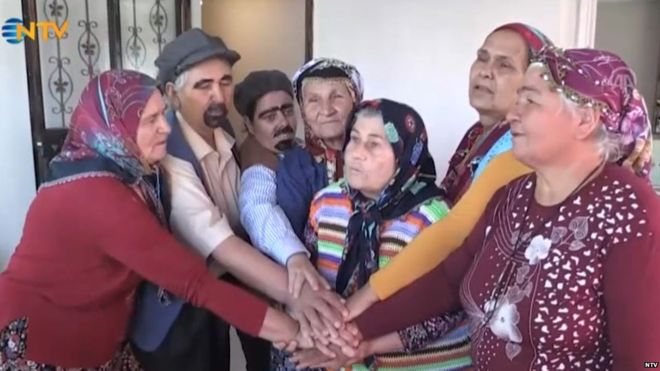
Photo: NTV
Led by a grandmother, an amateur theater group in Turkey is raising awareness about climate change and the lives of rural women.

Wherever you live, whatever age you are, you have the power to do something valuable for the world. A grandmother in rural Turkey understood that from an early age and is making her voice heard.

The BBC garnered this story from NTV, the Turkish television news channel.

Dilay Yalcin and Krassi Twigg reported, “A 62-year-old grandmother from rural Turkey who rose to national fame with her all-women village theatre group is now set to stage a play raising awareness about climate change.

“Ummiye Kocak from the village of Arslankoy in the Mediterranean province of Mersin recently began rehearsals for her new play ‘Mother, the Sky is Pierced!’

“She told Anadolu news agency that she wanted ‘people to realise just how serious it is.’

The climate crisis is ‘not only our problem, it is the world’s problem,’ she says. ‘I am shouting as loud as I can — this world is ours, we need to take good care of it!’

“Ummiye Kocak has written plays for many years, always aiming to change perceptions. Her previous works have tackled issues from poverty and domestic violence to Alzheimer’s Disease. … In 2013 she won an award at a New York festival with a film focusing on the difficulties of women’s lives in a Turkish village. …

“Ummiye Kocak grew up in a conservative rural area, and only got primary education ‘by chance — as each family was required to send one girl to school.

“But she says her father was open-minded enough to take all his children to the cinema at a time when no other dad in the village would, sparking her love of drama.

“She says that when she first arrived in the village of Arslankoy as a young bride, she noticed that women there had to do all the work — in the fields as well as in the house. She thought that wasn’t right and told herself: ‘Ummiye, you have to make the voices of these women heard!’

“Her village doesn’t have a stage, so she gathers her performers under a walnut tree in her garden for rehearsals while they do their domestic chores. …

“People in other parts of the country want a piece of the action, issuing invitations on social media for the group to perform locally.

“One woman in Istanbul wrote: ‘I’m proud and honoured on behalf of all women every time I see you, Aunt Ummiye. … I hope all women lead their lives knowing they have this power like you do.’ ”

More at the BBC, here.

Read Full Post »

Photo: Istanbul Metropolitan Municipality
The new Istanbul subway machines add credit to your subway cards while crushing, shredding, and sorting your recyclables.

Creating a more sustainable world doesn’t have to be painful for the individual or expensive for government. In Turkey, a city government wanted people to recycle more, and so it got the idea of rewarding subway riders who help out. Ceylan Yeginsu has the story at the New York Times.

“Istanbul [has] rolled out an alternative currency for commuters who need to top up their subway cards but are short of cash: recyclables.

“The city is installing ‘reverse vending machines’ at metro stations that allow passengers to add credit to their subway cards simply by inserting a plastic bottle or aluminum can into the machine. Once a value has been assigned to the recyclables, the machine will crush, shred and sort the material. …

“This is how the vending machines [work]: A 0.33-liter plastic bottle, for example, roughly equivalent to 11 ounces, would add 2 Turkish cents to a subway card, while a 0.5-liter bottle would add 3 cents and a 1.5-liter bottle would add 6 cents. (A subway journey costs 2.60 Turkish lira, about 40 United States cents; 100 Turkish cents, or kurus, make up 1 Turkish lira.) …

“Istanbul’s mayor, Mevlut Uysal, said the machines would track the number of bottles recycled by each passenger and reward those recycling the largest number of containers with free or discounted events such as theater tickets.

“Turkey is Europe’s third-largest producer of household and commercial waste, after Germany and France, and it is the worst in the region at recycling, according to a 2017 report by the consultancy group Expert Market, which is based in Britain. …

“Elif Cengiz, a manager for the waste management project, called Zero Waste, said … that the municipality had made waste management a priority in recent years because of rising concern over the damage that waste is causing to the environment.

“The country’s recycling drive has started to produce results, saving 30 million trees in 15 months since last June, Mustafa Ozturk, the under secretary for the Environment and Urban Planning Ministry, said, [adding] ‘The use of recycled material in production contributes to productivity and separate storage for paper waste also saves storage space and decreases waste collecting costs for local administrations.” More at the New York Times, here.

I’d love to see the perennially cash-strapped Massachusetts Bay Transportation Authority (MBTA) try the reverse-vending idea instead of constantly raising fares.

Read Full Post »

Radio Lifeline for Syria


Photo: Amandas Ong
An Alwan radio producer in the station’s recording studio. The broadcast lifeline to Syria is located in an apartment complex in Turkey.

Where people struggle to carry on their lives in the midst of war, radio can provide comfort and hope. This is a story about Syrians in exile who broadcast news and normalcy to people back home.

Amandas Ong writes at Slate, “I push my way out of the metro station in southwestern Istanbul where Sami — not his real name — and I have agreed to meet. …

” ‘It’s not far from here,’ he says, directing me down an overhead bridge through a number of serpentine streets. …

“The hive of activity inside forms the Istanbul operations of Radio Alwan, (Alwan means ‘colors’ in Arabic) an independent Syrian news station broadcasting into that devastated country every day. Alwan provides much-needed news updates to information-starved Syrians and also runs popular entertainment programs and controversial discussions. …

“Three bedrooms have been converted into a meeting room, a recording studio, and an office. … Most of the staff had no prior training in radio journalism before joining Alwan. Sami describes himself as having ‘come from a regular, boring HR job in Dubai.’ …

“ ‘The point of Alwan,’ he had told me in a prior conversation over FaceTime, ‘is not just to report the news. Radio is also a form of activism, and through our programs, we try to do our part by encouraging people to engage with civic organizations within Syria, and to inform them on what’s really happening both around the country and outside of it.’ …

“A law student named Ahmad al-Qadour started Radio Alwan in 2014 in the northern Syrian city of Idlib. … They decided to relocate Alwan’s central office to Istanbul after a series of threats from Islamic radical groups such as the al-Nusra Front, which had been part of the Syrian wing of al-Qaida before splitting from the group in 2016. …

“A typical day at Alwan begins at 6 a.m. in the Istanbul office, where the team of about 15 staff members assembles for a variety of Syrian and international news segments, followed by talk shows and short radio skits, some educational, others comedic. …

“Sami is especially proud of Oh, Grandma, a program presented by a woman from Idlib who is identified by her initial, N. She has a day job as a teacher, but in her role at Alwan, she visits the houses of women in the city and interviews them about their lives, their daily struggles, and discusses salient issues with them, such as the legal age for marriage for Syrian women. …

“Maram, a 24-year-old in a slouchy sweater and jeans, comes to talk to me. She graduated from a media school in Damascus and decided to come to Turkey to seek better job opportunities, before stumbling upon an open position at Alwan. …

“I ask her what she likes most about Alwan, and she doesn’t hesitate: ‘I learn a lot every single day, but most of all, it’s taught me so much about how to deal with uncertainty.’ …

“Sami [has] a philosophical approach to the objective of radio itself.

“ ‘We have a program called Acute Angle,’ he says, ‘that encourages people to accept the idea that there is no such thing as true fact. In each segment, we talk about different personalities like Michael Jackson, Ataturk, and even Walt Disney, and how these people have been represented both positively and negatively. I want our listeners to know that there are no taboos, and also no perspective on any one issue or narrative that should be taken for granted.’ …

“[It’s staff member] Dima who has perhaps the most poetic vision of her work at Alwan. ‘What I’ve learned is that the people who listen to us aren’t just suffering day in and out. They want to live, love, dance, laugh. Sometimes we draw courage from them, other times they are comforted by us, hundreds of miles away,’ she says. ‘That’s the beauty of radio: It has soul.’ ”

More here.

Unhappy Update, Dec. 29, 2019, here.

Read Full Post »

Older Posts »