Feeds:
Posts
Comments

Posts Tagged ‘uganda’

Photo: John Okot.
A volunteer for The Mango Project places mango slices in a solar dryer for preservation in Midigo, Uganda, where malnutrition is a serious issue.

One of my grandsons has had an interest in Uganda for several years — first, through learning about endangered mountain gorillas, then through helping support a start-up water business in the country. As a result, I pay extra attention to Ugandan news.

John Okot reports at the Christian Science Monitor about two brothers in Uganda who launched a mango initiative to help their neighbors.

“Francis Asiku’s plan to fight hunger in his village began, quite naturally, under a bountiful mango tree. It was 2011, and he had just landed his first nursing job at Midigo Health Centre IV in Yumbe district in northern Uganda. He was excited and joyful. But in his first month at work, Mr. Asiku was surprised to learn that what many infants and expectant mothers seeking care needed wasn’t necessarily medicine. It was nutritious food.

“He recalls one hot afternoon, in particular, when a young mother rushed into the health center with a 4-year-old child in her arms. Mr. Asiku hurried to help. He quickly diagnosed poor feeding as the root of the child’s problem. …

“He headed home on a dirt road in the inky-dark evening. When he spotted birds feasting on rotting mangoes along his path, a question struck him: Why were so many people in his community malnourished when it experienced two plentiful mango seasons a year?

“He raised the issue later that night with his younger brother, farmer Emmanuel Mao. Soon afterward, the brothers met with village elders under the huge mango tree where community meetings were held. That was the start of their nonprofit, The Mango Project, which distributes glass jars full of mangoes to schools, to health centers, and directly to hungry individuals.

“The toll of hunger in Uganda is staggering, according to the Global Hunger Index, a report published by several global nonprofits. Almost 37% of the population is undernourished, and about one-quarter of children have stunting, a condition that is associated with malnutrition.

“When Mr. Asiku and Mr. Mao met with the Midigo elders, [they said] the brothers needed to figure out a way to preserve Midigo’s abundant mangoes throughout dry periods, when they are scarce. …

“Mr. Asiku and Mr. Mao embarked on researching a simple way to preserve food. They began ‘jarrying’ – cutting fruit pulp into thin slices and putting them in a glass container of boiling-hot water and sugar. While canning is practiced throughout the world, many Midigo villagers can’t afford sugar, not to mention glass jars with secure lids. The relatively easy preservation method – and the brothers’ fundraising efforts to obtain the necessary supplies – delighted village elders. …

“The brothers initially collected mangoes that were scattered throughout the village, but have since expanded their initiative to preserve the fruit from their family’s ancestral land. The jarred fruit is safe to eat for up to a year.

“Mr. Asiku knows that the mangoes alone will not end malnutrition in the community, since humans need a balanced diet. But the initiative, he says, is a great start to breaking the hunger cycle in Midigo. …

“Irene Andruzu, who supervises one of the Midigo Health Centre’s facilities, says she receives at least 50 jars of mangoes monthly to help malnourished patients. During the pandemic alone, more than 12,000 jars of mangoes were distributed to health clinics and refugee settlements.

“Scovia Anderu, a social worker for Calvary Chapel Midigo, lauds The Mango Project for instructing villagers. She says that most villagers lack knowledge about nutrition and that there are few qualified personnel who can educate them on the subject at the grassroots.

“Zuberi Ojjo, the district health officer for Yumbe, [says] The Mango Project ‘reminds people of the importance of nutrition to our well-being.’ …

“One obstacle for The Mango Project is that charcoal, which is needed to heat the water used to sterilize jars, can be difficult to obtain. Since 2023, the government has banned commercial charcoal production in the northern region over concerns about the alarming depletion of trees there. Nevertheless, illegal, large-scale tree-cutting has disrupted weather patterns in the region, where communities rely mainly on agriculture amid erratic, unpredictable rainfall. …

“Mr. Asiku has found one alternate form of fuel. Over the years, he has been scrimping and saving, and last year he purchased a solar-powered dryer worth $600. Besides mangoes, he dries vegetables such as okra and eggplant to give to villagers.

“He hopes to distribute the food more widely as he acquires a license from the government to do so – and more dryers. He also has an orchard with 310 hybrid mango trees. This is meant to supplement the seasonal mangoes in case there is low supply because of damage caused by fruit flies.

“ ‘It’s fulfilling to see my people smiling at the end of the day,’ Mr. Asiku says.”

More at the Monitor, here.
Read Full Post »

Photo: Kang-Chun Cheng.
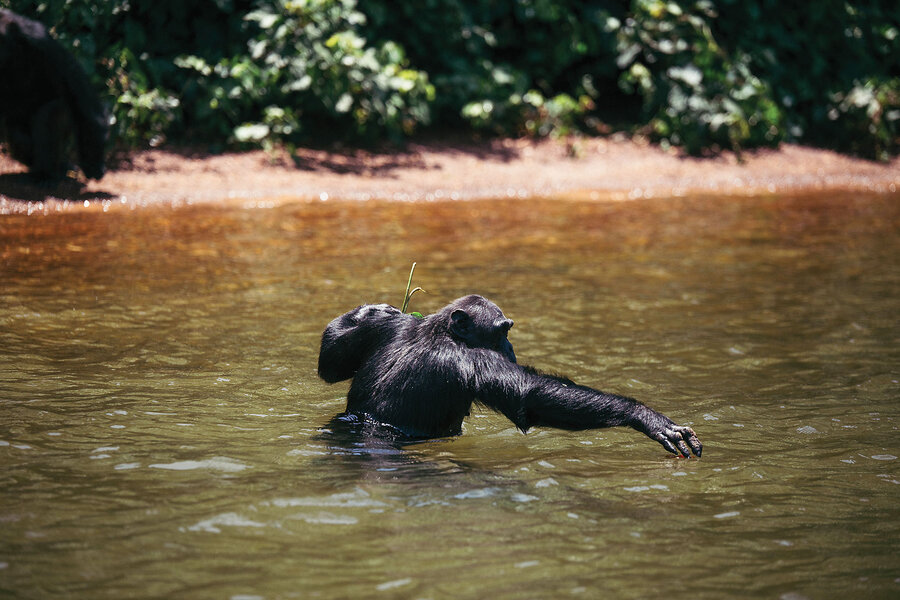
A chimpanzee swimming near the Ngamba Island sanctuary in Uganda.

Exercise instructors like to tell you how everything in your body connects to everything else. For example, moving your eyes as if trying to look behind you can help your neck turn a little farther in a neck exercise.

Interconnectedness is also true of nature. Consider Uganda, where work is being done to simultaneously protect chimpanzees, tropical forests, small-farm agriculture, and families.

Kang-Chun Cheng writes at the Christian Science Monitor, “From the shade of a banana tree, Samuel Isingoma explains why he is sacrificing his precious jackfruit to chimpanzees.

“ ‘Since I support and give fruit to the chimps, they don’t disturb anything else,’ says Mr. Isingoma, who has planted 20 jackfruit trees on his 17-acre plot in the western Ugandan village of Kasongoire. The trees’ bounty is solely for the primates. …

“Uganda is East Africa’s largest sugar cane producer and has one of the fastest-growing populations on the continent. The need to make space for homes and farms is reducing the forest cover that helps sustain chimpanzees.

“James Byamukama, an executive director at the Jane Goodall Institute, says it’s critical to have discussions within communities rather than try to impose solutions. Community monitors from the institute’s Uganda chapter have recommended that farmers plant crops that aren’t so palatable to wildlife. So about eight years ago, Mr. Isingoma started planting coffee beans, leaving behind the maize he used to cultivate.

“Now he is taking the institute’s advice one step further by giving his fruit over to hungry chimps.

“As a result, Mr. Isingoma says, ‘I feel there isn’t much of a human-wildlife conflict.’ “

The nonprofit We Stand for Wildlife expands on the connections between farming and forests.

“When over 1000 Ugandan small holder farmers adopted WCS conservation farming practices they increased crop-based income 15 fold and halted clearing on 2700 hectares [6671.845 acres] of riverside forest.

“Following the end of the civil war in 1986 refugee families began to return to their lands in the Murchison-Semliki region of Uganda that contain the last remaining natural forest in the country outside of protected areas. These riverside forests form corridors connecting the national parks and are vital habitat for chimpanzees.

“To feed their growing families farmers began to clear the forest to plant crops. Traditional agricultural practices quickly exhaust the soil and farmers are forced to deforest new areas. Between 2006 and 2010 WCS sound science showed that farmers were clearing nearly 8,000 ha of forest each year. Unless this changed the forest and its resident chimpanzee would soon disappear.

“In an attempt to avert this deforestation trend WCS joined forces with the Jane Goodall Institute and the Chimpanzee Trust. Initially we hoped that we could help farmers to capture the value of their trees by selling their stored carbon in the voluntary REDD+ market place. But the high cost of certifying the carbon for sale and the low price of forest carbon made this idea untenable.

“At WCS we adapted our plans and began offering farmers training in zero tillage farming that conserves nutrients and soil moisture, which is critical as rains become less predictable with climate change.

Farmers who adopted the less capital intensive conservation farming methods saw their maize yields increase 2-fold and their net revenue by 15-fold.

“Today over 1000 farmers are using conservation farming technique that preserve soil fertility and crop productivity dramatically reducing the need to clear more forest. Analysis of forest cover change using the Global Forest Watch interactive mapper shows that deforestation has visibly declined in areas under conservation farming. In lila was forest before the start of the REDD+ project; in green the forest still today and although it is difficult to quantify a 1 to 1 cause and effect relationship it show that deforestation was a lot less where our Private Forest Owners/conservation farmers live.”

More at the Monitor, here, at WCS, and at the Jane Goodall Institute. No firewalls.

Read Full Post »

Photo: Sophie Neiman.
Ms. Acogo spent several years on the street before receiving vocational training as a tailor from Hashtag Gulu in Uganda.

Recently, PRI’s The World broadcast a valuable but scary series on orphanages in Uganda, nearly all of which are bad. For children from impoverished or abusive homes, the alternative may be life on the streets.

In an issue last December, the Christian Science Monitor‘s Sophie Neiman wrote about how one city’s concerned citizens began helping street children reach for a better life.

“In the sticky evening,” she begins, “two boys in torn clothes dart between shop verandas and wrestle in the dust, trading jokes that quickly turn to insults. Onlookers grunt disapprovingly, angry at the noise. More groups of rowdy children will soon stream into the back alleyways of [the small city of Gulu] in northern Uganda, eking out a life in its underbelly.

“By day, the children pick through discarded plastic bottles trying to gather enough of them to sell. At night, they hang out in the shadows of dance clubs or sleep under pieces of cardboard between shop shelves that normally hold fruit.

“Steven Onek strolls over to the squabbling boys. Speaking in a calm and quiet voice, he breaks up their argument. A few minutes later, around another street corner, he comforts a teenager sporting a deep cut on his head, providing the boy with some money to see a doctor. 

“Such situations are commonplace for Mr. Onek, who is a program officer at Hashtag Gulu, a small organization supporting the city’s homeless children. For him, it is not so much a job as a calling.

‘Helping a child, one child out of the street, I feel like I have helped the whole nation,’ he says, smiling.

“The name Hashtag Gulu points to its history. Friends sharing on social media the problems they saw in their city decided to do more than that. At first, their efforts were all volunteer-based. The friends bought food for homeless children and comforted them when they could.

“ ‘If you were in our network, you were free to do anything, for any young person or child. You didn’t have to report to anyone,’ co-founder and director Michael Ojok said of Hashtag Gulu’s early days.

“Eventually the group grew into a fully registered community organization, as activists attempted to address the added problems caused by the coronavirus pandemic. Now, Hashtag Gulu reunites homeless children with their family members [if possible] and provides them with vocational skills. It is also a rare safe haven, running a free clinic as well as counseling and arts programs.

“Some of the children Hashtag Gulu works with are as young as seven, but its beneficiaries can be as old as 25. Most have nowhere else to go. Others have dropped out of school to make a living on the street, returning to their homes and families only rarely. 

“Gulu is a place accustomed to hardship. For some three decades, between the late 1980s and early 2000s, the city was the epicenter of an uprising against the government mounted by the Lord’s Resistance Army, notorious for forcibly recruiting some 20,000 child soldiers. A grim parade of boys and girls would flood into the city each night and sleep under its market stalls and in church yards, hoping to avoid capture by the rebels, before returning to their villages at dawn.

“Today, the children are often escaping family abuse or neglect, hoping to make it on their own. Mr. Dong, who asked to use a pseudonym, fled to the streets when he was six years old. His mother had died giving birth to him, and the women his father brought home with him were physically and emotionally abusive.

“Without parents to look out for him, he fell in with other children for safety. ‘I got a family outside of my family,’ he says. They helped each other find food; they also offered some protection in a community that viewed them as troublemakers, and from police officers quick to make arrests. …

“While collecting scrap metal a few years ago, a blade fell and cut Mr. Dong’s foot. He came to Hashtag Gulu for free medical treatment. After healing his injuries, workers provided him with piglets and agricultural training. Mr. Dong, now 16, lives with an aunt and continues to care for his pigs. …

“Hashtag Gulu also works with other local organizations to provide employment. At Taka Taka Plastics, which transforms waste into home goods, some 20 children who once lived on Gulu’s streets have been given jobs.

“Their Taka Taka earnings have enabled those young people to rent their own rooms, buy and cook their own food, and even start side businesses, says co-founder Paige Balcom, an American living in Gulu. 

“A municipal survey conducted two years ago estimated that there are some 2,000 children living rough in Gulu. So far, Hashtag Gulu has managed to reach about half of them with its programs. …

“Looking forward to the holiday is Ms. Acogo, also a pseudonym. Like Mr. Dong, she fled abuse at home, arriving on the streets in her early teens.

“ ‘We would go to night clubs, and there were men who would always support us. That is how we survived,’ she recalls quietly.

“Ms. Acogo became pregnant by one of those men. Hashtag Gulu helped her train as a tailor, and reconnected her with her grandmother. 

” ‘I didn’t know where to start from, how to raise this child,’ she recalls, holding her one-month-old baby. ‘Other women at home are now supporting me and guiding me into motherhood.’ “

More at the Monitor, here. No paywall. Subscriptions sought.

Read Full Post »

Photo: Sophie Neiman.
Patients relax while waiting for checkups at Dr. Gladys Atto’s eye clinic, Oct. 27, 2023, in a remote part of northeastern Uganda.

Service to others can make a certain kind of person very happy.

Consider eye doctor Gladys Atto and the free eye care she provides in rural Uganda.

Sophie Neiman has her story at the Monitor Daily: “Gladys Atto settles into a chair in her sparsely furnished office and rests her feet for a moment. It is only a few hours past midday; she is tired, but there is little time to relax. Already today, the young ophthalmologist has removed cataracts from five patients’ eyes so they can see again.  Another six surgeries are scheduled before evening. 

“Dr. Atto is the first and only ophthalmologist in Karamoja, a remote region the size of Belgium in the northeastern corner of Uganda. For the nearly 1.2 million people who live here, life is ruled by extremes. The climate is harsh; the sun hot. Rain rarely falls, making it hard to grow enough crops. 

“During the long dry periods, nomadic Karamojong pastoralists migrate over the scorched earth with their cows, searching for grass and water. In 2019, the region was hit hard by a surge of cattle rustling. Armed raiders roamed among thorny livestock pens and stole animals from their neighbors, hoping thefts would bring in the money they needed to survive. 

“In these rugged areas, access to Western-style health care is rare. The hospital where Dr. Atto works is one of just five in the extensive region, and the only one capable of providing specialized services. Travel is difficult, but especially so for those who are unwell: Long distances are traveled on foot along rough dirt roads, or in crowded public cars. 

“The care Dr. Atto provides is free of charge, but the cost of transport is out of reach for many in Karamoja, which is Uganda’s poorest region. 

“ ‘They are resilient,’ Dr. Atto says of the community she serves. ‘That is all I can say.’ 

“Dr. Atto learned her own tenacity at a young age, growing up during the government’s conflict with the Lord’s Resistance Army in northern Uganda. Over the course of some three decades, Joseph Kony recruited thousands of child soldiers to serve in his fearsome guerrilla group. 

“ ‘That time was a scary moment, but I believe that it built me up,’ she recalls. …

“As a child, Dr. Atto knew that she wanted to be a doctor. She loved science, and hoped to do some good in the world.  Interning as a doctor in her home city of Gulu, she saw how few eye specialists there were in Uganda. Without a permanent ophthalmologist in the public hospital, patients seeking care were sent away until a specialist from Kampala, the country’s capital, could visit and offer eye care. …

“A telephone conversation during her studies with the director of a hospital in Karamoja revealed that there had never been an eye doctor permanently posted there.  She offered her services full time. The director accepted. …

“Dr. Atto loaded everything she owned into a truck and made the 12-hour journey to her new posting. …

“When she arrived five years ago, the eye care unit was just two rooms. There was nowhere for patients to recover, so they often took to sleeping in the grassy courtyard. Specialty equipment was gathering dust; staff had not yet been trained on how to use it. 

“An international nongovernmental organization, Sight Savers, stepped in to sponsor Dr. Atto’s work in Karamoja. It also helped in the construction of a new eye clinic … and trained half a dozen staff members. …

“Ensuring these patients can see again is [nurse] Susan Niyigena’s favorite part of her job. ‘The eyes are the window to the beautiful things which are in the world. The environment, the people.’ …

“Sight is vital to the livelihoods of farmers and pastoralists in Karamoja, so Dr. Atto and her team run mobile eye clinics, traveling to rural villages. Hot wind whirls red dust into the air as they meet patients who cannot make it to the hospital in Moroto. …

“Whenever she can on these trips, Dr. Atto focuses on women, who bear the brunt of feeding and caring for their families. ‘If you want an improvement in any area of life, economically, socially, everything, a woman needs to be able to see,’ Dr. Atto says.”

More at the Monitor, here. No paywall.
(I’m not sure, but I’m guessing that if you live or travel in a part of the world the mainstream media doesn’t cover and you like to write, the Monitor might accept an article from you. Ask them.)

Read Full Post »

Photo: Kiva.org.
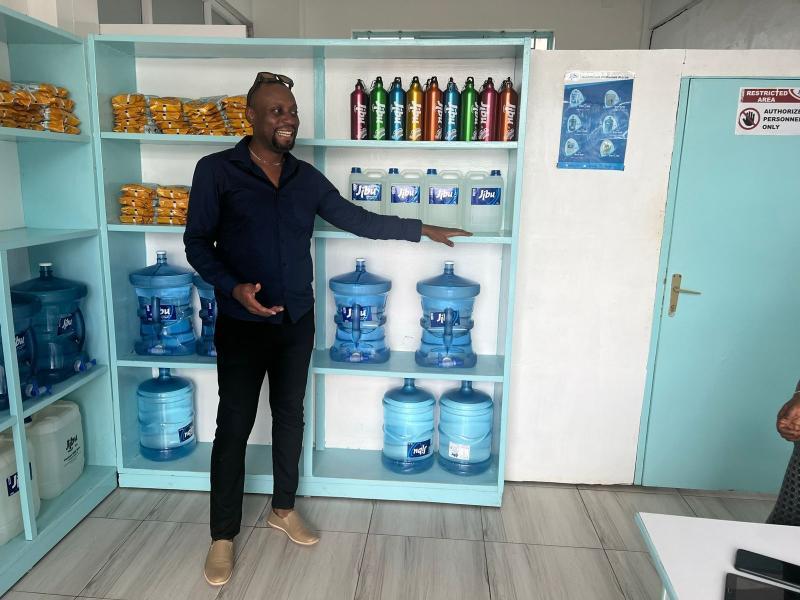
Ivan provides safe, affordable drinking water to people in Uganda, a country where, according to my grandson, 38 million people are without safe water. Ivan has applied for a loan from Kiva.org.

I was visiting Suzanne’s family yesterday and heard from my grandson about a worthy cause he’s donating some savings to. Actually, not donating. He is lending what he can to an entrepreneur called Ivan to help people in a country he has studied get access to safe drinking water.

How did this interest come about?

My grandson’s sixth-grade class’s research on the UN Global Goal of Eradicating Extreme Poverty involved choosing someone from a poor country who had applied to the lending nonprofit Kiva — and making a loan. After studying the poverty issue, screening a living-on-$1.98-cents-a-day experiment, and researching some of the Kiva offerings, the class voted.

My grandson was disappointed when the majority chose to support a grandmother in Thailand who was selling hammocks to help her care for a sick grandchild. He says that Uganda is a poorer country than Thailand — and he maintains that hammock accidents kill people. (He Googled it.) He also says that the annual income in Thailand is 8 times higher than in Uganda.

I asked him what the class majority’s reasoning was. He said (a) there was no way his favorite would get the extra $10,000 he still needed in the 8 days left in his application and (b) the grandmother still had 30 days left and was doing this for family. (He talks that way — “a and b.”)

He is not taking his defeat lying down, lending some of his own savings to Ivan’s cause, posting the link about Ivan in all the many chat rooms of his chess groups, sending Suzanne to twitter to promote Ivan’s application, and talking to me about a blog post.

Now here’s what Kiva says about Ivan: “Ivan is an experienced and seasoned entrepreneur in the safe water production and distribution sector. He has owned and run a Jibu water franchise for over five years and still counting. With the opportunity to open up a water production in the Munyonyo neighborhood, Ivan is excited at the opportunity to take safe and affordable drinking water to the residents of Munyonyo and also subsequently provide jobs for the youth who will be involved in the production and distribution value chain.

“Ivan is seeking a Kiva loan to open the Munyonyo operations. The loan will facilitate the launch of a water production and storefront facility, ensuring that every corner of Munyonyo has access to clean and affordable water. Please support Ivan so he can provide safe and affordable drinking water closer to the Munyonyo neighborhood.”

Interested? Please go to https://www.kiva.org/lend/2688341. Click on “technology.” Then click on the photo of Ivan and his water bottles. If you like the concept, maybe you or someone you know on social media will be up for helping. The Kiva rule is that Ivan has to get the total amount he applied for within the time allotted.

My grandson admits that this kind of lending is not a money-making proposition. He will get paid back in 39 months — in other words, when he is nearly 15 — without interest. (And I guess Kiva will reach him through Erik’s email, as Papa used a charge card when my grandson handed him the cash.)

But look, my grandson says, water is important — every 10 seconds someone in the world dies of water-borne disease, and 38 million Ugandans are without safe water.

Not a guy to argue with.

For more background on the nonprofit (“100% of every dollar you lend on Kiva goes to funding loans”) click here. It has a very good rating from Charity Navigator.

Read Full Post »

Photo: Vanessa Nakate.
Vanessa Nakate’s book A Bigger Picture: My Fight to Bring a New African Voice to the Climate Crisis recounts her journey as an environmental justice activist.

I continue to be impressed that people college age and younger are taking the lead on the critical issues of our time — gun control, climate change, inequality, everything. It is probably wrong to put pressure on them, but I do think they’re more likely to have answers — often because they don’t know what’s “impossible.” Older folks tend to believe things that have never been done are impossible. Young ones don’t.

At Living on Earth, Steve Curwood talks to a young Ugandan activist who has become a leader in fighting climate change.

“STEVE CURWOOD: Greta Thunberg started the Fridays For the Future climate strikes by sitting in front of the Swedish Parliament, and millions of people around the world ultimately joined her cause. One of them was Vanessa Nakate of Kampala, Uganda, who was just getting out of college at the time.

“Teenaged girls in Uganda don’t typically have the same social freedoms as many in the Global North have to be out on their own picketing and demonstrating. But at age 22 Vanessa Nakate could, as college age women have a lot more freedoms in her culture. And in the face of climate change, intensified floods and droughts that ravaged Uganda at the time, Vanessa was inspired by Greta to organize and start holding climate strike signs herself in front of the Ugandan Parliament.

“Greta Thunberg soon heard of Vanessa through social media and in January of 2020 Vanessa was invited to join Greta for a press conference at the World Economic Forum in Davos, Switzerland. But the Associated Press cropped Vanessa, the only black woman, out of a widely circulated photo that included Greta Thunberg and three other white European activists. Comments citing that editorial decision as racist soon went viral. And since that incident Vanessa has used her visibility to bring light to climate struggles in the Global South. In her book, A Bigger Picture: My Fight to Bring a New African Voice to the Climate Crisis, Vanessa points to how climate change is impacting Africa and the short shrift that she and other people and nations of color receive at the UN climate talks. … [Vanessa] what kind of climate change effects are going on in Uganda? …

“VANESSA NAKATE: Uganda as a country heavily depends on agriculture for survival for many communities, especially those in the rural areas. But with the rising global temperatures, many people are threatened with floods, droughts and landslides, causing massive destruction, massive loss of lives, loss of homes, farms and businesses. … In the western part of the country in areas of Kasese, because of the rising global temperatures, many people have been displaced and still are living in camps because of extreme flooding.

“CURWOOD: Please tell me a story of a particular recent climate related incident. …

“NAKATE: I can talk about one that happened last year. During the pandemic in 2020. The water levels of Lake Victoria rose as a result of extreme rainfall. And many people were displaced from their homes at a time when they had to stay at home to keep themselves safe. And with the rise in the water levels. Not only were farms destroyed, but even toilets were submerged, causing contamination of water sources and threatening the livelihoods of very many people.

“CURWOOD: Now, you join Friday’s for the Future in your 20s Vanessa. And that movement was made up of well, mostly teenagers and younger folks, why did you choose to join? …

“NAKATE: This is a challenge for some of my friends, because most of them were just finished in college and in their 20s. So, we all had this feeling that this movement was a movement for teenagers. But to me, that wasn’t the issue. … I just wanted to demand for climate justice and to talk about the challenges that the people in my country were facing because of the climate crisis.

“CURWOOD: Vanessa, tell me about some of the projects that you’re working on now.

“NAKATE: In 2019, I started school project Vash Green Schools Project. [It] involves the installation of solar panels and ecofriendly cookstoves in schools. I started this project to help drive a transition to renewable energy in schools in Uganda, and also for the clean cooking stoves to reduce the firewood that schools were using for preparation of foods. Almost all the schools in my country use firewood for food preparation. But with these ecofriendly stoves, the number that is used is greatly cut. … So far we’ve done installations in 13 schools.

“CURWOOD: You write in your book that when you came actually to the UN, a couple of [bad] things happened. …

“NAKATE: One of the people was a part of the Ugandan delegation [who] asked if I can meet him and talk about my activism. [I met] members of parliament, and I remember one of them actually recognizing me and saying that I’ve seen you on TV, you’re the girl who strikes every Friday. And at that moment, I’m like, wait, you’ve seen me. And you haven’t even said anything about the activism that I’m doing. …

“For the UN Youth Climate Summit … I was told that I would have a speaking role. I worked on my speech. And I was just really happy to talk about the experiences of the people in my country. [Then] I’m told that, well, you’re actually not going to speak but you will just be able to, you know, be like in discussions with other young activists. And at that point, it was really a disappointment before I left and I couldn’t tell my family or my friends because they were very excited.

“[And after the Davos incident] I felt like everything that I said at the press conference … didn’t matter, like it just went into the air and immediately disappeared, and no one was really paying attention. …

“It’s important for people to know that, historically, Africa is responsible for only 3% of global emissions. And yet Africans are already suffering some of the most brutal impacts of the climate crisis. It’s also important to know that while Africa, while the global south, is on the frontlines of the climate crisis, it is not on the front pages of the world’s newspapers. And it’s also important to know that there are a number of activists in the African continent in the global south who are speaking up, who are demanding for justice from leaders, from governments, from corporations. … We want climate action from the leaders and our voices will not be silenced.”

More at Living on Earth, here.

Read Full Post »

Photo: Abubaker Lubowa/Reuters.
From the
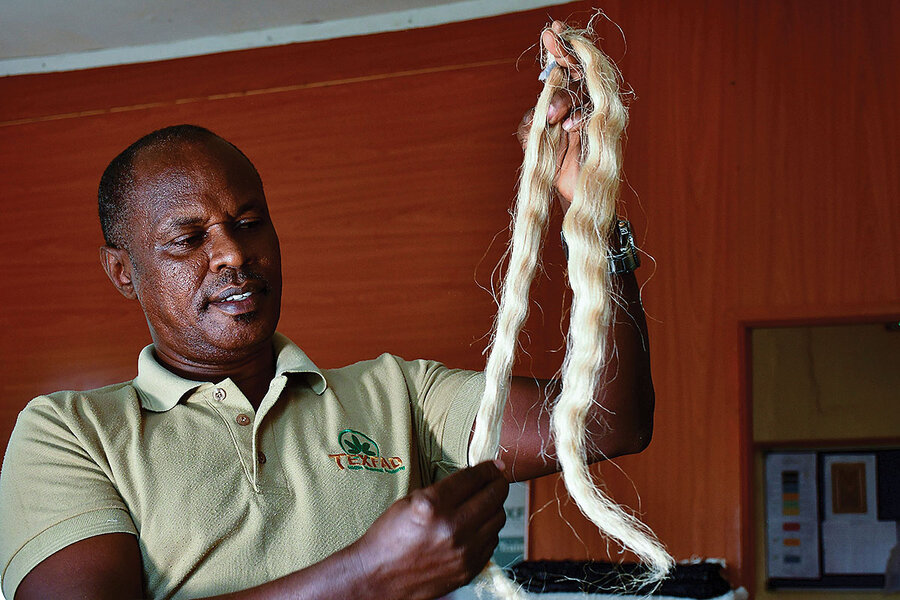
Christian Science Monitor news roundup: “Managing director Kimani Muturi shows off a TexFad hair extension made from banana trunk fibers near Kampala, Uganda, April 3, 2021. When finished using it, consumers can compost the product. The company also makes rugs and other handwoven textiles.

When in the air-conditioner season I stop to think about how much we all depend on fossil fuels, I worry that we will never be able to halt global warming. But then I read stories from around the world about inventive people doing what they can, and I remember the underlying wisdom of “one and two and 50 make a million.”

Lindsey McGinnis at the Christian Science Monitor has scoured the news media for signs of progress in a variety of areas, including the environment.

“Researchers from the University of Maryland and Yale have made a breakthrough in the search for sustainable plastic alternatives, developing a wood-based bioplastic that disintegrates in a few months. … The new bioplastic is created by using a biodegradable solvent to deconstruct wood powder found at lumber mills into a slurry, which can then be shaped into common plastic products, such as shopping bags and other packaging.

“Other experimental bioplastics have often lacked the strength to compete with petroleum-based plastics, but the scientists say their product showed high mechanical strength during tests, the capacity to hold liquid, and resistance to ultraviolet light. At the end of a product’s life, the bioplastic will quickly decompose in soil, or can be re-slurried and used again. Source: New Atlas, Nature Sustainability

“A startup in Uganda is making consumer products from edible banana plant material that would otherwise go to waste. Uganda is sub-Saharan Africa’s top producer of bananas and plantains, with an estimated 75% of all farmers growing some form of banana. They typically leave the stalks to rot after harvesting fruit. That’s where TexFad saw an opportunity. The company, which launched in 2013 and employs 23 people, runs the stalks through a machine to create long fibers, hangs the leathery strands to dry, and uses the material to create products such as carpets.

“Last year, the company made $41,000 in sales, and the managing director expects TexFad to double production in 2021 to 2,400 carpets, some of which will be exported to customers in the United Kingdom, Canada, and the United States for the first time. The company also creates hair extensions (used ones can be composted) and is working on a process to soften the fibers for use in clothing. Source: Interesting Engineering, Reuters

“A global network is helping reroute dangerous refrigerants before they leak into the atmosphere. Freezers and refrigerators have housed some of the most potent greenhouse gases, including the compound known as R12, a chlorofluorocarbon with roughly 10,000 times the destructive potential of CO2. The refrigerants pumped into modern units are better, but still pose global warming potential. When disposed of improperly – either knowingly or unknowingly – these gases are released into the atmosphere and contribute to climate change.

“Tradewater, a company that collects and destroys greenhouse gases and sells the carbon offset credits, is coordinating with governments and businesses around the world to dispose of the gases safely. Its teams are sometimes called ‘chill hunters’ or ‘ghostbusters’ for the way they track and trap the gases, transferring them from discarded refrigerator cylinders into a large container. Tradewater then incinerates the recovered gases. The group reports that 4 million to 5 million metric tons have been kept out of the atmosphere so far. Ángel Toledo has run a waste disposal plant on the edge of Guatemala City for 16 years, but only dealt with refrigerant gases since 2018. ‘It’s like a dream, helping the environment … [by preventing these] gases from reaching the atmosphere.’ Source: BBC.”

More at the Monitor, here. I am not a Christian Scientist, but the Christian Science Monitor newspaper has a long and illustrious history for objective reporting, especially on international news, although I believe they don’t cover health news.

Read Full Post »

20190824_bkp511

Photo: The Economist
Ugandan writer Jennifer Nansubuga Makumbi is part of an African literary Renaissance.

Other than a day trip from Spain to Morocco decades ago, I have never set foot in Africa. But I have experienced it, in a way, by reading African writers such as Wole Soyinka and Chinua Acebe. Today, a new generation of young writers is offering the world fresh insight.

The Economist writes, “In 2003 Harriet Anena was a schoolgirl in northern Uganda, a region then at war. The army had ordered people into squalid, crowded camps; insurgents stalked the bush.

“ ‘We scratch our destiny / from hands of a curtailing fate,’ she scribbled, sitting beneath a mango tree. In poetry she found a way to ask questions that children, especially girls, were not supposed to ask. ‘I started writing for therapy,’ she says.

“This month Ms Anena recited those lines on the stage of the National Theatre in Kampala, melding drums, dance and poetry in an arresting evocation of love and war. Her performance was the highlight of this year’s Writivism festival, an annual celebration of creative writing, and a testament to the vitality of the country’s small but flourishing literary scene.

“Uganda was once at the fulcrum of African literature. It was at Makerere University, on a hill above Kampala, that giants such as Chinua Achebe and Ngũgĩ wa Thiong’o gathered in 1962 for the first African Writers’ Conference, a landmark event held on the eve of independence for many countries. …

“Yet in a place where history and politics weigh heavy, writers are finding fresh voice. A number of trailblazing authors have passed through FEMRITE, a non-profit founded in 1996 to publish and promote women’s writing in Uganda. Writivism, now in its seventh year, publishes an annual anthology and runs a short-story prize.

“And Ugandan literature can boast of an international superstar in Jennifer Nansubuga Makumbi (pictured), whose debut novel Kintu is a multi-generational saga that ties oral myth to a recognisable present. …

“Encountering the names of familiar places in a novel ‘just blew by mind,’ says Nyana Kakoma, who runs a small publishing house in Kampala. ‘I said wait a minute, this is me, this is my life, this is Uganda as I know it.’

“Much of this new literature is strikingly political. The Betrothal, a play by Joshua Mmali, is a retelling of a multimillion-dollar corruption scandal that he covered as a journalist for the BBC; its performances at the National Theatre in Uganda last year were greeted with whoops of recognition from audiences. Bold writers can draw on the daily chronicles of hypocrisy and clampdowns recorded by a lively press. …

“War, corruption and sexism are not easy topics, and creative expression has its limits. Uganda has an authoritarian government, presided over by an ageing and increasingly testy strongman. This month Stella Nyanzi, an activist and academic, was sentenced to 18 months in prison after posting a poem on Facebook [about] the president’s mother.

“For all that, it would be a mistake to assume that Ugandan writing is glum, pious or austere. Young writers are finding humour in struggle, and joy in the everyday. There is the promise of freedom in their work. ‘Do not miss the chance to groove, my child,’ writes Peter Kagayi, a poet, ‘at the pattering of life’s raindrops.’ ”

More here.


Read Full Post »

Photos: Nichole Sobecki for the New York Times
Samuel Lagu set aside five acres of his land in Mireyi, Uganda, for a rice venture in which South Sudanese refugees and Ugandans work side by side.

Sometimes it’s the poor who do the best job of helping the poor. That is also true of nations. Uganda is no utopia, as those who have been oppressed by the government know firsthand, but it’s doing a better job of helping Sudanese refugees than many richer countries. Officials understand that refugees can build the economy, and individual Ugandans have not forgotten when they were in need and Sudanese people helped them.

Joseph Goldstein writes at the New York Times, “Solomon Osakan has a very different approach in this era of rising xenophobia. From his uncluttered desk in northwest Uganda, he manages one of the largest concentrations of refugees anywhere in the world: more than 400,000 people scattered across his rural district.

“He explained what he does with them: Refugees are allotted some land — enough to build a little house, do a little farming and ‘be self-sufficient,’ said Mr. Osakan, a Ugandan civil servant. Here, he added, the refugees live in settlements, not camps — with no barbed wire, and no guards in sight. …

“In all, Uganda has as many as 1.25 million refugees on its soil, perhaps more, making it one of the most welcoming countries in the world, according to the United Nations.

“And while Uganda’s government has made hosting refugees a core national policy, it works only because of the willingness of rural Ugandans to accept an influx of foreigners on their land and shoulder a big part of the burden.

“Uganda is not doing this without help. About $200 million in humanitarian aid to the country [in 2018] will largely pay to feed and care for the refugees. But they need places to live and small plots to farm, so villages across the nation’s north have agreed to carve up their communally owned land and share it with the refugees, often for many years at a time.

“ ‘Our population was very few and our community agreed to loan the land,’ said Charles Azamuke, 27, of his village’s decision in 2016 to accept refugees from South Sudan, which has been torn apart by civil war. ‘We are happy to have these people. We call them our brothers.’ …

“As the sun began to set one recent afternoon, a group of men on the Ugandan side began to pass around a large plastic bottle of waragi, a home brew. On the South Sudanese side, the men were sober, gathered around a card game.

“On both sides, the men had nothing but tolerant words for one another. … As the men lounged, the women and girls were still at work, preparing dinner, tending children, fetching water and gathering firewood. They explained that disputes did arise, especially as the two groups competed for limited resources like firewood. …

“Recent polls show that Ugandans are more likely than their neighbors in Kenya or Tanzania to support land assistance or the right to work for refugees. Part of the reason is that Ugandans have fled their homes as well, first during the murderous reign of [Idi] Amin, then during the period of retribution after his overthrow, and again during the 1990s and 2000s. …

“Many Ugandans found refuge in what is today South Sudan. Mark Idraku, 57, was a teenager when he fled with his mother to the area. They received two acres of farmland, which helped support them until they returned home six years later.

‘When we were in exile in Sudan, they also helped us,’ Mr. Idraku said. ‘Nobody ever asked for a single coin.’

More at the New York Times, here.

A goat shelter on the land that Ugandans such as Mark Idraku lent to a refugee from Sudan. Queen Chandia, who cares for 22 children, some of whom lost their families in Sudan’s civil war, said the donated land has made all the difference.

Read Full Post »

tlumacki_blindugandanparlimentarian_metro067

Photo: John Tlumacki/Globe Staff
Margaret Baba Diri, a Ugandan legislator who lost her sight, visits the Carroll Center for the Blind in Newton to gather ideas for helping the blind in her own country.

Here is a woman from Africa who refused to let her disability keep her from helping the people of her country.

Emily Williams writes at the Boston Globe, “Margaret Baba Diri is scrolling through her iPhone, even if it doesn’t seem that way at first. The screen is dark, and she holds it at her chest, her finger swiping through the pages as an automated voice calls out the names of her apps until she lands on the one she wants.

“She is practicing ‘flicking,’ a technique she learned during an eight-week training program this spring at the Carroll Center for the Blind in Newton.

“A member of the Ugandan Parliament for more than 20 years, Baba Diri, 64, came to the center to improve her skills and move closer to her goal of opening a center for the blind and visually impaired in Uganda.

“She hopes to model many aspects of the Carroll Center’s program, she said, especially the close relationship instructors build with students. ‘We’re not here for competition,’ she said. ‘We are all growing at our own pace.’ …

“Over time, Baba Diri has developed many ways to compensate for her lack of sight and work independently. She reads braille and, with the use of a special machine, can record, edit, and print notes in braille.

“Over the past several weeks, through the center’s independent living program, Baba Diri practiced a range of everyday tasks, such as crossing streets, washing clothes, and cooking meals. …

“As she learns, she is taking careful note of how those skills are taught and envisioning how she’ll construct her own programs. …

“Baba Diri lost her sight in 1990 from glaucoma. She had been teaching biology and chemistry at a secondary school for 14 years, and when she lost her sight, she also lost her ability to teach.

“ ‘I thought it was the end of my life,’ she said.

“But a friend reminded her that the loss of her sight didn’t diminish her intellect. She could learn braille, practice mobility training, and find a new career.”

Learn more about this indomitable woman at the Globe, here.

Read Full Post »

Photo: Gramophone
Children in Uganda are learning the joy of playing a musical instrument thanks to an initiative called Brass for Africa.

The opening sentence of the following article caught my attention as, in fact, both my children had instruments they no longer played. A couple years ago, they let me donate the oboe and the alto sax to the Worcester public schools as part of a WICN program.

At Gramophone, Isha Ranchod wrote about something similar occurring in Uganda, “If you found out that your son’s junior band had 30 brass instruments that were not going to be used anymore, what would you do?

“Airline pilot Jim Trott raised funds to have them shipped to Uganda after seeing the circumstances of children while there for work, and what started as a way to save the instruments from the scrap heap turned into a story of hope and transformation.

“Trott placed the trumpets in an orphanage called The Good Shepherd Home, with the tutelage of music given to Ugandan local Bosco Segawa and his organisation M-Lisada – and so he thought his work was complete.

“However, he continued to visit the home regularly, and was amazed to find overall improvement in the children learning music. He said that they had discovered self-confidence and pride within themselves and found that playing in their brass band together had become the most important thing in their lives.

“This was when Trott realised that he needed to find a way to sustain this musical intervention and share this opportunity with more children. And so the charity organisation Brass for Africa officially began. …

“The children involved include those living in extreme poverty (living either as street children or in a slum), as well as children living in orphanages and rehabilitation centres, living with physical or mental disability, or coping with HIV/AIDS. These children each have two training sessions a week, which include music theory, and are periodically recorded so as to let them hear their improvement along the way. The bands each have at least three performances a year, which not only serve as goals for the children to work towards, but also allow for them to show the local communities their growth and talent. …

“The music lessons are supplemented with a life skills programme tailored to the experiences of these Ugandan children. The emotional support and practical skills taught in this way aim to help the participants to reach their own goals in the long term. …

“The teachers of the programme were once students of Brass for Africa, having come through the programmes themselves. This ensures that they understand the challenges faced by the participants and also creates a sustainable cycle in which the culture is not forced to adapt to a Western influence. …

“The project’s vision has attracted two internationally-acclaimed trumpeters, Alison Balsom and Guy Barker, who serve as ambassadors and patrons. …

“In 2014, Balsom and Barker went to Kampala, Uganda, and played in the different bands with the children, making music together and experiencing first-hand what had drawn them to the charity in the first place.

” ‘There were hundreds of young people that I met, and for all of them, this was the highlight, the focus, and the safety net of their day.’ … Many of the children told Balsom that playing in the band gave them a valuable escape from the stresses and challenges of their daily lives.” Read about a girl whose life was changed by the program, here.

Photo: Jim Trott
Aisha Nassaazi, a Ugandan girl, says her life was changed completely by music.

Read Full Post »

Photo: Edwin Ongom, CURE International
Aisha holds her daughter at CURE Children’s Hospital of Uganda. Uganda surgeons are teaching Western doctors a technique to cure hydrocephalus in infants.

Western medical professionals are learning that offering medical insight in the Third World can be a two-way street. In this story, Westerners are benefiting from the teaching of some Ugandan surgeons.

Michaeleen Doucleff writes at National Public Radio, “It’s not every day that surgeons develop a new brain surgery that could save tens of thousands of babies, even a hundred thousand, each year. And it’s definitely not every day that the surgery is developed in one of the world’s poorest countries.

“But that’s exactly what neurosurgeons from Boston and Mbale, Uganda, report [last December] in the New England Journal of Medicine.

“The treatment is for a scary condition in which a baby’s head swells up, almost like balloon. It’s called hydrocephalus, or ‘water on the brain.’ But a more accurate description is ‘spinal fluid inside the brain.’

“Inside our brains, there are four chambers that continually fill up and release spinal fluid. So their volume stays constant.

“In babies with hydrocephalus, the chambers don’t drain properly. They swell up, putting pressure on the brain. If left untreated about half the children will die, and the others will be badly disabled.

“Traditionally doctors treat hydrocelphalus in the U.S. with what’s called a shunt: They place a long tube in the baby’s brain, which allows the liquid to drain into the child’s stomach.

“But a third of the time, these shunts fail within two years, says Dr. Jay Riva-Cambrin, a neurosurgeon at the University of Calgary. …

“For many kids in rural Uganda — and other poor countries — emergency neurosurgery isn’t an option. ‘They’re going to die from a shunt malfunction,’  says [Dr. Benjamin Warf, a neurosurgeon at Harvard Medical School, who led the development of the new method at a clinic in Uganda]. …

“So Warf and his colleagues decided to innovate. … In the new method, doctors basically poke a hole in the brain’s chambers so they can drain. They also prevented the chambers from filling back up by partially damaging the region of the brain that produces spinal fluid. …

“After 15 years of testing and optimizing, he and his team can finally say that their approach — at least in the short term — appears to be just as effective as the procedure commonly used here in the U.S.

“In the study, Warf and his colleagues tested the two methods on about 100 children in Uganda. After 12 months, the doctors couldn’t detect a difference in the children’s brain volume or cognitive skills. …

“The new technique has been so successful in developing countries that American doctors are now traveling to Uganda to learn how to do the technique from Ugandan doctors.

” ‘The doctors at the clinic in Uganda are wizards at the [new] method,’ says Riva-Cambrin. ‘They’re the ones that taught me the procedure.’ ”

More at NPR, here.

Read Full Post »

Photo: Evan Petty
Kids enjoying the baseball field at the Allen VR Stanley Secondary School of Math and Science for the Athletically Talented near Kampala, Uganda. 

The inimitable Karen Given at WBUR radio’s Only a Game has found another inspiring story to share with listeners. This one is about a Syracuse University grad who found his calling thanks to a youth baseball team in Uganda.

“Back in the spring of 2014, Evan Petty was a senior at Syracuse University. And he was feeling a little anxious.

” ‘Um … the pressure’s starting to kick in at that point,’ Evan says. “I didn’t really know what it is that I was really going to do. I had always really liked sports. I got a journalism degree, but I didn’t work hard enough to turn it into anything.’ …

“After graduation, Evan flew to Fairbanks to write game reports for the Goldpanners — a collegiate summer team. …

” ‘I guess it bought me time. That’s pretty much all it did,’ he says.

“Evan spent that summer thinking about baseball — he’d always loved the game. He thought he’d like to be a coach. But he didn’t have any training or experience. He figured he’d never find a paid job in this country, so he started looking elsewhere.

” ‘So I think that I looked in places like Japan, even, and places in Europe. Spain, they play some baseball. I took some Spanish in high school, maybe I could make something work with that,’ Evan says. ‘But then Uganda came up.’

“Yep. Uganda. A school was looking for an English teacher/assistant baseball coach.

“The Allen VR Stanley International School of Math and Science for the Athletically Talented was founded by an American businessman who wants to bring baseball to Uganda. Besides teaching kids math and science and English, the school had another well-publicized goal: to send a team to Williamsport.

“Evan had been watching the Little League World Series on TV since he was 13. He loves it.

“The quality of the play is so high, and everything about it is so emotional and real. It’s raw. Like, it’s so raw. It’s just the best,” he says. …

“Evan hopped on an airplane and flew to Kampala. …

“When Evan saw the baseball team he’d be coaching, he was even more excited. It’s not that the players had a lot of experience. In fact, many of them had none at all.

” ‘Put it this way: Balls were being thrown very fast, and bats were being swung very hard, and players were running very fast,’ Evan says. ‘There was a lot of raw talent everywhere.’ …

“In 2011, the team won the qualifying tournament in Poland, but the players were denied visas to come to the United States. Many of the players don’t have birth certificates. ‘Paperwork is hard in Uganda,’ Evan told me. …

” ‘We had to do a whole lot of stuff and satisfy a whole lot of people and pay a whole lot of money [in 2015 to attend the qualifying games in Poland],’ Evan says. ‘And then we had to win the games, and that was the easy part.’ …

“Uganda was headed back to Williamsport, and they had one simple goal.

” ‘Shock the world,’ Evan says.”

That is what they did. Read more.

Interestingly, the Disney flic Queen of Katwe — about a young female chess prodigy from the Katwe, Uganda, slums — also demonstrates that committed adults and international competitions offer Ugandan children one of their best hopes for rising above challenging circumstances.

Read Full Post »

Sweet potato evangelism has won the World Food Prize. I learned about this at National Public Radio, which has a regular feature on eating and health called the Salt.

Dan Charles reports, “One summer day in 2012, on a long drive through northern Mozambique, I saw groups of men standing beside the road selling buckets filled with sweet potatoes. My translator and I pulled over to take a closer look. Many of the sweet potatoes, as I’d hoped, were orange inside. In fact, the men had cut off the tips of each root to show off that orange color. It was a selling point. …

“In Africa, that’s unusual and new. Traditionally, sweet potatoes grown in Africa have had white flesh. …

“Those orange-fleshed sweet potatoes along the road that day represented the triumph of a public health campaign to promote these varieties — which, unlike their white-fleshed counterparts, are rich in Vitamin A. [In June], that campaign got some high-level recognition at a ceremony at the U.S. State Department. Four of the main people behind it will receive the 2016 World Food Prize. This prize is billed as the foremost international recognition of efforts to promote a sustainable and nutritious food supply.

“This year’s laureates are Maria Andrade, Robert Mwanga, Jan Low and Howarth (Howdy) Bouis. Three of them — Andrade, Mwanga and Low — worked at the International Potato Center, which is based in Peru, but has satellite operations in Africa. Bouis worked at the International Food Policy Research Institute in Washington, D.C. …

“In recent years, researchers have documented health improvements among villagers in Mozambique and Uganda, simply because they chose to eat sweet potatoes with orange flesh.” More at NPR.

Don’t you love the orange truck? I call that multichannel messaging.

Photo: Dan Charles/NPR
Maria Isabel Andrade is one of four researchers honored with the World Food Prize for promoting sweet potatoes that are orange inside to combat malnutrition.

Read Full Post »

I think it’s safe to say that most adults would rather take care of themselves than rely on charity, but sometimes it’s hard for people living in extreme poverty to figure out how to cut the cord. Beth Alaimo at the Christian Science Monitor‘s People Making a Difference has a story about some Ugandans who are finding a way.

“Iganga, a town conveniently located along the central highway from Kampala to Nairobi, is much more than a popular truck stop. It’s where Musana, a community organization breaking Uganda’s reliance on foreign aid, has made its home. …

“With 67 percent of the population living in poverty, Uganda is no stranger to dependency. Despite being a popular region for development ventures, organizations often lack an approach that prioritizes what locals want and need while leaving the savior mentality behind.

“Originally a children’s home for 80 orphans, Musana Community Development Organization decided to change its model from a system that perpetuated child-rearing dependency to one that encouraged parents to provide what they could. Today, says co-founder Leah Pauline, ‘we are more than a charity. We’re a sustainable solution for the community.’ …

“Its first and largest project, the nursery and primary boarding school, is the closest to being self-sustainable. Roughly 600 students are attending this upcoming semester, an estimated 500 of whom are paying fees, with the rest receiving scholarships.

“Businesses created and run by locals are also moving the Musana community closer to achieving sustainability. A trendy restaurant (the ‘only place in Iganga you can find a burger’ says Pauline), a dairy farm, and handmade women’s crafts are all businesses funding community outreach.

“A bakery is the newest sustainability project at Musana and has quickly become profitable. Proposed and started by the head of child care, the kids often come in and help bake.” More here.

A famed Wharton School professor from South Africa, Ian C. MacMillan, has been known to complain about the dependency cycle he sees in Africa, and has taken steps on his own to boost independent small businesses there. An article here is partly about that work.

Photo: Musana Community Development Organization
The Musana Community Development Organization runs several enterprises, including a nursery and primary boarding school. A bakery, proposed and started by the head of child care, is the newest project and has quickly become profitable. The children often come in and help bake.

Read Full Post »

Older Posts »