Feeds:
Posts
Comments

Posts Tagged ‘water’

Photo: RJ Sangosti/MediaNews Group/The Denver Post via Getty Images.
Above, Las Vegas Valley Water District Water Waste Investigator Devyn Choltko puts a water waste violation into the computer system outside a home in north Las Vegas, Nevada.

When water is seen running into the gutter from a lawn in a desert city, Water Waste Investigator 9393 steps in. The good news is, water conservation efforts like those in Las Vegas are paying off.

Yvette Fernandez reports at National Public Radio by way of the Mountain West News Bureau, an NPR regional hub, in collaboration with Nevada Public Radio in Las Vegas. 

“About two dozen investigators patrol neighborhoods throughout Las Vegas every day searching for signs of wasted water. They’re known as water waste investigators who are part of the Southern Nevada Water Authority. For more than 20 years, they have been helping conserve water in the growing desert city.

“Devyn Choltko is one of the investigators with the Las Vegas Valley Water District, which is part of SNWA. … On an early July morning, she stops her patrol car in a neighborhood where water flows onto the street.

” ‘Water Waste Investigator 9393,’ Choltko reports into her cell phone to record the incident. ‘Some misaligned sprinklers as well as over-irrigation causing some run-off,’ she continues. …

“Choltko says ‘spray and flow’ violations are among the most common problems. This is when water from a sprinkler head sprays out onto the sidewalk or street, and that’s considered wasted water.

“Choltko marks a yellow flag with the date, time and alleged violation, then places the marker on the property to notify the resident. The investigators can only leave the yellow flag if they have actually witnessed the violation.

” ‘Most people don’t even know they have a problem,’ Choltko says. …

“Residents get a few notices to take corrective action. If they are ‘repeat’ violators, a fine ‘is recommended,’ says Choltko. They face a fee of $80 initially, which can continue to double if ignored.

“Choltko says some homeowners may have issues they aren’t aware of. A homeowner, for example, may have taken proactive steps to conserve water by removing their grass and switching to desert landscaping. Succulents and drought-resistant plants should be watered using drip irrigation to get water directly to the roots and reduce evaporation. But faulty or worn-out tubes can result in water spewing onto sidewalks. …

“For low-income homeowners who cannot afford repairs, the SNWA can provide financial assistance to make necessary repairs. It will also provide help in detecting leaks.

“More than twenty years ago, drought gripped the Colorado River Basin. … By 2003, the Southern Nevada Water Authority, a not-for-profit water provider with a half dozen water collaborative agencies in southern Nevada, responded with several water conservation efforts, which included starting the water patrol. …

“Says Bronson Mack, a spokesperson with the SNWA, the goal [is] to educate people about the importance of water conservation and encourage people to change their behavior. That change can be as small as people taking shorter showers or reusing water for plants or cleaning.

” ‘We collected in the neighborhood of about $1-$1.5 million over the recent years in water waste violations,’ says Mack. The Las Vegas Valley Water District uses those dollars to support conservation programs, such as incentives to remove turf and rebates to install smart irrigation systems. …

“Just east of Las Vegas, receding ‘bathtub rings’ are etched into one of the country’s largest reservoirs, Lake Mead — a reminder of how much water there once was. The reservoir provides water to Las Vegas and surrounding Clark County. Lake Mead and Lake Powell are at less than 35% normal capacity.

“The Southern Nevada Water Authority … has a significant effort to recycle water that’s already been used by treating it and putting it back into use. According to SNWA, it returned more than 245,000 acre-feet of water to Lake Mead in 2024. …

“The population of Las Vegas has grown by over 800,000 people since 2002. And, the city has seen over 40 million visitors during that time. Despite that growth, ‘we have reduced our consumption of Colorado River water by more than 30% over the past two decades,’ Mack says. …

“Low levels at Lake Mead and Lake Powell are expected to continue, according to the latest data released by the Bureau of Reclamation. The Department of the Interior’s Acting Assistant Secretary for Water and Science, Scott Cameron, said in a news release: ‘forward-thinking solutions’ that prioritize conservation will be increasingly important.”

More at NPR, here.

Read Full Post »

Photo: Navajo Natural Heritage Program via Natural Resources Defense Council.
Diné Native Plants Program members work to restore a headwater stream impacted by livestock grazing.

The more that the US endangers its wetlands, the more we rely on the work that tribes do to protect them. Perhaps today’s article can help us see what the rest of us can do.

At the website for the Natural Resources Defense Council, or NRDC, Claudia Blanco Nuñez and Giulia CS Good Stefani describe how “Tribal Nations protect and manage millions of acres of wetlands, which help improve water quality, curb the risk of floods, recharge groundwater, and store large amounts of carbon.”

“Two years ago,” they report, “the U.S. Supreme Court slashed federal Clean Water Act protection of wetlands [with] harmful repercussions for droughts, wildfires, flooding, wildlife, and the drinking water supply. 

“In the absence of federal protection, the imperative to defend our shared waters falls increasingly on individuals, states, and Native American Tribal Nations. … Tribal Nations protect and manage millions of acres of wetlands in the United States, and with commitments made by the U.S. government to Tribal co-management and co-stewardship of federal lands, the amount of clean water safeguarded by Tribal Nations is growing.

“NRDC’s Science Office mapped the wetlands found within and intersecting the boundaries of Tribal reservation lands in the contiguous United States. Across the 294 federally recognized Tribal reservations mapped in this analysis, our scientists found that Tribes steward more than 3 million acres of wetlands. Even typically arid regions like the American Southwest have significant wetlands on Indigenous reservations. …

“In addition to the 56.2 million acres that are part of the Tribal reservation system, many Tribes have reserved or treaty rights on lands outside reservation boundaries, and most Tribes and their members maintain ongoing physical, cultural, spiritual, and economic relationships with their ancestral homelands. These reciprocal land and water relationships extend far beyond the political boundary of any designated reservation.

“This analysis is limited to federally recognized Tribes in the Lower 48 due to the complex Tribal governance systems in Alaska and Hawai’i. For example, the Alaska Native Claims Settlement Act of 1971 altered the previous Tribal ownership system to one led by Alaska Native Corporations. This system differs from federally recognized Tribes, which have a government-to-government relationship with the United States that includes eligibility for funding and services from the Bureau of Indian Affairs. That is to say, NRDC’s analysis looked at just a fraction of the total wetlands stewarded by and connected to the lives and well-being of Native peoples today.

“To learn more about Tribal wetland conservation, we spoke with leaders in the wetland management programs of the Navajo Nation and Red Lake Band of Ojibwe. …

“Navajo Nation agency staff are engaged in numerous projects to help restore and protect this essential resource. The Diné Native Plants Program recently submitted a grant application to remove invasive plant species along the Little Colorado’s riverbank. This will make space for native vegetation to grow and help with groundwater recharge for nearby Navajo farmers and families. The Diné Native Plants’ seed program also provides seed mixes for restoration projects that are solely sourced from Navajo plants. 

“Jesse Mike, the Diné Native Plants program coordinator, stepped out of the greenhouse to speak with us. He shared about the history of livestock grazing, trampling, and erosion that have impacted not only the health of the headwater streams on Navajo lands but also the underlying water table. His team is currently working to increase groundwater infiltration and improve the overall ecosystem health of three degraded streams in the Chuska Mountains. …

“The Red Lake Band of Ojibwe’s reservation is in northern Minnesota and has the greatest area of wetlands of any reservation in the contiguous United States. Across the Tribe’s more than 835,000 acres of land — all held in common by the Tribe — the Red Lake Band manages an astonishing 541,000 acres of wetlands. ‘So many wetlands,’ says Tyler Orgon, a biologist and the lead wetland specialist for the Red Lake Band Department of Natural Resources, ‘and we’re very fortunate for that.’ 

“A sizable portion of the Tribe’s wetland acreage north of Upper Red Lake is part of the largest expanse of peatlands in the continental United States. Peatlands cover about 3 percent of the earth and store more carbon than all of the planet’s other types of vegetation, including the world’s forests, combined. 

“One of the most important wetland-dependent plant species for the Red Lake Band — as well as other Anishinaabe and Dakota peoples across the Great Lakes region — is manoomin (Zizania palustris and Z. aquatica), the only wild rice native to Turtle Island. According to an Ojibwe prophecy, their ancestors were instructed to move west to the place where ‘the food floats on water.’

“The University of Minnesota research team We Must First Consider Manoomin (Kawe Gidaa-naanaagadawendaamin Manoomin) works to help protect this essential wetland-dependent plant by combining Western science with Indigenous science and learning from Ojibwe stewardship.

“The scientists have found that an increase in extreme weather conditions (like flooding events and record-breaking snowfall) negatively impact manoomin growth by uprooting the plant or drowning it out in its sensitive early stages. These weather events compound the already present settler-colonial impacts on wetlands in the region, including deforestation and conversion of wetlands into agricultural land use.

“Orgon hopes to restore some of the Red Lake Band’s wetlands that have been impacted by past agriculture.” More at NRDC, here.

Read Full Post »

Photo: Jenna Garrett/The Guardian.
Eric Haas in his backyard in Oakland, California. The California professor had a rainwater and greywater capture system installed at his highly efficient urban home to conserve water. 

I like reading about people who are handy at fixing or making things. Probably because I’m not. Other than sewing on a button or baking cookies, I don’t do much in the do-it-yourself line, but I know some of you do, and I’d love to hear about it.

Today’s article is part of a Guardian series on people who figure out ways to limit their impact on the environment. Sometimes that means working with companies specializing in sustainable building practices. Eric Haas told his story to Victoria Namkung.

“I joined the Peace Corps after college in 1985,” Haas explains, “and was a math and science teacher in Buchanan, Liberia. There, I started to realize that large parts of the world don’t live with all the energy consumption and materialism that we do in the US.

“I started seeing people’s innovative ways of keeping their houses warm or cool and how they would get their water. I had to carry my own water at times and be very conscious where it came from. These experiences started cementing this idea that life could take into account the environment you lived in.

Relatively simple ideas could make a huge difference in the comfort and quality of your house. You adapt and your lifestyle can adapt. …

“When our family settled in Oakland, California, in 2007, part of the decision in buying a house was whether it was somewhere I could finally focus on water conservation and other low-carbon-footprint projects like installing solar panels, insulation and high-efficiency appliances.

“I hired Dig Cooperative Inc, a local contractor known for pioneering water-conservation systems across the greater Bay Area, to install a rainwater and greywater collection system at our home. I have about 4,000 gallons of water I can collect, which translates to about 7inches of rain coming off the roof. Filtered rainwater is used to fill the toilets and washing machine and water most of our plants. It can also be saved on site for emergency use in case of a fire or an earthquake.

“The greywater system takes our ‘used’ shower, bathroom sink and washing machine water and diverts it to the backyard to water our vegetable gardens and six fruit trees. …

“During 2024, the typical household in our area used an average of 124 gallons of water a day. We used an average of 39 gallons of water a day, less than a third.

“It wasn’t hard and the whole project took about a week. Rain barrels needed to be purchased and set up and the ground had to be leveled. I have a relatively small and simple house and connecting the rainwater and greywater system into the existing plumbing just took a day or two.

“The whole project cost about $15,000. We still have a water bill because the shower, sink and dishwasher water use regular city water, but it’s a fraction of what it used to be. … Compared to the average water user, I save about $220 a year on my water bill. So, my rainwater and greywater systems do more for my local environment than they do for my wallet.

“Since moving to Oakland, I’ve noticed a lot of climate-related changes. Before, nobody had air-conditioning, and I never even thought about it. Now it’s almost a necessity on select days. When I first put in the system, there was enough rain periodically in California’s dry season to fill up the tanks enough that I never had to go back to city water for the first several years. Now it only lasts for about 10 months. The dry season is so dry and when we’ve got extra rain in the rainy season my tanks overflow and drain into the sewer because they’re full.

“We have to approach our water use differently in California. … Our overuse of water now impacts our quality of life. We have water-restriction days where they ask you not to use as much water, including not flushing our toilets every time, and we’re encouraged not to have a lawn. … You can still have a really nice garden. We have a hot tub, we have a regular shower, but because those things are connected into this larger system, we have a much smaller impact.

“I feel like I’m doing something real and concrete, and every time I hear the greywater pump go on or when I hear the pump from our rainwater system go on to fill up the washing machine or  toilet, that’s water that I’m not taking from the system and that matters.

“Every time it rains, I love to go out and look at the gutters and see how much it’s pouring into the system. It brings me joy to interact with the natural environment in this small way in my urban house.”

More at the Guardian, here. My DIY climate hack is a Guardian series about everyday people across the US using their own ingenuity to tackle the climate crisis in their neighborhoods, homes and backyards.

Read Full Post »

Photo: Panoramic Studio/Landprocess.
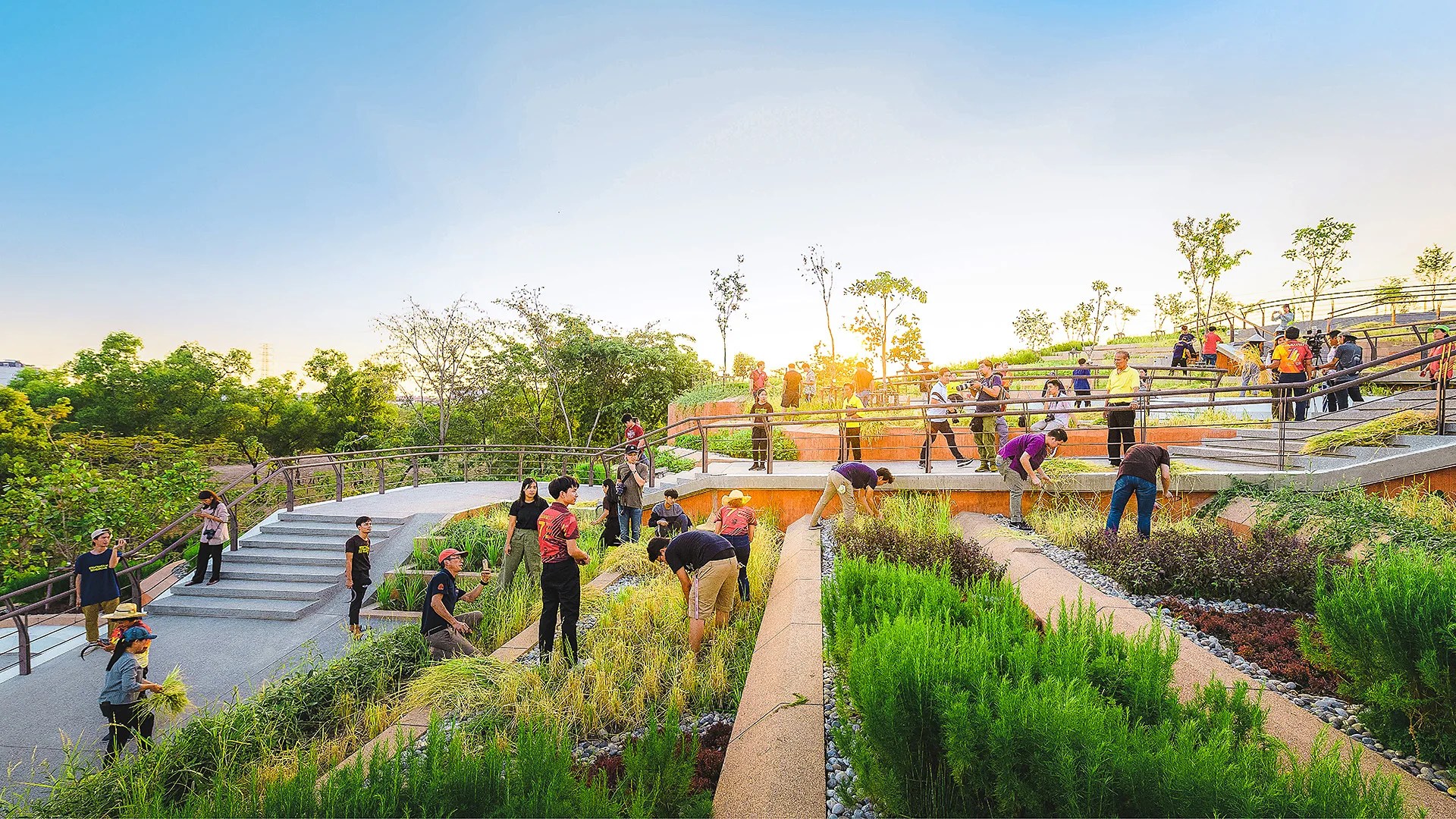
Thammasat University’s rooftop farm features cascades of rice paddy-style terraces used to grow organic crops.

Here in the US, we are all preoccupied with floods because we’re in the midst of an extreme hurricane season. So it seems strange to think of places where a certain amount of flooding is desired — rice paddies.

Xiaoying You at the BBC writes about what can be learned from ancient techniques for controlling rice-paddy flooding.

“One of Kotchakorn Voraakhom’s most memorable moments growing up in Bangkok in the 1980s was playing in floodwaters in a small boat built by her father in front of her home.

” ‘I was so happy that I didn’t need to go to school because we didn’t know how to get to it,’ recalls Voraakhom, a landscape architect based in the Thai capital.

“But nearly 30 years later, flooding turned from a fun childhood recollection to a devastating experience. In 2011, Voraakhom and her family – along with millions of others in Bangkok – found themselves ‘displaced and homeless‘ when floods plowed through swathes of Thailand and poured into the metropolis. …

“The disaster deeply shook Voraakhom, who believed it was time to use her expertise to do something for her hometown. She founded her own landscape architecture firm, Landprocess, which over the past decade has designed parks, rooftop gardens and public spaces in and around the low-lying city to help its people increase their resilience to flooding.

“Perhaps her most intriguing design so far has been an enormous nature-laden university roof inspired by rice terraces, a traditional form of agriculture that has been practiced in Asia for some 5,000 years. …

“The university roof designed by Voraakhom is part of a wider trend in Asia that is seeing architects seek inspiration from the region’s rice terraces and other agricultural heritages to help urban communities reduce waterlogging and flooding. …

‘The answers to the future of climate change, many of them are actually in the past,’ says Voraakhom.

“At Thammasat University, north of Bangkok, tiers of small paddy fields cascade down from the top of the building along Voraakhom’s green roof, allowing the campus to collect rainwater and grow food.

“There are four ponds around the building to catch and hold the water flowing down. On dry days, this water is pumped back up using the clean energy generated by the solar panels on the roof and used to irrigate the rooftop paddy fields. …

“Compared to a design made of concrete, the green roof can slow down runoff – excess rainwater that flows to the ground, a big problem for Bangkok – by about 20 times, according to estimates from Voraakhom. It can also lower the temperature inside the building by 2-4C (3.6-5.4F) during Bangkok’s notoriously hot summer, she says.

“Rice terraces are layer upon layer of paddy fields usually created by smallholder farmers along the sides of hills and mountains to maximize the use of land. They can be found in many Asian countries. …

“While their shapes and sizes may vary, all rice terraces are built to follow natural contor lines, which means each layer has equal elevation above sea level. This feat enables them to collect and hold rain and use it to nurture the soil and crops. Some rice terraces, such as those of the Hani people in southern China, overlook rivers, allowing the tiered soil to reduce, decelerate and purify excess rainwater washing down from the top of the mountain before it flows into the valley.

“Such indigenous know-how, passed down by generations of small-scale farmers, can hugely benefit Asian cities when it comes to handling rainstorms, according to Yu Kongjian, a professor of landscape architecture at Peking University in Beijing and the brains behind China’s ‘sponge city’ concept

“Chinese cities – as well as many others in Asia – have a monsoon climate, which is characterized by rainy summers and drier winters. … Huge downpours mean their flood-control measures need to be based on localized ways of adaptation tested and proven over thousands of years, he argues.

“Rice terraces are one of the pillars of Yu’s spongy city theory, which urges cities to turn to soil and greenery – not steel or cement – to solve flooding and excess rainfall problems. According to him, rainwater should be absorbed and retained at the source, slowed down in its flow and then adapted to where it ends up. Rice terraces deal with mitigating floods at the source, Yu says. …

“The Yanweizhou park, for example, completed in 2014 in Jinhua, Yu’s hometown, has a rice-terrace-like bank planted with grasses that can adapt to an underwater environment. The spongy feature is capable of reducing the park’s yearly maximum flood level by up to 63%, compared with a concrete one, a 2019 paper found.

“Such designs can also filter floodwater, which is often contaminated by sewage, chemicals and other pollutants. Another of Yu’s projects, Shanghai Houtan Park, is situated on a piece of once highly polluted land that used to house a landfill site for industrial waste. Since its establishment in 2009, each hectare of the park, which also features Yu’s terracing element, is capable of purifying 800 tons of heavily polluted water per day.”

Read about related flooding projects at the BBC, here. Fascinating photos.

Read Full Post »

Photo: Sarah Matusek/The Christian Science Monitor.
Jeff Dollente, a zanjero for the Imperial Irrigation District, greets the sunrise on his morning shift delivering water to farm fields in Imperial County, California, Feb. 15, 2023. The water originates from the Colorado River.

Suzanne’s friend Kevin was here last month. He had some interesting thoughts about floods in California, droughts other places, and how great it would be to move excess water from flooded places to drought-stricken ones.

Today’s story, by Sarah Matusek at the Christian Science Monitor, is a bit different, but it describes one way people are already moving water to where it’s needed.

“In the right light, Jeff Dollente seems to make the sun rise. Standing over a canal, he cranks a wheel as the sun ascends and the sky yawns off the dark. … He delivers Colorado River water – a vital resource at risk to farms that feed the rest of the United States.

“He’s a ‘zanjero,’ Spanish for ditch rider, for the Imperial Irrigation District, the area’s public-water and energy agency. California is entitled to the largest share of Colorado River water among seven basin states, and within that, the agency has the single largest entitlement, almost all of which goes to agriculture. Upping the ante: The river is the Imperial Irrigation District’s only water source. 

“The crisis on the Colorado River, strained by overuse and the effects of climate change, is unlikely to reverse due to recent heavy rain and snow, experts say. While critical lows along the river threaten water supplies and hydropower, California hasn’t agreed with other states this year on who should conserve how much – though the Imperial Valley is a controversial target of calls for cuts.

“As the federal government prepares to weigh in and high-level talks continue, so do zanjero daily duties on the ground. It takes focus and precision to safeguard each drop of liquid gold. …

“The Imperial Irrigation District is entitled to 3.1 million acre-feet of Colorado River water a year, though it uses less. (In 2021, for example, the district reports conserving 485,709 acre-feet.) The district also has among the most senior water rights on the river; junior water rights holders are generally expected to take cuts first. Imperial Valley growers – touting their efforts in farm-based conservation – are trying to hold on to a water-intensive farming tradition that’s more than a century old.

“Greening nearly half a million acres of farmland flanked by desert, the district gets its Colorado River water from the Imperial Dam on the California-Arizona border. The water nourishes alfalfa, winter vegetables, and other crops to the west – passing through some 3,000 miles of canals and drains – and then runs off into the Salton Sea. Robert Schettler, public information officer, calls it a daily miracle. …

“It’s a high-stakes relay race. From the Imperial Dam, water flows into the major All-American Canal, which feeds into three main canals, and then is directed into a series of lateral canals. Zanjeros – who oversee the lateral canals 24/7 – usher that water to delivery gates at the edge of farm fields, according to how much has been ordered. …

“Today on the Redwood Canal, he’s tasked with delivering water measured in cubic feet per second. At one stop, he raises a gate a mere inch higher to adjust the flow.

‘They’re the face of the district to the farmer,’ says Ralph Strahm, co-owner of Strahm Farms Inc. in Holtville. ‘They’re the ones that save the system from breaching if there’s a problem.’

“Some days are stressful for Mr. Dollente. But he’s never fallen in. He’ll often clean canals of trash – a tumbleweed today. One time he found a cow, another time a gun. 

The water district employs around 140 zanjeros, currently all male. … The term comes from the word zanja, or ditch, and describes part of the irrigation practices introduced by Spanish settlers in what would become California. Zanjeros have worked for the Imperial Irrigation District since it formed in 1911, once living in houses near the waterways they tended. …

“The role has also evolved alongside technology like cellphones. Mr. Strahm, the farmer, works closely with zanjeros and keeps their contacts in his phone. Still, he says he’d like to see the water district adopt more automation, which is widespread but most extensive along the larger canals, to support conservation.

“ ‘We need more accurate and timely delivery of water with recording devices to alert the zanjero when the water fluctuates,’ says the grower.

“Water-saving measures that he favors, like sprinkler or drip irrigation, don’t work when water fluctuates, he adds. ‘If there’s too little, the system shuts off. And if there’s too much, it can’t be used. It just goes to waste.’ ”

More at the Monitor, here. No firewall.

Read Full Post »

The organization Daughters for Earth believes women are key to solving the climate crisis.

Here’s a nonprofit I just learned about that’s working to, among other things, restore the Colorado River with a diverse environmental team. It’s called Daughters for Earth.

From the website: “The Colorado River has not connected to the sea for a generation, and its Delta is dying out. This once lush region of 3,000 square miles teeming with plant, bird, and marine life lived only in the memory of older community members.

“Most had abandoned hope that nature would ever return. … [The plan is to] help the Sonoran Institute (SI) revive, enhance, and maintain 751 acres of this area and reconnect the Colorado River to the sea. By reintroducing water, landscapes, wildlife, and communities thrive together.

“Led by Edith Santiago, who has 22 years of experience in the restoration of wetlands, this project comprises a diverse team of biologists, ecologists, hydrologists, community planners, environmental educators, and economists. Women hold over 50% of these positions.

“[The team aims to] monitor the water and surrounding wildlife and conduct restoration activities that include irrigation, weeding, fire prevention, vigilance, and signage to prevent vandalism. It will also help grow native species at the SI nursery near the Delta. Producing vegetation closer to restoration activities prevents plant damage and reduces transportation time.

“Environmental education and outreach activities are essential to inspire the local community to help restore and conserve the Colorado River Delta. SI will achieve this through an online course about wildlife and vegetation, guided visits to restored areas, talks, presentations, and workshops. Building a training and multiple-use site will serve as a gathering and educational spot for the community.

“SI has already engaged people through the visitor center at Laguna Grande, guided tours, and ‘Family Saturdays.’ Through these programs, nearly 26,000 people have reconnected with the river.

The recovery and stewardship of the Delta ultimately depend on the commitment of people who live in the region.

“Having local community groups, leaders, and government agencies participate in the restoration work, operate plant nurseries, manage restoration sites, and welcome guests is a significant part of this project. With a flowing river and a steady stream of visitors, the conservation site will become the heart of an economy based on working with nature, and a living, learning laboratory for the one million residents of Mexicali.

“The long-term plan is to restore and protect 30,000 acres of habitat. Another prime goal is to connect the river and sea for an average of 146 days a year.

“Through education and social media, it aims to reach more than 400,000 people who will get to know the endangered beaver and many of the 380 bird species in the Delta. It will continue implementing virtual and in-person activities with students from kindergarten through college, families, national and international media, and donors. …

“SI’s work has been crucial to adopting agreements between the United States and Mexico that have become a global example of collaboration. The Minute 319 and 323 accords between the two governments support the complete restoration of the Colorado River Delta.

“By advancing agreements governing the river, restoration can succeed in the Delta as people connect with their natural resources.” More at Daughters for Earth, here.

From the nonprofit’s Who We Are page: “Our planet and people are in crisis. Around the world, we face massive climate change due in large part to the destruction of Earth’s lands, waters, and wildlife, and women are being severely impacted. They are also on the frontlines fighting to protect our future.

“Women-led initiatives are combating this global crisis, making strides in protecting and regenerating the Earth, and ultimately transforming their communities. Yet, this work and leadership is often not seen, heard, appreciated, or funded.

“Daughters was co-founded by female leaders in the women’s rights, environmental and philanthropic sectors who came together to address the marginalization of women in climate change action. It is a campaign of One Earth, an organization working to accelerate collective action to solve the climate crisis through groundbreaking science, inspiring storytelling, and an innovative approach to climate philanthropy.”

Hat tip: Priscilla Stuckey on Mastodon.

Check out this urgent grandma rap on YouTube: “Grandmothers are calling for all daughters to rise.”

Read Full Post »

Photo: Serious Shea.
Community members stand by a tree planted in Senegal during the launch of the Great Green Wall Corporate Alliance, an initiative that is part of larger efforts to prevent desertification in Africa’s Sahel region. “Serious Shea,” says the Christian Science Monitor, “is transforming a previously firewood-dependent shea industry in Burkina Faso.”

When it comes to human rights and climate justice, corporations can get into the act. It can even boost their brand. Blogger Rebecca told me about a clothing company, Fair Indigo, where she buys clothes because the cotton is organic and she knows the workers are paid a fair wage. I myself have bought cotton towels at Patagonia, which has protected the environment for decades and now promises not to use cotton from Chinese forced labor.

At the Christian Science Monitor, Taylor Luck, Whitney Eulich, Ahmed Ellali, and Sandra Cuffe write about how various countries are working on water conservation — and how certain companies are helping.

“In Guatemala, farmers are setting up ‘living fences’ around fields, creating a buffer of roots to protect their soil during increasingly strong rainy seasons. In Jordan, local Bedouin communities and authorities are pioneering resilient desert agriculture in a region that has been hit by longer and more intense heat waves.

“And in Burkina Faso, William Kwende has been working to revolutionize shea butter production – by substituting renewable energy for traditional wood-burning methods that result in deforestation. He has introduced an approach with 100% renewable energy, self-sustaining biomass burners, and a closed water system, which is curbing emissions while also reducing crop losses. 

“At a time of global strain on food production, including an emerging famine in parts of East Africa, his story symbolizes the potential for using innovation to adapt to a changing climate.

The business Mr. Kwende co-founded, called Serious Shea, is designed to promote reforestation and to secure fairer wages and independence for the local women at the heart of the process. 

“A key part of the innovation: Serious Shea’s eco-processing centers transform shea tree biomass into natural biofertilizer and biochar, enriching soils that are at risk of desertification and reducing reliance on expensive imported chemical fertilizers. 

“ ‘People talk about water and food imports, but when you talk about food crises and adaptation, fertilizer is at the heart of it,’ Mr. Kwende tells the Monitor on the sidelines of COP 27 [Conference of Parties 27], this year’s global climate summit, at Sharm el-Sheikh. …

“Across the globe, innovative ideas like that are greatly needed. Extreme weather events are affecting the vital sector of food production – with the shifts especially hard for Indigenous communities and small-scale farmers. In Peru, rising temperatures have upended the livelihoods of alpaca farmers. In Pakistan, massive floods have sidelined several million acres from crop production. In Somalia and Kenya alone, drought threatens to push millions into food-poverty and starvation. …

“With its own farmers suffering losses amid intense heat waves and drop in Nile waters, atop the food-security crisis in the Horn of Africa, Egypt has placed agriculture front and center to an unprecedented degree at the current [COP]. …

“Agriculture experts say some of the solutions will involve mass-produced technologies such as battery-operated farm equipment. But it will also involve the rise and transfer of hundreds of local, homegrown solutions emerging across the world, many of which advocates say can cut carbon, improve resilience, and be replicated elsewhere. 

“In Mexico, where last summer eight of 32 states experienced moderate to extreme drought and where half of all municipalities in the country face water shortages, some farmers turn 2-liter soda bottles upside down over saplings to capture morning dew or dig holes and line them with organic materials like leaves, to retain rainfall around young trees.

“To the south in Peru, Alina Surquislla’s family has never seen anything like the current effects of rising temperatures in their three generations of alpaca herding. 

“There’s no water; the grass is turning yellow and disappearing for lack of rain,” says Ms. Surquislla. Alpacas are dying out at worrying rates. Speaking over a Wi-Fi satellite connection while walking at nearly 16,000 feet above sea level in the Apurimac region … for now, she says the answer for herders is to go to higher and higher elevations in search of water and grazing.

“Water is also scarce in Jordan. There, local Bedouin communities and authorities are scaling up pioneering desert agriculture in Al Mudawara, a border region near Saudi Arabia that has been hit by longer and more intense heat waves in the past few years. 

“Since 2019, under a directive by Jordan’s King Abdullah, each family in the area has been tending to 6-acre plots of yellow corn and green onions, watered from an underground aquifer. The crops have proved resilient to more frequent 120 degree F temperatures, sprouting up into green waves amid reddish desert sands that have not been utilized for agriculture in modern history. 

“Now over 4,000 acres of corn stalks stand 3 feet high and onions sprout in Al Mudawara. These provide alternative sources of income and living for Bedouin families, many of whom have been forced to abandon traditional camel shepherding due to the mounting costs of imported animal feed. …

“Says Abu Fahed al Huweiti, former director of the Al Mudawara Agricultural Cooperative that has steered the project. ‘It has given a new hope for people here.’

“In Tunisia, amid the lush fig and olive groves of Djebba, clinging to the tops of the Gorraa mountain, farmers continue a centuries-old terraced farming that has helped them cope with massive heat waves and drought that has hit much of Tunisia. 

“A series of cement-lined canals crisscross down the hill through the terraced farms, carrying water from natural springs fed by winter’s snow to groves of figs, pomegranates, quince, and olives on a rotating basis of collective water-sharing. 

“This ingenious method of traditional Berber farming provides timed irrigation of entire land plots, allowing local farmers to grow not only trees but also herbs and diverse flora and fauna, feeding livestock and chickens – all from the same measured water delivery. …

“ ‘We in Djebba keep using the same old techniques because it has shown success. It is an inherited model of coexistence and represents the ideal use of available water resources,’ says Fawzi Djebbi, Djebba farmer, activist, and head of the annual Djebba Fig Festival.  ‘Here we use the water as a collective resource from the mountains. This water belongs to all of us.’  

“Knowledge- and expertise-sharing has also been critical to speeding up farmers’ adaptation to the pummeling effects of severe weather events. 

“The CCDA, an Indigenous and small farmers movement for land rights and rural development in Guatemala, is working with many of their 1,300 affiliated communities around new techniques to help farmers adapt. This year’s rainy season has been one of the longest and heaviest this century, for example.

“One technique is planting trees and plants with deep roots around crop plots. The plants are a buffer against erosion, provide shade during the hot and dry season, and sometimes include edible plants as well. …

“Global organizations are seeking to spread helpful practices and information. The United Nations Food and Agriculture Organization (FAO) has been teaming up with Vodafone to get early warning systems and messages to rural farmers across Africa to better prepare for projected climate trends and to provide advice on mitigation measures.” 

More at the Monitor, here.

Read Full Post »

Photo: Jorge Sierra/WWF Spain.
“Hundreds of freshwater basins across the world, including the dried-up Santa Olalla permanent freshwater lagoon in Spain’s Doñana National Park, are the most likely to experience social and ecological impacts due to freshwater use,” says Xander Huggins at the Conversation.

I’ve been trying to learn meditation. Doctor recommendation. It seems to be mostly about focusing on breathing — in, out, in, out. I am starting to appreciate what a miracle breathing is. Unless we have asthma or COPD, we are too likely to take that miracle for granted.

Same thing with water.

Xander Huggins, a PhD Candidate in the Department of Civil Engineering, University of Victoria, writes at the Conversation, “When people use freshwater beyond a physically sustainable rate, it sets off a cascade of impacts on ecosystems, people and the planet. These impacts include groundwater wells running dry, fish populations becoming stranded before they are able to spawn and protected wetland ecosystems turning into dry landscapes.

“Developments in computer models and satellites have fostered a new understanding of how freshwater is being redistributed around the planet and have made clear the central role that people play in this change. This human impact is so significant that organizations like the United States Geological Survey are redrawing their water cycle diagram to include the impacts of human actions.

“Equally important to understanding how people affect freshwater availability, is understanding how people and ecosystems will respond to amplified freshwater challenges including drought, water stress and groundwater depletion. While these challenges impact localized sites, their impacts are scattered across the world. To address this global water crisis, global action is urgently needed.

In our recent study, we identified the basins of the world that are most likely to be impacted by two central and interrelated aspects of water scarcity: freshwater stress, which occurs when the consumption of water surpasses renewable water supply, and freshwater storage loss, which is the depletion of freshwater in reservoirs or in groundwater bodies due to persistent overuse.

“We identified 168 basins across the world that are the most likely to experience social and ecological impacts due to insufficient freshwater availability. These hotspot basins are found on every continent — a clear indication of the widespread, global nature of these challenges.

“To identify these hotspot basins, we assessed patterns in freshwater stress and freshwater storage trends and compared these to patterns in societal ability to adapt to environmental hazards and freshwater-based ecological sensitivity indicators.

“The hotspot basins are most vulnerable largely because they are likely to experience social and ecological impacts at the same time. … Hotspot basins are vulnerable as they are likely to face impacts such as low streamflow that harms aquatic biodiversity, reduced food security as agriculture is heavily reliant on freshwater supply, wells running dry and higher potential for social unrest.

“Reducing vulnerability in intertwined societal and environmental systems requires improved policy and management integration across sectors. Integrated Water Resources Management considers and balances social, ecological and hydrological sustainability goals by co-ordinating management across water, land and other related resources. Its inclusion in the United Nations Sustainable Development Goal framework highlights its importance. …

Afghanistan, Algeria, Argentina, Egypt, India, Iraq, Kazakhstan, Mexico, Somalia, Ukraine, Uzbekistan and Yemen have hotspot basins yet low implementation levels of much-needed integrated management practices. …

“While we focus on the identified hotspot basins, this does not mean that impacts cannot occur in basins with lower vulnerabilities. For instance, only a number of Canadian basins — all located in the prairies — are identified with moderate vulnerability in our global study. Yet, dry streams on Vancouver Islandfalling groundwater levels in the Lower Mainlandcrop yields affected by drought throughout the prairies and potential for salt-water intrusion along the East Coast are all instances of freshwater security challenges being faced in Canada. …

“While global studies, such as ours, are helpful at systematically highlighting regions for prioritization, they do not — and should not — provide explicit solutions. Rather, in such intricate social and ecological environments, actions to reduce impacts need to be attuned to place-based social norms, cultural values, hydrological conditions and local knowledge systems.

“Our hotspot basins can help guide such community-driven local action to help conserve freshwater resources that are most under threat and mitigate the ripple effects of these threats on people and ecosystems.”

More at the Conversation, here. See also this Christian Science Monitor post about water drying out in Egypt and all around North Africa and the Middle East. Neither site has a firewall.

Read Full Post »

Oh, the ingenuity of our species when we put our minds to a problem! Lack of water in the Canary Islands seems to have inspired problem solvers to pull water from thin air.

Colette Davidson at the Christian Science Monitor writes, “On a clear day, the tiny hamlet of La Vega, stacked up high on the hillsides of northern Tenerife, offers spectacular views of the rugged Atlantic coast. But this afternoon, the thick mist spiraling through Jonay González Pérez and Sara Rodríguez Dorta’s farmland sets an eerie Alfred Hitchcock filmlike scene. Nearly ripe for fog harvesting.

“ ‘There’s almost enough fog to start collecting it,’ says Mr. González Pérez, trudging through ankle-high grass in rubber galoshes as he snaps dead leaves off an artichoke plant. ‘But we need to wait a little longer, until the fog is at the same level as the catcher.’

“Since 2018, Mr. González Pérez and his wife have relied solely on fog collecting to water their 3.7 acres of farmland – which includes lemon and plum trees, artichoke plants, and 50 chickens – when rain is in short supply in the summer months.

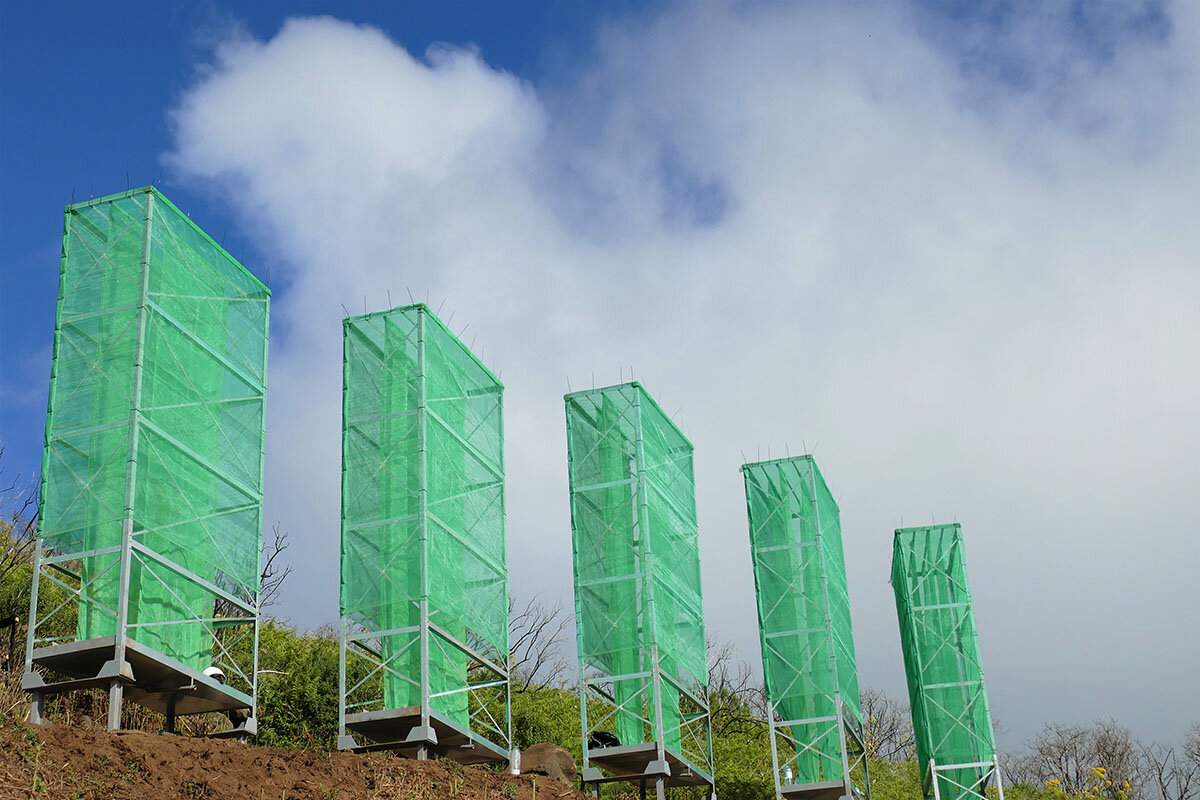
“On a good day, the couple’s 435-yard-long wall of collectors – vertical U-shaped nets cemented into the ground by metal poles – can harvest 475 gallons of water. The suspended fog droplets fall from the nets and flow through 220 yards of black tubing, which snake down the back of their property into a 95,000-gallon storage tank that resembles a giant waterbed.

“Their system – which the couple built with their bare hands over the course of a year – was entirely paid for through government subsidies, after they won a local award for the best initiative in rural farming.

“But this isn’t just a pet project for small-scale farmers. In 2020, the European Commission partnered with the local government in neighboring Gran Canaria to fund the Life Nieblas fog-collecting project, which aims to reforest areas decimated by drought or forest fire. Harvested fog water meets the World Health Organization’s standards on drinking water safety and has provided isolated communities with a much needed resource for decades.

“As the Canary Islands and regions around the world look to combat the effects of climate change, fog collecting is becoming an increasingly viable technology for communities facing soil erosion and water supply challenges.

“ ‘Fundamentally, we depend on our groundwater in the Canary Islands and water is always scarce,’ says María Victoria Marzol Jaén, a retired climate scientist at the University of La Laguna on Tenerife and one of the pioneering researchers into fog collecting in the Canary Islands in the 1990s.

“ ‘Fog water alone can’t supply this, but it can be useful for reforestation purposes, like in the case of forest fires. But for rural zones, where water consumption is much lower, [fog collecting] is more than just helpful. It can be the solution to water problems.’

“The first documented experiments into fog as an alternative water resource can be traced to South Africa in the early 1900s. In 1963, Chilean physicist Carlos Espinosa’s invention of ‘mist traps’ were patented and offered to UNESCO for free use around the world. Since then, researchers have made significant developments into the green technology, and research sites can be found in Chile, Peru, South Africa, Morocco, China, the United States, and the Canary Islands. …

“Apart from the initial materials and building costs, fog collection is a low-energy operation, whose structures, like netting, can blend more seamlessly into natural environments than wind turbines or solar panels. Upkeep involves merely clearing away overgrown plants and cleaning the filters.

“ ‘Fog collecting doesn’t consume any energy and doesn’t affect any other natural resources,’ says Ricardo Gil, a technical architect in Tenerife who runs the Nieblagua company. He has installed around 100 fog collectors across the Canary Islands, mainland Spain, and Portugal. ‘It also takes the pressure off extracting water from aquifers or desalinating ocean water.’

“Each of Nieblagua’s catchers can withstand winds of up to 62 mph, and use four sheets of netting to collect up to 8,000 gallons of water per year in optimum conditions. In several of the Canary Islands, which benefit from around five hours of fog per day, this translates to almost one person’s entire water needs. …

“For thirsty, drought-stricken regions, that can mean the difference between survival and desertification – especially when multiple catchers are set up in one area. In Arafo on Tenerife, 12 of Nieblagua catchers provide an estimated 26,000 gallons annually to new almond tree plantations.

“ ‘It’s not a fantasy. We’re using up our natural resources all around the world,’ says Mr. Gil. … ‘Here we have a natural resource right in front of us. We need to take advantage of it.’ ”

More at the Monitor, here. No firewall.

Read Full Post »

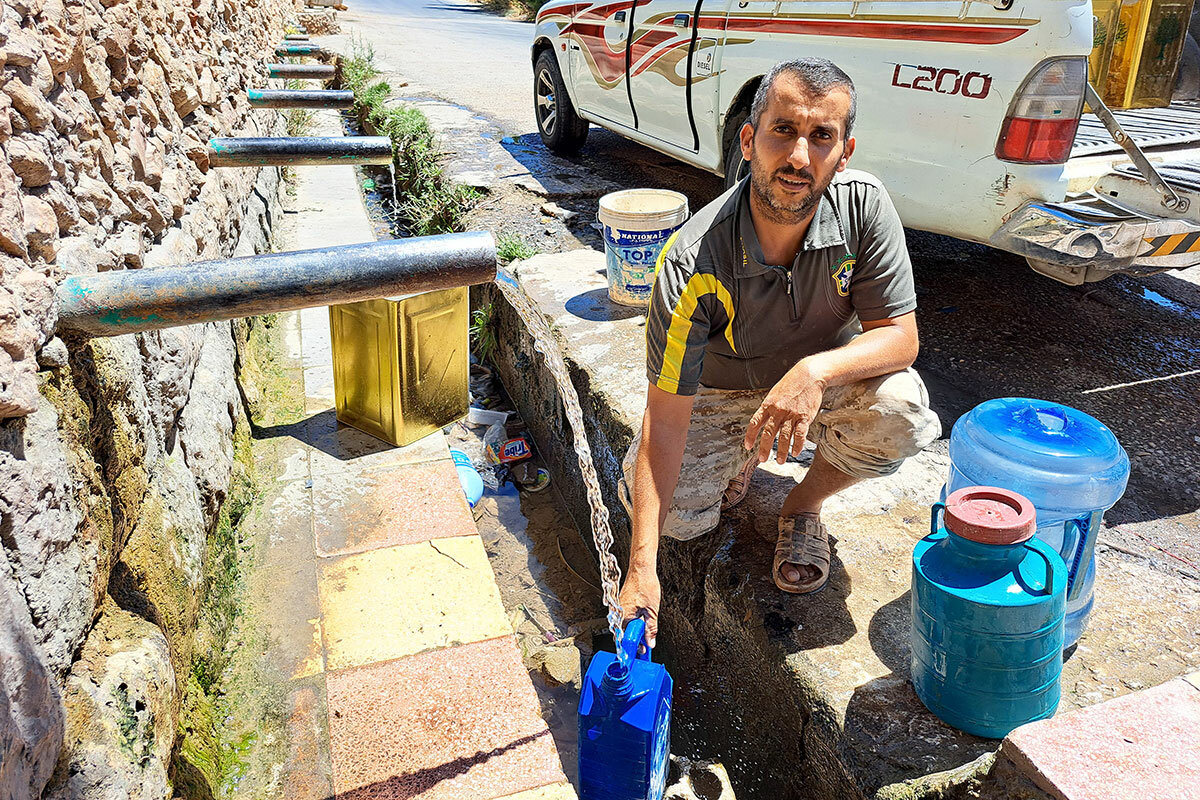
A sheep farmer in northern Jordan fills up water containers for his flock at a spring that for generations has been used to water livestock — Souf, Jordan, Aug. 24, 2022.

Either there is too much water or too little. In New England, where I live, there’s a drought, but when we get a heavy rain, the roads flood, the storm drains overflow, and instead of water going into the places where we need it, it washes into the sea.

Today’s story shares advice on water from those who have had little over the centuries and have learned to conserve.

Taylor Luck reports at the Christian Science Monitor, “In towns and cities across Jordan, ‘water day’ announces itself with a cacophony of high-pitched screeches filling the air. Motors groan and strain to pump a trickle of water from ground-level pipes up five stories to aluminum and plastic rooftop storage tanks – tanks that will hold a family’s water for an entire week or more.

“Families race to and fro across their apartments to run the pumps, do laundry, wash dishes, and water the garden before their 12-hour period is up. If they miss it, they have to wait until the next week – or perhaps weeks – for the next trickle.

‘Water day is more important than an anniversary or birthday in our household,’ says Um Uday, a working mother of five in West Amman.

“In Jordan, the second-most water-poor country in the world, people have long learned to live without the constant running water that most American families take for granted. Yet the dwindling resources due to climate change and population growth mean the most effective innovation in parched Jordan is not novel water distribution schemes, technology, or dam construction – but how people change their daily lives to get the most out of each drop. …

“In largely arid Jordan, water resources are less than 90 cubic meters (almost 24,000 gallons) per person annually, a fraction of the 500 cubic meters (about 132,000 gallons) per capita the United Nations defines as ‘absolute water scarcity.’

“Instead of supplying constantly running water, authorities release water through networks to a given village or neighborhood for one day on a weekly or twice-monthly basis as part of a rotation. The water distribution schedule is designed to distribute water equally in different parts of the country, without waste, while maximizing the rapidly diminishing reserves. …

“Suleiman, a retired air force officer who gave only his first name, stops his pickup at a roadside natural spring in the village of Souf, 35 miles north of Amman, to fill containers for his thirsty flock of sheep. As they have for generations, area residents come to this spring to stock up on water for livestock or washing; a second, purer, cold-water spring 2 miles up the hill is used for drinking water. With official water distributed to the village for a few hours once a month in the summer, these springs have become a main source. …

“Suleiman says, wiping his brow from the noon sun., ‘We have to make the most of each water source we have.’

“Yet this year has been particularly hard; Jordan’s Ministry of Water and Irrigation described 2022 as ‘the most difficult year’ yet. A shift in weather patterns means Jordan is witnessing a slight decline in rainfall. The rainfall it now receives occurs in intense, shorter time periods in concentrated areas, leaving its network of dams struggling to catch the torrential runoff.

“The dams are dry or nearing dry; green patches of earth mark where once mighty reservoirs stood. Plans to desalinate seawater at Aqaba, the nation’s only port, are two decades off at best and are costly. … With the capital getting priority for dam and aquifer water, towns and villages north and south of Amman bear the brunt of shortages – often going months without fresh supplies as summer demand spikes.  

“Um Mohamed, a widowed mother of four in Bayt Idis, a hilly, tree-dotted village in northern Jordan, heads one of thousands of households going without state-supplied water for the summer.

“On this day she purchased from a licensed private well 3 cubic meters (792.5 gallons) for $21 – enough for her family’s weekly consumption, but taking 15% of her monthly income. She will try to make it last one month. Like many, she is sticking to tried-and-true methods to stretch out each drop.

“She does the dishes in a single bucket of water placed in the sink, careful not to splash out of the bucket. Once she soaps and rinses the pots, dishes, and silverware, she pours the food-clouded water onto a few of her plants, watering in a rotation.

“Showers are timed and scheduled. Laundry is hand-washed in a large plastic basin utilizing the same water. Her backyard is dotted with jugs and buckets filled with water from her purchase; they will be used to water the plants and wash the floors over the next two weeks.

“ ‘We have entire summers where we don’t get water from authorities, so we have to rely on ourselves,’ she says. ‘If we don’t manage what we consume, then we consume ourselves.’ ”

More at the Monitor, here. No firewall. Want to read a novel about building a well in a dry land? Try Red-Haired Woman by Turkish Nobel laureate Orhan Pamuk. It’s kind of dark, though.

Read Full Post »

In my last batch of photos, I showed a piece from an Art League of Rhode Island exhibit to which my friend Ann Ribbens had contributed. The show, “Below the Surface,” had a humanity-versus-water theme, and the quilt I shared in that post featured a warning about toxins in fish. Today I’m displaying Ann’s lovely “Undersea Tapestry” and two other pictures from “Below the Surface.”

Now I’m wondering if there’s something in the water that New England artists are drinking. The next group of photos is from a recent exhibit at a Massachusetts gallery, and the subject is “Undercurrents: Water and Human Impact.” If artists are to be believed (and they are), things are not looking good for water and it’s all our fault.

At “Undercurrents,” I especially liked Henry Horenstein’s photograph “Cownose ray” and Joan Hall’s “The New Normal,” which hints at manmade items that wash in with the tide.

Still on the subject of art, I want to mention that yesterday I checked out the new mural on the Boston Greenway, where I used to love walking when I worked downtown. There are many post-Covid changes in the area (I felt like Rip Van Winkle gazing around in wonder after a long nap), but the Greenway is still hiring artists to paint the wall of the giant Air-Intake building over the Big Dig. The latest painting, of a little boy with a boombox, has a wistful feeling about it.

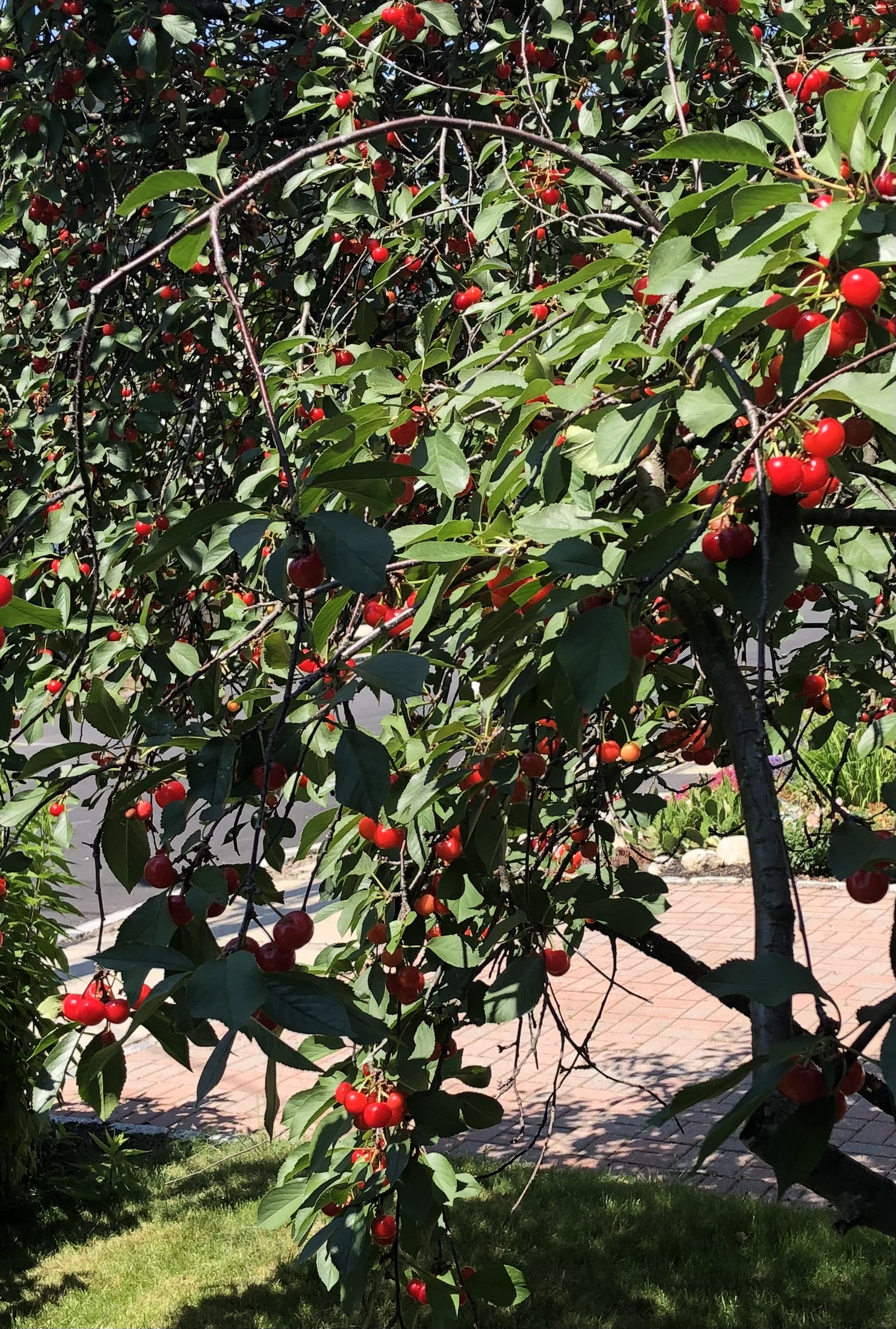
The mural photos are followed by several local scenes, including a look at the bright cherries next to John’s front porch.

I end with a picture that Ann took last month while traveling in France. I couldn’t resist. It looks so utterly French to me.

Read Full Post »

Photo: Melanie Stetson Freeman/Staff.
Ida Joe tries out her new sink with running water, which the nonprofit DigDeep installed in her home in Smith Lake, New Mexico. About 30% of those living on the Navajo [Diné] reservation do not have indoor plumbing or running water.

In Navajo Country, water is precious, and running water is sometimes nonexistent. Golly. I shouldn’t complain. Renovations at our house have left us without hot water since May 18, but at least we have cold water and friends with showers. Some Navajos [Diné, as they call themselves] trek periodically to the nearest town and rent a hotel room to take a shower!

Henry Gass, a writer at the Christian Science Monitor, reported the story from Smith Lake, New Mexico. “Ida Joe flinches a little as the tap sputters, then spurts water into the sink. Cautiously, tentatively, she pushes her hand under the faucet. She feels the water soak her skin and run through her fingers – first cold, then hot. After a few seconds, she starts to laugh.

“Outside the one-room house she shares with her two daughters and granddaughter, a cold breeze rolls across the dusty, arid plains of the Navajo Nation. A few hundred yards away, wild horses drink from a small, briny lake.

“Ms. Joe has lived on the Navajo Nation for all of her nearly 50 years. This late February day is her first with running water in her home. Until now, her family would drive to Thoreau, 10 minutes away, or Gallup, 45 minutes away, to buy gallon jugs of water.

They would drive to town to do laundry, and rent a hotel room for the day to use the shower. …

“Water is sacred on the Navajo Nation, and scarce. About 30% of the roughly 173,000 population lack running water, according to a report from the U.S. Water Alliance and DigDeep, an international nonprofit with Navajo employees who have been installing running water systems in homes on the reservation since 2014. The size of the reservation, the large distances between homes, scarce natural water sources, jurisdictional issues, and contamination from industries like uranium mines have all contributed to restricting access to running water here for generations.

“But according to those working to improve water access on the reservation, the COVID-19 pandemic has heralded a bittersweet turning point. … The pandemic drew widespread attention to the fact that many Navajo didn’t have enough water to thoroughly wash their hands, which was core advice of health experts at the time. … New coalitions have formed, funding has increased, and innovations from organizations like DigDeep have helped expand water access here more than ever before.

“ ‘This has been a silver lining for us,’ says Crystal Tulley-Cordova, principal hydrologist for the Navajo Nation Department of Water Resources. …

“A pickup truck, a trailer towing a backhoe, and a gleaming white water truck nicknamed ‘Big Ernie’ make up the DigDeep convoy. …

“The region has been in various forms of drought for over 20 years, and is currently experiencing severe and extreme drought. … There are also problems with water quality. Arsenic and uranium, both left over from a century of mining on the reservation. …

“Meanwhile, piping water onto the reservation is challenging because of how spread out the population is. Some areas are a checkerboard of public and private land, presenting right-of-way issues. On top of that, funding has typically been limited, according to Capt. David Harvey, deputy director of the Division of Sanitation Facilities Construction at the federal government’s Indian Health Service. …

“Through the CARES Act – a pandemic relief funding package passed by Congress in March 2020 – the Navajo Nation received over $5 million specifically for increasing water access on the reservation. …

“The [DigDeep] crew were here 18 months ago to install one of their foremost pandemic-era innovations: a ‘suitcase’ – a 4-cubic-foot box filled with a water pump, heater, filter, expansion tank, and battery installed outside homes to provide tap water from a 1,200-gallon underground tank. …

“During the pandemic, 100 of these suitcase systems have been installed by DigDeep crews on Navajo lands, at no cost to residents.

‘People [were being told], “Wash your hands for at least 20 seconds with soap and water.” But how can they do that if they don’t have running water?’ says Cindy Howe, the project manager for DigDeep’s New Mexico office. …

“Ms. Joe and her family wait in their car while Kenneth Chavez and Brian Johnson assemble the sink and Erving Spencer maneuvers the backhoe. …

“Ms. Joe likes living here, she says. She feels safe, and she wants to raise her kids and grandkids here.

“ ‘It’s one of the most important things that I would probably want to do before I go,’ she says, ‘teaching them the foundation of our culture.’ …

“As they finish their work at Ms. Joe’s house, ‘Big Ernie’ refills the 1,200-gallon tank that now supplies her indoor sink. …

“Lacking water ‘is just normal for a lot of people,’ says Ms. Howe of DigDeep. Her grandparents would melt snow for water. Her parents hauled water throughout her childhood as well – always on Sundays, so she could have a bath before school on Monday.

“ ‘It was really heartbreaking to see,’ she says. ‘Fifty-five years later, it’s still happening. We’re all helping each other [but] there’s still a lot of people that don’t have any water.’ ”

More at the Monitor, here.

Read Full Post »

Photo: Randall Hyman.
The Christian Science Monitor: “Activist Nicole Horseherder, who heads a nonprofit that seeks to protect water supplies on the reservation, stands on a ridge near Black Mesa in northern Arizona, the site of past disputes over coal mining.”

I’m grateful for the environmental leadership of indigenous people. They were environmentalists centuries before anyone used that word, and I think that paying attention to them will help us learn how to protect our planet.

Randall Hyman reports at the Christian Science Monitor about Navajo women who instinctively understand the importance of the natural world and their community’s place in it — and who don’t give up.

“One who has a master’s degree in linguistics,” Hyman says, “has made green energy a crusade on a reservation where coal, gas, and uranium have reigned supreme for decades, leaving tainted groundwater in their wake.

“Another returned to the Navajo reservation from Chicago to find that fracking had marred large sections of her native land – something she now works to stop in one of the largest methane hot spots in the United States. 

“A third was so distraught by the lack of ballot access on the reservation that she organized getting voters to the polls on horseback – her version of saddle-up democracy. 

“Two others have immersed themselves in politics directly – one as the youngest member of the Arizona State Legislature and the other as one of three women on the 24-member Navajo Nation Council. …

“Their efforts come at a particularly fraught time. Last year, from the vermilion sands bordering the Grand Canyon to the oil-rich scrublands east of Chaco Canyon, the Navajo Nation was hit by a perfect storm – a convergence of soaring pandemic deaths, dwindling energy revenues, and rising unemployment. Amid the chaos, Native women stepped up in what some see as an unprecedented wave. While one COVID-19 relief group raised $18 million in a matter of months, other women redoubled efforts to dismantle policies that have left Navajo (Diné) people vulnerable. 

“ ‘I think that you’re actually seeing a return to the way that Diné society has always been,’ says Nicole Horseherder, executive director of Tó Nizhóní Ání (Sacred Water Speaks), an organization pushing for new energy policies and water protection across the Navajo Nation. ‘Women are coming forward and saying, “I am a leader too. I can make these decisions. I can make better decisions.” ‘ …

“Underneath all the narratives is another factor – the dominant presence of women in Navajo society, where taking charge is rooted in a matrilineal culture. 

“ ‘When you see the destruction in your community, you realize you have to do something,’ says Wendy Greyeyes, assistant professor of Native American studies at the University of New Mexico in Albuquerque. ‘So, women are empowered. A lot of that harks back to our own creation stories. Changing Woman was a very powerful deity who reflected thinking about the longevity of our existence, of the Diné people. This ideology is baked into our DNA as Navajo women – our need to care and nurture and protect our communities, our families.’ …

“A year ago, on a chilly December morning, Nicole Horseherder marked an explosive turning point in her long battle against coal mining. Standing on a slope overlooking the towering smokestacks of the coal-fired Navajo Generating Station in northern Arizona, Ms. Horseherder set her cellphone on livestream and gazed at the 775-foot monoliths glowing in the sunrise a mile away.

“The stacks had been a landmark of the high desert for nearly half a century, symbols of fleeting prosperity and persistent pollution. The power plant serviced major cities of the Southwest and ran the huge Colorado River pumps supplying much of their water, but was among the top 10 carbon emitters in the United States. At precisely 8:30 a.m., a thunderous rumble shattered the clear morning and clouds of smoke mushroomed as 1,500 pounds of dynamite collapsed the stacks. …

“When I caught up with her last August on the Second Mesa of the Hopi reservation deep within the encircling borders of the Navajo reservation, [Horseherder] recalled her journey’s start. Driving to an overlook, she pointed north toward distant Big Mountain. For her, it stirred painful memories. 

“Ownership of the hardscrabble land surrounding Big Mountain, called Black Mesa, had long been an unresolved intertribal treaty issue. It remained in limbo until the 1950s and ’60s, when a Utah lawyer named John Boyden persuaded a minority of Hopi litigants to take it to court.

“True to its name, Black Mesa is underlain by rich coal seams. It is also sacred to the Navajos and Hopis, many of whom opposed outsiders tapping their minerals. But the lawsuit prevailed, eventually forcing the removal of some 10,000 Navajo residents while dividing mineral rights equally between the tribes. Boyden subsequently leased land and mineral rights for Peabody coal company. A half-century of coal mining and environmental controversy ensued. 

“Ms. Horseherder’s epiphany came when she returned home from Vancouver, British Columbia, with a master’s degree in the 1990s and discovered that her dream of leading a pastoral life had turned to dust. The springs that her family’s livestock depended on had run dry. ‘My whole attention and focus shifted,’ says Ms. Horseherder. ‘It became, “How am I going to protect the place where I live – how am I going to bring the water back? And where did the water go in the first place? ” ‘

“Ms. Horseherder became a vocal activist and founded Tó Nizhóní Ání, or Sacred Water Speaks. At the time, Peabody was pumping billions of gallons of water from deep aquifers, mixing it with pulverized coal, and sending the slurry through 273 miles of pipeline to a Nevada power plant. It assured tribal officials that the technology was safe, and many supported the operation because coal mining was a pillar of the Navajo and Hopi economies for nearly 50 years, providing tax revenues and well-paying jobs. 

“But environmentalists contended that depressurizing the aquifer was lowering the water table. While Ms. Horseherder fought Peabody for years – and others lost scores of animals to stock ponds they said were tainted by slurry – the power plant and related activities were only closed when the economics of the operations no longer worked. Wells never recovered, and impacts endure to this day, critics say. ‘What we’d like to see them do first,’ she says, ‘is fully reclaim those lands that they’ve mined, and reclaim the water as well.’ “

More at the Monitor, here.

Read Full Post »

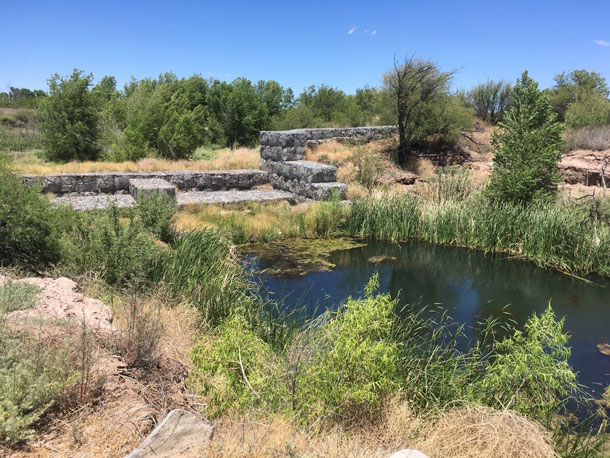
ranching_gabions

Photo: Bobby Bascomb
Gabions are baskets of rocks that Valer Clark places in stream beds to slow the water as it rushes through in the rainy season. They’re part of her work to bring dried-up land back to life.

Having woken up today to more US nuttiness (our whole family could visit Erik’s mom in Sweden and bring back whatever germs might be there, but she herself will have to postpone her trip to visit grandchildren because she’s Swedish), I decided to focus on an American actually doing good in the world.

In this episode of Living on Earth, Bobby Bascomb visits land preservationist Valer Clark at her ranch in Agua Prieta, Mexico. …

“BOBBY BASCOMB: Today the lands of the Southwestern US and Northern Mexico are considered desert or semi-arid. But for a couple months each year the region is awash with water from the seasonal monsoons. The normally dry river beds fill with flood water and swell to create habitat for all manner of water birds and amphibians. The watery paradise is short lived though, and most of those streams dry up in a matter of weeks.

“But that wasn’t always the case. A network of streams, rivers and wetlands once crisscrossed the landscape. In fact, more than 150 years ago, around the time of the Civil War, people in the region struggled with malaria, a mosquito-born illness typically associated with tropical wet climates. In Mexico, I found a ranch owner that’s working on ways to keep some of that water on the land longer. … My journey starts at the Gadsden Hotel in Douglas, Arizona. ..

“The opulence of the hotel hints at an earlier time of prosperity and wealth. Valer says the whole region, north and south of the border, was made rich more than 100 years ago by the same things.

“VALER CLARK: This was copper, cotton, and cattle. The three Cs, you know, all in the early 1900s.

“BASCOMB: Those three Cs made a lot of money but heavily degraded the land. … When Valer first visited back in the 70s, decades of mining and agriculture left the arid soil dry and cracked, few trees remained and the river beds were deeply eroded. …

“CLARK: When I got here and started seeing the lack of water and seeing the situation, what it looked like, and the hills were bare, and there was no grass. And I thought I wonder if you could make a change. I wonder if there’s something you can do about this. …

“BASCOMB: Valer eventually bought and rehabilitated some 150,000 acres of land in northern Mexico and the Southwest US. That’s more than 10 times the size of Manhattan. And her work here has been transformative, says Ron Pulliam, … an ecologist, formerly with the US Department of Interior, and founder of the nonprofit Borderlands Restoration Network. …

“PULLIAM:  If you put hundreds of cows out on a small area here, you basically reduce all the ground cover. So, when the rain comes it just runs off the land rather than being caught up in the vegetation.

“BASCOMB: And keeping that rainwater on the land is the fundamental key to what Valer is doing to rehabilitate her property. More water will mean more grass and trees, habitat for the wildlife that was once common here. It’s sort of a build it and they will come philosophy. …

“CLARK: This is what we call a gabion, which is a wire basket that is filled with rocks.

“BASCOMB: That’s it, a wire basket full of rocks. They’re about 3 feet tall, some just 5 or 6 feet wide, others more than a hundred feet across. Valer and her crew have built more than 20,000 of them on her property. They all sit in riverbeds which are dry most of the year until the monsoon rains come.

[When] the gabions get to work, they slow down the water rushing through the river bed so silt can accumulate behind them, like a sponge.

“BASCOMB: Nearly all these trees have sprouted up since Valer began keeping more water on the land. Near the stream, a canopy of cottonwood trees towers over us and a lush green understory creates the feeling of a jungle that follows the narrow band of water. We continue our walk on the edge of the forest, which she says is a vital corridor for wildlife in the region.

“CLARK: We’ve seen ocelot, we’ve seen bobcats and lions and bears and coatimundis and javelinas, ring tailed cats. …

“BASCOMB: We drive past parched bare earth cracked into the shape of a hexagon and stop at a different ecosystem all together. …

“Instead of a riparian forest this is a wetland teeming with life. Reeds and cat tails poke up through the water. At least a dozen different species of brightly colored birds dart about, butterflies sun themselves, and bright blue dragon flies copulate in mid-air. Ron Pullium says this region is a hotbed for insect diversity, including some 450 different species of bees. …

“BASCOMB: [The next day] we walk alongside a small creek, craning our necks up, hoping to spot some birds.

“PULLIUM: This creek is interesting just in itself. It was protected by Valer because it was identified as the most intact fish stream in northern Mexico, and perhaps the most intact in all of Mexico. …

“BASCOMB: For all her ecological work, Valer is still mindful of serving as a model for other ranches in the region that depend on raising cattle for their livelihood. She removed most of the cows from her ranch when she bought the place. But she did keep a small herd and is very deliberate about where and when they graze. And it’s paid off. Her ranch manager recruited members of his family to enter three novio steers in a large cattle exposition.”

Read more at Living on Earth about Valer Clark and why preservation is so satisfying to her.

Read Full Post »

062120whitefish20lake

Photo: Doug Struck
Access to streams in Whitefish, Montana, was threatened by development, so the town used the increasingly popular strategy of buying rights to the forest.

People can change their minds.

That’s what happened in Montana as property-rights advocates began to see that their water bills would be cheaper if they let government entities buy rights to forests on private lands.

Doug Struck writes at the Christian Science Monitor, “When the appetite for high-priced housing threatened the water source of [Whitefish, Montana], the residents raised taxes and spent money on forests. Three years later, when rising tourism upped the summer demand for water, more money was raised to buy more forests.

“The equation used by local and state officials, nonprofit groups, and private residents was straightforward: It’s cheaper and easier to have the forests cleanse the water than to throw chemicals and machinery at the task.

“ ‘Protecting forests of watersheds makes economic sense,’ says John Muhlfeld, the mayor of this town of 7,000 nestled in Montana’s Rocky Mountains. ‘And it’s a much different way of traditionally looking at a public water supply infrastructure.’ …

“As town planners look at the high cost of building water filtration plants and operating them year after year, the thought of letting the trees do it becomes a budgetary no-brainer.

“And the trees do it well. The natural filtering process that rain and snow undergo in seeping through forest canopies and forest beds, slowly toward streams and lakes, is so effective that five major cities in the United States – New York, Boston, Seattle, San Francisco, and Portland, Oregon – can pump unfiltered water from distant pristine watersheds to customer homes.

“New York is the poster-city example in this country. Twenty years ago, the city engaged in a wrenching political battle over whether to build a $6 billion water filtration plant that would cost $300 million per year to filter water for the city. Instead it gambled and spent $2 billion to protect the forested watershed in the Catskill Mountains, 125 miles away, the source of 90% of the city’s water. It was a bold and controversial decision – and it worked.

“ ‘Here we are, 20 years later they have been meeting the safe drinking water standards through tropical storms and superstorms,’ says Paul K. Barten, one of the junior architects of the original Catskills program who now chairs a current National Academy review of the system. …

‘People are not necessarily doing it because they love trees. … ‘They are doing it because it’s a lot less expensive.’ …

“The state and national park programs that began to emerge in the U.S. 150 years ago, and evolved at the prodding of such visionaries as John Muir, Frederick Olmsted, Gifford Pinchot, and Teddy Roosevelt, now preserve 13% of U.S. land, according to the World Bank. Another 56 million acres are held by various forms of private or public ‘trusts’ that allow some use but prohibit development, according to the Land Trust Alliance in Washington, D.C.

“In the case of Whitefish, that meant keeping land for logging. The Haskill Basin northeast of town was forestland owned for more than a century by the Stoltze lumber company. …

“Over the years, development pressures loomed larger as Whitefish blossomed into a high-end, expensive resort town sprouting multimillion-dollar second homes. … Stoltze ‘could have gotten an offer that they couldn’t refuse,’ says Kris Tempel, a biologist at the Montana Fish, Wildlife and Parks agency. …

“The Trust for Public Land … helped bring together $9 million from federal conservation funds. And Stoltze agreed to take a $4 million cut on the $21 million price of giving away development rights to its 3,000 acres in Haskill Basin. …

“That left a shortfall of $8 million. City residents had balked before about increasing the town’s ‘resort tax’ on restaurants, lodging, and retail. But in 2015, after a ‘Vote Yes for Water’ campaign by the mayor and others, residents gave an overwhelming 84% approval to a 1% tax increase. Late last year, the purchase of another 13,000-acre property helped protect a watershed for Whitefish Lake, a secondary source of water for the town.

” ‘The public support is a change in a place where encroachment on private land is viewed with suspicion, says [Montana Fish, Wildlife and Parks resource conservation manager Alan Wood]. ‘Twenty years ago there was a lot of opposition’ to these proposals.’

“But this deal ‘gave everyone what they wanted,’ says Mr. Wood. The town kept its access to clean and cheap water. Stoltze can keep harvesting timber on the land, employing an average of 110 workers.”

More at the Christian Science Monitor, here.

Read Full Post »

Older Posts »