Feeds:
Posts
Comments

Archive for May, 2019

Photo: Mark Makela
Caleb Hunt, left, and Tony Croasdale at the John Heinz National Wildlife Refuge at Tinicum in Philadelphia. In a city known for its punk underground and avian history, the friends have found an overlap that celebrates both niches.

No doubt among the pressing questions of our time, you have been wondering about the connection between punk rockers and birders. Wonder no more. Steve Neumann at the magazine Audubon has answers for you.

“It’s the evening golden hour at the John Heinz National Wildlife Refuge at Tinicum. A whirlwind of swallows swims through the soft light, chasing midges into a frenzy. Nearby on a platform a handful of birders scans the dimming sky, exposed to the marsh and its blood-thirsty elements.

“In plain T-shirts and khakis, the group blends into the woods-y backdrop — with two exceptions. Caleb Hunt, a bookkeeper for an adult-entertainment boutique, rocks a Philly Punx tank top with a fanged, horned Benjamin Franklin splashed across the front. Next to her, Tony Croasdale, the leader of today’s walk, sports an aviary of skin art. A Swallow-tailed Kite, Belted Kingfisher, Scissor-tailed Flycatcher, Greater Racket-tailed Drongo, Scarlet Tanager, and three types of vultures bedeck his legs, collarbone, and arms.

“Croasdale’s tattoos pay homage to two of his biggest life passions: birding and punk rocking. He plunged into the first as a kid when his father took him to Philadelphia’s Pennypack Park to learn about kingfishers. The music came later at age 19 when he launched the vegan thrashcore band R.A.M.B.O. under the stage name Tony Pointless. The collective quickly hit fame with two full-length albums and tours on five continents; but when it broke up in 2006, Croasdale came back to his home city and turned his focus to environmental activism. He eventually went on to found the BirdPhilly education program, which is how he and Hunt, who identifies as a committed punk, met in 2015.

“Though his moshing days are behind him, Croasdale says he still feels connected to punk culture. If anything, he’s found more space for expression by building birding into his practice. The hybrid approach has strengthened his resolve to tend to nature and fight oppression with personal action — a sentiment shared by his many ‘birdpunk’ friends around the country. …

“ ‘Philadelphia has so many row homes with basements,’ Croasdale adds. ‘That fosters a vibrant show scene.’ It was in those basements that Croasdale formed R.A.M.B.O. — an acronym for ‘Revolutionary Anarchist Mosh Bike Overthrow’ — in 1999 as lead singer. …

“Ultimately, that double lifestyle didn’t work out. Before a show in Malaysia, Croasdale and the band’s bassist, Bull Gervasi, went birding in Kuala Selangor, 100 miles away from where they were taking the stage. They gave themselves 10 hours to get back by bus, but it took 12 and they missed their call time.

‘It was kind of a big deal,’ Croasdale says. ‘It occurred to me that my head was not in the band; it was with the birds.’

“Today Croasdale is the site director for the Cobbs Creek Community Environmental Education Center … Working in conservation in West Philadelphia has helped Croasdale resolve a childhood dilemma. When he was 12, he realized that the government and in general, society, couldn’t be trusted to steward the planet and its resources. But it wasn’t until he fell into the punk scene that he was fully able to share that anxiety. ‘I found out there was music, a political ideology, and a counterculture that spoke to these issues. It provided me with like-minded peers,’ he says.”

More here.
Read Full Post »

Photo: Getty Images
Two suburban moms learned that asylum seekers lack even the minimal protections of refugees and decided to do something to help them.

Although there are not many refugees coming through at the moment, those that do have official government status and a range of support services when they arrive. Asylum seekers have nothing, and if they don’t have someone to stay with until their case is heard, they are likely to be held in jail, unable to get working papers and start supporting themselves.

Two women in a Boston suburb decided they had to do something to help.

Betsy Levinson reported at the Concord Journal, “Helping asylum-seekers is a two-way street, say the two Concord women who founded a nonprofit in 2014 to offer housing and emotional support to a vulnerable population.

“ ‘Our guests have become our friends,’ said Sharon Carlson, who founded Dignity in Asylum (DIAS) with Andrea Hewitt. …

“The main mission of DIAS is to pay for transitional housing, since asylum-seekers are not eligible for any government support while they go through the lengthy and arduous process of gaining a work permit. …

“ ‘They are so vulnerable,’ said Carlson. ‘They fled persecution and had to escape to save their lives.’

“Without any contacts or resources in the area, they can wind up in homeless shelters or ‘sleeping in stairwells,’ Carlson said.

“Referrals to DIAS come from two sources — the Boston Center for Refugee Health and Human Rights and Political Asylum Immigration Representation. Once they get a referral, they send out an application for housing, followed by a meeting to assess the individual need.

“Though many are highly skilled professionals in their home countries, they usually end up in low-level jobs to earn enough to transition from DIAS-supported housing to independence. But [the DIAS founders have] never heard a word of complaint.

“ ‘There is such dignity, such gratitude, such optimism,’ said Hewitt. ‘We feel lucky and grateful. They are lovely people.’ …

“Guests stay free until they get on their feet, and stay connected to the organization after they become independent.

“The outpouring of support [has] been unexpected and overwhelming, the women say.

“ ‘The attitude is so welcoming,’ said Hewitt. ‘The business community has been so supportive.’ The organization has received grants from area churches and the community chest, among other funding sources. For more information, visit dignityinasylum.org.”

More at the Concord Journal, here. I have met these women. To me, they are glowing examples of both personal morality and how a truly civilized country could show compassion for people who take initiative against overwhelming danger. Asylum seekers, managing to get themselves here despite extraordinary obstacles, show the courage and spunk that is needed in society.

Read Full Post »

Photo: Chicago Public Library
Chicago Public Library STEAM Team First Assistant Librarian Alejandra Santana (left) reads to storytime attendees at Bubbleland laundromat.

Suzanne and Erik’s son went through a period of being utterly enraptured and entranced by washing machines. When his uncle came to visit from Denmark, he made him sit on the floor of the bathroom with him and marvel at the wash cycle. When his sister was born, he pushed her baby bed in front of the washing machine to show her the greatest wonder of life. When my husband babysat him, he insisted on visiting the local laundromat just to watch the machines work. All the staff knew him.

So when I saw this story about the Chicago library system setting up story hours for young children in laundromats, I thought of my grandson. He would have considered library outreach an intrusion on his contemplation (he once sent my husband out of the laundry room because he was in the way), but I think that for other kids, libraries in laundromats would be fantastic.

Anne Ford writes at American Libraries, “Laundry: It’s got to be done. And if you’re in a family with small children and no washer or dryer at home, it’s got to be done at the neighborhood laundromat — probably every week, probably on the same day every week, and probably with those children in tow.

“That’s why, in 1989, Chicago Public Library (CPL) Children’s Librarian Elizabeth McChesney (now CPL’s director of children’s services and family engagement) visited a local laundromat to introduce herself to families. How she responded to what she saw there would help change the landscape of children’s literacy initiatives for decades to come.

“ ‘What I saw was that these were families who, because of a variety of circumstances, were not likely to come to the library for storytime,’ she says. So she went back to the library, threw some books, a couple of puppets, and a tambourine into a laundry basket, walked it back to the laundromat, and held a storytime for the kids there — right on the spot, as the washers whirred.

“McChesney’s not claiming she started the laundry-and-literacy movement. ‘People have done this off and on for the last 25, 30 years,’ she says. Still, thanks to her, CPL continues to hold regular storytimes at laundromats across Chicago. And, she says, the librarians who participate continue to see rewards.

“ ‘Families are now changing their behavior, showing up to do their laundry when the library is going to be there,’ she reports.

‘One little boy just recently said: “Let’s do laundry every day, Mom!” ‘ …

“Can’t these children simply go to a branch library instead? Not necessarily. As a recent paper on book deserts by Susan B. Neuman and Naomi Moland in the journal Urban Education (vol. 54, no. 1, p. 126–147) points out, in some areas, decreased funding for libraries has led to ‘limited hours and curtailed services’ — and in many low-income communities, demand has exceeded capacity or parents are often hesitant to check out books because of potential library fines. …

“Not all laundromat library programs are alike, though most operate with some type of librarian participation, direction, or materials curation.

“Wash Time Is Talk Time, an effort sponsored by [the Clinton Foundation’s Too Small to Fail (TSTF) early-childhood initiative and the Coin Laundry Association’s LaundryCares Foundation (LCF)], distributes posters in English and Spanish that encourage parents to talk, read, and sing with their children while they do laundry; it also provides books to some laundromats to lend out. …

“How effective are these programs, and what kind of impact are they having on children’s literacy? To find out, [the Laundry and Literacy Coalition (LLC)] is working with Neuman. … The first part of that evaluation, conducted last year, found that children in laundromats with literacy resources engaged in 30 times more literacy activities — such as talking with their families, singing songs, drawing, and reading books — than children in laundromats without those resources. The second phase, announced in March, found that librarians in these programs increased child engagement in literacy-related activities.” More here.

cache_13441508

Read Full Post »

Photo: Tim Tai/The Inquirer
Lifelike statues by Seward Johnson mysteriously appeared in a West Philadelphia parking lot this year.

Although parts of West Philadelphia are lovely (consider the campus of the University of Pennsylvania), other parts have been rundown for decades. Many approaches to lifting up West Philadelphia have been tried. Maybe the attention drawn by a new, mysterious art project will be the key to success.

Stephan Salisbury has the story at the Inquirer. “It seems as though a wormhole in time has opened up on West Market Street, and 10 figures from midcentury America have tumbled out right into the center of an empty lot beneath the Market-Frankford El.

“There is a strolling professor, in a suit, reading an open chemistry text as he walks, utterly oblivious to the bikinied woman in a lounge chair over his left shoulder. Nearby are some besuited businessmen wearing black cordovan wing tips. A hot dog vendor holds a bun in his hand for no one in particular.

“Around them – there are 10 figures in all — is a rubble-strewn lot between 47th and 48th Streets. …

“As unlikely as it may sound, it appears that the 4700 block of Market Street has been targeted by a somewhat reclusive private foundation — the Daniel Veloric Foundation — as the site for a museum sometime in the future. The figures are all sculptures by Seward Johnson, the New Jersey-based artist of ordinary folks doing ordinary things.

“A check of city records indicates that the Veloric Foundation acquired the entire block along Market Street in 2017. Two lots at the corner of Market and 48th were sold to Philadelphia Community College at ‘below market value,’ according to the college, as part of a 63-acre parcel Veloric dealt to PCC. The college intends to use the land to expand its Automotive Technology Program.

“But the rest of the block, now studded with the Seward Johnson figures, Veloric sees as a spot for ‘a museum, classroom, and public meeting space and other community activities in West Philadelphia,’ according to the foundation’s 2017 federal tax return. …

“Veloric is the sole manager and trustee of the $84 million foundation, according to the tax return, which states no mission, an unusual omission according to nonprofit officials. (The Veloric Foundation is registered with the government as a nonprofit charitable foundation.) …

“Veloric, who is 91, referred questions to his attorney, Albert S. Dandridge, III, a partner in the law firm of Schnader, Harrison, Segal & Lewis. Dandridge was a bit vague.

“ ‘It’s an opportunity zone,’ he said of the location along Market Street. He said the statues are ‘sort of a holding spot for now,’ and may not end up at that precise location.

“I don’t know exactly how they were acquired,” Dandridge said.

“Dandridge characterized Veloric as an entrepreneur who has labored in West Philadelphia his entire life, running multiple businesses, in the health-care and financial services industries. …

“Dandridge said that Veloric wanted the sculptures out in the open to be seen. ‘It gives the neighborhood hope’ he said, describing Veloric’s thinking. ‘People walking by are going to say: “Oh my god. Somebody wants to do something here. All these years it’s just a vacant lot.” ‘ ”

Read more here.

Read Full Post »

Photo: Book Aid International
The first shipment of books for the University of Mosul’s library arrives in Iraq for Alaa Hamdon’s Book Bridge campaign.

It’s a good thing that humans are like ants in one regard because as soon as a community is destroyed, people begin the work to build it back up. That is what is happening in Mosul, Iraq, a city that was overrun by the culture-hating forces of Isis not that long ago.

Olivia Snaije writes at Publishing Perspectives, “Since the destruction of the University of Mosul’s library, momentum is building for Book Aid International’s efforts to coordinate and enable publishers’ contributions to rebuilding. …

“Most news accounts date the main destruction of the University of Mosul library to 2015, following the start of the Islamic State group’s occupation in June 2014. … The library had been one of the most important in Iraq and the Middle East, a repository of information on the cultures, religions, and ethnicities that make up the region. The destruction of thousands of books, many of them precious, was a tragic addition to the country’s list of tremendous cultural losses in recent years.

“Used by up to 40,000 students, the library was, in the words of Alaa Hamdon at the London Book Fair, ‘an icon for the university, a lighthouse for students and the community, a shining light at the heart of the university.’ Hamdon is the founder of the Mosul Book Bridge campaign to rebuild the library. …

“When Mosul was liberated from ISIS in 2017, Dr. Hamdon decided to establish the Mosul Book Bridge effort to rebuild the university’s library, and contacted Book Aid International. The British charity works with more than 100 publishers in the UK and reports sending up to 300,000 books to countries worldwide.

“Traditionally, Book Aid’s service area has been mostly in Africa. But [Alison Tweed, chief executive, said] that reports of the deliberate cultural and intellectual destruction in Iraq were so moving that she offered to partner with Hamdon’s Mosul Book Bridge campaign.

“ ‘We have infrastructure and logistics,’ she said, ‘and it seemed like a wonderful partnership. … We like a challenge. We made a selection of books and put them onto trucks. They sat in Bulgaria for a few weeks and then limped across the border. The situation is volatile and ever-changing, but the books got there.’

“When the first shipment of 3,750 or so books arrived in Mosul in March 2018, Hamdon said he and his colleagues danced in the street. Tweed said that her colleagues danced in the office. ‘That appreciation is everything for us, it makes our work worthwhile.’

“What made Book Aid’s coordination and contribution especially valuable was that they delivered new books that the University of Mosul had specifically requested, said Mehiyar Kathem, whose Nahrein Network helps people across the Middle East to ‘reclaim their ancient heritage as local history, putting it to constructive use for their communities.’ …

” ‘I visited Mosul in January,’ Kathem said. ‘I’d like to stress how important it is to have the physical books there because the Internet doesn’t work well. These are brand-new important books, because you also have out-of-date books donated, like a book on electronics from the 1980s.’ …

“Hamdon said that rebuilding the library can help ‘give hope to everyone living there, that culture is back. People will feel reassured about their education and their future.’ ”

More here.

Read Full Post »

This weekend, I’m thinking about people who served our country in the military. And especially about the sacrifices of those who came back from combat with physical and emotional injuries — and how little the country does for them or their families after their service.

And I can’t help thinking at the same time how much I wish humanity had evolved to the point of solving conflicts in some other way than combat.

When I was a teen, I was friendly with the family of Charles Lawrence, who was head of the US branch of the Fellowship of Reconciliation, and I learned this Ed McCurdy peace song from them. I still sing it.

Last night I had the strangest dream
I never dreamed before.
I dreamed the world had all agreed
To put an end to war.
I dreamed I saw a mighty room
And the room was filled with men.
And the paper they were signing said
They’d never fight again.
And when the papers all were signed
And a million copies made,
They all joined hands end bowed their heads
And a grateful prayer was prayed.
And the people in the streets below
Were dancing round and round,
And the swords and guns and uniforms
Were scattered on the ground.
Last night I had the strangest dream
I never dreamed before.
I dreamed the world had all agreed
To put an end to war.

(Lyrics © T.R.O. Inc.) There are several versions on YouTube. I kind of liked this creaky one by Johnny Cash.

Read Full Post »

Do  birds rest before bed? It’s a serious question. I have been surprised this past week to note that some songbirds, so skittish all day, flitting hither and yon for food and flying off at the slightest human movement, just sit and take it easy in the evening. Is that a thing?

One evening, I watched a bluebird sitting on a branch and singing for the longest time. I flew away before he did. Then there was the cardinal in the photo, lounging and doing nothing that I could ascertain on the Concord Grape plaque outside the former Welch’s headquarters. Do birds get tired at the end of a busy day and rest? I’d love to know.

Speaking of Concord Grapes, they were bred by Ephraim Bull in the late 1840s. When I went to look up more online, I found something interesting I’d never heard before. Welch’s, still headquartered in Concord, is a cooperative. It’s actually owned by 900 grape growers. Imagine that!

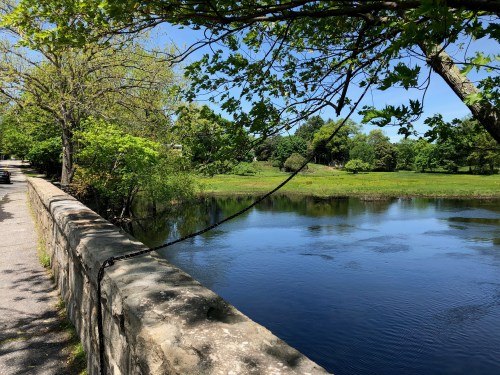
In other recent photos, note the rope tied to a tree by the Sudbury River. It was draped over the stone wall on Elm Street to tempt daredevils. It looked dangerous to me.

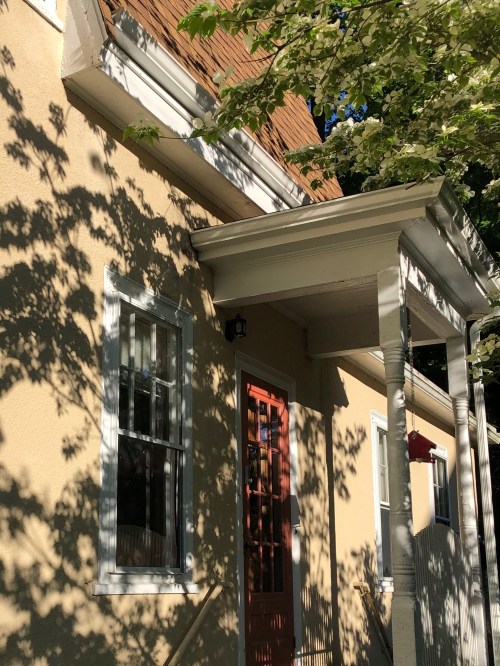
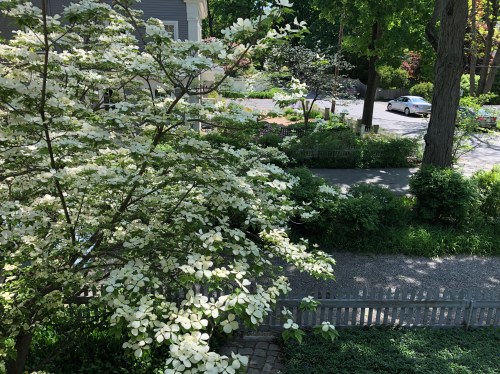
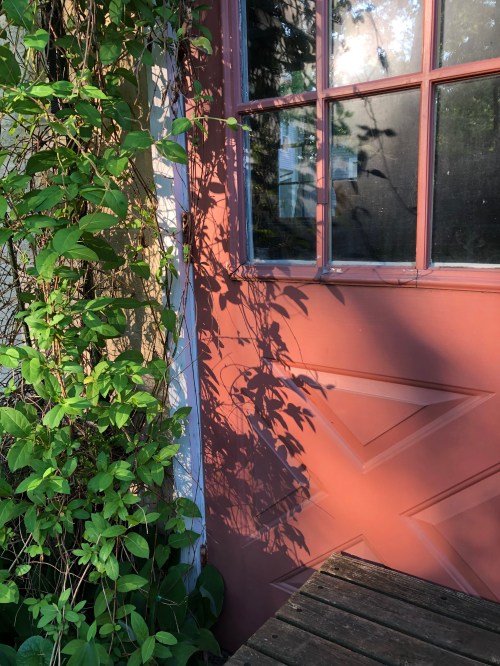
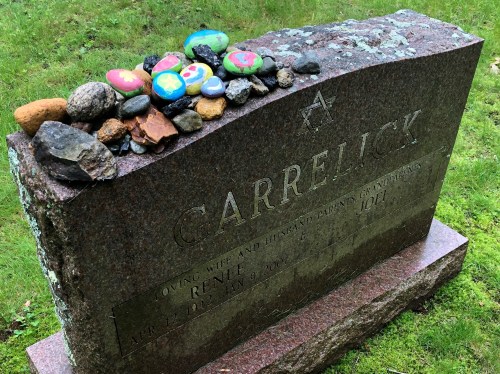
Next I give you our dogwood and various nice shadows. In Sleepy Hollow Cemetery, the headstone below always draws my attention. You can see that family and friends keep alive the memory of Renée, a local writer and historian who died young. I like the small stones more than the potted plants at other graves, although plantings that don’t die off are often nicely done.

In the woods nearby, ferns and skunk cabbage are celebrating spring. Still looking for Jack-in-the-Pulpit. Where have they all gone?

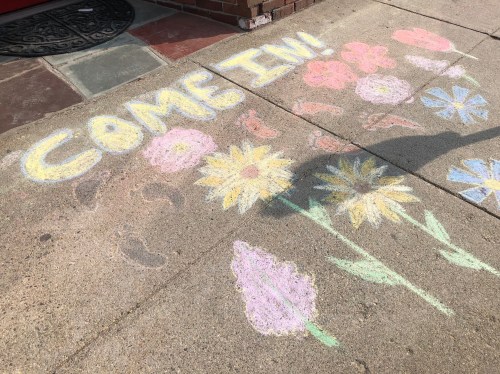
A woman who has a basement-level shop on Main Street is constantly coming up with ideas like the chalk drawings here to lure people down the stairs. I bet she wishes she never gave up her old shop at street level.

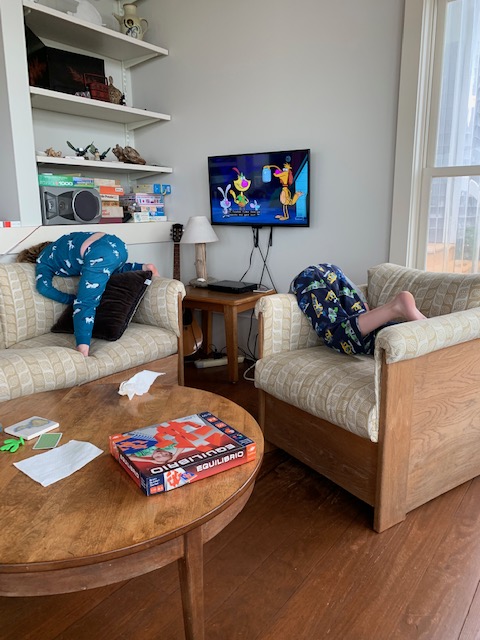
Finally, we have my first 2019 Painted Rock, a Higurashi-style wave. Plus a funny picture my husband took of two grandkids “watching” television.

052219-uh-oh-swing-into-Sudbury-River

052419-dogwood-shadows-in-May

052219-dogwood-see-from-upstairs

052219-evening-shadows-on-garage

052019-family-continues-to-remember-Renee

052019-ferns-on-conservation-land

051919-shop-welcome-maat

052419-giant-wave-on-painted-rock

051219-watching-tv-New-Shoreham

Read Full Post »

Photo: Afghanistan National Institute of Music
Afghanistan’s first all-female orchestra, Zohra, is touring.

I’ve been interested in Afghanistan since before the headlines were all about the US conflict there. At least since reading Jason Elliot’s excellent An Unexpected Light and seeing the Tony Kushner play Homebody: Kabul. But lately I have an even stronger interest as Erik’s sister works on women’s rights in Afghanistan for the United Nations.

This BBC story provides one angle on Afghan women’s rights. Vincent Dowd has the report.

“Five years ago, a unique all-female orchestra was formed in Afghanistan, a nation where only a few years previously music had been outlawed and women barred from education. Now Zohra is visiting the UK for the first time.

“No-one claims that in Afghanistan, the Taliban influence has been rooted out entirely. Violence continues. But two decades ago, the Afghanistan National Institute of Music would have been unthinkable.

“ANIM was founded in 2008, with international support, to bring music education to young Afghans. … ANIM teaches music skills to some 250 young people, both male and female. That figure is about to rise to 320 and there are plans to expand to cities such as Herat, Mazar-e Sharif and Jalalabad.

“About 70% of the young people at the institute come from disadvantaged backgrounds — some used to work the streets selling vegetables, plastic bags or chewing gum to support their families. Ages range from 12 to around 20.

“But five years ago, ANIM founder by Dr Ahmad Sarmast was urged to start a new project specifically to benefit girls.

” ‘One of our students told me we needed a group of four or five girls to play pop music,’ he says. ‘I liked the idea but almost at once it became clear most of the girls at ANIM wanted to join. Suddenly we were talking about a full orchestra.’ …

“There are around 100 female students at ANIM, 23 of whom have come to Britain. Their numbers will be doubled when they play in concert with the London-based Orchestra of St John’s and others. Instruments they’ve brought with them include the sarod, the rubab, tabla drums and the dutar.

“The music performed is a combination of traditional Afghan music and western classical. For instance, their new arrangement of Greensleeves contains attractive new instrumentation probably not envisaged by Ralph Vaughan Williams in 1934.

“The conductor for the Afghan pieces is Negin Khpalwak, who at 22 is one of the older musicians in the group. She joined the school not long after it opened — not initially with the idea of conducting at all. …

” ‘It’s much easier for me to conduct when we play Afghan music,’ she says. ‘We’re very familiar with it and we play together easily. If we perform something like Greensleeves — which I think is very well-known in England — we have to concentrate extra hard.’ …

“Negin Khpalwak says even in Kabul, students can still sometimes encounter people beyond the school who think it’s wrong that the orchestra even exists.

” ‘They will say that in Islam women aren’t allowed to go to school, not just for music but to study anything. But it’s not true — women have their own rights and those people need to be educated. Our music isn’t the only way to do that — but it’s one way.’ ”

More here.

Read Full Post »

Photo: Musica Secreta
A new effort to bring back the choral music of Renaissance nuns is getting attention in classical circles. Composer and princess Leonora d’Este is the focus of this research.

Like other achievements of women centuries ago, the music of nuns in the Renaissance has been mostly lost to time. Until now.

At Bachtrack, Laura Volpi reports on a gifted daughter of Lucrezia Borgia.

“In 16th-century Italy – and across Europe – convents were the backbones of the economic and spiritual well-being of a city. At their core were expertly run choirs of nuns, so talented and so popular that they were considered tourist attractions. … During this vibrant yet under-explored chapter in Renaissance musical history, a princess nun was composing for her convent in Ferrara, and her anonymously published motets lay unsung and unloved for 500 years.

“To find out more, I spoke to Dr Laurie Stras, Professor of Music at the University of Huddersfield, author of the recently published book Women and Music in Sixteenth-Century Ferrara, musicologist and co-director of two early music female-voice ensembles – Musica Secreta and Celestial Sirens. …

” ‘Most families couldn’t afford to pay a marriage dowry for more than one daughter,’ explains Stras. … ‘So families who wanted the best for their daughter would get her into a convent with plenty of income. But a comfortable convent might have had quite a high dowry in itself, so one of the ways to get a reduction was by bringing a skill to it, such as music.’

“Music was really profitable for convents: it brought in money from the community, donating to hear mass on their behalf, while a great musical reputation brought in girls of higher status and wealth. Music also kept the nuns entertained and helped develop and maintain community harmony. …

“Music composed for convents would only be for the choirs’ consumption, so to find some published was unusual. Yet princess Leonora d’Este is strongly believed to be the author of 23 motets. …

“Leonora D’Este was the daughter of Lucrezia Borgia and Alfonso I, the Duke of Ferrara. She became Mother Superior at Corpus Domini when she was 18 and several of her contemporaries write of her exceptional musical abilities. We know that her family supported her musical activities up to her death.

“Despite the limitations of a life of enclosure, for many women life in a convent was a passport to freedom.

‘Some women chose a monastic life because they were creatively driven and felt that they had more space to develop as creative or intellectuals in the convent than they would outside.’ …

“ ‘Leonora sent these motets for publication to see them preserved for posterity. Hers are incredible works, so far beyond what was already in print in the 1540s. Technically they are an amazing achievement. All these motets are written for five, equal voices, voci pari, all of which are more or less in the same compass. You get some very interesting dissonance treatment when you have five parts moving in such a confined space. … One of the most outlandish pieces is a setting of the Mass Gradual for Easter Sunday, Haec dies, in which the voices imitate the sounds of all the bells of the city going off.’ …

“It is important to bring this music back to choral ensembles today. ‘We know about the Sistine Chapel, we know about Palestrina and we know about Josquin des Prez only because of the way history has been written and the things that have been given value,’ says Stras. ‘By recovering this wonderful music, we bring the balance back. The English choral tradition has given prominence to boys’ voices as more appropriate for Renaissance music, but the sound of women singing is the sound of the Renaissance. It’s not something that is unusual or that should be suppressed: this is part of our heritage.’ ”

More at Bachtrack, here.

Read Full Post »

Photo: Robert Galbraith/Reuters/Corbis
Clinging to the top of a vehicle before being rescued by the U.S. Coast Guard from the flooded streets of New Orleans after Hurricane Katrina, 2005. The city’s homelessness problem grew exponentially after Katrina. Then a unique collaborative decided to do something about it.

Homelessness is increasing all over this wealthy, unequal land of ours. And you know what? It’s possible to do something about it. Where there’s a will, there’s a way. Consider this effort in New Orleans, as reported by Jeremy Hobson on WBUR’s Here and Now.

“Across the U.S., more than a half million people have been identified as homeless. New Orleans faced a major crisis in homelessness following Hurricane Katrina.

In 2007, two years after the storm, there were more than 11,600 homeless people in the city. Since then, New Orleans stepped up its effort to tackle homelessness and has brought that number down 90 percent.

“Martha Kegel, executive director of Unity of Greater New Orleans, tells Here & Now‘s Jeremy Hobson the strategy to tackle the ‘unprecedented explosion’ of homelessness in the city following Katrina was threefold.

“First, Kegel says, Unity of Greater New Orleans — a nonprofit leading a collaborative of organizations providing housing and services to the homeless — had to assemble an outreach team that ‘was willing to go anywhere and do anything to rescue and rehouse a homeless person.’

“Second, Kegel says the group put all its effort behind gathering a rent assistance fund. ‘We went directly to Congress,’ she says. …

“And lastly, she says, the team took a ‘Housing First’ approach, which is ‘simply the idea that you accept people as they are,’ whether they are sober or not. … ‘Once they’re in their apartment, you immediately wrap all the services around them that they need to stay stable and live the highest quality life that they can live.

” ‘Actually, this is a very cost-effective approach, because when you think about it, it is costing the taxpayer a tremendous amount of money to leave people on the street. They’re constantly cycling in and out of jail on charges that wouldn’t even be relevant if they had an apartment, things like urinating in public, drinking in public, obstructing the sidewalk because they’re having to sleep on the sidewalk. Homeless offenses, in other words, that are costing the taxpayers a lot of money to be putting them in jail and processing them through the criminal justice system. Their health is deteriorating while they’re out on the street. They’re being taken by ambulance to the emergency room constantly. Those are huge charges.

” ‘Really what you need is, you know, a relatively small amount of money to pay for some rent assistance and they can contribute some of that rent as well with disability benefits or if they’re able to work with, you know, employment income and a little bit of case-management assistance. It really has been proven over and over again in studies to be very cost effective.

” ‘This is permanent housing. How long the rent assistance lasts depends on what people need. And we’re kind of masters at trying to spread what is always an inadequate amount of money as far as it’ll spread. …

” ‘We have reached what we call “functional zero,” which means that we compiled a list using our outreach team [and] using our shelter lists that are updated every night. We housed, in their own apartments, every veteran on that list except nine that had refused housing, mostly because of mental illness. And we continued to work with those nine, at that point, [we] have housed four more of them. Then going forward, we have made a commitment that any time a veteran becomes newly homeless, we house them in an apartment within an average of 30 days or less. And we’ve maintained that now for over four years and we’re extremely proud of that. It is very hard work. It requires a lot of organizations working together — and the VA and the Housing Authority — everybody working together to make that happen.’ ”

Think about those homeless veterans this Memorial Day. If we do “war” to them, can we also do housing with services? It’s about compassion and taking responsibility.

And I like how Kegel says, “You have to love the people in your community and want your community to thrive and care very deeply about the vulnerable people in it, that you’re willing to do, what we say, whatever it takes.”

More here.

Read Full Post »

Photos: MOCA Cleveland
This museum is experimenting with new ways to be more inclusive, including free admission.

I’m impressed by the museum in this story because it has free admission every day in order to be more inclusive. Very unusual. The big museum where I live, Boston’s MFA, has one free day. It does have decent student hours, but it’s prohibitively priced for families on most days. Cleveland is going to have to raise a lot of money from grants.

Sarah Douglas writes at ArtNews, “If there is one word that has been on the agendas of almost every American art museum in the past few years, it is inclusion: How do institutions make diverse audiences feel welcome? The Museum of Contemporary Art Cleveland [has] announced a comprehensive plan to infuse inclusiveness into the museum on a structural and programmatic level.

“The five components of the initiative, which is called ‘Open House,’ are free admission for all, the creation of a diversity-focused curatorial fellowship (the first recipient is LaTanya Autry, who has held curatorial positions at the Yale University Art Gallery and the Mississippi Museum of Art), an engagement-guide apprenticeship program, enhanced onsite programming for families and teens, and the addition of an education specialist. …

“Jill Snyder, who has led the institution as its Kohl Executive Director since 1996, [says,] ‘We are taking what we hope is a noble approach that has a high quotient of humility, which is that we are really listening to what is going on in our community.’ …

“The museum’s lead investment in ‘Open House’ is the result of being the first recipient of a brand new grant from the Carl & Marilynn Thoma Art Foundation called ‘Bold Initiatives,’ which gives $500,000 over three years to small and mid-sized institutions to enact comprehensive plans that affect outreach, diversity, and inclusion. …

“One of the components of Open House, the engagement-guide apprenticeship program, which the Thoma Foundation grant is supporting, gets to what Snyder refers to as the integration of ‘welcoming, collaborative practices into every aspect of our business.’ The museum is creating a cohort of 10 to 12 part-time positions, with hiring based on the diversity ratio of Cuyahoga County, and will mentor these hires in visitor services, guarding art, and how to talk about art. It will be designed like a fellowship program, and the hires will be given board mentors and guided as to how they can apply their new skills elsewhere. Snyder describes it as workforce training in the cultural sector. …

“ ‘We set about defining initiatives moving toward our 50th anniversary in claiming that this idea of a Kunsthalle in the Midwest had a specific meaning,’ Snyder said. … ‘We saw that with artists, that what they were doing was not mediated through an art-world ecosystem, because we don’t have that here. There is no proliferation of galleries, collectors, and art criticism — those filters. So there is a more direct engagement between artist, museum, and community.’ …

“Open House [is] meant ‘to lower barriers to entry and to work on inclusion and accessibility. Even if we get people in the door, how do we make the encounter with new art rewarding?’ ” asks Snyder. That will be the ongoing challenge, but Cleveland is up for it.

Read more at ArtNews, here. Meanwhile, in San Francisco, museums offer free admission this summer to people on public assistance. And then, there’s this about a gift to the Los Angeles Museum of Contemporary Art that will allow for free admission.

Read Full Post »

Photo: Ryan Brennecke/The Bulletin, via Associated Press
The Blockbuster store in Bend, Ore., has 4,000 account holders and adds a few new ones every day.

As people turn away from “old media” toward ever evolving “new media,” the oldsters who are able to hang on sometimes do really well. That seems to be the case in this Last One Standing story.

Tiffany Hsu of the New York Times wrote in March, “There are only two Blockbuster stores left in the world. Very soon, there will only be one.

“The second-to-last Blockbuster, a squat blue-and-yellow slab wedged next to a real estate agency in Western Australia, will stop renting videos on [March 7] and shut down for good at the end of the month. Two stores in Alaska, part of the final group of Blockbuster outlets in the United States, closed in July.

“That will make the Blockbuster in Bend, Ore., one of a kind: a corporate remnant, just off the highway, near a cannabis retailer and a pet cremation service.

“But this is no elegy for Blockbuster, no lament for how Netflix killed the video star. … This is about the ability of the Bend store, like sturdy links in other dying chains, to live on and avoid being turned into a pawnshop or a fast-food restaurant.

“Some Tower Records stores still thrive in Japan long after their parent company declared bankruptcy and closed all of its American stores. There is a Howard Johnson’s in Lake George, N.Y., that is the lone survivor of what was once the country’s largest restaurant chain. Such holdouts have bucked the norm in the retail and restaurant industries, which have shed stores by the hundreds in recent years. …

“When Sandi Harding, the general manager of Bend’s Blockbuster store, heard that she would be running what is effectively the Lonesome George of video-rental chains, she posted a giddy message on Facebook: ‘Holy Cow it’s exciting.’

“The Bend store became a Blockbuster franchise in 2000. It has about 4,000 active accounts and signs up a few fresh ones each day, Ms. Harding said. Some of the new customers are tourists who have traveled hours out of their way to stop in. …

“ ‘It’s almost re-energized us, that we’re the last one,’ Ms. Harding said in an interview. ‘They treat us like celebrities.’

“A local beer maker, 10 Barrel Brewing, crafted a special beer, the Last Blockbuster, and served it at a party at the store. Two filmmakers raised nearly $40,000 on Kickstarter to finish a documentary about the location.

“One possible explanation for the store’s long life: Bend is in a region that the city’s mayor, Sally Russell, describes as having ‘huge expanses with really small communities’ that often do not have easy access to the high-speed internet necessary for content streaming. …

“ ‘It’s like with old vinyl, and how everyone wants to have turntables again,’ she said. ‘We get to a place where something out of date comes back in — there’s definitely interest in keeping this almost-extinct way of enjoying movies alive.'”

More at the New York Times, here.

Read Full Post »

il_794xn.1399122456_n197

Photo: KerryCan/Etsy
Online markets like Etsy and Amazon currently rely on fossil fuels for deliveries, which is why Etsy is leading the way in addressing climate effects.

I’m happy to see that more individuals and organizations are taking action against the climate crisis. In this story it’s Etsy, the site where many people sell handcrafts. (I hope you have checked out blogger KerryCan’s gorgeous vintage linens there.)

As Emily Dreyfuss wrote in February at Wired magazine, the online market favored by “indie makers” is working toward a carbon neutral future.

“Tomorrow, all the carbon emissions spewed into the atmosphere from US ecommerce deliveries — some 55,000 metric tons of CO2, by one estimate, from trucks and planes shipping packages across the country — will be neutralized.

“It’s all thanks to Etsy, the global online market for indie makers, which is picking up the tab on high-quality carbon offsets for itself as well as its competitors on Thursday. Etsy’s largesse ends after tomorrow, but it will continue to offset its own carbon footprint going forward, becoming the first ecommerce company to completely offset all its emissions generated from shipping.

“Etsy estimates that doing so will cost less than a penny per package — less than $1 million for the year. The company made more than $200 million in just the last quarter of 2018. The price of covering the industry’s emissions for one day won’t even reach six figures.

“ ‘It’s a pretty trivial cost,’ says Etsy CEO Josh Silverman, who joined the company in 2017 and has been credited with turning around its fortunes. Before he joined, the company’s sales seemed poised to be gobbled up by Amazon. Though Amazon has only continued to dominate — accounting for almost 50 percent of total online sales last year, by one estimate — Etsy has regained its foothold on the craft market. …

“Silverman sees tackling sustainability as core to his stewardship of the brand. Ecommerce has come under scrutiny for its environmental consequences, but Silverman believes Etsy sellers and customers are eager to minimize their harm to the planet. …

“If every ecommerce company offset its emissions, it would make a difference. Transportation is the single biggest source of greenhouse gas emissions, according to the US Environmental Protection Agency — more than electricity or industry. …

“If Amazon wanted to offset its shipping emissions now, some back-of-the-envelope math using available numbers suggests how much it might cost. The company says it shipped over 5 billion items using Amazon Prime in 2017. Amazon Prime, with its free two-day delivery, has been accused of having a larger environmental impact, since the expedited time frame can make bundling items in the same package or delivery vehicle less practical. If each of those items was shipped separately, and if I borrow from Etsy’s calculation that it costs less than a penny per package to offset emissions, then it would cost Amazon less than $50 million to offset the emissions of Amazon Prime shipments in a year … less than 5 percent of Amazon’s reported $11.2 billion profit from 2018. …

“While experts agree that carbon offsets are the best option for an organization wanting to take immediate action, they caution that it’s a stopgap measure and not a solution to climate change. ‘Offsets are sort of second best because, essentially, what it does is allow you to continue emitting, and what we have to actually do is stop emitting,’ says Phil Duffy, president of the Woods Hole Research Center, the leading climate change think tank in the US. …

“Etsy knows this. According to Mozen and Silverman, the company’s goal is to eventually cut down on actual emissions. … Today it becomes the first ecommerce company to offer its customers the promise that packages delivered from Etsy are not hurting Earth. It’s a pretty good start.”

Until Amazon gets serious about its impact on the climate, maybe you’d rather find what you’re looking for at Etsy. Read more at Wired, here.

Read Full Post »

large_t_bcyzlmnca3tnmpokvf8h7rlalyd5xo7anjqui3htc

Photo: REUTERS/Toru Hanai
Insects are facing habitat loss across Europe, so London and other cities are taking action.

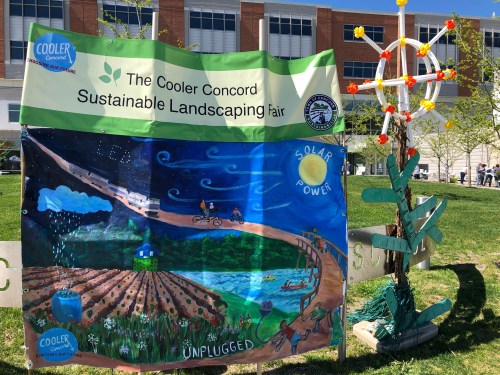
This story is for Jean, whose booth on MeadowScaping for Biodiversity I visited today at the high school’s sustainability event. Forward-thinking students at our school want this town of many lawns and too many lawn chemicals to change its pollinator-killing ways.

Charlotte Edmond at the World Economic Forum reports on how the city of London is getting serious about making bees and other important insects welcome.

“At any one time it’s estimated there are 10 quintillion insects alive. … Many of us hold no great affection for creepy crawlies, so it’s easy to overlook the crucial role they play in supporting ecosystems. Sitting at the bottom of the food web, they are also nature’s waste disposers, crucial to decomposition. Without them we would more than likely go hungry, with many crops needing pollinators to thrive.

But habitat loss and widespread use of insecticides and agrichemicals has led to insect numbers plummeting in recent years.

“In London, as with many other cities, you’re more likely to hear the buzz of cars than insects. But the UK’s capital is looking to give bugs a boost by creating an insect highway through the north-west of the city.

“A seven-mile wildflower corridor is being planted in parkland to provide a safe haven for insects. To support a range of bees and other pollinators, a mixture of seeds has been chosen.

“There has been a catastrophic loss of flower-rich grasslands in England since the 1930s, often as a result of intensive farming or redevelopment of green sites. … Recent studies have shown some species of pollinators in Britain have decreased by up to a third in the past two decades. There has also been a dip in the range of insects seen: in contrast to the sharp decline seen in some species, other insects, particularly those that [eat] crops, have become more prevalent.

“Experts are concerned by the impact the falling bug count will have. The UK government is five years into a strategy to curb pollinator loss, and is working with bodies such as Buglife to introduce more spaces to support pollinating insects. The charity is introducing a network of insect pathways throughout Britain, running through towns and countryside to connect existing wildlife areas together.

“Alongside this, it is working to create ‘urban hotspots’ for insects, transforming mown and unused areas of land by introducing shrubs, flowers and so-called bee hotels.

“Elsewhere, Norway has built a ‘bee highway’ through its capital, Oslo. And Berlin is one of a number of cities around the world to have introduced urban hives in a bid to support bee populations.

“Honey bees, bumblebees, wild bees and other pollinators are estimated to bring at least $25 billion to the European agriculture industry, ensuring pollination for most crops and wild plants.”

For more on London’s biodiversity efforts, go to the World Economic Forum site, here, where you can also find related stories.

Student-run fair to encourage town residents to use sustainable practices in their yards.

051819-sustainable-landscaping-fair

051819-native-flowers-Massachusetts

051819-MeadowScaping-for-BiodiversityJPG

Read Full Post »

2019-02-26-hijab

Photo: Gabrielle Emanuel/WGBH News
Shamso Ahmed has opened the first salon in Massachusetts specifically catering to Muslim women who wear hijabs, a religious head covering.

For some Muslim women, as for some Orthodox Jewish women, covering their hair in public is a religious obligation. Even though no one sees their hair when they are outside, when they are at home or among other women, they want it to look nice. Getting a good haircut at a salon can be a challenge, though.

As a young Virginia woman in a 2013 PRI story said, “There’s a JC Penney that has a hair salon nearby and they kind of stick you in a back storage room, and it’s okay, you still get a haircut, but it’s not the greatest atmosphere and you do kind of feel like you’re being shoved in a corner. It’s nice when they have the real chairs, especially when you’re going to pay that much for a haircut.”

Luckily in Boston, there’s a salon specifically for hijab-wearing women. Gabrielle Emanuel has the story,

“For most people, going to a beauty salon and getting a haircut is routine. But for Muslim women in Massachusetts who cover their hair for religious reasons, it can be a real challenge. At a traditional hair salon, they risk men seeing them without their headscarves on.

“But that is now changing. Massachusetts’ first salon and spa established specifically for Muslim women opened. … Shamso Ahmed is the woman behind the new business. She says she’s been dreaming about this since she was a young girl.

“At the age of 10, Shamso Ahmed fled the civil war in Somalia and arrived in Boston with her family. Two years later, she started wearing a hijab, a Muslim head covering, and that’s when she came up with the idea of opening a salon.

“ ‘I envisioned this huge, big salon that had all the services you could think of,’ remembered Ahmed. She wanted a place where ‘women felt safe.’

“Now, some two decades later, Ahmed has a degree in accounting and training in cosmetology. And she has a salon. While it’s not huge, the storefront is decked out. …

“In a neighborhood peppered with beauty shops, what makes Shamso Hair Studio and Spa unique is not the silver and black décor — or even the henna body art or the hammam steam spa — it is who is allowed in and who is not.

“Ahmed says the space is carefully designed to be female-only. At the door there’s a camera and a code required. The windows are frosted so people walking past can’t see in.

“For Muslim women who wear hijabs, Ahmed says it’s long been hard to find a place to get your hair done. … She said some women go to a salon and befriend a stylist, asking them to come to their home. Others ask to go to a salon after it’s closed for the day or they get their hair done in a backroom. Still others rely on female relatives.

“When Ahmed isn’t working on her other business, a translation service, she has often worked as a stylist going from house to house. Now, Ahmed is hoping her clients and others will come to her salon. …

“Ahmed said there’s been a lot of enthusiasm in the Muslim community, and people came from other states just to attend the opening. ‘Maine, Rhode Island, New York, New Hampshire,’ she ticked off the places. ‘Some of them came from Ohio, Virginia, Maryland, DC.’ …

“For Ahmed, this isn’t just a childhood dream she’s fulfilling. She said she’s also living out her mother’s dream, who owned a small business in Somalia before war broke out.”

More at PRI, here. There are a couple similar salons in Virginia. Read about them here.

Read Full Post »

Older Posts »