Feeds:
Posts
Comments

Archive for May, 2019

051419-hunting-lockets-in-Brimfield

Hunting for the best vintage lockets for Luna & Stella at the Brimfield antique fair, we really had to bundle up. It was awfully cold (and muddy) for May.

Ever since Suzanne first admired the nearly invisible hinges that characterized the old, handmade lockets, she wanted to offer lockets at Luna & Stella. At first, she investigated whether hinges like that were being made today. They weren’t. So she started an antique and vintage line to complement the way her contemporary birthstone jewelry preserves customers’ special memories.

The best place to start the hunt for vintage is at the Brimfield, Mass., antique fair, a mega event that occurs three times a year and involves thousands of dealers. According to one website, the show extends about a mile along both sides of Route 20 and several hundred yards back from each side of the road.

The dealers are not all selling lockets or even antiques. The event is also a flea market. You can find pretty much anything there. All that stuff you give to the Goodwill, or even throw out because it’s broken, could easily be displayed here with a price tag. It doesn’t even have to be old. People will buy anything.

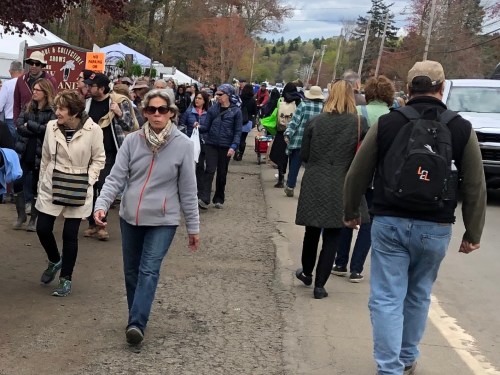
I had never been on any of Suzanne’s Brimfield expeditions, and as my sister was interested, I decided it was time. Alas, at the last minute, my sister was not able to make the trip. Getting to see pictures is not the same as being in those crazy crowds, eating at food trucks, and using Port-a-Potties, but it will have to do for now. It was definitely fun to see Suzanne in action. She was like a bloodhound on the scent, and I hope my sister will get a chance to watch her in action another time.

Here are a few photos. If a dealer has a dinosaur, you can bet it will get displayed prominently on the roadside. I noticed that the one below eventually talked Lady Liberty into hanging out.

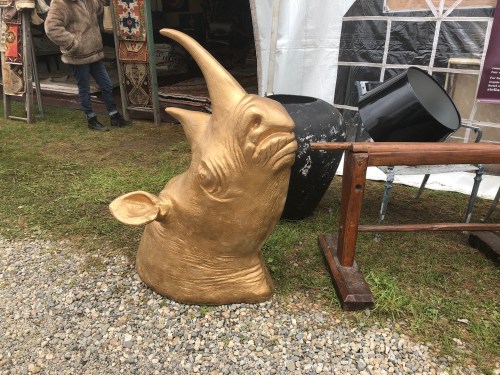
One thing you can do at Brimfield is get ideas here for the stuff you have at home. For example, if you have a fake rhino head collecting dust in your attic, you might want to spray it gold.

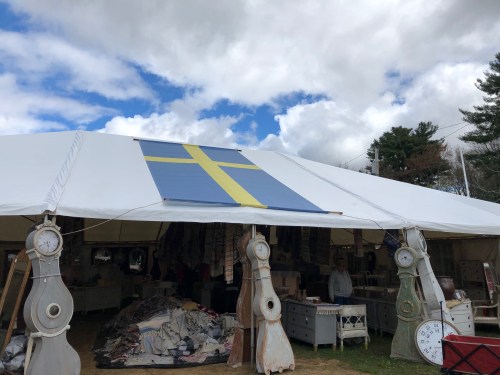
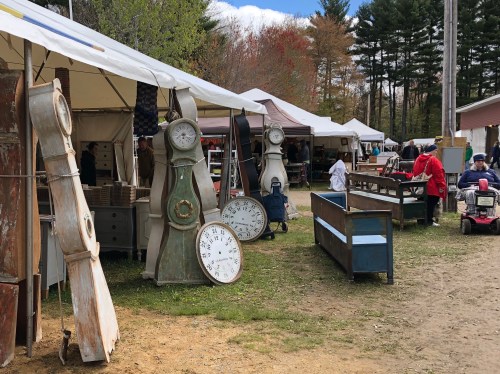
I sent Stuga40 the picture of the Swedish tent. Here’s what she said about the clocks, moraklocka: “Mora is a small city in Darlicalia (Dalarna). These clocks were painted and decorated by peasant artists. There are certain areas in Sweden like Dalarna and Hälsingland  where the ‘kurbits’ type of painted furniture is found. The red ‘dalahäst‘ [or wooden horse is] painted in this style and now used as a souvenir from Dalarna and Sweden.”

I loved the morning-glory look of the old Victrola. The quilt picture is for a few of my favorite readers.

The last photo is from the rural B&B where we spent a night. We needed the quiet haven after all the crowds.

You can read about the event here and get “tips on surviving Brimfield” here.

051419-Brimfield-dinosaur

051519-Brimfield-dino-&-Lady-Liberty


051419-Brimfield-rhino


051519-Brimfield-Swedish-antiques


051519-Brimfield-Moraklocka


051419-Brimfield-RCA-Victor


051519-Brimfield-quilts


051519-Brimfield-crwods


051519-Brimfield-B&B-view

Read Full Post »

real-kashmir-7-591a66101b34d7f508201129db96670cb2626d2a-s600-c85

Photo: Furkan Latif Khan/NPR
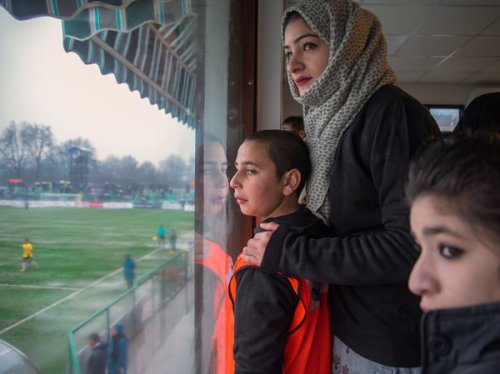
In wartorn Kashmir, there are Muslims and Hindus who who would rather play soccer than spend their lives fighting. Above, loyal Snow Leopards fans watch a game.

In every part of the world, no matter how troubled, there are always people who would rather play ball.

I have to blame the British colonial empire for leaving behind the seeds of war everywhere it went, chopping up countries without attention to the needs of the people living there. But thank goodness that human nature and the love of peace is strong! There are always some folks who have no interest in fighting.

Kashmir, created by Partition as the British left India, is an example of what I mean. Today, because of the way the country was divided, Kashmir knows constant war between Hindus and Muslims. Despite that, two friends, one Hindu and one Muslim, started something beautiful.

Lauren Frayer writes at National Public Radio (NPR), “They play soccer in a disputed Himalayan valley prone to car bombs, strikes and heavy snow. Soldiers with machine guns patrol their home stadium. Players sometimes have to arrive at practice three hours early to avoid police curfews. Their team is less than three years old, with a budget that’s one-tenth that of some of their competitors.

“[As of February 2019], Real Kashmir Football Club, from Indian-controlled Kashmir, [was] tantalizingly close to winning India’s top professional soccer title. They’ve been flitting back and forth between first, second and third place, and the season ends in early March.

” ‘We’re the only club in India that has sold-out stadiums at almost every game,’ says the team’s co-founder Shamim Mehraj. ‘What we have done is give people some hope in a place that has actually been taken down by conflict and violence for the past 60 years. It’s helping this place heal.’ …

“A natural disaster helped give birth to this soccer team. In 2014, the Kashmir Valley suffered devastating floods. Hundreds of people were killed. Schools were closed, and young people spilled out onto the streets of Mehraj’s hometown Srinagar, the summer capital of Jammu and Kashmir and one of the largest cities in the valley.

“One evening, Mehraj and a friend had an idea.

” ‘We used to go for evening walks. We would see a lot of kids hanging around doing nothing, and I had been a footballer myself. That’s when I thought, “Why don’t I get some balls and at least give these kids something to do?” ‘ recalls Mehraj, 38. He had played for his college team in New Delhi, and for his state in amateur soccer tournaments.

“Mehraj, who is Muslim, and his Hindu friend Sandeep Chattoo, 52, got friends and neighbors to pitch in and buy 1,000 soccer balls, which they handed out to flood victims. But why stop there? In March 2016, they started a team.

“They applied for the team to compete in India’s I-League 2nd Division — the pro soccer equivalent of baseball’s minor leagues. Mehraj and Chattoo invested their own money to pay players’ salaries. They also hired a Scottish former player, David Robertson, who had been coaching a professional soccer team in Phoenix, Arizona, to coach Real Kashmir, a.k.a. the ‘Snow Leopards.’

“Robertson had never been to India, and admits he probably couldn’t have placed Kashmir on a map.

” ‘All I ever saw was TV shows that showed it’s 90 degrees — it’s hot in India! But I arrived here and the next day, it was snowing,’ says Robertson, 50, now in his third season as Real Kashmir’s coach. ‘There was no Internet, the electricity was out, and I just thought, “I want to go home.” ‘

“Mehraj invited Robertson over to his family’s house, gave him a hot water bottle and some home-cooked Kashmiri food — and convinced him to stay. Since then, Robertson has recruited his own son, Mason Robertson, 24, to play for Real Kashmir. By the end of the 2017-2018 season, several Robertson relatives were in the stands at the team’s home stadium in Srinagar, to watch Real Kashmir win the 2nd Division title. …

“[By February, the team was] neck-and-neck with Chennai City FC and East Bengal FC for the top title in Indian professional soccer. …

” ‘I never did think we would go this far,’ Mehraj tells NPR, as he looks out over the turf at Real Kashmir’s home stadium. …

“Kashmir’s 21 percent unemployment rate triple that of the rest of India and militant groups recruit from the ranks of young, idle Kashmiri men. Soccer ‘keeps him away from that,’ says Ishfaq Hussain, 52, a former professional cricket player whose son Muhammad Hammad plays center-back for Real Kashmir. ‘He thinks always about when to play, when to practice. He’s got no time to join politics or go shouting or pelleting stones.’ …

“His teammates include fellow Kashmiris and recruits from Africa, Europe and across India — including Muslims, Hindus, Christians and atheists. Mehraj says he can’t manufacture T-shirts, stickers and banners fast enough to keep up with fans’ demand.”

More of the NPR story here. Follow the rankings here.
Read Full Post »

47538971_303

Photos: Hive Earth
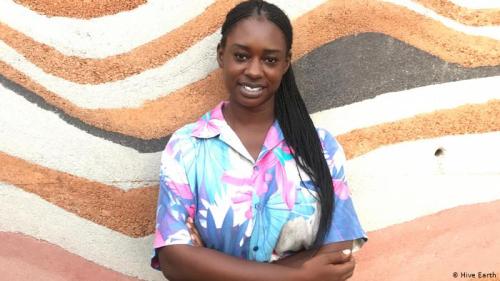
Joelle Eyeson is a co-founder of Hive Earth, which is working to address the housing challenges in Ghana. The company supports using the traditional ‘rammed earth’ technique as much more eco-friendly than cement.

Lately, I’ve seen a number of articles about how cement is bad for the planet. (For example, this story on the mining of sand used in cement.) But what else can we use? We can’t cut down all our remaining trees.

In Ghana, a company interested in sustainable home-building practices is experimenting with modernizing some traditional materials. DW interviewed Joelle Eyeson, co-founder of Hive Earth. Here is the DW interview.

“What are the housing challenges in Ghana right now?
“Joelle Eyeson: There is need for around 2 million new houses in Ghana per year, but most of the building is concentrated in the capital Accra, where land is very expensive. The other issue is that when you build in more rural areas it then becomes expensive to travel to the cities for work. We knew that the majority of people in Ghana have a relatively low wage. We thought it is strange you have workers building these big houses that cost hundreds of thousands of dollars and they could never afford them.

“So our aim is to build houses that our workers and the majority of Ghanaians and West Africans can afford. The prototype that should be ready by the end of the year will cost roughly $5,000 for a one-room house.

“What exactly is the ‘rammed earth’ technique that you use?
The rammed earth technique is just a mixture of laterite, clay and then granite chippings. We use 5 percent cement to bind it but also do it using lime.

We wanted a way of building without using cement, because it is very toxic; especially in our climate it combines with the heat and humidity and creates a really bad indoor air quality.

“When we discovered the rammed earth technique, we thought it was great because it is basically like the traditional mud house, but updated. It’s a tried and tested technique that’s been around for centuries. Parts of the Great Wall of China were even built with rammed earth.

“In what other ways are the buildings eco-friendly?
“In Ghana it is so hot you usually need air conditioning systems in your home, but these are not always affordable, eco-friendly, or good for your health. We teamed up with some German engineers who gave us the idea of underground cooling systems. We dig around 8 feet or more until we get to the cool air underground. Then we use a solar pump which is constantly bringing the cool air into the home. Then it is only the cost of the solar pump (around $300) which people need to pay and there are no bills. …

“With our foundation we are also planning on doing more workshops with local communities, helping to teach them the skills of building with rammed earth. We are also planning on building eco toilets. … We want to enable people to come and learn about rammed earth, build something that is beautiful, eco-friendly and useful for their own communities.”

More at DW, here.
The rammed-earth building technique uses local materials in Ghana and almost no cement.

47539467_403

Read Full Post »

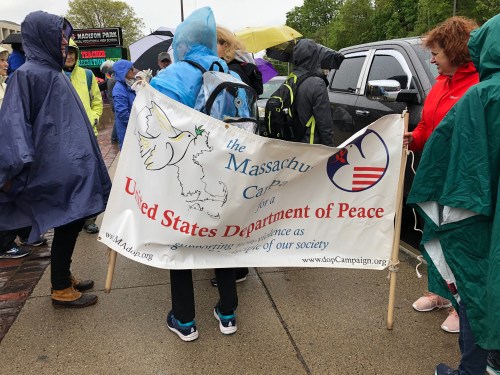
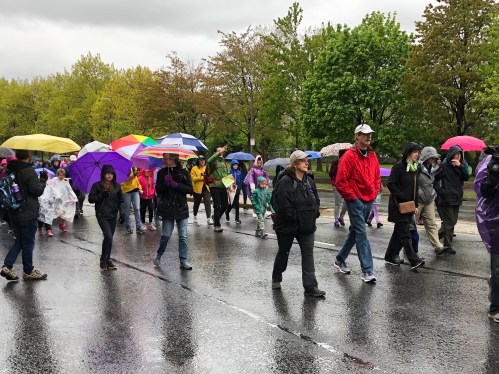
The Louis D. Brown Peace Walk in Boston has been supporting survivors of violent crime for a quarter century.

The nonprofit’s concern is for the people who are left behind after a violent death — the mothers, the fathers, the children, the siblings, the classmates, the communities. Sometimes the ongoing needs of these survivors get lost. In Boston, some of the bereaved families have banded together to help others heal. They have taken the lead in standing against violence and have invited residents of the Greater Boston area to join them. Nonprofit groups, churches, mosques, synagogues, and individuals arrive from the suburbs in droves.

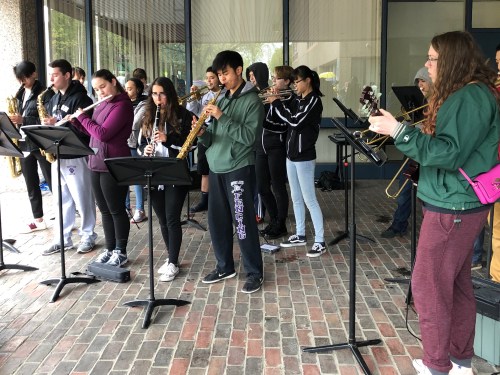
Here are a few photos from this year’s walk, which is always held on Mother’s Day.

I loved the band that played outside Madison Park High School, where our group joined the walk. Some people carried signs. Lots of people chanted peace slogans. We passed by a mural of the great Frederick Douglass in Roxbury.

If one or two people were to walk down Tremont Street on a rainy Sunday morning, no one would notice. When many hundreds do, it’s an event.

But other than raise funds for the Louis D. Brown Peace Institute outreach, which is valuable, does this help prevent violence? There are still homicides in Boston. But the huge gathering seems to generate an indefinable energy and awareness that sometimes leads individuals to wage peace in their own ways throughout the year.

051219-good-band-at-Peace-March-Boston

051219-good-idea-US-Dept-of-Peace

051219-Peace-Marcher-Boston

051219-Frederick-Douglass-mural-Roxbury-MA

051219-1-and-2-and-50-make-a-million


Read Full Post »

Whenever the sun peaked out this spring, I tried to take a picture. Not that you can’t take photos without sun, but I’m obsessed with shadows. Blogger and photographer Milford Street had a good idea for taking advantage of all the rain. He chose this time to shoot some waterfalls. Check out this shot from Ashby, Mass. (Where is Ashby, Mass.? Will I ever learn all the names of towns in this state?)

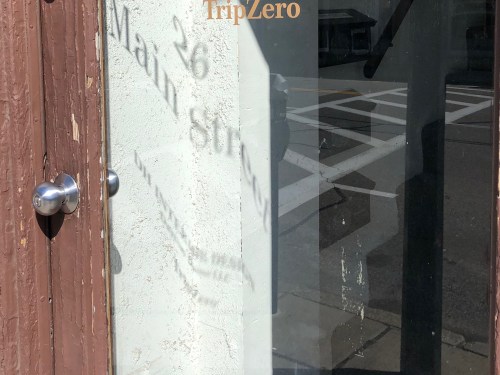
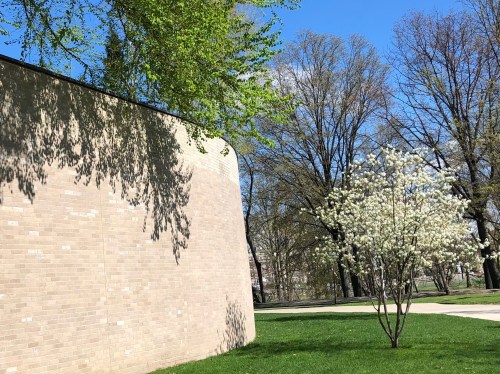
Moving right along, I loved the way the writing on the glass door below repeated itself on the interior wall. The very high wall that comes next is in Boston at the Isabella Stewart Gardner Museum, a magical place that no wall, alas, could protect from human error and theft.

Sunshine also brings out the vintage cars. I couldn’t resist shooting this red one, even though I am not especially into cars.

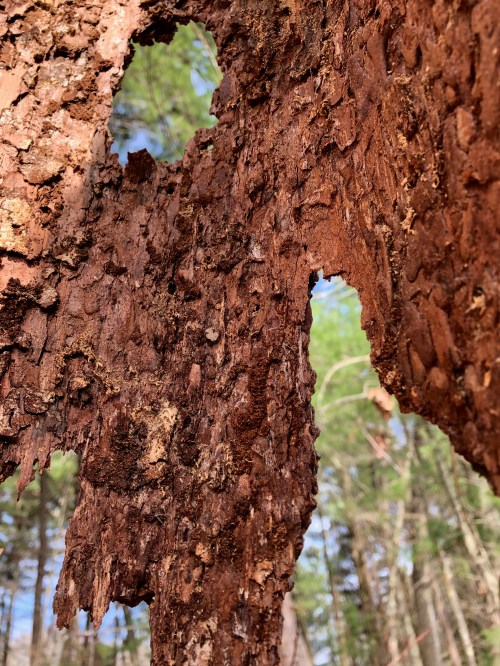
The curiosity you see after the car is a piece of bark hanging off a tree that is on conservation land. I have been finding walks in the woods very calming lately, especially since my sister’s cancer returned. If I don’t find ways to calm down, things start breaking or spilling or overheating in my vicinity. Not on purpose. They just happen.

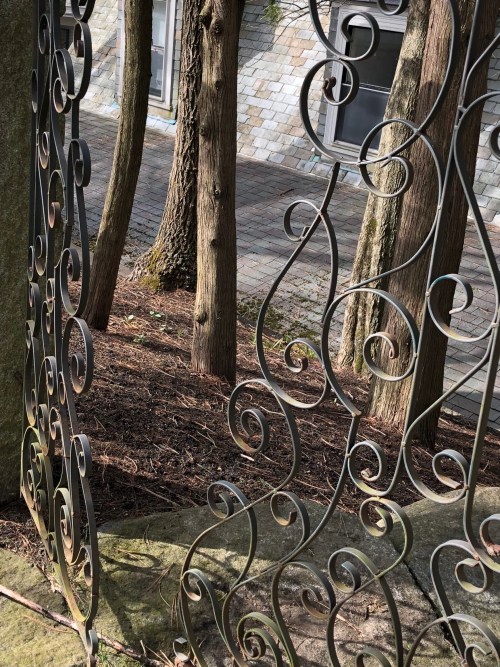
Next is a decorative gate standing all alone without a fence, like the random street lamp in the middle of a Narnia woods. You don’t know what its purpose is, but you’re kind of glad to see it.

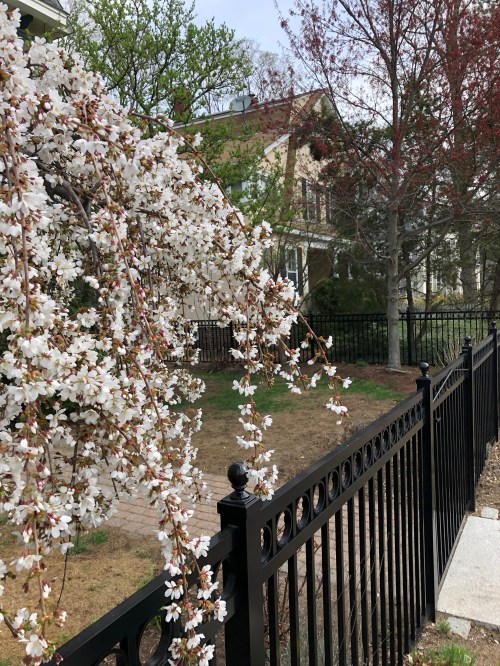
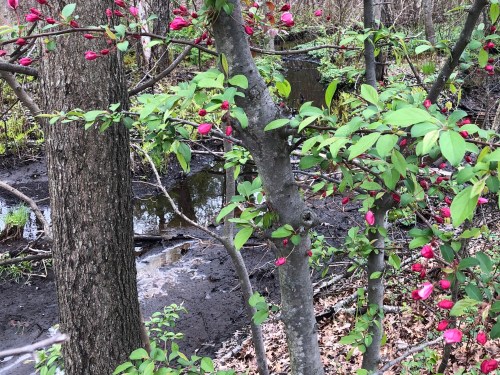
The gate is followed by my neighbor’s weeping cherry, which by this date has lost its flowers. The beauty of a weeping cherry is so short-lived. The apple tree by the swamp seems to have planted itself. It beautifies an ordinarily messy area I often pass on my walk.

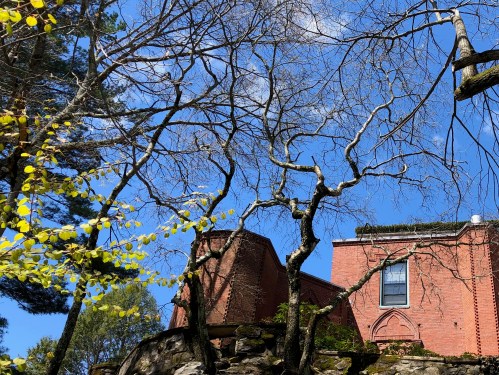
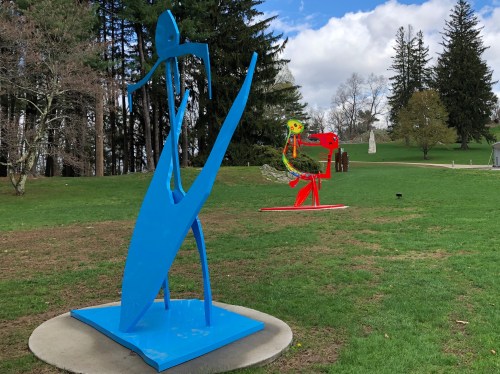
I will close here with photos from the amazing deCordova Museum in Lincoln, Mass.  The founder’s brick castle is quite dramatic in itself, as you can see, but the sculpture park is the museum’s crowning glory. Even when the indoor exhibits don’t speak to you, the outdoor ones will.

050819-shadow-through-door

042519-Isabella-Stewart-Gardner-wall

050319-vintage-car-ConcordMA

041419-bark-hanging-off tree

041919-curlicue-gate

041919-weeping-cherry

050319-blossoms-and-swamp

042419-deCordova.Museum-Lincoln-MAJPG

042419-outdoor-sculpture-deCordova

042419-reclining-head-deCordova

Read Full Post »

orchestr981

Photo: Handel & Haydn Society via AP / Chris Petre-Baumer
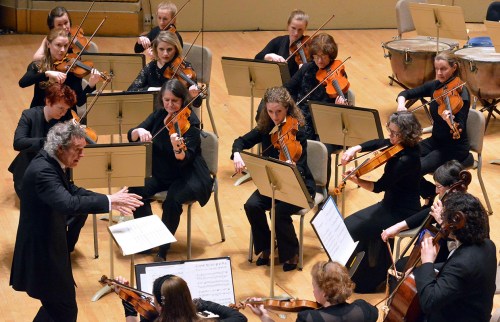
The Handel & Haydn Society performing Mozart’s “Masonic Funeral” at Symphony Hall in Boston on May 5, 2019. After the performance, the orchestra sought to find and thank the boy who cried “Wow!”

I have a story for you that is sweet on so many levels. You may like it for the support the concert audience gave a young boy or for the wish of the Handel & Haydn Society to find and thank the boy for his response to their music.

I think I like it most because of the way this grandfather is with his grandson.

As Kaitlyn Locke reports at WGBH radio, “Seconds after the orchestra stopped playing Mozart’s ‘Masonic Funeral Music’ at the Boston Symphony Hall on Sunday, 9-year-old Ronan Mattin was so swept away by the music that he loudly exclaimed — for the whole auditorium to hear — ‘Wow!’

“After a beat, as Ronan’s awe-filled ‘Wow!’ echoed throughout the hall, the audience burst into laughter and cheers. So charmed were the Handel and Haydn Society by the child’s exclamation that they asked the public to help find him, hoping to reward the sweet sentiment with a trip to meet the artistic director. …

“Ronan didn’t mean to be disruptive, said his grandfather, Stephen Mattin, who took Ronan to the concert. His grandson, Mattin explained, is on the autism spectrum, and often expresses himself differently than other people.

” ‘I can count on one hand the number of times that [he’s] spontaneously ever come out with some expression of how he’s feeling,’ Mattin said.

“Mattin said that his sister-in-law saw on television that the Handel and Haydn Society was searching for the ‘wow kid,’ and the family, who lives in Kensington, New Hampshire, reached out soon after. The Society has invited them to meet the artistic director, and they are figuring out a date.

“Ronan is a huge music fan, his grandfather said. He took the 9-year-old to another concert in Boston a few months ago, and he ‘talked about nothing else for weeks.’ …

David Snead, the president and CEO of the Handel and Haydn Society, wrote in a Facebook post that it was ‘one of the most wonderful moments [he’s] experienced in the concert hall.’ …

“Mattin said he was touched by the kindness of the other audience members and performers after the ‘wow’ moment, and that the Society reached out.

” ‘You know, everybody’s different. Everybody has different ways of expressing themselves,’ Mattin said. ‘I think people in general, society’s becoming more tolerant or understanding of the differences between people.’ ”

More here.

Read Full Post »

04poets_600

Photo: New York Times
Fisher poet Dave Densmore, on his boat, wrote his first poem as a joke in the 1970s. Now he studies writing.

Jobs like commercial fishing can provide a lot of of time to think, and it’s amazing how thinking often leads to poetry. That is also true of experiences that are so hard to capture they must be addressed obliquely.

Poetic storytelling is alive and well in the fishing community, it seems. Consider this transcript of a National Public Radio (NPR) report, in which Melanie Sevcenko describes an annual fisher poet event.

“MELANIE SEVCENKO: Moe Bowstern named herself after the front and back end of a ship. She calls herself a fishing woman. And for her, writing poetry comes with the job.

“MOE BOWSTERN: Well, I mean, have you ever been fishing? …  It’s unbelievably boring. And so you just have to think of something else to do.

“SEVCENKO: Now retired from commercial fishing, Bowstern is one of dozens of fisher poets who have been meeting for their annual gathering in a Astoria, Ore. During the last weekend of February, the far-flung fisher people interpret the commercial fishing industry in prose, poetry and song. …

“Bowstern started fishing in Kodiak, Alaska, in the mid-’80s when women on commercial boats were scarce. Her zine shares a name with a popular brand of deck boots, XTRATUF. This piece is called ‘Things That Will Be Difficult.’

“BOWSTERN: ‘It will be hard, if you are a man, to understand why your female crewmate, who started out so friendly, is so silent now when you are only trying to help. It will be hard if you are a woman to go’ …

“SEVCENKO: The poetry onstage at FisherPoets touches on what Bowstern calls an incredibly difficult life.

“BOWSTERN: Not just because of the rigors of the actual physical experience of the life, but it’s just, how can you be a fisherman at a time of climate change? And, like, where are you going to position yourself with resource extraction?

“SEVCENKO: That’s something John Copp has written about. For 20 years, he ran operations in Bristol Bay in the Bering Sea. Multinational corporations want to mine gold and copper from the area nearby and have been angling to do so for years. His poem ‘Tsunami’ is inspired by his opposition to the proposed Pebble Mine. … Many commercial fishermen have been against the Pebble Mine because of the damage it could do to the biggest salmon run on the planet. Copp is retired and lives in Oregon now. But he’s still inspired to write by the natural beauty of Alaska. …

“This weekend, once again, the fisher poets will do what they’ve done for more than two decades — gather on piers, in cafes and in theaters to perform their poetry for grateful audiences in this seaside town. Bowstern feels lucky that people who’ve never even been fishing want to hear their stories.

“BOWSTERN: We’re participating in two traditions that have been going on. Like, storytelling is probably only a little bit older than fishing, you know? So we get to tell stories in our special, weird language. And people just can’t get enough of it.”

The NPR transcript is here, and there’s another good article at the New York Times, here. If you know people who fish and also write poetry, have them check out the Fisher Poets website, here.

Read Full Post »

refugee-chocolate-hiring-20190216

Photo: Andrew Vaughan / The Canadian Press
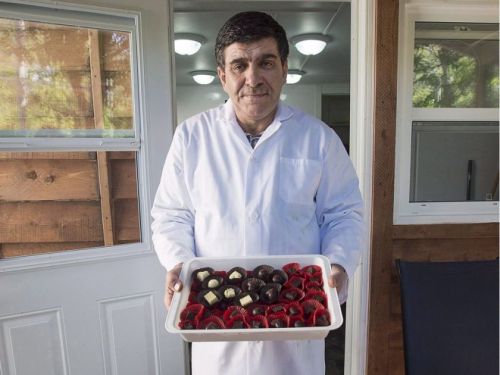
A former refugee who founded the Nova Scotia chocolate company Peace by Chocolate has committed to hiring 50 refugees by 2022 and to mentor 10 refugee-run start-ups over the next few years.

Refugees that a country takes in are often the most grateful people on the planet. Most are highly motivated to succeed and not be a burden. Some start their own businesses, and then, as soon as they get established, look for ways to give back to others.

The Canadian Press reports on one example. “A one-time Syrian refugee who founded a thriving Nova Scotia chocolate company has announced plans to hire and mentor other refugees. Peace by Chocolate of Antigonish, N.S., has committed to hiring 50 refugees by 2022, and to mentor 10 refugee-run start-ups over the next few years.

“The now-famous company was founded by the Hadhad family, who fled their home in war-torn Damascus in 2012. They arrived in Nova Scotia with next to nothing in 2016. …

“Tareq Hadhad, CEO of the company, said Peace by Chocolate aims to give back to the country that welcomed his family when so many nations were closing their borders to the Syrian plight. Now he plans to expand on that vision by giving back to other refugees looking to start new lives — as Canadians did for his family when they needed it most. …

“Hadhad said in an interview, ‘Being a refugee is not a choice, it’s not a decision, it’s not a life goal. These people are fleeing their homes because of war, because of persecution.’ …

“Hadhad’s father, Assam, ran a chocolate business in Damascus for decades but it was destroyed in a 2012 bombing.”

Another article, by Fadila Chater at the National Post, notes that the “chocolate company founded by Syrian refugees has produced its first chocolate bar — and given it an Indigenous name. [Its] new milk chocolate and hazelnut bar is to be called Wantaqo’ti (pronounced Wan-tahk-oo-di), the Mi’kmaq word for peace. …

“Founder Tareq Hadhad said via email … it is his company’s mission to translate the family’s concept of peace to all Canadians, starting with the Mi’kmaq of his home province. … Other versions of the bar will be sold using the Arabic, French and Mandarin words for peace.

‘Peace is beautiful in every language,’ Hadhad said. …

“ ‘When we came here as newcomers to this country, we really wanted to support this country to grow and prosper,’ he said.”

The Peace by Chocolate bars are available online, here.

Read more at the National Post, here and at the Canadian Press, here.

Read Full Post »

16x9_m

Photo: Clark Mischler
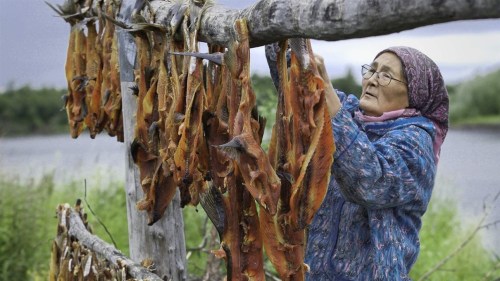
Hanging salmon at a fish camp near Kwethluk, Alaska, in the Yup’ik region, which has extensive coastline on the Bering Sea. The North Pacific Fishery Management Council is tapping the traditional knowledge of indigenous communities as it works toward more-sustainable fishery management.

I was listening to the radio in the car when the United Nations’ dire warning about biodiversity came out. Called the “Global Assessment Report on Biodiversity and Ecosystem Services,” it predicts one million species could be pushed to extinction in the next few years by such things as overbuilding and loss of habitat, global warming, and pesticides and herbicides. (The scientists who did the research provided their services for free. The naysayers are being paid. Ask yourself: Paid by whom?)

One commentator suggested that a road map for preventing loss of species is right under our noses in indigenous communities.

For a window on one way government agencies are starting to collaborate with indigenous communities, consider this Pew Trusts report on the salmon fishery in Alaska.

“The indigenous communities of the Bering Strait region have a vast knowledge of salmon runs, ocean currents, marine mammal behavior, and other ecosystem dynamics — information gathered over millennia and passed down from generation to generation. Now federal fishery managers will use that Traditional Knowledge to help guide management for the Bering Sea.

“The North Pacific Fishery Management Council voted at its December meeting in Anchorage, Alaska, to adopt a new Bering Sea Fishery Ecosystem Plan that lays the groundwork for meaningful incorporation of Traditional Knowledge into decision-making. Social scientists Julie and Brenden Raymond-Yakoubian, a married couple who have worked on the issue for years, say this is a groundbreaking action by the council.

“ ‘Indigenous communities have been living on — and with — the Bering Sea for generations,’ says Julie Raymond-Yakoubian, who is social science program director for Kawerak Inc., the Alaska Native nonprofit tribal consortium for the Bering Strait region. ‘They can see components of the ecosystem, including interconnections and relationships, that fishery managers might miss.’

“ ‘Incorporating indigenous perspectives is crucial for overcoming management challenges,’ adds Brenden Raymond-Yakoubian, who runs Sandhill.Culture.Craft, a social science consulting firm based in Girdwood, Alaska. …

Here are a couple of the nitty gritty matters addressed in the Pew interview.

“Q: What are the greatest challenges to ensuring that Traditional Knowledge informs decision-making?
“Brenden: One is getting recognition for Traditional Knowledge and ensuring there is a desire for it to inform policy and science. Another is getting natural scientists — those working in fisheries or oceanography, for example — to work with social scientists and Traditional Knowledge holders.

“Julie: There are five council meetings a year that each last about 10 days and are held in different places. Gaining a good understanding of how to work within the council’s process can be a full-time job. Most tribes don’t have the resources to do this. But if we want to include Traditional Knowledge and Traditional Knowledge holders in fisheries management, then these issues must be addressed.

“Q: How can Traditional Knowledge help address conflicts between federal fishery management and the subsistence way of life that Bering Sea communities have lived for millennia?
“Brenden: There are many ways. For example, management could include a broader understanding of the impact of commercial fishing on subsistence communities and of millennia-old practices and principles that have connected those communities to fish and the sea and sustained that relationship with the environment.

“Julie: Incorporating Traditional Knowledge will also help federal fishery managers better meet their existing obligations, such as the requirements to use the best scientific information available and consider social and ecological factors in management. It will also help them better implement ecosystem-based fishery management, which calls for managing fisheries at the ecosystem level rather than single-species level. Traditional Knowledge can also help federal fishery management become more adaptive, for example, by providing managers access to information about ecosystem changes they may not otherwise be aware of. This should help fishery managers adjust their policies to adapt to climate change, which would hopefully occur in a manner which ensured the sustainability of fishery resources for subsistence communities into a climate-uncertain future.”

More here.

Read Full Post »

glassmilkbottles2302d-0

Photo: Evening Standard
According to a UK newspaper, environmentally aware millennials are driving increased demand for milk in glass bottles. Plastic bottles are out.

I’ve been trying to be more thoughtful about cutting down on household items that aren’t good for the environment. But sometimes I’m a little clueless, carrying the recycling to the street on a regular basis and not noticing that all our milk comes in plastic bottles.

The last couple weeks, though, I’ve been buying cardboard bottles of milk. Unfortunately, they are not for sale everywhere and they cost more. That’s why the following story about the new popularity of glass bottles caught my attention. There is no milk delivery where I live, but it’s definitely available where Suzanne lives.

In England, Ella Wills reports at the Evening Standard, “milkmen and milkwomen are making a comeback in London as millennials have started using glass milk bottles in a bid to cut down plastic waste.

“Dairies in the capital told of a ‘phenomenal’ upsurge in interest from younger customers at the start of the year amid growing public upset over plastic waste.

“Both UK-wide company milk&more and east London dairy Parker Dairies have seen increased demand for glass bottles in 2018, citing David Attenborough’s Blue Planet II as the ‘catalyst’ for the new uptake. The firms said younger consumers and families seem willing to pay more for the service in a bid to help the environment. …

“The industry body [Dairy UK] said figures showed doorstep deliveries make up 3 per cent of milk sales in the UK — around 1 million pints per day — and glass milk bottles make up 3 per cent of all milk sales. But depot manager of Parker Dairies Paul Lough said interest of late in glass bottles has been ‘absolutely phenomenal.’

“He said the dairy, which has a fleet of 25 electric milk floats covering all of east London, the city and the West End, has gained 382 new customers since the beginning of the year. Of these new calls, 95 per cent are having milk delivered in glass bottles. …

“And the dairy has attracted a younger clientele, Mr Lough said, meaning the firm has expanded its product line to cater to the new demographic.

“ ‘Without a doubt [they are younger],’ he said. ‘That is why we are trying to change our product list. We do sourdough and honeys. … We sell 250 loaves a week to new customers.’

“Meanwhile, UK company milk&more said it has gained more than 2,500 new customers in [February] — the equivalent of five new milk rounds. And some 90 per cent of these customers across the country are ordering in the iconic glass bottles. …

“Milkman Ian Beardwell has been doing the same round in Wimbledon for Hanworth Dairy for 27 years. He said: ‘Since Blue Planet that has been the catalyst of the revival in glass. I used to do 550 calls before and in four weeks I’ve gained another 35 to 40 calls — 90 per cent glass.’ …

“Patrick Müller, managing director of milk&more, [added that] new customers were aged around 35 years old, coming from young families with a double income. … ‘Customers [said] they enjoy the experience of the glass bottle — the childhood memories — and they want to reduce their plastic wastage.’ ”

More here.


Read Full Post »

lead_720_405

Photo: University of York
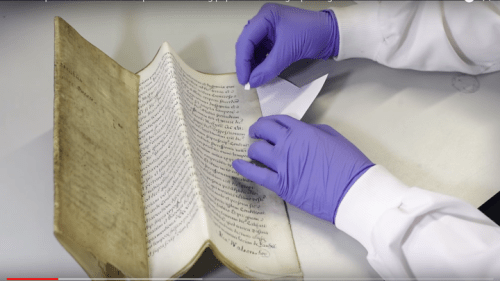
A UK lab is learning what the DNA in old books has to tell us about the past. Even the beeswax used in seals is rich with data, including the flowers that grew in that region year to year.

Do you know what set you on your career? As an oldest child, I spent a certain amount of time explaining things, and I liked making a school for my dolls. Although I ended up as an editor for many years, I started my worklife as a teacher and am now back to volunteer work as a teacher.

The scientist in the following story got launched on his passion after watching the movie Jaws.

Sarah Zhang writes at the Atlantic, “It was in the archives of the Archbishop of York that Matthew Collins had an epiphany: He was surrounded by millions of animal skins.

“Another person might say they were surrounded by books and manuscripts written on parchment, which is made from skins, usually of cows and sheep. Collins, however, had been trying to make sense of animal-bone fragments from archaeological digs, and he began to think about the advantages of studying animal skins, already cut into rectangles and arranged neatly on a shelf. …

“In recent years, archaeologists and historians have awakened to the potential of ancient DNA extracted from human bones and teeth. DNA evidence has enriched — and complicated — stories of prehistoric human migrations. It has provided tantalizing clues to epidemics such as the black death. It has identified the remains of King Richard III, found under a parking lot. But Collins isn’t just interested in human remains. He’s interested in the things these humans made; the animals they bred, slaughtered, and ate; and the economies they created.

“That’s why he was studying DNA from the bones of livestock — and why his lab is now at the forefront of studying DNA from objects such as parchment, birch-bark tar, and beeswax. … With ample genetic data, you might reconstruct a more complete picture of life hundreds of years in the past.

“Collins splits his time between Cambridge and the University of Copenhagen, and it’s hard to nail down exactly what kind of -ologist he is. He has a knack for gathering experts as diverse as parchment specialists, veterinarians, geneticists, archivists, economic historians, and protein scientists (his own background). ‘All I do is connect people together,’ he said. …

“Collins began his scientific career studying marine biology, thanks to a formative teenage viewing of Jaws. He specialized first in marine fossils and, later, in the ancient proteins hidden inside them. This turned out to be a dead end. For the most part, the fossils were too old and the proteins no longer intact enough to study. He was forced to look at younger and younger material, until he crossed from paleontology into archaeology. He applied the techniques of protein analysis to pottery shards, in which he found milk proteins that hinted at the diet of the people who used those pots.

“Collins quickly realized that DNA held even more potential than ancient proteins, which can be ‘a blunt tool compared to DNA.’ The DNA of any single animal is, after all, a library coding for all the proteins their cells can make. …

“When Collins embarked on the parchment project, he gathered a team that included geneticists as well as archivists, bookmakers, and historians.

“It didn’t take long for the group to hit their first culture clash. In science and archaeology, destructive sampling is at least tolerated, if not encouraged. But book conservators were not going to let people in white coats come in and cut up their books. Instead of giving up or fighting through it, Sarah Fiddyment, a postdoctoral research fellow working with Collins, shadowed conservationists for several weeks. She saw that they used white Staedtler erasers to clean the manuscripts, and wondered whether that rubbed off enough DNA to do the trick. It did; the team found a way to extract DNA and proteins from eraser crumbs, a compromise that satisfied everyone.”

Read how the research evolved, here.

Read Full Post »

image

Photo: Susie Armitage for Atlas Obscura
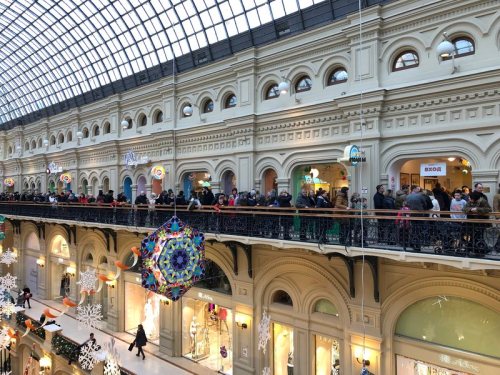
The line for Stolovaya 57, a Soviet-style cafeteria in a Moscow mall, shows the power of nostalgia and tight household budgets.

It’s funny how one can sometimes feel nostalgic for times that really were not great. There was privation and cruel lack of freedom in the old USSR, for example, but especially if a person was young then, there are aspects of that time that are missed. In this story, Russians miss the food they once enjoyed — or imagine they enjoyed — in Soviet cafeterias.

Susie Armitage writes at Atlas Obscura, “On a recent afternoon in Moscow, a line of hungry people stretched across the third floor of GUM, a stately 19th-century shopping arcade turned modern luxury mall overlooking Red Square.

“As the crowd waited to get into Stolovaya 57, a self-service cafe modeled on a Soviet workers’ canteen, a young woman snapped photos of the faux propaganda posters in the entryway. Inside, customers loaded their trays with fruity kissel, fuschia ‘fur coat’ salad, and jellied pork. On the hot food line, a woman in a white uniform dished out mashed potatoes, Chicken Kiev, and stuffed cabbage and curtly called out, ‘Next order, please!’ Murky jars of canned vegetables sat on shelves overhead. An abacus, like the kind used by Soviet shopkeepers, stood next to one of the cash registers. …

“As I stood in line with Pavel Syutkin, a culinary historian who co-authored CCCP COOK BOOK: True Stories of Soviet Cuisine with his wife, Olga Syutkin, he told me the long wait was just another period touch.

‘When you go step by step, 20 minutes, half an hour, you really get an effect of being inside the Soviet past,’ he said, recalling the anticipation that made the food taste better when he lived in Cold War-era Russia.

“I asked Syutkin why, in 2019, a mostly Russian crowd would wait this long for a bowl of borscht served with a heavy dollop of Soviet kitsch. He explained that Stolovaya 57 is one of the cheapest places to eat near Red Square …

“Aside from the prime location, Stolovaya 57’s popularity may have something to do with its name. Whether they’re from Moscow or a remote part of Siberia, Russians have a shared understanding of the word stolovaya, which means ‘dining hall’ or ‘cafeteria.’ Due to the Soviet legacy of public canteens, it’s shorthand for an affordable, filling, and predictable meal. …

“According to Anya Von Bremzen, author of Mastering the Art of Soviet Cooking, while a handful of these early canteens had genteel touches such as fresh flowers and live music, many were plagued by rats and served awful food. The cafeteria in the Kremlin was so bad that Lenin ordered multiple investigations. As it turned out, in addition to struggling with food shortages, the nascent Soviet state had replaced many professional chefs with ideologically pure but untrained ones. …

“While the dishes in any Soviet cafeteria were supposed to be identical, in practice the quality varied widely. A large stolovaya in Moscow or Leningrad (now St. Petersburg) typically served far better food than the canteens in smaller towns. …

“Lackluster food wasn’t necessarily the fault of individual chefs, who had to make do with whatever ingredients the state provided. The Soviet food supply system routed the best stuff to high-level officials and larger state enterprises. ‘Access to good products was a symbol of your place in the social hierarchy,’ Syutkin said. …

“In 1959, Soviet leader Nikita Khrushchev signed a resolution to make the system of public food service ‘more massive, comfortable, and favorable.’ … A publication called The Female Worker documented cafeterias with great interest, lauding a particular dining hall in the Byelorussian Soviet Socialist Republic (now Belarus) for its ingenuity in using kitchen scraps to raise its own pigs. …

“However, nostalgia isn’t the only thing motivating people to wait half an hour for plates of pickled herring. My 31-year-old friend Victor [points out] that many of his peers are on tight budgets. Russia’s economy has been sluggish in recent years, and paychecks still don’t go as far as they used to.” More here.

Photo: Universal History Archive/UIG via Getty Images
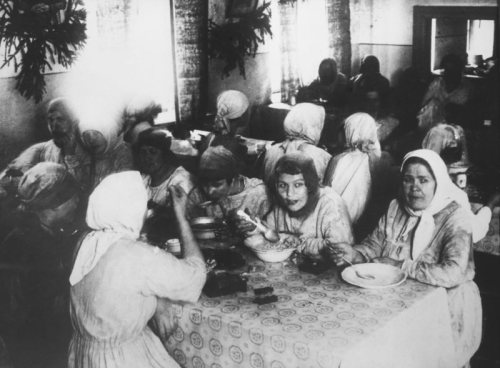
Women factory workers eating in a Soviet Union lunchroom in 1928.

image-1

Read Full Post »

refugee-moo-paw-with-vegetables
Photo: Sean Powers
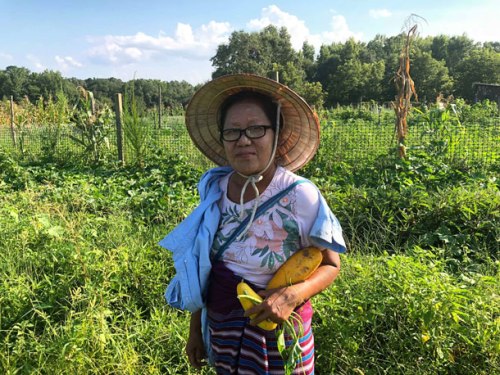
Karen refugee Moo Paw shows the vegetables she’s grown at the Neighbor’s Field in North Carolina.

I’m always interested in what Karen refugees from Myanmar (Burma) are doing as they adjust to new lives in the United States — especially as I know Mia, a Karen woman in one of the Rhode Island English classes where I volunteer.

At the radio show Living on Earth (LOE), there’s an interesting Karen farming story from producer Sean Powers of Georgia Public Broadcasting and the Bitter Southerner podcast.

“BOBBY BASCOMB [LOE managing producer]: The United States has long been a place for political refugees to seek safety and put down roots, in some cases literally. In Comer, Georgia, a community garden called the Neighbor’s Field is helping refugees work through their trauma by working the land. …

“POWERS: It’s a hot Saturday afternoon in Comer, Georgia. Moo Paw is feeding her chickens, hens, goats, and ducks. There’s even a donkey. You could say they’re kind of like her babies. She is one of the many refugees at the Neighbor’s Field, who fled violence and persecution in Myanmar. That’s the country formerly known as Burma. …

“She says Burmese soldiers kidnapped her father, and used him as a porter to carry food for them. After leaving Myanmar, Moo Paw lived in a refugee camp in Thailand before moving to the United States with her husband and children. They relocated to the Atlanta area, before settling here in Comer. Her son, Tahay Than, says moving to Comer was to satisfy Moo Paw’s green thumb.

“TAHAY: My mom, where she lived in Burma or Thailand, she always liked to plant. You know, working the farm. So, when she farms, that makes her feel like she is home or something, like in a home country, mother country or something. So that’s why she moved to Comer. …

“PAW: My garden. Here vegetables. Here grass. Me planted the cucumbers this year. Here sweet potato. Very beautiful.

“POWERS: It’s that beauty that takes Moo Paw back to memories of her family. She and her son Tahay say in Myanmar, farming for their family was a way of life.

“PAW: My grandmother planted rice, peanuts. Chili, corn.

“TAHAY: Most of the time, everybody who lived in Burma, they would plant in order to survive.

“POWERS: And that makes this garden all the more meaningful. The vegetables growing here, they don’t look like your typical produce that you would find at most supermarkets in the United States. That’s because the seeds come from Myanmar and Thailand. …

“POWERS: The flavors growing in Moo Paw’s soil are just a small part of the pie. There are two-dozen plots of land at the Neighbor’s Field that are being rented by refugees from Myanmar. For a large plot, it’s a hundred dollars a year. Rebecca Smith [who versees the day-to-day operations at the Neighbor’s Field], says it’s been incredible to see how working the farm helps build community. …

“SMITH: They’re just amazing foragers, they can figure out how to cook everything and make it taste good, and it’s just stuff that we think are weeds. Like sometimes people will be out here just butchering a pig for a celebration or Moo Paw’s out here feeding her chickens and people in the garden and you just feel like you’re in a different world, not Comer, Georgia.”

More at Living on Earth, here. In North Carolina, too, there are Karen refugees working on farms. Read this at Transplanting Traditions.

Read Full Post »

img_5840_slide-ff1c3b28ab10fe2abcf7dd215aafd3846b326aee-s700-c85

Photo: Chris Livesay for NPR
A security guard blocks off the recording area outside the Violin Museum in Cremona, Italy, for a project to preserve every note of the Stradivarius violin.

When a whole town — or almost a whole town — gets on board to support an artistic project, the results can be impressive. I imagine that the key is to tap what matters to people. In this case, violins.

Christopher Livesay reported about the unusual preservation project at National Public Radio (NPR) in February.

“Inside the concert hall of the Violin Museum in Cremona, Italy, Antonio de Lorenzi plays the prelude from Bach’s Partita No. 3 on a Stradivarius violin. Cremona is the town where master luthier Antonio Stradivari crafted his storied instruments three centuries ago.

“But there’s no guarantee that his instrument’s inimitable sound will survive for centuries more, says Fausto Cacciatori, the museum’s chief conservator.

” ‘What will these instruments sound like in 200 years? I hope they can still be played,’ he says. ‘But you never know. All it takes is one unfortunate event. An earthquake, for instance. Think about what happened to so much art during World War II.’

“Cacciatori says Stradivarius instruments need a 21st century failsafe — and someone who understands music as well as technology to pull it off. Enter deejay Leonardo Tedeschi. …

“When he’s not spinning records, Tedeschi runs Audiozone, a northern Italian sound engineering firm. And he had an idea: ‘To bring the sound of Stradivari and make it accessible around the world,’ he says.

“The idea came to him in 2014, when he wanted to mix the analog sounds of Stradivarius violins in some of his own electronic recordings, but discovered the elements he needed were lacking. That’s when he reached out to the Violin Museum in Cremona, just a 45-minute drive from his native Piacenza, with a proposal.

“First, they would need to record Stradivarius instruments, and while they were at it, those of other master luthiers. Then they would have to save the recordings in a database that future composers could use to make their own music electronically.

“The Violin Museum, which was already concerned about preserving these sounds for future generations, agreed. … They would have to painstakingly record every possible note that can be played on each instrument.

” ‘Every possible note, and even more difficult, every note transition,’ explains Tedeschi. ‘From one note to all the other ones in the same string.’ …

“In the concert hall, Lorenzi, who is with the Italian Symphony Orchestra and has performed in the world’s top concert halls, plucks the notes C, D, E, F, G, A, B and C — ‘do, re, mi, fa, sol, la, ti, do’ — on the Stradivarius violin. Then down the scale, until the engineers say they’ve got it. …

“He says, ‘It takes a lot of mental and physical concentration. It’s one of the most demanding things I’ve ever done.’

“But that meditative concentration is hard-won. Outside the museum, Tedeschi points out the thorn in his side.

“A rumble passes as a woman drags a suitcase across cobblestones. Then, the hiss of a street-sweeper machine. It’s what you’d expect in a city of 70,000 people, with a bustling open-air market and a population of typically boisterous Italians. …

” ‘Every time we hear this sound, the sound will mix with the frequency of our instruments, so we cannot use that sound in our product,’ Tedeschi laments.

“At the end of December, just before recording was set to begin, he went to the mayor of Cremona, Gianluca Galimberti, and asked for help. … The mayor asked the people of Cremona to please keep it down, and blocked traffic around the concert hall during recordings from Jan. 7 to Feb. 9.”

Did it work? Read more here.

Read Full Post »

img_6977_custom-cc736ababb2851142350b8484394ed46b6ac9f94-s600-c85

Photo: Matthias Le Dall
Thanks in part to his original songwriting, singing, and guitar-playing, physics doctoral student Pramodh Senarath Yapa won this year’s “Dance Your PhD” contest.

This is such a creative idea: a “Dance Your Ph.D.” contest!

Just as almost any information can be compressed into a haiku, almost any abstract concept can be danced. That’s what my high school dance teacher said when she made us partner with classmates to choreograph scientific principles.  And when Page and I started to choreograph Lavoisier’s discovery of oxygen to the Firebird Suite, Miss Hinney reminded us that we had to give life to the concept, not do a historical reenactment. Hard but memorable.

That’s why I loved this story about dancing your PhD. Emma Bowman writes at National Public Radio (NPR), “Pramodh Senarath Yapa, a physicist currently pursuing his doctorate at the University of Alberta in Edmonton, Canada, has been named the 2018 winner of the ‘Dance Your PhD’ contest.

“The competition, sponsored by the American Association for the Advancement of Science (AAAS) and Science magazine, invites doctoral students and Ph.D. recipients to translate their research into an interpretive dance. The winner takes home $1,000.

“It took Senarath Yapa six weeks to choreograph and write the songs for ‘Superconductivity: The Musical!’ — a three-act swing dance depicting the social lives of electrons. The video is based on his master’s thesis, which he completed while pursuing his degree at the University of Victoria in Canada.

“The 11-minute sing-songy rendition is far less paralyzing than the jargony title of Senarath Yapa’s thesis alone: ‘Non-Local Electrodynamics of Superconducting Wires: Implications for Flux Noise and Inductance.’

” ‘Superconductivity relies on lone electrons pairing up when cooled below a certain temperature,’ Senarath Yapa told Science. ‘Once I began to think of electrons as unsociable people who suddenly become joyful once paired up, imagining them as dancers was a no-brainer!’ …

“John Bohannon, a former contributing correspondent for Science, founded the contest, now in its 11th year. It all started at a party one New Year’s Eve that was heavy on scientist attendees and light on the dancing. ‘I tapped into their competitive spirit,’ Bohannon tells NPR’s Scott Simon. …

” ‘I think in general, they’re exhibitionists. If you’re willing to stand up and defend some crazy obscure research topic that you’ve devoted your life to then there’s probably something in you that wants to dance.’ ”

More at NPR, here.

Read Full Post »

« Newer Posts - Older Posts »