Feeds:
Posts
Comments

Archive for May, 2023

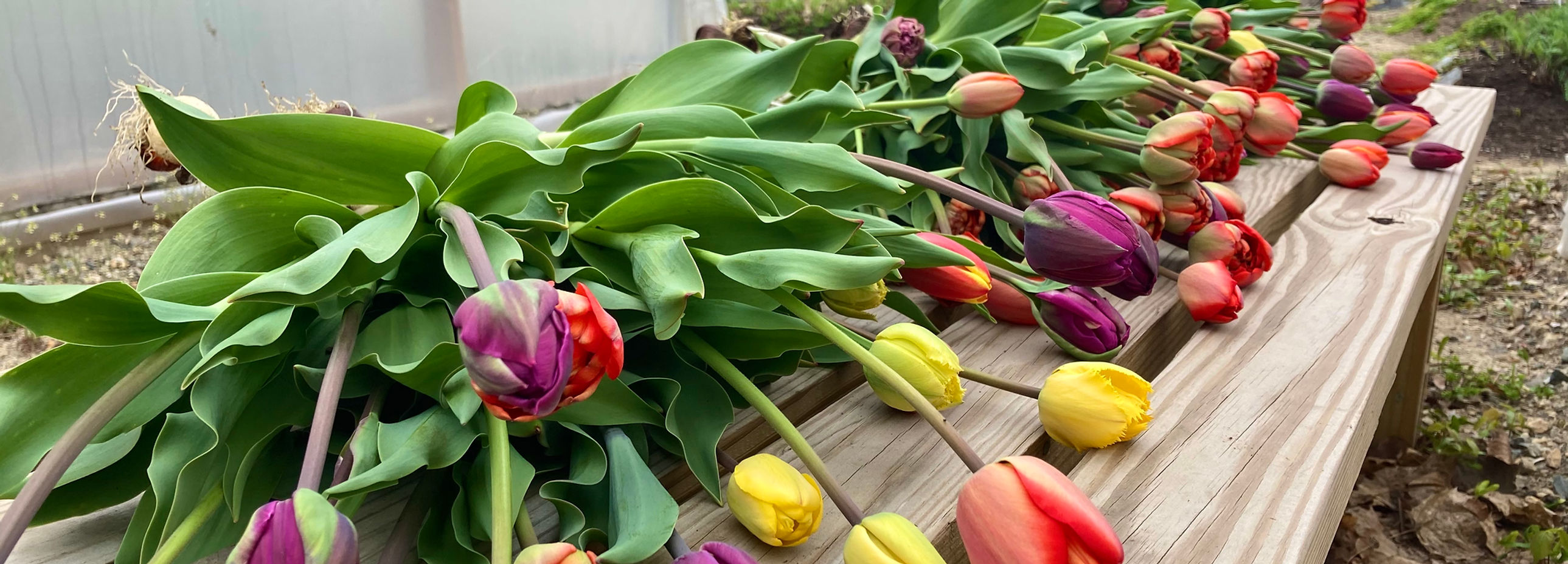
Photo: What Cheer Flower Farm.

Today’s story shows, among other things, that if you pick a really good name, you’re halfway to your goal. Who wouldn’t be drawn to a charity with a name like What Cheer Flower Farm?

And wait till you hear what it does! Frank Carini’s ecoRI News story was originally reported in 2018.

“The place was a complete mess, but a trio of determined women was going to buy it anyway, as soon as the seller removed about 50 tattered mattresses from the dilapidated building.

“The 2.7-acre property was covered with wind-blown trash. More than a year later, the three women are still picking up broken glass. … They ripped up poison ivy by gloved hand, and brought in a tractor to help tear down the overgrowth. The empty factory with a brick facade, largely vacant since the 1990s, has no running water or electricity, is covered in graffiti, has been the victim of arson, and has been gutted of all scrap metal.

“ ‘The property was neglected for years,’ said Shelby Doggett, who, at 25, is the youngest of the three buyers.

“The women, Doggett, her mother, Marian Purviance, and Anne Holland, bought the derelict property for $525,000, so they could give away flowers.

What Cheer Flower Farm was incorporated [in October 2017] and it acquired the former site of the Colonial Knife Co., forgotten industrial land in the heart of the city’s Olneyville neighborhood, not far from Route 6, this spring.

“After the sale became final, the first two essential items the women had delivered were a port-a-potty and a truckload of compost.

“This new urban farm, at 46 Atwood St., only began its growing season two months ago. The seeds were planted late in the season because there was plenty of other work to do first. For one, the property was covered in pavement.

“Some 4,000 square feet of parking lot was torn up and transformed into an organic raised-bed ‘field’ of flowers, both perennial and annual. Purviance, the farm’s horticultural director, has years of garden cultivation and management experience.

“ ‘I worked in the fine-gardening business for a long time, and I worked for very high-end clients. A lot of them really didn’t even appreciate what it was to have a garden and how much a flower really means,’ said Purviance, 57, a 30-year resident of Providence.

‘I get so much more satisfaction out of working on this project than I did working for people who take that for granted.’

“The nonprofit flower farm with two full-time farmers — Purviance and Doggett, who as the program director also handles the administrative side of things; Holland is the communications manger — and with support from volunteers, grows organic flowers on a brownfield site.

“They give their product away to ‘people who deserve flowers but don’t have access,’ Purviance said.

“To supply those people who deserve flowers, What Cheer Flower Farm has partnered with Amos House, the Ronald McDonald House of Providence, and Meals on Wheels of Rhode Island. The women deliver bouquets and buckets of cut flowers to these institutions and other partners.

“About 90 percent of the flowers currently being grown at the farm were started from seed by Purviance in her kitchen and in a friend’s basement. The rest of the plants were donated by Green Animals Topiary Garden in Portsmouth. …

“Besides brightening people’s lives with free flowers — 1,000 have so far been donated — the nonprofit’s mission also includes reversing urban blight, creating a job training center for Rhode Island residents to help them enter the state’s $2.5 billion ‘green’ economy, and making Providence famous for urban flower farming.

“Chicken manure from Scratch Farm and horse manure from a gentleman farmer in Rehoboth, Mass., have been used to build soil. … The farm rents a meter from Providence Water, which allows it to use a fire hydrant for watering. The water is stored in donated tanks of various sizes.

“Where the dilapidated building now stands, the co-founders envision a barn, classroom space, an office, and space for lease. …

“What Cheer Flower Farm has applied for a brownfield remediation grant with the Rhode Island Department of Environmental Management. An ongoing inventory assessment didn’t find elevated levels of polychlorinated biphenyls (PCBs). The owners have worked with the National Resources Conservation Service and David Foss of Wilcox & Barton Inc., a Vermont-based environmental consulting firm.

“The property is in better toxic shape than the new owners predicted, but there’s still much work to be done. Much of that work will revolve around fundraising. As a 501(c)(3), the organization will rely on grants, donations, volunteers, and kindness. They also plan to host fee-based workshops for hobby gardeners and amateurs.”

From the farm’s website: “Our staff are busy working on growing, rescuing and giving away flowers. You can visit as a volunteer, or as an artist who wants to work outside en plain air or as a group seeking a tour. …

“What Cheer Flower Farm is a nonprofit dedicated to bringing solace, joy and healing to the people of Rhode Island via flowers as well as supporting our local floral economy via job training.

“We grow, rescue and give away 100,000 flowers per year and are on track to expand to giving away 300,000 flowers per year in the next five years. We never sell flowers – all are given away freely via our network of local nonprofits and organizations serving Rhode Islanders including hospitals, senior services, recovery centers, shelters, hospices and food pantries. …

  ” 2022 Achievements

  • “92,000 flowers grown, rescued and given away
  • “$50,000 grant won from United Way/Social Enterprise Greenhouse
  • “Relaunched Flower Festival named ‘The Best Thing to Do in RI’ by The Boston Globe.”

More at ecoRI News, here. No firewall.

Read Full Post »

Photo: Wikimedia.
Devastation on the island nation Vanuatu (near Australia) after Cyclone Pam in March 2015. Vanuatu is one of the countries most vulnerable to climate change. Already this year it was hit by two Category 4 cyclones, blamed on global warming.

Today’s story by Michael Birnbaum at the Washington Post could be subtitled The Mouse That Roared. That’s because a tiny nation vulnerable to climate change is pushing the world’s highest court to take a stand.

“The small Pacific island nation of Vanuatu won a major victory to advance international climate law [in March] after it persuaded the U.N. General Assembly to ask the world’s highest international court to rule on the obligations of countries to address climate change.

“The request for an advisory ruling from the International Court of Justice is expected to clarify the legal obligations of countries to address climate change — and to create a path for them to be sued if they fail to do so. The U.N. effort was a significant outcome for Vanuatu, an archipelago nation of 320,000 people that is suffering from climate-change-driven natural disasters. In recent weeks, it was hit by two Category 4 cyclones, the severity of which its leaders blamed on global warming. Thousands of people are still living in shelters.

“The country has used its moral authority and ability to stage action at the United Nations to achieve outsize results on climate issues. The U.N. General Assembly approved the measure by acclamation, with neither the United States nor China standing in the way of the effort despite uncertainty in advance whether they would seek a formal up-or-down vote.

“[The] decision was also a measure of how much global attitudes about the urgency of addressing climate change have shifted in recent years. A similar effort in 2011 by two other island nations, Palau and the Marshall Islands, failed at the United Nations. This time, Vanuatu obtained co-sponsorship from more than 120 countries, including Britain, France, Germany and other industrialized nations with a long history of high emissions.

“ ‘It is a matter of basic survival for us,’ Vanuatu Climate Change Minister Ralph Regenvanu said in an interview.

‘We can’t do anything economically and politically because we don’t have any power. What we can use is our sovereignty as a United Nations member state.’ …

“Having the International Court of Justice weigh in creates a ‘pretty clear pathway to recognizing that states have a duty not only not to violate fundamental human rights, but states have a duty to avoid transboundary harm through activities under their control,’ said Carroll Muffett, president of the Center for International Environmental Law, a D.C.-based nonprofit that works to use international law to address ecological issues.

“He compared an advisory ruling to consulting a lawyer while being engaged in behavior that falls in a legal gray zone.

“ ‘It’s like when you send a note to your lawyer, and you get a lawyer’s note back saying what you’re doing is illegal,’ he said. ‘It puts you on notice that you could be held accountable for your actions.’ …

“As Vanuatu gained support for the U.N. action, it was careful to try to build consensus, with its leaders saying they are not suing anyone nor seeking to create new international obligations. Instead, they say, they are seeking to clarify how preexisting international agreements apply to climate change. …

“Neither the United States, which is the world’s largest historical emitter, nor China — which is soon poised to overtake the United States on that count — opposed the measure. The two superpowers have been competing for influence among Pacific island nations as they seek to project power across that ocean, giving the small countries outsize leverage despite their minuscule economies and populations.

“But even as the United States stood aside and allowed the referral to be approved without objection, a U.S. diplomat also said the Biden administration believes diplomacy is a better way to achieve action on climate issues than inside a courtroom.

” ‘Launching a judicial process, especially given the broad scope of the questions, will likely accentuate disagreements and not be conducive to advancing our ongoing diplomatic and other processes. In light of these concerns, the United States disagrees that this initiative is the best approach for achieving our shared goals,’ diplomat Nicholas Hill told the General Assembly after the measure was approved, speaking on behalf of the State Department.

“Vanuatu’s policymakers said they had tried to craft their work in a way that would win broad acceptance.

“ ‘We have deliberately tried to make this as noncontentious as possible,’ Regenvanu said. ‘Once we get the question before the court, then the process of submissions begins, and there might be a slight change of tactic there. Because obviously we want the highest level ambition in that opinion.’

“The effort began four years ago in a classroom at the University of the South Pacific in Fiji. Law students there decided that an advisory opinion from the International Court of Justice could be an effective tool to advance climate justice. They worked to convince their governments to follow suit.

“Vanuatu has also promoted a global fossil fuel nonproliferation treaty, advocating a total phaseout of oil, coal and gas as quickly as possible. And it has been a leader on international efforts to create a system to compensate the worst-hit countries for ‘loss and damage’ from climate change.”

More at the Post, here.

Read Full Post »

Photo: Luana Rigolli/T293 Gallery).
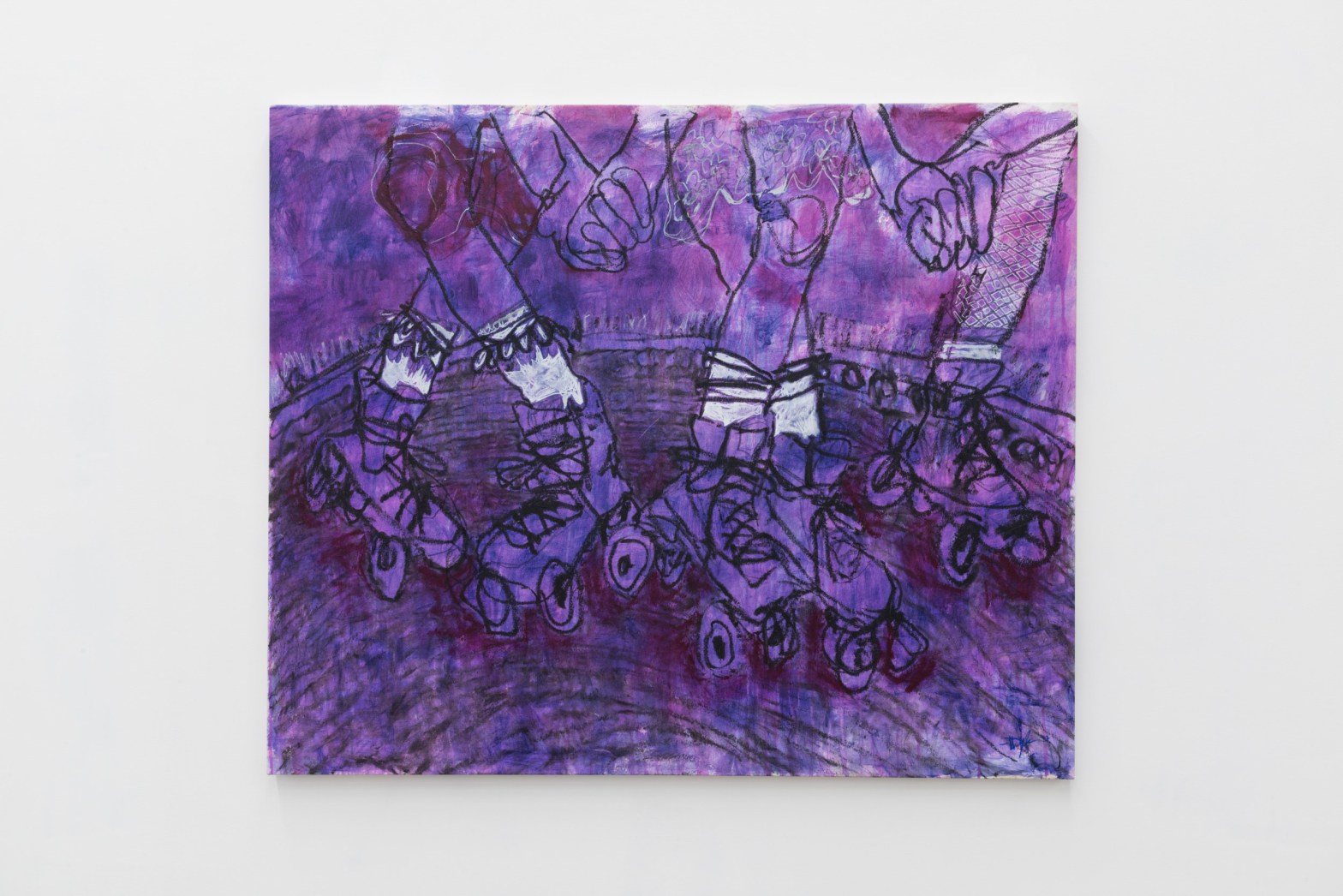
Art by Dylan Rose Rheingold, “Hot Skates” (2022), oil, acrylic, paint pen on canvas. Although growing numbers of artists question the value of signing their works, Rheingold is one who has chosen to sign.

When my mother died, there were decisions to be made about several works by our neighbor, the Abstract Expressionist Richard Pousette-Dart. For most of his career he rebelled against the custom of signing work. But toward the end of his life, he came around to the idea that in the art market, his family and friends needed to have his signature. He offered to sign our paintings. We sold some and kept some. The photographs and brass jewelry were never signed.

Anoushka Bhalla wrote recently at Hyperallergic that the issue of signing keeps coming back in the art world.

“It all began during the early Renaissance when a young Raphael Santi forwent the long-held tradition of co-operative art making under guild systems to autograph his first painting, ‘The Mystical Marriage of St. Catherine.’

“While Raphael was modest in breaking long-established customs, obscuring his signature within decorations behind a Virgin Mary figure, his male successors centuries down the line would not remain as bashful. The signatures of Picasso and Keith Haring are far more familiar than that of, say, Helen Frankenthaler. …

“Signed artworks by male artists fetch astounding prices in the secondary market as compared to their female counterparts. A recent study states that ‘For every £1 a male artist earns for his work, a woman earns a mere 10p.’ The same study also states that ‘while the value of a work by a man rises if he has signed it, the value of a work by a woman falls if she has signed it, as if it has somehow been tainted by her gender.’ Female artists have long been conscious of this gender disparity, with some feeling paralyzed against the market and choosing to forgo their signatures to make their works more ‘collectible.’ Are these artists signing away their autonomy too?

“I spoke to Baseera Khan about these troubling statistics. A femme artist of color, they were the subject of a solo exhibition at the Brooklyn Museum in 2021. ‘No, I don’t sign my works. I think it’s an old tradition,’ they declare. ‘I don’t think I’m valued because of my gender, because I’m a femme artist, quite not as much as the male artists — and that’s a fight.’ …

“Artists Julie Torres and Ellen Letcher, who operate LABspace, an artist-run gallery in Hillsdale, New York, often find themselves in awkward positions, having to ward off collectors who demand signatures from their artists and sometimes even return works for them to be signed. But for others, like Lucia Hierro, whose work was recently acquired by the Guggenheim Museum, and who often does not sign her pieces, says she will stand her ground. There is a finality to signatures, she says, which she dislikes.

“[Although Xayvier Haughton] makes art that is difficult to collect, he feels defenseless in the face of powerful collectors who make sure to somehow obtain his signature before acquisition. He acknowledges this as a conscious decision on his part. Installations are notoriously difficult to collect, and that in itself is an anti-market statement. … While Haughton wants to adhere to his principles, he doesn’t want to be blacklisted in the art world — which he feels is the fate of artists who defy the desires of collectors. In this fickle art-world bubble, he’s attempting to hold onto his autonomy by forgoing his signature.

“But some disagree with this sentiment. Bhasha Chakrabarti, also an emerging artist, who works in painting, sculptures and installations, is a skeptic. ‘I find the idea of making installation with the motivation of evading the market to be disingenuous…. If you make art and are functioning within the gallery system, you’re not evading the art world,’ even though, she adds, she feels suspicious of the art world’s deep stake in capitalism. When I mention the Eurocentric history of asserting ownership via signatures on artwork, she counters, citing Sufi mystic poets who claimed authorship after each recital. …

“Artist Chiffon Thomas approaches the dilemma more philosophically. Thomas, whose solo show Staircase to the Rose Window was on view at PPOW Gallery in Tribeca last year. … Over time, he explains, he stopped signing his works and acquired an existential approach to art-making. He realized he wanted to capture a sense of universality in his art, to the extent that he grew uncomfortable using his childhood, his family, or any personal signifiers. …

“But perhaps the most compelling response comes from a young artist, Dylan Rose Rheingold. As more painters shy away from signing their works on the front of their canvases, Rheingold realizes this is an empowering act as a woman. Nevertheless, she will occasionally sign as ‘Dylan,’ a traditional male name, although she also uses the more feminine ‘Dylan Rose,’ and lately she is using her full name, Dylan Rose Rheingold, boldly asserting ownership over her art.

“Her resolve strengthens when she explains passionately a recent encounter she had with a ‘big collector who owns a big gallery in New York. … When I met him, he told me that I should drop my middle name because my work would be a lot more valuable. People would not assume I’m a woman.’ She countered with ‘I’m happy to take my chances.’ ”

More at Hyperallergic, here. No firewall but memberships are encouraged.

Read Full Post »

Photo: Inquilinxs Unidxs Por Justicia (United Renters For Justice) via NextCity.
A collective of Minneapolis renters, now known as the Corcoran Five, were key to winning a landmark $18.5 million class-action settlement against their landlord. Not long after, in 2020, they signed a purchase agreement for the five buildings in question and began turning them into a tenant-run co-op.

Do the little guys ever win? They do if they organize. As Evicted author Matthew Desmond reminded readers at the New York Times, ” ‘The weapons of the weak are always weak weapons,’ the French historian Lucien Bianco once wrote. It’s true. Paper flowers, homemade noisemakers: it’s not much. … But you cannot deny that that was, and has always been, a true power in American life.” 

In his 2020 article, Desmond dug into one particular organizing success, beginning his story with a Minneapolis City Council meeting that took place in May of that year.

“Vanessa del Campo Chacón rose to speak. An immigrant from Veracruz, Mexico, who ran an in-home day care from her small apartment, Chacón spoke in Spanish, and a bearded young man knelt by her side and translated. This was Roberto de la Riva, co-director of Inquilinxs Unidxs por Justicia (United Renters for Justice), a tenants’ rights organization that also goes by the abbreviation IX. ‘I’m hours or days from being evicted, and I don’t think the city has deemed this pertinent enough to be involved and to take responsibility,’ Chacón said. ‘We want dignified homes,’ she continued. ‘I’m asking for my daughter and for all the families that are here.’ 

“As she spoke, two other tenants approached the dais and, standing behind the council members, unfurled a huge yellow banner that read, ‘Don’t Evict Vanessa.’

“ ‘I’m sorry,’ the council president, Lisa Bender, interjected. ‘We can’t allow people to come back behind the dais.’ … She was sympathetic to the tenants, but she also had a meeting to run. Before Bender could finish, the room erupted. …

“After a bailiff escorted the tenants off the dais, Vanessa’s neighbor, Chloé Jackson, approached the lectern, pressing her hands together as if in prayer. A Black woman with plastic-rimmed glasses, Jackson was raising her teenage son, Trayvon, on the $15.69-an-hour wage she earned at the airport iStore. ‘We don’t know exactly how long any of us have,’ Jackson said. … ‘You guys get to go home tonight, sleep in the comfort of your beds,’ she said. ‘We have to wonder about this every single night.’

“This was not the first time Jackson and IX organizers had confronted the City Council. For years, Jackson, Chacón and other residents of five buildings in the city’s Corcoran neighborhood had been involved in a prolonged battle against their landlord, Stephen Frenz, and his business partner, Spiros Zorbalas. The tenants had mobilized for better conditions, resisted evictions and participated in a rent strike. They had banded together and pushed the City Council to revoke Frenz’s rental license. It eventually did, stripping his ability to collect rent. But Frenz still owned the apartments where Jackson and Chacón lived. He wanted everybody out so he could renovate and sell to the highest bidder. The tenants had another idea: They wanted Frenz to sell to them.

“Today, in the pandemic economy, millions of renters are at risk of eviction. Even the expanded provisions supplied by the CARES Act — the $600-a-week supplements to states’ stingy unemployment insurance — weren’t doing enough to shield many renting families from homelessness. … Watching this looming eviction crisis take shape, I’ve often thought of those Minneapolis tenants, whom I followed over the last year and a half. I went to report on them — the security guards, store clerks and night-shift custodians — because I wanted to see what happened when a group of tenants organized against a pair of landlords who owned hundreds of apartments generating, as of 2016, a net operating income of approximately $300,000 a month (or $3.6 million annually). Over the course of my reporting, I saw the tenants reimagine — and then reinvent — what stable, affordable housing could look like in their community. I saw them fight,” wrote Desmond in the Times, “and I saw them win.”

The lengthy article goes on to describe key players. Jackson, for example, was not always an activist. Far from it. Desmond explains how it happened gradually.

“Near the end of 2017, Roberto de la Riva knocked on Chloé Jackson’s door on 22nd Avenue South. Jackson opened the door, sighed and asked, ‘Why do you people keep knocking?’

“Born and raised on the South Side of Chicago, Jackson moved to Minneapolis in 2013, after the Mall of America hired her in its housekeeping department. She was 28 and had an 8-year-old son. Three years earlier, she became the legal guardian of three teenagers, after their mother, Jackson’s aunt, died. She and her boyfriend kept food on the table — she worked at McDonald’s; he was a mechanic — until all three of her cousins were out of the house. By that time, she needed a break and figured a new city might do the trick.

“In Minneapolis, she found a $625-a-month, one-bedroom apartment in the Corcoran neighborhood, within walking distance of the Lake Street light-rail stop. Giving her son the bedroom, Jackson slept in the living room by a pinkish-orange salt lamp and an 8-by-10-inch photograph of her mother. Jackson took a series of jobs, finally landing at the airport iStore, where she was working full time when de la Riva knocked on her door. As its assistant manager, Jackson woke up at 2:30 each morning; got breakfast ready for her son; fed her cat, Kitty; and hopped on the light rail to the airport, arriving at 3:40 a.m. to open the store.

“When Jackson first moved in, she found her landlord, Stephen Frenz, to be fairly responsive. But seeing the condition of the units inhabited by her neighbors, many of them undocumented immigrants, changed her perspective. Jackson often pulled out a bucket or two to catch the leaks. But to sit at a neighbor’s table for coffee, she often had to step over some half-dozen buckets. Many units had roaches and mice, filthy carpets. (Frenz told me that Jackson’s leak and those of other tenants were mended and that tenants’ lack of cleanliness caused the pest infestations.) ‘I felt so bad,’ Jackson remembered. ‘These are people who didn’t know English, and I felt like this man was taking advantage of them.’ …

“Jackson began warming to the idea of buying the properties. She had long tried to avoid this path, hoping to live a quiet life. But haltingly at first, then all at once, Jackson was becoming, as they say in the movement, ‘politicized.’ “

I can’t cover the whole Times article here, but I recommend anything Matthew Desmond writes. I do want to share this part this part of the story for Mother’s Day: “On May 18, Jackson was sitting in her apartment, on a Zoom call with other IX organizers. In the middle of their meeting, several organizers received a simple text from Eddie Landenberger of Land Bank Twin Cities. It read: ‘We closed.’ Landenberger’s text let everyone know that they had finally done it. They had bought the Corcoran Five.

“The tenants yelled and whooped. …

“ ‘Why’s everyone screaming?’ Jackson’s son, Trayvon, asked, coming out of his bedroom. He was 16 now, handsome and half a foot taller than Jackson.

“ ‘Son, come here,’ she said. ‘We closed on the buildings.’

“ ‘Oh, Mom,’ he said, reaching out in embrace. ‘I’m so proud of you.’ ”

The Times article is here. For a version of the story without a firewall, see reporter Cinnamon Janzer at NextCity, here.

Read Full Post »

Lady Slippers in the wild will soon turn pink.

A real New England spring is tender, touching. The seasonal changes are not always dramatic or photogenic. I would have liked to share with you, for example, the carpets of tiny, blue forget-me-nots I saw all along the edge of a field yesterday, but my phone camera is not sensitive enough. In a photo, they would look like an undifferentiated smear of white.

Still, there is plenty to show, and I hope it’s all welcome, especially to those in the South who are already wilting in the heat of summer.

I found the Lady Slippers along a woodland trail. They will soon turn pink.

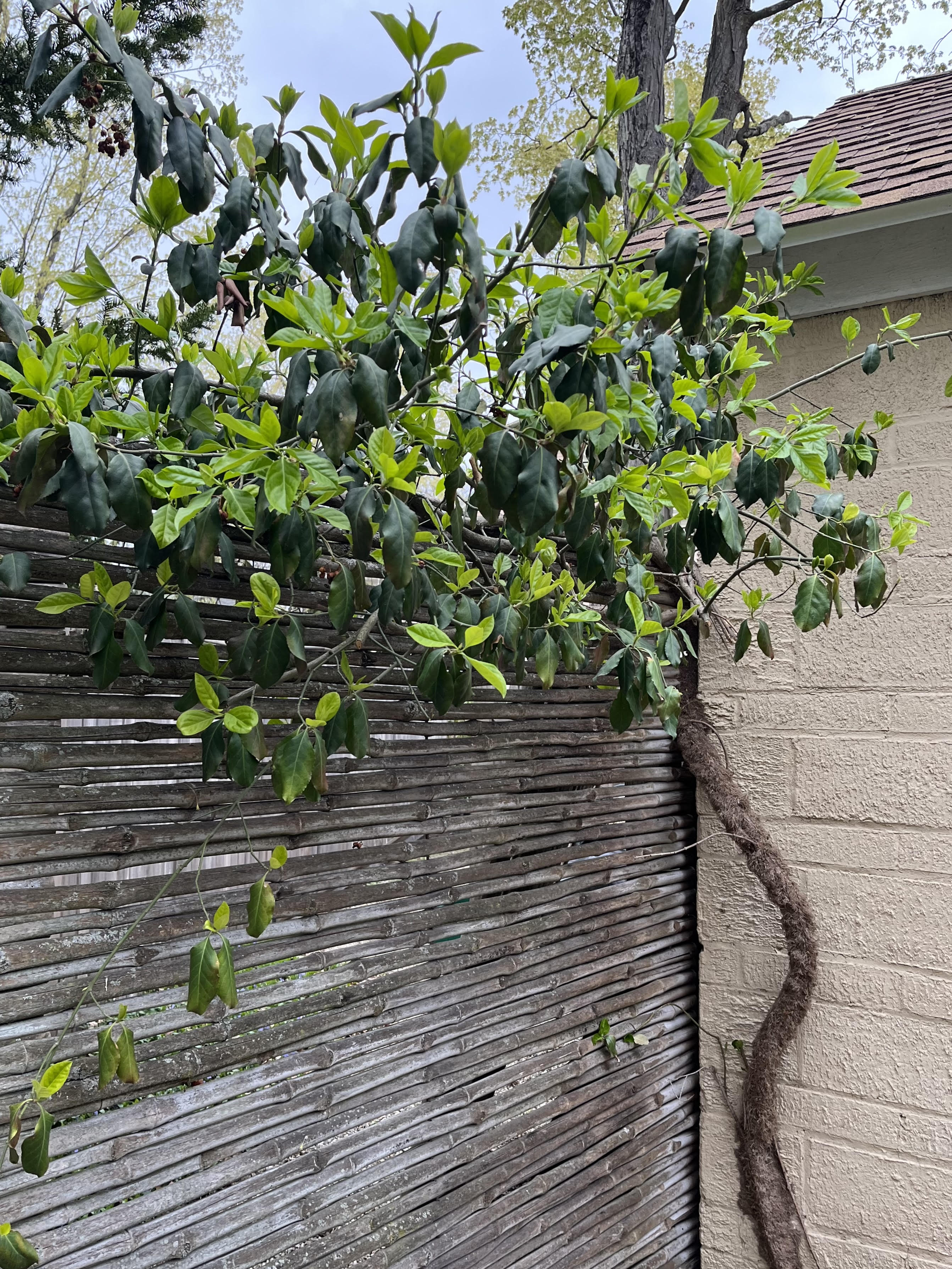
I liked the way the euonymus below spoke of new and old growing along together.

Wish I could share how wonderful those lilacs smell — or the fragrance everywhere of little lilies-of the-valley.

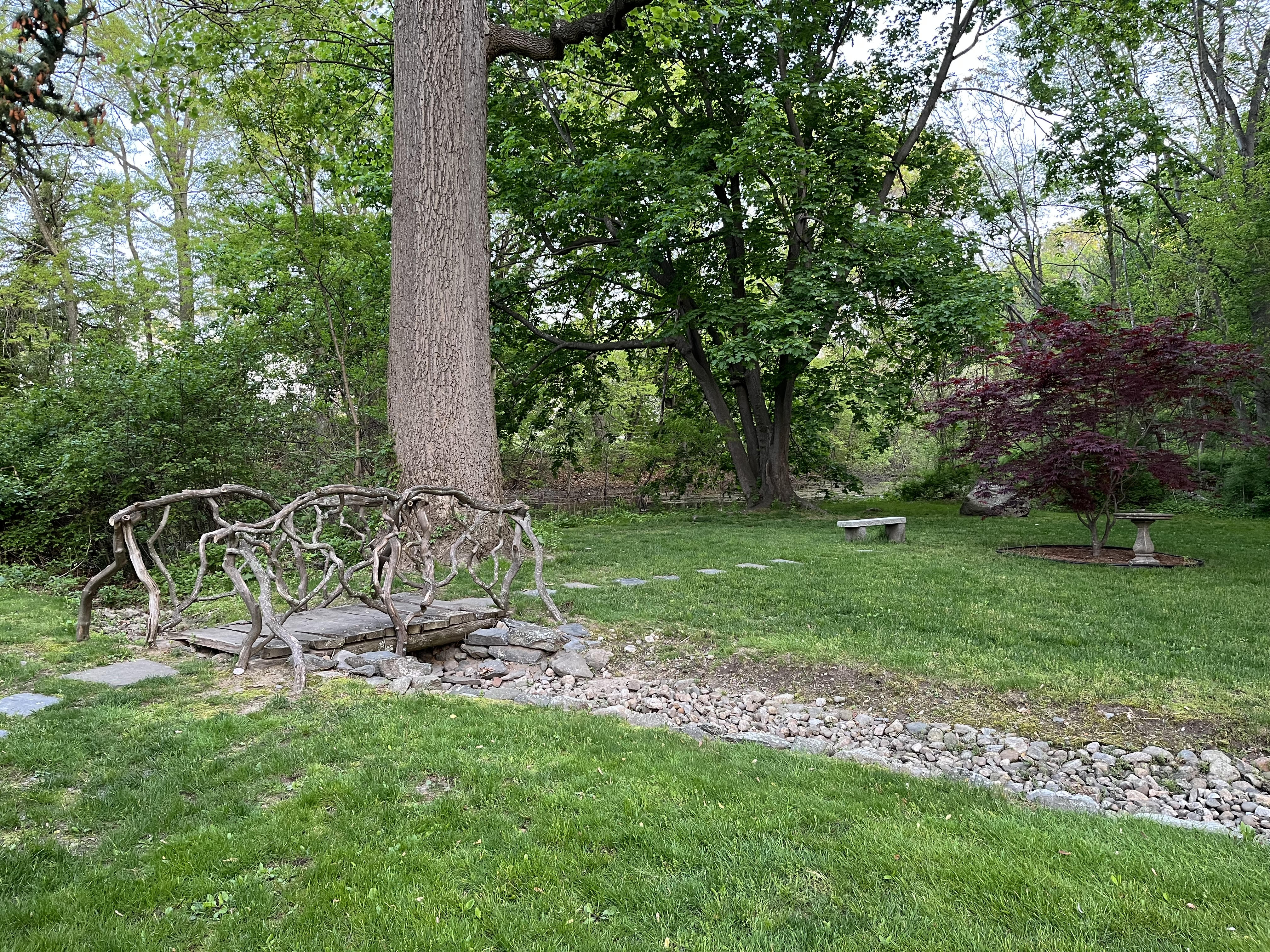
The quirky fairy bridge on the campus of Butler Hospital in Providence reminded me of similar ones in New York’s Central Park that filled me with delight during that sad year I was visiting my ailing sister.

In the next photo, I wanted to capture how tired that old wheel looked in the energetic sunshine.

I liked how the stone wall nurtures its floral decorations.

Erik finished the tree house — a triumph of his and a small child’s imagination and will.

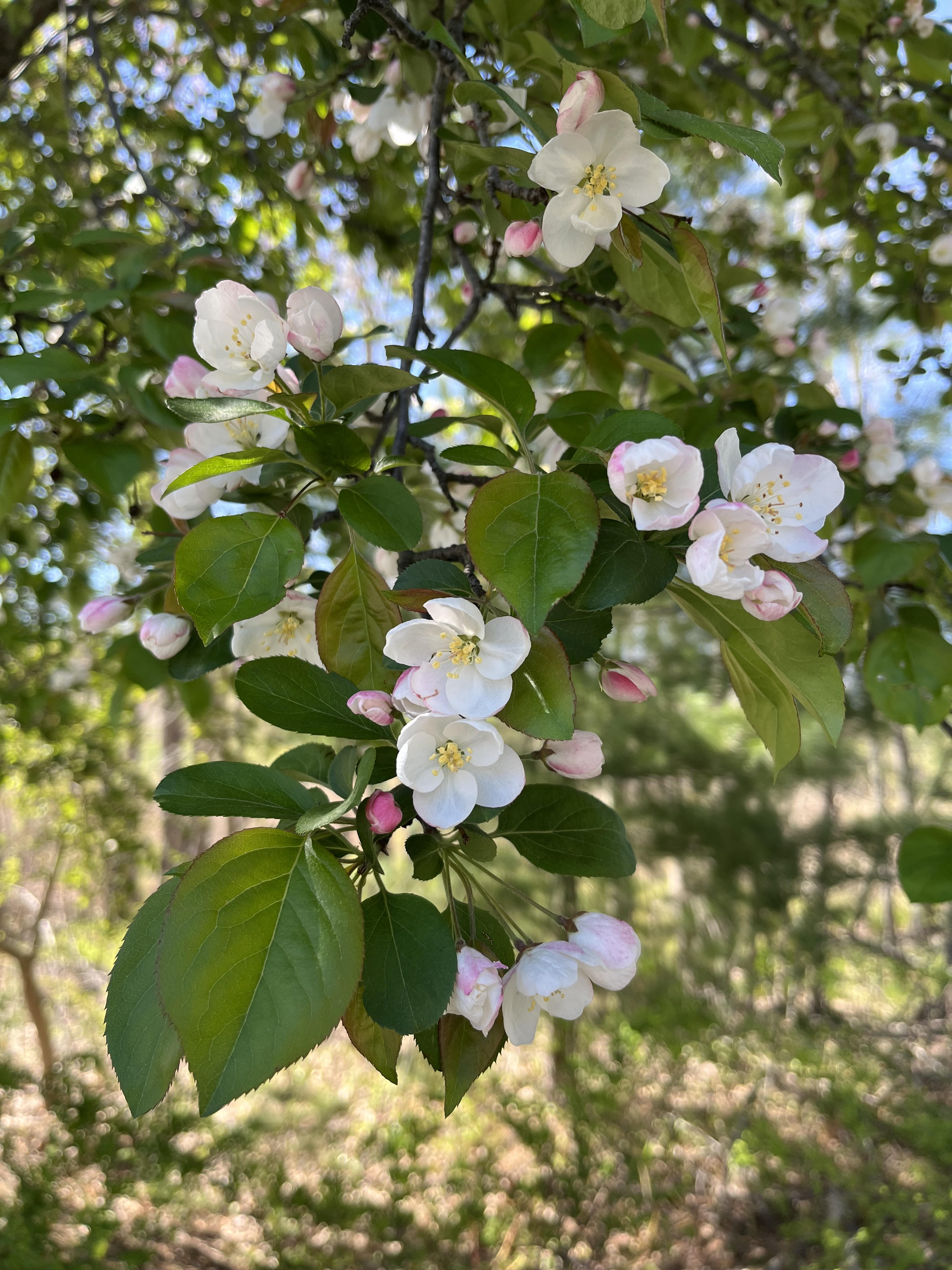
After the crabapple blossoms come a couple of the signs I can never resist, including one honoring a local Korean War hero, featured in the recent film Devotion.

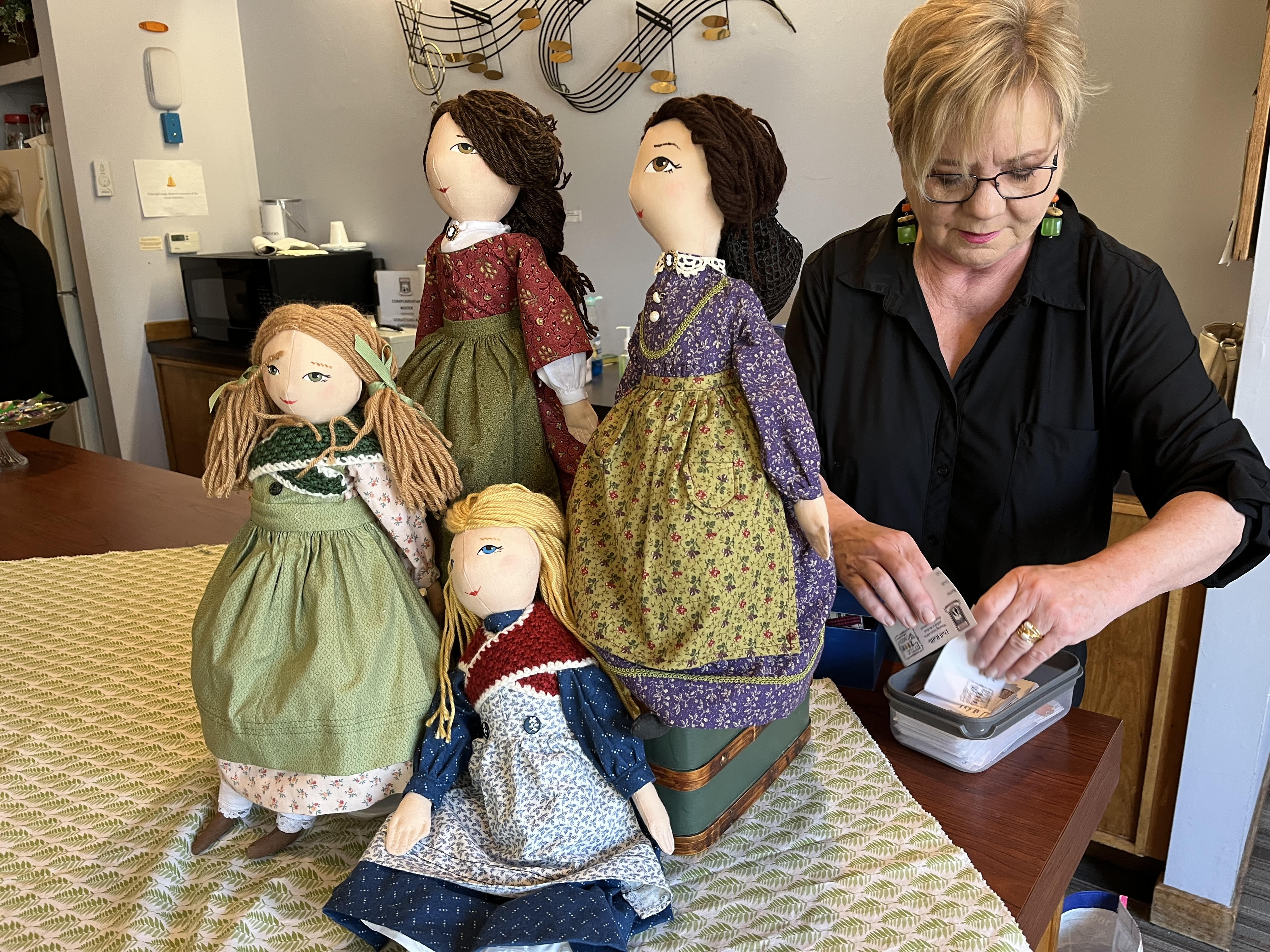
The talented costume designers for the decennial production of Little Women honored a local author with dolls featuring the main characters in her book. A lucky theatergoer with the right ticket number got the dolls after the show.

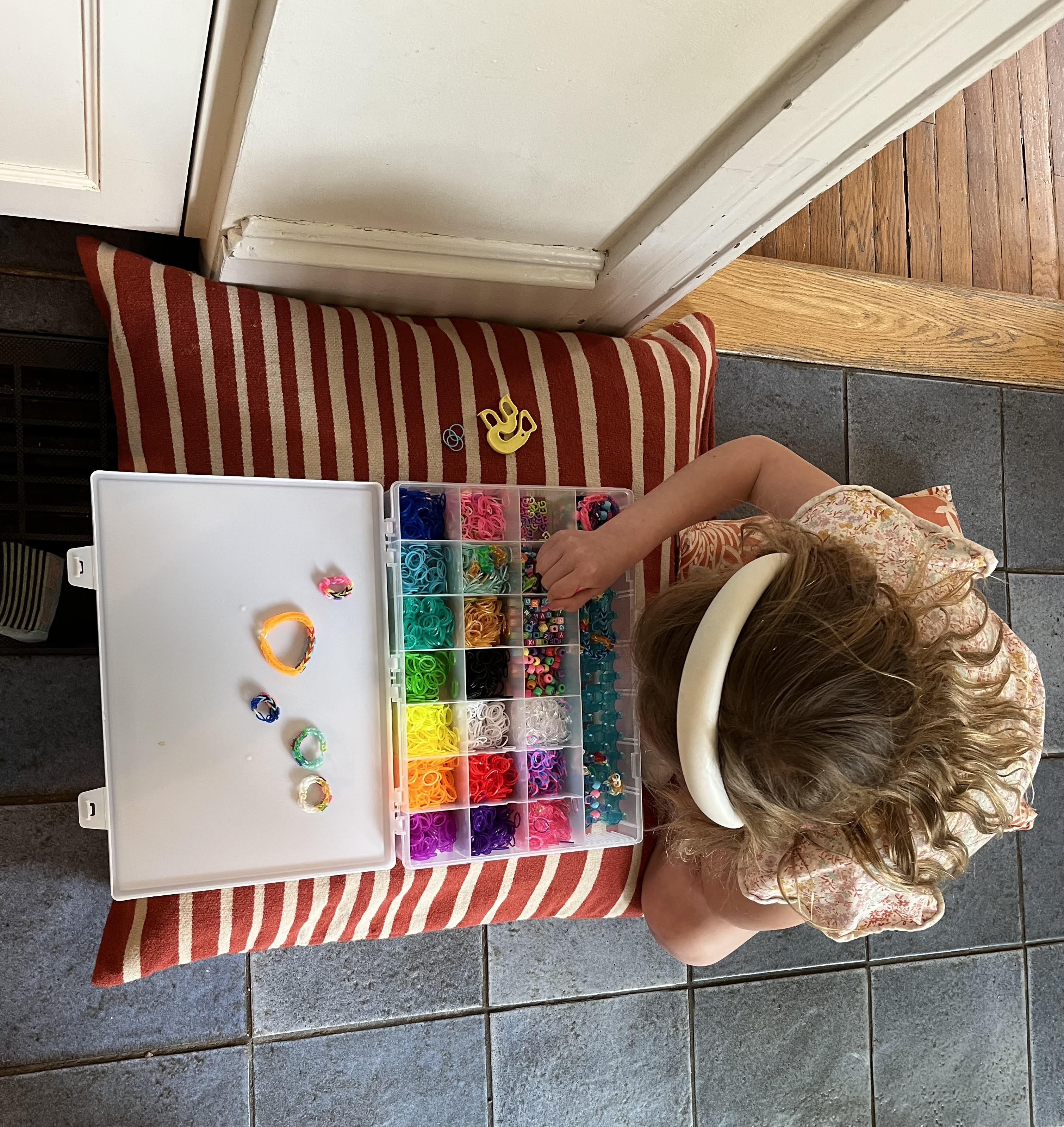
A little crafter is oblivious to all on a sunny spring day.

Read Full Post »

Singer sewing machine just like the one I sold to woman in Oklahoma years ago.

A nice thing happened to me recently. I got a phone call out of the blue from a woman in Oklahoma who had bought my old sewing machine on eBay years ago and kept my contact information. A real surprise.

She responded to my recorded message as if she were talking to me in person. “Yes, Ma’am. This is Margie M—. I had bought a sewing machine around 2014, I’m not sure. But anyway I was just wondering about it. I love the machine and wish I’d a called sooner. [She give her number.] Thank you and have a blessed day.”

I called her back. She was utterly charming. She said she’d wondered if the seller of the machine was even still alive, and she wished she’d called sooner. She’d had a number of sewing machines, but mine was the best. She said either I took very good care of it or I didn’t use it much. (I didn’t use it much.)

We talked a little about what was going on in her life, about ailing family members and how she was caring for them. At the end she wished me a blessed day again.

I think the experience of chatting with someone like Margie, a stranger with a very different life in a very different part of America, made it a blessed day, all right.

Read Full Post »

Photo: Brett Seymour.
A trove of spices was found in the stern of the ship by Brendan Foley and a team of archaeologists. It had been there for centuries.

For those of us who hope that one day the lost island of Atlantis will be found, any story about underwater discoveries of ancient artifacts is thrilling.

Line Sidonie Talla Mafotsing writes at Atlas Obscura, “Built 1485, the Danish warship Gribshunden served as the flagship and mobile seat of government for King Hans of Denmark and Norway. In the summer of 1495, Hans set sail for Kalmar, Sweden, where he was set to negotiate with Swedish leader Sten Sture the Elder. The goal of the mission was to convince Sten Sture and the Swedish council to give up their sovereignty and rejoin the Kalmar Union, which had unified much of Scandinavia under a single ruler (and which Sweden had left a few decades before, despite the union being named for a Swedish town).

“The ship itself had a role to play: to show Hans’s authority to the Swedish council. It was also laden with goods — from gunpowder weapons to artwork to delicacies — to demonstrate his power.

“However, while anchored in the Baltic Sea near the port of Ronneby, Sweden, Gribshunden mysteriously caught fire. Though the king wasn’t on board at the time, many crewmen were, in addition to all those pricey goods. Although the exact number of deaths is unknown, many of the crew of 150 were on board when the ship sank to the bottom of the Baltic with its precious cargo. …

“In the 1970s, a local diving club came across a mysterious wooden wreck there, in 33 feet of water. It wasn’t until 2001 that the first archaeological excavations of the ship began, after one of the divers told local archaeologists about what they had found. It was another decade before the remains were identified as those of Gribshunden. All through the excavation of the wreck, remarkably preserved by the cold waters of the Baltic, amazing and sometimes odd artifacts have emerged and attracted media attention. In 2015, there was a nearly perfectly preserved wooden ‘sea monster’ figurehead. In 2019, archaeologists discovered a well-preserved rare Atlantic sturgeon. Further excavations in 2021 revealed something even more remarkable: a treasure trove of spices, plant material, fruits, nuts, and cereals, that somehow survived underwater for more than 500 years.

“In a study published in the journal PLoS ONE, Brendan Foley and Mikael Larsson, archaeologists at Lund University in Sweden, examined the finds for new insights into how nobility lived and ate during the Middle Ages, and shed light on how these organic materials survived so long underwater.

“Foley and a team had been excavating the stern when they made the finds. ‘We think, but we’re not sure, that the back part of the ship is probably where the highest ranking individuals were situated,’ says Foley. They sifted through the sand and silt and revealed almond shells and peppercorns. They recovered thin strands of saffron by hand. ‘We took four samples of botanical assemblage that included both local and exotic spices, fruits, and vegetables,’ says Larsson, including black mustard, dill, clove, ginger, cucumber, grape, and berries such as blackberry and raspberry. ‘The botanical remains that really stand out are the exotic spices,’ he says. Clove, ginger, and saffron had never been found before in the medieval Baltic.

Larsson says that their work is the first anywhere in the world to find saffron in such a setting. …

“Though the geographical origins of saffron are not completely understood, it is thought to have originated in the eastern Mediterranean, and been grown in Southwest Asia and the Mediterranean basin. Ginger is believed to have originated in Southeast Asia, and cloves are native to Indonesia. Black pepper comes from South India. Despite this time being known as the ‘Dark Ages’ in Europe, the finds show that Scandinavia wasn’t just a backwater of the world economy. …

“[One] question focuses on how these delicate organic remains were able to survive in the Baltic. ‘It’s a mystery,’ says Foley. ‘We don’t know, we didn’t find any containers.’ When they found the saffron, it was just in a lump in the sediment. ‘No glass jar around it, no ceramic jar, no wooden box, no silver box,’ he says. It may have been stored in some sort of fine textile bag that disintegrated over the years—but somehow the spice remained.

“ ‘The Baltic Sea is really weird,’ Foley says. For one, it has the lowest salinity found in the global oceans. This, combined with low temperatures and low dissolved oxygen to feed microbes, have given the Baltic a reputation for remarkable preservation of archaeological material, specifically wooden shipwrecks.”

More at Atlas Obscura, here. No firewall.

Read Full Post »

Photo: Daguerre Val de Loire via the Guardian.
The family thought their painting was a fake, but it turned out to be an authentic work by Pieter Bruegel the Younger, “L’Avocat du village” (“The Village Lawyer”). It sold at auction for $850,000.

It can sometimes happen in families as younger generations come along, new people marry into the family — and those who know the history of a painting on the wall die off — that the importance of a work becomes something no one takes seriously.

I remember the husband of a babysitter John had when he was three scoffing about a painting his wife said was a Turner. I believed the babysitter was better informed. Today I wonder where that painting is.

Jonathan Edwards reports at the Washington Post about a similar situation.

“Malo de Lussac entered the tiny, dimly lit TV room in October, expecting the unremarkable as he assessed the value of the art and artifacts in his new client’s home in northern France. Then, a painting caked in dust and almost entirely hidden by a door caught the auctioneer’s eye.

“Pay it no mind, his client told de Lussac. Yes, the family had long called it ‘The Bruegel,’ but it was an affectionate dig at a painting that was clearly a fake.

“Turns out, the family joke was a hidden masterpiece, a genuine work of Pieter Bruegel the Younger, a 17th-century Flemish artist. Painted more than 400 years ago, ‘L’Avocat du village’ — or ‘The Village Lawyer’ — sold [in March] at auction in Paris for the equivalent of about $850,000 — the result of a discovery that de Lussac described as one of the most thrilling of his career.

“ ‘I was very, very surprised,’ de Lussac said.

“His coup started out as a workaday assignment: Travel from Paris to a client’s home in northern France to estimate how much their artwork and artifacts would sell for at auction. Because of the home’s size, he’d blocked out the entire day to accomplish the job.

“For the first hour, everything went as expected. After a half-hour of chatting and building a rapport with the owner over coffee, they started touring the house by surveying the living room. They then moved to the kitchen. Everything fell within de Lussac’s expectations: furniture, china, some ‘interesting’ but relatively unimportant paintings.

“They moved on to a TV room, where his client directed his attention to some 19th-century paintings they thought would be of the most interest. … Then de Lussac spotted part of a painting covered in dust and mostly obscured by a door. He shut it to get a look at the entire work. The brushstrokes, the colors, the canvas material: It all rang true with de Lussac’s knowledge of Bruegel the Younger. Born in Brussels around 1564, Bruegel was the eldest son of Pieter Bruegel the Elder, one of the most prominent artists of the Flemish Renaissance in Flanders, a Dutch-speaking region of what is now Belgium. …

“ ‘My heart was beating so hard,’ de Lussac said.

“The owners broke the bad news: The painting had long been regarded as a knockoff by the family. Their forebears had purchased it in the late 1800s, and it spent the next century bouncing to different houses as younger generations inherited the work. …

“But acting on his hunch, de Lussac pressed the current owner. Everything he observed jibed with what he knew of Bruegel the Younger, who had painted several works depicting the same scene of a Spanish official collecting taxes from Flemish peasants.

“The owners were skeptical but willing to let de Lussac send the painting to a Bruegel expert in Germany. In December, they got word: It was genuine.

“[DeLussac] said that he believes the original buyer purchased it as a genuine Bruegel, and that knowledge of its authenticity was lost to time.”

More at the Post, here. At the Guardian, there is an earlier version of the story without a firewall, here.

Read Full Post »

Photo: Pinterest.
Seadragon, an elusive marine animal found in the waters around Australia.

Everyone in my family loves the ocean and the creatures that live in the ocean. Yesterday my oldest grandson was regaling me with stories of stripers swimming near where he surfs, crabs nibbling his toes, and a too-close-for-comfort encounter with a seal. His sister told me about last weekend’s visit to Mystic Aquarium in Connecticut and her subsequent internet research on sand sharks. She was relieved to learn that Rhode Island has very few shark attacks.

Australia seems to harbor some of the most exotic sea creatures, and today’s story is about another aquarium breeding one of them — the seadragon.

Remy Tumin reports at the New York Times, “For more than a decade, researchers at the New England Aquarium in Boston have been trying to breed some of the most elusive and enchanting fish under the sea. Lacy and delicate, sea dragons live only in the waters along Australia’s southern coast, and their small habitat and limited range make them an ideal candidate for in-captivity breeding.

“Since 2008, the aquarists have tried to replicate the sea dragons’ natural habitat. They have changed the temperature of the sea dragon tank to match the seasons of the southern hemisphere. They have adjusted the amount of light in the exhibit. They got a taller tank. None of it worked.

“ ‘I had kind of given up and thought it’s never going to happen,’ said Jeremy Brodt, an aquarist and galleries manager at the New England Aquarium. And then, ‘out of the blue,’ Mr. Brodt said, ‘it happened.’

“Last May, aquarium staff members discovered that a male weedy sea dragon was successfully carrying his mate’s eggs. … The eggs had hatched in mid-July, and [aquarists] have been raising 18 baby dragons since then. …

“Aquarists hope that breeding these fickle creatures in captivity will lead to fewer sea dragons being collected from their native sea grass habitat, which is under increasing stress from climate change and runoff from storms. Sea dragons, which are primarily of the leafy or weedy varieties, are not currently threatened, but the Australian government has strict regulations that allow only a limited number of them to be collected for public display in aquariums. Still, scientists are worried that the animals’ already limited habitat may be contracting.

“ ‘They’re a great, phenomenal animal, they get people’s attention,’ Mr. Brodt said. ‘It’s a way to get that message across and talk about these unique animals and the issues that they’re facing.’ …

“Like their sea horse cousins, male sea dragons are responsible for carrying the species’s eggs to term and can have more than 150 eggs attached to their tails. Their elaborate mating ritual involves male and female sea dragons mirroring each other, moving together as they spin upward through the water. During their dance, the female sea dragon transfers her eggs to a patch on the underside of her partner’s tail, where he fertilizes and carries them. If the transfer is interrupted somehow — by competing love interests, for example, or even clumsiness — the eggs may drop or end up unfertilized.

“No one has ever seen a leafy sea dragon mate in the wild, said Greg Rouse, a marine biologist at Scripps who was not involved in the New England Aquarium’s project. … To protect the male sea dragon from bumping the eggs off his tail, aquarists at the New England Aquarium moved him to his own smaller holding tank to be monitored. Once the eggs hatched, the team gently removed the baby sea dragons and placed them in a tank stocked with highly nutritious food. …

“ ‘They’re pretty impressive specimens when they’re adults,’ Mr. Brodt said. ‘That first year, it’s crazy. They’re about two centimeters when they hatch and look like floating grape stems. They grow about one centimeter a week for several months.’

“So what made this a successful pregnancy? The researchers were considering moving some of the adult sea dragons out of their display and into a larger tank to give them more space to float when they discovered the egg transfer had already occurred in the existing exhibit. Two developments may have helped the breeding effort, Mr. Brodt said: The aquarium had a surplus of live food to dole out (adult sea dragons are primarily fed frozen food with some live supplements), and because of natural population fluctuations, there were fewer sea dragons in the tank at the time. …

“Dr. Rouse, the Scripps marine biologist, said both food and space were likely factors in the success. Because sea dragons ‘bond up as pairs in the wild and they don’t hang around in big groups, maybe they get a little bit disturbed if there’s too many in a tank with them,’ Dr. Rouse said. … Even so, the hormonal ‘synchronization’ between a male and a female has to line up perfectly. Moon phase and water temperatures also probably play a role in their reproduction.”

More at the Times, here. Wouldn’t you love to be able to say to someone who asks you about your work, “Lately I’ve been raising ’18 baby dragons’ “?

Read Full Post »

Art: John Everett Millais.
Pre-Raphaelite artist Elizabeth Siddal was the model for the drowned Ophelia of Shakespeare fame. She is not known for her art but for looking lovely in death.

I never thought about this before, but I read a critique the other day that claimed Western culture has an unhealthy admiration for pictures of beautiful dead girls — starting at least with the painting by John Everett Millais of the drowned Ophelia from Hamlet, if not earlier.

That’s a new reason to see something different in the painting. And here’s another reason: the model herself may have been victimized, or at least marginalized.

Richard Brooks writes at the Guardian, “She is immortalized as the drowning Ophelia in John Everett Millais’s celebrated 1850s painting and as the auburn-haired model for several pre-Raphaelite artists in the mid-19th century. After dying prematurely aged 32, Elizabeth Siddal was marked down for decades as a depressive and laudanum addict, and was portrayed as such in Ken Russell’s 1967 BBC film Dante’s Inferno – named after her husband, Dante Gabriel Rossetti.

“More recently, she has been mythologized in several TV dramas and novels – even as a vampire victim.

“Only now, with The Rossettis exhibition opening on 6 April at Tate Britain, will Siddal finally be judged for what she really was and achieved – a considerable artist in her own right.

“Admittedly, she had some bouts of poor health and suffered, not surprisingly, after giving birth to a stillborn daughter in 1861. However, this exhibition, with several previously unseen works, will show Siddal as an independent woman who was not just a talented artist but also had a strong influence on the career of Rossetti. …

“Siddal was untrained as an artist, as a teenager working in clothes shops in central London where she taught herself to design dresses. She was introduced to the pre-Raphaelites just as the group formed in 1849, before meeting Rossetti and becoming the model in his Rosso Vestita portrait. In 1852, she sat for Millais’s Ophelia and other pre-Raphaelites such as William Holman Hunt.

“She then began to draw and paint herself, encouraged by Rossetti and her patron, John Ruskin, who gave her an allowance. She also wrote poetry.

“And yet during the 1850s, as she began a relationship with Rossetti … her work was dismissed by the pre-Raphaelites as a ‘pale imitation’ of Rossetti. There were even claims that Rossetti helped paint her watercolors. Regarded as an appendage to her husband, she remained unknown during her lifetime. …

“However, ‘The Rossettis,’ featuring 17 of her drawings and watercolors, along with Jan Marsh’s forthcoming biography, Elizabeth Siddal: Her Story, plus new research by Glenda Youde, a York University art historian, highlight her as a skilled artist.

“They also prove that she had a real influence on Rossetti by comparing and contrasting the work of the two artists in the exhibition. ‘They were together, after all, in the same studio,’ says Youde. ‘You can see her effect on the style in paintings which Rossetti did himself either during her lifetime, or especially afterwards.’

“This view is supported by Marsh. ‘In many cases it was Rossetti who was adopting and responding to her ideas and execution,’ she says.

“The exhibition also contains a remarkable poem, dedicated to her by Rossetti. ‘The Portrait,’ which illuminates the power of a portrait to bring back memories of a dead loved one, was one of several kept inside a leather-bound book that in 1862 Rossetti buried beside her body in Highgate cemetery in north London.

“Seven years later the book was removed after the tomb was, controversially, opened. Owned for many years by the University of Delaware in the US, a loose sheet of paper with Rossetti’s original crossings-out and changes for ‘The Portrait’ will be seen for the first time at the Tate. Alongside will be Rossetti’s most famous portrait of Siddal – ‘Beata Beatrix.’ …

“There is, however, one unsolved mystery. Siddal is known to have completed one self-portrait – a rendering showing her red locks and stern expression. Siddal painted it in 1853, but it has not been seen publicly for more than a century, although it was photographed about 50 years ago. This photograph is in the exhibition’s catalogue.”

More at the Guardian, here. All I know is Rossetti wrote one of the saddest poems ever, “The Woodspurge,” which I always thought was after the death of this young wife. I memorized it in high school for a poetry assembly, and I still know it by heart. But now I have just looked it up and learned it was written before he even married her. No one seems to know what was troubling him when he wrote it. Hmph.

Read Full Post »

Photo: Buda Musique via the BBC.
Emahoy Tsegué-Maryam Guèbrou, the composer and piano-playing nun who died March 26 at age 99. The BBC reports she led an “extraordinary life, which included being a trailblazer for women’s equality and walking barefoot for a decade in the isolated mountains of northern Ethiopia.”

Here’s a woman who had a long and fruitful life, dying at 99 after making her mark as a nun, a musician, and a proponent of women’s equality. You may be surprised to learn of the advantages a girl could have back in the day if her family was connected to Ethiopian royalty.

Brian Murphy reports at the Washington Post, “Emahoy Tsegué-Maryam Guèbrou, a classically trained musician who once abandoned music for a hermit-like life as a nun in her native Ethiopia and later returned to the piano with a genre-defying blend of Western and Ethiopian influences, died March 26 at her convent in Jerusalem. She was 99. …

“The styles explored by Sister Guèbrou (the title Emahoy is equivalent to ‘Sister’ for a nun) were so singular in sound and structure that music scholars often puzzled over the main source of her inspiration — seamlessly mixing forms such as jazz, chamber music and rhythms from her homeland. …

“Her work was brought to a larger audience in recent years on the soundtrack for the Oscar-nominated documentary Time (2020) about a two-decade saga for an inmate and his family; and as music on the Netflix race-and-prejudice drama Passing (2021).

“Sister Guèbrou, meanwhile, spent long stretches in solitude inside the Ethiopian Monastery of Debre Genet, or Sanctuary of Paradise, in Jerusalem, where she lived since 1984 in a single room adorned with her artwork of icons and angels. …

“In her few specific comments on her musical influences, she expressed admiration for the European classical canon including Frédéric Chopin and Johann Strauss. Yet she stayed rooted in the five-note melodic runs common in Ethiopian music, while also exploring the flowing richness of Eastern Orthodox chants or the distinctly American sounds such as jazz or the old-timey snap of ragtime. …

” ‘Just within the first five or 10 seconds of the song, we have invocations of European modernism, of Ethiopian traditional music and of the links between Ethiopian Orthodoxy and a broader Judeo-Christian tradition,’ said Ilana Webster-Kogen, an ethnomusicologist at the University of London’s School of Oriental and African Studies.

“ ‘Getting all of that musical information within about five seconds of listening means that comparing her to anyone else wouldn’t make sense,’ she added.

“There was a decade, however, when Sister Guèbrou played nothing at all.

“She was a rising young talent as a teen, studying for two years under Polish violinist Alexander Kontorowicz in Cairo and then was offered a scholarship to London’s Royal Academy of Music. Sister Guèbrou never made clear what happened next. For some reason, she was blocked by Selassie’s government from traveling to London.

“She was devastated. For nearly two weeks, she refused to eat. She ended up in a hospital in Ethiopia’s capital, Addis Ababa. Her family feared she was near death. Weak and ailing, Sister Guèbrou said she slept for an entire day.

“ ‘When I wake up, I had a peaceful mind,’ she told the BBC in 2017. ‘I was changed. And I didn’t care for anything.’

“She left music behind. At 19, she joined the Gishen Mariam monastery in Ethiopia’s northern highlands. For the next decade, she barely left the monastery grounds, where she slept in a hut on a dried-mud bed. She noticed many of the nuns and monks were barefoot. She gave up shoes as well.

“She had already experienced huge swings in her life. She was raised in privilege in a family that had deep connections in the Ethiopian royal court, including her father’s work in diplomatic and liaison roles. She and her sister, Senedu, attended a Swiss boarding school and soaked in Western music and art.

“After Italian forces under Benito Mussolini invaded Ethiopia in 1935, Sister Guèbrou and her family were placed under house arrest and later sent to POW camps in Italy for two years. Three of her brothers were killed in the fighting. (She composed the 1963 piece, ‘The Ballad of the Spirit,’ in their memory.) …

“At nearly 30 years old, she decided to see how her fingers felt back on the piano keys. The music flowed. Now, however, it was more infused with the meditative sounds and chants from the monastery.

“ ‘I said to myself, “I have nothing. I have music,” ‘ she recalled. ‘I will try to do something with this music.’ …

“In 1974, a coup toppled Selassie and ended Ethiopia’s monarchy. Anyone favored by the ousted royal regime, including Sister Guèbrou and her family, was now under suspicion and closely monitored. When Sister Guèbrou’s mother died in 1984, she moved permanently to the monastery in Jerusalem, always seen in public in the flowing religious garb that covered her head. …

“ ‘We can’t always choose what life brings,’ she told the BBC. ‘But we can choose how to respond.’ ”

More at the Post, here.

Read Full Post »

Photo: Sophia Evans/The Observer.
Gilbert, left, and George at their new gallery on April 1. When artists want control, they sometimes open their own museums.

I am always curious about innovations in the museum world. If you search this site on the word “museum,” you will find a wide range of posts, including one about a pandemic-era “mini museum for stir-crazy gerbils,” here, and a 2018 post on micro museums, here.

Vanessa Thorpe reported at the Guardian recently about two guys in London who decided to open a museum for their own work.

“Every creative person yearns for a room of their own,” wrote Thorpe. “But for the stars of Britain’s contemporary art world, it seems that now only a venue of their own will do. [In March] it was Tracey Emin in Margate; on [April 1] it was the turn of the veteran duo Gilbert and George.

“ ‘It is very exciting to see so many people,’ said George Passmore, 81, after the gates swung wide at 10 am to let in an orderly queue of first visitors. ‘Most amusing,’ added his lifelong collaborator – and, since 2008, civil partner – Gilbert Prousch, 79. …

“ ‘Do you know the gates [at this building] are painted in a shade called Invisible Green?’ asked Passmore. ‘It was invented for the great garden designer Humphry Repton when he noticed the grounds of the stately homes he created were being walked across by the public. He needed to put up barriers in a color that would not stand out. It is odd, because it is not invisible at all.’

“The pair’s decorative wrought-iron gates are also not intended to keep out the public. Far from it: the Gilbert and George Centre, which they have planned for years, is a built representation of their slogan ‘art is for all’ and designed as a gift to the community they have lived and worked alongside together for most of their working lives.

“Passmore, born in Devon, and Prousch, born in Italy, met in 1967 while studying sculpture at St Martin’s School of Art in London and developed a unique and entertaining style that places their own images in a variety of visual contexts and poses. ‘We are two people but one artist,’ they have been fond of explaining.

“This first show in the venue features vast photographic screens of leaves and organic products, including figs, roses, dates and leafy greens through which the artists peer or can be seen lolling on benches, either resting or in a swoon. …

“Mark Schofield, 50, a longtime fan, brought his parents, Jackie and Tony, down from Peterborough to see the show. A scientist who now lives in Boston, he was bowled over by the galleries.

“ ‘There’s this clear contrast that I love between the deadpan faces and the joy and mischief of the art. It is so English, somehow,’ he said.

“Rachel Scott, a painting conservator from Dalston, was also struck by the humor of the work. … For Bash Ali, 44, a charity worker and artist, the trip up from the south-east of the city had been well worth it. ‘It really works. It is such a great space.’

“The ‘naughty and a bit rude’ tone of much of Gilbert and George’s art was part of the appeal, said Paul Rudgley from Birmingham, who was visiting the centre with his artist friend Arran Patel from London. But in the end, as a collector of Pantone colors and a former paint industry executive, it was the bright and bold hues that won the day for him.

“The opening of the Gilbert and George Centre followed last weekend’s seaside event in Margate, Kent, when a new artists’ space run by Tracey Emin, a comparative newcomer on the subversive art scene, was unveiled. And over in south London, Damien Hirst’s Newport Street Gallery has also given space to displays of work from his own art and his wider collection since 2015. Admission to each of these three new private galleries is free, although Hirst’s is currently closed.

“Emin, 59, wore a full town crier’s outfit for the opening of her venue. Called the TKE Studios and T.E.A.R. (Tracey Emin Artist Residency), it has been constructed inside a former Edwardian bath-house after a [$1.3 million] investment. As the artist cut the ribbon, she promised: ‘We are going to make Margate an artistic mecca’ before she announced new plans to buy up a nearby derelict pavilion, for swimmers and surfers.

“Early to the trend for running his own artistic space, Turner prize finalist Yinka Shonibare offered more than just a gallery to visitors to his experimental space in east London. Called Guest Projects, and launched a decade ago, his project still offers residences for performers as well as visual artists and musicians.

“When it started, it provided food, too, in a special supper club called the Artists Dining Room where guest chefs create dinners inspired by the work of artists including Louise Bourgeois, David Lynch, Frida Kahlo and Jean-Michel Basquiat.

“ ‘Artists should have a space in which they can fail, and the art market doesn’t really allow room for failure – there’s too much at stake, Shonibare said at the time.”

More at the Guardian, here. You can enjoy all the pictures as there is no firewall.

Read Full Post »

Images: Brett Hawkes photos; Ally Rzesa illustration.

When do people get interested in researching family history? Some people never. Others — like my cousin who has made his genealogy hobby an obsession — very young. In today’s article, a 71-year-old from Massachusetts got the bug when he started going through the photos his grandfather took in France.

Travel writer Christopher Muther reports for the Boston Globe about Brett Hawkes and the stacks of old photos he used to re-create his grandfather’s journeys in WWI.

“For the better part of a century, the boxes and their mostly-forgotten contents collected dust while occupying real estate in attics throughout Massachusetts.

“But for Brett Hawkes … they inspired a once-in-a-lifetime journey that spanned 600 miles across the French countryside.

“Hawkes received the boxes of old photos and letters when his mother passed away in 2013. He said he glanced at them occasionally, but otherwise, they remained stored away, collecting another decade of dust. He came upon them again in the winter of 2022 while cleaning his office, but this time, the more he studied them, the more he was drawn to what he saw.

The pictures, taken in 1917 on the frontlines of the war in France, showed soldiers fighting in trenches, bombed buildings, and previously idyllic fields transformed into hastily-dug cemeteries.

“But his grandfather also took pictures of everyday life in the small towns where he was stationed. There are pictures of friends he made, soldiers playing football in a snowy field, and peaceful streets.

“ ‘I stared at these old photos and thought, “Oh my God, look at these churches bombed to the ground.” I started wondering what they look like now,’ Hawkes said. ‘I happened to find a photo he took of a famous chateau, and I Googled it and saw it was all renovated.’

“That’s when the idea for his trip took root. He devised a plan to find the locations of as many of the photos as possible — thankfully, his grandfather had labeled the towns where pictures were taken — and re-create his grandfather’s 1917 route in France. …

“Alton Hawkes entered the war just months after America’s entry and was sent for further training in Abainville before being stationed in the villages of Warmaise, Chepoix, and Broyes, about 70 miles north of Paris.

“Brett said his grandfather, who studied engineering, was also an avid amateur photographer and collector, which made reconstructing the route easier. He also had letters that his grandfather had written home to his family, outlining some of his more benign activities.

“ ‘What boggled my mind was that he took these photographs of the destruction and fighting that would be classified today,’ he said. ‘The more I learned, the more I became emotionally involved. It’s part of the reason why Ancestry.com and 23andMe are so popular. People want to feel an emotional connection with the past.’

“Hawkes has two skills that made the trip possible. The first was years of cycling experience. When he was 16, his neck was broken in a severe car accident. As a result, the right side of his body was paralyzed. Over time he regained the use of his body, but the former athlete continued walking with a limp. While he could no longer run or play sports, he could cycle, which remains his passion.

“His other skill is the ability to speak French and a general love of French culture. He brushed up on his French before the trip, but he spoke no English for three weeks on the road.

“ ‘Being able to speak French helped form bonds and broke down barriers with the people I met,’ he said. …

“Those meetings with residents are what made his trip a success. He would roll into small farming towns and seek out cafes where he would strike up conversations with locals. If the town was too small for a cafe, he knocked on the doors of houses that his grandfather had photographed, or he would seek out the mayor of a town he was visiting for assistance in finding buildings or bridges.

“ ‘I’m an older guy. I wasn’t threatening. I couldn’t punch myself out of a paper bag,’ he said. ‘I think that helped a lot.’

“When word spread through these tiny towns of the American retracing his grandfather’s WWI route, strangers would show up at bed and breakfasts where Hawkes was staying with information about locations in the photographs and stories about the war that had been handed down. …

“ ‘I started to really go through a transition. It became more than a vacation, it became a passion. It was an incredible experience. It’s hard to explain, but that’s really what happened. I went through a transformation.’

“He found the field where the French government awarded his grandfather the Croix de Guerre for his bravery in battle. In one photo, his grandfather stood on a pile of rubble that had once been a church. Hawkes found the location with a new church in its place. It was the same with historic buildings that had been repaired or rebuilt. Just like his grandfather, the younger Hawkes was there to document it all.

“ ‘He guided me from heaven,’ Hawkes said.”

More at the Globe, here.

Read Full Post »

Photo: Luiz Bicalho.
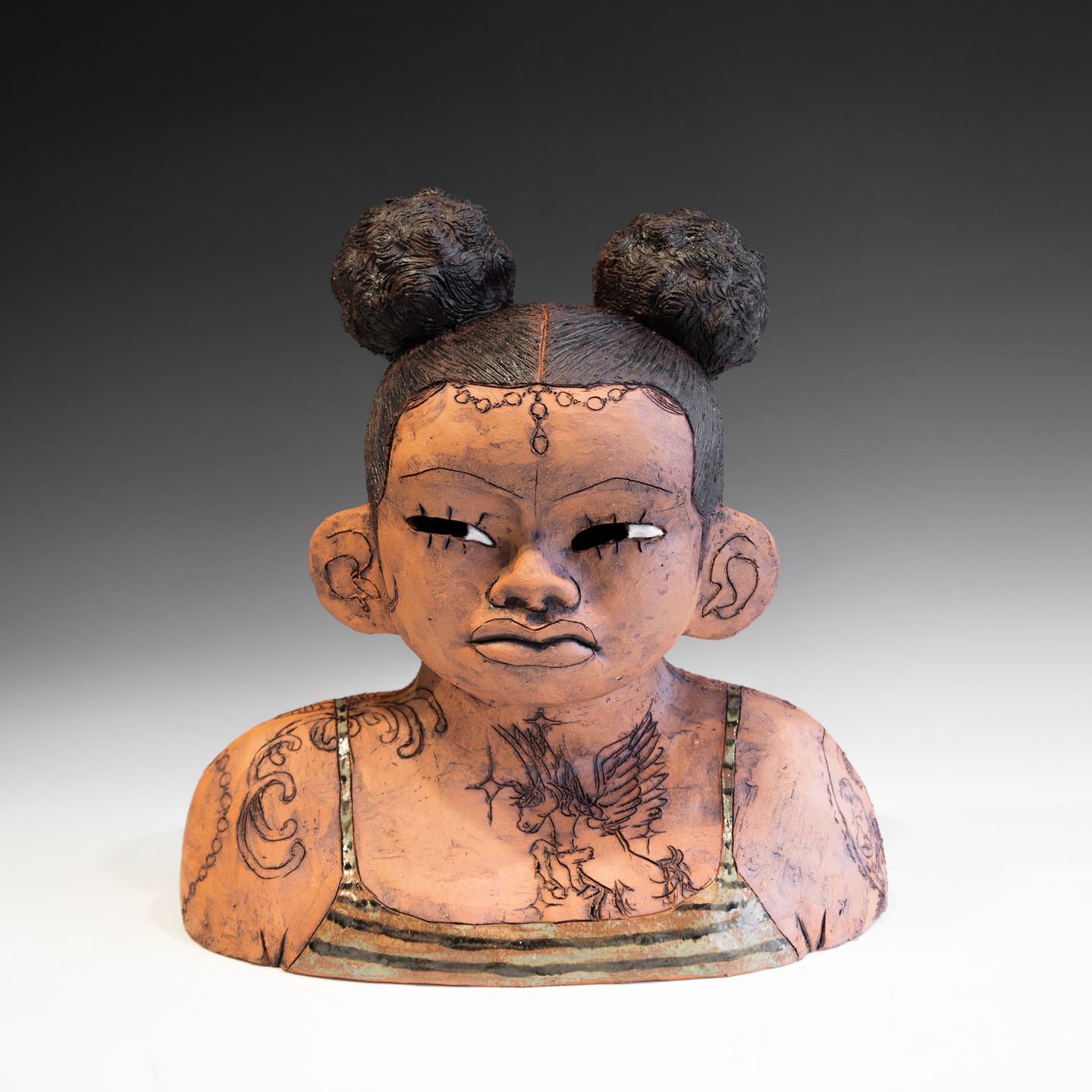
The Sydnie and Haylie Jimenez creation “Memory Armor,” 2023. Stoneware, underglaze, glaze, oxide wash.

We have all read stories about the closeness of twins and the unusual effects that such closeness can lead to. I have blogged more than once about pairs of twins who become collaborative artists, for example, including the Brazilian brothers Os Gemeos (“the twins” in Portuguese), who created the first of the giant Dewey Square murals in Boston, part of my beat.

The acclaimed art critic Cate McQuaid wrote in April at the Boston Globe about identical twins whose work was being shown even closer to my home.

“There’s a rich figurative thread in the history of marginalized artists that declares, ‘this is who we are. See us,’ ” she writes. “When the 20th-century art world was besotted with modernist abstraction, sculptor Elizabeth Catlett, painter Aaron Douglas, and others stuck to figuration to tell Black stories. In the 1980s and 1990s, Nan Goldin and Catherine Opie used photography to showcase their queer communities.

“Identical twins Sydnie and Haylie Jimenez, mixed-race artists born in 1997, are the heirs of such artists. Their barbed show ‘Love You to Death’ is at Lucy Lacoste Gallery.

“Sydnie, a ceramicist, and Haylie, who paints and draws on paper and on clay tiles, make defiantly exuberant figurative works rejoicing in identity and relationship — their own, and those of their LGBTQ/BIPOC community. Some figures grin convivially, but many wear stern expressions, on the lookout for trouble.

“ ‘Memory Armor’ depicts a young woman with her hair atop her head in two buns. Sydnie crafted the figure and Haylie inscribed the tattoos. A chain inked at her hairline drops down, hinting at a third eye, a channel to wisdom and divinity. With a skull on her shoulder and Pegasus on her chest, a two-headed dragon and a butterfly on her back, she’s at once cautious and expressive.

“In collaborative pieces such as ‘I Love Country Boys’ and ‘Black Bikini,’ solid young women stand proud in their swimsuits, tattooed with flowers, nails, and the word ‘ROTTEN’ in ornate script. These figures, presented with the illustrative flare of cartoons, come across as people to be reckoned with. Many of Sydnie’s solo works have that thorny charm. A series of cherubs outfitted with black batwings includes ‘Blonde Haired Cherub,’ who looks ready to fight, and ‘Bucket Hat Cherub,’ wearing a beatific smile but a T-shirt emblazoned with ‘PROBLEM.’ …

“The Jimenez sisters say in their statement for ‘Love You to Death’ that their own relationship informs how they build community. These warm and prickly works invite viewers to hang with them, and savor their ferocity, loyalty, and joy.” More at the Globe, here.

You can read about artist twins Mohammed and Omar Kabbani from Lebanon and the Brazilian team Os Gemeos at this blog, here and here.

By the way, gallery owner Lucy Lacoste, who started out in ceramics herself, has a sharp eye for innovation in the field.

In the early 2000s, I brought her a booklet I picked up at a gallery in Minnesota where I was enraptured with the mysterious tea cups of Anne Kraus, coming back multiple times to admire the tiny paintings and read the inscriptions.

Lucy was grateful. She told me I’d made her day, and she set out at once to see if Kraus was already represented by a gallery. She was. Nevertheless, Lucy has been very successful hunting for similar kinds of quirky genius. What is interesting to me is that although the messages of the pieces are often dark, the artistic expression brings joy.

I guess that is how art tames and triumphs over what is painful.

Read Full Post »

Photo: Luna & Stella.
Birthstones of family members can be extra meaningful on Mother’s Day. For fun, read here about traditional associations with your own birthstone.

Newer visitors to this site don’t know that my eclectic blog is hosted by my daughter’s jewelry company, Luna & Stella. Suzanne gave me carte blanche to write about whatever was of interest to me, and I’ve been grateful for every day of the 12 years I’ve been writing here — through all the adjustments to aggravating WordPress “improvements.”

Although I tend to wander off in all directions, every once in a while, I get the urge to tell the world about Suzanne’s lovely products, especially at Mother’s Day, May 14th this year.

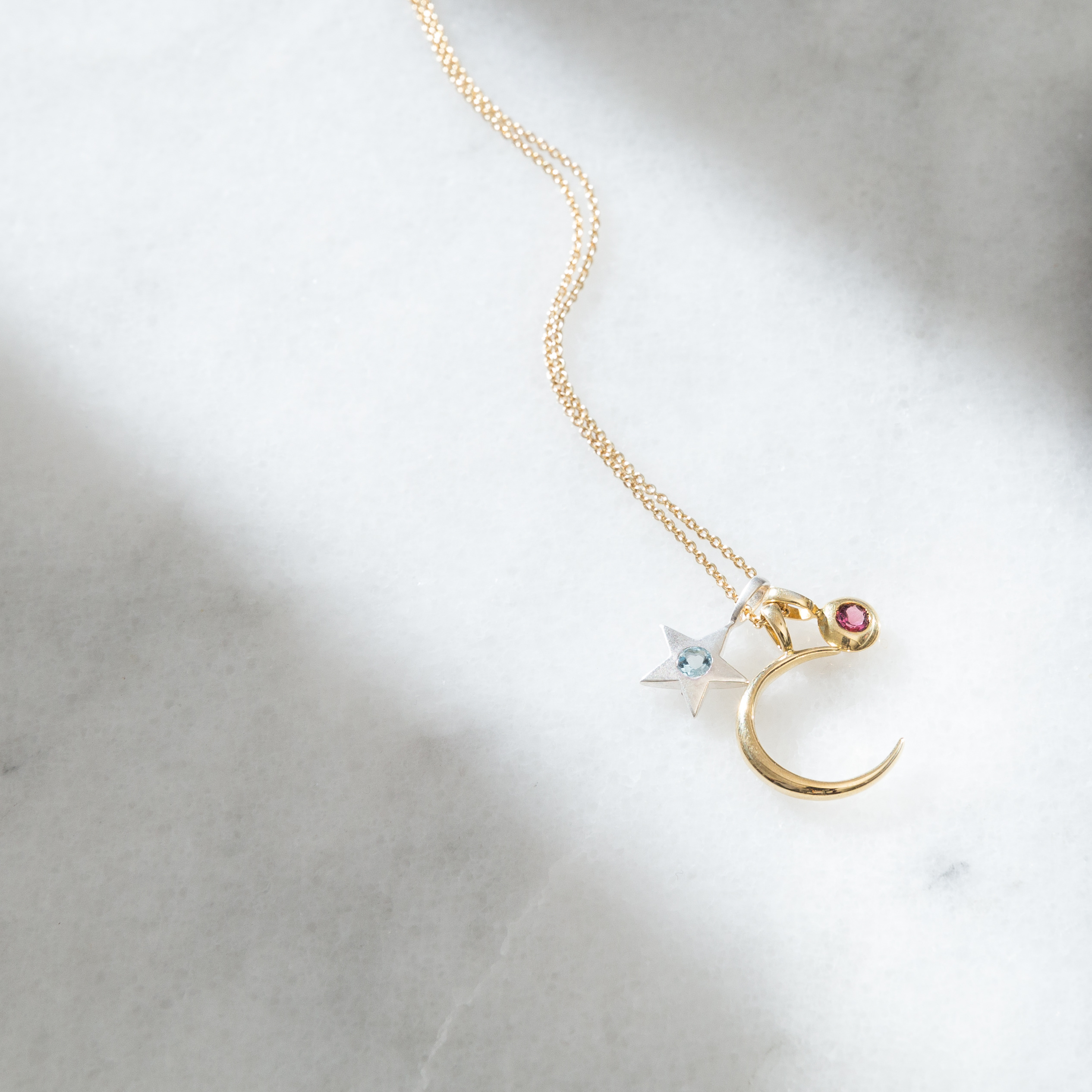
The necklace above is the kind you can customize with different charms using the birthstones of the mother’s family. I got one from Luna & Stella’s online shop years ago. It has birthstones for February, March, April, May, July, and December — my husband, my children, my grandchildren.

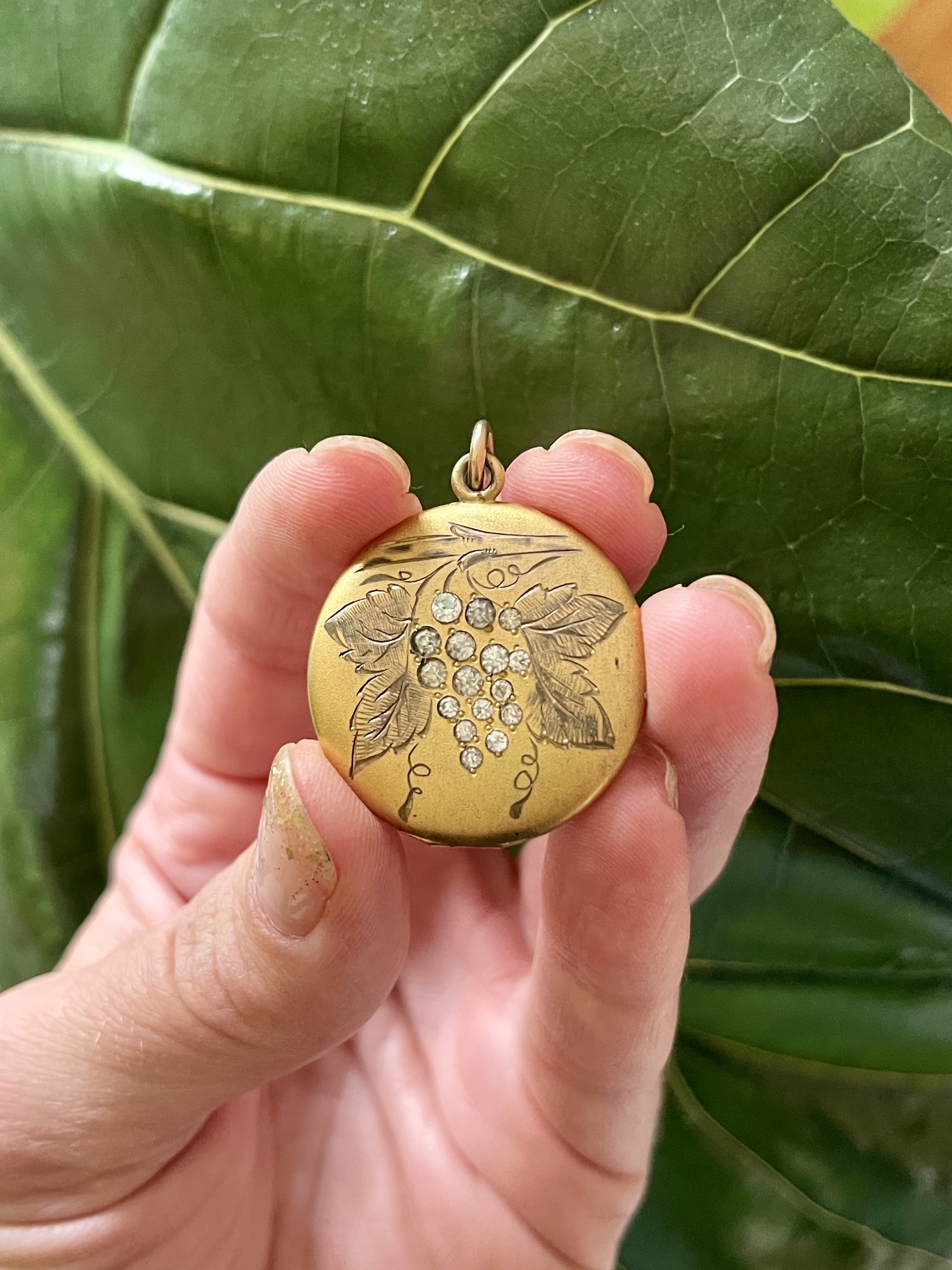
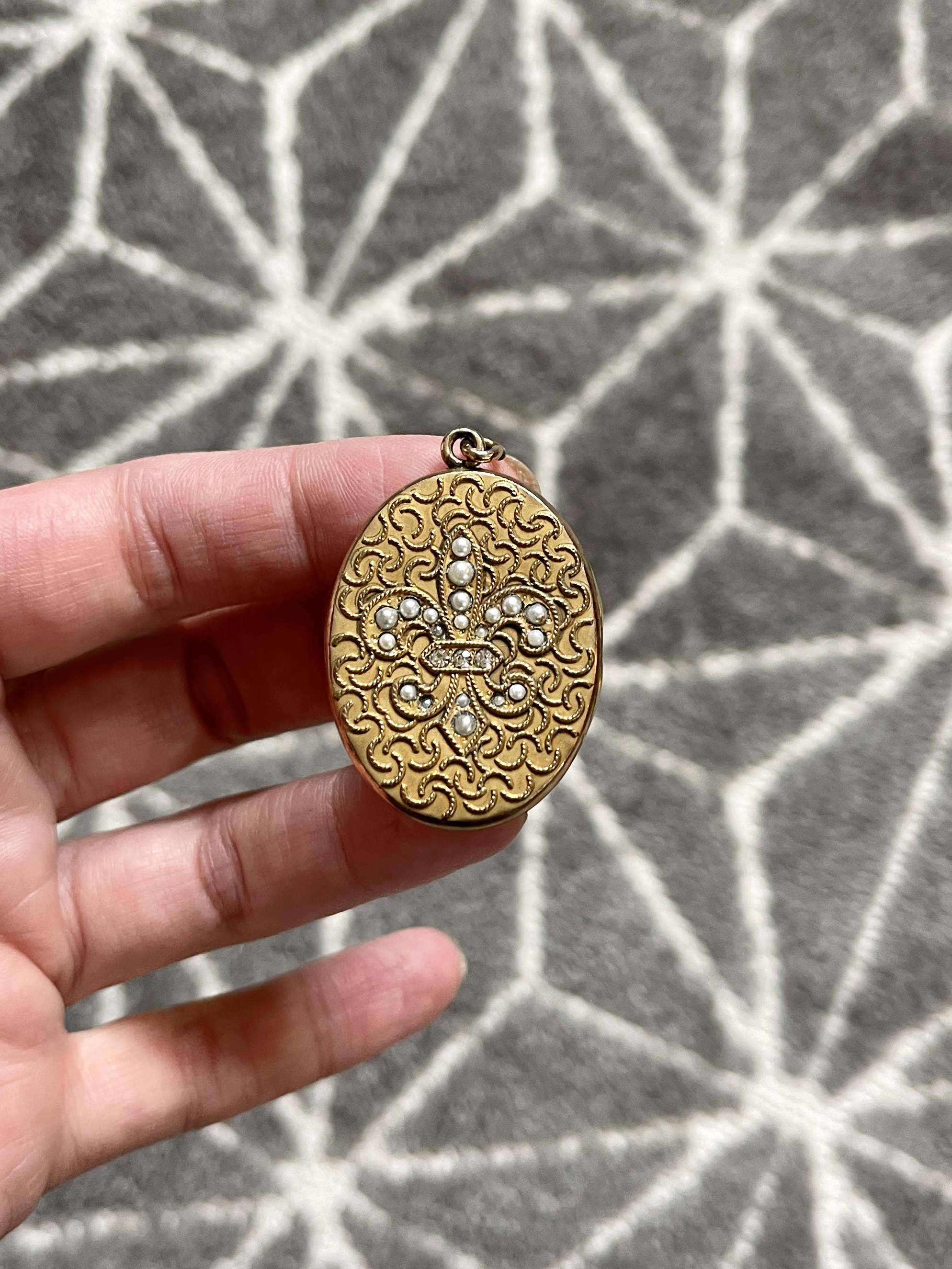
Today, Suzanne also offers an array of vintage lockets — all one of a kind. Look at three she just got in.

Luna & Stella will ship pretty much anywhere in the world.

PS. I need to show you a painting I saw recently. It reminds me of Suzanne at about six months old, reaching for the turntable on the days I tried bringing her along to my radio show. (Just a community station. Nothing big.)

Art: Karen Winslow, Self-Portrait with Daughter Annie, 1988. Working with a baby on a hip. Ah, yes indeed!

Read Full Post »

« Newer Posts - Older Posts »