Feeds:
Posts
Comments

Posts Tagged ‘climate change’

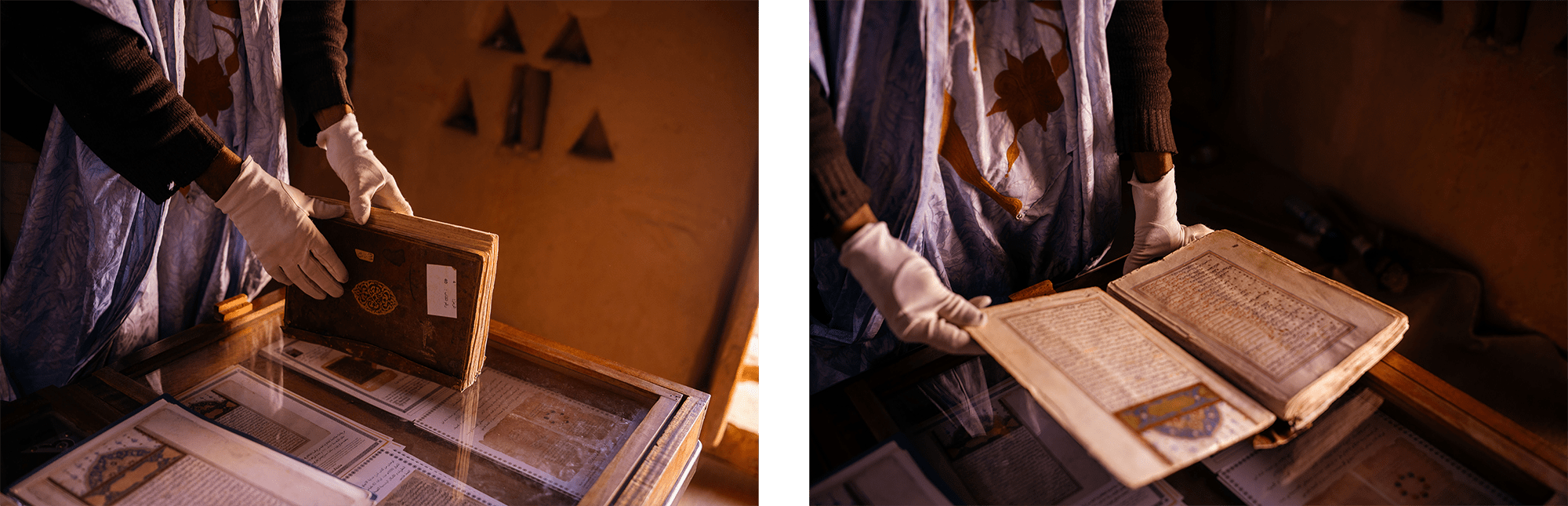
Photo: Kang-Chun Cheng.
Habott opening a book on Sufism interpretation in the family library.

I had to do a little research before sharing today’s article about a family’s work to preserve ancient manuscripts. I’m sorry to say that my geography is weak, and I didn’t know where to find Mauritania.

According to Wikipedia, Mauritania is a country in Northwest Africa, situated in the middle of Mali, Senegal, Algeria, and Western Sahara. Its full name is the Islamic Republic of Mauritania.

At the Dial recently, Kang-Chun Cheng described the history of the manuscripts and focused on why climate change and desertification is threatening them.

“Dressed in a boubou, a traditional Arab robe, ” Cheng writes, “Mohammed Abdullah Ould Gholam Habott, 51, puts on gloves before delicately handling the ancient manuscripts. He opens a book about Sufism, a mystical practice within Islam, and then another about its interpretation. Gingerly, he thumbs through the pages of Arabic script.

“Habott is the custodian of his family’s library and has been for 24 years. The size of a large sitting room, the library contains more than 1,000 pieces of Quranic manuscripts, legal texts and scientific writings –– some of the oldest in West Africa — ranging from mathematics to astronomy. It’s one of three such libraries still open to the public in Chinguetti, an ancient desert village in northern Mauritania.

“Established around 777 AD, Chinguetti — meaning ‘spring of horses’ in the extinct Azayr language — is home to roughly 4,800 people. The unforgiving environment makes survival feel like a concession; temperatures can exceed 43 degrees Celsius [109.4 F] during the day, then plummet down to 10 degrees after the sun sets. …

“Designated as a UNESCO World Heritage site in 1996, Chinguetti once served as an important trading outpost for the Mediterranean Timbuktu caravan route and a resting spot for religious pilgrims en route to Mecca. Small libraries were built to maintain and organize holy writings left behind by generations of transient pilgrims. Today, tourists and researchers travel great distances to look at them.

“Books are stored in storage cabinets, on open shelves and in wood and glass display cases. With few windows, the libraries are kept relatively dark and the texts out of the hot sun, but the rooms are far from temperature controlled. These simple preservation methods may not be enough to withstand changes to the desert climate.

“Temperatures here are rising up to 1.5 times faster than the global average, rainfall is plummeting, and sandstorms are becoming more common. While the texts are relatively safe in the arid desert air, the fates of the libraries themselves are precarious. Desertification threatens to bury towns. With fewer trees and vegetation, sand can more easily migrate onto the streets. In some places, dunes reach window height and pour into people’s homes.      

“The libraries in Chinguetti are owned and overseen by families, custodial positions passed down through generations. From a young age, Habott was captivated by stories that his grandfather told him of pilgrimages to Mecca and traveling to Andalusia, Spain, to purchase Moorish texts. His family’s library has existed since the 1800s and, as the eighth custodian, Habott tells me he felt proud of the culture and heritage the libraries carried. …

“His two sons, aged 12 and 18, don’t share this dream. Chinguetti’s remoteness and lack of resources (access to electricity only stabilized in 2013) mean there are very few economic opportunities. Many young people have little incentive to stay; the city’s population has been steadily declining for years as youth travel elsewhere for blue-collar work and a larger life. …

“ ‘An ocean of sand is coming,’ Habbott says from the dry coolness of his library. ‘I ask Allah to keep this family going.’ ”

A nice collection of photos may be enjoyed at the Dial, here. No firewall.

In case, like me, you had never heard of the Dial, here’s what they say about themselves: “We created The Dial in 2023 to make space for daring writing unconstrained by geography. English-language journalism is growing perilously small in voice, in ambition and in subject. We see an opportunity to publish stories from the point of view of those on the ground — with the world itself as our center of gravity, rather than Brooklyn. We trained as editors at The New York Review of Books, Politico’s European newsroom and the Atlantic.” I like the sound of their goals!

Read Full Post »

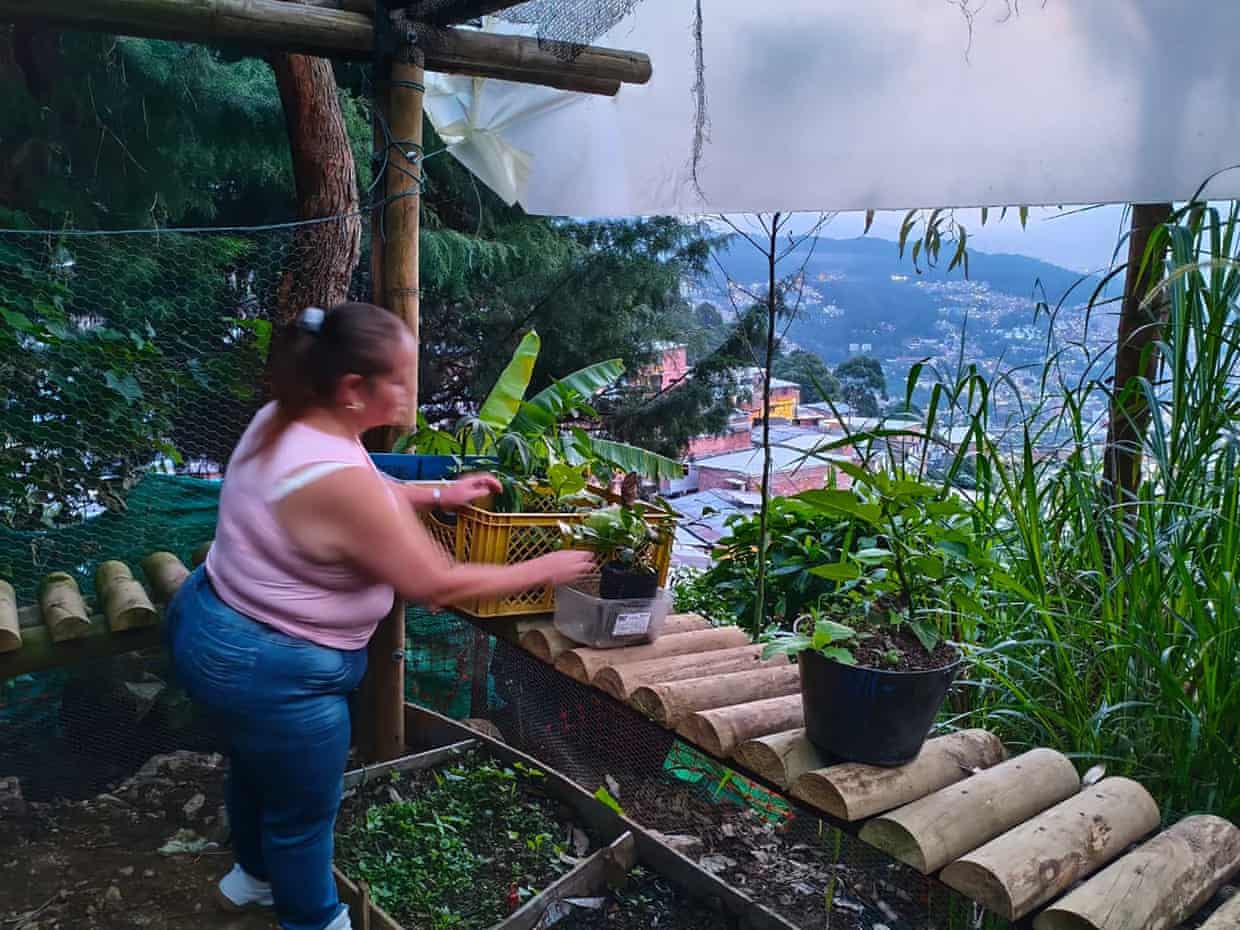
Photo: Suzanne Bearne.
Above, Nancy Elena Quiros Correa, who says the climate in Medellín, Colombia, has become hotter and wetter. Many neighbors collect containers to store rainwater for washing clothes and flushing toilets.

Remember my recent post about storing rainwater in garden fences (here)? Well, ingenuity is not limited to the Netherlands. People around the world are realizing that climate change calls for storing water. In Medellín, Colombia, violent gangs are no longer getting all the attention, and residents are free to work on the normal challenges of life.

Suzanne Bearne explains at the Guardian.

“In his home on a steep hillside in the neighbourhood of Golondrinas in Medellín, Róbinson Velásquez Cartagena stands proudly next to two large tanks of water – a rainwater harvesting system he designed and built to help reduce the risk of flooding and landslides.

“It is one of the nature-based solutions that Velásquez and others in the community have proposed as part of a disaster risk and climate crisis adaptation plan for Comuna 8, a growing informal settlement of 150,000 people in Colombia’s second-largest city. …

“Neighborhoods such as this, where brick houses with corrugated metal roofs are densely stacked on unstable ground, are susceptible to landslides and floods. In 1987, a devastating landslide killed 500 people in the area.

“Organizations and residents such as Velásquez Cartagena came together and, in 2020, began to develop the Local Agreement for Inclusive Climate Action, in line with the Medellín city council’s Climate Action Plan. …

“The plan was formally launched in August 2023 by several organizations, including Medellín’s disaster risk management department (DAGRD), the housing and habitat committee for Comuna 8, and Heriot-Watt University in the UK. …

“The plan comprises eight measures to address climate risks, including managing rainwater, reforestation to control erosion and sedimentation on hillsides and in ravines, and establishing eco-gardens and agroforestry systems. While the city aims to implement similar plans across all 21 comunas, challenges remain in securing government support and funding for grassroots initiatives.

” ‘I started the rainwater harvesting system because I wanted to prove that it can reduce the risk of disasters by reducing the water that runs on to the streets, which can flood when it rains,’ says Velásquez Cartagena, a community leader. … His system collects water from the rooftop drainage and stores it in containers; he then uses the water for his washing machine and toilet.

“Originally a disaster-management scheme, the plan was expanded by the community to [outline] climate risks and vulnerabilities, a heat map, past floods and landslides, responsible stakeholders and action points.

“ ‘In the plan, there are nature-based solutions, with several that are not that expensive or hard to make,’ says Velásquez Cartagena. …

“In the El Pacifico neighbourhood, Nancy Elena Quiros Correa oversees a small 9 metre by 3 metre (30ft by 10ft) plot that was set up as a community tree nursery last year.

“ ‘The nursery will prevent rocks from falling, soak up water when it rains, and increase biodiversity,’ she says. …

“Other projects include a rainwater-harvesting system installed at a local community center last year and an ecological restoration garden.

” ‘The garden will restore nature and stabilize the land,’ says Harry Smith, a professor in global urbanism at Heriot-Watt University, who has worked with Comuna 8 on environmental projects for the past 10 years. ‘But it also stops one of the problems they have there, which is land invasion as people continue to build new homes on land that has been sold illegally by armed groups.’

“While the plan was being approved, the community ‘hit the ground running,’ says Smith. ‘They wanted to do some pilot projects to show that they don’t need to wait for the municipality to come along and do things.’

“Velásquez Cartagena is working with community leaders to produce a user-friendly guide to the plan, with engaging graphics, that can be printed and shared on social media. …

“Juan David Moreno, the head of the technical team at DAGRD, says: ‘The work in Comuna 8 was a pilot, and we developed it for the rest of the communities. … In some communities, you have different needs,’ says Moreno. ‘We assessed the terrain, the community needs and the different hazards. … The main lesson from Comuna 8 was that we needed to work closely with the people, as they live in the territories and know the local hazards.’ …

“Despite all of their work, Quiros Correa still has reservations about what the plan will achieve. ‘I now have a more realistic view of the local government actions. Everything that we have achieved here has involved fighting and negotiating with the local government.’ ”

More at the Guardian, here. What is your community doing? In our town, anyone who builds hard surface like a macadam parking lot is now responsible for controlling water runoff.
Read Full Post »

Photo: Judith Jockel/The Guardian.
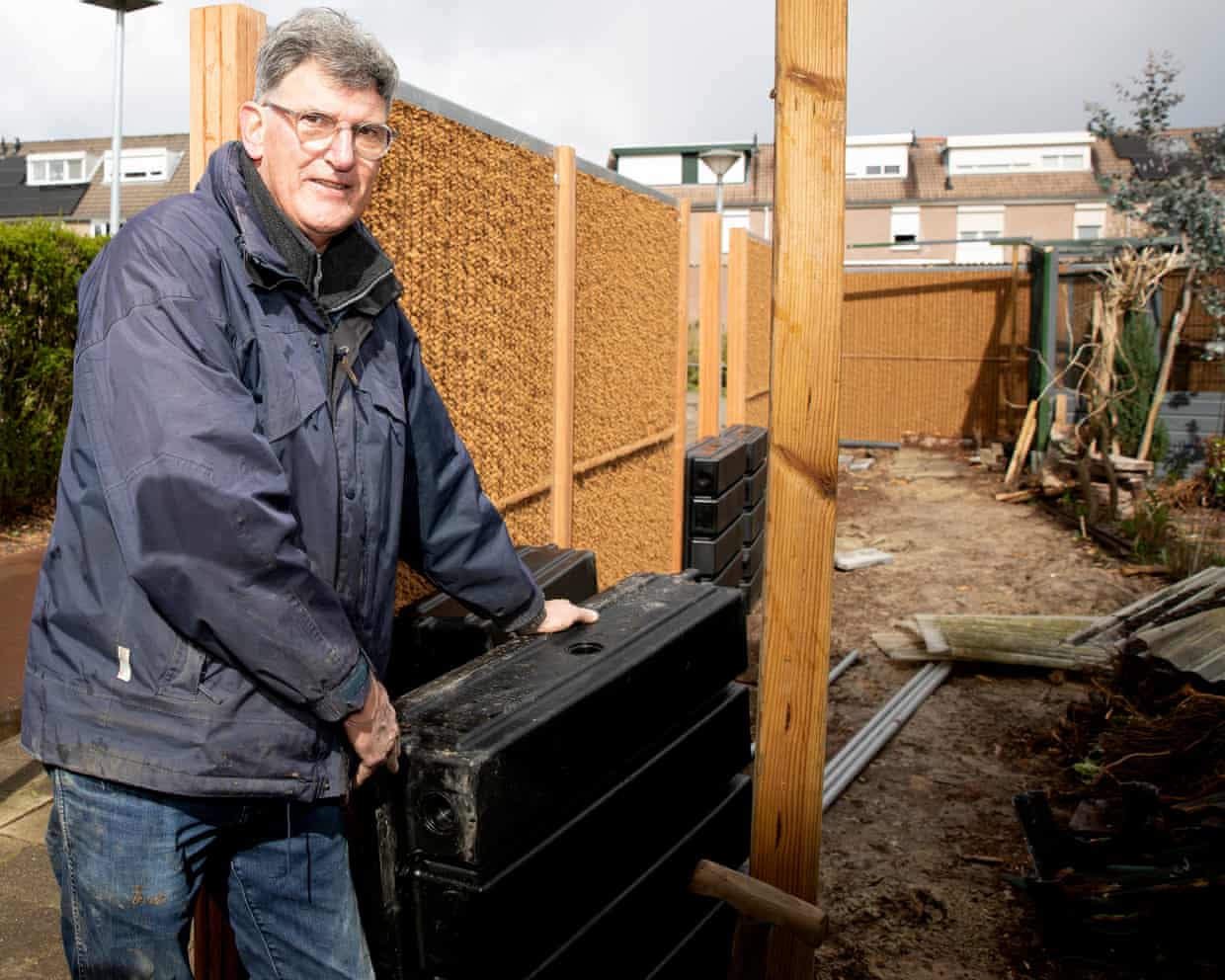
In the Netherlands, Harry den Hartigh installs a fence that also serves as a rainwater store.

Not to stereotype, but the Dutch strike me as exceptionally good problem solvers. (Maybe the bloggers at Cook and Drink can give an informed opinion.) Most of us know how they built their country on a delta and how today advise other places threatened with flooding.

Senay Boztas writes at the Guardian that the Netherlands is now experimenting with a new way to control water … until it’s needed.

“Good fences make good neighbors – but rain fences could make even better ones,” says Boztas. “That is the hope of housing corporations in the Netherlands, which are adopting rainwater storage in their garden fences.

“In a tidy neighborhood in Veldhoven, where the social housing provider, Woonstichting ’thuis, is installing its first such rain fence, one couple, Theo and Willy Bolder, are already seeing an increase in their popularity. ‘People are all coming round to ask what it costs,’ said Willy Bolder.

“Outside, between rattan fence panels, a series of plastic blocks have been linked to the drainage from their roof. Together, they will store up to 2,160 liters [571 gallons] of water – reducing pressure on the drains during downpours and preserving rainwater for the garden in times of drought.

“ ‘The rain is getting heavier and heavier nowadays, and if you have a cloudburst the drainage isn’t good and it comes up through the toilet,’ she said. …

“Theo added that the hotter summers were threatening the trees and their quality of life. ‘I always go fishing in a lake, it’s always full of water, but last summer it was completely dry,’ he said. …

“The couple are not the only ones to feel the effects of the climate crisis in this low-lying country. … Weather extremes are now more likely. The Netherlands was shocked by floods in Limburg in 2021, when … the River Geul burst its banks.

“Rik Thijs, deputy mayor for public space, greenery and water in nearby Eindhoven, said private and public initiatives were needed to adapt to the changing weather. ‘Our sewage system cannot cope with the rainfall that is coming, and we cannot increase its capacity, so we need to do things differently,’ he said. …

“This might mean plans to bring an old river, the Gender, back to the surface, ‘wadi‘ pools that can hold water during heavy rain, and incorporating green roofs and rainwater storage into housing developments. ‘The Netherlands is very vulnerable because we are, of course, one large delta,’ he said.

“The country’s vulnerability to water was graphically illustrated by the North Sea flood of 1953, when at least 1,800 people died, tens of thousands of animals drowned and there was huge damage to property and farmland. While the disaster, in the province of Zeeland, inspired the Delta Works sea defenses, it also left its mark on the Dutch entrepreneur Harry den Hartigh, whose company, SunnyRain Solutions, installed the storage system in the Bolders’ garden. …

” ‘I was born in Zeeland and my parents experienced the flood disaster,’ said den Hartigh. … In his youth, he also saw how Zeeland struggled to source enough fresh water for agriculture owing to brackish water from the sea, and this inspired his rainwater storage system. …

“Despite the Netherlands’ reputation for rain, it has increasing concerns about water shortages in the summer, and overheating cities. Jannes Willems, assistant professor in urban planning at the University of Amsterdam, said simple solutions at scale could make a difference. ‘Rainwater harvesting is a very easy fix,’ he said. ‘We have a water system that was built to discharge water as quickly as possible.’

“But with flood events and rain bursts, the sewers simply cannot cope. ‘You can better let it infiltrate the soil through green measures, bringing back natural elements in cities. And then, in times of heatwaves, that can lower temperatures,’ he said. …

“Matthijs Hulsbosch, a property and sustainability manager, said the fences could also make the complex’s 11,000 homes more resilient. … ‘We can fix leaks, but it might be better to prevent them through these kinds of ideas – and save a great deal of money and inconvenience.’

“Willems said it also represented a change to the idea that a country that reclaimed a fifth of its land from the sea could always bend nature to its will. ‘Fifty years ago, the Dutch water system was a good example of modernist thinking: being able to master nature,’ he said. ‘With green infrastructure, the Dutch are trying to rebrand that narrative and bring back a natural state,’ “

More at the Guardian, here.
Read Full Post »

Photo: Seed Global Health.
Dr. Vanessa Kerry (second from left) speaks at the Foreign Policy event at the World Health Assembly in Geneva in May 2025. Under her leadership, Seed Global Health has helped educate more than 45,000 doctors, nurses, and midwives in seven countries.

We humans are inconsistent critters. Today we’re panicking that the latest stupid war is messing up our oil markets (and I get it: we still need oil), but we seem to downplay just how bad oil really is for us.

At the environmental radio show Living on Earth, we learn what fossil fuels are actually doing to our health.

“The burning of fossil fuels is linked to some 300,000 deaths in America every year, not to mention the related carbon emissions that promote global warming. Dr. Vanessa Kerry directs Global Health and Climate Policy and teaches at the Harvard T H Chan School of Public Health. She is also the World Health Organization Special Envoy for Climate Change and Health and joins host Steve Curwood to discuss the major health costs and lost opportunities linked to pollution.

Steve Curwood
“There’s been a shift in messaging from environmental groups regarding the impact of air pollution on environmental health. Discuss what that means in terms of the effectiveness of helping people understand the impact of the environment on their daily lives.

Vanessa Kerry
“There’s a group that calls [climate change] the greatest hoax of our time, and there are others that are really trying to think strategically about what is happening on this earth in ways that aren’t just degrees Celsius. Health has been a really important piece — how extreme heat puts you at risk of flaring your diabetes or your lung disease or your heart disease. …

“But I think there’s another step that we can also take to help people really understand what we’re up against in climate change, which is that these health impacts that we’re seeing cost us money, because if you are too sick to go to work, or you can’t breathe, or your child has an asthma attack, and you can’t go to work because you’re taking them to hospital, that’s lost income. We know, for example, that the United States is losing 100 billion in productivity from extreme heat already now, and that’s supposed to go to 500 billion in the next 20 years. So these, it’s very real. And I think for those that can’t even think about health, understanding the economic bottom line and how it affects your pocket is something that I think is universally related and understood and very real.

Curwood
“If it’s that much of a health danger, climate change is almost an aside. …

Kerry
“Without question, the burning of fossil fuels is driving our risk through multiple pathways. Particulate matter is co-emitted with the greenhouse gasses and … not only do you breathe it in and can it cause issues in your lungs, but actually particulate matter can cross into your bloodstream, lead to increased risk of heart attacks, worsen your blood pressure, increased risk of strokes, cause all sorts of other problems. …

“Beyond the direct impacts of fossil fuels, people who are paying out of pocket for catastrophic health costs related to this are therefore losing access to nutrition, ability to send their children to school, access to other resources. … We know that we’re going to see upwards, you know, 44 million people are going to fall into poverty from the health impacts of climate change alone, according to the World Bank, in the next 20 years.

Curwood
“If air pollution has such a tremendous impact on us, health-wise and economically as well, why aren’t we talking about this more in America?

Kerry
“The Harvard School of Public Health and Department of Environmental Health is actually looking at that exact question. … And there’s lots of data out there that tells us that investments in health actually have higher returns.

Curwood
“To what extent are the massive impacts of air pollution on public health part of the reason that we have such a huge economic divide in this country? …

Kerry
“When you look at who lives in urban cities, in heat deserts, where it can be absolutely crippling to live in high heat, it’s often people of color or people in poverty. And so there’s a massive divide that is happening where we are exacerbating inequity, not just in the United States, but globally. …

Curwood
“The Heritage Foundation in Washington claims that climate change alarmism (quote, unquote) is discouraging families from having children. …

Kerry
“It’s really actually the perpetuation of misinformation. … How we communicate a conversation which is fact-based, scientific, ground in truth … is a really critical question.”

More at Living on Earth, here. And whiled we’re on the subjec t, I want to be sure everyone knows about the heeroes of Cancer Alley in Louisiana, who just dont’ care if fighting the Power is impaossible, They do it and succeed. (Click here.)

Read Full Post »

Photo: Dietmar Rabich, Wikimedia Commons, CC BY-SA 4.0.
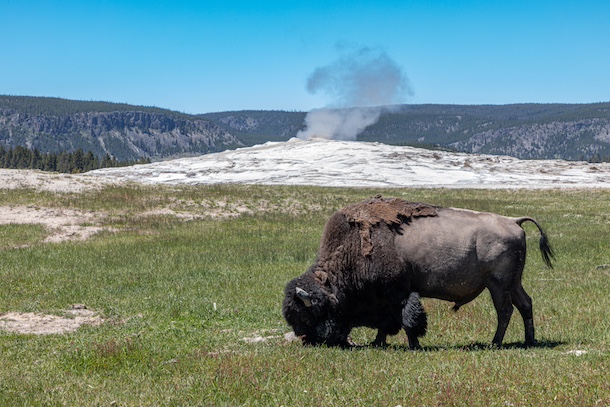
The American bison is a well-loved symbol of the prairie, and for good reason. Bison provide important ecosystem services.

I have blogged several times about Frank and Deborah Popper’s insights on the loss of population in the industrial Midwest and the idea of returning former urban areas to prairie, a kind of Buffalo Commons. (See one post, here.) It’s an optimistic concept: Instead of crumbling under the loss of “the way things were,” we can learn not only to accept the change but feature it.

But what if the prairie itself is disappearing? The environmental radio show Living on Earth investigates the role of agribusiness.

“The American prairie is one of the most biodiverse ecosystems in the world, with numbers of species rivaling even a tropical rainforest. But today, just one percent of eastern tallgrass prairie remains, and western shortgrass prairie is disappearing at a rate of more than a million acres a year. Author Josephine Marcotty joins host Paloma Beltran to discuss her book Sea of Grass: The Conquest, Ruin, and Redemption of Nature on the American Prairie.

Paloma Beltran
How did the idea for Sea of Grass first come about?

Josephine Marcotty
Growing up, I really had little or no contact with the prairie because it was gone. … I grew up in a suburb of Detroit, and the prairie was something I read about in books like Laura Ingalls Wilder, but not something that I had experienced. So it was only when I started exploring the prairie that was left and understanding what we had lost that inspired me to write, not only about agriculture, but about what we were losing by expanding agriculture in the Midwest.

Beltran
Can you describe the American prairie for us? You know, what does it feel like to visit such a place and what makes it special?

Marcotty
The tallgrass prairie, which is now almost completely gone, used to be an extraordinary place where grasses would be taller than a standing person, and in order to see over the top of them, you had to stand on top of a horse. It was a place where people could get lost, and often did in those tall grasses, or in the massive wetlands that used to occupy a third or 25% of the mid part of the country. It was an extraordinary place full of animals that we no longer have, wolves and bears and other carnivores, extraordinary birds. So I mean, the thing that I like about a prairie is the immense silence. All you hear is the sound of wind, and that enormous sense of space that you get, which is very similar to [being] out on a great lake or out on an ocean. …

Beltran
Let’s talk about one of the main characters in your book, the buffalo. …

Marcotty
They are what biologists call a keystone species on the prairie. They have been around for millions of years. … They were huge. And they shared the grasslands with giant sloths and other animals that you know have long gone. But over time, they became a key part of the grassland ecosystem. So they come through and they eat the grass short and that creates an environment that’s conducive to birds that like short grass, or insects that need short grass, and then they move on, and then the grass grows taller, and then that becomes an ecosystem for other animals that like taller grass. One of the things that they do is they wallow.

If you’ve ever been to Yellowstone National Park or any other park where you can see bison, you’ll see them roll over and just create these huge clouds of dust, and then when they leave, there’s a little wallow. Those wallows are really important for collecting water when it rains, and scientists have found that there’s unique species of animals and insects that will live in and around those wallows when they collect water. Bison, they carry seed across thousands, hundreds of miles when they eat the grass, and then they move the seed up to other parts of the of the grassland. …

Prairies create a whole universe of organisms around them, and that’s an excellent way of sequestering and processing carbon, of sequestering and processing nitrogen, both of which are very important for world health in terms of air pollution and in terms of climate change. The world’s grasslands contain more carbon than humans have released since the Industrial Revolution, more than the planet’s forests and atmosphere.

[But] we’re plowing up about a million acres a year, and that’s the equivalent of adding 11.2 million cars to the road every year. … For many, many decades, intensive agriculture stopped at around the 98th parallel because it was too dry in the West to really graze crops properly. And instead, that’s why we have cattle there. That’s because it was good country for cattle and bison. But through genetic technology, we now are creating seeds like for corn that is much more capable of withstanding severe weather, that can thrive in dry conditions. … And the profits from that are much greater than from growing cattle. So you can sell a piece of land that has been plowed for much higher price than you can sell it if it hasn’t been plowed. …

What’s driven the loss of grasslands … is just growing corn for our gas tanks.

More at LOE, here.

Read Full Post »

Photo: Green and Open Somerville.
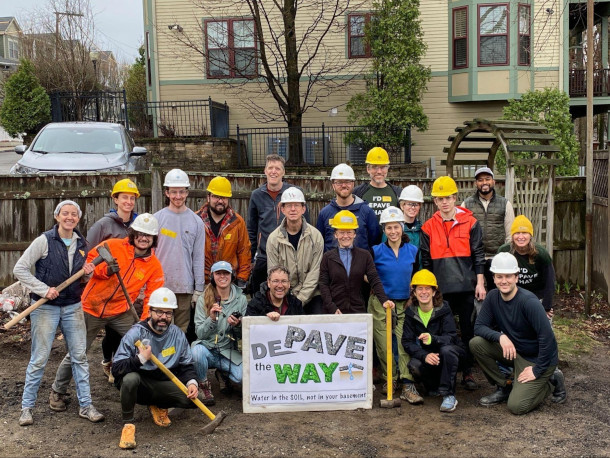
Green and Open Somerville’s “Depave the Way” initiative helps neighborhoods increase green space. This is a “depaving party” of volunteers.

Sometimes it seems like the challenges that face us are just too immense for any individual to address. Climate change, for example.

But some folks in Somerville, Massachusetts, are adopting an optimistic attitude, believing if “depavers” like them around the world would start removing pavement in their neighborhoods, it could have a real impact.

At the very least, it could make the places they live greener.

Let’s tune in to the environmental radio show Living on Earth.

” In the warm weather months, a 90-degree day every so often can be a nice treat. But by 2070, the Massachusetts Bay Area will likely see almost 40 more of these days a year than it currently does. And too much of a good thing can definitely have its drawbacks. In the Boston area, the city of Somerville is particularly vulnerable. Over three quarters of Somerville is paved, and eighty two percent of the city is defined as a ‘hot spot,’ or an area that has a heat index in the top 5% statewide. Stronger storms intensified by climate change are a threat there, too. Just a few decades from now, extreme storms in parts of Somerville could bring up to 10 feet of flooding. But there may be some relief in sight. Somerville residents are taking matters into their own hands. Living on Earth’s Sophia Pandelidis went to find out more.

Sophia Pandelidis
“It’s Sunday morning, and a rag tag group of neighbors has shown up to party. … But not the way you might think. First off, they’re all wearing hard hats. … This is a ‘depaving party.’ About 20 volunteers are gathered in the fully paved backyard of a Somerville, Massachusetts home. And it’s their job to rip it up. …

“Armed with sledgehammers and wheelbarrows, the group works together to break up the asphalt and carry it to a dumpster in the driveway.

 “The goal is to leave this yard pavement free. These depaving parties have been happening since 2010 and are now run by Green and Open Somerville. Leigh Meunier is one of the leaders of the group’s Depave the Way initiative. Her wide, bright eyes make you want to listen to her. She says there’s more than one reason to ditch asphalt. … First, it helps neighborhoods adapt to climate change. Depaving can prevent flooding by giving stormwater a place to soak into the ground and lower temperatures by reducing the urban heat island effect. That could save lives, especially in environmental justice communities that face higher heat risks. But climate resilience isn’t the only benefit to depaving.

Leigh Meunier
“Ideally, when you can get pavement out, it increases not just more space for water to go, but it increases opportunities for planting gardens, for planting trees, for yards, for kids to run around and play, park space, etc. …

Pandelidis
“Yards filled with native plants instead of asphalt can also be havens for pollinators and local wildlife. … But Leigh’s favorite part of depaving is how it brings the community together in an active way. …

Meunier
“I want my creative energy to go towards something that’s meaningful. …

Pandelidis
“The depaving movement is not new. It got its start in Portland, Oregon back in 2007, and has since spread across the United States and even Europe. Leigh says word is traveling fast here in Somerville.

Meunier
“More people are biking, walking, taking transit, and have less need for cars. So we have all these long driveways that fit like five cars, and everybody’s moving in and saying, ‘I don’t need that anymore.’

Pandelidis
“Everyone who wants to depave should be able to, Leigh says. But keeping up with growing demand is tough for her small team. And while volunteers are free, depaving still has a price too steep for some: up to $700 to rent a dumpster. So Green and Open Somerville is partnering with local NGOs to offset those costs for low-income, environmental justice neighborhoods.” 

We don’t own a home anymore, but we had one for 40+ years with a driveway that was pebbles. We did have to order more pebbles once in a while.

More at Living on Earth, here. No firewall. Nice photo of one depaver’s garden, a happy result of the volunteers’ sledgehammer work.

Read Full Post »

Photo: Jonathan Wiggs/Globe.
A New Haven, Connecticut, carbon-capture start-up is testing its concept at this sewage facility in Fall River, Massachusetts. Limestone gets mixed in with waste water at the bottom of the tank to draw out carbon.  

Nowadays most of us don’t think much about sewage. Out of sight, out of mind. But I regularly read novels that were written before indoor plumbing, and I often think about how awful those chamber pots and outhouses must have been. I feel grateful for the people who do think about sewage today.

Kate Selig reports at the Boston Globe about a New Haven, Connecticut, company turning sewage into a tool for fighting climate change.

“At the edge of a picturesque bay in this historic city,” she writes, “a deep waste water tank harbors an unlikely climate experiment.

“Near the base, a narrow tube spits out a milky stream that’s as thick as roux. The liquid, a mix of treated waste water and a naturally occurring mineral, is swirled in with the sewage. The combination kick-starts chemical reactions that pull carbon dioxide, a greenhouse gas that drives climate change, into a harmless bicarbonate ion.

“CREW Carbon, a startup founded in New Haven, is betting that this simple combination could turn dirty water into a powerful climate solution. It has partnered with waste water treatment plants along the East Coast, including the facility in Fall River, to put this approach into action. As a bonus, municipalities often find that limestone is a cheaper and more effective way to treat waste water than conventional methods. …

” ‘We don’t need massive new infrastructure or subsidies,’ said Joachim Katchinoff, the company’s cofounder and CEO. ‘And because our process delivers real operational and cost benefits, it creates a win-win for utilities and for the planet.’ The company grew out of research at Yale and was founded in 2022 by Katchinoff and Noah Planavsky, a geochemist and Yale professor. …

“When the water flows out of the plant, the company says, the dissolved ions eventually make their way to the ocean, where they can be stored for thousands of years. Katchinoff estimated that a single treatment plant can remove thousands to tens of thousands of tons of carbon dioxide annually. The startup sells carbon removal credits, a way for companies to pay to offset their climate pollution. CREW Carbon is one of the first companies to deliver credits in New England.

“The municipalities benefit as well. Some waste water treatment plants see cost savings and increased safety for workers by using limestone instead of chemicals for controlling pH. The limestone also can yield cleaner water flowing out of the plant. And in some cases, CREW Carbon is sharing revenue with the treatment facility from the carbon credits it sells. …

“The company’s first partnership was with the local utility in New Haven. Since then, it has grown to have six full-scale projects, most located on the East Coast. It delivered its first carbon credits in the spring, making it the first company in the world to have done so using waste water alkalinity enhancement, as the method is known. Alkalinity is a measure of the water’s ability to neutralize acids.

“In the coming years, the startup has committed to delivering about 70,000 tons of carbon dioxide removal, the equivalent of taking over 16,000 gas-powered cars off the road for a year, to a coalition of companies that includes Alphabet and McKinsey. …

“On a recent day, Jonathan Mongie, a project manager for Inframark, which operates the Fall River plant, leaned over a tank where waste water treated with limestone was being disinfected.

“ ‘I can see deeper than we’ve ever seen before,’ he said, observing the clarity of the water. The limestone increased the amount of solid particles in the waste water separated out using gravity. The plant was already meeting stringent discharge standards, Mongie said, but the limestone has improved the cleanliness of the water flowing into the bay. …

“Planavsky, the Yale professor, said CREW Carbon’s approach is not a silver bullet for the climate crisis. Instead, he said, it could be part of a future integrated approach where many industries each do their relatively small part. (Though Planavsky is a cofounder, he does not receive any money from the company.)

“Some scientific questions remain about waste water alkalinity enhancement, especially what happens after the water leaves the treatment plant. Tyler Kukla, a research scientist at CarbonPlan, a nonprofit that analyzes climate solutions, said the chemical reactions that occur within the waste water plant are well understood and take place within a closed system, making them easier to monitor. However, he said, it is less clear what happens to the carbon as it travels out to the ocean.

” ‘This is a work in progress,’ he said. ‘We can make measurements that we feel very confident about in many cases, but there is still a part of the system that is a little bit fuzzy to us.’ “

More at the Globe, here.

Read Full Post »

Photo: David L Ryan/ Boston Globe Staff.
A view of a Forbes sea star at Northeastern University’s Ocean Genome Legacy Center.

As I was reading today’s story, an image kept coming to mind: an image of someone in a burning house running out with a few precious items.

You’ll see why when you read Kate Selig’s article at the Boston Globe on a genome bank.

“On a rocky outcropping a few miles northeast of Boston Harbor,” she writes, “scientists are racing to build a library of tissue and DNA from ocean creatures — before it is too late. It’s a last-ditch effort. As global warming drives ocean temperatures ever higher, some species have vanished and the populations of others have plummeted. If climate change continues unchecked, many marine species could face a mass extinction, rivaling the worst in earth’s history.

“To preserve the oceans’ historical record, researchers in Nahant, a peninsular town jutting into the Atlantic, are collecting samples from marine organisms around the world and distributing them to scientists.

“ It’s not difficult to do,’ said Dan Distel, a marine biologist who serves as the director of Northeastern University’s Ocean Genome Legacy Center. ‘It’s not expensive to do. And of course, if we miss the opportunity, it’s too late.’ …

“The Nahant collection has informed hundreds of studies, providing a baseline understanding of how species are doing while also tracking global trends. The repository houses common local species, such as spiky sea urchins and flatfish with their eyes trained skyward. But there are also some ‘real weirdos,’ as Distel described them. A prized specimen from the Philippines is a preserved giant shipworm, a glistening, tubular creature that lives in a tusk-like shell. A petite marine mussel the size and shape of a plump grain of rice rests in a small jar.

“A whiteboard at its entrance decorated with drawings of fish, sea stars, and a crab displays the current count: over 31,000 DNA samples and 28,000 tissue samples.

“Distel is the ringmaster behind the menagerie. … In addition to his work at the center, he has dedicated much of his career to studying shipworms, a type of worm-like clam notorious for gnawing through submerged wood. Distel was part of an international team that discovered a live specimen of the giant shipworm, a find that drew international attention. …

“ ‘These guys are a great example of a nearly extinct species,’ he said, with a touch of reverence. ‘There’s only one place in the world where we know they can still be found.’

“As humanity continues to burn fossil fuels, the world’s oceans have stood as a bulwark to the most extreme impacts of climate change by swallowing much of the excess heat trapped by greenhouses gases. But that has come at a staggering cost.

“The surface layer of the ocean has warmed by about 1.5 degrees Fahrenheit over the past century. In the Gulf of Maine, which is warming much faster than most ocean surfaces on the planet, the higher temperatures are forcing out lobsters, altering the migration patterns of whales, and fueling a population boom of invasive green crabs.

“The center was founded in 2004 by Donald Comb, a Massachusetts biotechnology pioneer. … Comb, who loved the oceans, decided to put up the funds to build a biorepository focused on marine species. The center became the first ocean-focused public DNA bank in the United States. …

“Large samples preserved in jars are stored in shelving units and a repurposed tool chest. They infuse the center with what students call ‘the low tide smell.’

“The real action takes place in the freezer room. Four mechanical freezers, rigged with alarms and known as ‘minus 80s’ for their low temperatures, store small tubes that contain the complete genome of an organism. A single freezer can fit thousands of samples. The center also has a liquid nitrogen freezer that chills samples so quickly that living bacteria can be revived. …

“Angela Jones, a Northeastern PhD candidate in marine and environmental sciences, has supplied the center with samples from her doctoral research on sea stars, studying two species in New England that have undergone steep population declines. …

” ‘It’s important to understand what the species are like now so that we can understand how they change under worsening conditions,’ she said.”

More at the Globe, here.

Read Full Post »

Photo: Marvin Joseph/The Washington Post.
Until Jagadish Shukla, meteorologists generally believed that predicting the weather beyond 10 days was a hopeless pursuit. He wanted to help farmers anticipate monsoons.

Did you ever read Erik Larson’s Isaac’s Storm, a book about a devastating hurricane in Texas before there was good weather prediction? That was the first time I heard about the “butterfly effect,” tiny changes in weather conditions with powerful results.

A researcher interested in chaos theory asked himself what could happen with more butterflies than one.

Anusha Mathur writes at the Washington Post, “Standing in his home office in Rockville, Maryland, meteorologist Jagadish Shukla gestured at the high-resolution satellite map of India hung on the wall. It shows every groove of his home country’s geological landscape in vivid detail. …

“ ‘The trick is how to find predictable components in a chaotic system,’ Shukla told me. …

“He’s come a long way from his childhood village in northern India, where he spent his summers playing outside and praying for rain.

“The most anticipated season of each year was the annual monsoon, he writes in his memoir, A Billion Butterflies: A Life in Climate and Chaos Theory. Monsoons follow India’s hottest period and last for months, providing both relief from the sun and fertility for the land.

“But the monsoon also can be a source of suffering. Some years the rain brings intense flooding, while in others there’s too little for a good harvest — or worst of all, drought and famine. …

In 1970, 26-year-old Shukla arrived in Boston to pursue a doctorate at MIT.  “His goal: find a way to predict the Indian monsoon’s seasonal impact.

“At the time, weather forecasters relied heavily on ‘initial conditions’ — how volatile factors such as temperature, pressure, wind or jet stream today might affect the weather tomorrow. As a result, meteorologists generally believed that predicting the weather beyond 10 days was a hopeless pursuit.

“Soon after arriving at MIT, Shukla learned about the ‘butterfly effect,’ coined by renowned meteorologist Edward Lorenz. Lorenz observed that even the tiniest changes in initial weather conditions — something as small as a butterfly flapping its wings — could make an entire system chaotic over time.

” ‘The idea is that if you change just one decimal point in your initial condition, you will get a different forecast after 10 days,’ Shukla said.

“Lorenz’s work made many scientists skeptical about whether seasonal predictability was worth focusing time [on]. But Shukla’s felt sure that — at least for the monsoon — there was knowledge to be gleaned from the chaos. …

“Then came the breakthrough. While daily weather is driven by volatile initial conditions, seasonal averages are shaped by something else, ‘boundary conditions’ such as ocean temperature, soil moisture, snow cover and vegetation. And these boundary conditions are a source of predictability. …

“Said David Straus, a climate dynamics professor at George Mason University who worked with Shukla, ‘Shukla had a really outsize role in saying, ‘Look, all these little pieces of evidence in the past are there, we can use them together.” ‘ …

“Shukla’s team ran simulations in which they dramatically changed the initial conditions — the metaphoric flutter of billions of Lorenz’s butterflies — while keeping the boundary conditions fixed. Despite the day-to-day instability, the seasonal outcomes remained consistent. It was the origin of the phrase ‘predictability in the midst of chaos,’ which became the title of Shukla’s bellwether paper, published in the journal Science in 1998. …

“As Shukla deepened his work on dynamic seasonal prediction, a new scientific field was emerging: climate change. Throughout the 1970s and ’80s, Shukla’s colleagues repeatedly asked if he would turn his attention to global warming. …

“He ‘wasn’t convinced yet’ about global warming. He worried the claim of human-induced climate change was too bold, too early.

“Finally, in 2004, he accepted an invitation to serve on the United Nation’s Intergovernmental Panel on Climate Change (IPCC) to work on its fourth comprehensive assessment of the climate. …

“In the bombshell IPCC report, published in 2007, Shukla and his fellow scientists declared that the ‘warming of the climate system is unequivocal’ and identified ‘discernible human influences.’ That year, the panel received the Nobel Peace Prize for its work, along with former vice president Al Gore, with Shukla sharing in the honor.

“ ‘I cannot accept something simply on faith and belief,’ Shukla said. ‘The reason 2007 got the Peace Prize was because it was the first time our model said, “Oh, it’s now beyond the uncertainty.” ‘ “

Read at the Washington Post, here, how climate-denying members of the US House put Shukla under an intense and vicious investigation in 2015. Despite the misery of that period, he says, “It’s a small price to pay to defend the integrity of climate science. … If we don’t defend it, who will?”

Read Full Post »

Photo: Robert Ritchie, Unsplash via Living on Earth.
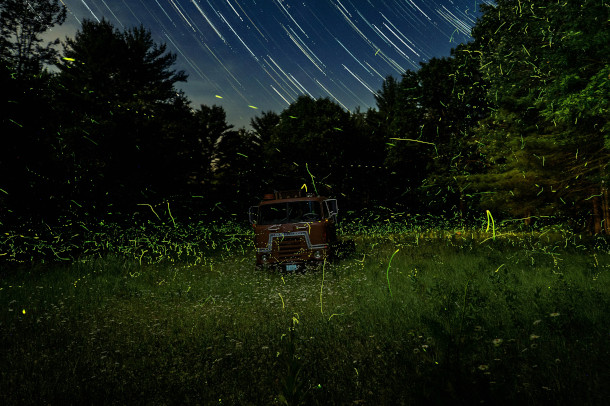
The streaks of light in this 30-minute timelapse image show fireflies in a Wisconsin field.

Where are the fireflies of our childhood? Although the population perked up around here this past summer, possibly because of all the rain, firefly lovers have reason to be worried about the long term. Today’s story explains what’s going on — and how we can all help.

Eric Berger writes at the Guardian, “Max Vogel, a 29-year-old public defense attorney, was picnicking with friends in early August at Prospect Park in Brooklyn, New York, when he noticed flashes of light appear in the air around him.

“They were fireflies, bioluminescent insects that the Washington DC native had not seen while living in Oregon, where there are few, if any. For many Americans who live where fireflies do, their flashing lights at dusk are a tangible rite of summer – though one that may now be under threat. …

“Vogel said, ‘It’s like a shooting star that just is surprising and gives you the childlike wonder of how you felt when you first saw fireflies in your yard.’

“Even in areas of the US where there are typically fireflies, people are especially excited to see them this year because there appear to be more this summer after a steady decline in recent years, according to scientists.

“Despite that welcome news, researchers caution that it does not necessarily signal a reversal of the downward trend. They remain concerned about the long-term viability of the firefly family, which includes more than 2,000 species, some of which are at risk of extinction due to factors such as light pollution and climate change.

“ ‘It’s been really uplifting to hear all of the reports of huge increases in fireflies,’ said Candace Fallon, senior endangered species conservation biologist for the Xerces Society for Invertebrate Conservation. ‘But they are also insects, and insects are notorious for having populations that bounce up and down each year, and so it’s hard to say that their populations are increasing from a single year of data.’

“Fireflies, also known as lightning bugs, are beetles that come out at night during summer and produce a bioluminescent gleam, primarily to attract a mate.

“Cultures around the world treasure the bugs, including in Japan, where they are symbols of love and fallen soldiers.

“ ‘Catching fireflies is a relatively harmless thing that you can do that really connects you to your natural world,’ said Matt Schlesinger, chief zoologist with the New York Natural Heritage Program, which is participating in a project to identify which firefly species occur in state parks.

“Scientists in the US and Canada do not have baseline data on firefly species, which makes it difficult to quantify how much the population has decreased, and they must instead rely on anecdotal reports and documented habitat loss, which point to a downward trajectory, Fallon said.

“She and other researchers conducted a study published in the journal PLOS One which found that 18 species in North America are threatened with extinction. But the scientists also did not have enough data on more than half of the assessed species to determine their extinction risks. …

“The primary factor behind fireflies’ decline is habitat loss and degradation, according to the Xerces Society. That includes land being disrupted by development, light pollution and pesticide use. Artificial lighting at night makes it hard for the bugs to communicate and mate, Fallon said.

“Climate change, including an increase in droughts and rising sea levels, also affect firefly populations, she said.

“Still, there are some firefly species that appear to be doing ‘just fine,’ Schlesinger said [adding that] the kinds that specialize in particular habitats are the ones struggling. …

“ ‘If they can still have a big year, at least those species are probably doing fine and have the potential to recover,’ Schlesinger said. That said, ‘any single year doesn’t tell you about the long-term trajectory of firefly populations. …

“Kids should continue the tradition of venturing out with jars in the summer but should then release the bugs rather than collecting them, Schlesinger said.

“Other ways to help fireflies survive include: not using pesticides, reducing artificial lighting at night, and allowing the grass to grow long and the leaves to pile up in your yard.

“ ‘A lot of fireflies pupate in leaves, and so when we rake those and put them in bags, we’re destroying their habitat at a very small scale,’ Schlesinger said.

“Despite the concerns about extinction, Fallon is encouraged by master gardeners in Arkansas who created a firefly sanctuary, and by lawmakers in Maryland who approved legislation earlier this year which introduces new regulations on what type of lighting can be bought with state funds. …

“ ‘I think we have enough time to make a difference.”

More at the Guardian, here. See also the radio show Living on Earth, here.
Read Full Post »

Photo: Kim Willsher/The Guardian.
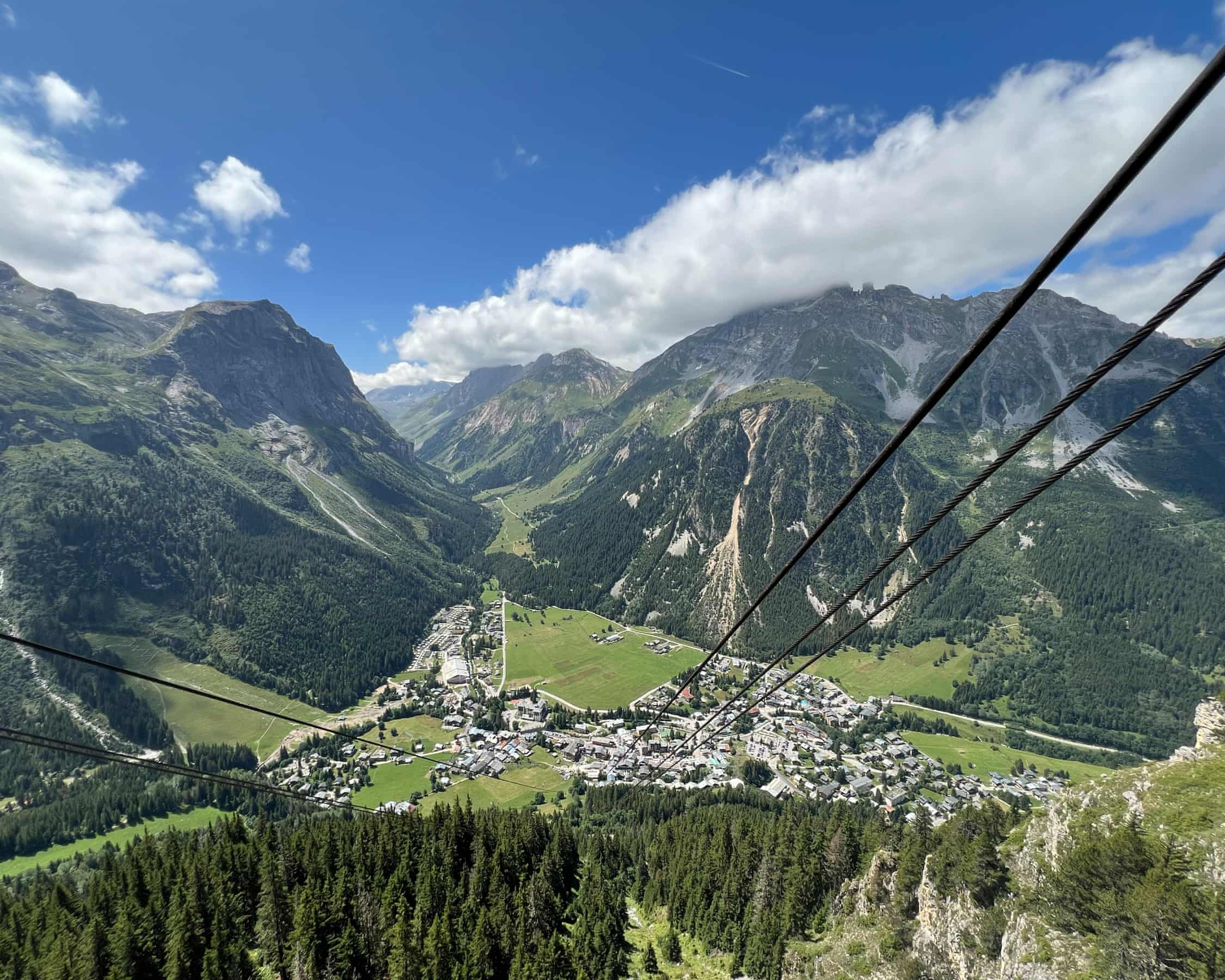
Pralognan-la-Vanoise in the French Alps is in danger from global warming. An engineering operation to prevent catastrophic flooding will cost about €400,000 ($465,000). 

As discouraging as it is to read another story about global warming, one has to feel a little hopeful that human ingenuity keeps tackling its effects.

Kim Willsher reports at the Guardian about how engineering is fighting back in France. I leave it to you to decide whether putting humans first or the glacier first would be best.

The villagers of Pralognan-la-Vanoise in the French Alps know well the perils posed by the mountains that encircle them. Avalanches, rockfalls, mudslides, sudden crevices and torrents of water are within the living memory of most villagers, and every day the climate emergency throws up new dangers.

“Less than a year ago, an enormous lake formed by a melting glacier was discovered high above Pralognan that experts feared could inundate the village with more than 60,000 cubic metres [15,850,000+ gallons] of icy water. …

“As used to natural hazards as local people are high up in the Alps, they are not, however, an idle threat. The Swiss village of Blatten was wiped out by a rock and ice avalanche in May and last year a mountain lake swollen by heavy rainfall caused torrential flooding in La Bérarde in the Isère, forcing inhabitants to flee the hamlet. They have not returned.

“Today, an engineering operation is under way to prevent such a catastrophic scenario in Pralognan. Three workers have been helicoptered to the Grand Marchet glacier at an altitude of 2,900 metres [1.8 miles] to gouge a [narrow] ‘overflow channel’ in the ice. …

“ ‘The aim is to help the water find its way down the mountain gradually and avoid a rapid emptying of the lake,’ said David Binet, the director of the mountain land restoration service (RTM) for the northern Alps, part of the national forestry commission tasked with identifying and preventing natural hazards.

“ ‘What causes the problems and damage with torrents in the mountains is not the water but the stones, gravel, sand and even large rocks it brings down with it.’

“The glacier blocks the lake from spilling down the mountain but it is shrinking at a rate of 2 to 3 metres [6.6 to 9.8 feet] a year. There is also the risk that that the warmer waters of the lake could form a channel gush from underneath.

“Binet said his agency was examining 300 of the estimated 600 lakes in the Alps and Pyrenees one by one for such hazards. The Pralognan operation will cost about €400,000 [$465,000)]. …

“The idea of taking mechanical shovels to glaciers already shrinking at an alarming rate was deemed the least environmentally damaging option. Olivier Gagliardini, a glacier expert at Grenoble University, described it as ‘unfortunate, but necessary.’

“Martine Blanc, the mayor of Pralognan, said … ‘We asked ourselves could it wait but on the principle that prevention is better than cure we decided to go ahead,’ she said. ‘We decided to anticipate events rather than suffer them. Nature is nature and there’s no such thing as zero risk.’ …

“Local shopkeepers say the number of tourists and hikers this summer is down, possibly because the campsite is closed, but Silvere Bonnet, the director of the tourist office, said he had had very few calls from potential visitors concerned about the lake. …

“On a sunny day, the giant rock faces etched with shimmering cascades that rise almost vertically have a benevolent beauty. An hour later in a rapid change of atmosphere, the peaks are cloaked in dark clouds and loom intimidatingly.

“ ‘They can appear rather menacing at first to visitors because they are so sheer,’ [Bernard Vion, a 66-year-old Alpine guide who has watched the expanse of water grow and the mountain change over his lifetime] said. The 66-year-old knows these mountains ‘like his pocket,’ as the French say. He made his first high-altitude climb aged eight with his father, also a guide. Both his grandfathers were Alpinists.

“Vion first spotted what he describes as ‘a puddle’ of water on the Grand Marchet glacier in 2019. Every year since he has watched it grow; it now measures almost 2.5 acres. …

“ ‘We are on the frontline of climate change here. We know it is happening,’ he said.

“Blanc agreed. … ‘People here are used to natural hazards. We’re used to avalanches, falling rocks, torrential floods and mudslides because we’ve seen them and lived with them since we were young. Local people understand there are things we can control and then those we cannot.’ ”

More at the Guardian, here.

Read Full Post »

Photo: Mike Householder/AP.
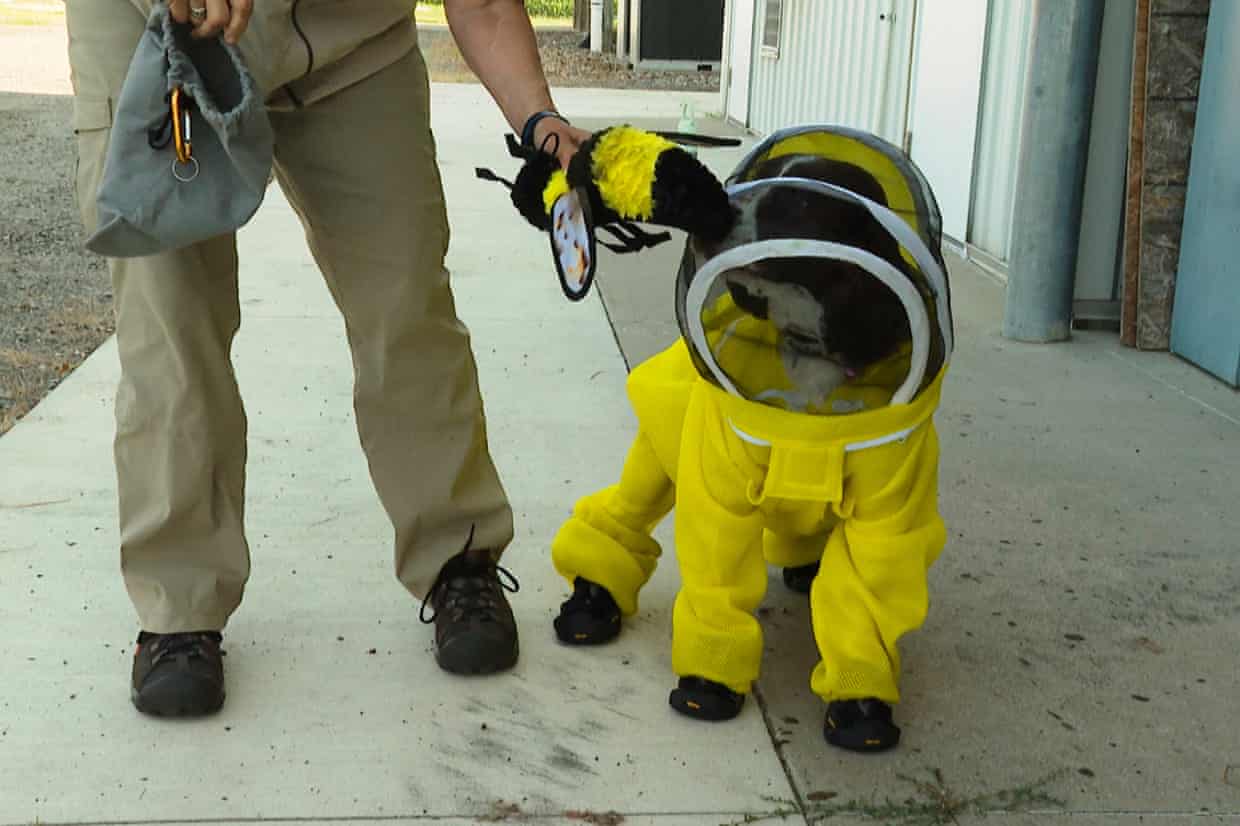
Sue Stejskal lets Maple, an English springer spaniel, sniff a bee-themed dog toy at Michigan State University’s Pollinator Performance Center. Maple is part of an effort to screen and diagnose diseases that sicken honeybees.

It seems that over the past few years, I’m hearing more and more about bees — their importance to the food chain, their worrisome diseases. On Instagram I’ve been following the intrepid Erika Thompson @texasbeeworks, and after Sandra told me about an inspiring bee tour, I added @bodhis.bees in Rhode Island. Then, there’s my friend AJ, who shares honey from his hives when the black bear leaves them alone.

Keeping bees and other pollinators healthy is an important job that’s getting increasingly difficult as unaware humans damage their environment. In today’s story, a specially trained dog is helping protect bees.

Ramon Antonio Vargas reports at the Associated Press via the Guardian, “Maple, a springer spaniel aged nine, is earning news headlines by helping Michigan State University (MSU) researchers identify bacteria that is harmful for bee colonies. …

“Maple landed the role after spending seven years detecting human remains for a sheriff’s office. She had to retire from the sheriff’s office after suffering an injury on the job – leaving her handler, Sue Stejskal, in search of something to keep Maple busy.

“ ‘She’s a very over-the-top, enthusiastic, sometimes hard-to-live with dog because of her energy level,’ Stejskal, who has been training dogs for law enforcement and other uses for more than 25 years, said to the AP.

“Fortunately for Stejskal, MSU professor Meghan Milbrath was seeking out tools to screen and diagnose diseases that sicken honeybees, which her lab studies. A veterinarian who had taken part in a training about honeybees later put Stejksal and Milbrath in touch.

“And soon, the pair hatched a plan by which Stejskal taught Maple to apply her police canine detection methods in beehives to uncover American foulbrood – a bacterial disease that poses a deadly threat to honeybee larvae.

“The work Maple has since done for MSU’s Pollinator Performance Center has been crucial, with bees and other pollinators in a years-long decline stemming from diseases, insecticides, a lack of a diverse food supply and climate change driven by human emissions of greenhouse gases.

“ ‘American foulbrood [harms] young developing bees, and when a hive gets infected, it actually basically leads to death,’ Milbrath, an assistant professor in MSU’s entomology department. …

” ‘Beekeepers have had to burn tens of thousands of dollars of equipment due to this disease,’ Milbrath said to WILX.

“Maple carries out her duties in a distinctive, yellow protective suit. Her gear includes a veil for her head and four bootees worn on her paws to shield Maple in case she steps on a bee. …

“About 465 bee species are native to Michigan alone. Among the goals of training Maple to spot American foulbrood for the Pollinator Performance Center was to create a guidebook with which other dogs could be similarly taught, WILX noted.

“Stejskal told the AP, ‘I was over-the-moon excited because my dog would have joy in her life and would still be able to work,’ Stejskal said.” More at the Guardian, here.

You probably know there are things we can all do to help bees.

Many homeowners, for example, are giving up pesticides and herbicides. They are leaving the leaves on their lawns in fall to provide pollinator habitat in spring, and they’re committing to No Mow May. After all, as Bee City tells us, “The start of the growing season is a critical time for hungry, newly emerged native bees. Flowers may be hard to find. By allowing it to grow longer, and letting flowers bloom, your lawn can provide nectar and pollen to help your bee neighbors thrive.”

Please add bee tips if you know of some not covered here.

Read Full Post »

Photo: Nick Ut / AP.
A blue whale, the largest mammal on Earth, surfaces in the Pacific Ocean near Long Beach, California.

Whether we’re talking about Jonah and the whale or Pinocchio or the lobster fisherman’s uncomfortably close encounter in 2021, we humans have always been fascinated by the largest mammals on Earth. And the blue whale is the most massive of them all. But what is going on with Leviathan of late?

Shola Lawal writes at Al Jazeera that it is not singing as much as it used to.

“Unlike our musical sounds, those produced by whales are a complex range of vocalizations that include groans, clicks and whistles and that can sound like anything from the mooing of a cow to the twitter of a bird. These vocalisations can be so powerful that they can be heard as far as 10km (6 miles) away, and can last for half an hour at a time. …

“For researchers, these complex sounds are a window into whale behavior, even if humans don’t yet know exactly how to decode them.

“The frequency of songs and their intensity can signal various things: an abundance of food, for example. In recent studies, however, researchers have been alarmed to find that blue whales, the largest whales and, indeed, the largest mammals on Earth, have stopped singing at specific times.

“Their eerie quietness, scientists say, is a signal that ocean life is changing fundamentally. The most recent study, conducted by scientists from the Monterey Bay Aquarium Research Institute in California in the US and published in February, examined three types of whales. Researchers found that blue whales, in particular, have become more vulnerable to this change.

“Whale songs are critical for communication between males and females when mating and among schools of whales migrating. …

“The first study, conducted in the sea waters between the islands of New Zealand between 2016 and 2018, was led by scientists from the Marine Mammal Institute at Oregon State University in the US. Over that period of time, researchers tracked specific blue whale vocalizations linked to feeding (called D-calls) and mating (called patterned songs).

“Researchers used continuous recordings from underwater devices called hydrophones, which can log sounds over thousands of kilometers, and which were placed in the South Taranaki Bight – a known foraging spot for blue whales off the west coast of New Zealand.

“They discovered that during some periods, particularly in the warmer months of spring and summer when whales usually fatten up, the frequency and intensity of sounds related to feeding activity dropped – suggesting a reduction in food sources. That decline was followed by reduced occurrences of patterned songs, signaling a dip in reproductive activity.

” ‘When there are fewer feeding opportunities, they put less effort into reproduction,’ lead researcher Dawn Barlow told reporters. The results of that study were published in the journal Ecology and Evolution in 2023.

“Then, in a study published in the scientific journal PLOS One in February [2025] researchers tracked baleen whale sounds in the California Current Ecosystem, the area in the North Pacific Ocean stretching from British Columbia to Baja California. Blue whales are a type of baleen whale, and the study focused on them, alongside their cousins, humpback whales and fin whales.

“Over six years starting in 2015, the scientists found distinct patterns. Over the first two years, ‘times were tough for whales,’ lead researcher John Ryan, of the Monterey Bay Aquarium Research Institute in California, noted in a press statement, as the whales, particularly blue whales, were found to be singing less. Over the next three years, however, all three whale species were back to singing more frequently, the study noted.

“Both studies found one main reason for the reduction of whale song: food or, in this case, the lack of it. It turns out that the research, conducted between 2015 and 2020, captured periods of extreme marine heatwave events that killed off krill, the small shrimp-like animals that blue whales feed on.

“Those heatwaves are part of a looming environmental catastrophe … caused by high-emission human activities, chief among them being the burning of fossil fuels. …

“Krill, which blue whales primarily feed on, are highly sensitive to heat and can all but vanish during heatwaves, the studies found. Their movement patterns also change drastically: instead of staying together, as they usually do, krill disperse when it is hot, making them harder for predators like blue whales to find.

“Typically, when foraging, blue whales sing to others to signal that they have found swarms of krill. … Heatwaves can also trigger harmful chemical changes in the oceans that encourage the growth of toxic algae, which causes poisoning and death to mammals in the oceans and sea birds, researchers have previously found, suggesting that blue whales are also at risk of being poisoned.

“In the more recent study in California, researchers found that in the first two years when whales were singing less frequently, there was also a reduction in other fish populations. …

“ ‘Compared to humpback whales, blue whales in the eastern North Pacific may be more vulnerable due to not only a smaller population size but also a less flexible foraging strategy,’ Ryan, the lead author of the California study said in a statement. …

“It is likely, both studies say, that blue whales need to spend more time and energy finding food when it is scarce, instead of singing.”

At Al Jazeera, here, you read about climate change effects on other species, too.

Read Full Post »

Illustration: Wingårdhs.
Tomelilla, a town in southeast Sweden, is focused on sustainability and has plans to build a school with reused materials.

With half of my family in Sweden for the fall semester, I am interested in Swedish stories. Here is one about residents in the Skåne district determined to live sustainably.

Abigail Sykes reports at the Guardian, “In a small town in Sweden, the local authority is carrying out an unusual experiment.

“In 2021 one of the team had been reading an article about the concept of doughnut economics – a circular way of thinking about the way we use resources – and he brought it up. ‘I just mentioned it casually at a meeting, as a tool to evaluate our new quality of life program, and it grew from there,’ says Stefan Persson, Tomelilla’s organizational development manager.

“The concept, developed by British economist Kate Raworth is fairly straightforward. The outer ring or ecological ceiling of the doughnut consists of the nine ‘planetary’ boundaries. These are the environmental limits that humans are at risk of passing – we’ve already crossed the safety thresholds on climate change, ocean acidification and biogeochemical flows, for example, but remain within safe limits on our atmospheric aerosol loading. The inner ring forms a social foundation of life’s essentials, and the ‘dough’ in between corresponds to a safe and just space for humanity, which meets the needs of people and planet. …

“ ‘Doughnut economics is like running a farm. Using an excess of resources, like nutrients, on your crops is a mistake. Not using enough is a mistake too,’ says Persson’s colleague Per-Martin Svensson, who is a farmer when he is not doing council work. …

“Doughnut economics is being used in Tomelilla, in Sweden’s southern Skåne region, in several ways. It has been integrated into financial planning and decision support, so that rather than building a new ice rink, the plan is now to revamp an existing building.

“The local government produces an annual portrait of how well it is doing at meeting doughnut economics targets. The best results in the latest diagram were on air quality, housing and social equality. Air quality in the area was good to begin with, but in order to keep improving it, young people at lower and upper secondary school have been given a free travel card for public transport. It is hoped the measure will also improve social equality in terms of access to education and health. Overcrowding and income disparities have both decreased, but it’s hard to link that directly to any of the council’s work.

“Education is a priority, but targets such as carbon emissions, biodiversity and health are more difficult to meet. Emissions have not been decreasing, but in 2023 the town council adopted a climate program to achieve net zero by 2045. …

“Tomelilla’s flagship doughnut economics project, though, is planning a new school. The council hasn’t built a school – or any other big development – since the 1990s. The project is still at an early stage so no decisions have been made about the final construction.

“Last year, a consultant report made recommendations for the project. These included using existing and carbon-neutral materials as far as possible, growing hemp as a building material on the current site; building the school around a greenhouse for growing vegetables as well as for educational and social activities; and making the school an off-grid energy producer using solar power and batteries. …

“This vision has carried over into the council’s procurement requirements, although budget constraints and other considerations have meant it is still unclear whether all of these ideas will come to fruition. …

“It has certainly been demanding. Is it even possible to use the resources needed for a large construction project and stay within the doughnut? Persson thinks it may not be possible but he is focusing on the bigger picture, with a more holistic view of social change. ‘In individual projects, there are always trade-offs. But we’re also looking at how the local community as a whole can move towards the doughnut model. I think that if we’re going to build anything, it should be democratic meeting places and schools.’ …

“Tomelilla is the first local government to attempt to deliver infrastructure and education using doughnut economics. … With a population of about 7,000, it is certainly one of the smallest towns in the international network of the Doughnut Economics Action Lab, dwarfed by Barcelona, Glasgow and Mexico City, which are all putting Raworth’s theories into practice in local governments. …

“The people of Tomelilla welcome the challenge and are extremely proud of the way their town is forging a path. As Jonna Olsson, one of the staff at the council says: ‘Doughnut economics is a really interesting way to work with sustainability. It feels cool to be a cog in international change.’ ”

More at the Guardian, here. No firewall.

Read Full Post »

Photo: Niharika Kulkarni/AFP via Getty Images.
People fill up their bottles from a water tank on a hot summer day in Varanasi, Uttar Pradesh, India.

We are all experiencing a new level of heat wave.Where I go in the summer, sea breezes used to be enough to cool us down, but no more. Some places, however, are experiencing the new intensity more than others. Parts of India, for example, were pretty hot in the first place, and global warming has made it worse.

Charlotte Steiner, Sameer Kwatra, and Prima Madan write at the Natural Resources Defense Council (NRDC) about new Heat Action Plans (HAPs) in parts of India.

“As India grapples with yet another season of intense heat, the cities of Churu, Rajasthan, and Varanasi, Uttar Pradesh, are taking action to strengthen local preparedness and resilience. These cities launched their comprehensive Heat Action Plans (HAPs) in May of this year. Developed in collaboration with city authorities, health experts, and [NRDC] partners — Mahila Housing Trust (MHT) and Indian Institute of Public Health-Gandhinagar (IIPHG) — the Churu Heat Action Plan and Varanasi Heat Action Plan represent a significant milestone. …

“For Varanasi and Churu, building resilience to extreme heat is critical. Varanasi, a city of significant cultural and spiritual importance, gets more than 85 million tourists and pilgrims every year and has been grappling with worsening heat waves, year over year. In 2024, the city recorded a scorching 47.2 degrees Celsius (117 degrees Fahrenheit) — the highest temperature in 140 years. Churu, often referred to as the gateway to the Thar Desert, is not only one of the hottest places in India, but it is also particularly at risk for extreme heat events. …

“Historically, HAPs did not include climate projections to highlight the future increase in temperatures to assess risk. However, without concrete data on future projections, it’s hard for city officials and policy makers to move from planning to long-term action. Including robust climate analysis in HAPs strengthens the scientific credibility of the HAP, as well as helping city officials and urban planners to justify budget allocations for long-term heat resilience. It also builds a case for investment in public health and infrastructure to plan for not just saving lives today but reducing the risk over the long run.

“Both the Churu and Varanasi HAPs include tailored climate analysis in addition to a detailed assessment of historical trends (typically included in HAPs), highlighting rising baseline temperatures during both the day and night. The climate analysis for the two cities revealed that, by 2049, the temperatures in Churu are projected to increase by approximately 3.89 degrees Celsius and in Varanasi, by an additional 3.29 degrees Celsius. This could imply more days above 45 degrees Celsius, longer heat waves, and more nighttime heat stress. These HAPs also incorporate the U.S. National Oceanic and Atmospheric Administration Heat Index, which combines air temperature and relative humidity to indicate how hot it actually feels to the human body and thereby highlight the human thermal discomfort more realistically.

“Based on hyperlocal analysis, these HAPs also identify specific hot spot areas or account for localized vulnerabilities; they also include ward-level geographic information system (GIS) spatial vulnerability assessments, offering a detailed view of how extreme heat impacts different parts of each city differently. These assessments will help local authorities target interventions more effectively and equitably as they work on implementing each HAP.  …

“Timely early warnings, joint response protocols, and localized capacity building are essential to reducing heat-related morbidity and mortality and maintaining critical services during peak summer months. Keeping up with this expectation, the Churu and Varanasi plans embed institutional accountability by outlining a detailed stakeholder responsibility matrix. This framework defines clear roles, timelines, and coordination mechanisms across state, district, and municipal levels, ensuring that each actor — from government departments to civil society — knows when and how to act.” More at the nonprofit NRDC, here.

NRDC articles are quite technical and full of data charts, but even I can understand the drift, and I hope you find it interesting. I think every town in the world is going to need a HAP.

Read Full Post »

Older Posts »