Feeds:
Posts
Comments

Posts Tagged ‘music’

Photo: Peace Tracks.
Sandra Rizkallah and Tom Pugh, founders of Plugged In Band and Peace Tracks, at a 2024 United Nations event for the International Day of Education.

We used to say in the sixties that education should get the mega funding and the Defense Department hold a bake sale, instead of the other way around. (Humor paper the Onion gets the idea here.) Nothing has changed. The worthy cause described below has been defunded by our government and is now looking for alternate benefactors.

James Sullivan had the story for the Boston Globe. It’s about a Massachusetts peace group that makes music with teens from war-torn countries.

“Tensions are running high across the globe, but the couple behind the Needham-based initiative Peace Tracks are doing what they can to alleviate some of that through collaborative songwriting workshops. Launched during the pandemic, Peace Tracks is an offshoot of Sandra Rizkallah and Tom Pugh’s nonprofit Plugged In Band, which has been connecting students who want to form rock bands for 24 years.

“After a harrowing hospitalization with COVID in 2021, Rizkallah went home to recuperate.

” ‘It was a time for me to dream, to play, to do something I always wanted to do,’ she said. That’s when the couple came up with the idea for Peace Tracks.

“The new program focuses on teenagers living in conflict-torn regions, including Ukraine, Palestine, Lebanon, and refugee camps in Jordan and Berlin. Interacting online with the help of Peace Tracks facilitators, the students learn to practice empathy and compassion while writing and recording music together.

Peace Tracks was recently named one of the world’s 100 ‘brightest education innovations’ by the Finland-based HundrED Foundation.

“Working with students from around the world ‘forces you to get out of your bubble and think about bigger problems,’ said [Ali Belamou, a 16-year-old who lives in Morocco]. ‘The conversations are deep, personal, and intimate.’

“His classmate, Ismail Sebai, said he has learned English as a second language primarily through music and movies. He counts Brent Faiyaz, Bryson Tiller, and Drake among his favorite rappers. …

“Joining the students on the call was Afifa el Bassim, their English instructor. … With the Peace Tracks program, ‘we give them the freedom to say what they want,’ she said of the students. …

” ‘Another educator on the call, Gideon Gichiri, has been working with the Peace Tracks program in a refugee community in Berlin. A native of Kenya, he moved to Germany in 2022. After meeting Rizkallah and Pugh when they were visiting Berlin, he introduced the group’s work to the Sprach Café, a space for immigrants to learn German.

“Music, he said, truly is a universal language. ‘When the world is very fast, music slows it down,’ he said.

“Luke Flinter is an aspiring rock musician growing up in Falls Church, Va. He said that each Peace Tracks participant contributes what they can to the songwriting process. Some who have musical skills may cut instrumental tracks for their fellow students to write to. In some cases, he said, ‘I would edit their guitar parts or re-record what they did.’

“Others in these small groups — typically four to eight teammates, plus facilitators — might use their phones to record footage for videos.

“Flinter spent some of his young life in Abu Dhabi, before his family settled outside of Washington, D.C. Peace Tracks, he said, ‘proves what I already thought: that music transcends every cultural and racial boundary.’

“Rizkallah has always felt compelled to seek antidotes to world conflict, she said. Her mother was a Holocaust refugee who instilled in her ‘not a sense of being a victim, but more a humanitarian. My mom was always helping people, regardless of who they were or where they came from.’

“Peace Tracks launched in late 2023 with students from the US, Jordan, Morocco, and Palestine. One week later, the war in Gaza began.

“ ‘It’s been moving for all of us to see how the program has positively impacted everyone,’ Rizkallah said, ‘but especially the youth in Palestine. They felt unheard.’

“ ‘Peace Tracks gave me hope,’ said Faris, a Palestinian student from Ramallah who wants to study international relations, in an email. ‘I saw students from many countries working toward one goal. … ‘That experience showed me that people who care still exist.’

“Until June, Peace Tracks was funded by a two-year US State Department grant. … The group is currently working to develop fund-raising through other resources.

“In September, Rizkallah and Pugh traveled to the United Nations General Assembly in New York City, where they attended a discussion about ‘leading in messy times,’ Rizkallah explained. Among other things, she learned that sometimes it’s better to plunge into your project and set your course as you go. ‘You don’t have to have everything figured out,’ she said. ‘You might have to do it messy. That really had a deep impact on me. … ‘It’s been challenging, [but we] wholeheartedly believe in this mission.’ ”

More at the Globe, here.

Read Full Post »

Photo: Lorianne Willett/KUT News.
Dr. Tyler Jorgensen sets “A Charlie Brown Christmas” on a record player at Dell Seton Medical Center in Austin, Texas. He uses vinyl records as a form of music therapy for palliative care patients.

We’ve had a lot of posts about how playing music from a patient’s youth affects those with dementia. It’s like watering a dry plant. The patient perks right up and often starts singing along. Now a doctor in Texas has found that old musical memories have a pleasing affect on people in palliative care, too.

Olivia Aldridge writes at National Public Radio [NPR], “Lying in her bed at Dell Seton Medical Center at the University of Texas at Austin, 64-year-old Pamela Mansfield sways her feet to the rhythm of George Jones’ ‘She Thinks I Still Care.’ Mansfield is still recovering much of her mobility after a recent neck surgery, but she finds a way to move to the music floating from a record player that was wheeled into her room.

” ‘Seems to be the worst part is the stiffness in my ankles and the no feeling in the hands,’ she says. ‘But music makes everything better.’

“The record player is courtesy of the ATX-VINyL program, a project dreamed up by Dr. Tyler Jorgensen to bring music to the bedside of patients dealing with difficult diagnoses and treatments. …

” ‘I think of this record player as a time machine,’ he said. ‘You know, something starts spinning — an old, familiar song on a record player — and now you’re back at home. …

“The man who gave Jorgensen the idea for ATX-VINyL loved classic rock. That was around three years ago, when Jorgensen, a long-time emergency medicine physician, began a fellowship in palliative care — a specialty aimed at improving quality of life for people with serious conditions, including terminal illnesses.

“Shortly after he began the fellowship, he says he struggled to connect with a particular patient. …

“He had the idea to try playing the patient some music.

“He went with ‘The Boys Are Back in Town,’ by the 1970s Irish rock group Thin Lizzy, and saw an immediate change in the patient.

” ‘He was telling me old stories about his life. He was getting more honest and vulnerable about the health challenges he was facing,’ Jorgensen said. …

“Jorgensen realized records could lift the spirits of patients dealing with heavy circumstances in hospital spaces that are often aesthetically bare. And he thought vinyl would offer a more personal touch than streaming a digital track through a smartphone or speaker.

” ‘There’s just something inherently warm about the friction of a record — the pops, the scratches,’ he said. ‘It sort of resonates through the wooden record player, and it just feels different.’

“Since then, he has built up a collection of 60 records and counting at the hospital. The most-requested album, by a landslide, is Fleetwood Mac’s ‘Rumours’ from 1977. Willie is also popular, along with Etta James and John Denver. And around the holidays, the Vince Guaraldi Trio’s ‘A Charlie Brown Christmas’ gets a lot of spins.

“These days, it’s often a volunteer who rolls the record player from room to room after consulting nursing staff about patients and family members who are struggling and could use a visit. …

“Often, the palliative care patients visited by ATX-VINyL are near the end of life. Jorgensen feels that the record player provides an interruption of the heaviness those patients and their families are experiencing. Suddenly, it’s possible to create a new, positive shared experience at a profoundly difficult time. …

“Other patients, like Pamela Mansfield, are working painstakingly toward recovery. She has had six neck surgeries since April, when she had a serious fall. But on the day she listened to the George Jones album, she had a small victory to celebrate: She stood up for three minutes, a record since her most recent surgery. With the record spinning, she couldn’t help but think about the victories she’s still pursuing.

” ‘It’s motivating,’ she said. ‘Me and my broom could dance really well to some of this stuff.’ “

More at NPR, here. For a different angle on music at the end of life, check out a Guardian story on a documentary about the Threshold singers, here.

Read Full Post »

Photo: Erin Trieb for NPR.
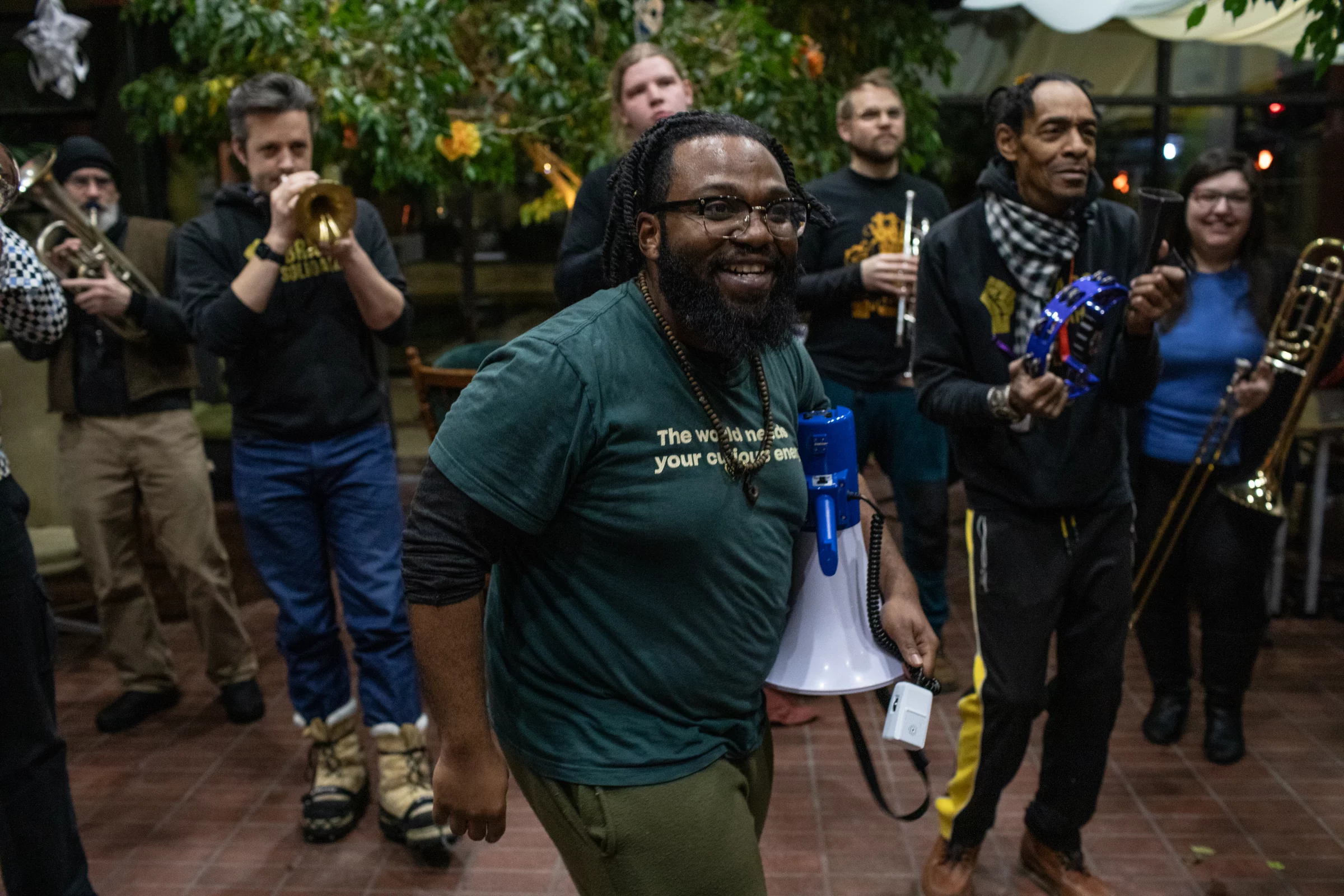
Alsa Bruno (center) sings with Brass Solidarity, a band founded in 2021 in response to the killing of George Floyd. Above, you see them practicing at a community center in Minneapolis, Minnesota, Jan. 19, 2026.

You have probably noticed how much music is in the air around Minneapolis these days: songs of love, agape, hope, unity, and resistance. Suzanne sent me the one that Bruce Springsteen wrote, which is brand new, but some of the songs go back to the civil rights movement of the 1960s, to slave songs, folk music, and gospel.

Recently on Instagram I heard Brass Solidarity play “Don’t Let Nobody Turn You ‘Round,” and I thought, “Oh, I know that one! We used to sing it in the ’60s!”

Brass Solidarity has been introducing both hope and a joyful sense of connection into government-instigated chaos in Minneapolis. So I went online to learn more about them. In a 2023 report from Minnesota Public Radio, here, Minneapolis teacher and band member Natalie Peterson observed, “there’s a lot of work that can be done through energizing people and just bringing a joyful energy to something that can be incredibly hard.”

Last week, Kat Lonsdorf and Megan Lim added more at NPR: “Raycurt Johnson strolls into a local theater in south Minneapolis, shaking off the cold. He’s carrying a tambourine in one hand and a bullhorn in the other.

” ‘I was born in the civil rights era, and I’m still doing that,’ the 65-year-old says with a laugh.

“Around him, other musicians unpack their instruments, mostly brass: tubas, trombones, trumpets. Together they make up a community band called Brass Solidarity, formed in the aftermath of the 2020 murder of Minneapolis resident George Floyd by police officer Derek Chauvin. … The band plays once a week in George Floyd Square, where the killing occurred. When Renee Macklin Good was killed by a federal immigration agent earlier this month just blocks from there, the band started playing music in her memory as well. …

“The following week, Brass Solidarity was at Good’s memorial site, playing for people gathered there. ‘It was really interesting because there was a lot of mournfulness coming in, but people were rocking with us, and jamming with us,’ says Daniel Goldschmidt, another member of the band, who plays the melodica. …

“Since then, Brass Solidarity has turned out for several anti-ICE protests, and updated their repertoire a bit to include critical lyrics about ICE and other federal agencies. Goldschmidt, a practicing music therapist, says the music isn’t just about bringing the mood up in an otherwise depressing environment – it also helps calm people down, at a time when many are angry. Which is especially helpful [amid threats] to deploy the military to Minneapolis.

” ‘Street band music has the ability to bring down the temperature in spicy situations on the street during protests,’ Goldschmidt says.

“The band has been playing even as the temperatures have hovered well-below freezing. … ‘[But] the horns lock up. Someone’s here with a wooden clarinet right now. That’s not gonna work when it’s cold,’ says Alsa Bruno, a singer with the band. ‘And yet, we show up.’

“In recent days, the band has been meeting and playing indoors, as the weather has dropped into the negative single digits. But members are still showing up at outdoor events, banging drums or singing into bullhorns.

” ‘This is not a moment for us to give in to insecurity. It’s actually the moment that we get to stand together in the cold, knowing we’re all cold, being arm in arm, knowing that this weather is just weather,’ says Bruno. ‘It’s temporary. We’re forever.’ “

Finally, in case you missed it: the spirit of folk singer Woody Guthrie has returned, with Resistance Revival Chorus belting out his song “All You Fascists Bound To Lose.” In fact, you may be hearing other Guthrie anthems again, not just “This Land Is My Land.” There’s another one mourning Mexican migrants who died being deported. We are relearning from the singer who was ahead of his time that eternal vigilance is the price of liberty.

See the 2025 PBS report on the Guthrie revival, here.

Please add music that speaks to you just now.

Read Full Post »

Photo: Mattias Krantz / Youtube.
Mattias Krantz taught an octopus to make music on an underwater piano.

We have all heard stories about how intelligent octopuses are. I have posted several such stories myself: for example, this one about naturalist Sy Montgomery. Today’s octopus story, however, takes the cake.

Mihai Andrei writes at ZME Science, “Mattias Krantz is a YouTuber with a penchant for bonkers engineering and musical projects. … This is the story of Tako, a common octopus rescued from the frying pan, and how it came to play musical notes on an underwater piano. …

“Krantz approached the project with the naive optimism of a doer. His hypothesis was simple: if playing the piano requires finger independence and multitasking, an octopus should technically be the most dexterous player on Earth.

“We humans are centralized creatures. Our brain sits in our skull like a CEO in a penthouse, barking orders down the spinal cord to the rest of the body. The octopus is different. They are the result of convergent evolution — intelligence evolving on a completely different branch of the tree of life. Sometimes, an octopus’ arm will make its own decisions, without consulting the brain. And we’re not talking about reflex.

Octopus arms can fully make some decisions all by themselves.

“Krantz … hooked up a system of lights. He tried to teach Tako that hitting a lighted key meant food, a method that previously worked on chicken.

“It was a disaster.

“Tako simply ignored the keys and the lights. He dismantled the equipment. He did what octopuses do best: he investigated the environment on his own terms.

“This failure illustrates a critical concept in animal behavior science: the Umwelt. It’s the self-world of the animal. We humans are visual creatures; we love lights and screens. Octopuses are tactile and chemical creatures. Trying to teach an octopus using visual cues designed for a human is like trying to teach a human to read using only smells. It doesn’t matter how smart the student is if the teacher is speaking the wrong language.

“Or, as Krantz put it, he was ‘trying to apply chicken logic to an octopus.’ …

“Octopuses explore the world by grabbing and retracting. They are ambush predators and foragers; they reach into crevices and pull out crabs. So instead of piano keys, he built a custom piano with levers instead of keys.

“But that was only half the battle. The other half was the ‘crab’ elevator.

“Tako loves eating crabs. This was his favorite reward. So, Krantz built a contraption where Tako had to pull a piano lever to lower a tube containing a crab. … It turned the piano from an instrument into a puzzle. And if there is one thing cephalopods love, it is a puzzle. But he added a twist: the crab would only lower slightly. To get the crab all the way down, Tako had to hit the right notes in sequence.

“Suddenly, the ‘eight pianists in one body’ began to coordinate. With the right motivation and mechanism, Tako organized and started to create sounds. Not just noise, but deliberate activation of sound to achieve a result. …

“Octopuses lack ears and are deaf to the soaring melodic frequencies (treble and mid-range) that make up the ‘music’ we hear. However, they possess balance organs called statocysts that allow them to detect low-frequency vibrations (roughly 400Hz–1000Hz) and particle motion in the water.

“Tako wasn’t ‘jamming’ or appreciating the blues. To Tako, the piano wasn’t an instrument of expression but rather a [vending machine] that ‘thudded’ when he hit the right combination. … He may have enjoyed the activity to some extent, and definitely seemed to enjoy the puzzle-solving part, but we can’t say he was creating music.

“Still, the most poignant part of this story isn’t the music. It’s the relationship. We have a dark history of underestimating animals until we give them a name. In the lab, they are subjects. In the market, they are food. But in the home, they become individuals.

“As the experiment progressed, Krantz realized he wanted what was best for Tako. But he probably wouldn’t have survived if he was sent back into the ocean. The experiment created a bond. The ‘subject’ became a ‘who.’ Tako may not be Rachmaninoff, but he was Tako; not food.

“So, the musician decided Tako will live with him from now on.” More about what that entailed at ZME Science, here.

Read Full Post »

Photo: Chris Leee.
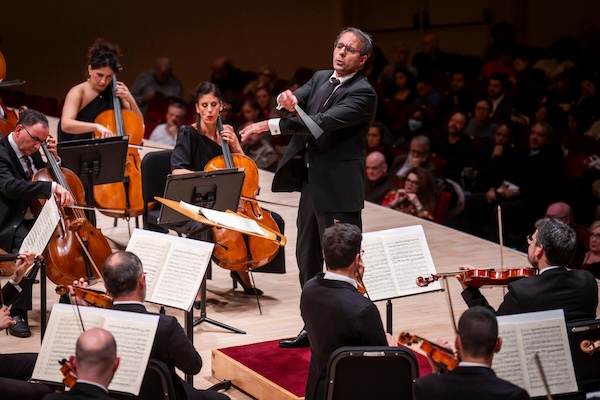
Saleem Ashkar conducted the Galilee Chamber Orchestra last November at Carnegie Hall. The orchestra has equal numbers of Arab and Jewish musicians.

Looking for a bright spot in the frightening new world order? No need to go farther that the Galilee Chamber Orchestra and the reasons why people of good will were determined to make music with equal numbers of supposedly hostile tribes.

David Patrick Stearns wrote at the Philadelphia Inquirer last fall, “On the face of it, the Galilee Chamber Orchestra could be an impossible meeting of musical minds.

“Comprising ‘equal numbers of both Jewish and Arab musicians,’ as its website notes, the orchestra has a 13-year history, and is now on a high-prestige tour with celebrated pianist Bruce Liu that includes the Kimmel Center on Nov. 19 and New York’s Carnegie Hall Nov 20.

“Based in Nazareth (known as the ‘Arab capital of Israel’), the orchestra’s common ground on this tour includes Mozart among other composers whose nationalities, from centuries past, now feel like neutral territory — while still speaking to the present.

“ ‘Classical music has become something that belongs to the world. If you go to Japan or Brazil, they feel that Mozart and Beethoven belong to them as much as anybody else.’ … said Nabeel Abboud-Ashkar, executive director of Polyphony Education, the conservatory where the orchestra is based. ‘Once you’re part of this cultural world, you instantly connect with so many people.’ …

“With that kind of mandate, it’s no surprise that the orchestra, in its last U.S. tour in 2022, was acclaimed for generating more sound than a typical chamber orchestra. This year, its 42 players draw from Polyphony students, faculty, graduates, and nearby professionals.

“Structurally, the conservatory/orchestra setup resembles Venezuela’s much larger El Sistema but also is meant to have an ethnicity mixture more like the Spain-based West-Eastern Divan Orchestra. Galilee Chamber Orchestra is firmly planted in its Jewish/Arab balance and in Israel, a country with a 20% Arab population.

“The tour program includes the Mozart Piano Concerto No. 23 with Paris-born, Montreal-raised pianist Liu, a 2021 winner of the International Chopin Piano Competition. The presence of Symphony No. 3 (‘Scotch’) by the Jewish composer Felix Mendelssohn isn’t meant to make a statement but is a piece the orchestra has wanted to do for a few years.

“Also, Abboud-Ashkar’s brother Saleem Ashkar, conductor of the tour, has considerable history with the composer, having also been the soloist in both piano concertos in a well-received, major-label recording with the Leipzig Gewandhaus Orchestra.

“More intentional is the inclusion of Nocturnal Whispers by Arab composer Nizar Elkhater, whose own Israel-based ensemble, named Abaad, seeks to fuse Western and Eastern musical styles

“The orchestra’s concerts haven’t been subject to the kinds of in-concert interruptions and demonstrations that have greeted the Israel Philharmonic and the Jerusalem Quartet in Europe and the U.S.

“But years of war, however, have strained the orchestra and conservatory in tangible ways. Planning is more provisional than ever. Concerts can be canceled on short notice, lessons planned to be in-person can suddenly switch to online, getting home from a European tour can be impeded and delayed by new conflict outbreaks in the Middle East.

“Among the musicians, tensions are heightened by constantly seesawing events, said Abboud-Ashkar. After the attack of Oct. 7, 2023, the whole operation was suddenly in unfamiliar territory, he said. …

“ ‘We feel everything that is happening around us,’ Abboud-Ashkar said in a Zoom interview from Nazareth. ‘Some people might think we’re being naive and ask … “How can you talk about collaboration and partnership being equal … with horrific things happening in Gaza?” …

‘We believe that what we’re doing has an impact. Even if it’s just making it a little better, we’re moving the needle in the right direction.’

“The main enemy may well be despair. Within the orchestra and conservatory, lack of hope for war resolution can turn into loss of musical motivation.

“ ‘On the other hand, there are cases where people show incredible empathy for others,’ said Abboud-Ashkar. ‘There’s a commitment to having this (musical) dialogue … and having more consideration for each other. When you’re in distress … you’re motivated to continue and to always find a way. You fight for your space and your values and hope there are still enough people out there who shared them. We’re going to stay together because this is what we believe in.’ ”

I am so touched by this idea of moving “the needle a little in the right direction.” That is all any of us can do, but we really must do it in order for all the little bits to add up. More at the Inquirer, here.

Read Full Post »

Photo: Bohdan Lozytsky.
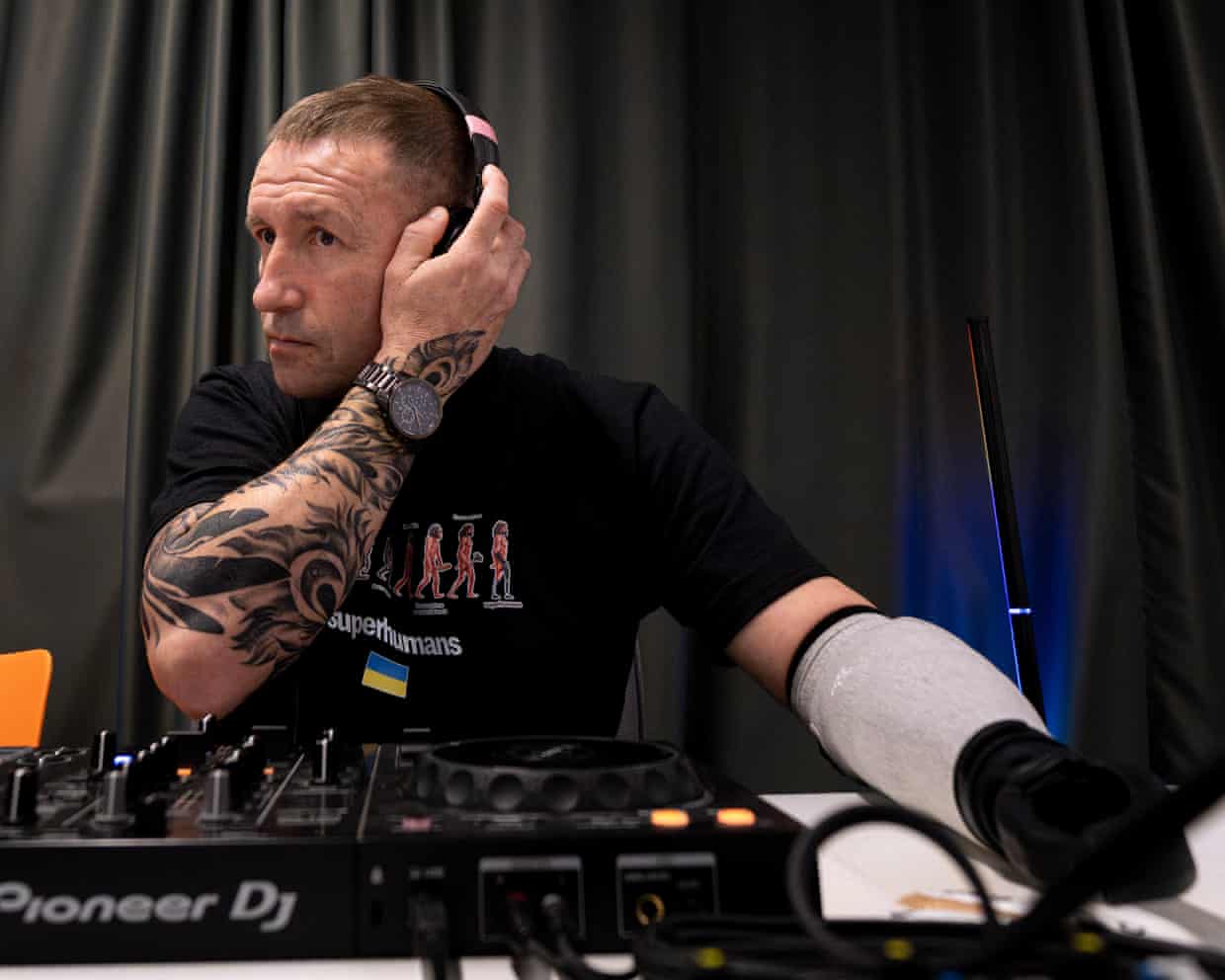
Ukraine was veteran Dmytro Melnik works with the EnterDJ system, as part of rehabilitation from trauma. 

Several of us who for a few months helped out Ukrainian journalists with social media in English befriended Vitali, who lives with his wife and little girl in Rivne and does charitable work for displaced Ukrainian women and children. We were always relieved that Vitali had not yet been called up by the army.

That changed in December, not long after Rivne, too, began suffering from Russian bombing. We worry about him because of the obvious dangers of conflict — and the PTSD some soldiers experience when they get home. I hope he never needs an intervention like the one in today’s article.

Darcie Imbert tells Guardian readers about a worthy music therapy program — EnterDJ at the Superhumans center near Lviv.

“In Ukraine, sound carries a different weight: the cautionary blurt of sirens, Shahed drones humming overhead, the concussive thwack of air defense interception and the subsequent explosion. But as well as the sounds of war, which continue three and a half years into Russia’s full-scale invasion, music still plays, clubs remain open during the day (closing well before the midnight curfew), and electronic dance music remains an intrinsic part of many Ukrainian lives. …

“The rehabilitative power of dance music is most evident at the Superhumans center, near Lviv in the west of Ukraine. Here, the most critically war-wounded are treated with prosthetics and reconstructive surgery, and psychological support is given to children and adults affected by the war. And within the range of treatment is music therapy.

“Howard Buffett, the son of Warren Buffett and one of the center’s chief funders, suggested forming a Superhumans band, so the center teamed up with music charity Victory Beats, which was set up one year into the war to provide veterans with relaxation and a nonverbal outlet for emotional expression.

“ ‘We were working with a 25-year-old soldier with severe brain damage and limited use of his hand,’ the charity’s founder, Volodymyr Nedohoda, remembers. ‘We started with a [sound-based] relaxation session designed to calm the nervous system, but stopped almost immediately because the low frequency triggered pain. When he started to feel better, he asked for a DJ console.’

“Having witnessed the efficacy of electronic music as therapy firsthand, Nedohoda and Vlad Fisun – a DJ and former editor-in-chief of Playboy Ukraine – partnered to create the EnterDJ program, which teaches veterans the basics of mixing. All that users require is a laptop, headphones and an internet connection; some tune in from home, others show up to a dedicated space in the Superhumans center. …

“Speaking with the same stoicism that underpins most of my conversations with Ukrainians, another veteran, Oleksandr, tells me about the incident that led him to Superhumans and EnterDJ. ‘I was serving in Poltava when a missile destroyed my leg,’ he says. ‘I remember everything about it. The blast, phoning my commander to say I was alive, realizing I’d have to drive an automatic car, worrying about the blood in my car after the evacuation.’ He laughs at the absurdity, and continues. ‘In hospital, I lost nearly all my blood and had to be resuscitated. I woke up knowing my leg was gone, but thankful the rest of my body and brain were OK. That’s most important.’

“For Oleksandr, EnterDJ became a daily routine, ‘to get some good moments if the day was hard, or to celebrate if I gained something in rehabilitation.’ Within six months, he was performing alongside the Lviv Philharmonic Orchestra, using a Midi controller to layer sounds over a composition written with British composer Nigel Osborne.

“Oleksandr had started off using singing bowls in a sound therapy session. … Before being fitted with a prosthetic leg, EnterDJ ‘helped distract me from the trauma and rehabbing,’ he says, holding his kind gaze steady. … ‘We have composed ambient music for therapeutic purposes; I added electronic effects to live classical instruments. The audience relaxed deeply; some even fell asleep. So we met our goal!’ …

“Roman Cherkas, who served in the Third Tank brigade in eastern Ukraine, has gravitated towards drum’n’bass. He joined the EnterDJ program after months of surgeries, prosthetics and rehabilitation at the centre, after losing both of his lower limbs in a mortar strike. He speaks to me on a call from his home, ready with a drum’n’bass mix. ‘Right now, I still don’t feel mobile, I can’t move around normally. Music has become energy for me, life energy,’ he says. …

“After six months in the program, Roman performed in Lviv at a showcase by one of the world’s leading drum’n’bass labels, Hospital Records. He speaks slowly and thoughtfully about how music shifts his headspace. He becomes completely absorbed by it, sometimes sitting in his chair mixing for six-hour stretches. ‘I tried working with psychologists but it didn’t work for me. You have to consciously switch your brain on and imagine lifting your legs, which is very difficult. With music, it’s the opposite, it switches my mind automatically and makes me feel better.’ ”

More at the Guardian, here.

Read Full Post »

Photo: Alfredo Sosa/CSM.
Community MusicWorks, a program that allows students to use stringed instruments at no cost, is shown presenting its end-of-year gala in Providence, Rhode Island.

When I was visiting Nancy on Thursday, we talked about an amazing new music hall and school in our area and how it provides free noontime concerts to all comers. My husband and I had just attended one where some of the jazz teachers performed new compositions.

Looking at the huge crowd reminded me what music means to people, and how the word “free” in connection with “music” can make a real difference in people’s lives.

Troy Aidan Sambajon reports at the Christian Science Monitor about how it can make a difference for low-income children.

“The melodies drifting from Community MusicWorks’ spacious building are more than just the sounds of young musicians practicing. They are the heartbeat of the neighborhood.

“For 28 years, an after-school program run by the Providence, Rhode Island-based nonprofit has been reimagining what access to classical music education looks like. Community MusicWorks operates in areas of the state where K-12 students might not otherwise be able to afford to play stringed instruments. The program allows students to use instruments at no cost, offers mentorship, and hosts free concerts and workshops for the wider community to attend.

“Eli Arrecis, 10, is starting his fourth season in CMW this fall. On the last day of summer camp in late July, he and his fellow campers are performing original songs for their parents, using violins, violas, cellos – and shakers they crafted out of cardboard.

“Since joining the program, Eli listens to music with a newfound appreciation and even picks up sheet music at home to read for fun. His parents hope to enroll Eli’s siblings in the program. …

“In an era when many schools’ arts budgets are dwindling, CMW offers something increasingly rare: a space where young people find joy, purpose, and camaraderie through music.

“CMW’s beginnings were modest. In 1997, while he was a senior at Brown University, Sebastian Ruth launched the program with a $10,000 grant and a vision for what he termed ‘musicianship working for positive social change.’

“Mr. Ruth grew up in Ithaca, New York, and was first inspired by a high school violin teacher, who encouraged him to think about the social and spiritual impact of music on people. He and a small team rented a tiny storefront in Providence’s West End neighborhood – one of the city’s most diverse but also most economically disadvantaged areas – and began offering free violin lessons. …

“Within a few years, CMW expanded to the building next door to accommodate its growing after-school program. Hundreds of students later, CMW has cemented its place in the neighborhood with a new state-of-the-art facility, which opened in September 2024. …

“The three-story building has a performing arts center, group practice rooms, an instrument repair workshop, and plenty of space for lessons. Financing for the $15 million project came from state and local funds, as well as individual donations.

“AlexisMarie Nelson started her CMW journey in the sixth grade in 2006. It led her to study violin and viola and to eventually graduate from the Boston Conservatory at Berklee College of Music. Now a program coordinator at CMW, she says … ‘The connections that we’re making are so important.’

“Inside the building, teens such as Cesar Mendez shuffle in and out of lessons and jam sessions. They engage in soul-searching discussions about music and identity.

“ ‘This place feels like home,’ says Mr. Mendez, an 18-year-old violist who joined the program nearly a decade ago. ‘It’s just full of life.’

“But the real impact goes beyond mastering scales. ‘The arts aren’t just about skill-building or learning to play an instrument,’ Mr. Ruth says. ‘It’s a different way of being with other people. Many communities, particularly urban communities, are just doing a disservice to the children by not having adequate opportunities to learn the arts.’ …

“Notes Cecil Adderley, chair of music education at Berklee College of Music and president of the National Association for Music Education. ‘It’s a way to model how to excel at something artistic.’

“Even if students never go pro, he adds, they’re using their creativity as well as fostering collaboration and a sense of belonging. ‘You’re learning not just how to be a musician – but how to be a better neighbor.’ …

” ‘A lot of the time, we talk just so we don’t feel alone in the questions we have,’ says Mr. Mendez, who will study biomedical engineering at the University of Rhode Island this fall.”

More at the Monitor, here.

Read Full Post »

Photo: Lou Foglia for WBEZ.
Seth Boustead of the nonprofit Access Contemporary Music in Chicago describes the location they chose for their concerts: “The door dings when you walk in, like a 7-Eleven — we left that.”

I love stories about the successful repurposing of eyesore buildings. In today’s article, WBEZ’s Graham Meyer gives an inspiring example from Chicago.

“Not everyone looks at the long-vacant husk of a former convenience store and gets visions of string quartets and piano recitals. But that’s exactly how it happened for Seth Boustead, the head of Access Contemporary Music.

“In February 2023, in a cab traveling on North Clark Street, Boustead saw the familiar sight of the empty store at 4116, once a 7-Eleven, before that a White Hen Pantry. This time, the window had a ‘for rent’ sign. After the cab ride, Boustead zipped back on his bicycle and peered in the dark windows.

“ ‘This would be an amazing chamber music venue,’ he remembers thinking. …

“ ‘It’s pretty unrecognizable [now],’ Boustead said. ‘The door dings when you walk in, like a 7-Eleven — we left that. Behind the bar, there’s still, where the grease trap used to be, a door that goes down into the floor where they used to dump grease. I found a training poster for their employees, and we’re planning to frame it and put it in the bathroom.’

“ACM, now 21 years old, has always done many different things simultaneously. It gives music lessons, has a composer collective and presents concerts, such as the annual Sound of Silent Film Festival, where it commissions and live-performs scores for modern silent films. And once a year, it throws a classical music street festival called Thirsty Ears.

“The CheckOut [aims] to put on two or three chamber concerts a week, mostly self-produced. There are incipient plans for a jazz night on Thursday and for cabaret shows to fill the void left when Davenport’s abruptly canceled all its cabarets in April. …

“Unsurprisingly, a project of this magnitude had obstacles, money chief among them. Boustead said the rent for the CheckOut is close to the three music schools’ combined. And it quickly became clear that in addition to the renovations necessary to convert the space to a music venue, they would have to make up for upkeep that 7-Eleven had inconveniently deferred. …

“Then there were the administrative hurdles. The property was zoned for single-family houses, and the area had a liquor license moratorium. Both the odd zoning and the moratorium had the effect of funneling ACM through 46th Ward Ald. Angela Clay’s office, so that she and the community could weigh in before the project began. Boustead made a presentation to the Graceland West Area Community Association about lessons, rehearsals and concerts for 60 to 100 audience members filling the empty shell.

“ ‘Folks were excited about having this kind of small cultural institution in the neighborhood, but there’s a lot of red tape the city puts up,’ said Jesse Orr, director of infrastructure and development in Clay’s office.

“Boustead started checking boxes. With some hand-holding from Clay’s office, they hacked through the permits, inspections, zoning and other city tasks. And he worked on money. ACM landed a Community Development Grant through the city’s Department of Planning and Development for $250,000. They started a capital campaign, offering naming rights for the stage and chairs. …

“[In August] Boustead assembled a preview crowd and noted the irony that 7-Elevens play classical music to prevent people from loitering. This time, the 7-Eleven left, and the classical music stayed around.

“The Palomar Trio, part of ACM’s long-standing house ensemble, played piano-violin-cello music ranging chronologically from modern Dmitri Shostakovich to the of-the-minute 42-year-old Reena Esmail. With acoustical work still to be done, the room echoed more than would be ideal, and how to manage the sound of the air conditioning against the temperature of the room hasn’t been settled. But the music filled the space nicely, the louds excitingly loud and soft effects detectable. You’d never guess it had once been slinging slushies.” More at WBEZ, here.

If you are interested, Dylan Weinert at New City Music has a review of the opening, here.

Read Full Post »

Photo: Alex Hecht for the New York Times.
A team helps Hunter Noack and his piano travel to scenic locations to give his concerts an outdoor vibe.

What I’m wondering as I read today’s story about classical piano in the great outdoors is whether the project is more about bringing nature into the concert experience or about attracting new audiences. Doesn’t it draw traditional concertgoers? Besides the whale, that is.

Sopan Deb reports at the New York Times that “for the last decade, the classical pianist Hunter Noack has been embarking on an unusual journey: He hauls a thousand-pound 1912 Steinway concert grand piano to places in the outdoors not known for hosting concerts. …

“This summer, Noack, 36, is in the midst of a 10th-anniversary tour of his ‘In A Landscape’ project, which has taken him to Jack London State Historic Park in Glen Ellen, Calif.; Black Butte Ranch in Sisters, Ore.; and Warm Springs Preserve in Ketchum, Idaho. …

“Inspired by the preservationist John Muir, Noack started the project as a way of getting closer to nature, and bringing classical music to rural areas where it is not typically accessible. The idea, Noack said, is to remove the barriers that typically limit classical music to concert venues like Carnegie Hall.

“ ‘What John Muir was trying to articulate is that we don’t just need the wild to recreate in,’ Noack said in an interview. ‘We need the wild to be human, and to be more compassionate, and to be more empathetic. And that’s the medicine that I needed. To be outside.’

“The roots of the project can be traced back to 2015. Noack, a native of Sunriver, Ore., had just moved to Portland, a couple of years after graduating from the Guildhall School of Music in London. He was working odd jobs and struggling with student debt. He considered joining the National Guard, but instead applied for a small grant from a regional arts and culture council in Portland to try an experiment. …

“After graduating from college, Noack, along with a friend from boarding school, created an immersive play in San Francisco. In London, Noack eagerly took in shows by the experimental theater company Punchdrunk.

“ ‘These theater and opera companies were really pushing the boundaries, and that’s what I wanted to do with my art: classical piano,’ Noack said.

“A traveling group of six helps Noack bring his piano to the various remote locations. The team has developed a system for moving the nine-foot instrument. The piano sits on a custom-designed 16-foot flatbed trailer, and can go anywhere that a four-wheel-drive vehicle can. Once they have arrived at a destination, the trailer turns into the stage.

“The first year, Noack rented a piano from a local dealer. But when he said he wanted to bring the rented piano to Mount Bachelor, in Bend, Ore., and the Alvord Desert, in the southeastern part of the state, the dealer did not want to take on the insurance liability. Afterward, in 2017, a philanthropist purchased and donated the piano that Noack uses today.

“Noack didn’t intend for ‘In A Landscape’ to be a full-time job, but the initial audience response was so large that he kept going. … The concerts are held rain or shine, hot or cold. (The temperature during concerts has ranged from subfreezing to above 100 degrees.)

“Among the notable locales where Noack has played are the entrance to Yellowstone (via the Roosevelt Arch in Montana), Joshua Tree National Park in California, Crater Lake in southern Oregon and Banff National Park in Canada. …

“Noack’s shows have even appeared to attract wildlife. He recalled that at a two-night run near the Oregon coast, the piano was located near a cliff. A whale swam up to shore for both performances and lingered for their entirety.

“ ‘I like to think that the whale was enjoying this show,’ Noack said.

“Among other wildlife that made appearances were free-range horses, birds and deer.

“Noack’s ambition to bring a piano to unfamiliar territory is expansive. He said he wants to perform at, among other striking sites, remote villages in Canada; at the Preikestolen, a steep cliff in Norway; during a safari in Africa; atop Vinicunca, the rainbow mountain in the Andes of Peru; and by the salt flats of Bolivia.

“ ‘My hope is that I can use this project, my love of the music and my curiosity about how public lands and natural resources are managed, to explore the world and learn,’ Noack said.”

More at the Times, here.

Read Full Post »

Photo: Thais Coy/American Flamenco Repertory Company.
Yjastros, the American Flamenco Repertory Company, performing in Albuquerque, New Mexico.

Nowadays people don’t seem to talk much about catharsis in theater: the idea that in suffering along with the actors, the audience can feel a kind of cleansing or relief.

That is what you also get experiencing the controlled rage and sorrow of music like Edith Piaf’s, Portuguese fado, or Spanish flamenco.

Today, as I’m reading about flamenco flourishing in part of the US, I’m thinking what a gift it is to be able to convert rage and sorrow into something like peace.

John Burnett reports at National Public Radio (NPR) that the state of New Mexico is “a global center of flamenco the passionate dance, song and music of the Roma people of southern Spain.

“The epicenter is Albuquerque. New Mexico’s largest city boasts a world-famous flamenco festival. … The University of New Mexico is the only American university that offers graduate and undergraduate Dance degrees with an emphasis in flamenco. The National Institute of Flamenco is home to a world-class repertory company, and a conservatory that teaches students as young as three, to young adults who want to be professional dancers.

“The popularity of flamenco has exploded in the last four decades. You can find its distinctive percussive footwork from Tokyo to Israel to Toronto. … But what’s different about flamenco in Nuevo Mexico is that it’s homegrown. New Mexico traces its deeply Hispanic identity to the arrival of Spanish settlers 400-plus years ago.

” ‘Here in New Mexico it’s got to sound like us,’ says Vicente Griego, a celebrated singer from northern New Mexico who specializes in cante jondo, the deep song of flamenco. ‘There’s other people who want to do flamenco exactly the way it’s been done in Spain. But what makes us really special here and what keeps us honest, is that we have our own history. We’ve had our own resistance, our own celebration, our own liberation.’

“Says Marisol Encinias, executive director of the National Institute of Flamenco: ‘I like to think that there’s something in our DNA that ties us to the antecedents of flamenco from way back.’ …

“Eva Encinias, Marisol’s mother, learned dance from her mother, Clarita, and is considered the grande dame of flamenco in Albuquerque.

” ‘Even though we present all of this very, very high-end flamenco, the rationale behind that is to inspire and cultivate young people,’ says Eva, sitting in the costume room of the National Institute of Flamenco that she founded 43 years ago. She’s surrounded by racks of extravagantly ruffled dresses. ‘We all started as children and we know the impact that flamenco had on us as young people.’

“Outreach is a huge part of their mission. Between Eva and her children, Marisol and Joaquin, they’ve taught thousands of flamenco students at the Institute and at UNM. …

” ‘We’re gonna clap along to the music, in 4/4 time, which means that we count 1-2-3-4,’ intones Sarah Ward, a Canadian who became enthralled with flamenco and now teaches. She’s leading a class of fourth-graders at the Taos Integrated School of the Arts. Fifteen kids happily stomp their sneakers to the count. …

“One of her bright-eyed students is 10-year-old Cypress Musialowski. ‘I feel an opportunity to let out anger,’ she says. ‘I really like stomping my feet. But I also feel like I can just flow and be me.’ …

Flamenco has been called performed aggression—the pounding wooden heels, the feral singing, the baroque guitarwork.

“The Spanish poet Federico Garcia Lorca defined duende, the spirit of flamenco, as ‘tragedy-inspired ecstasy.’ …

“And it’s really hard to learn, says Marisol Encinias, who is also an assistant professor of flamenco dance at UNM. ‘It’s a really, really challenging artform,’ she says. ‘I had a guitarist friend who said you spend your whole life trying to be mediocre.’

“Evelyn Mendoza, the 27-year-old education manager at the Institute, says, ‘I mean, you sweat your heart, soul, tears, blood and everything into any dance form that you do. … But flamenco is so different because it’s fierce.’ “

Read more at NPR, here. (Consider supporting this great public resource, here.)

Read Full Post »

Photo: Noam Brown.
Bending the Bars artists Kashdatt, Chuckie Lee and ZQ recording in the studio. 

Given that the US leads the world in numbers of people incarcerated (1,808,100), more than even China, that’s a lot of human beings we can’t just forget about. We need to find ways for them to be engaged in the world and not give up hope, for our own sakes as well as theirs.

Monica Uszerowicz writes at the Guardian about an experiment in Florida that was organized by inmate advocates and received no help from the system.

“In ‘Locked Down,’ a song by the San Diego-based poet and rapper, Chance, she sings with both foreboding and care: ‘Every day that you wake up you’re blessed / love every breath, ’cause you don’t know what’s next.’

“Chance wrote the song – originally a poem, its title a callback to Akon’s ‘Locked Up’ – while imprisoned in Phoenix, Arizona, during the beginning of the Covid pandemic and subsequent lockdown (‘six feet apart in a five-by-five,’ she raps in the same song, alluding to the virtual impossibility of social distancing in the American prison system). … She shared with me in a recent phone call, ‘It’s crazy how they maintained control and instilled fear within us. When you’re locked up, you ask yourself … are you going to be angry, or are you going to find what your calling and purpose is?’

” ‘Locked Down’ is also one of 16 tracks on Bending the Bars, a hip-hop album featuring original songs by artists formerly or currently incarcerated in Florida’s Broward county jails (with the exception of Chance, a Florida native). Bending the Bars was organized by the south Florida abolitionist organization Chip – the Community Hotline for Incarcerated People – which was initially founded to support inmates during the early days of Covid.

“Nicole Morse, a Chip co-founder and associate professor at the University of Maryland Baltimore County, says the organization began fielding calls in April 2020, primarily from Broward, the county just north of Miami-Dade; the calls were primarily about medical neglect, abuse and an atmosphere of abject fear. …

“In 2021, the data Chip had gathered was used to support a lawsuit filed by the American Civil Liberties Union of Florida and Disability Rights Florida on behalf of individuals suffering from Covid in the Broward county jail.

“Something more hopeful was emerging from those hotline calls, too: creativity. ‘People wanted to share their latest poetry or a song they were developing,’ Morse said. ‘Art was helping people survive an incredibly desperate time.’

“Noam Brown, a children’s musician and Chip committee member, began dreaming up the idea of an album. … Chip hoped to create a platform for the wealth of talent they continually encountered. The organization began fundraising, applying for grants and putting the word out that they were producing an album; Gary Field, an incarcerated organizer, writer and scholar, became the executive producer, helping to connect the artists with Chip.

“Musicians on the inside used two phones to record their songs – one as the microphone to record their vocals, the other to listen to the beat. ‘The challenges were phenomenal,’ Field shared in a phone call. ‘People couldn’t even talk to their families, never mind collaborate on something as complicated as producing a studio album. We were in the middle of a pandemic. There were four phones and 40 inmates trying to use them.’

“Spaces with two easily accessible phones were limited; the duration of any prison phone call is restricted. But Chip covered the costs of the calls, while Brown’s brother, Eitan, worked as the sound engineer, and the Grammy-winning children’s artists Alphabet Rockers helped create beats. Artists who were already out were able to spend time in the studio, including Chance, who returned to south Florida after her release.

“After reconnecting with a former classmate, the two attended a meeting for Chainless Change, a Lauderhill-based non-profit advocating for those affected by the criminal legal system. ‘It was divine – I don’t believe in accidents; I knew I was being called to go back to Florida’ Chance said. She began working with the group and helped organize a poetry event, where she met Field, Brown and Morse. She asked if they had room on the album for one more.

“The result is nearly an hour of uniquely south Floridian hip-hop and R&B, both of which are constellations of so many genres – Caribbean beats, southern bass, Deep City soul, Miami drill – poetic musings on love, loneliness and hope, and demands for systemic change to the draconian and brutal conditions of the Florida prison system. While Morse noted that the album’s sound quality was impaired by technical limitations, Bending the Bars is polished and clear, an accomplishment owed partly to its production and mostly to the ingenuity of its artists: singers, rappers and collaborators like J4, Corvette Cal and Chuckie Lee, all of whom alchemized the tracklist into a textural tapestry: playful, mournful, educational and intentionally dotted with prerecorded interjections from the prison phone line (‘you have one minute remaining’). 

“Field, whose song ‘Tearing Down Walls and Building Bridges’ closes the album, studied political science at Columbia University and received his master’s from Gulf Coast Bible College, and has contributed 2,000 pages of writing to the Massachusetts Institute of Technology civic media project Between the Bars. He knows, intimately, the significance of the writing process.

” ‘I remember, as an inmate back in 2010, what a profound sense of gratitude the opportunity to write gave me,’ he shared. …

“The system often censored mail or blocked phone calls during the recording process. … ‘We had to develop a set of strategies to overcome those barriers,’ they said. ‘The project was made without the cooperation of any prison or jail. Every strategy we came up with for how to get through to people … we can now share those strategies with loved ones of incarcerated folks who don’t have any additional privileged access.’ “

More at the Guardian, here.

Read Full Post »

Photo: SRG/SSR.
Construction of this year’s Eurovision stage began in early April, three weeks before rehearsals kicked off.

You have to admire the ambition that goes into producing an extravaganza. Just envisioning it seems beyond the imagination of normal mortals. Today’s story describes the behind-the-scenes magic of the 2025 European song competition known as Eurovision, in which fans root for their own countries.

Mark Savage reports at the BBC, “Thirty-five seconds. That’s all the time you get to change the set at Eurovision. Thirty-five seconds to get one set of performers off the stage and put the next ones in the right place. Thirty-five seconds to make sure everyone has the right microphones and earpieces. Thirty-five seconds to make sure the props are in place and tightly secured. …

” ‘We call it the Formula 1 tire change,’ says Richard van Rouwendaal, the affable Dutch stage manager who makes it all work. ‘Each person in the crew can only do one thing. You run on stage with one light bulb or one prop. You always walk on the same line. If you go off course, you will hit somebody.’

“The stage crew start rehearsing their ‘F1 tire change’ weeks before the contestants even arrive. Every country sends detailed plans of their staging, and Eurovision hires stand-ins to play the acts. …

“As soon as a song finishes, the team are ready to roll. As well as the stagehands, there are people responsible for positioning lights and setting pyrotechnics; and 10 cleaners who sweep the stage with mops and vacuum cleaners between every performance. …

“The attention to detail is clinical. Backstage, every performer has their own microphone stand, set to the correct height and angle, to make sure every performance is camera perfect.

” ‘Sometimes the delegation will say the artist wants to wear a different shoe for the grand final,’ says Van Rouwendaal. ‘But if that happens, the mic stand is at the wrong height, so we’ve got a problem!’ …

” ‘It’s a big logistics effort, actually, to get all the props organized,’ says Damaris Reist, deputy head of production for this year’s contest. ‘It’s all organized in a kind of a circle. The [props] come onto the stage from the left, and then get taken off to the right. Backstage, the props that have been used are pushed back to the back of the queue.’ …

“What if it all goes wrong?

“There are certain tricks the audience will never notice, Van Rouwendaal reveals. If he announces ‘stage not clear’ into his headset, the director can buy time by showing an extended shot of the audience. …

” ‘There’s actually lots of measures that are being taken to make sure that every act can be shown in the best way,’ says Reist. …

“It’s no surprise to learn that staging a live three-hour broadcast with thousands of moving parts is incredibly stressful. …

“The shifts are so long that, back in 2008, Eurovision production legend Ola Melzig built a bunker under the stage, complete with a sofa … and two (yes, two) espresso machines.

” ‘I don’t have hidden luxuries like Ola. I’m not at that level yet!’ laughs Van Rouwendaal ‘But backstage, I’ve got a spot with my crew. We’ve got stroopwafels there and, last week, it was King’s Day in Holland, so I baked pancakes for everyone.’ “

More at the BBC, here.

This year the winner was Austria’s Johannes Pietsch, or JJ, and the song was “Wasted Love.”

Read Full Post »

Photo: Mark Vonesch / Modern Biology.
“Fungi whisperer” Tarun Nayar started experimenting with connecting a synthesizer to plants and fungi during the early days of the COVID-19 pandemic. 

Today we have another example of the creative work that got a lift during the pandemic. Not that we ever want a pandemic, but it doesn’t hurt to remember that good things can flourish in the shelter of nothing-much-going-on.

Radhika Iyengar writes at Atlas Obscura about some pandemic-era experiments. “On a pleasant December morning, Tarun Nayar was at a mangrove reserve in Mumbai, where he plugged his synthesizer into a thick leaf. The sound that emerged was hypnotic and otherworldly, blending a sense of the future with nostalgic echoes of 1980s synthwave. It felt like something right out of Stranger Things.

“Nayar is not your traditional musician—he’s a fungi whisperer. By connecting cables from his custom-built modular synthesizers to mushrooms, fruits, and leaves, he transforms their natural bioelectric signals into captivating sounds. …

“Over the last five years, Nayar has jammed with myriad types of fungi, including trumpet-shaped chanterelles and the glorious, red-roofed fly agaric mushrooms. He has also collaborated with a giant ficus tree, clumps of bamboo, sword ferns, a pineapple, and even the odd-looking citrus fruit called Buddha’s Hand. ‘It’s an intoxicating feeling to be able to make all these crazy sounds and program really interesting melodies, many of which will probably be impossible to play on a traditional instrument,’ he muses.

“Music has always been central to Nayar’s life. Born to a Punjabi father and a Canadian mother, he was immersed in Indian classical music from an early age, particularly through his training in tabla, a type of hand drum. But for the past four years, the former biologist, who is based in Montreal, has been experimenting with what one may describe as plant music.

“Nayar’s journey into this experimental soundscape began during the COVID-19 pandemic, when he was living on a tiny island north of Vancouver, surrounded by nature. That’s when he began ‘messing around’ with flora. He recalls plugging a software synthesizer into a salmonberry bush. ‘All of a sudden, the synthesizer started playing a piano patch,’ he says. ‘I could actually “listen” to the salmonberry bush.’ …

“In 2021, Nayar started posting videos of his ‘little experiments’ on the internet under the stage name Modern Biology. While initially his videos on TikTok received only three to four views, slowly they gained momentum and worldwide attention, leading to tens of thousands of people appreciating his work. ‘To be honest, I was quite surprised that people were interested in this relatively niche practice. It really gave me a feeling of community during the pandemic when my bubble was quite small,’ admits Nayar. Today, he has over 379,000 followers on Instagram alone.

“To be clear, fruits, fungi, and trees don’t make music. They don’t even produce sounds that lie within the audible range of human hearing. But as Nayar explains, ‘almost every behavior in plants and fungi is mediated by electrical impulses, just like in humans. Every thought, every movement, every little cellular division is associated with an electrical activity. These signals or processes are all reflected in the conductivity of the organism’s body. All I’m doing is tapping into these fluctuating electrical fields and translating the electrical signals into musical notes.’…

“His interest in sound synthesis began several years before the pandemic, sparking a deep fascination that eventually led him to build his own analog synthesizers at home. He pursued courses focused on DIY synthesizers made out of breadboards—versatile plastic boards with perforated holes, designed for assembling electronic circuits by plugging in jumper cables. …

“One of the first exercises in the online course involved the humble orange. ‘We had to use it in a circuit as a resistor,’ Nayar recalls. ‘Everything has electrical resistance, but some materials are so resistant that current can’t even pass through them. Fruits and vegetables, however, are effective conductors, allowing electrical current to flow through them.’

“When Nayar squeezed the orange, he realized that its conductivity changed, and the sound changed with it. ‘The pitch of the oscillator went up or down depending on whether you were squeezing it or not,’ he says, adding with a hint of amusement, you can actually play the synthesizer just by squeezing the orange!’

“From holding festivals in parks to conducting intimate gatherings at restaurants, Nayar has been gaining attention for his experimental music. His goal is to encourage people to reconnect with nature. ‘For the most part, as human beings we kind of forget that the world is alive,’ he says.”

Lots more at Atlas Obscura, here, where you can also listen to some musical results.

Read Full Post »

Photo: John and Suzanne’s Mom.

Do you talk to your houseplants? Do you sing to them?

Today’s story suggests that it’s no joke. Music can be the plant “food of love,” so play on.

Kate Morgan at the Washington Post reported the phenomenon.

“Zak Peters’s business began when he realized that the cannabis plants in his Massachusetts basement seemed to grow better when he played music for them. ‘I don’t know why, but they loved Radiohead so much,’ he says. …

“The flora seemed like an enthusiastic audience, so at the start of the pandemic, when most live music performances were canceled and venues closed, Peters started inviting local bands to play to the plants. …

“When Peters relocated to Austin in 2021, the idea grew. Bands and venues across the city have hired his company, Play to the Plants, to cover stages with houseplants of all shapes and sizes. It’s about more than just decoration, he says.

“ ‘People just love the idea of playing to the plants,’ Peters says. ‘It’s calming and it just makes the bands feel good.’ It also makes the plants feel good, at least in Peters’s estimation. ‘We’ve never had a plant die,’ he says. ‘If anything, they’ve had better growth.’

“Even if you’re not toting your plants along to concerts, there may be some benefit to exposing them to music. A number of streaming services now offer curated playlists and channels aimed at improving plant growth, and while scientists can’t say for sure whether it works, it probably can’t hurt.

“Plants do respond to sound. That much, at least, is settled science. Researchers have found that plants feel vibrations and react to them. When Heidi Appel, a chemical ecologist and professor of biology at the University of Houston, and her colleague, Rex Cocroft of the University of Missouri, replicated the sound of a caterpillar chewing, plants sensed those vibrations and increased their chemical defenses. They concluded it was proof that plants respond directly to noises.

“In fact, Appel says, plants (and all living things) are constantly surrounded by sound waves and vibrations. Whether we’re aware of it or not, she says, we all live in a vibroscape, an atmosphere of natural vibrations that humans may not even notice. ‘Plants are so responsive to everything in the environment,’ she says. ‘So what sounds are important to plants? Raindrops, probably. And pollinators, perhaps herbivores.’ …

“One study found that when beach evening-primrose flowers were exposed to the sound of a flying insect, they produced sweeter nectar almost immediately. …

“Research from the past few years suggests plants will lean toward sounds played at certain frequencies, and in a recent study, Japanese scientists exposed some arugula plants to Jimi Hendrix and others to Mozart. While the study didn’t look at which might be ‘better’ for the plants, it did find that the cellular structure of the plants was different depending on which music had been played to them. …

“Regardless of the science behind it, there’s plenty of music being made for plants. Several major streaming services have launched dedicated plant channels, and they all have different vibes, so choosing the right fit might depend a lot on your plants’ personalities. SiriusXM’s Music for Plants channel is heavy on the strings-driven instrumentals, for romantic plants that appreciate a sweeping fantasy film score or an Andrew Lloyd Webber musical. On Apple Music, artists including Hortus Botanist and Audioponics offer ambient synthesizer grooves for plants that just want to, like, chill, you know?

“And then there’s Spotify’s Hardcore Gardening.

“Last year, the streaming service partnered with Chris Beardshaw, a Britain-based horticulturalist and broadcaster who oversaw a study in which plants exposed to hardcore punk grew to be ‘much more robust’ compared to plants grown in silence or exposed to classical music. The plants that were ‘bombarded’ by hardcore, he says, ‘were the shortest but the stockiest and most resilient, with the least incidence of pests or disease.’

“In other words, if you want to grow the toughest plants in the mosh pit, toss on the playlist, which kicks off with Black Flag and keeps up the energy with songs from Bane, Have Heart and all the other loudest bands you can think of.”

More at the Washington Post via MSN, here. No paywall.

Read Full Post »

Photo: Malin Fezehai for the Washington Post.
Steve Otieno (described below) rehearsing with the Ghetto Classics orchestra in Kenya.

Charitable work is complicated. It is not always possible to do the good for people that you intend. But if you are making a meaningful difference in some lives, that may be enough.

In Kenya, an orchestra called Ghetto Classics aims to help poor children achieve something fine and eventually move away from the dangers of their extreme poverty.

Katharine Houreld writes at the Washington Post about both the successes and failures of the orchestra.

“The violin’s quaver steadied and swelled through the gloomy concrete staircase, escaped through the wire mesh and soared over the packed-dirt playground before dissipating in the acrid smoke drifting in from the smoldering dump site next door.

“It was the last day of class before Ghetto Classics broke up for Christmas, and 14-year-old Steve Otieno was practicing his Christmas carols for his final performance of 2024. Undeterred by the demolition of his home last month, the floods that devastated his neighborhood in Nairobi this year, or the eye-watering stink of burning plastic all around him, he stroked the strings to coax forth each note of ‘Joy to the World.’

“ ‘Music makes me feel calm when I’m stressed,’ he said shyly. ‘Some people have drugs. For me, it is music.’

“Steve is one of thousands of children from the poorest neighborhoods of the Kenyan capital who have been introduced to classical music by Ghetto Classics. The organization was set up in 2008 by Elizabeth Njoroge, a classically trained singer who studied pharmacology at her parents’ urging but longed to return to music. A chance encounter with a priest trying to fund a basketball court at a Catholic school in the Nairobi slum of Korogocho inspired her to raise money for the first class of musicians there. …

“Now Ghetto Classics provides lessons to about 1,000 students, who feed three orchestras, a choir and a dance group. Njoroge raises funds to support its expanding programs.

“Ghetto Classics works in schools and community centers in Nairobi and Mombasa, but its headquarters is in the St. John compound in Korogocho, where a church, school and community all share space. A tarmacked basketball court and a dirt field for soccer are enclosed by a sagging chain-link fence and scraggly trees; on one side of the compound, the children have planted a garden to try to filter out the choking smoke.

“Ghetto Classics has performed for former president Barack Obama, first lady Jill Biden and Pope Francis. Alumni are studying in the United States, Britain and Poland.

They include one determined pianist who learned to play by watching videos and repeating the motions on a piece of cardboard on which he’d drawn keys.

“The lessons provide a refugee for students suffering from hunger, domestic violence and crime, said violin instructor David Otieno, who is not related to Steve. He joined the program a decade ago as a student; now he’s one of 45 graduates working as paid instructors.

“The tall, dreadlocked 29-year-old credits Ghetto Classics with saving him from the neighborhood gangs. He witnessed his first homicide when he was still in primary school, and as he grew up, the gangs sucked in friend after friend. His teachers became so worried he’d be killed, he said, that they collected money to move his mother and six siblings to a safer neighborhood where he could continue his music.

“Back then, he said, the group shared 10 violins among 30 students. Now he has his own instrument. Once shy and fearful, he has played in Poland, in the United States and at State House, the Kenyan president’s home in Nairobi.

“ ‘The violin gives you a voice,’ he said. ‘It makes you talk to people you’d never otherwise talk to.’ His students filed into the compound bumping fists.

“Thousands of kids enroll in Ghetto Classics, but most fall away. The discipline is demanding. … About a dozen young musicians who spoke to the Washington Post said their parents had never seen them perform. Some were single parents too busy working, some weren’t interested and some were actively opposed. …

“When opera singer David Mwenje started with Ghetto Classics, his father was skeptical, he said, but he came to see him perform and was won over — a bittersweet memory to which Mwenje clings now that his father has died.

“Mwenje sang for six years, including for Pope Francis at the Vatican, before turning professional in 2021. His first audition landed him the role of Okoth — a messenger who must tell a village medicine man that his daughter has taken up with foreign missionaries — in Nyanga: Runaway Grandmother with Baraka Opera Kenya at the Kenya National Theatre. It was the first ray of hope in years darkened by his father’s death and the covid pandemic that shuttered his school, he said.

“ ‘Through this opera, I could control all my pain,’ he said. ‘I also love to sing “Bring Him Home,” from Les Misérables, because the song reminds me of my dad and I feel like I’m pleading with God to bring him home.’ ”

More at the Post, here.

Read Full Post »

Older Posts »