Thanksgiving can be a fraught holiday not only because of occasional family feuds but because, as more of us now know, the story of our First Thanksgiving story has been distorting reality. It was not all about Pilgrims and Indian people sharing wild turkey and pledging eternal friendship. For indigenous tribes, the first European contact was the beginning of endless tragedy.
This year Edward Fitzpatrick at the Boston Globe added to our knowledge after interviewing a member of a New England tribe called the Narragansett.
Lorén Spears, also Tomaquag Museum executive director, says, “There’s no US history without Indigenous people’s history. [People] really need to dig in and come visit places like Tomaquag Museum. … Go to the Mashpee Museum, go to the Aquinnah Cultural Center, go to the Pequot Museum, and find out the real history.”
Even if Indigenous people spend Thanksgiving with family and festivities, she says, “They still know that this isn’t always a happy time for us because it reminds us of all the trauma and loss that our communities have felt due to the conquest that took place here and how it still affects us today economically: health disparities, educational disparities, the list goes on.”
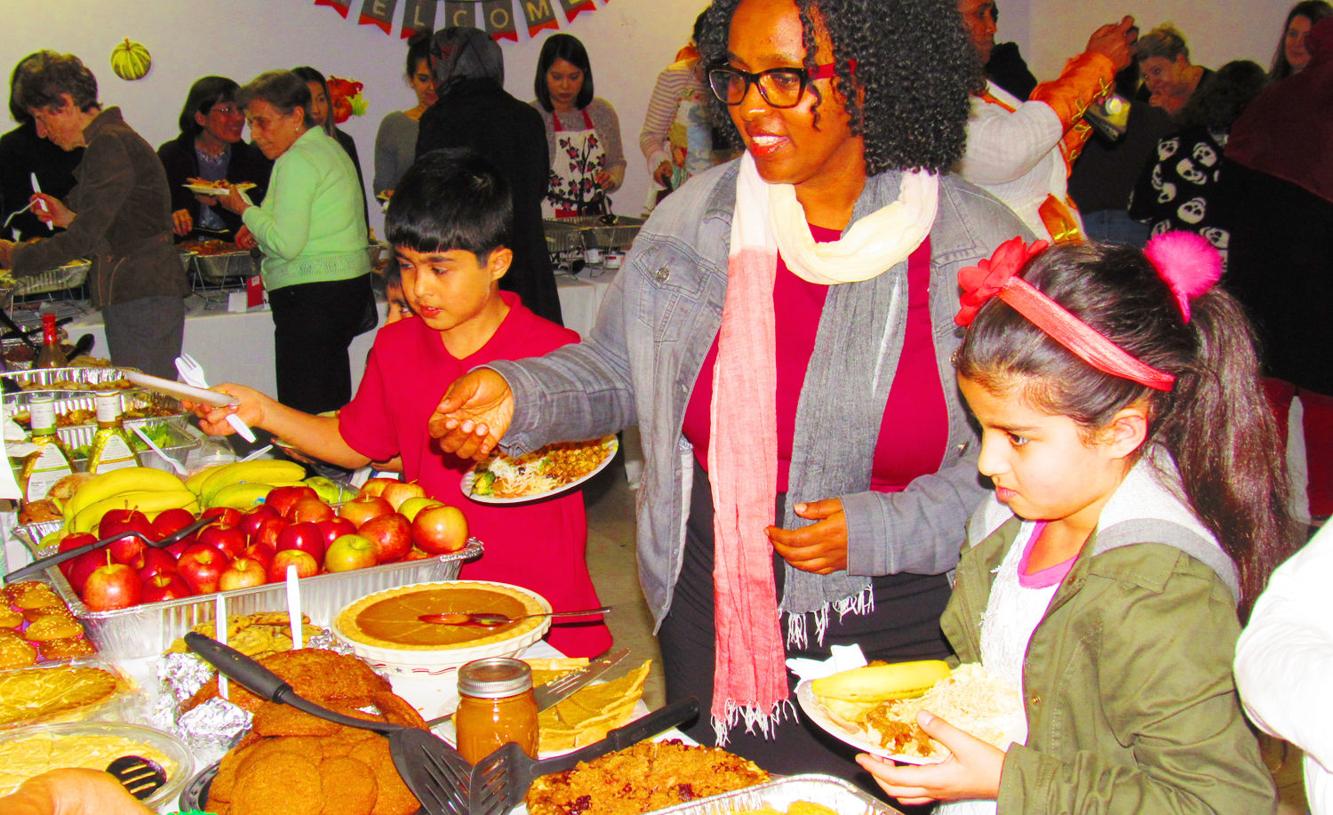
I have read other accounts of indigenous people gathering with family, making it a day of gratitude for the harvest and for community. Immigrants also make the occasion their own.
When I asked students in one English as a Second Language class about Thanksgiving, a young woman from Egypt said that last year, her first US Thanksgiving, she didn’t know anything about the holiday, but she prepared a turkey along with the family’s favorite Egyptian dishes. I said, “Well, if you had a turkey, you had Thanksgiving.” But what do I know? It’s about being thankful. Turkey not necessary.
Plenty of people don’t like turkey. When my family went to a restaurant one Thanksgiving, my Swedish son-in-law ordered beef. And Latinx immigrants have told me they like to serve ham and pineapple, with or without turkey.
Our family tends to stick with turkey, stuffing, gravy, potatoes, another vegetable, cranberry sauce, salad, and a dessert using apples. But before Covid, my sister and her husband always brought bagels and lox. And if we had a guests from another country, they would bring national dishes. Does your gathering have dishes that are unique to your celebration?
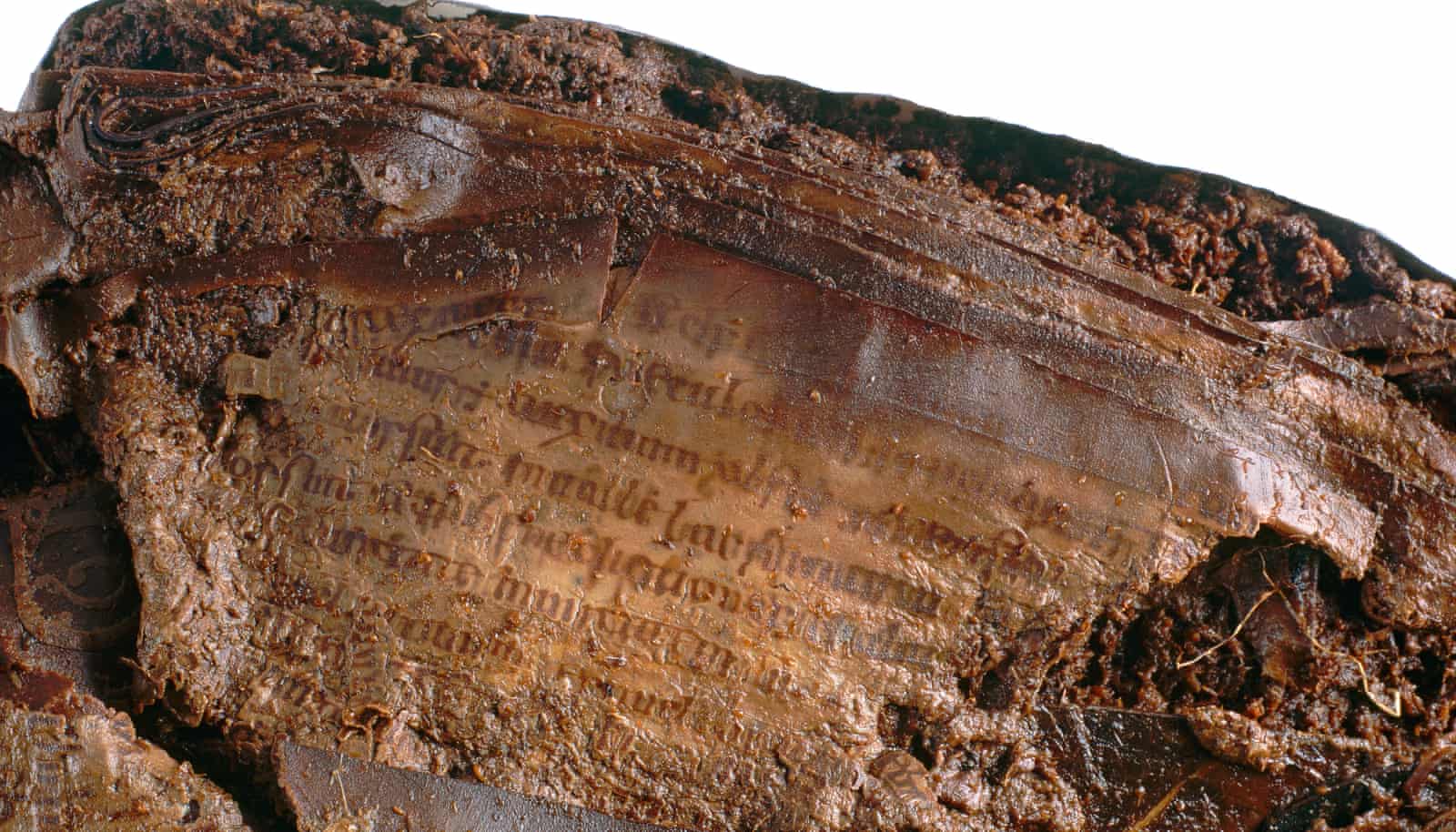
Photo: National Museum of Ireland. Found in an Irish bog. The psalter is shown here pre-conservation – lines of psalms clearly visible.
In the miracles-all-around-us department, imagine finding in a peat bog a medieval book of psalms that looked like the monastic compilers might have had links with Egypt! Lisa O’Carroll writes for the Guardian about a book on the psalter’s discovery and painstaking restoration.
“One summer’s day in Tipperary as peat was being dug from a bog, a button peered out from the freshly cut earth. The find set off a five-year journey of conservation to retrieve and preserve what lay beyond: a 1,200-year-old psalm book in its original cover.
“Bogs across Europe have thrown up all sorts of relics of the ancient past, from naturally preserved bodies to vessels containing butter more than a millennium old, but the 2006 discovery of an entire early medieval manuscript, entombed in a wet time capsule for so long, was unprecedented, said the National Museum of Ireland.
“The book fell open upon discovery to reveal the Latin words in ualle lacrimarum (in the valley of tears), which identified it as a book of psalms. One particularly unexpected feature was the vegetable-tanned leather cover with a papyrus reed lining, suggesting the monks could have had trade links with Egypt.
“ ‘It still blows me away,’ said John Gillis, the chief manuscript conservator at Trinity College Dublin, home of the Book of Kells, the Book of Armagh and 450 other medieval Latin manuscripts. ‘It was by far and away the most challenging, most interesting project I have ever undertaken – and to put that in context, I am surrounded by these iconic manuscripts.’
“Ten years after going on display at the National Museum in Dublin, the Faddan More Psalter is one of Ireland’s top 10 treasures and now the subject of a 340-page book from the institution documenting every stage of the ‘terrifying’ preservation process for future scholars. …
“The process of stabilising the book outside the bog, drying it and then unpicking and unfolding pages where possible was painstaking. Archaeologists placed the ‘conglomeration’ of squashed pages, leather and turf in a walk-in cold store in the museum at 4C. But there was no manual in the world to guide Gillis on how to go about the task. …
“Initial examination was limited in order to mitigate further trauma. CT scans and X-rays to find 3D structures were excluded owing to concerns that they could accelerate the degradation.
“After trying sophisticated versions of freeze-drying, vacuum-sealing, and drying with blotting paper, Gillis settled on a dewatering method using a vacuum chamber installed in the museum lab for four years to minimise shrinkage and decay.
“It would take two years before all the folio fragments were in a dry and stable state before the daunting task of dismantling could begin, a process chronicled in the book out later this month, The Faddan More Psalter, The Discovery and Conservation of a Medieval Treasure.
“ ‘It was absolutely terrifying,’ Gillis said of the responsibility he felt.
‘I heard from someone in the British Museum that there was a picture of the [book fragments] on the walls in a staff area there with the words “If you think you have a bad day ahead …”
” ‘You had this nerve-racking scenario of disturbing this material, which meant losing evidence, when the whole point was trying to gain as much information as possible.’
“Many of the spaces between the iron gall letters had dissolved into the bog, leaving an alphabet soup of several thousand standalone letters. It would take months after the drying process to piece them all together, in sequence on the right pages.
“ ‘The rewards when you slowly lifted up a fragment, and suddenly beneath this little bit of decoration would appear, particularly the yellow pigment they used. It would kind of shine back at you,’ Gillis said. ‘And you’d go: “Wow, I am the first person to see this in 1,200 years.” So that kind of privilege made all the sleepless nights and racking of the brain worthwhile.
“ ‘It was the purest conservation I’ve ever carried out. There is no repair, I’ve attached nothing new. All I’ve done is captured and stabilised.’ ”
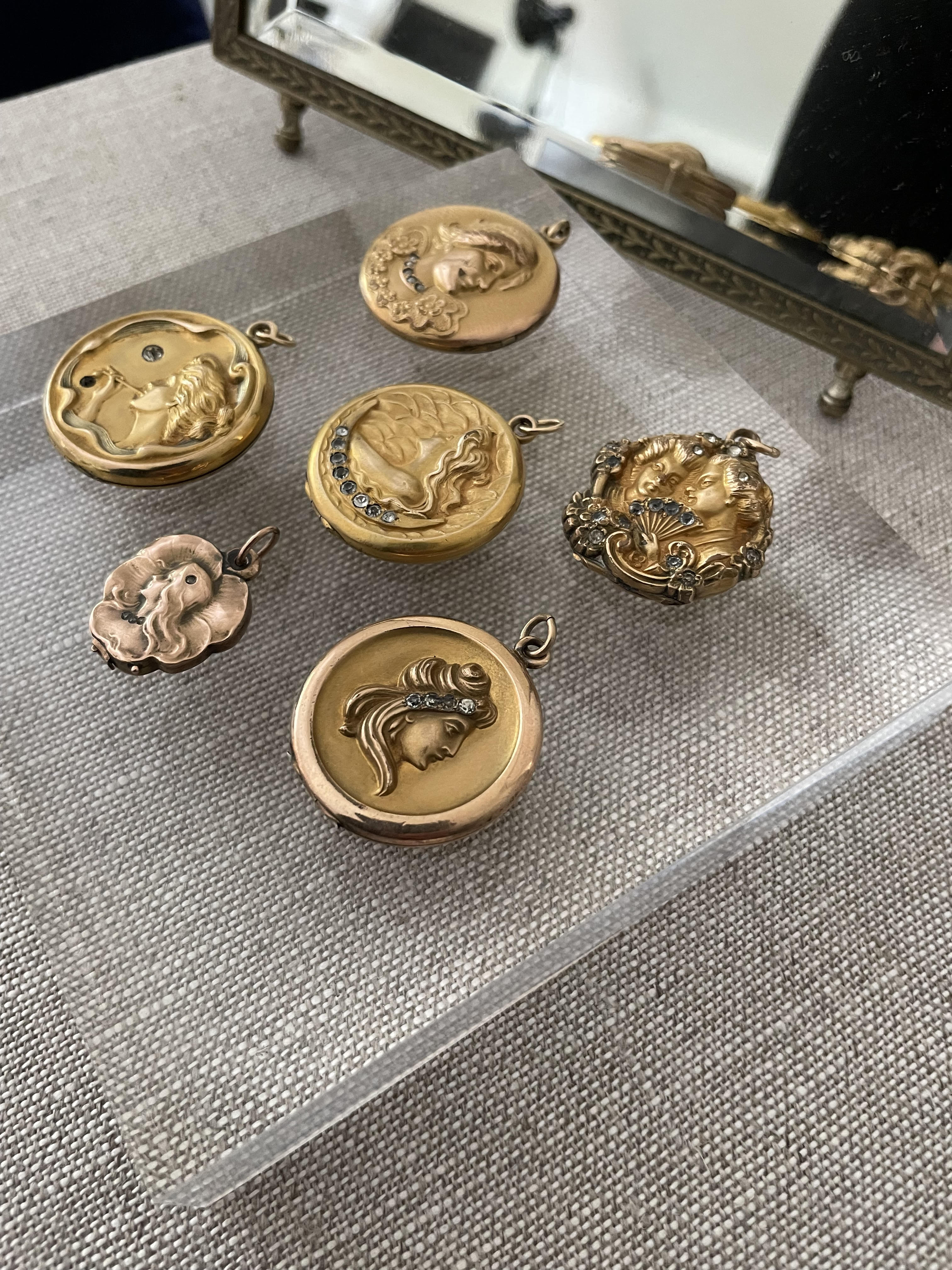
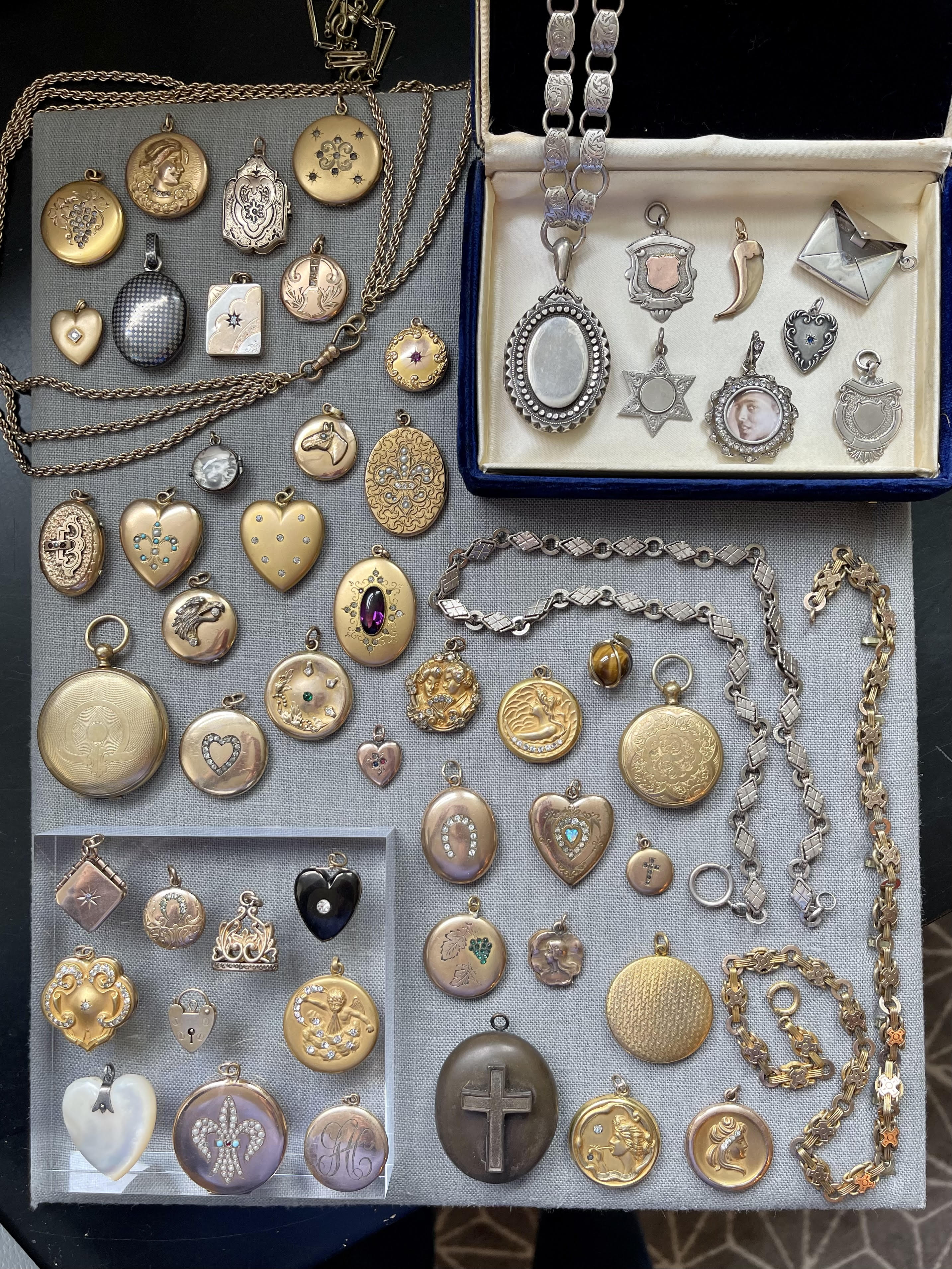
For friends old and new, here’s a bonus post just to remind you that this blog is hosted by my daughter‘s vintage and contemporary jewelry company, Luna & Stella.
In addition, there are lots of good deals in the Luna & Stella Archive Sale: https://www.lunaandstella.com/collections/archive-sale. Find gold and silver lockets, charms, and contemporary birthstone jewelry for every taste. I think the chains are pretty special, too — hard to find.
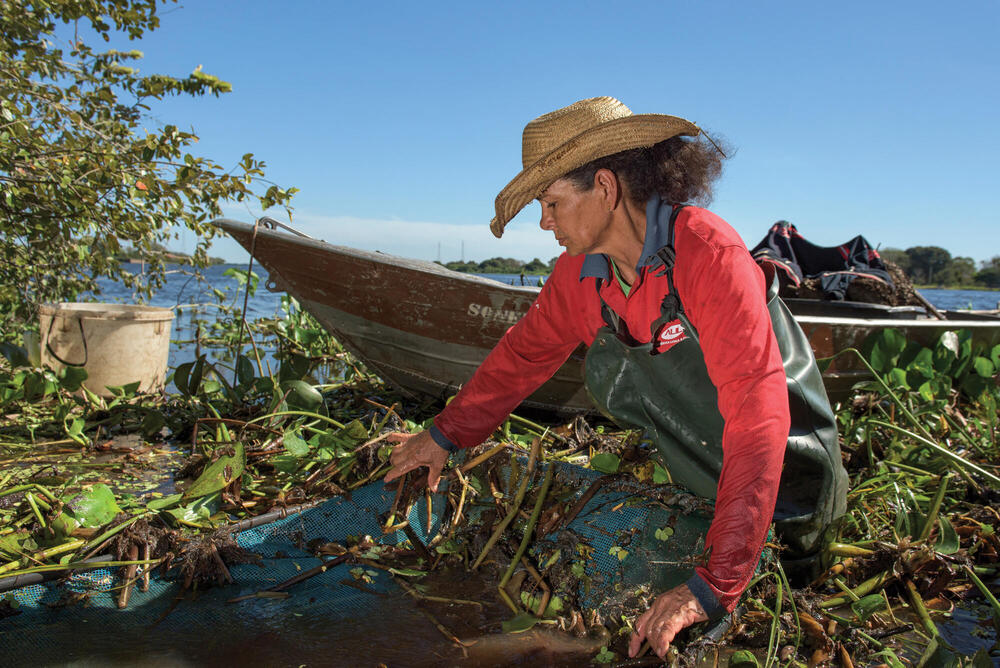
Photo: Jaime Rojo/WorldWildlife.org. “Life here for us is very fulfilling,” says Elizete Garciada Costa Soaresabout the Brazilian wetland. “We have fish to eat; we have bait to sell to make money for other necessities. Even if we don’t have money for meat, we can go out on the river to fish and bring back a piranha to eat with manioc flour.”
Without actually realizing it, we’ve accepted the message over the centuries that subsistence living is undesirable. But back before capitalism, having enough for food and shelter — and something to sell if a few extras were needed — could make a pleasant life. In some parts of the world it still does.
Jill Langlois writes at World Wildlife Magazine about people who build good lives from South America’s huge wetlands.
“By the time Elizete Garciada Costa Soares wades into the deep, warm waters of the Paraguay River, the sky is usually black. The tiny crabs and bait fish called tuvira, which she captures with a metal screen, come out at night, long after the hot sun that washes over the Brazilian Pantanal has set.
“It takes Soares at least an hour to reach the best spots to fish for bait, where the tuvira and crabs hide under the thick green leaves of the water hyacinths that float on the river’s surface. She’ll be gone for at least three or four days, so she brings a tent to pitch along the riverbank. Later, she will sell the bait to other fishers, usually in the nearby town of Miranda.
“Soares is well aware of the dangers of her profession — she’s had her fair share of run-ins with jaguars and anacondas in the 26 years she’s been heading out on the river to fish. But she wouldn’t have it any other way.
“ ‘Life here for us is very fulfilling,’ says Soares of herself and her husband. ‘We have fish to eat; we have bait to sell to make money for other necessities. Even if we don’t have money for meat, we can go out on the river to fish and bring back a piranha to eat with manioc flour. Here, we never go hungry.’
“At just over 42 million acres, the Pantanal is the world’s largest tropical wetland, created by the convergence of more than 1,200 rivers and streams rushing down from the eastern Andes and the high plateaus of the Cerrado, the vast tropical savanna to the east. More than 10 times the size of Florida’s Everglades, it stretches across the borders of Brazil, Bolivia, and Paraguay. Its primary waterway is the Paraguay River, which meanders through the three countries before joining the Paraná River and flowing into Argentina.
“The Pantanal is a landscape of extremes. Acting like a giant sponge, the upper part of the basin retains floodwaters from October to March, providing natural flood protection for the millions of people who live downstream. It then slowly drains between April and September, leaving discrete pools teeming with wildlife and providing life-giving water long after the rains have gone.
“This seasonal rise and fall, the pulsing of water in and out of the surrounding landscapes, is responsible for the wetland’s significant biodiversity. Though often overshadowed by the Amazon, its neighbor to the north, the Pantanal is home to more than 4,700 plant and animal species, including fig and ipê trees, jabiru storks, capybaras, and caiman. …
“In addition to being an environmental jewel, the Pantanal is also a tremendous resource for people, says Lucy Aquino, director of WWF-Paraguay: ‘The Pantanal is one of the most important regions in the world, in terms of services provided to humanity, and one of those regions that supplies food to the world.’
“For now, the Pantanal is relatively intact, sustaining more than 270 communities — 1.5 million people — in addition to its flora and fauna, and helping to stabilize the climate throughout the region and beyond.
“But while much of the Bolivian Pantanal is protected, the overwhelming majority of the wetland, lying in Paraguay and Brazil, is not. In all, conservation areas represent just 4.6% of the Pantanal, and its headwaters in the Cerrado are at particularly high risk.
“In recent years, roads, water management systems, hydroelectric dams, large-scale mines, farms, and cattle ranches have begun to change the dynamics of the wetland, threatening the region’s integrity. In addition to poorly planned infrastructure, mining, and agricultural development, the region faces other threats, including the lack of basic sanitation and the construction of canals for navigation.
“Moreover, by the end of the century the Pantanal is expected to be much drier and hotter, with potentially devastating results, including extreme droughts and floods, and the possible shrinking of the wetland as a whole. In the absence of a holistic vision, unsustainable development threatens to limit the Pantanal’s ability to function and to adapt to climate change, putting homes and habitats at risk.
“There is a tension between communities’ needs for development — for sanitation services and clean drinking water, for example, along with roads and hydropower dams — and the costs of such development to the ecosystem and people alike. But development done right, well-designed and sustainable, would contribute to the wetland’s conservation, says Julio Cesar Sampaio da Silva, who leads WWF-Brazil’s work in the Cerrado and Pantanal. …
“ ‘Considering the Pantanal as a shared territory and developing strategies for shared management — creating a truly shared vision for the region — is fundamental to having effective conservation of these natural resources,’ he says. …
“In 2018, the three countries formally signaled their shared commitment to sustaining those resources when they signed a landmark trilateral agreement known as the Pantanal Declaration. …
“Citing the importance of the wetland to those well beyond its boundaries, WWF-Bolivia director Samuel Sangueza-Pardo calls the agreement
‘a decisive step in integrating Bolivia, Brazil, and Paraguay’s joint commitment to maintain this ecosystem, which is fundamental for the welfare of more than 10 million people.’ …
“For Pantanal residents like Elizete Soares, that kind of commitment provides hope for the future of the only home they know. ‘The Pantanal, for us,’ says Soares, ‘is everything.’ ”
Photo: Richard Ankrom/Brewery Art Colony. The Freeway sign with Richard Ankrom’s correction — a stealth project to warn drivers they had to get left fast if they wanted to go north on route 5.
It may go back to leaving May Day baskets for neighbors as a child — ringing the doorbell and hiding — but I do like stealth projects. For example, when I was working on PR for a production of the musical Sunday in the Park with George about Impressionist Georges Seurat, I placed greeting cards with his famous painting around a bookshop for customers to notice or buy. I have no idea what the salespeople did when they couldn’t find a shop code.
Today’s story is about a professional sign painter and artist who saw a highway sign that badly needed fixing. He didn’t call the highway department.
As Nate Rogers writes at theLAnd magazine, “In 2001, Richard Ankrom installed a fake freeway sign in downtown L.A. in order to fix a real problem for commuters. The sign is now long gone, but 20 years later, the stunt remains etched into the soul of the city.
“In the pre-dawn hours of August 5, 2001,” Rogers reports, “Richard Ankrom got in his pick-up truck and drove out to a downtown L.A. freeway sign. He parked along an off-ramp near 4th and Beaudry Streets, stashed two large sheets of aluminum in the bushes, and took a deep breath. …
‘I was scared,’ he recalled recently, perched on an overpass, staring down at the area where this occurred two decades earlier. ‘I stood there, just to kind of calm down, you know.’
“There was no turning back now, he remembered thinking. He’d already spent the time and money to manufacture a near-undetectable replica of two pieces of freeway signage to exact industry specification. And in advance of their installation, he’d prepared a decal for his truck that read ‘Aesthetic De Construction,’ created a phony work order in case anyone approached him, and cut his shaggy blond hair to a city-worker-appropriate length.
“He’d also already enlisted his friends from the Brewery Art Colony … to get up at the crack of dawn to document what would later become known as his infamous ‘Guerrilla Public Service’ project. … And anyway, after the signage — an Interstate 5 emblem and an accompanying green placard reading ‘NORTH’ — had been made, it had to be put up. Otherwise, what was the point? …
“For many years, if you were traveling north on the 110 in downtown Los Angeles and were intending to go north on the 5, there was no easily visible signage to prepare you for the sudden interchange. And it’s not just any interchange, either — it’s a strange corkscrew of an exit on the left side of the freeway, sneaking up on you at the end of a tunnel. Without a decent amount of warning, you would very likely miss it. …
“A sign artist by trade, Ankrom wasn’t fazed by the initial part of his project. He downloaded a Caltrans manual, cross-checking the information by assessing an easily accessible freeway sign in person. He then cut the aluminum and painted the shield and placard, essentially by hand. On the back of the shield, he signed his name. …
“There was one part he couldn’t make himself, however, which was the circular reflectors that had to sit on top. But he was able to convince the company that made them that he needed the reflectors for a film project — which was not untrue … ‘It had to be documented,’ he said.
“Just after the sun came up on installation day, with video cameras rolling from various vantage points, Ankrom put on a hardhat and safety vest, hoisted a ladder up to the larger freeway sign apparatus, and climbed up to the plank with his work. …
“There happened to be a Caltrans crew working nearby when Ankrom was up there [but] no one questioned him. ‘They say if you’re dressed correctly and carry a clipboard around, you can get away with a lot of stuff,’ he put it. …
“Some nine months later, after he posted [the footage] on a pre-YouTube video hosting site, the story was broken simultaneously by LA Weekly and the Downtown News. (The video — a bizarre and hypnotizing behind-the-scenes look at every step of the process — is its own work of art.) Almost immediately, he had a line of media teams waiting outside his studio to set up interviews for national news programs. …
“Caltrans also weighed in after it was reached for comment by various media organizations. In a shocking moment of humility, they noted that, while they didn’t approve of Ankrom’s methods, they couldn’t deny the quality of his work. Not only would they not be pressing charges — they were going to leave his handiwork up. One Caltrans representative jokingly told ABC that they had a job application for Ankrom to fill out. …
“These days, Caltrans is less amused by Ankrom’s story than it was in 2001. When reached for comment, a representative didn’t want to talk about the specifics — instead preferring to state that they ‘very strongly discourage unauthorized persons from trespassing onto Caltrans right of way,’ and that there are ‘legal penalties and serious personal liability’ for doing so. Should you have an issue with something like signage, the representative recommends you ‘simply submit a Customer Service Request.’ ”
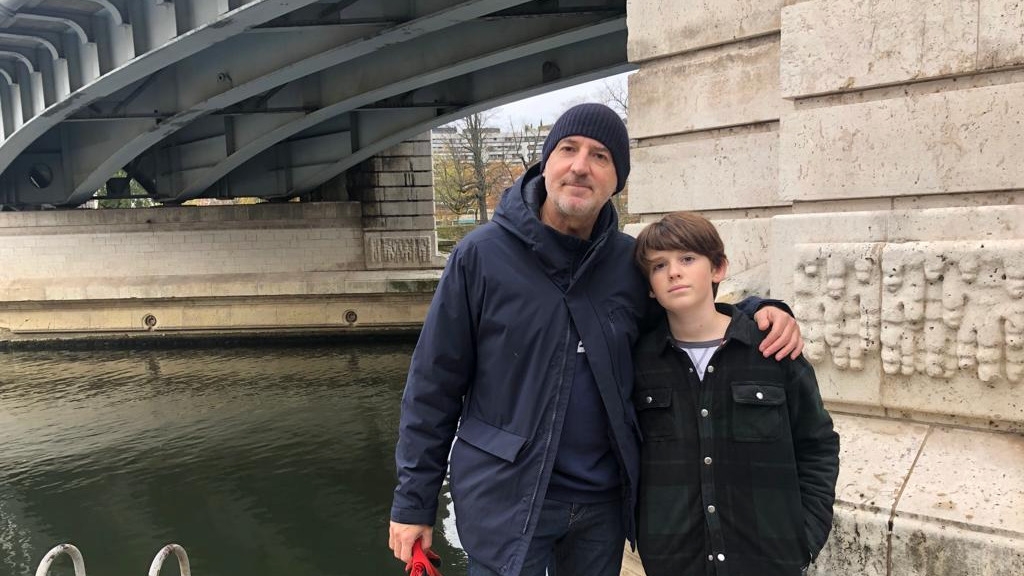
Photo: Rebecca Rosman/The World. Alexandre de Fages de Latour and his son, Raphael, are pictured near the Seine in Paris, where they fish out treasures — and junk. Raphael aims to have a clean river before the Olympics come to Paris.
I am really into kids who lead the way: kids and young adults who lead the fight against US gun violence, for example, or fossil fuels. In fact, yesterday when I saw that kids had written wise messages from the environmental nonprofit Sunrise Movement on sidewalks all over town, I went online and made a donation. At this moment in time, it just seems to me that young leaders are more likely to get things done than their elders.
Rebecca Rosman reports at Public Radio International’s the World about a Parisian kid focused on protecting the Seine.
“Paris Mayor Anne Hidalgo has set a goal of making the Seine swimmable by 2024 when her city will host the Olympic Games. If she succeeds, it will be the first time that bathing in the Seine is legal in over 100 years. To do that, though, the city will have to significantly reduce the levels of toxic bacteria that flow through the river. [Moreover] around 360 tons of plastic are found in the Seine every year.
“Lucky for Hidalgo, 11-year-old Raphael is on the case. For nearly two years now, the scrappy middle schooler has spent nearly every weekend with his dad, fishing debris out of the 450-mile stretch of water.
“ ‘It’s not unusual for us to catch an entire ton in a single day,’ Raphael’s dad, Alexandre de Fages de Latour said. …
‘I always knew there were things at the bottom of the water, but not to the point of scooters and bicycles,’ Raphael said. His biggest find: a 360-pound Yamaha motorcycle that took an entire team to pull out.
“Then, there are the more unusual objects, including a digital single-lens reflex (DSLR) camera, jewelry and even a 19th-century bayonet. Those treasures are stored at a makeshift museum located in his dad’s basement and are also shared on his Instagram account @raf_sur_seine where he now has more than 20,000 subscribers.
“It all started, however, at around Christmas 2019 when Raphael saw a YouTube tutorial from someone doing something similar. So, Raphael asked his parents for several meters of rope, a hook and a powerful magnet that could attract metal objects weighing more than a ton. …
“ ‘At first, it was just meant to be a leisurely weekend activity,’ Raphael said. ‘But once I saw just how much debris there was buried at the bottom of the river, it became like a full-time job … and I wanted other people to know, too.’ Last October, Raphael was even awarded the Medal of Paris for his efforts. …
“ ‘There’s more than 7 billion people on Earth … so, there’s definitely enough of us to clean up and save the planet,’ Raphael said. ‘But when it comes to taking action, hardly anyone does. Even something as simple as picking up cigarette butts from the ground and placing them in the trash could make a huge difference.’ …
“While he’s not sure if he can make the entire Seine glisten by the 2024 Olympics, he hopes to be one of the first to swim in the water once it’s declared safe.”
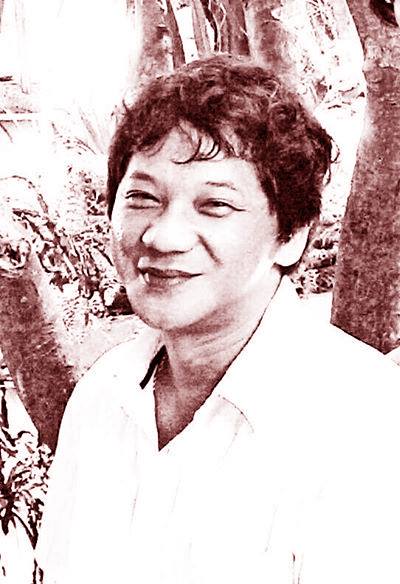
Blogger Nguyễn Thị Phương Trâm got a couple of us hooked on Vietnamese poetry with her translation of a long and moving epic by the poet pictured above, Lê Vĩnh Tài.
At the AJAR Press, where Lê Vĩnh Tài’s work is published, Nguyễn Trọng Tạo provides background on the poet, “Lê Vĩnh Tài was born in 1966 in Ban Me Thuot, Daklak. He graduated from Tay Nguyen Medical School but later pursued a career in business and making poetry. Le Vinh Tai’s poetry is rich in intellect but also carries much of tenderness and trembling. He is like a ‘balanced renovator.’ ”
A small sample of his more playful poetry comes from Nguyễn Thị Phương Trâm’s blog, Songngutaitram:
“I want to write a poem
“because the poem will “because the poem be
“the poem “will throw itself upon the pages “with the vigour of a child learning how to talk
“the poem “the lyrics you’ve forgotten
“I want to turn us into a poem.”
Nguyễn Thị Phương Trâm, herself a poet as well as a translator, reports that she was “born 1971 in Phu Nhuan, Saigon, Vietnam. The pharmacist currently lives and works in Western Sydney, Australia.”
A word on the Vietnamese press called AJAR: “AJAR is dedicated to the discovery of poetry and art in both ordinary and hidden places, providing a space for these works to be exhibited, loved, and challenged. As a bilingual journal and independent small press based in Hanoi, AJAR provides an opening for questions, imaginings, and poetic (im)possibility to be shared across borders, inhabiting language as it moves between worlds and words. In bringing fresh and critical voices of Vietnamese literature and art into English, and welcoming those voices from everywhere into Vietnamese, we focus on quality translations and envision books as artifacts of artistic collaboration. Alongside single author poetry collections, AJAR publishes a bilingual journal of poetry, short fiction, essay, and artwork that revolves around a specific word of choice for each issue.
“While accepting donations from individuals, AJAR is self-funded and unaffiliated with any outside or inside organization. To be a part of keeping AJAR alive, please buy books or contact us at shop@ajarpress.com.”
To learn more about translation in general, check out This Little Art, by Kate Briggs. Briggs brings up many fascinating points about the decisions that translators must make — points you may never have thought about — and opines that, in fact, the translator is also the author. At least, the author in the second language.
Photo: Case 1-Euro. A small town in Sicily decided to sell decrepit houses for almost nothing to see if someone would fix them up. It’s certainly bringing in more curious visitors.
Sometimes getting something for nothing may cause a recipient to be careless with the gift, as in a story I read a few years ago about a guy who built and donated a home to a homeless woman who let it run to ruin.
Other times, wonderful things happen.
Harrison Jacobs writes at the Washington Post, “If someone said you could buy a house for a dollar, your reaction might be disbelief. That was how Rubia Andrade felt when she read a news article in 2019 about towns in Italy selling properties for one euro.
“ ‘Obviously, your first thought is that this can’t be true. I needed to see it in person,’ said Andrade, a Brazilian American who works in California’s solar industry.
“Andrade booked a flight three days later and drove to Mussomeli, Italy, a hilly town in central Sicily with about 11,000 residents that had recently launched a program selling hundreds of properties in the run-down historical center. …
“The 1-euro housing program was first proposed over a decade ago by TV personality Vittorio Sgarbi. Then the mayor of Salemi in southern Sicily, Sgarbi proposed the idea as a way to save the town’s crumbling old quarter. The idea has since caught on in 34 municipalities across Italy.
“But it was only in the past few years that it captured the global imagination when articles about towns launching similar programs on the island went viral. …
“While some houses sold through these programs are livable upon purchase, most are little more than four medieval-era walls. Roofs are caved in, and floors are torn up. Many are filled with dead pigeons or other vermin. Prospective buyers who haven’t done research are usually surprised by the conditions, said Toti Nigrelli, the deputy mayor of Mussomeli.
‘We tell people to come here first because we don’t want any surprises. We want them to know what they are getting into.’ …
“Though the official cost is 1 euro (around $1.14), fees and closing costs can typically run up to 3,500 euros (or almost $4,000). Then, you are required to renovate it within a designated time frame — typically three to five years — or forfeit a sizable deposit, usually around 5,000 euros (or $5,709). According to Nigrelli, towns use the deposit to ward off speculators and ensure buyers renovate the properties instead of letting them sit. Renovations cost anywhere from 5,000 to 100,000 euros, depending on the house’s size and condition and the renovation style. Most end up spending 20,000 euros to 40,000 euros, Nigrelli said.
“None of those complications deterred Andrade. She initially purchased a 1-euro property and returned that summer to renovate. Since then, she has bought two more and become an evangelist, returning every few months with friends, family and even Facebook acquaintances to help them with the purchasing process.
“ ‘Even with the fees and the cost of the renovation, it costs less than a timeshare in the U.S.,’ Andrade said.
“While Andrade first saw the 1-euro program as a cheap way to own a vacation home, she now has bigger plans: to help revive the town. Andrade and her son are converting their three properties into an art gallery, a wellness center and a restaurant. She plans to move to Mussomeli permanently.
“She’s far from the only one. Danny McCubbin is one of about a dozen foreigners who bought 1-euro houses in Mussomeli and now lives there full-time. McCubbin, an Australian who worked for celebrity chef Jamie Oliver for 17 years, bought a 1-euro house with the intention of converting it into a community kitchen to provide meals to vulnerable people. He crowdfunded over $30,000 last March for the project.
“Complications due to the pandemic delayed renovations, but he has since purchased an 8,000-euro house to live in and rented a storefront in Mussomeli’s piazza.
“Since launching the Good Kitchen this summer, McCubbin has become an unofficial ambassador for the 1-euro program. …
‘“The townspeople thought I was opening a restaurant. They didn’t understand the concept,’ McCubbin said. After he partnered with local charities to host picnics and baking parties for orphans and those dealing with mental health issues, locals got the idea.”
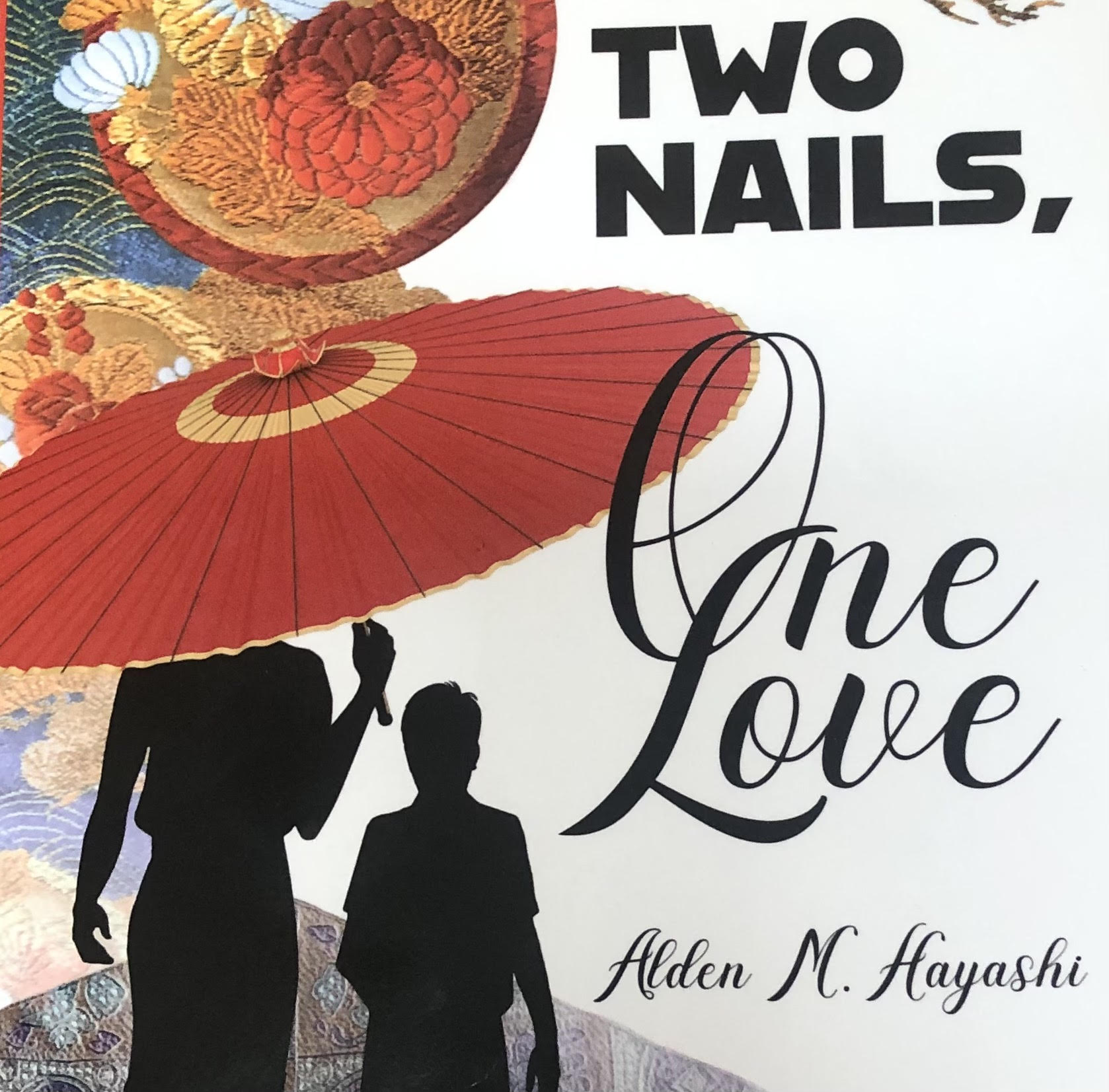
Art: Jana Brenning. The above novel by Alden Hayashi came into being partly because he wanted to write about his mother’s WW II trauma and the incarceration of innocent Japanese Americans in camps. It’s also about the difficulty of coming out to a very cautious parent as a gay man.
I’ve been telling friends, especially friends in book groups, to check out Alden Hayashi’s novel. It’s based on his relationship with his reticent Japanese American mother, who suffered injustice at the hands of the US, her birth country — a history she long kept hidden. Since publication, the book has found an audience not only in the Japanese American community, but among other Americans. After all, this is our history, and we need to Face History.
Alden had a lot of experience from his day job ghost-writing books for management consultants and others, and he thought it would have been ideal if he had been able to ghost-write his mother’s story. But as he explained in one of the online book discussions he’s been invited to attend lately, his mother didn’t begin to open up about her history until late in life, and he could tell that some of the dates were getting confused. He had already learned a lot on his own by research into obscure government documents and by attending a Japanese American group’s visit to his mother’s infamous camp in Arkansas. (Americans used to refer to these camps as “internment camps,” but they are more properly called “concentration camps.”)
I do not think that making this history part of a book about the gay son coming out in a family conditioned against being the “nail that sticks up” has kept it from being a good novel. If anything, the mother’s story made the son’s feel more real, and the son’s story helped show the consequences of an early trauma for a future parent.
But the aspect that will rivet you the most is learning that many of these Americans were rounded up from the camps to be exchanged with Americans trapped in Japan and occupied Asia. The first group that went “home” were in fact Japanese people who wanted to go. But for Americans like Alden’s mother, home was Hawaii, her birthplace. She had never even visited Japan. And her family was being sent to a country they felt they were at war with. In fact, her brother fought and died for the US alongside other Japanese Americans. The family definitely did not find a warm welcome when they got to Japan.
I’d read many intriguing vignettes about this history on Alden’s Facebook page and was thrilled it got into a book. No wonder he bristled during the years 2016-2020, when a whole religion was considered terrorist by some powerful people. He was so afraid of history repeating itself.
Be sure to look for the moment when the mother in the novel visits the Statue of Liberty with her grown son. Find the book here.
Check out this interesting conversation between Alden and another Japanese American author.
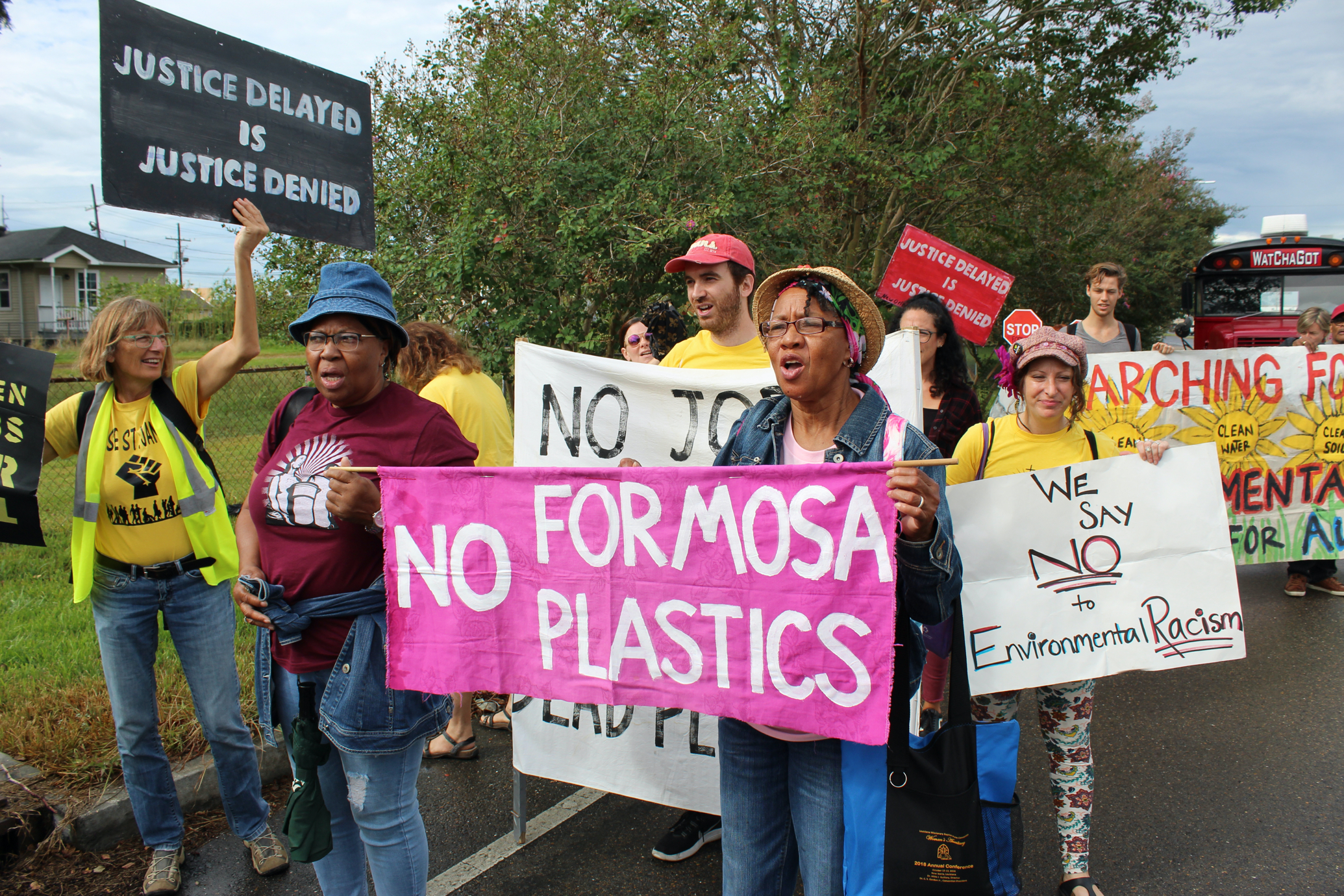
Photo: Louisiana Bucket Brigade. One of the most effective grassroots groups fighting pollution in poor neighborhoods is the Louisiana Bucket Brigade, ordinary folks who got fed up with being endangered by Cancer Alley.
It’s no secret that some of the most polluting companies are located in poor or Black communities. I once had a boss who insisted that was not done on purpose, but still, decision makers often count on poor communities not fighting back.
I’m glad to say that’s changing. I’ve learned so much just from following the grassroots Louisiana Bucket Brigade, which has been fighting back effectively against Formosa Plastics.
In another example of fighting back, Michael Laris writes at the Washington Post about “how an outdoorsy engineer is working to cut transportation pollution around disadvantaged communities.”
Laris reports, “As a clean air and innovation manager at the Environmental Defense Fund, [Harold] Rickenbacker works with companies and communities to monitor and reduce pollution from transportation, which contributes to climate change and harms health, particularly in disadvantaged areas.
“While working on his engineering doctorate at the University of Pittsburgh several years ago, he worked with families hurt by the city’s air pollution, both outdoors and seeping into their homes. ‘My will to succeed when I wake up in the morning is impacted by … the air that I’m breathing,’ said Rickenbacker, who has taken up these issues in Maryland, Virginia, Delaware and other states. …
“Q: The Environmental Defense Fund has developed a mapping tool to help understand how truck pollution near warehouses and fulfillment centers affects low-income communities and people of color. How does that work?
“A: Medium- and heavy-duty trucks spew nitrogen oxides, black carbon, particulate matter, smog — you name it — which has had a clear impact on upper-respiratory health, things like asthma, lung cancer and even hypertension in some of the work we’ve done out in West Oakland. We use our GIS-based tool to calculate the population that lives within a half-mile radius of the predefined distribution centers and warehouses. It calculates the demographic and socioeconomic variables around those facilities. You can pinpoint X percentage of people of color that live near this facility and X amount of people with health issues who live near these facilities. Then you can prioritize things like green infrastructure, electric vehicles, workforce development, renewable energy. We’re using health- and equity-based tools to identify where the distribution of those infrastructure benefits should take place first.
“Q: What has the Environmental Defense Fund found in Oakland through its air monitoring work?
“A: Hyperlocal air pollution monitoring can occur every 30 to 60 meters, and every minute, every second, down to the hour or daily averages. Why is this significant? Well, conventional air pollution monitoring networks are spaced miles apart or away from cities.
We’ve had a partnership with Google Earth Outreach for many years, where we’re installing monitors on vehicles and getting a much more complete picture of air pollution at that neighborhood level.
“In West Oakland, the data really highlighted impact zones where residents lived among elevated levels of pollution. The highest concentrations of nitrogen dioxide in that community created a 40 percent greater risk of cardiovascular disease events among those who were 65 years of age or older. …
“Q: Big trucks drive a lot and they pollute a lot, as they move so much of the economy. Yet electric trucks, which have no emissions, are still comparatively costly. How can that problem be tackled?
“A: We have to lean on large corporations to move the needle. There are tons of different incentive programs out there, where there are opportunities to purchase commercial EVs and deploy them in communities. But that’s often not enough. For some of our corporate giants, if you have the bandwidth, you have the resources, you can really drive the demand and drive the market. If there’s a clear need for electric trucks, manufacturers will understand that and then you essentially have this revolving market where prices go down.
“Q: Unlike with power plants and other big polluters causing climate change, transportation emissions stem from huge numbers of individuals making individual decisions. How do you address such a sprawling problem?
“A: Part of it is really this idea of coalition-building. You have groups like EV100 that has dozens of corporations that have carbon-neutrality goals for 2030, or transportation-emission reduction goals. It’s not really an individual discussion or decision. It has to be more of a collective. [Justice40 initiative, which] means investments in climate, clean energy, clean transportation, you name it. Low-income communities that have been subjected to racial segregation — those same communities that have the health burdens — should see clean transportation and other environmental benefits in their communities first.
“Q: But it’s still this vast swath of society that’s making decisions about what kind of cars to buy and how much to drive them — and creating those emissions.
“A: Under the infrastructure funding and reconciliation packages, there are going to be tons of opportunities to beef up infrastructure, including public transit. Most of the communities that are impacted by transportation emissions are the same communities that are using public transit. More affluent communities can also understand you can lower your carbon footprint by riding a bus and not driving your vehicle. So at that point, it does turn into more of an individual decision.”
Alas, last-minute lobbying by the gas industry and a Pennsylvania Senator means the infrastructure bill actually has a huge fund for building more polluting buses. Man, you just cannot win! If you live in Pennsylvania, please give Sen. Patrick J. Toomey what-for!
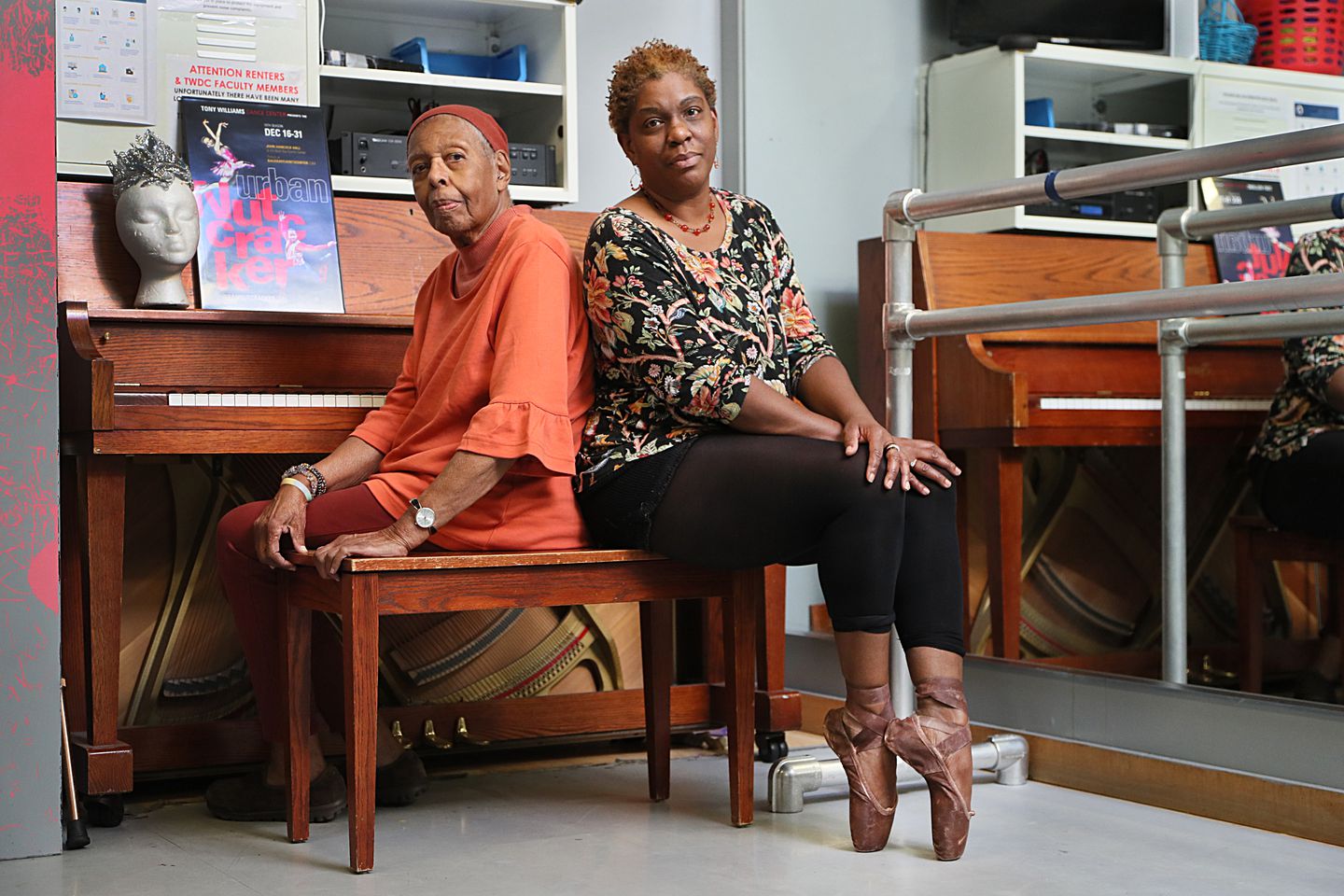
Photo: Suzanne Kreiter/Globe Staff. Mother and daughter Afrika Lambe (a pianist), and Erika Lambe (a dancer) talk about their deep roots in Boston arts and their love for the “Urban Nutcracker.“
Boston has an unusual dance event at the holidays. It’s called the“Urban Nutcracker.” Some years ago, Kristina and I went to see to a production and really enjoyed it. My understanding is that it’s a little different every year, so I know I need to get back there. Today’s story highlights a mother and daughter who have had a role in preparing young dancers of color to take part both here and in the wider arts world.
The daughter danced with the acclaimed Boston Ballet for 11 years, but says that despite some principal solos there, she finds her current work with young dancers more meaningful.
Karen Campbell reports at the Boston Globe, “Twenty years ago, dancer Erika Lambe became Boston Ballet’s first Black Sugar Plum Fairy in ‘The Nutcracker.’ During much of her time with the company, she was the only Black ballerina.
“Now Lambe is involved with a version of the classic ballet dedicated to putting artists of color front and center. This season, City Ballet of Boston’s production of ‘Anthony Williams’ Urban Nutcracker’ also celebrates a landmark 20th anniversary. Williams’s multicultural twist on the ballet classic, set in present-day downtown Boston, blends the traditional Tchaikovsky score with Duke Ellington’s jazzy version and features dance styles ranging from ballet and flamenco to hip-hop.
“ ‘There’s no other “Nutcracker” like this,’ Lambe says. ‘Its whole intent is to speak to a more diverse audience, unlike the more traditional productions. … Twenty years ago, people in this community wouldn’t even consider going to a ballet, but this has brought them into the theaters and gives kids exposure to dance, ballet in particular. It’s such a holiday tradition.’
“This year, Lambe reprises her role as the Mother in ‘Urban Nutcracker,’ and a role behind the scenes, too, as ballet mistress, running the children’s rehearsals, working with some of the adults in the production, teaching upper-level classes in City Ballet of Boston’s school, and running its introductory Relevé program. She’s also helping in the wardrobe department, refurbishing costumes and making new tiaras.
“Now in her 50s, Lambe, who grew up in Brookline, has been enmeshed in the dance world since she began classes at the age of 4. She says she was never one of those kids who dreamed of being a ballerina, but after seeing a Boston Ballet ‘Nutcracker’ production when she was 6, she was hooked, beginning training with the company as one of only a handful of students of color. ‘I hated ballet, but I wanted to be in “The Nutcracker.” ‘ …
“When she was 10, she says, the ballet master pushed for her to be given the role of Clara. Boston Ballet founder E. Virginia Williams demurred, saying the ballet was a period piece, but she cast Lambe in other challenging roles to showcase her talent.
“At the age of 16, Lambe began her professional career at Dance Theater of Harlem under the legendary Arthur Mitchell, which led to three years of ‘great opportunities.’ Then Edward Villella invited her into the fledgling Miami City Ballet. In 1993, she joined Boston Ballet, dancing with the company until 2004. ‘I did a lot. Jumping was my forte, and I was a quick study. I remember I got thrown into a solo [last minute] in “Raymonda” — and I got a good review!’ she recalls with a delighted laugh.
“Lambe comes by her drive and enthusiasm honestly. Her mother is Afrika Hayes Lambe, a beloved Boston area dance accompanist with an impressive background as a vocal soloist as well. At the age of 88, Afrika is still accompanying ballet classes, known for her expansive memory in repertoire ranging from ballet classics to Broadway tunes.
Erika’s grandfather was the internationally acclaimed tenor Roland Hayes, whose father had been enslaved and was later emancipated. Roland went on to fill concert halls and shatter racial barriers around the world.
” ‘A lot of my grandfather’s history informs me,’ Lambe says, citing Hayes’s tireless fight against racism and inequity to blaze a trail for generations of Black vocalists and become one of the highest-paid recitalists in the world by the 1920s. …
” ‘I had hoped to follow in my grandfather’s footsteps,’ says Erika Lambe. ‘I wanted to be a principal or soloist at Boston Ballet, but it just didn’t happen. I got some principal roles so I did get the opportunities, just not the title. I had a great career dancing … but I feel like maybe what I’m doing now is more meaningful.’
“Williams, a progressive dance educator and former principal dancer with Boston Ballet … says at his own school, Lambe has become an inspiring role model. ‘Students and parents can identify with her,’ Williams says. ‘She really cares about them, and she’s passionate, reliable, professional, and very proactive about getting things done.’
“Lambe who has taught widely in Greater Boston, also currently teaches at Reading’s Northeast School of Ballet and created a program to bring students from the school’s youth company into the upcoming ‘Urban Nutcracker’ production. ‘It’s a great exchange,’ says Williams, ‘a nice bridge between the white suburbs and inner-city kids. … People that come to the show are struck by the diversity onstage. … Our first show happened right after 9/11, now this one’s right after COVID. I hope it offers the community a kind of a salve to help us heal wounds.’ “
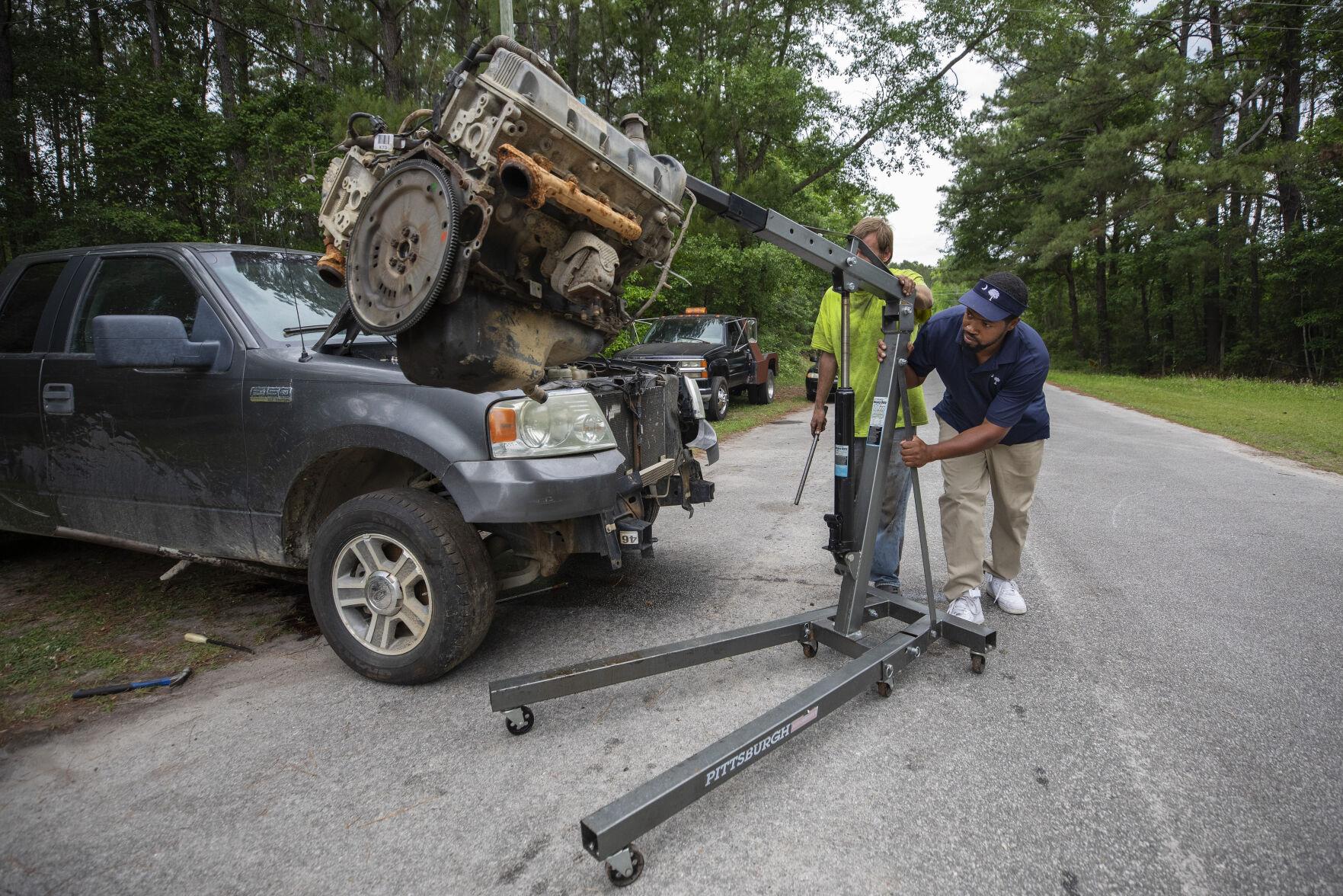
Photo: Lauren Petracca/PostAndCourier. Eliot Middleton (right) and Matthew Poston remove an engine from a truck they are fixing up for donation in McClellanville, South Carolina, on May 10, 2021.
The roots of today’s story were planted in a strong relationship between a South Carolina father and son who knew how to repair cars.
Sydney Page reported at the Washington Post in July, “On Christmas Day last year, Eliot Middleton showed up unannounced at Melanie Lee’s home in Andrews, S.C., with a white 1993 Oldsmobile. What happened next shocked her: Middleton, whom she had never met before, put the key to the Oldsmobile in her hand. He didn’t charge her a dime. He just gave her the car, no strings attached.
‘I had no idea what was going on,’ said Lee, 59. ‘He handed me the keys and didn’t ask for anything.’
“She is one of 33 people Middleton has gifted with a car in the past nine months. Middleton, 38, is a restaurant owner and former auto mechanic who spends his spare time repairing used cars and giving them to people in need in rural South Carolina.
“ ‘There’s a lack of transportation in the rural areas, and I knew I could use my previous experience in mechanics to help,’ Middleton said.
“Only a few weeks before Middleton dropped off the car, Lee’s 33-year-old son, who was ill for several years, passed away. After driving daily for two hours to and from the hospital in Charleston to visit him, her 2007 Chevrolet Tahoe broke down.
“She took the car to a shop to replace the transmission, but ‘I had no means of paying for it,’ she said. She needed a car to help with child care for her two granddaughters, who are 12 and 6 and rely on her to pick them up from school every day and drive them to dance rehearsal. …
“The idea to fix and donate old vehicles came spontaneously to Middleton in early 2020, after he hosted a food drive and several local families showed up with no transportation. They walked more than four miles to get a hot meal. …
“ ‘There’s no public transportation in the area whatsoever,’ said Middleton, who lives in McClellanville, a small fishing town on the Atlantic coast with a population of about 600. ‘We don’t have taxis and Ubers. Without a car, people don’t have a way to get around.’
“So, Middleton — who co-owns Middleton & Maker Village BBQ, a restaurant in the neighboring town of Awendaw, S.C. — decided to put his auto mechanic skills to use the two days a week he isn’t at the restaurant. [As of July], nearly 100 vehicles have been donated for him to fix up. …
“Before jumping into the restaurant industry, Middleton worked as an auto mechanic for 15 years. As a young boy in McClellanville, his plan was to follow in his father’s footsteps.
“ ‘My dad was a mechanic, and I would hang out around his shop since I was 4 years old,’ Middleton said. ‘I’ve always been fascinated by cars.’
“After he graduated from high school, Middleton trained to become an auto mechanic, and in 2004, he and his father opened their own auto service. …
“ ‘We had a lot of single moms as customers, and we always ran into problems with them not having enough funds,’ Middleton recalled. ‘We spoke about trying to find a way to help them,’ [but] whenever they started to brainstorm ideas, something got in the way. Middleton’s father’s health began to decline, and in 2014, they closed the shop. Barbecuing has always been a side passion for Middleton, he said, so he decided to change course and pursue it professionally.
“Still, despite leaving the auto industry, the notion of repairing used vehicles for people in need remained a shared goal for Middleton and his father. But after receiving the first donated car in January 2020, several things in their lives took priority, including Middleton’s father’s failing health — he died in March 2020. Around the same time, Middleton opened a restaurant, just as the coronavirus pandemic was taking hold.
“ ‘Things started changing in my life, and I couldn’t focus on the car program the way I wanted to,’ said Middleton, who has two daughters, ages 14 and 8.
“By September 2020, though, Middleton felt ready, with fresh motivation to honor his father’s legacy. He repaired the first car — a 1997 navy Toyota Camry — and gave it to an unemployed single mother of two children, one of whom is disabled and requires regular medical appointments. …
” ‘That felt great. I could feel my dad’s presence around me, and I could hear him saying “this is exactly what we always wanted to do.” ‘
“Within two months, the same woman was able to land a stable job, and she recently contacted Middleton to say she bought herself a new car and is donating the one he gave her back to him.
Photo: Linda Dulan. In July, the Thunderbird American Indian Dancers hosted its 42nd annual powwow at New York’s Queens County Farm Museum. Seen here, an old-style men’s dance.
I’ve always wanted to get to the Narragansett tribe‘s summer Powwow in Rhode Island. And I will do it yet — never mind how busy summer gets.
In today’s post, Dance magazine whets my appetite even more with wonderful pictures from a “dance powwow” in New York State.
“Over the course of three days in July, the Thunderbird American Indian Dancers hosted its 42nd annual powwow at Queens County Farm Museum. Founded in 1963 by members of the Mohawk, Hopi, Winnebago and Kuna (San Blas) tribes, Thunderbird is the oldest resident Native American dance company in New York, and puts on the city’s largest powwow, drawing dancers from more than 40 tribal nations for a series of performances and dance contests, as well as crafts and food stands.
The next morning the mother showed the women how to make the dress, showed them a special dance and sang a very special song for them. Sure enough, her daughter got well.
“Dance Magazine joined [a] sunset bonfire to capture some of the competitions, and asked Thunderbird director Louis Mofsie and company dancer Michael Taylor to share their insights on the place of dance within the powwow.”
They write, “The powwow is a social gathering where we get together to dance and sing, to meet old friends and make new ones. Originally a Western/Great Plains tradition, it does not have any religious or ceremonial significance — our religious and ceremonial dances and songs are restricted and closed to outsiders.
“Dancing is the major activity. Over the weekend, there are dance competitions and also what are called intertribal dances, where the dancers from all tribes are invited to participate. Our bonfire each evening during the gathering is there to help us travel back in time to the days when we had no spotlights. It reminds us of our past, our connection to our heritage and how it has survived through all our hardships to this day.
“As Native American people, we start dancing at a very young age. Dancing at powwows is how we learn the different styles of dances and what they represent. It helps us to connect to our roots and reinforces our awareness of who we are. It also reminds us that Native American dance is the original dance in America—and is still alive today. …
“Women’s Fancy Shawl Dance. This dance dates back to around 1945, right after the Second World War. Native American women and men had volunteered for the armed services and traveled all over the world. During their travels they observed how the women in many different countries were dancing. When they returned home, they decided to introduce a different style of dancing. Traditionally, the women did a very slow, graceful movement around the outer edge of the dance circle, and the men would be doing more vigorous movement on the inside. The Fancy Shawl Dance is much faster in rhythm, more vigorous and permits them to dance on the inside of the circle. The women wear shawls with very long fringe along the edges, and as they move, the fringe reminds you of the feathers that the men wear. Although the women do not wear the feathers and bells on their legs like the men do, their footwork and movements are very similar.
“Men’s Fancy Dance. They say this dance also originated around the end of the Second World War. When the men returned home from the war, they also wanted a more vigorous style of movement. Fancy dancing is much faster than traditional men’s dancing. Each of the dancers tries to create as many fancy steps as they can while keeping time with the singing and drumming. The men wear feathers with ribbons attached to each end, and they carry dance wands that are decorated with ribbons and feathers.
“Women’s Jingle Dress Dance. This dance tells the story of its origin. There was a mother who had a very ill daughter. One night she had a dream, and in it she had a vision: She was told to show the women how to make a special dress with little cones or jingles on it, show them how to do a special kind of dance and sing them a very special song. If she did all these things, it would help her daughter get well. The next morning the mother showed the women how to make the dress, showed them a special dance and sang a very special song for them. Sure enough, her daughter got well. The dance started out as a healing dance but has come down to us as one of the more popular competition dances at the powwow gatherings.”
I never thought about it before, but why should any community have an art form that never evolves. I love the idea that indigenous people who returned from WW II incorporated new influences into traditional dance. More at Dance, here.
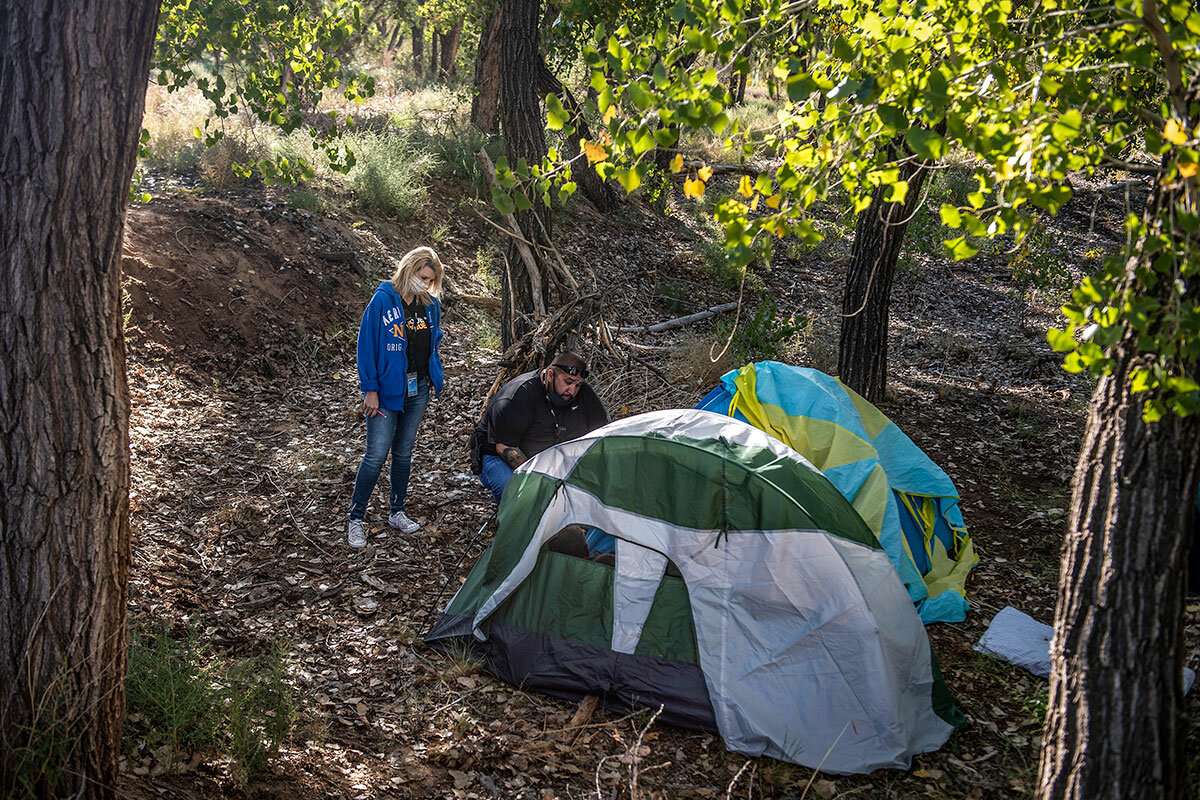
Photo: Ann Hermes/CSM. Leigh White and Walter Adams, behavioral health specialists, respond to a 911 call about a homeless encampment in Albuquerque. They are members of the Albuquerque Community Safety department, an ambitious experiment in policing, according to the Christian Science Monitor.
Is there another way to do policing that actually accomplishes the goal of keeping people safe? That is the question communities have been asking themselves since the demonstrations and riots of 2020. The epicenter of that upheaval, Minneapolis, just voted against doing away with the police department altogether since no clear alternative had been proposed. Now let’s take a look at a small-scale experiment in Albuquerque, New Mexico.
Henry Gass has the story at the Christian Science Monitor. “It’s early October, and perhaps the busiest week of the year in New Mexico’s largest city. … Walter Adams and Leigh White are on patrol. Their white car, stamped with ‘Community Safety’ decals, is headed for a neighborhood once known as the ‘war zone.’
“Mr. Adams and Ms. White aren’t carrying guns, though. Instead, they are armed with a trunk full of water bottles, Cheez-Its, and Chewy bars. … Before long, the first dispatch flashes over the computer screen. They have to head west.
“A few minutes later, they’re standing outside two tents pitched in the trees near a church. People walking or jogging along a nearby trail glance over.
“ ‘Someone called 911 and said there was a fire,’ says Ms. White. A man inside the tent curses back at her.
“ ‘We know better than that,’ he says. He’s been homeless for seven years, he tells them. ‘That’s what people do, call the cops,’ he adds. ‘It’s [bull].’
“ ‘We’re not here for that,’ replies Mr. Adams. ‘What happens is police get a call, and they send us.’
“Ms. White and Mr. Adams, in fact, aren’t police. What they do is not normal emergency response work nor normal police work. It’s something of a hybrid of the two – part of an experiment that Albuquerque is hoping will change public safety in America.
‘We’re not quite sure if [everything] is going to work,’ says Mariela Ruiz-Angel, director of ACS. ‘But if we don’t get this going, [if we] try to overanalyze, we’ll never get anywhere.’
“They are members of the Albuquerque Community Safety (ACS) department. Launched in August, the agency is intended to complement the city’s police and fire departments by having teams of behavioral health specialists patrol and respond to low-level, nonviolent 911 calls.
“While it is modeled after programs in a few other cities, ACS is the first stand-alone department of its kind in the country. The initiative is still nascent – Mr. Adams and Ms. White are one of just two responder teams at the moment. But authorities here hope it will defuse the kinds of tensions between police and residents that have surfaced in cities across the country and help reinvent 911 emergency response systems, which many believe have become antiquated.
“ ‘What Albuquerque is doing is really exciting and innovative,’ says Nancy La Vigne, executive director of the Task Force on Policing at the Council on Criminal Justice, a think tank based in Washington, D.C. Police chiefs ‘almost universally say we’d love to offload these calls to other people. We need these types of models to be developed and implemented, so we can learn from them.’
“On this stop, the program makes its small mark. Mr. Adams tells the homeless man about resources available at HopeWorks, a local nonprofit. The man says he’s been there before, but never upstairs, where many of the services are.
“ ‘As long as you show commitment, they’ll help you,’ says Mr. Adams. The man says he’ll go. …
“From 2010 to 2014, members of the Albuquerque Police Department shot and killed 27 people. One of them, in March 2014, was James Boyd, a homeless man diagnosed with schizophrenia. … The police entered into a court-approved agreement with DOJ that October, which the department has been operating under ever since.
“Initially, police shootings in the city decreased for several years. But more recently they have begun to rise again. … While all this was going on, New Mexico’s behavioral health system was falling into disarray as well. … Since moving to Albuquerque from the East Coast 20 years ago, Ms. White has watched as the city’s police and mental health care systems have fallen in national rankings – and wondered what she could do. …
“In many cities, calling 911 hasn’t always been the best way to get someone help. Albuquerque’s aim with its new initiative is as much to re-imagine its emergency response system as it is to reform policing. …
“ ‘The default response is to send police to a scene and hope they solve whatever is happening,’ says [Rebecca Neusteter, leader of the Transform911 project at the University of Chicago Health Lab, an initiative aimed at reforming the nation’s emergency response system]. That’s ‘really not in anyone’s interests.’ …
“ ‘By and large [ACS] is a positive move’ for policing in the city, says Peter Simonson, executive director of the American Civil Liberties Union of New Mexico. ‘It holds the promise that perhaps someday we will see fewer armed officers interacting with people in mental health crisis.’
“Ms. White and Mr. Adams are having a busy morning. … Mr. Adams and Ms. White grab water bottles and snacks from the trunk. They offer them to the people in the encampments, who eye them with a mixture of suspicion and curiosity. Then the behavioral health specialists ask the people if they’re connected to services, or want to be. …
“Mr. Adams approaches them with a disarming ease. He ambles up and greets the individuals like he would a stranger he’s asking for directions. It’s an unruffled approach born of his past.
“Mr. Adams grew up in a town, Las Vegas, New Mexico, that had widespread gang and drug problems. It also was home to the state’s main psychiatric hospital. To keep him out of trouble, Mr. Adams’ father would have his son accompany him to basketball games at the hospital.
“So, starting in third grade – long before he knew about behavioral disorders – young Walter began socializing with people who were dealing with mental health issues. …
“ ‘You knew those people, you knew their name, you talked to them. So to me, it wasn’t anything new or different.’ ”
Read more about these remarkable people and about the innovative program and the people it serves at the Monitor, here.
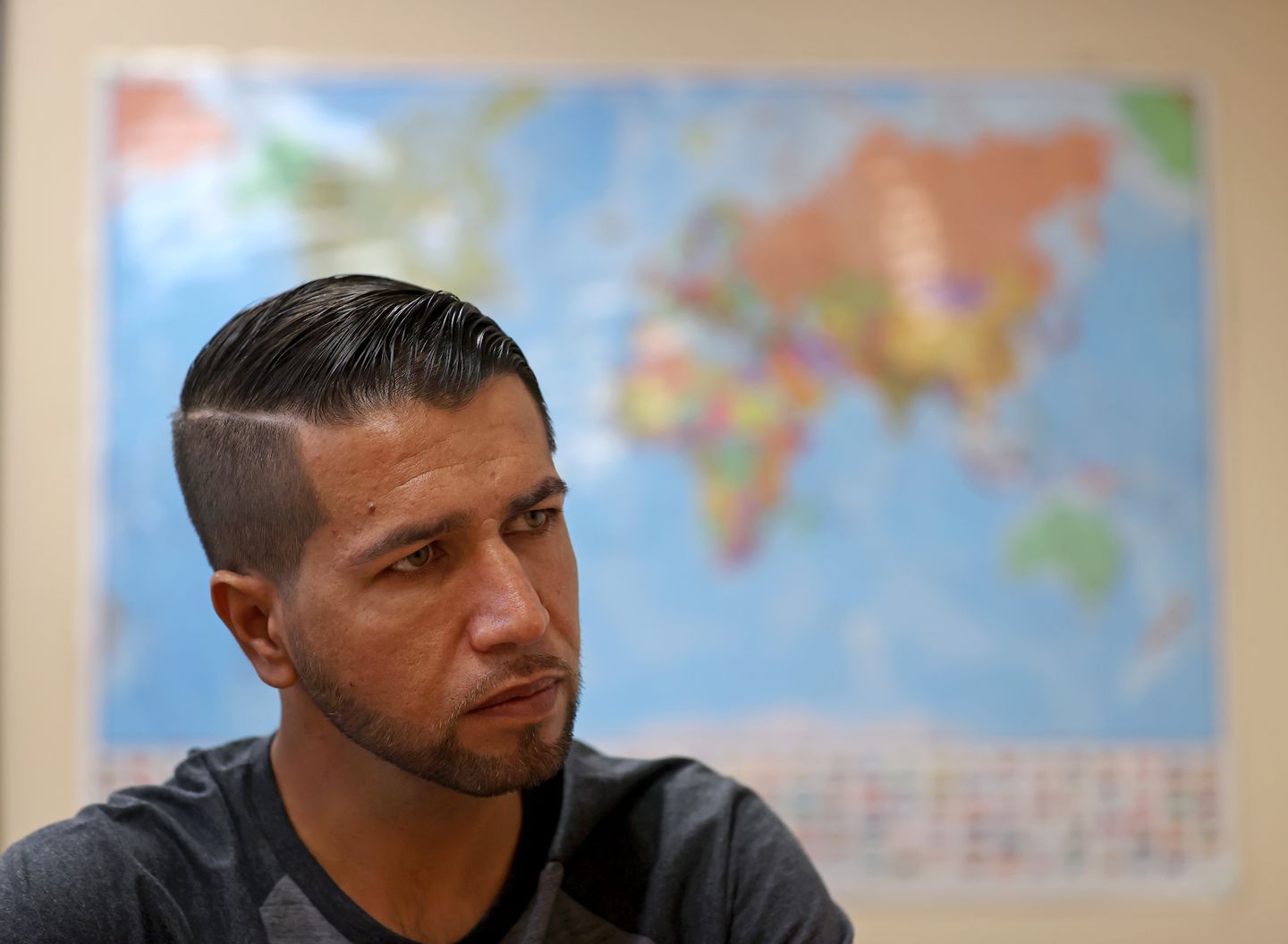
Photo: David L. Ryan/Globe Staff. Aminullah Faqiry, newly arrived with his family in Rhode Island, was an interpreter for the US military, in Afghanistan. He talks with Edward Fitzpatrick about his life there and his sorrow about the failure of 20 years of fighting the Taliban.
Because I’ve volunteered with refugees for several years, I know firsthand that these people do not leave jobs, friends, and family in their home country because they prefer to live in the United States or any other country. They leave because the situation at home is untenable. And it breaks their hearts.
Consider the sadness of the former military interpreter who recently arrived with his immediate family in Rhode Island, forced to abandon other family members who are now in grave danger. Ed Fitzpatrick, a reporter for the Boston Globe, talked to him.
He writes that Aminullah “Faqiry said he was overcome with emotion as he prepared to board the plane to leave Afghanistan, and people began looking at him, wondering why he wasn’t happy to be escaping an incredibly precarious situation. But he knew the source of his tears.
“ ‘I am a very patriotic person,’ Faqiry explained. ‘I cried for my people, for my country, for the system being destroyed, for so many sacrifices that we had made.’
“He said he cried for the family members he was leaving behind — for his mother and father, who are struggling with health problems, and for the widow and the children of his brother, who was killed by the Taliban. …
“He said he was crying because the Afghan people had been ‘liberated’ before the Taliban arrived.
“ ‘Women were able to go to school, and a girl was able to walk on the streets free without tension and without fear,’ he said. ‘Afghanistan was growing up. We were on the move to compete in the world.’ …
“But now, he said, it was clear ‘We were going to go back — my country was going to be thrown back like 50 years. … We are leaving everything behind to the Taliban, who we fought for 20 years and who are a terrorist organization. … We were not able to hold on — we had fallen. … I wanted my country and my people to have been peaceful. It just didn’t happen,’ Faqiry said. ‘I was crying because we lost everything.’ ”
But as you know, people do what they have to do. Most refugees regroup, find or create work to support their families, and give back to their host countries. Today, in Virginia, former refugees are offering a warm welcome to Afghans.
Story Hinckley reports at the Christian Science Monitor, “For many Americans, it’s difficult to imagine what the tens of thousands of newly arrived Afghan refugees are going through.
“But Arshad Mehmood doesn’t have to imagine. He knows. Only seven years ago, Mr. Mehmood was in their shoes, fleeing Pakistan. He describes being kidnapped and tortured by the Taliban for being a local politician.
“Now, as the regional coordinator for a national nonprofit, Mr. Mehmood as well as his team in northern Virginia, many of whom are refugees themselves, is helping these new arrivals with everything from finding apartments to translating school enrollment forms from English to Pashto. They have assisted more than 80 Afghan families over the past three months and expect to help almost 200 by the end of the year.
“And while this practical aid is important, says Mr. Mehmood, it’s not what newly evacuated Afghan allies need most right now. That would be encouragement and empathy. And here in Virginia, Afghans are finding this support in local communities – especially from the refugees who came before them.
“ ‘English was my third language, but I did it. We live a good life here,’ says Mr. Mehmood. His wife, who is a manager at T.J. Maxx, feels welcomed to wear her hijab on the job. His daughter will start her first year of college this fall, and his son is a defensive star on his American football team.’ ”
Read on. There is light in darkness. Perhaps after reading these stories, you will find a way to help a refugee family. And if like blogger Milford Street you already do help refugees, please share a word about your experience.
More at the Monitor, here, and at the Globe, here.




 Suzanne's Mom's Blog