Feeds:
Posts
Comments

Archive for the ‘Uncategorized’ Category

Today’s story reminds me of an old-time jingle my father used to sing: “Shave and a haircut: Two bits!” But the article says that instead of getting a shave with your haircut for only a quarter (two bits), you can now get a Covid shot. And maybe a fried fish sandwich.

Lena H. Sun has the story at the Washington Post. “Reginald Alston never expected to get a coronavirus vaccine and never expected anyone would change his mind about it.

“But his best friend, a hair salon owner, kept telling him he was being shortsighted and maybe even a little bit selfish. What about his niece and her newborn who live with him? How would he feel if they became sick? Also, his job as a contractor and painter meant he was often going into other people’s homes. Didn’t he want to be protected?

“By the time that friend, Katrina Randolph, told him about the nearby barbershop hosting a vaccination clinic, and offered to drive him there, Alston, 57, was far along on the journey to changing his mind.

‘She really influenced me to get it,’ he acknowledged, standing on the sidewalk outside the Hyattsville, Md., barbershop earlier this month after getting immunized. ‘I listen to Katrina. I know she wants me to be around.’

“Alston got his jab of the one-dose Johnson & Johnson vaccine, along with a free fried fish sandwich and a $30 coupon toward a haircut and a shave, at The Shop Spa, a barbershop that serves a predominantly Black and Latino clientele. It’s the first coronavirus vaccine clinic in a barbershop in Maryland and organizers hope it will become a national model. A newly formed partnership that includes Black community and business leaders, the University of Maryland and the White House covid-19 response team is working to make that happen. …

“ ‘Why not go where people already have trust — the barbershop and the salon?’ said Stephen B. Thomas, a health policy professor at the University of Maryland School of Public Health in College Park, who founded the barbershop initiative known as HAIR (Health Advocates In-Reach and Research) more than a decade ago. …

“As the United States enters what is likely to be the toughest stretch of its ambitious immunization effort, health officials are moving away from mass vaccination sites and focusing instead on small clinics like The Shop Spa that rely on word-of-mouth and use trusted, often nontraditional messengers. …

“Alston’s friend, Randolph, 52, [is] part of the cadre of barbers and stylists trained as health educators through the University of Maryland program. The initial focus was colon cancer, diabetes and other diseases that disproportionately affect Blacks. But with vaccination levels lagging in Black and Brown communities, the program seemed a natural to persuade those who have been hardest hit by the pandemic but are often reluctant to get shots. …

“Mike Brown, 49, The Shop Spa’s lead barber, sees sharing such information as one more way to connect with regulars. ‘These are people we genuinely care about, and have become part of their family,’ he said. ‘Sometimes we’re like marriage counselors, sometimes fashion consultants, sometimes drinking buddies. We’re respected in the information that we give.’ …

“To get the word out about the barbershop clinic, Thomas and his team canvassed churches, local businesses and homeless communities and came up with about 100 people who hadn’t been immunized yet.

“Getting them to come to the clinic was another matter. During preregistration calls, Thomas said, some people hung up when they learned the vaccine being offered was from Johnson & Johnson. Others declined even after face-to-face conversations with the team administering the jabs.

“ ‘J & J is radioactive in the Black community because of the baby powder issue,’ he said, referring to the product the company stopped selling last year after it was ordered to pay billions of dollars related to claims the product causes cancer. The company has denied the allegations. …

“Other people opted out of the clinic over worries about the rare but severe type of blood clot that has been linked to the vaccine, even though federal health officials have said the vaccines’ benefits far outweigh those risks.

“Still others expressed a distrust of the health-care system that Thomas says can be overcome only by expanding these health-care outreach efforts beyond coronavirus vaccinations. …

“All in all, 35 people received the shots during that first clinic, Thomas said. … Despite the initial small turnout, the barbershop clinic is starting to generate buzz. … ‘Now we have demand,’ Thomas said. ‘People are bringing people.’

“Randolph figures she has changed the minds of at least 75 people. That includes Alston, her 63-year-old aunt who has such limited access to health care that she has no front teeth, and Jamar Gibbons, 36, a postal worker — all of whom showed up for a shot and a free fish sandwich.

“Luz Castillo, 20, who works at the restaurant next door came to the clinic because she was worried about exposure to unvaccinated customers. She, too, was concerned about blood clot risks linked to the vaccine. But she said she was reassured after a Spanish-speaking health worker answered her questions and pointed to the millions of vaccinated people who have had no problems.” By the way, Suzanne had J&J. No problems.

More at the Post, here.

Read Full Post »

Photo: ArtTrav.
The Medici Chapel in Florence recently got a new kind of cleaning. This is the “before” shot of Michelangelo’s sculptures of Dusk and Dawn. See the New York Times for how they look today.

How do you clean a masterpiece? Carefully, My Friends. Especially if much of the damage was caused by the decomposing body of a long-dead Medici.

Jason Horowitz reports at the New York Times that you may also want to keep any strange method of cleaning a secret until after it actually succeeds.

“As early as 1595, descriptions of stains and discoloration began to appear in accounts of a sarcophagus in the graceful chapel Michelangelo created as the final resting place of the Medicis. In the ensuing centuries, plasters used to incessantly copy the masterpieces he sculpted atop the tombs left discoloring residues. His ornate white walls dimmed.

“Nearly a decade of restorations removed most of the blemishes, but the grime on the tomb and other stubborn stains required special, and clandestine, attention. … Restorers and scientists quietly unleashed microbes with good taste and an enormous appetite on the marbles, intentionally turning the chapel into a bacterial smorgasbord.

“ ‘It was top secret,’ said Daniela Manna, one of the art restorers. …

“ [A team headed by] Monica Bietti, former director of the Medici Chapel’s Museum … used bacteria that fed on glue, oil and apparently [a dead Medici’s] phosphates as a bioweapon against centuries of stains.

“In November 2019, the museum brought in Italy’s National Research Council, which used infrared spectroscopy that revealed calcite, silicate and other, more organic, remnants on the sculptures and two tombs that face one another across the New Sacristy.

“That provided a key blueprint for Anna Rosa Sprocati, a biologist at the Italian National Agency for New Technologies, to choose the most appropriate bacteria from a collection of nearly 1,000 strains, usually used to break down petroleum in oil spills or to reduce the toxicity of heavy metals. …

“Then the restoration team tested the most promising eight strains behind the altar, on a small rectangle palette spotted with rows of squares like a tiny marble bingo board. All of the ones selected, she said, were nonhazardous and without spores.

“ ‘It’s better for our health,’ said Manna, after crawling out from under the sarcophagus. ‘For the environment, and the works of art.’ …

“In February 2020 Covid hit, closing the museum in March and interrupting the project. … The bacteria strains got back to the Medici Chapel, which had reopened with reduced hours, in mid-October. Wearing white lab coats, blue gloves and anti-Covid surgical masks, Sprocati and the restorers spread gels with the SH7 bacteria — from soil contaminated by heavy metals at a mineral site in Sardinia — on the sullied sarcophagus of Lorenzo di Piero, Duke of Urbino, buried with his assassinated son Alessandro.

“ ‘It ate the whole night,’ said Marina Vincenti, another of the restorers. …

“In 2016, [she had] attended a conference held by Sprocati and her biologists. (‘An introduction to the world of microorganisms,’ Sprocati called it.) They showed how bacteria had cleaned up some resin residues on Baroque masterpiece frescoes in the Carracci Gallery at Palazzo Farnese in Rome. Strains isolated from mine drainage waters in Sardinia eliminated corrosive iron stains in the gallery’s Carrara marble.

“When it came time to clean the Michelangelos, Vincenti pushed for a bacterial assist.

“ ‘I said, “OK,” said [Paola D’Agostino, who runs the Bargello Museums]. ‘ “But let’s do a test first.” ‘

“The bacteria passed the exam and did the job.”

More at the Times, here.

Read Full Post »

Photo: Georgia State University.
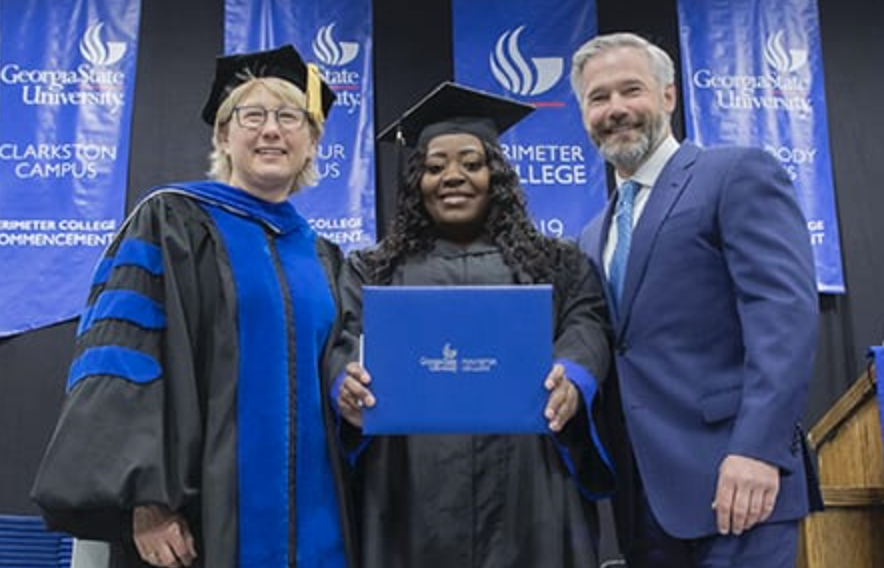
Latonya Young was able to finish college after Kevin Esch, her Uber passenger, secretly paid off previous school costs.

This feel-good story was widely reported, but just in case you missed it, I want you to know that once upon a time when an Uber driver mentioned to a passenger that she couldn’t finish college because of a debt for classes already taken, the passenger knew he had to help out. And — secretly at first — he did. But it may have been the ongoing friendship and support that had the biggest effect.

Sydney Page has the story at the Washington Post. “Latonya Young, a 44-year-old single mother of three, received a bachelor’s degree [in May]. It was a lifelong goal — and she credits one of her Uber passengers with making it possible.

“She met the passenger three years ago when she pulled over in downtown Atlanta to pick him up. Kevin Esch, who had just come from an Atlanta United soccer game, got into her car. The two started chatting.

“ ‘The conversation was easy and felt authentic,’ said Esch, 45.

“He shared details about his recent divorce, and Young — whose marriage ended in 2011 — offered advice.

“During the half-hour ride to Esch’s home, he learned that Young, who had been an Uber driver for three years, was working late that night because she needed money to pay a utility bill.

“And he learned something else: Young wanted to be the first member of her family to graduate from college. Although Young started taking classes at Georgia State University in 2010, she dropped out a year later because she couldn’t pay the tuition.

“Once they arrived at his home, Esch, an estate manager, tipped Young $150 — enough to cover the utility bill — and gave her his phone number.

“ ‘She promised me that she would go back to school,’ he said, adding that he asked her to keep him informed throughout the enrollment process. It was the start of an unexpected friendship.

“After the Uber ride, ‘I had my mind made up that I wanted to go back to school,’ she said. ‘He motivated me.’

“But a few weeks later, when Young tried to re-enroll at Georgia State, she was told that she wasn’t permitted to register until her balance from eight years earlier was paid in full. She owed $693 — a sum she couldn’t afford.

“When she told Esch about the financial hold, he immediately went to the university, without Young’s knowledge, and paid off her debt.

‘I didn’t want that to be a roadblock, because it was something that I could change,’ Esch said. ‘I was in a place to be able to do it, and it was the right thing to do.’ …

“ ‘I was in shock,’ Young said. ‘This person barely knew me, and yet he wanted to help me.’

“She vowed to pay him back, but his response was: ‘Pay me back by graduating.’

“Young was grateful for the support, she said, after years of working multiple jobs and putting off her education. …

“ ‘It was like I was stuck inside a box and couldn’t get out. I was just trying to do whatever I had to do to take care of my kids,’ Young said, adding that she was also in a car accident in 2015, which further set her back financially. …

“After meeting Esch, though, ‘I felt it was time for me to do something for myself, and to set an example for my kids,’ Young said. Plus, she added, ‘I wanted to remain a woman of my word and do exactly what I told Kevin I was going to do.’

“She re-enrolled in courses, and in December 2019, Young received her associate’s degree in criminal justice from Georgia State’s Perimeter College. Esch was there on graduation day, cheering her on in the stands. …

“Still, ‘I knew I wasn’t finished,’ she said. Getting a bachelor’s degree was her ultimate goal, ‘so I went straight ahead. Not only was I aiming for that, but I was aiming to raise my GPA as much as I could before I graduated.’

“Young continued with her studies while working part time as a substitute teacher, as well as a hairstylist. She also received support from the Jeanette Rankin Women’s Scholarship Fund, which offers financial aid to low-income women older than 35 pursuing postsecondary education. …

“ ‘The funding helped me get through the hardships,’ Young said, adding that it was often difficult to manage being a single mother while working two jobs and keeping up with her classes. …

“Despite the challenges, though, Young graduated with her bachelor’s degree in criminal justice from Georgia State’s Andrew Young School of Policy Studies on May 6. Of course, alongside her family, Esch was in the stands once again — beaming with joy.”

Read the rest of the story at the Post, here.

Read Full Post »

Photo: Tini and Jacob Wijpkema.
Rare cactus, Copiapoa cinerascens, found in Chile. According to the NY Times, “Cactus traffickers are cleaning out the deserts.”

Today’s story, about an endangered cactus from Chile, demonstrates the role individuals’ tastes can play in the environment. Our individual choices add up to a force for right or wrong, whether we leave our engine running while we go shopping or we collect plants and animals because they are rare. “One and two and 50 make a million,” you know.

At the New York Times, Rachel Nuwer says some rare cactuses are getting too popular with unscrupulous collectors.

“Andrea Cattabriga has seen a lot of cactuses where they didn’t belong. But he’d never seen anything like Operation Atacama, a bust carried out last year in Italy. A cactus expert and president of the Association for Biodiversity and Conservation, Mr. Cattabriga often helps the police identify the odd specimen seized from tourists or intercepted in the post.

“This time, however, Mr. Cattabriga was confronted by a stunning display: more than 1,000 of some of the world’s rarest cactuses, valued at over $1.2 million on the black market.

“Almost all of the protected plants had come from Chile, which does not legally export them, and some were well over a century old. The operation — which occurred in February 2020, but is being made public now because of the cactuses’ recent return to Chile — was most likely the biggest international cactus seizure in nearly three decades. It also highlights how much money traffickers may be earning from the trade. …

‘Here is an organism that has evolved over millions of years to be able to survive in the harshest conditions you can find on the planet, but that finishes its life in this way — just as an object to be sold,’ [Mr. Cattabriga] said.

“As with the market for tiger bones, ivory, pangolin scales and rhino horn, a flourishing illegal global trade exists for plants. ‘Just about every plant you can probably think of is trafficked in some way,’ said Eric Jumper, a special agent with the Fish and Wildlife Service. Cactuses and other succulents are among the most sought after, along with orchids and, increasingly, carnivorous species.

“Trafficking can take a serious toll. Over 30 percent of the world’s nearly 1,500 cactus species are threatened with extinction. Unscrupulous collection is the primary driver of that decline, affecting almost half of imperiled species. Yet this realm of illegal trade is typically overlooked, a prime example of ‘plant blindness,’ or the human tendency to broadly ignore this important branch on the tree of life.

“ ‘The basic functioning of the planet would effectively grind to a halt without plants, but people care more about animals,’ said Jared Margulies, a geographer at the University of Alabama who studies plant trafficking. ‘A lot of plant species are not receiving the amount of attention they would be if they had eyes and faces.’

“Yet the size of Operation Atacama could be a notable exception. It is also the largest known example of cactuses stolen from the wild being repatriated for reintroduction into their native habitat.

“Experts also hope the case can be a turning point for how countries, collectors, conservationists and the industry deal with the thorny issue of international cactus trafficking.

“ ‘Society as a whole can no longer continue to have a naïve view of this problem,’ said Pablo Guerrero, a botanist at the University of Concepción in Chile. …

“Cactuses confiscated by the Italian authorities are normally destroyed or, if they are rare species, sent to botanical gardens. But with Operation Atacama, ‘it was very different,’ Mr. Cattabriga said. … At first, there was discussion of sending the plants to other botanical gardens in Italy and broader Europe. But Mr. Cattabriga, [Lt. Col. Simone Cecchini, chief of the wildlife division of the local police department] and Dr. Guerrero were adamant they be returned to Chile for both conservation and symbolic purposes.

“Working with [Bárbara Goettsch, co-chair of the Cactus and Succulent Plant Specialist Group at the International Union for Conservation of Nature] and several others, they spent much of 2020 navigating Italian, Chilean and international bureaucracy to secure permission to send the plants home. ‘It’s the first time this has happened, so no one was really clear on how to do this,’ Dr. Guerrero said.

“The authorities finally agreed to the transfer in late 2020. But neither Chile nor Italy would pay the approximately $3,600 shipping cost.

“Dr. Goettsch managed to secure about three-quarters of the funds from the International Union for Conservation of Nature, and the botanical garden in Milan pitched in as well. The rest was provided by Liz Vayda, owner of B. Willow, a plant shop in Baltimore that regularly donates to environmental groups.

“Finally, in late April, 844 cactuses made the return journey to Chile.”

Read about the homecoming at the Times, here.

Read Full Post »

Photo: U.S. Army.
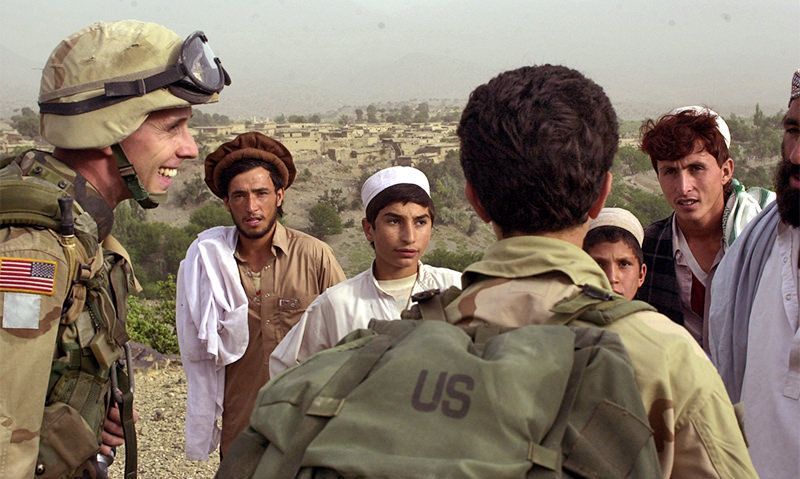
An Afghan interpreter assists U.S. military personnel trying to locate Taliban weapons.

On Memorial Day, as we honor the men and women of our military, I am thinking in particular of those whose lives have been lost fighting in Afghanistan. Today, many who are leaving that troubled country have a justifiable concern about what will happen to their interpreters and friends when the Taliban reassert control.

I am not one to say we should stay there, but I have learned from Shagufa just how bad things are likely to get, and I wanted to know what our soldiers thought.

Ken Olson writes at Legion.org, “Gerald Keen’s Afghan interpreter is running out of time. One relative was assassinated by the Taliban a month ago. Another was killed by an IED last Sunday. Both also worked as translators for U.S and coalition forces in Afghanistan.

“ ‘It’s like he has a bounty on his head,’ Keen says of the Afghan national he worked closely with during his 2016 deployment. ‘The Taliban has no remorse.’ …

“There are more than 17,000 interpreters and their families mired in the same bureaucratic quagmire of the U.S. Special Immigration Visa application process. Their peril is exponentially greater now that the United States has announced it will withdraw all of its troops from Afghanistan. …  

“It’s a haunting reminder of the situation faced by the Montagnards who risked their lives and their families’ lives to support U.S. operations in the Vietnam War. The American Legion has asked the president and Congress through a 2018 National Security Commission resolution to recognize the crucial contribution Afghan and Iraqi interpreters have made and ensure they are able to come to the United States. ‘Our wartime allies saved countless American lives and directly contributed to every level of tactical, operational and strategic success during the mission is Iraq and Afghanistan,’ according to Resolution No. 16, passed by Legion’s National Executive Committee in October 2018.

“The International Refugee Assistance Project also called for the mass evacuation of Afghans at risk to Guam or another location while they slog through the lengthy visa process, much like what was done for Iraqi Kurds as part of Operation Pacific Haven in 1996. …

“The Special Immigrant Visa program most Afghan nationals are using was established in 2009 when Congress created the Afghan Allies Protection Act, says Julie Kornfeld, an attorney with the International Refugee Assistance Project who represents several Afghan interpreters. The statute calls for visa applications to be processed in nine months. The reality is far worse. Kornfeld has clients who have been waiting as long as 10 years.

“ ‘The U.S. mission in Afghanistan recruited Afghan nationals with a promise of safety, but we’ve made it bureaucratically impossible for them to access safety,’ she says. ‘It sends a message to them that we aren’t fulfilling our promise to protect them.’ …

“ ‘It’s very frustrating,’ Keen adds. ‘We couldn’t have made it through this without these interpreters.’ ”   

So today, as we honor military personnel who have died serving in wars at the behest of a series of presidents, let’s spare a thought for those who are in danger because they helped us, and let’s support any elected representatives who may be trying to rescue those people.

More here.

Read Full Post »

Photo: Sir Cam.
Says Professor James Diggle, “When I was able to sign off the final proofs … I literally wept with joy.”

Once when I was in high school in New York, my father had a temporary stay at Lenox Hill Hospital, and I trotted over in my green uniform and my monstrous stack of school books to pay him a visit. When the doctor came in, he asked me what I was studying, and my father proudly told him I was learning Ancient Greek. That’s when the doctor burst our bubble. He said he’d studied Greek for five years and never had a use for it.

Well, I ended up studying it for five years, too, and although I can’t say I ever had a practical application for it, I don’t regret it. So I was interested in today’s article about the newest, biggest ever Ancient Greek lexicon. There’s a funny angle to the story that makes me think the book would never have been purchased back in those days by that demure girls school, where the students tittered over Aucassin et Nicolette as if it were Fanny Hill.

Alison Flood reports at the Guardian, “Victorian attempts to veil the meanings of crude ancient Greek words are set to be brushed away by a new dictionary 23 years in the making. It is the first to take a fresh look at the language in almost 200 years and promises to ‘spare no blushes’ for today’s classics students.

“The late scholar John Chadwick first came up with the idea to update HG Liddell and Robert Scott’s 1889 dictionary, the Intermediate Greek-English Lexicon, in 1997. An abridged version of a lexicon published in 1843, the Liddell and Scott had never been revised, and is packed with antiquated terms and modestly Victorian translations of the more colourful ancient Greek words. Despite this, it remains the most commonly used reference work for students in English schools and universities.

“It was initially thought that Chadwick’s project would take five years, but Cambridge professor James Diggle, who was then chair of the advisory committee, said it soon became clear that the Intermediate Lexicon was ‘too antiquated in concept, design and content,’ and the team would need to start afresh.

“Diggle and his fellow editors then set out on the ‘Herculean task’ of rereading most examples of ancient Greek literature, from Homer to the early second century AD. They then worked through the 24 letters of the Greek alphabet to create a modern guide for today’s students to the meanings of ancient Greek words and their development through the years. The lexicon is the first to be based on an entirely new reading of the Greek texts since 1843.

‘At the outset of the project I undertook to read everything which the editors wrote. I soon realized that if we were ever to finish I had better start to write entries myself,’ said Diggle.

“ ‘The moment of greatest relief and joy was when I was able to sign off the final proofs and say to the publisher, “It’s finished. You can print it.” You can’t imagine what it was like, to realize that we had finally got there. I literally wept with joy.’

“The completed Cambridge Greek Lexicon, which is being published by Cambridge University Press, runs to two volumes and features around 37,000 Greek words, drawn from 90 authors and set out across 1,500 pages.

“The new dictionary’s editors ‘spare no blushes,’ Diggle said, when it comes to the words that ‘brought a blush to Victorian cheeks.’ The verb χέζω (chezo), translated by Liddell and Scott as ‘ease oneself, do one’s need,’ is defined in the new dictionary as ‘to defecate’ and translated as ‘to shit.’ …

“Antiquated and offensive language also gets a makeover. While Liddell and Scott defined βλαύτη (blaute) as ‘a kind of slipper worn by fops,’ in the Cambridge Greek Lexicon it is described as ‘a kind of simple footwear, slipper.’ …

“The Cambridge Greek Lexicon also begins each entry with the root meaning of a word, a fundamentally different approach to the 19th-century lexicon, which started entries with a word’s earliest appearance in literature.

” ‘Take a word like πόλις, which will be familiar to many in its English form “polis,” ‘ said Diggle. “Our article shows the variety of senses which the word can have: in its earliest usage “citadel, acropolis”; then, more generally, “city, town” and also “territory, land”; and, more specifically, in the classical period, “city as a political entity, city-state”; also, with reference to the occupants of a city, “community, citizen body.” ‘ “

More at the Guardian, here.

Read Full Post »

Photo: The Guardian.
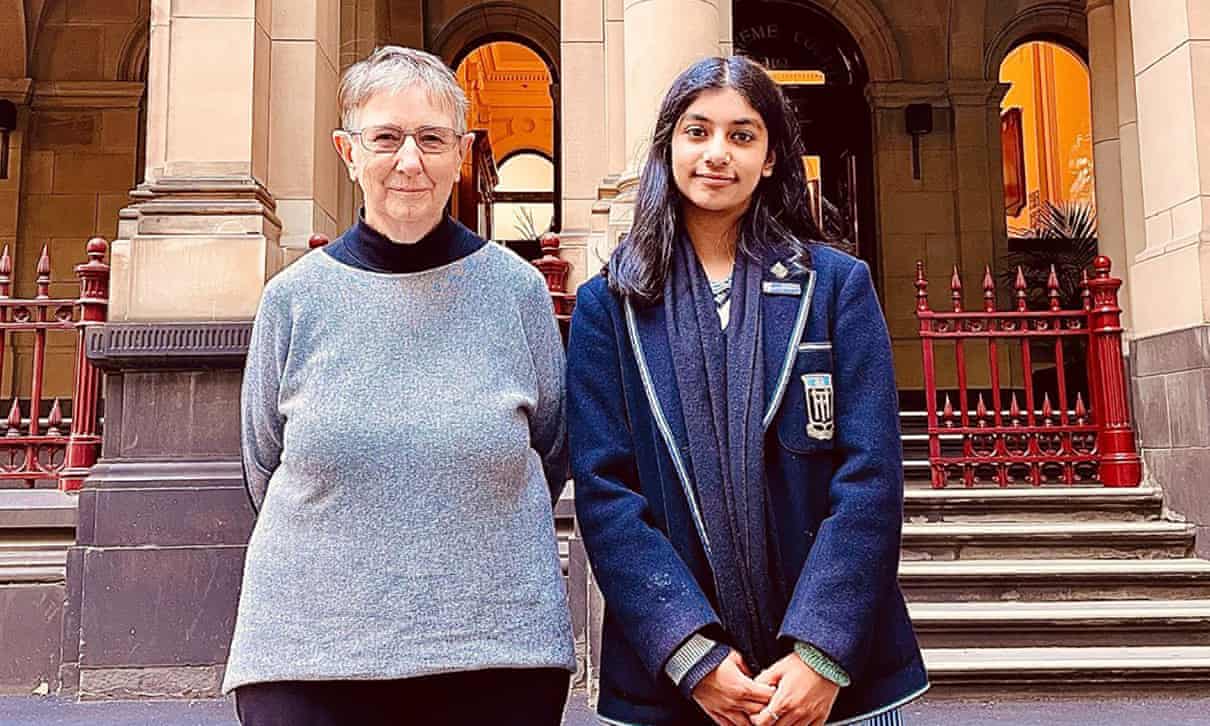
Sister Brigid Arthur, 86, and Anj Sharma, 16, are among a group who secured a judgment from the Australian federal court that found the government has a duty to protect young people from climate change.

If you ever feel powerless to do anything about climate change, consider how an 86-year-old nun and eight Australian teenagers stopped a massive new coal mine in its tracks by persuading a court that the needs of youth need to be addressed first. Fingers crossed that the success is more than temporary.

Adam Morton writes at the Guardian, “The federal court of Australia has found the environment minister, Sussan Ley, has a duty of care to protect young people from the climate crisis in a judgment hailed by lawyers and teenagers who brought the case as a world first.

“Eight teenagers and an octogenarian nun had sought an injunction to prevent Ley approving a proposal by Whitehaven Coal to expand the Vickery coalmine in northern New South Wales, arguing the minister had a common law duty of care to protect younger people against future harm from climate change.

“Justice Mordecai Bromberg found the minister had a duty of care to not act in a way that would cause future harm to younger people. But he did not grant the injunction as he was not satisfied the minister would breach her duty of care.

“David Barnden, a lawyer representing the children, said it was a historic and ‘amazing decision’ with potentially significant consequences.

“ ‘The court has found that the minister owes a duty of care to younger children, to vulnerable people, and that duty says that the minister must not act in a way that causes harm – future harm – from climate change to younger people,’ he said outside court.

‘It is the first time in the world that such a duty of care has been recognized, especially in a common law country.’

“He said Bromberg had indicated he would now take submissions before making further declarations about what the minister’s duty of care may mean for whether the mine extension could go ahead.

“Whitehaven Coal had a different interpretation of the judgment. In a statement to the stock exchange, it did not mention the duty of care finding, and said it welcomed the court dismissing the teenagers’ attempt to block Ley from approving the mine extension. …

“Speaking for the children, 17-year-old Ava Princi said it was ‘thrilling and deeply relieving’ that the justice had recognized the minister had a duty of care. …

“She said though an injunction was not granted the case was ‘not over yet. … There will be further submissions on what the duty of care means for the minister’s decision and the mine.’ …

“The court heard the expansion of the mine could lead to an extra 100m tonnes of CO2 – about 20% of Australia’s annual climate footprint – being released into the atmosphere as the extracted coal is shipped overseas and burned to make steel and generate electricity.

“In his judgment, Bromberg said the evidence presented to the court showed the potential harm the children could face due to global heating ‘may fairly be described as catastrophic, particularly should global average surface temperatures rise to and exceed 3C beyond the pre-industrial level.’ ” More at the Guardian, here.

It may not be over, but a finding for children and their future is important, and when added to other recent judicial decisions described in the Guardian article, there’s some reason for hope.

Read Full Post »

Photo: Time magazine, 2020.
At 15, scientist Gitanjali Rao made history with a device to detect lead in drinking water. ‘You don’t need a PhD to make a difference,’ she says.

More kids are getting into science these days, and I think their enthusiasm is going to benefit us all.

Anne Branigin reports at the Lily, “Gitanjali Rao just finished her final exam of the year and, like any other teenager, is eager to begin her summer.

“The 15-year-old is, in many ways, not your typical teen. She landed on the cover of Time magazine in 2020 as its inaugural ‘Kid of the Year’ for her scientific achievements, which include building a device, Tethys, that detects lead in drinking water.

“But Rao doesn’t see herself as exceptional. In fact, when she was younger, she didn’t even see herself as ‘the science type.’ She was driven, instead, by trying to find solutions to problems in her community. Once she discovered science and technology could be a means of finding those solutions, there was no turning back.

‘Using science and technology as social change became something that was intuitive to me and something that I wanted to keep doing,’ she said. …

“Rao says her passion for STEM has shaped her days and her goals — she is working on creating a global network of young innovators to tackle global problems. It also fuels her relentless optimism for the future and all its possibilities. …

“Anne Branigin: I’m curious what a normal day looks like for you during a very not-normal year.

“Gitanjali Rao: A normal day obviously involves being your normal high school student, just, you know, maintaining a social life, still doing homework every single day, studying for exams. But then there’s this added layer of my research and innovations. A lot of my work has been focused on running my innovation workshops for students all over the globe, which is also taking up a little bit — a lot of my energy and time trying to maintain that sort of situation as well. And also just being, even remotely, in the public eye obviously comes with its own perks, but also disadvantages of being able to manage that as well. …

“I love helping people. I love using science and technology to do that. So that priority always comes first. … I don’t do eight things at a time. I might do eight things in a day, but not eight things at a time because I know what I need to focus on. I know how to prioritize my work. …

“Anne Branigin: On the subject of your generation, there’s a recent study showing that interest in STEM is at an all-time high among young people.

“Gitanjali Rao: It honestly makes me really happy to see younger generations engaging in science. Today’s kids are tomorrow’s innovators and they [will] make the world better, stronger and more sustainable in the future. …

“Anne Branigin: What do you think makes your generation’s approach to science unique?

“Gitanjali Rao: So a question that I commonly get is, what is one word to describe your generation? And I like to say, hotheaded — but in a good way. Our generation, if we put our mind to something, we want to get it done. That’s how I have been. That’s how a lot of my friends have been. …

“Anne Branigin: In the past, we haven’t always seen people of color and women and other members of marginalized communities really be the drivers of this technology. I’m curious how you’ve been thinking about equity and how those conversations have come up with your peers.

“Gitanjali Rao: My generation is destined to be innovators more than any generation that came before. And we’re the first generation to grow up as natural innovators because of how we live, where we live and what we have access to from a technology standpoint.

“Where I want to see that equity change is in education. Access to resources is something that obviously people have faced across the world. It’s an issue still to this day. It’s the 21st century, and we’re still talking about girls and women struggling to get education. But what it’s important to recognize is that a lot of times, the ideas start in the bare minimum.

“With my device, Tethys, to detect lead in drinking water, I started with a cardboard box and a couple of drawings on a piece of paper. And honestly, what that turned into was not looking at what resources I had, but dreaming big and then thinking back to reality.

“So equity is something that we need to work together to make a difference. But until then, it’s about using what we have on hand. Most of the innovators that I talk to online don’t have their driver’s license. I don’t have my driver’s license. But at the same time, it gives me this opportunity to be like, ‘Okay, with the resources that I have on hand, without having money to spend, what can I do?’ “

More at the Lily, here.

Read Full Post »

Photo: Josh Reynolds for the Boston Globe.
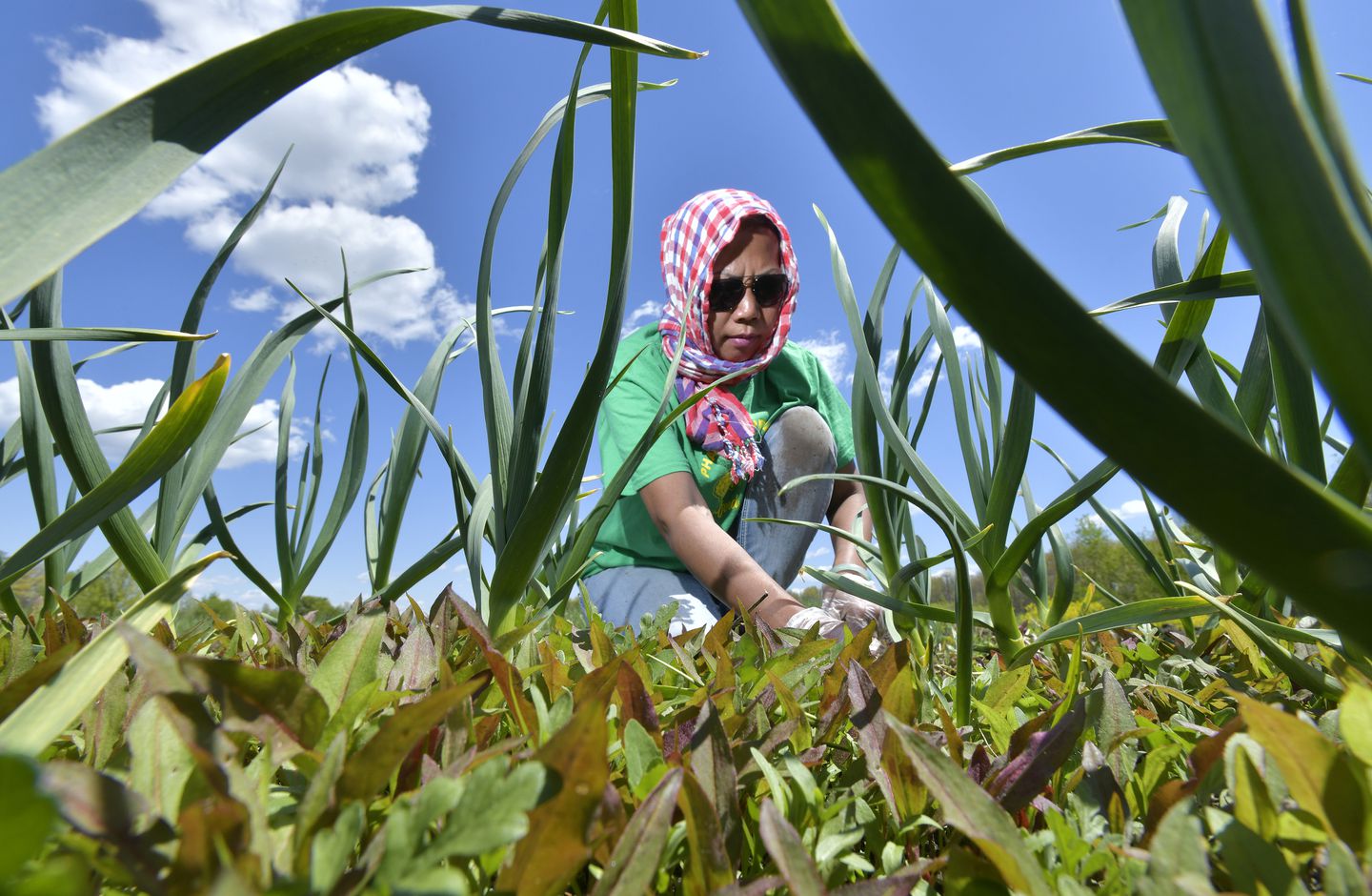
Phalla Nol of Lowell weeded rows of garlic in her plot at White Gate Farm in Dracut.

I’ve really been intrigued by the Boston Globe “States of Farming” series — “occasional stories looking at Black, indigenous, and people of color (BIPOC) farmers in New England.” Today’s article addresses how a Cambodian who arrived here as child went about building a well-respected produce business.

Jocelyn Ruggiero writes that after Phalla Nol’s family “entered the United States as refugees in October 1981, they settled in Revere. Nol spoke ‘a little bit’ of English and could understand well enough to get along at the local high school, where the students were friendly. The adults in the community weren’t as welcoming.”

After an act of arson that left Nol’s family homeless, they rebuilt their lives in Greater Boston, got jobs, and made friends.

Her father “was 71 in 1998 when he retired from the New England Seafood Company and was among the first participants in the New Entry Sustainable Farming Project, an initiative of Tufts University’s Friedman School of Nutrition Science and Policy. The farmer training program supported his plot at Smith Farm, a training site owned by the Dracut Land Trust, where New Entry trained him in such skills as sourcing seeds, selling produce, using small farm equipment, pest and disease management, and drip irrigation. …

“Although Nol ‘loved the farm,’ it didn’t generate enough revenue to interest her. ‘He didn’t care about money, but me, I do care about the money.’ Beginning around 2007, however, Nol saw an opportunity for profit. She began purchasing produce from Cambodian New Entry farmers and graduates and resold those vegetables at local farmers’ markets. This proved to be a financial success.

“In 2013, New Entry found that they had more Southeast Asian crops from their Cambodian farmers than they could use in their CSA. So Hashley approached Nol with a proposition.

“ ‘Phalla was . . . already organizing and buying and selling from other farmers for her own markets,’ [New Entry director Jennifer Hashley] said. New Entry proposed that Nol become a ‘broker’ of sorts between the farmers and Whole Foods. ‘We helped her get the necessary insurance and distributor’s license she needed to aggregate orders among the farmers and sell directly to Whole Foods. We also connected her to Russo’s in Watertown to do similar wholesale sales.’ …

“Tony Russo, the owner of Russo’s in Watertown, has nothing but respect for Nol after doing business with her for eight years. ‘Phalla’s remarkable. . . . She’s honest, she’s responsible, she’s skillful. All the products she gives us are always just what they’re supposed to be, never less than that, and she’s fair with her prices. She’s a very hardworking person in a very difficult business environment. She’s a tower of strength.’

“Today, Nol leases five acres from the town of Westford and a smaller plot from the Dracut Land Trust. Her sister drives from New Jersey to help every weekend, and nieces, nephews, cousins, and other relatives do what they can to chip in. Although Nol pays a couple of people to plow and till, her mother, Kimsan Ly, ‘is with me 24 hours. . . . She’s my main helper. She’s stronger than me!’ Nol and her mother begin many days at 5:30 in the morning, and some nights harvest until well after dark, preparing for farmers’ markets and wholesale deliveries. Since so much of the business’s financial success is tied to her family’s help, Nol is unsure of what the business will look like 10 years from now. ‘The older we get, the more challenging it is.’ …

“Despite the challenges and despite the uncertainty of the future, she’s proud of the business she’s built: ‘My stand, what a crazy thing,’ Nol laughs. ‘At my stand, people line up, from here to there,’ she says, making a wide gesture. ‘They fight to get to my veggies!’ ”

For more on the family’s difficult history in Cambodia and both challenges and successes in American, check out the Globe, here.

Read Full Post »

Photo: Jim Maragos, US Fish and Wildlife Service, CC BY-NC 2.0.
The Ocean Panel is a group of 14 countries looking to protect 100% of their ocean areas by 2025. Pictured: a coral reef in the Palmyra Atoll National Wildlife Refuge.

I don’t know which aspect of this story is more hopeful: that there is time to save oceans or that 14 countries have pledged to collaborate. On anything.

From the radio show Living on Earth: “The oceans are facing serious and growing threats, including climate change, overfishing, plastic pollution and more. But a group of 14 world leaders called the Ocean Panel is committing to transform the ocean from victim to solution, by sustainably managing 100% of their ocean areas by 2025. Jane Lubchenco is the Deputy Director for Climate and Environment for the White House Office of Science and Technology Policy, as well as a co-chair of the Ocean Panel Expert Group that helped ground this vision in research. She joins Host Aynsley O’Neill. …

“O’NEILL: Before she took her White House job, [Jane Lubchenco] spoke with us about the vision and work of the Ocean Panel. Jane, welcome back to Living on Earth!

“LUBCHENCO: Thanks, Aynsley, it’s a delight to be here.

“O’NEILL: Now, when we look at how we currently manage the oceans, why does the world need this total transformation in management? …

“LUBCHENCO: We’ve treated a lot of these problems issue by issue. And part of the message that the Ocean Panel leaders heard is the need for integrated solutions that consider the whole suite of human activities. The other major thing that I think they heard was that a smart future is not just doing more of the same. It’s actually doing things differently, being much smarter about how we fish, much smarter about how we produce energy, much smarter about how we transport goods around the world. And so much of what is in their new, exciting Ocean Action agenda is doing things smarter, more effectively, more efficiently, and also doing things more holistically. …

“In September of 2019, we had a new report that came out from the IPCC, the Intergovernmental Panel on Climate Change. There was a special report on the ocean and the cryosphere, and it painted in very depressing detail, all of the ways that the ocean has been massively affected by climate change and ocean acidification. … The same week, the Ocean Panel unveiled a report. … The report that the Ocean Panel commissioned, looked at a variety of ocean-based activities and asked simply, what is the potential for mitigating climate change? And they found enough data at the global scale to analyze five categories of activities. And when they added up how much they could get from each of those five, they came to the astounding conclusion that it might be as much as 1/5 of what we need, by way of carbon emission reductions to achieve the 1.5 degree centigrade target of the Paris Agreement by 2050.

So that’s huge. You know, a lot of those activities weren’t even on the table. And here, we find that they actually could play a very significant role in helping to turn things around in terms of climate change.

“O’NEILL: So Jane, you mentioned five ocean-based activities to help mitigate climate change. Could you go through those for us, please?

“LUBCHENCO: So the first one was increasing renewable energy from the ocean, and that’s a big one. Most of that is going to likely be wave energy, but it might also be tidal, it might be current, it might be thermal, depending on what part of the world you are in.

“The second category was making shipping less polluting. So 90% of the goods that are traded globally travel by ocean and currently, that’s pretty polluting. Its dirty fuels contribute significantly to greenhouse gases. But it is technologically possible to decarbonize shipping, and that could have a huge benefit.

“Number three is focusing on what we call blue carbon ecosystems. So these are coastal and ocean ecosystems, such as mangroves, salt marshes, or seagrass beds, that are little carbon engines that are just sucking carbon out of the atmosphere like crazy. Those habitats; mangroves, sea grasses, salt, marsh beds, can not only remove but then sequester as much as 10 times as much carbon as an equivalent area of forest, for example. And we’ve currently lost about half of them globally. So here is an opportunity to actually protect the remaining ones, but also to restore those that have already been degraded.

“The fourth area for ocean based activities to mitigate climate change comes from focusing on a little bit greater efficiency with aquaculture, mariculture operations, a little bit greater efficiency with fisheries. But the big one in this category is really shifting diets globally, away from animal protein on the land, and including animal protein from the sea, instead of that animal protein from the land.

“And then the fifth category was simply sequestering carbon on the seabed. And the panel who looked at these five categories, said that the first four, they felt completely comfortable recommending that they be pursued aggressively. Smartly, yes, but aggressively. This fifth one, carbon storage in the seabed has a lot of questions still about technical and environmental impacts. And so they recommended further study for those. …

“This is not really sacrifice. It’s being smarter about doing things. I think people are familiar with the concept of greater efficiency when we think about energy. You know, much of the focus for mitigating climate change has been focusing on how do we use energy more efficiently. And there have been tremendous advances in energy efficiency of our appliances, of our automobiles, of our transportation systems. That same concept of being more efficient, is what underlies a lot of the transformative actions that are in the ocean action agenda. So yes, this is an incredible opportunity. And it’s my belief that these 14 nations that have embarked on this journey of discovery and now journey of action will have such success with what they are proposing that others will say, oh my gosh, I want some of that too.”

More at Living on Earth, here.

Read Full Post »

Photo: Michelle Groskopf.
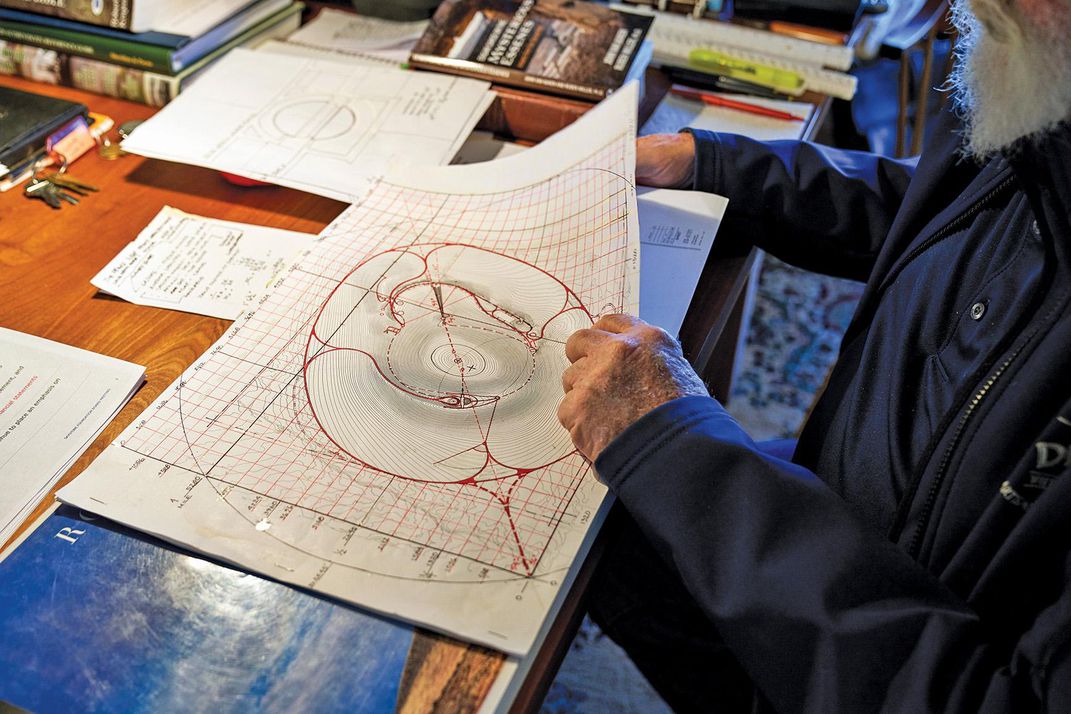
At home in Arizona, James Turrell views plans for the access road to his giant desert artwork. “Tight contour lines near the center represent the steep slope to the summit,” the
Smithsonian reports.

What is the difference between intensity and obsession, and does the latter ever benefit humanity? Read this story and be the judge. It’s about an artist in his late 70s who as a young man spent a year in jail for teaching other young men how to avoid the draft — and Vietnam. An unusual person.

At the Smithsonian magazine, Wil S. Hylton describes James Turrell’s massive art project in the desert.

“It was a cloudless day in northern Arizona,” writes Hylton, “and James Turrell wanted to show me an illusion. We climbed into his pickup truck and drove into the desert. After a few miles, he turned off the pavement to follow a dusty road; then he turned off the road and barreled across the desiccated landscape. When we reached the base of a red volcano, he shifted into four-wheel-drive. …

“The engine groaned and Turrell gripped the wheel with two hands as we climbed. Here and there we lost traction and slipped backward a few feet, but eventually we reached the top. The desert stretched for miles around, a patchwork of green and gold and brown, with the snowcapped peaks of the San Francisco mountains on the horizon.

“Turrell pointed down. ‘You see how the area right below us seems to be the lowest point?’ he asked. I followed his gaze, and it was true: The desert appeared to slope toward us from every direction, as if the volcano were sitting at the bottom of an immense bowl. ‘But it can’t be,’ Turrell said, ‘or we’d be surrounded by water. This is an illusion that Antoine de Saint-Exupéry talked about. You have to be between 500 and 600 feet above the terrain for it to happen.’ …

“Turrell, who turns 78 this year, has spent half a century challenging the conventions of art. While most of his contemporaries work with paint, clay or stone, Turrell is a sculptor of light. He will arrive at a museum with a construction crew, black out the exterior windows, and build a new structure inside — creating a labyrinth of halls and chambers, which he blasts with light in such a way that glowing shapes materialize. In some pieces, a ghostly cube will appear to hover in the middle distance. In others, a 14-foot wedge of green shimmers before your eyes. One series that Turrell calls ‘Ganzfelds’ fills the room with a neon haze. To step inside is to feel as if you are falling through a radioactive cloud. In another series, ‘Skyspaces,‘ Turrell makes a hole in the roof of a building, then winnows the edges around the opening to a sharp point. The sky above appears to flatten on the same plane as the rest of the ceiling, while supersaturated tones of light infuse the room below.

“Turrell’s work can be found in 30 countries around the world. He has produced nearly 100 Skyspaces alone. … The volcano is different. It is Turrell’s most ambitious project, but also his most personal. He has spent 45 years designing a series of tunnels and chambers inside to capture celestial light. Yet Turrell has rarely allowed anyone to visit the work in progress. Known as Roden Crater, it stands 580 feet tall and nearly two miles wide. One of the tunnels that Turrell has completed is 854 feet long.

When the moon passes overhead, its light streams down the tunnel, refracting through a six-foot-diameter lens and projecting an image of the moon onto an eight-foot-high disk of white marble below.

“The work is built to align most perfectly during the Major Lunar Standstill every 18.61 years. The next occurrence will be in April 2025. To calculate the alignment, Turrell worked closely with astronomers and astrophysicists. Because the universe is expanding, he must account for imperceptible changes in the geometry of the galaxy. He has designed the tunnel, like other features of the crater, to be most precise in about 2,000 years. Turrell’s friends sometimes joke that’s also when he’ll finish the project. …

“One thing I came to understand about Turrell was that, deep in his marrow, the crater was not just a vision but a kind of duty. The decades of struggle to gather funds, perfect the design and continue work on the project were culminating in the twilight of his life with a painful recognition that time was running out. … He had, reluctantly, shifted his focus to drafting meticulous blueprints for the crater, so that if he did not complete it, someone else could. But there was little peace in that. He seemed to be torn between the forces of obsession and mortality.

“That began to change a few years ago, when Turrell got a call from Kanye West. Like countless others, West wanted to visit the crater. But for reasons even Turrell cannot explain, he agreed to give West a private tour. Late one night, they wandered for hours through the underground chambers, staring at the stars and basking in ethereal light. Afterward, West offered to donate $10 million to the project, which Turrell, who has received many more offers than actual donations over the years, regarded as a compliment, but little more. Then the money appeared.”

Whoa!

Read the whole story at the Smithsonian, here.

Read Full Post »

Photo: Marcos Paulo Prado/unsplash.
A diary version of the chain letter, begun by Kyra Peralte
, comforted participants during the pandemic.

As things are gradually getting back to something resembling normal, people are taking stock of the past 14-plus months and recording how they got through them. A new kind of chain letter, first begun by Kyra Peralte, provided support to 115 strangers around the world.

Sydney Page writes at the Washington Post, “Kyra Peralte thought keeping a diary during the pandemic might help her sort out her tangled feelings. Then she decided to drop her journal in the mail and share it with a stranger.

“Peralte — a mother of two in Montclair, N.J. — started writing candidly last April about the challenges of juggling work, marriage and motherhood during a global crisis. Writing was cathartic, but Peralte, 44, wanted to know how other women were doing. Was she alone in her feelings or were other women experiencing the same overwhelming stress? She craved connection.

“So she made an unusual offer. She invited other women from near and far to fill the remaining lined pages of her black-and-white marbled composition notebook with their own pandemic tales.

‘I wanted an interaction that felt human, and it feels very human to read someone else’s writing,’ said Peralte, a children’s game designer.

“She dreamed up ‘The Traveling Diary’ — a simple notebook that would traverse the globe via snail mail, collecting handwritten stories and, ultimately, creating a community.

“A year later, seven marbled notebooks have circulated in various locations — from the United States to Australia, Canada to South Africa — and a growing group of strangers have formed an unexpected friendship as a result. So far, 115 women have signed up to participate.

“Peralte found her first contributor on a Zoom conference for entrepreneurs, during which she mentioned her diary idea. A woman from North Carolina immediately reached out and said she would like to write in the book.

“From there, Peralte wrote a Medium article, in an effort to recruit more women to get involved. Word spread, and she created a website so participants could easily add their names to the queue. Each person is allowed to keep the diary for up to three days and fill as many pages as they wish, with whatever writing or artwork they choose. Then, they are responsible for mailing it to the next person, whose address Peralte provides. …

“Amy Tingle, 52, sat down with the diary last September, in the wake of civil unrest and ongoing protests, and she decided to focus her entry on America’s racial reckoning.

“ ‘I couldn’t escape the sadness,’ said Tingle, who lives in Maine. ‘I remember being really disappointed in humanity.’ Writing in the communal diary, ‘was definitely a therapeutic thing during that time,’ she said. As an artist, she also included a collage of women, symbolizing the sense of friendship she felt with other participants. While writing her own thoughts was healing, she said, it was equally meaningful to read the words of other women who held the book before her. …

“Kirsty Nicol, 29, who lives in London, heard about the Traveling Diary through a friend. She received the journal two months ago, after it was shipped from New York City.

“ ‘It came to me at a challenging time during lockdown,’ she said. …

“Reading the entries allowed her to escape, transporting her into the lives of others and finding bits of wisdom they left. One woman from Australia had written: ‘Working with the setbacks. Not against them. Patience and gratitude. It’s a dance. Life is moving and we can stomp our feet in rejection, or we can gracefully embrace the mess, tidying as we go.’ …

“When Colleen Martin, 44, received the diary on her doorstep in Florham Park, N.J., last November, ‘I had just recently lost my brother,’ she said. … It helped her look for meaning and ‘the growth and development that occurs in terrible times.’ …

“ ‘It has really evolved into a community,’ Peralte said. She often hosts Zoom events so the women get the chance to get to know one another more, share stories they might have missed and connect more intimately. Some of the women, she said, have actually become close friends.”

More here.

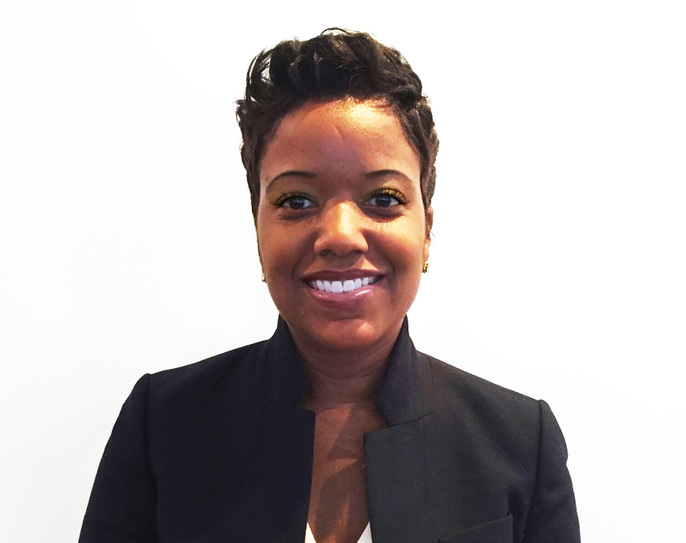
Kyra Peralte, below, had the original idea to send a composition notebook with a diary entry to a stranger in April 2020, during the pandemic. “A year later,” says the Washington Post, “seven diaries have circulated, and 115 women have been part of the traveling diary.”

Read Full Post »

Photo: Abubaker Lubowa/Reuters.
From the
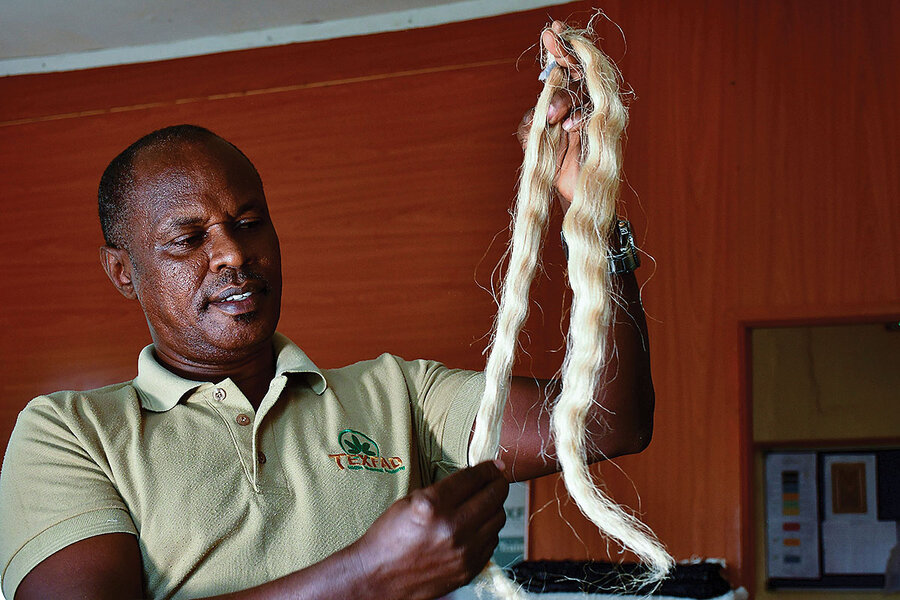
Christian Science Monitor news roundup: “Managing director Kimani Muturi shows off a TexFad hair extension made from banana trunk fibers near Kampala, Uganda, April 3, 2021. When finished using it, consumers can compost the product. The company also makes rugs and other handwoven textiles.

When in the air-conditioner season I stop to think about how much we all depend on fossil fuels, I worry that we will never be able to halt global warming. But then I read stories from around the world about inventive people doing what they can, and I remember the underlying wisdom of “one and two and 50 make a million.”

Lindsey McGinnis at the Christian Science Monitor has scoured the news media for signs of progress in a variety of areas, including the environment.

“Researchers from the University of Maryland and Yale have made a breakthrough in the search for sustainable plastic alternatives, developing a wood-based bioplastic that disintegrates in a few months. … The new bioplastic is created by using a biodegradable solvent to deconstruct wood powder found at lumber mills into a slurry, which can then be shaped into common plastic products, such as shopping bags and other packaging.

“Other experimental bioplastics have often lacked the strength to compete with petroleum-based plastics, but the scientists say their product showed high mechanical strength during tests, the capacity to hold liquid, and resistance to ultraviolet light. At the end of a product’s life, the bioplastic will quickly decompose in soil, or can be re-slurried and used again. Source: New Atlas, Nature Sustainability

“A startup in Uganda is making consumer products from edible banana plant material that would otherwise go to waste. Uganda is sub-Saharan Africa’s top producer of bananas and plantains, with an estimated 75% of all farmers growing some form of banana. They typically leave the stalks to rot after harvesting fruit. That’s where TexFad saw an opportunity. The company, which launched in 2013 and employs 23 people, runs the stalks through a machine to create long fibers, hangs the leathery strands to dry, and uses the material to create products such as carpets.

“Last year, the company made $41,000 in sales, and the managing director expects TexFad to double production in 2021 to 2,400 carpets, some of which will be exported to customers in the United Kingdom, Canada, and the United States for the first time. The company also creates hair extensions (used ones can be composted) and is working on a process to soften the fibers for use in clothing. Source: Interesting Engineering, Reuters

“A global network is helping reroute dangerous refrigerants before they leak into the atmosphere. Freezers and refrigerators have housed some of the most potent greenhouse gases, including the compound known as R12, a chlorofluorocarbon with roughly 10,000 times the destructive potential of CO2. The refrigerants pumped into modern units are better, but still pose global warming potential. When disposed of improperly – either knowingly or unknowingly – these gases are released into the atmosphere and contribute to climate change.

“Tradewater, a company that collects and destroys greenhouse gases and sells the carbon offset credits, is coordinating with governments and businesses around the world to dispose of the gases safely. Its teams are sometimes called ‘chill hunters’ or ‘ghostbusters’ for the way they track and trap the gases, transferring them from discarded refrigerator cylinders into a large container. Tradewater then incinerates the recovered gases. The group reports that 4 million to 5 million metric tons have been kept out of the atmosphere so far. Ángel Toledo has run a waste disposal plant on the edge of Guatemala City for 16 years, but only dealt with refrigerant gases since 2018. ‘It’s like a dream, helping the environment … [by preventing these] gases from reaching the atmosphere.’ Source: BBC.”

More at the Monitor, here. I am not a Christian Scientist, but the Christian Science Monitor newspaper has a long and illustrious history for objective reporting, especially on international news, although I believe they don’t cover health news.

Read Full Post »

Photo: Matthew Genge, Imperial College London.
The simulation of the Scottish countryside for an online geology class included buildings, walls, and gravestones.

Although it always seemed likely I would turn out to be an English major, I did have to choose a science in college. My mother thought it was charming that the geology class had the same two professors from the time she was there. She recommended the course. And a few people said geology would be easier than the other sciences. Ha! They were wrong about that! But I learned as much as I could, if not very well, and to this day I can tell you if your dorm is made of Wissahickon Schist.

If I thought geology was hard back then, what would it have been like this past year? At Atlas Obscura, Robin George Andrews reports on the challenges of teaching it online during the pandemic.

“If you decide to pursue a degree in geology,” Andrews notes, “be prepared to spend some time in the wilderness, where you will be asked to find and analyze rocks that will help teach you how the planet works. You will sketch curious outcrops, smash stone to pieces, peer at crystals through a hand lens, and, every now and then, even lick rocks, if it comes to that, all under the watchful, judging eye of your instructors.

“When the pandemic kicked into gear back in March 2020, these both scintillating and stressful field schools were no more. Geology instructors across the world were at a bit of a loss as to what to do. Many understandably concluded that there was no way to replicate this hands-on learning experience and just made do, but Matthew Genge, a planetary scientist at Imperial College London (ICL), had an epiphany.

“By happenstance, he had taken up the hobby of video game design a decade earlier. ‘It’s pure problem solving,’ he says. ‘You get that achievement buzz when you make something work or overcome some challenge.’

“One of his colleagues, fellow ICL geoscientist Mark Sutton, had also been dabbling in the same digital sandbox. So they decided to put their skills to pedagogical use:

They built video game versions of the field trips their undergraduate students would normally go on, where they could practice the same techniques and learn about the planet in the same way they would in the real world.

“It started with a 3D replica of Sardinia (and Mt. Etna on Sicily), where students galivanted about, looking for ancient fossils, prodding volcanic rocks, and exploring an abandoned silver mine. But like in all good video games, things escalated quickly. Before long, students were piloting spaceships, fending off hostile fighters, and trying to find a good place to land on an asteroid (to study its chemistry). …

“Back in 2019, Sutton had brought a drone to Sardinia — one of the usual field trip locations — and took a bunch of photographs of the places they were visiting to learn geology. A year later, Genge used those photographs, along with some bespoke computer code, to whip up a virtual version of the study area.

“In the (real) field, the objective would be to examine a location, study it scientifically, pose a research question, and then attempt to answer it. The same scenario played out in the virtual world Genge and Sutton created.

“For example, an area that was once a lake, 330 million years ago, is now jam-packed with plant and animal fossils. There are even ancient traces of rain, which made little indentations that have been naturally preserved. Some of these impressions are elongated in one direction, which can be used to estimate wind speed. A student might find these rain prints, examine them in high resolution, and then write something about how they might be used to understand what Earth’s atmosphere was like back then.

“The students were engaged, and the quality of their work was similar to what the instructors had seen in previous field seasons. ‘Two of the projects were close to being publishable,’ says Genge.”

More details (including how the video game meant the study of meteorites could become a space adventure) at Atlas Obscura, here.

Read Full Post »

Photo: Colorado Public Radio.
Cherish Ross is with FLOW, a sign language interpreting agency that specializes exclusively in performing arts.

So many interesting kinds of jobs in the world! And the luckiest people are the ones whose work aligns with what they love doing. Consider those who interpret for the deaf at concerts.

Corinna da Fonseca-Wollheim has a cool story at the New York Times. “On a recent afternoon in a brightly lit studio in Brooklyn, Mervin Primeaux-O’Bryant and Brandon Kazen-Maddox were filming a music video. They were recording a cover version of ‘Midnight Train to Georgia,’ but the voices that filled the room were those of Gladys Knight and the Pips, who made the song a hit in the 1970s. And yet the two men in the studio were also singing — with their hands.

“Primeaux-O’Bryant is a deaf actor and dancer; Kazen-Maddox is a hearing dancer and choreographer who is, thanks to seven deaf family members, a native speaker of American Sign Language. Their version of ‘Midnight Train to Georgia’ is part of a 10-song series of American Sign Language covers of seminal works by Black female artists that Kazen-Maddox is producing for Broadstream, an arts streaming platform.

“Around the world, music knits together communities as it tells foundational stories, teaches emotional intelligence and cements a sense of belonging. … As sign language music videos proliferate on YouTube, where they spark comments from deaf and hearing viewers, the richness of American Sign Language, or A.S.L., has gotten a broader stage.

“ ‘Music is many different things to different people,’ Alexandria Wailes, a deaf actress and dancer told me in a video interview, using an interpreter. Wailes performed ‘The Star-Spangled Banner’ at the 2018 Super Bowl, and last year drew thousands of views on YouTube with her sign language contribution to ‘Sing Gently,’ a choral work by Eric Whitacre. …

“A good A.S.L. performance prioritizes dynamics, phrasing and flow. The parameters of sign language — hand shape, movement, location, palm orientation and facial expression — can be combined with elements of visual vernacular, a body of codified gestures, allowing a skilled A.S.L. speaker to engage in the kind of sound painting that composers use to enrich a text.

“At the recent video shoot, Gladys Knight’s voice boomed out of a large speaker while a much smaller one was tucked inside Primeaux-O’Bryant’s clothes, so that he could ‘tangibly feel the music,’ he said in an interview, with Kazen-Maddox interpreting. Out of sight of the camera, an interpreter stood ready to translate any instructions from the crew, all hearing, while a laptop displayed the song lyrics.

“In the song, the backup singers — here personified by Kazen-Maddox — encourage Knight as she rallies herself to join her lover, who has returned home to Georgia. In the original recording the Pips repeat the phrase ‘all aboard.’ But as Kazen-Maddox signed it, those words grew into signs evoking the movement of the train and its gears. A playful tug at an invisible whistle corresponded to the woo-woo of the band’s horns. Primeaux-O’Bryant signed the lead vocals with movements that gently extended the words, just as in the song: on the drawn-out ‘oh’ of ‘not so long ago-oh-oh,’ his hands fluttered into his lap. The two men also incorporated signs from Black A.S.L.

‘The hands have their own emotions,’ Primeaux-O’Bryant said. ‘They have their own mind.’

“Deaf singers prepare for their interpretations by experiencing a song through any means available to them. Many people speak about their heightened receptivity to the vibrations of sound, which they experience through their body. As a dancer trained in ballet, Primeaux-O’Bryant said he was particularly attuned to the vibrations of a piano as transmitted through a wooden floor.

“Primeaux-O’Bryant was a student at the Model Secondary School for the Deaf in Washington in the early 1990s when a teacher asked him to sign a Michael Jackson song during Black History Month. His first reaction was to refuse.

“But the teacher ‘pulled it out’ of him, he said, and he was thrust into the limelight in front of a large audience. Then, Primeaux-O’Bryant said, ‘the lights came on and my cue happened and I just exploded and signed the work and it felt good.’ Afterward the audience erupted in applause: ‘I fell in love with performing onstage.’ ”

Find information on things like the role of ballet training in ASL interpretation, the impact of the pandemic, and Egyptian Arabic Sign Language at the Times, here.

Read Full Post »

« Newer Posts - Older Posts »