Feeds:
Posts
Comments

Archive for the ‘Uncategorized’ Category

The Journey Junkies blog doesn’t seem to have a Reblog button, but I have their permission to share this post about an unusual garden in India.

They write: “The Nek Chand Rock Gardens had been on our radar for a long time before we finally made it there. Located in the city of Chandigarh, at the foot of the Himalayas, the gardens are one of India’s hidden gems. In fact, they largely undiscovered by foreign tourists. Indeed, on our visit, we were the only foreigners enjoying the gardens. Interestingly, although they are largely overlooked by visitors from overseas, the gardens are the second most visited tourist attraction in the country after the Taj Mahal. Around 5000 visitors a day enter the gates of the gardens to experience Nek Chand’s captivating wonderland.

“Although the gardens themselves are incredible, the story of the Nek Chand Rock Gardens is even more so. Nek Chand was born in 1924 in Pakistan and moved to India during partition in 1947. Two years later he joined the Highway Department in Chandigarh as part of the Refugee Employment Programme. In 1951, he secured a position as a road inspector at Chandigarh Public Works Department. His job was to supervise the construction of a re-vitalisation of the road system in the city. …

“It was Nek Chand’s job to supervise the re-vitalisation of the road system in the 1950’s. However, Nek Chand was a man with a vision. It was during this period, that he started to collect unwanted materials that had been discarded throughout the area. These were items that had been abandoned when the city was being re-built, as well as objects that had been thrown away by residents. He searched for rocks, broken crockery, coloured glass, along with tiles and whatever else he could find. With these materials, he secretly built a sculpture garden hidden on government land. It started small, just a patch of land, with stones bordering the area, together with a few sculptures. However, before long, the garden had expanded significantly and various courtyards were added.”

More here.

Read Full Post »

Bygone Jingles

Photo: CarGurus.
1953 Chevrolet. Back in the day, singer Dinah Shore was better known for singing the Chevrolet jingle than for her movies.

Given that you have to keep a distance from other people on your walk, it’s possible to sing quietly to yourself sometimes without feeling too ridiculous. The other day, for some reason, the old commercial for Rheingold Beer came into my head, and when I got home, my husband and I brainstormed about other well-remembered jingles.

Then I went on Youtube. I couldn’t find the commercial about the inkspot menace that will ruin “your rugs and furniture and clothes, and add a whole lot to your woes” (does anyone know it?), but I found several others.

What do you notice or think about when you play these ads? I notice there is no diversity among the characters. And I think how it’s a miracle anyone raised in this time became a feminist. All the messages for girls were about chasing some guy with nice hair. Check these out.

Rheingold Beer.

Chock Full o’ Nuts. The original jingle said, “Better coffee Rockefeller’s money can’t buy.” They had to change it.

Ipana Toothpaste.

Brylcreem.

Chevrolet.

Robert Hall.

Ajax.

Oscar Meyer Wiener.

Wildroot Cream Oil.

Send me your favorites?

Read Full Post »

Photo: Cairo Scene.
Last fall, the Mersal Foundation, a health-care nonprofit in Egypt, received one large award from AstraZeneca for its work with lung cancer patients and another to aid those afflicted with the Coronavirus.

When I read a story like today’s, which is about a nonprofit that’s filling the gaps in a health-care system, I think of my favorite Allen Ginsberg poem:

“When Music was needed, Music sounded
“When a ceremony was needed, a teacher appeared
“When students were needed, telephones rang
“When cars were needed, wheels rolled in …”

It reminds that good people can make things happen.

Sudarsan Raghavan reported recently at the Washington Post, “The pleas for help were flooding in. By 2 p.m., Raba Mokhtar was picking up the 131st call of the day to the Mersal Foundation’s 24-hour hotline. Like the vast majority, it was related to the coronavirus pandemic.

“On the other end of the line, a woman was frantically describing the condition of a relative, a 67-year-old man who had tested positive for the virus. He had a 100-degree fever and could hardly breathe. They had first tried the Health Ministry’s hotline to look for a bed in a government hospital, with no luck. …

“In a country where government health resources can be either stretched or inadequate and where most people cannot afford hospitalization, a once little-known charity has become a lifeline for thousands of Egyptians. For the past year, and especially during the latest coronavirus wave, the Mersal Foundation has contracted and paid for beds in private hospitals or provided oxygen tanks to people in need.

“Mersal and its founder, Heba Rashed, have become so trusted that more than a quarter-million people now follow her social media accounts to learn the true impact of the pandemic in Egypt. …

“Egypt has reported about 165,000 infections and 9,100 deaths since the start of the outbreak. Medical experts and even government ministers have publicly said the real numbers are far higher.

“Doubts among the public deepened in January when a video went viral online claiming that coronavirus patients at a government hospital had died because of a lack of oxygen. The government denied the report, but a week later Sissi ordered a doubling of oxygen production to meet increased demand.

“Against this backdrop, the Mersal Foundation has emerged as a trusted oasis of care. And Rashed, 40, has become a coronavirus prognosticator for her legions of followers.  

‘It makes me feel very responsible for every word I utter,’ she said. ‘People get affected by everything I say.’

“Growing up in Jordan and the Egyptian desert town of Fayoum, Rashed never intended to start a charity. In college, she studied Spanish and Arabic and later earned a master’s degree in linguistics and several diplomas in other fields. She later worked as a linguist and as a project manager. In her spare time, she volunteered at a local charity.

“Soon, Rashed said, she realized she had ‘no passion’ for her job and found her charitable work more fulfilling. She also noticed there were few nonprofit groups in Egypt specializing in health issues. So with two friends, she launched Mersal five years ago. ‘It was truly hard at the start,’ Rashed recalled. ‘We had no connections.’

“Eventually, they found a sympathetic donor. He gave roughly $1,300, and they set up the charity in Rashed’s apartment. Slowly they grew, soliciting donations mostly on social media. They began to get noticed by some larger donors.

“Today, the foundation has four offices in Cairo and one in the northern city of Alexandria, with roughly 200 employees, according to Rashed. …

“ ‘The second wave is much more vicious than the first one, in terms of the intensity of the infection,’ Rashed said. ‘The number of infections is bigger than the last wave. The symptoms are much more.’

“She was infected. So were more than half of her 100 employees in the office, forcing mass isolations. ‘It made it very hard to do our work,’ Rashed said matter-of-factly. …

“The case of the 67-year-old man who had been struggling to breathe was typical. His oxygen levels were extremely low, though he was using a tank. … Mokhtar, the employee who took the call, asked the man’s relative to send a complete medical report, X-rays of his lungs and any bloodwork. Mokhtar gave her the WhatsApp number.

“ ‘We will show them to the medical department, and we will get you a bed when one becomes available,’ Mokhtar said. ‘Peace be with you.’

“Finding a bed usually takes a few hours but can stretch into a day or two, employees said. … The foundation has contracted with more than 30 private hospitals. In some cases, patients who need help getting care can pay some or all costs. Mostly, though, the charity pays as much as $1,300 per day for hospital beds in intensive care units, money obtained in large part through online appeals for donations.”

More at the Washington Post, here. Grateful stories may be found at the Mersal Foundation Facebook page, here,

Read Full Post »

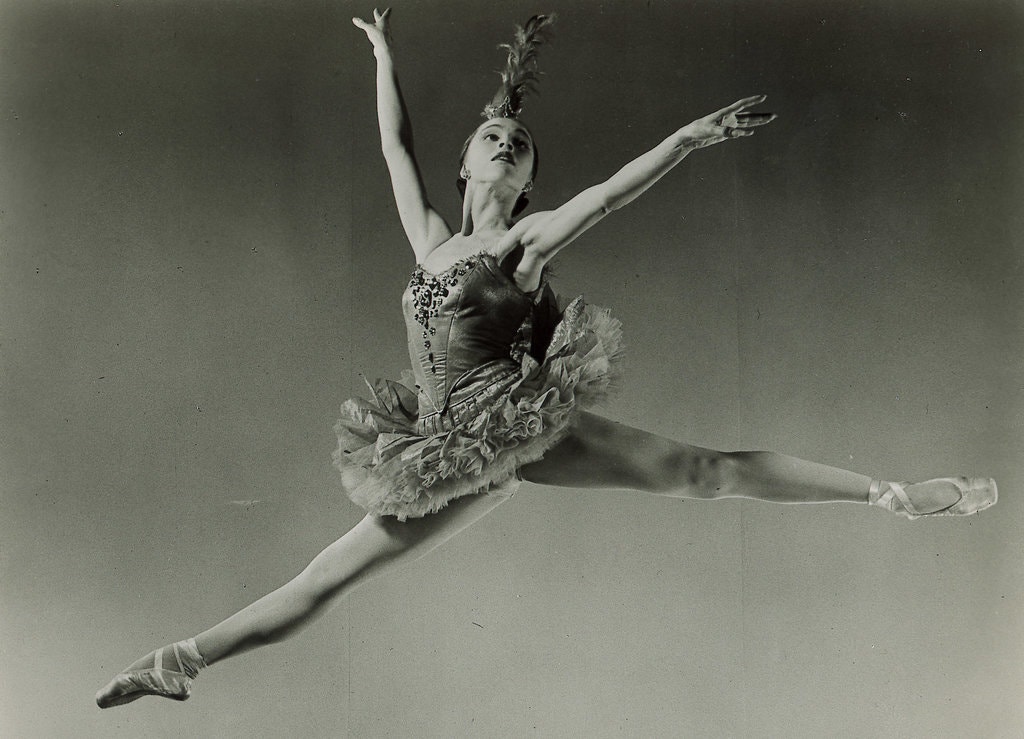
Photo: New York City Ballet Archives.
Maria Tallchief in the title role in George Balanchine’s ballet “Firebird.”

When I was a child, I was taken a couple times to see “The Nutcracker” at the New York City Ballet. I went backstage to see the ballerinas after the show and got autographs on slips of paper that, of course, I managed to lose. I got Patricia McBride. I got Maria Tallchief. Recently, I read an obit about Tallchief that filled in some blanks in her remarkable history.

Jack Anderson reported at the New York Times, “Maria Tallchief, a daughter of an Oklahoma oil family who grew up on an Indian reservation, found her way to New York and became one of the most brilliant American ballerinas of the 20th century, died [in April 2013] in Chicago. …

“A former wife and muse of the choreographer George Balanchine, Ms. Tallchief achieved renown with Balanchine’s New York City Ballet, dazzling audiences with her speed, energy and fire. Indeed, the part that catapulted her to acclaim, in 1949, was the title role in the company’s version of Stravinsky’s ‘Firebird,’ one of many that Balanchine created for her. …

“A daughter of an Osage Indian father and a Scottish-Irish mother, Ms. Tallchief left Oklahoma at an early age, but she was long associated with the state nevertheless. She was one of five dancers of Indian heritage, all born at roughly the same time, who came to be called the Oklahoma Indian ballerinas. …

“She was born Elizabeth Marie Tall Chief on Jan. 24, 1925 in a small hospital in Fairfax, Okla. Her father, Alexander Joseph Tall Chief, was a 6-foot-2 full-blooded Osage Indian whom his daughters idolized. … Her mother, the former Ruth Porter, met Mr. Tall Chief, a widower, while visiting her sister, who was a cook and housekeeper for Mr. Tall Chief’s mother.

“ ‘When Daddy was a boy, oil was discovered on Osage land, and overnight the tribe became rich,’ Ms. Tallchief recounted in ‘Maria Tallchief: America’s Prima Ballerina,’ her 1997 autobiography written with Larry Kaplan. …

“She had her first ballet lessons in Colorado Springs, where the family had a summer home. She also studied piano and, blessed with perfect pitch, contemplated becoming a concert pianist.

“But dance occupied her attention after the family, feeling confined in Oklahoma, moved to Los Angeles when she was 8. The day they arrived, her mother took her daughters into a drugstore for a snack at the soda fountain. While waiting for their order, Mrs. Tall Chief chatted with a druggist and asked him if he knew of a good dancing teacher. He recommended Ernest Belcher.

As Ms. Tallchief recalled in her memoir, ‘An anonymous man in an unfamiliar town decided our fate with those few words.’

“Mr. Belcher, the father of the television and film star Marge Champion, was an excellent teacher, and Ms. Tallchief soon realized that her training in Oklahoma had been potentially ruinous to her limbs. At 12 she started studies with Bronislava Nijinska, a former choreographer for Diaghilev’s Ballets Russes, who had opened a studio in Los Angeles. …

“Tatiana Riabouchinska became her chaperon on a trip to New York City, which, since the outbreak of World War II, had become the base of the Ballet Russe de Monte Carlo, a leading touring company. She joined the troupe in 1942.

“Nijinska, one of its choreographers, cast her in some of her ballets. But Ms. Tallchief also danced in Agnes de Mille’s ‘Rodeo,’ a pioneering example of balletic Americana. It was de Mille who suggested that Elizabeth Marie make Maria Tallchief her professional name. Her sister, who survives her, went on to achieve fame mostly in Europe.

“In the summer of 1944, the entire Ballet Russe de Monte Carlo served as the dance ensemble for ‘Song of Norway,’ a Broadway musical based on the life and music of Grieg, with choreography by Balanchine. And Balanchine remained as a resident choreographer for the company. …

“Balanchine paid increasing attention to Ms. Tallchief, and she became increasingly fond of him, admiring him as a choreographic genius and liking him as a courtly, sophisticated friend. Yet it came as an utter surprise when he asked her to marry him. After careful thought, she agreed, and they were married on Aug. 16, 1946. …

“Balanchine wanted a company of his own. In 1946, he and the arts patron Lincoln Kirstein established Ballet Society, which presented a series of subscription performances; it was a direct forerunner of today’s City Ballet. … Ms. Tallchief was soon acclaimed as one of its stars. …

“Ms. Tallchief remained closely identified with her Osage lineage long after she found fame and glamour in Paris and New York, and she bridled at the enduring stereotypes and misconceptions many held about American Indians. Recalling her youth in her memoir, she wrote of a dance routine that she and her sister were asked to perform at Oklahoma country fairs. …

” ‘It wasn’t remotely authentic,’ she wrote. … The performance ended with Marjorie performing ‘no-handed back-flip somersaults. In the end, [we] stopped doing the routine because we outgrew the costumes. I was relieved when we put those bells away for good.’ ”

More at the New York Times, here, and at the Library of Congress, here.

Read Full Post »

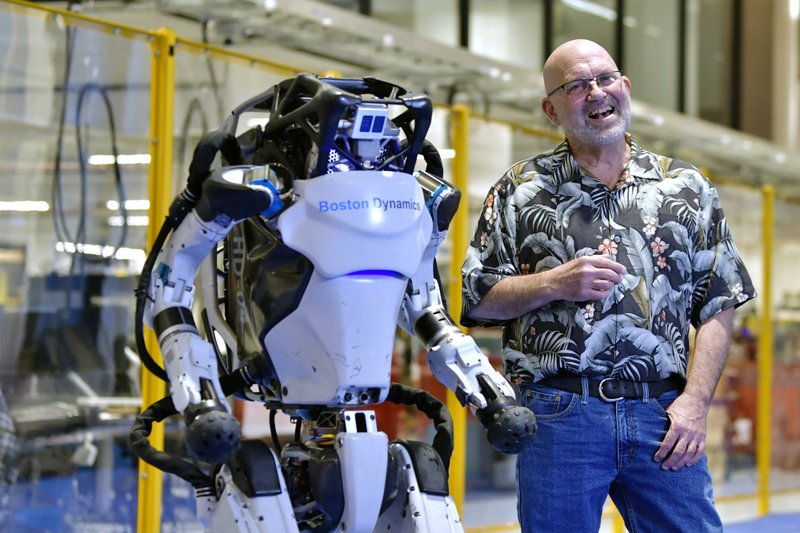
Photo: Associated Press.
Marc Raibert, founder and chair of Boston Dynamics, with an Atlas robot that can dance with near-human fluidity.

We can probably all think of discoveries that initially seem frivolous or peculiar and later turn out to be important to humanity. So perhaps we shouldn’t laugh too much about a robot dancing to Motown. Who can tell what will come of it?

Rodrique Ngowi writes at the Associated Press (AP), “The man who designed some of the world’s most advanced dynamic robots was on a daunting mission: programming his creations to dance to the beat with a mix of fluid, explosive and expressive motions that are almost human.

“The results? Almost a year and half of choreography, simulation, programming and upgrades that were capped by two days of filming to produce a video running at less than 3 minutes. The clip, showing robots dancing to the 1962 hit ‘Do You Love Me?’ by The Contours, was an instant hit on social media, attracting more than 23 million views during the first week.

“It shows two of Boston Dynamics’ humanoid Atlas research robots doing the twist, the mashed potato and other classic moves, joined by Spot, a doglike robot, and Handle, a wheeled robot designed for lifting and moving boxes in a warehouse or truck. …

“[Says Boston Dynamics founder and chairperson Marc Raibert], ‘We didn’t want a robot doing robotlike dancing. We wanted it to do human dancing and, you know, when a human dances, the music has a beat and their whole body moves to it — their hands, their body, their head,’ he says. …

‘It looked like the robot was having fun and really moved with the music. And I think that had a lot to do with the result of the production.’

“Teaching robots to dance with fluid and expressive motions was a new challenge for a company that spent years building robots that have functional abilities like walking, navigating in rough terrain, pick things up with their hands and use attached advanced sensors to monitor and sense many things, Raibert says.

“ ‘You know, our job is to try and stretch the boundaries of what robots can do, both in terms of the outer research boundary, but also in terms of practical applications. And I think when people see the new things that robots can do, it excites them,’ he says.

“The advanced Atlas robot relies on a wide array of sensors to execute the dance moves, including 28 actuators — devices that serve as muscles by converting electronic or physical signal into movement — as well as a gyroscope that helps it to balance, and three quad-core onboard computers, including one that processes perception signals and two that control movement. …

“ ‘We’ve gotten calls from all around the world,’ Raibert says. ‘We got a call from one of the sound engineers who had recorded the original Contours performance back in the ’60s. And he said that his whole crew of Motown friends had been passing it around.’ “

More at AP, here.

A dancing Atlas robot at Boston Dynamics.

Read Full Post »

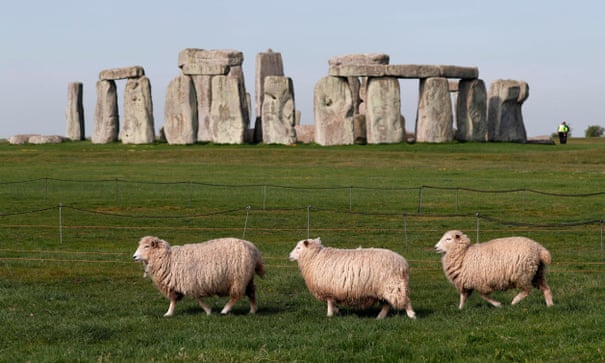
Photo: Adrian Dennis/AFP/Getty.
As construction for a tunnel under Stonehenge begins, archaeological surprises are turning up.

Do you ever wonder about the layers of civilization buried deep beneath your feet? John Hanson Mitchell wondered about my region’s layers back in a 1980s book, here. He got himself into a kind of trancelike state in which he believed he could sense the presence of indigenous tribes living their lives beside what is now Interstate 495.

More recently, as Steven Morris reports at the Guardian, “Bronze age graves, neolithic pottery and the vestiges of a mysterious C-shaped enclosure that might have been a prehistoric industrial area are [being] unearthed by archaeologists who have carried out preliminary work on the site of the proposed new road tunnel at Stonehenge.

“One of the most intriguing discoveries is a unique shale object that could have been part of a staff or club found in a 4,000-year-old grave. Nearby is the resting spot of a baby buried with a small, plain beaker. Ditches that flank the C-shaped enclosure contain burnt flint, suggesting a process such as metal or leatherworking was carried out there thousands of years ago.

“Just south of the site of the Stonehenge visitor centre, archaeologists came upon neolithic grooved ware pottery possibly left there by the people who built the stone circle or visited it.

“ ‘We’ve found a lot – evidence about the people who lived in this landscape over millennia, traces of people’s everyday lives and deaths, intimate things,’ said Matt Leivers, A303 Stonehenge consultant archaeologist at Wessex Archaeology. …

“The plan to drop the A303, which passes close to the stones, into a two-mile tunnel is hugely controversial, with many experts having said that carrying out such intrusive construction work would cause disastrous harm to one of the world’s most precious ancient landscapes and lead to the loss of hundreds of thousands of artefacts. A legal challenge was launched against the £1.7bn plan late last year.

“Highways England and Wessex Archaeology, which is leading the exploration of the tunnel corridor, said they were working on the project systematically and sensitively. …

“Close to the western end, two burials of Beaker people, who arrived in Britain in about 2,500BC, were found. One was an adult, buried in a crouched position with a pot or beaker. Also in the grave was a copper awl or fragment of a pin or needle and a small shale cylindrical object, of a type that is not believed to have been found before.

“ ‘It is an oddity,’ said Leivers. More detailed work will be carried out to find out what it is, but one theory is that it could be the tip of a ceremonial wooden staff or mace. Also found in the same area was a pit dating to the age of the Beaker people containing the tiny ear bones of a child and a very simple pot – a sign that this too was a grave. Usually Beaker pots are ornate but this one is plain, probably to reflect the age of the person who died.

“A little farther south, the C-shaped enclosure was found. ‘It is a strange pattern of ditches,’ said Leivers. ‘It’s difficult to say what it was, but we know how old it is because we found a near-complete bronze age pot in one of the ditches.’ …

“Another find was a group of objects dating to the late neolithic period – when the stone circle was built – including grooved ware pottery, a flint and red deer antlers. …

“Highways England said the amount of survey work that had been carried out was unprecedented because of the significance of the site. David Bullock, A303 project manager for Highways England, said: ‘There has been a huge amount of investigations so that this route can be threaded through so as to disturb as little as possible.’ ”

What mysteries will your everyday items pose for archaeologists of the future? What will more advanced people with no need for mouth guards or braces, say, make of gizmos like that?

More at the Guardian, here.

Read Full Post »

Photos: James Austin V.
Alaska is delivering vaccines by sled, boat, plane, and snowmobile. Flashback to the Iditarod origins — when diphtheria antitoxin was rushed to Nome by dog sled.

It’s so interesting to me which states are doing well with vaccine distribution and why! West Virginia was ahead of the pack because it used local pharmacies but also had a central sign-up site. Now Alaska seems to have taken the lead, and its techniques are completely different.

Cathy Free writes at the Washington Post, “Alaska, the state with the largest land mass in the nation, is leading the country in a critical coronavirus measure: per capita vaccinations.

“About 13 percent of the people who live in Alaska have already gotten a shot. … But the challenge for Alaska has been how to get vaccines to people across difficult, frigid terrain — often in remote slivers of the state.

“ ‘Boats, ferries, planes, snowmobiles — Alaskans will find a way to get it there,’ said the state’s chief medical officer, Anne Zink, 43.

“Alaskans are being vaccinated on fishing boats, inside 10-seater planes and on frozen landing strips. Doctors and nurses are taking white-knuckle trips to towns and villages across the state to ensure residents are protected from the coronavirus.

“Contributing to Alaska’s quick speed in getting the vaccine to its residents is a federal partnership that allows the state, which has more than 200 indigenous tribes, to receive additional vaccines to distribute through the Indian Health Service.

“Other reasons include the state’s small population of 732,000, as well as a high number of veterans, Zink said. The U.S. Department of Veterans Affairs is working with the Centers for Disease Control and Prevention to ensure that high-risk veterans receive priority for the vaccine.

“But one big reason is the state is practiced in delivering precious cargo by transport not often used in the Lower 48. Sometimes that even means adventures by sled. One all-female medical crew of four in December used a sled pulled by a snowmobile to deliver vaccine to the village of Shungnak in the state’s remote Northwest Arctic Borough.

‘It’s just an easier way to get around when you don’t have a lot of roads,’ said Kelli Shroyer, public communications director for the Maniilaq Health Center in Kotzebue, Alaska, where the crew started their journey. …

“Zink was so impressed by the sled crew’s delivery in December that she posted about it on her Facebook page. ‘I love the pictures of vaccination distribution in Alaska,’ she wrote. ‘Recipients expressed how grateful they were that even though they are so remote, they are getting this vaccine. They are not forgotten. …

‘One chief told me how his grandmother took his mother out to the wilderness for a year so that she would be safe. When they returned, they learned that most of their village had died.’ …

“Thousands of Alaskans are playing a role in getting people vaccinated, Zink said.

“Curt Jackson used to employ his water taxi, the Orca, to shuttle tourists from the small city of Homer to villages across Kachemak Bay that aren’t accessible by roads. In late December, Jackson received a request to take three nurses across the bay to Seldovia, a town with about 450 residents, including members of the Seldovia Village Tribe. Planes couldn’t fly that morning because of weather, and the water was rough.

“When the women climbed aboard his 32-foot aluminum landing craft and took seats in the windy darkness, Jackson said, he noticed that the woman in the middle, Candace Kreger, was clutching a bright blue cooler. That was when he realized that the women were traveling with the precious doses. …

“For Ellen Hodges, a doctor from Bethel, Alaska, the coronavirus vaccination effort is the most rewarding project in which she has been involved, she said. Hodges, 46, has flown to several villages in a six-seater plane to vaccinate medical workers and elders, who meet her on the runway.

“ ‘We land in the isolated tundra, and they’ll be lined up waiting,’ she said. ‘Some places have up to 30 people, and some have only one.’ “

More at the Washington Post, here.

An all-female medical crew from Alaska’s Maniilaq Health Center took a sled to deliver vaccine to the isolated village of Shungnak in December.

Read Full Post »

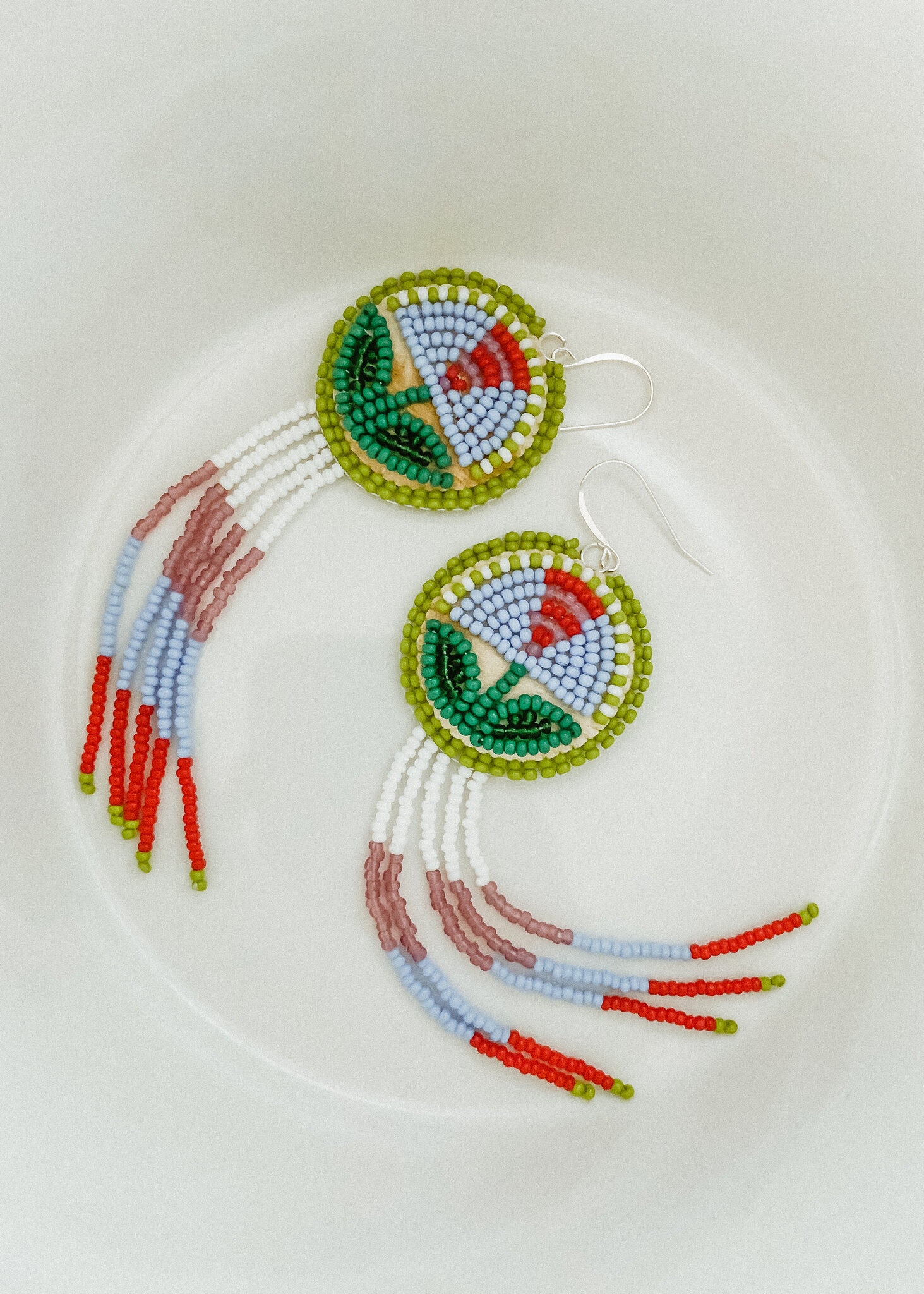
Photo: Tayler Gutierrez.
Earrings beaded onto smoked hide by the Cherokee artist Tayler Gutierrez.

You’re probably tired of all the whistling in the dark about good things that have come from lockdown when you know the past year has been mostly bad. But I wouldn’t want you to miss this cheerful story about indigenous beadworkers finding a market on Instagram during the pandemic.

Anna V. Smith reports on the phenomenon at the New York Times. “Last year, after the museum that Tayler Gutierrez worked at in Salt Lake City closed temporarily because of the coronavirus, she turned to her beadwork.

“A citizen of the Cherokee Nation of Oklahoma, Ms. Gutierrez, 24, had been practicing beadwork for years after learning from a mentor, the Diné poet Tacey Atsitty, and she already had a modest following on her Instagram page, where she posted her custom hat brims, earrings and leather pouches.

“But when the museum reopened in May, Ms. Gutierrez decided to take a much bigger leap: She put in her resignation notice and committed full-time to her craft. In July, she dropped her first collection of beadwork on Instagram; it included a set of earrings layered with two-tiers of dentalium shells and Swarovski crystals, and another pair with blooming flowers stitched with beads onto moose hide.

“With relatively few followers, she wasn’t expecting many people to buy. Instead, everything sold in five minutes.

“Ms. Gutierrez was shocked but thrilled — especially after the months of labor and love she had put into the work. (It takes around eight hours to make one pair of floral beaded earrings.) …

“Ms. Gutierrez just started her business ‘Kamama Beadwork last year, but she is one of many Indigenous beadwork artists on Instagram who have seen a spike in followers and sales that far outpaces their available stock.

“Partially, that’s because with craft fairs, powwows and art markets shuttered, many vendors and buyers are relying more heavily on the internet, [including] e-commerce websites like From the People, which launched in May as an online market space for Indigenous artists.

“Sales have been spurred by a national dialogue around racial injustice that has led to increased efforts to support Black and Indigenous artists and businesses. …

“As the Ojibwe fashion writer Christian Allaire has documented, the beading world is full of Indigenous artists blending traditional methods and contemporary forms: for example, Jamie Okuma and her beaded Louboutin stilettos; Skye Paul and her tattoo-inspired beaded patches or cow print beaded fringe earrings; and Tania Larsson’s fine jewelry made from musk ox horn and other natural materials of the Canadian Arctic.

“On Instagram, these artisans and others have amassed huge followings; when they drop collections or individual pieces, they sell out in minutes. Followers set alarms, pre-log into PayPal and have to buy as soon as the goods are available if they want a chance to snag anything at all. Recently, the same is true for Indigenous artists with half the amount of followers, including Ms. Gutierrez.

“Jaymie Campbell of White Otter Design Co. is one beadwork artist who has perfected the art of the Instagram drop. … As a full-time beader, Ms. Campbell made an Instagram account in 2016, a year after starting her business. At the time, there were seemingly fewer accounts by fellow artists, Ms. Campbell said. But that’s changed somewhat suddenly, as the isolation of the pandemic has connected more people in the digital sphere.

Virtual beading circles — online versions of community gatherings where beaders share techniques — have popped up, and many artists have experienced a surge in followers.

“ ‘The growth has been unprecedented, in my experience,’ Ms. Campbell said from her home in New Denver, British Columbia (population 473). On Indigenous People’s Day alone she gained over 2,000 followers from people promoting her work on social media.

“But in beadwork economics, more demand doesn’t necessarily mean more supply — and that is an important aspect of the work itself. As the Indigenous studies scholar and bead artist Malinda J. Gray, who is Anishinaabe Ojibwe Caribou Clan, from the Lac Seul Band, has written: ‘Beadwork encompasses a temporality that transcends the capitalist view of exchange.’

“Beadwork knowledge, materials and motifs are passed down through generations, Ms. Gray said, and those layers of time, meaning and memories give a piece of work ‘its own essence. And that’s something that cannot be mass produced.’ ”

And now for a word from our “sponsor”: Suzanne also sells jewelry on Instagram @lunaandstella, where you can find gorgeous antique heart lockets for Valentine’s Day. Or go to the website, here.

More at the New York Times, here.

Read Full Post »

Photo: Ottaviano Caruso/AWA.
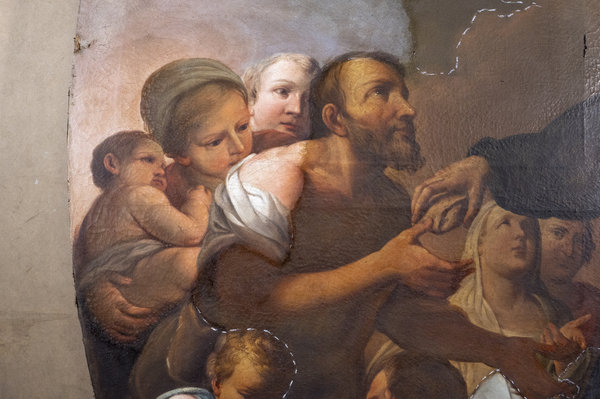
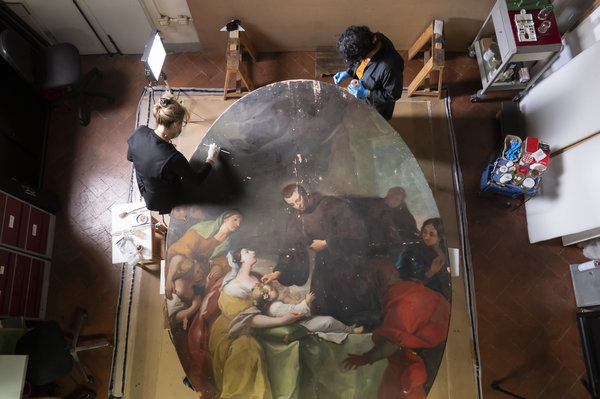
Restoration experts are working on Violante Ferroni’s painting Saint John of God Feeds the Poor.

An arts foundation in Italy asks, Where are the female Renaissance artists? Although many women who might have pursued some kind of art were probably bent over a tub of suds, there are others who created but are forgotten.

Sylvia Poggioli reported at National Public Radio’s “Weekend Edition” about new efforts to right centuries of wrong.

“Florence is one of the main stops on any art lover’s European itinerary. At the Uffizi Galleries, visitors can have their fill of works by Renaissance masters Leonardo da Vinci, Michelangelo and Raphael. Of course, none of these artists are women.

“In 2009, a new nonprofit foundation in Florence started to investigate why.

” ‘I started going into museum storages and attics and checking what was actually there, what works by women,’ says Linda Falcone, the director of Advancing Women Artists.

‘It was something that had never been done before because no one had ever before asked the question, “Where are the women?” ‘

“In the years since, AWA has shed light on a forgotten part of the art world, identifying some 2,000 works by women artists that had been gathering dust in Italy’s public museums and in damp churches. It has also financed the restoration of 70 works spanning the 16th to the 20th centuries.

“The organization was founded by Jane Fortune, an American philanthropist who died in 2018. Fortune was an intrepid art detective whom Florentines nicknamed ‘Indiana Jane’ in homage to her native state and her Renaissance treasure hunting skills. …

“During the Renaissance, Falcone says, ‘Women didn’t have citizenship. They couldn’t produce art as a profession. They couldn’t issue invoices. They couldn’t study anatomy.’ …

“A few Italian women were able to study painting in their fathers’ studios — most notably Artemisia Gentileschi, daughter of the 17th century painter Orazio Gentileschi. AWA is responsible for restoring David and Bathsheba, one of her paintings that was found after being hidden in a Florentine palazzo’s attic for 3-1/2 centuries.

“The group also rediscovered a 21-ft.-long canvas depicting 13 life-size males — the only known Last Supper painted by a woman. It is by the 16th century Dominican nun Plautilla Nelli — whose workshop was inside a convent in Florence. …

“Says [Falcone], ‘Nelli actually chooses sort of the key moment in which Christ announces his betrayal. And you have all of the apostles feeling the emotion of that very serious news. And so she is able to do a study of their responses, of their psychological responses.’ And, unlike most Last Suppers by male artists, Nelli puts food on the table, says Falcone.

‘She has lettuce, she has salt cellars, a lot of wine, bread for every apostle and knives and forks and beans and lamb — she did a Last Supper were people were meant to eat, first of all.’

“[Unlike] male artists of the time, Nelli signed her canvas — adding the words ‘pray for the paintress.’

“The nun’s works were prized by Florentines during the 16th century because they were believed to be imbued with spirituality. Her contemporary, the art historian Giorgio Vasari, wrote that she ‘would have done marvelous things if, like men, she had been able to study and to devote herself to drawing and copying living and natural things.’ …

“With backing from Advancing Women Artists, [art restorer Elizabeth Wicks] is currently restoring two large works by Violante Ferroni, an 18th century child prodigy of whom little is known today. …

“At the time, female artists were usually limited to painting still-lifes and small portraits. But while still in her 20s, Ferroni was awarded a prestigious commission by Florence’s San Giovanni di Dio hospital to paint two ovals — each of them 8-by-11 1/2 feet — with spiritual scenes to help heal the ill. The subject was usually reserved for men. …

“Falcone says that through restoration work, documentation and exhibits, AWA has contributed to a growing worldwide interest in and awareness of art by women. Yet the organization recently announced it is shutting down next June because it does not have sufficient funds to expand.”

More at NPR, here.

Photo: Francesco Cacchiani/AWA
Restoration expert Elizabeth Wicks and the nonprofit Advancing Women Artists have recently been restoring works by Violante Ferroni, a forgotten 18th century woman.

Read Full Post »

Rewilding in the UK

Photos: Murdo MacLeod
Scotland is inviting nature to return to abandoned industrial spaces.

The idea of “rewilding” industrial spaces, or turning them back to nature, makes me happy. One often reads about it happening in the UK, but we could do it, too, if we wanted to.

This photo essay in the Guardian is about how, in Scotland, rewilding often happens through benign neglect. Bella Bathurst wrote the text and Murdo MacLeod took the photos.

“Since the idea of rewilding took hold, it has generally been seen as a rural pursuit involving withdrawal from farmland so that animals and vegetation can restore their own ecology. At its most herbivorous, it includes allowing hedgerows or scrub to flourish unchecked. At its most primal, it involves deliberately releasing animals such as beavers or wolves in the belief that the re-entry of a single alpha species brings with it a cascade of ecological benefits. …

“The perception is that it is expensive, far away and often inaccessible. It certainly isn’t something that just anyone can do.

“But what if the wildest places of all were right under our feet? In the forgotten spaces in our cities, rewilding has always happened naturally, land falling under stone and resurging again, concrete lids flipped off before submerging once more. In the margins and the demilitarised zones, the abandoned embankments, the bits we don’t want or the lands already contaminated beyond human tolerance, ecology is thriving.

“In some places – such as the land around the abandoned Chernobyl nuclear plant in Ukraine – plant and insect life has adapted to the extreme conditions: boars have moved in, there is a new radiation-munching fungus and, in the thin strip of no-man’s land between the borders of North and South Korea, leopards and Asiatic black bears have been spotted. …

“In Scotland, the 40-mile strip between Glasgow and Edinburgh has always been mined, for not just coal, but stone, gravel, lead and even gold. After centuries of hard pickings, parts of Lanarkshire and Ayrshire have an upended appearance. What was underground is now on top and what was above has gone below, with buildings and bridges slumped over old drift mines and razor-lined spoil heaps terraced by extraction tracks. Wildfowl nest on lochs made from old coal holes and an orchid called Young’s helleborine, discovered in 1975, favours only the best iron ore. …

“At an explosives factory once owned and operated by the Alfred Nobel Company, [sections] are still in use, but most of the 330-acre site was long ago abandoned. Along the cracks in the old pipelines and through the decaying buildings, it would be quicker to list the native plants that are no longer there than those that are. …

“Public feeling is that big business should be obliged to make good what it has taken, but human attempts to restore land are often amateurish. Planting a few conifers and flinging around a mix of wildflowers may be a quick fix, but sometimes it appears that the best thing to do is nothing. …

“In 1913 the 13th Earl of Home tried to lift local unemployment at Douglas by allowing mining nearby. The mining unseated [his] castle, it was demolished, and the flooded workings (known locally as the Black Hole) are now so patterned with commuting birdlife that it resembles an avian Heathrow. …

“On the other side of the Clyde, between the Erskine Bridge and the old John Brown shipyard, lies what used to be the Beardmore naval construction works in Dalmuir. In the early 20th century it produced munitions, planes, submarines and warships before being converted into a fuel-supply depot and then being gradually abandoned.

“Now a cycle path runs through it, but otherwise there is nothing new here except nature: golden leaves of birch springing from the concrete jetty, hawkweed drifting Ophelia-like in the drowned oil storage tanks, wrens nesting in the rusted embankments, mallards cackling from the blackthorn scrub. …

“Dalmuir is beautiful, dangerous – and almost certainly contaminated. … Halflands like these can be among the most joyous and optimistic places on earth, but they can also carry with them a polluting sense of menace. Finding them means that you may end up meandering across an indeterminate line between a walk in the park and full-scale urban exploration; you explore at your own risk. …

“They also have a habit of vanishing. Brownfield sites tend to be classified as wasteland, and with the pressure on housing, they are first in line for redevelopment. Ardeer is intended for ‘regeneration’ and Dalmuir will shortly be dug up to make way for the Scottish Marine Technology Park, a deepwater ship hoist and a new small-vessel fabrication yard.”

More at the Guardian, here.

Abandoned naval construction works in Dalmuir, Scotland. Explore at your own risk.

Read Full Post »

Sometimes a small, well-networked country or state can do a better job making challenging things happen than the big guys can. I’m thinking, for example, about West Virginia’s remarkable success in getting the Covid vaccine into people’s arms. (NBC has a cool story about Mom & Pop drugstores and the advantage of knowing your community.)

Today’s story comes from a very different part of the world and concerns a very different topic: the struggling print-magazine industry.

Elle Hunt reports at the Guardian, “At 8.31am on a Thursday, Henry Oliver received a text message from his employer, alerting him to a company-wide Zoom call in 29 minutes’ time.

“The day was 2 April 2020, a week into New Zealand’s national lockdown to control the spread of coronavirus. Oliver, who is the editor of Metro magazine, and his team had been scrambling to adjust to remote working and – with magazine publishing not among the ‘essential services’ permitted to continue through the pandemic – a new digital-first operation.

“Within an hour of that text, Oliver and the 300-odd other employees of Bauer Media New Zealand were told they were being made redundant, the titles they worked on would be put up for sale, and the entire company was to close. …

“A privately owned German company operational in 13 countries, including the US, UK and Australia, Bauer had been a pillar of the New Zealand magazine industry since 2012. In particular it was known for its current affairs and long-form features journalism, as the home of the Auckland-centric Metro, North & South and The Listener – titles with steady subscriber bases and some of the most experienced and awarded journalists in the country on staff.

“In its suddenness and its sweep, Bauer’s decision seemed to sound a death knell for an entire industry. … Yet less than a year later, not only have Bauer magazines been brought back to life under new ownership, but also new titles have been launched – reflecting a flurry of investment and innovation in New Zealand media precipitated by the pandemic.

“Sydney private equity firm Mercury Capital purchased Bauer NZ for an unspecified sum in June (later renaming it Are Media) – extending a lifeline to The Listener and four other mastheads.

Metro and North & South were both acquired by independent investors seeking to preserve New Zealand’s tradition of long-form features journalism.

“Meanwhile, four entirely new monthly titles – staffed by former Bauer editors and writers, with former CEO Paul Dykzeul advising – were launched by School Road Publishing in November.

“The recovery, since the dire outlook in April, has exceeded all expectations: testament to the appetite of New Zealanders not just to read magazines, but to make them.

“The day after he was made redundant, Oliver started work on a zine. With a budget procured from property developer Britomart Group, he was able to deploy the talents of many of the journalists and designers who had been let go with him from Bauer. He gave it the tongue-in-cheek title Essential Services, describing it as a ‘small affirmation of life in the face of media industry collapse.’

“Oliver went on to produce two more issues with funding from government agency Creative New Zealand. … ‘I just thought to myself, it’s not really up to a German billionaire whether I get to make magazines or not.’

“Others too had spied opportunity in among the rubble. German-born journalists Konstantin Richter and Verena Friederike Hasel … made a ‘spontaneous’ offer on North & South to ensure its survival, as subscribers themselves. Richter is also a board member of the Swiss media giant TX Group, founded by his family, and splits his time between the two countries. …

“Richter describes their vision as ‘a mix of change and tradition’: retaining North & South’s time-honoured focus on issues that span the length of New Zealand, bridging the urban-rural divide – while injecting news and perspectives from further afield. He sees an opportunity to build on the tradition of investigative and long-form features journalism in a nation that is more receptive than others to the concept.

Metro, meanwhile, was bought by media entrepreneur Simon Chesterman, who retained Oliver as editor and moved the magazine to quarterly publishing. It relaunched with a splash in November with an exclusive essay from Lorde.

“Oliver says they were aligned on the importance of an Auckland-centric title in the age of coronavirus. ‘We’re going to be living in a more local world for the foreseeable future, so a city magazine, an authority on a specific place, can be more relevant than ever.’

“Plus, at a moment of up-to-the-minute, pandemic-driven doom-scrolling, ‘here is space for a slower media,’ says Oliver. ‘That was really what was taken away with the shutdown of the magazines.’

“To [Colin Peacock, host of Radio New Zealand’s Mediawatch programme], the industry’s reinvention suggests a new era of ‘start-up-style media’ in New Zealand. … Peacock points to Shepherdess – a new quarterly magazine for rural women, which launched in mid-March – and the free ‘mountain culture’ publication 1964 as examples of how print might be reinvented to serve a specific, perhaps localised audience. …

“In April, Bauer’s Australia and New Zealand chief executive Brendon Hill had said magazines would be ‘untenable’ in New Zealand through the pandemic: ‘Publishing in New Zealand is very dependent on advertising revenue and it is highly unlikely that demand will ever return to pre-crisis levels.’

“But the industry’s bounceback from catastrophe reflects New Zealand readers’ loyalty to their long-standing magazines – potentially to a fault, Peacock suggests. … The resurrection of The Listener, almost identical in form and focus, suggests there was next to no enthusiasm for a refresh, says Peacock. …

“Richter and Friederike Hasel are hopeful that North & South readers will embrace a new global perspective – especially at this time of transition, not just for New Zealand’s media but New Zealand itself. Bauer’s exit was ‘a shock to many,’ says Friederike Hasel – ‘but I think something good might come out of that.’ ”

More at the Guardian, here.

Read Full Post »

My older granddaughter is having a birthday this week, and her joker dad told her she wouldn’t really be 8 until after the pandemic. Maybe sometime in the summer.

She is on to his tricks, but I laughed as I unnecessarily reassured her over What’s App that she would be 8 on her real birthday. Gotta be grateful for any wisp of humor in a pandemic, even goofy humor.

Comedian Mike Birbiglia always knew that laughter was important, but since he started putting his comedy online, he’s learned just how hungry people are to laugh in difficult times.

At Vulture, Birbiglia how his virtual shows got started. “On March 10, 2020, I drove from my apartment in Brooklyn to a weekend of club shows in Buffalo, New York, to work out new material for a theater tour. … I like Buffalo because I like the people at my shows and the hotel near the club and the people at the hotel and the coffee shops near the hotel. In general, those are the folks I encounter when I’m on the road.

“And I love being on the road. I like meeting people from all over the country and performing shows. … The further you go into more remote locations, the more people seem to crave live comedy.

“When I was 24, I was asked to perform in Seward, Alaska, which has a population of 2,700 people. I was booked there by, I believe, the town of Seward. If memory serves, I was pretty terrible and the crowd was pretty great. Same with Fargo, North Dakota. I remember driving there with my brother Joe through many feet of snow and thinking, This show is gonna be as bad as these roads, and then it was one of the most appreciative crowds I’ve ever played for. …

“These types of shows are typically called ‘hell gigs’ by comics — shows that don’t take place in clubs, but instead loud bars, town gymnasiums, bowling alleys, sometimes even laundromats.

I’ve performed in the center of all-night college walkathons and in the deli lines of cafeterias in the afternoon. I’ve shown up to at least 30 shows that didn’t have a microphone and 100 that didn’t have a stage. Hell gigs are part of the job.

“But the location actually doesn’t really matter. People just want to watch comedy. Everyone’s reason for watching comedy is different, but for me, it’s the shared catharsis of a person onstage talking about the same anxieties you might be experiencing. …

“At its best, stand-up comedy is one person taking the mic and providing the audience with an hour of escapism from the predictability of life. … In one moment, it shocks us, and in the next, it hangs a lantern on the universality of the absurd.

“Stand-up comedy on TV can shrink the format. It can feel like reheated pizza. When you show up in Fargo or Seward, you’re delivering the fresh, hot pizza of comedy right to their door. Showing up in people’s towns cements the communal upside of comedy, which is that it isn’t just the comedian who is seen and heard, but it’s also the audience.

“On March 11, 2020, I was driving to Buffalo via Ithaca, listening to epidemiologists on NPR weigh in on the spreading virus. I stopped at a local pizzeria called Thompson and Bleecker and sat down at the communal table. I was sitting with a couple of strangers who just drove in from Maryland, and they were concerned about the virus too. The guy said, ‘We were listening to Joe Rogan, and he had this scientist on, and we’re starting to think this is really serious.’

“That was the moment I knew I had to drive home. When the Venn diagram of Joe Rogan intersects with NPR, I know there’s something of a national consensus. Things are bad and are about to get worse.

“I drove the four hours back to Brooklyn. We postponed the Buffalo shows for what we thought was a shocking amount of time: four months. My agent asked me to consider doing some virtual shows, to which I was completely resistant.

“The next person I talked to was comedian Sam Morril, who [said] to me, ‘I actually get a lot out of it. I also didn’t expect that not only are you performing for people who can’t leave their houses from the shutdown, but you’re also performing for people who maybe couldn’t even leave their houses before COVID.’

“That’s when I decided I would try this at least once.

“In summer 2020, I did one night of Mike Birbiglia: Working It Out Virtually for 500 people who were located around the world. It was weird. And fun. Then I decided to do more.

“I started adding virtual crew members: a cinematographer, a sound technician, a director. We added three more iPhones to give us new camera angles. We lit my brother Joe’s Rhode Island office like a TV studio. It became this strange hybrid stand-up comedy interactive talk show.

“What I discovered was that the same thing people enjoyed about the live shows were things they were able to enjoy on the Zoom show. One of our producers noticed that during one of the shows someone wrote in the live Zoom chat: ‘I can’t unmute! I want to laugh!’ Those folks were unmuted by the hosts. They were seen. They were heard. …

“People Zoomed in from the most remote locations: living rooms with their cats and dogs and rabbits, gathered around bonfires with whiskey, families huddled in their children’s playroom because it has the best Wi-Fi, a woman knitting a shawl in her TV room, a couple carving a pumpkin with their family in the kitchen. Five continents and over 20 different countries were represented. …

“I’ve done about 18 of these virtual shows, and I’ve learned things from them that I thought I had long understood after 20 years of being a professional comedian. People need comedy. At very least, they need to laugh — particularly when life is most burdensome and unwieldy. People need to laugh to be reminded what laughter feels like and why anyone would have laughed in the first place. It’s the defibrillator that sends a shock to the heart to restore a normal rhythm. …

“I enjoy it because I feel connected to people all over the country and all over the world. I’m not saying it’s ideal. Arguably these are the worst conditions imaginable for comedy, but I think the people participating appreciate that I’m showing up at all. I mean, let’s be honest. It’s a hell gig.”

More at Vulture, here.

Read Full Post »
By Golly, it pays to read the alum magazine. The people I knew at grad school are no longer posting their achievements, but younger people are doing plenty of creative and interesting things! Consider a 2017 Syracuse University grad who launched a national campaign not far from where I live.

Brandon Dyer wrote about her initiative at Syracuse University Magazine. “When in-person instruction at her school was canceled for the rest of the year because of the pandemic, school guidance counselor Sarah Kamya ’17 decided to work from her hometown of Arlington, Massachusetts. Unlike her New York City apartment, her home in Arlington had enough room to accommodate a makeshift office.

“After her online workday was over, Kamya often tried to spend time outside. ‘I would go on a lot of walks every day, and I passed a few Little Libraries in my neighborhood,’ she says. The Little Free Libraries are part of a national network of outdoor, weatherproof, publicly accessible bookshelves that serve as a free book exchange in many communities. ‘I found that they were a great place to get or share books,’ Kamya says. …

“As an undergraduate majoring in child and family studies [at Syracuse’s] Falk College, Kamya had interned at a local middle school. Although she enjoyed her hands-on experience, it underscored the fact that people of color are still underrepresented in materials used to support the curriculum — an observation Kamya recalled from her own childhood as a book lover who rarely saw herself represented. …

“For the past year, Kamya has been working at Manhattan’s Public School 191, the Riverside School for Makers and Artists, where she has seen how important an inclusive curriculum is to the students, who are predominately people of color. …

“In the Little Free Libraries near her home office, Kamya saw an opportunity to enlighten her community. She began by placing books that offered full, relatable portrayals of Black characters. ‘It was a light bulb, and it just worked out with the timing of being home, the timing of the protests going on. … Why not take this opportunity to really spread awareness and open up people’s eyes to things that they hadn’t seen before?’

“Kamya says these books can potentially enhance awareness, providing access to literature that is new to many families and giving all children an opportunity to read stories that feature Black excellence. She believes books have the power to create change. ‘That change may be within ourselves or spread to others.’ She calls her project Little Free Diverse Libraries.

“To finance books, she started with a request on social media. She asked her family and friends to make a donation and promised all proceeds would be spent at Black-owned bookstores. This idea resonated with people, and she raised $10,000. Then, New York City author Eva Chen amplified Kamya’s message to her own 1.4 million followers and suggested a way to streamline the donation process. …

“ ‘People are really supportive of this project and have been helping me expand this further than I ever imagined.’

“To date, 28 different states have received or will be receiving books from Kamya’s collection. She filled 15 Little Libraries in her hometown of Arlington, and volunteers in Austin, Texas, filled five. Three Little Libraries in Los Angeles have received books like Undefeated, written by Kwame Alexander and illustrated by Kadir Nelson, and Hair Love, written by Matthew Cherry and illustrated by Vashti Harrison. Other examples include Angie Thomas’ The Hate U Give, Michelle Obama’s Becoming, and Beverly Daniel Tatum’s Why Are All the Black Kids Sitting Together in the Cafeteria?

“During her summer vacation, Kamya is spending a lot of time in her dining room processing the piles of books. She’s enlisted friends and her parents, calling the project a team effort. ‘I had to make my mom relocate her home office, but it’s okay,’ she says. When donations arrive, Kamya spends at least an hour unboxing everything. Each book is outfitted with individual stickers that say: ‘Black stories matter. This book was chosen with love by anti-racist educators. Please treat it with care and return it to the Little Free Library so that others can enjoy it.’

“Although her project is time consuming, the potential benefits for people of color inspire Kamya.

‘My hope is that these younger people and students will really feel motivated. Hopefully students of color can see themselves represented and go out there and make change.’ …

“Kamya’s goal is for these books to be accessible to all people and to inspire conversations. ‘I want the books to keep replenishing themselves. I want Black authors to keep writing books, and for characters that are minorities to be represented.’ ” More.

The original Little Free Library team also interviewed Kamya, asking, for example:

“What advice do you have for Little Free Library stewards who want to share diverse books in their libraries?
“My advice for Little Free Library stewards is to reach out to those in the community. When I started this project, I had people reach out to me saying they were a teacher or a parent, and they had some books they would like to donate, or their kid had outgrown the books and they were happy to drop off these books so the next person could have them. Sometimes people don’t even know what they have until they take a closer look at their collection!  I would also suggest thinking about your own community, who is represented, who is not represented and what books can you add to your library to welcome or educate those within the community. …

“Can Little Free Library stewards apply to receive books from you?
“I am continuing to send books, as long as I have the books and the funds. If stewards would like to receive books they can reach out to me via email, through the [Little Free Library stewards’ private] Facebook group, or on Instagram.

“What are your top 10 favorite diverse children’s books?
“1. Tallulah the Tooth Fairy CEO by Dr. Tamara Pizzoli
“2. I Am Enough by Grace Beyers
“3. Julian is a Mermaid by Jessica Love
“4. Jabari Jumps by Gaia Cornwall
“5.The Undefeated by Kwame Alexander
“6. Amazing Grace by Mary Hoffman
“7. The Proudest Blue by Ibtihaj Muhammad
“8. The Day you Begin by Jacqueline Woodson
“9. Hair Love by Matthew Cherry
“10. Of Thee I Sing by Barack Obama”

More at the Little Free Library site, here. For a podcast by Kamya, click at Syracuse University Magazine. And check out the Little Free Diverse Libraries Instagram profile.

Read Full Post »

So many things have been cancelled this year! But the people of New Orleans are not taking the cancellation of their beloved Mardi Gras lying down. Where there’s a will, there’s a way.

Doug MacCash writes at NOLA.com, “Carnival season 2021 may lack the usual parades, marching bands and big bags of beads, but never-say-die New Orleanians have taken their holiday back by inventing a whole new way of celebrating. …

“Socially distanced float houses have become a thing. A really big thing. … Lavishly, lovingly, laughingly decorated houses are becoming as ubiquitous as potholes. …

“Tiffany Tandecki, a marketing and development exec, said the thing she would have missed most about Mardi Gras parades is the satire. So she transplanted some Carnival-style comedy to her 5975 Canal Blvd. home for the pleasure of passing commuters. Tandecki used the characters from her TV binge-watching fave ‘Schitt$ Creek’ to lampoon the crumbling streets of her Lakeview neighborhood and COVID-19-era frustrations in general.

“In Tandecki’s view, the sweet-tart sitcom, in which a family of millionaires finds themselves adapting to small-town life, is a perfect metaphor. There’s millionaire Moira Rose shaking up an afternoon martini to take the edge off the stress of home schooling. There’s disdainful son David passing judgment on the inconvenient virus with raised eyebrows. There’s ditzy daughter Alexis stating the obvious: ‘I miss my life.’ And there’s bewildered hubby Johnny, standing beside a burglarized Lakeview car with a smashed-out window.

“The painted plywood cutouts of the ‘Schitt$ Creek’ characters standing in Tandecki’s front yard look exactly like the sort of thing you might see on a passing Carnival float, because they were made by professional float maker Lindsay DeBlieux, who Tandecki hired to bring her vision to life. …

“For DeBlieux, like most Mardi Gras float artists, the cancellation of this year’s parades was a catastrophe. Her employer, Mardi Gras Decorators LLC, tried to keep the staff employed as long as possible, she said, but in December, she was laid off. Thank goodness that by that time, the float house fad was fast taking root.

“Almost immediately, DeBlieux said, she was commissioned by three homeowners who planned to participate in the Krewe of House Floats, a citywide stationary house parade. … Then she was enlisted into the Krewe of Red Beans ‘Hire a Mardi Gras Artist’ campaign that is producing some of the city’s most elaborate float houses.

“Of course, DeBlieux welcomes the income at a time when many of her fellow citizens are unemployed. But the float house phenom is important in another way, too. Despite the popularity of parades, the talents of float artists can go unnoticed in the joyful chaos. Carnival 2021 has helped slow down the parade, so to speak, and let the creativity shine. …

“Megan Boudreaux, an insurance claims adjuster and member of the Leijorettes Carnival dance troupe, has made a historic impact on Mardi Gras. She’s right up there with the first person who put a plastic baby in a king cake, or tossed the first doubloon. … Boudreaux’s contribution began humbly. She just didn’t want to sit out Carnival 2021. So she planned to decorate her front porch and maybe toss trinkets to passersby on Mardi Gras morning. …

“Boudreaux didn’t invent Carnival house decoration, of course. But she made it into a movement. In no time, her Krewe of House Floats Facebook page attracted thousands of do-it-yourselfers aching for a way to safely celebrate, plus homeowners eager to employ professional artists. Before Boudreaux’s widening eyes, KOHF subkrewes sprouted up in 39 neighborhoods across the city. …

“On Feb. 1, the KOHF plans to launch an online map that will allow Carnival fans to tour decorated houses in social-distanced safety. Boudreaux said it was startling to realize that roughly 3,000 participants have added their addresses to the site. Some of them live far, far from the parade routes. …

“Artist Devin DeWulf, the captain of the Krewe of Red Beans, a marching group known for its dizzyingly complicated costumes decorated with dried legumes, has become a COVID-era hero. His organization raised more than $1 million to support restaurants by supplying meals and snacks to front-line hospital employees. To help provide float sculptors and painters with work, the krewe founded the Hire A Mardi Gras Artist project. …

“The project was conceived by Caroline Thomas, a float designer with Royal Artists. … Each house cost $15,000, paid for by donations and a lottery. DeWulf said the project has employed 45 artists and is on track to produce 21 projects.”

More here.

Read Full Post »

This interesting story about reaching for a more egalitarian type of economics says that capitalism got started in the Netherlands in the 17th century, but a very good book says that says it started with the enclosure of commonly used pasture in England in the 13th century. (See Steven Stoll’s Ramp Hollow: The Ordeal of Appalachia.)

Whenever capitalism started, it’s past time for a look at whether it inevitably caused the extreme inequality we see today.

Ciara Nugent writes at Time, “One evening in December, after a long day working from home, Jennifer Drouin, 30, headed out to buy groceries in central Amsterdam. Once inside, she noticed new price tags. The label by the zucchini said they cost a little more than normal: 6¢ extra per kilo for their carbon footprint, 5¢ for the toll the farming takes on the land, and 4¢ to fairly pay workers. …

“The so-called true-price initiative, operating in the store since late 2020, is one of dozens of schemes that Amsterdammers have introduced in recent months as they reassess the impact of the existing economic system. By some accounts, that system, capitalism, has its origins just a mile from the grocery store. In 1602, in a house on a narrow alley, a merchant began selling shares in the nascent Dutch East India Company. In doing so, he paved the way for the creation of the first stock exchange — and the capitalist global economy that has transformed life on earth. ‘

“[But, asks Drouin], ‘Is it actually making us healthy and happy? …

“In April 2020, during the first wave of COVID-19, Amsterdam’s city government announced it would recover from the crisis, and avoid future ones, by embracing the theory of ‘doughnut economics.’

“Laid out by British economist Kate Raworth in a 2017 book, the theory argues that 20th century economic thinking is not equipped to deal with the 21st century reality of a planet teetering on the edge of climate breakdown. Instead of equating a growing GDP with a successful society, our goal should be to fit all of human life into what Raworth calls the ‘sweet spot’ between the ‘social foundation,’ where everyone has what they need to live a good life, and the ‘environmental ceiling.’ By and large, people in rich countries are living above the environmental ceiling. Those in poorer countries often fall below the social foundation. The space in between: that’s the doughnut.

“Amsterdam’s ambition is to bring all 872,000 residents inside the doughnut, ensuring everyone has access to a good quality of life, but without putting more pressure on the planet than is sustainable. Guided by Raworth’s organization, the Doughnut Economics Action Lab (DEAL), the city is introducing massive infrastructure projects, employment schemes and new policies for government contracts to that end. …

“Raworth says DEAL has received an avalanche of requests from municipal leaders and others seeking to build more resilient societies in the aftermath of COVID-19. Copenhagen’s city council majority decided to follow Amsterdam’s example in June, as did the Brussels region and the small city of Dunedin, New Zealand, in September, and Nanaimo, British Columbia, in December. In the U.S., Portland, Ore., is preparing to roll out its own version of the doughnut, and Austin may be close behind.

“The theory has won Raworth some high-profile fans; in November, Pope Francis endorsed her ‘fresh thinking,’ while celebrated British naturalist Sir David Attenborough dedicated a chapter to the doughnut in his latest book, A Life on Our Planet, calling it ‘our species’ compass for the journey’ to a sustainable future. …

“Amsterdam is grappling with what the doughnut would look like on the ground. Marieke van Doorninck, the deputy mayor for sustainability and urban planning, says the pandemic added urgency that helped the city get behind a bold new strategy. … She says, ‘I think in the darkest times, it’s easiest to imagine another world.’ …

“Raworth published her theory of the doughnut as a paper in 2012 and later as a 2017 book, which has since been translated into 20 languages. The theory doesn’t lay out specific policies or goals for countries. It requires stakeholders to decide what benchmarks would bring them inside the doughnut — emission limits, for example, or an end to homelessness. The process of setting those benchmarks is the first step to becoming a doughnut economy, she says.

“Raworth argues that the goal of getting ‘into the doughnut’ should replace governments’ and economists’ pursuit of never-ending GDP growth. Not only is the primacy of GDP overinflated when we now have many other data sets to measure economic and social well-being, she says, but also, endless growth powered by natural resources and fossil fuels will inevitably push the earth beyond its limits. …

“The doughnut can seem abstract, and it has attracted criticism. Some conservatives say the doughnut model can’t compete with capitalism’s proven ability to lift millions out of poverty. Some critics on the left say the doughnut’s apolitical nature means it will fail to tackle ideology and political structures that prevent climate action.

“Cities offer a good opportunity to prove that the doughnut can actually work in practice. … Van Doorninck, the deputy mayor, says the doughnut was a revelation.

‘I was brought up in Thatcher times, in Reagan times, with the idea that there’s no alternative to our economic model. … Reading the doughnut was like, Eureka! There is an alternative! Economics is a social science, not a natural one. It’s invented by people, and it can be changed by people.’ …

“When the Netherlands went into lockdown in March, the city realized that thousands of residents didn’t have access to computers that would become increasingly necessary to socialize and take part in society. Rather than buy new devices — which would have been expensive and eventually contribute to the rising problem of e-waste — the city arranged collections of old and broken laptops from residents who could spare them, hired a firm to refurbish them and distributed 3,500 of them to those in need. ‘It’s a small thing, but to me it’s pure doughnut,’ says van Doorninck. …

“The doughnut model doesn’t proscribe all economic growth or development. In her book, Raworth acknowledges that for low- and middle-income countries to climb above the doughnut’s social foundation, ‘significant GDP growth is very much needed.’ But that economic growth needs to be viewed as a means to reach social goals within ecological limits, she says, and not as an indicator of success in itself.”

More at Time, here.

Read Full Post »

« Newer Posts - Older Posts »