Feeds:
Posts
Comments

Archive for the ‘Uncategorized’ Category

Photo: Josh Levinson
The European Starling is thought to adorn its nest with flowers to ward off pests.

One of my favorite shows is Living on Earth, an environmental program recorded in Greater Boston and produced by Public Radio International (PRI). One of the show’s regular features is called BirdNote, and you can learn a lot about individual species just from that.

The Living on Earth website recently posted this:

“STEVE CURWOOD: European Starlings can often be found scrounging through the grass of a backyard or a nearby park for tasty treats. But now and then, they’ll also pluck a marigold or other bright flower to bring back to the nest. These flowers aren’t just for decoration, as Michael Stein explains in this week’s BirdNote. It appears to bring health benefits to their young.

“It’s Living on Earth. I’m Steve Curwood.

“European Starlings famously travel in massive flocks, up to one hundred thousand birds strong at times. They can almost resemble a school of fish moving together in a squeaky symphony. And, BirdNote’s Michael Stein reports that when starlings are paired up and raising chicks they have an unusual way to keep their nest clean and healthy. …

“MICHAEL STEIN: Watch long enough, though, and you may see a starling pause in the hunt to neatly pluck a marigold or other bright flower – and then fly up to deposit the bloom in the nest.

“How romantic. But there’s more to it. Ornithologists have found that starlings regularly adorn their twig nests with fresh vegetation – the more fragrant the better. Marigolds, of course, but also elderberry flowers, yarrow leaves, and even willow bark.

“All of which – as your nose will tell you – are full of aromatic chemicals. The starlings are actually fumigating their nests. Why? The chemicals have been thought to help discourage pests and parasites. Scientists have discovered that the smelly plants may offer an even more direct benefit to nestlings – by stimulating their immune systems.
It turns out that starlings hatched in well-fumigated nests tend to weigh more and live longer than those raised without benefit of fragrant herbs.” More.

For another Living on Earth BirdNote, click here. This one is about a Laysan Albatross called Wisdom who was still producing chicks in 2018, despite the fact her 67 years made her quite old for her species. Who knew the Albatross could live so long?

This might be a good time to remind you how Coleridge used an Albatross in the Rime of the Ancient Mariner to send a message — not just to the stunned and speechless wedding guest but to us all:

Farewell, farewell! but this I tell
To thee, thou Wedding-Guest!
He prayeth well, who loveth well
Both man and bird and beast.

Photo: Kiah Walker, USFWS, CC
Wisdom the Laysan Albatross was still producing chicks at age 67. She doesn’t even look tired.

Read Full Post »

Photo: AFP/Sebastien Rieussec
A dancing contest in Mali challenges entrants to excel in traditional dances not their own. Here is a contestant in the “Faso Don,” performing during the filming of the show in the Malian capital, Bamako.

In Mali, an African country still suffering from the effects of French colonialism, ethnic groups have often had trouble getting along, and extremists have moved into vulnerable areas. (See my blog post about a secret operation to save ancient manuscripts from the radicals’ destructive rampage.)

But better days are ahead, especially if more people act on their ideas to promote peace and coexistence.

Sebastien Rieussec wrote recently for Agence France-Presse [APF] about one such person.

“All 3,000 seats in the cavernous Palace of Culture in Bamako had been snapped up, and the mood was at fever pitch as the TV dance competition reached its climax. The three finalists took to the floor one by one, dancing alongside a celebrity — a format familiar to viewers of talent shows around the world.

“But here’s the difference: the three hopefuls each had to perform a traditional dance from a region of Mali that was not their own. …

“In the landlocked Sahel state of Mali, the show has been a raging success. And it has bred a desperately-needed sense of unity in a country burdened by jihadist violence and ethnic tensions.

“The competition is the brainchild of dancer and choreographer Sekou Keita. Just six years ago, he was wondering how he could reverse the decline of traditional dance in Mali, a country whose music is now achieving global fame.

” ‘Our dances are so varied, we have a number of ethnic groups — we’re very lucky to have such cultural wealth,’ he told AFP. … ‘But [dancers] don’t know the traditional dances of their own country.’

“From this came his idea for a program that explored ancient cultural roots and built bridges across ethnic divides — ‘Faso Don,’ or ‘Dances of the Country’ in the Bambara language.

“Over six weeks, TV audiences shared the fate of eight young men and women from different regions, who shared a house Big Brother-style in Bamako, the capital.

“Each week they performed before an audience and the TV cameras, their numbers progressively falling as a competitor was eliminated by a vote by the public and the jury. … The final took place last weekend before an audience exhilarated by the ground-breaking, cross-cultural performances.

“Dressed in traditional costumes, the finalists performed one dance from their region and one from another region, accompanied by Malian stars such as musician Bassekou Kouyate and singers Habib Koite and Oumou Sangare. …

“The winner was Rokia Diallo, a woman from the Fulani pastoral community in Sikasso, southern Mali. Dressed in a flowing gown and a veil, she interpreted the takamba, a sinuous, sensuous dance from the Songhai group in the far north of the country.

” ‘It’s the first time I’ve seen something like this,’ said hip-hop dancer Oumar Tamboura, who had come to support a relative who was also one of the finalists. ‘Until now, people weren’t interested in folk dance, tradition and costumes.’

“Faso Don has not just revived interest in generations-old regional dances in Mali. It has also reinforced mutual respect in a country whose reputation for hospitality is tragically being supplanted by one for violence.”

Read more of this hopeful initiative here. It’s another example of one solitary individual having an idea and making a big difference.

Read Full Post »

Photo: Gordon Parks
Paul Robeson — American actor, athlete, bass-baritone concert singer, writer, and civil rights activist — is the voice behind a forgotten international brotherhood song called “The Four Rivers.”

For a big chunk of last summer, I was reading War and Peace and trying to understand where various battles were fought by studying a couple maps my husband dug up. He is a good source not only of maps but of random historical trivia, including a tidbit about one of the rivers Tolstoy mentions, the Don.

It seems that during World War II, the Popular Front put out a song about four rivers representing the biggest countries fighting fascism — Great Britain (the Thames), China (the Yangtze), the United States (the Mississippi), and the Soviet Union (the Don).

Singers, if you ever do a set on international peace, you might want to include “the Thames, the Yangtze, the Mississippi, and the Don” theme.

I was disappointed that the internet has so little information about “The Four Rivers,” even in the biographies of its most famous singer, Paul Robeson. So in the end I decided to post a recording of the music and part of the Robeson Wikipedia entry.

You may know Robeson for “Old Man River” and standing up to McCarthy’s House UnAmerican Activities Committee. This Wikipedia excerpt shows that his exceptional mind was obvious from a young age.

“In late 1915, Robeson became the third African-American student ever enrolled at Rutgers, and the only one at the time. He tried out for the Rutgers Scarlet Knights football team, and his resolve to make the squad was tested as his teammates engaged in excessive play, during which his nose was broken and his shoulder dislocated. The coach, Foster Sanford, decided he had overcome the provocation and announced that he had made the team.

“Robeson joined the debating team and sang off-campus for spending money, and on-campus with the Glee Club informally, as membership required attending all-white mixers. …

“He was recognized in The Crisis [the official magazine of the National Association for the Advancement of Colored People (NAACP)] for his athletic, academic, and singing talents. At this time, his father fell grievously ill. Robeson took the sole responsibility in caring for him, shuttling between Rutgers and Somerville, [NJ]….

“At Rutgers, Robeson expounded on the incongruity of African Americans fighting to protect America in World War I but, contemporaneously, being without the same opportunities in the United States as whites.

“He finished university with four annual oratorical triumphs and varsity letters in multiple sports. … Walter Camp [“Father of American Football”] considered him the greatest end ever. Academically, he was accepted into Phi Beta Kappa and Cap and Skull. His classmates recognized him by electing him class valedictorian. … In his valedictory speech, he exhorted his classmates to work for equality for all Americans.”

More at Wikipedia, here, where you also can investigate all the footnotes I removed for simplicity’s sake.

Read Full Post »

Photo: David Swanson/Philadelphia Inquirer
Asiaish Lawrence speaks about his involvement in Dreams, Diaspora, and Destiny, an augmented-reality mural that involved students from the Haverford School and Philadelphia’s Mastery Shoemaker Charter School.

At my last job, my very artistic colleague Melita tried to explain augmented reality (AR) to me. It sounded like science fiction. As I recall, she had ideas about using it in one of the exhibits she curated, but I don’t remember what the upshot was. Our workplace appreciated new technology, but not necessarily arts technology.

Schools tend to be more open than that. Recently, I read an article that both explains the AR concept and shows how it was used by students from somewhere I once lived. (Years ago, I lived in a third-floor walk-up directly across from the Haverford School.)

Grace Dickinson wrote the augmented-reality story at the Philadelphia Inquirer in October, but the project she describes is available for at least a year.

“Mural Arts Philadelphia is bringing art to life with the city’s first augmented-reality mural, Dreams, Diaspora, and Destiny. The project invites viewers to experience a large-scale painting completed on a warehouse at 53rd and Media Streets through the lens of a smartphone app that casts holograms and generates a changing soundtrack as you move from left to right. Picture a metaphysical version of Pokémon Go in which the power of a screen momentarily alters reality around you.

‘To see the augmented-reality mural, you’ll need to download the free app, created by the local production firm Blue Design. It’s available in the Apple App store under the name ‘MuralArtsAR.’ ”

The idea was that people who showed up at 53rd and Media would just need to point their phone screens with the app at the mural.

When you do that, Dickinson says, “Immediately, elements such as light beams, colorful orbs, floating crystals, and sculpturelike figures will begin to pop out from the painting, covering a wall the length of a city block. …

” ‘I like making art that the viewer can look at for 15 or 20 minutes and really get lost in,’ says muralist Joshua Mays, who conceptualized the project with Philadelphia DJ and producer King Britt, the mastermind behind the audio component. ‘Both King and I are futurists, so we enjoyed the idea of going deep in order to create further realms to discover.’

“With the yearlong Dreams, Diaspora, and Destiny project, Mays and Britt set out to visualize possible futures for West Philadelphia, involving students from Mastery Shoemaker Charter School, across the street from the mural, as well as from the Haverford School. The collaboration marks the first Mural Arts Philadelphia partnership to connect public and private high school students. …

“Says Mays, who worked with about 30 students, ‘I want them to always remember to aspire for something greater but to also continuously stretch their imaginations — and their imaginations really ran wild with this.’

“Thinking about the destiny of West Philadelphia, the students dreamed up imagery ranging from an undersea world full of squids and water spirits to a landscape where robots intermingle with humans in everyday life.

” ‘I picture clean energy, no smog, with holograms suspending all around us, and a soundtrack of Kanye West’s Graduation album playing on repeat,’ Haverford School senior Garrett Johnson says. …

“Including the students’ ideas in his design, Mays developed a progressive series of abstract images that start with a representation of the African diaspora and end with a portrait of a woman holding a shining seed between her fingers, the focal point of the mural.

” ‘The seed is meant to unveil a world of future possibilities, radiating out to a past that reconnects the main character with her ancestral heritage.’ …

“The audio component, which you can hear through the app, follows the temporal transition of the painting. Drums, chants, and other tribal percussion notes mark the beginning, shifting to trumpet and electric piano tunes inspired by ’70s jazz, and ending with rhythmic, hip-hop-inspired beats mixed with futuristic sounds. …

” ‘I recorded them doing things like riding the elevator up and down, banging on the water cooler, and closing classroom doors,’ says Britt. ‘Then I manipulated the recordings into musical notes — so, for instance, the water cooler became the kick drum, and the elevator was worked into the sound of a keyboard.’ …

” ‘I had the kids come up with a list of questions to ask [neighborhood elders], such as, “How do you think the mural will affect this neighborhood?” and, “What did the neighborhood look like 20 years ago?” and, “What kind of music do you like?” ‘ ” says Britt, who then included snippets of the interviews in the soundtrack.

More here.

Read Full Post »

Photo: Reuters/Bob Strong
Cities consume more than two-thirds of the world’s energy. Copenhagen is a city that’s determined to become the first carbon-neutral capital and, in the process, is showing that sustainability improvements are good for the economy.

Copenhagen, where Erik’s Swedish-Danish relatives live, is showing the world that cutting carbon emissions to fight global warming can actually reduce energy prices and boost the economy. In a win-win for all concerned, big steps by the local energy company are complemented by the small steps of individuals who know that biking everywhere is good for both the environment and personal health.

Lin Taylor writes for the World Economic Forum, “Around the world, more than 70 major cities have pledged to end their reliance on fossil fuels and stop pumping out climate-changing emissions by 2050.

“But Copenhagen — a city of wind turbines, bicycles and reliable public transportation – thinks it can go even further: It intends to accomplish that shift in just seven years. It will require a complete reimagining of how the Danish capital is powered and designed — and a lot of cyclists. …

“While other cities have parking garages for cars, Copenhagen has them for bicycles. Virtually all its 600,000 residents own a bicycle, and the city has 375 kilometres of dedicated cycle lanes.

“The harbour-rimmed municipality also is mostly powered by clean energy — and it has its own renewable energy company and wind turbines. Running its own energy systems is one of the reasons Copenhagen is already well on track to being carbon neutral – meaning it will produce no more carbon emissions than it can offset elsewhere. …

“In 2017, Copenhagen produced about 1.37 million tonnes of climate-changing gases, down 40 percent from 2005, according to city figures. That’s about 2.2 tonnes of emissions per capita, one of the lowest rates for a European city. The city said the reduction in emissions was largely due to a switch to wind energy under HOFOR, the city’s own utility company. …

“Around the world, cities consume more than two-thirds of the world’s energy and account for about three-quarters of carbon dioxide emissions, according to the United Nations. That means finding ways for cities to become carbon neutral will be key to meeting the Paris commitment to keep the rise in global temperatures to ‘well below’ 2 degrees Celsius above pre-industrial levels. …

“In its quest to cut emissions, Copenhagen has another distinct advantage: For over 100 years, the city — and Denmark as a whole — has relied on district heating, a system where heat is produced and supplied from one neighbourhood or area plant, instead of per household. That means the city itself can make the switch to cleaner energy for large numbers of residents, cutting carbon emissions by over half compared to the use of individual gas or oil boilers, HOFOR says.” It adds:

“The city also has a newly-built district cooling system, which uses seawater to cool buildings and households, cutting energy consumption up to 80 percent compared to traditional methods of air-conditioning.

“By 2025, the city aims to be powered entirely by wind, sun, geothermal energy, waste, and wood and other biomass. Yet despite its huge investment in new, clean technologies, one of the city’s big priorities is cutting prices for energy users. …

“[Jørgen Abildgaard, director of the city’s climate programme,] said it was crucial to work closely with industries such as construction and transport to devise business models and technologies that work both to meet business goals and cut emissions. …

“As the city’s emissions-cutting commitments have grown, so has its economy, which has seen 25 percent growth over the past two decades.” More at the World Economic Forum, here.

Photo: Thomson Reuters Foundation/Lin Taylor
On a typical day in August, numerous bicycles are parked on a street in central Copenhagen, Denmark.

Read Full Post »

Photos: Agata Poniatowski
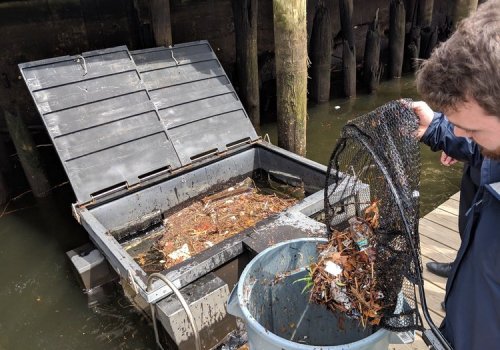
Oyster shells from restaurants get taken to Governors Island in the heart of the New York Harbor to be used in fighting erosion. Billion Oyster Project has collected more than 1 million pounds of oyster shells so far. 

I go to poetry readings at the local library, and inevitably in the question period, someone in the audience asks the poet, “How do you get your ideas?” (This is a question poets expect, and they always have a ready answer. Watch for the deer-in-the-headlights look if you ask a question they don’t expect.)

But I’m not sure any of us really know where we get our ideas. There is something mysterious about the way individual brains connect connect things heard, seen, smelled, touched, tasted with their individual experiences.

Today’s story is about shoring up an eroding harbor with recycled oyster shells. The idea to use oysters this way comes from years of research and contributions from many people. But, according to the report at National Public Radio (NPR), an idea for extending the benefits came from kids. Read on.

Andrea Strong reports, “Across New York City, more than 70 restaurants are tossing their oyster shells not into the trash or composting pile, but into the city’s eroded harbor. It’s all part of Billion Oyster Project‘s restaurant shell-collection program. …

“The shells are trucked over to Brooklyn’s Greenpoint neighborhood and once a month are brought en masse to Governors Island in the heart of the New York Harbor, just yards away from both Brooklyn and Lower Manhattan. There, rolling shell hills sparkle in the sun while ‘curing’ out in the elements for one year, a process that rids them of contaminants.

“The shells then get a final cleaning and are moved to Billion Oyster Project’s hatchery at the Urban Assembly New York Harbor School, a public high school on Governors Island that offers technical and vocational training in the marine sciences. In an aquaculture classroom’s hatchery, student-grown oysters produce larvae in an artificially induced springtime environment.

“In one to two weeks, each larvae grows a ‘foot’ — a little limb covered in a kind of natural glue — and then is moved to a tank full of the ‘cured’ restaurant shells, which serve as anchors for all of those sticky feet. This phase is critical: If larvae can’t find a place to attach, they die. One reclaimed shell can house 10 to 20 new live oysters, depending on shell size. …

“If the water is warm enough, mature oysters are moved to a reef structure — a cage or shellfish bag — that provides a stable area for oysters to fuse together and create a healthy reef in the New York Harbor.

“Then, the oysters begin doing what oysters do — which, it turns out, is quite a lot. Oysters are natural water filters; each one cleans 30 to 50 gallons of water a day. They also provide food and shelter for all sorts of marine creatures, supporting biodiversity. …

“Oyster reefs can protect against a hurricane’s wave velocity, which can destroy a city’s infrastructure. The New York Governor’s Office of Storm Recovery has partnered with Billion Oyster Project to install oysters on its $74 million Living Breakwaters Project, which aims to reduce and reverse erosion and damage from storm waves, improve the ecosystem health of Raritan Bay and encourage environmentally conscious stewardship of nearshore waters. …

“Brian Owens, who goes through about 20,000 oysters a week at his restaurant, Crave Fishbar, … says the project is not just smart for sustainability; it’s also good for business. Recycling shells significantly reduces carting expenses, something all NYC restaurants must pay for by the bag. ‘Recycling them into the reef is a huge savings,’ he says.

“In addition to saving on garbage collection, restaurants may soon be eligible for a tax credit thanks to New York Assemblywoman Linda Rosenthal. The credit is a much needed balm for restaurants that have been hit with escalating costs and increasing regulatory burdens over the past few years. …

“The idea came from neither restaurants nor Rosenthal, but from students at one of Billion Oyster Project’s partner schools, West End Secondary on the Upper West Side.

“Rosenthal championed their idea, building support for the bill and bringing the students to Albany to learn about lawmaking and to participate in a press conference.

“Education of the next generation of environmental stewards has been at the heart of Billion Oyster Project since its inception in 2008, when [Billion Oyster Project Executive Director Pete] Malinowski was teaching aquaculture at the Harbor School. …

“Fifteen years later … that classroom program has grown into Billion Oyster Project and now includes programming in more than 80 middle and high schools. That works out to about 1,215 high school students and more than 6,500 middle school students. …

” Through this work, students develop awareness and affinity for the resource and the confidence that comes from knowing their actions can make a difference. With young people who care, the harbor has a real fighting chance,’ ” says Malinowski.

More.

Sending 422 oyster reef structures into the Hudson River to protect and purify New York Harbor.

Read Full Post »

Photo: Sophia Evans for the Observer
The Maidment family in England are focused on making their daily lives as free of plastic as possible and spreading the word at Plastic-Free Hackney.

It seems like only yesterday that a guy in the 1967 movie The Graduate told Dustin Hoffman’s character that his future lay in plastics.

McGuire: There’s a great future in plastics. Think about it. Will you think about it?

Ah, yes. Plastics had a future, all right. In the blink of an eye, they have become a nightmare for the planet, refusing to disintegrate in landfills, clogging oceans, cluttering city streets.

There are many things made of plastic that we may always need. I’m thinking of certain medical uses. But what about all the things we use that really don’t need to be made of plastic. Can we make a dent in those? Here’s a family in England that’s trying.

Nosheen Iqbal reports at the Guardian, “Bettina Maidment … is the founder of Plastic Free Hackney, a campaign to rid the east London borough of single-use plastic and has been serious about committing her family to plastic-free, zero-waste living for two years now. First to go was milk cartons. ‘That was an easy switch, we got a milkman.’

“Then came bamboo toothbrushes, swapping out supermarket shopping for the local greengrocer, and making deodorant, cleanser, moisturiser and handsoap at home. She opens her fridge to reveal shelves of glass jars and reusable containers; her larder is stocked with lentils, pasta, porridge and the like, bought in bulk and stored in glass or canvas bags. …

“She is not alone. As public anger grows over the environmental impact of single-use plastic, trying to live plastic-free and more sustainably has become a mainstream concept.

“ ‘There was a huge uptick in the conversation after Blue Planet about how to reduce plastic use and it remains, by quite a margin, the single biggest topic area people call us for,’ says Julian Kirby, lead campaigner on plastics at Friends of the Earth. ‘In my experience, the amount of public concern for this environmental issue is unprecedented,’ he says. ‘It’s been phenomenal.’ …

“ ‘My interest was piqued online and I saw how other people were doing it and slowly started reducing my waste.’ She opened an Instagram account [@plasticfreehackney] to document the process of going plastic-free. …

“For Kiran Harrison, 43, who works as a massage therapist and storyteller in Worthing, West Sussex.the impetus to go plastic-free came around the time her son, now nine months, was born. She visited her local cloth nappy [diaper] library, where parents can loan reusable nappies, and gradually began swapping out the plastics in her home. …

“Support from a fast-growing zero-waste community in Sussex has also helped; a plastic-free, zero-waste food store has recently arrived in Worthing.

“ ‘Some people are cynical about how you can sustain a lifestyle like this,’ she admits, ‘or cynical about making a small contribution when big companies produce so much waste, but I’m not down with the “what’s the point of doing anything, we’re all doomed” brigade – it’s far too apathetic for my liking.’

Harrison’s top tip is to ‘do things gradually so they become a habit. Trying to do everything at once is overwhelming.’

“Friends of the Earth, which established a UK network in 1970, launched its #plasticfreefriday campaign [last] February. … According to a UN report published in June, the proportion of plastic waste that has never been recycled stands at 90.5% – a figure so alarming that it was declared the winning international statistic of 2018 by the Royal Statistical Society.

“Waleed Akhtar, an actor from London, … uses beeswax wraps rather than clingfilm for his sandwiches and carries a reusable water bottle, bamboo cutlery, Tupperware and a reusable bag everywhere he goes. … ‘I used to drink bottled water every day, but I did a play called Fracked!, and a monologue in it about the impact of water bottles on the environment kicked it all off for me.’ …

“THE STEPS YOU CAN TAKE …
“Use a reusable water bottle …
“Carry a reusable cup …
“Switch to solid soaps …
“Say no to disposable cutlery …
“Brush with bamboo.”

Some of these are super easy to do — like handing back plastic forks and spoons the takeout restaurant puts in your bag. More at the Guardian, here.

For past posts on this challenge, search SuzannesMomsBlog on the word plastic. A sample of articles: a bike path made of recycled plastic in the Netherlands, a plastic-eating microbe, a trash wheel that rounds up plastic on waterways.

This beeswax cling wrap is washable and reusable but quite expensive. I’ll let you know what I think after I’ve tried it.

Read Full Post »

Our New Year’s Eves are quiet these days. We watched an Agatha Christie on television and went to sleep. But I’ve been saving a suitable tile from the New York subway system since my October trip to visit my sister, so here it is and Happy New Year!

2018 was not a good year for my sister, who was diagnosed with a bad brain cancer in July. But it was also a year we learned to be grateful for things like a clean surgery and cancer treatments without bad side effects. My perspective changed.

My perspective on the nation and on the future of the planet and my own role in it has also been evolving. I began to suspect that, other than our Bill of Rights, our country may not be as special as we thought. After all, all countries think they are special. And even the Bill of Rights can’t survive unless we commit to protecting it and interpreting it justly. Surely none of those rights were intended to lead to the deaths of thousands of innocent Americans every year. Perhaps 2018 was a turning point.

I’ve also been giving more thought to my role in global warming. Do I make too many unnecessary car trips when I could walk or take public transportation? Do I serve the family too much meat, especially beef? Should I find a way to plant more trees? I know I need to stop sneaking around the local laws against plastic bags and find a sustainable alternative.

I will be writing more about initiatives to protect the planet and will be looking for ideas to apply in my own life from you and from websites like 1MillionWomen. By the way, I learned about 1MillionWomen from a wonderful book called Climate Justice, by Mary Robinson. I hope you will put it on your list. It shows how the poorest communities are the first to feel the crunch of global warming and how, if we pay attention to those communities, we will also be taking arm against the sea of troubles that threatens us all.

Even better, the book shows how extraordinarily effective ordinary people can be when they have simply had enough.

Read Full Post »

Photo: Colin Mandlin
Ubuntu Theater Project in Oakland, California, is using a pay-as-you-can model to expand their audience. Their production of
Othello, pictured above, was presented in a rug shop.

I have posted about finding unusual venues, like rug shops, for artistic performances (click here) and also about establishing pay-as-you-can models for a range of purposes (for example, the food business). Today’s post is about a California theater company that does both.

Ashley Lee reports at the American Theatre website, “Amid the dense arts scene of California’s Bay Area, Ubuntu Theater Project has proudly distinguished itself with a mission statement of being ‘radically inclusive.’

“Founded in 2012 as a handful of summer theatre festivals, Ubuntu — named after a Zulu proverb that means ‘I am because we are’ — now programs year-round shows at various venues throughout Oakland, Calif., one of America’s most diverse cities. They often stage American classics with predominantly casts of color, a majority of whom are Oakland natives. Though a seat at each performance costs between $15 and $45, the company has regularly drawn a percentage of patrons from low-income communities through pay-as-you-can tickets sold at the door, and has offset those costs with a bucket donation ask after the curtain call.

“But all that wasn’t inclusive — or radical — enough for Ubuntu. So last summer, the theatre adopted a pay-as-you-can subscription model, guaranteeing tickets to its seven shows for a single amount named by the ticketholder. …

“ ‘There was a financial risk — we had no idea what people were gonna pay,’ concedes Simone Finney, the organization’s marketing director. … ‘This is a way to invite someone into a continued conversation, rather than just an affordable experience of one show. It’s not just transactional; it’s saying, “I want to be part of this community.” ‘ …

“It was a huge gamble — and it’s paid off surprisingly well, both in terms of cash flow and feedback. Ubuntu’s subscriber base grew from just 25 devoted patrons to around 300 and counting. … Finney attributes the generosity of their higher-end subscribers to word of mouth, since her marketing budget didn’t suddenly multiply over the past season. ‘We’re trying to do a lot on not a lot,’ she admits.

“Leigh Rondon-Davis, Ubuntu’s executive associate, [says] ‘A lot of the feedback we’ve gotten is, “Thank you, I can finally afford to see theatre.” ‘ …

“As with any first-time initiative, the program had its share of hitches. … Their online ticketing platform, Vendini, doesn’t allow buyers to input their own prices; the current two-step work-around involves making a donation via the Square Cash app, waiting for a manually sent email from Rondon-Davis, and then booking tickets with a coupon code. …

“If their expanded subscriber base returns for next season, the organization hopes to offer shows that reflect their audience even more.

“ ‘Our bread and butter for a while was classics or established works, and humanitarian world premieres of new works,’ says Rondon-Davis. ‘Now, edgier works.’ …

“Adds Finney: ‘People don’t just come to things because they’re free. … You still want to earn people’s time, interest, and enthusiasm.’ …

“While other theatre companies might be hesitant to make this drastic leap, no one needs to jump into the deep end immediately. Instead Finney and Rondon-Davis suggest following in Ubuntu’s footsteps and experimenting with PAYC tickets at the door for each performance. Most important, they suggest, talk to your audiences to identify what their primary challenges are when it comes to seeing theatre. …

“ ‘It’s not always cost — it can be location, the type of work, not having people to go with, not feeling welcome in a theatre space,’ notes Finney. “These are conversations we will continue to have. … This hasn’t made us take a financial hit and has been, in fact, very beneficial to us. I hope that makes more companies consider accessible pricing, not just as a sacrifice you make, but something that could be a viable part in the life of a company.’ ” More.

Read Full Post »

Photos: Beit HaGefen Arab-Jewish Cultural Center
People dance in the streets of the mostly Arab neighborhood of Wadi Nisnas in Haifa, Israel, for the 25th Holiday of Holidays festival, which celebrates religious diversity.

Most days, I find news about Israel completely depressing. Then along comes a story about an annual three-religion celebration there, and I’m reminded that not everyone associated with the 70-year-old nation and its neighbors is keen on in endless war.

Dina Kraft writes at the Christian Science Monitor. “In the port city of Haifa, two young art curators, one Jewish and one a Palestinian citizen of Israel, are dealing with something decidedly less fraught [than the daily news]: They are planning the logistics of an art installation that will include 88 pounds of white pepper, za’atar, sumac, and ginger.

“The piece is an exploration of what notions of ‘home’ mean, a loaded concept in a land claimed by two peoples. It is planned as a centerpiece of a new art exhibition for the Holiday of Holidays, the only event of its kind in Israel and a rare celebration of religious and cultural diversity in the fractious Middle East. The festival honors Christmas, Hanukkah, and Muslim traditions over three weekends in December in a gathering that is part block party, part intercultural artistic extravaganza. …

“Every year there is a different theme and this one is ‘the third dimension,’ an invitation to look at what happens when different cultures and identities influence each other to create something new – a hybrid space – as Yael Messer describes it. Ms. Messer is curator of the art gallery run by the Beit HaGefen Arab-Jewish Cultural Center. Messer, who is Jewish, is going over plans with Haneen Abed, her deputy, a Palestinian Israeli, in their shared office. The staff of the center is made up of both Arab and Jewish citizens of Israel.

“The story of the Holiday of Holidays is also the story of Haifa, Israel’s third-largest city. Haifa likes to bill itself – though not without criticism – as the country’s capital of coexistence, a place where Jewish and Arab residents live more integrated lives.

“Across the country, most Jews and Arabs live separately even in so-called mixed towns and cities, such as Haifa, where the two groups usually inhabit different neighborhoods. Social interaction is especially rare.

“But the festival brings together people from both sides of the demographic divide to dance to music performed on outdoor stages, on streets festooned with holiday lights. Arabs and Jews together follow the path of food and literary tours through the alleyways and streets of the mostly Arab neighborhood of Wadi Nisnas, eating local offerings like hummus and baklava at food stalls and attending concerts of liturgical music at churches. The massive undertaking is organized by Beit HaGefen and funded by the city of Haifa.

“Upstairs from Messer and Ms. Abed, their colleague Hila Goshen, the cultural director of Beit HaGefen, has her laptop open to a color-coded schedule of the festival’s events.

“ ‘It seems like every year there is some war, or military operation, or suicide bombing that happens [during the planning season] and we ask, “What are we doing, bringing people together to hear music and hear each other?” ‘ says Ms. Goshen. ‘And then the festival happens and this place looks like the most normal place on earth. The magic happens.’ …

“She says the example of the gathering, brief as it is, shows this concept of shared society, a place where Arabs and Jews can live together and lead equal lives.

“ ‘I know all our issues are not being solved in this festival,’ she says. ‘But even having this kind of exposure to thinking a little bit differently is a seed we have to plant.’

“Some critics believe this is gauzy naiveté. They argue that people really come to the festival for the food, not the message of unity. But [Asaf Ron, the director of Beit HaGefen,] disagrees.

“ ‘I don’t think people come for the hummus or the knafeh,’ he says. ‘I think they come for the hope.’ ”

More at the Christian Science Monitor, here. Check out past posts about the three religions interacting as the Daughters of Abraham, here, and in the pliable time of youth, here.

And for extra inspiration, click here to learn about the Parents Circle Family Forum, a beacon of light in Israel that brings together the bereaved on both sides of the conflict who understand that ending it can only come from the ground up.

Read Full Post »

Photo:  Svt Nyheter
Saga Vanecek, an 8-year-old Swedish-American girl, pulled a 1,500-year-old sword from a lake in southern Sweden last July, prompting comparisons to Arthurian legends about the Sword in the Stone and the Lady of the Lake.

You never know when wonders will appear. This little girl was not out helping archaeologists on a dig like the 13-year-old boy in this earlier post. She was just dawdling in a lake while her father was calling her to hurry so he could watch the World Cup on television. And then — a miracle.

Jon Henley writes at the Guardian, “An eight-year-old girl has pulled a 1,500-year-old sword from a lake in southern Sweden.

“ ‘I felt something with my hand and at first I thought it was a stick,’ Saga Vanecek told the local Värnamo Nyheter [VN] newspaper. ‘Then it had a handle that looked like it was a sword, and then I lifted it up and shouted: “Daddy, I found a sword!” ‘

“The find, made in July but announced only [in October] for fear it would trigger a summer stampede to the site at Tånnö on the shore of Lake Vidöstern, felt ‘pretty cool and a bit exciting,’ she told the Swedish public broadcaster Sveriges Radio. …

“Her father, Andrew, said in a Facebook post that the sword, estimated by experts from the nearby Jönköping county museum to date to the 5th or 6th century AD, before the Viking era, was still in the remains of its wood and leather scabbard.

“He told VN he had been waiting impatiently for his daughter to come in from the water because the football World Cup final was about to start, but she was busy skimming stones. Then she stooped and held up the ancient weapon.

“Neighbours confirmed to the Swedish-American family, who moved to Sweden from Minnesota last year, that the rusted artefact did indeed look old, and Nevecek called an archaeologist the next day.

“Annie Rosén, from the museum, said: ‘I was on holiday, but when I saw the pictures I went straight away. You cannot imagine such a sword – so well preserved.’

“Another expert at the museum, Mikael Nordström, [said] they were exploring the possibility it could have been a place of sacrifice. … Subsequent searches by museum staff and local council workers uncovered a brooch from roughly the same period but there were no other significant finds.”

More at the Guardian, here. And you can read Saga Vanecek’s own report here.

May 2019 be the year that girls everywhere pull miracles from lakes and stones.

Read Full Post »

5760

Photo: RMIT University/Nature Communications
Australian university researchers have developed an ultraviolet (UV) active ink that changes color when exposed to UV rays to help sunbathers see when they’ve had enough sun exposure.

My kids expect that every spring I’ll trot out the latest skin-cancer articles to scare them about sun exposure. Well, after all, getting skin cancer is something to worry about. I have a number of people in my family who have had dangerous melanomas. I myself had what they call a melanoma in situ. I had it removed in the 1990s and still get checked every six months.

Given winter vacations to sunny climes, spring and summer are not the only times to be wary. You might be interested in reading about a new way to protect yourself.

According to Nicola Davis at the Guardian, “A simple paper sensor featuring smiley and frowny faces drawn in UV-sensitive ink has been produced by researchers in a bid to keep us safe in the sun.

“Scientists say the different expressions appear in sequence as UV exposure increases, offering a low-tech way for people to gauge when it is time to cover up.

“The team add that they have produced different versions of the wristband for different skin tones – something they say is important given that darker skin can tolerate greater UV exposure before damage occurs, and more exposure is needed to produce vitamin D.

“Further, the sensor can respond to varying levels of the different components of UV radiation: while UVA is thought to cause skin ageing and wrinkles, it’s mainly UVB that causes sunburn and leads to skin cancer. …

“Writing in the journal Nature Communications, [Prof Vipul Bansal, lead author of the study from RMIT University in Australia,] and colleagues describe how they sought to tackle the issue by creating a cheap device based on phosphomolybdic acid, or PMA. This substance turns from colourless to blue in the presence of lactic acid and UV radiation.

“The team then used this mixture of lactic acid and PMA as an ink to draw four invisible faces on paper, and used transparent sheets of the sort used for overhead projectors to create filters that they put on top of them. This allowed the researchers to tweak the intensity of UV radiation reaching the ink so that the faces changed colour in sequence as exposure to UV radiation rose from 25% to 50%, then 75%, and finally 100% of a ‘safe’ dose.

“The team found that the PMA-based ink turns a darker blue colour under UVB than UVA over the same period of time, meaning that the higher the proportion of UVB in the sunlight an individual is exposed to, the quicker the sensor will indicate a 100% dose of UV radiation.

“By further adjusting the number of filters for each of the four faces, the team were able to adjust the system to produce different sensors to work for six different skin tones.

“Bansal said that while devices were designed using UV light in the laboratory, they are currently being tested in outdoor conditions. The team hope that the sensors will be on the market in a year, costing about a 1AUD [$0.71] a piece.

“Matthew Gass of the British Association of Dermatologists, who was not involved in the research, said said the product does ‘have the potential to be another tool that helps people avoid excessive sun exposure, but they are not a replacement for actual sun protection in the form of sunscreen, protective clothing, and making use of shade.’ ”

My dermatologist insists that sunscreens should include zinc and be waterproof. Just FYI.

More at the Guardian, here.

Read Full Post »

Photo: Newshub
Sans Forgetica is a typeface meant to aid memory. It was invented by researchers at RMIT in Melbourne, Australia.

There’s a new memory-boosting font that you can download for free and use for short texts. The inventors say you wouldn’t want to use it for long texts like a novel because it would give you a headache. But I say, what good is a typeface if you can’t read novels with it?

Lisa Martin writes at the Guardian, “Australian researchers say they have developed a new tool that could help students cramming for exams – a font that helps the reader remember information.

“Melbourne-based RMIT University’s behavioural business lab and design school teamed up to create ‘Sans Forgetica,’ which they say uses psychological and design theories to aid memory retention.

“About 400 university students have been involved in a study that found a small increase in the amount participants remembered – 57% of text written in Sans Forgetica compared with 50% in a plain Arial.

“Typography lecturer Stephen Banham said the font had an unusual seven-degree back slant to the left and gaps in each letter.

“ ‘The mind will naturally seek to complete those shapes and so by doing that it slows the reading and triggers memory,’ Banham told the Guardian.

“Senior marketing lecturer Janneke Blijlevens said the concept of ‘desirable difficulty’ underpinned the font’s design. …

“The font was designed with year 12 students cramming for exams in mind but could also be used to help people studying foreign languages and elderly people grappling with memory loss.” More at the Guardian, here.

I can see that having to work harder to read something may cause memory to fire on more burners, but when I was a kid, a friend who purported to analyze handwriting told me that broken letters like this indicated a criminal mind!

Read Full Post »

Photo: Michael Falero
Seventh graders Daelyn Brown and Elaina Grady with their teacher, Justin Parmenter, at Waddell Language Academy in Charlotte, NC. After a traumatizing shooting at a nearby school, Parmenter launched an activity called Undercover Agents of Kindness. The results speak for themselves.

Like you and me, the folks of WNYC radio have noticed a certain lack of emphasis on kindness in the public sphere. Recognizing that there are always people reaching out to others somewhere, they decided to track down those obscure acts of kindness and feature them on the air. The station’s series taps the knowledge of listeners, who provide leads.

From WNYC: “We expect schools to prepare students by teaching them math and science and reading and writing. But what about teaching kindness?

“Justin Parmenter, who teaches Language Arts to seventh graders at Waddell Language Academy in Charlotte, North Carolina, decided to try. After a deadly school shooting at a nearby high school rocked the campus, he launched Undercover Agents of Kindness, an activity designed to gets his students out of their social bubbles and doing good deeds for each other.”

He writes at his blog: “I’d already been thinking a lot about the decline in positive interactions in our society and how we might more effectively teach character in our schools. … An adult simply talking about character or modelling positive behavior does not often lead to the changes we want to see in our children. There had to be a more impactful approach. …

“To increase interaction between students who did not normally talk to each other, I had students draw a random classmate’s name from a bowl.  After they drew names, I was shocked to hear some of them had no idea who the other person was –- even after being in class together for two months and in many cases attending the same school for years. Students had two weeks to perform an unexpected act of kindness for the other person and complete a written ‘mission report’ detailing what they did and how it went.

“Soon I began to see encouraging sticky notes on lockers in the hallway. Batches of homemade cupcakes and bags of leftover Halloween candy made their way onto desks in my classroom, as did origami, inspirational quotes, and hand-drawn portraits.  I heard compliments exchanged about all kinds of things. Students I’d never seen together started offering to carry each other’s books and musical instruments to the next class.  As the mission reports started trickling in, I read accounts of children studying together, inviting others to sit together at lunch, helping others put football equipment on at practice.

“However, it was my students’ reflections on the kindness activity that revealed its impact most.

Again and again they acknowledged that it was difficult and felt awkward to approach someone they didn’t know well and do something for them.  But almost every time they added that they were proud of themselves for doing it anyway and felt the power in brightening someone else’s day.”

WNYC interviewed the teacher with two of those students.

” ‘I always thought that people would just reject me if I ever started talking to them, but the truth is if you branch out, you’d be surprised at how nice people can be,’ Waddell student Daelyn Brown, 12, says of the kindness activity.

” ‘When someone does something kind for you or you do something kind for a person, it’s just like wow, I can do this so much and I can make so many friends and everybody would be so happy,’ adds fellow classmate Elaina Grady, 13.”

Listen to the radio report here. And please treat yourself to the wonderful student notes at the teacher’s blog, here.

Read Full Post »

No Christmas Snow

122318-Ukrainian-erector-set

A handful of snowflakes came down on Christmas Eve Day, but not enough for me to shoot a snowy picture. Although I was mighty tired of snow last March, I would have liked to see some this week.

A fresh snowfall is pretty, but I guess I’m glad the roads are dry. Our plan for Christmas is to watch John’s children open presents early, then come home and get ready for our Christmas dinner, which shouldn’t be hard as two of the world’s best cooks are bringing more than half the meal.

Suzanne, meanwhile, is in the Caribbean with the Swedish side of the family. Note the photo of her kids learning a traditional song from their Swedish-Danish cousins while dancing around the tree (actually, it’s a lamp this year) on an island that probably never sees snow.

In other December photos: John’s children getting creative with an erector set (who needs to know what the Ukrainian directions say?), an Amaryllis on Erik’s piano as well as his Santa Lucia and Swedish creche, early Christmas gift-opening before the trip to the Caribbean, and family members enjoying 80-degree weather. Finally, the Swedish tomtens that my husband and I received in time for Christmas.

I hope that those who celebrate this holiday have a merry one, and I send warm wishes to everyone. See you tomorrow.

121718-amaryllis

122018-Swedish-creche-and-Lucia

122018-ripping-thru-the-presents

122018-ripping-thru-the-presents-at-breakneck-speed

122418-Christmas-in-Guadalupe

20181224-cousins-teach-Swedish-tradition

121118-tomtens-and-Christmas-tree

Read Full Post »

« Newer Posts - Older Posts »