Feeds:
Posts
Comments

Archive for the ‘Uncategorized’ Category

The Nonprofit Quarterly recently published a short piece about how artisans are playing a critical role in West Virginia’s economic development strategy.

Ruth McCambridge reported, “In West Virginia, a state rich in artisans including fashion designers, leatherworkers, and furniture makers, the Tamarack Foundation for the Arts offers business help meant to bring that local work to a more national market.

“ ‘We get artists’ work into major markets outside the state,’ CEO Alissa Novolselick said. ‘We help them get in front of power buyers, big art institutions or really high volume galleries, or different sorts of market opportunities.’

“Success in this larger arena is completely possible, she says, pointing to Blenko Glass and Fiestaware as West Virginia–based businesses with a ‘hugely diversified portfolio.’ She calls this part of a strength-based community economic development strategy, rather than just support for artists: ‘We really believe that art as economic development can be part of the total answer to working on a more diversified economy for West Virginia.’ …

“Art can create more than a visual; it can create a place. And the richness goes both ways, says Novoselick, who contends that the rural nature of the settings of many of these centers of arts development informs the art. …

“A recent study of five hundred West Virginia art entrepreneurs found that they felt the low cost of living and doing business in the state helps lower the risk of what would otherwise be a chancy endeavor.” More here.

When I was working at the magazine, we had articles from a number of New England states about their version of a “creative economy.” The perennial worry, of course, is that once the artists have done their job and brought tourists and business to an area, they may be unable to pay the inevitable higher rents. Forward-looking locales explore ways to protect artists for the long term.

Photo: MountainMade WV Handmade Art
Blenko Glass

Read Full Post »

Magic To Do…

I loved this post at A Musical Life on Planet Earth. Willedare is kindly letting me reblog it.

amusicalifeonplanetearth

I have loved Stephen Schwartz’s music ever since I heard the cast album of Godspell in 1971.

I don’t remember how I came to own it, but I played that record over and over again.

So I was wildly excited and nervous when — at age ten — I auditioned for a new musical being directed by Bob Fosse with songs written by Mr. Schwartz.

I sang Cat Stevens’ song “Father and Son” at the audition. (My aunt had given me and my siblings many of Cat Stevens’ albums, which I also loved.)

I vaguely remember standing on a stage, singing to a few people in a darkened theater.

At one point during the audition — or maybe during a callback? — the pianist played a particular section of “Father and Son” in different keys in order to get a sense of my vocal range.

I gamely sang higher and higher until my voice finally cracked.

I must…

View original post 1,244 more words

Read Full Post »

antique-lockets-2


What is important to you? Who is important to you?

Today I’m thinking about all the ways we hold what we care about as close as we possibly can. Maybe we love to wear an article of clothing that reminds us of the dear friend who gave it to us. Or a ring that belonged to a great-grandmother. Or a child’s photo in a locket.

As you know, this blog appears because my daughter, Suzanne, suggested five years ago that I write a blog tied to her contemporary birthstone jewelry company and (I’m still amazed by this) basically said, “Go forth, and write about anything that interests you.” Wow.

Today what interests me is letting you know that Suzanne’s company, Luna & Stella, is now offering antique lockets that are rapidly finding a mix-and-match niche. The handmade hinges, just to mention one highlight, are nearly invisible, impossible to find today.

Dear Friends, carry what’s important with you wherever you go. In your heart. Or maybe in a locket. Get those creative juices flowing … maybe a photo of Lady Liberty would be good.

From the founder: “Luna & Stella blends its own contemporary heirlooms with antique and estate pieces.  Influenced by the moon and star icons used in Victorian jewelry, Luna & Stella creates fine jewelry that is symbolic of loved ones, using birthstones and other symbols to represent the relationships between parents, grandparents, children, partners, siblings, and friends. 

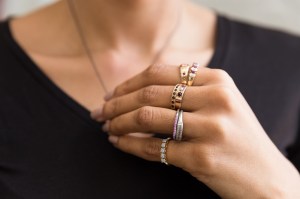
“A passionate collector of antique jewelry, Suzanne curates a selection of antique lockets and Victorian and Estate stacking rings chosen to layer with Luna & Stella’s collection of modern talismans, charms, symbols and birthstones. 

“I love finding lockets with the original photos inside.  It is a glimpse into another time and place.  I wonder about the people in the photos – were they her parents?  Her husband? Her children? Her sister or someone else important to her? Whoever they were, they were important to the wearer and I think it is so special that those memories have been preserved in some way, over a 100 years later.  When the new owner puts in her own photos, the locket gets new life and new meaning to each caretaker.

“The url to our website is http://www.lunaandstella.com/ and to the collection of lockets is: http://www.lunaandstella.com/collections/vintage-locket-collectionNot all of the pieces you have are online, yet but they will be by Nov 15.  Clients can customize the lockets with a new or antique chain, and charms from our or their own personal collections.”

antique-lockets-on-bust

loved-ones-in-antique-locket

Read Full Post »

We have no idea what Wednesday will bring, but let’s do this. Let’s commit to focusing on what we once shared with that friend whose life path led him to a different decision. Let’s honor his or her life path if not the most recent destination. We’ve had different life experiences.

Let’s focus on what we both like: the funny things small children say, lazy days at the beach, imaginative Halloween costumes, the blended aromas of a Thanksgiving kitchen, Peter Pan.

There’s no need to bring Abe Lincoln into this, but well, you know: A house divided against itself cannot stand.

As I passed by on my walk last Thursday, this engraving with its old-fashioned wording spoke to me.

110316-let-all-your-things-be-done-with-love

Read Full Post »

I’m old enough to have lived through many contentious election cycles, my mother having gotten my help going door-to-door when I was 7. So I’m here to tell you, life goes on. The old world keeps turning. The seasons come around. Dawn lights up city streets. Those who seek kindness and beauty find it.

101116-voting-outreach-2

101116-voting-outreach-2


101116-voting-outreach-1


102616-old-time-services-providence


102616-turret-shadow-wayland-square


103016-graveyard-tree-concord


103016-graveyard-tree-concord


103016-decay-concord-ma


Read Full Post »

Photo: Postmodern Jukebox band.

Scott Bradlee and his Postmodern Jukebox band take modern hits and play them in old-timey styles with surprise guest artists. The results are awesome.

James Sullivan has the story at the Boston Globe.

“When the Wang Theatre at the Citi Performing Arts Center first opened in 1925, the ornate performance hall was known as the Metropolitan. Scott Bradlee’s Postmodern Jukebox [offers] listeners a ticket of sorts back to the Jazz Age of the theater’s beginnings, with Bradlee’s old-time piano anchoring the collective improvisation of a Dixieland ensemble.

“Then they’ll get to the part of the song when Justin Bieber taunts an ex because she still hits his phone up.

“Right from the start of the band’s five-year ascent on YouTube, Postmodern Jukebox made its method clear: The group takes the pop hits of the text-and-Snapchat age and recasts them as meticulously arranged period pieces, from ragtime to doo-wop. …

“Despite the vintage sound, his group’s work is not intended as a pure throwback, says Bradlee, a 35-year-old New Jersey native, who recently moved to Los Angeles after launching PMJ from a Queens basement in 2011.

“ ‘It’s more of an alternative universe, in a way,’ he says. ‘We might even go into something a little bit hip-hop or funky. It’s more . . . an aesthetic – you kind of know it when you hear it.’ …

“Working outside the conventional music industry in more ways than one, Postmodern Jukebox doesn’t announce all the performers expected at any given performance. Drawing from a roster that now numbers nearly 70 singers and musicians, Bradlee varies the lineup from city to city, depending on location and availability.

“Sara Niemietz … takes the lead on PMJ’s versions of OutKast’s ‘Hey Ya!’ and Bieber’s ‘Love Yourself,’ for which, she says, she had Bessie Smith – the ‘Empress of the Blues’ – in mind. …

“Though Niemietz headlines her own shows, acts, and does theater work, she likes the all-for-one-and-one-for-all camaraderie of the PMJ players.

“ ‘It’s almost like you’re on a team,’ she says. ‘Everyone is working together to create a larger experience.’ ” More at the Globe.

Listen:

Read Full Post »

Small tree farms are now eligible to sell carbon credits, which can supplement or even replace logging income. But to many owners, getting into the market looks pretty daunting. In a recent article in the New York Times, Erica Goode explains how the obstacles can be overcome.

“Lately, [Eve] Lonnquist, 59 and recently retired, has been thinking about the future of her family’s land. Like many small-forest owners, they draw some income from logging and would like to keep doing so. But they would also like to see the forest, with its stands of Douglas fir, alder and cherry, protected from clear-cutting or being sold off to developers.

“ ‘For us, the property is our family’s history,’ she said.

“More than half of the 751 million acres of forestland in the United States are privately owned, most by people like Ms. Lonnquist, with holdings of 1,000 acres or less. These family forests, environmental groups argue, represent a large, untapped resource for combating the effects of climate change.

“Conserving the trees and profiting from them might seem incompatible. But Ms. Lonnquist is hoping to do both by capitalizing on the forest’s ability to clean the air, turning the carbon stored in the forest into credits that can then be sold to polluters who want or need to offset their carbon footprints.

“ ‘Trees are the No. 1 way in which carbon can be removed from the atmosphere and stored in vegetation over the long term,’ said Brian Kittler, the western regional office director for the Pinchot Institute for Conservation, which has a program in Oregon to help the owners of family forests develop potentially profitable carbon projects. …

“The carbon credits from Ms. Lonnquist’s forest could bring an estimated $235,000 over the first six years, and about $6,000 a year after that, said Kyle Holland, the managing director of Ecological Carbon Offset Partners, a California firm that helps small-forest owners enter the carbon markets. …

“Recent developments in forestry may help make the prospect more appealing by lowering the initial costs to landholders. Mr. Holland’s company, for example, has developed a digital tool — a smartphone equipped with a laser to measure distance and an inclinometer to measure height — that he believes will greatly reduce the expense of conducting a forest inventory, which typically costs $40,000 to $100,000 or more, depending about the amount of land.

“With the specialized smartphone, landholders can take an inventory themselves, photographing and measuring the diameters and heights of their trees. The photos and data are sent to the company’s office in California, where an expert forester goes through the images, identifying the species and checking for damage to the branches or crowns, among other things. Probability models are used to calculate the amount of carbon stored in the forest.”

Hmmm. I wonder if this smartphone app could also be used by towns like Arlington, where John and other volunteers are conducting a tree inventory, not for selling carbon credits but for beautification plans.

More at the New York Timeshere.

Photo: American Forest Foundation

Read Full Post »

Although I completely understand the indignation of civil libertarians about some Massachusetts prisoners being obliged to make business cards for state officials, I think prisoner job-training programs like Michigan’s show real promise.

Consider this Associated Press story by David Eggert about “a new program that removes soon-to-be-released inmates from the general population and assigns them to an exclusive ‘vocational village’ for job training. The idea is to send them out through the prison gates with marketable skills that lead to a stable job, the kind that will them out trouble long term. …

“Jesse Torrez, 41, is among the prisoners who were admitted to vocational housing at the Richard A. Handlon Correctional Facility in Ionia, about 110 miles northwest of Detroit. There, the inmates receive full days of training in high-demand skills such as welding, machining and carpentry.

“Torrez, who is imprisoned for unarmed robbery, served two previous prison terms. Each time after release, he said, he reverted to ‘drinking and drugging’ when he could not find steady work. If he lied about his criminal record, the employer would inevitably find out and fire him.

” ‘It was just real tough, due to my past, which I created and am totally accountable for,’ said Torrez, a father of five who is hoping to be paroled in 2017 and is being trained in construction trades.

“He said he has a job waiting for him with a manufacturer. …

” ‘We see an untapped talent pool here,’ said Mark Miller, president and CEO of Cascade Engineering Inc. in Grand Rapids, which makes automotive parts, trash carts, storage containers and other goods.

“Cascade does not ask job applicants about their crimes until they have been extended an offer. Depending on the job, inmates can make between $11.60 to start and $15.15 an hour within a year.”

More.

Photo: AP
Inmate William Garrett works on a cabinet at the Habitat for Humanity Prison Build at the Ionia Correctional Facility in Ionia, Mich.

Read Full Post »

What to do about our throwaway culture? Well, Sweden has a proposal: tax breaks to encourage people to get things repaired.

Charlie Sorrel at fastcoexist.com explains that the idea involves “halving the tax paid on repairs and increasing taxes on unrepairable items. …

” ‘If we want to solve the problems of sustainability and the environment we have to work on consumption,’ Sweden’s finance and consumption minister Per Bolund told the Local. ‘One area we are really looking at is so-called “nudging.” That means, through various methods, making it easier for people to do the right thing.’ …

“The proposed legislation would cut regular tax on repairs of bikes, clothes, and shoes from 25% to 12%. Swedes would also be able to claim half the labor cost of appliance repairs (refrigerators, washing machines and other white goods) from their income tax. Together, these tax cuts are expected to cost the country around $54 million per year. This will be more than paid for by the estimated $233 million brought in by a new ‘chemical tax,’ which would tax the resources that go into making new goods and computers.

“In 2015, France passed a law requiring manufacturers to label products with information about how long spares will be available, and also requires free repair or replacement for the first two years of the product’s life. That’s another step forward, but it’s also cheaper for manufacturers to replace a broken cellphone than to repair it.

“Apple takes a third path—it swaps out your broken phone for a new one, often free of charge, and then breaks down your old unit, reusing its internals if possible, or recycling them.”

More here. Not sure how you benefit if you do the repair yourself. But knowing those Swedes, they’ll figure out something.

Photo: Geri Lavrov/Getty Images

Read Full Post »

Did you read the Ancient Greek tragedy Antigone, by Sophocles, in school? I was actually in a college production — performed in Greek. It was much too hard for me, even with my bit part.

But in high school, the play really captured my imagination with its young heroine insisting that the higher laws required her to give her rebel brother a proper burial and the king determined to make an example of rebels.

Anyway, that’s how I remember dinner discussions — my aunt and uncle arguing for the power of the state and me arguing for rebels.

So you may imagine how intrigued I was when I saw that a theater troop was enlisting big stars to bring Antigone (in English) to Ferguson, Missouri, to generate a community dialogue. Ferguson was where the majority of Americans first became aware of the issues that have led to the Black Lives Matter movement.

National Public Radio alerted listeners to the event, here.

“WILLIS RYDER ARNOLD (REPORTER): Bryan Doerries is a director who puts on ancient Greek plays. He says his productions aren’t boring classroom exercises.

“BRYAN DOERRIES: These are readings on steroids, and spit is flying and tears are projectile crying off the stage, and sounds are coming up out of the actors that they’ve never heard themselves make before.

“ARNOLD: After the performance, Doerries asks the audience to react. He leads a conversation that can take as long as the actual play. For him, the performance is a chance to ask some deeper questions.

“DOERRIES: How many different ways can we give you, as the audience, permission to have a conversation that wouldn’t otherwise be possible, to speak your personal truths, to be acknowledged and heard?

“ARNOLD: A local resident urged Doerries to bring his project to Ferguson. Doerries will present ‘Antigone.’ ”

The plan for “Antigone in Ferguson,” developed by Outside the Wire and the PopTech Institute, and co-presented by the Onassis Foundation USA, was as follows:

“Screening of selected segments from the documentary Antigone in Ferguson, followed by a dramatic reading of scenes from Antigone with Reg E. Cathey (House of Cards, The Wire), Gloria Reuben (ER), Glenn Davis (24, The Unit), and Samira Wiley (Orange Is the New Black).

“The reading will be followed by a town hall discussion, framed by remarks from community panelists — including members of law enforcement, activists, and concerned citizens — facilitated by Bryan Doerries, with the goal of generating powerful dialogue and fostering compassion, understanding, and positive action.”

I managed to find twitter reactions the day after the Sept. 17 performance:

Sep 18 Amazing! brought the community together through art and our own human experiences!
Sep 18 All of tonight’s was incredible. Thank you . Wow.
Sep 17 I wish everyone I know could have been at the reading of Antigone in Ferguson by . Church choir as Greek chorus? Amen

Read Full Post »

I’ve read about book lovers delivering books to children and adults by camel, donkey, portable Uni bookshelf and van. Now at the BBC, Theodora Sutcliffe reports on a sailboat that can get books to watery places in Indonesia.

“The toothless steersman positioned the rudder. A second sailor, balancing barefoot on an outrigger, coaxed an elderly engine into life. A third poled the boat away from the trash-strewn beach. In West Sulawesi, Indonesia, a ground-breaking mobile library was on its way.

“The Perahu Pustaka (Book Boat) is sorely needed. In a recent study of 61 nations for which data was available, Indonesia ranked second worst for literacy – only Botswana scored lower. More than 10% of the West Sulawesi’s adult population cannot read, while in many villages, the only book available is a solitary copy of the Quran.

“So in 2015, local news journalist Muhammad Ridwan Alimuddin decided to combine his twin passions for books and boats by setting up a mobile library on a baqgo, a small traditional sailboat. His aim? To bring fun, colourful children’s books to remote fishermen’s villages and tiny islands in the region where literacy is low and reading for pleasure virtually non-existent. He preaches the joy of reading. …

“Despite never finishing university, he has written 10 books on maritime culture and helped sail a small traditional pakur craft from Sulawesi to Okinawa in Japan. His love of the sea can be seen in his maritime museum, a collection of model and antique boats, which shares space with his library. And he uses the boat journeys, which can mean up to 20 days at sea, to research and make YouTube documentaries on the fishing and seafaring life of his native Mandar people. …

“As we closed in on the oyster-farming village of Mampie on the West Sulawesi coast, a gaggle of children emerged from the palms to watch the library boat pull in. Others stopped the hard, repetitive work of shucking oysters as Alimuddin, a volunteer from his home village and his crew of three unrolled plastic mats and covered them in books.

“Excited children dived into the brightly coloured tomes; their mothers, some with babies, were more circumspect.

“ ‘We have low expectations,’ Alimuddin said. ‘We want them to use the books – that’s all.’

“With more than 17,000 islands scattered across the Indian and Pacific oceans – some virtually in the Philippines, others close to Australia or butting up against Singapore – education in Indonesia is a constant struggle. …

“ ‘When you see a child smile and open a book, all your problems disappear,’ Alimuddin said with a smile of his own.” More here.

Photo: Theodora Sutcliffe
In 2015, Alimuddin decided to combine his twin passions for books and boats by setting up a mobile library.

Read Full Post »

Photo: Evensi

My husband and I alternate between our two sets of grandchildren on Halloween. Last year we got a kick out of seeing John perform the role of MC for the costume fashion show at the park on his street. Although we won’t be there this year, I’m glad I got to see my oldest grandson in this year’s Yoda costume and his sister as a mermaid. Her puzzlement about the way the bottom of her costume was cut led to explanations of mermaid anatomy and collaboration on mermaid drawings.

This year we join the Providence grandkids (one gentleman fire chief, one lady construction worker) for the gathering at Brown Street Park and the annual parade through blocked-off Providence streets.

Brown Street Park has many Friends (changed to “Fiends” for the holiday). It’s in an upscale neighborhood near the university and flourishes because of people who both care about it and know how to raise money. If only all Providence neighborhoods were like that (which I say because behind one place where I volunteer, there’s a filthy campsite where drugs are sold. I am told the city cleaned it up once, but the vacant lot reverted to its current sorry state. How I wish the city would try again and neighbors would feel that they could go in and plant a garden or something!) But I digress.

If you go to the Friends of Brown Street Park website, here, you will find a well-organized group of volunteers soliciting help from other potential volunteers for initiatives such as the Hallloween party and parade, the summer concert series and the Earth Day clean-up.

In poor communities, good things can happen, too, but no outsider can come in and decree what those good things should be. First come efforts to build trust among all neighbors, as suggested here, then come deliberations about what neighbors actually want. I am going to look into getting the city to deal with that no-longer-vacant lot. It’s so disturbing for children who attend nearby activities. All neighborhoods should be safe for children.

Read Full Post »

Recently, my husband pointed out an amazing story in the Audubon magazine about birds that were extinct in Central Europe. Today they are being reintroduced and learning where to fly by following a human-powered light aircraft.

Esther Horvath wrote, “Anne-Gabriela Schmalstieg and Corinna Esterer aren’t your typical foster mothers. For starters, the youngsters they care for aren’t humans — they’re captive-bred Northern Bald Ibises, a species that went extinct in Central Europe more than three centuries ago.

“For six months each year the two 20-somethings dedicate their lives to the birds, living onsite in campers at the Schönbrunn Zoo in Vienna, Austria, and looking after the ibises from sunrise to sunset seven days a week. The entire first month the women must abstain from coffee, alcohol, and cigarettes because they have to spit in the birds’ food to make it easier to digest. The chicks eat as many as 15 times a day, dining on a mash of rat, mouse, and chicken, as well as fresh grasshoppers.

“When the ibises aren’t eating or resting, the foster moms spend as much time as possible bonding with them. …

“From day one, they call over and over: ‘Komm, komm, Waldies, komm, komm’ (‘Come, come, ibis, come, come’). When the chicks are three months old, their caretakers move them from the zoo to an aviary in Seekirchen, where they slowly become accustomed to a microlight aircraft and learn to follow it during training exercises, the women calling all the while. …

“The birds journey between the same breeding grounds their ancestors did centuries ago and a suitable overwintering site. Unlike back then, humans now watch them every flap of the way thanks to GPS tags attached to each bird. (To follow their annual trek, download the Animal Tracker app.)

‘For us it is very emotional,’ Schmalstieg says. ‘The birds follow the aircraft because we are sitting in it.’

If you get the Audubon magazine, you can see the actual craft with the birds following it high in the air. Read the online version here.

Photo: Wikimedia
Adult Northern Bald Ibis

Read Full Post »

One of the things I like about twitter is being exposed to stories I probably wouldn’t read about in the New York Times. This one is from a UK website called Foodism and highlights an effort to build businesses from food leftovers that might otherwise be wasted.

“It’s 4pm at Borough Market and the gaggle of children are elated, having spent the day growing, buying and selling market produce. Now trading time is over, and it’s time for their little stall to close, there’s only one question left.

” ‘What will you do with your leftover produce?’ asks development manager David Matchett, who runs the market’s Young Marketeers project for local schools. ‘We can make it into leftovers for tomorrow,’ pipes up one kid. ‘Or we can give it to people!’ ‘We give our food to my old auntie,’ shouts another.

” ‘I’ve been running this project five years,’ Matchett tells [Foodism reporter Clare Finney], ‘and not once in that time has a child ever suggested throwing the food away.’ ”

Other uses are found, Finney writes, giving a new heat source at home as an example.

“The heat source is used coffee grounds, recycled by the innovative clean technology company Bio-bean into pellets for biomass boilers, biodiesel and briquettes for wood burners. …

“With its sharp branding, smart technology and simple but potentially revolutionary innovation, Bio-bean is irresistibly representative of the new generation of companies applying principles of modern business, as well as slick design, to an issue that can often appear stale and tasteless: wasted food. …

” ‘These are viable businesses,’ Kate Howell, director of development and communications at Borough Market, says of Bio-bean, and of those other companies turning food waste or surplus into consumables. Indeed, many of the biggest names in the world today actually started here with the market, which has provided a seedbed for sustainable businesses like Rubies in the Rubble, which makes a range of chutneys and sauces from supermarket rejects, Chegworth Valley of apple juice fame, and the street food stall selling meat from previously unwanted billy kids, Gourmet Goat.’ …

“A few months ago, [the grocery chain] Sainsbury’s launched a trial of banana breads made from bananas too bruised to sell in store, to enormous accolades. ‘Originally we estimated they would sell 1,000 loaves,’ says Paul Crew, director of sustainability at Sainsbury’s, with palpable excitement. ‘Customer feedback has been overwhelmingly positive and we’ve already sold 3,000, saving just as many bananas.’ ”

Hey, that’s what we all do with bruised bananas! Now you and I can claim to be trendy as well as thrifty.

Read the Foodism article here.

Photo: Foodism
Bio-bean turns used coffee grounds into pellets for biomass boilers, biodiesel and briquettes for wood burners.

Read Full Post »

Photo: Reuters/Mohamed Abd El Ghany
Visitors play music and talk together in a Cairo, Egypt, bookshop where the new “scream room” is found.

There’s a rather unusual bookstore in Cairo: one that offers customers a room where, if they feel the need to scream, they can just let it rip. No charge for ten minutes.

“Visitors to a bookshop in Cairo are being invited into a dark, soundproof room to scream at the top of their lungs in an effort to relieve their frustrations and escape from the stresses of daily life.

“The new ‘scream room’ is tucked away in the ‘The World’s Door’ bookshop and is also equipped with a full drum kit allowing customers to let go of their worries …

“Owner AbdelRahman Saad offers each visitor ten minutes inside the private scream room, free of charge. He believes it is the first room of its kind in the Middle East.

” ‘I entered it at a time when I was really stressed and came out much more relaxed,’ said frequent visitor Mohamed el-Debbaby. ‘What’s even better is that I was able to find solutions to the problem I was facing.” More here.

(Reporting by Reuters Television; Writing by Adela Suliman; Editing by Patrick Johnston/Jeremy Gaunt)

Photo: Reuters/Mohamed Abd El Ghany
Mohamed el-Debbaby, a dentist, screams in a soundproof room inside a bookshop in Cairo in an effort to escape from the stresses of daily life.

Read Full Post »

« Newer Posts - Older Posts »