Feeds:
Posts
Comments

Archive for the ‘Uncategorized’ Category

Photo: Hufton+ Crow.
This affordable housing in New York was designed by the firm of famed architect Daniel Libeskind.

If you’ve spent your career catering to the wealthy, where do you go for other worlds to conquer? One architect turned to the poor.

The story is from Justin Davidson at Markets Today via MSN.

“Walk down an ordinary blah-colored stretch of Marcus Garvey Boulevard in Bedford-Stuyvesant, past the dispiriting bulk of Woodhull Hospital and the brown-brick boxes of the Sumner Houses project, and you come upon an incongruous apparition, a great white sugar cube that’s been carved, beveled, and knocked askew. Stranger still, this work of obviously ambitious architecture was executed on a spare budget for residents with meager incomes. Even more startling, the Atrium, an affordable-housing development for seniors and veterans of the shelter system, was designed by the firm of Daniel Libeskind, he … of the kind of jagged form that would defy attempts to gift-wrap it.

“With the Jewish Museum in Berlin, opened in 2001, Libeskind established himself as a pioneer of deconstructivism, a style based on the illusion that buildings were lifting off, bursting, imploding, or peeling apart. After the 9/11 attacks, when he was appointed master planner of the World Trade Center rebuilding project, he became famous as the embodiment of advanced architecture, headlining a period when a dozen or so celebrities scattered the world with signature structures. You might not know where a building was or what it was for or how it stood up, but you could quickly identify who designed it. His global brand would seem like an odd choice for the most basic tier of New York’s urban shelter. …

“Spend some time in and around the Atrium, though, and you begin to see that the pairing of high-design auteur and low-income residents meets an assortment of needs and isn’t just noblesse oblige. Erected by a cluster of nonprofits — Selfhelp Community Services, Riseboro Community Partnership, and the nonprofit developer Urban Builders Collaborative — on a patch of NYCHA [New York City Housing Authority] land, the Atrium leavens the neighborhood with 190 new apartments, a spacious community room, fresh landscaping, and a jolt of jauntiness.

“Like many public-housing projects, the original Sumner Houses, built in the late 1950s, withdraw from the street, lurking behind a perimeter of pointless lawn. The Atrium does the opposite, hugging the sidewalk, peppy and reassuring. This is an active, even restless building that greets passersby with a smooth dance move. … The whole structure makes a quarter-twist from ground to roof, and you can trace its sinews stretching diagonally across the grid of ribbon windows.

“Inside, comfortable apartments encircle the raised, skylit courtyard that gives the building its name. That arrangement is a resonant one for Libeskind, who grew up in the Amalgamated Houses in the Bronx, a complex developed in the 1920s by the garment workers union. …

” ‘It stood out,’ Libeskind told me. ‘It was populated by working-class people, but it had a sense of elegance.’ The courtyard was essential, a way for mostly Jewish immigrants to replace the tenement’s narrow, stinking air shaft with a form of genuinely gracious living. …

“Still, there’s a difference between an outdoor courtyard and an indoor atrium. Carelessly handled, the nine-story doughnut form could easily have evoked stifling precedents. … To avoid any hint of that oppressiveness, Libeskind laced the floor with diagonal walkways between raised planters and sculpted the inner façade almost like a climbing gym, with protrusions, ledges and trapezoidal windows placed in an apparently random arrangement. The goal was to make the court a destination rather than a vestibule. Since it’s one floor up from the lobby, going there requires an affirmative decision. …

“The success of a low-income housing complex depends on its social warmth. Selfhelp maintains a small team of social workers on-site, mostly to help residents navigate the welfare bureaucracy but also just to be there if they want to chat. …

“The residents I spoke to enjoy the Atrium, not because of its architectural pedigree but because it is clean and safe and orderly and bright, a rare haven for New Yorkers whose lives have often been turbulent. Still, loneliness is a tough enemy. …

“Designing a building and running it are different arts, but doing each one well fortifies the other. With the Atrium, Libeskind has given vulnerable people a place they can gradually make their own. He has also demonstrated that the daunting list of rules, requirements, prohibitions, and economic strictures that govern affordable housing in New York don’t have to choke off inventive architecture. …

“Ahmed Tigani, a deputy commissioner at the city’s Department of Housing Preservation and Development, insists that the Atrium shouldn’t be a one-off showcase of precious design. Recruiting architects like Libeskind makes it clear that low-income housing is an integral part of the cityscape. City housing staffers should wrestle with loftier questions than those described by the number of units built, Tigani says. ‘What is the physical impact of our investment, but also the social and spiritual impact? What does a building visually contribute? Does it feel like a part of your neighborhood? Does it feel like a statement of belief in what that housing can be?’ ”

More at MSN, here.

Read Full Post »

Photo: North Wind Picture Archives/Alamy.
A monk writing by hand.

When I mentioned that string teachers have found that beginning students no longer have the finger strength for pressing down strings, Erik wondered what they had been doing in the old days that made their fingers stronger.

One thing they had been doing was writing by hand, not just swiping. Turns out we’ve lost something important.

Additionally, as Christine Rosen says at the Guardian, “In the process we are in danger of losing cognitive skills, sensory experience – and a connection to history.”

She beings by citing the autopen, “a device that stores a person’s signature, replicating it as needed using a mechanical arm that holds a real pen.

“Like many technologies, this rudimentary robotic signature-maker has always provoked ambivalence. We invest signatures with meaning, particularly when the signer is well known. … Fans of singer Bob Dylan expressed ire when they discovered that the limited edition of his book The Philosophy of Modern Song, which cost nearly $600 and came with an official certificate ‘attesting to its having been individually signed by Dylan,’ in fact had made unlimited use of an autopen. Dylan … acknowledged that: ‘using a machine was an error in judgment and I want to rectify it immediately.’

“Our mixed feelings about machine-made signatures make plain our broader relationship to handwriting: it offers a glimpse of individuality. Any time spent doing archival research is a humbling lesson in the challenges and rewards of deciphering the handwritten word. You come to know your long-dead subjects through the quirks of their handwriting; one man’s script becomes spidery and small when he writes something emotionally charged, while another’s pristine pages suggest the diligence of a medieval monk. The calligraphist Bernard Maisner argues that calligraphy, and handwriting more broadly, is ‘not meant to reproduce something over and over again. It’s meant to show the humanity, the responsiveness and variation within.’

“But handwriting is disappearing. A high-school student who took the preliminary SAT used for college admittance in the US confessed to the Wall Street Journal that ‘audible gasps broke out in the room’ when students learned they would have to write a one-sentence statement that all the work is the student’s own, in cursive, or joined-up handwriting. …

“The Common Core State Standards for education in the US, which outline the skills students are expected to achieve at each grade level, no longer require students to learn cursive writing. Finland removed cursive writing from its schools in 2016, and Switzerland, among other countries, has also reduced instruction in cursive handwriting. One assessment claimed that more than 33% of students struggle to achieve competency in basic handwriting, meaning the ability to write legibly the letters of the alphabet (in both upper and lower case). …

“Schoolchildren are not the only ones who can no longer write or read cursive. Fewer and fewer of us put pen to paper to record our thoughts, correspond with friends, or even to jot down a grocery list. Instead of begging a celebrity for an autograph, we request a selfie. Many people no longer have the skill to do more than scrawl their name in an illegible script, and those who do will see that skill atrophy as they rely more on computers and smartphones.

“A newspaper in Toronto recorded the lament of a pastry instructor who realized that many of his culinary students couldn’t properly pipe an inscription in icing on a cake – their cursive writing was too shaky and indistinct to begin with. …

“The skill has deteriorated gradually, and many of us don’t notice our own loss until we’re asked to handwrite something and find ourselves bumbling as we put pen to paper.

“Some people still write in script for special occasions (a condolence letter, an elaborately calligraphed wedding invitation) or dash off a bastardized cursive on the rare occasions when they write a cheque, but apart from teachers, few people insist on a continued place for handwriting in everyday life.

“But we lose something when handwriting disappears. We lose measurable cognitive skills, and we also lose the pleasure of using our hands and a writing implement in a process that for thousands of years has allowed humans to make our thoughts visible to one another. We lose the sensory experience of ink and paper and the visual pleasure of the handwritten word. We lose the ability to read the words of the dead.

“We are far more likely to use our hands to type or swipe. We communicate more but with less physical effort. …

“In 2000, physicians at Cedars-Sinai hospital in Los Angeles took a remedial handwriting course. ‘Many of our physicians don’t write legibly,’ the chief of the medical staff explained to Science Daily. And unlike many professions, doctors’ bad writing can have serious consequences, including medical errors and even death; a woman in Texas won a $450,000 award after her husband took the wrong prescription medicine and died. The pharmacist had misread the doctor’s poorly handwritten instructions. Even though many medical records are now stored on computers, physicians still spend a lot of their time writing notes on charts or writing prescriptions by hand.

“Clarity in handwriting isn’t merely an aid to communication. In some significant way, writing by hand, unlike tracing a letter or typing it, primes the brain for learning to read. Psychologists Pam Mueller and Daniel Oppenheimer compared students taking class notes by hand or on a laptop computer to test whether the medium mattered for student performance. Earlier studies of laptop use in the classroom had focused on how distracting computer use was for students. Not surprisingly, the answer was very distracting, and not just for the notetaker but for nearby peers as well.

“Mueller and Oppenheimer instead studied how laptop use affected the learning process for students who used them. They found that ‘even when laptops are used solely to take notes, they may still be impairing learning because their use results in shallower processing.’ In three different experiments, their research concluded that students who used laptop computers performed worse on conceptual questions in comparison with students who took notes by hand. … We retain information better when we write by hand because the slower pace of writing forces us to summarize as we write, as opposed to the greater speed of transcribing on a keyboard. …

“Researchers worry that abandoning the pen for the keyboard will lead to any number of unforeseen negative consequences. ‘The digitization of writing entails radical transformations of the very act of writing at a sensorimotor, physical level and the (potentially far-reaching) implications of such transformations are far from properly understood,’ notes Anne Mangen, who studies how technology transforms literacy. …

“It is popular to assume that we have replaced one old-fashioned, inefficient tool (handwriting) with a more convenient and efficient alternative (keyboarding). But like the decline of face-to-face interactions, we are not accounting for what we lose in this tradeoff for efficiency, and for the unrecoverable ways of learning and knowing, particularly for children. A child who has mastered the keyboard but grows into an adult who still struggles to sign his own name is not an example of progress.

As a physical act, writing requires dexterity in the hands and fingers as well as the forearms.

“The labor of writing by hand is also part of the pleasure of the experience, argues the novelist Mary Gordon. ‘I believe that the labor has virtue, because of its very physicality.’ “

Very interesting piece. Read more at the Guardian, here.

Read Full Post »

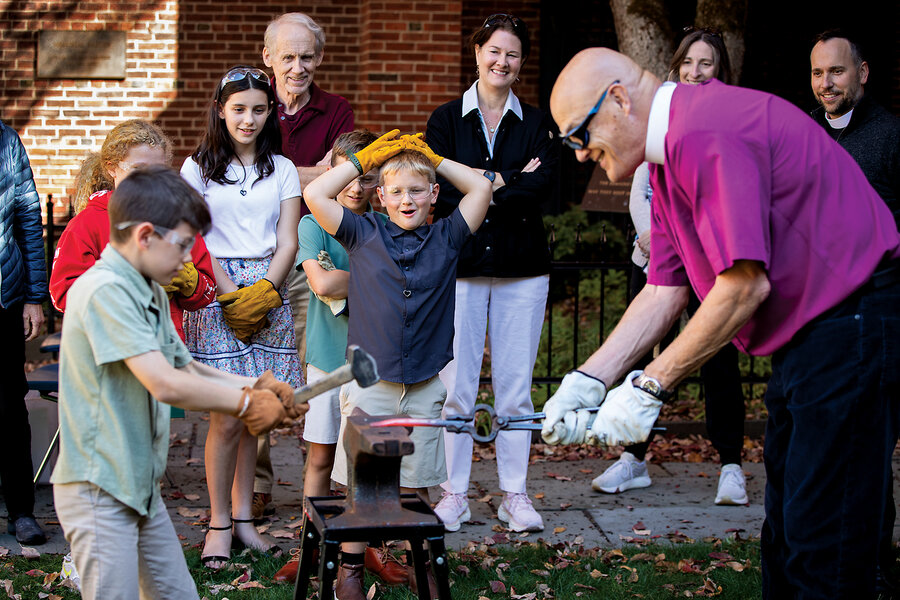
Photo: Melanie Stetson Freeman/Christian Science Monitor staff.
Retired Episcopal Suffragan Bishop Jim Curry, co-founder of the nonprofit Swords into Plowshares, gives a blacksmithing demonstration in Winchester, Mass. The nonprofit’s goal is to get guns off the streets and make young people enthusiastic about peaceful projects.

In a Providence park, there’s a sculpture made from illegal handguns. It’s kind of a depressing pillar to failure, unless you look at it as the removal of guns from circulation. It’s ambiguous, which I guess art is supposed to be.

Here’s a story about an effort to turn young people away from the gun culture of the streets.

Troy Aidan Sambajon writes at the Christian Science Monitor, “Retired Episcopal Suffragan Bishop Jim Curry ignites his propane forge in the courtyard of Parish of the Epiphany church. Slowly he heats the barrel of a dismantled rifle to 2,000 degrees Fahrenheit, and then starts hammering the red-hot metal on his anvil. In minutes, a piece of once-deadly weaponry transforms into a humble weeding tool. 

“Bishop Curry then invites onlookers to try their own hand at making garden tools from firearm parts, using the forge that he takes with him to various communities in the Northeast region. With each strike of the hammer, participants mold a hopeful vision of a future without gun violence.

“Before the demonstration, Bishop Curry gave a sermon explaining the mission of Swords to Plowshares (S2P) Northeast, a nonprofit that he co-founded a decade ago in New Haven, Connecticut. ‘At the forge, we hammer guns into gardening tools and art. We forge rings from shotgun barrels into hearts – symbolizing that the change we need begins in the transformation of our own hearts,’ he told parishioners.

“His work has inspired residents in Connecticut, New Hampshire, and Vermont to start their own independent S2P chapters, which host gun-surrender events in partnership with police departments. Law enforcement officials vet and dismantle the weapons, and then give the parts to the chapters for public blacksmithing demonstrations. Besides raising awareness about gun violence, the demonstrations help get young people interested in blacksmithing.

“Montrel Morrison, who runs a youth mentoring organization in Connecticut, calls S2P Northeast a ‘safe haven and beacon of hope.’ …

“Kam’eya Ingram, who spent the last two summers as a blacksmith with S2P Northeast, says that ‘when someone dies from gun violence, it’s like the world goes quiet.’ But for her, hammering on the anvil fills the silence with a resounding release of emotions. … ‘I feel like I’m bringing people peace – letting them know that one more gun is gone and that this [gun violence] might not happen to someone else.’

“Bishop Curry … studied religion at Amherst College. He graduated in 1970 and started his career working in public schools in Huntington, Massachusetts, as a middle and elementary schoolteacher for 10 years. Yet he longed to serve the spiritual needs of his community.

“That desire led him to the seminary in 1982, and, three years later, he was ordained as a deacon and priest in the Episcopal Diocese of Connecticut. He focused his ministry as a spiritual adviser, working in hospitals with families in Connecticut and addressing the devastating impacts of gun violence and suicide. By 2000, he was elected suffragan bishop of Connecticut. 

“His life ‘changed entirely,’ he says, in the wake of the December 2012 shooting at Sandy Hook Elementary School in Newtown, Connecticut. … Newtown was in his diocese. …

“In early 2013, he joined other Episcopal bishops in Washington, D.C., and helped found Bishops United Against Gun Violence. Through that group, he learned about the Guns to Gardens movement, a network of nonprofits that repurposes unwanted firearms into garden tools and artwork. …

“In 2014, he co-founded his chapter, S2P Northeast, with Pina Violano, a trauma nurse and nursing professor at Quinnipiac University. The group’s namesake peacebuilding mission comes from the Old Testament (Isaiah 2:4): ‘They shall beat their swords into plowshares, and their spears into pruning-hooks.’ …

“S2P Northeast has partnered with a Colorado organization called RAWtools on a nationwide gun-surrender program and, before the COVID-19 pandemic, taught blacksmithing skills to incarcerated people. …

“For Bishop Curry, ‘the real life of the forge’ has been to empower teens from New Haven through summer job opportunities. They are paid to transform guns through blacksmithing and help lead public demonstrations. …

“Jared Sanchez, age 18, takes pride in being a junior blacksmith instead of working a teenager’s typical mundane hustle. In a single day, he can make seven or eight garden tools out of shotgun barrels. He has also created a heart necklace for his younger sister and a cross to sit beside his grandfather’s urn. …

“After two summers serving as a blacksmith alongside Bishop Curry, Mr. Sanchez has come out of his shell and come into his own as a leader. Handling so many firearm parts has revealed to him the depth of the gun violence problem in his community and the work that must be done to combat it.”

More at the Monitor, here. No paywall. Nice pictures.

Read Full Post »

Photo: David Swanson/AFP/Getty Images.
The hillside along the Pacific Coast Highway burns in front of the driveway to the Getty Villa in the Pacific Palisades neighborhood in Los Angeles on Jan. 7.  

Planning, courage, and commitment saved California’s Getty Museum in the last big conflagration, but how long can it escape what few others did?

Kelsey Ables at the Washington Post explained how the famous art collection was protected in January.

“As wildfires ravaged greater Los Angeles … the J. Paul Getty Museum faced encroaching flames on two fronts. Blazes nearly surrounded the Getty Villa in Pacific Palisades, coming within six feet of its walls. Days later, ominous red clouds were visible from the Getty Center in Brentwood, hovering on the horizon like a warning.

“The fire at the Villa was the closest flames had ever come to either building. But through it all, the institution made no evacuation plans. On the most intense nights at each location, a team of more than a dozen people at the Villa and 28 at the Center waited it out, and the museums’ vaunted artworks — the ancient sculptures, the Gentileschis, the Manets and Monets — remained inside.

“This was no gamble, though. Those familiar with the Getty describe it as a place one would evacuate to, rather than from.

“With the fire about a mile away from the Center on Jan. 10, a security staff member suggested to J. Paul Getty Trust chief executive Katherine Fleming that she might want to leave. ‘I was thinking, “I actually feel really good here,” ‘ she said in an interview. ‘This feels like a very safe place to be.’

“That is by design. … As the fires have killed more than 20 and razed swaths of the Los Angeles region, the Getty — with its more than $8 billion endowment — has emerged as a beacon of fire preparedness as well as a symbol of the defenses that wealth can build.

“From its grounds to the museum’s core, the $1.3 billion Getty Center, which was designed by architect Richard Meier and opened in 1997, was built to resist flames. …

“High on a hilltop, the campus has sprawling plazas made of fire-resistant travertine imported from Italy. Open spaces surround imposing, elevated buildings that boast walls constructed from reinforced concrete or fire-protected steel. The roofs are covered with stone aggregate, which is fire-resistant. Inside, the buildings are equipped with special doors that prevent flames from traveling. Temperature and humidity are closely monitored during red-flag warnings.

“Outside, the grounds are routinely cleared; the plants, selected for their drought-resistant qualities, are pruned regularly to prevent them from becoming fuel. During a previous fire, the museum said: ‘There is no need to evacuate the art or archives, because they are already in the safest place possible.’

“ ‘It’s very much like a fortress,’ said [Todd Cronan, an L.A. native and art history professor at Emory University in Atlanta], who briefly lived at the Center as a fellow. …

“To Cronan, though, the Getty’s unassailable features say ‘more about privatization and their … endowment than anything else,’ he wrote [by email].

“While the Getty stresses that it does not hire private firefighters or seek special treatment, it maintains its own water tanks — including a 1 million gallon tank at the Center — year-round. …

“When the Villa emerged largely unscathed last week, the museum in a press release credited its own ‘extensive efforts to clear brush from the surrounding area,’ noting that it also stores water on-site and that the grounds were irrigated ahead of the blaze. …

“Fleming, the CEO, said they were confident in their preparations but described a nail-biting evening watching the fire move closer as 15 staff members remained on-site. … The next day, with staff unharmed and the Villa still standing, Fleming found a strange calm in the collections. The galleries were ‘cleaner than an operating room.’ “

More at the Post, here.

Update April 4, 2025. The Getty is selling bonds to raise money for more protection. Article here.

Read Full Post »

Photo: Alan Devall/Reuters.
A drone view shows volunteers with people affected by the Palisades wildfires, at a donation center in Arcadia, California, Jan. 12, 2025.

If you ever feel like your world is run by people without hearts, do what Mister Rogers’ mother advised when he was a little boy: “Look for the helpers.” As long as there are a few willing helpers, all things are possible.

Consider the volunteers in the recent California wildfires. At the Christian Science Monitor, Ali Martin wrote in January about people stepping up, even those whose lives had also been damaged.

The story started with a family’s pet goat. “Coco the goat is nestled in a soft bed between two cars in the parking lot of El Camino Real Charter High School on the western edge of Los Angeles’ San Fernando Valley. Other wildfire evacuation shelters wouldn’t allow the 10-year-old house goat to stay with her family – the animal shelters board pets on their own, in kennels – but breaking up wasn’t an option for her owner, Maji Anir. …

“She is quietly out of the way, is no bother, and offers a drop of levity in a sea of stress – most people who take notice stop to pet her, spirits lifted. Workers are letting her stay.

“Mr. Anir and his family had just two hours to evacuate as the fire approached their home in Malibu – not enough time to get everything they needed. They pulled away Tuesday evening as the sun was setting. By morning the house was gone, along with all of their neighbors’. …

“Even in this besieged region, ruin is bending toward resilience. And from the staff to random visitors and those sheltering, a common theme is kindness. …

“El Camino is a well-appointed charter school. … Classes for the school’s 3,500 students were scheduled to start back up in mid-January. Now, with the Palisades Fire burning out of control on the other side of a mountain ridge, the campus is a gathering place for those needing refuge – and the people volunteering to help.

“Kate Delos Reyes was supposed to be in a residential program for mental health treatment. The program in Santa Monica was canceled as fires swept through the nearby Pacific Palisades.

“She’s seen fires before, when she worked at a rehab center in another Southern California mountain range. Remembering that stress, she drove to the evacuation center at El Camino to lend whatever help they might need. ‘Kindness is free, you know.’ …

“Eddie Včelíková is fielding a stream of texts from her friends while she scrolls through social media. She is taking in photos of her childhood home in Altadena; St. Mark’s Episcopal Church, which she attended every Sunday; her schools – all of it destroyed.

“Altadena, an unincorporated town in northern LA County, welcomed Black homebuyers in the mid-1900s, when redlining kept them out of other neighborhoods. As the area developed along the southwestern base of the San Gabriel Mountains, so did the diversity of its middle-class bedrock. Last week, the Eaton fire, which is still burning, swept through much of the small community and leveled entire blocks.

“When she saw video of the burned-out park where she played every weekend as a child, Ms. Včelíková says she broke. She found her way to the shelter. ‘I’m just out here volunteering to stay busy because it’s the only thing I think that’ll keep me from going insane.’ …

“She’s tried to get back into her old neighborhood, but National Guard troops are blocking every route – protecting vacant homes from looting. On Sunday, she attended a virtual church service hosted by St. Mark’s. The church may be gone, but its spirit is not. …

“[Soon] not even the shelter itself is safe. The Kenneth Fire has broken out in late afternoon on a ridge overlooking this edge of the San Fernando Valley. … This refuge is shutting down. Most of the evacuees are heading 20 miles east to another shelter at the Westwood Recreation Center.

“Leslie and Megan Walsh are making space in their packed trunk for a small suitcase. They’ve just met a young woman who needs a ride to Westwood, and they’ve offered to take her.

“They’re from San Diego; they know what LA is going through. In 2003, fires swept through parts of their city, and they had to flee. Their neighborhood lost 300 homes. Now, with Megan living in LA, the family wanted to help however they could.

“Leslie and her daughter drove to LA with a car full of animal supplies – pet food and beds, mostly – to donate. But their first stop, a shelter in Agoura Hills, was evacuated, so they came here. Now this one’s evacuating. …

“The Walshes headed back to San Diego with their supplies. Over the next couple of days, Megan ran a donation drive among their San Diego neighbors. She and her parents returned to LA Sunday with a U-Haul truck and two more cars filled with clothing, toiletries, pet food, sleeping bags, air mattresses, and more. …

“Back at El Camino high school on Thursday, in the hours before the Kenneth Fire erupted, first responders had pulled into a corner parking lot to take a break and grab a meal. The shelter was overflowing with food donations, so school administrators redirected the potluck to feed firefighters and police officers.

“Administrative Director Jason Camp says the support for first responders was driven by an outpouring in the community. … He notes the number of people – emergency responders, volunteers, local officials – who are managing their own fears and losses from the widespread devastation. Nobody is untouched.

“Some people who are displaced or lost their homes want to be part of the solution and ‘to help somebody through the pain and maybe together they can get through it,’ he says. ‘It’s refreshing to see that not everything’s in total chaos. The heart is still there.’ ”

More at the Monitor, here.

Read Full Post »

Photo: Alfredo Sosa/CSM.
Police officers at a headquarters briefing before departing on assignment in Columbus, Ohio, Nov. 24, 2024.
Columbus is learning to deal with protest marches differently. And with more success.

As a country, the US is not exactly on the cutting edge when it comes to handling large protests. As Clifford Stott, professor of social psychology at Keele University in England and visiting professor at Ohio State, says, “Policing of crowds in America is about 20 years behind what it is in Europe.”

This is in spite of the fact that an American, Gene Sharp, practically wrote the book on peaceful protests. (See my post, here.) We seem to have an issue of learning, unlearning, and relearning.

In January, Simon Montlake wrote at the Christian Science Monitor about how the police in Columbus, Ohio, have been handling pro-Palestinian protests.

“At a pro-Palestinian street protest in Columbus, Ohio, last fall, demonstrators march to the rhythm of liberation chants, punctuated by occasional horns from passing cars. ‘Free, free Palestine,’ they cry, waving flags and banners.

“But mingling among the demonstrators are four uniformed police officers wearing powder-blue police vests emblazoned with ‘Columbus Police Dialogue.’ One of them is Sgt. Steve Dyer, the team leader of a special unit that talks with protesters rather than confronting them with riot gear.

“ ‘Their goal is to have their voices heard,’ Sergeant Dyer says. ‘We will walk and work with those who are there to peacefully protest.’ By walking with and talking to protesters, police hope to build legitimacy – a bridge of communication that could deescalate potential conflicts.

“This kind of policing stems from a more nuanced understanding of crowd dynamics, researchers say. It seeks to measure how officers’ words and deeds can steer participants toward peaceful self-expression.

“It appears the approach is working. Since October 2023, there have been more than 50 pro-Palestinian demonstrations with a total of about 13,000 protesters in Columbus. During this time, police made only three arrests, despite ‘significant public order challenges.’ …

“[At a recent event] Jineen Musa, a student leader wearing round, tortoiseshell glasses and a black hoodie, is holding a bullhorn to her lips. ‘Don’t talk to any cops, even the dialogue cops!’ she says. …

” ‘Some have already talked with officers who have radioed the information to Sgt. Steve Dyer, the dialogue unit’s team leader at the steps of the Statehouse.

“He learns they plan to march north behind a black pickup truck as they protest on one of the city’s main roads. Now Sergeant Dyer can alert the nine-officer bicycle patrol that will help direct traffic during the demonstration. The cruisers will follow the protesters. At the same time, the dialogue team will continue to mingle among the crowd.

“There are only a few units in the United States specially trained for this type of policing. Columbus police try to ensure that marchers are able to exercise their rights to free speech and assembly. At the same time, they use engagement and dialogue with an aim to maintain peace and order. …

“ ‘It’s been more of a one-way conversation in the past,’ says Robert Sagle, a deputy chief of police in Columbus who oversees the dialogue team. … Police officers are now trying to do more than issue warnings. Staying on the ground and walking with and talking to protesters, police hope to build legitimacy – a bridge of communication that could de-escalate potential conflicts. …

“As word has spread of what Columbus is doing, the department has begun to train police officers from other cities in crowd management. Last July, its dialogue officers worked outside the Republican National Convention in Milwaukee to help facilitate order and defuse tensions during protests. …

“Columbus is a case study into these kinds of reforms. Still, the violent responses of its police department during the racial justice protests of 2020 still hover over it. …

“As in many U.S. cities, the Columbus police were unprepared for the intensity and duration of the protests that followed. It was a destabilizing experience to try to maintain peace and order, many say, in a crowd directing its anger precisely at them. …

“ ‘The intensity of what happened in 2020 was nothing like anything I experienced as a police officer before,’ says Sgt. Kolin Straub, a Black officer who worked the front lines.

“Still, police responded aggressively, using rubber bullets, pepper spray, tear gas, and other violent tactics against protesters. … In July 2020, over 30 people filed a federal lawsuit against Columbus police, seeking damages for unnecessary brutality and violations of their constitutional rights. In December 2021, Columbus settled the lawsuit, paying out $5.75 million in damages. …

“In June 2021, Mayor Andrew Ginther, a Democrat who had clashed publicly with police leadership over the need for reform, appointed Elaine Bryant, a Black deputy chief from Detroit, to head the department.”

Read what happened next at the Monitor, here.

Read Full Post »

Photo: Lilian Carswell/USFWS.
Sea otter.

According to the state of Washington’s Fish and Wildlife department (WDFW) , the European green crab is a menace. That is something we’ve noticed in Rhode Island, where it’s pushing out the delicious blue claw crabs.

WDFW says, “The European green crab (Carcinus maenas) is a globally damaging invasive species that poses a threat to native shellfish, eelgrass, and estuary habitat critical for salmon and many other species.

“Potential impacts include destruction of eelgrass beds and estuarine marsh habitats, threats to the harvest of wild shellfish and the shellfish aquaculture industry, salmon and forage fish recovery, and a complex array of ecological impacts to food webs. Research is ongoing regarding potential impacts on juvenile Dungeness crab and crab fisheries.

“In areas where European green crabs have been able to establish large populations for extended periods of time, they have had dramatic impacts on other species, particularly smaller shore crabs, clams, and small oysters. While green crabs cannot crack the shell of a mature oyster, they can prey upon young oysters, and will dig down six inches to find clams to eat.

One green crab can consume 40 half-inch clams a day, as well as other crabs its own size.

“Their digging can have significant negative impacts on eelgrass, estuary and marsh habitats.”

But here’s a ray of hope.

Manuela López Restrepo reports at National Public Radio (NPR), “A new study has found that a restored sea otter population might be the solution. …

“As it turns out, sea otters — which are listed as threatened under the Endangered Species Act — love to eat these crabs. One estimate by researchers in California found that a group of otters in Elkhorn Slough consumed somewhere between 50,000-120,000 crabs a year.

“A new study, published in the Biological Invasions journal, found that there was a direct relationship between the two species: if an area had a healthy population of sea otters, it would also have a low green crab population.

“Yes, says ecologist Rikke Jeppesen, whose team at Elkhorn Slough Reserve on the California coast published the recent study.

” ‘It’s really a win-win scenario if we can support a native threatened species, the sea otter, which in turn then helps control an invasive invertebrate,’ Jeppesen told ‘All Things Considered.’ … ‘Sea otters are our assistant managers of the estuary for invasive species control.’

“What’s more, they’re biologically predisposed to eating a lot of crabs, she said.

” ‘Sea otters rely on fur for insulation as opposed to seals, which rely on blubber. Blubber insulates much better, so sea otters have to eat a lot to keep warm,’ she said. ‘It’s basically a weasel in the water. And weasels are super active. They have a high metabolism. So to sustain sea otter health and keep warm, they just need to eat a lot.’ “

More at NPR, here. An interview with the researcher is here. And a previous study in Nature showed similar results, here.

Read Full Post »

Photo: Gabriela Contreras González.
Saint Catherine of Alexandria, patroness of students, teachers, librarians, and lawyers.

Today’s post is about art restoration, a field that always seems brave to me. Imagine charging into some time-honored work and presuming to “fix” it! I guess a good restorer becomes the artist, too — perhaps in the way that a skilled translator of a literary work becomes a coauthor.

This month, with trepidation, my husband and I put a lovely Inuit watercolor into the hands of a conservator. Would she be able to remove all the mildew from life in a damp summer cottage? The results were nothing short of miraculous.

At Artnet, Min Chen writes about a larger work of conservation in Mexico.

“For decades, the interior of the Temple of Our Lady of the Assumption, a church in the town of Santa María Huiramangaro in Mexico, stood stark white, with blue accents. But the parish was not always so bare. A new restoration has revealed a host of resplendent 16th-century religious paintings that once spanned the ceiling of the historic church.

“The project, undertaken by participants including the Ministry of Culture of the Government of Mexico and the National Institute of Anthropology and History (INAH), dispatched a team of professionals to conserve the roof of the church. What they discovered instead were ancient images of saints and martyrs — hagiographic works rarely found in the Michoacán region — which had been painted over during the 1940s.

“The work, said Laura Elena Lelo de Larrea López, expert restorer at the INAH Michoacán Center, in a statement, ‘allowed us to recover an extraordinary work on the horizontal roof of the main altar, and to discover the rich artistic, technical and iconographic evolution that has marked this religious site.’

“The Temple of Our Lady of the Assumption was constructed in the early 16th century, when Santa María Huiramangaro was designated a district head, overseeing the communities of San Juan Tumbio, Zirahuén, and Ajuno. The building reflected the architectural styles of Mudéjar, which featured ornate motifs believed to have been originated by Muslim craftspeople in the 13th century, and Plateresque, a late-Gothic and early Renaissance aesthetic imported by the Franciscans.

“During restoration work, three pictorial layers of religious iconography were uncovered on the church’s ceiling. The oldest, from the 16th century, saw the use of tempera paint, which was applied in thin glazes to depict various characters corresponding to Saints Paul, Peter, Agatha of Cantania, and Catherine of Alexandria, as well as baby Jesus in Franciscan habit. The works were retouched with oil paints in the following century, adding volume and colors to the depicted figures’ clothing.

“When water ran dry in the region in the 17th century, the church fell largely into disrepair, as Santa María Huiramangaro lost its capital status. ‘The misfortune was a blessing in disguise, in terms of conservation,’ said Lelo de Larrea López, ‘since, not having the resources to renew its religious furnishings, the parish priests of the Temple of Santa María preserved its Plateresque ornaments. …

“Still, experts uncovered evidence of a restoration effort in the 20th century. Acrylic paints were deployed to touch up the faces of the saints. …

“During remodeling work in the 1940s, the iconography on the church’s roof was painted over in white, with blue designs. The repainting, noted Lelo de Larrea López, ’caused an alteration in the appearance of the place.’

“The latest conservation removed the repainted layer and restored missing portions of the paintings. Additionally, the ceiling was cleaned of dust and animal droppings, reinforced with joints and wood grafts, and fumigated to deter wood-eating insects. Other roof elements, such as corbels, partitions, and Franciscan cord carvings, were also given a refresh.

“The work marks the latest phase in a major restoration of the Temple of Our Lady of the Assumption, which began a decade ago with a focus on its main altarpiece. Despite a dismantling (undertaken to tackle a collapse in the church’s rear wall), conservators found the artifact in a well-preserved state. Over 2022 and 2023, they addressed damage to its cornices and carvings, and undid a repainting job to reveal its original gold leaf and polychrome.”

I admire the commitment it takes to work on projects of ten years or more like this. Have you ever had a piece of art restored?

More at Artnet, here.

Read Full Post »

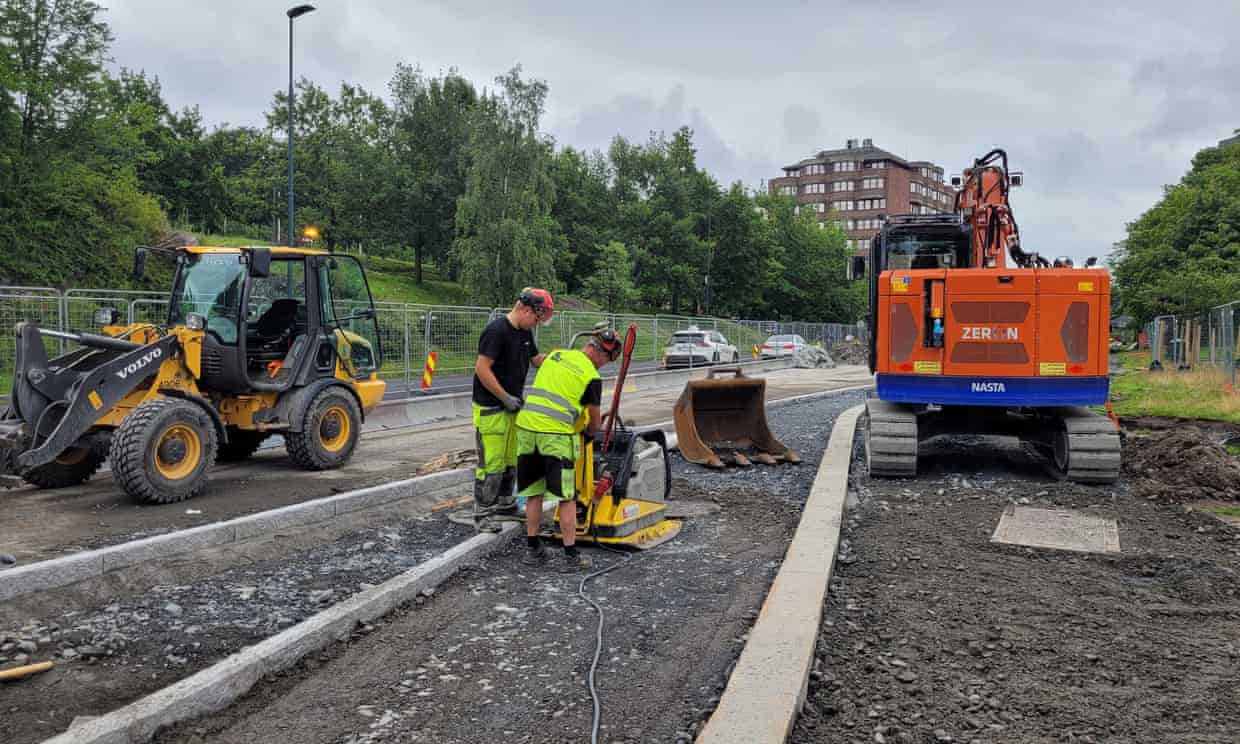
Photo: Ajit Niranjan/The Guardian.
The electric machinery at an emissions-free building site in Oslo, Norway, makes for quieter construction.

Whether we realize it or not, our noisy world is making us a little more jittery than we need to be. It’s not just the clangor and clash of big cities but near airports, hospitals with medivac helicopters, and construction sites.

Despite Norway’s reputation as one of the biggest oil producers, it is leading the way with electric vehicles, even at construction sites.

Ajit Niranjan has the story at the Guardian.

“Tafseer Ali felt no need to raise his voice as the pair of diggers lumbered past him, their treads weighing heavy on the rock and asphalt. Quiet electric machines like these make it easy to work in the city center, the construction manager said – and keep the neighbors happy. …

“The peaceful streets of Oslo are growing even calmer as the city drives noisy machines off municipal building sites. For locals and builders, the drop in decibels is a welcome side-effect of a goal to keep city-managed construction projects free from toxic emissions. The mandate, which is the first of its kind in the world, came into effect on 1 January.

“ ‘I don’t think we’re going to get to 100%, because not all [electric] machines are available on the market,’ said Ingrid Kiær Salmi, an engineer from Oslo’s urban environment agency, speaking to the Guardian at a building site in the city center last year. ‘But I think we’re going to get pretty close.’

“Construction is one of the biggest sources of urban air pollution, but even forward-thinking cities such as Oslo have struggled to clean it up. The Norwegian capital has led the way in replacing the petrol and diesel that powers its construction equipment with biofuels, which do little to heat the planet but still foul the local air. It is now moving to battery-powered machines.

“The latest data shows Oslo’s municipal building sites were 98% free from fossil fuels in 2023; three-quarters were powered by biofuels and less than one-quarter by electricity. For projects run by the urban environment agency, which has more recent data through to October 2024, two-thirds of machine hours were powered by electricity and one-third by biodiesel.

“The proportion of its projects powered by electricity has more than doubled in the past two years as new machines have come on to the market. …

“Electric vehicles are nothing new to Norwegians, who are more likely to drive a car with a big battery than one with a combustion engine, but the market for clean diggers [excavators] and wheel loaders still has a way to go. The building industry has pushed back on Oslo’s pioneering plans for moving too fast. …

“The requirement that all machinery on building sites must be emission-free is ‘at this point, neither effective nor cost-efficient,’ said Stine Marie Haugen, from the Norwegian construction and civil engineering contractors’ association.

“ ‘Currently, very few countries in Europe have a strong focus on emission-free machinery, which means that access to such equipment is somewhat limited,’ she said. ‘Only a few countries bear the development costs of bringing these machines to market.’

“But by taking on these costs, Norway and a handful of other countries are making clean machines cheaper and more attractive for cities around the world. Manufacturers say the early demand from procurement policies like Oslo’s has encouraged them to develop new electric machinery and make existing ones better.

“As the volume of vehicles increases, costs will come down – but ‘like with all new technology, there is a green premium,’ said Tora Leifland, the head of public affairs at Volvo Construction Equipment. A battery-powered machine can cost twice as much as a diesel one, she said, though it will save money on fuel and do little to inflate the overall costs of a construction project.

“There are also benefits that are harder to capture, such as quieter working conditions on-site and reduced disruptions to local communities and businesses.”

More details at the Guardian, here. No firewall. Contributions to support the Guardian‘s reliable journalism are solicited.

Read Full Post »

Above: In Chinese medicine, massaging different parts of the foot improves the health of body regions thought to correspond.

I’ve been interested in reflexology since 2007, when I ventured behind a Shanghai sandwich board that read “foot massage” and engaged with a young woman who spoke no English. It was a pretty aggressive massage, but I walked on air afterward.

Back in the States, I went to a place called Joyful Feet a couple times, and recently took a short class to learn about the philosophy. That class focused on hand massage, which was interesting but not the same.

Phil Daoust explored the topic of foot care, starting with pedicures, at the Guardian.

“I am in a south London nail bar,” he wrote, “reclining in a motorized armchair, mechanical fingers kneading my back while my feet soak in a little whirlpool bath. Someone has brought me coffee. …

“It has taken me 61 years to have my first-ever pedicure, and the moment I sat down all I could think was: ‘Why did it take me so long?’

“The next 40 minutes are bliss. … I leave Jolie Nails & Spa with a spring in my step, on feet that … well, no, you still wouldn’t call them beautiful – that will take several more sessions (and something to put a shine on my nails; I quite like the look of Boy de Chanel, probably in black) – but at least I’m no longer ashamed to show them to the world.

“This is not about getting beach-ready. … I have belatedly realised that if I want to make it to 100, I’ll have to take care of my feet. Unless I keep them strong, and flexible, and sensitive, more and more activities will slip out of reach. In the worst of all possible worlds, I will have a fall and end up in hospital. …

‘Our feet are literally the foundation for any movement we might make,’ the longevity guru Peter Attia reminds us in his book Outlive.

” ‘Whether we’re lifting something heavy, walking or running, climbing stairs, or standing waiting for a bus, we’re always channelling force through our feet.’

“They’re also crucial to balance. ‘They’re the feedback point for the brain to know where it is in its environment,’ says Asha Melanie, a York-based personal trainer with an interest in longevity. In their natural, unshod state, feet are our main point of contact with the earth. ‘There are hundreds of thousands of sensory receptors in each foot,’ Melanie says. ‘And then we put our clumpy shoes on and stop them from being able to feel anything.’

“More than that, I’d argue: we forget they should feel anything. We wrap them up and it’s out of sight, out of mind. … I’ve only really become aware of mine in the few months since I started yoga. There they were, naked, ugly and surprisingly unstable. Yoga teachers would tell me to spread my toes, or to ground ‘all four corners of my feet’ and I’d think ‘How?’ and ‘All four whats?‘ …

“This pedicure is my way of telling my feet: ‘I see you. I will do better by you.’ …

“Melanie says, now they’re fit for polite company, I must stop hiding them away. ‘Go barefoot as much as possible,’ she advises. … That doesn’t mean I should immediately chuck away my shoes, Melanie says, but I should try to transition towards something less chunky and cushioned, with plenty of room for the toes to spread and wriggle. ‘It has to be a gradual process, so that all your ligaments, tendons and joints can adapt.’

“But this is just the first step. Now I’ve freed my toes, I need to re-educate them, so I can spread them when I need a more stable base, or put my weight precisely where it’s needed. I could start by just splaying them out: simply standing or sitting in bare feet, then willing the toes to separate and spread a little. … I am embarrassed at how hard it is to isolate – or try to isolate – individual toes or groups of toes. … I struggle to move just the two biggies without taking everything with them. …

“How long will it take to make real progress, I ask Melanie. ‘How long is a piece of string?’ she says. ‘The more you put in, the more you’re going to get out of it. But doing a couple of minutes every day, you could see a difference in weeks.’

“I should also keep an eye on my big toes, where any weakness can lead to knee, hip and back pain. ‘It sounds ridiculous,’ Melanie admits, but when you’re walking this is where you push off, so problems here will affect the rest of your body. One way to build strength is to sit on a chair and lift your big toe as far as you can with your index and middle finger. Then, without moving any other muscles, press down with your toe while lifting with your fingers, so that nothing is moving yet both your toe and fingers are trying to. Hold for seven or eight seconds, relax and repeat four or five times.

“What else should be on my to-do list? Improving my ankle mobility, apparently. ‘Everyone should be doing ankle cars [controlled articular rotations],’ says Melanie. This is as simple as sitting down with one leg out in front of you, then keeping the leg immobile while slowly rotating the foot through its full range of motion, five times clockwise, then five times anti-clockwise, before repeating with the other leg.”

Much good advice on soles and arches, too, at the Guardian, here. No paywall.

Read Full Post »

Photos: Avedis Hadjian.
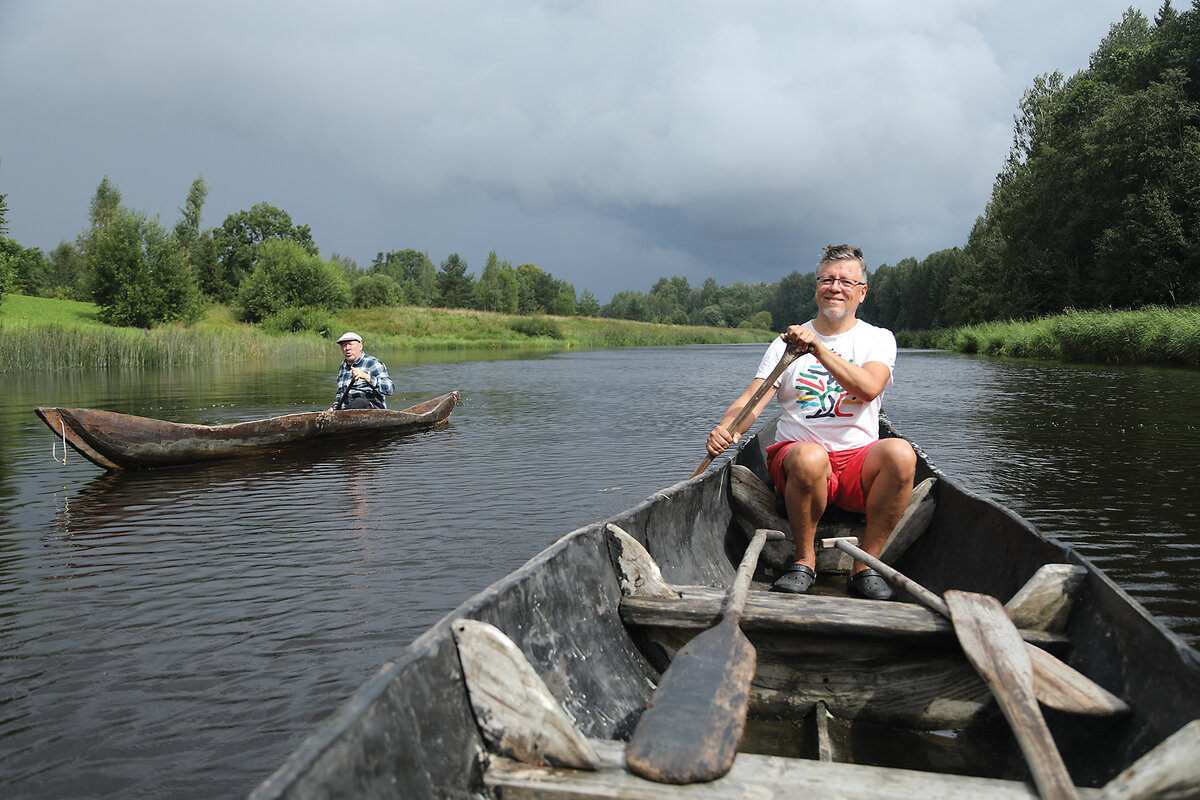
Estonian canoe maker Mr. Ruukel works on his latest dugout canoe outside his barn in Tohera.

Today I want to share a lovely photo essay from the Christian Science Monitor about a canoe maker in Estonia. Be sure to click through and see all the pictures at the Monitor.

Avedis Hadjian writes, “Aivar Ruukel is one of the last five masters in Estonia who make the Baltic country’s traditional dugout canoe, known as a haabjas. Until the 1960s, it was the conventional means of transportation in the Soomaa, or ‘land of bogs,’ region during the spring floods, locally called the fifth season.

“Mr. Ruukel and Priit-Kalev Parts, another haabjas maker, are the most vocal advocates for preserving the tradition, which is threatened by the making of fiberglass or other modern – often motorized – boats.

“Both Mr. Ruukel and Mr. Parts learned their craft from older masters in the early 1990s, shortly after Estonia gained its independence from the Soviet Union, and are now trying to engage the new generation, training young apprentices in haabjas building. …

“On a gray morning, Aivar Ruukel is scouting for the ideal aspen in the Soomaa, a vast wilderness area in southwestern Estonia. The aspen is the preferred tree for making [the] traditional dugout canoe – an art that is now endangered.

“ ‘The ideal tree should have the shape of a pencil, but every tree is perfect in its own way,’ even if only a few can be used to build the boat, says Mr. Ruukel.

“Some of the trees are covered with black canker, a fungal infection. ‘You can’t make a haabjas out of them, but they are used by woodpeckers to make their nests, so they serve a higher purpose,’ he says.

“Mr. Ruukel is one of the last five masters in the Baltic country who make the canoes. Until the 1960s, it was the conventional means of transportation in the Soomaa [during] the spring floods. …

“Both Mr. Ruukel and Mr. Parts [train] apprentices in haabjas building. A skillful wielding of the axe to hollow out the tree is only part of the required expertise and techniques, which also involve expanding the trunk by filling it with water and then hanging it above a carefully controlled fire.

“What was a necessary means of transportation in the past has now become an Estonian identity marker. In 2021, haabjas building was inscribed on UNESCO’s List of Intangible Cultural Heritage in Need of Urgent Safeguarding.”

More at the Monitor, here.

In the “search” box at this blog, you can find several posts about Estonia, a country that’s interesting in more ways than one. (For example here, here, and here.)

Mr. Ruukel (left) and Jari Hyvönen, his brother-in-law visiting from Finland, paddle in canoes on the Pärnu River.

Read Full Post »

Photo: Waterworld/City of Tea Tree Gully.
Chlorine cinema … Zootopia screens at the “dive-in” cinema at Waterworld Aquatic Centre in South Australia.

Back in the day, drive-in movies were a thing — watching a feature from your parked car, a box for the sound hooked inside, probably ordering food delivered to your window. There are not too many active drive-ins any more, but in Australia, “dive-ins” (you read that right) are a cherished tradition showing no signs of being mothballed.

Chris Baker writes at the Guardian, “Imagine you’re lying on an inflatable [raft], fingers and toes dangling in warm, rippling water. It’s almost dusk and the early evening calm is shattered by a piercing scream. Suddenly a great white shark appears, mouth agape with enormous, monstrous teeth. Nearby swimmers who were quietly chatting a moment ago are now flailing in terror.

“You’re at Aquamoves pool in Shepparton, central Victoria, watching Jaws while paddling in the pool at their dive-in movie night.

“Dive-ins are a time-honoured tradition in landlocked Australia, where residents can’t easily access what much of the nation takes for granted on a hot summer day: proximity to the coast or an air-conditioned cinema. …For a little more than the price of a regular swim, locals get to watch a movie on a screen next to the pool while they splash, bob or float. …

“Often, as in Shepparton, the film screened has some connection to the sea, water or swimming. Think Penguins of Madagascar, Finding Dory or Moana.

“My first experience of a dive-in was as an adult at Mount Druitt in western Sydney during the January school holidays. I had scheduled an evening catch-up with old friends in the area, and their kids had insisted we go to the local pool. As night fell, Lightyear, an origin myth of the Buzz Lightyear character from the Toy Story franchise, was projected on to a large screen. …

“The kids’ excitement, like mine, was apportioned between the pool and Lightyear, and we applauded wildly with pruny fingers as the credits rolled.

“Dive-ins harness many of the best things about Australian summers: balmy evenings, the relief of a refreshing dip, and the novelty (for children) of being able to stay up later than normal because it’s school holidays. …

“Many Australians who experienced dive-ins as kids carry nostalgic memories into adulthood. Thirty-something Angus Roth grew up in Canberra and was a regular at the Big Splash water park dive-ins in the early 90s. He continued the tradition by taking his two kids to wet screenings. He associates some of his favorite Pixar movies with ‘the smell of chlorine’ and says he ‘loved the free-range nature of the evenings where the usual rules of “sit down and be quiet” didn’t apply.’

“A hint of anarchy pervades the best dive-in experiences. The managers of Aquamoves pool in Shepparton recognized this and showed terrifying genius in programming Jaws to a floating audience in 2019. It was such a hit that swimmers plunged back into shark-infested cinematic waters a year later to see Blake Lively pursued by a great white in The Shallows.

“Bikash Randhawa, the chief operating officer at Village Roadshow Theme Parks, agrees the best dive-in evenings combine fun with a sense of occasion. At the Wet’n’Wild water park in Oxenford in Queensland’s Gold Coast, the park’s ‘giant wave pool transforms into a floating cinema featuring a 45 meter [~148 foot] squared screen.’ …

“Dive-ins are also a much-loved institution at Waterworld Aquatic Centre in Ridgehaven, South Australia. They host one screening in January and another in February, often with a theme. When Barbie screenedkids and grownups donned hot pink bathers and lurid accessories to channel their inner Barbie and Ken, while their ‘Splash for a cure’ dive-in for The Incredibles brought staff and patrons out in spandex and capes to raise funds for the Leukemia Foundation. …

“Dive-in sessions don’t always end when summer nights are over. The University of Newcastle’s Students Association holds a free winter dive-in July at the heated pool at its Callaghan campus as part of its midyear welcome back week. …

“Not to be outdone, Griffith University in Queensland presents its dive-in at the Mount Gravatt campus at the start of the academic year. A giant inflatable screen commands pride of place; popcorn, fairy floss and snow cones are on the house, and students are encouraged to come in costume. …. Psychology student Abbie Chen says “watching a Hunger Games movie in a floating inflatable doughnut was fun and pretty surreal, and the silliness of the evening brings people together”.

“For Jen Curtis, a farmer who lives in Victoria’s central highlands wine country, a movie at the local pool brings respite from the summer heat and is a welcome distraction from physical labor. But more importantly, she says: ‘It’s about connection, making our own fun, and looking after each other.’ ”

More at the Guardian, here. Np paywall. Fun pictures.

Read Full Post »

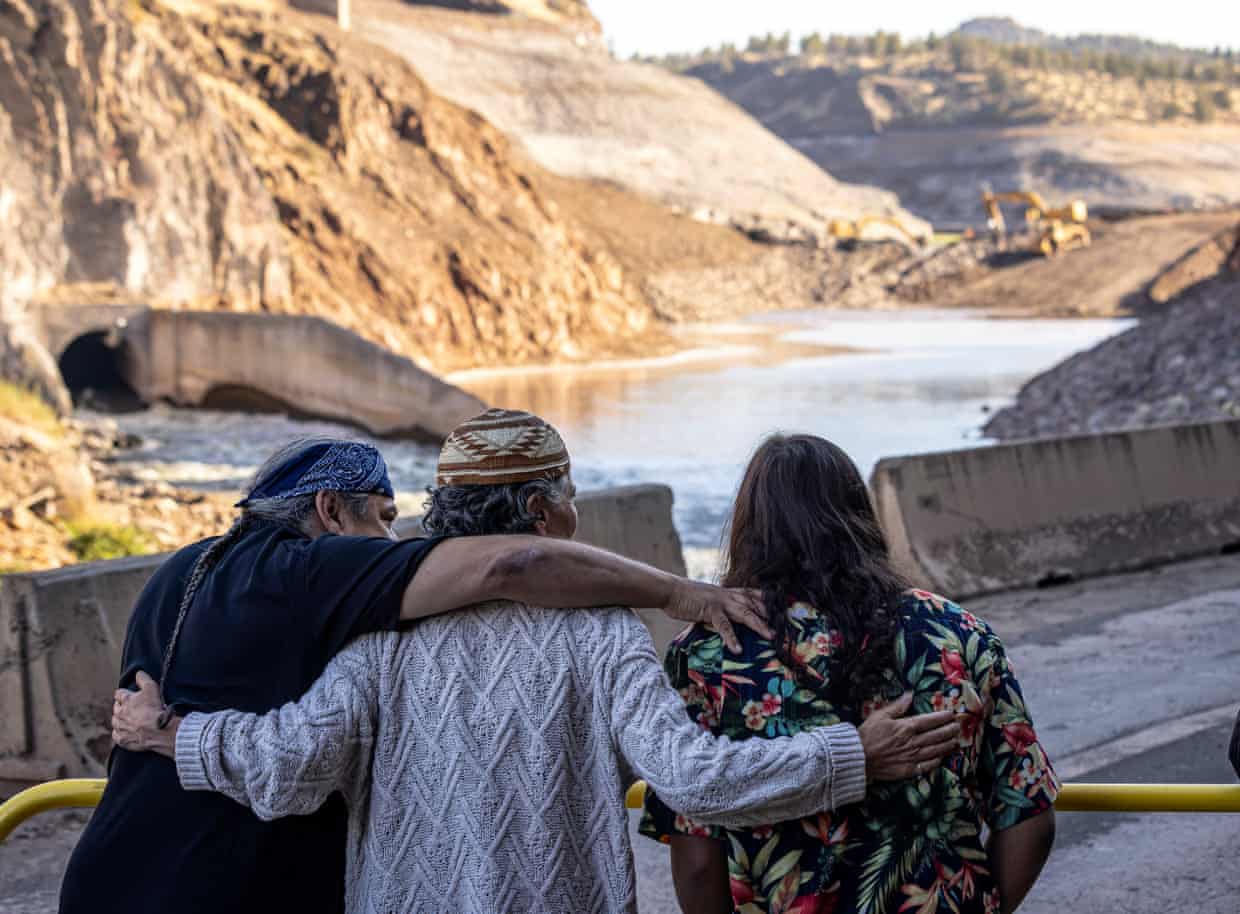
Photo: San Francisco Chronicle/Hearst Newspapers/Getty Images.
Leaf, Lisa and Chaas Hillman look on as construction crews allow the Klamath River to run freely for the first time in nearly a century, near Hornbrook, California, in August. 

Everything done to Nature for human convenience has a downside. We have dammed up many rivers over the years for water reservoirs and electricity, flooding whole ecosystems. In the last couple of decades, though, we’ve been trying our best to restore what was lost, often with the guidance of indigenous tribes that always knew better.

Gabrielle Canon has one story at the Guardian.

“Explosions roared through the canyons lining the Klamath River [in 2024], signaling a new chapter for the region that hugs the Oregon-California border. In October, the removal of four hydroelectric dams built on the river was completed – the largest project of its kind in US history.

“The blast of the final dam was just the beginning. The work to restore the river, which winds 263 miles (423km) from the volcanic Cascade mountain range in Oregon to the Pacific coast in northern California, is now under way. …

” ‘It has been more successful than we ever imagined,’ said Ren Brownell, the spokesperson for the Klamath River Renewal Corporation, a nonprofit created to oversee and implement the removal. …

“The Klamath River was once an ecological powerhouse – the third-largest salmon-producing river in the American west. Its basin covered more than 9.4m acres (3.8m hectares) and its network of wetlands was the largest in the region. The ecosystem was home to millions of migrating birds. Tribes, including the Hoopa, Karuk, Klamath, Modoc and Yurok, thrived in this bountiful and beautiful watershed for thousands of years, with the river providing both sustenance and ritual.

“Over the last hundred years, these landscapes have been drastically altered.

“After the first dam began operating in 1918 – one of four that would eventually be forged in the lower Klamath to provide hydroelectric power to communities nearby – the course of the river was changed. The dams obstructed the migration of salmon and other native species, which help carry nutrients into the systems from the ocean, to cascading effects.

“They also held on to huge stores of sediment that would otherwise have flowed downriver, and created shallow reservoirs that quickly heated when the weather warmed. Increased water temperatures in the river allowed toxic algal blooms to thrive.

“In recent decades, the climate crisis has turned up the dial, deepening droughts and fueling a rise in catastrophic fire as the region grows ever hotter. The impacts only increased as more water was diverted to support the farming and ranching in the region, and more habitat was altered by mining and logging.

“Twenty-eight types of salmon and steelhead trout, seen as indicator species that represent the health of the ecosystems they live in, have been listed as threatened or endangered.

“As the Klamath ecosystem deteriorated, there was growing recognition that removing the dams would be a crucial first step in helping the region recover and build resilience in a warming world.

“But, faced with a strong resistance to change in local communities tucked around the reservoirs and a long history of difficult battles over water in the parched landscapes in the west, dam removal seemed all but impossible. The land for the dams was taken from tribes during the throes of colonization and development and more recently supported energy corporations that had shareholders to answer to.

“Then, in 2002, disaster struck. Algae flourished in the shallow warming waters that year, exacerbated by the dams and decisions from the US Bureau of Reclamation to divert vital flows to farms, leaving little for fish. The event killed 70,000 salmon and thousands of other species, resulting in one of the worst die-offs ever to occur in the US.

“The layers of fish floating belly-up sent an important signal of the horrors that could continue into the future if the dams remained. Forming a coalition, tribes up and down the Klamath launched a fierce campaign to educate the public, inform the shareholders of the companies that owned and operated the dams, and petition their boards. They protested and attended public hearings, and engaged with state and federal officials.

“It took decades of advocacy to convince PacifiCorp, a subsidiary of Berkshire Hathaway Energy, to let go of the aging infrastructure straddling the Oregon-California border. But in the mid-aughts, assured by shifts in public opinion and incentivized by the steep costs to relicense the dams, the company agreed it was time to see them go.

“In November 2020, nearly 20 years after the die-off, an agreement was forged between a long list of stakeholders that included tribal and state governments and federal agencies. The Klamath River Renewal Corporation was created to oversee and implement the removal.

“The organization had to help bring residents near the reservoirs onboard, navigate dozens of species-management plans, and model how outdoor-recreation enthusiasts could continue to enjoy the river. Ranchers and fishers, environmentalists and farmers, and locals and visitors all had connections to the basin, and were eager to weigh in. …

“Brownell, who grew up along the riverbanks, was standing in the canyon as the blast of the first dam released flows and the river that had been held over the last hundred years found its way back to itself. …

“There were moments of trauma along the way. Over the 100 years the dams were standing, they had held back 15m cubic yards of sediment. When the dams were removed, the heavy dead organic matter had to run downriver, soaking up oxygen in the water. Extensive modeling had predicted a severe impact on aquatic life, but no one knew how bad it would get or how long it would take for the river to regain its health. Some models predicted the suffocating conditions could linger for up to a month.

“ ‘I was braced and prepared but it was still tremendously hard,’ said Brownell, recalling how the water, rid of oxygen, looked like oil as it cascaded through its banks. ‘You can easily compare a river’s health to an individual’s health,’ she said. ‘Often when someone is sick, they are going to get worse before they get better. … The whole time everyone was so excited because it felt like the start of something – I just felt sick,’ she said.

“Leaf Hillman, a Karuk tribal ceremonial leader who has dedicated decades to seeing this project come to fruition, helped keep hopes high with assurances that these were signs of healing.

“ ‘For me it was beautiful,’ he said, recalling how he felt even when the rushing waters became clouded by silt. ‘I could envision what it was going to look like – a restored river.’

“In the end, the river lacked oxygen for only two 24-hour periods, a far shorter time than scientists had feared.”

At the Guardian, here, you can read what happened next. No paywall.

Read Full Post »

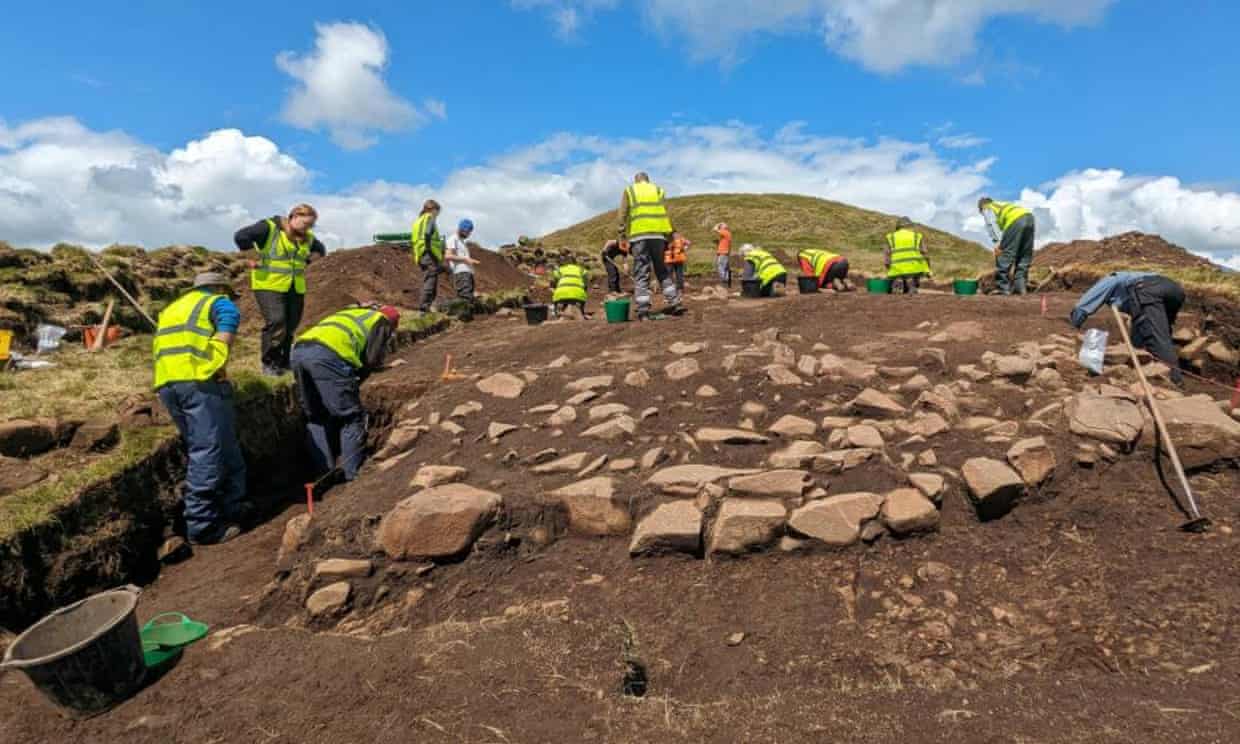
Photo: Gordon Noble, University of Aberdeen.
The community archaeological dig at the East Lomond hillfort site. 

Did you ever want to be an archaeologist? I think there was a period in childhood that it interested me, encouraged by gifts of picture books about the discovery of Knossos in Crete. But then I moved off in other directions.

Perhaps you had that experience, too, always wondering what it would have been like. Today there are opportunities to get a taste of that world as a volunteer.

Libby Brooks writes at the Guardian about the thrill of being a citizen archaeologist in Scotland.

“They were moving forward in a line across the 10 sq metre [~108 square foot] trench, volunteer excavators elbow to elbow with academics, and Joe Fitzpatrick was at the far edge.

“He was digging around the hearth of a building, about 60cm (2ft) below surface level, when he hit the earth twice with his mattock and out it popped – a rare bronze spear butt, a metal fitting placed over the end of a wooden shaft to counterbalance the spear head. Covered in Pictish inscriptions, it had remained buried for more than one and a half millennia, and was one of the most groundbreaking archaeological discoveries of 2024 in Scotland.

‘The hair stands up on the back of your neck and you tingle,’ says Fitzpatrick, of the moment he realized the significance of the find. ‘It is special.’

“Fitzpatrick, who has always had a passion for history, got involved with the regular community dig at the site of the East Lomond hillfort, beside the village of Falkland in Fife, as a retirement activity.

“He was working next to Prof Gordon Noble, the head of archaeology at the University of Aberdeen, who was leading the dig: ‘We just looked at each other,’ Fitzpatrick recalls. ‘Two men with their jaws hanging open, dumbfounded.’

“He helped unearth the artifact in July, during excavations organized by the Falkland Stewardship Trust and the University of Aberdeen, which bring together members of the public and students to help uncover settlement remains dating from around the second or third century AD to around AD700.

“He is one of a growing legion of citizen archaeologists, eager volunteers who are sustaining projects across the country even as volunteering more generally is in decline.

“Fitzpatrick says: ‘A lot of people who retire are more aware of keeping active and outdoors, but we also have young people working out what to do after their studies, and the media has broadened archaeology’s appeal with programs like ‘Time Team’ and ‘Digging for Britain’ – it’s not just Oxford dons doing it.’

“An ‘exceptionally rare’ find like the spear butt boosts team morale … says Noble. ‘Community involvement has really ramped up in the past 10 years,’ he says. ‘There’s the excitement of uncovering the past on your doorstep. These volunteers come from all walks of life.’ …

“Although Volunteer Scotland has warned that last year’s Scottish Household Survey results ‘point to a crisis in volunteering,’ for those participating in culture and heritage the numbers remain constant, compared with a drop of four percentage points elsewhere.

“Jeff Sanders, the head of outreach for the Society of Antiquaries of Scotland, says the cost of living crisis has affected individuals and their ability to participate, but also organizations and their capacity to put things on for volunteers. …

“As well as funding challenges, Sanders says there is a push to diversify volunteering – volunteers are often retirees with more disposable income. Sanders also works on the Make Your Mark campaign, which worked with the Scottish Refugee Council over the summer to co-design archaeology taster sessions to attract people who wouldn’t ordinarily get involved in volunteering.

“This ‘continuing upward trend’ in community involvement has prompted Emily Johnston to chart the citizen archaeologist phenomenon as part of her doctoral research at the University of Edinburgh. She has launched a database of community archaeology activities across Scotland, Outreach in Scottish Archaeology (OScA). …

“Says Johnston, ‘A lot of volunteers have been really interested in archaeology from a young age. It’s about creating a tie to your past and gives people a sense of identity.’ “

I love the idea of “taster sessions” for volunteers — in any field. I imagine more people would take on gigs if they knew there was no embarrassment about dropping out. They would keep trying things until they found the right opportunity for them. I tried volunteering with many ESL [English as a
Second Language] organizations until I found the right fit.

More at the Guardian, here.

Read Full Post »

Photo: Reuters.
The Monreale cathedral was declared a Unesco World Heritage Site in 2015, and has recently undergone extensive restoration.

Some organized religions eschew signs of wealth and pomp. For others, such things emphasize the value they put on their faith. I always like hearing about the individual stonemasons who gave their heart and soul to carving small corners of the great cathedrals, but I have mixed feelings about covering churches in gold, however beautiful. I was not part of the fundraising for my church’s dome, which one member paid to gild, covering the sky-blue paint.

All to say that an extraordinary amount of gold is now drawing tourists to a cathedral in Sicily, a UNESCO World Heritage site.

The BBC’s Sara Monetta writes, “On a hill overlooking the city of Palermo, in Sicily, sits a lesser-known gem of Italian art: the cathedral of Monreale. Built in the 12th century under Norman rule, it boasts Italy’s largest Byzantine-style mosaics, second in the world only to those of Hagia Sophia in Istanbul.

“Now, this Unesco World Heritage site has undergone an extensive restoration to bring it back to its former glory. The Monreale mosaics were meant to impress, humble and inspire the visitor who walked down the central nave, following the fashion of Constantinople, the capital of the surviving Roman empire in the east.

“They span over [69,000 square feet] and contain about [4.6 pounds] of solid gold. …

“Local experts from the Italian Ministry of Culture led a series of interventions, starting with the removal of a thick layer of dust that had accumulated on the mosaics over the years. Then they repaired some of the tiles that had lost their enamel and gold leaf, making them look like black spots from down below. Finally, they intervened in the areas where the tiles were peeling off the wall and secured them.

“Working on the mosaics was a challenge and a big responsibility, says Father Nicola Gaglio. He has been a priest here for 17 years and has followed the restoration closely, not unlike an apprehensive dad.

” ‘The team approached this work almost on their tiptoes,’ he tells me. ‘At times, there were some unforeseen issues and they had to pause the operations while they found a solution. For example, when they got to the ceiling, they realized that in the past it had been covered with a layer of varnish that had turned yellowish. They had to peel it off, quite literally, like cling film.’

“The mosaics were last partly restored in 1978 , but this time the intervention had a much wider scope and it included replacing the old lighting system.

” ‘There was a very old system. The light was low, the energy costs were through the roof and in no way it made justice to the beauty of the mosaics,’ says Matteo Cundari. He’s the Country Manager of Zumtobel, the firm that was tasked with installing the new lights. …

“I ask Fr Gaglio what it was like to see the scaffolding finally come off and the mosaics shine in their new light. He laughs and shrugs.

” ‘When you see it, you’re overwhelmed with awe and you can’t really think of anything. It’s pure beauty,’ he says. ‘It’s a responsibility to be the keeper of such world heritage. This world needs beauty, because it reminds us of what’s good in humanity, of what it means to be men and women.’ “

More at the BBC, here. No firewall.

Read Full Post »

« Newer Posts - Older Posts »