Although most of the country will celebrate the beginning of the American Revolution in 2026, the anniversary of the signing of the Declaration of Independence, in my town the big event is 2025 — 250 years after farmers with muskets confronted British soldiers at the North Bridge.
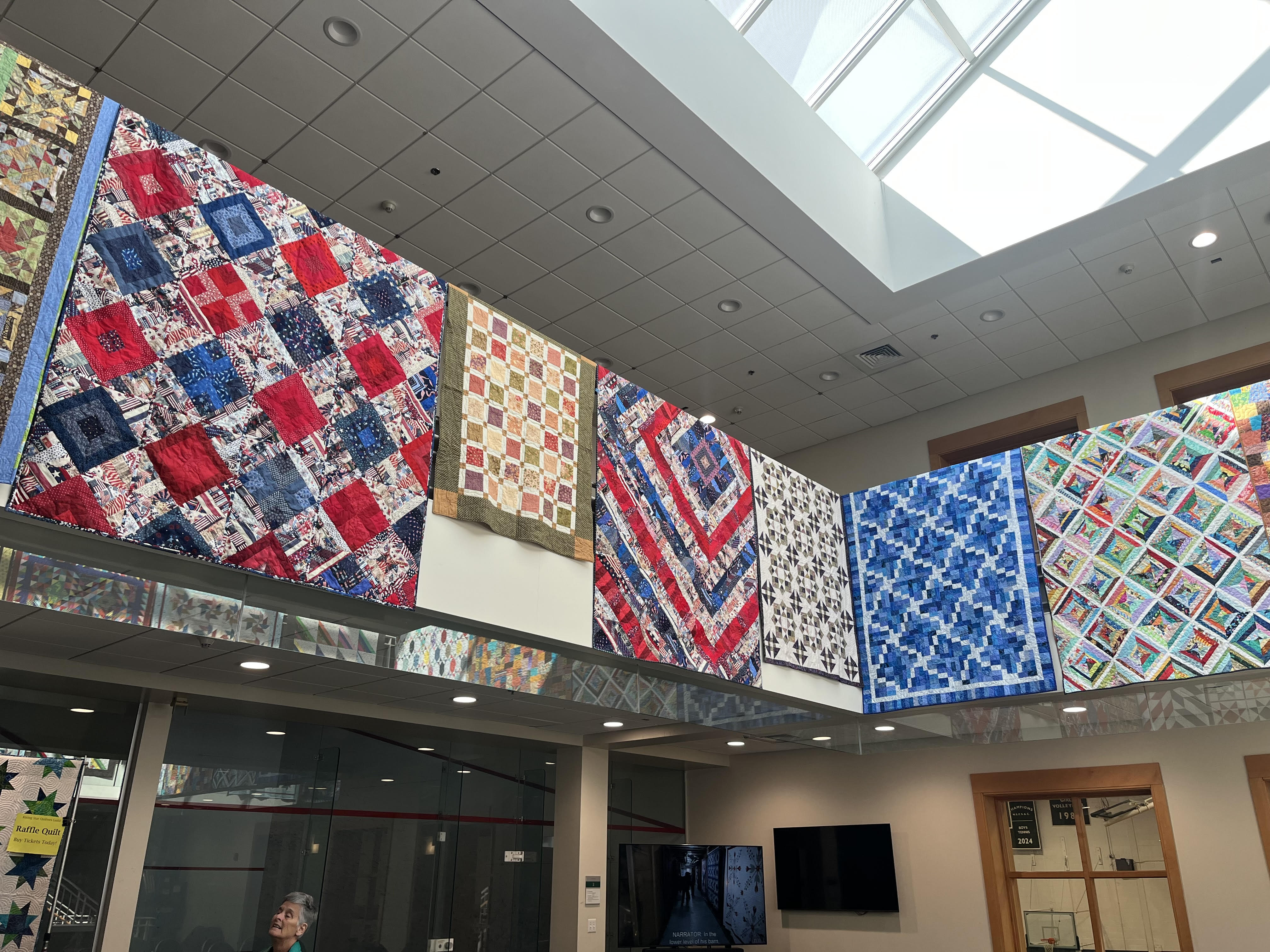
All New England calls it Patriots Day, and this year it will be more like Patriots Month. We started early with activities, and I took some pictures at the quilt show.
I couldn’t study every quilt as there were too many, but I’ll explain why these caught my eye.
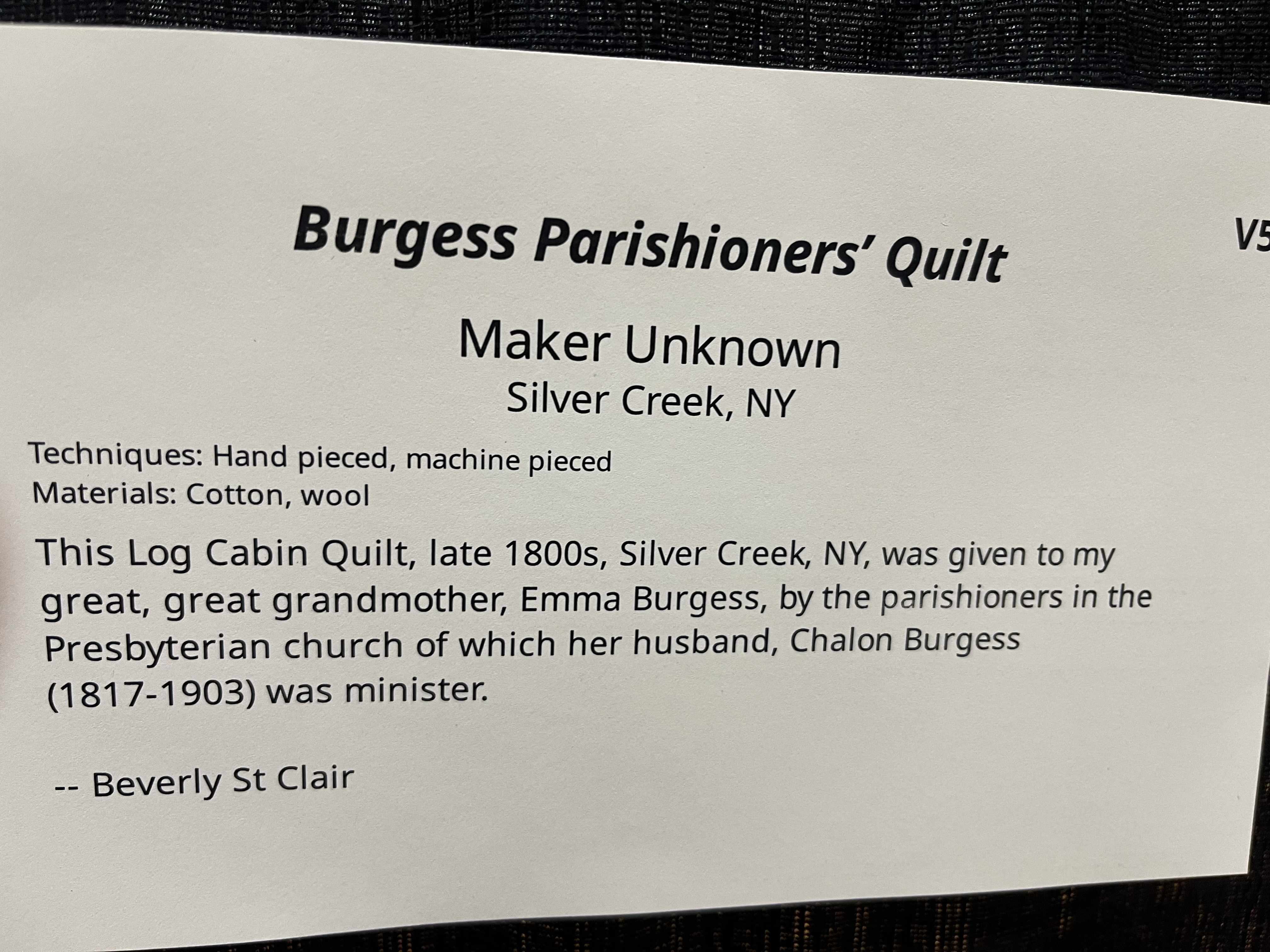
The first, a traditional log cabin style, I thought was in amazing condition to have lasted from the late 1800s.
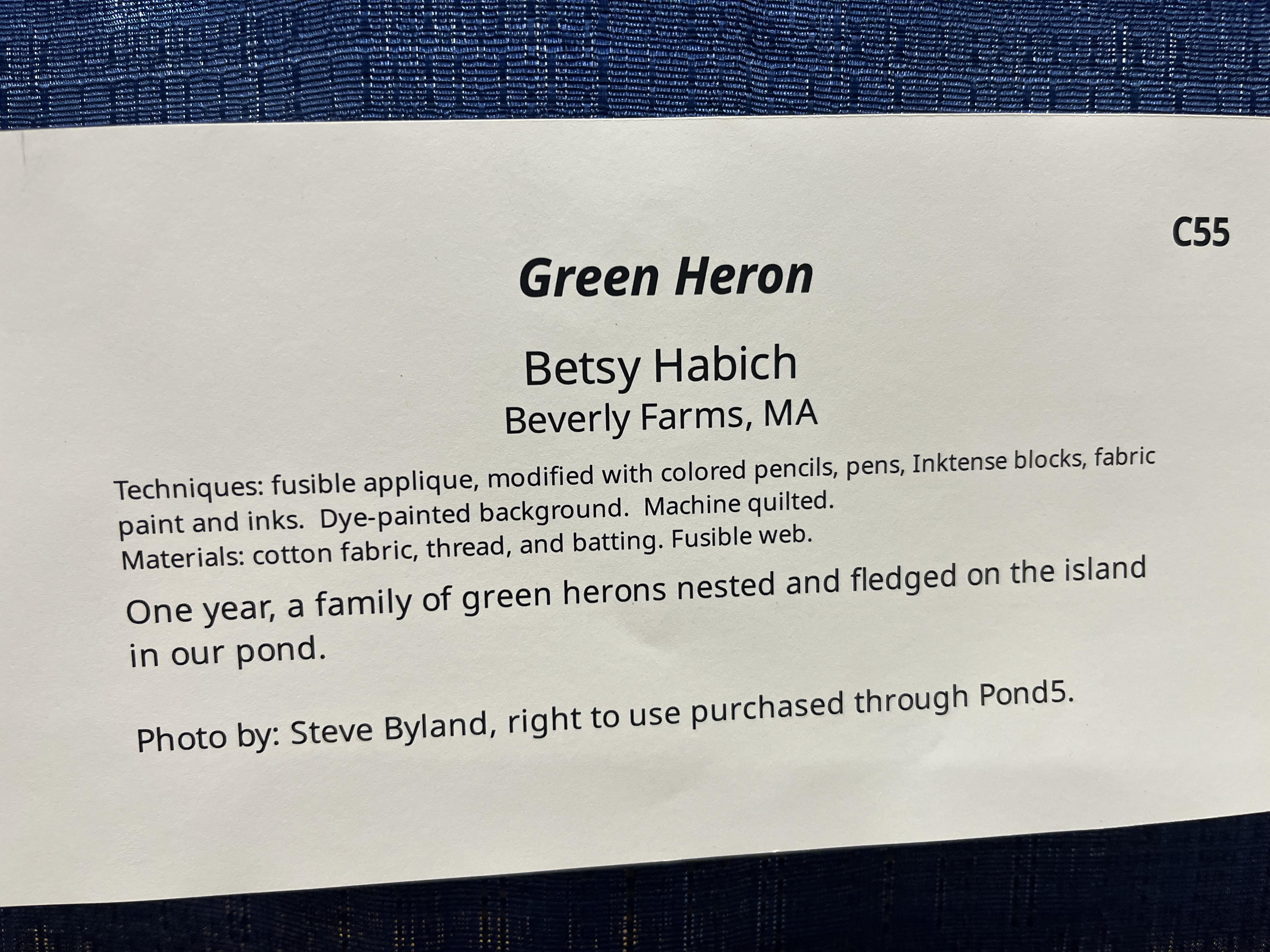
I photographed the green heron because I love herons and I liked this realistic one.
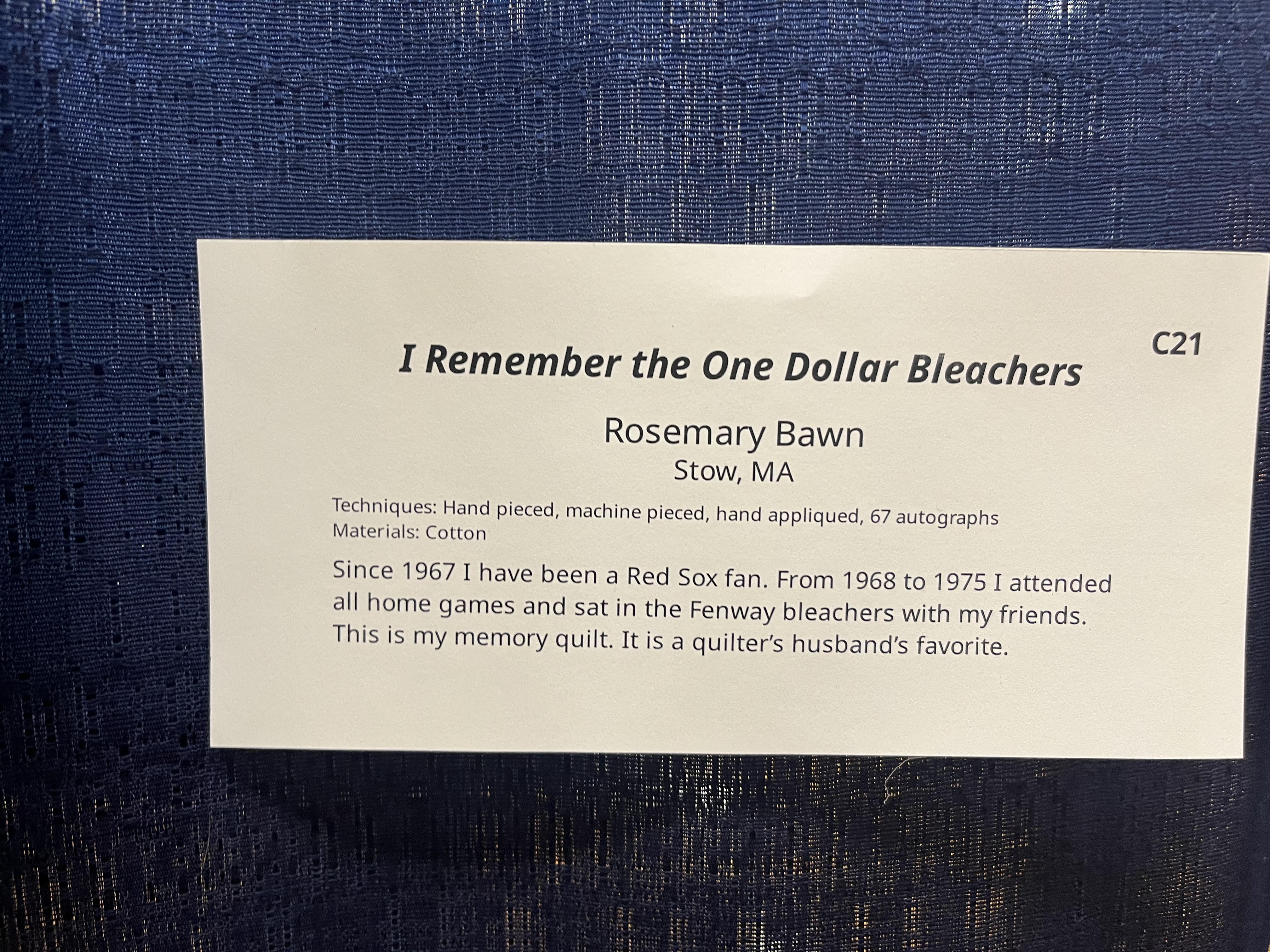
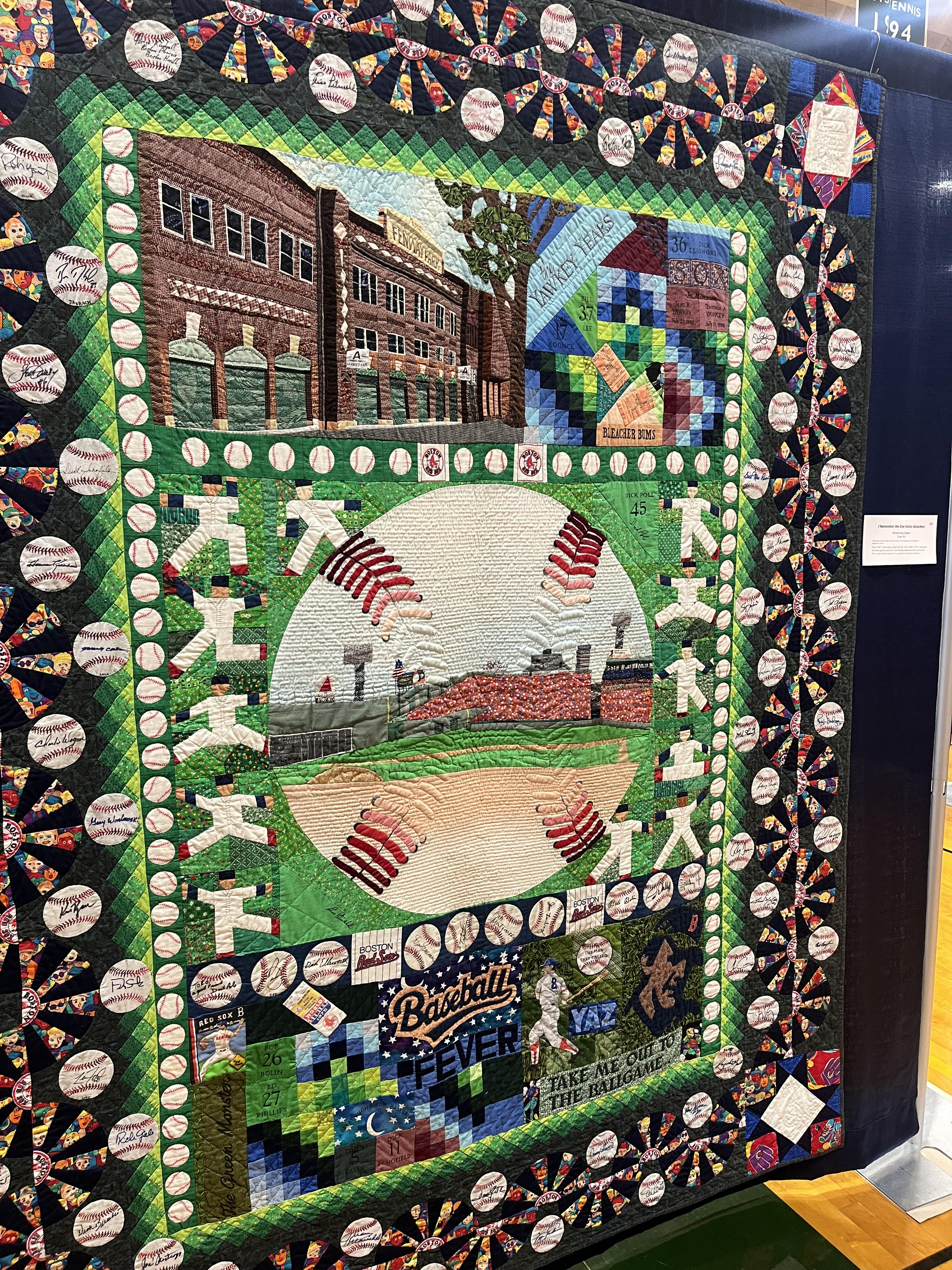
Contemporary New England cherishes its baseball team, the Red Sox, and Fenway Park, where the Sox play. Rosemary Brown, of Stow, went to town on that.
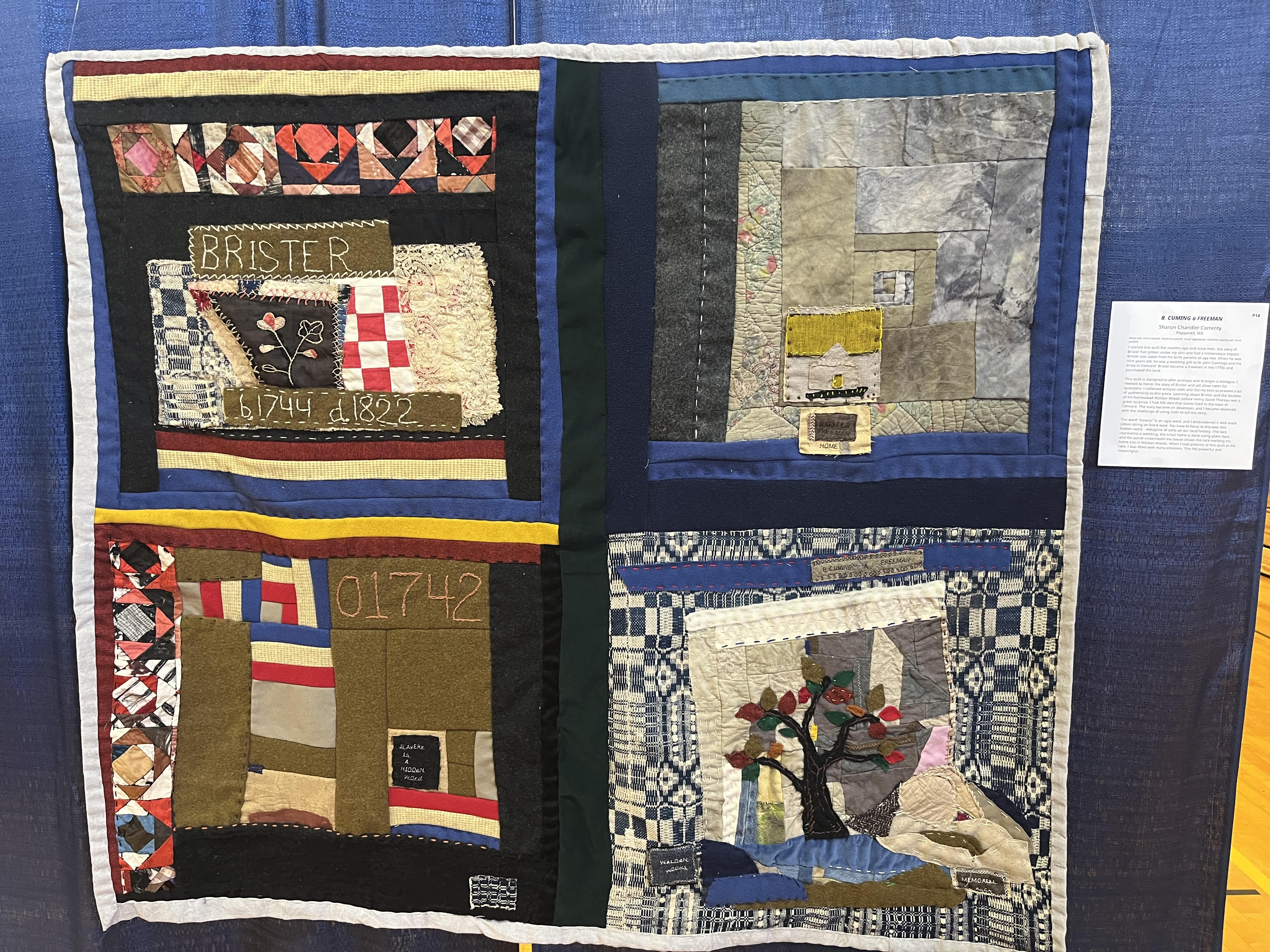
Until recently most Concordians didn’t realize there had once been slaves in our holier-than-thou town. In fact, I’m told, some slaves kept the farms going as the farmers took up their muskets. Brister Freeman is one we’ve been learning more about in recent years. He eventually gained his freedom, and he has an area of town named after him. Sharon Chandler Correnty explains her quilt below.
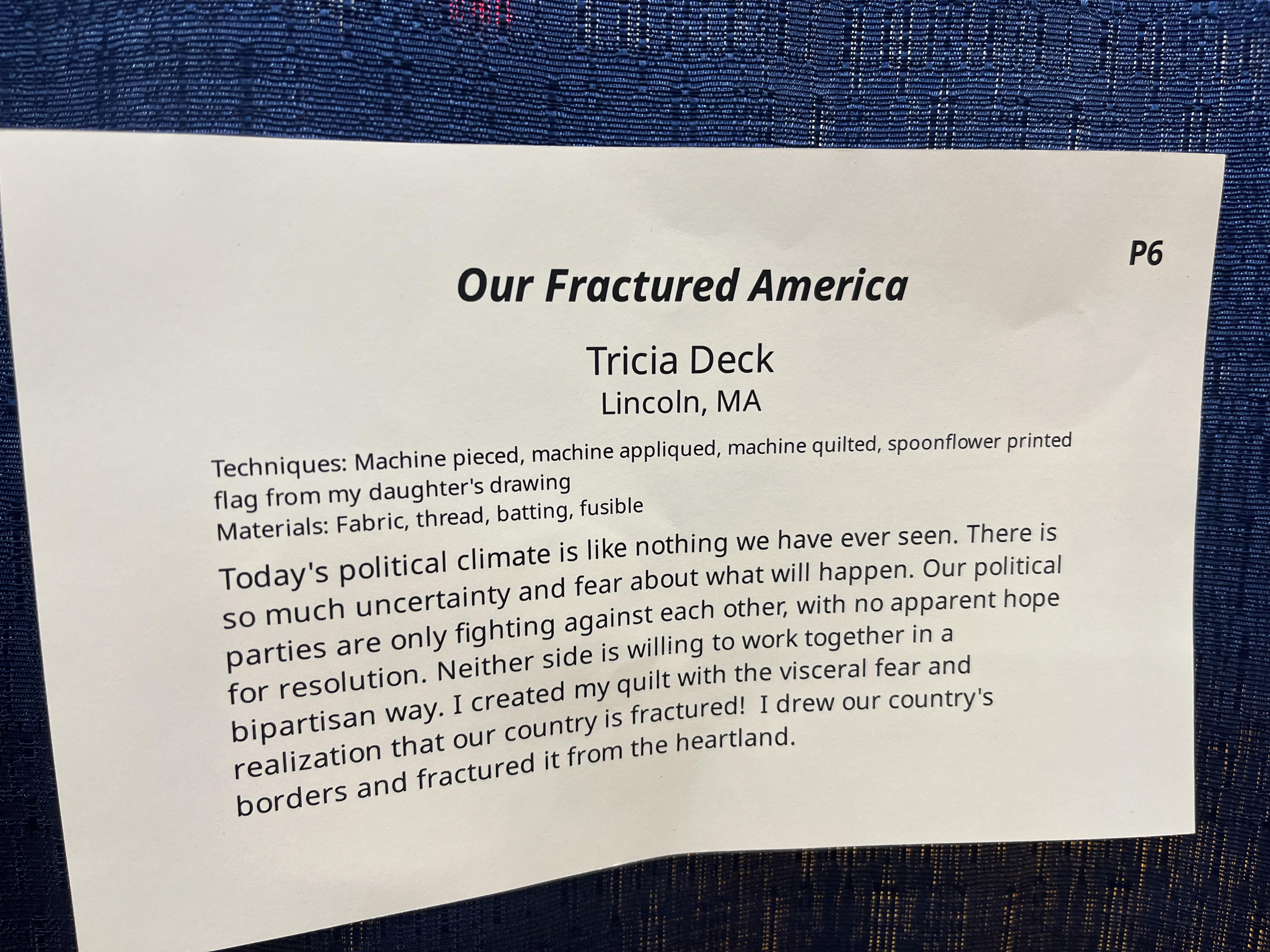
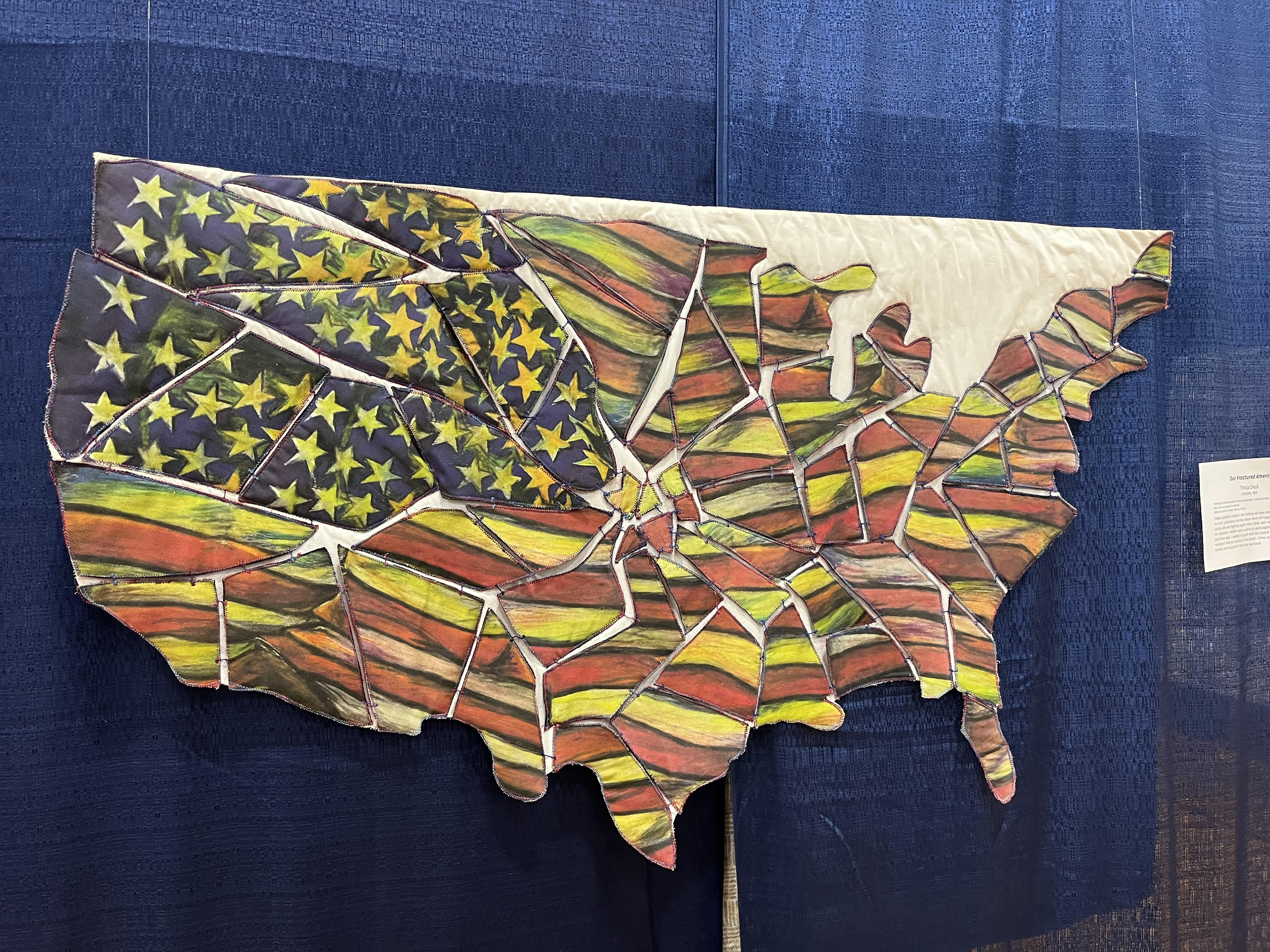
I was really moved by the next one, a nontraditional concept. Heartbreaking.
Below I share one thing I can do to help mend my broken heart. My thanks to the coat maker for the reminder that the country belongs to the people. We had a revolution for that.
Photo: Linda Xiao for the New York Times. The hearty and healing Korean soup called gukbap.
Did you love Michelle Zauner’s Crying in H-Mart, her wistful, mouth-watering memoir? The Korean American emo singer wrote beautifully about her difficult relationship with her Korean mother, a relationship that couldn’t be understood without delving into the love they shared for Korean food.
If you also like Korean food, consider this hearty, aromatic soup, good for whatever ails you.
Eric Kim writes at the New York Times, “I come from water people. My mother, Jean, grew up in Jeonju, the capital of North Jeolla, a province on South Korea’s west coast known for its salt-preserved seafood, assertively seasoned cooking and clear spring water. It’s said that the same water makes the region’s bean sprouts especially sweet, germinating them, then eventually extracting their gentle flavor, as in one of the city’s signature dishes, bean-sprout soup with rice.
“In Korean cuisine, a scoop of steamed white rice nestled inside a bowl of brothy soup, or gukbap, forms a wide category of healing meals. Many things can become gukbap, like those bean sprouts and rice (kongnamul gukbap), our house brew when I was growing up; pork bones and rice (dwaeji gukbap); and beef, radish and rice (sogogi gukbap). There’s always rice, or bap, which also means meal in Korean. To some ears, then, gukbap could be translated to ‘soup meal,’ breakfast, lunch or dinner, not least because that one bowl contains protein, carbohydrates, vegetables, fat, everything.
Build a meal around soup — or build a life around it, as my family has, a pot ever-simmering on the stove — and you might slowly find yourself healed.
“Soup rice eases as it goes down. My friend Matt Rodbard, who was a writer of the cookbooks Koreaworld and Koreatown, calls gukbap a ‘utility player,’ because it can be served in the morning, ‘for fortifying a hangover or just getting you a solid foundation for the day,’ or in the evening with soju, to catch (or extend) the night’s excesses. …
“It took me until my 30s to realize how much I had taken my mother’s cumulative hours of boiling homemade stocks for granted. In the United States, standard boxed broths like chicken, beef and vegetable are much too assertive for the kinds of gentle Korean soups that nuzzle you from the inside because they’re so rich in flavor yet light on the tongue.
“There are no shortcuts to that kind of umami, but there are tricks: Sohui Kim, who wrote Korean Home Cooking, taught me to sear beef before boiling it for a stronger-tasting broth. Or if you want the kind of quiet savoriness that only vegetables can lend, turn to her ideal soup meal these days: doenjang guk, with hearty greens like spinach and radish tops. For Joanne Lee Molinaro, the author of The Korean Vegan Cookbook, her vegetarian yukgaejang fits the bill whenever she’s craving gukbap, which is often meat-based. The spicy soup’s quintessential ingredient, gosari, the new stems of the bracken fern, shreds beautifully, like meat. Caroline Choe, who wrote the cookbook Banchan, adds a little ground black pepper and scallions to gomtang, a beef-bone soup, her go-to for gukbap. Each of these cherished home soups is eaten with a scoop of rice, because on the Korean table, when there’s guk, there’s bap.
“This Kim-family gukbap, a Korean American iteration of my mother’s hometown classic, leads with beef and radish, bolstered by a hearty handful of soybean sprouts, which lend both protein and aroma. The brightest, reddest gochugaru you can find, bloomed in the beef fat, results in a tongue-tingling chile oil, pure flavor floating atop the soup.
“Ordinarily you would use a big, juicy Korean radish for this type of broth, for the edge of sweet bitterness it lends, but I prefer small red radishes, the latent Pink Power Ranger in me emerging as their carmine skins soften to a translucent fuchsia, a sign of tenderness. Where salt seasons this soup, fish sauce dials up its umami. …
“Resourcefulness is never bad when you’re cooking from scratch, especially when you remember that water, too, is a resource. In the Korean kitchen, a cook might save the starchy runoff water from rinsed rice to thicken a soup later or to germinate a bean seedling.”
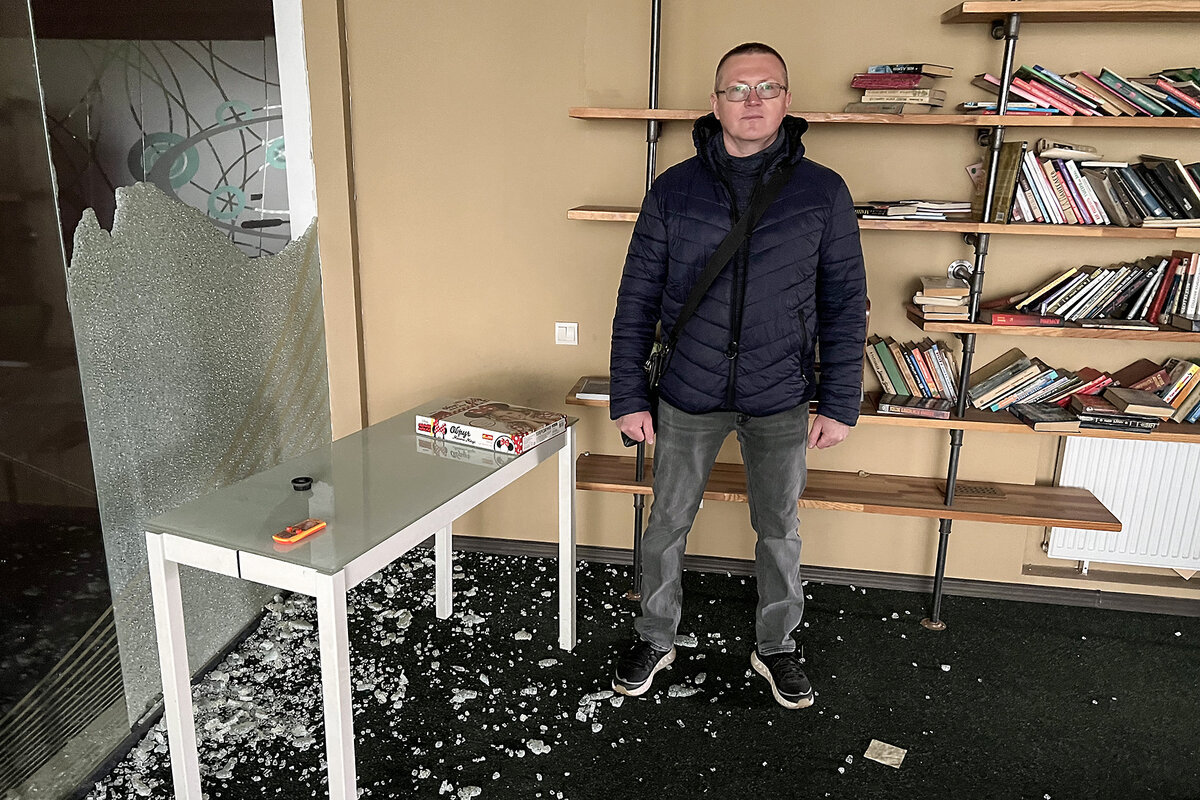
Photo: Howard LaFranchi/The Christian Science Monitor. Ihor Pohorielov, commercial director of Ranok Publishing, at the company’s bomb-damaged offices, in Kharkiv, Ukraine, Nov. 4, 2024.
If ants can keep working and rebuilding after we’ve knocked over their anthill, how much more humans in war zones?
Among the many buildings damaged or destroyed by the Russian invasion in Ukraine are publishers of books. But books remain strong and Ukrainians keep reading.
Here’s a story by Howard LaFranchi at the Christian Science Monitor.
“Across Ukraine, but especially in Kharkiv, the country’s publishing capital, Russia’s war has been something of a boon to the nation’s publishing industry. More Ukrainians are seeking solace and distraction in books, and interest in Ukrainian literature and Ukrainian-language books is spiking.
“Many of the country’s publishing houses – from textbook-publishing giants to boutique operations specializing in culture – are keeping busy. And this despite the fact that Russian President Vladimir Putin has made publishing houses a key target of his war on Ukrainian culture.
“Publishers say a combination of their resolve to keep operating and a reawakened enthusiasm for books among a variety of readers is keeping the presses running.
“ ‘The war is reminding Ukrainians that books are an outlet for joy, for culture, for travel, when other outlets are closed to us,’ says Yuliia Orlova, general director of Vivat Publishing.
“ ‘We hear all the time about people rediscovering the joys of books as they spend less time on their computers and phones,’ she says. ‘People want to distract themselves from all the sad and depressing things going on around them, so they turn to fiction and fantasy. It’s their way to escape.’
“One night in November, Ihor Pohorielov was awakened by a Russian bomb blast that nearly shook him out of bed. His thoughts went to the modern offices and cavernous storage facilities where he works as the commercial director for Kharkiv’s Ranok Publishing, and which had already been the target of Russian air strikes. …
” ‘I thought of the orders we need to get out and the clients we need to serve – so I came into work’ the next day. …
“Across Ukraine, but especially in Kharkiv, the country’s publishing capital, Russia’s war has been something of a boon to the book publishing business.
“As more Ukrainians seek solace and distraction in books, and as interest in Ukrainian literature and Ukrainian-language books spikes, many of the country’s publishing houses – from textbook-publishing giants to boutique operations specializing in culture – are keeping busy.
“And this despite the fact that Russian President Vladimir Putin has made publishing and printing houses a key target of his war on Ukrainian culture.
“Kharkiv’s publishing industry was shaken to its core last May when a Russian S-300 missile struck the giant Faktor-Druk, one of Europe’s largest printing houses. The blast destroyed presses, incinerated some 100,000 books, and knocked out the three publishing companies housed there. …
“But the sense of devastation was short-lived. In a show of solidarity, several European publishers offered to print Ukrainian books for distribution to millions of Ukrainian refugees around Europe.
“An American philanthropic organization, the Howard G. Buffett Foundation, quickly agreed to pick up the tab for Faktor-Druk’s reconstruction. …
“ ‘Printing in Kharkiv is hanging on despite the almost daily attacks on the city,’ … says Yuliia Orlova, general director of Vivat Publishing, a division of the Faktor Group. …
“Ms. Orlova does not hide the fact that the war has been devastating for Ukrainian publishing in many ways, especially for the people who work in the sector. ‘The attacks and the destruction in the city have a big impact on the mental health of our workers. People don’t sleep and they are constantly worried for their families,’ she says. …
“Since 2022, the number of registered publishers in Ukraine has plummeted from about 1,600 to 150, Ms. Orlova says. …
“But Ms. Orlova cites another statistic that underscores the bright side of Ukrainian book publishing: Over the same period, the total number of books printed grew by 70%.
“The reasons for that jump are largely related to the war. Russia’s systematic destruction of Ukraine’s infrastructure has meant widespread power outages and spotty access to the internet, Ms. Orlova says. ‘We hear all the time about people rediscovering the joys of books as they spend less time on their computers and phones,’ she says. …
“Mr. Putin’s war on Ukrainian culture – targeting museums, churches, universities, and publishing houses – is feeding a renewed interest in history, language, art, and literature that confirm Ukrainian nationhood, publishers say.
” ‘Interest among Ukrainians in who we are was already starting to grow, but it was the full-scale invasion that really encouraged this desire to know more about our history and culture,’ says Oleksandr Savchuk, whose specialty Kharkiv publishing house carries his name.
“ ‘For many Ukrainians, the picture of who we are was like a puzzle with lost pieces,’ he says. ‘But now people are finding those pieces so we can complete the full picture.’
“To help nurture that process, in 2023 the philosophy professor and publisher opened a facility he calls a ‘Book Strongroom,’ a combination bookstore, event space, and neighborhood bomb shelter adjacent to his publishing operations. …
“Oleksandr Savchuk is a small player who has published about 50 titles over the last decade. … ‘For the 12 years before the invasion I was suffering to try to show people their great history and culture. It was a hard-going process,’ he says. … ‘I see now that I’m being heard.’ “
More at the Monitor, here. No firewall, reasonable subscriptions rates for a paper unusually strong in international news.
Photo: Vishal Subramanyan/California Academy of Sciences. “High up in the Sierra Nevada,” writes the Smithsonian,“the tiny Mount Lyell shrew has been shying away from cameras since it was first identified almost 100 years ago. Then three undergraduates hit the jackpot.
I’m not sure if I regard today’s update as more about a threatened mammal or about achieving something important when you’re still an undergraduate.
Here are two takes on the story of a rarely studied shrew that is threatened by climate change. First, an interview at National Public Radio (NPR).
“Juana Summers, Host “For more than 100 years, scientists have known about a shrew living in the mountains around Yosemite National Park. California designated it a ‘species of special concern,’ but nobody had seen it.
“Vishal Subramanyan “There’s never actually been even a confirmed sighting of the shrew alive, just because they’re almost always found dead.
“Sacha Pfeiffer, Host “Vishal Subramanyan is a wildlife photographer and a recent graduate of the University of California, Berkeley. Back in the fall, he and two other undergraduate student researchers, Harper Forbes and Prakrit Jain, decided to find a Mount Lyell shrew. … So they set off into the Sierra Nevada mountains with a lot of plastic cups to set traps in the ground to try to catch this elusive creature.
“Prakrit Jain “Shrews are quite fast and not very personable, at least at first. They’re always running away. If you try to pick them up, sometimes they might try to bite.
“Summers “Prakrit Jain is still a student at Berkeley, and he says, before you can even think about the taming of the shrew, you’ve first got to catch one alive. …
“Pfeiffer “Once you catch one, you have to act quickly because this shrew has a very fast metabolism. That means if they don’t eat every few hours, they can die in the traps.
“Subramanyan “It was pretty much just go, go, go, and we never really slept for more than two hours at a time. And throughout the course of the three nights and four days, we probably never slept for more than eight hours ’cause we were just constantly trapping, photographing, then trapping again.
“Summers “Their traps caught a lot of shrews — several different species, actually — but the researchers suspected that at least five of them were the ones they were actually looking for.
“Pfeiffer “This month, genetic testing confirmed that these undergraduate students had indeed taken the first known photographs of the Mount Lyell shrew.
“Summers “It may seem like a lot of work to snap a photo, but Subramanyan says it’s actually really important for the world to see these furry little animals. He points to studies that show how other small mammals in the region are at risk with their habitat rapidly warming. And this shrew and its long snout help put a face to the impacts of climate change on biodiversity.
“Subramanyan “A majority of species that are disappearing aren’t these, you know, traditionally charismatic species you hear about like lions and wolves. But it’s often these smaller, often overlooked animals that are disappearing completely under the radar with no public awareness or attention.
“Pfeiffer “These researchers say that they dream of exploring far off and distant places. But they realize that the breakthrough they made in what was already a well-studied part of the world shows there’s still a lot to learn closer to home.”
At the Smithsonian there’s a roundup of other interviews.
“Subramanyan, who graduated from the University of California, Berkeley, last year, is a wildlife photographer. Jain and Forbes, undergraduate students at UC Berkeley and the University of Arizona, respectively, made headlines in 2022 for discovering two new scorpion species. After receiving permits from California’s Department of Fish and Wildlife, the trio headed to the Eastern Sierra. They set up 150 pitfall traps near stream and wetland habitats and checked in on them every two hours. …
“They got set up, then they waited.
“ ‘I would love to say we spent three days waiting, and the shrew finally appeared at the last second,’ says Subramanyan to Astrid Kane at the San Francisco Standard. ‘But we got the Mount Lyell within the first two hours.’
“ ‘It just shows that it’s generally an underappreciated species in an underappreciated ecosystem, that people haven’t spent the time and been able to actually bring dedicated focus to the shrews,’ he adds to Issy Ronald at CNN.
“To photograph the shrews, the team had to work quickly. They continued to trap more of the animals, following their planned sleep schedule during the nights, when temperatures dropped to 15 degrees Fahrenheit. The researchers set up a white background and a terrarium for the imaging. ‘You trap some shrews, you photograph them, you release them, and by that time there are more shrews. So it was pretty nonstop,’ Subramanyan says to SFGATE’s Timothy Karoff.
“The animals run around a lot — and bite — making it especially hard to get good photos of them. ‘For every photo that we got in focus, we must have 10 or 20 photos where the shrew is running out of the frame,’ says Jain to Sabrina Imbler at Defector. …
‘The students hope their work will increase public recognition for shrews and other less charismatic animals. ‘Many, many species of shrew are known from only a single specimen, or only known from a single locality, or have not been seen in decades,’ says Jain to Katharine Gammon at the Guardian. ‘So if we struggle to find a shrew in a place like California — one of the best studied places in the world — you can only imagine how the shrew diversity of places like southeast Asia and central Africa, for instance, can just be so under-appreciated.’
“Mount Lyell shrews are also extremely threatened by climate change — 89 percent of the animal’s habitat is projected to be lost by the 2080s, according to a statement from the University of California, Berkeley. …
“ ‘If we look at the extinction crisis and the types of animals it’s impacting, a lot of animals are disappearing without any documentation,’ Subramanyan says to the Guardian. ‘An animal like the Mount Lyell shrew, if it was not photographed or researched, could have just quietly disappeared due to climate change, and we’d have no idea about it at all.’ ”
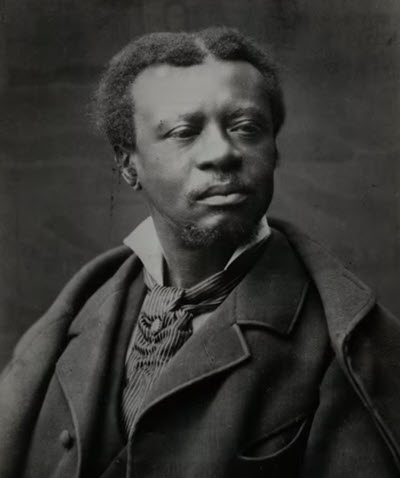
Photo: Opera Lafayette. Nineteenth-century American composer Edmond Dédé at about age 50.
When I think of an African American born in pre-Civil War New Orleans studying music with the best and rising to high levels of composing, the word that comes to mind is courage.
There is so much I don’t know about the lives of others, and I am grateful to Early Music America for enlightening me about the Edmond Dédé, America’s first black opera composer. Patrick D. McCoy has the story.
“Like many artists of color with the opportunity,” writes McCoy, “Edmond Dédé fled the antebellum United States. After a time in Mexico, he eventually settled in France. … Among Dédé’s surviving works is a four-act opera, Morgiane,ou Le Sultan d’Ispahan, which was never performed or published in his lifetime.
“Morgiane, a happy-ending tale inspired by Ali Baba and the Forty Thieves, was finished in 1887, making it perhaps the oldest-known complete opera by a Black composer born in the United States. …
“Morgiane [received] its world premiere, fully staged, with shows in the Washington D.C. area (Feb. 3 and 7) and New York City (Feb. 5). … Patrick Dupré Quigley, artistic director-designate of Opera Lafayette, will conduct. …
” ‘I knew it was my mission to get this done,’ recalls Givonna Joseph, co-founder of OperaCreole, after receiving a digital file of the opera in 2014. ‘The world needed to know that a free Black man from New Orleans not only composed over 100 works, but also a complete French grand opera with a ballet and an extra brass section. It was never performed, so I was set on a path for restorative and transformational justice.’
“Not long after, conductor Quigley was investigating musicians of color from New Orleans and happened upon that same digitized, 550-page manuscript, which had been crammed into another composer’s score, part of a large private collection from France that ended up in Harvard’s Houghton Library. The full opera is now online and available for public view. …
“Thinking about an eventual performance, Quigley and Opera Lafayette founder Ryan Brown checked if anyone else was working on the project. They quickly found Joseph and her daughter, Aria Mason, who co-founded OperaCreole in 2011. … It was a double jackpot: Morgiane checked every box for both companies.
“And they’d all worked with a singer in common, bass-baritone (and noted composer) Jonathan Woody, who introduced them in a Zoom call in 2023. …
“Much of what’s known about the composer comes from scholarship by Candance Bailey and by Sally McKee, author of The Exile’s Song: Edmond Dédé and the Unfinished Revolutions of the Atlantic World. He was born in 1827 in New Orleans, when the city was the center of opera in America, and was educated by visiting European musicians on clarinet and violin. He was locally celebrated as a skilled violinist and composer. His earliest published music straddled the line between art song and popular tunes — an attractive mix that Joseph has called ‘an early version of the blues.’
“By the late 1850s he studied briefly at the Paris Conservatoire and built a career in Bordeaux, where he worked as a repetiteur, violinist, and assistant conductor at the prestigious Grand Théâtre. …
“Decades later, with Morgiane, he seemed to bring together his musical heritage: ‘People will be shocked that they’ve never heard of this composer,’ says Quigley. ‘The vocal writing is virtuosic, the orchestration is unbelievably colorful. He was a string player, and you hear the inner voices, it’s masterful. He combines the tunefulness of what you think of from New Orleans with the prevailing French operatic forms of the time.’
“Morgiane is through-composed — everything is sung and the orchestra plays the entire time, with no spoken dialogue. … The score calls for bright, agile voices.
“Its sensational plot, with a libretto by a still-obscure poet named Louis Brunet, taps the sort of ‘exotic’ Middle Eastern locales then in vogue (think Aïda, Samson et Dalila, or Thaïs). A beautiful young woman on her wedding day is kidnapped by the evil henchman of the Persian Sultan. Her family crosses the desert from Arabia to Isfahan (in Persia) and infiltrates the Sultan’s court on the day he’s planning to marry the young woman. They have disguised themselves as itinerant singers. But moments before they’re about to rescue her, disaster! They are discovered, imprisoned, and condemned to death. Just before the execution, the mother of the young woman who’s been kidnapped — the title character, Morgiane, is the mother — speaks to the Sultan with a shocking revelation.
“Spoiler alert: From under her cloak Morgiane pulls out a diamond ring, the very ring that he’d given her the day their daughter was born. ‘I was your sultana,’ she says. …
“Quigley says he was ‘taken aback at my own ignorance of just how early composers of color were an integral part of both American and European art music. In New Orleans alone, people of color were involved with the composition, performance, and production of opera from the late 18th century onward.’ …
“For now, says Quigley, there are plans to help ensure the success and longevity of Morgiane. Opera Lafayette will record the opera, and make the score and parts available to help the opera enter the repertoire. In addition, some of its most delectable music — the overture, the entr’actes, the ballet sequences, plus a few other numbers — would make a highly attractive orchestral suite.”
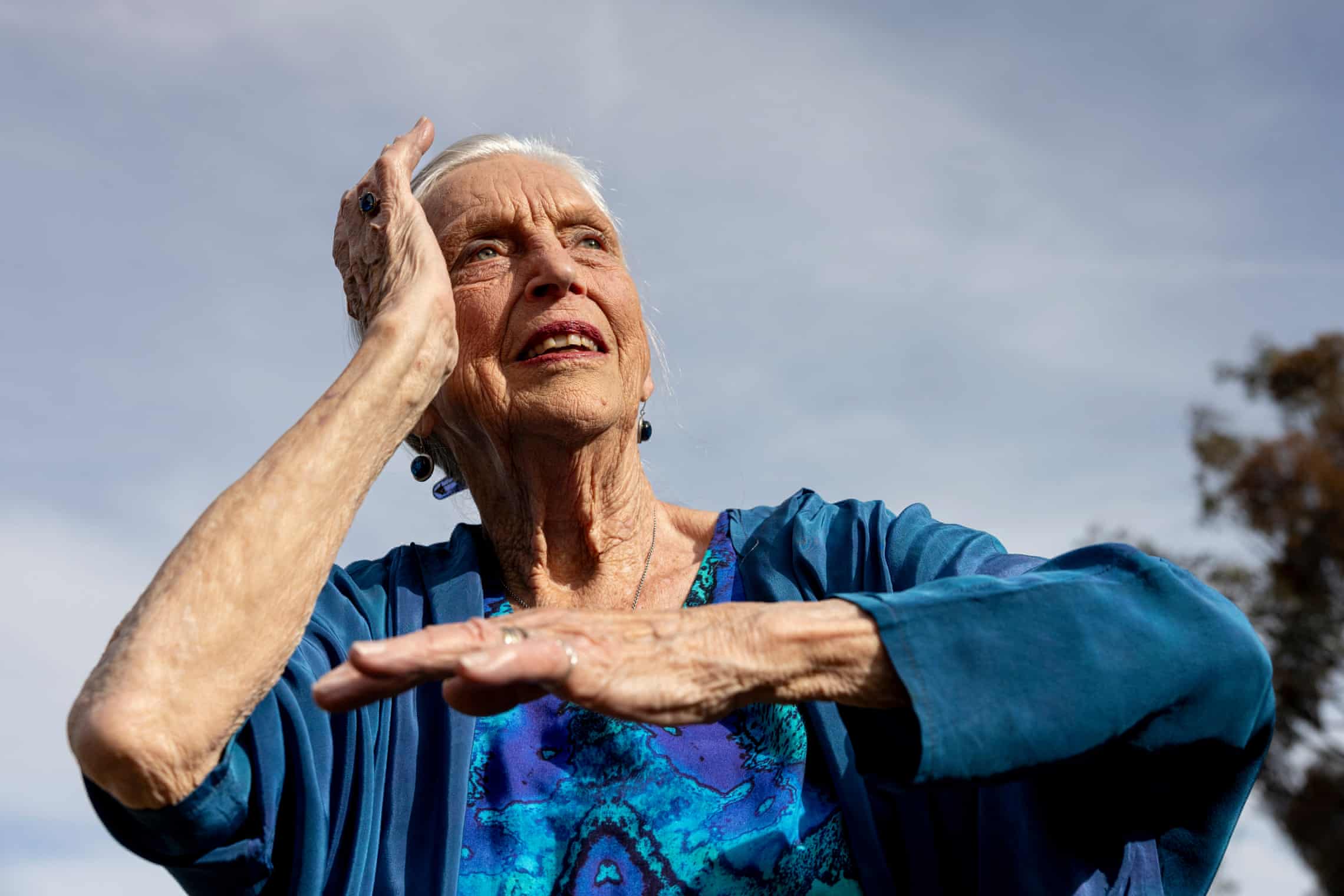
Photo: Teagan Glenane/The Guardian. Australian choreographer Elizabeth Cameron Dalman at her property in Bungendore, just outside Canberra. “I’d always been inspired by nature, which I imagined as I was performing.”
As an older citizen who thinks backing up in a parking lot is living life on the edge, I can never resist a story about elderly people who ignore aging.
Steve Dow at the Guardian wrote recently about a dancer in Australia.
“At 91, Elizabeth Cameron Dalman dances in nature at her bushland retreat outside Canberra, Mirramu Creative Arts Centre, surrounded by writers, singers and visual artists. … ‘So many people bring up this age thing,’ she says, ‘and my reply is that in dance we are ageless.’
“A contemporary dance pioneer in Australia, Dalman has just seen the final performance of one of her ‘great inspirations’ and occasional collaborators, dancer Eileen Kramer, in a filmed component of the dance work ‘Afterworld,’ part of Sydney festival. Kramer died in November at 110. ‘I’m going to live to that age,’ Dalman chuckles.
“In Adelaide in 1965, Dalman co-created Australian Dance Theatre, running the company for a decade, confounding the era’s prejudice against modern dance and women artistic directors. …
“She [likes to] talk about what feeds longevity, pointing to medical research showing the health and mobility benefits of dancing for Alzheimer’s and Parkinson’s patients. ‘It’s not just pure exercise, you are adding creative activity,’ she says. ‘You’re engaging the left and right side of the brain.’ …
“Dalman has been consulting with ADT’s current artistic director, Daniel Riley, on the company’s 60th anniversary production ‘A Quiet Language.’ … The show, created by Riley, is billed as an examination of legacy, ‘transmuting the rebellious energy of the company’s early days into an electric new era.’
“Over the past decade, Dalman herself has graced international stages, notably touring for four years as part of the Irish choreographer Michael Keegan-Dolan’s critically acclaimed ‘Swan Lake/Loch na hEala,’ which transposed the classical ballet to the Irish midlands. When Keegan-Dolan posted an international callout for a woman aged 60 with long white hair to play the story’s cranky, arthritic matriarch, Dalman – 82 at the time – emailed saying she had the requisite long white hair. …
“Dalman has always been determined to dance. … She enrolled in dance class at three, learning both classical ballet and modern. Later, she began an arts degree at the University of Adelaide. …
“In 1957, aged 23, Dalman paid her way to London with the hope of launching a dance career. There, she saw a life-changing performance by the Mexican choreographer José Limón. ‘He touched my soul. I thought, “Oh wow, that’s how I want to dance,” ‘ she recalls. In 1960-61 she studied at the Folkwang school in Essen, Germany, where her classmates included Pina Bausch: ‘She was amazing, a technical whiz.’
“In Germany, Dalman met the Colombian American choreographer Eleo Pomare, who rose to prominence in the civil rights era. She created works with Pomare’s company from 1961 to 1963, living in Amsterdam with him and four other dancers. Pomare later remarked that Dalman danced ‘as if she swallows the heat and you feel that the heat is burning from the inside out.’ …
“Dalman returned to Australia in late 1963, and performed in the artist Stan Ostoja-Kotkowski’s experimental theatre show ‘Sound and Image’ at the 1964 Adelaide festival. It inspired her to open a dance school, and in 1965 she took her students on a regional tour, alongside dancers from Royal Ballet alumnus Leslie White’s Adelaide academy.
“Buoyed up by the tour’s success, Dalman and White set up Australian Dance Theatre, but the going was financially tough, and White left in 1967. Dalman put Australian Dance Theatre forward to perform in the 1968 Adelaide festival, but when it turned down her request for financial support she instead bought some half-price cruise ship tickets and took the troupe on its first international tour, sailing to the Netherlands, Switzerland and Italy.
“Back home, Dalman faced discrimination because of her gender: ‘I felt the battle, I had to keep proving myself. Even once we got a little bit of funding later, in 1973, and I’d been running the company since 1965, never in the red, this board member, a man, said, “Oh we have to do something about the finances, they haven’t been run correctly.” Then he took us into the red the next year.’
“Dalman remained artistic director until 1975. Then, having split with her husband, she and [their son] Andreas moved to Ventimiglia, a seaside town in northern Italy. … She founded a dance school and a youth dance theatre there in 1976, and it became ‘a place of healing.’
“In 1986, on a visit home to Australia, Dalman met another mature artist, who became an inspiration: the Japanese butoh dancer Kazuo Ohno, then almost 80. … A decade later, Dalman and Andreas visited Ohno – who was still dancing, and preparing to tour the US – at his Yokohama home. ‘He said, “Oh Elizabeth, it’s so good to talk to a senior, mature artist.” ‘ Dalman, then 60, had been contemplating ending her career. ‘When I met him, I realized I had to keep going.’
“In 1989, Dalman bought a 40-hectare property at Bungendore, near Weereewa/Lake George, outside Canberra. The bush reminded her of Italy, dancing among the olive groves or by the river. She established Mirramu Creative Arts Centre there the same year, followed by Mirramu Dance Company in 2002. …
“ ‘It was hard leaving Adelaide because that was my home, but the pull of this place, the land and the lake, is very powerful.’ “
Photo: Hufton+ Crow. This affordable housing in New York was designed by the firm of famed architect Daniel Libeskind.
If you’ve spent your career catering to the wealthy, where do you go for other worlds to conquer? One architect turned to the poor.
The story is from Justin Davidson at Markets Today via MSN.
“Walk down an ordinary blah-colored stretch of Marcus Garvey Boulevard in Bedford-Stuyvesant, past the dispiriting bulk of Woodhull Hospital and the brown-brick boxes of the Sumner Houses project, and you come upon an incongruous apparition, a great white sugar cube that’s been carved, beveled, and knocked askew. Stranger still, this work of obviously ambitious architecture was executed on a spare budget for residents with meager incomes. Even more startling, the Atrium, an affordable-housing development for seniors and veterans of the shelter system, was designed by the firm of Daniel Libeskind, he … of the kind of jagged form that would defy attempts to gift-wrap it.
“With the Jewish Museum in Berlin, opened in 2001, Libeskind established himself as a pioneer of deconstructivism, a style based on the illusion that buildings were lifting off, bursting, imploding, or peeling apart. After the 9/11 attacks, when he was appointed master planner of the World Trade Center rebuilding project, he became famous as the embodiment of advanced architecture, headlining a period when a dozen or so celebrities scattered the world with signature structures. You might not know where a building was or what it was for or how it stood up, but you could quickly identify who designed it. His global brand would seem like an odd choice for the most basic tier of New York’s urban shelter. …
“Spend some time in and around the Atrium, though, and you begin to see that the pairing of high-design auteur and low-income residents meets an assortment of needs and isn’t just noblesse oblige. Erected by a cluster of nonprofits — Selfhelp Community Services, Riseboro Community Partnership, and the nonprofit developer Urban Builders Collaborative — on a patch of NYCHA [New York City Housing Authority] land, the Atrium leavens the neighborhood with 190 new apartments, a spacious community room, fresh landscaping, and a jolt of jauntiness.
“Like many public-housing projects, the original Sumner Houses, built in the late 1950s, withdraw from the street, lurking behind a perimeter of pointless lawn. The Atrium does the opposite, hugging the sidewalk, peppy and reassuring. This is an active, even restless building that greets passersby with a smooth dance move. … The whole structure makes a quarter-twist from ground to roof, and you can trace its sinews stretching diagonally across the grid of ribbon windows.
“Inside, comfortable apartments encircle the raised, skylit courtyard that gives the building its name. That arrangement is a resonant one for Libeskind, who grew up in the Amalgamated Houses in the Bronx, a complex developed in the 1920s by the garment workers union. …
” ‘It stood out,’ Libeskind told me. ‘It was populated by working-class people, but it had a sense of elegance.’ The courtyard was essential, a way for mostly Jewish immigrants to replace the tenement’s narrow, stinking air shaft with a form of genuinely gracious living. …
“Still, there’s a difference between an outdoor courtyard and an indoor atrium. Carelessly handled, the nine-story doughnut form could easily have evoked stifling precedents. … To avoid any hint of that oppressiveness, Libeskind laced the floor with diagonal walkways between raised planters and sculpted the inner façade almost like a climbing gym, with protrusions, ledges and trapezoidal windows placed in an apparently random arrangement. The goal was to make the court a destination rather than a vestibule. Since it’s one floor up from the lobby, going there requires an affirmative decision. …
“The success of a low-income housing complex depends on its social warmth. Selfhelp maintains a small team of social workers on-site, mostly to help residents navigate the welfare bureaucracy but also just to be there if they want to chat. …
“The residents I spoke to enjoy the Atrium, not because of its architectural pedigree but because it is clean and safe and orderly and bright, a rare haven for New Yorkers whose lives have often been turbulent. Still, loneliness is a tough enemy. …
“Designing a building and running it are different arts, but doing each one well fortifies the other. With the Atrium, Libeskind has given vulnerable people a place they can gradually make their own. He has also demonstrated that the daunting list of rules, requirements, prohibitions, and economic strictures that govern affordable housing in New York don’t have to choke off inventive architecture. …
“Ahmed Tigani, a deputy commissioner at the city’s Department of Housing Preservation and Development, insists that the Atrium shouldn’t be a one-off showcase of precious design. Recruiting architects like Libeskind makes it clear that low-income housing is an integral part of the cityscape. City housing staffers should wrestle with loftier questions than those described by the number of units built, Tigani says. ‘What is the physical impact of our investment, but also the social and spiritual impact? What does a building visually contribute? Does it feel like a part of your neighborhood? Does it feel like a statement of belief in what that housing can be?’ ”
Photo: North Wind Picture Archives/Alamy. A monk writing by hand.
When I mentioned that string teachers have found that beginning students no longer have the finger strength for pressing down strings, Erik wondered what they had been doing in the old days that made their fingers stronger.
One thing they had been doing was writing by hand, not just swiping. Turns out we’ve lost something important.
Additionally, as Christine Rosen says at the Guardian, “In the process we are in danger of losing cognitive skills, sensory experience – and a connection to history.”
She beings by citing the autopen, “a device that stores a person’s signature, replicating it as needed using a mechanical arm that holds a real pen.
“Like many technologies, this rudimentary robotic signature-maker has always provoked ambivalence. We invest signatures with meaning, particularly when the signer is well known. … Fans of singer Bob Dylan expressed ire when they discovered that the limited edition of his book The Philosophy of Modern Song, which cost nearly $600 and came with an official certificate ‘attesting to its having been individually signed by Dylan,’ in fact had made unlimited use of an autopen. Dylan … acknowledged that: ‘using a machine was an error in judgment and I want to rectify it immediately.’
“Our mixed feelings about machine-made signatures make plain our broader relationship to handwriting: it offers a glimpse of individuality. Any time spent doing archival research is a humbling lesson in the challenges and rewards of deciphering the handwritten word. You come to know your long-dead subjects through the quirks of their handwriting; one man’s script becomes spidery and small when he writes something emotionally charged, while another’s pristine pages suggest the diligence of a medieval monk. The calligraphist Bernard Maisner argues that calligraphy, and handwriting more broadly, is ‘not meant to reproduce something over and over again. It’s meant to show the humanity, the responsiveness and variation within.’
“But handwriting is disappearing. A high-school student who took the preliminary SAT used for college admittance in the US confessed to the Wall Street Journal that ‘audible gasps broke out in the room’ when students learned they would have to write a one-sentence statement that all the work is the student’s own, in cursive, or joined-up handwriting. …
“The Common Core State Standards for education in the US, which outline the skills students are expected to achieve at each grade level, no longer require students to learn cursive writing. Finland removed cursive writing from its schools in 2016, and Switzerland, among other countries, has also reduced instruction in cursive handwriting. One assessment claimed that more than 33% of students struggle to achieve competency in basic handwriting, meaning the ability to write legibly the letters of the alphabet (in both upper and lower case). …
“Schoolchildren are not the only ones who can no longer write or read cursive. Fewer and fewer of us put pen to paper to record our thoughts, correspond with friends, or even to jot down a grocery list. Instead of begging a celebrity for an autograph, we request a selfie. Many people no longer have the skill to do more than scrawl their name in an illegible script, and those who do will see that skill atrophy as they rely more on computers and smartphones.
“A newspaper in Toronto recorded the lament of a pastry instructor who realized that many of his culinary students couldn’t properly pipe an inscription in icing on a cake – their cursive writing was too shaky and indistinct to begin with. …
“The skill has deteriorated gradually, and many of us don’t notice our own loss until we’re asked to handwrite something and find ourselves bumbling as we put pen to paper.
“Some people still write in script for special occasions (a condolence letter, an elaborately calligraphed wedding invitation) or dash off a bastardized cursive on the rare occasions when they write a cheque, but apart from teachers, few people insist on a continued place for handwriting in everyday life.
“But we lose something when handwriting disappears. We lose measurable cognitive skills, and we also lose the pleasure of using our hands and a writing implement in a process that for thousands of years has allowed humans to make our thoughts visible to one another. We lose the sensory experience of ink and paper and the visual pleasure of the handwritten word. We lose the ability to read the words of the dead.
“We are far more likely to use our hands to type or swipe. We communicate more but with less physical effort. …
“In 2000, physicians at Cedars-Sinai hospital in Los Angeles took a remedial handwriting course. ‘Many of our physicians don’t write legibly,’ the chief of the medical staff explained to Science Daily. And unlike many professions, doctors’ bad writing can have serious consequences, including medical errors and even death; a woman in Texas won a $450,000 award after her husband took the wrong prescription medicine and died. The pharmacist had misread the doctor’s poorly handwritten instructions. Even though many medical records are now stored on computers, physicians still spend a lot of their time writing notes on charts or writing prescriptions by hand.
“Clarity in handwriting isn’t merely an aid to communication. In some significant way, writing by hand, unlike tracing a letter or typing it, primes the brain for learning to read. Psychologists Pam Mueller and Daniel Oppenheimer compared students taking class notes by hand or on a laptop computer to test whether the medium mattered for student performance. Earlier studies of laptop use in the classroom had focused on how distracting computer use was for students. Not surprisingly, the answer was very distracting, and not just for the notetaker but for nearby peers as well.
“Mueller and Oppenheimer instead studied how laptop use affected the learning process for students who used them. They found that ‘even when laptops are used solely to take notes, they may still be impairing learning because their use results in shallower processing.’ In three different experiments, their research concluded that students who used laptop computers performed worse on conceptual questions in comparison with students who took notes by hand. … We retain information better when we write by hand because the slower pace of writing forces us to summarize as we write, as opposed to the greater speed of transcribing on a keyboard. …
“Researchers worry that abandoning the pen for the keyboard will lead to any number of unforeseen negative consequences. ‘The digitization of writing entails radical transformations of the very act of writing at a sensorimotor, physical level and the (potentially far-reaching) implications of such transformations are far from properly understood,’ notes Anne Mangen, who studies how technology transforms literacy. …
“It is popular to assume that we have replaced one old-fashioned, inefficient tool (handwriting) with a more convenient and efficient alternative (keyboarding). But like the decline of face-to-face interactions, we are not accounting for what we lose in this tradeoff for efficiency, and for the unrecoverable ways of learning and knowing, particularly for children. A child who has mastered the keyboard but grows into an adult who still struggles to sign his own name is not an example of progress.
As a physical act, writing requires dexterity in the hands and fingers as well as the forearms.
“The labor of writing by hand is also part of the pleasure of the experience, argues the novelist Mary Gordon. ‘I believe that the labor has virtue, because of its very physicality.’ “
Very interesting piece. Read more at the Guardian, here.
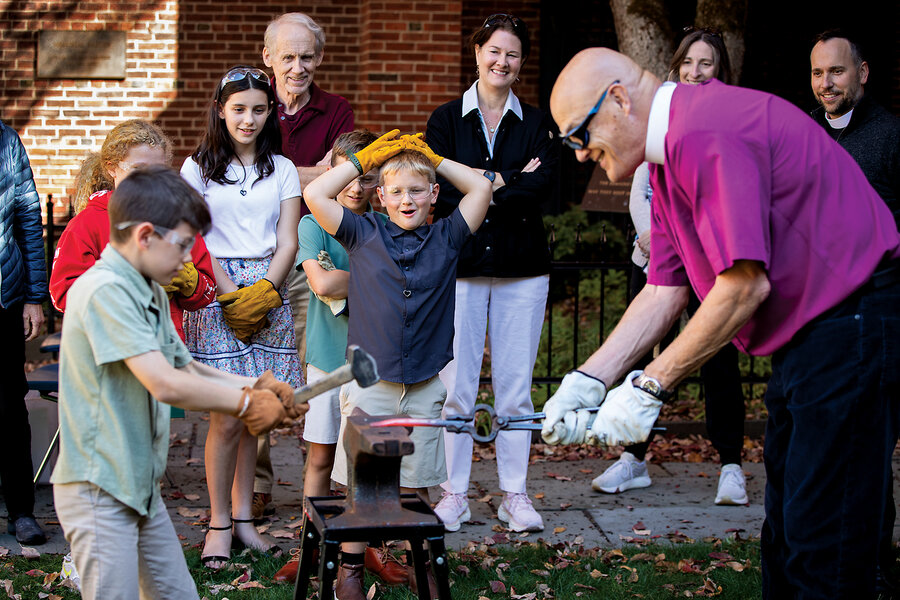
Photo: Melanie Stetson Freeman/Christian Science Monitor staff. Retired Episcopal Suffragan Bishop Jim Curry, co-founder of the nonprofit Swords into Plowshares, gives a blacksmithing demonstration in Winchester, Mass. The nonprofit’s goal is to get guns off the streets and make young people enthusiastic about peaceful projects.
In a Providence park, there’s a sculpture made from illegal handguns. It’s kind of a depressing pillar to failure, unless you look at it as the removal of guns from circulation. It’s ambiguous, which I guess art is supposed to be.
Here’s a story about an effort to turn young people away from the gun culture of the streets.
Troy Aidan Sambajon writes at the Christian Science Monitor, “Retired Episcopal Suffragan Bishop Jim Curry ignites his propane forge in the courtyard of Parish of the Epiphany church. Slowly he heats the barrel of a dismantled rifle to 2,000 degrees Fahrenheit, and then starts hammering the red-hot metal on his anvil. In minutes, a piece of once-deadly weaponry transforms into a humble weeding tool.
“Bishop Curry then invites onlookers to try their own hand at making garden tools from firearm parts, using the forge that he takes with him to various communities in the Northeast region. With each strike of the hammer, participants mold a hopeful vision of a future without gun violence.
“Before the demonstration, Bishop Curry gave a sermon explaining the mission of Swords to Plowshares (S2P) Northeast, a nonprofit that he co-founded a decade ago in New Haven, Connecticut. ‘At the forge, we hammer guns into gardening tools and art. We forge rings from shotgun barrels into hearts – symbolizing that the change we need begins in the transformation of our own hearts,’ he told parishioners.
“His work has inspired residents in Connecticut, New Hampshire, and Vermont to start their own independent S2P chapters, which host gun-surrender events in partnership with police departments. Law enforcement officials vet and dismantle the weapons, and then give the parts to the chapters for public blacksmithing demonstrations. Besides raising awareness about gun violence, the demonstrations help get young people interested in blacksmithing.
“Montrel Morrison, who runs a youth mentoring organization in Connecticut, calls S2P Northeast a ‘safe haven and beacon of hope.’ …
“Kam’eya Ingram, who spent the last two summers as a blacksmith with S2P Northeast, says that ‘when someone dies from gun violence, it’s like the world goes quiet.’ But for her, hammering on the anvil fills the silence with a resounding release of emotions. … ‘I feel like I’m bringing people peace – letting them know that one more gun is gone and that this [gun violence] might not happen to someone else.’
“Bishop Curry … studied religion at Amherst College. He graduated in 1970 and started his career working in public schools in Huntington, Massachusetts, as a middle and elementary schoolteacher for 10 years. Yet he longed to serve the spiritual needs of his community.
“That desire led him to the seminary in 1982, and, three years later, he was ordained as a deacon and priest in the Episcopal Diocese of Connecticut. He focused his ministry as a spiritual adviser, working in hospitals with families in Connecticut and addressing the devastating impacts of gun violence and suicide. By 2000, he was elected suffragan bishop of Connecticut.
“His life ‘changed entirely,’ he says, in the wake of the December 2012 shooting at Sandy Hook Elementary School in Newtown, Connecticut. … Newtown was in his diocese. …
“In early 2013, he joined other Episcopal bishops in Washington, D.C., and helped found Bishops United Against Gun Violence. Through that group, he learned about the Guns to Gardens movement, a network of nonprofits that repurposes unwanted firearms into garden tools and artwork. …
“In 2014, he co-founded his chapter, S2P Northeast, with Pina Violano, a trauma nurse and nursing professor at Quinnipiac University. The group’s namesake peacebuilding mission comes from the Old Testament (Isaiah 2:4): ‘They shall beat their swords into plowshares, and their spears into pruning-hooks.’ …
“S2P Northeast has partnered with a Colorado organization called RAWtools on a nationwide gun-surrender program and, before the COVID-19 pandemic, taught blacksmithing skills to incarcerated people. …
“For Bishop Curry, ‘the real life of the forge’ has been to empower teens from New Haven through summer job opportunities. They are paid to transform guns through blacksmithing and help lead public demonstrations. …
“Jared Sanchez, age 18, takes pride in being a junior blacksmith instead of working a teenager’s typical mundane hustle. In a single day, he can make seven or eight garden tools out of shotgun barrels. He has also created a heart necklace for his younger sister and a cross to sit beside his grandfather’s urn. …
“After two summers serving as a blacksmith alongside Bishop Curry, Mr. Sanchez has come out of his shell and come into his own as a leader. Handling so many firearm parts has revealed to him the depth of the gun violence problem in his community and the work that must be done to combat it.”
More at the Monitor, here. No paywall. Nice pictures.
Photo: David Swanson/AFP/Getty Images. The hillside along the Pacific Coast Highway burns in front of the driveway to the Getty Villa in the Pacific Palisades neighborhood in Los Angeles on Jan. 7.
Planning, courage, and commitment saved California’s Getty Museum in the last big conflagration, but how long can it escape what few others did?
Kelsey Ables at the Washington Post explained how the famous art collection was protected in January.
“As wildfires ravaged greater Los Angeles … the J. Paul Getty Museum faced encroaching flames on two fronts. Blazes nearly surrounded the Getty Villa in Pacific Palisades, coming within six feet of its walls. Days later, ominous red clouds were visible from the Getty Center in Brentwood, hovering on the horizon like a warning.
“The fire at the Villa was the closest flames had ever come to either building. But through it all, the institution made no evacuation plans. On the most intense nights at each location, a team of more than a dozen people at the Villa and 28 at the Center waited it out, and the museums’ vaunted artworks — the ancient sculptures, the Gentileschis, the Manets and Monets — remained inside.
“This was no gamble, though. Those familiar with the Getty describe it as a place one would evacuate to, rather than from.
“With the fire about a mile away from the Center on Jan. 10, a security staff member suggested to J. Paul Getty Trust chief executive Katherine Fleming that she might want to leave. ‘I was thinking, “I actually feel really good here,” ‘ she said in an interview. ‘This feels like a very safe place to be.’
“That is by design. … As the fires have killed more than 20 and razed swaths of the Los Angeles region, the Getty — with its more than $8 billion endowment — has emerged as a beacon of fire preparedness as well as a symbol of the defenses that wealth can build.
“From its grounds to the museum’s core, the $1.3 billion Getty Center, which was designed by architect Richard Meier and opened in 1997, was built to resist flames. …
“High on a hilltop, the campus has sprawling plazas made of fire-resistant travertine imported from Italy. Open spaces surround imposing, elevated buildings that boast walls constructed from reinforced concrete or fire-protected steel. The roofs are covered with stone aggregate, which is fire-resistant. Inside, the buildings are equipped with special doors that prevent flames from traveling. Temperature and humidity are closely monitored during red-flag warnings.
“Outside, the grounds are routinely cleared; the plants, selected for their drought-resistant qualities, are pruned regularly to prevent them from becoming fuel. During a previous fire, the museum said: ‘There is no need to evacuate the art or archives, because they are already in the safest place possible.’
“ ‘It’s very much like a fortress,’ said [Todd Cronan, an L.A. native and art history professor at Emory University in Atlanta], who briefly lived at the Center as a fellow. …
“To Cronan, though, the Getty’s unassailable features say ‘more about privatization and their … endowment than anything else,’ he wrote [by email].
“While the Getty stresses that it does not hire private firefighters or seek special treatment, it maintains its own water tanks — including a 1 million gallon tank at the Center — year-round. …
“When the Villa emerged largely unscathed last week, the museum in a press release credited its own ‘extensive efforts to clear brush from the surrounding area,’ noting that it also stores water on-site and that the grounds were irrigated ahead of the blaze. …
“Fleming, the CEO, said they were confident in their preparations but described a nail-biting evening watching the fire move closer as 15 staff members remained on-site. … The next day, with staff unharmed and the Villa still standing, Fleming found a strange calm in the collections. The galleries were ‘cleaner than an operating room.’ “
Photo: Alan Devall/Reuters. A drone view shows volunteers with people affected by the Palisades wildfires, at a donation center in Arcadia, California, Jan. 12, 2025.
If you ever feel like your world is run by people without hearts, do what Mister Rogers’ mother advised when he was a little boy: “Look for the helpers.” As long as there are a few willing helpers, all things are possible.
Consider the volunteers in the recent California wildfires. At the Christian Science Monitor, Ali Martin wrote in January about people stepping up, even those whose lives had also been damaged.
The story started with a family’s pet goat. “Coco the goat is nestled in a soft bed between two cars in the parking lot of El Camino Real Charter High School on the western edge of Los Angeles’ San Fernando Valley. Other wildfire evacuation shelters wouldn’t allow the 10-year-old house goat to stay with her family – the animal shelters board pets on their own, in kennels – but breaking up wasn’t an option for her owner, Maji Anir. …
“She is quietly out of the way, is no bother, and offers a drop of levity in a sea of stress – most people who take notice stop to pet her, spirits lifted. Workers are letting her stay.
“Mr. Anir and his family had just two hours to evacuate as the fire approached their home in Malibu – not enough time to get everything they needed. They pulled away Tuesday evening as the sun was setting. By morning the house was gone, along with all of their neighbors’. …
“Even in this besieged region, ruin is bending toward resilience. And from the staff to random visitors and those sheltering, a common theme is kindness. …
“El Camino is a well-appointed charter school. … Classes for the school’s 3,500 students were scheduled to start back up in mid-January. Now, with the Palisades Fire burning out of control on the other side of a mountain ridge, the campus is a gathering place for those needing refuge – and the people volunteering to help.
“Kate Delos Reyes was supposed to be in a residential program for mental health treatment. The program in Santa Monica was canceled as fires swept through the nearby Pacific Palisades.
“She’s seen fires before, when she worked at a rehab center in another Southern California mountain range. Remembering that stress, she drove to the evacuation center at El Camino to lend whatever help they might need. ‘Kindness is free, you know.’ …
“Eddie Včelíková is fielding a stream of texts from her friends while she scrolls through social media. She is taking in photos of her childhood home in Altadena; St. Mark’s Episcopal Church, which she attended every Sunday; her schools – all of it destroyed.
“Altadena, an unincorporated town in northern LA County, welcomed Black homebuyers in the mid-1900s, when redlining kept them out of other neighborhoods. As the area developed along the southwestern base of the San Gabriel Mountains, so did the diversity of its middle-class bedrock. Last week, the Eaton fire, which is still burning, swept through much of the small community and leveled entire blocks.
“When she saw video of the burned-out park where she played every weekend as a child, Ms. Včelíková says she broke. She found her way to the shelter. ‘I’m just out here volunteering to stay busy because it’s the only thing I think that’ll keep me from going insane.’ …
“She’s tried to get back into her old neighborhood, but National Guard troops are blocking every route – protecting vacant homes from looting. On Sunday, she attended a virtual church service hosted by St. Mark’s. The church may be gone, but its spirit is not. …
“[Soon] not even the shelter itself is safe. The Kenneth Fire has broken out in late afternoon on a ridge overlooking this edge of the San Fernando Valley. … This refuge is shutting down. Most of the evacuees are heading 20 miles east to another shelter at the Westwood Recreation Center.
“Leslie and Megan Walsh are making space in their packed trunk for a small suitcase. They’ve just met a young woman who needs a ride to Westwood, and they’ve offered to take her.
“They’re from San Diego; they know what LA is going through. In 2003, fires swept through parts of their city, and they had to flee. Their neighborhood lost 300 homes. Now, with Megan living in LA, the family wanted to help however they could.
“Leslie and her daughter drove to LA with a car full of animal supplies – pet food and beds, mostly – to donate. But their first stop, a shelter in Agoura Hills, was evacuated, so they came here. Now this one’s evacuating. …
“The Walshes headed back to San Diego with their supplies. Over the next couple of days, Megan ran a donation drive among their San Diego neighbors. She and her parents returned to LA Sunday with a U-Haul truck and two more cars filled with clothing, toiletries, pet food, sleeping bags, air mattresses, and more. …
“Back at El Camino high school on Thursday, in the hours before the Kenneth Fire erupted, first responders had pulled into a corner parking lot to take a break and grab a meal. The shelter was overflowing with food donations, so school administrators redirected the potluck to feed firefighters and police officers.
“Administrative Director Jason Camp says the support for first responders was driven by an outpouring in the community. … He notes the number of people – emergency responders, volunteers, local officials – who are managing their own fears and losses from the widespread devastation. Nobody is untouched.
“Some people who are displaced or lost their homes want to be part of the solution and ‘to help somebody through the pain and maybe together they can get through it,’ he says. ‘It’s refreshing to see that not everything’s in total chaos. The heart is still there.’ ”
Photo: Alfredo Sosa/CSM. Police officers at a headquarters briefing before departing on assignment in Columbus, Ohio, Nov. 24, 2024.Columbus is learning to deal with protest marches differently. And with more success.
As a country, the US is not exactly on the cutting edge when it comes to handling large protests. As Clifford Stott, professor of social psychology at Keele University in England and visiting professor at Ohio State, says, “Policing of crowds in America is about 20 years behind what it is in Europe.”
This is in spite of the fact that an American, Gene Sharp, practically wrote the book on peaceful protests. (See my post, here.) We seem to have an issue of learning, unlearning, and relearning.
In January, Simon Montlake wrote at the Christian Science Monitor about how the police in Columbus, Ohio, have been handling pro-Palestinian protests.
“At a pro-Palestinian street protest in Columbus, Ohio, last fall, demonstrators march to the rhythm of liberation chants, punctuated by occasional horns from passing cars. ‘Free, free Palestine,’ they cry, waving flags and banners.
“But mingling among the demonstrators are four uniformed police officers wearing powder-blue police vests emblazoned with ‘Columbus Police Dialogue.’ One of them is Sgt. Steve Dyer, the team leader of a special unit that talks with protesters rather than confronting them with riot gear.
“ ‘Their goal is to have their voices heard,’ Sergeant Dyer says. ‘We will walk and work with those who are there to peacefully protest.’ By walking with and talking to protesters, police hope to build legitimacy – a bridge of communication that could deescalate potential conflicts.
“This kind of policing stems from a more nuanced understanding of crowd dynamics, researchers say. It seeks to measure how officers’ words and deeds can steer participants toward peaceful self-expression.
“It appears the approach is working. Since October 2023, there have been more than 50 pro-Palestinian demonstrations with a total of about 13,000 protesters in Columbus. During this time, police made only three arrests, despite ‘significant public order challenges.’ …
“[At a recent event] Jineen Musa, a student leader wearing round, tortoiseshell glasses and a black hoodie, is holding a bullhorn to her lips. ‘Don’t talk to any cops, even the dialogue cops!’ she says. …
” ‘Some have already talked with officers who have radioed the information to Sgt. Steve Dyer, the dialogue unit’s team leader at the steps of the Statehouse.
“He learns they plan to march north behind a black pickup truck as they protest on one of the city’s main roads. Now Sergeant Dyer can alert the nine-officer bicycle patrol that will help direct traffic during the demonstration. The cruisers will follow the protesters. At the same time, the dialogue team will continue to mingle among the crowd.
“There are only a few units in the United States specially trained for this type of policing. Columbus police try to ensure that marchers are able to exercise their rights to free speech and assembly. At the same time, they use engagement and dialogue with an aim to maintain peace and order. …
“ ‘It’s been more of a one-way conversation in the past,’ says Robert Sagle, a deputy chief of police in Columbus who oversees the dialogue team. … Police officers are now trying to do more than issue warnings. Staying on the ground and walking with and talking to protesters, police hope to build legitimacy – a bridge of communication that could de-escalate potential conflicts. …
“As word has spread of what Columbus is doing, the department has begun to train police officers from other cities in crowd management. Last July, its dialogue officers worked outside the Republican National Convention in Milwaukee to help facilitate order and defuse tensions during protests. …
“Columbus is a case study into these kinds of reforms. Still, the violent responses of its police department during the racial justice protests of 2020 still hover over it. …
“As in many U.S. cities, the Columbus police were unprepared for the intensity and duration of the protests that followed. It was a destabilizing experience to try to maintain peace and order, many say, in a crowd directing its anger precisely at them. …
“ ‘The intensity of what happened in 2020 was nothing like anything I experienced as a police officer before,’ says Sgt. Kolin Straub, a Black officer who worked the front lines.
“Still, police responded aggressively, using rubber bullets, pepper spray, tear gas, and other violent tactics against protesters. … In July 2020, over 30 people filed a federal lawsuit against Columbus police, seeking damages for unnecessary brutality and violations of their constitutional rights. In December 2021, Columbus settled the lawsuit, paying out $5.75 million in damages. …
“In June 2021, Mayor Andrew Ginther, a Democrat who had clashed publicly with police leadership over the need for reform, appointed Elaine Bryant, a Black deputy chief from Detroit, to head the department.”
According to the state of Washington’s Fish and Wildlife department (WDFW) , the European green crab is a menace. That is something we’ve noticed in Rhode Island, where it’s pushing out the delicious blue claw crabs.
WDFW says, “The European green crab (Carcinus maenas) is a globally damaging invasive species that poses a threat to native shellfish, eelgrass, and estuary habitat critical for salmon and many other species.
“Potential impacts include destruction of eelgrass beds and estuarine marsh habitats, threats to the harvest of wild shellfish and the shellfish aquaculture industry, salmon and forage fish recovery, and a complex array of ecological impacts to food webs. Research is ongoing regarding potential impacts on juvenile Dungeness crab and crab fisheries.
“In areas where European green crabs have been able to establish large populations for extended periods of time, they have had dramatic impacts on other species, particularly smaller shore crabs, clams, and small oysters. While green crabs cannot crack the shell of a mature oyster, they can prey upon young oysters, and will dig down six inches to find clams to eat.
One green crab can consume 40 half-inch clams a day, as well as other crabs its own size.
“Their digging can have significant negative impacts on eelgrass, estuary and marsh habitats.”
But here’s a ray of hope.
Manuela López Restrepo reports at National Public Radio (NPR), “A new study has found that a restored sea otter population might be the solution. …
“As it turns out, sea otters — which are listed as threatened under the Endangered Species Act — love to eat these crabs. One estimate by researchers in California found that a group of otters in Elkhorn Slough consumed somewhere between 50,000-120,000 crabs a year.
“A new study, published in the Biological Invasions journal, found that there was a direct relationship between the two species: if an area had a healthy population of sea otters, it would also have a low green crab population.
“Yes, says ecologist Rikke Jeppesen, whose team at Elkhorn Slough Reserve on the California coast published the recent study.
” ‘It’s really a win-win scenario if we can support a native threatened species, the sea otter, which in turn then helps control an invasive invertebrate,’ Jeppesen told ‘All Things Considered.’ … ‘Sea otters are our assistant managers of the estuary for invasive species control.’
“What’s more, they’re biologically predisposed to eating a lot of crabs, she said.
” ‘Sea otters rely on fur for insulation as opposed to seals, which rely on blubber. Blubber insulates much better, so sea otters have to eat a lot to keep warm,’ she said. ‘It’s basically a weasel in the water. And weasels are super active. They have a high metabolism. So to sustain sea otter health and keep warm, they just need to eat a lot.’ “
More at NPR, here. An interview with the researcher is here. And a previous study in Nature showed similar results, here.
Photo: Gabriela Contreras González. Saint Catherine of Alexandria, patroness of students, teachers, librarians, and lawyers.
Today’s post is about art restoration, a field that always seems brave to me. Imagine charging into some time-honored work and presuming to “fix” it! I guess a good restorer becomes the artist, too — perhaps in the way that a skilled translator of a literary work becomes a coauthor.
This month, with trepidation, my husband and I put a lovely Inuit watercolor into the hands of a conservator. Would she be able to remove all the mildew from life in a damp summer cottage? The results were nothing short of miraculous.
At Artnet, Min Chen writes about a larger work of conservation in Mexico.
“For decades, the interior of the Temple of Our Lady of the Assumption, a church in the town of Santa María Huiramangaro in Mexico, stood stark white, with blue accents. But the parish was not always so bare. A new restoration has revealed a host of resplendent 16th-century religious paintings that once spanned the ceiling of the historic church.
“The project, undertaken by participants including the Ministry of Culture of the Government of Mexico and the National Institute of Anthropology and History (INAH), dispatched a team of professionals to conserve the roof of the church. What they discovered instead were ancient images of saints and martyrs — hagiographic works rarely found in the Michoacán region — which had been painted over during the 1940s.
“The work, said Laura Elena Lelo de Larrea López, expert restorer at the INAH Michoacán Center, in a statement, ‘allowed us to recover an extraordinary work on the horizontal roof of the main altar, and to discover the rich artistic, technical and iconographic evolution that has marked this religious site.’
“The Temple of Our Lady of the Assumption was constructed in the early 16th century, when Santa María Huiramangaro was designated a district head, overseeing the communities of San Juan Tumbio, Zirahuén, and Ajuno. The building reflected the architectural styles of Mudéjar, which featured ornate motifs believed to have been originated by Muslim craftspeople in the 13th century, and Plateresque, a late-Gothic and early Renaissance aesthetic imported by the Franciscans.
“During restoration work, three pictorial layers of religious iconography were uncovered on the church’s ceiling. The oldest, from the 16th century, saw the use of tempera paint, which was applied in thin glazes to depict various characters corresponding to Saints Paul, Peter, Agatha of Cantania, and Catherine of Alexandria, as well as baby Jesus in Franciscan habit. The works were retouched with oil paints in the following century, adding volume and colors to the depicted figures’ clothing.
“When water ran dry in the region in the 17th century, the church fell largely into disrepair, as Santa María Huiramangaro lost its capital status. ‘The misfortune was a blessing in disguise, in terms of conservation,’ said Lelo de Larrea López, ‘since, not having the resources to renew its religious furnishings, the parish priests of the Temple of Santa María preserved its Plateresque ornaments. …
“Still, experts uncovered evidence of a restoration effort in the 20th century. Acrylic paints were deployed to touch up the faces of the saints. …
“During remodeling work in the 1940s, the iconography on the church’s roof was painted over in white, with blue designs. The repainting, noted Lelo de Larrea López, ’caused an alteration in the appearance of the place.’
“The latest conservation removed the repainted layer and restored missing portions of the paintings. Additionally, the ceiling was cleaned of dust and animal droppings, reinforced with joints and wood grafts, and fumigated to deter wood-eating insects. Other roof elements, such as corbels, partitions, and Franciscan cord carvings, were also given a refresh.
“The work marks the latest phase in a major restoration of the Temple of Our Lady of the Assumption, which began a decade ago with a focus on its main altarpiece. Despite a dismantling (undertaken to tackle a collapse in the church’s rear wall), conservators found the artifact in a well-preserved state. Over 2022 and 2023, they addressed damage to its cornices and carvings, and undid a repainting job to reveal its original gold leaf and polychrome.”
I admire the commitment it takes to work on projects of ten years or more like this. Have you ever had a piece of art restored?
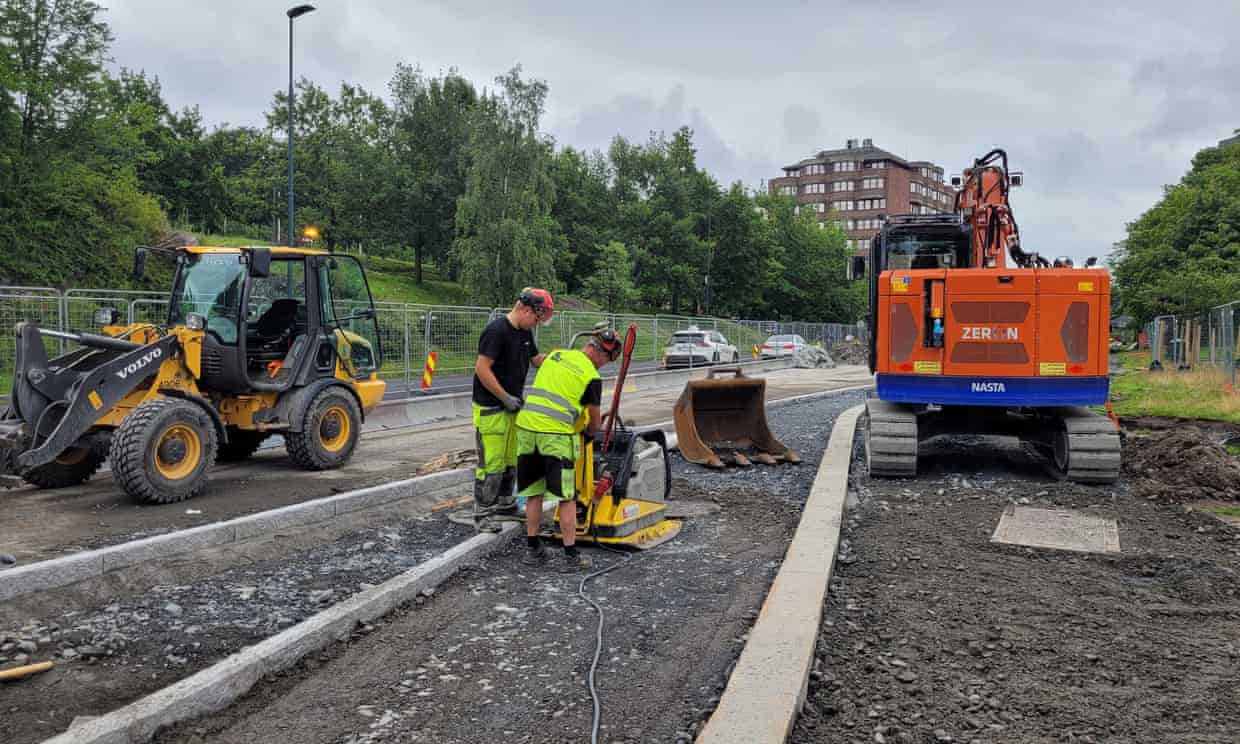
Photo: Ajit Niranjan/The Guardian. The electric machinery at an emissions-free building site in Oslo, Norway, makes for quieter construction.
Whether we realize it or not, our noisy world is making us a little more jittery than we need to be. It’s not just the clangor and clash of big cities but near airports, hospitals with medivac helicopters, and construction sites.
Despite Norway’s reputation as one of the biggest oil producers, it is leading the way with electric vehicles, even at construction sites.
Ajit Niranjan has the story at the Guardian.
“Tafseer Ali felt no need to raise his voice as the pair of diggers lumbered past him, their treads weighing heavy on the rock and asphalt. Quiet electric machines like these make it easy to work in the city center, the construction manager said – and keep the neighbors happy. …
“The peaceful streets of Oslo are growing even calmer as the city drives noisy machines off municipal building sites. For locals and builders, the drop in decibels is a welcome side-effect of a goal to keep city-managed construction projects free from toxic emissions. The mandate, which is the first of its kind in the world, came into effect on 1 January.
“ ‘I don’t think we’re going to get to 100%, because not all [electric] machines are available on the market,’ said Ingrid Kiær Salmi, an engineer from Oslo’s urban environment agency, speaking to the Guardian at a building site in the city center last year. ‘But I think we’re going to get pretty close.’
“Construction is one of the biggest sources of urban air pollution, but even forward-thinking cities such as Oslo have struggled to clean it up. The Norwegian capital has led the way in replacing the petrol and diesel that powers its construction equipment with biofuels, which do little to heat the planet but still foul the local air. It is now moving to battery-powered machines.
“The latest data shows Oslo’s municipal building sites were 98% free from fossil fuels in 2023; three-quarters were powered by biofuels and less than one-quarter by electricity. For projects run by the urban environment agency, which has more recent data through to October 2024, two-thirds of machine hours were powered by electricity and one-third by biodiesel.
“The proportion of its projects powered by electricity has more than doubled in the past two years as new machines have come on to the market. …
“The requirement that all machinery on building sites must be emission-free is ‘at this point, neither effective nor cost-efficient,’ said Stine Marie Haugen, from the Norwegian construction and civil engineering contractors’ association.
“ ‘Currently, very few countries in Europe have a strong focus on emission-free machinery, which means that access to such equipment is somewhat limited,’ she said. ‘Only a few countries bear the development costs of bringing these machines to market.’
“But by taking on these costs, Norway and a handful of other countries are making clean machines cheaper and more attractive for cities around the world. Manufacturers say the early demand from procurement policies like Oslo’s has encouraged them to develop new electric machinery and make existing ones better.
“As the volume of vehicles increases, costs will come down – but ‘like with all new technology, there is a green premium,’ said Tora Leifland, the head of public affairs at Volvo Construction Equipment. A battery-powered machine can cost twice as much as a diesel one, she said, though it will save money on fuel and do little to inflate the overall costs of a construction project.
“There are also benefits that are harder to capture, such as quieter working conditions on-site and reduced disruptions to local communities and businesses.”
More details at the Guardian, here. No firewall. Contributions to support the Guardian‘s reliable journalism are solicited.




:focal(1457x1526:1458x1527)/https://tf-cmsv2-smithsonianmag-media.s3.amazonaws.com/filer_public/e5/6d/e56d993f-2e9c-44e0-9694-f0ef8cc34b83/lyell_shrew_on_natural_background.jpg)







 Suzanne's Mom's Blog